

Nothing surprises or delights quite like a gift.
A 2018 study by the University of Zurich found that even a small gift from a sales representative makes customers much more likely to make a purchase. In the study, reps gave customers six tubes of toothpaste. A trivial offering. The results? Anything but trivial. On average, orders almost doubled.
Direct mail gifting is a demand generation tactic that assists other channels by cleaning up after them. It's something like an educated Hail Mary pass that sweeps up unconverted marketing qualified leads.
In practice, corporate gifting has been a runaway success at B2B companies.
What Is Lead Gen Gifting and Why It Works for B2B
Lead gen gifting is a B2B tactic that sends physical or digital gifts to prospects at specific funnel stages to drive engagement through personalized touchpoints.
The psychology: reciprocity. A gift creates a subtle obligation to respond.
Lead gen gifting works in B2B for three reasons:
Reciprocity principle: Gifts create psychological obligation to respond
Pattern interruption: Physical and digital gifts cut through inbox noise
Brand recall: Tangible touchpoints increase memorability
The University of Zurich study proves the point. A small gift doubled purchase rates. In B2B, where deal cycles are longer and buying committees are larger, that kind of leverage matters.
Where Gifting Fits in Your Outbound Sales Motion
Gifting isn't a standalone play. It's a force multiplier that works at points where prospects stall, no-show, or go dark.
Prospecting and Cold Outreach
Cold outreach is a numbers game. Tilt the odds by pairing gifts with content for prospects who match your ICP.
Build your target list using these criteria:
Company employee count: Match your sweet spot (e.g., 200-1,000 employees)
Industry fit: Target sectors where you have proven wins
Job title and seniority: Focus on decision-makers and influencers
Once you've built a clean list, target them with blogs, webinar invitations, or other high-value content. Add a gift to push them over the engagement threshold.
For prospects who have engaged but haven't booked a demo, pair an incentive with value messaging. The goal: get them into a meeting.
For international audiences, gifting requires cultural awareness. Track currencies, exchanges, and local gift-giving norms before sending.
Meeting Acceleration and Demo Show Rates
Setting a demo is one thing. Getting prospects to show up is another.
Once you set a demo, send a low-value coffee gift card to encourage attendance. Test before you scale: start with a small segment, measure the lift, then roll it out if the numbers justify it.
Stalled Pipeline and Deal Acceleration
Sometimes a deal stalls despite strong engagement. Strategic gifting can restart the conversation.
Use gifting for deal acceleration in two scenarios:
End-of-period push: Target champions, decision-makers, and influencers in stalled deals to get a critical next meeting or action item on the books
Contract acceleration: Incentivize DocuSign recipients to finalize
At the end of the sales period, ZoomInfo teams push to convert as many opportunities into paying customers as possible. Our sales team gets creative, offering prospects personalized, high-value gift cards to bring in any lagging opportunities at the end of the month or quarter.
The longer a deal remains unsigned, the more likely it falls through. A gift card at the final step improves win rates by serving as a completion reminder.
How to Target the Right Accounts and Contacts with Data
Random gifting is expensive. Data-driven gifting is strategic.
The difference between a wasted budget and pipeline acceleration comes down to targeting. Use firmographics, technographics, and intent data to select gift recipients who are actually worth the investment.
Targeting Criteria | What It Tells You | Gift Application |
|---|---|---|
Firmographics | Company size, industry, revenue | Determines account tier and gift budget |
Technographics | Tech stack signals | Enables personalization hooks |
Intent Signals | In-market behavior | Optimizes timing of send |
Build a Gift-Worthy Account List Using ICP Filters
Start with your ideal customer profile. Filter accounts by employee count, industry, revenue, and region before you send a single gift.
Narrow your list using these ICP filters:
Employee count: Match your sweet spot for deal size
Industry fit: Target sectors where you have proven product-market fit
Revenue range: Align with your pricing tiers
Geographic region: Focus where you can deliver and support
A tight ICP means every gift goes to an account that could realistically become a customer. No waste.
Identify Decision-Makers vs. Influencers
Buying committees have multiple players: decision-makers control budget, influencers shape opinions, and champions advocate internally.
Gift strategically based on role:
Decision-makers: Higher-value gifts for executives who sign contracts
Influencers: Moderate-value gifts for practitioners who evaluate solutions
Champions: Personalized gifts to reinforce their advocacy
Multi-threading your gifting strategy across the buying committee increases your odds of staying top-of-mind. This approach keeps you visible throughout the evaluation process.
Use Intent Signals to Time Your Send
Timing matters. A gift sent when a prospect is actively researching solutions hits different than one sent during their busy season.
Time your gifting using these trigger events:
Funding rounds: Signal budget availability
Leadership changes: Create new priorities and evaluation windows
Tech adoption signals: Indicate buying mode
Competitor churn: Open the door for replacement
Intent data from platforms like ZoomInfo tells you when accounts are in-market. Combine that signal with a well-timed gift, and you maximize response rates.
Match Gifts to Deal Stage and Account Tier
Not all gifts are created equal. The value of the gift should match the value of the opportunity.
As a rule, the gift increases and matches the opportunity value the further you go down the funnel. Optimize gift value through testing.
Corporate gift-giving practices have changed with the increase in working from home. Digital gift cards now dominate due to simplicity and remote work reality.
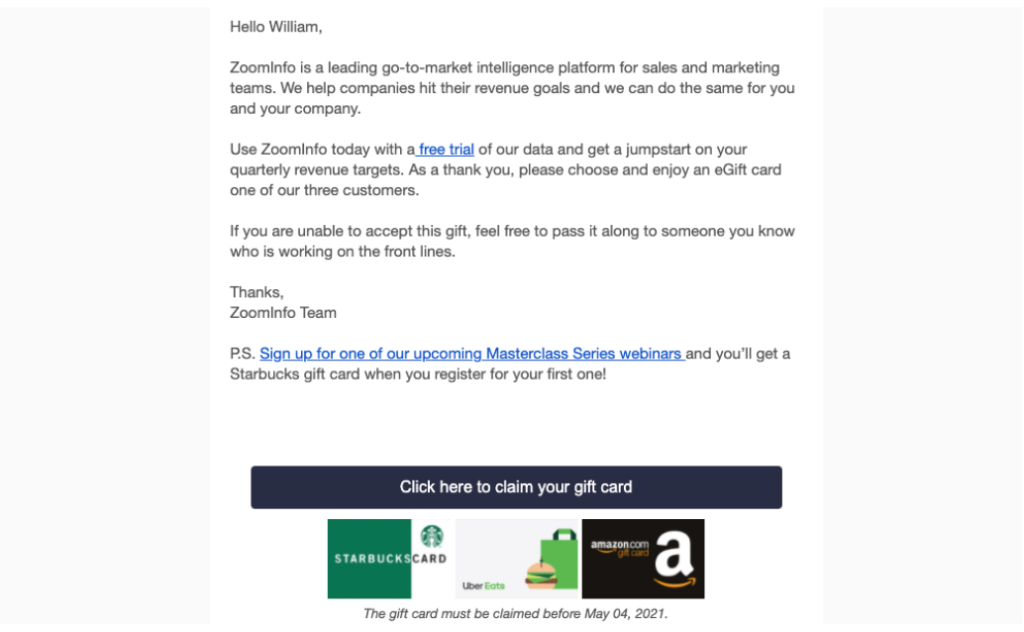
ZoomInfo offers gift cards at the end of emails paired with a call to action. Below is an example of how we offer gifts to cold leads when encouraging them to sign up for a webinar.
We don't require prospects to take a meeting to claim the gift. They can even pass it on if they are unable to use it.
Tier your gifts by funnel stage:
Early pipeline: Low-cost digital gift cards for coffee or food delivery
Mid-funnel: Moderate-value gifts tied to meeting attendance
Late-stage and strategic accounts: Higher-value personalized gifts for deal acceleration
Low-Cost Touches for Early Pipeline
Early-stage prospects haven't invested time in your product yet. Keep the gift value low with coffee cards, food delivery vouchers, and other digital options that are simple to send and claim.
Digital gift cards dominate in 2026 due to remote work being standard. They're easy to distribute, track, and scale.
Appropriate early-stage gift types include:
Coffee shop gift cards
Food delivery vouchers
Streaming service credits
The goal isn't to wow them. It's to interrupt their pattern and earn a response.
Higher-Value Gifts for Strategic Accounts
Strategic accounts and late-stage deals justify higher investment. These are opportunities where the contract value supports a more substantial gift.
Escalate gift value in these scenarios:
Significant deal size: Contract value is above your average
Competitive displacement: You're competing against entrenched incumbents
Complex buying committee: Multiple executives are involved
Extended sales cycle: Timeline has stretched beyond normal
Personalization matters more at this stage. Reference their tech stack, recent company news, or specific pain points in your gift selection and messaging.
Operationalize Gifting in Your GTM Stack
Running a corporate gifting program requires attention to compliance, budget, list management, unit economics, and KPI measurement. Manual work doesn't scale.
Your gifting program needs to integrate with your existing go-to-market stack. Focus on these tech stack considerations:
CRM integration: Sync gift sends with contact records and opportunity stages in Salesforce or HubSpot
Sales engagement: Trigger gifts within multi-touch sequences using Outreach or Salesloft (part of Clari)
Data enrichment: Use ZoomInfo to verify addresses and enrich contact records before sending
ZoomInfo's GTM Workspace and GTM Studio enable workflow automation and data enrichment that make gifting programs more precise and less manual.
Follow Up After the Gift
Sending the gift is only half the play. The follow-up converts attention into meetings and pipeline.
Structure a Post-Gift Outreach Cadence
Don't assume a gift will generate inbound interest. Build a follow-up sequence that includes multiple touchpoints across channels.
Your post-gift cadence should include:
Email follow-up: Send within 24-48 hours of gift delivery
Phone or LinkedIn message: Use as a secondary touchpoint
Additional email touches: Space 3-5 days apart
Clear call-to-action: Include in every message
Multi-touch outreach increases response rates. Use your sales engagement platform to automate the sequence while keeping messages personalized.
Use AI to Personalize Follow-Up Messaging
Generic follow-ups waste the goodwill created by the gift. Personalization matters.
CoPilot in GTM Workspace helps draft personalized follow-up emails and prep for meetings by surfacing relevant account and contact insights. Use it to reference specific details about the prospect's company, tech stack, or recent activity.
AI-assisted personalization doesn't replace human judgment. It speeds up the research and drafting process so reps can focus on the conversation, not the prep work.
Beyond prospecting, gifting plays a role in client onboarding and retention. A well-timed gift after contract signing reinforces the relationship and sets a positive tone for implementation.
Measure the Impact of Your Gifting Program
If you can't measure it, you can't improve it. Track the metrics that matter for pipeline and revenue.
Key metrics to track:
Gift claim rate: Percentage of recipients who accept the gift
Claim-to-meeting rate: Percentage of claimers who book a meeting
Pipeline influence: Revenue in deals where gifting was a touchpoint
Deal velocity: Time-to-close for gifted vs. non-gifted opportunities
Run A/B tests to optimize gift value, messaging, and timing. Test different gift types, send cadences, and follow-up approaches, then use the data to refine your program over time.
Attribution is tricky in multi-touch campaigns. Use your CRM to tag gifting touchpoints and analyze their correlation with closed-won deals.
For retention and expansion, track gifting's impact on renewal rates and upsell opportunities. Marketing gift ideas for existing clients should focus on reinforcing the relationship and creating moments of delight that increase customer lifetime value.
Key Takeaways for Data-Driven Gifting
Gifting works when it's targeted, timed, and tied to your sales motion. Random acts of generosity don't scale, but data-driven gifting does.
Three principles to follow:
Start with data: Use ICP filters and intent signals to select gift-worthy accounts
Match gift value to deal stage: Scale investment based on opportunity value and funnel position
Operationalize and measure: Integrate gifting into your GTM stack and track pipeline impact
Gifting isn't just for new business. Use it for referral programs, client retention, and expansion plays. A thoughtful gift to a happy customer who refers new business is one of the highest-ROI investments you can make.
Ready to build more targeted prospect lists for your gifting campaigns? Talk to our team to see how ZoomInfo can help.