
Why most B2B retargeting strategies fall short
Most B2B website visitors leave without converting. They find your product page, read a few paragraphs, and disappear, no form fill, no demo request, no signal you can act on. For a fintech company selling to credit unions, investment firms, and commercial banks, this is a familiar frustration. Two prospects see your billboard, visit your site, and vanish. One was a perfect fit. The other was never going to buy. Without a way to tell them apart, your retargeting budget treats them exactly the same.
That is the core problem a B2B retargeting strategy has to solve: not just re-engaging visitors who left, but re-engaging the right ones. ZoomInfo, an all-in-one AI GTM Platform, created ZoomInfo WebSights to solve exactly this problem. WebSights resolves anonymous website traffic to company identities, matching visitor IP addresses to firmographic profiles, so you can build retargeting audiences from qualified accounts instead of undifferentiated traffic.
The sections below walk through the full retargeting strategy: what B2B retargeting is and how it differs from B2C, how to segment your audience by intent, how to run a campaign step by step, how to future-proof against cookie deprecation, and how to measure ROI in terms leadership actually cares about.
What is B2B retargeting and why does it matter
B2B retargeting is the practice of using tracking pixels, first-party data, or IP-based identification to re-engage website visitors who left without converting, then serving them targeted ads on other platforms. When a prospect visits your pricing page and leaves, retargeting lets you follow that account across the web with relevant ads until they are ready to take the next step.
B2B retargeting differs from its B2C counterpart in three important ways. First, buying cycles are longer, often spanning months rather than days, which means your retargeting program needs to sustain engagement across a much wider window. Second, B2B purchases involve multiple stakeholders, so account-level targeting matters more than individual-level targeting. Third, B2B buyers consume multiple pieces of content before making a purchase decision, which means a single ad impression rarely drives conversion on its own. Retargeting is the mechanism that keeps your brand present across that entire research journey.
It also helps to understand how retargeting differs from remarketing, since the two terms are often used interchangeably but describe different channels and data sources.
Dimension | Retargeting | Remarketing |
|---|---|---|
Channel | Paid display, programmatic, social ads | Email, owned channels |
Data source | Pixel/cookie data, IP-based identification, first-party signals | First-party CRM data, email lists |
Targeting breadth | Reaches anonymous visitors not yet in your database | Re-engages known contacts already in your system |
The business case for B2B retargeting is straightforward: most B2B website visitors leave without converting, and without a retargeting program, those accounts are invisible to your sales and marketing teams. Retargeting is the mechanism to re-engage the accounts that matter before they end up in a competitor's pipeline.
How ZoomInfo WebSights qualifies your website traffic
The fundamental problem with most retargeting programs is that they treat all website visitors as equally worth pursuing. They are not.
WebSights resolves anonymous website traffic to company identities, matching visitor IP addresses to firmographic profiles, and connects only qualified accounts to Google Ads for retargeting. Once a visitor's company is identified, WebSights appends firmographic attributes including industry, company size, revenue, and geography, so you can filter for ideal customer profile fit before any account enters your retargeting pool.
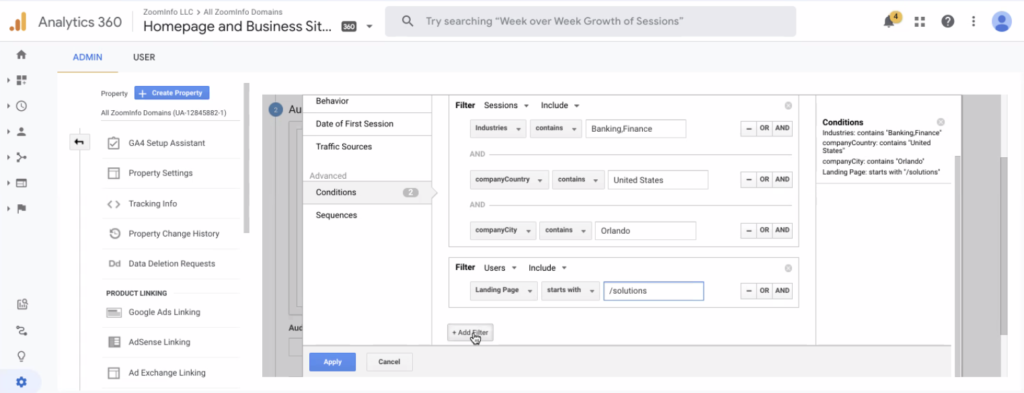
Figure 1
: After connecting WebSights with Google Analytics, you can create segments with specific company attributes.
Once you have WebSights integrated with Google Analytics, you can create an audience segment with specific company attributes that fit your ideal customer profile, in addition to the other filters Google Analytics offers, like webpage consumption and traffic source.
WebSights feeds anonymous traffic signals into ZoomInfo's GTM Context Graph, which reasons across firmographic and behavioral data to surface which accounts are worth pursuing, not just which domains visited. This is the distinction between a pixel that counts visits and an intelligence layer that tells you which visits actually matter.
For the fintech example: rather than retargeting every visitor, you can configure WebSights to surface only credit unions based in the United States with at least 25 employees, or commercial banks with more than $1 million in annual revenue. Non-ICP accounts never enter your retargeting pool, which means your budget concentrates on the accounts that can actually become customers.
Building your B2B retargeting audience: a segmentation framework
Treating all website visitors as one audience is one of the fastest ways to waste retargeting budget. A government agency clicking through a thought leadership post and a VP of Finance spending four minutes on your pricing page are not the same signal. Lumping them into the same audience means serving the same ad to both, and paying for impressions that will never convert.
The Intent-Stage Segmentation Matrix below maps five behavioral segments to the ad message and offer that fits each one.
Behavioral segment | Intent signal | Recommended ad type | Offer |
|---|---|---|---|
Homepage visitors | Low intent, early awareness | Brand awareness ad | Thought leadership content, industry report |
Pricing page visitors | High intent, actively evaluating | Demo or trial ad | Case study or ROI calculator |
Product page visitors (2+ minutes) | High intent, deep research | Comparison ad | Product walkthrough or feature overview |
Content downloaders | Mid intent, problem-aware | Nurture ad | Related content, webinar invitation |
Repeat visitors (3+ sessions) | Very high intent, active consideration | Direct outreach trigger | Personalized demo offer |
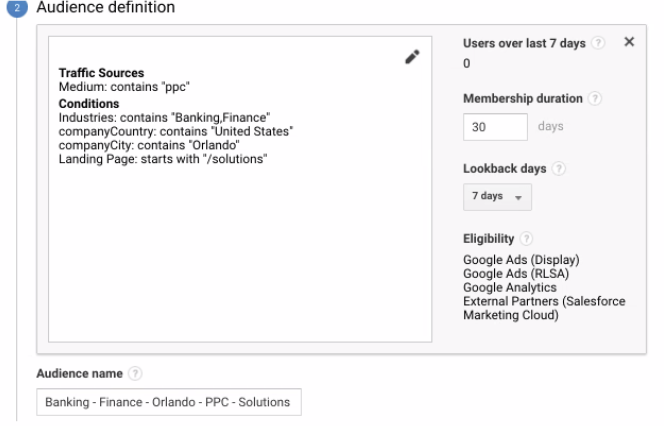
Figure 2:
An example of an audience segment with company attributes pulled in from ZoomInfo with WebSights and regular Google Analytics filters to drop into Google Ads
Exclusion logic matters as much as inclusion logic. Always exclude recent converters, current customers, and visitors who bounced in under 10 seconds. These groups either no longer need your retargeting message or never engaged with it meaningfully enough to warrant follow-up spend.
WebSights adds a layer that generic pixels cannot. By filtering audience lists by firmographic attributes before they reach Google Ads, you remove non-ICP accounts from your retargeting pool entirely. This directly addresses one of the most common budget drains in B2B advertising: government agencies, consumer brands, and irrelevant industries generating clicks that look like engagement but produce zero pipeline. Data enrichment at the audience-building stage is what separates a retargeting program that scales efficiently from one that scales waste.
How to launch a WebSights retargeting campaign: step by step
Step 1: Connect WebSights to Google Analytics
Install the WebSights pixel on your website and configure the Google Analytics integration. Verify that company-level data is flowing into your Google Analytics account before building any audiences. If data is not appearing within 24-48 hours, confirm the pixel is firing on all pages and that the integration credentials are correctly configured.
Step 2: Define your ICP filters
In WebSights, set the firmographic attributes that define your ideal customer: company size, industry, annual revenue, and geography. This is where the fintech example becomes concrete. If you only want to reach credit unions based in the United States with at least 25 employees, configure those parameters here. If commercial banks with more than $1 million in annual revenue are your priority segment, set that instead. Accounts that do not match these filters will not appear in your retargeting audiences.
Step 3: Build your audience segments
Apply the Intent-Stage Segmentation Matrix from the previous section. Create separate audience lists for each behavioral segment: homepage visitors, pricing page visitors, product page visitors who spent two or more minutes, content downloaders, and repeat visitors with three or more sessions. Keeping these segments distinct lets you control ad creative and bid strategy independently for each group.
Smartsheet increased MQLs by 84% and opportunity rates by 26% after tightening audience targeting with ZoomInfo data. Precise ICP-filtered audiences are what drive that kind of outcome, broad retargeting pools dilute the signal and inflate cost per acquisition.
Step 4: Export qualified audiences to Google Ads
Once your audience segments are built and filtered in WebSights, export them to Google Ads. The export workflow maps your WebSights audience lists directly to Google Ads customer match or audience targeting. Review each exported list to confirm the account counts reflect your ICP filters before activating campaigns.
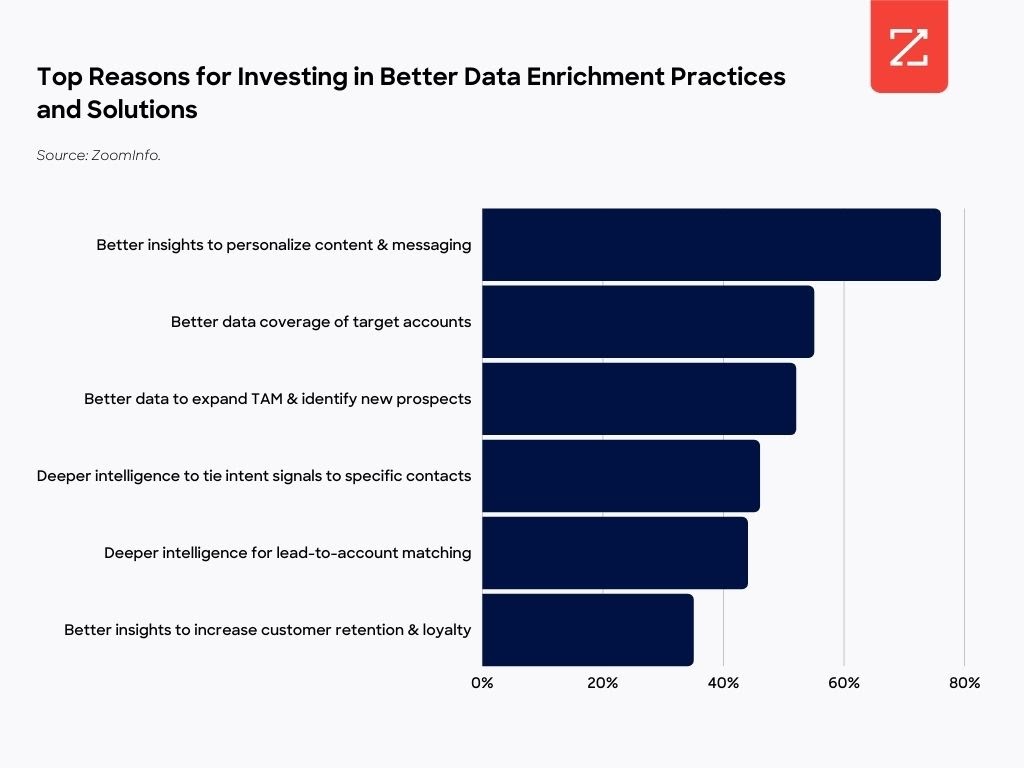
Figure 3
: The ability to personalize messaging is a top reason for seeking B2B data and intelligence practices.
Step 5: Map ad creative to funnel stage
Match your creative to the visitor's intent level. Homepage visitors are early in their research and respond to thought leadership and brand credibility. Pricing page visitors are actively evaluating and need proof: case studies, ROI calculators, or a direct demo offer. Product page visitors who spent significant time are comparing options and benefit from differentiation-focused creative. Repeat visitors are the highest-priority segment and warrant the most direct offer you can make.
Step 6: Set frequency caps and exclusions
For display campaigns, 3-5 impressions per week per account is a reasonable starting point. Too few impressions and you lose the retargeting effect; too many and you create ad fatigue that can damage brand perception. Apply exclusions for recent converters (anyone who submitted a form or booked a demo in the last 30 days) and current customers. Review your exclusion lists monthly to keep them current.
Future-proofing your retargeting strategy: cookieless alternatives
Third-party cookies are being phased out across major browsers, which means retargeting programs built entirely on cookie-based tracking face growing reach limitations. This is not a distant problem. It is already affecting match rates and audience sizes for teams that have not adapted their approach.
Four alternatives are worth building into your retargeting strategy now:
First-party data collection: Gate high-value content, build newsletter subscriber lists, and use progressive profiling to capture firmographic data directly from your audience. First-party data is not subject to cookie deprecation and improves in quality over time as your audience grows.
Server-side tracking: Send event data directly from your server to ad platforms rather than relying on browser-based pixels. This approach bypasses browser restrictions and ad blockers, giving you more complete data on visitor behavior.
Contextual targeting: Serve ads based on the content of the page being viewed rather than the user's browsing history. Contextual targeting requires no personal data and is fully compatible with privacy regulations.
IP-based account identification: WebSights uses IP-to-organization matching to identify which companies are visiting your site without relying on third-party cookies. This approach is structurally different from cookie-based retargeting and is not affected by browser-level cookie restrictions.
WebSights is built on ZoomInfo's database of 210M IP-to-Organization pairings. Because it identifies accounts through IP-to-organization matching and firmographic data rather than third-party cookies, it is structurally more durable as cookie deprecation accelerates. You do not need to rebuild your audience identification strategy from scratch when a browser update changes what cookies can track.
This account-level intelligence feeds into ZoomInfo's GTM Context Graph, enabling retargeting decisions grounded in behavioral reasoning rather than cookie history. The result is a retargeting program that gets more precise as your first-party data grows, rather than one that degrades as third-party tracking erodes.
Measuring B2B retargeting ROI: the metrics that matter to leadership
Retargeting is one of the hardest channels to attribute accurately because it operates across the full funnel and rarely drives last-click conversions. A prospect who visited your pricing page, saw three retargeting ads over two weeks, and then converted through a sales email did not "convert from retargeting" in a last-click model. But retargeting was part of what moved them. Acknowledging this upfront is what separates a credible B2B retargeting strategy from one that sets unrealistic expectations and loses budget in the next planning cycle.
The four KPIs below give you a measurement framework that holds up in a leadership conversation.
KPI | What it measures | Why it matters to leadership |
|---|---|---|
ROAS (return on ad spend) | Total revenue attributed to retargeting divided by total ad spend | Connects campaign investment directly to revenue output |
CPA (cost per acquisition) | Total ad spend divided by conversions | Benchmarks efficiency and tracks improvement over time |
View-through conversion rate | Conversions from users who saw but did not click the ad | Captures the influence of retargeting on accounts that converted through other channels |
Pipeline influence rate | Percentage of pipeline that touched a retargeting ad before closing | The leadership metric: shows retargeting's contribution to deals, not just clicks |
Last-click attribution systematically undercounts retargeting's contribution. Retargeting ads warm up accounts that convert through other channels, so a last-click model assigns zero credit to the impressions that built awareness and kept your brand present during the evaluation period. Use assisted conversion reporting in Google Ads and multi-touch attribution models to capture the full contribution. When presenting to leadership, frame retargeting performance in pipeline terms: what percentage of closed-won deals touched a retargeting ad, and what was the average deal size for those accounts.
Redwood Logistics cut cost per click by 99% and saved 25 hours per week using ZoomInfo for targeted campaign management. That kind of efficiency gain is what a well-instrumented B2B retargeting strategy looks like in practice: not just lower CPCs, but time recovered from manual campaign management and redirected toward higher-value work.
For context on how retargeting fits into a broader demand generation strategy, the measurement framework above is most effective when retargeting audiences feed back into your overall account scoring and sales routing logic.
How Akorbi uses WebSights to identify and target high-value accounts
Akorbi is a language services and technology company that needed better visibility into which accounts were visiting their website and whether those visits were translating into meaningful engagement. The challenge was familiar: strong web traffic, low form conversion, and no way to connect anonymous visits to the accounts that actually mattered.
"Not only does WebSights help us to determine which accounts to target and when; it also helps answer important questions like, 'Is our website converting? What kind of companies do we get traffic from, and how frequently?'" -- Ed Cavazos, Executive VP at Akorbi
WebSights gave Akorbi's marketing team the account-level visibility they needed to move from guessing at audience quality to making targeting decisions grounded in firmographic data. Rather than retargeting every visitor, they could identify which companies were showing up, filter for ICP fit, and concentrate spend on the accounts most likely to convert.
Ready to qualify your web traffic and retarget only your best-fit accounts? Request a demo of ZoomInfo WebSights.
Frequently asked questions about B2B retargeting strategy
How does ZoomInfo WebSights identify which companies visit my website?
ZoomInfo WebSights uses IP-to-organization matching, cross-referencing visitor IP addresses against ZoomInfo's database of 210M IP-to-Organization pairings to resolve anonymous traffic to company identities. Once a company is identified, WebSights appends firmographic attributes including industry, size, revenue, and geography, so you can filter for ICP-fit accounts before building retargeting audiences. This approach does not rely on third-party cookies, making it more durable as cookie deprecation accelerates.
What is the difference between retargeting and remarketing?
Retargeting uses paid display ads and pixel or IP-based identification to reach website visitors who left without converting. Remarketing re-engages existing contacts through owned channels like email, using first-party CRM data. In B2B, the distinction matters because retargeting reaches anonymous accounts you have not yet identified, while remarketing nurtures known contacts already in your database. The two strategies are complementary, not competing.
How do I build a B2B retargeting audience that excludes non-ICP companies?
Connect WebSights to Google Analytics and apply firmographic filters matching your ideal customer profile, industry, company size, annual revenue, and geography, before exporting audiences to Google Ads. This removes non-ICP accounts from your retargeting pool before they consume budget. Layer behavioral segmentation on top, prioritizing visitors who reached high-intent pages like pricing or product pages, to further concentrate spend on accounts most likely to convert.
How do I measure whether my B2B retargeting campaigns are working?
Primary KPIs for B2B retargeting are ROAS, CPA, and pipeline influence rate (the percentage of pipeline that touched a retargeting ad before closing). Avoid relying solely on last-click attribution: retargeting ads warm up accounts that convert through other channels, so assisted conversion reporting in Google Ads captures the full contribution. Frame retargeting performance for leadership in pipeline terms, not just CTR. Redwood Logistics cut cost per click by 99% as a concrete example of what well-measured retargeting ROI looks like.
Is B2B retargeting GDPR and CCPA compliant?
B2B retargeting can be compliant with GDPR and CCPA when implemented correctly. Key requirements include obtaining proper consent for cookie-based tracking (or using consent-exempt IP-based identification where permitted), honoring opt-out requests, and ensuring your ad platforms have signed Data Processing Agreements. ZoomInfo is ISO 27001, ISO 27701, SOC 2 Type II, and TRUSTe GDPR/CCPA certified, providing a compliant data foundation for WebSights-powered retargeting campaigns.