
Choosing between ActiveCampaign vs. Omnisend for your marketing comes down to five questions:
Are you marketing to businesses (B2B) or directly to consumers through an online store?
Do you need a built-in CRM alongside your marketing automation, or do your campaigns center on purchase behavior and product catalogs?
Is your primary challenge executing campaigns, or knowing which accounts and contacts to target in the first place?
Do you need multi-channel automation across email, SMS, and WhatsApp, or are email, SMS, and web push notifications enough?
How important is having verified B2B contact data and buyer intent signals in your marketing stack?
In short, here's what we recommend:
ActiveCampaign is the right choice for businesses that need marketing automation paired with a built-in CRM. Its visual automation builder supports complex, branching logic that responds to behavioral triggers, and its Active Intelligence AI system can generate entire campaigns from plain-language prompts. With native email, SMS, WhatsApp messaging, and 1,000+ integrations, ActiveCampaign lets lean marketing teams run multi-channel campaigns without enterprise budgets. The trade-off: pricing climbs as contact lists grow, advanced features carry a learning curve, and the CRM, while useful, lacks the depth of dedicated sales platforms.
Omnisend is built for ecommerce stores that want to drive more revenue through email, SMS, and web push without the complexity of a general-purpose platform. Its 40+ pre-built automation workflows center on retail triggers like cart abandonment, browse abandonment, and post-purchase follow-ups. Product blocks pull directly from your live store catalog, unique discount codes generate automatically per recipient, and everything runs across email, SMS, and web push in a single workflow. The limitation: no CRM, no B2B automation, and the drag-and-drop builder offers less design flexibility than some competitors.
Both platforms handle campaign execution well. But they share the same assumption: that you already know who to market to. For B2B teams, that assumption is often the problem. You can build the most sophisticated automation in the world, but if your contact data is incomplete, your emails bounce, and you can't see which accounts are in-market, the automation runs on fumes.
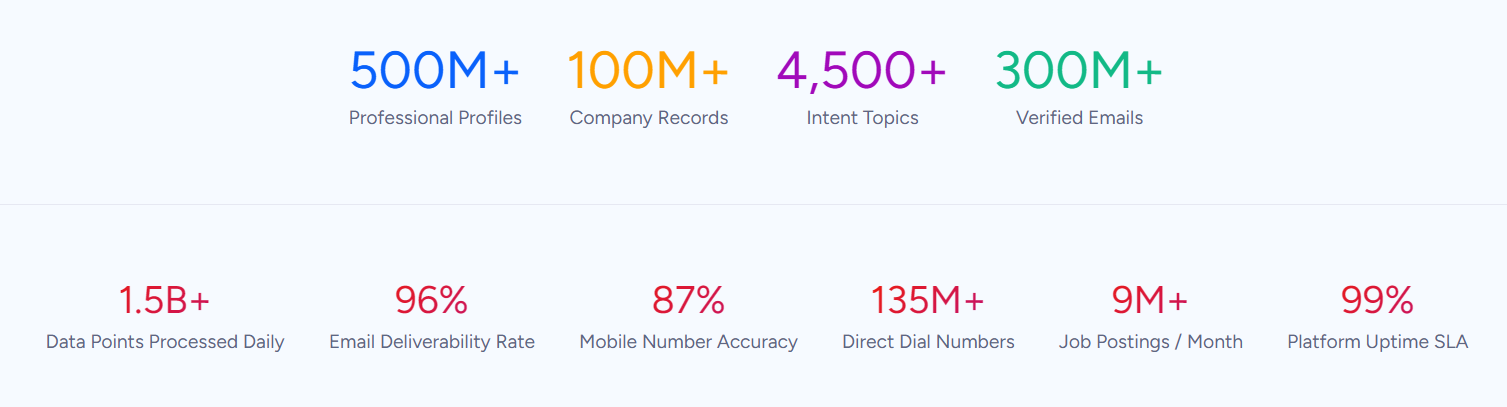
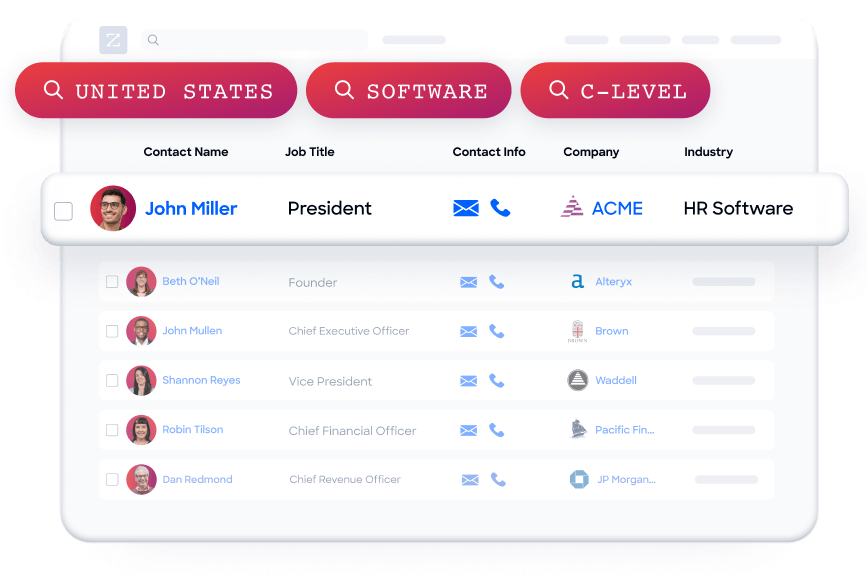
ZoomInfo is an AI-powered go-to-market platform that solves the intelligence problem upstream of campaign execution. Built on a B2B dataset of 500M contacts, 100M companies, 135M+ verified phone numbers, and 200M+ verified business emails, ZoomInfo's GTM Context Graph combines this data with your CRM records, conversation transcripts, and behavioral signals to reveal which accounts are in-market, who the decision-makers are, and why deals move or stall. Marketers build audiences and launch multi-channel plays from GTM Studio, sellers execute from GTM Workspace, and teams using other tools access the same intelligence through APIs and MCP. For B2B companies, ZoomInfo provides both the targeting intelligence and the execution capabilities that campaign-focused platforms were never built to deliver.
If knowing which accounts to target and when to engage them would change your marketing results, see how ZoomInfo works.
ActiveCampaign vs. Omnisend vs. ZoomInfo at a glance
ActiveCampaign | Omnisend | ZoomInfo | |
|---|---|---|---|
Primary focus | Marketing automation + CRM | Ecommerce email & SMS automation | B2B data intelligence + GTM execution |
Channels | Email, SMS, WhatsApp | Email, SMS, web push | Email, display ads, calls, direct mail |
CRM included | Yes (built-in) | No | Yes (via GTM Workspace) |
Contact database | Your own imported contacts | Your store's customer list | 500M B2B contacts with verified data |
Buyer intent signals | No | No | Yes (Guided Intent, 210M+ IP pairings) |
AI capabilities | Active Intelligence (campaign builder, segments, content) | Forms AI, AI segments, subject lines | GTM Context Graph, AI agents, account research |
Free plan | No (14-day trial) | Yes (250 contacts, 500 emails/month) | Yes (ZoomInfo Lite, 10 exports/month) |
Starting price | $15/month (1,000 contacts) | $16/month (500 contacts) | Custom pricing |
Integrations | 1,000+ | 200+ | 120+ marketplace partners + API/MCP |
Best for | B2B, SaaS, service businesses | DTC ecommerce stores | B2B sales and marketing teams |
The fundamental split: general-purpose vs. ecommerce-native
ActiveCampaign and Omnisend are both marketing automation platforms, but they serve different businesses.
ActiveCampaign has been in development since 2003 as a platform for any business that needs to nurture leads, manage customer relationships, and run multi-channel campaigns.
It targets growth-stage SMBs and mid-market companies with lean marketing teams that have outgrown basic email tools but don't need enterprise platforms like Marketo or Eloqua. SaaS companies use it for trial-to-paid conversion sequences. Service businesses use it for appointment reminders and referral campaigns. Ecommerce stores use it too, but it treats ecommerce as one of many use cases rather than the only one.
Omnisend took a different path. Founded in 2014 as Soundest, it was built from the start for online merchants.
Every feature ties back to retail: automation workflows fire on cart abandonment and order events, product content blocks sync live from the connected store, and unique discount codes auto-generate per recipient with one-click checkout application on Shopify. Omnisend doesn't try to serve SaaS companies, consultants, or professional services firms. It serves stores on Shopify, WooCommerce, BigCommerce, Wix, and Ecwid, and it does that job well.
This matters because the right choice depends less on features and more on what kind of business you run. An ecommerce store will find Omnisend's native store integration far more convenient. A B2B company will find ActiveCampaign's CRM and lead scoring far more relevant. Choosing the wrong type leads to constant workarounds.
Automation depth: ActiveCampaign leads on complexity, Omnisend leads on speed
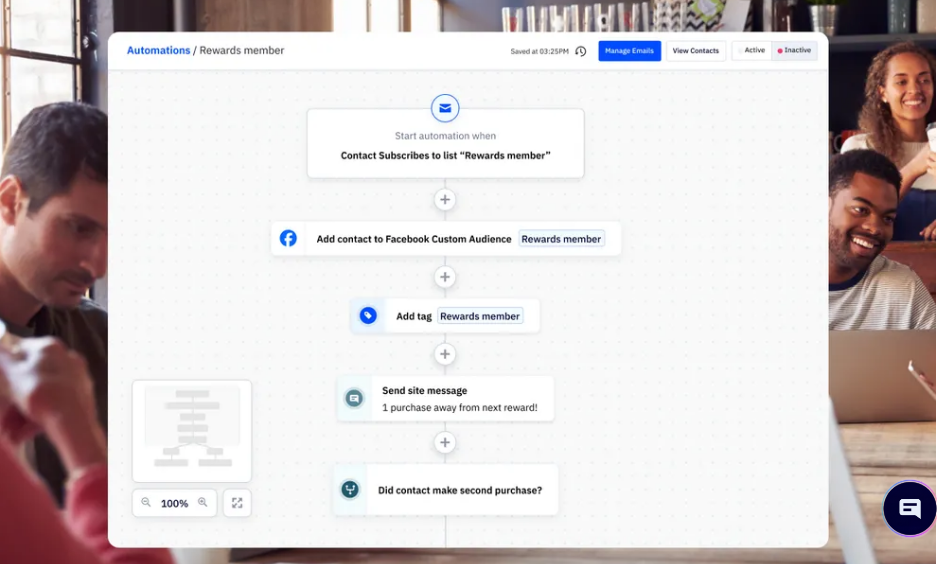
ActiveCampaign's automation builder is the core of the platform and the primary reason businesses choose it.
The visual workflow editor supports unlimited automation actions on Plus plans and above, conditional branching based on real-time behavior, and triggers that respond to email engagement, site visits, deal stage changes, form submissions, and custom events. You can build multi-step sequences where a contact's path adapts based on dozens of behavioral signals.
Source: ActiveCampaign
The AI Campaign Builder goes further.
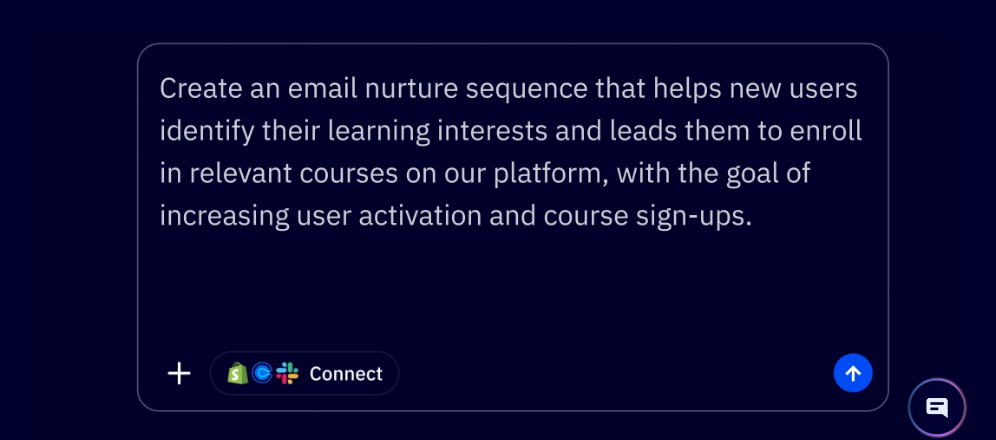
Describe a campaign goal in plain language and the system generates the full workflow (wait periods, branching paths, and action steps included). ActiveCampaign claims this builds campaigns 3x faster than manual configuration. Predictive Sending analyzes each contact's engagement history and delivers emails when that person is most likely to open, rather than blasting the entire list at a single time.
Omnisend's automation is narrower but faster to deploy.
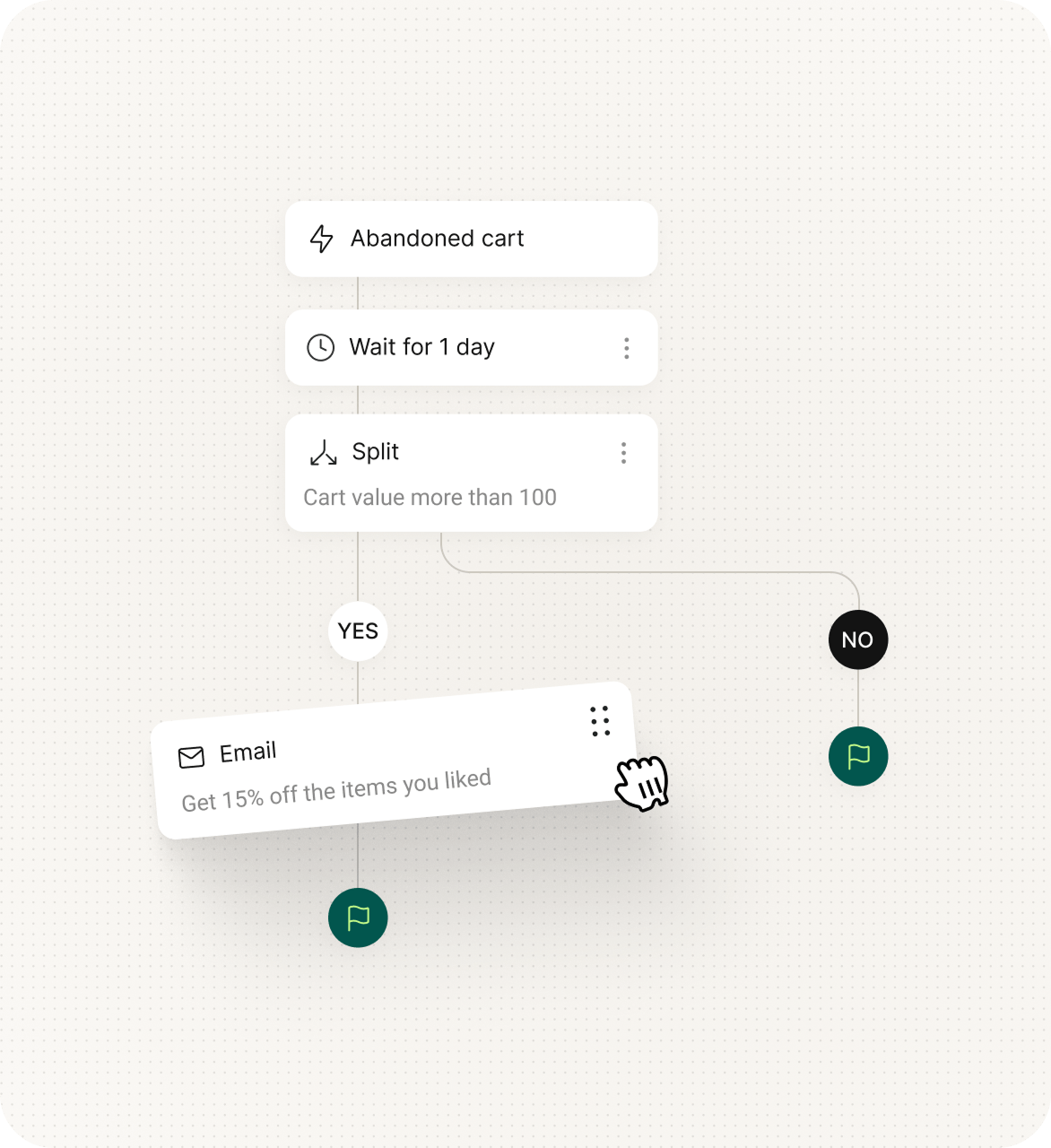
The platform ships 40+ pre-built automation workflows organized around ecommerce triggers: welcome series, abandoned cart, abandoned checkout, browse abandonment, order confirmation, shipping confirmation, cross-sell, product reviews, birthday, and customer reactivation. Each comes pre-configured with messaging, timing, and exit conditions based on ecommerce best practices.
Source: Omnisend
What makes Omnisend's automation distinct is its channel handling within workflows.
Email, SMS, and web push blocks coexist in a single sequence, and the platform checks each contact's subscription status per channel automatically. If a contact hasn't opted into SMS, the workflow skips that step and moves to the next rather than halting.
The platform also includes abandonment deduplication logic: when a contact starts checkout, the abandoned cart workflow exits them and the abandoned checkout workflow takes over, preventing duplicate messages at different funnel stages.
The trade-off is clear.
ActiveCampaign gives you the tools to build almost any automation you can imagine, but that flexibility demands time to learn and configure. Omnisend gives you proven ecommerce workflows that work out of the box, but try to build something outside the ecommerce playbook and you'll hit walls fast.
Channel coverage: different bets on how to reach customers
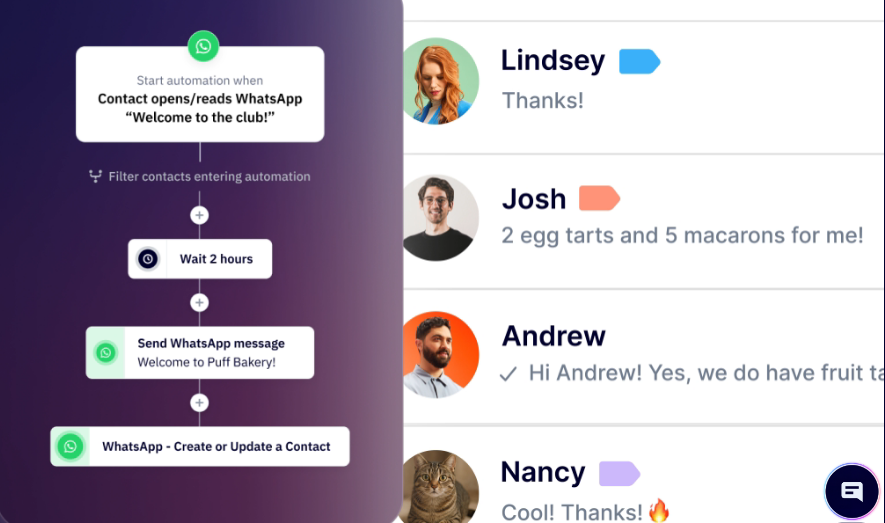
ActiveCampaign covers four channels natively: email, SMS, WhatsApp, and landing pages.
The WhatsApp integration arrived through ActiveCampaign's April 2025 acquisition of Hilos, and ActiveCampaign operates as a Meta Business Partner with direct WhatsApp Business API access. The Flows builder handles no-code conversational automation, and a shared inbox handles live agent responses. For businesses serving customers in Latin America, Europe, or Southeast Asia (where WhatsApp dominates), this is a real advantage.
Source: ActiveCampaign
On the SMS side, ActiveCampaign provides dedicated 10DLC registration, two-way SMS with an inbox, and delivery to 180+ countries. The AI layer can plan SMS campaigns, generate on-brand content, and summarize conversations.
Omnisend covers three channels: email, SMS, and web push notifications. No WhatsApp support.
But Omnisend includes something neither ActiveCampaign nor most competitors offer: native web push notifications at no extra cost, with unlimited volume on Standard and Pro plans. Web push is valuable for ecommerce because it requires no personal information to subscribe.
A visitor who browses a product page can grant browser permission and be retargeted the next day, no email or phone number needed.

Source: Omnisend
Omnisend's SMS reaches 200+ countries, and MMS (images and text together) is available in the US and Canada at $0.045 per message. A standout feature: retarget non-openers with SMS. Send an email campaign, and automatically follow up via SMS only with subscribers who didn't open it.
For ecommerce, Omnisend's channel mix (email, SMS, and push) covers the bases without the complexity or cost of WhatsApp. For B2B or international businesses, ActiveCampaign's WhatsApp support opens a channel Omnisend doesn't touch.
For B2B teams, the real gap is upstream
Both ActiveCampaign and Omnisend are campaign execution platforms. They handle what happens after contacts are in your database: sending emails, triggering automations, tracking engagement. Neither answers the question B2B marketing teams face first: who should be in that database to begin with?
ActiveCampaign's built-in CRM helps manage contacts once you have them, and its lead scoring surfaces the most engaged ones. But the contacts themselves come from your own lead capture: forms, landing pages, event signups, purchased lists. If your total addressable market includes ten thousand companies and you've captured two hundred, you're automating inside a sliver of your actual opportunity.
This is the problem ZoomInfo was built to solve.
Where ActiveCampaign and Omnisend start with the contacts you have, ZoomInfo starts with the 500M contacts and 100M companies in its database, verified by 300+ human researchers and reaching up to 95% accuracy on first-party data.
For B2B teams, this changes the equation: instead of building automations and hoping the right people find your forms, you identify the right accounts and contacts first, then run campaigns against verified data.
Source: ZoomInfo
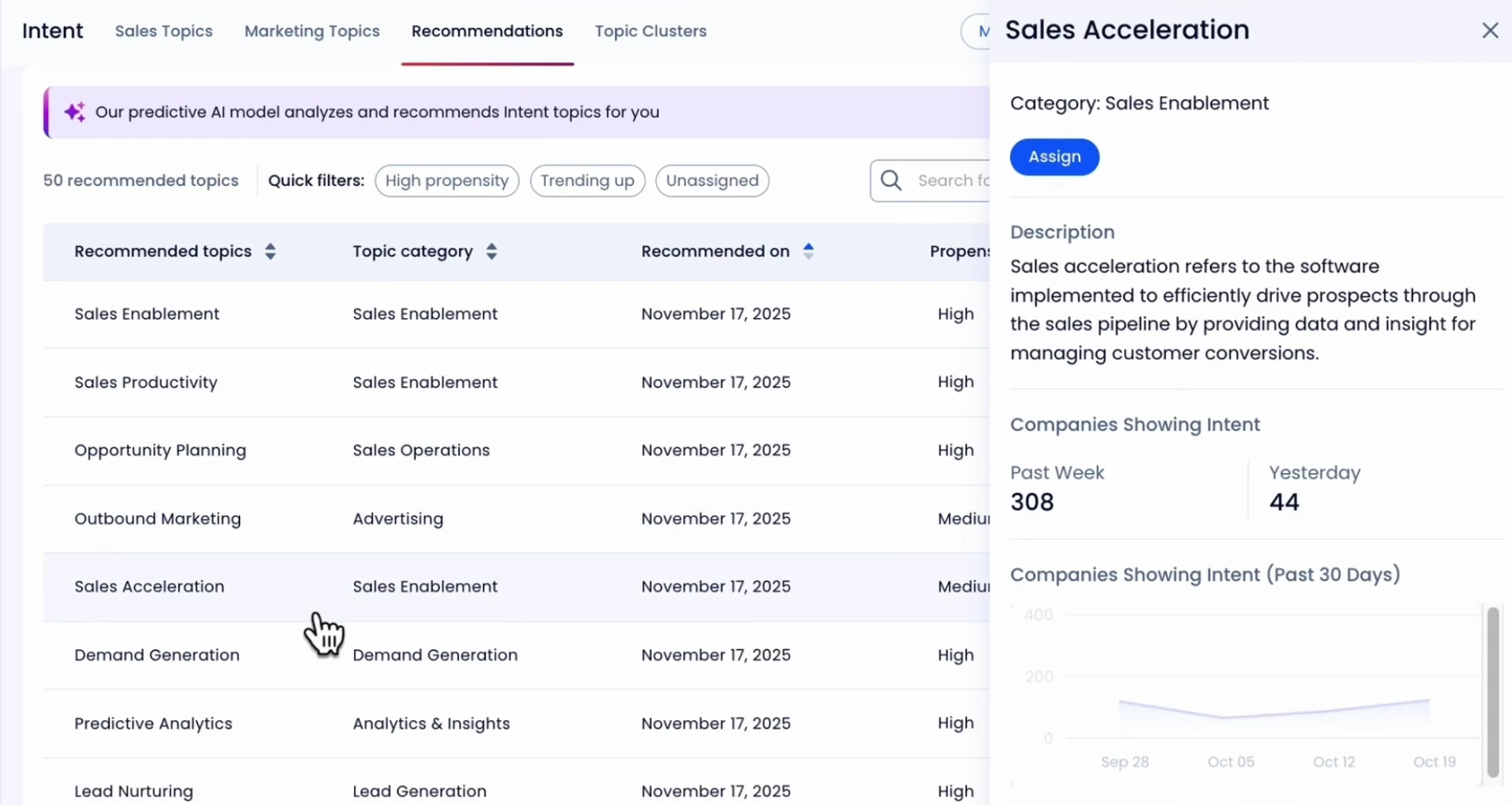
ZoomInfo's buyer intent signals add a timing layer that campaign tools lack entirely. The platform tracks signals from 210 million IP-to-Organization pairings and 6 trillion+ new keyword-to-device pairings sourced monthly to surface which companies are researching solutions like yours right now. Guided Intent, exclusive to ZoomInfo, identifies the topics historically correlated with your closed-won deals rather than requiring you to guess which keywords matter.
For marketers, GTM Studio turns this intelligence into action.
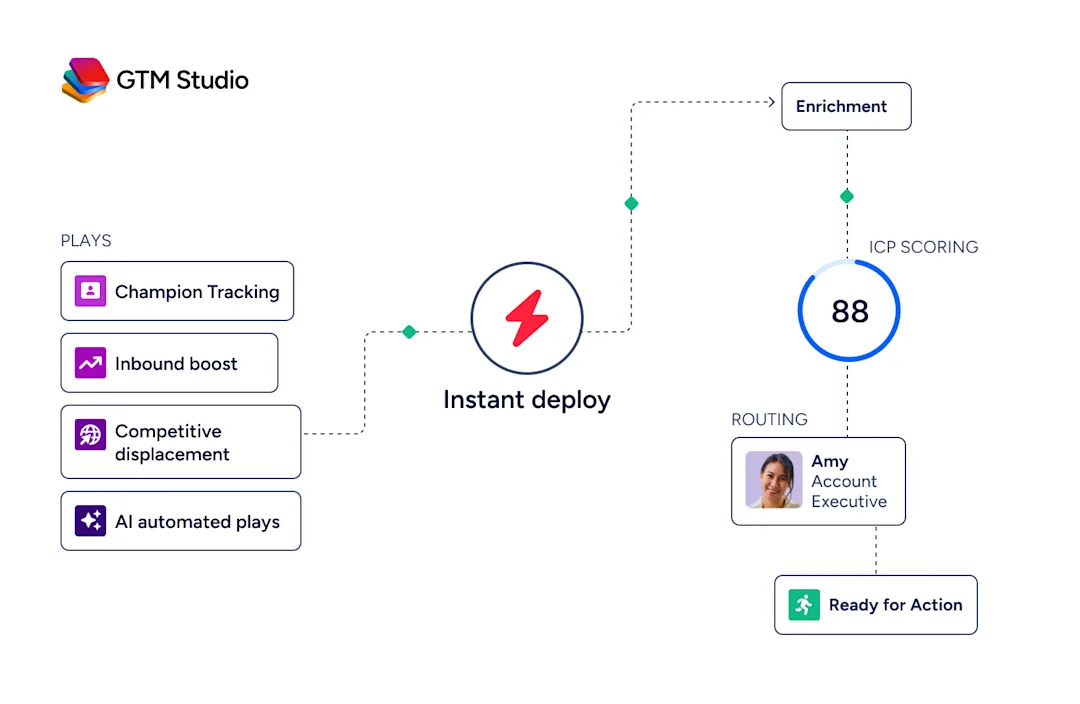
Describe an audience in natural language, and the platform builds the segment, enriches it with verified data, and launches multi-channel plays across email, display ads, calls, and direct mail. Plays that used to take three weeks now launch in 30 minutes, without engineering support. And because GTM Studio feeds directly into GTM Workspace for sellers, the accounts marketing identifies flow into sales execution without friction.
Source: ZoomInfo
"It's not just the data itself. It's more about the right data at the right time to help us reach out with the right message across that full buyer journey." (Chelsea Kenyon, Senior Director of Digital Strategy, Redwood Logistics)
CRM and customer data: three different approaches
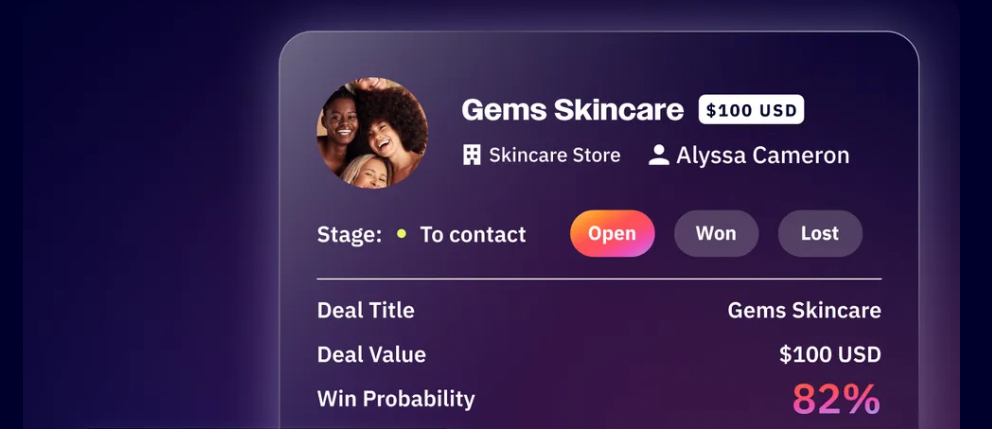
ActiveCampaign includes a built-in CRM with visual Kanban pipelines, deal tracking, lead and deal scoring, task management, and sales routing.
It's not Salesforce, but for small teams that need marketing and sales in one place, the CRM is a real asset. Automations can create deals, change stages, assign tasks, and trigger follow-ups based on deal events. The Chrome extension and Outlook add-in let reps manage the pipeline from their inbox.
Source: ActiveCampaign
Omnisend has no CRM. By design. Its customer data model centers on ecommerce purchase behavior: orders, products viewed, cart contents, average order value, and Customer Lifecycle Stages (Champions, Loyalists, At-Risk, etc.) computed from RFM analysis.
If you run an online store, this is the data that matters. If you run a B2B sales operation with deal pipelines and buying committees, Omnisend isn't built for you.
ZoomInfo approaches customer data from the opposite direction.
Rather than waiting for contacts to opt in, ZoomInfo's database provides verified business email addresses, direct-dial phone numbers, employment history, and org charts for companies in your target market. The GTM Context Graph then layers this third-party data with your existing CRM records, conversation transcripts from Chorus, and engagement signals to build a single intelligence layer.
In a Fortune 500 competitive RFP analyzing 25 million contacts across vendors, the independent consultant concluded that "no other competitor came even close" to ZoomInfo's data coverage.
"ZoomInfo is our one source of truth for account data, and even more so for contact data. There's no other provider in the market that provides you with that level of detail." (Thor Sanderson, Senior Manager of Sales Technology Enablement, Smartsheet)
AI capabilities comparison
All three platforms have invested in AI, but each applies it to different problems.
ActiveCampaign's Active Intelligence is the broadest AI system among email marketing platforms.
Launched in May 2025, it includes AI agents for campaigns, automations, segments, personalization, forms, goals, and insights. The system follows an "Imagine, Activate, Validate" framework: describe a business goal, and AI agents build the campaign, create segments, generate content, and track performance.
The AI Brand Kit imports brand assets from a URL automatically. AI-Suggested Segments surface high-value audience groups. Several agents remain in beta as of early 2026, so reliability varies.
Source: ActiveCampaign
Omnisend's AI is more focused.
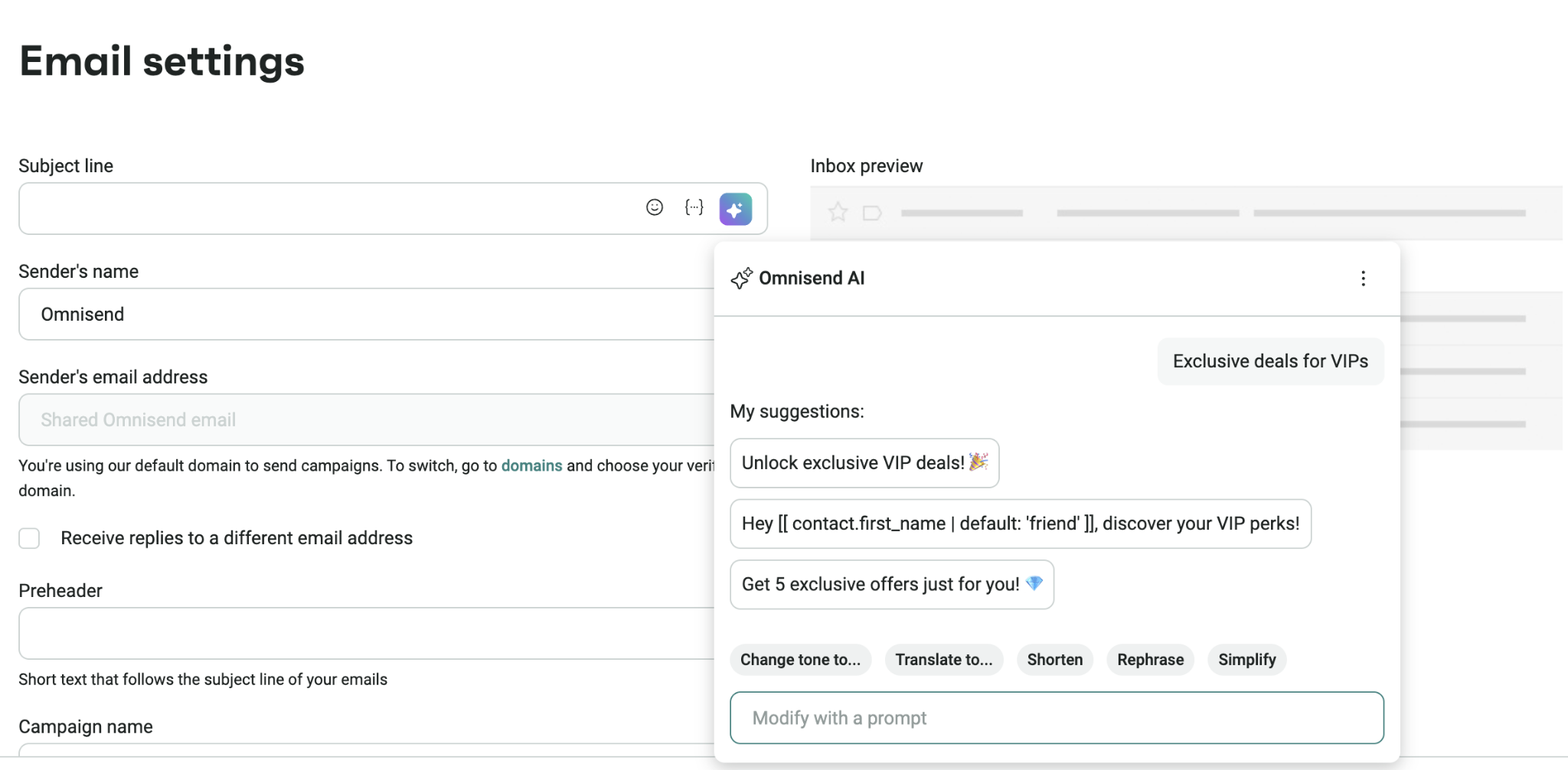
Forms AI generates signup forms from plain-language descriptions. The AI Segment Builder translates audience descriptions into configured filter rules. The subject line generator produces three variations per prompt with iterative refinement. A dynamic product recommender populates per-recipient product blocks at send time using recently viewed items and purchase history.
Most AI features are available on all plans, including free. The AI is practical and fits daily workflows well, but it doesn't attempt the goal-directed approach ActiveCampaign is pursuing.
Source: Omnisend
ZoomInfo's AI operates at a different level.
The GTM Context Graph processes 1.5B+ data points daily, reasoning across CRM data, conversation intelligence, intent signals, and company data to understand not just what happened in a deal, but why.
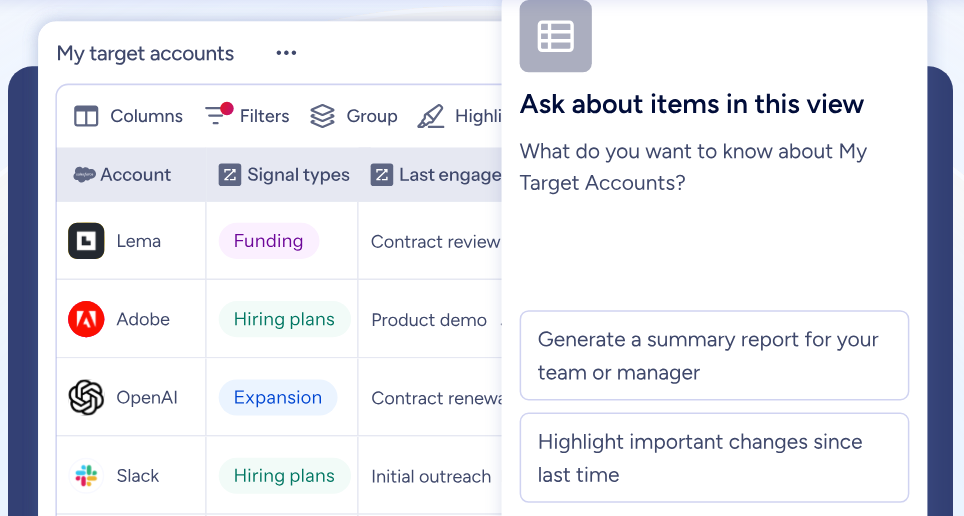
In GTM Workspace, AI agents handle account research, generate follow-ups, monitor signals, draft outreach, and update CRM fields. The AI Assistant produces one-click account briefs pulling CRM history, company news, and stakeholder context into a ten-second summary. In GTM Studio, audiences are built in natural language, plays improve as prospects respond, and every click, open, and reply sharpens targeting automatically.
Source: ZoomInfo
Both ActiveCampaign and Omnisend offer MCP (Model Context Protocol) integrations, letting external AI tools like Claude and ChatGPT query their data. ZoomInfo's MCP server does the same but exposes a richer dataset: company intelligence, contact data, intent signals, and account research, not just campaign metrics.
"That combination of our internal CRM data, external signals, and AI that's given all that context has helped us craft very specific account- and persona-based messages. And people have responded to them right away." (Toby Carrington, Chief Business Officer, Seismic)
Pricing models reveal different priorities
ActiveCampaign uses contact-based pricing across four tiers: Starter, Plus, Professional, and Enterprise.
The Starter plan begins at $15/month for 1,000 contacts but caps automations at five actions per workflow. The Plus plan removes that cap and adds landing pages, native ad platforms, and AI content generation. Professional adds predictive sending, conditional content, revenue attribution, and priority support. Enterprise adds SSO, HIPAA support, and a dedicated account team. At 10,000 contacts, the Starter plan runs $149/month.
ActiveCampaign charges once per unique contact regardless of how many automations or segments that contact appears in. There's no permanent free plan, just a 14-day trial and a 30-day money-back guarantee for first-time subscribers.
A common pain point: G2 reviewers report that pricing has risen over recent years and climbs as contact lists grow.
Omnisend uses the same contact-based model but with a more generous entry point.
The permanent free plan includes 250 contacts, 500 emails/month, and access to all core features (automation, segmentation, forms, reporting). The Standard plan starts at $16/month with email credits equal to 12x your billable contacts. The Pro plan starts at $59/month with unlimited emails and SMS as a paid add-on. At 10,000 contacts, Omnisend's Standard plan runs at approximately $132/month.
An important billing detail: Omnisend counts non-subscribers who received automated messages in the last 30 days (like order confirmations) as billable contacts, which can push invoices above your subscriber count during busy periods.
ZoomInfo uses custom-quoted, consumption-based pricing with no published prices. Costs scale around data access, API consumption, AI activity, and user seats.
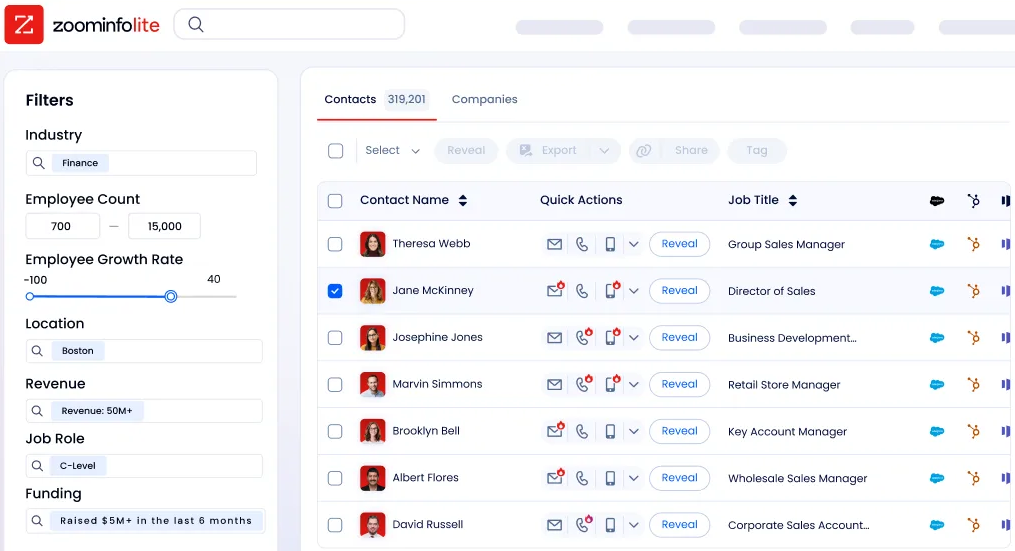
For teams that want to explore before committing, ZoomInfo Lite is a permanent free tier with access to the B2B database, 10 monthly export credits, the Chrome extension, and WebSights Lite for up to 10 website visitor reveals per day. A 7-day free trial provides broader access.
Source: ZoomInfo
ZoomInfo is an enterprise investment, not an SMB subscription. Comparing it with ActiveCampaign and Omnisend on price alone misses the point. ActiveCampaign and Omnisend charge for campaign execution. ZoomInfo charges for the intelligence that makes campaigns worth running.
For a B2B team whose pipeline depends on reaching the right decision-makers at the right companies at the right time, the ROI calculation centers on pipeline impact, not cost per contact.
Deliverability and data quality
Email deliverability is a shared concern across all three platforms, but each handles it differently.
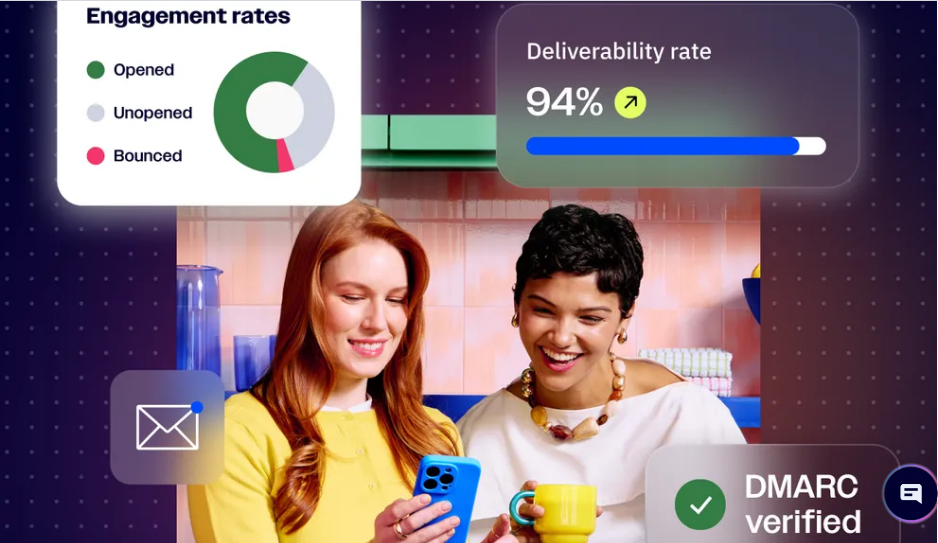
ActiveCampaign reports 99.88% email deliverability by its own measurement, with EmailToolTester independently reporting 94%.
The platform routes emails through a private network, offers dedicated IP management, and supports DKIM and DMARC authentication with a free DMARC testing tool. Worth noting: ActiveCampaign can filter Apple Mail Privacy Protection opens from reporting, preventing inflated open rates from skewing your analytics.
Source: ActiveCampaign
Omnisend achieves 94.2% inbox placement versus an approximately 83% industry average in independent testing, with built-in DKIM/SPF/DMARC setup wizards and custom click-tracking domains introduced in March 2026.
One gap: Omnisend does not expose an in-dashboard deliverability score, unlike some competitors, limiting proactive list health management.
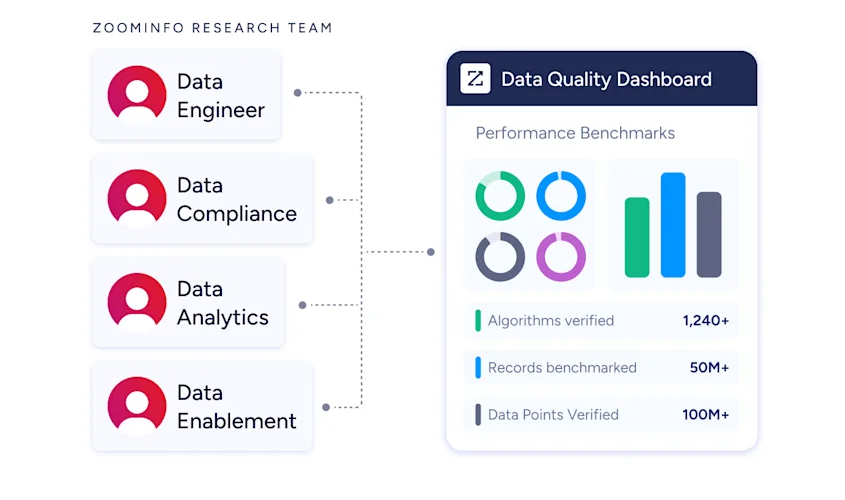
ZoomInfo addresses data quality at the source. When B2B teams build campaigns on purchased lists or scraped contacts, bounce rates climb, sender reputation degrades, and deliverability suffers across every platform they use.
ZoomInfo's verification pipeline, backed by 300+ human researchers and multi-source validation, delivers contacts with up to 95% accuracy. ZoomInfo also includes NeverBounce (acquired in 2018), which verifies emails to prevent bounces before they happen. When you start with verified data, deliverability problems shrink before the first email goes out.
ActiveCampaign vs. Omnisend vs. ZoomInfo: Which should you choose?
The right platform depends on what kind of business you run and what your primary marketing challenge is.
Choose ActiveCampaign if:
You run a B2B, SaaS, or service business that needs marketing automation and CRM in one platform
Complex, multi-step automations with conditional branching are central to your strategy
You need WhatsApp as a marketing channel alongside email and SMS
You want AI to help build campaigns, suggest segments, and optimize send times
Your team has the time to learn a feature-rich platform
Choose Omnisend if:
You run an online store on Shopify, WooCommerce, BigCommerce, or Wix
Ecommerce-specific workflows (abandoned cart, post-purchase, cross-sell) are your primary automation needs
You want email, SMS, and web push in a single workflow builder
Budget matters and you want to start free with all core features unlocked
You value 24/7 live support on every plan, including free
Choose ZoomInfo if:
You're a B2B company where knowing which accounts to target matters more than optimizing subject lines
Verified contact data, buyer intent signals, and org charts would change your pipeline generation
Your marketing team needs to build audiences from market data, not just your existing contact list
You want AI that reasons across CRM, conversation intelligence, and third-party signals, not just campaign metrics
Your go-to-market strategy spans sales and marketing, and both teams need shared intelligence
Explore ZoomInfo with the free ZoomInfo Lite tier or a 7-day free trial.
ActiveCampaign and Omnisend both excel at what they do. ActiveCampaign gives B2B and service businesses automation with a built-in CRM. Omnisend gives ecommerce stores fast, affordable, revenue-focused marketing.
But for B2B teams that need the intelligence layer, the verified data, and the intent signals that make campaign execution effective, ZoomInfo provides what neither campaign tool was built to deliver: the ability to find the right buyers before you write the first email.
"You'll get 10x the value if you think of ZoomInfo as a full platform and not just a tool for one team." (John Kotsuros, Founder and CEO, SpringDB)
ActiveCampaign vs. Omnisend vs. ZoomInfo FAQ
What is the core difference between ActiveCampaign, Omnisend, and ZoomInfo?
ActiveCampaign is a general-purpose marketing automation platform with a built-in CRM, serving B2B, SaaS, and service businesses with workflow automation across email, SMS, and WhatsApp.
Omnisend is an ecommerce-specific marketing automation platform for online stores, combining email, SMS, and web push notifications with native store integrations for Shopify, WooCommerce, and others.
ZoomInfo is a B2B data intelligence and go-to-market platform that provides verified contact data on 500M professionals, buyer intent signals, and AI-powered execution through GTM Workspace and GTM Studio.
Which platform is cheapest to get started with?
Omnisend offers the most accessible entry point with a permanent free plan covering 250 contacts, 500 emails per month, and access to all core features. ZoomInfo Lite is also a permanent free tier with 10 monthly export credits and access to its B2B database.
ActiveCampaign has no free plan, offering a 14-day trial followed by paid plans starting at $15 per month for 1,000 contacts. At 10,000 contacts, ActiveCampaign's Starter runs $149 per month while Omnisend's Standard runs approximately $132 per month.
Can ActiveCampaign work for ecommerce businesses?
Yes. ActiveCampaign integrates with Shopify, WooCommerce, and Square on its Starter plan, and supports deeper ecommerce integrations on higher tiers. It can handle abandoned cart recovery and post-purchase sequences.
However, it lacks ecommerce-native features like live product catalog blocks, automatic unique discount code generation per recipient, and web push notifications that Omnisend includes by default.
Does Omnisend work for B2B businesses?
No. Omnisend has no lead scoring, pipeline management, CRM, or account-based automation. Its segmentation is built around purchase behavior, product views, and customer lifecycle stages specific to retail. B2B businesses needing to manage sales pipelines, score leads, or track buying committees should look at ActiveCampaign or ZoomInfo.
How does ZoomInfo complement ActiveCampaign or Omnisend?
ZoomInfo integrates with ActiveCampaign and other marketing automation platforms through its API and marketplace. For B2B teams using ActiveCampaign, ZoomInfo provides the verified contact data, company intelligence, and buyer intent signals that feed into ActiveCampaign's automation workflows.
ZoomInfo identifies which accounts are in-market and who the decision-makers are; ActiveCampaign handles the campaign execution against those contacts. Omnisend's ecommerce focus makes it less relevant for ZoomInfo's B2B use case.
Which platform has the best AI capabilities?
Each platform applies AI to its core use case.
ActiveCampaign's Active Intelligence generates campaigns from plain-language prompts, suggests segments, and optimizes send times. Omnisend's AI builds signup forms, generates subject lines, and powers product recommendations. ZoomInfo's GTM Context Graph operates at a broader level, processing 1.5 billion data points daily to reason across CRM records, conversation intelligence, and third-party signals, surfacing which accounts to target and why deals move or stall.
For campaign optimization, ActiveCampaign's AI is the most developed. For B2B go-to-market intelligence, ZoomInfo's AI operates in a category the other two don't address.
What channels does each platform support?
ActiveCampaign supports email, SMS (180+ countries), WhatsApp (via Meta Business Partner status), and landing pages. Omnisend supports email, SMS (200+ countries with MMS in US and Canada), and web push notifications (free, unlimited on paid plans).
ZoomInfo supports outbound email, display advertising through a native demand-side platform, phone outreach, and direct mail through GTM Studio's multi-channel orchestration.
Which platform has the best automation for abandoned cart recovery?
Omnisend is the strongest choice for abandoned cart automation. It ships a pre-built workflow that fires automatically, includes product images pulled from the store catalog, generates unique discount codes per recipient, and handles the hand-off between cart abandonment and checkout abandonment with built-in deduplication logic.
ActiveCampaign can handle abandoned cart recovery through its ecommerce integrations but requires more manual setup. ZoomInfo does not address cart abandonment, as it focuses on B2B go-to-market rather than ecommerce transactions.
Keep comparing ActiveCampaign:
