
Choosing between Bigin vs. Pipedrive for your CRM often comes down to five questions:
Are you adopting a CRM for the first time, or replacing one that no longer fits?
Do you need a tool your non-technical team can use in 30 minutes, or are you willing to invest in a more capable system?
Is your budget under $10 per user per month, or can you spend more for automation and reporting?
Do you mostly need to manage existing relationships, or do you also need to find and qualify new prospects?
Is your sales motion B2B with complex buying committees, or simpler transactions with individual buyers?
In short, here's what we recommend:
Bigin is the CRM for small businesses that have never used one before. Zoho built it as a deliberate alternative to complex CRM software. It delivers pipeline management, built-in telephony, WhatsApp integration, and workflow automation starting at $7 per user per month. Its Team Pipelines let you run sales, onboarding, support, and delivery workflows in a single account, and you can set up the whole thing in 30 minutes. The trade-off: Bigin caps automations, custom fields, and reporting at levels that growing sales teams will outgrow.
Pipedrive is the CRM built by salespeople for salespeople. It pioneered the kanban-style pipeline view that's now an industry standard, and it adds automation, AI-powered email writing, deal scoring, and revenue forecasting that Bigin doesn't offer. With 500+ marketplace integrations, a prospecting toolkit (Pulse), and email marketing through Campaigns, Pipedrive handles more of the sales process under one roof. The trade-off: it costs more, has no permanent free plan, and its best features require higher-tier subscriptions.
Both platforms organize deals you already have. But for B2B teams, the harder problem is often upstream: finding the right companies to target, knowing when they're ready to buy, and understanding who's involved in the decision. Neither Bigin nor Pipedrive was built to solve that. ZoomInfo was.
ZoomInfo is an AI go-to-market platform built on B2B data spanning 500M contacts, 100M companies, 135M+ verified phone numbers, and 200M+ verified business email addresses. By combining this data with your CRM records, conversation transcripts, and behavioral signals, ZoomInfo's GTM Context Graph (processing 1.5B+ data points daily) reveals the context behind your accounts: not just what happened, but why, and what to do next. Your team accesses this intelligence through GTM Workspace for sellers, GTM Studio for marketers and RevOps, or APIs and MCP inside any front-end, including your existing CRM.
If your sales team needs more than a pipeline tracker and you want intelligence driving every conversation, see how ZoomInfo works.
Bigin vs. Pipedrive vs. ZoomInfo at a glance
Bigin | Pipedrive | ZoomInfo | |
|---|---|---|---|
Built for | Small businesses new to CRM | SMB sales teams | B2B go-to-market teams |
Starting price | $7/user/month (free plan available) | $14/user/month (no free plan) | Custom-quoted (free Lite tier available) |
Pipeline management | Team Pipelines across departments | Unlimited custom sales pipelines | GTM Workspace with AI-prioritized accounts |
Prospecting tools | Basic web forms and lead capture | Pulse toolkit, LeadBooster, Prospector (400M+ profiles) | 500M contacts, buyer intent, website visitor ID |
Automation limits | 30 on Express, 100 on Bigin 360 | 50 on Growth, 250 on Ultimate | AI agents handle research, outreach, and CRM updates |
AI capabilities | Zia Agents (email reply, cross-sell, churn analysis) | AI email writer, deal scoring, AI Sales Assistant | GTM Context Graph with AI-driven execution |
Integrations | Zoho ecosystem + Zapier + select third-party | 500+ marketplace apps | 120+ native integrations, API, and MCP for any tool |
Best for | Micro-businesses graduating from spreadsheets | Dedicated sales teams managing active pipelines | B2B teams needing intelligence-driven prospecting and execution |
Two CRMs, two different buyers
Bigin and Pipedrive both manage sales pipelines, but they serve different stages of business maturity.
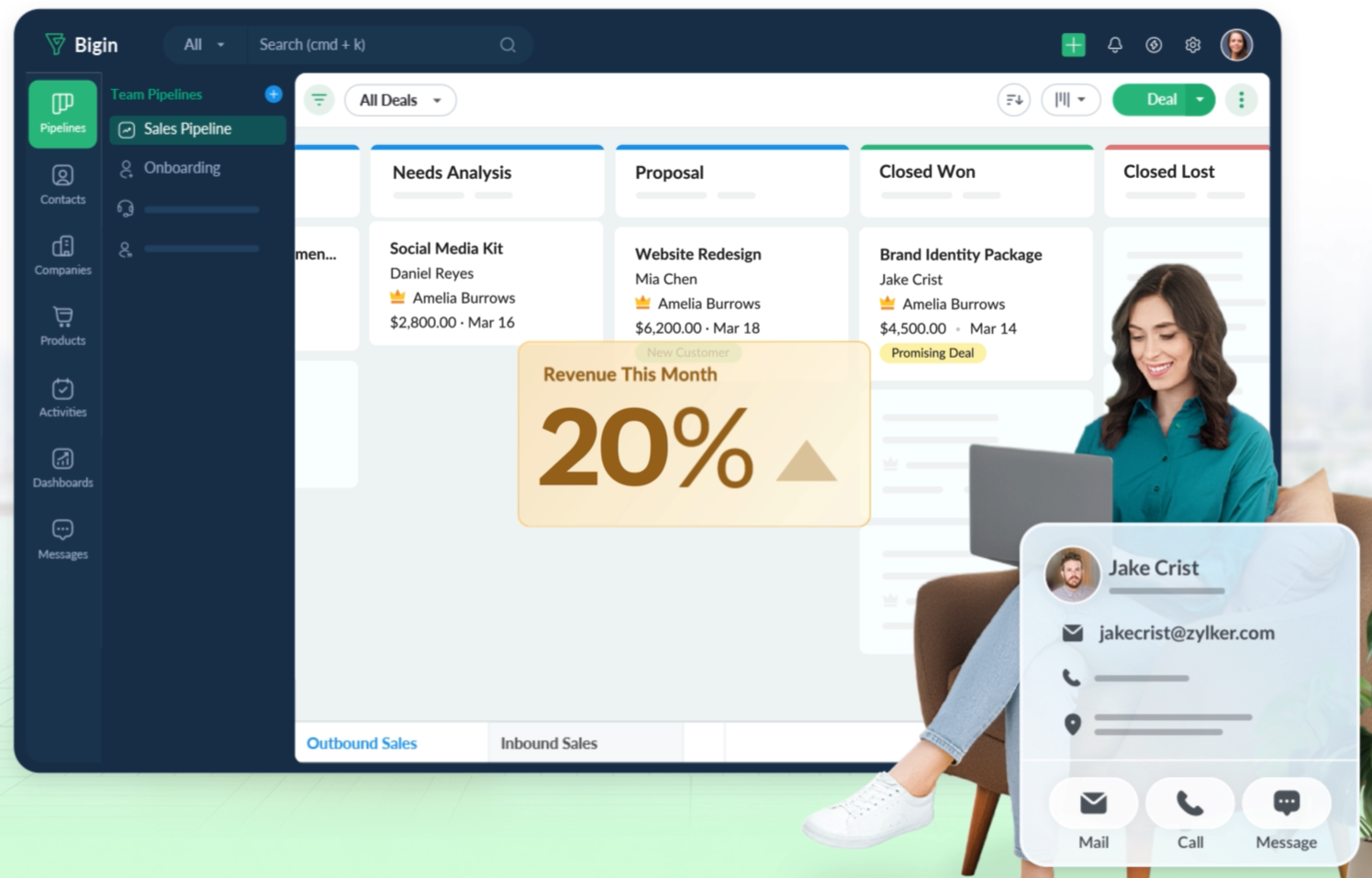
Bigin targets the business that has never used a CRM. Zoho's own data confirms this: 65% of Bigin customers had never used a CRM before signing up. The interface is stripped down on purpose. You get pipelines, contacts, activities, and dashboards. The learning curve is close to zero. For a five-person company that has been running on spreadsheets, that's exactly right.
Source: Bigin
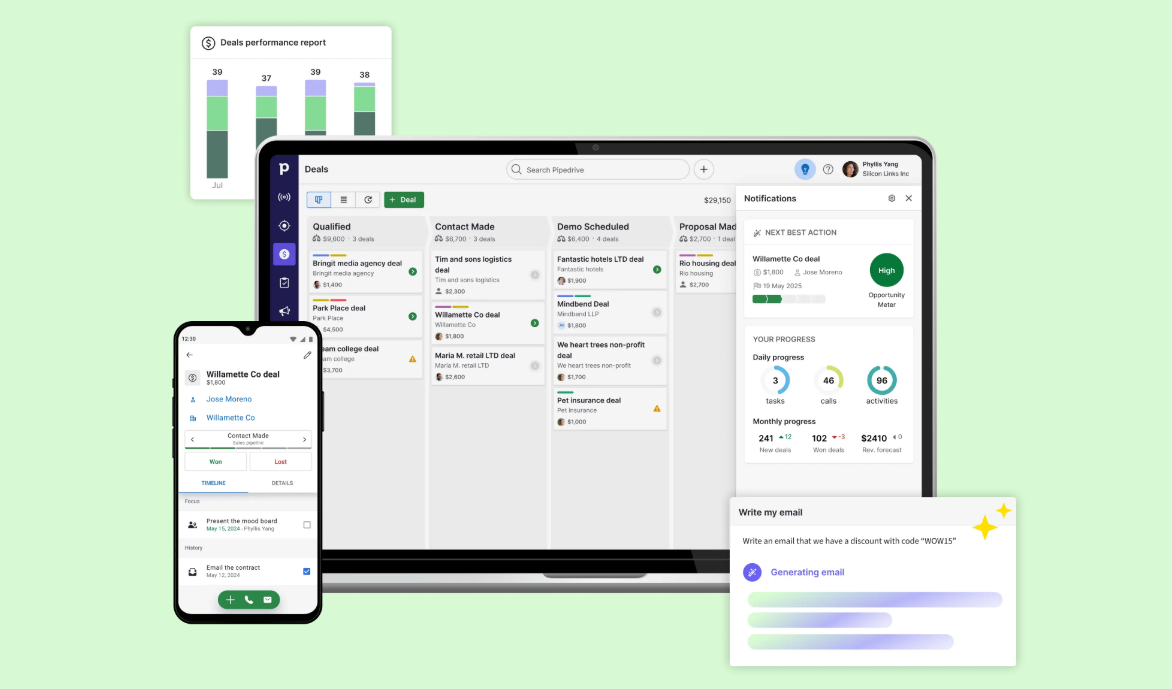
Pipedrive targets the business that already knows it needs a CRM and wants one that keeps up with an active sales process. Founded in 2010 by five salespeople frustrated with tools built for managers, Pipedrive assumes you understand pipeline stages, deal velocity, and follow-up cadences. It gives you the tools to act on that understanding: deal rotting alerts, revenue forecasting, email tracking, and conditional workflow automation.
Source: Pipedrive
The gap between them isn't quality. It's ambition. Bigin is a CRM you can outgrow by design; Zoho offers a single-click migration path to Zoho CRM when you do. Pipedrive scales with you through its higher tiers and add-ons, though teams with complex post-sale needs will still need additional tools.
Pipeline management: simplicity vs. depth
Both platforms center on visual pipeline views, but the experience diverges quickly.
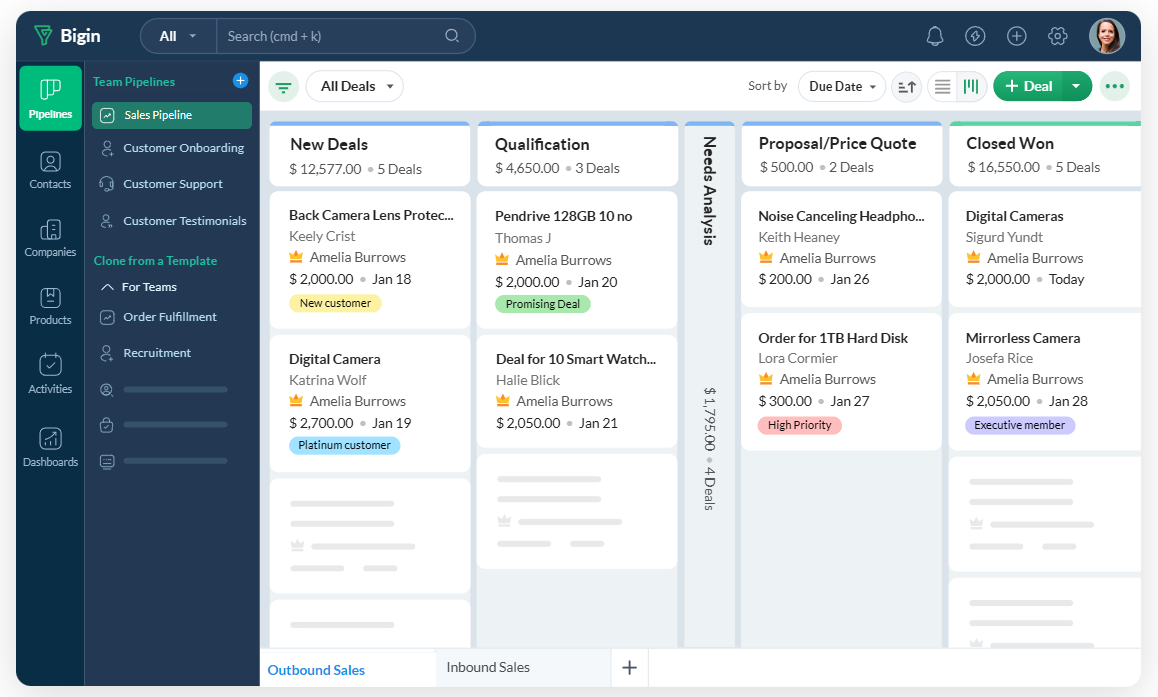
Bigin's standout feature is Team Pipelines, which Bigin calls "an industry-first" for small business CRM. Instead of limiting pipelines to sales, you can create separate pipelines for customer onboarding, support, order fulfillment, and other operations in the same account. Connected Pipelines automate handoffs between them: when a deal closes in the sales pipeline, a linked record appears in the onboarding pipeline. For a small business where the same people handle sales and delivery, this is practical.
Source: Bigin
The limits depend on your plan. Express ($7/user/month) allows 3 team pipelines and 15 sub-pipelines. Premier ($12) allows 5. Bigin 360 ($18) allows 15. Custom fields per module follow the same pattern: 10, 25, and 50.
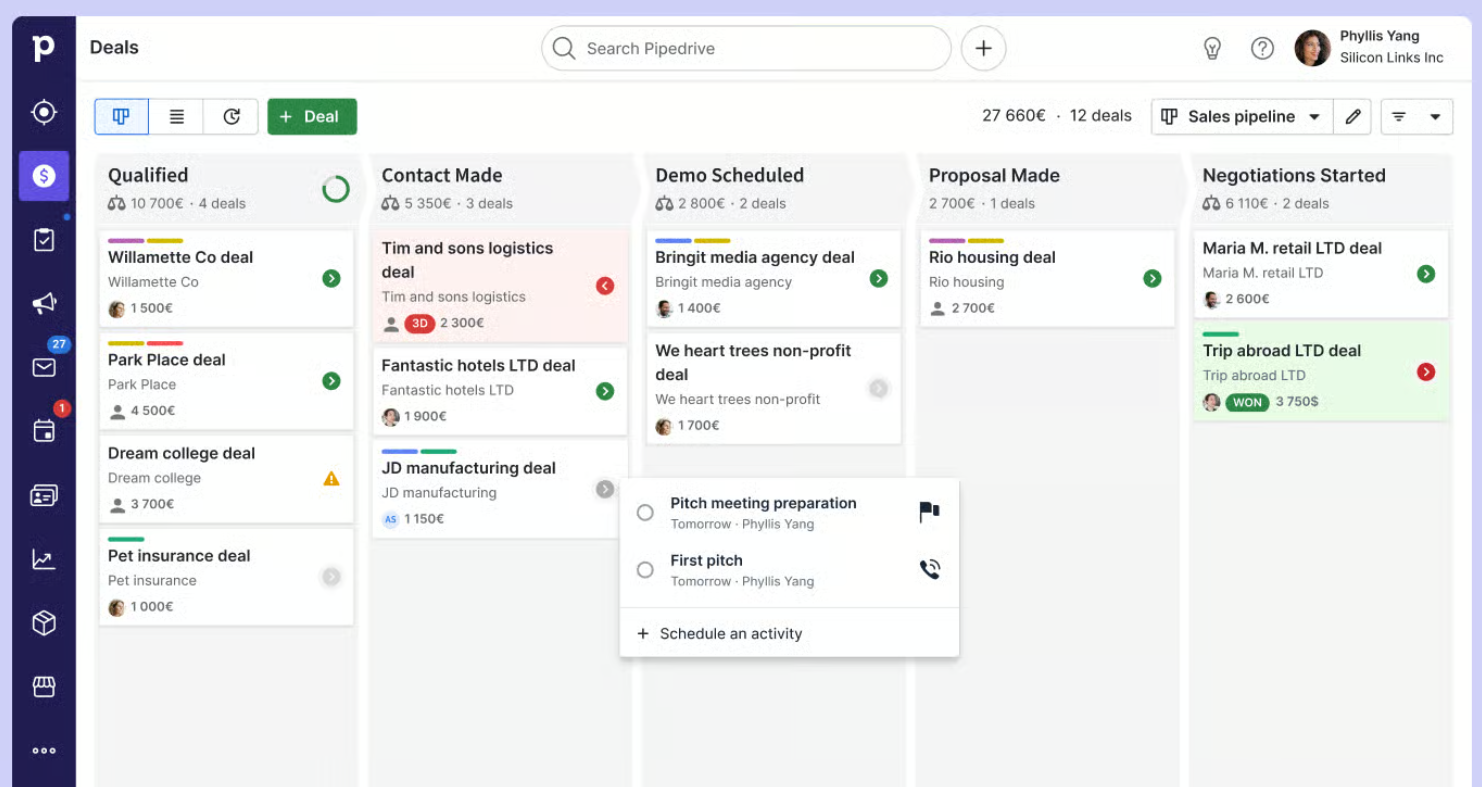
Pipedrive takes a different approach. Instead of multi-department pipelines, it focuses on making sales pipelines as capable as possible. You get unlimited custom pipelines on all plans, each with custom stages, custom fields, and deal rotting indicators that flag deals going cold. The forecast view projects expected revenue by close date. Activity-based selling means every deal shows its next scheduled action, and deals with no upcoming activity surface immediately.
Source: Pipedrive
Pipedrive also includes deal scoring (custom models to prioritize deals by conversion likelihood), recurring revenue tracking, and formula fields for auto-calculated values. These features require Premium or higher, but they give sales managers visibility that Bigin's dashboards can't match.
For a solo consultant tracking 20 deals across sales and project delivery, Bigin's Team Pipelines solve the right problem. For a 15-person sales team that needs forecasting, deal health tracking, and conditional automations, Pipedrive's depth matters.
Where both CRMs fall short: finding the right prospects
Bigin and Pipedrive are pipeline management tools. They organize deals that already exist. The question they don't answer: who should you be selling to in the first place?
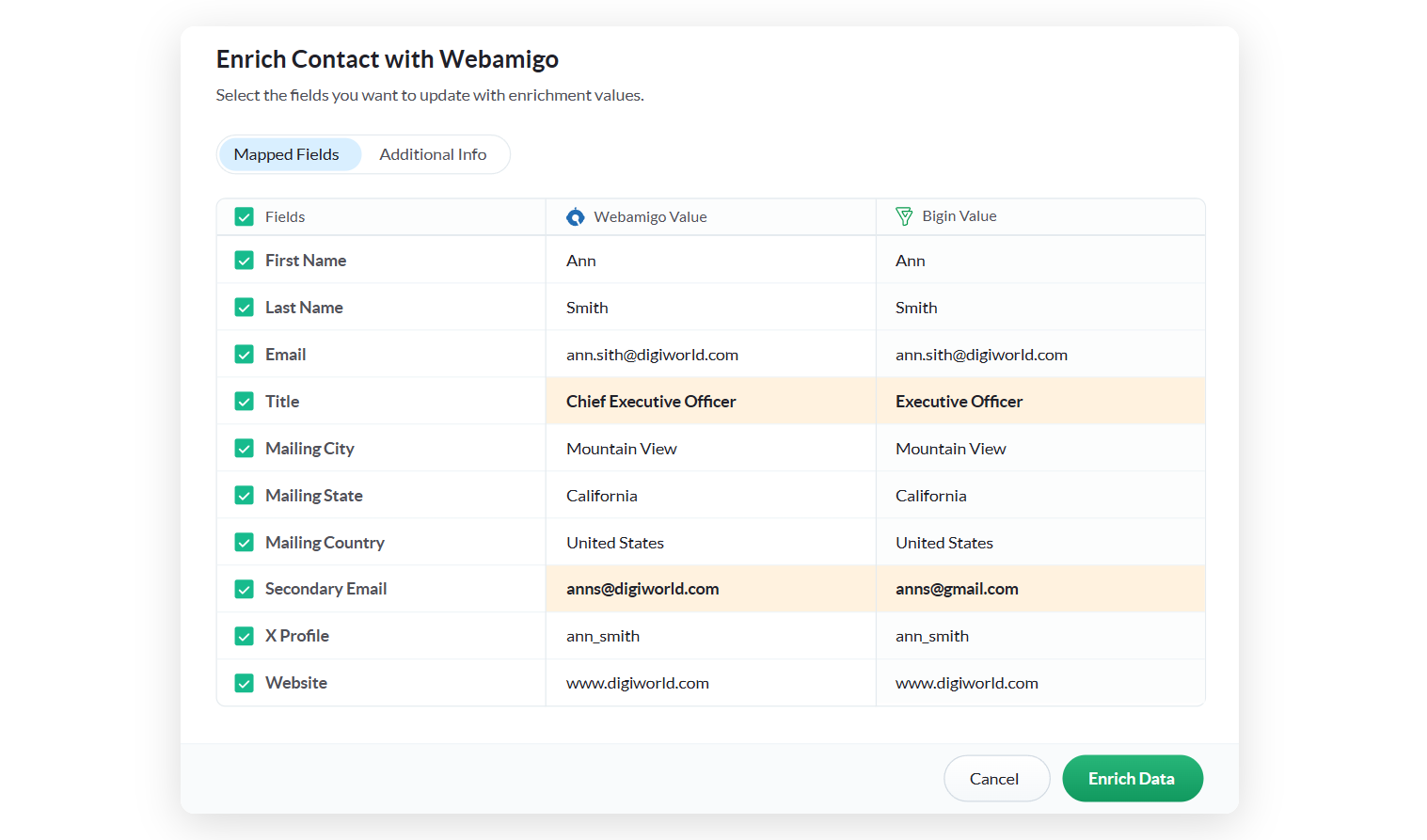
Bigin captures leads through web forms, social ad integrations via LeadChain (Facebook, Instagram, LinkedIn, TikTok), and manual entry. Data enrichment, powered by WebAmigo, fills in missing fields like job titles and company details on Premier plans and above. These help organize inbound leads, but they don't tell you which companies in your market are actively looking for what you sell.
Source: Bigin
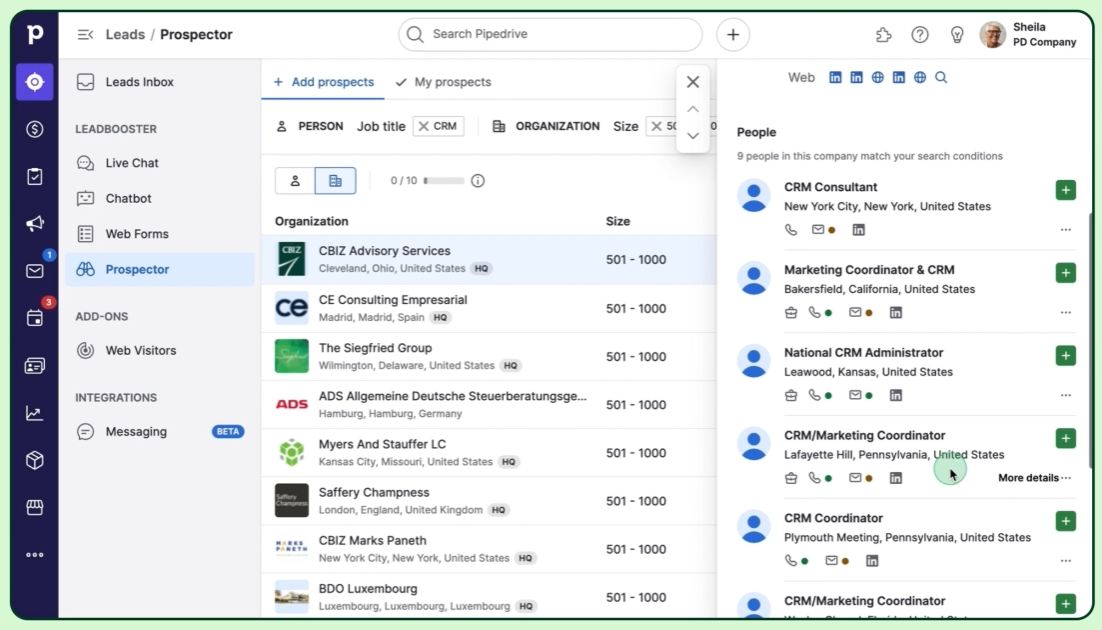
Pipedrive goes further with Prospector, part of the LeadBooster add-on, which gives you access to a database of over 400 million profiles and 10 million companies. The Pulse toolkit adds data enrichment, custom lead scoring, and automated sequences. The Web Visitors add-on identifies which companies visit your website. These are real prospecting capabilities, and for many SMBs, they're enough.
Source: Pipedrive
ZoomInfo treats prospecting as the core problem, not an add-on. The platform's B2B data spans 500M contacts and 100M companies, verified by 300+ human researchers with up to 95% accuracy on first-party data. Buyer Intent data tracks signals from 210 million IP-to-Organization pairings and 6 trillion+ keyword-to-device pairings monthly, showing you which companies are researching solutions like yours right now. Guided Intent, exclusive to ZoomInfo, identifies topics historically correlated with deal success rather than requiring you to guess which keywords matter.
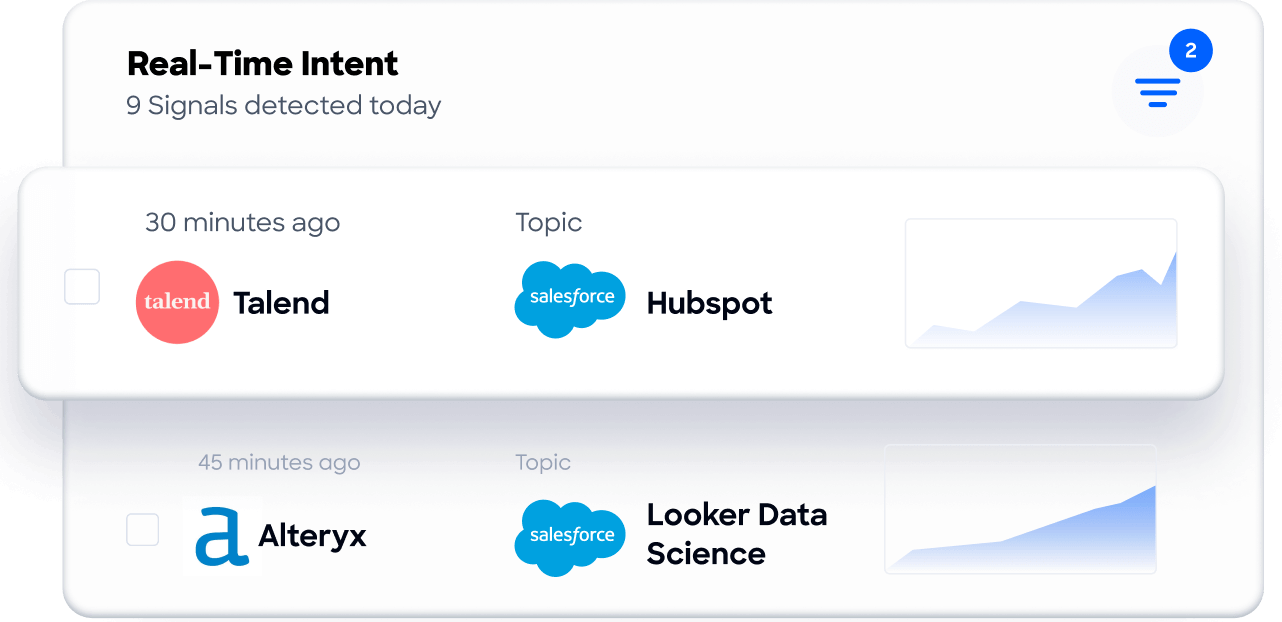
WebSights identifies not just which companies visit your website but the specific people involved, with direct contact information. Technographics profile the tech stacks of 30+ million companies. Department org charts show the buying committee structure, with 120M direct-dial phone numbers and 200M+ verified business email addresses attached.
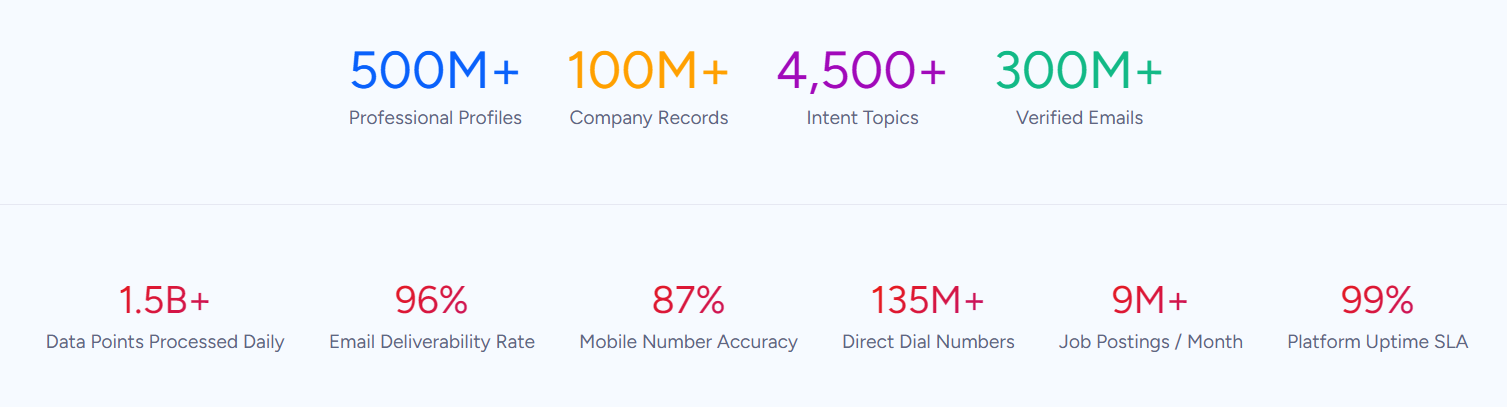
The difference is structural. Bigin tells you what stage a deal is in. Pipedrive adds forecasting for when it might close. ZoomInfo tells you which companies to pursue, who makes the decision, what technology they use, and whether they're researching alternatives right now.
"ZoomInfo gives us the information we need to execute. We don't have to spend our time digging. It's already there, so we can be three steps ahead." — William Kenimer, Vice President of Revenue Operations, Vensure (Vensure Case Study)
Automation and AI: the capability gap widens at scale
Automation is where the platforms diverge most.
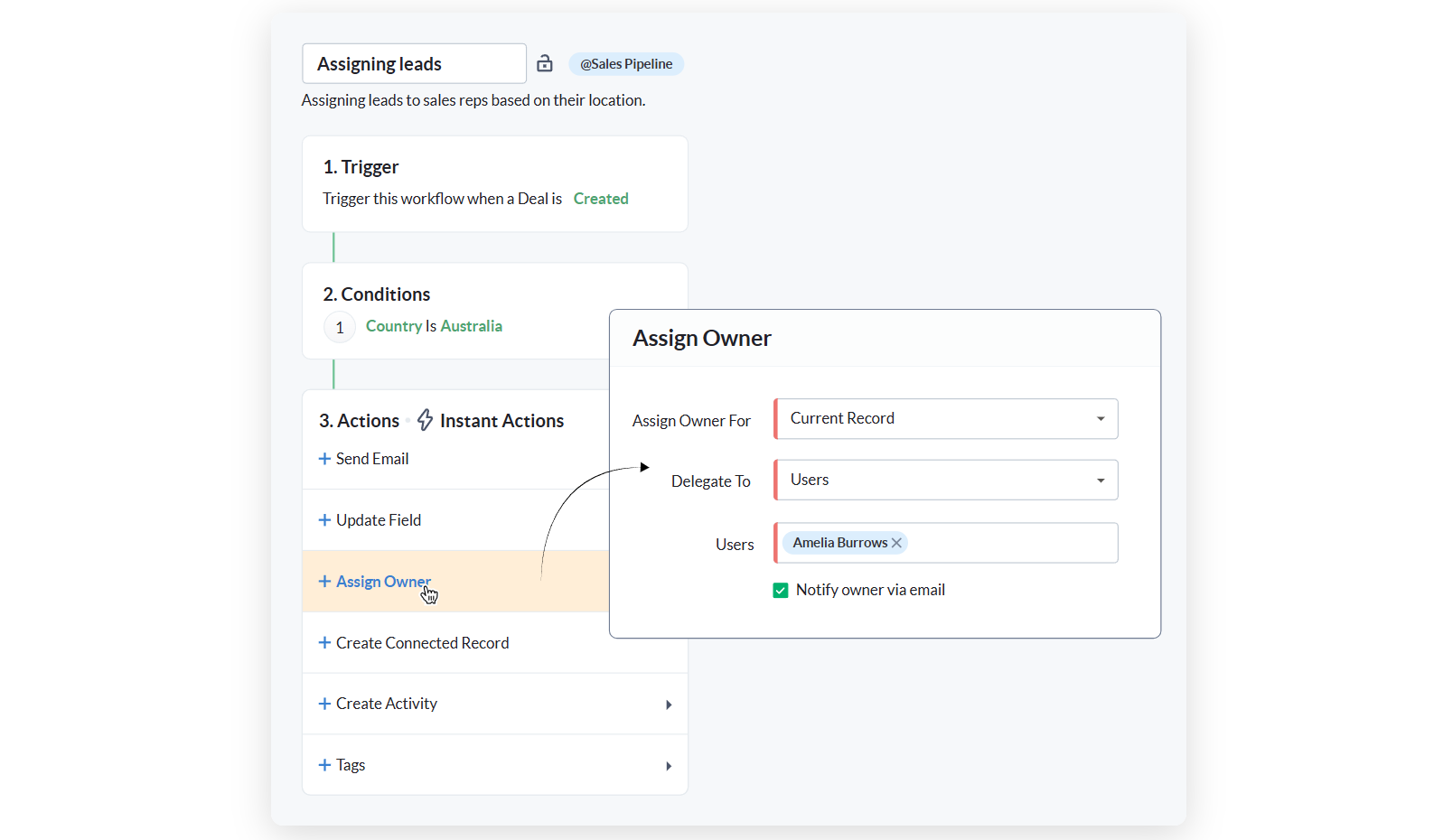
Bigin keeps automations simple. Workflows follow a trigger-condition-action pattern: a deal moves to a new stage, and Bigin sends an email, creates a task, or updates a field. Stage Transition Rules on Premier and above add entry and exit criteria to pipeline stages. The ceiling is real: 30 automations on Express, 50 on Premier, and 100 on Bigin 360. Businesses running multiple Team Pipelines with complex handoffs can hit these limits.
Source: Bigin
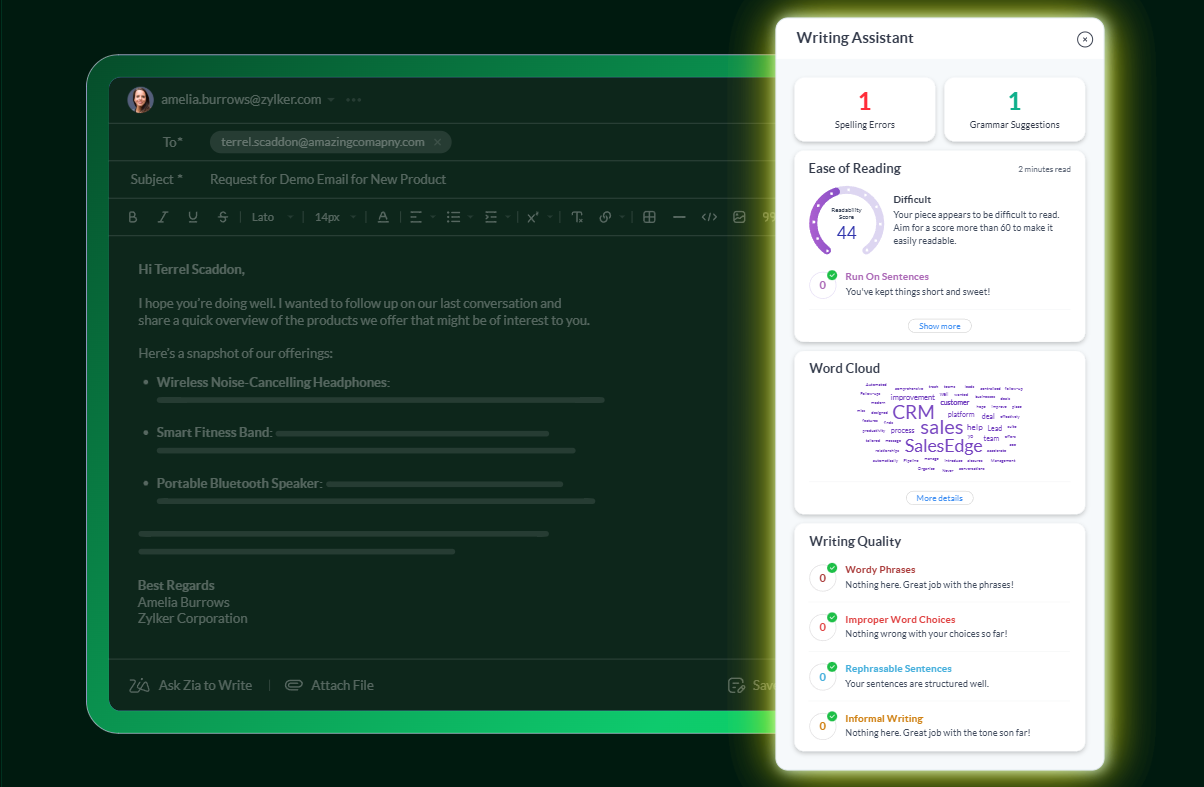
Bigin's AI layer, Zia Agents, is in early access. Three agents are available: a Reply Assistant that monitors email inboxes and auto-responds, a CrossSell Genie that identifies upsell opportunities after deals close, and a Churn Analyzer that examines lost deals for patterns. Setup requires no coding: install, configure knowledge sources, and activate. AI credits are bundled at 1,000/month on Premier and 3,000 on Bigin 360.
Source: Bigin
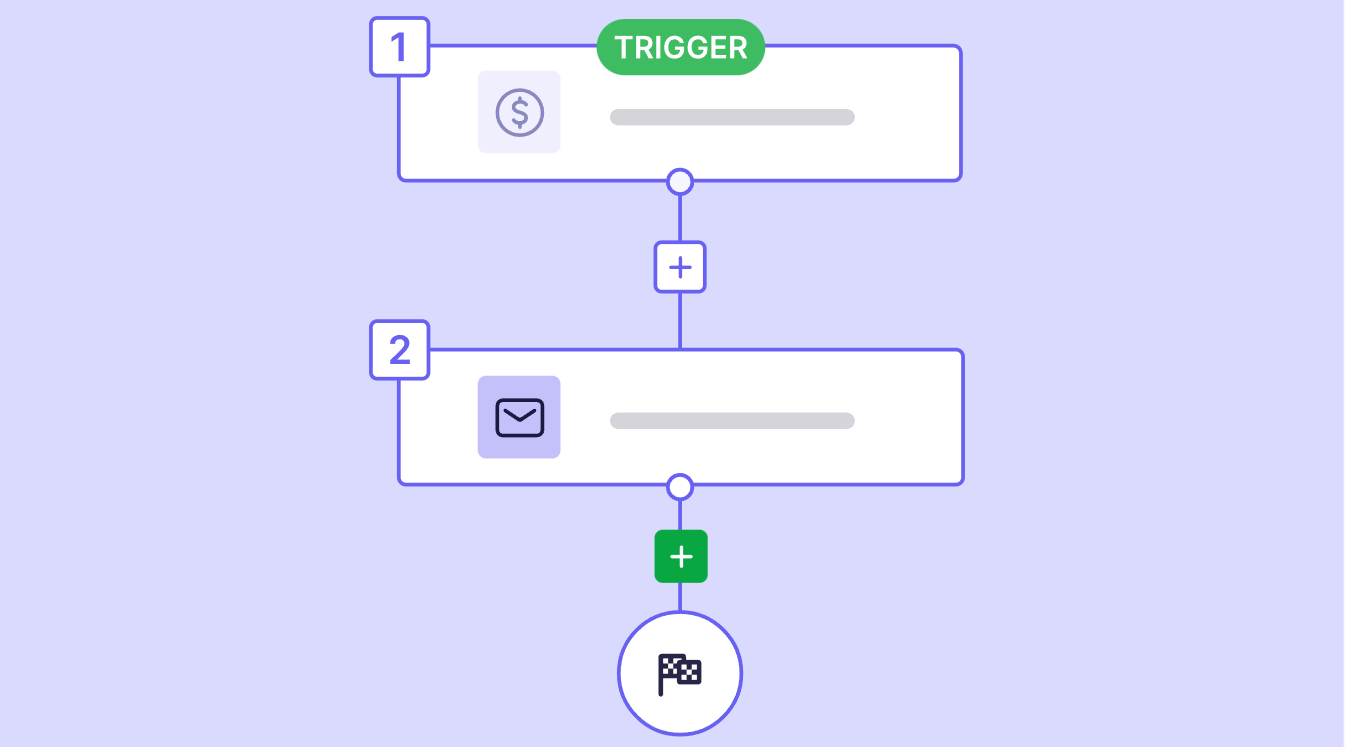
Pipedrive pushes automation further. Workflows support if/else branching, "wait until event" conditions, date-based triggers (not just event-based), and native integrations with Slack, Microsoft Teams, Trello, and Asana inside the automation engine. The Sequences feature automates multi-step follow-up flows that pause when a prospect engages, rather than running blind on a timer.
Source: Pipedrive
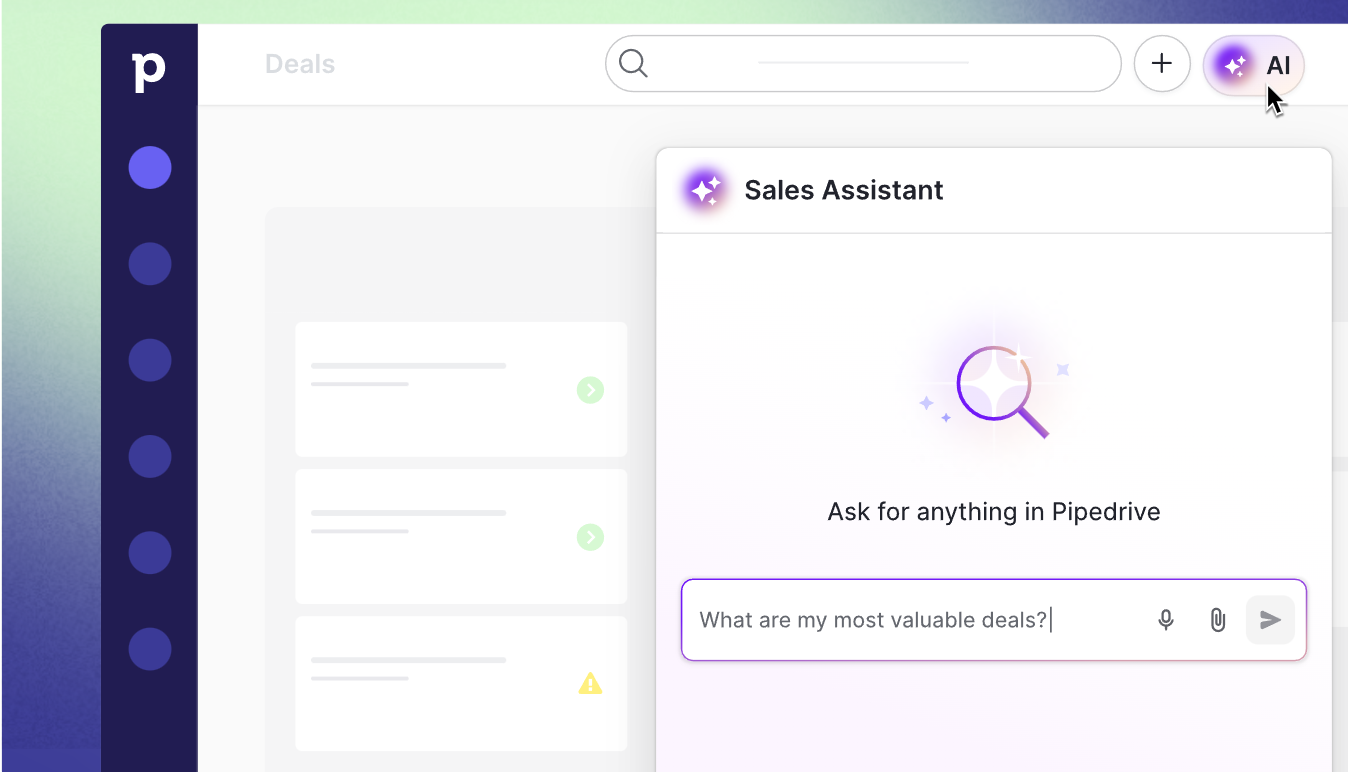
Pipedrive's AI suite includes an AI email writer that generates drafts with configurable tone and length, AI email summarization (in beta) that condenses threads into summaries with readiness-to-buy scores, AI-generated reports from natural language prompts, and an AI Sales Assistant that surfaces win probability predictions and next-action recommendations.
Source: Pipedrive
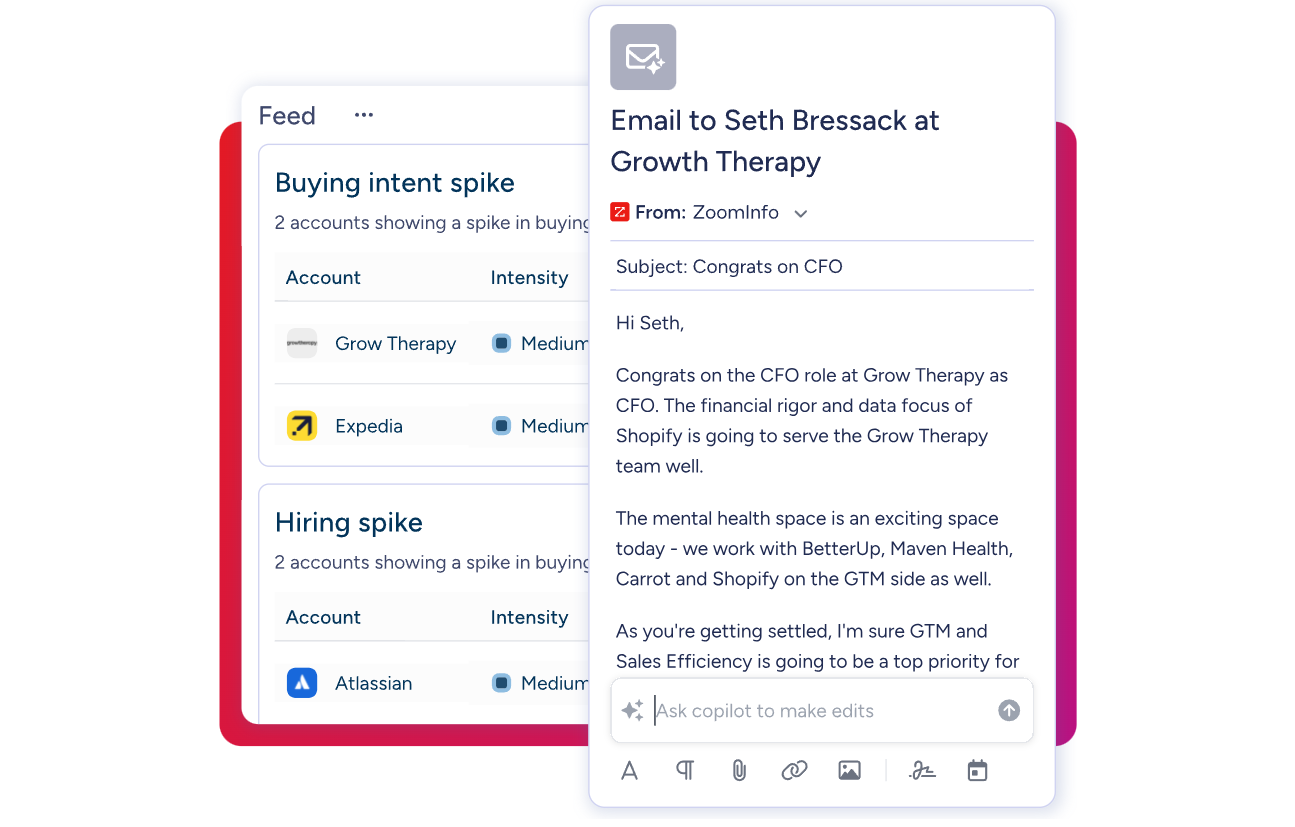
ZoomInfo operates at a different level. Rather than automating CRM tasks, ZoomInfo's AI agents inside GTM Workspace automate the research, prioritization, and outreach that happen before a deal enters any CRM. The agents handle account research, outreach drafting, CRM updates, and signal monitoring continuously. In GTM Studio, marketers and RevOps teams describe audiences in natural language, and AI agents handle enrichment, scoring, routing, and message creation. These aren't rule-based automations with caps. They're AI agents drawing on the GTM Context Graph to understand the full context of every account.
"ZoomInfo's not just a contact data company anymore. They've built a full system of execution. GTM Intelligence works the list, writes the outreach, triggers the play, and helps drive predictable growth." — Ian Brodie, CEO & Co-Founder, Levanta (Levanta Case Study)
Email and communication: built-in vs. add-on vs. intelligence-driven
How each platform handles communication reflects its priorities.
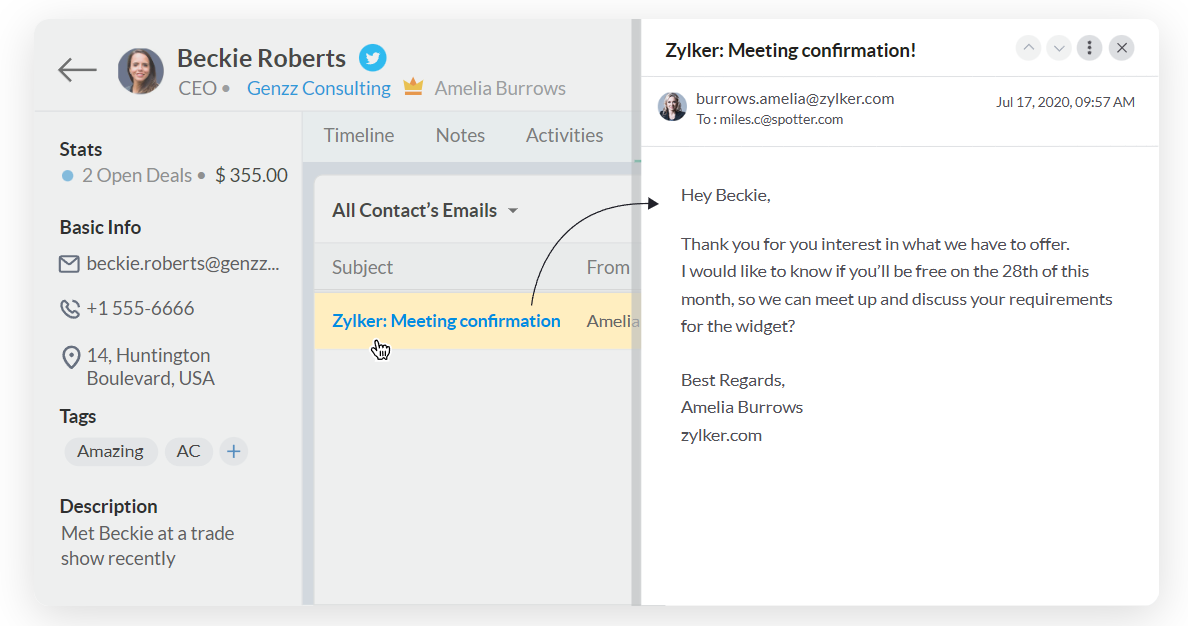
Bigin connects to Gmail, Outlook, Zoho Mail, and any IMAP/POP3 provider. Email integration is available from Express onward. Mass emails are capped at 300/day on Express and 1,000/day on Premier. For businesses where WhatsApp is the primary channel, Bigin's WhatsApp Business integration includes a shared inbox, automated workflows triggered by pipeline events, and customizable templates. Built-in telephony with one-click calling and automatic call logging is available on every plan, including free.
Source: Bigin
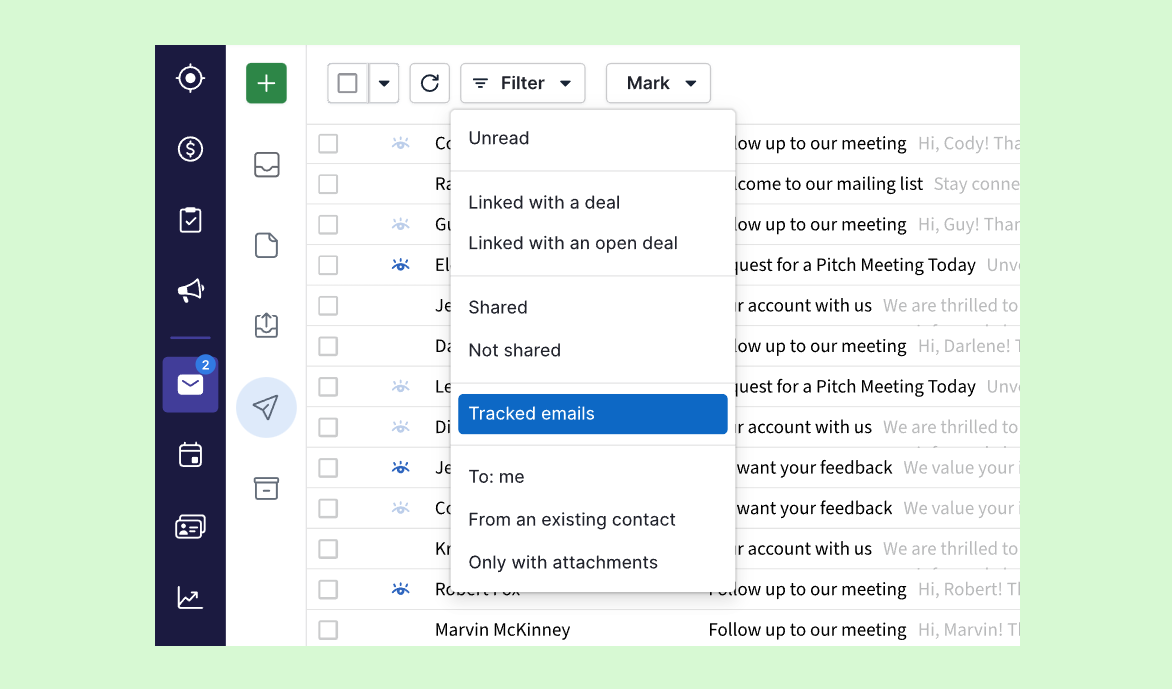
Pipedrive centralizes email in its Sales Inbox, an email client that automatically links messages to deals and contacts. Email sync requires the Growth plan or above. Features include email templates, group email to 100 contacts, email scheduling, and open/click tracking. The Scheduler generates shareable booking links integrated with Zoom, Teams, and Google Meet. Smart Docs lets reps create, send, track, and sign proposals and contracts inside the CRM with built-in eSignature. For email marketing, the Campaigns add-on adds a drag-and-drop email builder, segmentation using CRM data, and marketing automation workflows.
Source: Pipedrive
ZoomInfo approaches communication from the intelligence side. GTM Workspace's AI agents draft personalized outreach based on the full account context: what the company is researching, who joined the buying committee, what came up on the last call, and which messaging patterns have worked in similar deals. Chorus captures and analyzes every customer call, meeting, and email, feeding the GTM Context Graph with the context behind deal movements. The difference: Bigin and Pipedrive help you send emails. ZoomInfo helps you send the right email to the right person at the right time, informed by intelligence neither CRM can generate.
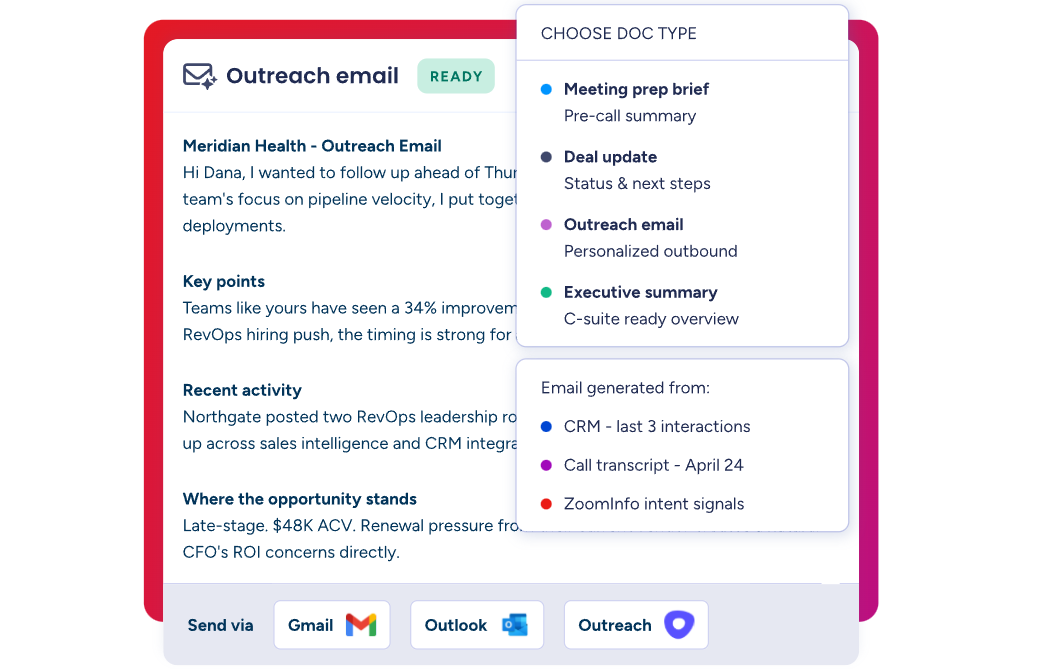
"That combination of our internal CRM data, external signals, and AI that's given all that context has helped us craft very specific account- and persona-based messages. And people have responded to them right away." — Toby Carrington, Chief Business Officer, Seismic (Seismic Case Study)
Integrations and ecosystem
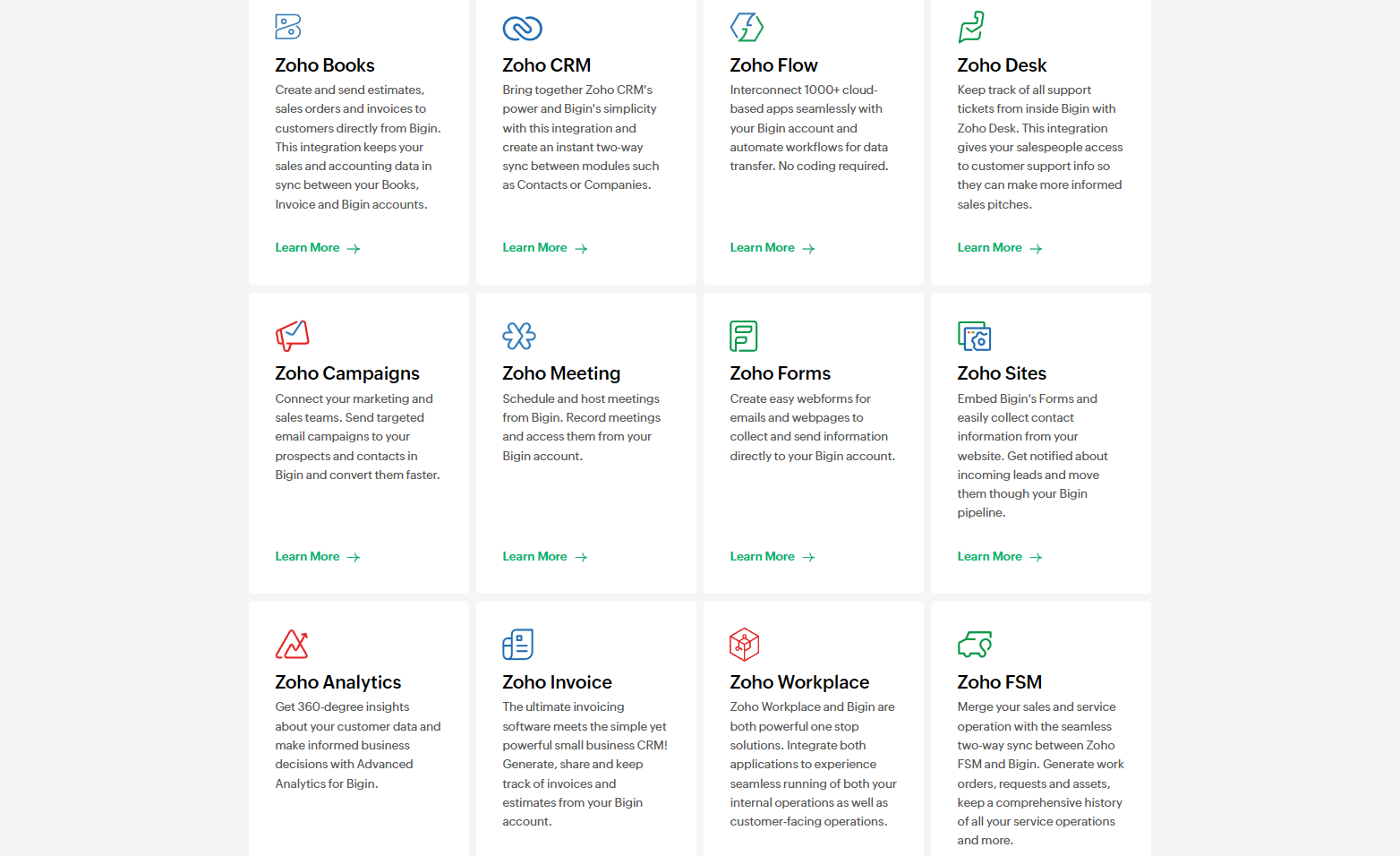
Bigin integrates natively with 15+ Zoho apps (Zoho Books, Desk, Campaigns, Analytics, and more), plus Google Workspace, Microsoft 365, WhatsApp, Zapier, Mailchimp, Zoom, QuickBooks Online, Shopify, and Stripe, among other third-party apps. The Zoho Flow connector extends reach to 1,000+ apps. REST APIs are available on all plans, including free. For businesses already using Zoho products, Bigin is the natural CRM complement.
Source: Bigin
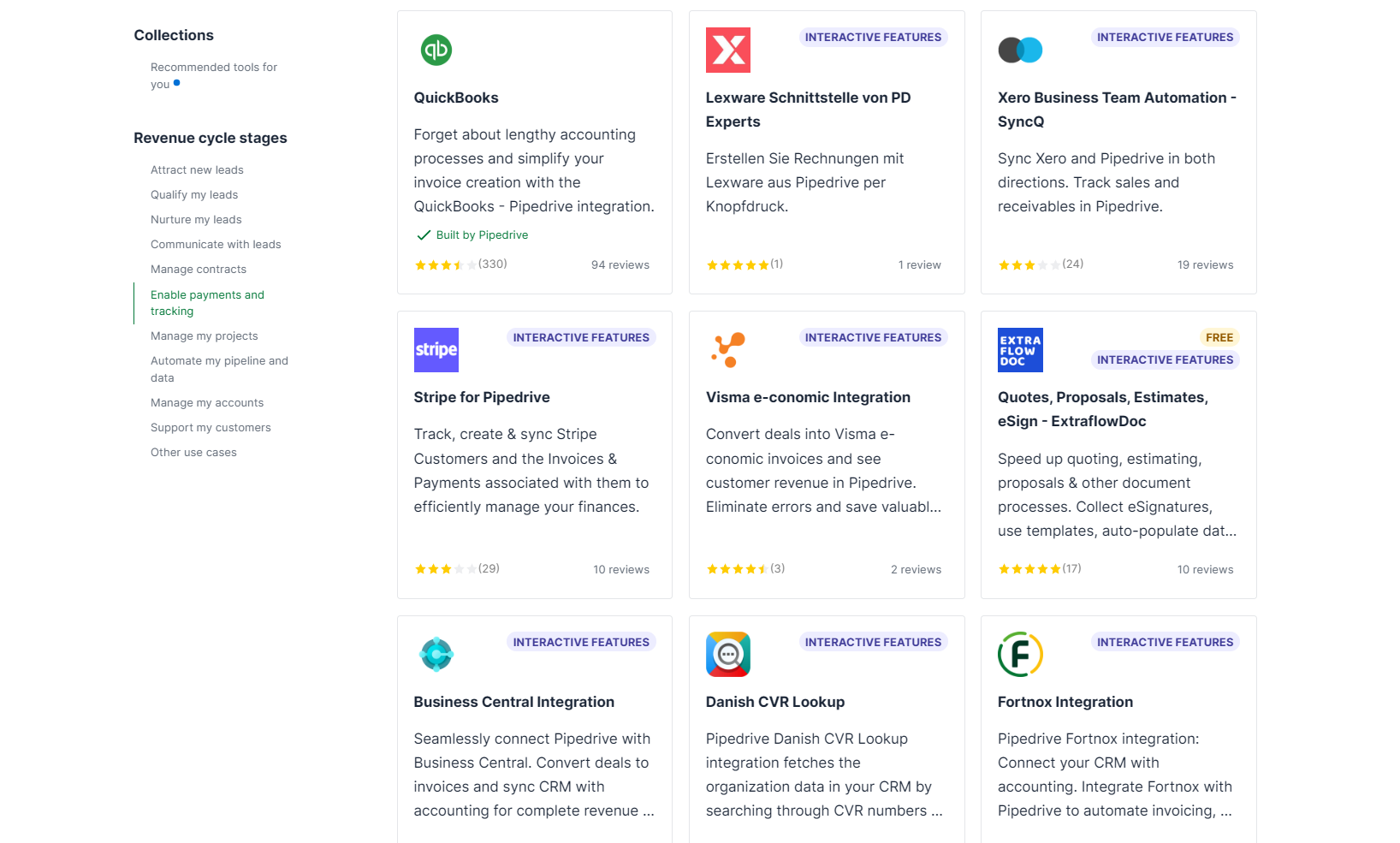
Pipedrive offers 500+ marketplace integrations covering accounting (QuickBooks, Xero, Stripe), communication (Slack, Zoom, Teams), document management (PandaDoc, DocuSign), and automation (Zapier, Make). The open API is available on all plans. App Extensions let developers embed custom UI inside Pipedrive. For teams with established sales stacks, Pipedrive's integration breadth is a clear advantage over Bigin.
Source: Pipedrive
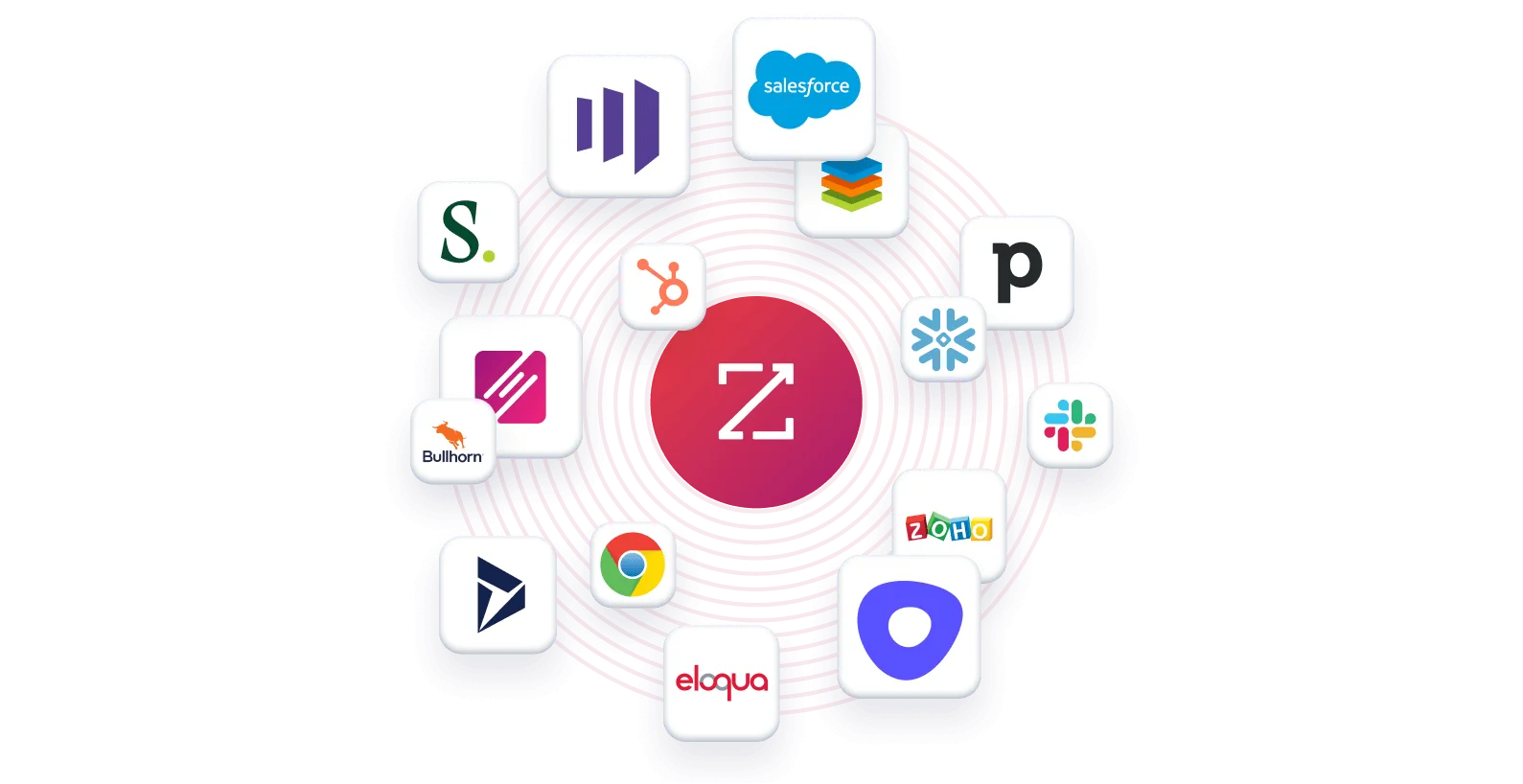
ZoomInfo integrates with 120+ tools across CRM, marketing automation, sales engagement, revenue intelligence, and data warehouse categories, including Salesforce, HubSpot, Microsoft Dynamics 365, Snowflake, and Salesloft among other enterprise platforms. The Enterprise API provides programmatic access to ZoomInfo's data and intelligence. The MCP server connects AI models directly to ZoomInfo's B2B data as a native tool, supporting Claude and ChatGPT. Cloud Partners enable direct data ingestion into AWS, Google Cloud, Snowflake, and Databricks. API access is included in all relevant plans.
"The plug-and-play aspect of the API means I can integrate it into any process and get information at a moment's notice." — Jerry Wilson, Senior Marketing Intelligence Analyst, BDO Canada (BDO Canada Case Study)
Reporting and analytics
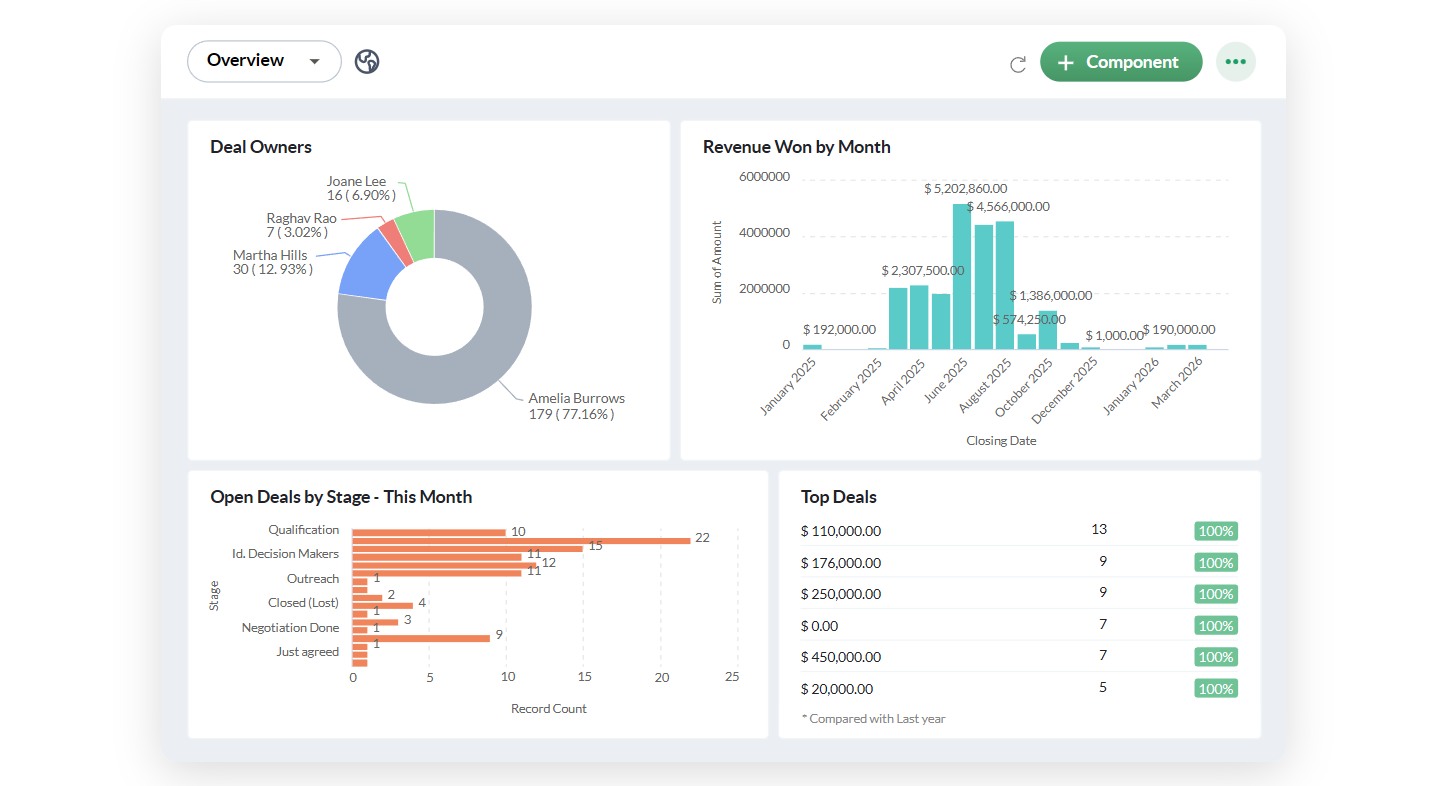
Bigin's reporting covers charts (pie, bar, funnel, heatmap), KPIs, and Target Meters. Pre-built dashboards for call and email analytics require no setup. Dashboard Drilldown lets you click into any chart to view and edit underlying records. Custom dashboards are available from Express. For deeper analysis, you need a separate Zoho Analytics subscription.
Source: Bigin
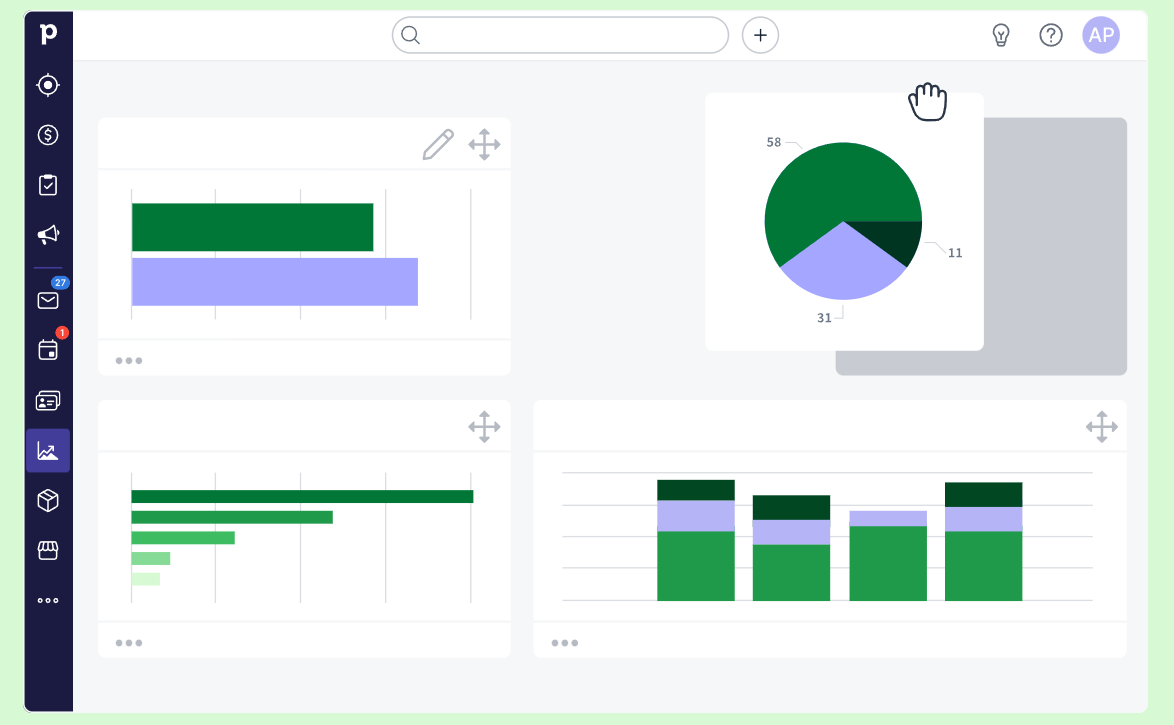
Pipedrive offers customizable reports with revenue forecasting, conversion reports, deal velocity analysis, and team performance metrics. AI-generated reports let you type a question in plain language and get a report without configuring filters, available on all plans. Shareable dashboards let non-Pipedrive users view reports via link. Goal tracking with visual progress indicators keeps teams accountable.
Source: Pipedrive
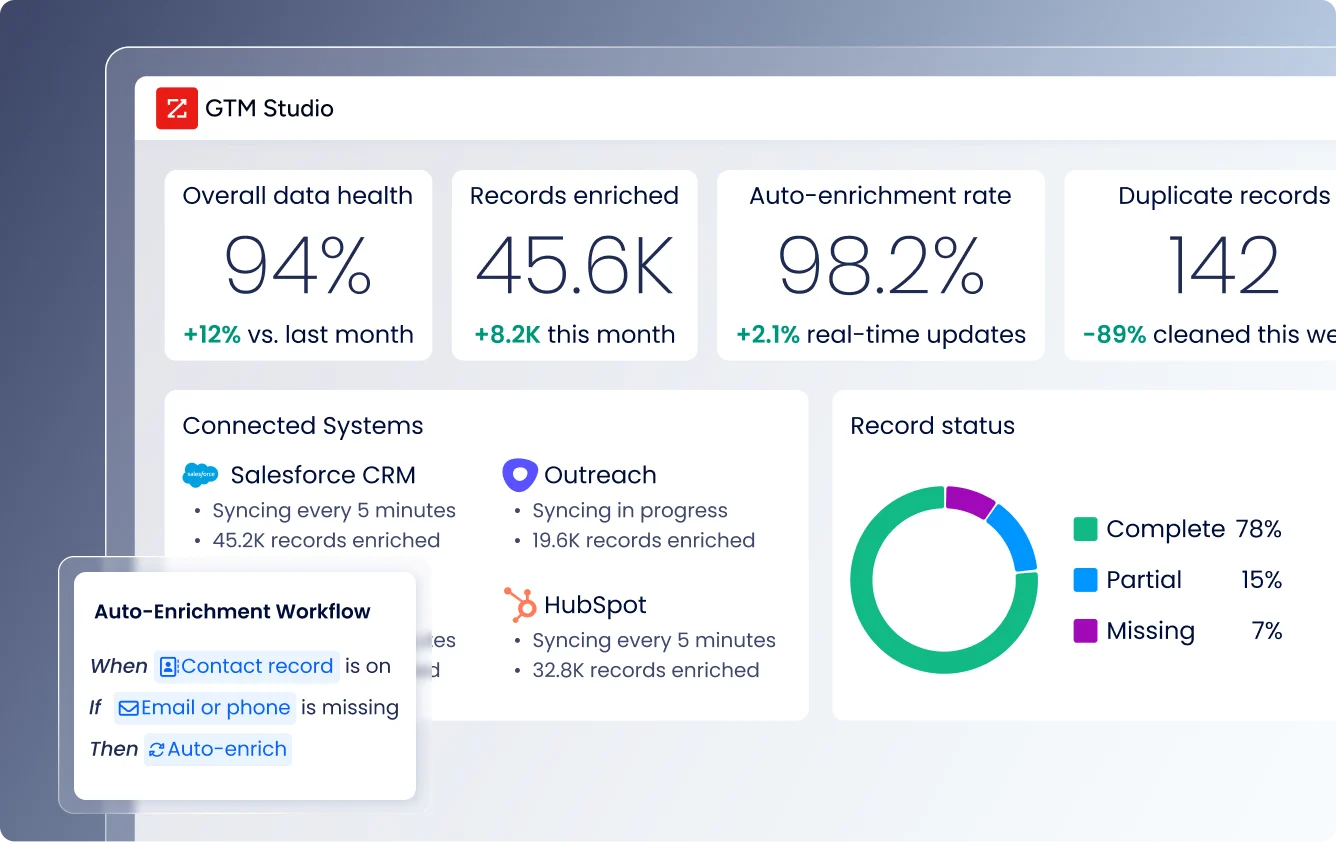
ZoomInfo provides dashboards tracking engagement, funnel progression, and top-performing segments through GTM Studio, plus deal intelligence and win-pattern analysis through GTM Workspace. The analytics go beyond what happened in your pipeline. They draw on the GTM Context Graph to explain why deals moved and which patterns predict success.
Pricing tells you who each platform is for
The pricing structures make the target buyer clear.
Bigin offers four tiers:
Plan | Price (annual) | Records | Pipelines | Automations |
|---|---|---|---|---|
Free | $0 (1 user only) | 500 | 1 | 3 |
Express | $7/user/month | 50,000 | 3 | 30 |
Premier | $12/user/month | 100,000 | 5 | 50 |
Bigin 360 | $18/user/month | 1,000,000 | 15 | 100 |
Bigin includes built-in telephony on the free plan, WhatsApp integration from Express onward, and no forced contracts with a 30-day money-back guarantee. The free plan is permanent but single-user. Paid plans offer a 15-day free trial with no credit card required.
Pipedrive offers four tiers with no permanent free plan:
Plan | Key additions | Notable limits |
|---|---|---|
Lite | Core pipeline, contacts, Pulse feed, API | No email sync, no automations, 2,500 leads+deals per seat |
Growth | Email sync, automations, sequences, scheduler | 50 automations, 5 sequences, 100 custom fields |
Premium | Smart Docs, Projects, LeadBooster included, AI email | 150 automations, 25 sequences, 300 custom fields |
Ultimate | Contact enrichment, security alerts, highest limits | 250 automations, 50 sequences, 500 custom fields |
Pipedrive offers up to 42% off with annual billing and a 14-day free trial with full access. No credit card required for the trial. Annual subscriptions cannot be refunded after purchase.
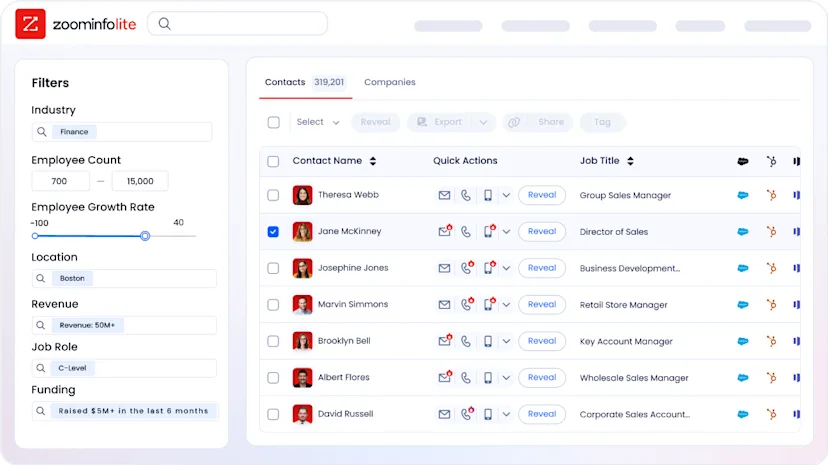
ZoomInfo uses custom-quoted, consumption-based pricing organized into Sales and Marketing product lines, each with tiered plans (Professional, Advanced, Enterprise for Sales; Marketing Demand, ABM Lite, ABM Enterprise for Marketing). No prices are published. A permanent free tier, ZoomInfo Lite, provides access to ZoomInfo's B2B database with 10 monthly export credits, and a 7-day free trial is available for paid plans.
The comparison is straightforward: Bigin is priced for businesses where CRM is a new expense. Pipedrive is priced for businesses where CRM is a core tool. ZoomInfo is priced for B2B organizations where go-to-market intelligence drives revenue.
Bigin vs. Pipedrive vs. ZoomInfo: Which should you choose?
The right choice depends on where you are and where you're going.
Choose Bigin if:
You're adopting a CRM for the first time and need something you can set up in 30 minutes
Your budget is under $20/user/month and you need telephony and WhatsApp included
You manage multiple business processes (sales, onboarding, support) and want them in one account
Your team runs on Zoho products and wants a native CRM complement
You value mobile-first design with device-specific integrations
Choose Pipedrive if:
You have a dedicated sales team that needs pipeline management and forecasting
Workflow automation with conditional logic, sequences, and date-based triggers matters to your process
You need 500+ integrations with your existing sales stack
Email marketing and prospecting tools under one CRM roof appeal to you
You want AI-assisted email writing, deal scoring, and natural language reporting
Choose ZoomInfo if:
You sell B2B and need to identify which companies to target, not just manage deals you already have
Buyer intent signals, verified contact data, and org chart intelligence would change how you prospect
Your team needs AI agents that research accounts, draft outreach, and update CRM without manual work
You want the same intelligence layer accessible in your CRM, in a dedicated workspace, or via API in any tool
You're ready to move from managing a pipeline to building an intelligence-driven go-to-market motion
See how ZoomInfo's intelligence transforms your go-to-market execution.
Bigin and Pipedrive are both well-designed CRMs that solve real problems for the teams they serve. Bigin gives micro-businesses a capable system at an approachable price. Pipedrive gives growing sales teams the depth to manage, automate, and forecast with confidence.
But for B2B companies where finding the right prospects matters as much as managing them, the intelligence layer is the missing piece. ZoomInfo provides that layer: the data, the context, and the AI-driven execution that turns a static pipeline into an active growth engine.
Bigin vs. Pipedrive vs. ZoomInfo FAQ
What is the main difference between Bigin, Pipedrive, and ZoomInfo?
Bigin is a simple, affordable CRM for small businesses new to CRM software, with Team Pipelines for managing sales, onboarding, and support in one account. Pipedrive is a more capable sales CRM for dedicated sales teams, with deeper automation, forecasting, and 500+ integrations. ZoomInfo is an AI go-to-market platform that provides B2B data intelligence, buyer intent signals, and AI-driven execution, solving the upstream problem of finding and qualifying the right prospects before deals enter any CRM.
Which platform is cheapest?
Bigin is the most affordable, with a permanent free plan (single user) and paid plans starting at $7/user/month. Pipedrive has no free plan and starts at $14/user/month. ZoomInfo uses custom-quoted pricing for paid plans but offers a permanent free tier called ZoomInfo Lite with 10 monthly export credits and access to its B2B database.
Can I use ZoomInfo alongside Bigin or Pipedrive?
Yes. ZoomInfo integrates with major CRMs through its API and marketplace integrations. Pipedrive is available through the ZoomInfo marketplace ecosystem. For any CRM, ZoomInfo's API and MCP server can push enriched contact data, intent signals, and account intelligence into the tools your team already uses. ZoomInfo works alongside your CRM, not as a replacement.
Which platform has the best automation capabilities?
Pipedrive leads among the two CRMs, with if/else branching, date-based triggers, sequences that pause on engagement, and native Slack and Teams integrations in its automation engine. Bigin keeps automations simpler with trigger-condition-action workflows and caps at 100 rules on its highest plan. ZoomInfo takes a different approach, using AI agents that handle account research, outreach drafting, and CRM updates continuously based on the GTM Context Graph.
Which platform is best for a small business with no CRM experience?
Bigin. Sixty-five percent of its customers had never used a CRM before signing up. It offers a 30-minute setup, a permanent free plan, built-in telephony, and a learning curve close to zero. Bigin also includes pre-built pipeline templates for common use cases like order fulfillment, recruitment, and event management.
How do prospecting capabilities compare?
Bigin captures leads through web forms and social ad integrations but has no built-in prospecting database. Pipedrive offers Prospector with access to over 400 million profiles and 10 million companies, plus the Pulse toolkit for data enrichment and lead scoring. ZoomInfo provides the largest B2B data platform with 500M contacts, 100M companies, buyer intent data tracking 210 million IP-to-Organization pairings, website visitor identification, technographic data on 30+ million companies, and department org charts with verified direct-dial numbers and emails.
Which platform has the best mobile app?
Bigin and Pipedrive both offer strong mobile apps, but with different strengths. Bigin was designed mobile-first and offers platform-specific integrations including Samsung S Pen and Galaxy AI support, Apple Watch companion, and Apple Pencil compatibility. Pipedrive provides a solid mobile CRM with offline mode, in-app calling, and a Nearby feature for field reps. ZoomInfo provides mobile access through its platforms but is primarily a desktop intelligence tool.
Is Pipedrive or Bigin better for a growing sales team?
Pipedrive. It offers unlimited pipelines on all plans, deeper automation with conditional logic, revenue forecasting, deal scoring, AI email writing, and a prospecting toolkit. Bigin is designed for smaller operations and includes plan-level caps on pipelines, automations, and custom fields that growing teams will outgrow. Bigin acknowledges this by offering a migration path to Zoho CRM.
More CRM comparisons worth a look:
