
CaptivateIQ has moved fast since its founding in 2017. What started as a commission automation tool built to replace spreadsheets has grown into a sales performance management platform, earning a Leader placement in The Forrester Wave for Sales Performance Management Solutions, Q1 2025 and a Customers' Choice distinction from Gartner Peer Insights.
It now handles commission calculations, territory plannisng, quota setting, and predictive modeling from a single workspace, trusted by 800+ companies including Gong, Expedia, Boston Scientific, and Deel.
To write this CaptivateIQ review, we analyzed the platform in depth. It's the right choice if:
You manage complex, multi-tier commission structures that have outgrown spreadsheets
You need compensation teams to own plan changes without filing IT tickets
You want commission calculations, territory planning, and quota setting in one system
SOX compliance, audit trails, and financial controls are non-negotiable
You have the internal resources and time to invest in a thorough implementation
However, CaptivateIQ might not be the best choice if:
You need a self-serve trial or transparent pricing before committing
Your team requires native iPaaS connectors (Zapier, Workato, Make)
You want a mobile app for reps to check earnings on the go
You're a smaller team looking for quick, lightweight commission tracking
You need the platform productive within days rather than weeks or months
CaptivateIQ handles what happens after deals close (calculating commissions, managing payouts, planning territories), but the quality of those plans depends on the data feeding them. Territory carves, quota targets, and incentive models are only as strong as the account intelligence behind them.
This is where ZoomInfo enters the picture: a B2B data and intelligence platform built on 500M contacts, 100M companies, 135M+ verified phone numbers, and 200M+ verified business email addresses. ZoomInfo provides the account data, buyer signals, and market intelligence that inform the sales planning decisions CaptivateIQ executes.
We've included a look at ZoomInfo later in this review as the natural complement for teams that want compensation and planning decisions built on accurate, verified data. If you're ready to explore ZoomInfo, you can start a free trial.
What is CaptivateIQ?
CaptivateIQ is an incentive compensation management and sales performance platform founded in 2017 by Mark Schopmeyer, Conway Teng, and Hubert Wong. The three co-founders came from sales operations and finance and built the product they wished had existed.
As they described in their Series C announcement: "When we founded CaptivateIQ four years ago, compensation leaders were tracking and managing sales data using outdated legacy software or, in the worst cases, a single spreadsheet."
The company joined Y Combinator in 2018, landed its first paying customer that same year, and has since raised $164.6 million across multiple rounds from Sequoia Capital, Accel, and ICONIQ Growth. A Series C in January 2022 valued the company at $1.25 billion.
Today, CaptivateIQ positions itself around the concept of "Return on Incentives." As its About page explains: "Despite being one of the largest expenses on a P&L, many companies fail to calculate the return they're getting on their incentive programs."
The platform aims to turn commissions from an opaque cost center into a measurable growth lever.
The product suite spans three modules: CaptivateIQ Incentives for commission management, CaptivateIQ Planning for territory and quota management, and CaptivateIQ Catalyst for predictive modeling. All three run on SmartGrid, a proprietary calculation engine that processes over 6.25 trillion calculations per month.
CaptivateIQ targets both enterprise and mid-market companies with complex commission structures. Primary buyers are compensation professionals, finance and accounting teams, sales operations leaders, and revenue operations teams. The platform has particular depth in Technology/SaaS, Financial Services, Medical Devices, and Manufacturing.
CaptivateIQ Pros & Cons
Pros | Cons |
|---|---|
No-code plan builder handles complex multi-tier commission logic | Steep initial setup requires significant time and internal resources |
SmartGrid processes 10M+ transactions in 12 seconds | No published pricing; all quotes require sales contact |
Planning and incentives unified in a single platform | No native iPaaS connectors (Zapier, Workato, Make) |
Real-time rep earnings visibility with AI explainers | Performance slowdowns reported with large commission models |
Strong SOX compliance and audit controls | No mobile app available or on near-term roadmap |
Forrester Wave Leader in SPM (Q1 2025) | Reporting and dashboard customization is limited |
94% CSAT from 2,500+ G2 reviews | One-time setup fee plus potential connector and support add-on costs |
CaptivateIQ Review: How It Works & Key Features
Commission Management: CaptivateIQ automates the full cycle from data ingestion through payout, replacing manual spreadsheet processes.
CaptivateIQ's core product, CaptivateIQ Incentives, replaces the spreadsheets and legacy tools compensation teams have relied on. The platform claims a 90% decrease in monthly processing time and 60 hours per month saved on average.
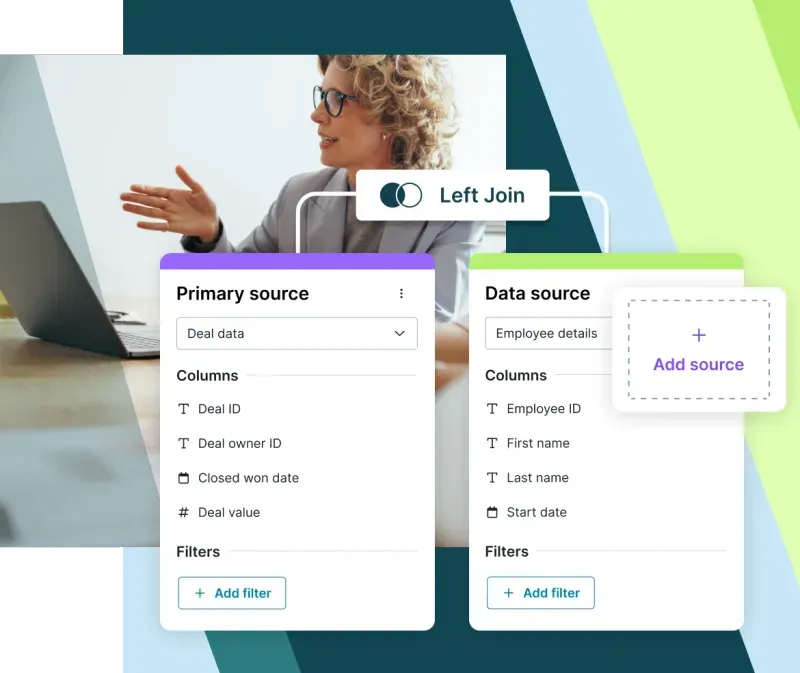
The workflow starts with data ingestion. SmartGrid connects to CRMs, ERPs, and other source systems, loading up to 50 million records per sync. Administrators build commission plans using a no-code Guided Plan Builder with spreadsheet-like logic.
Source: CaptivateIQ
The platform handles tiers, accelerators, splits, overlays, draws, partner commissions, bonuses, and clawbacks, supporting up to 7,000 unique plans simultaneously.
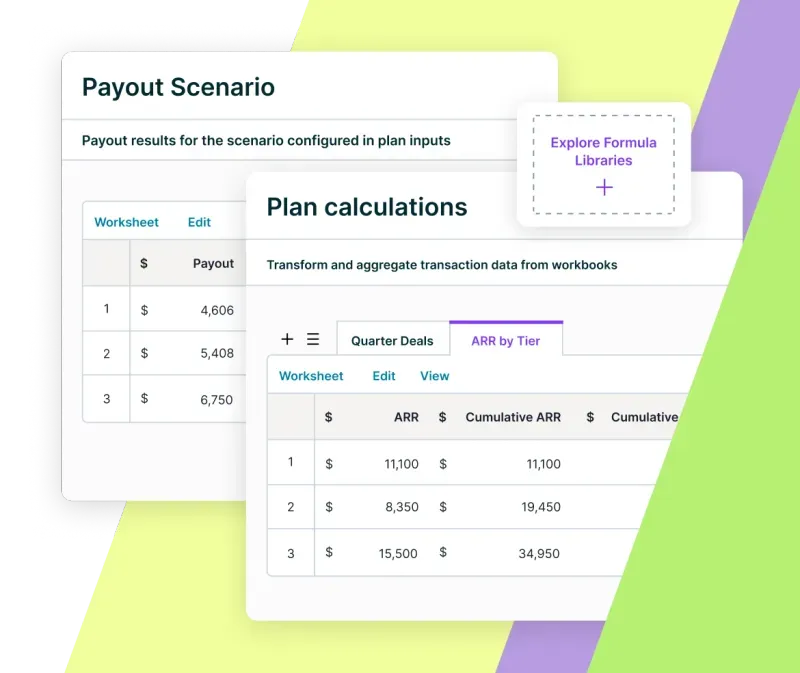
Once plans are configured, SmartGrid runs dependency-aware calculations across thousands of payees at once. Every payout traces from the source transaction through the applied logic, which matters for both accuracy and SOX audit requirements.
Source: CaptivateIQ
After calculations complete, built-in workflow automation handles statement generation, multi-step approvals, and locking. Commission statement locking prevents unauthorized post-approval changes, and the full audit trail supports ASC 606 reporting and compliance review.
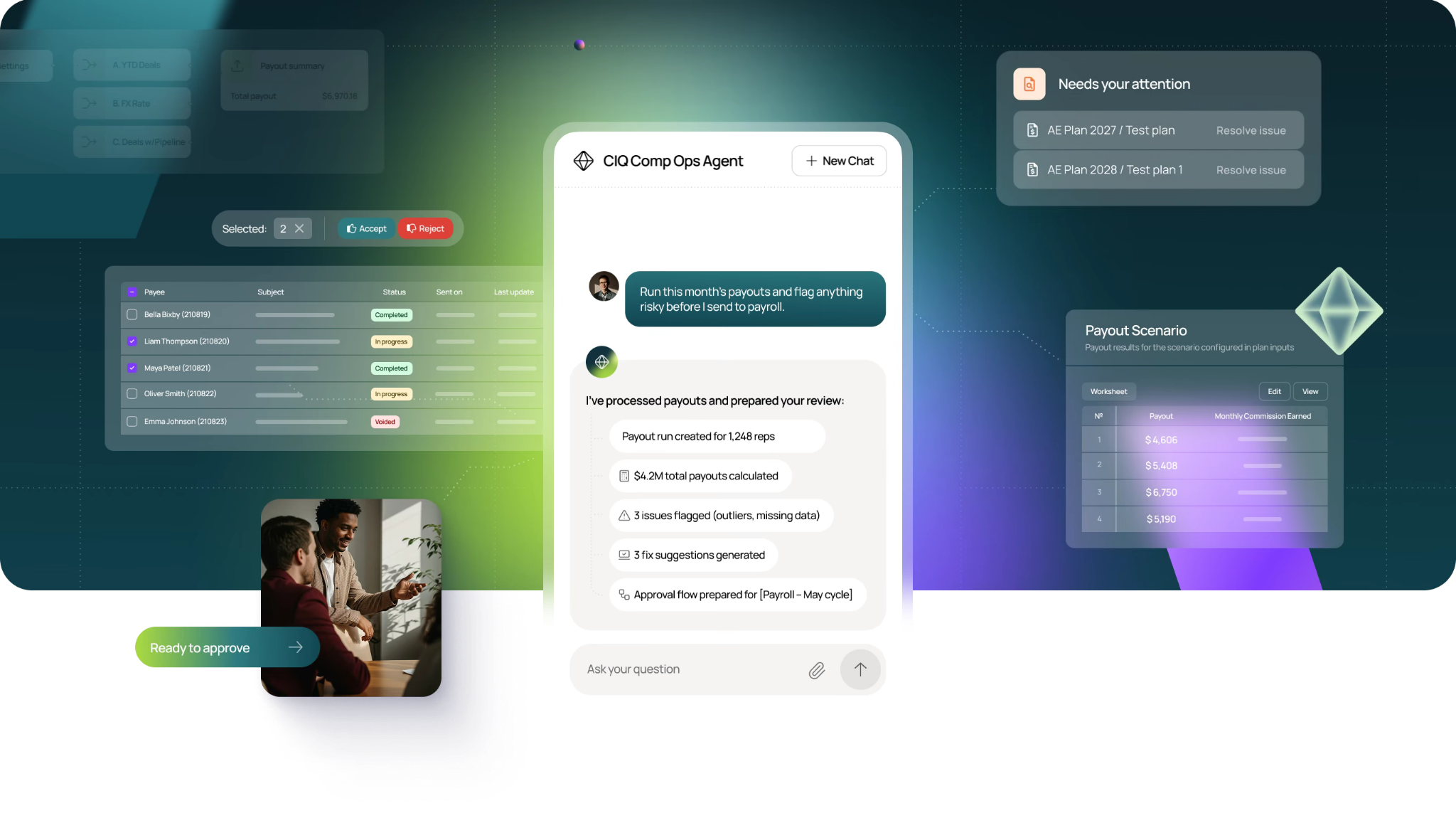
On the rep-facing side, sellers access their earnings through a web interface where AI agents generate plain-English explanations for every line item, citing plan clauses and underlying transactions. Reps can run natural-language what-if analysis to see how future deals would affect their commissions.
Sales Planning: CaptivateIQ unifies territory management, quota setting, and capacity planning in the same platform as incentive compensation.
CaptivateIQ Planning addresses a problem most compensation teams know well: when capacity plans, territory assignments, and quota targets live in disconnected spreadsheets, changes in one area don't propagate to the others. The result is misaligned hiring plans, unfair territory carves, and quotas that don't reflect reality.
Planning runs on the same SmartGrid engine as Incentives. Users connect data from CRMs (Salesforce, HubSpot), ERPs (NetSuite, Sage Intacct), HRIS platforms (Workday), and data warehouses (Snowflake, Amazon Redshift) via native connectors. SmartGrid handles data cleanup and combination in a no-code interface without pre-processing.
The module covers three connected dimensions.
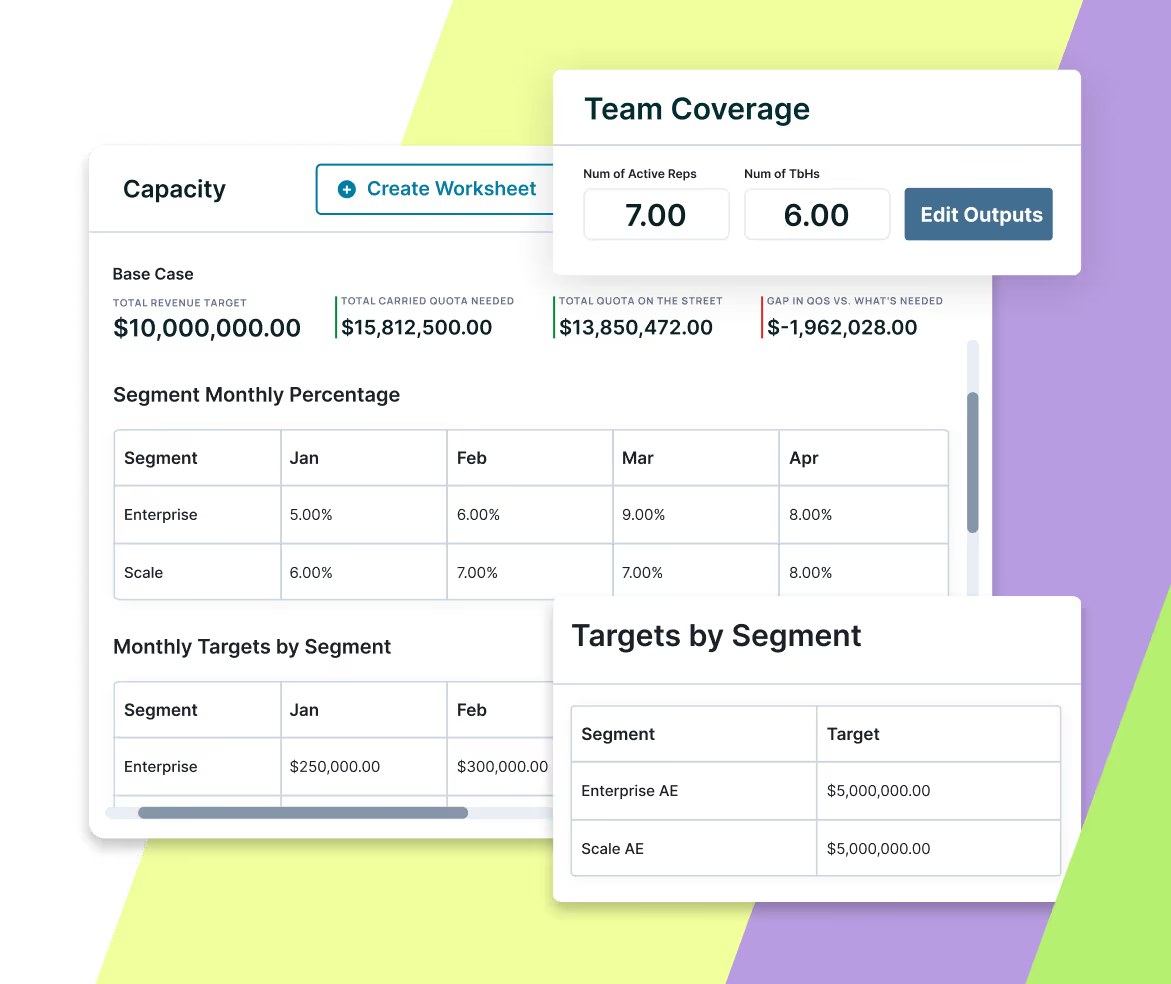
Capacity planning lets teams build and adjust hiring and ramp plans against revenue targets, with AI-generated scenarios surfacing alternative hiring paths.
Source: CaptivateIQ
Quota setting provides role-based quota templates with ramp adjustments, historical performance calibration, and both top-down and bottom-up methodologies.
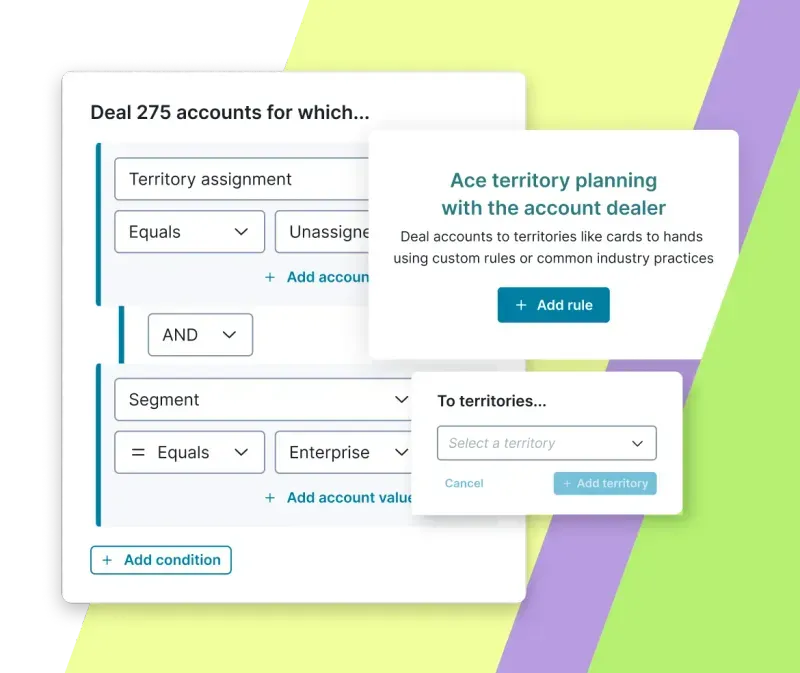
Territory and account carving uses rule-based assignment logic to distribute accounts across territories in seconds, with scenario modeling to evaluate revenue impact before committing.
Source: CaptivateIQ
The key advantage is the closed loop. Quota changes in Planning automatically sync to compensation structures in Incentives, eliminating the reconciliation burden that plagues teams using separate planning and ICM tools. When a territory is reorganized mid-quarter, the downstream commission impact is calculated immediately.
AI Agents: CaptivateIQ's AI agents handle plan building, payout explanation, and territory configuration through natural language.
CaptivateIQ Agents is a suite of AI agents that operate within the platform, grounded in actual plan rules, performance data, and calculation logic. The suite launched in May 2026 at the company's annual Captivate user conference, with initial agents in limited beta and general availability planned for later in 2026.
Three agents cover distinct workflows.
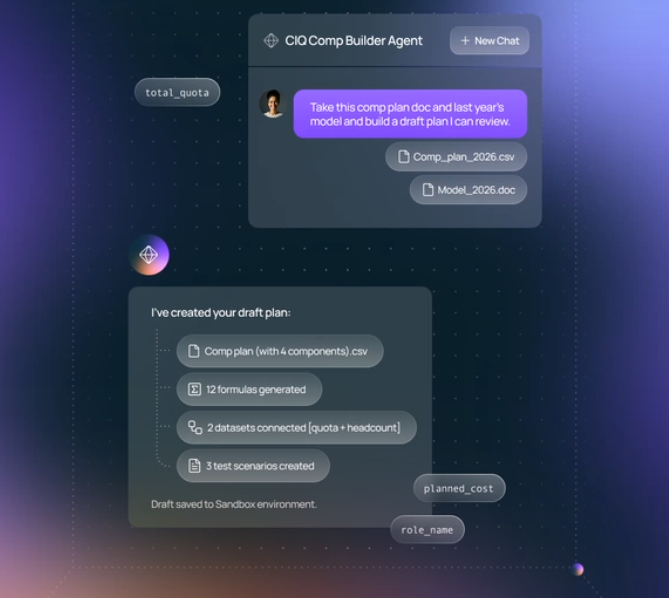
The Comp Builder Agent lets administrators describe a compensation plan in plain language and the agent builds it without formulas or code. It can also debug complex compensation logic and reduce plan design errors through verification.
Source: CaptivateIQ
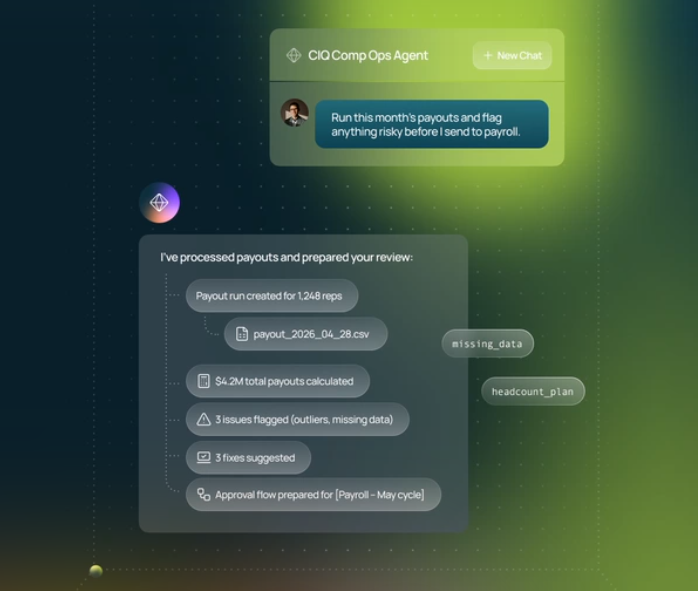
The Comp Ops Agent explains commission payouts in plain English, including formulas, plan rules, and source data. Its sub-components, the Plan Doc Explainer and Statement Explainer (both launched in December 2025), answer questions about quotas, targets, eligibility rules, and validate calculations.
Source: CaptivateIQ
The Rev Planning Agent lets users describe a territory assignment goal in natural language, and the agent builds and runs the configuration for human review before committing.
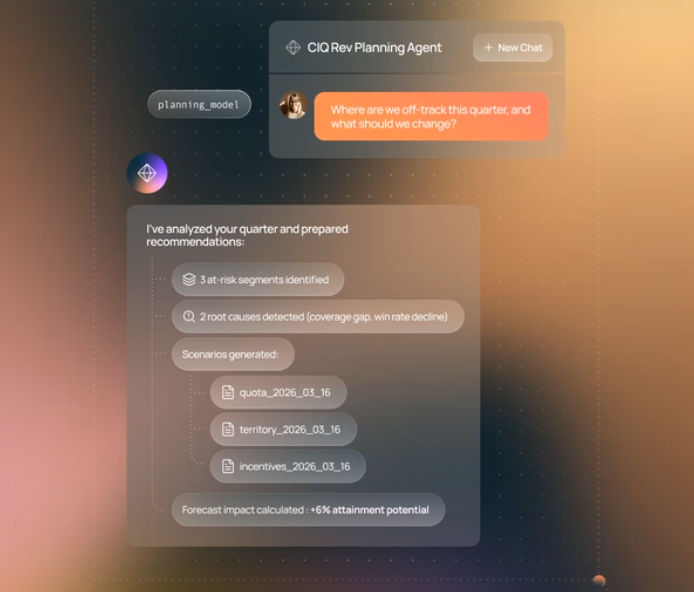
Source: CaptivateIQ
What distinguishes these from generic AI assistants is the governance layer. Every agent action follows the same permissions, rules, and approval processes already defined in the platform. In a system where calculation errors have direct financial consequences, that matters.
Workflow Automation: CaptivateIQ removes manual steps between commission calculations and payroll through no-code workflow builders.
Enterprise Workflow Automation addresses what CaptivateIQ calls "Time-to-Payroll" (TTP) inefficiency: the weeks of manual processes spanning different teams and systems after calculations complete.
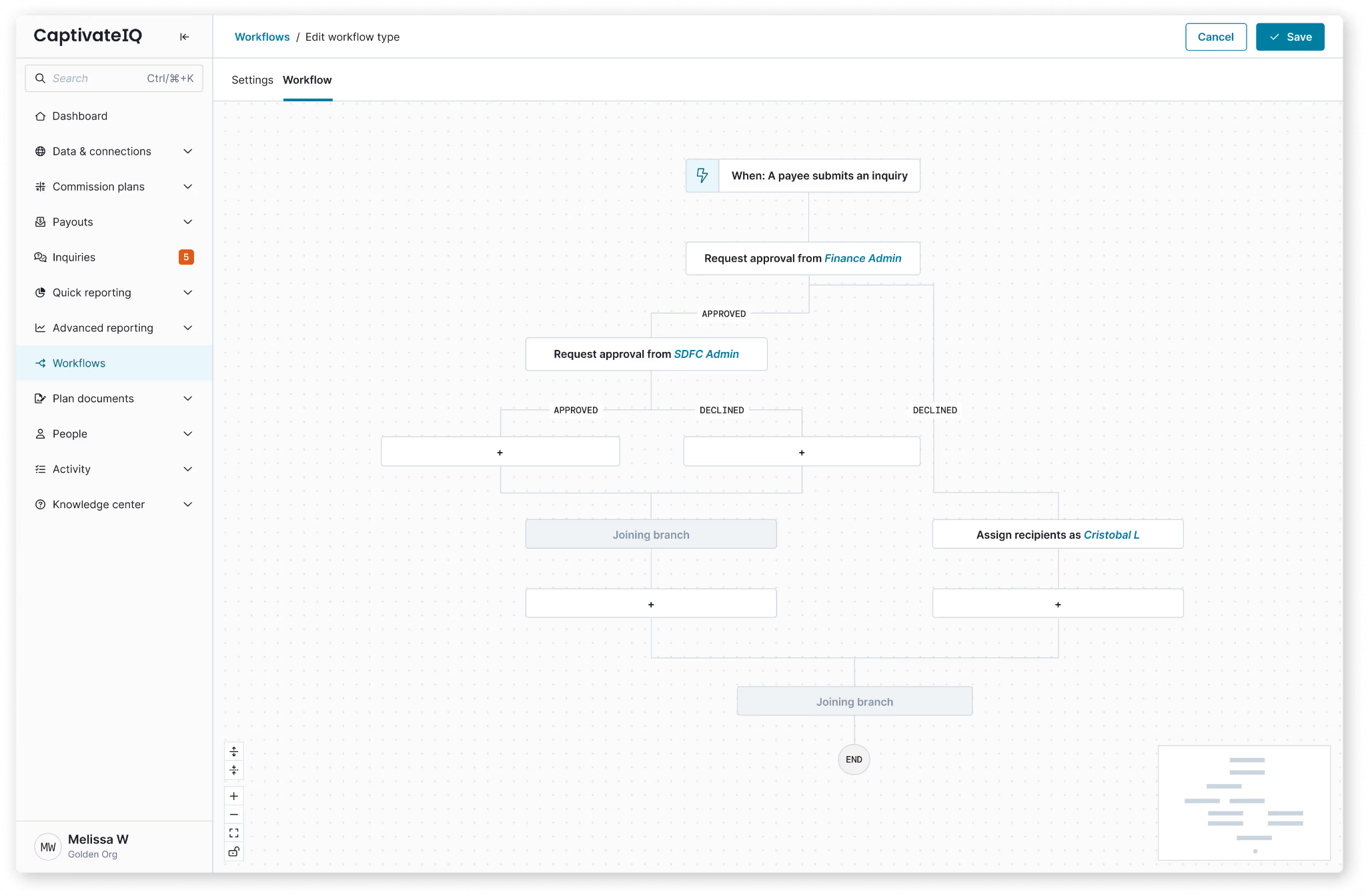
The Custom Workflow Builder is a no-code interface where admins define automated workflows for inquiry types, approval chains, routing logic, and outcome paths. Workflows can be triggered by rep submissions (flagging incorrect deal data), organizational changes (territory reassignments), or system events.
Source: CaptivateIQ
The system routes automatically to admin-defined recipients at each step with email notifications, supports branching logic with multiple outcome paths, and when corrections are confirmed, adjustments are applied to upstream data.
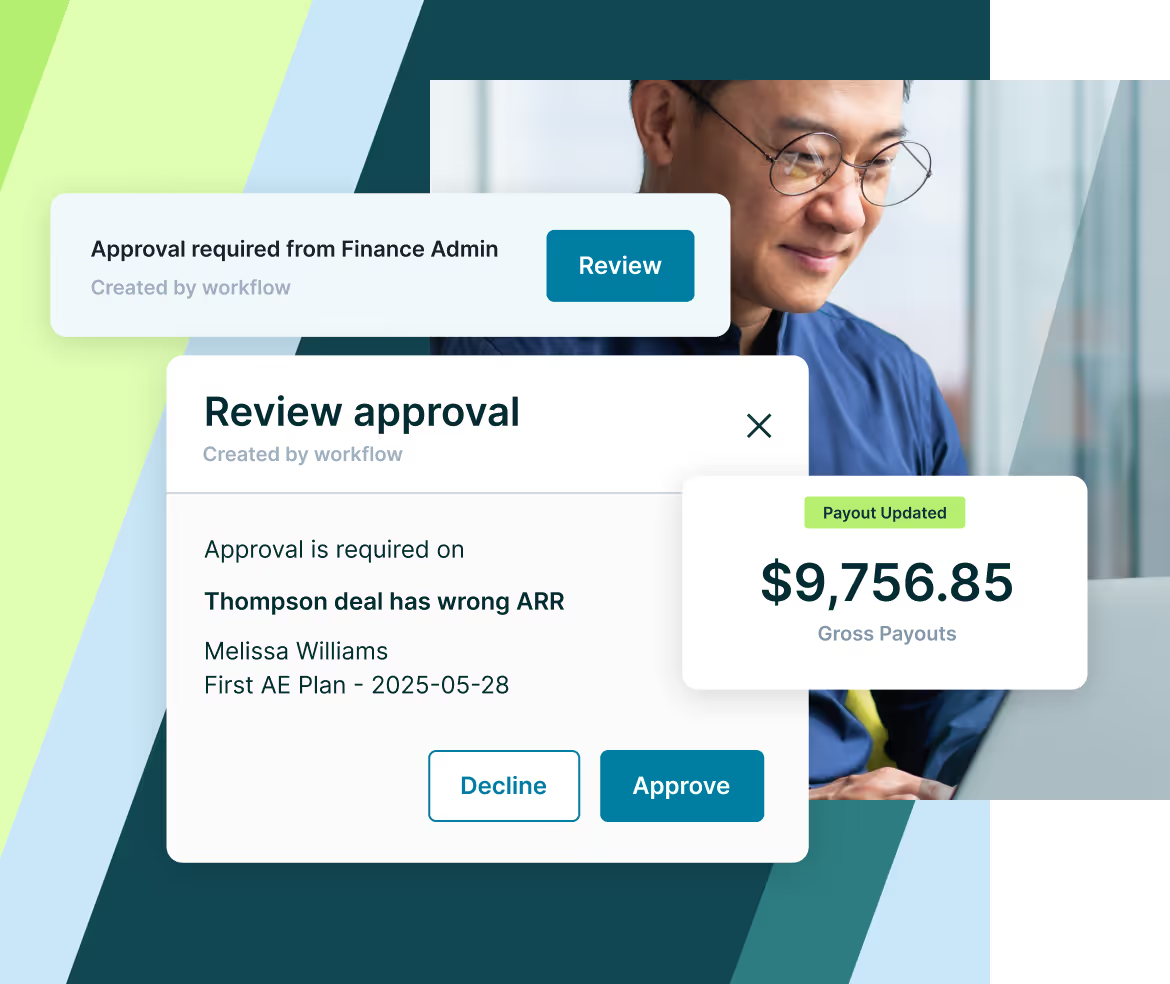
The module also automates MBO goaling and scoring, discretionary bonus approvals, and data collection for quota assignments and split modifications. All approvals and inquiry statuses are visible in one place, with justification records for compliance integrated with the platform's SOX controls.
Source: CaptivateIQ
Pricing: CaptivateIQ uses custom, quote-based pricing with no published price points.
CaptivateIQ does not publish specific pricing. The pricing page directs all prospects to "Contact us for a custom quote."
The model is per-seat pricing plus a one-time setup fee. Seats include both admin users and total payees. Three factors drive the final quote: the number of payees, the complexity of compensation plans, and the integrations required. Two customers with the same headcount could receive different quotes based on plan complexity.
CaptivateIQ Incentives, Planning, and Catalyst are three distinct products, each carrying its own subscription cost.
Beyond the base subscription, documented add-ons include ASC-606 reporting (available as an add-on), Premier and Elite Support tiers (commission plan configuration support is not included in the base Basic Support tier), and integration connector fees. Professional services for implementation and custom configuration are billed separately.
Contracts auto-renew unless written non-renewal notice is provided at least 30 days before term end. All payments are final, non-cancelable, and non-refundable. There is no self-serve free trial or freemium plan, though CaptivateIQ offers self-guided product tours via Navattic.
Where CaptivateIQ Falls Short
CaptivateIQ delivers real value for complex compensation management, but several limitations show up with regular use. These reflect a platform built for depth of commission logic rather than ease of adoption or broad flexibility.
Blank Canvas Complexity. G2 reviewers consistently note that initial setup requires significant time and internal resources because CaptivateIQ is a blank canvas. TrustRadius users describe needing to understand how plans are structured before the system becomes productive.
Even after go-live, cycling from month to month takes real effort. Implementation can take 4-6 months for complex deployments, longer than some mid-market competitors.
Opaque Pricing. With no published pricing, no self-serve free trial, and no freemium tier, evaluating CaptivateIQ requires a sales conversation before you can estimate costs.
The modular structure (separate products for Incentives, Planning, and Catalyst, plus add-ons for ASC-606 reporting, premium support, and connector fees) makes total cost of ownership hard to predict until you're well into the evaluation process.
Integration Gaps. G2 and TrustRadius users flag the absence of native iPaaS connectors for Zapier, Workato, and Make. Teams needing workflow automation outside CaptivateIQ must use the raw API, which requires engineering involvement.
For a platform that otherwise emphasizes admin self-sufficiency, this creates a bottleneck.
Performance at Scale. G2 reviewers report slow page load times when viewing monthly metrics or working with large commission models. Pages reportedly query the database in real time even when underlying data only refreshes daily, adding latency during heavy processing periods.
No Mobile Access. CaptivateIQ has no mobile app, and some reviewers note it is not on the near-term roadmap. Sales reps checking earnings on the go are limited to the browser, a notable gap for a platform that emphasizes rep-facing transparency.
Reporting Constraints. G2 reviewers note that reporting features could be more customizable. Standard reporting is included in the subscription, but building the specific dashboards and views compensation leaders need often requires workarounds or exports.
These limitations aren't failures. They reflect the trade-offs of building a flexible commission platform. But they're worth weighing against CaptivateIQ's strengths, especially when evaluating how the platform fits into a broader revenue operations stack.
The Natural Complement to CaptivateIQ: ZoomInfo
CaptivateIQ handles the back end of the revenue cycle: calculating commissions, managing payouts, planning territories, and setting quotas. But every one of those functions depends on the quality of data flowing into them.
Territory carves are only as fair as the account intelligence behind them. Quota targets are only as achievable as the market data they're built on. Commission plans are only as motivating as the sales opportunities they're tied to.
This is where ZoomInfo fits. ZoomInfo is a B2B data and intelligence platform built on 500M contacts, 100M companies, 135M+ verified phone numbers, and 200M+ verified business email addresses. Its GTM Context Graph processes 1.5B+ data points daily, fusing this data with your CRM records, conversation transcripts, and behavioral signals to reveal the full context behind your accounts.

That context shows not just what happened, but why it happened and which actions to take next. Your team accesses this intelligence through the GTM Workspace for sellers, GTM Studio for marketers and RevOps, or through the API and MCP in any other front-end.
Where CaptivateIQ asks "how do we compensate the revenue our team generates?", ZoomInfo asks "how do we help them generate that revenue in the first place?" Together, they form the two halves of a complete revenue operations system.
Comprehensive Data for Smarter Territory and Quota Decisions
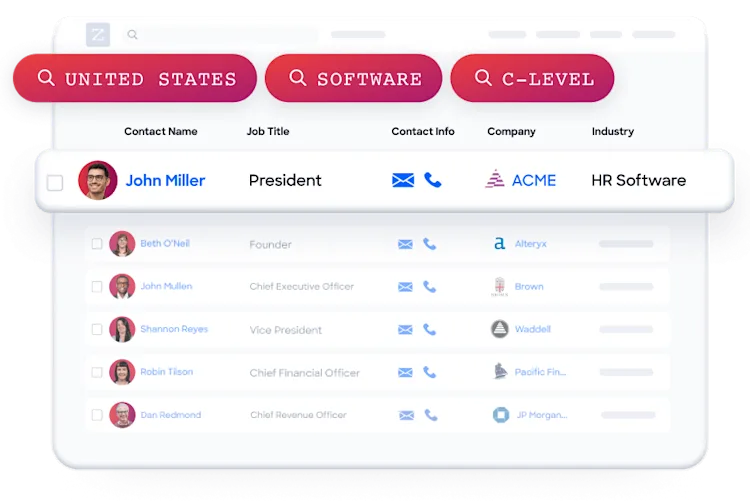
CaptivateIQ Planning lets you carve territories and set quotas. ZoomInfo provides the market intelligence to make those decisions well. With 300+ company attributes for segmentation, firmographics covering 100M companies, technographics tracking 30,000+ technologies across 200+ categories, and buyer intent data revealing which accounts are actively in-market, ZoomInfo gives RevOps teams the inputs to build fair territories and achievable quotas.
Source: ZoomInfo
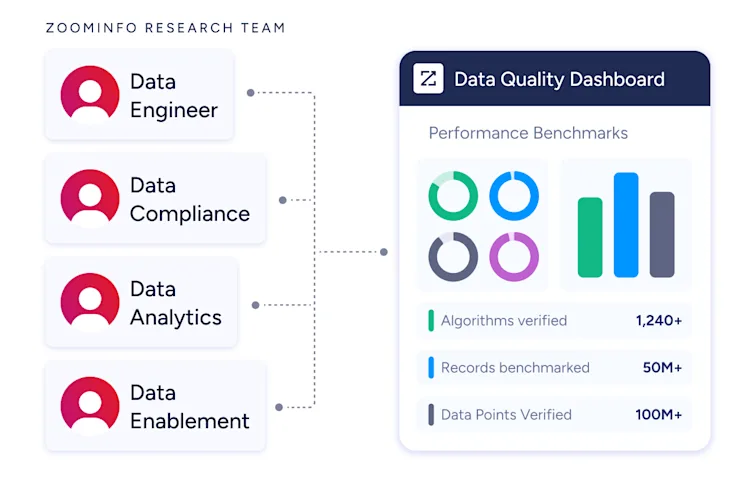
The data is verified through a multi-source pipeline backed by 300+ human researchers, reaching up to 95% accuracy on first-party data. In a Fortune 500 competitive RFP analyzing 25 million contacts across vendors, the independent consultant concluded that "no other competitor came even close."
Source: ZoomInfo
For teams using CaptivateIQ's territory planning module, ZoomInfo's data ensures that account assignments reflect actual market opportunity rather than stale CRM records.
When territory changes flow through to commission plans in CaptivateIQ, the quality of the underlying account data determines whether those plans are fair and motivating.
Snowflake feeds 70+ firmographic and technographic data fields from ZoomInfo into their Account Propensity Scoring model, achieving 90% higher opportunity rates and 2x higher customer conversion. (Snowflake Case Study)
Intelligence That Drives the Deals Your Reps Get Paid On
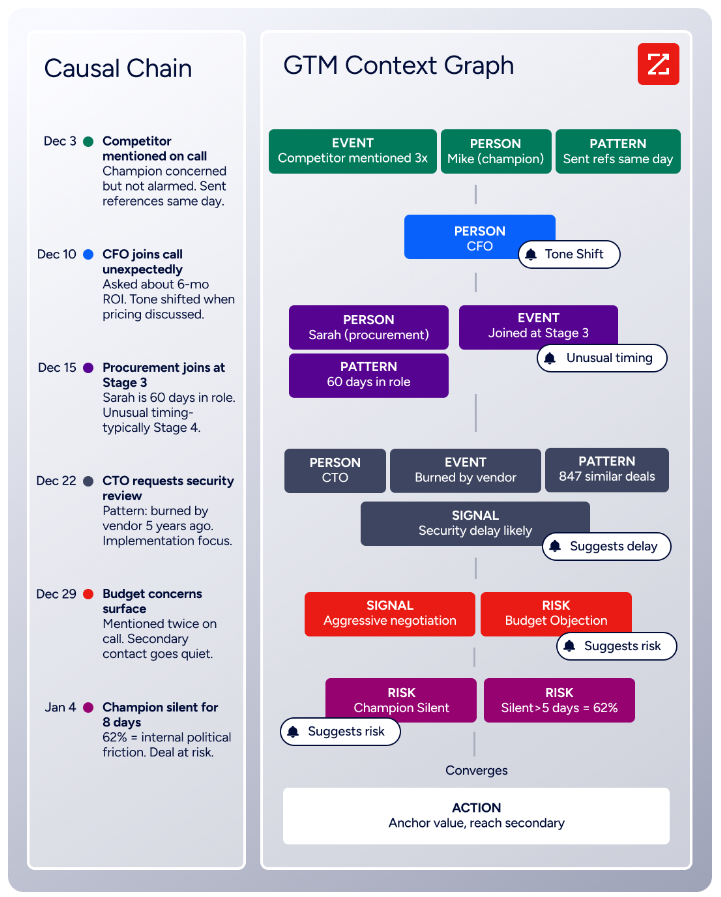
Commissions only matter when reps close deals. ZoomInfo's GTM Context Graph helps them do that by surfacing not just contact data, but the context behind buying decisions: who's championing internally, what objections are stalling progress, and which accounts match the patterns of your closed-won deals.
Source: ZoomInfo
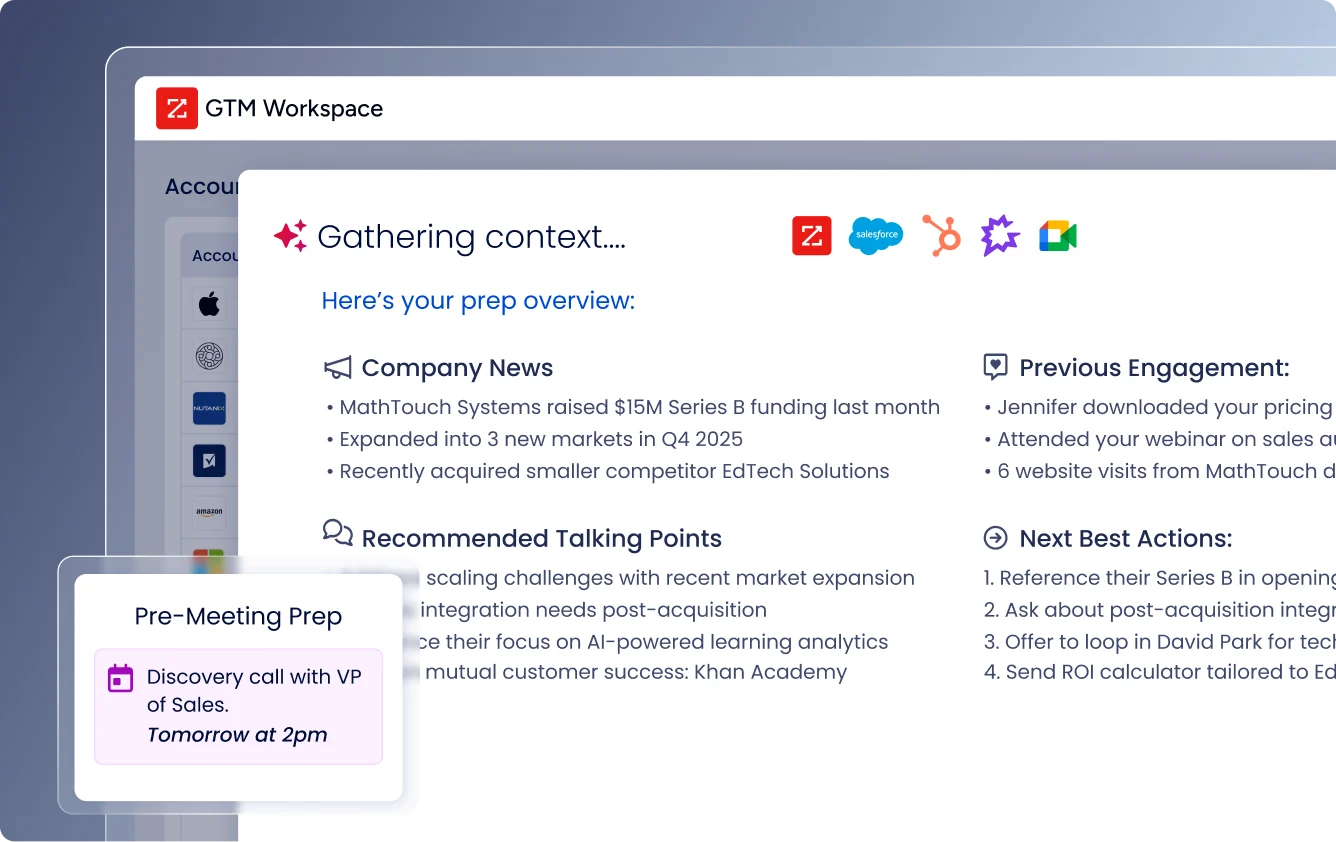
GTM Workspace gives sellers a single surface where prioritized accounts, AI-drafted outreach, and deal execution converge.
Source: ZoomInfo
The results show up in pipeline. Seismic attributed 39% of active pipeline to opportunities identified or influenced by ZoomInfo signals and reported 54% productivity gains. Thomson Reuters increased closed-won deals by 40% and achieved 115% average quota attainment each month.

Source: ZoomInfo
Higher attainment driven by better intelligence means more commissions processed through CaptivateIQ, more accurate forecasting in CaptivateIQ Catalyst, and a clearer picture of incentive ROI.
"That combination of our internal CRM data, external signals, and AI that's given all that context has helped us craft very specific account- and persona-based messages. And people have responded to them right away." Toby Carrington, Chief Business Officer at Seismic. (Seismic Case Study)
Universal Access: Use the Data Wherever Your Stack Needs It
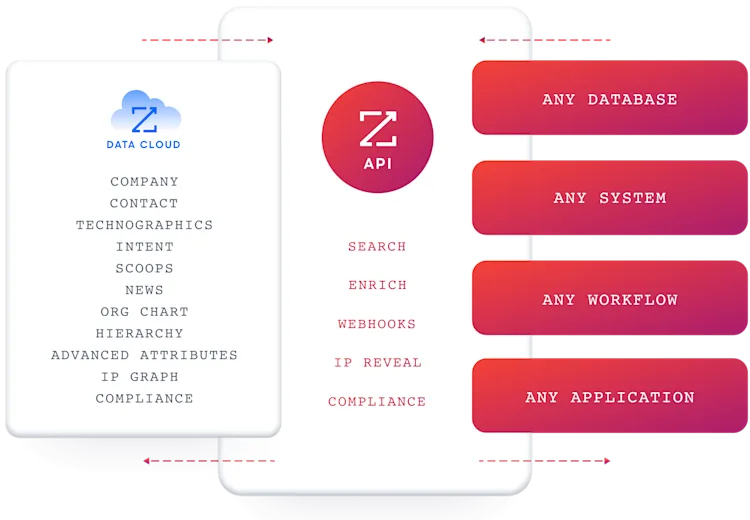
CaptivateIQ connects to CRMs, ERPs, and data warehouses through SmartGrid. ZoomInfo's data flows into those same systems through native integrations with Salesforce, HubSpot, and Microsoft Dynamics, an App Marketplace with 120+ partner integrations, Cloud Partners for direct ingestion into AWS, Snowflake, and Databricks, and an Enterprise API for programmatic access. API access is included in all relevant plans.
Source: ZoomInfo
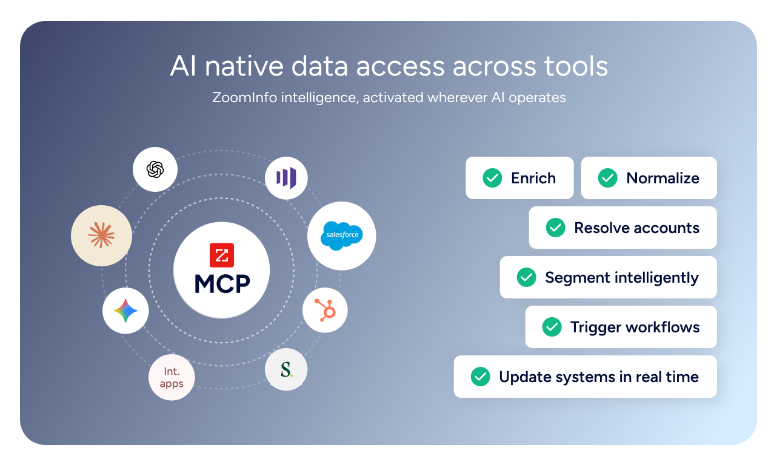
The ZoomInfo MCP server connects AI models directly to ZoomInfo's data as a native tool, letting AI agents pull verified account intelligence into any workflow.
Source: ZoomInfo
For teams building custom RevOps automations, this means ZoomInfo's data can feed territory models, account scoring, and quota calibration wherever they live, including the data warehouses CaptivateIQ's SmartGrid ingests from.
Pricing and Accessibility
ZoomInfo uses a custom-quoted, consumption-based pricing model across three product lines (Sales, Marketing, and standalone products like Chorus and Chat), each with multiple tiers.
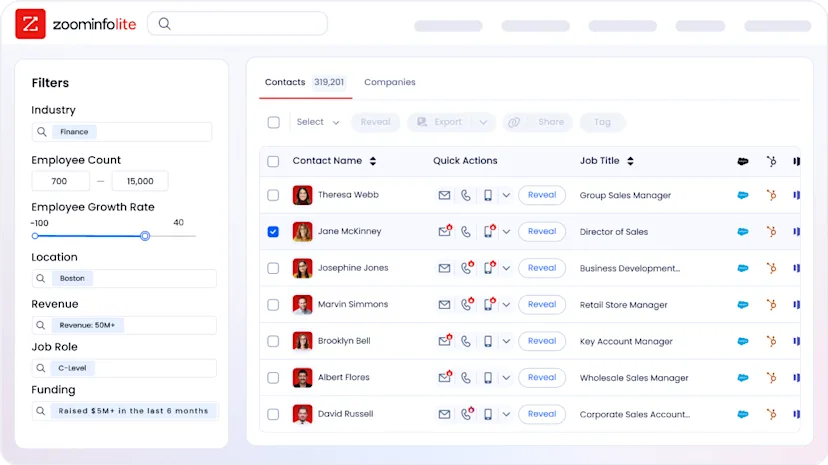
Unlike CaptivateIQ, ZoomInfo offers two free entry points: ZoomInfo Lite, a permanent free tier with access to ZoomInfo's database, 10 monthly export credits, and WebSights Lite for website visitor identification, and a 7-day free trial with no credit card required.
Source: ZoomInfo
CaptivateIQ and ZoomInfo: How They Work Together
Aspect | CaptivateIQ | ZoomInfo |
|---|---|---|
Primary Function | Incentive compensation management and sales planning | B2B data, intelligence, and go-to-market execution |
Revenue Cycle Stage | Post-sale: calculating commissions, managing payouts | Pre-sale: finding, engaging, and closing deals |
Territory Planning | Builds and manages territory assignment rules and quota targets | Provides account data, firmographics, and market intelligence to inform territory design |
Rep Experience | Earnings transparency, what-if calculators, payout statements | Account intelligence, AI-drafted outreach, buying signals |
Data Engine | SmartGrid (ingests CRM/ERP/HRIS for commission calculations) | GTM Context Graph (fuses 500M contacts, CRM data, conversation intelligence, and signals) |
AI Capabilities | Plan building, payout explanation, territory configuration agents | Account research, outreach generation, deal intelligence agents |
Integrations | CRM, ERP, HRIS, data warehouses via native connectors | 120+ integrations, Enterprise API, MCP server, Cloud Partners |
Free Access | No free plan or trial; demo-only | Permanent free tier (ZoomInfo Lite) and 7-day free trial |
Best For | Compensation teams managing complex commission structures | Sales, marketing, and RevOps teams driving pipeline and revenue |
Final Verdict
CaptivateIQ and ZoomInfo serve different stages of the revenue cycle, and neither replaces the other.
Choose CaptivateIQ if you need to replace spreadsheet-based commission management with a platform that handles complex, multi-tier compensation logic at scale.
It's the right tool when your compensation team spends more time wrangling data than designing plans, when reps distrust their payout statements, or when your finance team needs SOX-compliant audit trails for every commission dollar.
The combination of no-code plan building, unified planning-to-payout workflows, and AI agents that explain every calculation makes CaptivateIQ a strong choice for mid-market and enterprise companies with at least 50-100 commissioned reps and the implementation resources to set it up properly.
Add ZoomInfo if you want the compensation and planning decisions inside CaptivateIQ built on the best available account data and market intelligence.
ZoomInfo's B2B data, buyer intent signals, and GTM Context Graph ensure that territories reflect actual market opportunity, quotas are calibrated to real demand, and your reps have the intelligence they need to close the deals they'll be compensated for.
Whether your team accesses ZoomInfo through GTM Workspace, GTM Studio, or the API and MCP feeding your data warehouse, the result is the same: better data in means better decisions out, from first touch to final payout.
Get started with ZoomInfo here.
The most effective revenue operations teams don't choose between pipeline intelligence and compensation management. They connect both, ensuring the same data quality and market awareness that drives deal execution also informs the incentive structures behind it.
CaptivateIQ FAQ
What does CaptivateIQ do?
CaptivateIQ is an incentive compensation management and sales performance platform that automates commission calculations, territory planning, quota setting, and payout workflows.
It replaces spreadsheet-based commission management with a no-code interface that handles multi-tier structures, split credit, accelerators, and clawbacks. The platform is used by 800+ companies including Gong, Expedia, and Boston Scientific.
How much does CaptivateIQ cost?
CaptivateIQ does not publish specific pricing. All pricing is custom-quoted based on the number of payees, the complexity of compensation plans, and the integrations required. The model is per-seat pricing plus a one-time setup fee.
CaptivateIQ Incentives, Planning, and Catalyst are separate products, and add-ons like ASC-606 reporting, premium support, and integration connectors carry additional costs. There is no free plan or self-serve trial.
How long does CaptivateIQ take to implement?
CaptivateIQ's pricing page claims "up and running in a matter of weeks instead of months." However, G2 reviewers note that implementation can take 4-6 months for complex deployments, depending on the number of commission plans, data sources, and approval workflows involved.
The initial setup requires significant time and internal resources because the platform is a blank canvas that must be configured to match your specific compensation structures.
Does CaptivateIQ have a mobile app?
No. CaptivateIQ does not have a mobile app, and some reviewers note it is not on the near-term roadmap. Sales reps checking their earnings on mobile devices are limited to the browser experience.
What integrations does CaptivateIQ support?
CaptivateIQ integrates with CRMs (Salesforce, HubSpot, Microsoft Dynamics), HR platforms (Workday, ADP, BambooHR), data warehouses (Snowflake, Amazon Redshift, Google BigQuery), databases (MySQL, PostgreSQL, Oracle), ERPs (NetSuite), and accounting tools (QuickBooks Online, Sage Intacct, Xero, Stripe, Zuora). It also offers an Open API for custom integrations.
However, CaptivateIQ lacks native iPaaS connectors for Zapier, Workato, and Make, meaning teams needing workflow automation outside the platform must use the raw API.
How does CaptivateIQ compare to spreadsheets for commission management?
CaptivateIQ addresses the core problems with spreadsheet-based commissions: manual data wrangling, formula errors, lack of audit trails, and slow processing. Customer evidence supports the improvement: Planview reduced monthly calculation time by 90%, and Tecan runs commissions 4x faster after switching.
The trade-off is that CaptivateIQ requires a meaningful implementation investment upfront, while spreadsheets can be started immediately (even if they don't scale).
What analyst recognition has CaptivateIQ received?
CaptivateIQ was named a Leader in The Forrester Wave for Sales Performance Management Solutions for Incentive Compensation, Q1 2025, earning the highest possible scores in 12 of 26 criteria.
It was included in the Gartner Market Guide for Sales Performance Management for the fourth consecutive year, named a Gartner Peer Insights Customers' Choice vendor in 2024, named a Major Player in the 2025 IDC MarketScape for Worldwide SPM, and ranked in G2's 2026 Best Sales Software Products Top 50.
Can CaptivateIQ handle SOX compliance requirements?
Yes. CaptivateIQ has a dedicated SOX compliance framework covering segregation of duties, change control with statement locking, audit logging, granular access controls, customizable compliance reporting, and data protection with AES-256 encryption at rest and TLS 1.2 in transit. The platform also supports ASC 606 accrual automation, though the ASC-606 reporting module is an add-on subscription.
Researching CaptivateIQ? These comparisons and alternatives help you decide:
