
Close CRM has earned a loyal following among inside sales teams, and for good reason. It combines calling, email, SMS, and pipeline management into a single platform that gets reps selling faster, not configuring software. For bootstrapped startups and lean sales teams under 100 people, that simplicity is a genuine competitive advantage.
But as your team's needs evolve, you might find that a communication-first CRM covers only one piece of the puzzle. Close has no native B2B data layer for prospecting, limited reporting that struggles with non-linear deal movement, no marketing automation, a fixed data model that can't accommodate complex business relationships, and an inside-sales focus that doesn't extend to enterprise-grade territory management or post-sale retention.
That's where this guide comes in. Whether you're looking to:
Access comprehensive B2B data intelligence and buyer intent signals to know who to target and when
Scale to enterprise-grade customization, reporting, and partner ecosystem depth
Unify sales and marketing automation on shared data
Manage deals visually with graduated, budget-friendly pricing
Layer enterprise sales engagement execution and structured coaching on top of your CRM
Build a full business software stack (CRM, finance, HR, support) without enterprise pricing
Model complex business relationships with a flexible, AI-native data architecture
We'll explore dedicated Close CRM alternatives that excel in these specific areas.
Some teams might use these tools alongside Close to fill gaps, while others might replace Close entirely with a platform better suited to their growth trajectory. This isn't about finding a "better" CRM; it's about finding the right fit as your sales operation matures.
The Best Close CRM Alternatives |
|---|
Best Alternative for B2B Data Intelligence and AI-Powered Sales Execution We chose ZoomInfo because it provides the comprehensive B2B data layer and buyer intent signals that Close CRM lacks entirely, giving sales teams the intelligence to know who to target, when to engage, and what to say before they ever pick up the phone. |
Best Alternative for Enterprise Teams Needing Unlimited Customization We chose Salesforce because it removes Close's fixed-schema ceiling with unlimited custom objects, enterprise-grade reporting, and a 9,000+ app ecosystem that scales from startup to global organization. |
Best Alternative for Teams Needing Sales and Marketing in One Platform We chose HubSpot because it natively unifies CRM, marketing automation, and multi-touch revenue attribution on shared data, closing the gap between campaigns and pipeline that Close's sales-only architecture cannot bridge. |
Best Alternative for Visual Pipeline Management and Graduated Pricing We chose Pipedrive because its kanban-first pipeline view and graduated pricing structure give deal-stage-focused teams a more natural daily workspace without the steep mid-tier price jump Close requires for automation. |
Best Alternative for Enterprise Sales Engagement and Conversation Intelligence We chose Salesloft because it layers enterprise-grade cadence analytics, AI-powered rep prioritization, and structured coaching workflows on top of an existing CRM, going far deeper on sales execution than Close's built-in automation. |
Best Alternative for a Full Business Stack Without Enterprise Pricing We chose Zoho CRM because its permanent free plan, 55+ natively integrated business apps, and AI capabilities at $23/seat unlock enterprise-grade features at a fraction of what Close or Salesforce charge. |
Best Alternative for Teams That Have Outgrown Rigid Data Models We chose Attio because its fully flexible object-relational data model and AI-native attributes let teams build a CRM around their business rather than forcing their business into a fixed schema. |
What is Close CRM?
Source: Close
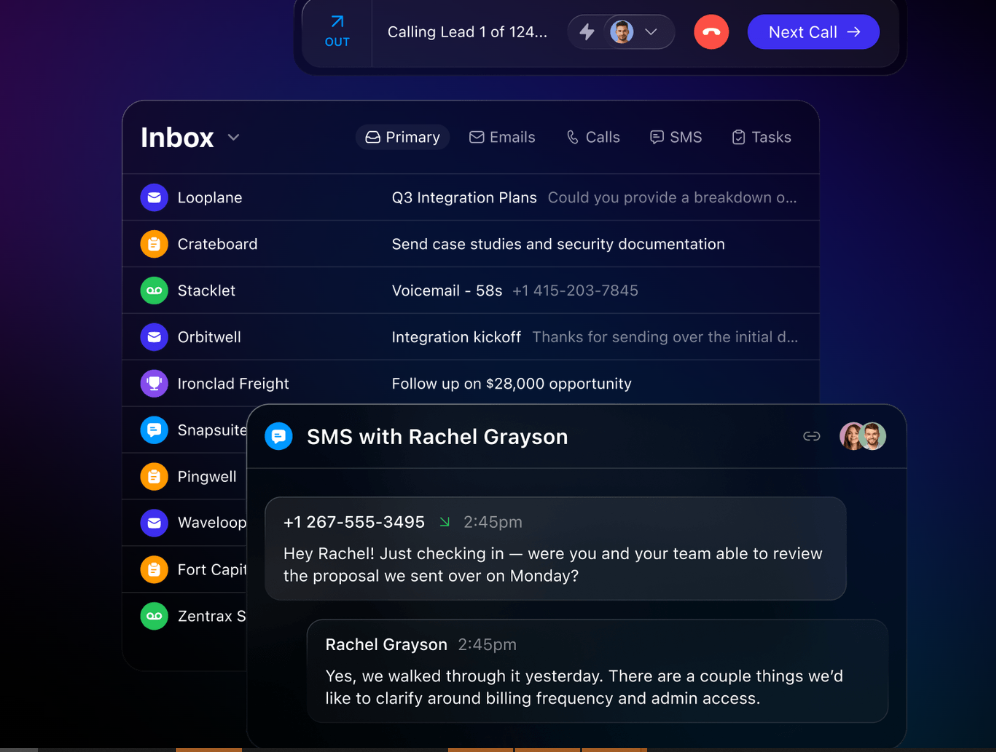
Close is a sales CRM built for action, designed to eliminate friction between a salesperson and their next conversation. Unlike traditional CRMs that require third-party tools for communication, Close builds email, calling, SMS, and WhatsApp directly into the platform so every touchpoint is automatically logged without manual data entry.
Its key features include:
Built-in global calling with Power Dialer and Predictive Dialer for high-volume outbound
Unified inbox for email, SMS, WhatsApp, and call logs in a single view
Chloe AI agent that autonomously calls inbound leads, qualifies them, and books meetings
Workflow automation mixing email, SMS, and call tasks in multi-step sequences
Smart Views for dynamic, real-time filtered lead lists that replace static task queues
Call coaching with Listen, Whisper, and Barge for live manager intervention
Pipeline management with Kanban view and Pipeline Guidance for stalled deals
When a lead comes in through a Close Form, everything connects automatically: the contact is created, a Smart View surfaces them, a Workflow triggers a sequence, and the rep can call directly from the lead record with one click. Close claims 10,000+ sales teams and a cumulative 2 billion calls, emails, and texts processed through the platform.
That communication-first design is Close's greatest strength for inside sales teams under 100 people. But as your requirements expand into areas like B2B data intelligence, enterprise reporting, marketing automation, or flexible data modeling, you might need platforms that go deeper in those specific areas.
Looking for the intelligence layer that tells your team who to target, when to engage, and what to say? ZoomInfo provides comprehensive B2B data, buyer intent signals, and AI-powered sales execution. Learn more about ZoomInfo.
How We Curated Our List of Close CRM Alternatives
After testing Close CRM and researching the market, we focused on finding tools that address specific needs where Close's inside-sales focus creates gaps. While Close handles sales communication well, growing teams often need more depth for:
Identifying the right buyers with verified contact data and intent signals before outreach begins
Building enterprise-grade reporting, custom data models, and territory management
Unifying sales and marketing automation on shared customer data
Managing deal stages visually with graduated pricing that doesn't force steep tier jumps
Running structured sales engagement programs with conversation intelligence and coaching at scale
Consolidating CRM with finance, HR, and support tools in a single ecosystem
Modeling complex business relationships that don't fit a fixed Lead/Contact/Opportunity schema
Each tool on this list is a leader in one of these areas. You might want to use them alongside Close or switch to them entirely; it all depends on what your growing sales team needs most.
DISCLAIMER: We aren't covering every single CRM or sales tool on the market! Our focus is on highlighting the best alternatives that address some of Close CRM's limitations for various use cases. |
|---|
1. ZoomInfo: Best Alternative for B2B Data Intelligence and AI-Powered Sales Execution
ZoomInfo is an all-in-one AI GTM platform built on the industry's most comprehensive B2B data foundation. While Close CRM excels at the execution layer (calling, emailing, and texting leads), it has no native data layer to help teams find the right people, identify in-market accounts, or understand why deals are moving. ZoomInfo fills that gap with intelligence that powers every step before and during outreach. Its key features include:
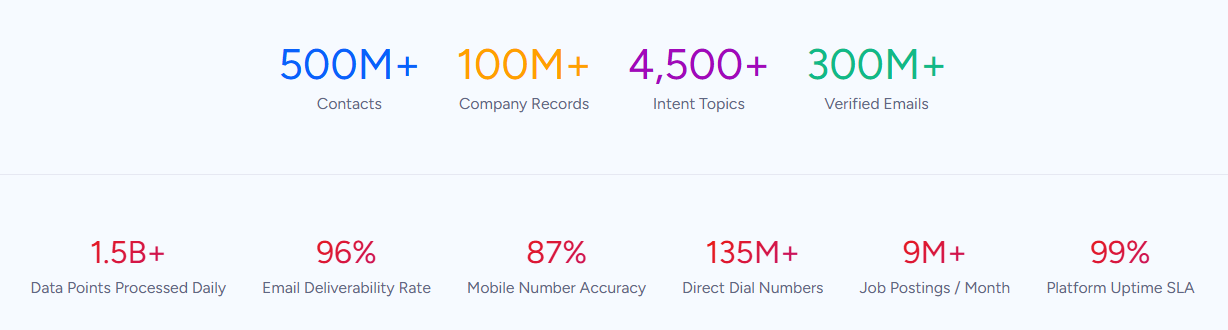
Comprehensive B2B data: 500M contacts, 100M companies, 135M+ verified phone numbers, 120M direct-dial phone numbers, and 200M+ verified business email addresses with up to 95% accuracy on first-party data
Buyer intent signals: Tracks signals from 210 million IP-to-Organization pairings and 6 trillion+ new keyword-to-device pairings sourced monthly to identify accounts actively researching solutions
GTM Context Graph: A proprietary intelligence layer that processes 1.5B+ data points daily, fusing ZoomInfo's data with CRM records, conversation intelligence, and behavioral signals to capture not just what happened in a deal, but why it happened
AI-powered execution: GTM Workspace for sellers and GTM Studio for marketers and RevOps
For B2B sales teams that have realized their biggest bottleneck isn't dialing speed but knowing who to call and when, ZoomInfo provides the data foundation and intelligence layer that a communication-first CRM like Close simply does not offer.
Why Choose ZoomInfo Over Close CRM for Sales Intelligence
Close CRM is a strong execution tool. But execution without intelligence means reps are dialing into the dark. ZoomInfo provides the context that makes every call, email, and sequence more effective.
Comprehensive B2B Data: Find the Right Buyers Before You Dial
Close CRM stores and manages the leads your team already has, but it provides no native way to discover new prospects, verify contact information, or enrich existing records with firmographic and technographic data. Reps using Close still need to manually research contacts, rely on purchased lists of uncertain quality, or bolt on separate data providers just to populate the CRM with actionable records.
ZoomInfo operates the most comprehensive B2B data platform in the world, spanning 500M contacts and 100M companies with 300+ company attributes for market segmentation.
The platform provides department org charts with decision-makers' direct dials and verified emails, job-change alerts via Contact Tracker, and technographic profiles covering 30,000+ technologies across 200+ categories for 30+ million companies. Data quality is maintained through a multi-source verification pipeline backed by 300+ human researchers.
The difference is felt at the point of action: the direct dial actually rings and the email actually lands, rather than a high bounce rate that damages sender reputation and buries sequences in spam folders. In a Fortune 500 competitive RFP analyzing 25 million contacts across vendors, the independent consultant concluded that "no other competitor came even close."
ZoomInfo in Action: Your team is expanding into a new vertical and needs to build a targeted list of VP-level decision-makers at mid-market SaaS companies using a competitor's product.
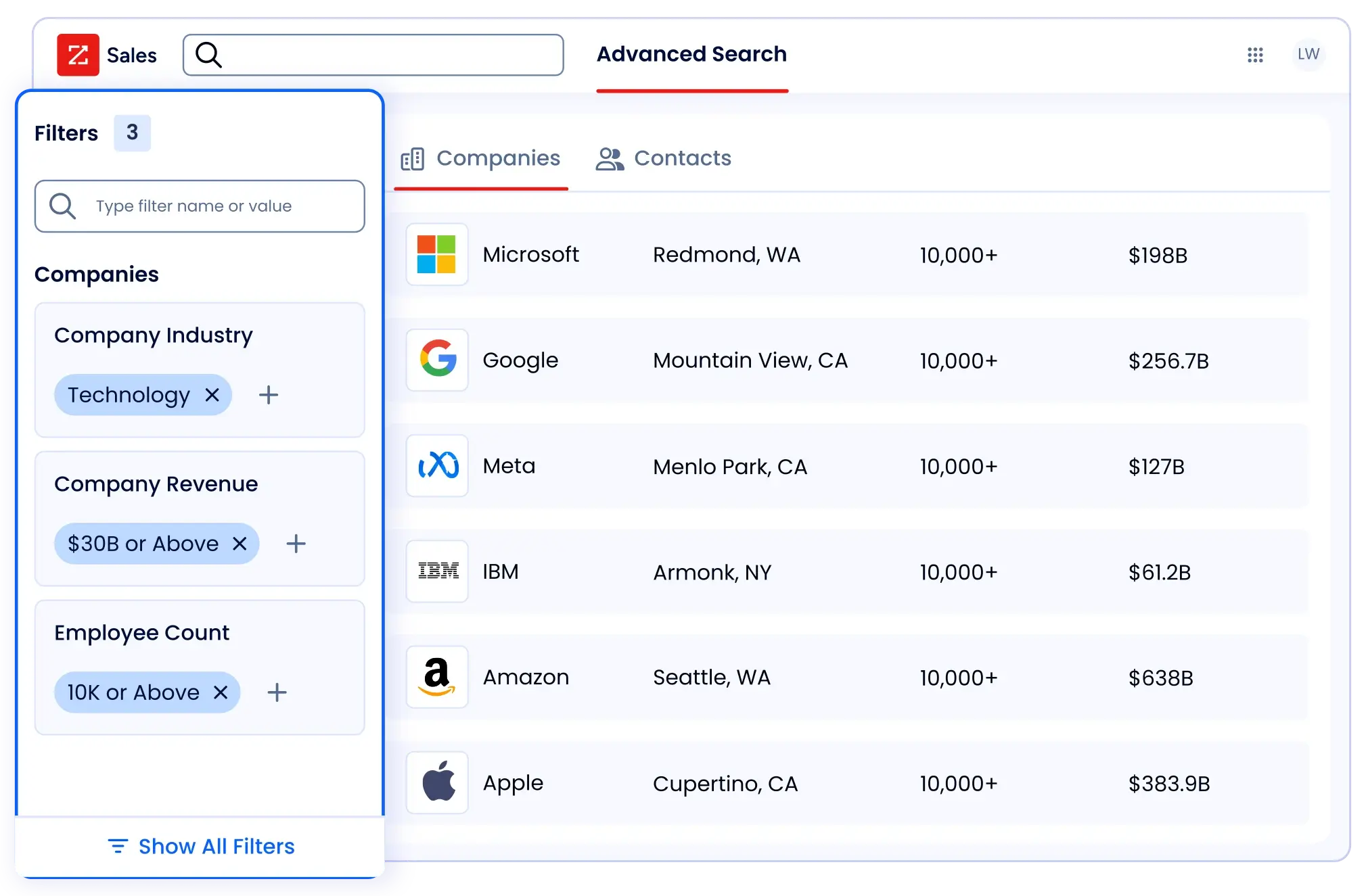
In ZoomInfo, you filter by industry, headcount, technology stack, and seniority level. Within minutes, you have a verified list with direct dials and business emails, complete with org charts showing the buying committee. That list flows directly into your CRM or sales engagement tool for immediate outreach.
"ZoomInfo gives us the information we need to execute. We don't have to go through and spend our time digging. It's already there, so we can be three steps ahead." (Vensure)
Buyer Intent Signals: Know When Accounts Are Ready to Buy
Close CRM's Smart Views are powerful for filtering and prioritizing leads already in the pipeline. But they operate entirely on internal data: lead status, activity dates, custom fields. Close has no mechanism to tell you which companies outside your pipeline are actively researching solutions like yours right now.
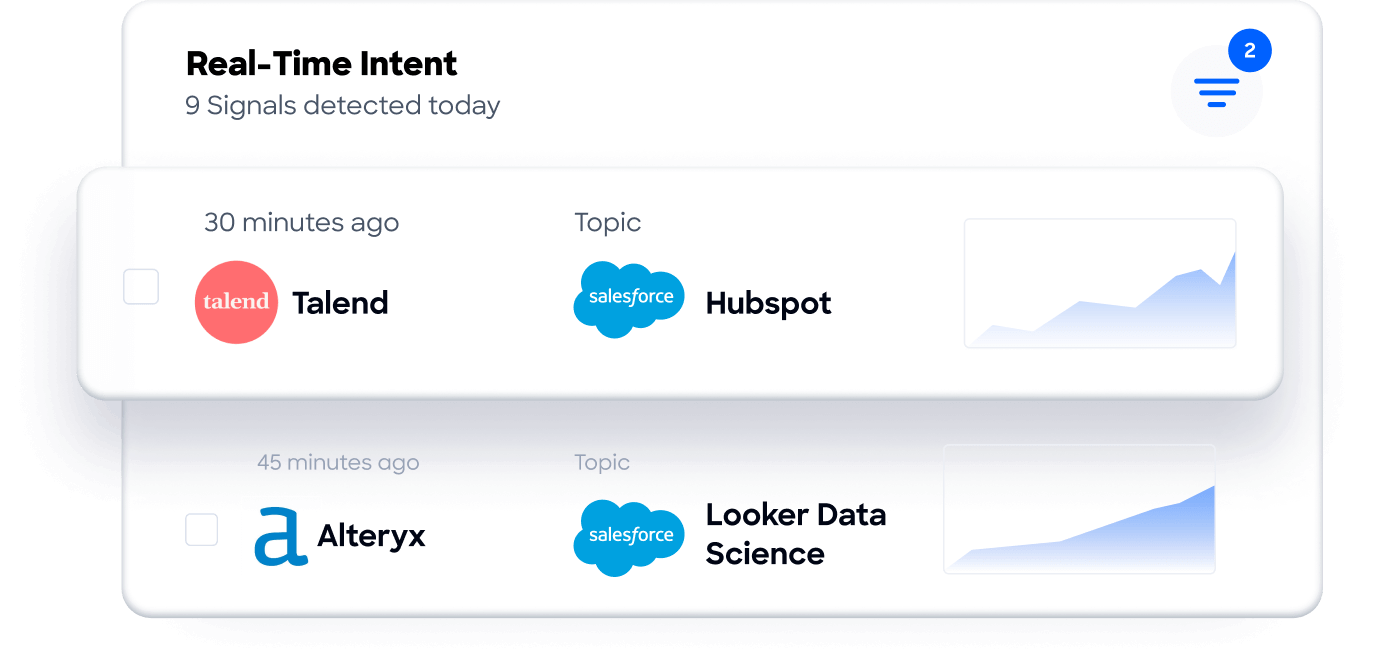
ZoomInfo Intent tracks buying signals across the web, identifying companies actively researching topics relevant to your business.
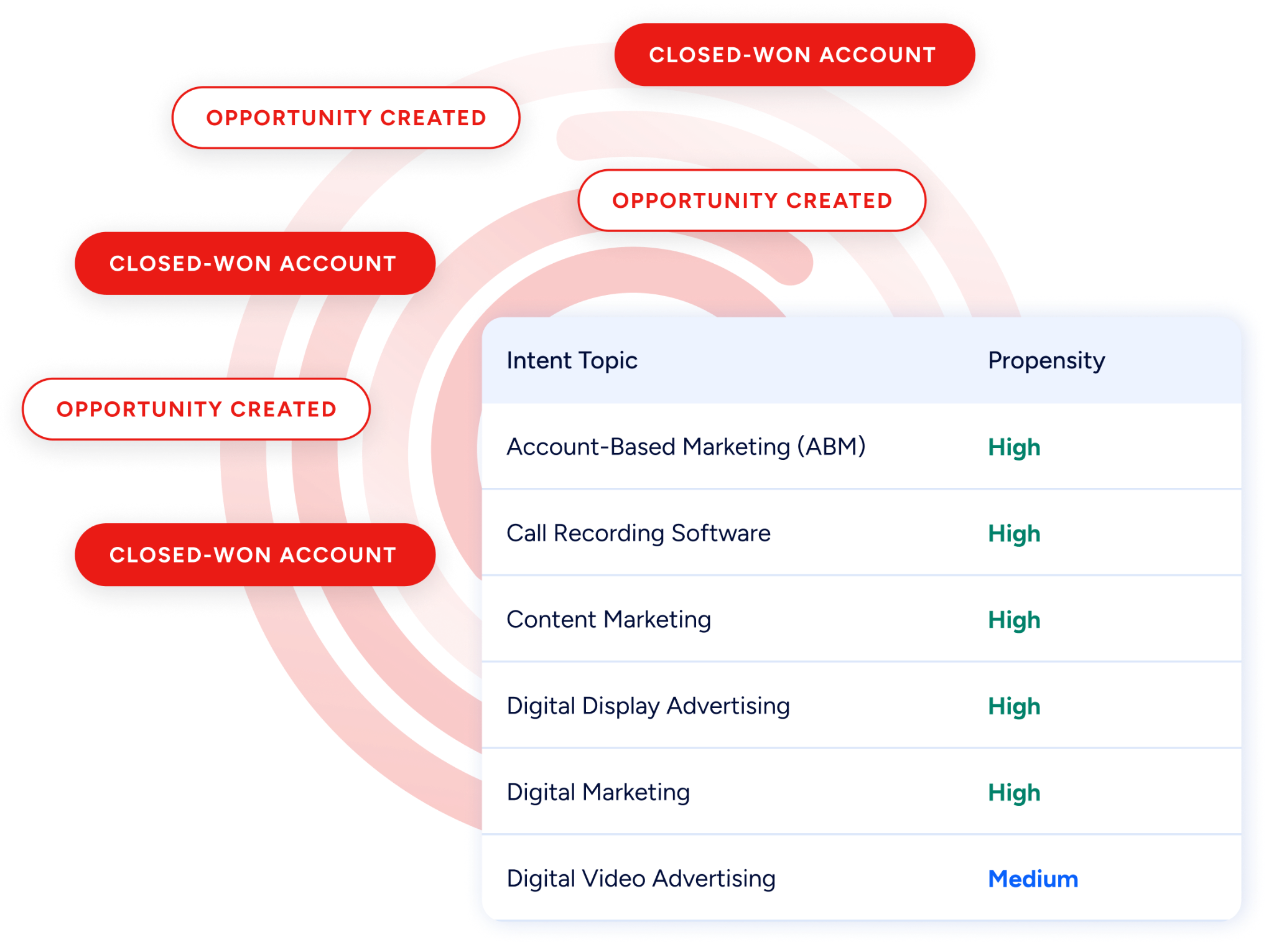
Guided Intent, exclusive to ZoomInfo, goes further by identifying topics historically correlated with your deal success rather than requiring manual topic selection.
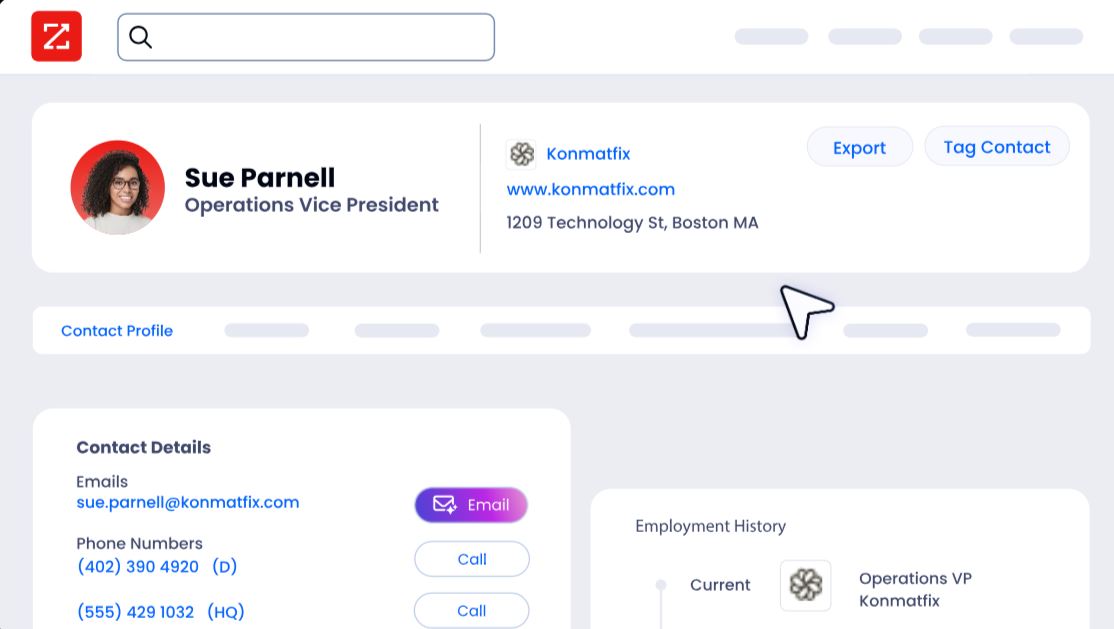
WebSights resolves anonymous website traffic to companies, including buying team identification with Automatic Traffic Filtering that distinguishes real visitors from bots.
These signals feed into the GTM Context Graph, which connects intent data with CRM records, conversation history, and behavioral signals to surface not just that an account is active, but why it matters for your pipeline.
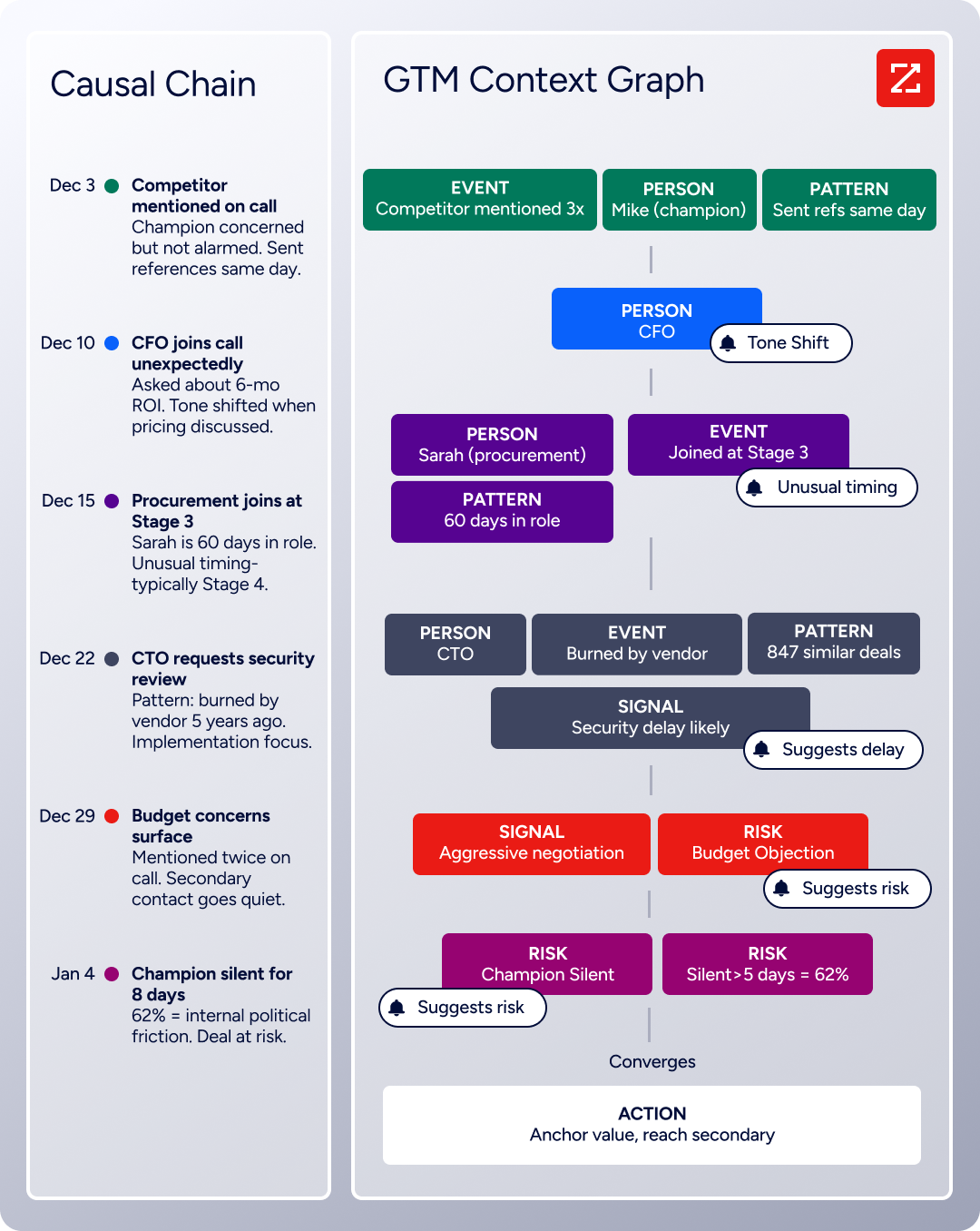
As ZoomInfo's CPO Dominik Facher writes: "The CRM recorded the state change. It has no record of why it happened."
ZoomInfo in Action: Three companies on your target account list just spiked in research activity around your product category. ZoomInfo surfaces these accounts with the specific topics they're researching, the contacts most likely involved in the buying decision, and their verified direct contact information.
Your reps reach out with relevant messaging while the prospect is actively evaluating, rather than discovering the opportunity weeks later when it's already gone to a competitor.
Seismic's sales team attributed 39% of active pipeline to opportunities identified or influenced by ZoomInfo signals, while saving 11.5 hours per week and boosting productivity by 54%. (Seismic)
GTM Workspace: AI-Powered Sales Execution in One Surface
Close's AI capabilities are growing (Chloe for AI calling, Draft Assist for email follow-ups), but the platform's AI layer is primarily assistive: it helps with individual tasks rather than orchestrating the full selling motion.
GTM Workspace is ZoomInfo's native front-end for sellers, providing an AI-powered execution engine built on the GTM Context Graph. It addresses a fundamental fragmentation problem: the average enterprise has 23 GTM technologies, and sellers context-switch constantly between them.
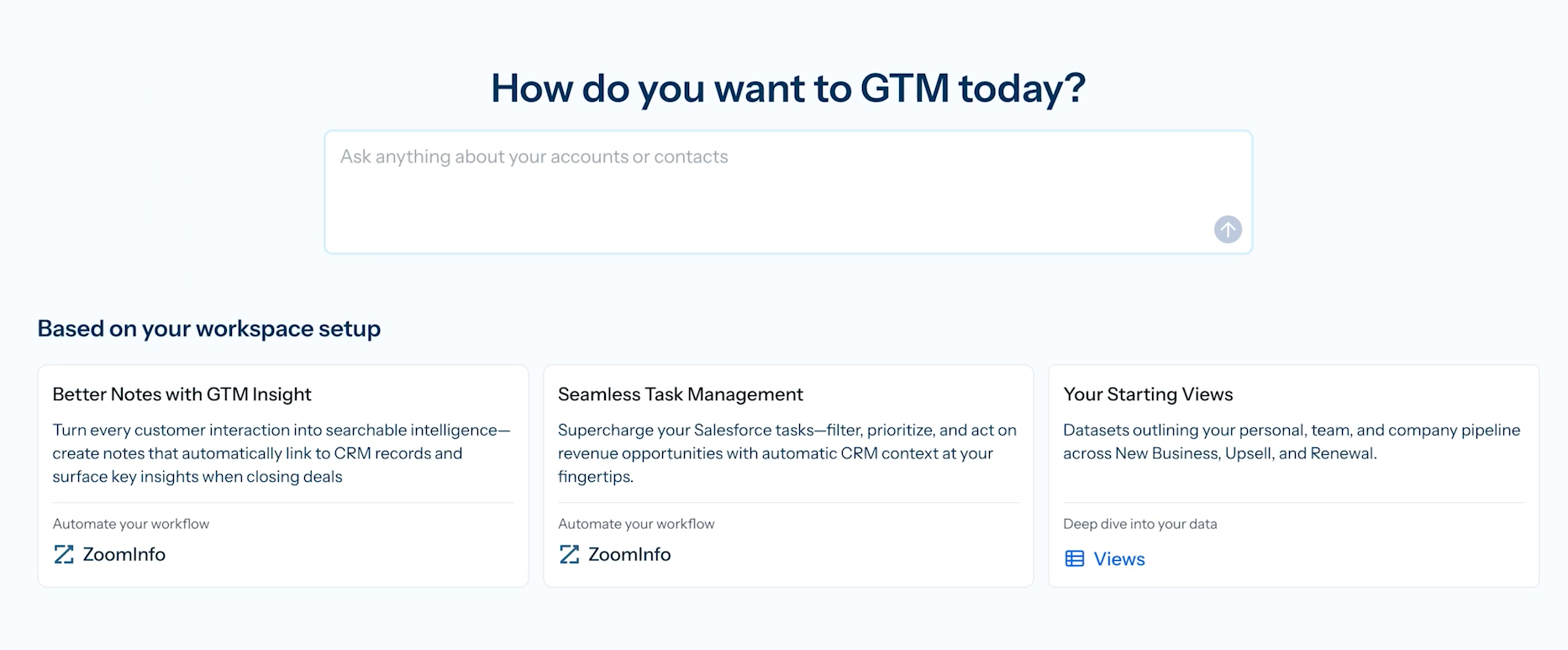
GTM Workspace consolidates this into a single view: a complete Book of Business across CRM, ZoomInfo data, conversation history, and market intelligence. Specialized AI agents handle account research, outreach drafting, CRM updates, and signal monitoring.
The Action Feed delivers a live stream of in-market buyers matched to target criteria, with pre-drafted actions on every signal. AI-generated outreach addresses the specific concerns identified in the prospect's context, not generic templates.
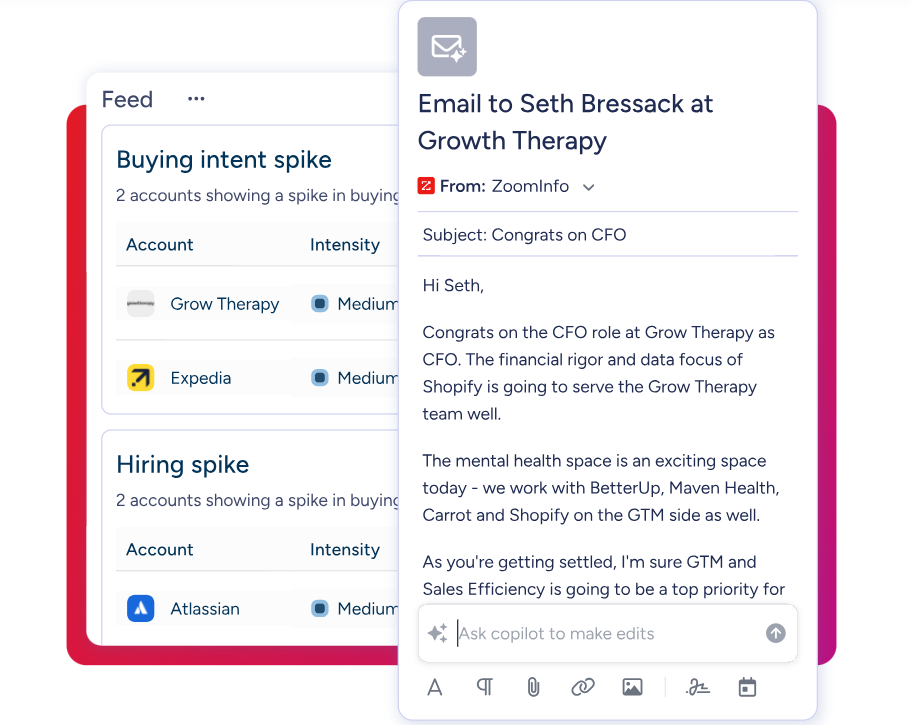
For marketers and RevOps, GTM Studio provides a builder environment where audience definition, campaign orchestration, and pipeline measurement happen in natural language. Expansion plays that used to take 3 weeks now launch in 30 minutes without technical support.
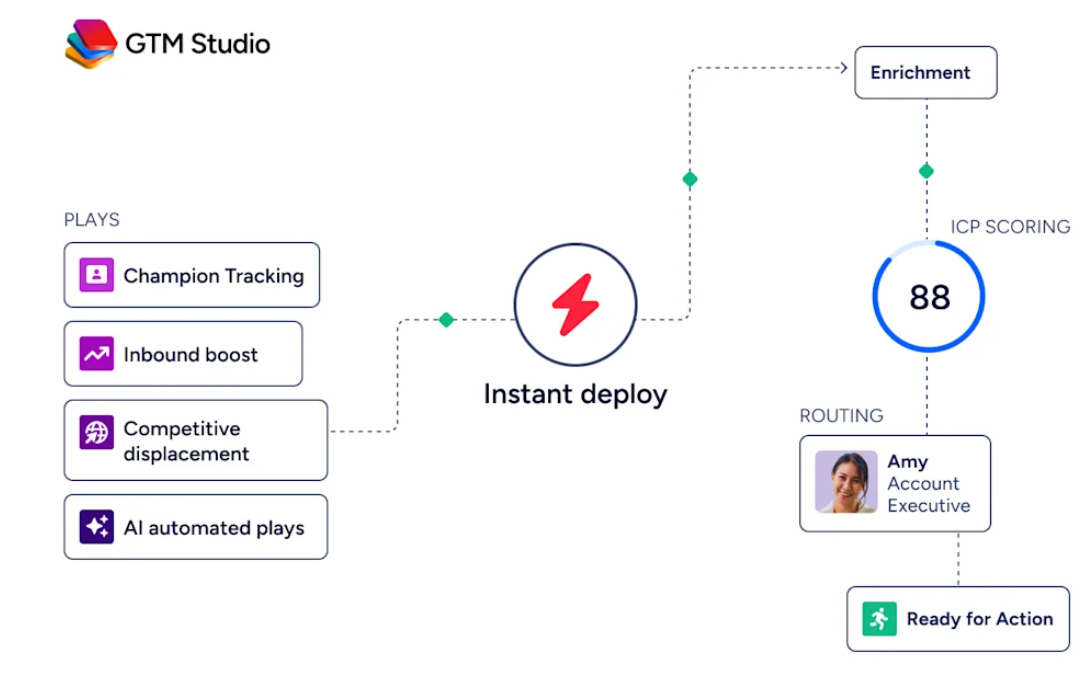
ZoomInfo in Action: A seller opens GTM Workspace to a prioritized account feed where AI-drafted outreach already addresses the specific objection the intelligence engine identified. The rep reviews the AI-generated account brief (pulling CRM history, company news, and stakeholder context into a 10-second summary), personalizes the message, and sends it. CRM updates without leaving the page. Meanwhile, GTM Studio routes new high-intent accounts into the rep's feed automatically as they match proven win patterns.
"ZoomInfo's not just a contact data company anymore. They've built a full system of execution. GTM Intelligence actually works the list, writes the outreach, triggers the play, and helps drive predictable growth." (Levanta)
ZoomInfo Pricing
ZoomInfo uses a custom-quoted, consumption-based pricing model with no publicly listed prices. The platform offers three product lines (Sales, Marketing, and Chorus), each with tiered plans that scale based on usage, number of seats, monthly credit volume, and feature requirements.
ZoomInfo Lite is a permanent free tier (not a trial) that includes access to ZoomInfo's B2B database with 100M+ verified profiles, 10 monthly export credits, individual and company searches, the ReachOut Chrome Extension, WebSights Lite (up to 10 website visitor reveals per day), and HubSpot integration. No credit card required, no time limit.
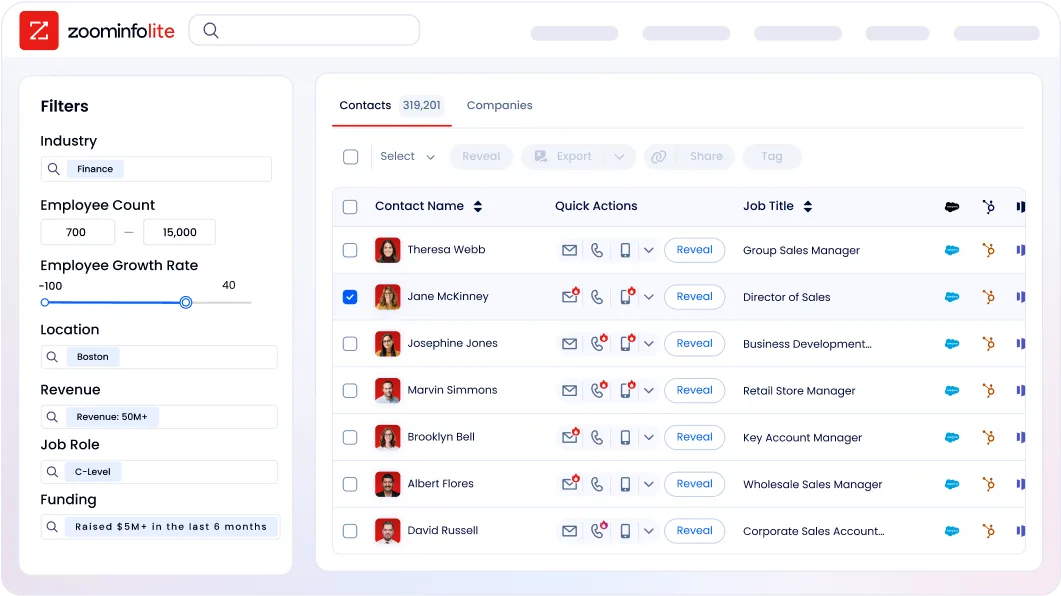
A separate 7-day free trial provides access to more advanced features beyond Lite, also with no credit card required.
API access is included in all relevant plans, and ZoomInfo's MCP server is available for teams connecting ZoomInfo data to AI agents and third-party tools.
Who Should Use ZoomInfo?
Choose ZoomInfo if:
Your sales team's biggest bottleneck isn't dialing speed but finding the right people to dial. You need verified direct dials, business emails, and org charts for your target accounts, not just a CRM to log calls you've already made.
You want to know which accounts are actively researching your solution category before your competitors reach them, and you need buyer intent signals to prioritize outreach based on real buying behavior rather than gut feel.
You're running an enterprise or upper mid-market B2B sales motion and need an intelligence layer that connects data, signals, and context across your entire go-to-market stack, whether you use ZoomInfo's native products or plug its data into your existing tools via API and MCP.
Want to see the full picture of your target accounts before every conversation? Start with ZoomInfo Lite for free or request a demo to experience the complete platform.
2. Salesforce: Best Alternative for Enterprise Teams Needing Unlimited Customization
Source: Salesforce
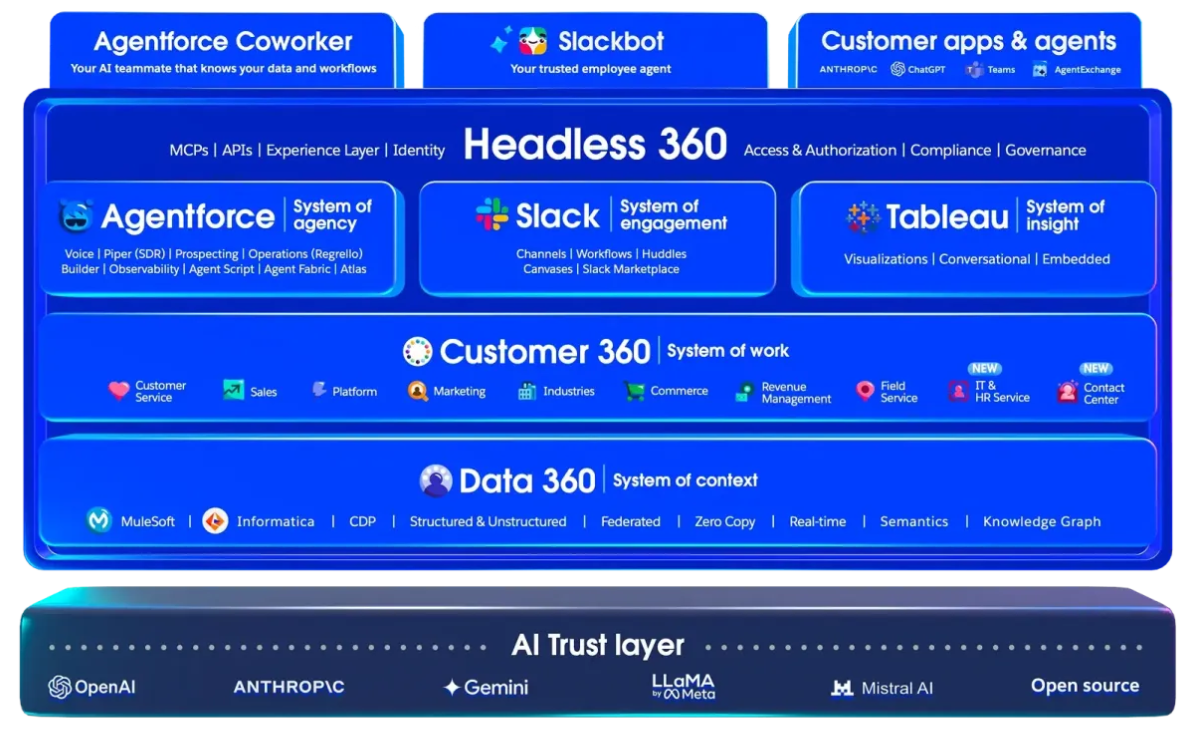
Salesforce is a multi-cloud enterprise platform purpose-built for organizations that need a CRM system that bends to their processes rather than the other way around. Where Close CRM operates with a fixed Lead/Contact/Opportunity data model, Salesforce lets teams define any data structure, any process, and any permission model the business requires. Its key capabilities include:
Unlimited custom objects with custom fields, validation rules, and relationship links
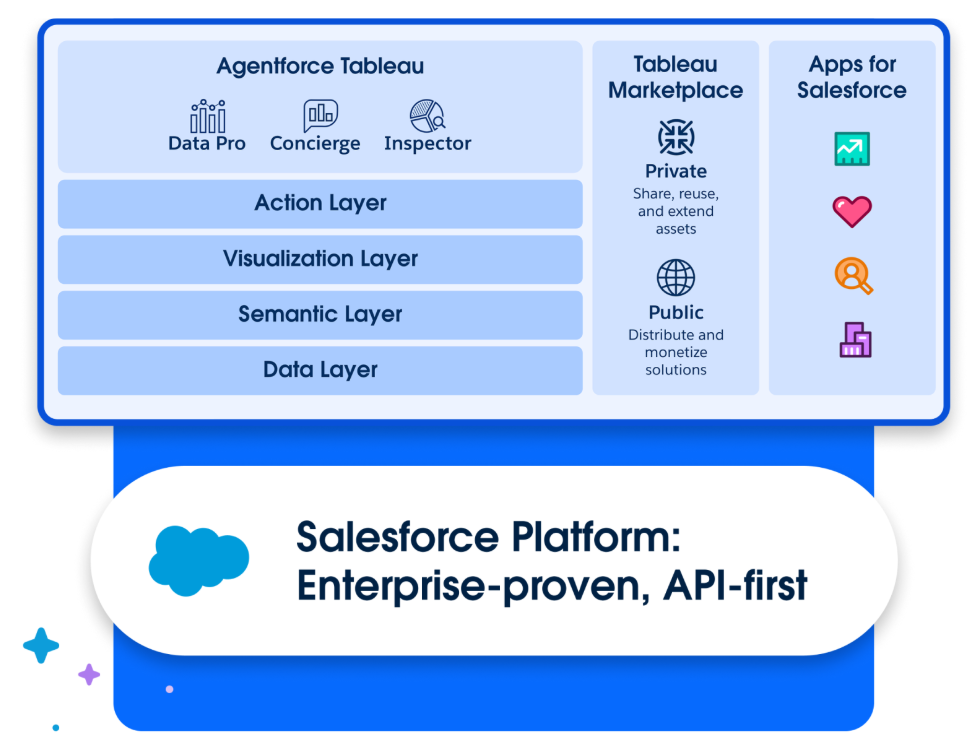
Enterprise-grade analytics via the native report builder, CRM Analytics, and Tableau
Hierarchical territory management and compliance-grade permissions
Agentforce, Salesforce's autonomous AI agent platform for sales, coaching, and support
Why Choose Salesforce Over Close CRM for Enterprise CRM Requirements?
Salesforce stands out in the following areas:
Unlimited Custom Objects vs. a Fixed Data Model.
Close operates on a fixed Lead/Contact/Opportunity schema. Users can create custom fields but cannot create custom object types, meaning businesses needing to track territories, partner relationships, or industry-specific entities hit hard walls. Salesforce was designed from the ground up to eliminate that ceiling. Custom objects are a core platform primitive, allowing teams to represent any business process. A manufacturing company can track equipment installations; a financial services firm can track portfolio positions. The entire relational data structure is configurable without engineering involvement.
Pipeline Reporting That Handles Non-Linear Deal Movement.
The most consistently cited limitation in Close reviews is reporting. Pipelines that skip stages or move backwards don't report properly, requiring exports to spreadsheets. Salesforce's native report builder, combined with CRM Analytics and Tableau, handles non-linear deal movement and complex rollup logic directly. CRM Analytics delivers embedded analytics within Salesforce records, with a reported 28% increase in close rates from in-context pipeline intelligence.
Source: Salesforce
Territory Management and Enterprise Permission Models.
Close explicitly acknowledges it is "not designed for outside sales team mapping and routing" and performs best for teams under 100 people. Salesforce supports full hierarchical territory structures (global to region to territory), automated lead and account assignment, and compliance-grade data access controls. For organizations in regulated industries, Salesforce offers industry-specific clouds across 17 verticals with purpose-built compliance features.
The AppExchange Ecosystem Closes Every Gap Close Acknowledges.
Close self-identifies gaps in proposal generation, marketing automation, and post-sale management. Salesforce addresses every one through native products and the AppExchange, which IDC named a Leader in Application Platform Marketplaces. Salesforce CPQ handles quoting natively. Marketing Cloud covers campaign automation. Service Cloud handles post-sale success. 91% of Salesforce customers use at least one AppExchange app.
NOTE: We also evaluated Microsoft Dynamics 365, which offers comparable enterprise depth with tight Microsoft 365 integration, and HubSpot Sales Hub (covered separately in this list). Salesforce offers the most comprehensive customization, reporting depth, and partner ecosystem for enterprise teams outgrowing Close.
Salesforce Pricing
Salesforce uses a multi-tier, per-user annual subscription model:
Free Suite: $0/user/month for up to 2 users with basic lead/account/opportunity management
Starter Suite: $25/user/month with unlimited users, AI email sync, and lead routing
Pro Suite: $100/user/month (annual) with customization, quoting, and forecasting
Enterprise: $175/user/month (annual) with AI for sales, pipeline insights, and workflow automation
Unlimited: $350/user/month (annual) with full AI suite, conversation intelligence, and Premier Success
Agentforce 1: $550/user/month (annual) with unmetered Agentforce, Tableau Next, and Slack Enterprise+
Note: the total cost of ownership for Salesforce is typically higher than list prices suggest. Over 70% of implementations are partner-led, adding consulting costs, and Agentforce consumption is billed separately at Enterprise tiers and above.
Who Should Use Salesforce?
Choose Salesforce if:
Your sales team has 50+ people operating across multiple regions and needs hierarchical territories, role-based access, and field-level security.
Your data requirements don't fit a fixed Lead/Contact/Opportunity schema, and you need custom objects for partner relationships, contract tracking, or industry-specific entities.
You're exporting pipeline data to spreadsheets because your current CRM's reporting can't handle non-linear deal movement or multi-pipeline rollup.
Curious how Salesforce stacks up directly against ZoomInfo? See our Salesforce vs ZoomInfo comparison.
3. HubSpot: Best Alternative for Teams Needing Sales and Marketing in One Platform
Source: HubSpot
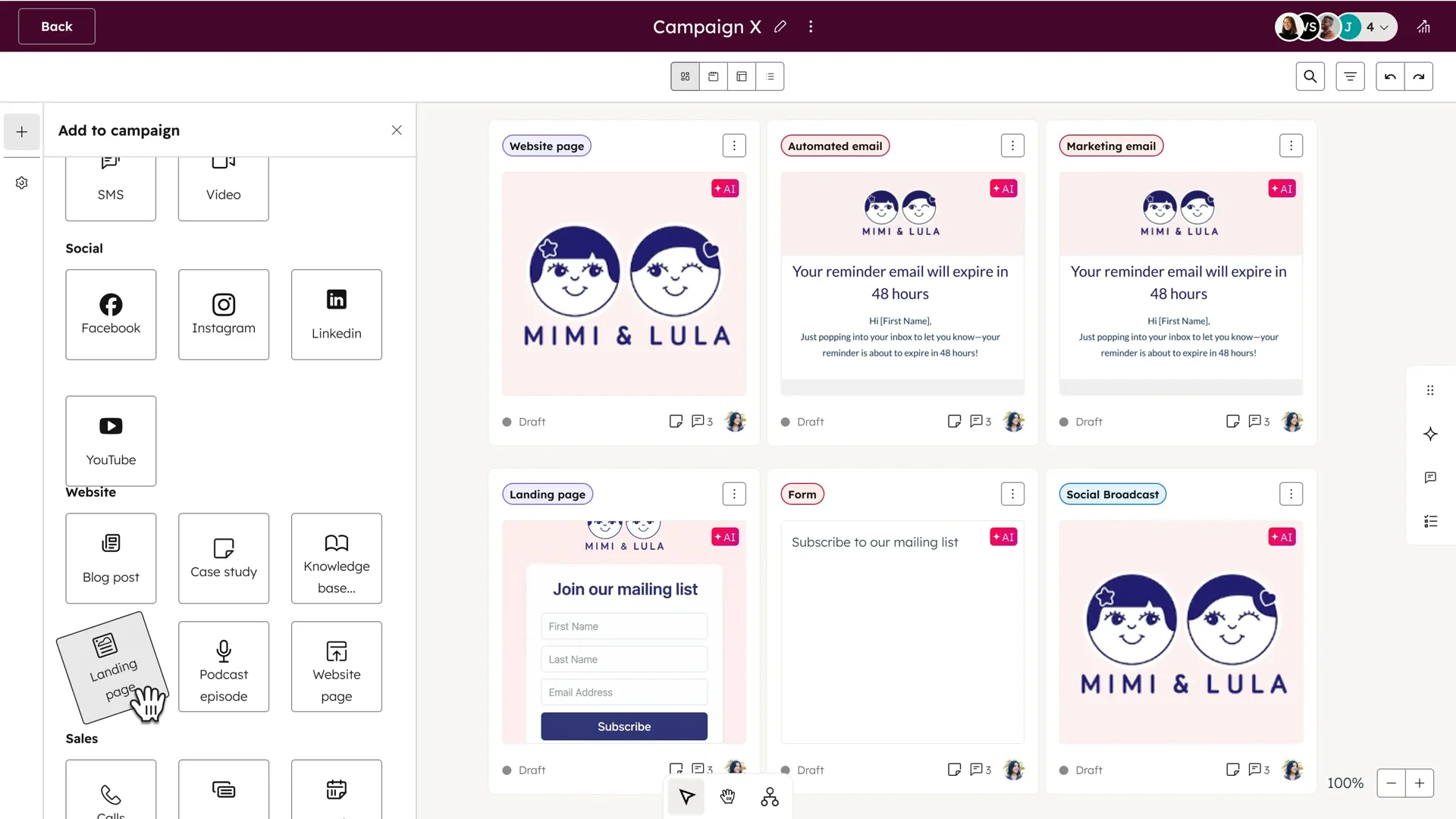
HubSpot is an AI-powered customer platform that natively combines CRM, marketing automation, sales engagement, and customer service in a single system. It's an alternative to Close for teams that have outgrown a pure sales-execution tool and need their CRM to handle the entire go-to-market motion, from inbound lead generation through post-sale retention. Its key capabilities include:
Native marketing automation (email campaigns, lead scoring, nurture sequences) sharing the same CRM data layer
Custom report builder with multi-touch revenue attribution
Free CRM tier with unlimited contacts, deal tracking, and email sync
Gradual pricing from Free through Starter ($15/seat) to Professional ($100/seat) to Enterprise ($150/seat)
Service Hub for post-sale customer success and ticketing
Breeze AI layer with prospecting, customer, data, and content agents
Why Choose HubSpot Over Close CRM for Sales and Marketing on Shared Data?
HubSpot stands out in the following areas:
Marketing Automation Built Into the CRM.
Close explicitly acknowledges it is not suited for teams needing marketing automation or landing pages. For inbound-led teams, this means purchasing a separate marketing platform and syncing data bidirectionally, introducing lag and attribution blind spots. HubSpot's Sales Hub and Marketing Hub share the same Smart CRM data layer. When a lead clicks through a campaign email, the event writes directly to the CRM record and can trigger a sales sequence, update a lifecycle stage, and notify the assigned rep, all without middleware.
Custom Reporting and Multi-Touch Attribution.
Reporting is the most cited limitation in Close G2 reviews. HubSpot Professional and Enterprise include a drag-and-drop custom report builder, custom dashboards, and full multi-touch attribution (first touch, last touch, linear, time decay, or custom weighted models). The Pathfinder customer journey tool lets teams visualize exactly where contacts enter, stall, and convert. For sales leaders frustrated by Close's inability to report on deals that skip stages, HubSpot's report builder handles those edge cases.
A Free Foundation and Gradual Pricing Path.
Close jumps from Essentials at $35/seat to Growth at $99/seat, locking workflow automation, Power Dialer, and AI behind that near-3x increase. HubSpot's free CRM provides unlimited contacts and deals (up to 1M records), email tracking, meeting scheduling, and Gmail/Outlook sync for up to 2 users permanently. Starter at $15/seat adds bulk email and basic automation. Professional at $100/seat unlocks workflows, sequences with A/B testing, and the full marketing suite.
NOTE: We also evaluated ActiveCampaign, which excels at email marketing automation but has a significantly weaker CRM, and Pipedrive (covered separately), which has no native marketing automation. HubSpot offers the most complete sales-plus-marketing unification for teams outgrowing a pure sales execution tool.
HubSpot Pricing
Free: $0, up to 2 users. Unlimited contacts and deals, email tracking, meeting scheduling, 1 deal pipeline.
Starter: $15/seat/month (annual) or $20/seat/month (monthly). Removes HubSpot branding, adds bulk email and basic automation.
Professional (Sales Hub): $90/seat/month (annual) or $100/seat/month (monthly). One-time onboarding fee: $1,500. Full email sequences with A/B testing, custom reporting, multi-touch attribution, and forecasting.
Enterprise (Sales Hub): $150/seat/month (annual only). One-time onboarding fee: $3,500. Custom objects, predictive lead scoring, sandbox environment, and SSO.
Who Should Use HubSpot?
Choose HubSpot if:
Your team runs both inbound marketing and outbound sales and you're paying for a separate marketing automation platform alongside your CRM.
You need multi-touch revenue attribution and custom dashboards that tie campaign spend to closed revenue.
Post-sale customer retention matters as much as winning deals, and you want ticketing, knowledge base, and customer health scoring in the same connected platform.
Wondering how HubSpot compares directly to ZoomInfo? See our HubSpot vs ZoomInfo comparison.
4. Pipedrive Best Alternative for Visual Pipeline Management and Graduated Pricing
Source: Pipedrive
Pipedrive is a pipeline-first sales CRM built for small and medium-sized businesses that want activity-based deal tracking without the communication-first constraints of tools like Close. Serving 100,000+ companies across 179 countries, Pipedrive pioneered the kanban-style pipeline view and built its entire product philosophy around the insight that salespeople need a workspace designed for them. Its key capabilities include:
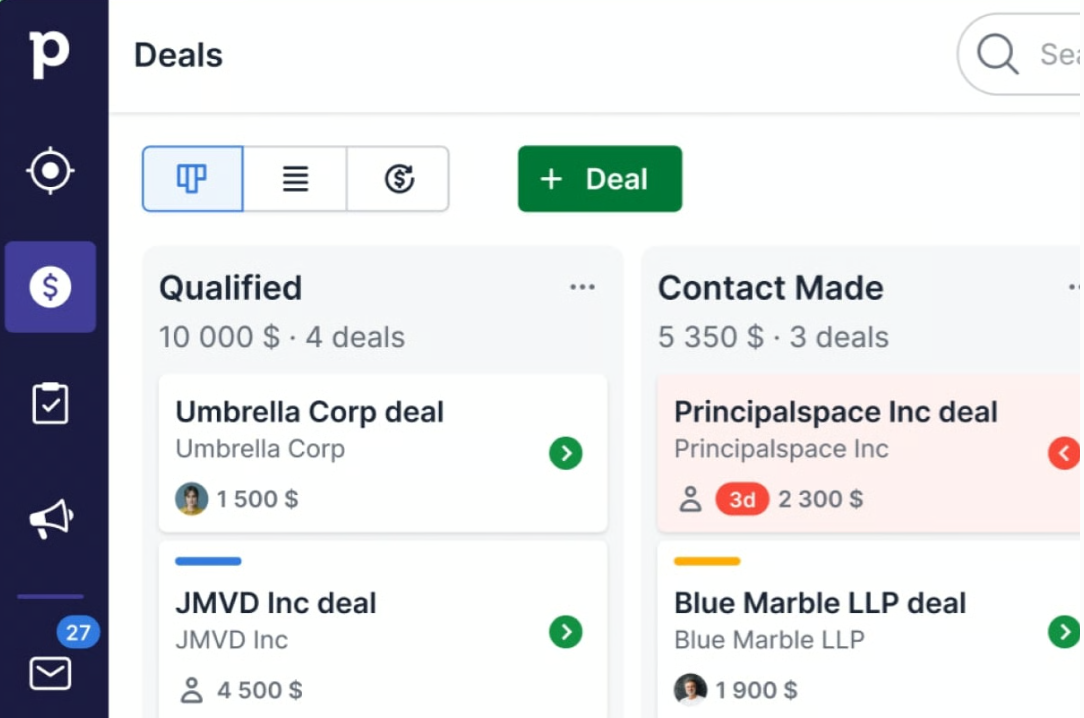
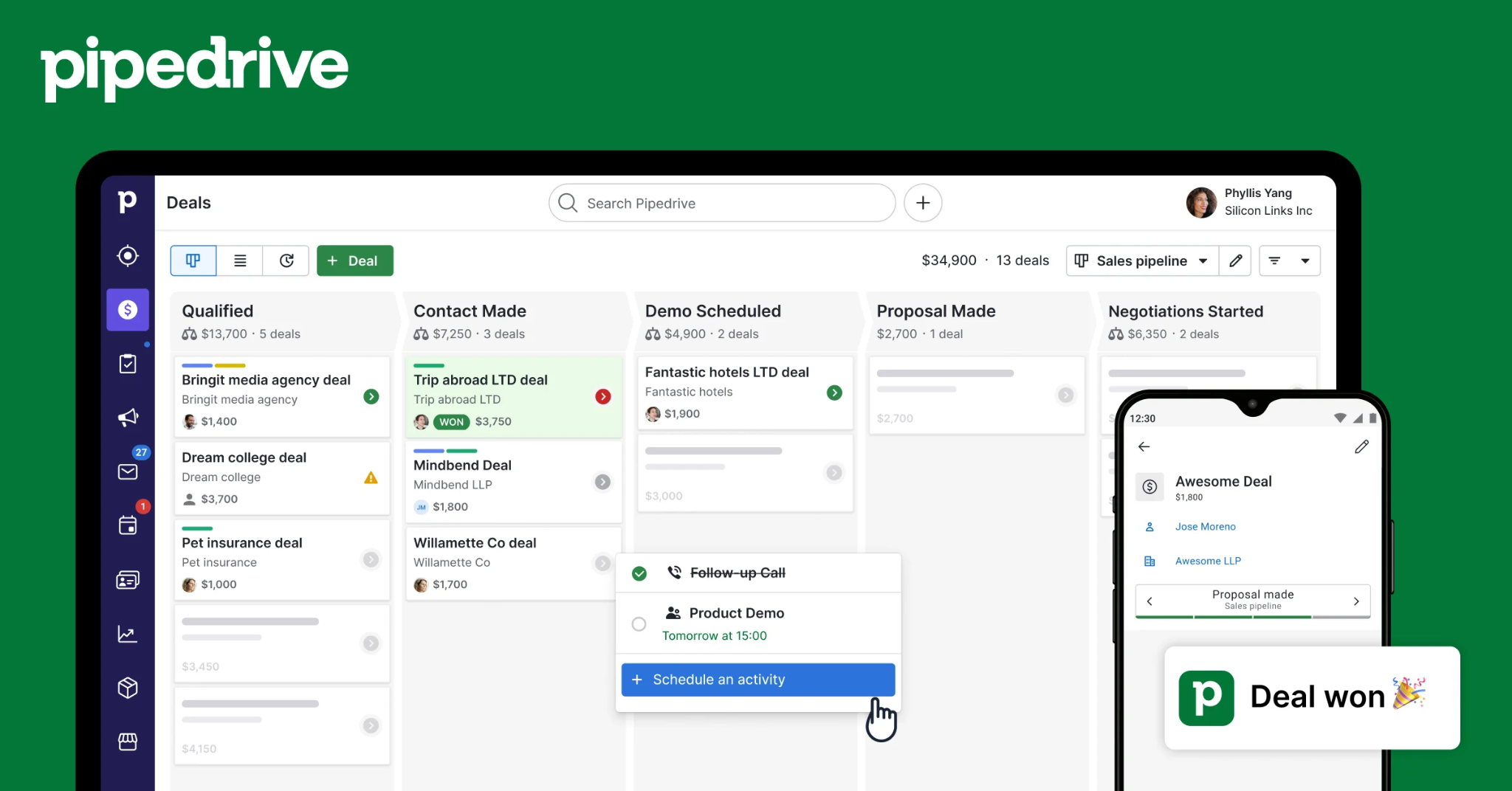
Visual drag-and-drop kanban pipeline with deal rotting alerts for idle opportunities
Graduated pricing starting at $14/seat/month (annual) with no steep mid-tier jump
AI sales features including AI coach, email generation, and smart pipeline suggestions at mid-tier pricing
500+ marketplace integrations including JustCall, Aircall, and Cloudtalk for teams with established calling preferences
Smart Docs with eSignature and native LeadBooster prospecting with 400M+ profiles
Why Choose Pipedrive Over Close CRM for Pipeline Management?
Pipedrive stands out in the following areas:
Pipeline Visibility as the Primary Workspace.
Pipedrive's kanban pipeline view is the operational center of the CRM: the first thing reps see on login and the primary surface for deal management. Deals are color-coded cards with deal rotting alerts flagging anything idle beyond a user-defined threshold. Close's pipeline exists as a feature nested inside its communication-first model. For teams whose process centers on structured deal stages ("where does this deal stand?") rather than communication volume ("how many calls today?"), Pipedrive's layout aligns more naturally with how they approach each day.
Source: Pipedrive
Graduated Pricing Without a Binary Choice.
Close jumps from Essentials at $35/seat to Growth at $99/seat, locking automation behind a near-3x price increase. Pipedrive's tiered plans provide a more graduated path: Lite at $14/seat (annual), Growth adding email sync, workflow automations with if/else conditions, and email sequences without requiring a price jump to $99. For a 10-person team, moving to automated follow-up sequences costs substantially less than Close's Growth plan. Pipedrive also does not delete data when usage limits are exceeded, preserving existing records and notifying admins at 80% and 100% capacity.
Flexible Calling Integration for Established Telephony.
Close's proposition is partly predicated on replacing your existing dialer. For teams that have built calling workflows around JustCall, Aircall, or Cloudtalk, Pipedrive integrates with those tools through its Marketplace, letting teams keep their preferred dialer while using Pipedrive as the CRM of record. This composability extends across a free open API available on all plans with RESTful endpoints and OAuth 2.0 support.
NOTE: We also evaluated Freshsales, which occupies similar SMB territory with strong native telephony. Pipedrive has broader market presence and appears more frequently in Close-specific comparison discussions, making it the stronger match for teams actively evaluating Close alternatives.
Pipedrive Pricing
Pipedrive offers four tiers with annual billing saving up to 42%. A 14-day free trial with no credit card required is available.
Lite: $14/seat/month (annual). Customizable pipelines, deal rotting, Leads Inbox, custom fields, API access.
Growth: Adds email sync, workflow automations with if/else branching, sequences, meeting scheduler, and forecast view.
Premium: Smart Docs with eSignature, LeadBooster (chatbot, live chat, Prospector), AI email creation and summarization.
Ultimate: Contact data enrichment, security alerts, highest usage limits across all categories.
Who Should Use Pipedrive?
Choose Pipedrive if:
Your team needs a clear, visual stage-by-stage pipeline view as the primary daily workspace rather than a communication-centric inbox.
You're scaling and need a path to automation that doesn't require a near-3x per-seat price jump.
Your team already uses a specialist calling tool and doesn't want to abandon that investment by switching to a CRM that bundles its own dialer.
For a direct head-to-head of Close and Pipedrive on features and pricing, see our Close vs Pipedrive comparison.
5. Salesloft: Best Alternative for Enterprise Sales Engagement and Conversation Intelligence
Source: Salesloft
Salesloft is an AI revenue orchestration platform that addresses a fundamentally different use case than Close: rather than replacing a CRM, Salesloft layers enterprise-grade sales engagement and revenue intelligence on top of an existing CRM (primarily Salesforce). Its key capabilities include:
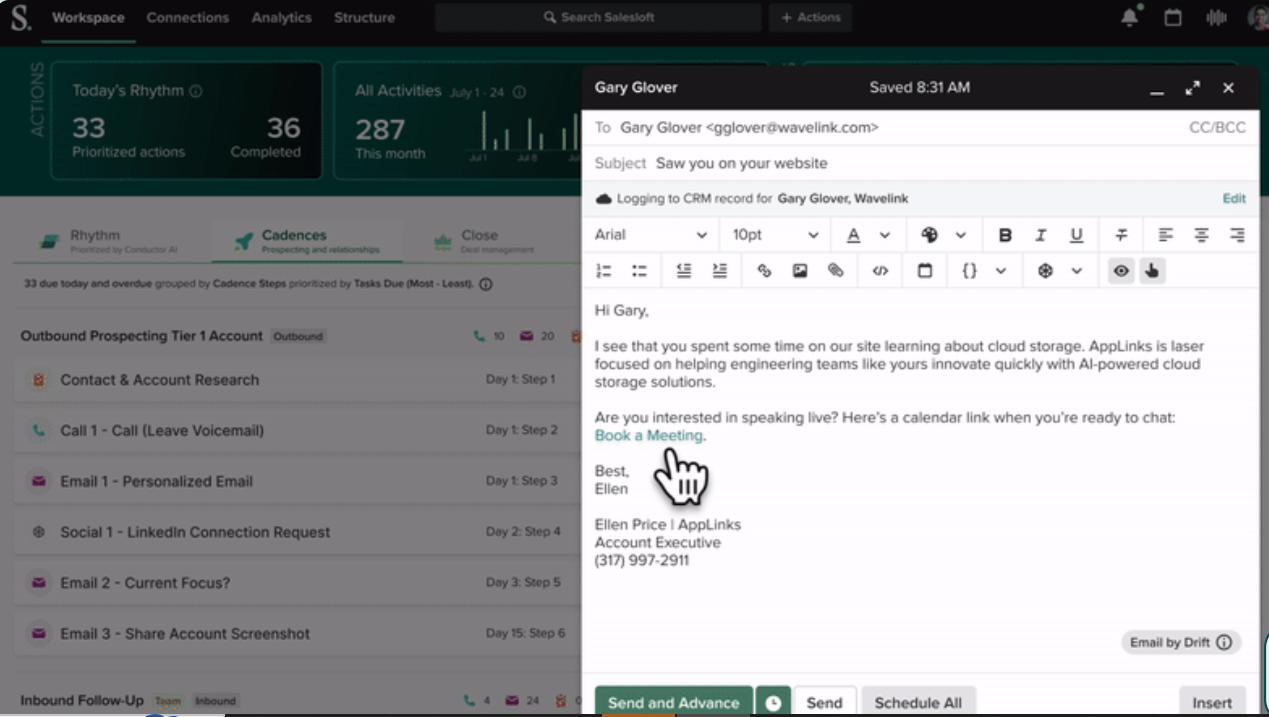
Multi-step cadence automation across email, phone, LinkedIn, and SMS with A/B testing at the template level
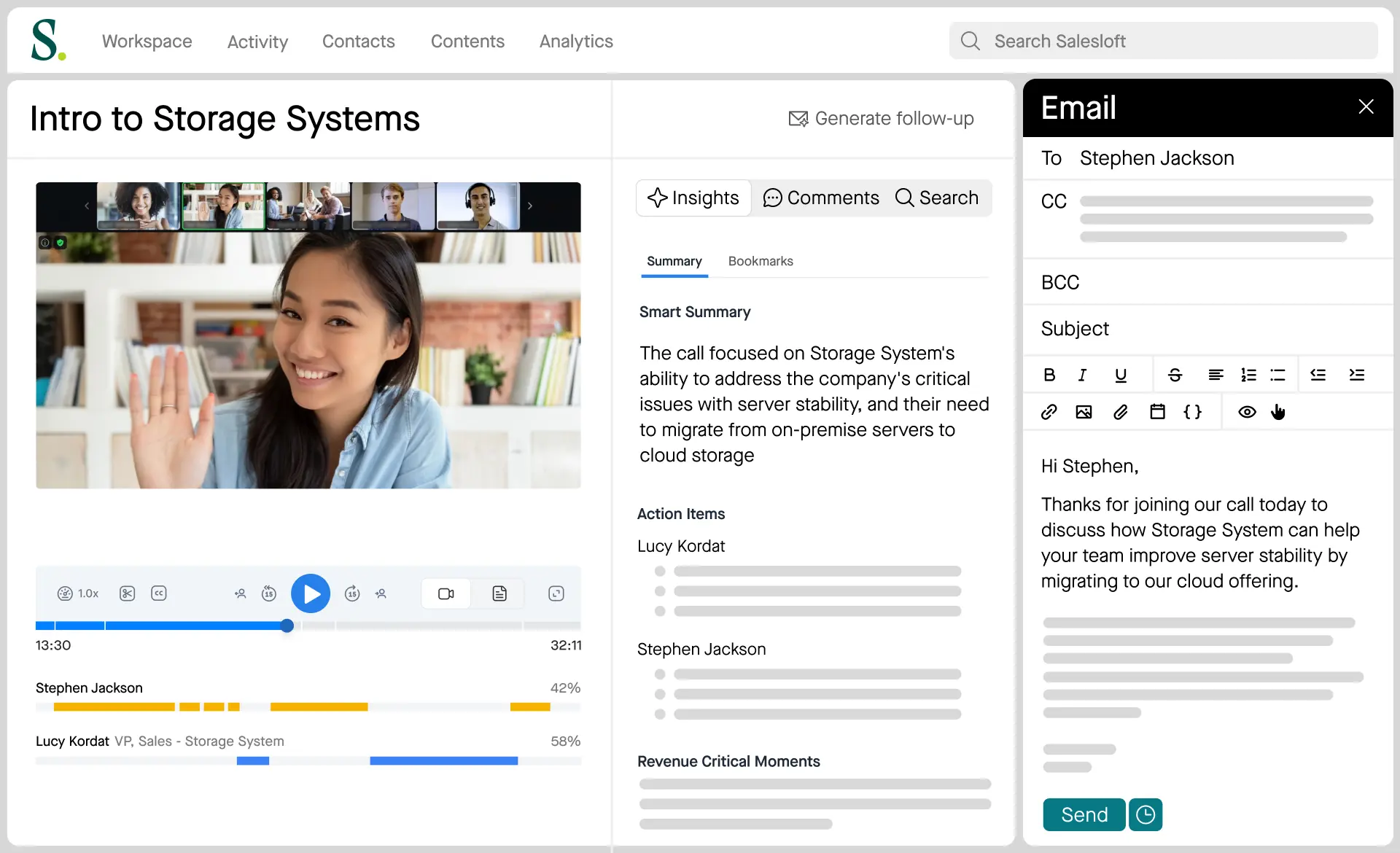
Conversations: automatic call recording, transcription, AI summaries, and manager coaching scorecards pre-populated by AI
Rhythm: a patent-pending AI prioritization engine that continuously re-ranks daily actions based on real buyer behavior
Deals: opportunity management with AI-assessed deal health scoring across 30+ stakeholder engagement factors
Native ZoomInfo Buying Signals integration that routes account-level intent directly into the Rhythm prioritization engine
Why Choose Salesloft Over Close CRM for Enterprise Sales Engagement?
Salesloft stands out in the following areas:
Step-Level Sequence Analytics and A/B Testing.
Close's Workflow system handles multi-touch outreach well, but the intelligence stops at outcome attribution per step. Salesloft's Cadence engine embeds A/B testing directly in cadence steps, reporting open rates, click rates, and conversion rates per variant. Sales managers know which specific email subject line at step three drove qualified meetings, turning sequence optimization into a data exercise.
Structured Conversation Intelligence and Scalable Coaching.
Close's Listen, Whisper, and Barge features are useful for real-time intervention but only address the live-call scenario. Salesloft Conversations covers the entire coaching lifecycle: calls are recorded, transcribed, then processed by AI agents that generate structured recaps, identify competitor mentions and objections, and pre-populate coaching scorecards. For organizations managing 20+ reps, this transforms coaching from reactive bandwidth into a systematic daily process.
Source: Salesloft
AI-Driven Signal Prioritization.
Close's Smart Views are strong for dynamic lead filtering, but the intelligence layer relies on the rep's judgment about which leads deserve attention. Salesloft Rhythm uses Conductor AI to continuously rank every action based on buyer behavior. It ingests first-party engagement data, website visitor signals, and third-party partner signals (including ZoomInfo intent data).
NOTE: We also evaluated Outreach, which competes directly with Salesloft across cadence automation and conversation intelligence. Salesloft stands out for teams in the ZoomInfo ecosystem: ZoomInfo Buying Signals sync natively into the Rhythm prioritization engine via their published partnership, routing account-level intent directly into rep action queues.
For a detailed look at how Outreach and Salesloft compare on cadence automation and conversation intelligence, see our Outreach vs Salesloft breakdown.
Salesloft Pricing
Salesloft operates on a quote-only, negotiated subscription model:
Advanced: Covers pipeline generation, seller coaching, conversation intelligence, and opportunity management.
Elite: Adds multi-team management, enterprise data platform capabilities, and greater customization.
Pricing for both tiers requires a demo at salesloft.com/pricing. Contracts are annual and seat-based.
For a more detailed breakdown of what Salesloft actually costs, see our Salesloft Pricing guide.
Who Should Use Salesloft?
Choose Salesloft if:
Your sales team has 50+ reps with dedicated RevOps support and you need systematic, scalable coaching infrastructure beyond live call monitoring.
Your primary CRM is Salesforce and you want a tight execution layer running on top of it with deep bidirectional sync.
You're running account-based selling motions that require account-level signal aggregation across multiple stakeholders.
6. Zoho CRM: Best Alternative for a Full Business Stack Without Enterprise Pricing
Source: Zoho CRM
Zoho CRM is a cloud-based CRM platform that targets SMBs and mid-market companies wanting enterprise-class features without enterprise pricing, including a permanent free tier that Close does not offer. Its key capabilities include:
Permanent free plan for up to 3 users with leads, contacts, deals, and basic workflow automation
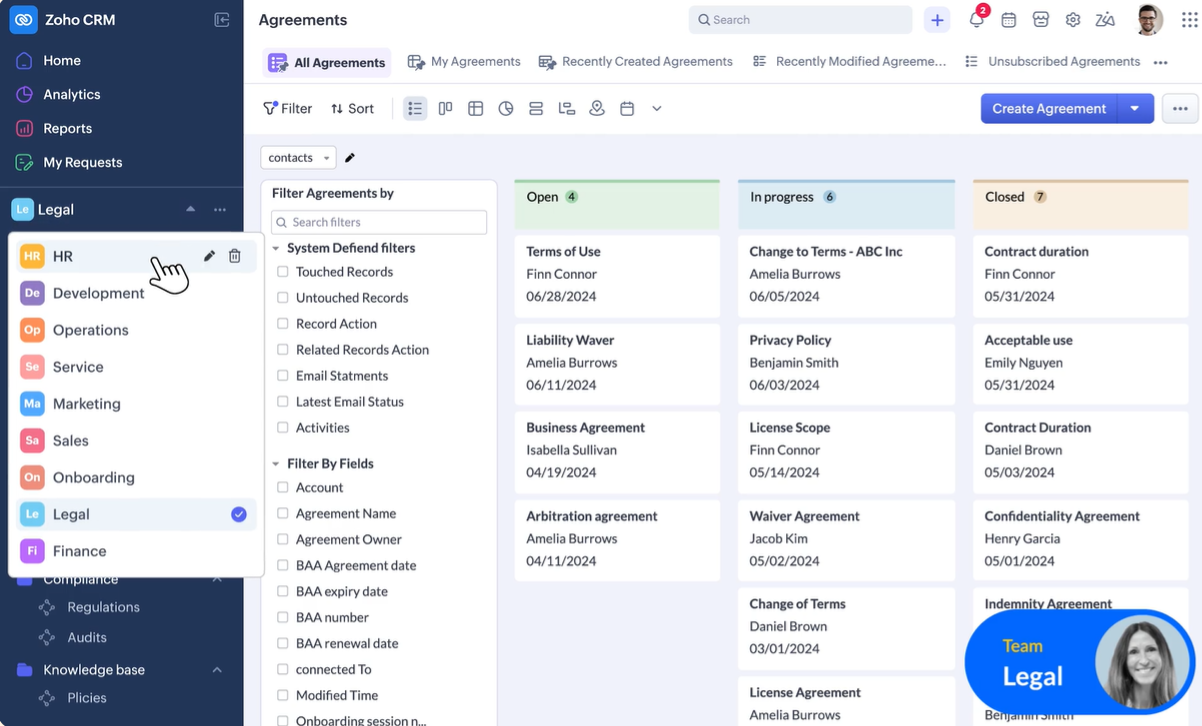
Native integration with 55+ first-party Zoho applications spanning CRM, finance, HR, email marketing, support, and BI
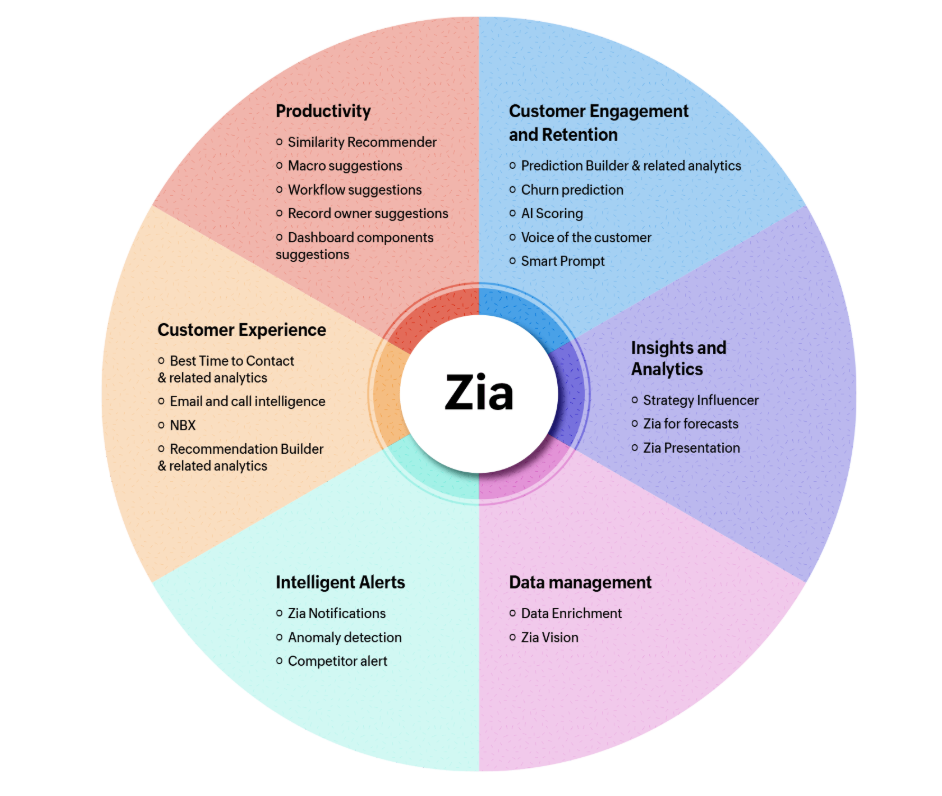
Zia AI with predictive lead scoring, email sentiment analysis, anomaly detection, and call transcription starting at the Professional plan ($23/seat/month)
Custom modules, territory management, multi-currency support, and Blueprint process enforcement at the Enterprise tier ($40/seat/month)
Omnichannel communication spanning email, phone, WhatsApp Business, SMS, live chat, and social media
Why Choose Zoho CRM Over Close CRM for Ecosystem Breadth?
Zoho CRM stands out in the following areas:
A Permanent Free Plan That Removes Adoption Friction.
Close offers a 14-day trial then requires $35/seat/month minimum. Zoho CRM's free plan is permanent: up to 3 users with leads, contacts, deals, 10 workflow rules per module, mobile apps, and email integration. For solopreneurs or lean two-person teams, this removes the entire financial friction of CRM adoption.
A 55+ App Ecosystem That Replaces the Point-Solution Stack.
Close consolidates CRM and sales communication well, but has no native accounting, HR, marketing automation, support, or BI tools. Zoho One bundles 50+ integrated applications under a single per-employee price. A customer record in Zoho CRM surfaces open support tickets from Zoho Desk, invoice status from Zoho Books, and campaign engagement from Zoho Campaigns, all without building integrations.
Zia AI and Deep Customization at Lower Price Points.
Close's AI features (AI Email Assistant, Pipeline Guidance, Chloe) require the Growth plan at $99/seat. Zoho delivers Zia starting at the Professional plan ($23/seat), including predictive scoring, email sentiment analysis across eight emotion categories, competitor mention detection, and call transcription. At Enterprise ($40/seat), Zoho adds custom modules equivalent to Salesforce custom objects, territory management, and Blueprint process enforcement, all at less than a quarter of Salesforce Enterprise's price.
Source: Zoho CRM
NOTE: We also evaluated Pipedrive (covered separately) and Freshsales for the budget-friendly slot. Zoho CRM offers the most comprehensive feature-to-price ratio: a zero-cost entry point, a 55+ app ecosystem, and AI at $23/seat, a combination neither competitor matches.
Zoho CRM Pricing
Zoho CRM uses per-seat pricing billed monthly or annually (annual saves up to 34%):
Free: $0, permanent, up to 3 users, 5,000 records
Standard: $14/user/month (annual). Custom reports, dashboards, forecasting, Cadences, and AI agents for sales activity
Professional: $23/user/month (annual). CPQ, Zia email intelligence, Blueprint process automation
Enterprise: $40/user/month (annual). Zia AI assistant, Territory Management, Journey Orchestration, Sandbox, 20 pipelines
Ultimate: $52/user/month (annual). Custom AI/ML via QuickML, enhanced limits
A 15-day free trial of the Enterprise plan is available with no credit card required.
Who Should Use Zoho CRM?
Choose Zoho CRM if:
Your team is 1-3 people and needs a full CRM with no ongoing cost.
You're building a business stack from the ground up and want a single vendor for CRM, accounting, email marketing, and support.
You need custom modules and territory management but Salesforce's pricing is out of range.
7. Attio: Best Alternative for Teams That Have Outgrown Rigid Data Models
Source: Attio
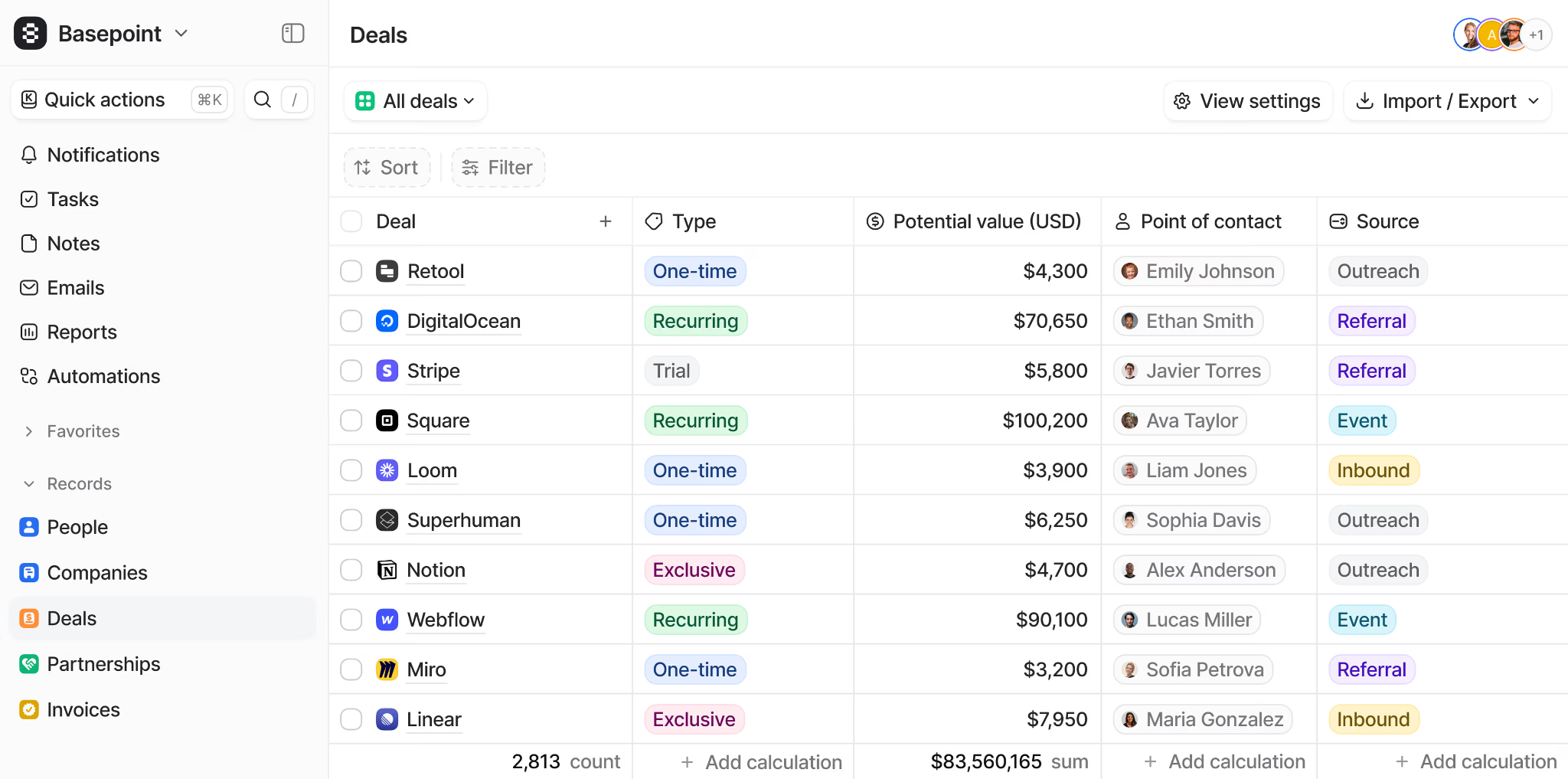
Attio is a modern, AI-native CRM built on a fully flexible object-relational data platform. Where Close asks teams to conform to its fixed Lead/Contact/Opportunity structure, Attio builds the CRM structure around your business. Its key capabilities include:
Fully custom object and attribute data model with no predefined schema constraints
AI attributes that auto-populate through web research and classification logic
Ask Attio: a natural language CRM interface for querying and acting on data
Native call intelligence with automatic recording, transcription, and AI insight extraction
Real-time collaborative workspace with simultaneous multi-user record editing and inline commenting
Why Choose Attio Over Close CRM for Complex Data Needs?
Attio stands out in the following areas:
Custom Object Architecture vs. Close's Fixed Data Model.
Close operates on a fixed schema: Leads, Contacts, and Opportunities. Users can add custom fields but cannot create custom object types. For companies tracking subscriptions alongside deals, investor networks alongside contacts, or marketplace transactions alongside opportunities, Close's model breaks down. Attio supports fully custom objects as a first-class data modeling tool. Want a "Subscription" object linked to a "Company" object with its own renewal status and ARR value? That's a standard workflow.
AI Embedded at the Data Layer.
Close's AI features (Chloe, Draft Assist, AI Enrich) are assistive tools layered on top of the CRM. Attio's AI attributes are a first-class attribute type inside the data model. A field like "ICP Tier" can re-evaluate itself based on funding announcements, headcount changes, or product category shifts without manual triggers. Ask Attio, powered by Universal Context, indexes all CRM data (records, calls, emails, notes, calendar events) as one interconnected system and answers questions like "what were the top objections across every call in Q1?" with source citations. It integrates with Slack and MCP-compatible AI tools.
Real-Time Collaborative Workspace Architecture.
Close's CRM model is fundamentally single-user-per-record, designed for one rep owning a lead and working through their pipeline individually. Attio was built for distributed GTM teams where multiple people (AEs, CSMs, founders, product managers) contribute to the same record simultaneously with live updates, inline comments, and tagged colleagues. This collaborative UX reduces the common CRM-adoption failure mode where reps resent updating the tool.
NOTE: We also evaluated Folk and Breakcold in this category. While Folk excels at relationship management with strong LinkedIn integration, it lacks Attio's sales execution depth. Attio offers the most mature combination of flexible data architecture, AI-native workflows, and collaborative UX for teams outgrowing Close's fixed schema.
Attio Pricing
Attio uses per-seat pricing with annual billing saving 20%:
Free: $0/month, up to 3 seats, 50,000 records, up to 3 custom objects
Plus: $29/user/month (annual) / $36 (monthly). 250,000 records, 5 custom objects, Ask Attio, AI agents, Call Intelligence
Pro: $69/user/month (annual) / $86 (monthly). 1,000,000 records, 12 custom objects, email sequences, 10,000 workspace credits/month
Enterprise: Custom pricing. Unlimited custom objects, SAML 2.0/SSO, migration service included
Note: AI features and workflow automations consume workspace credits. Teams running high-volume automated enrichment may need add-on credit packs.
Who Should Use Attio?
Choose Attio if:
Your business model doesn't fit neatly into "leads, contacts, and opportunities" and you need to track subscriptions, marketplace transactions, or any entity type Close's fixed schema would force into a workaround.
You're running a product-led growth motion and need to connect product usage data and activation signals directly into your CRM to inform sales prioritization.
Your GTM team is distributed across multiple roles and you need real-time collaborative editing on shared records rather than a single-owner workflow model.
The Final Verdict
While Close CRM excels as a communication-first CRM for inside sales teams, growing businesses often need specialized tools that go deeper in specific areas. Based on our research, here are the best alternatives:
ZoomInfo for comprehensive B2B data intelligence, buyer intent signals, and AI-powered GTM execution
Salesforce for unlimited customization, enterprise-grade reporting, and a 9,000+ app ecosystem
HubSpot for unified sales and marketing automation on shared data
Pipedrive for visual pipeline management and graduated, budget-friendly pricing
Salesloft for enterprise sales engagement, conversation intelligence, and AI-driven rep prioritization
Zoho CRM for a full business software stack at a fraction of enterprise pricing
Attio for flexible, AI-native data modeling that adapts to complex business relationships
Remember, you don't have to choose between Close and these alternatives exclusively. Many teams successfully use Close alongside specialized tools to create their ideal sales stack. Consider your specific needs, team size, and growth trajectory when deciding which solution works best for you.
Ready to see who your best prospects are before you ever pick up the phone? Start with ZoomInfo Lite for free and get instant access to verified B2B contacts, company intelligence, and website visitor insights. Or request a demo to experience the full platform.
Close CRM Alternatives FAQ
Why do sales teams look for Close CRM alternatives?
Close CRM works well as a communication-first CRM for inside sales teams under 100 people, but growing teams often discover gaps in specific areas.
The most common limitations include a fixed Lead/Contact/Opportunity data model with no custom objects, limited reporting that doesn't handle non-linear deal movement cleanly, no native B2B data layer or buyer intent signals for prospecting, no marketing automation, and a SaaS/inside-sales focus that limits post-sale retention and enterprise use cases.
What is the best overall Close CRM alternative?
There is no single best alternative because Close covers multiple functions. ZoomInfo is the top choice for teams needing B2B data intelligence and buyer intent signals. Salesforce leads for enterprise-grade customization and reporting. HubSpot is the strongest option for teams needing unified sales and marketing automation. The right choice depends on which specific Close limitation you need to address.
Is there a free alternative to Close CRM?
Yes, several alternatives offer permanent free plans. HubSpot's free CRM includes unlimited contacts and deals for up to 2 users. Zoho CRM's free plan supports up to 3 users with leads, contacts, deals, and basic automation. Attio's free tier supports up to 3 seats with 50,000 records. ZoomInfo Lite also offers permanent free access to its B2B database with 10 monthly export credits.
Which Close CRM alternative is best for enterprise sales teams?
Salesforce is purpose-built for enterprise organizations, offering unlimited custom objects, hierarchical territory management, compliance-grade permissions, and industry-specific clouds across 17 verticals. Salesloft is the top choice for enterprise sales engagement and coaching at scale, layering on top of an existing CRM like Salesforce. ZoomInfo provides the enterprise-grade data intelligence layer that both tools rely on.
How does Close CRM compare to HubSpot for growing teams?
Close focuses exclusively on sales communication (calling, email, SMS) and does it well for small teams. HubSpot covers both sales and marketing with shared data, meaning leads from email campaigns flow directly into sales sequences without a separate tool or data sync.
HubSpot's free CRM tier is also more generous than Close's 14-day trial, and its pricing steps (Free, $15, $100, $150) are more gradual than Close's jump from $35 to $99.
Which alternative is best for teams that need better reporting?
Salesforce offers the deepest reporting with its native report builder, CRM Analytics, and Tableau, handling non-linear deal movement and multi-pipeline rollup directly. HubSpot Professional provides custom report builders with multi-touch revenue attribution for teams needing to tie campaign spend to closed revenue. Both are significant upgrades from Close's reporting, which users consistently cite as its primary limitation.
Can I use ZoomInfo alongside Close CRM?
Yes. ZoomInfo's API and MCP server make its intelligence accessible in any tool, meaning teams can feed ZoomInfo's verified contact data, buyer intent signals, and account intelligence into Close or any other CRM. You don't have to replace Close to benefit from ZoomInfo's data layer.
Which Close CRM alternative has the most flexible data model?
Attio offers the most flexible data architecture, allowing teams to create fully custom objects, relationships, and attributes from scratch with no predefined schema constraints. Salesforce also supports unlimited custom objects at enterprise scale. Both remove the ceiling that Close's fixed Lead/Contact/Opportunity model imposes on businesses with complex relational data needs.
Looking beyond Close CRM? Compare the strongest alternatives side by side:
