
Dreamdata is a B2B Activation and Attribution Platform that gives marketing teams a single view of the buying journey, from first anonymous website visit through closed revenue. Its account-level multi-touch attribution, LinkedIn Marketing Partner integration, and audience activation make it a leader in B2B marketing analytics.
But as your go-to-market motion scales, Dreamdata's strengths in one area can leave gaps in another. Its 1-2 month learning curve and complex setup slow time to value. Its limited dashboard layouts frustrate power users who want custom reporting without exporting to a BI tool. And its digital-first data model leaves offline touchpoints (phone calls, for example) unmeasured.
That's where this guide comes in. Whether you need to:
Unify B2B data, intent signals, and sales execution in one AI-powered GTM platform
Surface attribution insights with AI analytics rather than manual configuration
Track phone calls, forms, and offline conversions alongside digital touchpoints
Prove campaign incrementality with statistically defensible measurement
Get enterprise-grade attribution natively inside Salesforce and Adobe Experience Cloud
Start B2B attribution at zero cost before committing budget
Prove LinkedIn Ads ROI in hours, not months, on a lean budget
We'll explore Dreamdata alternatives that excel in these areas.
Some teams will use one of these tools alongside Dreamdata to fill a gap. Others will replace Dreamdata with a platform better suited to their GTM motion. This isn't about finding a "better" platform; it's about finding the right fit as your revenue operations grow.
The Best Dreamdata Alternatives
Best Alternative for Unified B2B Data, Intelligence & GTM Execution We chose ZoomInfo because it is an AI GTM platform that combines B2B data (500M contacts, 100M companies) with a GTM Context Graph and access through APIs, MCP, GTM Workspace, and GTM Studio, powering attribution, prospecting, and activation in one platform. |
|---|
Best Alternative for AI-Powered Revenue Attribution Without a Dedicated Analyst We chose HockeyStack because its Odin AI Analyst answers attribution questions in plain English, its no-code report builder enables custom dashboards without SQL, and its fast onboarding gets teams to insights in days instead of months. |
Best Alternative for Enterprise Teams in the Adobe and Salesforce Ecosystem We chose Adobe Marketo Measure because it writes attribution data directly into native Salesforce objects, making revenue credit visible inside the CRM without a separate platform login, and captures sales-generated touchpoints alongside marketing interactions. |
Best Alternative for B2B Teams That Close Deals Over the Phone We chose Ruler Analytics because it combines call tracking, form attribution, and marketing mix modelling in one platform, filling the offline conversion gap that Dreamdata's digital-first model leaves unmeasured. |
Best Alternative for Statistically Defensible ROI Proof We chose SegmentStream because its geo holdout incrementality testing, marginal analytics, and automated budget reallocation give performance marketing teams a measurement approach that proves causation, not just correlation. |
Best Alternative for Teams Starting B2B Attribution Without Upfront Investment We chose Factors.ai because its functional free tier delivers company identification and high-intent alerts immediately, while its LinkedIn AdPilot with Smart Reach impression capping addresses budget waste that standard attribution tools only report on. |
Best Alternative for LinkedIn and Google Ads Attribution on a Lean Budget We chose Fibbler because it connects LinkedIn Ads campaigns to CRM pipeline in under an hour at $89/month, making it the fastest and cheapest path to proving LinkedIn ROI for B2B SMBs. |
What is Dreamdata?
Source: Dreamdata
Dreamdata is a B2B Activation and Attribution Platform built for marketing teams that need to connect every revenue touchpoint to actual pipeline and closed deals. Three former Trustpilot colleagues founded it in Copenhagen in 2018, born from a real problem: in a leadership meeting at Trustpilot, the heads of product, sales, and marketing each named a number for their contribution to revenue, and the three numbers totaled 200% of actual revenue.
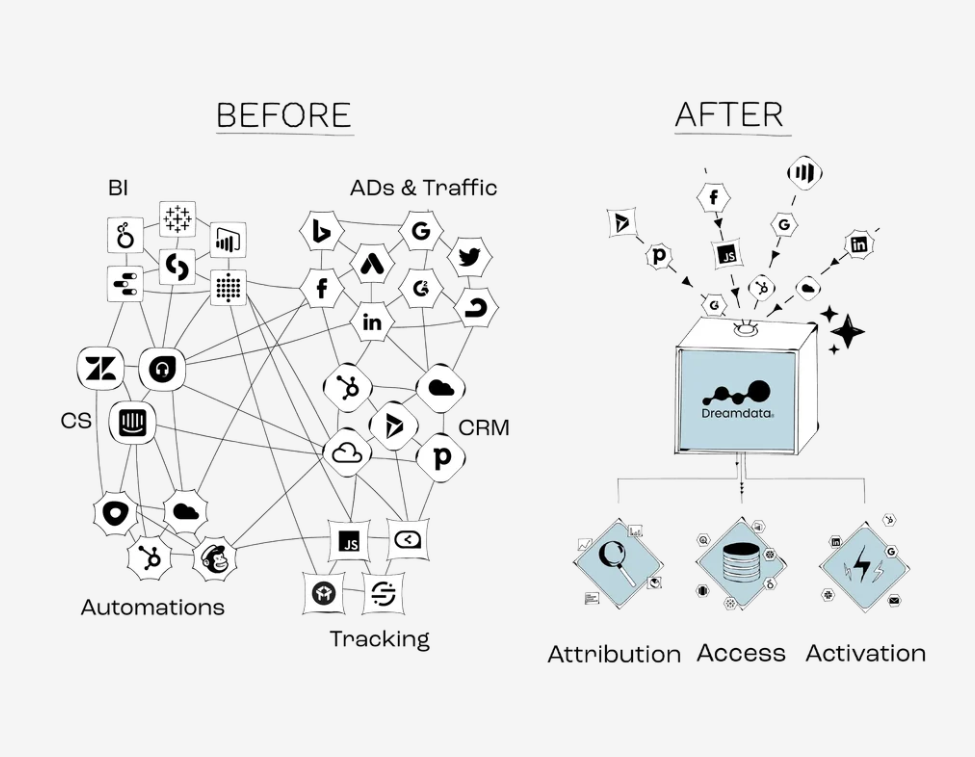
Dreamdata solves this by stitching together the full account-level buying journey, from first anonymous website visit through closed revenue, across three interlocking workflows:
Measure: Multi-touch revenue attribution and analytics tied to CRM data, with six default attribution models plus data-driven ML and custom options
Activate: Dynamic audience building and daily sync to LinkedIn, Google, Meta, and Microsoft Ads via the Audience Hub
Automate: AI-driven intent signals that surface high-intent accounts to sales through CRM syncs, Slack/Teams alerts, and a Chrome Extension
LinkedIn depth: As an official LinkedIn Marketing Partner with access to the Company Intelligence API, Dreamdata offers organic and paid LinkedIn attribution no other analytics platform can replicate
Cookieless tracking: Identifies up to 80% of anonymous website visitors even when cookies are declined
Data warehouse export: Full data model export to BigQuery, Snowflake, S3, and Azure for custom BI analysis
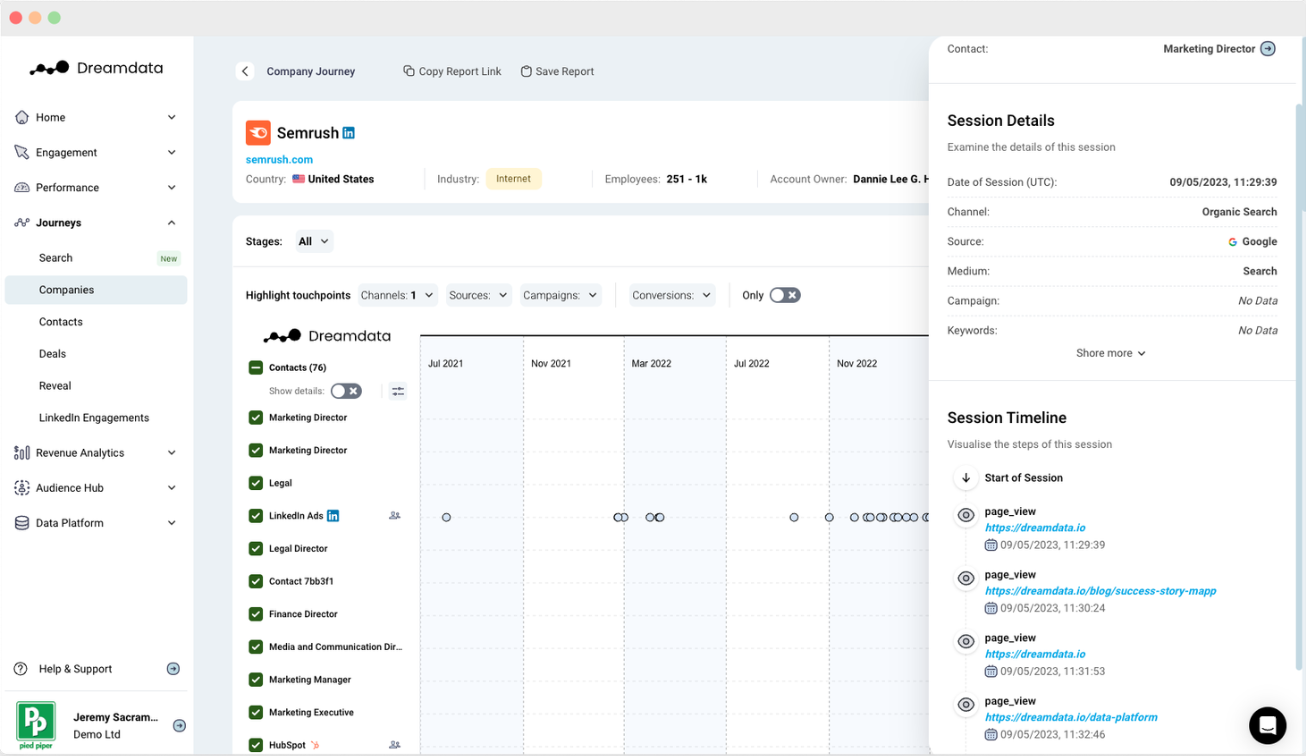
Dreamdata's account-level approach is differentiated: while most analytics tools report at the contact or session level, Dreamdata resolves all contacts and anonymous visitors to the company account, reflecting how B2B buying committees actually work. Its customer journey view lets teams trace the full sequence of activities that moved a company from cold prospect to signed customer.
Source: Dreamdata
That said, as your revenue operations grow more complex, you might need deeper capabilities in specific areas: a B2B data layer that powers prospecting alongside attribution, phone call tracking for offline conversions, AI-powered analytics that remove the need for a dedicated analyst, or statistically defensible incrementality testing. That's why we've focused on platforms that serve these use cases.
Looking for a platform that combines B2B data with AI-powered GTM intelligence? ZoomInfo unifies 500M contacts, intent signals, and conversation intelligence into a single GTM Context Graph, accessible through any tool via APIs and MCP. Learn how ZoomInfo can power your go-to-market motion.
How We Curated Our List of Dreamdata Alternatives
After testing Dreamdata and researching the B2B attribution and revenue intelligence market, we found that while Dreamdata excels at account-level multi-touch attribution with deep LinkedIn integration, different GTM motions and team profiles require different solutions. We focused on tools that address specific needs where businesses may want deeper capabilities:
Unifying B2B data, intent signals, conversation intelligence, and sales execution in one AI-powered platform
Getting attribution insights through AI-powered analytics without months of manual configuration
Tracking phone calls, forms, and offline conversions alongside digital touchpoints in the same attribution model
Proving campaign causation through incrementality testing, not just correlation through multi-touch models
Surfacing attribution data natively inside Salesforce for enterprise teams running Adobe and Salesforce infrastructure
Starting B2B attribution at zero cost with a functional free tier before committing budget
Proving LinkedIn Ads ROI quickly and affordably without a full multi-channel attribution stack
Each tool on this list leads in one of these areas. You might use them alongside Dreamdata to fill a gap, or choose one as a replacement; it depends on what your growing B2B team needs most.
DISCLAIMER: We aren't covering every tool in the B2B attribution market! Our focus is on highlighting the best alternatives that address specific limitations of Dreamdata's approach for various use cases. The goal is to provide insights into tools that serve particular GTM needs. |
|---|
1. ZoomInfo: Best Alternative for Unified B2B Data, Intelligence & GTM Execution
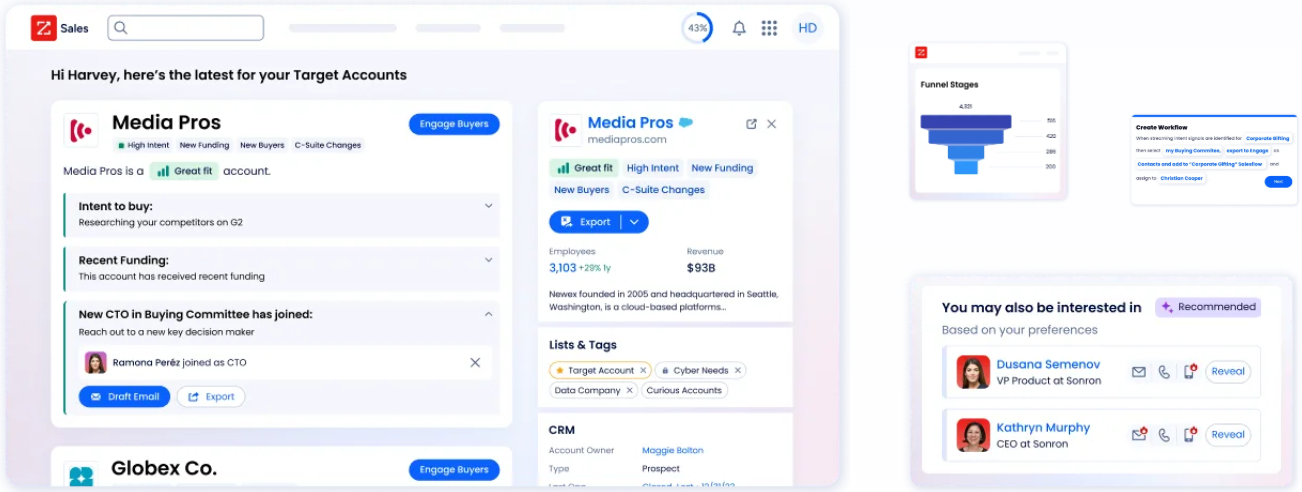
ZoomInfo is an AI GTM platform that takes a broader approach than Dreamdata. Dreamdata is a marketing analytics layer that measures and activates based on existing touchpoint data. ZoomInfo operates the largest B2B data platform in the industry and layers intelligence, prospecting, and execution on top of it. Its key features include:
B2B data: 500M contacts, 100M companies, 135M+ verified phone numbers, 120M direct dials, and 200M+ verified business emails, checked by 300+ human researchers with up to 95% accuracy on first-party data
GTM Context Graph: An intelligence layer that processes 1.5B+ data points daily, fusing ZoomInfo's third-party data with customer CRM records, conversation transcripts, and behavioral signals to capture not just what happened in a deal, but why it happened
Buyer Intent Data: 210 million IP-to-Organization pairings and 6 trillion+ keyword-to-device pairings sourced monthly, with Guided Intent that identifies topics historically correlated with deal success
Access: Intelligence available through GTM Workspace for sellers, GTM Studio for marketers and RevOps, and APIs and MCP for custom tools or AI agents
For B2B revenue teams that need more than marketing attribution, ZoomInfo provides the data, intelligence, and execution tools that power the go-to-market motion, from identifying target accounts through executing outreach and measuring results.
Why Choose ZoomInfo Over Dreamdata for Unified GTM Intelligence
Dreamdata excels at measuring marketing's contribution to revenue after the fact. ZoomInfo provides the upstream data, signals, and execution tools that drive revenue creation. Here's where ZoomInfo steps up.
B2B Data: The Foundation Dreamdata Doesn't Have
Dreamdata analyzes the touchpoints your existing GTM stack generates: it ingests CRM records, ad platform data, and website visits, then attributes them to revenue. What it doesn't provide is the contact and company data that fuels prospecting, identifies buying committees, and fills pipeline.
ZoomInfo's data covers three dimensions: identity (who buyers are and how to reach them), company attributes (org charts, technographics across 30,000+ technologies), and signals that reveal when accounts are in-market. An independent consultant validated this in a Fortune 500 competitive RFP analyzing 25 million contacts across vendors, concluding that "no other competitor came even close."
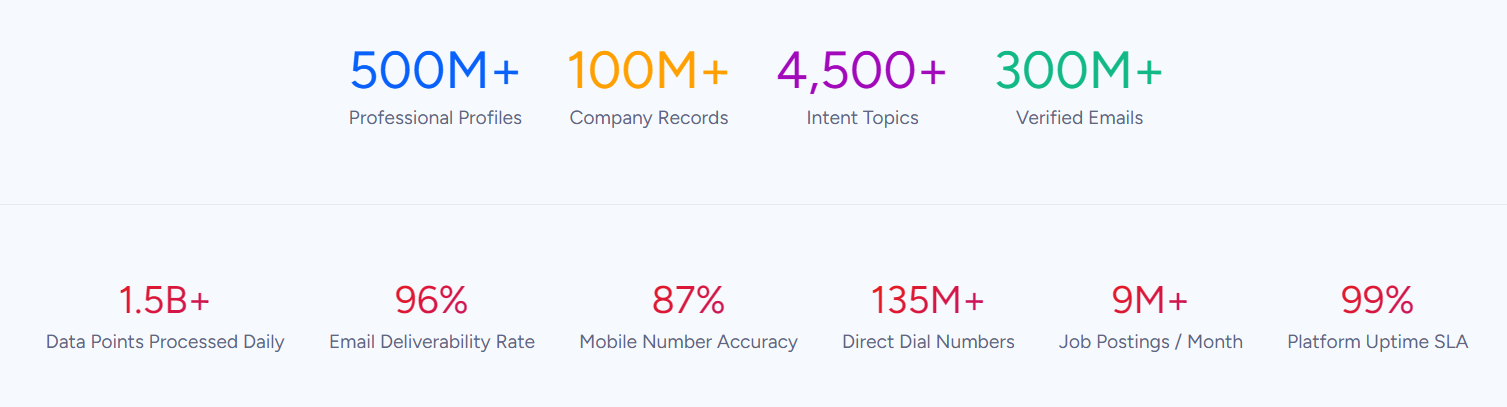
For revenue teams, the difference is structural: Dreamdata shows which of your existing campaigns drove pipeline. ZoomInfo finds the pipeline opportunities, with verified direct dials and emails that connect, then layers intent and behavioral intelligence to prioritize them.
ZoomInfo in Action: Your marketing team identifies target accounts using ZoomInfo's company and technographic filters. The platform surfaces three accounts showing intent signals for your solution category through Guided Intent. GTM Workspace delivers AI-drafted outreach to the right contacts (verified direct dials and emails) addressing the concerns the intelligence layer identified. Meanwhile, GTM Studio enrolls those accounts into targeted LinkedIn and display ad campaigns. The full motion, from identification through execution, runs on one intelligence layer instead of separate tools for data, intent, attribution, and activation.
"ZoomInfo's not just a contact data company anymore. They've built a full system of execution. GTM Intelligence actually works the list, writes the outreach, triggers the play, and helps drive predictable growth." (Ian Brodie, CEO & Co-Founder, Levanta)
The GTM Context Graph: Intelligence That Goes Beyond Attribution
Dreamdata's attribution models resolve touchpoints to accounts, run data-driven ML attribution, and connect CRM pipeline stages to digital interactions. But attribution looks backward by definition: it tells you what happened and which channels got credit.
ZoomInfo's GTM Context Graph captures something different: why deals move or stall, and what should happen next. It fuses ZoomInfo's third-party data with a customer's CRM records, conversation intelligence from Chorus, email interactions, and behavioral signals. A CRM records that a deal moved stages. Conversation intelligence transcribes what the VP of Finance said on the last call. Intent data logs a research spike.
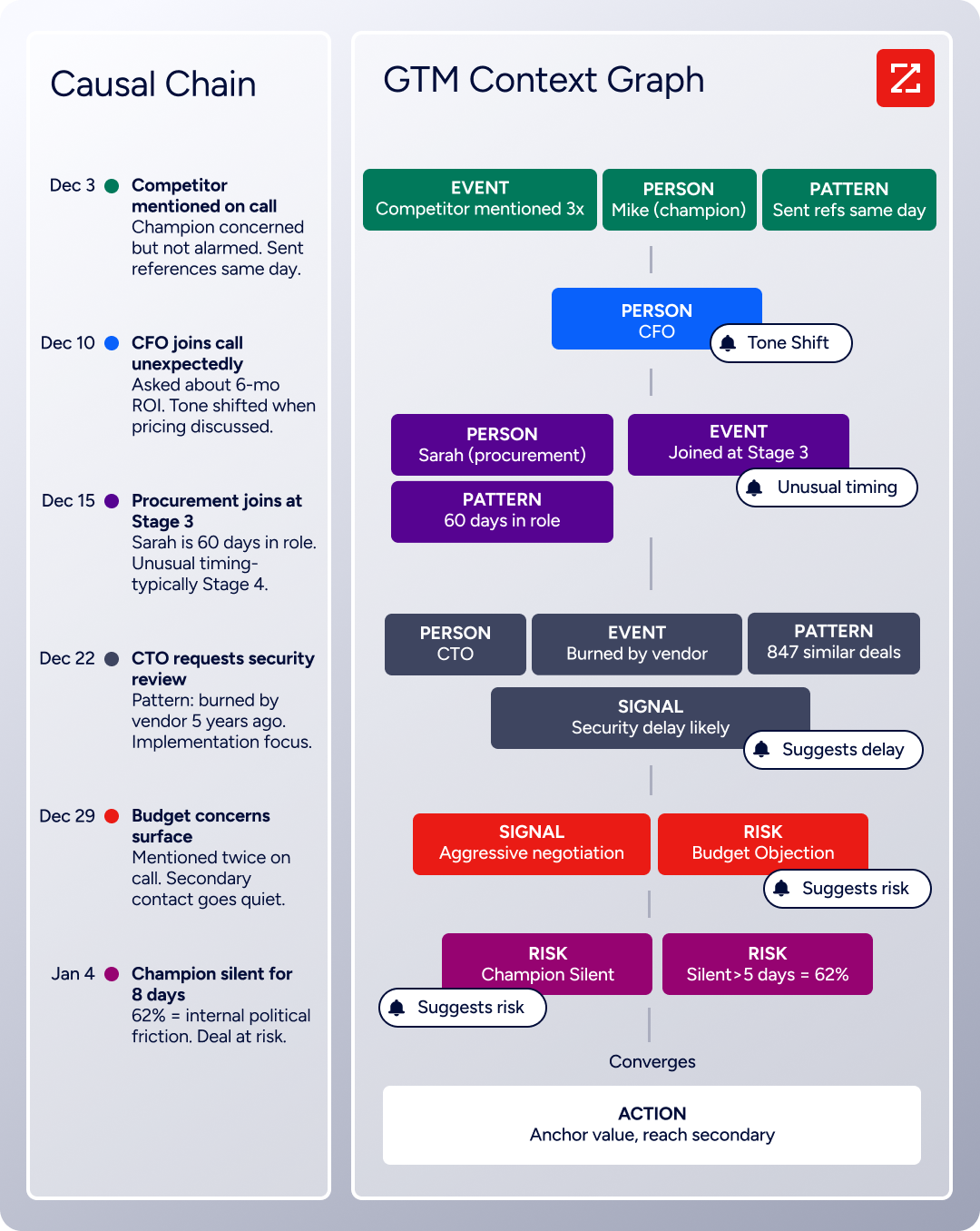
The GTM Context Graph connects these signals to reveal why the deal accelerated and what pattern it matches from thousands of similar deals.
As ZoomInfo's Chief Product Officer Dominik Facher writes: "The CRM recorded the state change. It has no record of why it happened."
ZoomInfo in Action: A seller opens GTM Workspace and sees a new executive sponsor on a target account's buying committee. The AI-drafted follow-up email addresses the concern the CFO raised last week, because the GTM Context Graph recognizes that executive sponsorship entering at this deal stage, combined with ROI-focused questions, matches the pattern behind closed-won deals in this segment. That same intelligence triggers a GTM Studio play targeting twelve similar accounts whose signal combinations match your win patterns.
"That combination of our internal CRM data, external signals, and AI that's given all that context has helped us craft very specific account- and persona-based messages. And people have responded to them right away." (Toby Carrington, CBO, Seismic)
Use Intelligence in Any Tool, Any Workflow
Dreamdata surfaces its intelligence through its own dashboards, with data warehouse exports (BigQuery, Snowflake, S3) as the main extensibility path and a recently launched MCP server for AI agent access. In practice, team members must log into Dreamdata or build custom BI reports to see attribution insights.
ZoomInfo delivers the same intelligence through three paths. GTM Workspace gives sellers a single screen where prioritized accounts, AI-drafted outreach, and deal execution converge.
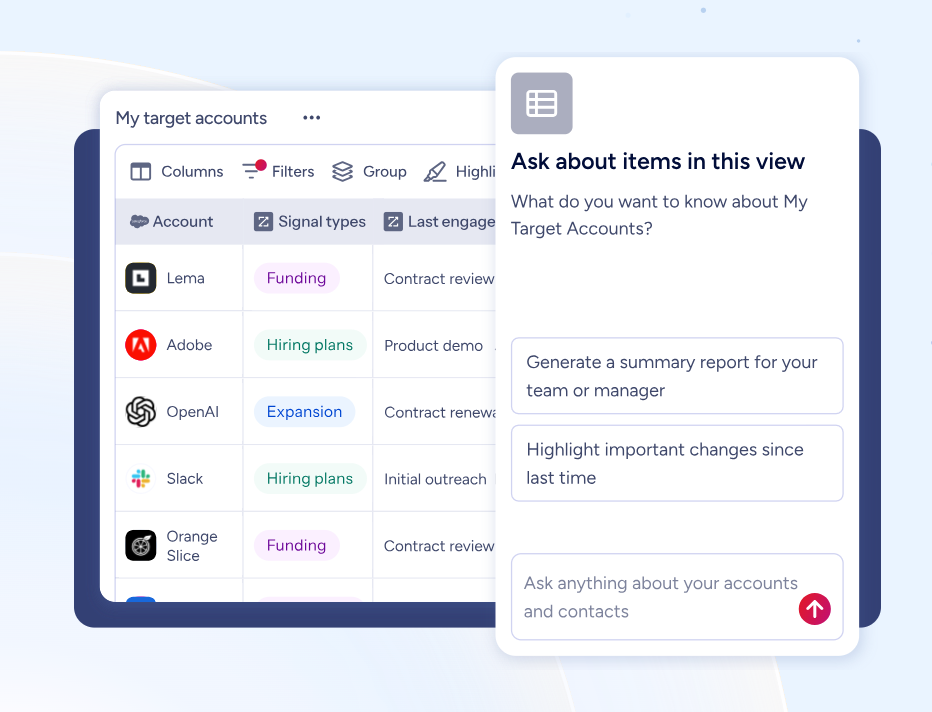
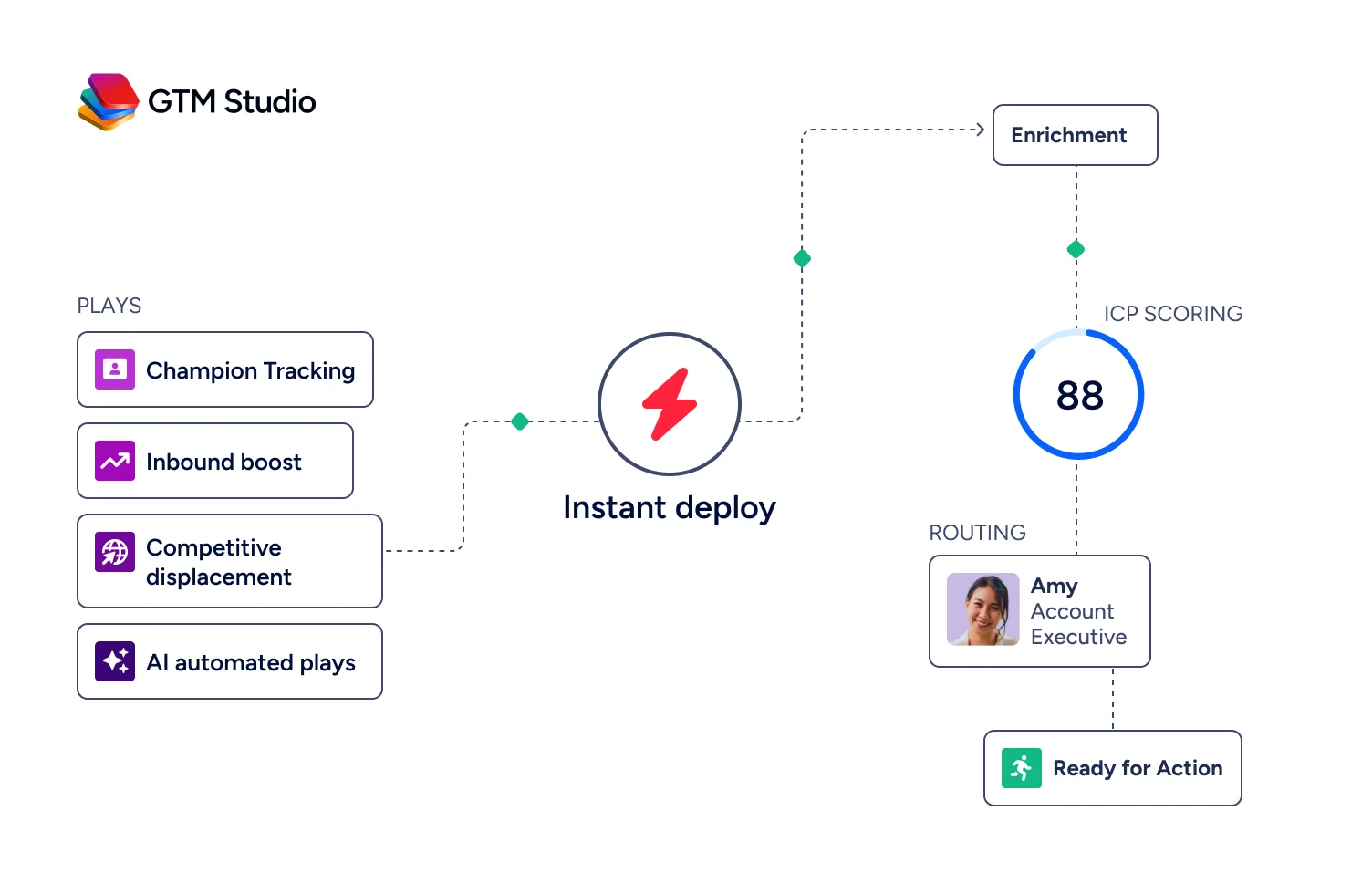
GTM Studio gives marketers and RevOps a builder where audience definition, campaign orchestration, and pipeline measurement happen in natural language.
APIs and MCP expose the same intelligence to custom agents, internal tools, or partner platforms (from Anthropic Claude to Google to proprietary systems). The ZoomInfo MCP server is listed in the Claude directory and supports Claude and ChatGPT.
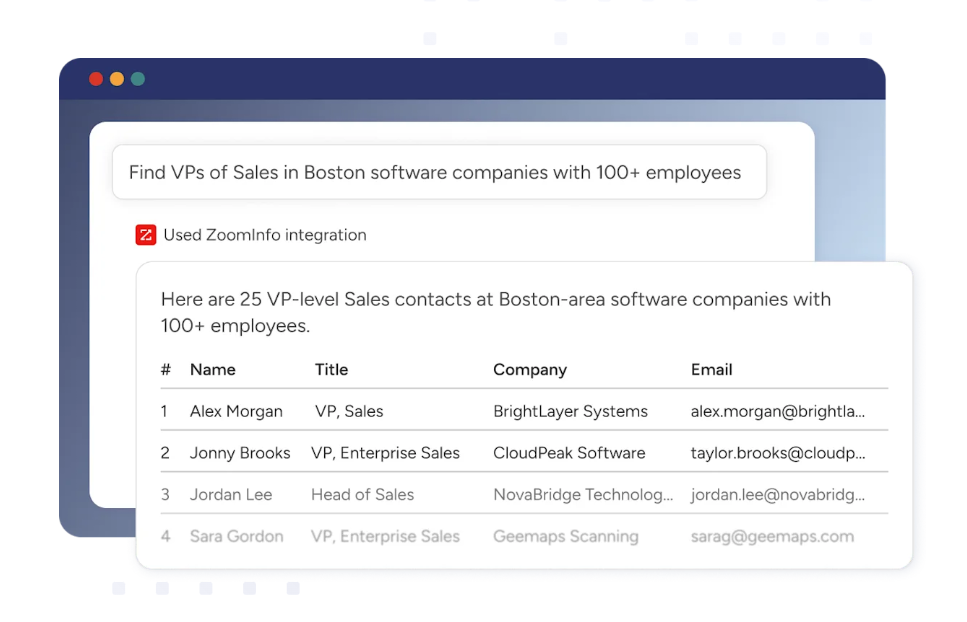
All three paths draw from one GTM Context Graph: the same data, the same intelligence, the same continuously learning model. Nothing is degraded or siloed by access point.
ZoomInfo in Action: A large financial services firm builds an internal app using ZoomInfo's MCP server that combines their proprietary risk models with ZoomInfo's company intelligence and intent signals. Sales reps query the app in natural language and receive account briefs that blend internal compliance data with ZoomInfo's intelligence. As CEO Henry Schuck said: "That's a surface area we would never see before."
"ZoomInfo is our one source of truth for account data, and even more so for contact data. There's no other provider in the market that provides you with that level of detail." (Thor Sanderson, Senior Manager of Sales Technology Enablement, Smartsheet)
NOTE: We considered other B2B data and intelligence platforms, including 6sense and Demandbase. 6sense offers account-based marketing and intent capabilities. Demandbase provides an ABM platform with advertising. ZoomInfo stands apart with the largest B2B data foundation, the GTM Context Graph's ability to combine first-party and third-party data, and access that delivers intelligence into any tool via APIs and MCP without platform lock-in.
ZoomInfo Pricing
ZoomInfo uses a custom-quoted, consumption-based pricing model with no public prices. Pricing scales with enterprise license agreements, data access, API consumption, and AI activity. The mechanics are seat-and-credit-based: seats determine user access, credits determine export volume (1 credit = 1 exported profile).
Sales Plans are structured across three tiers:
Professional: Contact and company data, detailed profiles, advanced search, mobile numbers and business emails, CRM integrations (HubSpot, Salesforce, and more), Chrome extension, AI-powered email generation
Advanced: AI-driven account prioritization, Buyer Intent signals, website visitor tracking, Champion Tracking, buying group filters, automated outreach workflows, GTM plays
Enterprise: Real-time buyer intent, sales activity automation, advanced company attributes, custom Intent signals, AI-generated account summaries and ICP creation, dedicated customer service manager
Marketing Plans include Marketing Demand, ABM Lite, and ABM Enterprise tiers for audience targeting, advertising, and full-funnel ABM orchestration.
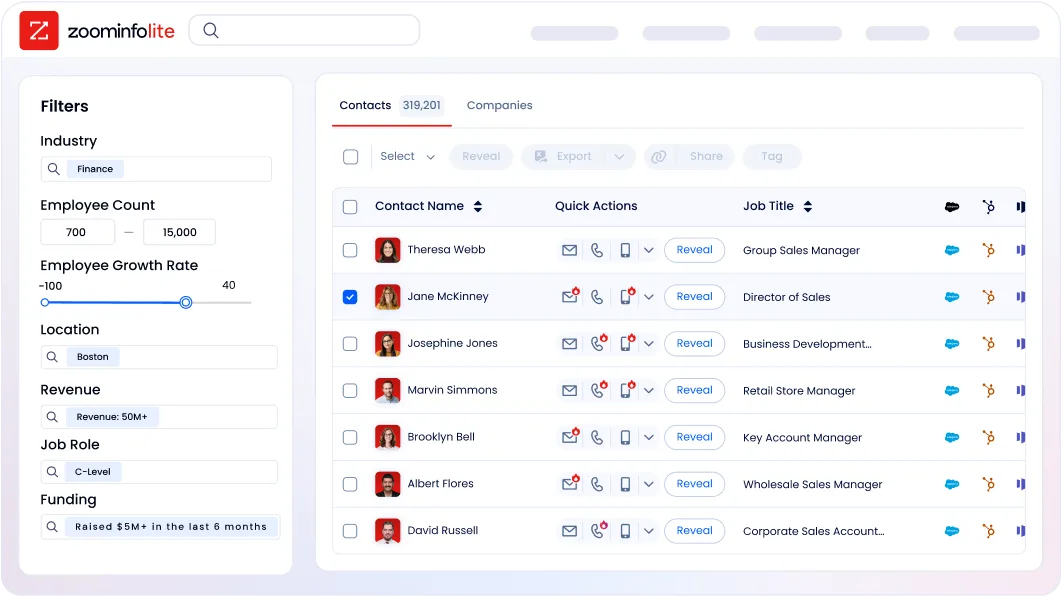
ZoomInfo also offers ZoomInfo Lite, a permanent free tier (no credit card, no time limit) with access to the B2B database, 10 monthly export credits, individual and company searches, WebSights Lite, and HubSpot integration. A 7-day free trial of the full platform is also available.
Who Should Use ZoomInfo?
Choose ZoomInfo if:
Your revenue team needs more than attribution: you need a B2B data foundation with verified contacts and company intelligence that powers prospecting, targeting, and pipeline generation alongside measurement.
You want an intelligence layer that captures why deals move or stall (not just which channels appeared in the journey) and uses it to prioritize accounts, draft outreach, and surface next-best actions for sellers.
Your organization runs a complex GTM motion across sales, marketing, and RevOps, and needs one intelligence layer accessible in any tool via APIs, MCP, or dedicated front-ends, instead of siloed data in separate point solutions.
Ready to see how ZoomInfo's GTM Context Graph can power your go-to-market motion? Request a demo and see how 35,000+ companies use ZoomInfo's B2B data and AI-powered intelligence to find, win, and grow customers.
2. HockeyStack: Best Alternative for AI-Powered Revenue Attribution Without a Dedicated Analyst
Source: HockeyStack
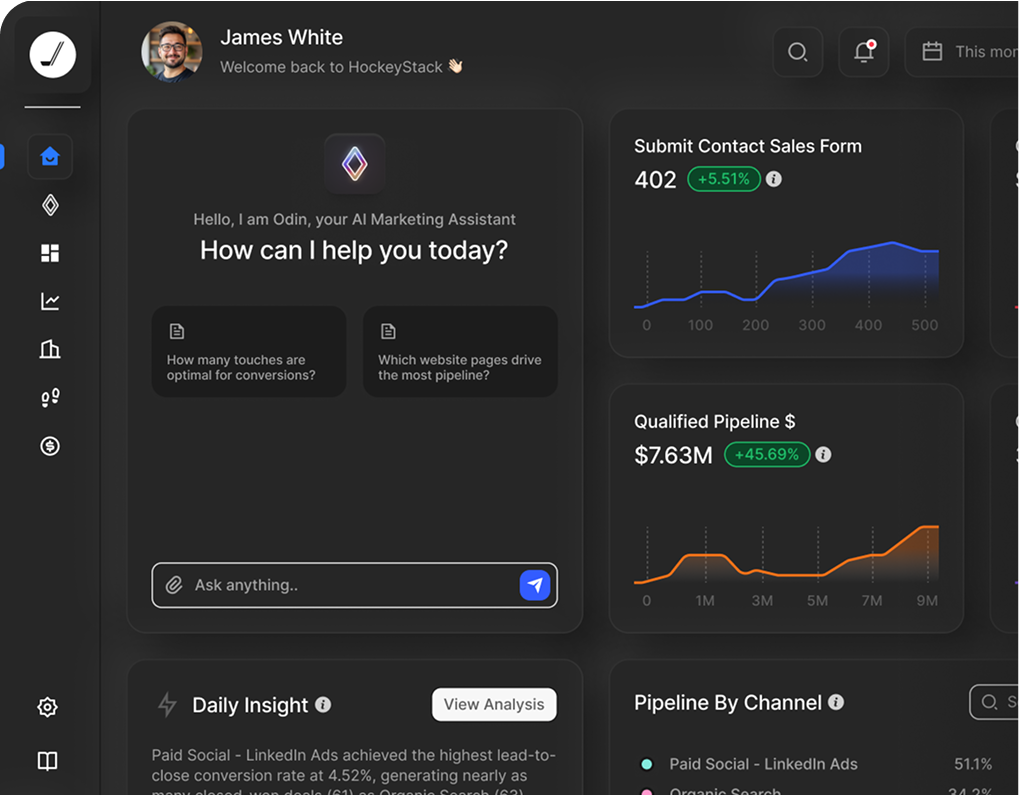
HockeyStack is a B2B Revenue Data Intelligence platform that unifies sales and marketing data into a single account-level timeline, then applies AI to surface attribution insights without requiring data engineering or a dedicated analytics hire. Its key capabilities include:
Odin AI Analyst: A multi-agent AI system that answers revenue and attribution questions in plain English, creates reports on demand, and delivers prescriptive budget recommendations
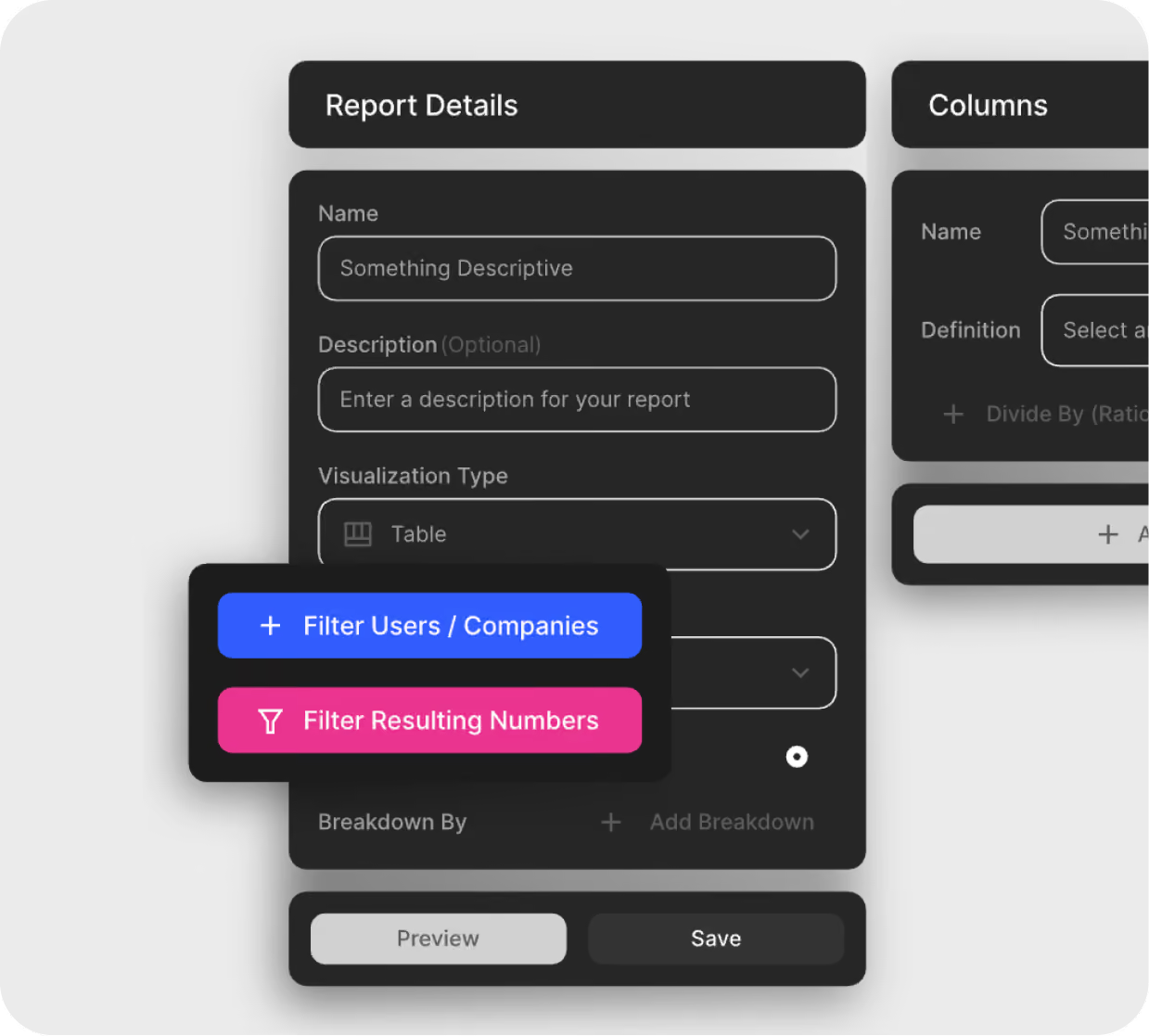
No-code report builder: Full control over attribution models, scoring weights, campaign groupings, and exclusion rules directly in the UI without developer involvement
9 simultaneous attribution models: All nine models run against the same dataset concurrently for side-by-side comparison
Blueprints: Prescriptive engagement patterns derived from closed-won data that identify ideal touch sequences per segment
12 prebuilt AI Agents plus a custom builder for deal resurrection, budget optimization, pre-call briefs, and win/loss analysis
Why Choose HockeyStack Over Dreamdata for AI-Powered Revenue Intelligence
HockeyStack stands out in the following areas:
Odin AI Analyst Removes the Analytics Bottleneck
Dreamdata is a capable attribution platform, but its learning curve (typically 1-2 months to proficiency) and setup complexity create friction for teams without a dedicated analyst.
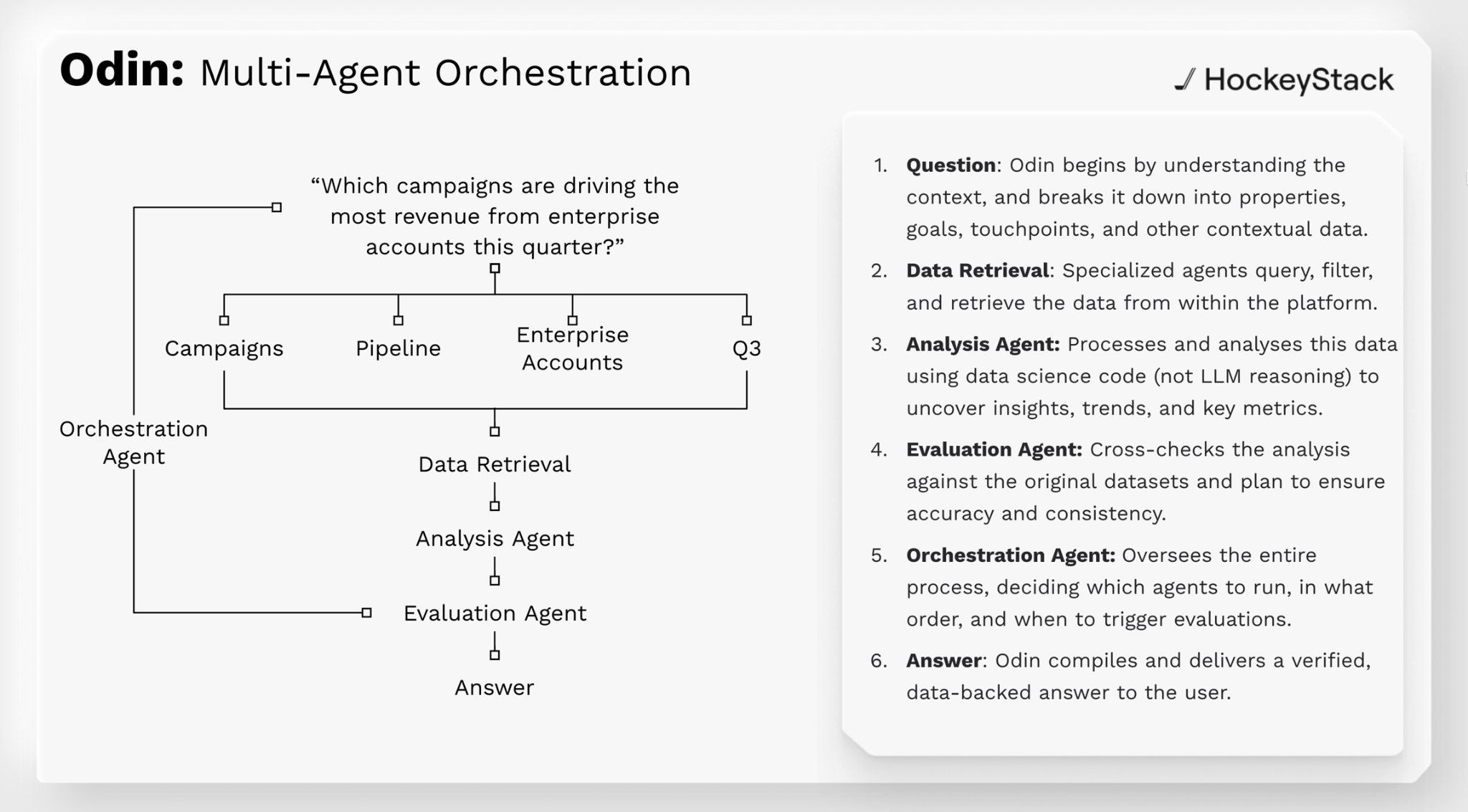
HockeyStack's Odin AI Analyst uses a multi-agent architecture where specialized agents handle query interpretation, report building, and data analysis. The analysis step uses deterministic executable code, not generative inference, making every number auditable and structurally immune to hallucination.
Source: HockeyStack
A demand gen manager can ask "which LinkedIn campaigns drove qualified pipeline in Q2 by ICP segment?" and get a defensible answer with recommended next steps.
No-Code Attribution Customization Solves Dreamdata's Dashboard Flexibility Gap
One of the most frequently cited frustrations in Dreamdata reviews is limited custom dashboard flexibility.
HockeyStack handles attribution customization in the UI: the no-code report builder lets any team member construct dashboards, apply exclusion rules, and adjust campaign groupings without SQL.
Source: HockeyStack
HockeyStack also runs all 9 attribution models simultaneously, so a marketer can see how credited value shifts between first-touch, linear, and W-shaped models in one interface.
Faster Time to Value for Teams Without Dedicated Marketing Ops
HockeyStack's out-of-the-box dashboard templates go live the moment data sources connect, delivering attribution dashboards within the first week of implementation. For teams where a 1-2 month proficiency ramp is not viable, this timeline difference is a real factor.
For a comprehensive look at HockeyStack's capabilities and how they stack up, see our HockeyStack review.
NOTE: We also evaluated Factors.ai and SegmentStream as mid-market Dreamdata alternatives. Factors.ai offers account-level intent scoring with a free entry tier. SegmentStream is built for cookieless, model-based attribution for performance marketers. HockeyStack offers the most complete attribution platform for B2B teams growing past basic CRM reporting, combining an AI analyst, no-code report builder, and account-level journey visibility in one platform.
HockeyStack Pricing
HockeyStack uses a custom-quoted, sales-led pricing model with no published prices. All purchases require booking a demo.
GTM Intelligence: Custom pricing. Includes GTM Reporting, Odin AI Analyst, Blueprints, 2 AI Agents, Account Overview, Conversion API, Account Scoring, Audience Sync, Enrichment, Signals, Workflows, and Salesforce iFrame.
GTM Execution: Custom pricing. Everything in GTM Intelligence plus the full library of 12 prebuilt AI Agents, Custom Agent Builder, and 250,000 Agent Credits for autonomous revenue workflows.
Additional costs include Account Intelligence Credits (10,000 included annually; additional at $0.08/credit) and a Data Warehouse add-on for BigQuery, Snowflake, S3, and Redshift export. There is no free trial or free plan, though HockeyStack offers a free Account Research Tool and an Interactive Demo.
For more details on HockeyStack's plans and cost structure, see our HockeyStack pricing breakdown.
Who Should Use HockeyStack?
Choose HockeyStack if:
Your marketing team answers attribution questions through manual Excel analysis or fragmented BI reports, and you need a platform where non-technical marketers can ask questions and get defensible answers without routing every request through a data analyst.
You've evaluated a multi-touch attribution platform like Dreamdata but found the configuration complexity and time-to-value timeline to be a barrier for your team.
You need to compare multiple attribution models side-by-side, particularly when different stakeholders (CFO, demand gen lead, CMO) prefer different model perspectives.
3. Adobe Marketo Measure: Best Alternative for Enterprise Teams in the Adobe and Salesforce Ecosystem
Source: Adobe Marketo Measure
Adobe Marketo Measure (formerly Bizible) is a B2B multi-touch attribution platform built for enterprise organizations whose marketing and sales operations run on Salesforce and Adobe Experience Cloud. Its key capabilities include:
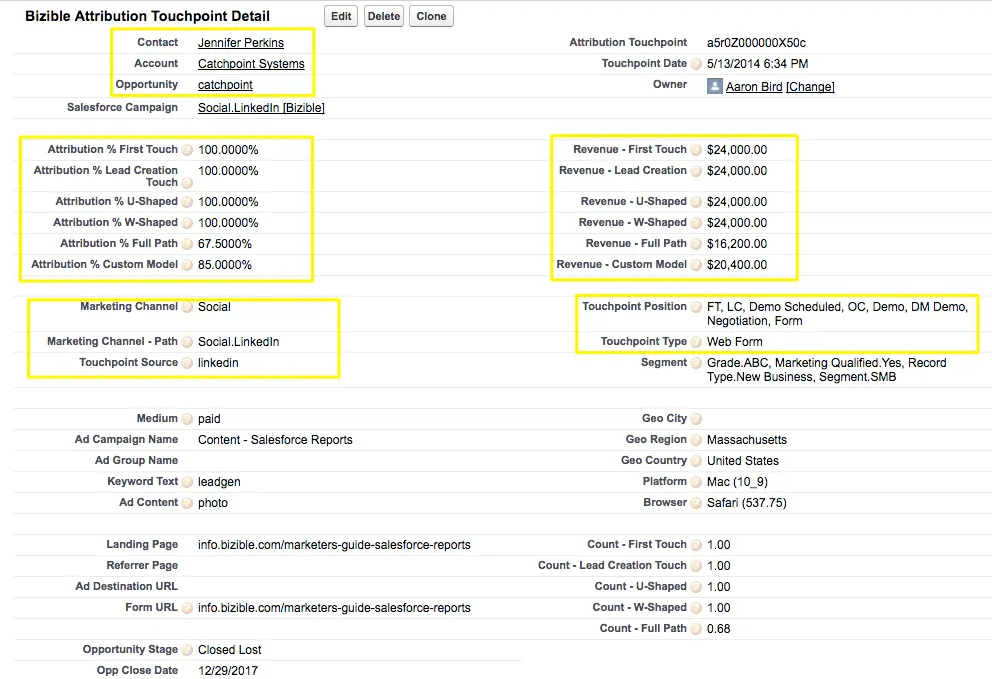
Salesforce-native touchpoints: Buyer Touchpoints and Buyer Attribution Touchpoints created as native CRM objects, making attribution data visible inside Salesforce without a separate platform login
Activities attribution: Captures Salesforce Tasks and Events (sales emails, BDR calls, meetings) as touchpoints alongside digital marketing interactions
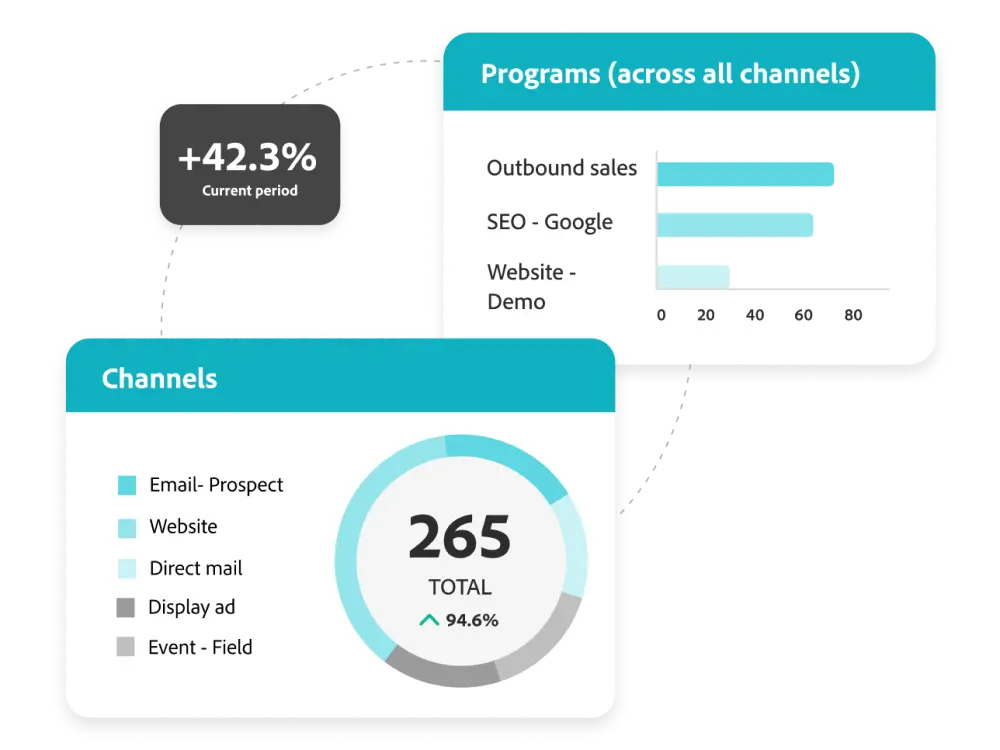
Six concurrent attribution models: First Touch, Lead Creation, U-Shaped, W-Shaped, Full Path, and Custom, all running simultaneously on the same dataset
Adobe ecosystem integration: Native connections to Adobe Analytics, Marketo Engage, and Adobe Real-Time CDP
Why Choose Adobe Marketo Measure Over Dreamdata for Enterprise Attribution
Adobe Marketo Measure stands out in the following areas:
Attribution Data Lives Natively Inside Salesforce
Dreamdata functions as a standalone analytics platform: teams must log in and navigate a separate interface to access attribution reporting. Marketo Measure creates attribution touchpoints as native objects on Lead, Contact, Account, and Opportunity records directly inside Salesforce. Revenue attribution credit is a field on the CRM record itself, queryable and reportable without leaving the system.
Source: Adobe Marketo Measure
Activities Attribution Captures Sales-Generated Touchpoints
Dreamdata's attribution model is built primarily around marketing-owned touchpoints: ad clicks, website visits, content downloads, form fills. Marketo Measure's Salesforce Activities Attribution generates touchpoints from CRM Tasks and Events, including sales emails, calls, and meetings logged by BDRs. These appear in the same attribution record alongside digital marketing touches. For enterprise teams where sales development represents a significant budget line, attributing revenue credit only to marketing-owned channels misrepresents the GTM motion.
Six Attribution Models Run Simultaneously With ML-Driven Weighting
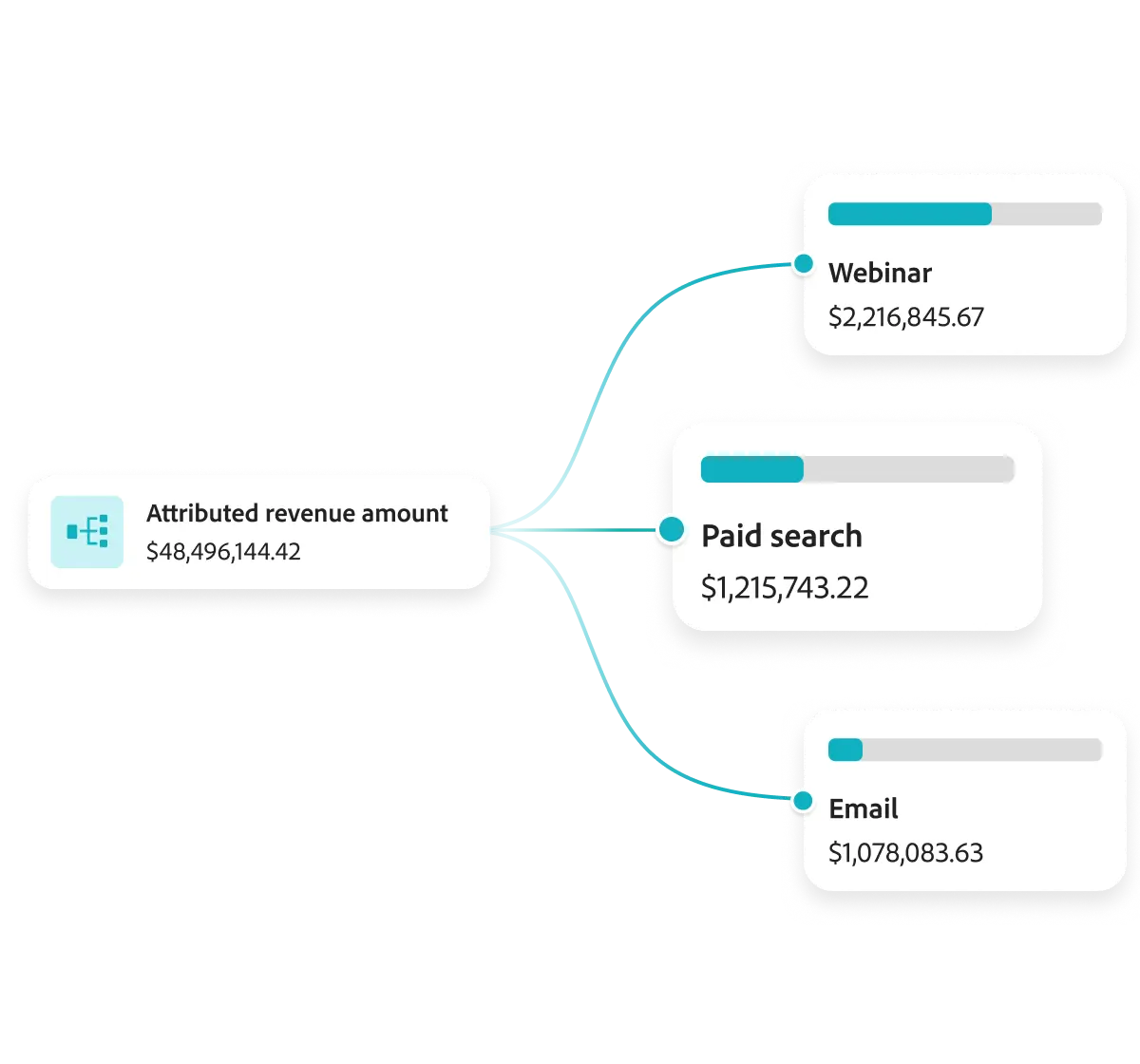
Marketo Measure runs all six attribution models simultaneously on the same underlying touchpoint data.
For Marketo Measure Ultimate customers, the Custom model can delegate weighting to Attribution AI, Adobe's ML service that applies incremental scoring, stripping out baseline brand-lift effects so measured performance reflects true marginal campaign contribution.
Source: Adobe Marketo Measure
NOTE: We also evaluated CaliberMind and Full Circle Insights as enterprise attribution options. CaliberMind offers account-level analytics with ABM reporting depth. Full Circle Insights is tightly Salesforce-native with granular funnel stage tracking. Adobe Marketo Measure fits best for teams already committed to the Salesforce and Adobe ecosystem, where the AI tier provides a credible path beyond rules-based modeling.
Adobe Marketo Measure Pricing
Adobe Marketo Measure does not publish pricing. It is sold as an add-on to Marketo Engage, with all tiers requiring a custom quote. No self-serve signup, no published list price, and no free trial is documented publicly.
Tier 1 (Foundational Attribution): Standard multi-touch models (all five running concurrently), 1 custom segment, CRM and Marketo Engage integration.
Tier 2 (Advanced Attribution): Adds Salesforce Activities Attribution, Boomerang Stages, Custom Attribution Model with ML weighting, multi-currency support, ABM features, and 10 custom segments.
Marketo Measure Ultimate: Requires Adobe Experience Platform license. Multi-CRM and multi-MAP data ingestion, Snowflake Data Warehouse export, Attribution AI dashboards. Note: no migration path from Tier 1/2/3 to Ultimate exists; a fresh implementation is required.
Who Should Use Adobe Marketo Measure?
Choose Adobe Marketo Measure if:
Your organization already runs Salesforce CRM and Marketo Engage as core GTM infrastructure, and you need attribution data to surface natively inside Salesforce reports and dashboards.
Your B2B sales cycle is long and complex (6-18+ months, multiple stakeholders, active BDR/SDR function) and you need to include sales-generated touchpoints alongside marketing interactions in a unified attribution model.
Your enterprise architecture involves multiple CRM instances, multiple business units, or complex data warehouse requirements that need the scale of Adobe Experience Platform.
4. Ruler Analytics: Best Alternative for B2B Teams That Close Deals Over the Phone
Source: Ruler Analytics
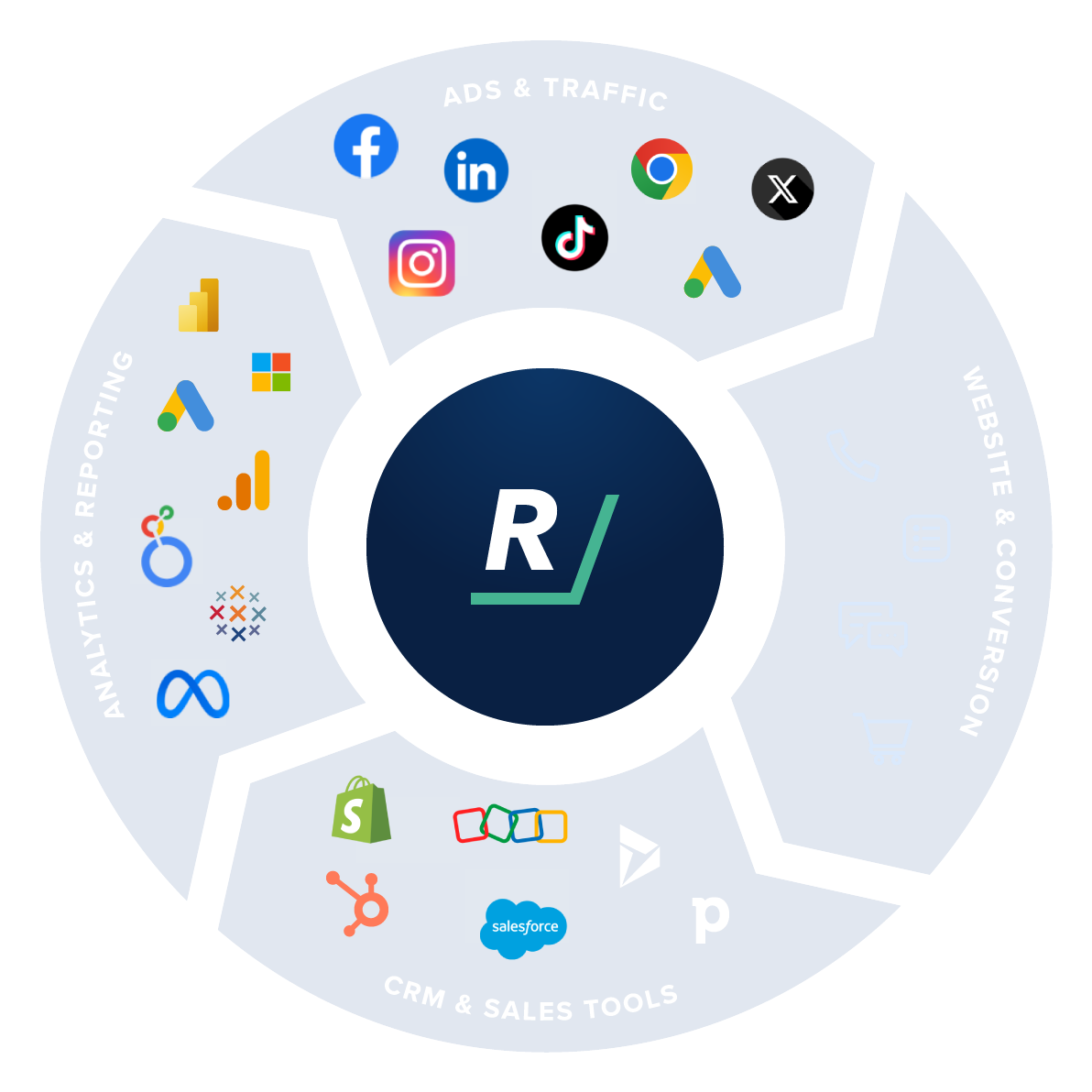
Ruler Analytics is a marketing measurement platform that combines multi-touch attribution, marketing mix modelling, and impression attribution with a capability Dreamdata does not offer: phone call tracking. Its key capabilities include:
Call tracking via Dynamic Number Insertion: Assigns a unique phone number to each website visitor and captures the full marketing path that drove the call
Form and live chat attribution: Tracks submissions and chat sessions from Calendly, Typeform, Gravity Forms, Drift, Intercom, and Olark as first-class conversion events
Closed-loop CRM revenue attribution: Passes source data into the CRM at lead creation and reads closed-won revenue back for smart bidding
Six multi-touch attribution models: First-click, last-click, linear, time-decay, position-based, and data-driven (Markov chain)
Marketing Mix Modelling: Econometric models that measure revenue contribution of channels producing no trackable click
Why Choose Ruler Analytics Over Dreamdata for Phone-Heavy Lead Generation
Ruler Analytics stands out in the following areas:
Call Tracking Fills the Conversion Gap Dreamdata Cannot Close
Dreamdata's attribution model is built on digital touchpoints: web sessions, ad engagements, form fills, CRM stage progressions. It does not capture inbound phone calls as conversion events. Ruler addresses this with Dynamic Number Insertion: each website visitor sees a unique tracking number, so when they call, Ruler matches the caller to their complete browsing history, including campaign, keyword, and pages visited.
Transparent, Predictable Pricing Built for SMBs
Dreamdata's paid tier is custom-quoted with no public prices. Ruler publishes its pricing in full: the Small plan starts at $360/month ($400/month on annual billing) for up to 10,000 monthly visits, with all tiers including multi-touch attribution, unlimited user seats, guided onboarding, and a dedicated Customer Success Manager. For small and mid-market B2B teams without a dedicated attribution budget, Ruler's predictable pricing is easier to evaluate.
Unified Measurement Across MTA, MMM, and Impression Attribution
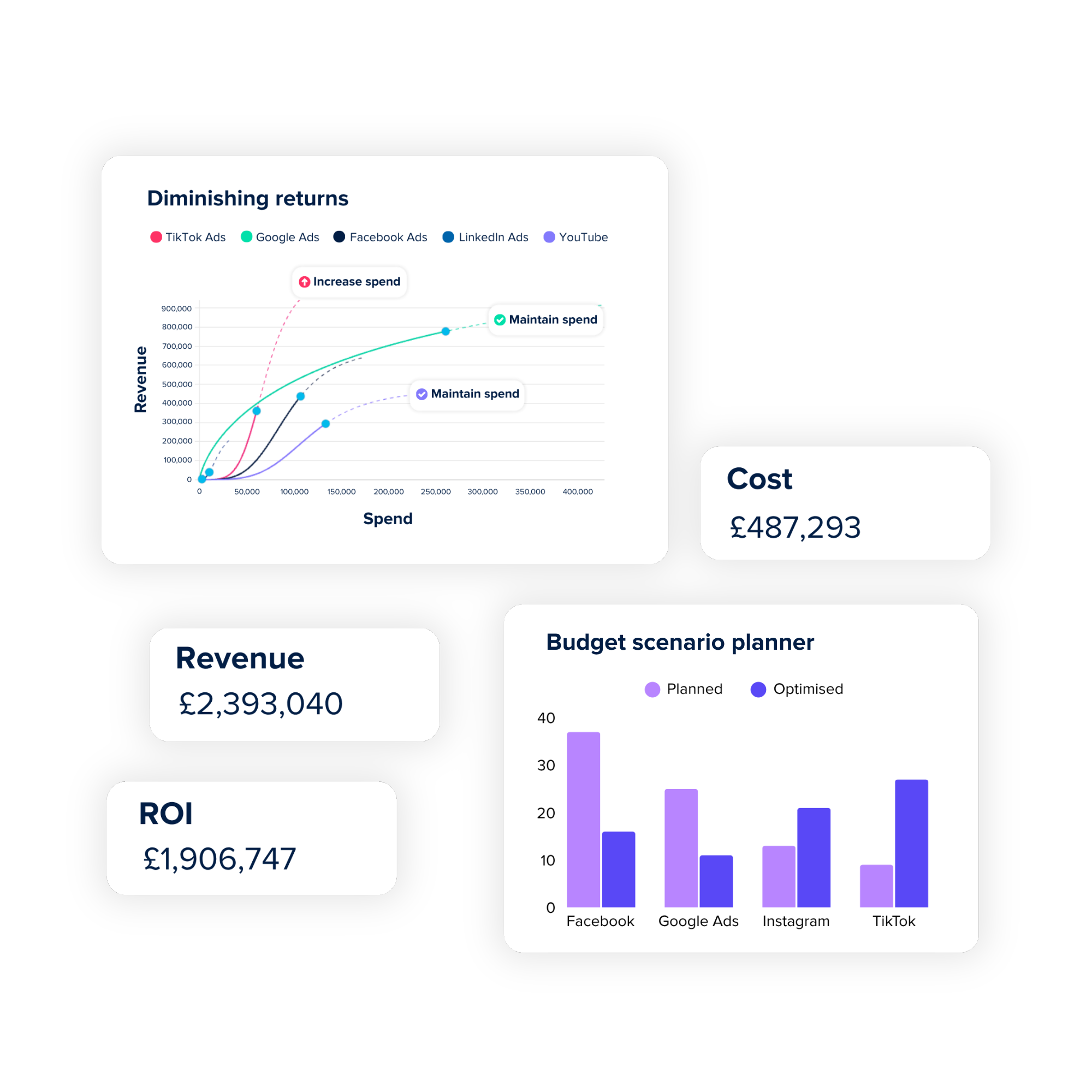
Most attribution tools operate within the click-based multi-touch framework. Ruler combines multi-touch attribution, Marketing Mix Modelling, and impression-based attribution in one platform. The MMM layer models diminishing returns per channel to identify saturation points, giving teams visibility into where incremental spend stops producing returns.
Source: Ruler Analytics
NOTE: We also evaluated HockeyStack and Factors.ai for teams at this end of the market. HockeyStack offers account-level analytics for digital-native B2B funnels. Factors.ai provides a capable entry-level attribution option with a free tier. Ruler Analytics offers the best measurement coverage for teams needing offline touchpoints (particularly phone call attribution) alongside marketing mix modelling.
Ruler Analytics Pricing
Ruler uses a traffic-volume-based flat fee model. Month-to-month billing is available; annual commitments carry a 10% discount. All plans include unlimited user seats and a dedicated Customer Success Manager.
Small (up to 10,000 visits/month): $400/month. Multi-Touch Attribution (all six models), first-party data platform, integration and activation, guided onboarding.
Medium (up to 50,000 visits/month): $668/month. Adds advanced segmentation, data-driven and impression attribution.
Large (up to 100,000 visits/month): $1326/month. Everything in Medium.
Advanced (100,000+ visits/month): $2000/month. Adds Marketing Mix Modelling (modelled ROAS, diminishing returns analysis, Budget Scenario Planner) and AI Agent (Analyst and Media Planner).
All prices are subject to UK VAT. No free trial is listed publicly; prospective customers are directed to a demo booking.
Who Should Use Ruler Analytics?
Choose Ruler Analytics if:
Your B2B leads regularly arrive via inbound phone calls (professional services, legal, HR outsourcing, automotive) and you need those calls attributed to the specific campaigns and keywords that drove them.
You need attribution that closes the loop to actual closed-won revenue in your CRM and feeds that signal back into Google Ads or Microsoft Ads for smart bidding.
You want published, predictable pricing and a platform where onboarding support and a dedicated CSM are included at every tier.
5. SegmentStream: Best Alternative for Statistically Defensible ROI Proof
Source: SegmentStream
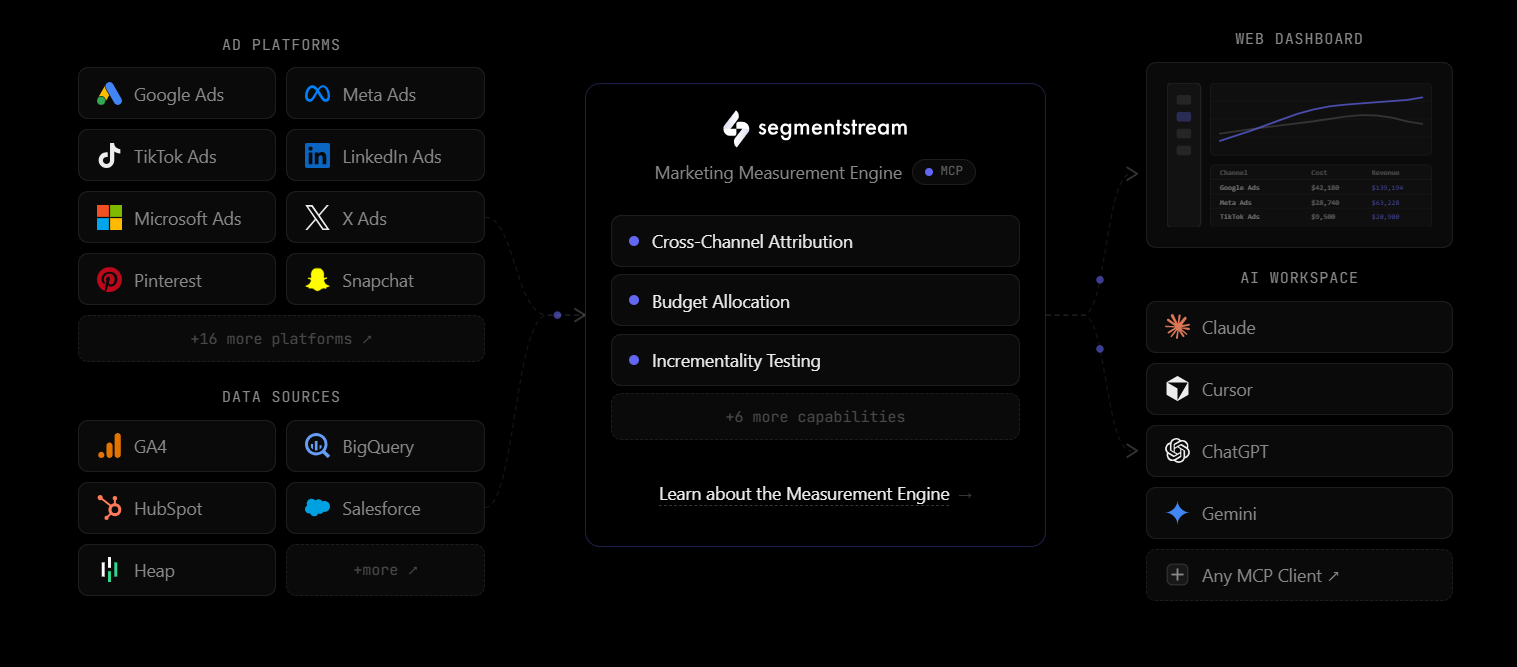
SegmentStream is a marketing measurement and attribution platform built for teams that want a statistically defensible ROI number, not a full B2B activation suite. Its key capabilities include:
GEO holdout incrementality testing: Geographic test-and-control experiments that prove whether a campaign caused incremental conversions
AI-driven multi-touch attribution: ML models trained on the company's own conversion data to identify causal touchpoints
Automated budget optimization: Automatically redistributes ad spend across platforms on weekly, bi-weekly, or monthly schedules
Marginal analytics: Per-channel diminishing returns curves that show where the next dollar stops producing return
Server-side conversion tracking: Captures conversions in cookieless and ad-blocked environments
MCP server: Exposes the full attribution stack to AI agents for automated performance analysis
Why Choose SegmentStream Over Dreamdata for Measurement Rigor
SegmentStream stands out in the following areas:
Geo Holdout Incrementality Testing Proves Causation, Not Just Correlation
Dreamdata's attribution shows which channels appeared in customer journeys. It cannot tell you whether those channels actually caused the conversion.
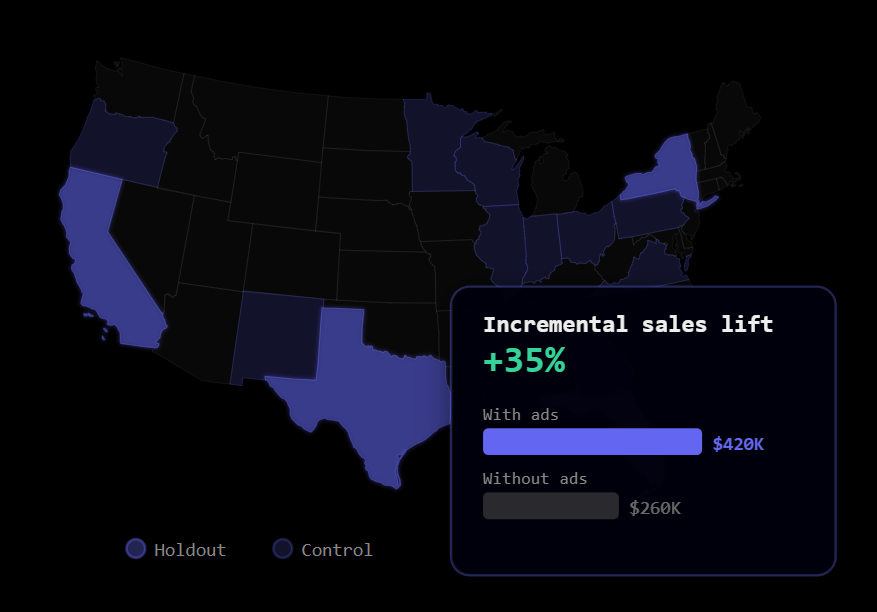
SegmentStream's Incrementality Testing module uses geo holdout experiments: geographic markets are split into test and control groups, campaigns are paused in test regions, and the conversion gap quantifies true causal lift. A neutral third party conducts this, not the ad platform whose inventory is under evaluation. For teams whose CFO is pushing back on marketing ROI claims, this is the only measurement approach that produces a number a finance team can audit.
Source: SegmentStream
Marginal Analytics and Automated Budget Reallocation Close the Measurement-to-Action Loop
Dreamdata shows teams which channels drove pipeline. It does not move money. SegmentStream's Automated Budget Allocation takes the output of its Marginal Analytics (which models per-channel diminishing returns curves) and translates those findings into specific dollar-level recommendations applied across all connected ad platforms. A reinforcement learning loop measures actual outcomes against predictions, recalibrating curves each cycle. In example data, prediction accuracy reaches 97.5% by Week 19 with cumulative revenue gains of $48,292.
Platform Independence and Auditable Methodology
SegmentStream refuses co-marketing arrangements or partnerships with any ad platform it measures, positioning itself as an independent auditor. Every attribution model the platform runs is published as a detailed whitepaper, so a finance team can audit the methodology rather than accept a black-box output.
NOTE: We also evaluated Fibbler and Ruler Analytics as alternatives in this space. Fibbler excels at LinkedIn-specific pipeline attribution for B2B teams with tight budgets. Ruler Analytics is a solid choice for call tracking and offline conversion stitching. SegmentStream offers the most rigorous measurement platform for performance teams whose primary need is statistically defensible ROI proof with automated budget reallocation.
SegmentStream Pricing
SegmentStream uses a flat-fee, per-project subscription model with no per-seat charges. All plans are billed quarterly or annually.
Online (from $800/month): For e-commerce, DTC, and online-only businesses. Includes Identity Graph, Cross-Channel Attribution, and AI Agent. Incrementality Testing available as a paid add-on.
Full Funnel (from $1,200/month): For businesses with CRM-closing revenue flows (B2B SaaS, financial services, healthcare lead-gen). Adds CRM and warehouse conversions and CRM funnel attribution.
Enterprise (from $5,000/month): Includes Server-Side Conversion Tracking, Automated Budget Allocation, and Incrementality Testing. Hands-on onboarding, dedicated CSM, and SAML SSO.
No free trial is publicly listed. The Enterprise tier requires a paid proof-of-concept.
Who Should Use SegmentStream?
Choose SegmentStream if:
Your paid media budget is large enough ($500K+/year) that the difference between average ROAS and marginal ROAS translates to real misallocation, and you want automated correction week over week.
You've been burned by platform-reported attribution and want a neutral third-party measurement layer whose methodology your CFO can audit.
Your primary problem is proving whether a campaign caused conversions, and you're willing to run geo holdout experiments to get a defensible answer.
6. Factors.ai: Best Alternative for Teams Starting B2B Attribution Without Upfront Investment
Source: Factors.ai
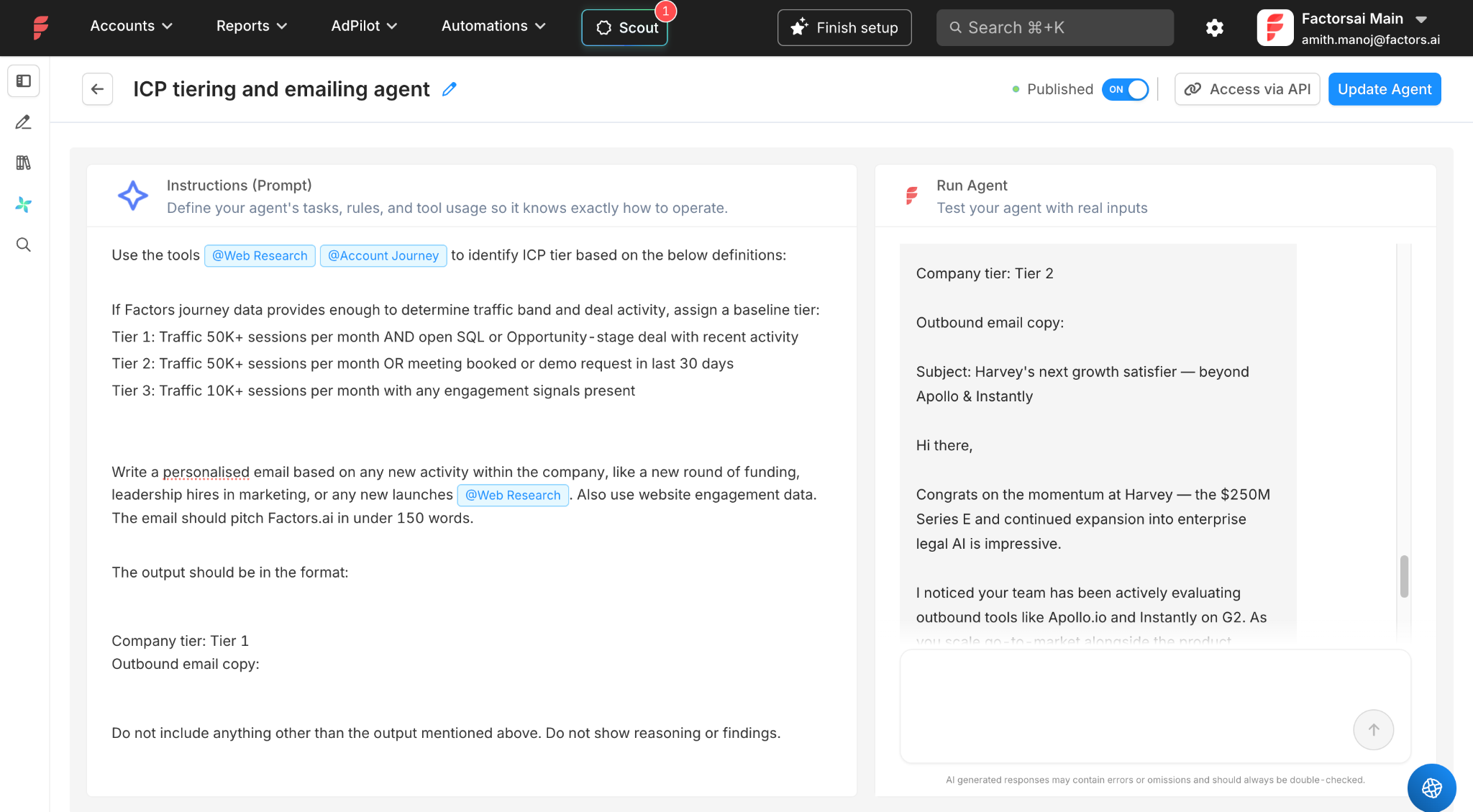
Factors.ai is an AI-powered Account-Based Marketing platform that offers the only functional free B2B attribution and account intelligence starting point in this comparison. Its key capabilities include:
Free company identification: Identifies website-visiting companies at no cost with no credit card, delivers web analytics, and fires Slack/Teams alerts
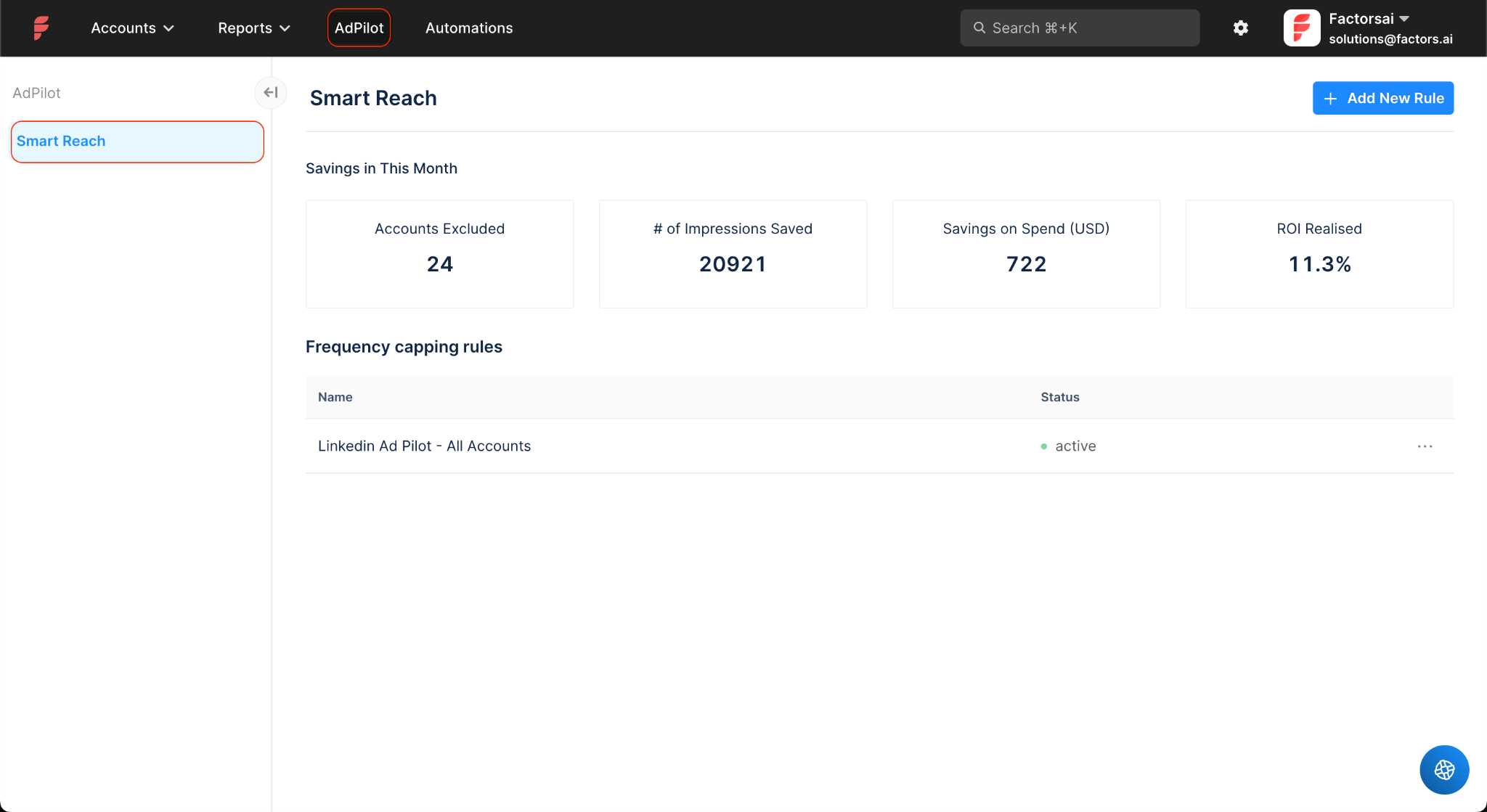
LinkedIn AdPilot with Smart Reach: Impression-capping mechanism that LinkedIn Campaign Manager does not offer natively
Waterfall enrichment: Achieves a stated 75%+ company identification rate using multiple enrichment providers in sequence
Scout AI agents: Autonomous agents that monitor churn signals, upgrade intent, and competitive displacement, callable via REST API or MCP
Multi-touch attribution: Eight configurable models including LinkedIn view-through attribution
Why Choose Factors.ai Over Dreamdata for B2B Attribution
Factors.ai stands out in the following areas:
A Functional Free Starting Point
Dreamdata's free plan offers two months of data history, five seats, and a single sync, designed for evaluation rather than operation. Factors.ai's free plan delivers ongoing operational capability: company-level identification, web analytics, and Slack/Teams alerts for high-intent accounts with no credit card and no stated time limit. For teams that have not yet secured budget for an attribution platform, this lets them build knowledge of their intent signals before any procurement conversation begins.
LinkedIn Ad Execution Beyond Attribution
Dreamdata's LinkedIn integration is its strongest capability, offering Company Intelligence API access and CAPI integration. But Dreamdata's LinkedIn layer is measurement. Factors.ai's LinkedIn AdPilot extends into execution.
Its Smart Reach feature sets per-account impression caps, automatically adding over-served accounts to exclusion lists. That redistribution of impressions across the full target list is an execution outcome, not a reporting one.
Source: Factors.ai
Lower Implementation Friction
Factors.ai holds G2 badges for "Easiest Setup" and "Easiest Admin" in the Mid-Market Account-Based Orchestration Platforms category, with onboarding taking about 30 minutes for core features. The tradeoff is explicit: Factors.ai's attribution layer is less sophisticated than Dreamdata's, and its data warehouse export capabilities are absent. But for teams where a 1-2 month proficiency ramp is not viable, Factors.ai removes that barrier.
NOTE: We also evaluated HubSpot's free attribution reporting and Albacross as low-cost alternatives. HubSpot's free tier provides CRM-native attribution but cannot identify anonymous website visitors or analyze LinkedIn campaigns at the account level. Albacross specializes in visitor identification but lacks ad optimization execution. Factors.ai offers the best free-to-start B2B attribution and account intelligence combination.
Factors.ai Pricing
Factors.ai publishes four plan tiers. Pricing for paid tiers requires a demo to receive a quote.
Free ($0/month): Company-level website visitor identification, website traffic analysis, Slack/Teams alerts. No credit card required.
Basic (starts at $6,000/year): Adds 75%+ identification rate, account segmentation, LinkedIn Ads influence tracking, rule-based alerts, up to 50 custom reports, CRM data sync.
Growth (starts at $20,000/year): Adds complete buyer journey visibility, custom account scoring, G2 intent data, AI-powered workflows, advanced ABM analytics.
Enterprise (starts at $30,000+/year): Adds predictive account scoring, LinkedIn Ads impression control (Smart Reach), dynamic audience sync to Google and LinkedIn, Google Ads Enhanced Conversions, combined first/second/third-party intent data.
Note: Smart Reach, the LinkedIn impression capping feature, is gated to the Enterprise tier.
Who Should Use Factors.ai?
Choose Factors.ai if:
Your team runs LinkedIn as a primary demand generation channel and is losing budget to impression concentration on a small subset of large accounts.
You are evaluating B2B attribution platforms before budget approval is secured, and need a free tier that delivers real operational capability rather than just a UI preview.
Your marketing team lacks dedicated marketing ops bandwidth for a multi-month implementation.
7. Fibbler: Best Alternative for LinkedIn and Google Ads Attribution on a Lean B2B Budget
Source: Fibbler
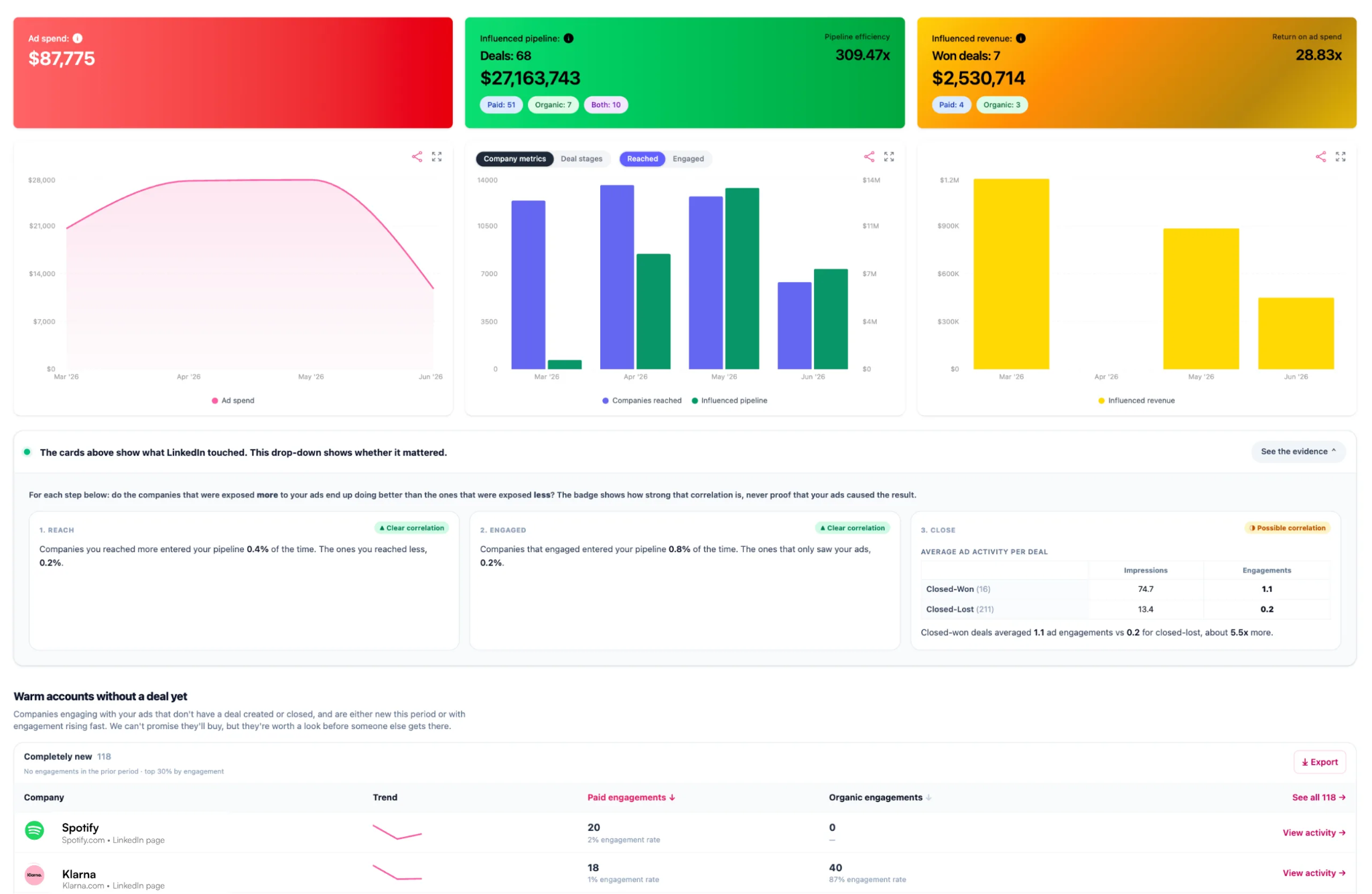
Fibbler is a paid ads attribution and activation platform built for B2B SMBs that need to connect LinkedIn Ads and Google Ads engagement to pipeline and closed revenue inside their CRM, without the setup complexity or enterprise pricing of a full attribution suite. Its key capabilities include:
Company-level ad engagement tracking: Maps impressions, clicks, video views, and interactions to named accounts
Direct CRM sync: Pushes ad engagement data as custom fields to HubSpot, Salesforce, and Attio
Revenue attribution: Connects closed-won revenue to exact campaigns within a 90-day lookback window
Lift Analysis: Splits deals into LinkedIn-influenced and non-influenced groups and compares close rate, deal size, and sales cycle
LinkedIn optimization tools: Impression caps, ad scheduling (dayparting), and one-click audience exclusions
Accessible pricing: $89/month with a 30-day free trial, no credit card required
Why Choose Fibbler Over Dreamdata for LinkedIn and Google Ads Attribution
Fibbler stands out in the following areas:
Time to Value: Hours vs. Weeks
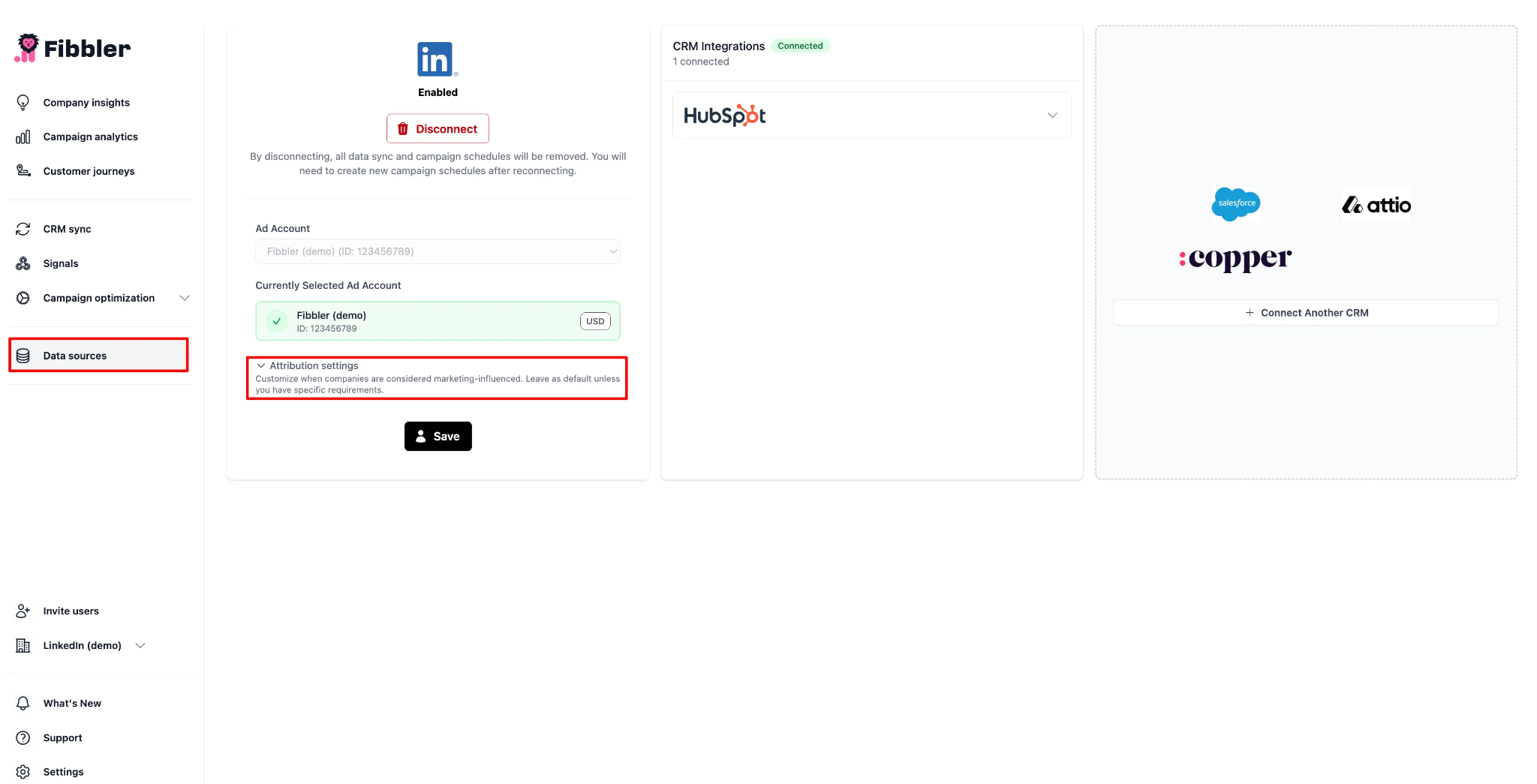
Fibbler's Quick Start guide describes a five-step setup completable in under five minutes, with LinkedIn data syncing in 30-60 minutes. Dreamdata requires CRM connection, stage model configuration, tracking script installation, UTM mapping, and attribution model selection (a process G2 and Capterra reviewers describe as taking 1-2 months). If the core job is "prove that LinkedIn Ads drove pipeline," Fibbler solves that problem in a fraction of the time.
Source: Fibbler
LinkedIn Company Intelligence API Access: 10x More Companies Identified
Fibbler is one of only five companies globally with access to LinkedIn's Company Intelligence API, which returns all companies that have engaged with a campaign with no upper limit. Most platforms rely on LinkedIn's standard AdAnalytics API, capped at 15,000 companies per request. Fibbler surfaces around 10x more companies from the same campaign data.
Pricing Accessible at Any Stage
Dreamdata's full attribution platform sits behind enterprise negotiation. Fibbler publishes flat-fee pricing: $89/month for Growth, $129/month for Unlimited, and $159/month for Agency. All plans include a 30-day free trial with full feature access and no credit card required. As the pricing page states: "Attribution you can afford with your own credit card."
NOTE: We also evaluated RevSure AI and Spectacle as newer entrants. RevSure AI offers pipeline prediction suited to complex revenue operations. Spectacle provides LinkedIn creative analytics. Fibbler offers the most direct LinkedIn Ads attribution for teams whose primary need is connecting campaigns to CRM pipeline quickly and affordably.
Fibbler Pricing
Growth ($89/month): 1 LinkedIn Ads account, unlimited Company Insights, Customer Journeys, Lift Analysis, Campaign Analytics, Audience Exclusions. HubSpot and Attio CRM integration. 1 user. 30-day free trial, no credit card required.
Unlimited ($129/month): All Growth features plus Salesforce CRM, unlimited CRM sync, Signals, Campaign optimization, unlimited users, and Priority Support.
Agency ($159/month): 2 client accounts included (additional at $69/account/month), client-switching view, all CRM integrations, unlimited users.
Google Ads Add-On ($59/account/month): Identifies companies clicking Google Ads via IP-to-company matching. Up to 1,000 identified companies per month. Requires an active LinkedIn Ads base subscription. 14-day free trial for existing subscribers.
Who Should Use Fibbler?
Choose Fibbler if:
Your demand generation team runs LinkedIn Ads as the primary paid channel and needs to prove to leadership that the budget is working (in pipeline and revenue terms) without weeks of platform configuration.
You are a marketing manager or head of marketing at a B2B SaaS company in the 10-200 employee range who needs attribution that can be evaluated on a single credit card.
You are a LinkedIn Ads agency managing multiple client accounts and need demonstrated pipeline influence for reporting at a price point that supports profitable operations.
The Final Verdict
Dreamdata excels as a B2B attribution and activation platform with strong LinkedIn integration and account-level journey visibility, but different GTM motions and team profiles require specialized solutions. Based on our research, here are the best alternatives:
ZoomInfo for teams that need more than attribution: an AI GTM platform with B2B data (500M contacts, 100M companies), a GTM Context Graph, and access through APIs, MCP, GTM Workspace, and GTM Studio
HockeyStack for B2B teams that need AI-powered attribution insights without a dedicated analyst, with an Odin AI Analyst that answers questions in plain English and no-code report customization
Adobe Marketo Measure for enterprise organizations running Salesforce and Adobe Experience Cloud, where attribution data needs to surface natively inside the CRM
Ruler Analytics for B2B teams that close deals over the phone, with call tracking, form attribution, and marketing mix modelling in one platform
SegmentStream for performance marketing teams running large paid media budgets who need statistically defensible incrementality proof and automated budget reallocation
Factors.ai for teams starting B2B attribution before budget approval, with a functional free tier and LinkedIn impression optimization at the Enterprise level
Fibbler for B2B SMBs that need to prove LinkedIn Ads ROI quickly and affordably, with setup in hours and pricing starting at $89/month
You don't have to choose between Dreamdata and these alternatives exclusively. Many B2B teams use multiple tools together: Dreamdata for multi-channel attribution alongside a specialized tool for phone tracking, data enrichment, or ad execution. Consider your GTM motion, team resources, and the measurement gaps you need to fill when deciding which solution works best.
Ready to see how ZoomInfo's GTM Context Graph can power your go-to-market motion? Request a demo and see how 35,000+ companies use ZoomInfo's B2B data and AI-powered intelligence to find, win, and grow customers.
Dreamdata Alternatives FAQ
Why do B2B marketers look for Dreamdata alternatives?
Dreamdata is a strong B2B attribution platform, but teams seek alternatives for several reasons. Its learning curve typically requires 1-2 months before the platform delivers reliable value. Its digital-first data model does not capture phone calls or offline conversions. Its custom dashboard layouts are limited, pushing power users to export to external BI tools. And its advanced paid tier uses custom-quoted enterprise pricing, which can be a barrier for growth-stage teams.
What is the best overall Dreamdata alternative?
There is no single best alternative because Dreamdata serves several functions. ZoomInfo is the top choice for teams needing unified B2B data, intelligence, and GTM execution in one platform. HockeyStack is the strongest option for teams wanting AI-powered attribution insights without a dedicated analyst. Adobe Marketo Measure leads for enterprise teams embedded in the Salesforce and Adobe ecosystem.
Is there a free alternative to Dreamdata?
Factors.ai offers the most functional free tier in B2B attribution: company-level website visitor identification, web analytics, and Slack/Teams alerts for high-intent accounts with no credit card and no time limit. Dreamdata itself offers a permanent free plan, but it caps data history at two months with a single sync, limiting its use for production attribution work. ZoomInfo offers ZoomInfo Lite, a permanent free tier with access to its B2B database and 10 monthly export credits.
Which Dreamdata alternative is best for LinkedIn Ads attribution?
For LinkedIn-focused B2B teams, Fibbler provides the fastest and cheapest path to proving LinkedIn campaign ROI, with setup in under an hour and pricing at $89/month. Factors.ai's LinkedIn AdPilot offers impression capping via Smart Reach to redistribute budget across target accounts, though this is gated to the Enterprise tier. Dreamdata itself remains strong on LinkedIn with its official Marketing Partner status and Company Intelligence API access.
How does HockeyStack compare to Dreamdata for B2B attribution?
HockeyStack addresses the three weaknesses Dreamdata reviewers cite most: its Odin AI Analyst removes the need for a dedicated analytics hire, its no-code report builder solves dashboard flexibility limitations, and its out-of-the-box templates deliver insights in days rather than months. Dreamdata offers deeper LinkedIn integration, more flexible data warehouse exports, and a free tier for evaluation, while HockeyStack offers 9 simultaneous attribution models and 12 prebuilt AI Agents for revenue automation.
For a side-by-side breakdown of both platforms, see our Dreamdata vs HockeyStack comparison.
Which alternative is best for companies that get leads via phone calls?
Ruler Analytics is built for B2B teams that close deals over the phone. Its Dynamic Number Insertion assigns a unique number to each website visitor, attributing calls to specific campaigns, keywords, and landing pages. Dreamdata does not offer call tracking. Ruler's pricing starts at £299/month with unlimited user seats and published, predictable costs at every tier.
Can I use these alternatives alongside Dreamdata?
Yes. Many B2B teams use Dreamdata for multi-channel attribution while adding a specialized tool for a specific gap. You might pair Dreamdata's attribution with ZoomInfo's B2B data and prospecting capabilities, Ruler Analytics for phone call tracking, or SegmentStream for incrementality testing. The right approach depends on whether your gap is in data, measurement methodology, execution, or a specific channel.
Which Dreamdata alternative offers the fastest time to value?
Fibbler gets teams to LinkedIn campaign-to-pipeline insights within an hour of connecting, at $89/month. HockeyStack delivers attribution dashboards within one week of implementation through its out-of-the-box templates. Both contrast with Dreamdata's typical 1-2 month learning curve. For enterprise teams, the tradeoff is depth: Dreamdata and Adobe Marketo Measure require more setup but offer more sophisticated attribution models and data integration.
Looking beyond Dreamdata? Compare the strongest alternatives side by side:
