
If you're comparing Bizible vs. Dreamdata, you're trying to answer one of the hardest questions in B2B marketing: which of your efforts actually drive revenue?
Both platforms tackle multi-touch attribution, connecting marketing touchpoints to pipeline and closed deals across long sales cycles. But the right choice depends on questions most comparison articles skip:
Are you already invested in Adobe's ecosystem, or do you need a platform-agnostic solution?
Do you need attribution reports, or do you need to act on that data by pushing audiences to ad platforms?
How important is LinkedIn attribution to your measurement?
Does your team have the resources for a complex enterprise implementation, or do you need faster setup?
Is your primary goal proving marketing's past impact, or identifying which accounts to pursue next?
Here's what we recommend:
Adobe Marketo Measure (formerly Bizible) is the enterprise attribution platform for teams on Salesforce and Adobe Marketo Engage. It captures every touchpoint (online and offline) and writes attribution data into your CRM as native objects, so sales and marketing report from the same numbers. Six attribution models run simultaneously (including an ML-powered custom model), letting marketing ops teams show different attribution views to different stakeholders without rebuilding reports. However, Marketo Measure requires serious implementation work, doesn't publish pricing, and its top tier (Ultimate) requires Adobe Experience Platform, a large additional investment.
Dreamdata is a B2B attribution and activation platform for growth-stage SaaS companies that need measurement and action in one place. Beyond attribution, Dreamdata builds dynamic audiences from your GTM data and syncs them daily to LinkedIn, Google, Meta, and Microsoft Ads, closing the loop between measuring what worked and doing more of it. Its LinkedIn Marketing Partner designation gives it deeper LinkedIn attribution than any other platform. The trade-off: a steep learning curve, and the most advanced features require custom-priced enterprise plans.
Both platforms measure marketing's contribution to revenue well. But attribution answers a backward-looking question: what worked? For teams that also need to answer the forward-looking question (which accounts should we target now, and how do we reach them?), there's another type of platform to consider.
ZoomInfo is an AI GTM platform built on a B2B database of 500M contacts, 100M companies, 135M+ verified phone numbers, and 200M+ verified business email addresses. Its GTM Context Graph processes 1.5B+ data points daily, combining this data with your CRM records, conversation transcripts, and behavioral signals to show the full picture of your accounts (not just what happened, but why deals move or stall and which accounts to pursue next). Where Bizible and Dreamdata tell you which channels drove last quarter's pipeline, ZoomInfo identifies which accounts to pursue this quarter, who to contact, and what to say. Teams use GTM Workspace for sales execution, GTM Studio for marketing and RevOps orchestration, or APIs and MCP in any third-party tool.
If forward-looking intelligence sounds like what's missing from your marketing stack, see how ZoomInfo works.
Bizible vs. Dreamdata vs. ZoomInfo at a glance
Adobe Marketo Measure (Bizible) | Dreamdata | ZoomInfo | |
|---|---|---|---|
Core focus | Enterprise marketing attribution | B2B attribution + audience activation | AI GTM intelligence + execution |
Attribution models | 6 models + ML custom model | 6 models + data-driven + custom | N/A (intent signals + buyer intelligence) |
CRM integration | Native Salesforce/Dynamics objects | HubSpot, Salesforce, Pipedrive, Dynamics | Salesforce, HubSpot, Dynamics + 120 integrations |
Activation capabilities | Reporting only | Daily audience sync to LinkedIn, Google, Meta, Microsoft | Native DSP, cross-channel orchestration, AI outreach |
LinkedIn depth | Standard ad platform tracking | LinkedIn Marketing Partner + Company Intelligence API | LinkedIn ad audience targeting + intent signals |
AI capabilities | Attribution AI (Ultimate tier only) | AI Signal Recommendation Agent, AI report summaries | GTM Context Graph, AI agents |
Website visitor ID | JavaScript tracking (known visitors) | IP-to-company resolution (up to 80% anonymous) | WebSights (company + contact-level identification) |
Free tier | No | Yes (permanent, 5 seats, 2-month history) | ZoomInfo Lite (permanent, 10 monthly credits) |
Best for | Enterprise Marketo Engage + Salesforce teams | Growth-stage B2B SaaS marketers | Revenue teams needing data, signals, and execution |
Attribution philosophy: measuring the past vs. powering the present
Bizible and Dreamdata both solve attribution, but they start from different assumptions about what marketers need.
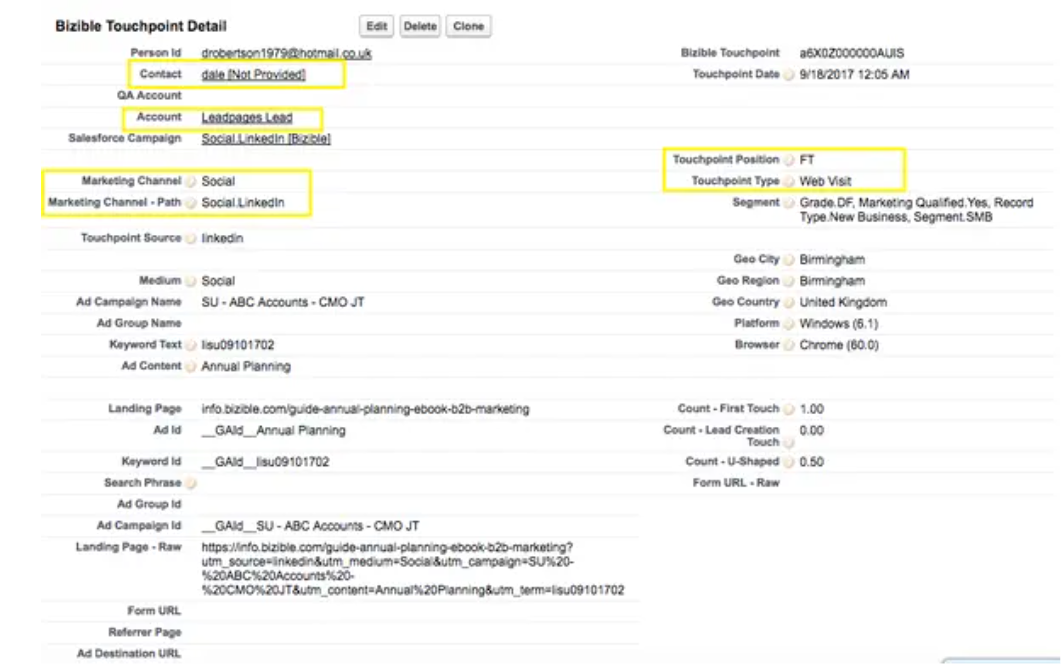
Adobe Marketo Measure assumes your CRM is the center of your universe. It installs a managed package directly into Salesforce, creating custom Buyer Touchpoint and Buyer Attribution Touchpoint objects that live alongside your existing Leads, Contacts, and Opportunities. Attribution data appears inside the sales team's workflow without a separate login.
Source: Adobe
This is the product's strongest feature: sales reps see every marketing interaction on each Contact record, and revenue ops teams build Salesforce reports using attribution data like any other CRM field.
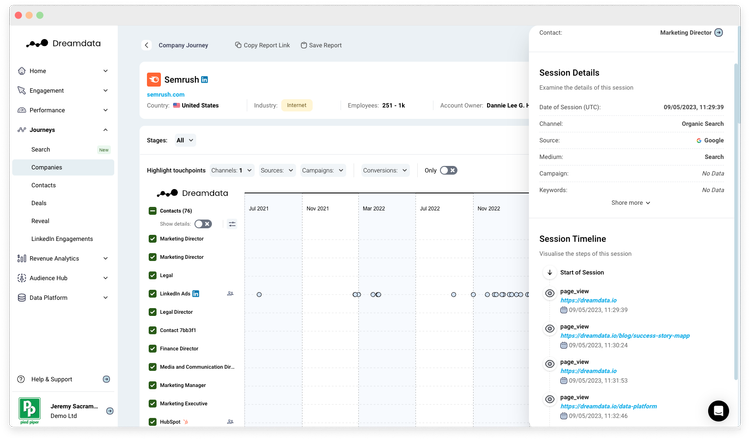
Dreamdata assumes the CRM alone isn't enough. Because 81% of the customer journey happens before sales gets involved, Dreamdata starts by stitching together anonymous website visits, ad impressions, G2 profile views, and LinkedIn engagement at the account level. Its IP-to-company resolution identifies up to 80% of anonymous visitors even when they decline cookies.
Source: Dreamdata
The result is a fuller picture of the buying journey, though one that lives primarily in Dreamdata's own interface rather than natively in your CRM.
ZoomInfo starts from a different premise. Attribution measures what already happened. ZoomInfo's buyer intent data tracks signals from 210 million IP-to-Organization pairings and 6 trillion+ new keyword-to-device pairings monthly to show which accounts are researching right now.
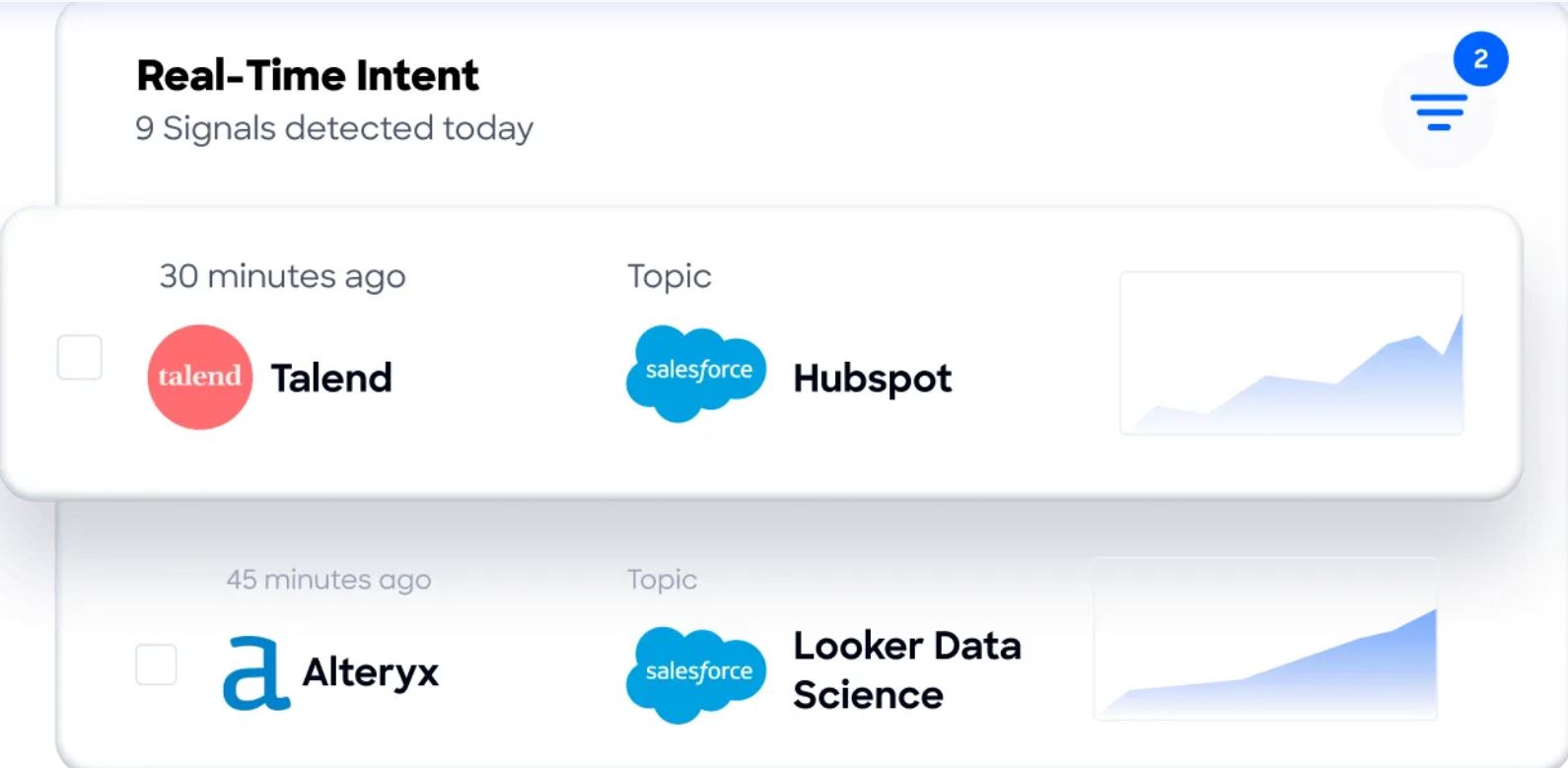
Guided Intent, exclusive to ZoomInfo, identifies the topics historically correlated with deal success rather than requiring manual topic selection. This complements attribution: Bizible or Dreamdata tells you that webinars drove 30% of last quarter's pipeline; ZoomInfo tells you which accounts are researching your category today and gives you the contact data to reach them.
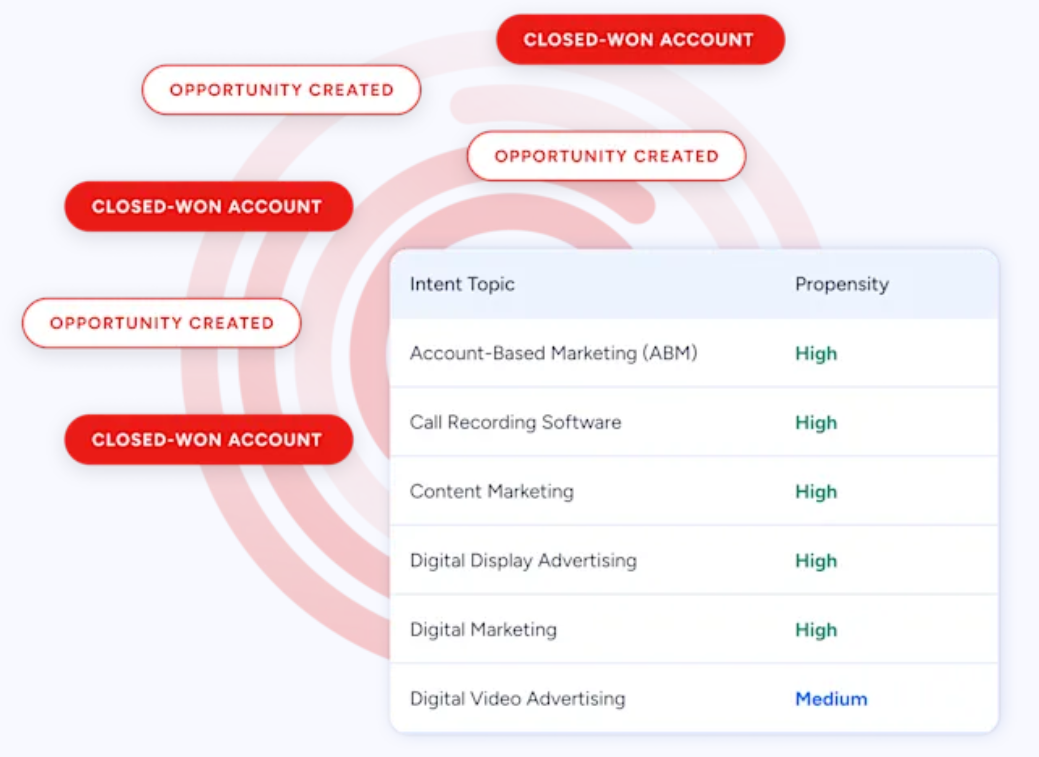
Seismic's sales team attributed 39% of active pipeline to opportunities identified or influenced by ZoomInfo signals, while saving 11.5 hours per week per seller. (Seismic Case Study)
CRM integration depth: native objects vs. external analytics
How attribution data reaches your team matters almost as much as the data itself.
Marketo Measure's approach is the most embedded. The Salesforce managed package installs 7 custom objects, custom fields, and 25 stock reports directly into your CRM org.
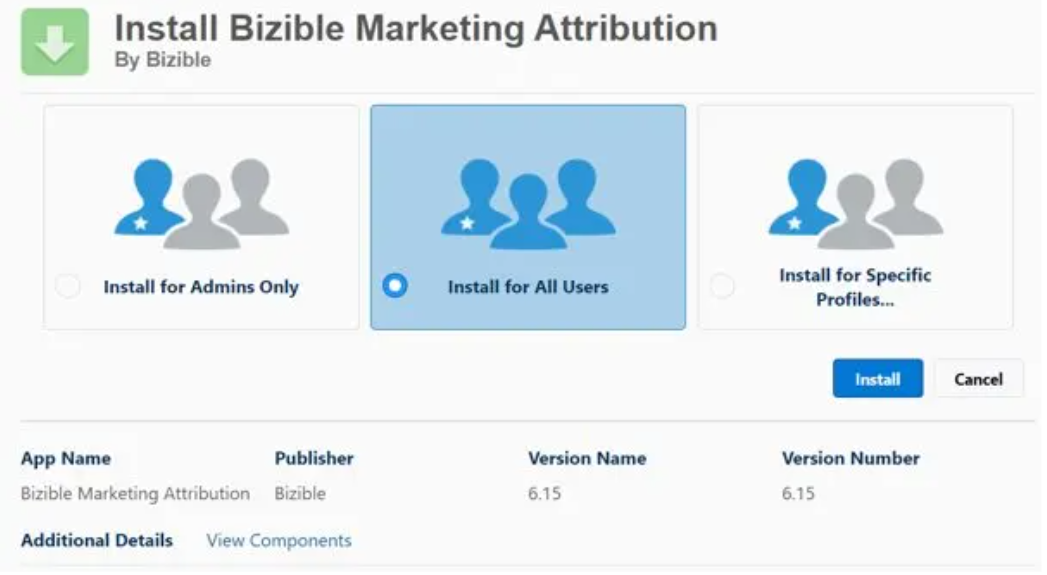
Source: Adobe
It never writes to standard Salesforce objects, keeping the integration non-destructive. For organizations where Salesforce is the single source of truth, this CRM-native model means attribution becomes part of the existing reporting workflow rather than a separate tool people forget to check.
The cost is implementation complexity. G2 reviewers consistently describe setup as slow and resource-intensive, requiring clean UTM governance, campaign naming conventions, Salesforce campaign hierarchy alignment, and touchpoint rule configuration before reliable data appears. You'll need a dedicated Marketing Ops specialist to maintain the platform.
Dreamdata takes a lighter approach. It connects to HubSpot, Salesforce, Pipedrive, and Microsoft Dynamics to pull CRM data, but attribution results live in Dreamdata's own dashboard.
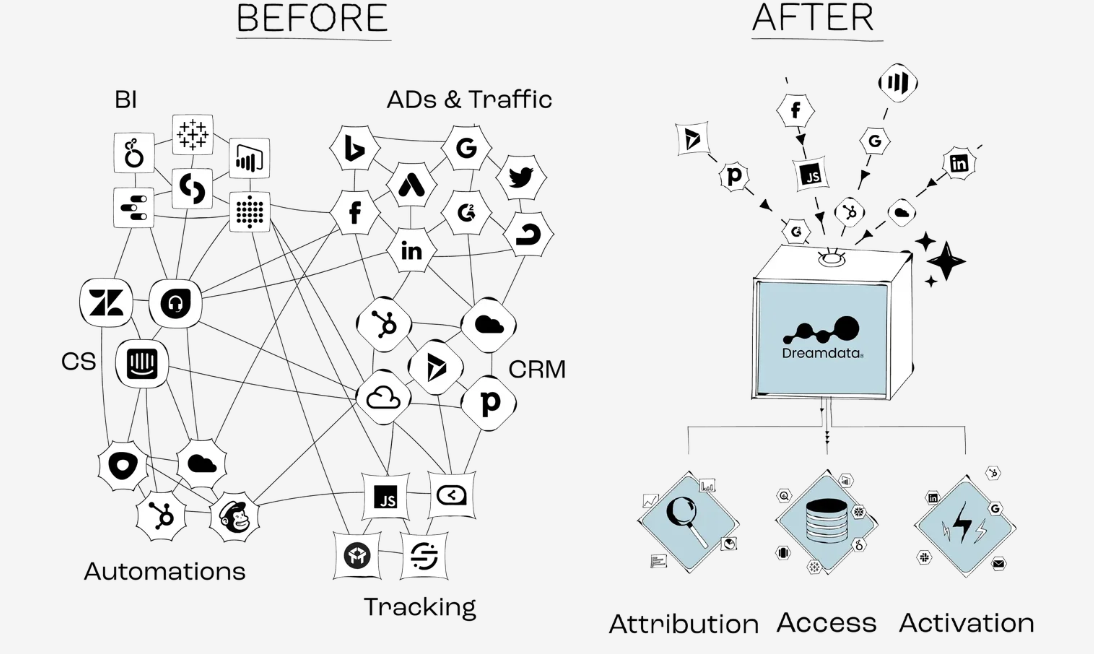
Source: Dreamdata
One Capterra reviewer flagged the inability to push enriched attribution data back into Salesforce field values, though reverse ETL through partners like Hightouch or Census provides a workaround. The upside: faster setup. The downside: another tool your team needs to log into.
ZoomInfo takes a different approach. Rather than writing attribution touchpoints to your CRM, ZoomInfo enriches your CRM data with verified contacts, firmographics, technographics, and intent signals. This feeds cleaner data into whatever attribution tool you use. With API access included in all plans plus MCP support for AI agents, ZoomInfo's data reaches any tool in your stack.
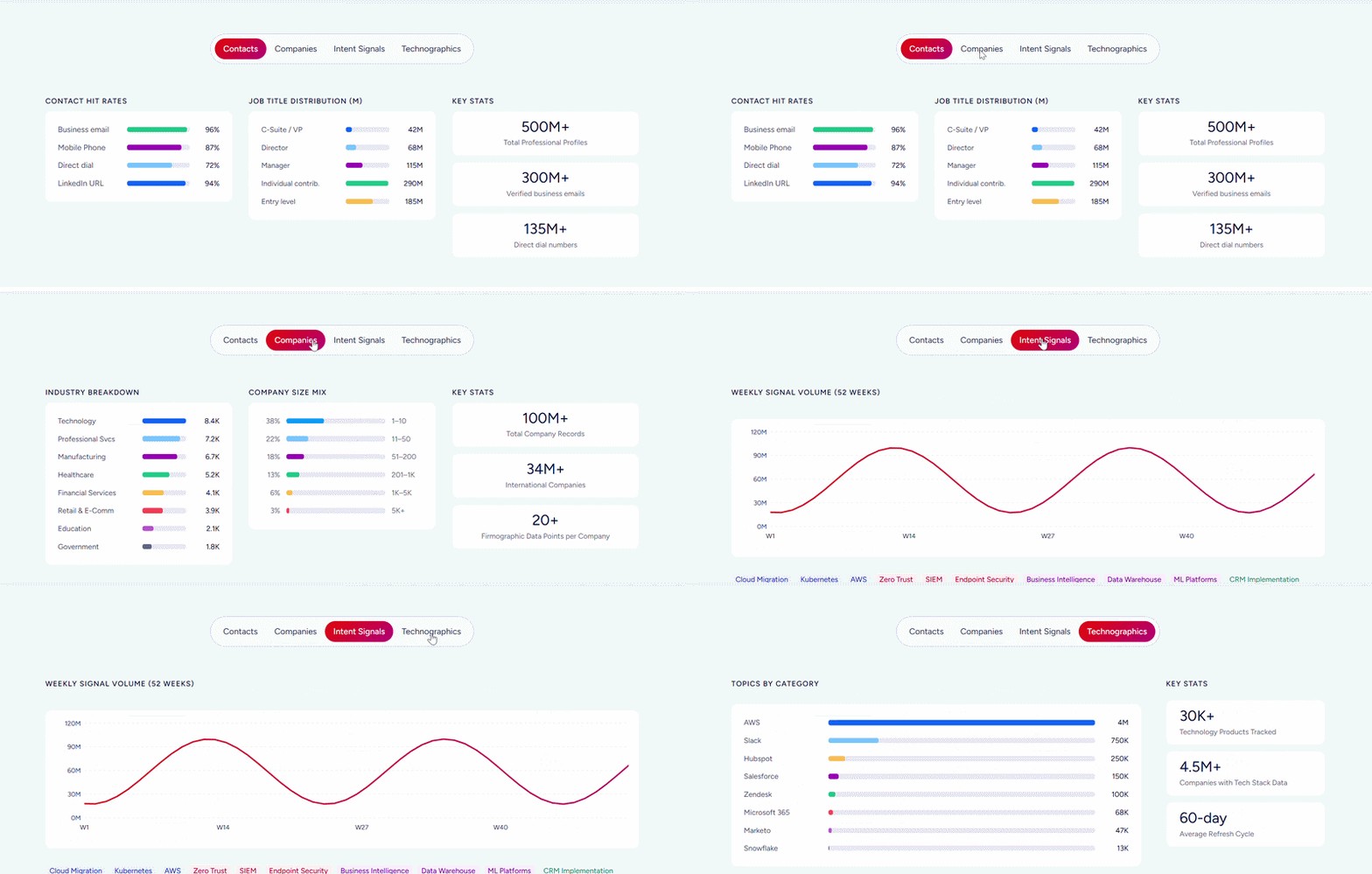
Attribution models: flexibility vs. simplicity
Both Bizible and Dreamdata offer multiple attribution models, but their approaches differ.
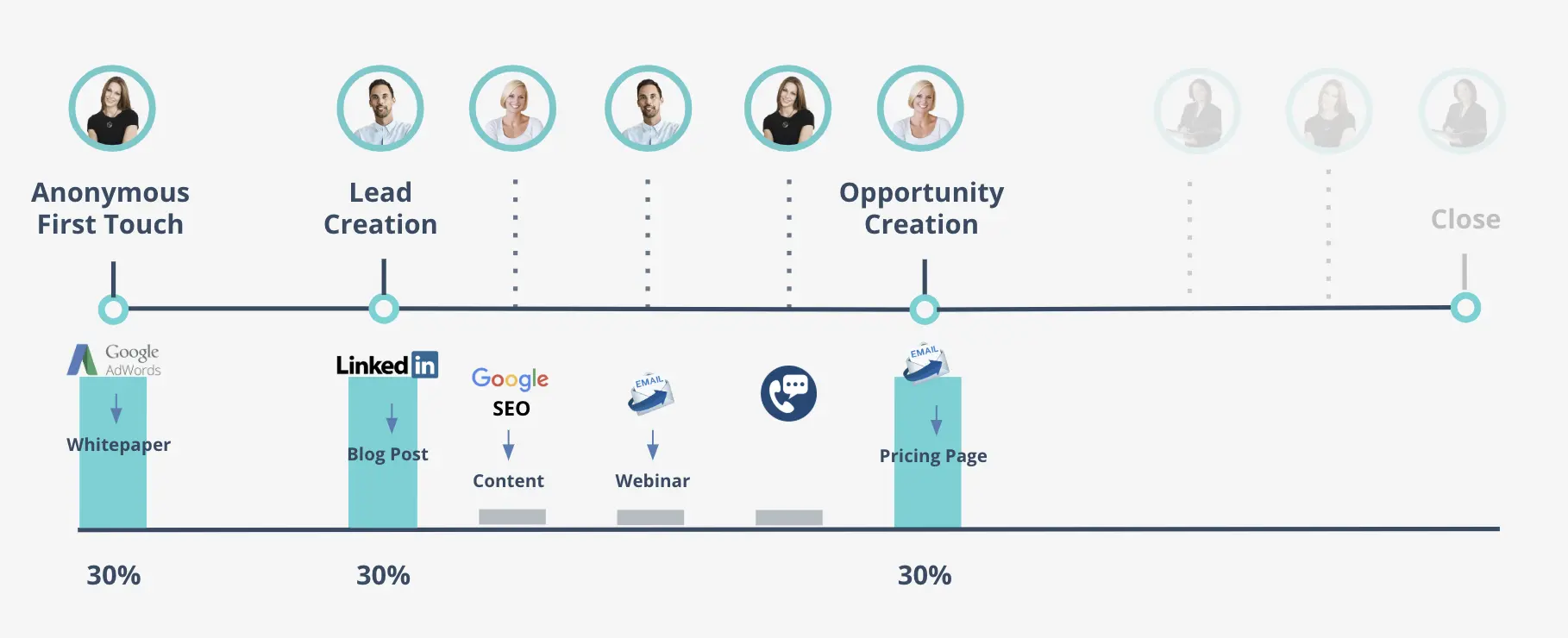
Marketo Measure ships with six attribution models running concurrently: First Touch, Lead Creation, U-Shaped, W-Shaped, Full Path, and a Custom model. All six calculate simultaneously from the same dataset. A CMO can toggle from Full Path to W-Shaped and see how every channel's attributed revenue shifts without rebuilding reports.
Source: Adobe
The Machine Learning Model analyzes historical touchpoint data and suggests attribution weights that recalculate every seven days.
For long enterprise sales cycles, Marketo Measure's Boomerang Stage tracking captures recurring stage transitions. When a prospect recycles through MQL or SQL multiple times over a 9-12 month deal, the platform generates distinct numbered touchpoints for each re-entry (e.g., MQL-01, MQL-02). This granularity matters for organizations with non-linear buying processes.
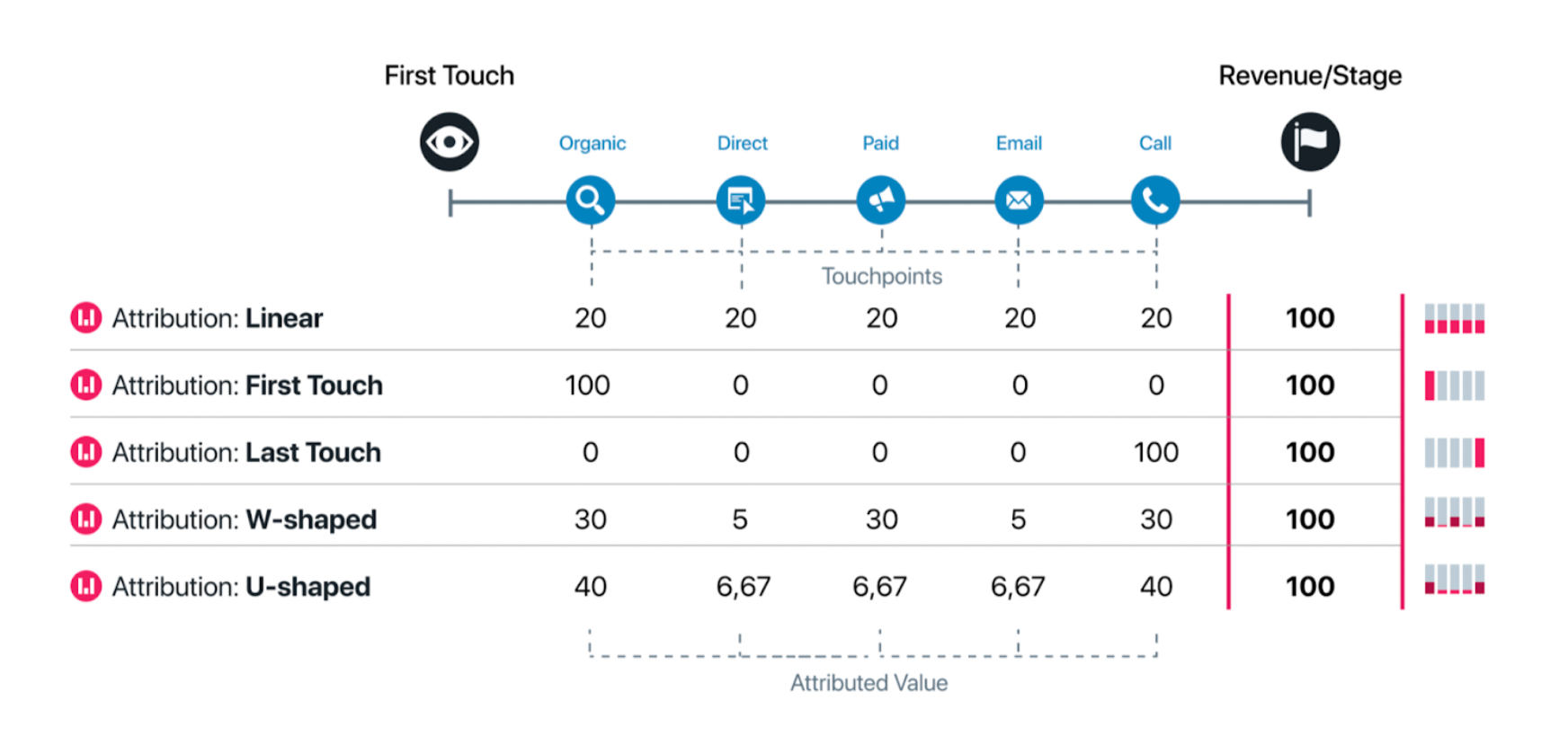
Dreamdata offers six default models (Linear, First-touch, Last-touch, W-shaped, U-shaped, and Data-Driven) plus the ability to create custom model variants with independent exclusion rules. The Data-Driven model uses ML trained on the customer's own journey data. Attribution Exclusions let you filter specific sessions out of any model, and for the data-driven model, exclusions retrain the algorithm's weights.
Source: Dreamdata
Where Dreamdata pulls ahead is its LinkedIn Impression Attribution, an algorithm that assigns partial credit to LinkedIn ad impressions at configurable weighting tiers. Given how much B2B marketing spend flows through LinkedIn, this is a real gap in Marketo Measure.
Neither attribution platform, however, addresses a more fundamental question: are you attributing credit to the right accounts in the first place? Attribution models can only measure touchpoints with accounts that entered your funnel.
ZoomInfo's Guided Intent identifies accounts researching your category that may never have touched your marketing, expanding the pipeline that attribution tools then measure.
Activation: where Dreamdata leaves Bizible behind
This is the clearest distinction between the two attribution platforms.
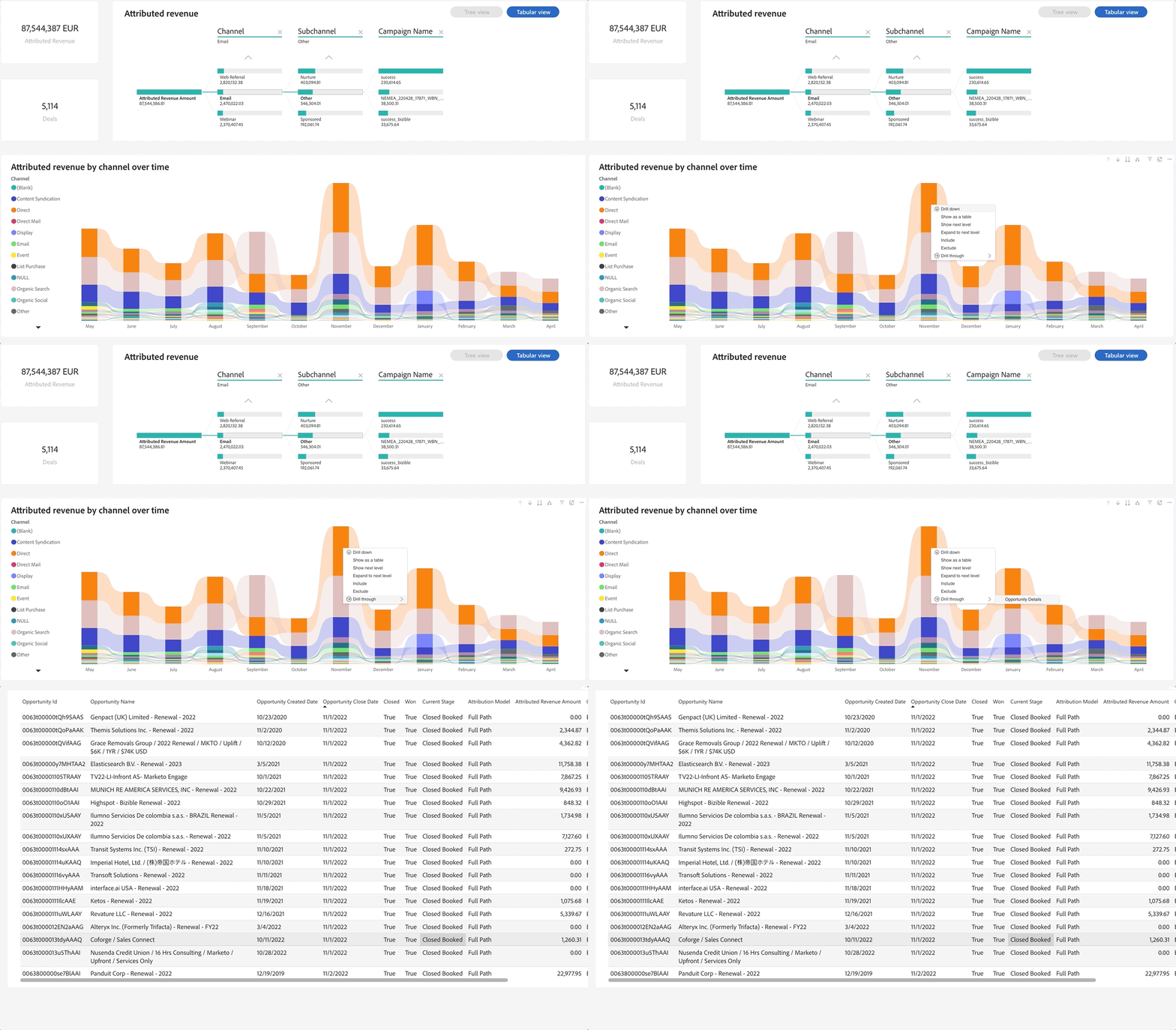
Marketo Measure is a measurement tool. It produces attribution reports and dashboards. The Discover Dashboards surface attributed revenue, ROI, engagement, and velocity data. But Marketo Measure does not send audiences to ad platforms, push conversion data back to bidding algorithms, or trigger campaigns from attribution signals. Once you have the insight, acting on it requires separate tools.
Source: Adobe
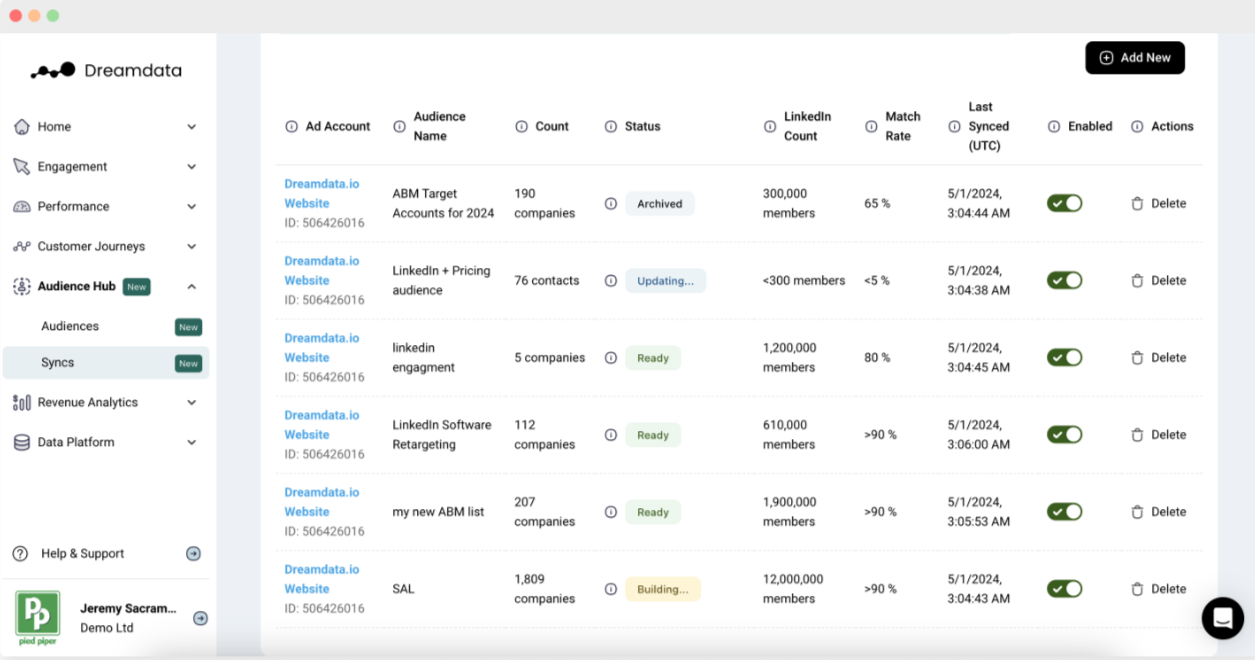
Dreamdata's Audience Hub changes this. Marketers build dynamic audiences filtered by GTM signals (ad touchpoints, CRM stage, intent score, page visits) and sync them daily to LinkedIn, Google, Meta, and Microsoft Ads.
Source: Dreamdata
The platform also pushes pipeline stage data back to ad platforms via offline conversion APIs, training bidding algorithms on revenue signals rather than form fills.
This matters. Most B2B ad platforms optimize toward the wrong objective because they never see what happens after the form fill. By feeding CRM conversion data back to LinkedIn and Google, Dreamdata trains those algorithms to find more accounts like the ones that actually closed.
ZoomInfo approaches activation from the opposite direction. Instead of building audiences from past attribution data, ZoomInfo builds them from current intent signals and verified contact data.
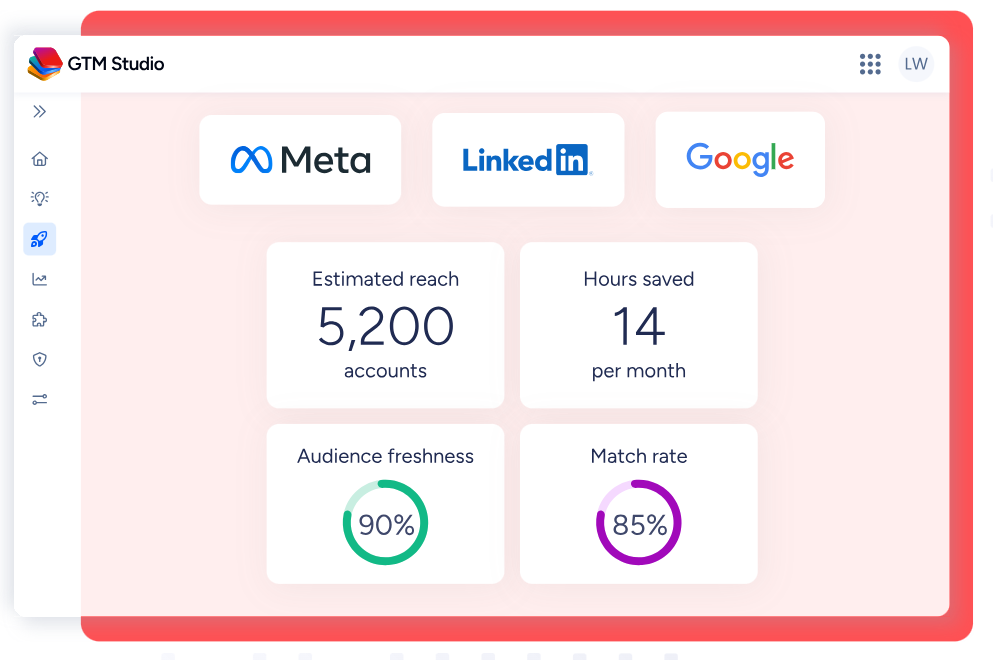
GTM Studio lets marketers describe audiences in natural language and launch multi-channel plays (email, calls, ads, direct mail) triggered by buyer behavior, without engineering tickets.
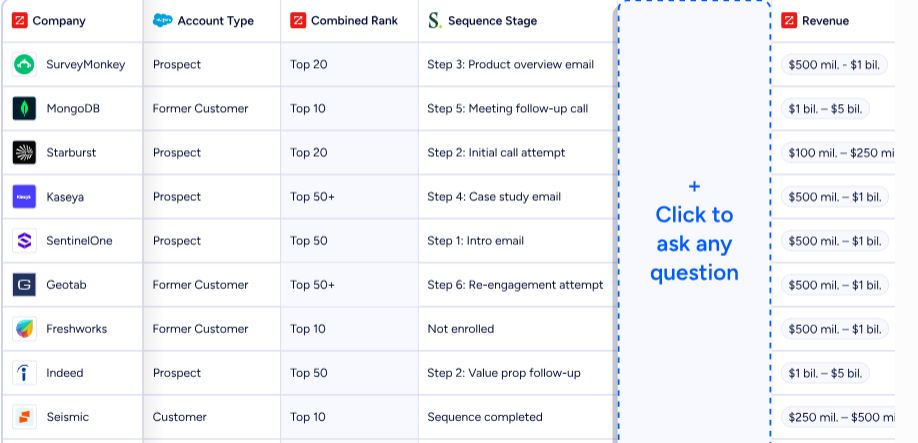
The platform includes a native demand-side platform for display advertising based on 300+ company attributes, with audiences that auto-update as account signals change.
Redwood Logistics achieved a 99% reduction in cost-per-click and 310% increase in click-through rate using ZoomInfo's data-driven audience targeting. (Redwood Logistics Case Study)
LinkedIn attribution: Dreamdata's structural advantage
For B2B companies where LinkedIn is a primary demand generation channel, the attribution comparison isn't close.
Dreamdata holds an official LinkedIn Marketing Partner designation and is the only analytics platform integrated with LinkedIn's Company Intelligence API, enabling attribution of both paid and organic LinkedIn company page impressions to pipeline and revenue.
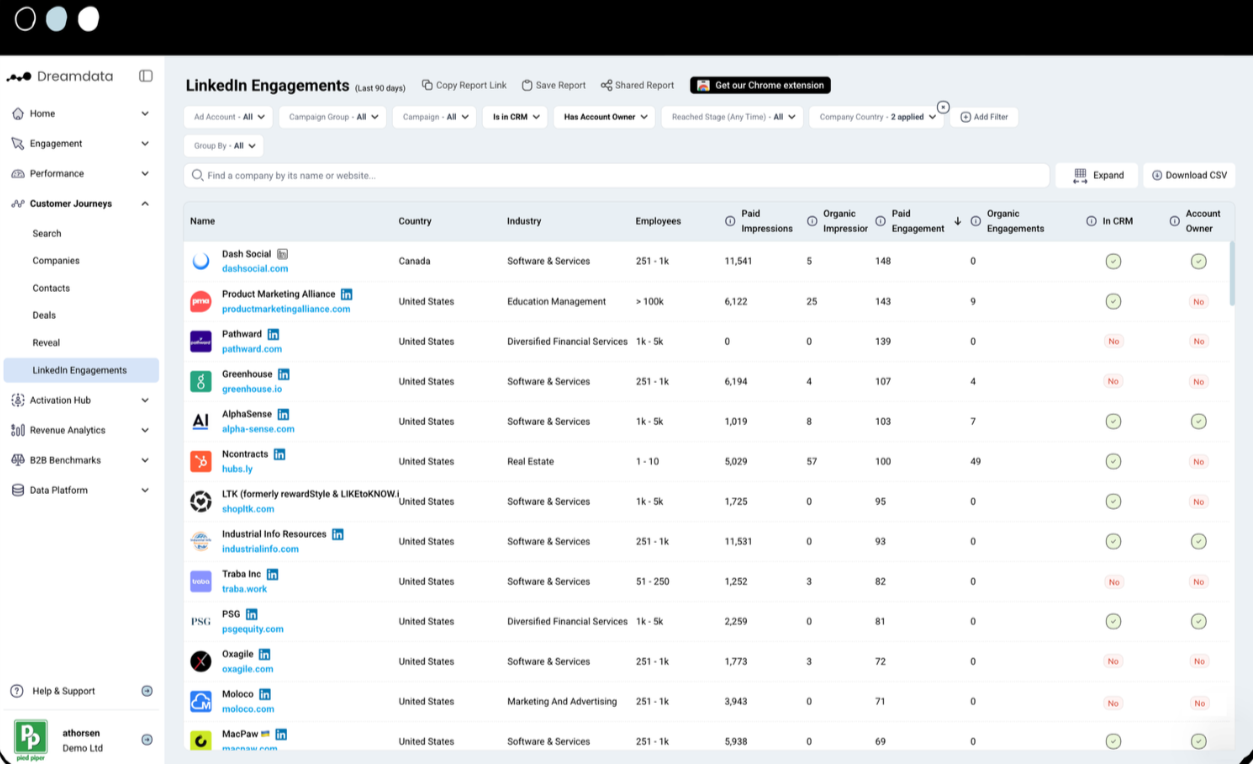
Source: Dreamdata
Their annual LinkedIn Ads Benchmarks Report, built from 66M+ sessions and 3.5M+ customer journeys, is widely referenced in B2B marketing. Dreamdata won the LinkedIn Marketing Partner Customer Value Award in 2024 and the LinkedIn Marketing Partner Award for B2B Thought Leadership in 2026.
Marketo Measure tracks LinkedIn paid ads through standard API connections, pulling cost and click data. But it lacks Dreamdata's impression attribution algorithm and organic LinkedIn attribution. For companies spending heavily on LinkedIn, this gap means Marketo Measure systematically undervalues LinkedIn's contribution to pipeline.
ZoomInfo connects to LinkedIn differently. Rather than attributing LinkedIn ad performance after the fact, ZoomInfo powers LinkedIn ad targeting with better data.
Matched audiences built from ZoomInfo's intent signals and company attributes produce better targeting inputs for LinkedIn campaigns. The two approaches are complementary: ZoomInfo improves who you target on LinkedIn; Dreamdata measures whether that targeting worked.
The data foundation question
Attribution platforms are only as good as the data feeding them. Both Marketo Measure and Dreamdata depend on clean CRM data and accurate touchpoint tracking.
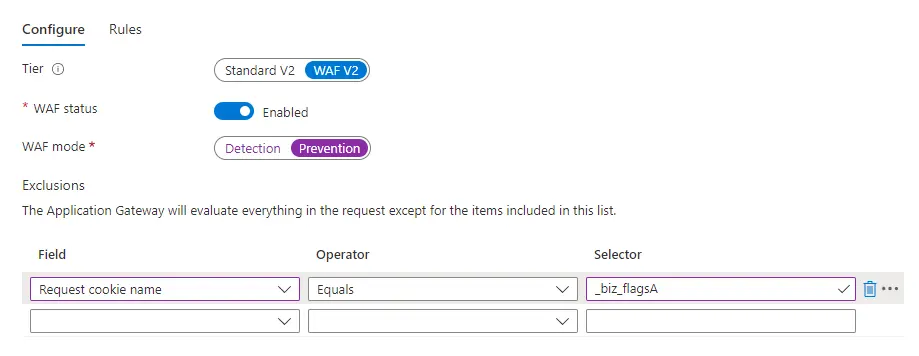
One Capterra reviewer of Dreamdata stated it plainly: "If your CRM health is poor, then no magic will happen." Marketo Measure faces the same constraint. Its JavaScript tracking relies on first-party cookies, creating data loss for users with ad blockers or Safari ITP.
Source: Adobe
Adobe retired Cross-Domain Tracking and View-through Attribution in mid-2024 due to third-party cookie deprecation, and G2 reviewers report touchpoints "disappearing" as browsers tighten privacy rules.
Dreamdata addresses the privacy challenge more directly. Its cookieless tracking identifies up to 80% of anonymous website visitors via IP-to-company resolution, maintaining visibility even as cookie-based tracking degrades.
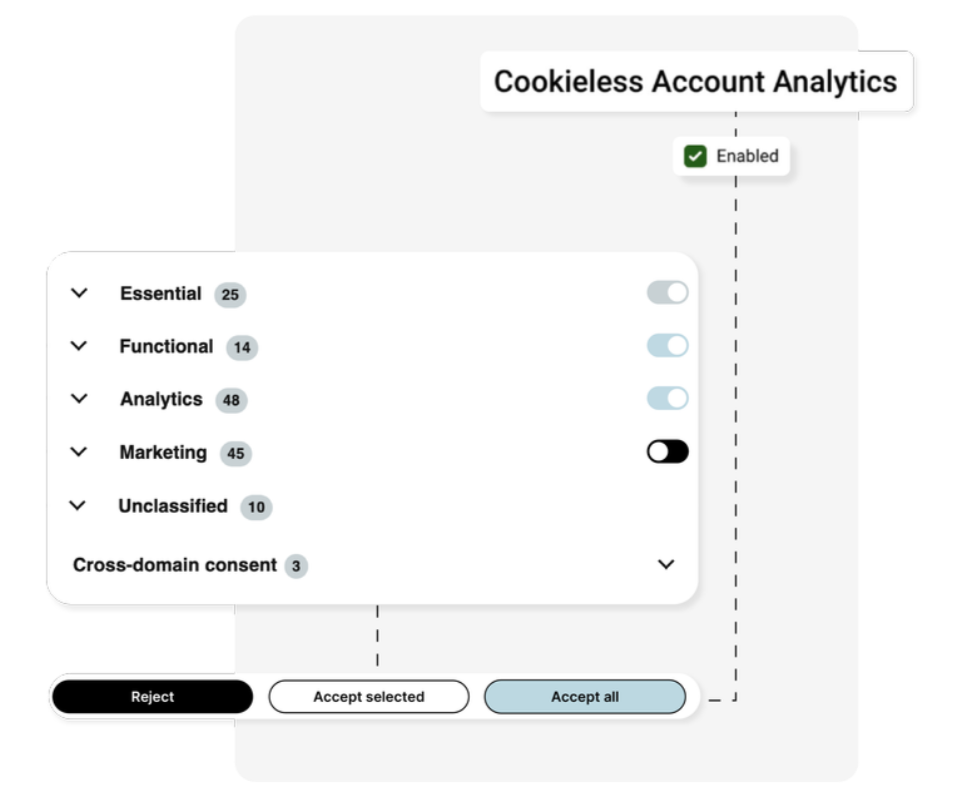
Source: Dreamdata
ZoomInfo addresses data quality at its root. Rather than inferring who visited your website from incomplete browser signals, ZoomInfo maintains 500M contacts and 100M companies verified through a multi-source pipeline backed by 300+ human researchers, achieving up to 95% accuracy on first-party data.
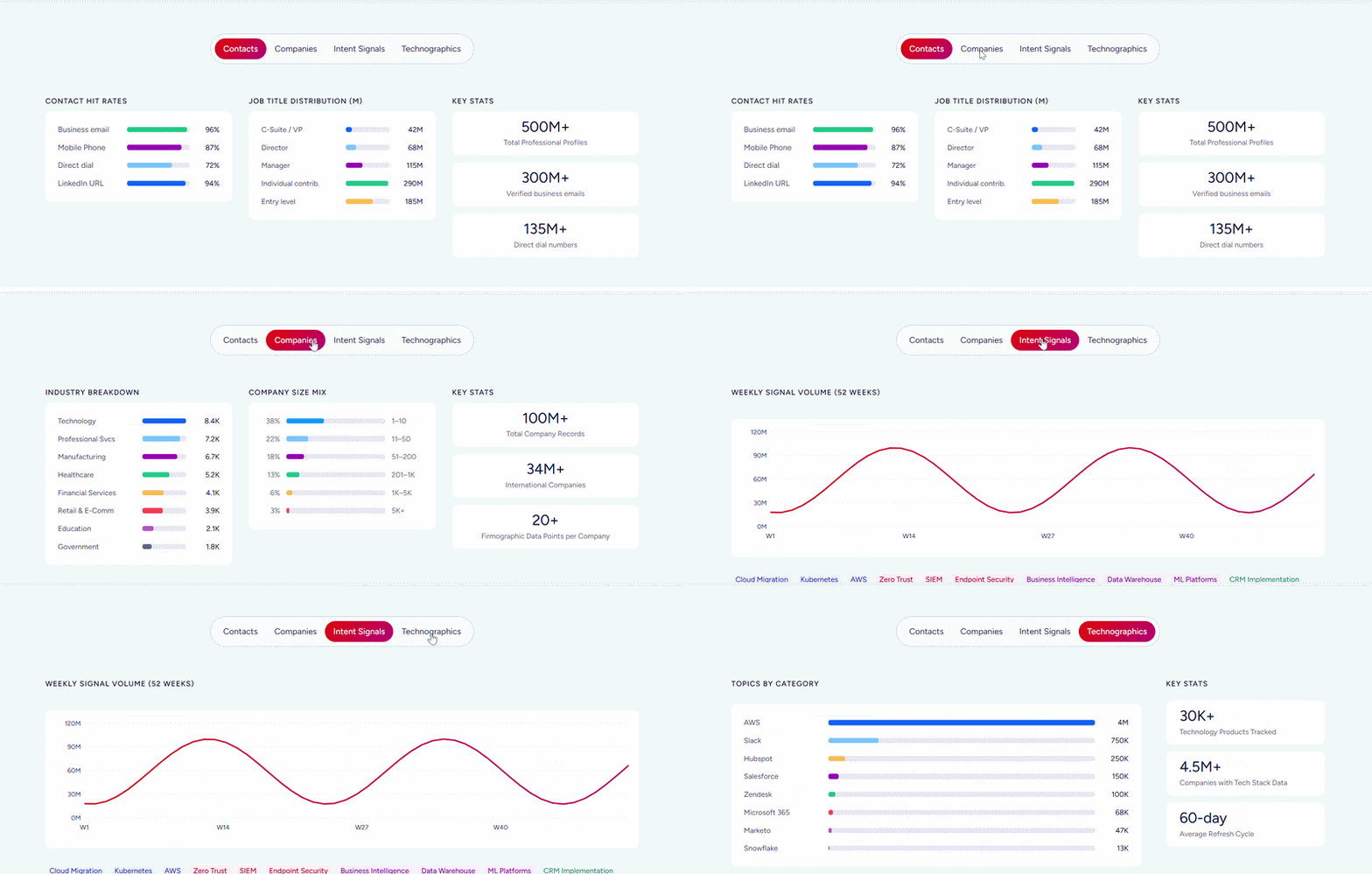
In a Fortune 500 competitive RFP analyzing 25 million contacts across vendors, an independent consultant concluded that "no other competitor came even close." When your CRM data is enriched with verified contacts, firmographics, and org charts, every downstream tool (including attribution platforms) produces more reliable results.
SpringDB achieved a 300% increase in database usability and 2x–3x improvements in campaign conversions by using ZoomInfo's enriched data for audience targeting. (SpringDB Case Study)
Pricing and accessibility
Marketo Measure's pricing reflects its enterprise positioning. Adobe does not publish pricing for any tier. All pricing is negotiated through enterprise sales, and the product is tied to Adobe Marketo Engage licensing. Four tiers exist (Tier 1 through Marketo Measure Ultimate), with the top tier requiring Adobe Experience Platform, a large additional investment.
There is no free trial, no free tier, and no migration path from lower tiers to Ultimate without a full reimplementation.
Dreamdata's pricing is more accessible. A permanent free plan includes B2B web analytics, cookieless tracking, engagement scoring, company identification, and an audience builder for up to 5 seats with 2 months of history. No credit card required. The paid "Activation & Attribution" tier is custom-priced, requiring a demo to get a quote. The free tier is a genuine evaluation environment, not a crippled demo.
ZoomInfo offers two free entry points. ZoomInfo Lite is a permanent free tier with access to the B2B database, 10 monthly export credits, and WebSights Lite.
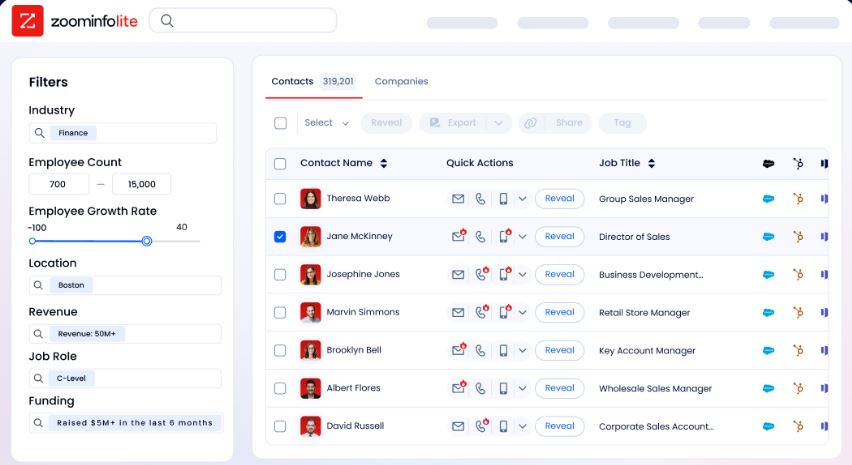
A separate 7-day free trial provides broader access to core platform features. Paid plans are custom-quoted with consumption-based pricing that scales with seats, credits, and feature access across Sales, Marketing, and other product lines.
For budget-constrained teams evaluating attribution, Dreamdata's free tier is the lowest-risk starting point. For teams already running Marketo Engage and Salesforce, Marketo Measure may already be partially included in their Adobe licensing. For teams that need the data foundation that makes attribution (and everything else) work better, ZoomInfo's free tier is a place to start.
Setup complexity and time to value
Implementation timelines reveal each platform's priorities and target audience.
Marketo Measure requires coordinating JavaScript tracking deployment, CRM package installation, ad platform connections, and domain registration. The tracking script setup alone involves decisions about hardcoding versus tag management, WAF allowlisting, iFrame handling, AJAX form customization, and multi-domain configuration.
Online channel rules must be configured via a downloadable CSV spreadsheet with priority-ordered mapping columns. Once uploaded, changes lock for seven days while the platform reprocesses existing touchpoints. Expect weeks to months before full proficiency.
Dreamdata's setup is lighter but still requires investment. You connect your CRM, install the web tracking script, configure stage models, and map UTMs. Capterra reviewers note that customizing integrations and ensuring tracking fires correctly takes real effort. The consensus across reviews is 1-2 months to reach proficiency.
ZoomInfo's GTM Workspace deploys in weeks, not months. The onboarding program runs 30 to 90 days depending on scope, structured across planning, technical implementation, education, and adoption phases. This program produced a 25% improvement in customer satisfaction scores and won Rocketlane's Golden Comet award for Best Customer Onboarding Team of 2024.
Bizible vs. Dreamdata vs. ZoomInfo: Which should you choose?
The right choice depends on where your biggest gap is: measurement, activation, or intelligence.
Choose Adobe Marketo Measure if:
You run Marketo Engage and Salesforce as your core marketing and CRM stack
CRM-native attribution data is a hard requirement for your reporting workflow
You need Boomerang Stage tracking for non-linear sales cycles
Your organization has dedicated Marketing Ops resources to implement and maintain the platform
You're committed to the Adobe ecosystem and willing to invest in setup complexity for Salesforce integration
Choose Dreamdata if:
You're a growth-stage B2B SaaS company that needs attribution and activation in one platform
LinkedIn is a primary demand generation channel and you need deep LinkedIn attribution
You want to close the loop between measurement and action by syncing audiences to ad platforms daily
Faster setup and a free evaluation tier matter to your buying process
You want customer success support that acts as a strategic partner, not just a help desk
Choose ZoomInfo if:
Your biggest gap isn't measuring what happened but knowing what to do next
You need verified B2B data, buyer intent signals, and execution tools in one platform
You want intelligence that shows which accounts are in-market and why deals move
Your team needs to reach decision-makers with verified direct dials and business emails
You want a GTM platform that serves sales, marketing, and RevOps from one data layer
Explore ZoomInfo with a free trial or ZoomInfo Lite.
The honest answer for many B2B teams: attribution and intelligence aren't competing priorities. They're complementary. Bizible or Dreamdata measures which efforts produced revenue. ZoomInfo identifies the next revenue opportunities and gives your team the data and tools to capture them.
The teams getting the most from their GTM investment use both measurement and intelligence, not one at the expense of the other.
Impartner saw a 45% increase in website engagement and saved 15 hours using ZoomInfo's automation for account-based marketing. (Impartner Case Study)
Bizible vs. Dreamdata vs. ZoomInfo FAQ
What is the main difference between Bizible and Dreamdata?
Adobe Marketo Measure (formerly Bizible) is an enterprise B2B marketing attribution platform that writes touchpoint data directly into Salesforce as native CRM objects, making it ideal for organizations centered on Salesforce and Adobe Marketo Engage.
Dreamdata is a B2B attribution and activation platform that combines multi-touch attribution with audience building and daily ad platform syncing. Bizible focuses on CRM integration and enterprise reporting; Dreamdata focuses on closing the loop between measurement and campaign activation.
How does ZoomInfo compare to Bizible and Dreamdata?
ZoomInfo is not an attribution platform. It's an AI GTM platform built on a B2B database of 500M contacts and 100M companies. While Bizible and Dreamdata measure which past marketing efforts drove revenue, ZoomInfo identifies which accounts are in-market now using buyer intent signals, provides verified contact data to reach decision-makers, and offers execution tools for sales and marketing teams.
The three platforms are complementary rather than interchangeable.
Which platform has better LinkedIn attribution?
Dreamdata leads on LinkedIn attribution. It holds an official LinkedIn Marketing Partner designation and is the only analytics platform integrated with LinkedIn's Company Intelligence API, enabling attribution of both paid and organic LinkedIn company page impressions to pipeline and revenue.
Marketo Measure tracks LinkedIn paid ads through standard API connections but lacks Dreamdata's impression attribution algorithm and organic LinkedIn attribution.
Does Adobe Marketo Measure have a free plan or trial?
No. Adobe does not offer a free trial or free plan for Marketo Measure. All pricing is negotiated through Adobe's enterprise sales process, and the product is tied to Marketo Engage licensing.
By contrast, Dreamdata offers a permanent free plan with real functionality (up to 5 seats, 2-month history, basic tracking and audience building), and ZoomInfo offers both a permanent free tier (ZoomInfo Lite with 10 monthly credits) and a 7-day free trial.
Which platform is easiest to implement?
Dreamdata generally has a faster setup, though reviewers still report 1-2 months to full proficiency. Marketo Measure is consistently described as the most resource-intensive to implement, requiring JavaScript deployment coordination, CRM package installation, campaign naming convention governance, and touchpoint rule configuration. ZoomInfo's GTM Workspace deploys in weeks.
Can I use ZoomInfo alongside Bizible or Dreamdata?
Yes. ZoomInfo's data enrichment and intent signals complement both attribution platforms. Enriching your CRM with ZoomInfo's verified contact and company data improves attribution accuracy in either Bizible or Dreamdata.
ZoomInfo's intent signals identify accounts that attribution tools may not yet see because those accounts haven't entered your marketing funnel. The platforms serve different functions in the GTM stack and work well together.
Which attribution models does each platform support?
Marketo Measure offers six models (First Touch, Lead Creation, U-Shaped, W-Shaped, Full Path, and Custom) with an ML-powered model that recalculates weights weekly. All six run simultaneously. Dreamdata offers six models (Linear, First-touch, Last-touch, W-shaped, U-shaped, and Data-Driven) with the ability to create custom variants carrying independent exclusion rules.
ZoomInfo does not offer traditional multi-touch attribution models; its intelligence focuses on buyer intent signals, account scoring, and predictive analytics.
What happens if my CRM data quality is poor?
Both attribution platforms depend on CRM data quality. Dreamdata reviewers have noted that poor CRM health directly limits attribution accuracy. Marketo Measure requires clean UTM governance and structured Salesforce campaigns as prerequisites for reliable data.
ZoomInfo can help address this upstream: its Operations product automates CRM data enrichment, deduplication, and verification using data from approximately 60 vendors through a codeless interface, improving the data foundation that attribution tools rely on.
Related breakdowns to help you choose:
