
Choosing between Dynamics 365 and SugarCRM for your B2B sales operation comes down to five questions:
Do you need a full enterprise suite that unifies CRM and ERP, or a sales CRM built for B2B relationship selling?
Is your company invested in the Microsoft ecosystem (Teams, Outlook, Azure), or running a separate ERP from SAP, Epicor, or Syspro?
Are you in manufacturing, wholesale, or distribution, where ERP purchase history drives sales decisions?
Can your team absorb a multi-month implementation, or do you need faster time to value?
Is the quality of your prospect and account data a bottleneck your CRM alone can't solve?
In short, here's what we recommend:
Dynamics 365 is Microsoft's CRM and ERP suite, covering eleven applications across sales, service, finance, supply chain, and HR on a shared data layer called Dataverse. Its native integration with Teams, Outlook, and Power BI lets sales reps surface CRM data without leaving the tools they already use. AI agents like the Sales Qualification Agent research leads, draft outreach, and hand off only high-potential prospects. Microsoft has been named a Leader in the Gartner Magic Quadrant for SFA for fifteen consecutive years. The tradeoff: implementations commonly run $250,000 to $2 million, licensing is complex, and the learning curve is steep for teams without dedicated admins.
SugarCRM (now rebranding as SugarAI) is a B2B sales CRM built for companies in manufacturing, wholesale, and distribution. Its standout capability is Sugar sales-i, which ingests ERP order data and surfaces cross-sell opportunities, churn signals, and buying pattern insights inside the CRM. SugarCRM has been named a Leader in the Nucleus Research SFA Value Matrix for six consecutive years. The tradeoff: a 15-user minimum creates an $885/month floor, reviewers describe the interface as dated, and mobile performance lags behind the desktop experience.
Both platforms are strong CRMs for different audiences. But neither generates the B2B intelligence your sales team needs to identify the right prospects, understand buying committees, or detect when accounts are actively in-market. That's a different problem, and it's where ZoomInfo fits.
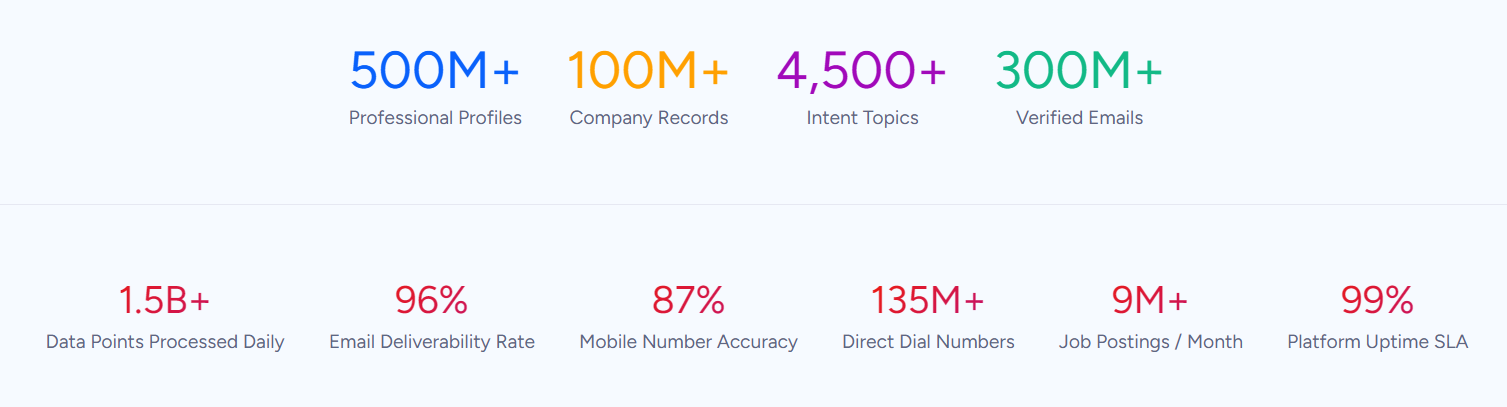
ZoomInfo is a B2B data and GTM platform built on 500M contacts, 100M companies, 135M+ verified phone numbers, and 200M+ verified business email addresses. Its GTM Context Graph combines this data with your CRM records, conversation transcripts, and behavioral signals to reveal not just what happened in a deal, but why. ZoomInfo integrates with both Dynamics 365 and Sugar via its API and MCP access. Sellers work from GTM Workspace for account research, prioritized outreach, and signal-driven execution. Marketers and RevOps teams use GTM Studio to build and launch GTM plays in minutes instead of weeks. Whichever CRM you pick, ZoomInfo is the intelligence layer that makes it work harder.
If better data and AI-driven intelligence sound like the missing piece in your sales stack, see ZoomInfo in action.
Dynamics 365 vs. SugarCRM vs. ZoomInfo at a glance
Dynamics 365 | SugarCRM | ZoomInfo | |
|---|---|---|---|
Core role | Enterprise CRM + ERP suite | B2B sales CRM for manufacturing, wholesale, distribution | B2B data intelligence and GTM execution platform |
Primary strength | Microsoft ecosystem integration, breadth of modules | ERP-connected sales intelligence via sales-i | B2B data, intent signals, GTM Context Graph |
AI capabilities | Copilot + autonomous agents across CRM and ERP | AI prioritization, sentiment, generative AI (higher tiers) | GTM Context Graph processing 1.5B+ data points daily |
CRM + ERP | Native ERP modules (Finance, Supply Chain, HR) | 180+ ERP integrations via sales-i | Not an ERP; enriches CRM data with third-party intelligence |
Sales entry price | $65/user/month (Professional) | $59/user/month (Standard, 15-user min) | Custom-quoted, consumption-based pricing |
Implementation | 4–12 months typical; $250K–$2M+ | Days to weeks (SugarCloud); longer for on-premises | |
Free trial | 30-day free trial | 7-day free trial | Free trial + permanent ZoomInfo Lite |
Best for | Microsoft-stack enterprises needing unified CRM + ERP | Mid-market manufacturers, wholesalers, distributors | Any B2B team needing better data, signals, and AI-driven prospecting |
Enterprise suite vs vertical specialist: two different CRM philosophies
Dynamics 365 and SugarCRM start from different premises about what a CRM should be.
Microsoft built Dynamics 365 as a platform that covers the entire business. Its eleven applications span sales, customer service, contact center, field service, finance, supply chain management, commerce, project operations, human resources, and SMB operations (Business Central). All of them run on Dataverse, a shared data layer that connects front-office and back-office operations natively. For an organization already running Microsoft 365, Azure, and Teams, Dynamics 365 extends that stack into CRM and ERP without adding a separate vendor.

Source: Microsoft
This breadth has a cost. Dynamics 365's scope means you're adopting a platform built to serve every department. If your sales team only needs CRM, you inherit complexity designed for finance, supply chain, and HR users too.
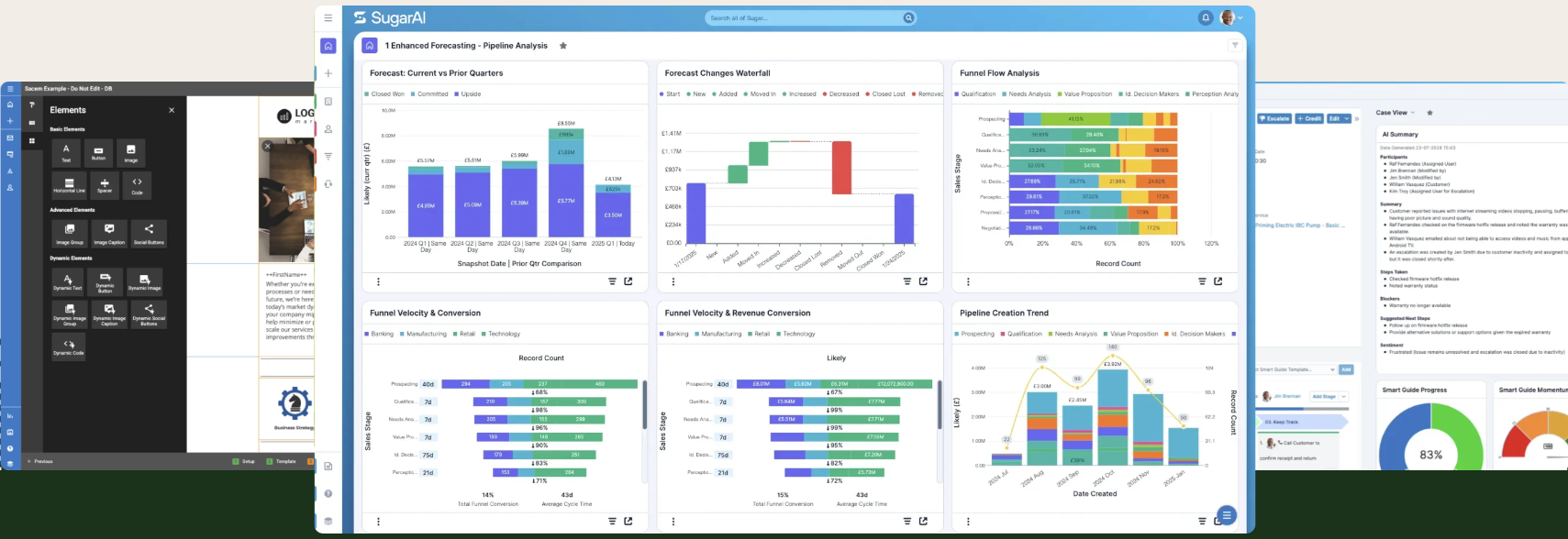
SugarCRM made the opposite bet. Instead of covering every business function, it focused on a specific audience: B2B sales teams in manufacturing, wholesale, and distribution. The product suite has four components: Sugar Sell for sales automation, Sugar sales-i for ERP-connected intelligence, Sugar Serve for customer service, and Sugar Market for marketing automation. The platform positions itself against Salesforce on price and against HubSpot on flexibility, targeting mid-market companies frustrated with enterprise overhead.
Source: SugarAI
For organizations that need both CRM and ERP under one contract, Dynamics 365 is the natural fit. For sales teams in relationship-driven industries that want a CRM tuned to their workflow without the weight of an enterprise suite, SugarCRM is the leaner choice.
The intelligence gap neither CRM closes on its own
Here's the problem that surfaces after you've chosen and deployed your CRM: the data inside it is only as good as what goes in.
CRMs are systems of record. They manage the contacts, accounts, and deals your team has already identified. They don't tell you who you're missing. They don't verify that the phone number on a contact record still works. They don't alert you when a target account starts researching your category. They don't map the buying committee at an account your rep has never engaged. Forbes estimates 91% of CRM data is incomplete, and that number compounds as people change jobs, companies restructure, and contact details go stale.
Dynamics 365 and SugarCRM both address parts of this. Dynamics 365 offers data enrichment features and LinkedIn Sales Navigator integration. SugarCRM's sales-i surfaces intelligence from ERP data. But neither platform generates the foundational B2B data (verified phone numbers, business emails, company attributes, org charts, technographics, and intent signals) that feeds effective prospecting and account planning.
ZoomInfo was built to solve this. Its data platform covers 500M contacts and 100M companies, verified through a pipeline backed by 300+ human researchers with up to 95% accuracy on first-party data. In a Fortune 500 competitive RFP analyzing 25 million contacts across vendors, the independent consultant concluded that "no other competitor came even close." Beyond static data, ZoomInfo Intent tracks signals from 210M IP-to-Organization pairings, identifying companies researching your category before they engage a vendor.
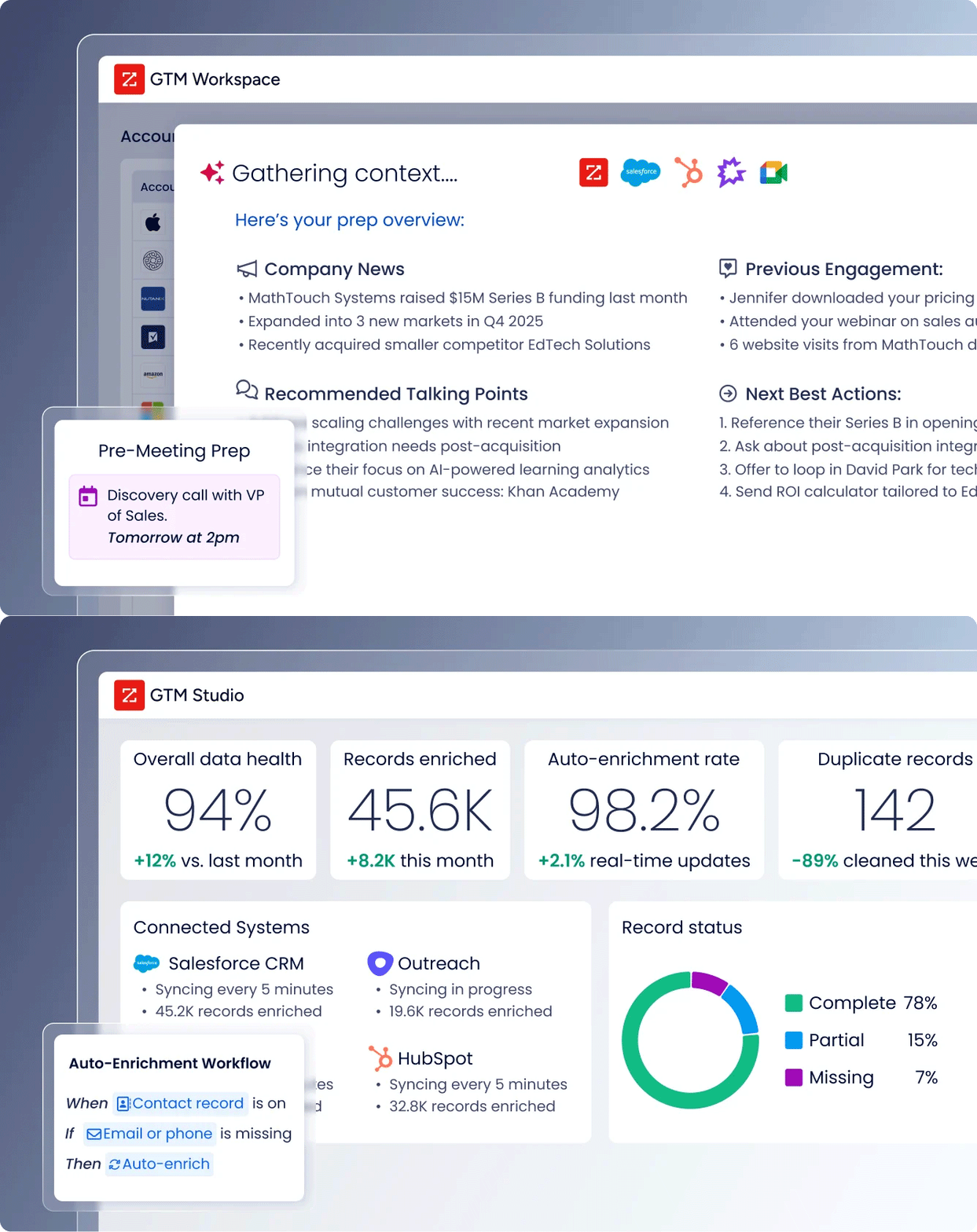
This intelligence is accessible everywhere your team works. GTM Workspace gives sellers AI-generated account briefs, signal-driven action feeds, and AI-drafted outreach. GTM Studio lets marketers and RevOps teams describe audiences in plain language, launch multi-channel plays, and track pipeline impact. APIs and the MCP server push the same intelligence into any CRM, custom agent, or third-party tool.
ZoomInfo integrates with both Dynamics 365 (a featured integration in ZoomInfo's marketplace) and Sugar (supported via ZoomInfo's CRM and MAP integrations). Whichever CRM you choose, ZoomInfo is the data foundation that determines whether your reps sell to real buyers with current information, or work stale leads with missing phone numbers.
"ZoomInfo gives us the information we need to execute. We don't have to go through and spend our time digging. It's already there, so we can be three steps ahead." — William Kenimer, Vice President of Revenue Operations, Vensure
Sales capabilities take different approaches
Both platforms handle the core selling workflow (leads, opportunities, accounts, pipeline), but the design behind each sales module reflects their different audiences.
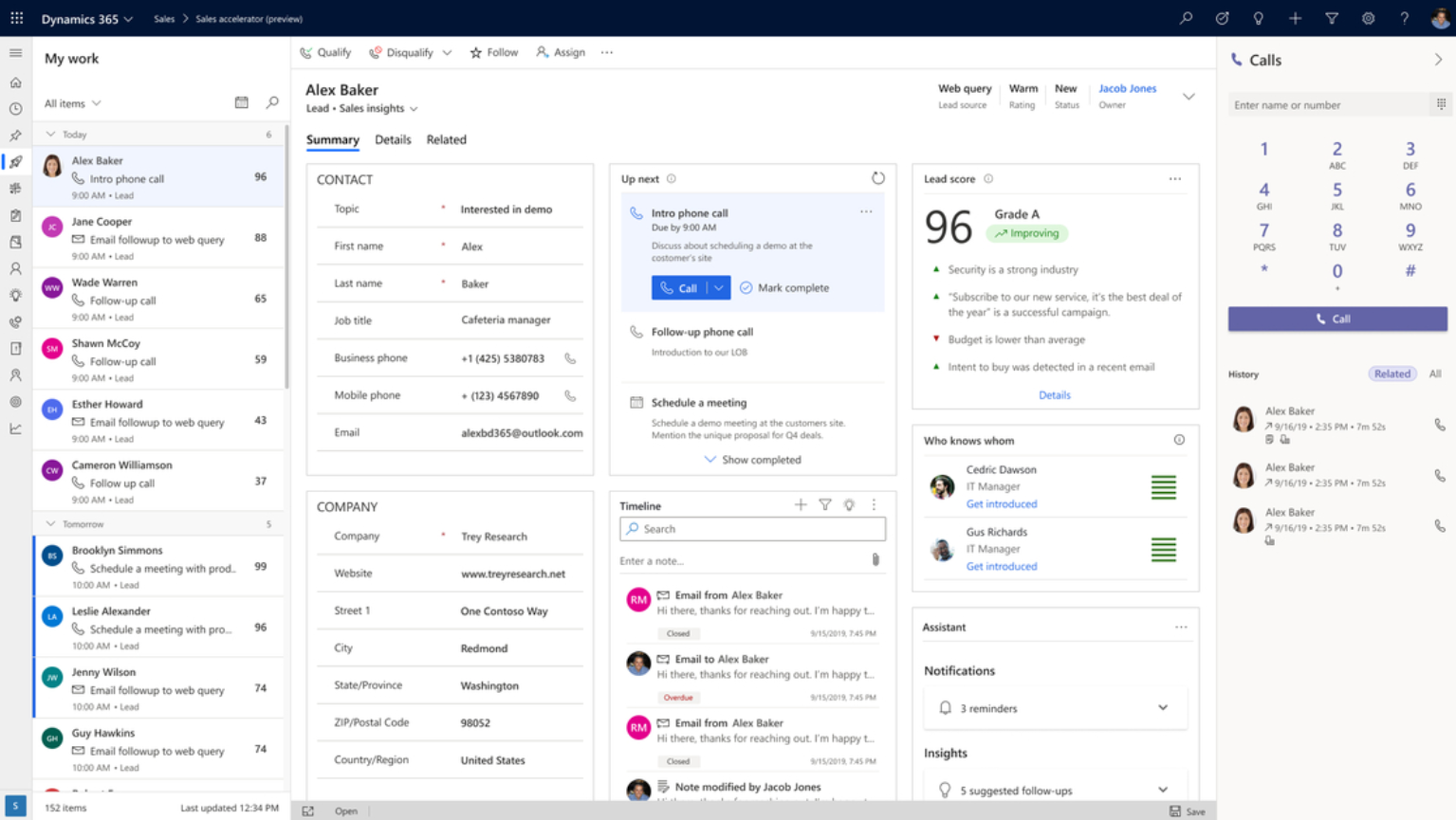
Dynamics 365 Sales is organized around a lead-to-cash pipeline with AI layered throughout. The Sales Qualification Agent researches leads using internal and external knowledge sources, evaluates fit against a configured target customer profile, and in its "Research and engage" mode, sends emails and follows up without seller intervention. Copilot handles record summarization, meeting prep notes, email drafts, and call summaries. Conversation intelligence analyzes Teams and phone recordings to detect customer sentiment and suggest follow-ups. The Microsoft Relationship Sales tier bundles LinkedIn Sales Navigator into the CRM license.
Source: Microsoft
This pays off in complex enterprise sales where AI automation absorbs administrative work. For a 200-person sales organization running Microsoft 365, the tight integration (Outlook, Teams, SharePoint, Power BI) means reps rarely leave their familiar tools.
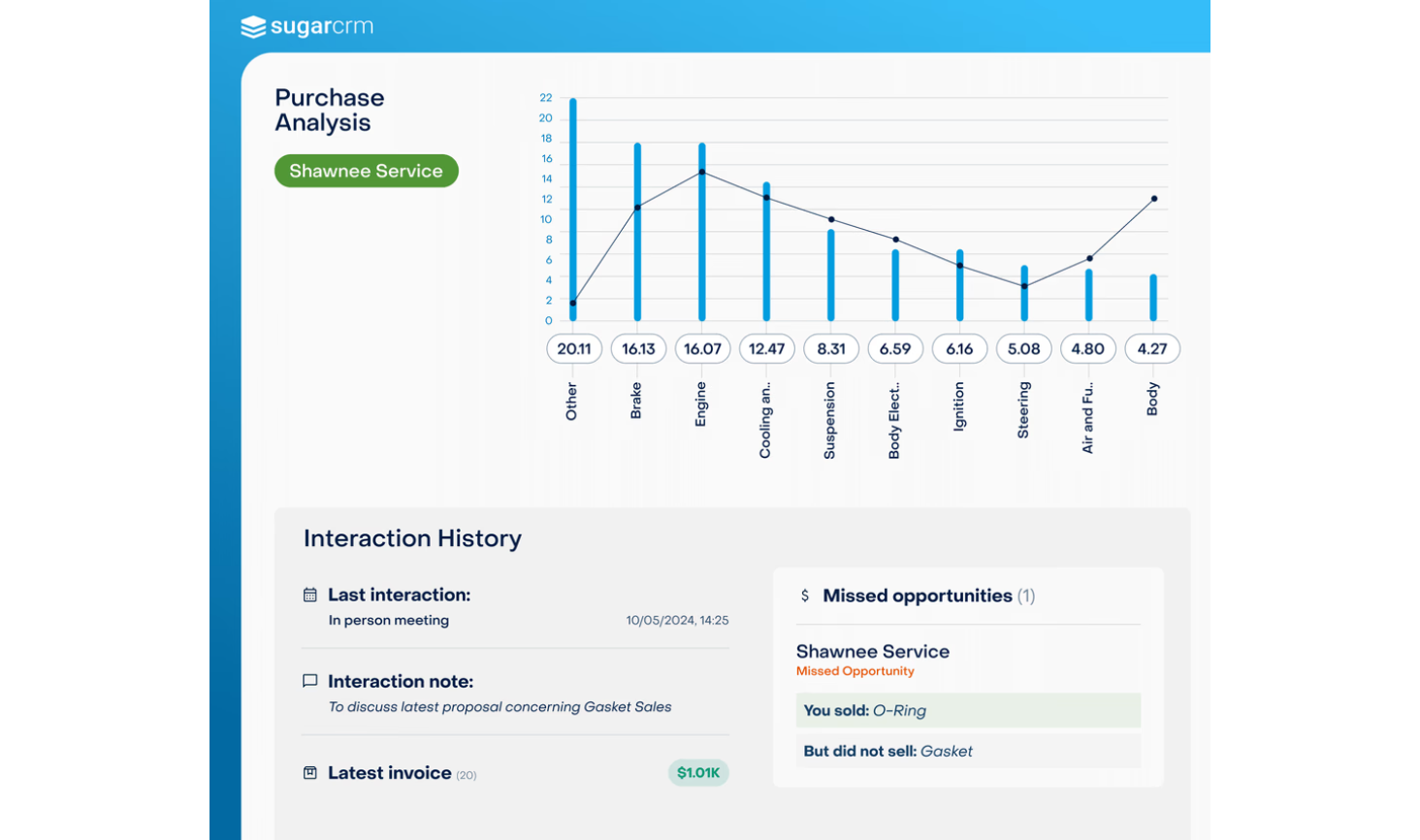
Sugar Sell treats selling as a guidance problem rather than an automation problem. The platform functions as "a sales coach, not a database", surfacing which accounts and opportunities matter most at login, explaining why, and recommending what to do next. Guided workflows assign tasks automatically based on deal size and timelines, keeping sales processes consistent across the team. Before any customer interaction, reps see a context view combining company summaries, recent news, social insights, and complete interaction history.
Source: SugarAI
Sugar's strength shows in high-volume account management, the kind seen in manufacturing and wholesale, where a single rep manages hundreds of accounts and needs to spot which ones deserve attention today.
ERP integration reveals the real divide
This is where the two platforms diverge most sharply, and where the buyer's existing infrastructure matters more than either product's feature list.
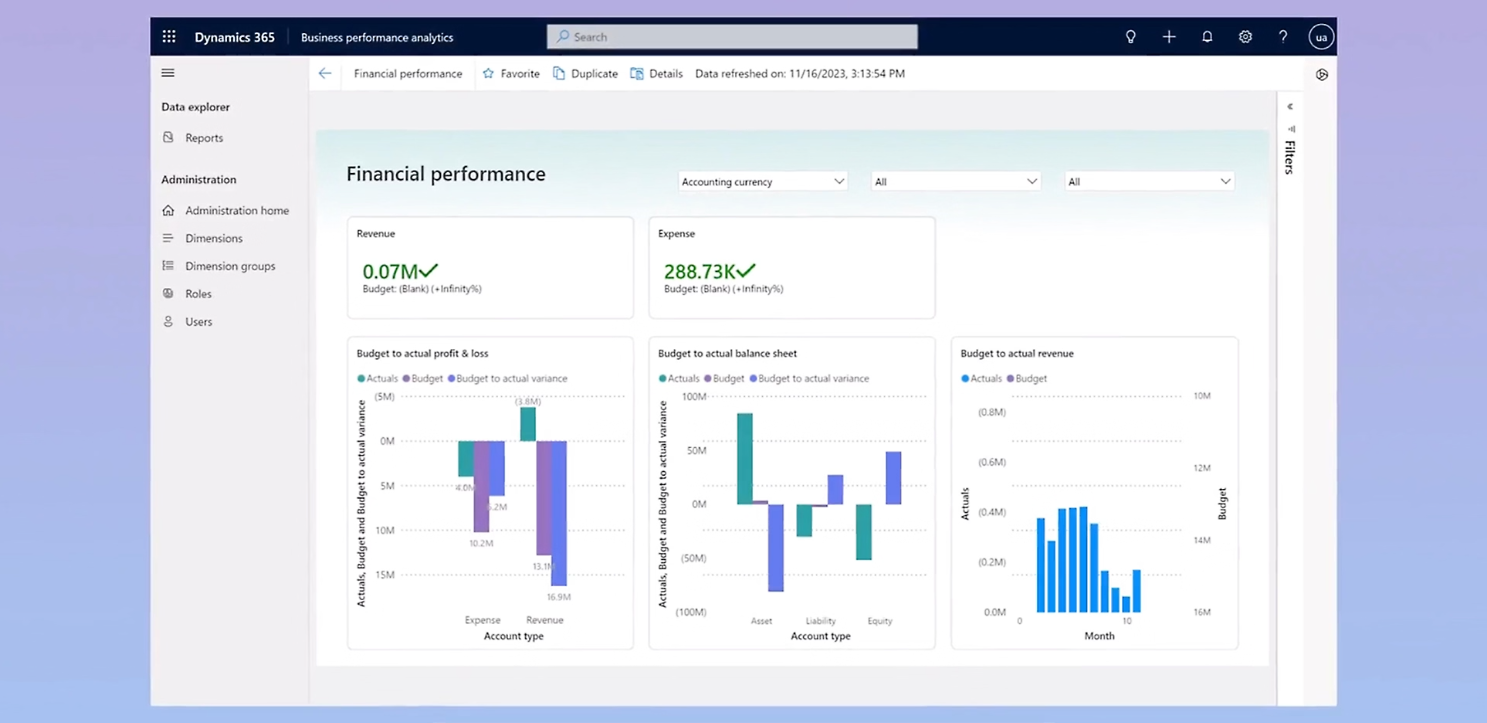
Dynamics 365 doesn't just integrate with ERP. It is an ERP. Dynamics 365 Finance, Supply Chain Management, and Business Central share the same Dataverse platform as Sales. A sales rep can see inventory levels, order status, and financial data without an integration layer because it's all one system. For organizations that want a single vendor for CRM and ERP, this native unity is a genuine advantage. But it only works if you adopt Microsoft's ERP modules. If you run SAP, Oracle, or Epicor for operations, connecting them to Dynamics 365 CRM often requires middleware or custom development.
Source: Microsoft
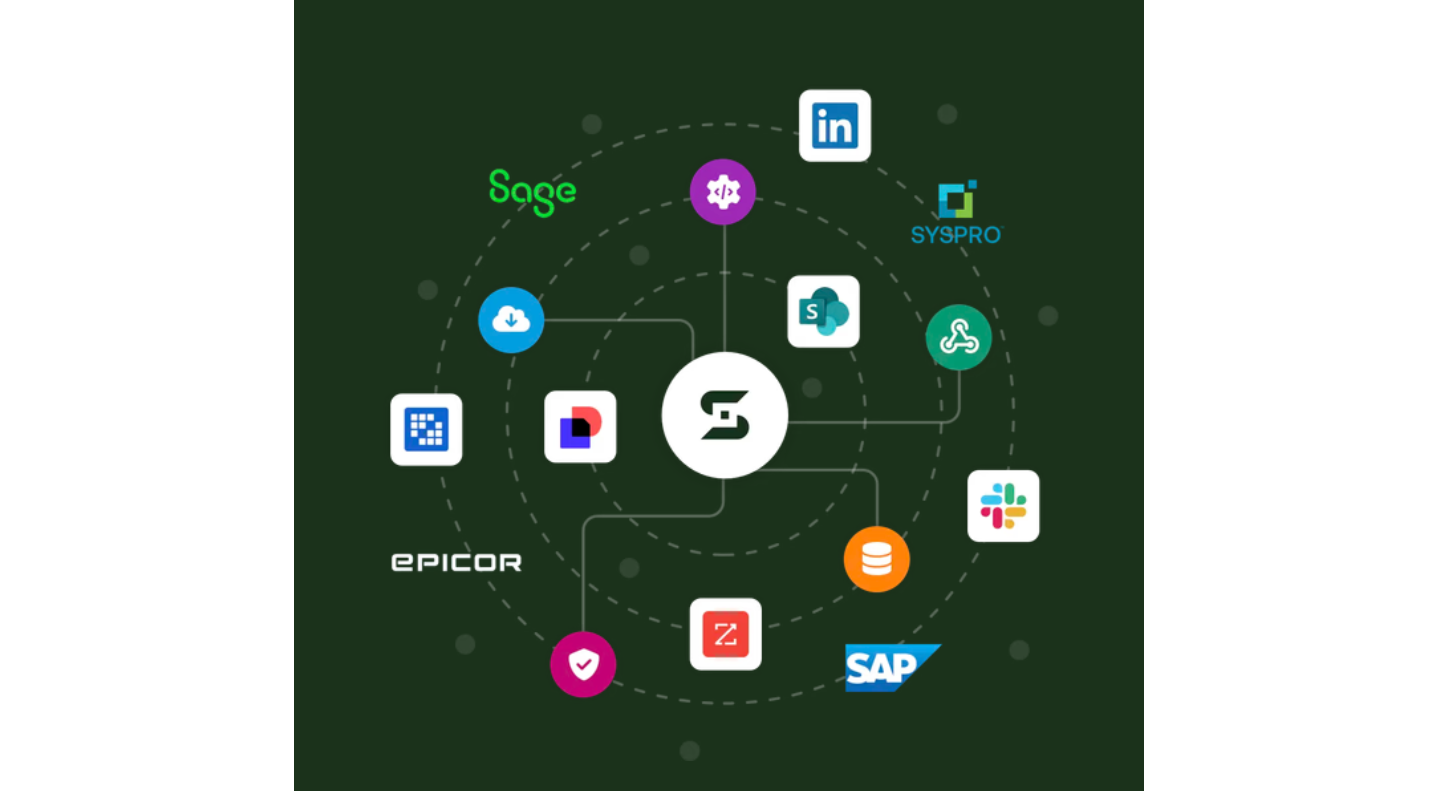
SugarCRM took a different path. Instead of building its own ERP, it built connectors to everyone else's. Sugar sales-i connects to 180+ ERP systems, including SAP, Oracle, Epicor, Procede, Syspro, and Sage. It ingests transactional data from these systems and surfaces buying patterns, cross-sell opportunities, and churn signals inside the CRM.
Source: SugarAI
The practical question: if you already run a non-Microsoft ERP and have no plans to switch, SugarCRM's connector approach gets you CRM-to-ERP intelligence without replacing your back office. If you want one vendor for everything and are willing to adopt Microsoft's ERP alongside its CRM, Dynamics 365 offers deeper native integration.
AI capabilities work at different levels
Both platforms have invested in AI, but the scope and maturity differ.
Dynamics 365 has embedded Copilot across the suite and deployed autonomous agents that go beyond assistance into action. The Sales Qualification Agent can research, email, and follow up with leads on its own. The Sales Opportunity Agent continuously analyzes every deal for risk signals. The Account Reconciliation Agent handles financial matching. Microsoft's advantage here is access to Azure OpenAI Service at the infrastructure level: its AI runs on its own cloud, with its own models, and connects natively to its own data.
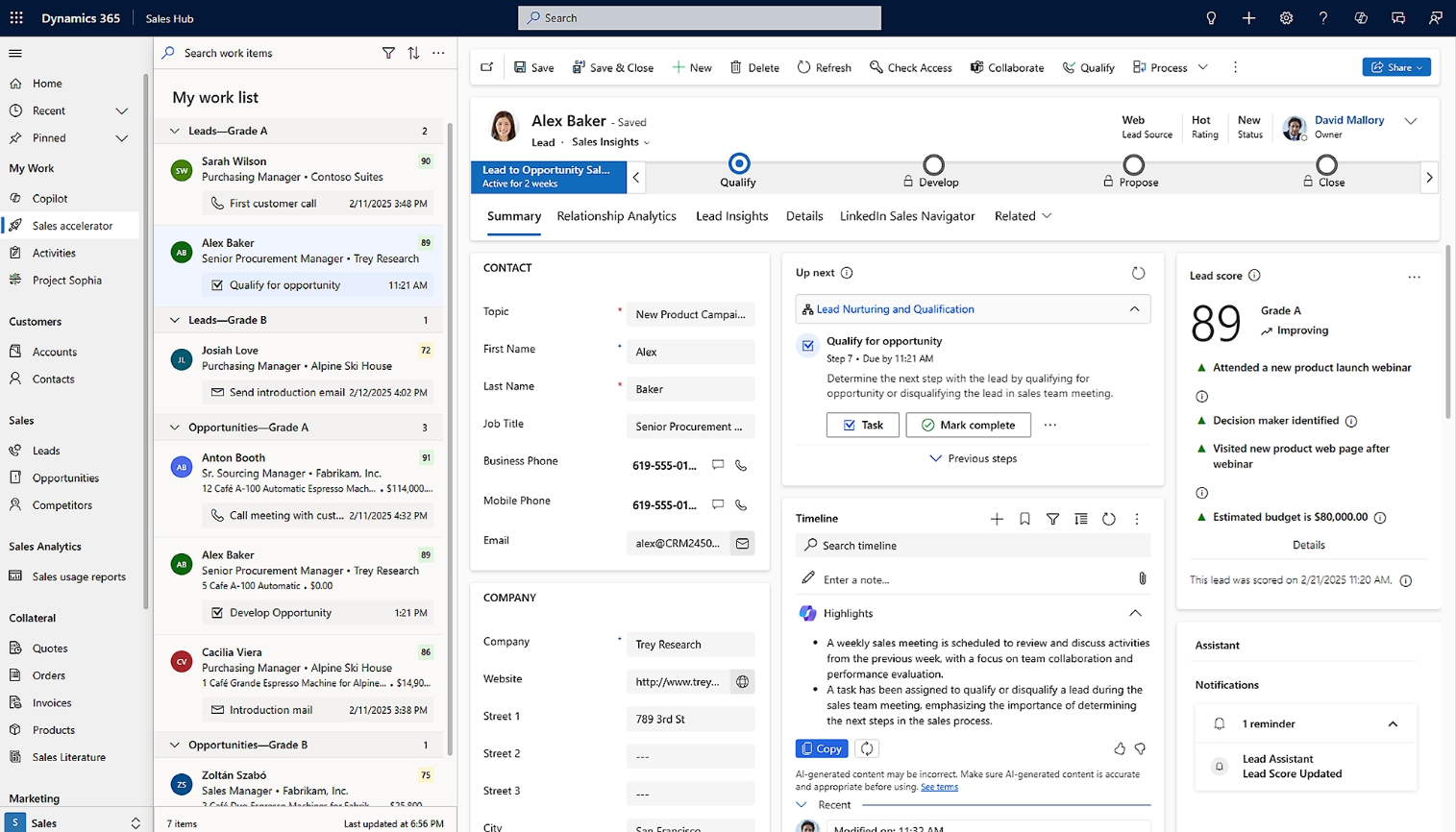
Source: Microsoft
The limitation: much of this AI operates on data already in your CRM. If your CRM data is incomplete (missing contacts, stale company records, no intent signals), the AI inherits those blind spots.
SugarCRM focuses its AI on sales guidance rather than autonomous execution. Intelligent lead prioritization, Revenue Intelligence, generative AI, and sentiment analysis are available at the Advanced tier ($85/user/month), though several of these features are asterisked on the pricing page and may require upgrading to Premier ($135/user/month). Sugar's AI draws from ERP data via sales-i, which gives it a signal source (actual purchase behavior) that generic CRM AI doesn't have.
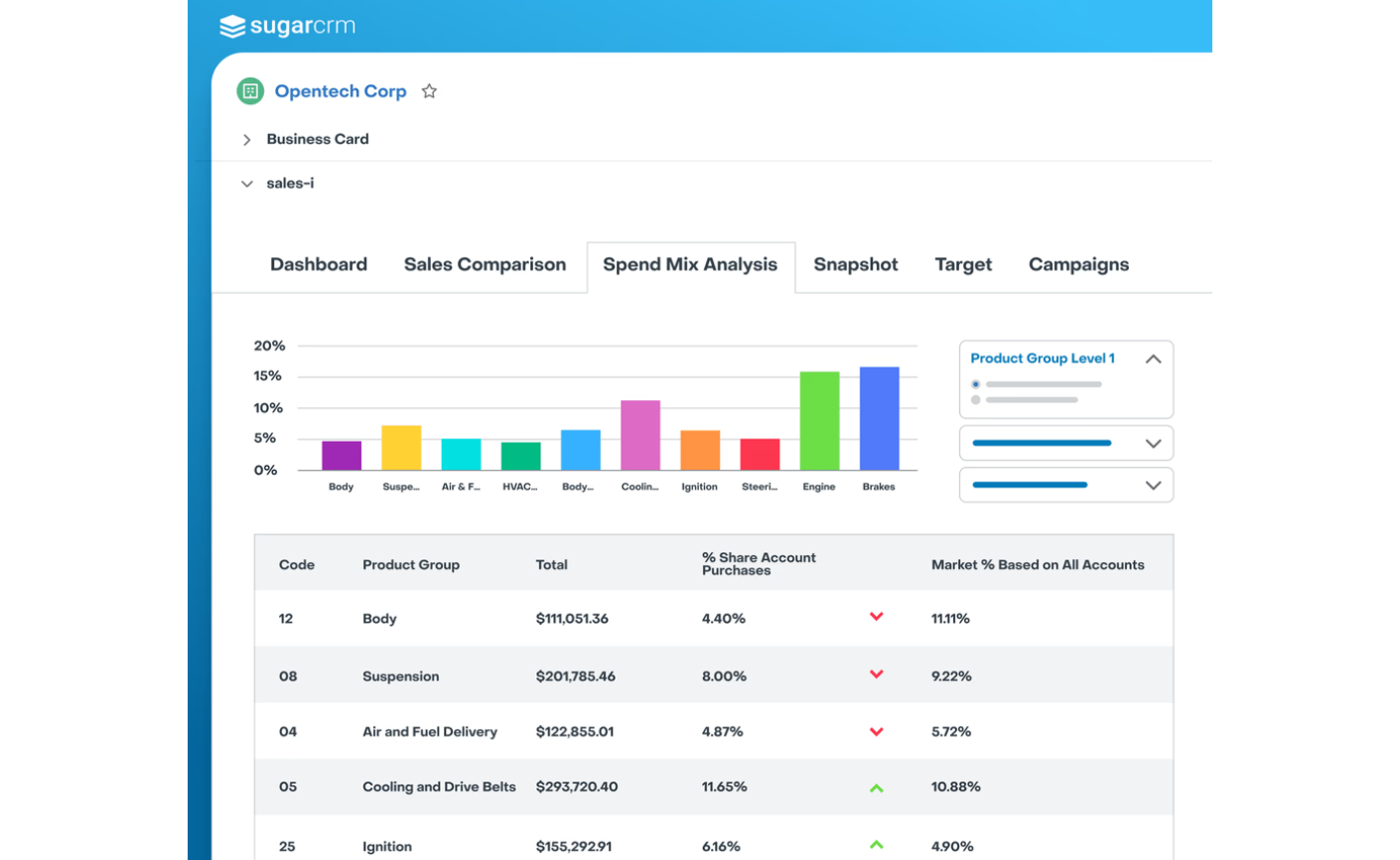
Source: SugarAI
The limitation: Sugar's AI is narrower. It doesn't offer autonomous agents that execute tasks independently, and the most valuable AI features sit behind higher-priced tiers.
ZoomInfo addresses the data gap that constrains both platforms' AI. Its GTM Context Graph processes 1.5B+ data points daily, combining third-party B2B intelligence (contacts, companies, intent signals, technographics) with a customer's own CRM data and conversation intelligence. The result: an intelligence layer that captures not just what happened in a deal, but why it happened, which deals match your win patterns, which stakeholders are emerging, and which accounts show buying intent before they fill out a form. This feeds into GTM Workspace, where AI agents draft outreach, monitor signals, and update CRM records, or into any other tool via API and MCP.
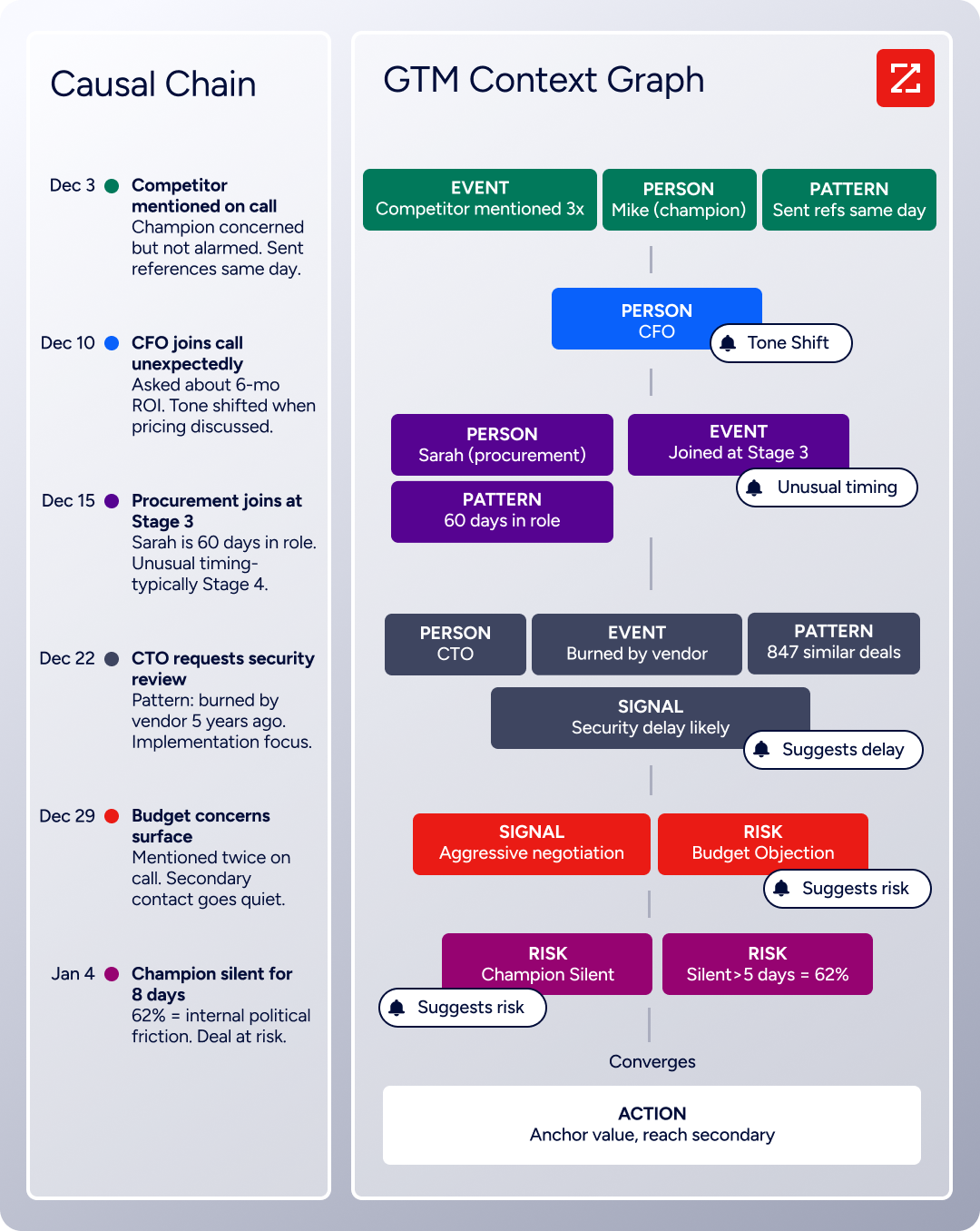
Seismic's sales team attributed 39% of active pipeline to opportunities identified or influenced by ZoomInfo signals, while boosting productivity by 54%. "That combination of our internal CRM data, external signals, and AI that's given all that context has helped us craft very specific account- and persona-based messages. And people have responded to them right away." (Seismic case study)
Pricing models target different buyers
The pricing structures tell you who each platform is designed for.
Dynamics 365 Sales starts at $65/user/month for Professional, which covers core sales automation but limits customization and excludes Copilot. Sales Enterprise at $105/user/month adds full customization, Copilot, and prebuilt agent access. Sales Premium at $150/user/month includes Sales Insights and AI-powered enrichment.
But the license fee is only the beginning. Software licensing is typically just 15–20% of total implementation cost, with consulting, customization, data migration, and training driving the rest. 60% of implementations exceed initial budgets by 20–40%. Enterprise Finance and Operations implementations routinely run $375K–$1.75M or more. AI agent usage requires Copilot Credits purchased separately (unless on Sales Premium, which includes 1,000 credits/user/month), plus an active Azure subscription.
SugarCRM starts at $59/user/month for Sugar Sell Standard, the lower per-seat price of the two. Advanced is $85/user/month, and Premier is $135/user/month. All tiers carry a 15-user minimum, creating a floor of $10,620/year even for smaller teams. Mail and calendar integration requires at least the Advanced tier. AI features like intelligent lead prioritization, Revenue Intelligence, and generative AI are asterisked at the Advanced level and may require Premier or separate purchase. Sugar Market and Sugar Serve pricing isn't published; both require a direct quote.
The hidden costs differ in character. Dynamics 365's unpredictability comes from implementation: the gap between quoted license cost and actual deployment cost. SugarCRM's comes from feature gating: what looks like a $59/user product often requires the $135/user Premier tier once you add the capabilities that make the platform worth using.
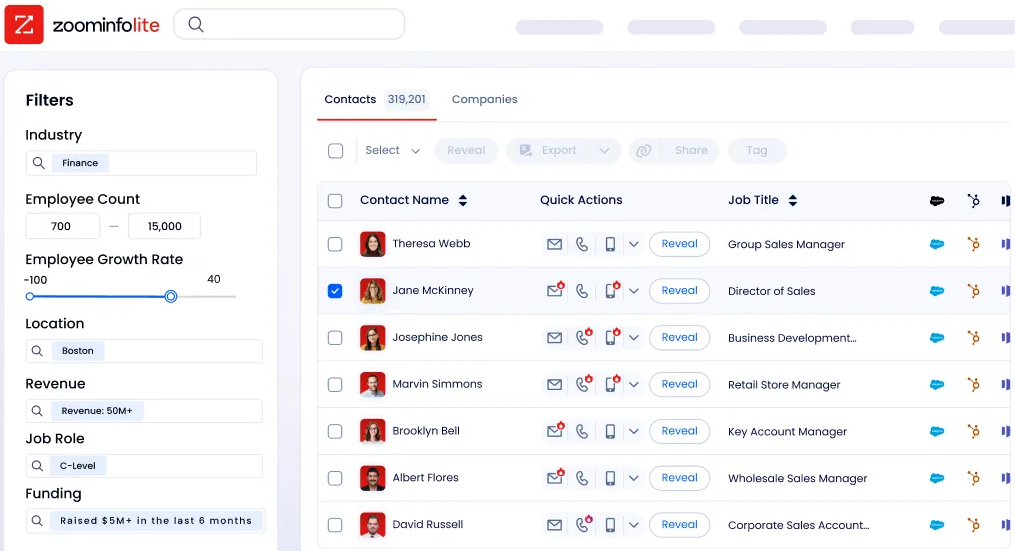
ZoomInfo uses consumption-based pricing that scales with seats, credit volume, and feature access. No prices are published. A permanent free tier (ZoomInfo Lite) gives individual users access to the B2B database with 10 monthly export credits. A 7-day free trial provides broader access. The pricing question with ZoomInfo is separate from the CRM decision: you're not replacing your CRM but adding the intelligence layer that makes it more effective.
Implementation and learning curve differ sharply
Dynamics 365 implementations are measured in months, not days. Typical enterprise deployments take 4–12 months depending on scope, and most require a Microsoft implementation partner. Microsoft's Success by Design framework guides implementation through structured phases. G2 and Capterra reviewers describe a steep onboarding curve and clunky navigation between modules, particularly for teams without dedicated administrators.
SugarCRM offers faster initial deployment for cloud customers. SugarCloud lets organizations "get up and running in days, not months" compared to on-premises deployment. The platform supports no-code configuration, reducing developer dependency. But G2 reviewers and Capterra reviewers still flag a learning curve for setting up custom workflows and automations, and the mobile app is consistently described as slow compared to the desktop experience.
ZoomInfo deploys alongside your existing CRM rather than replacing it. GTM Workspace connects to Salesforce, HubSpot, and Microsoft Dynamics natively. ZoomInfo redesigned its onboarding from 30 to 90 days, producing a 25% improvement in customer satisfaction scores and winning Rocketlane's Golden Comet award for Best Customer Onboarding Team of 2024. Because ZoomInfo sits on top of your CRM rather than replacing it, the deployment risk is lower.
Dynamics 365 vs. SugarCRM vs. ZoomInfo: Which should you choose?
The right choice depends on your business, your existing infrastructure, and the problem you're solving.
Choose Dynamics 365 if:
You're already running Microsoft 365, Teams, and Azure
You need unified CRM and ERP under a single vendor
Your sales team operates in an enterprise with dedicated IT and admin support
You can invest in a multi-month implementation with a certified partner
AI agents that execute autonomously (lead qualification, outreach, scheduling) are a priority
Choose SugarCRM if:
You're in manufacturing, wholesale, or distribution with a relationship-driven sales model
You run a non-Microsoft ERP (SAP, Epicor, Sage, Syspro) and need your CRM to read that data
You manage a mid-market sales team (15+ reps) that values guided selling over automation
You want faster deployment than an enterprise suite without sacrificing configurability
ERP-connected intelligence (cross-sell alerts, churn detection, buying pattern analysis) is a priority
Use ZoomInfo with either if:
Your CRM data is incomplete, stale, or missing key contacts
You need verified phone numbers, business emails, and org charts your CRM doesn't generate
You want intent signals showing which accounts are researching your category
Your reps spend too much time on manual research instead of selling
You want AI-powered execution (account briefs, outreach drafts, signal-driven prioritization) built on B2B data
See ZoomInfo in action with a free trial.
The CRM you choose shapes how your team manages relationships and tracks deals. But the intelligence feeding that CRM determines whether your reps chase the right accounts, reach the right people, and engage at the right time. Dynamics 365 and SugarCRM each excel at their version of the CRM problem. ZoomInfo solves the data problem that sits underneath both of them.
"Anything that minimizes our team's need to switch contexts is beneficial. ZoomInfo offers a unified view, eliminating the need to navigate between systems." — Ben Perceval, RevOps Manager, Spekit
Dynamics 365 vs. SugarCRM vs. ZoomInfo FAQ
What is the core difference between Dynamics 365, SugarCRM, and ZoomInfo?
Dynamics 365 is Microsoft's enterprise suite combining CRM and ERP modules on a shared data platform, serving organizations that want a single vendor for sales, service, finance, and supply chain. SugarCRM is a B2B sales CRM focused on manufacturing, wholesale, and distribution, differentiated by ERP-connected intelligence through its sales-i product. ZoomInfo is not a CRM. It's a B2B data intelligence and GTM execution platform that provides verified contacts, intent signals, and AI-powered insights that make whichever CRM you choose more effective.
Which platform is more affordable for a mid-market sales team?
SugarCRM has the lower per-seat entry point at $59/user/month versus Dynamics 365 Sales Professional at $65/user/month. However, SugarCRM requires a 15-user minimum ($10,620/year floor), and many of its AI features require upgrading to the $135/user/month Premier tier. Dynamics 365 has no user minimum but its total cost of ownership is higher: implementations commonly run $250,000 to $2 million, with software licensing making up only 15–20% of the total spend.
Can I use ZoomInfo with either Dynamics 365 or SugarCRM?
Yes. ZoomInfo integrates with Dynamics 365 through a native connector in ZoomInfo's marketplace. SugarCRM is supported through ZoomInfo's CRM integrations. ZoomInfo's API and MCP server can also push data into any CRM. The intelligence is the same regardless of which CRM you use: verified contacts, company data, intent signals, and AI-powered account research from the GTM Context Graph.
Which platform has better AI capabilities?
Each platform applies AI differently. Dynamics 365 has the broadest AI scope, with autonomous agents (Sales Qualification Agent, Sales Close Agent) that can research leads and send outreach without human intervention. SugarCRM focuses AI on sales guidance: prioritizing accounts, surfacing insights from ERP data, and recommending next steps. ZoomInfo's AI operates on the largest third-party data foundation in B2B, using its GTM Context Graph to deliver contextual intelligence beyond what either CRM can generate from internal data alone.
Which CRM is better for manufacturing and distribution companies?
SugarCRM is built for these industries. Its sales-i product connects to 180+ ERP systems and surfaces buying patterns, cross-sell opportunities, and churn signals from actual order history, a capability no other major CRM offers natively. Dynamics 365 can serve manufacturing companies, especially if they also adopt its Supply Chain Management and Finance modules, but its ERP-to-CRM intelligence requires using Microsoft's own ERP products rather than connecting to third-party systems like SAP or Epicor.
How long does implementation take for each platform?
Dynamics 365 enterprise implementations typically take 4–12 months and require a certified Microsoft partner. SugarCRM's cloud deployment can be operational in days to weeks, though complex configurations with on-premises ERP integrations take longer. ZoomInfo deploys alongside your existing CRM in weeks, connecting to Dynamics 365 or Sugar without requiring changes to your CRM configuration.
Do any of these platforms offer a free plan?
ZoomInfo offers a permanent free tier called ZoomInfo Lite with access to its B2B database and 10 monthly export credits. Neither Dynamics 365 nor SugarCRM offers a permanent free plan. Dynamics 365 provides a 30-day free trial for most products. SugarCRM offers a 7-day free trial. ZoomInfo also offers a separate 7-day free trial with broader feature access beyond ZoomInfo Lite.
What happens if I outgrow SugarCRM or Dynamics 365?
Dynamics 365 scales within the Microsoft ecosystem: you can add Finance, Supply Chain Management, or other modules as your needs grow, all on the same Dataverse platform. SugarCRM scales within its product line (Sell, Serve, Market) and its ERP connector ecosystem, but organizations that need full ERP capabilities would need a separate product. ZoomInfo scales independently of your CRM choice, since it functions as the data and intelligence layer rather than the system of record. Switching CRMs doesn't require replacing ZoomInfo.
Comparing Dynamics 365 and SugarCRM? These related breakdowns go deeper:
