
Choosing between Freshworks vs. Pipedrive for your CRM often comes down to five questions most comparisons skip:
Do you need a CRM that also handles customer support and IT service management, or do you want a tool built exclusively for selling?
Is your priority managing the full customer lifecycle, or closing deals as fast as possible?
How important is it that your contact data is accurate, complete, and continuously updated without manual research?
Are you a small team that needs simplicity, or a growing organization that will hit feature ceilings quickly?
Do you want AI that helps agents answer tickets, or AI that tells your reps which deals to pursue and why?
In short, here's what we recommend:
Freshworks (specifically Freshsales) is the right pick for mid-market teams that want a CRM bundled with customer support, IT service management, and marketing automation under one vendor. Freshworks' strength is breadth: you can run your sales pipeline in Freshsales, handle support tickets in Freshdesk, and manage IT requests in Freshservice, all from the same company. The CRM includes built-in phone, email, chat, and WhatsApp, plus AI contact scoring and deal insights through Freddy AI. The trade-off is that Freshsales competes for investment with Freshworks' higher-priority products (Freshservice and Freshdesk), so the CRM doesn't evolve as fast as dedicated alternatives.
Pipedrive is built for small and mid-sized sales teams that want a CRM designed from the salesperson's perspective. Pipedrive pioneered the kanban-style pipeline view that's now an industry standard, and every feature exists to help reps move deals forward. The interface is fast, the learning curve is short, and pricing starts at $14/seat/month. Where Pipedrive falls short is everything after the deal closes: there's no native customer support, no service desk, and no post-sale relationship management.
Both platforms give you a place to manage deals. But neither solves the problem that kills most sales efforts before they start: incomplete, outdated contact data. Your reps can't close deals they can't find, and they can't reach prospects whose phone numbers are wrong.
ZoomInfo is a B2B data and GTM platform built on 500M contacts, 100M companies, 135M+ verified phone numbers, and 200M+ verified business email addresses. But ZoomInfo isn't just a database. Its GTM Context Graph processes 1.5B+ data points daily, combining this data with your CRM records, conversation transcripts, and behavioral signals to show not just who your buyers are, but why deals move or stall. Your team accesses this intelligence through GTM Workspace (for sellers), GTM Studio (for marketers and RevOps), or API and MCP in any front-end. For teams serious about pipeline generation, ZoomInfo provides the data foundation that makes any CRM more effective.
If better data and smarter prospecting sound like the missing piece of your sales stack, see how ZoomInfo works.
Freshworks vs. Pipedrive vs. ZoomInfo at a glance
Freshworks (Freshsales) | Pipedrive | ZoomInfo | |
|---|---|---|---|
Core strength | Multi-product suite (CRM + support + ITSM) | Pipeline-first sales CRM | B2B data, intelligence, and GTM execution |
Pipeline management | Visual pipeline with Kanban views | Visual Kanban pipeline with deal rotting alerts | Account prioritization with AI-driven signals |
AI capabilities | Freddy AI (contact scoring, deal insights, email drafting) | AI Sales Assistant, AI email writer, AI reports | GTM Context Graph with AI agents for research, outreach, and deal intelligence |
Built-in communication | Phone, email, chat, WhatsApp, SMS | Email sync, calling integrations, meeting scheduler | Multi-channel outreach, conversation intelligence (Chorus) |
Contact data | CRM records only; no third-party database | CRM records + Prospector (400M+ profiles via add-on) | 500M contacts, 135M+ verified phones, 200M+ verified business email addresses |
Customer support tools | Full suite (Freshdesk, Freshchat, Freshcaller) | None | Not a support tool |
Integrations | 1,200+ marketplace apps | 500+ marketplace apps | 120+ native integrations + API/MCP for any tool |
Starting price | $9/user/month (paid); free for 3 users | $14/seat/month; no free plan | Free tier available; paid plans custom-quoted |
Free trial | 21-day trial, no credit card | 14-day trial, no credit card | 7-day trial + permanent free tier |
Best for | Mid-market teams wanting one vendor for sales and support | SMB sales teams focused on closing deals | Revenue teams that need accurate prospecting data and buyer signals |
One is a suite, the other is a specialist
Freshworks and Pipedrive solve different problems. Understanding that difference matters more than comparing feature checklists.
Freshworks is a multi-product company. Freshsales is its CRM, but it sits alongside Freshdesk (customer support), Freshservice (IT service management), Freshchat (messaging), Freshcaller (cloud phone), and Freshmarketer (marketing automation). If your business needs a single vendor for sales, support, and internal IT, Freshworks delivers that. The products share a common design language and integrate natively, so a sales rep can see a customer's support history without switching tools.

Source: Freshworks
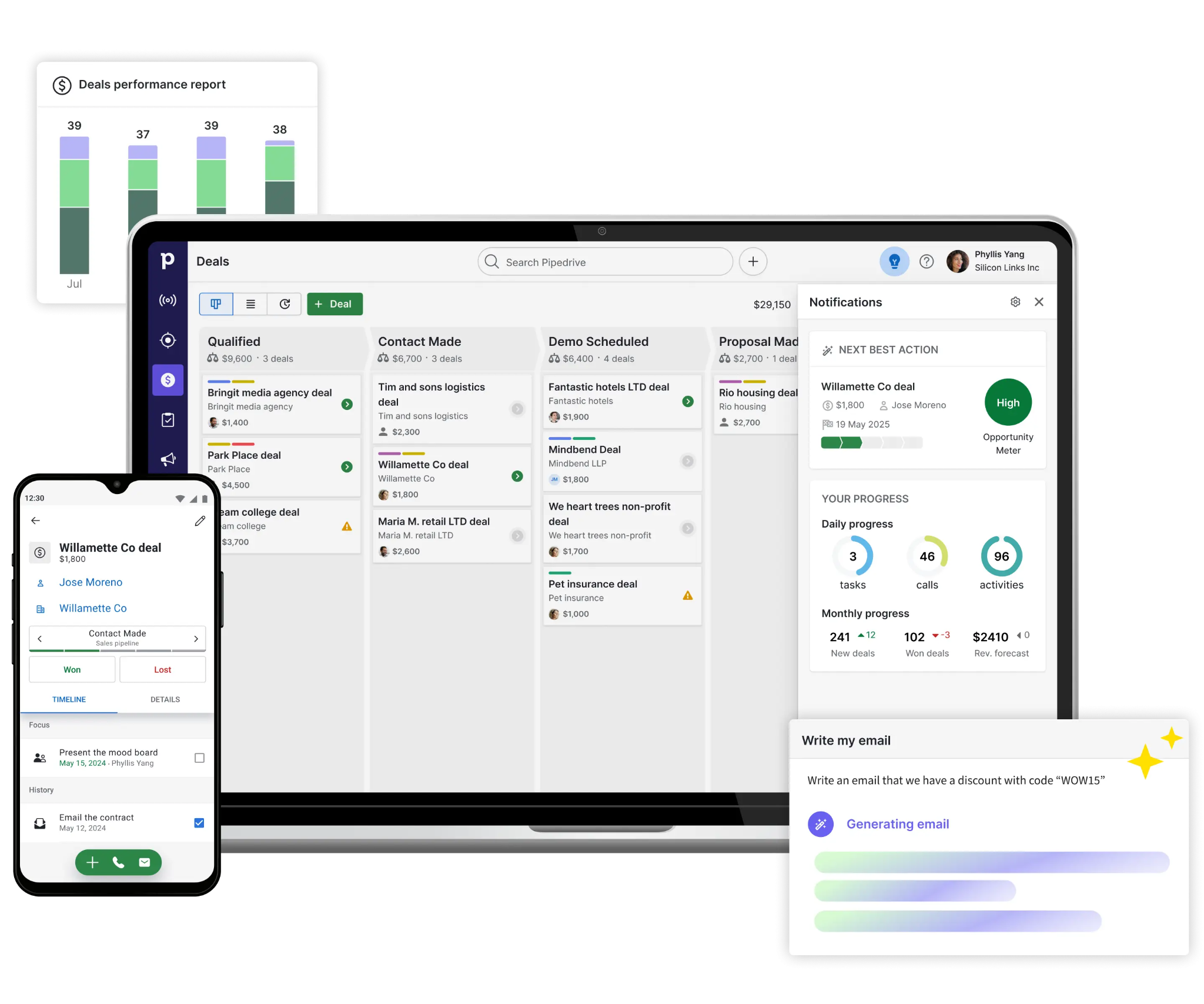
Pipedrive has no such split priorities. It does one thing: sales pipeline management. Every feature, every update, and every hire is oriented toward helping salespeople close deals. The company's founding story is built on this premise: the five co-founders were salespeople frustrated that CRMs were built for managers, not for the people actually selling.
This focus shows in the product. Pipedrive's pipeline view is faster, more intuitive, and more customizable than Freshsales' equivalent. Deal rotting alerts, activity-based selling, and the entire UX are designed for a rep's daily workflow. But once a deal closes, Pipedrive's usefulness drops sharply. There's no ticketing system, no knowledge base, no service desk.
Source: Pipedrive
Pipeline management: simplicity vs. ecosystem
Both platforms use visual kanban boards for deal management, but the experience differs in ways that matter for daily use.
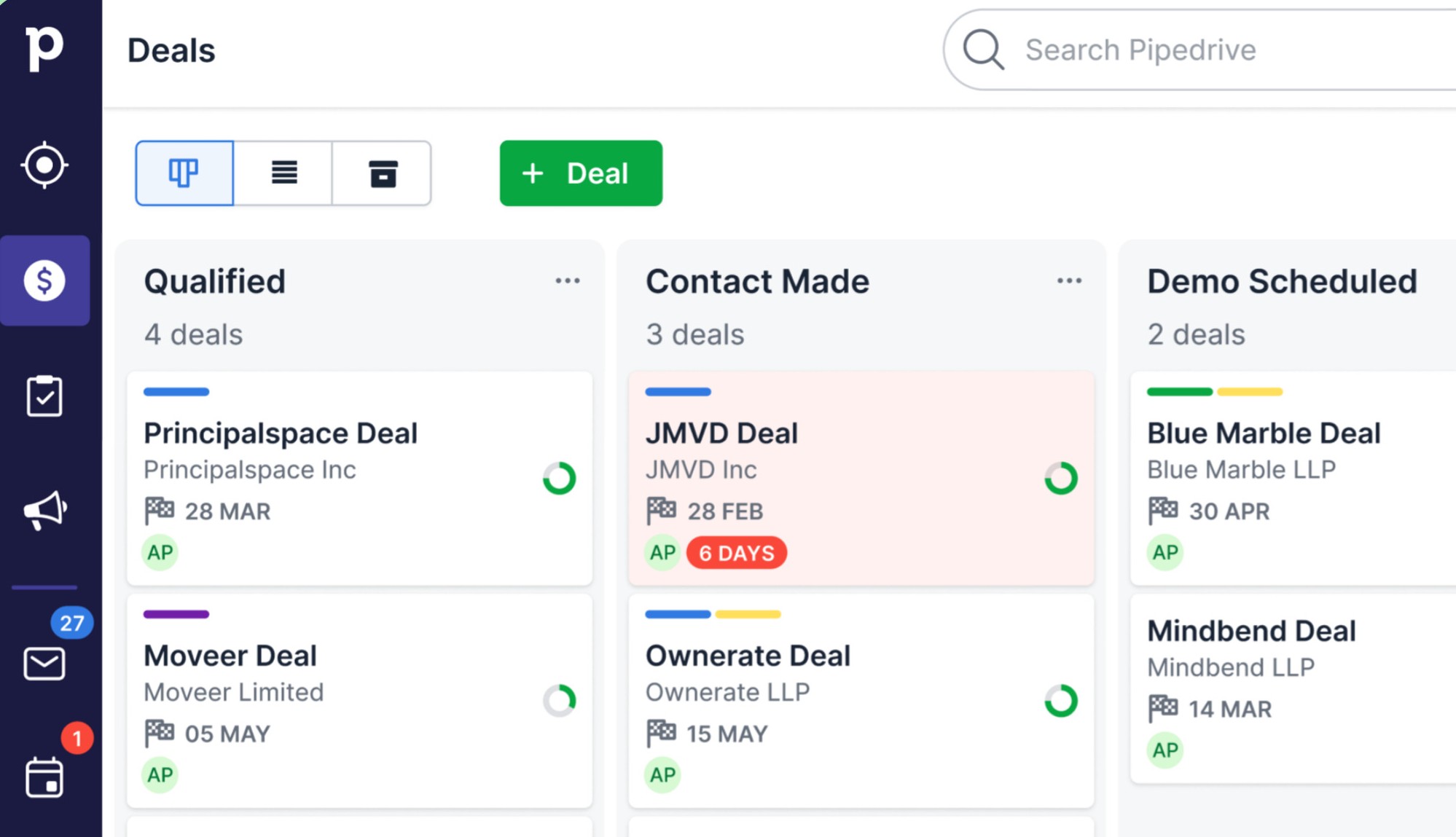
Pipedrive treats the pipeline as the center of the product. The kanban view loads first when you log in. Deals display their value, expected close date, and activity status at a glance. Colored cues flag deals going cold before they stall. You can create multiple custom pipelines with custom stages on every plan, including Lite. Weighted pipelines assign probability to each stage for more accurate forecasting. Three pipeline views (kanban, list, and forecast) give reps and managers different lenses into the same data.
Source: Pipedrive
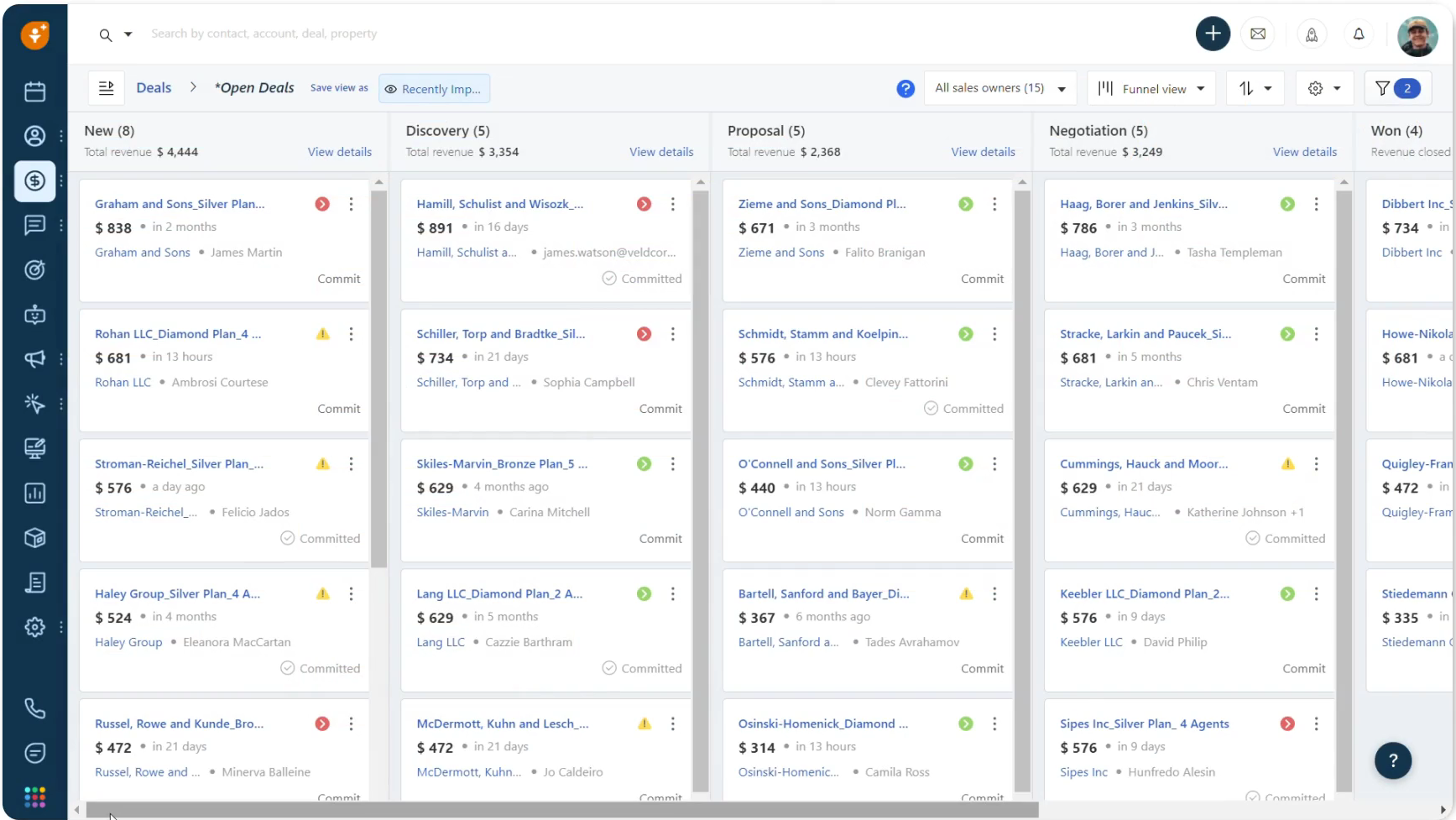
Freshsales offers a similar kanban pipeline view, but it's one feature among many rather than the product's organizing principle. You get visual deal tracking, drag-and-drop stage movement, and multiple sales pipelines on Pro and above. The advantage is context: because Freshsales connects to Freshdesk and Freshchat, a deal record can surface the customer's support ticket history, chat transcripts, and marketing touchpoints alongside pipeline data.
Source: Freshworks
Where Freshsales pulls ahead is in deal-adjacent workflows. Built-in CPQ (Configure, Price, Quote) ships with every paid plan, letting reps generate quotes, invoices, and contracts without a separate tool. Pipedrive includes Smart Docs with document generation and eSignatures, but only on Premium and above.
AI takes different shapes in each platform
Both Freshworks and Pipedrive have invested in AI, but their approaches reflect their different priorities.
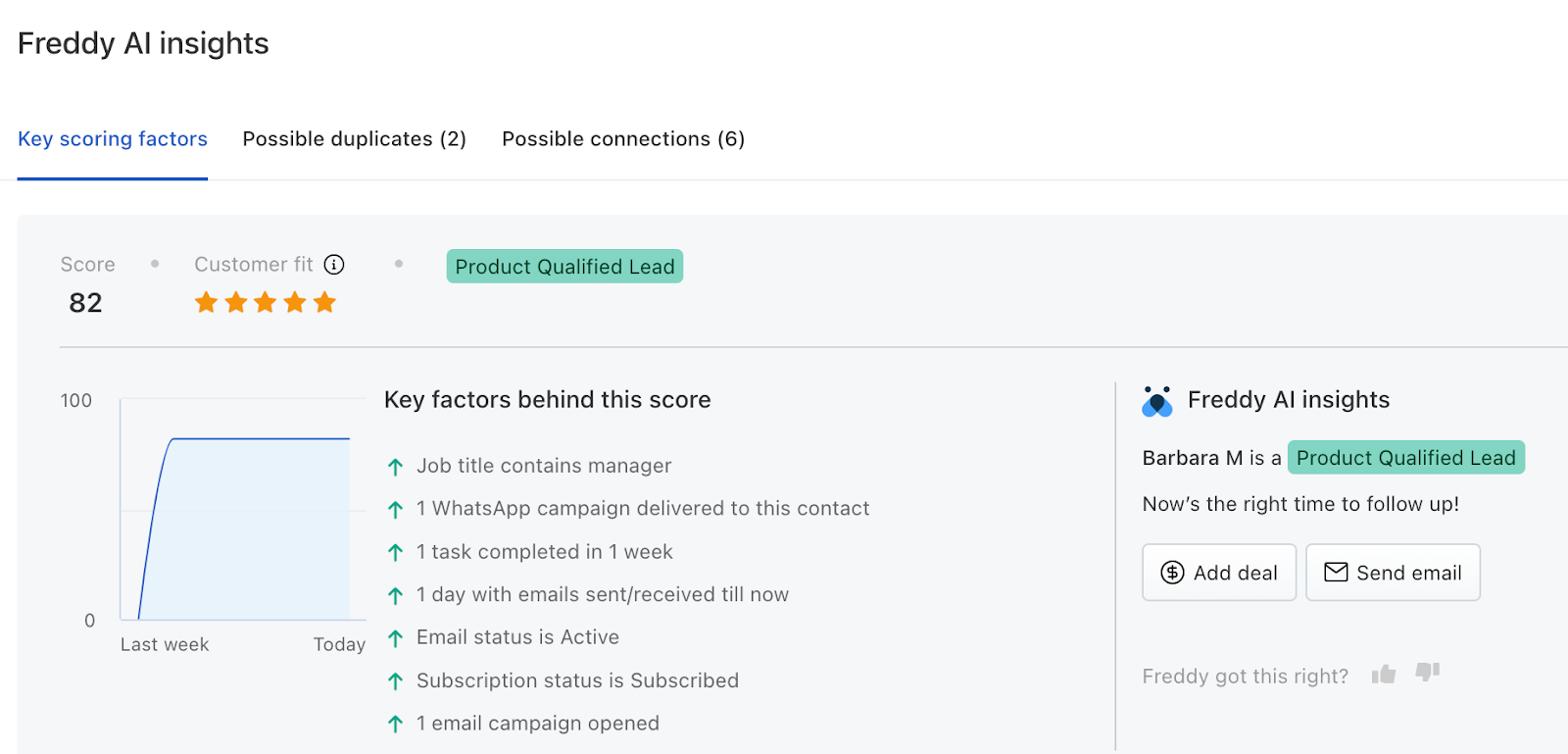
Freshsales' Freddy AI operates across the full Freshworks suite, not just the CRM. In Freshsales, Freddy AI scores contacts based on behavioral patterns, generates deal insights from parsed email and deal history, detects duplicate records, flags out-of-office contacts, and writes prospecting emails on demand. Contact scoring and deal insights are available on Pro plans ($39/user/month) and above. Freddy AI's deeper capabilities (autonomous ticket resolution, agentic workflows) are concentrated in Freshdesk and Freshservice rather than the CRM.
Source: Freshworks
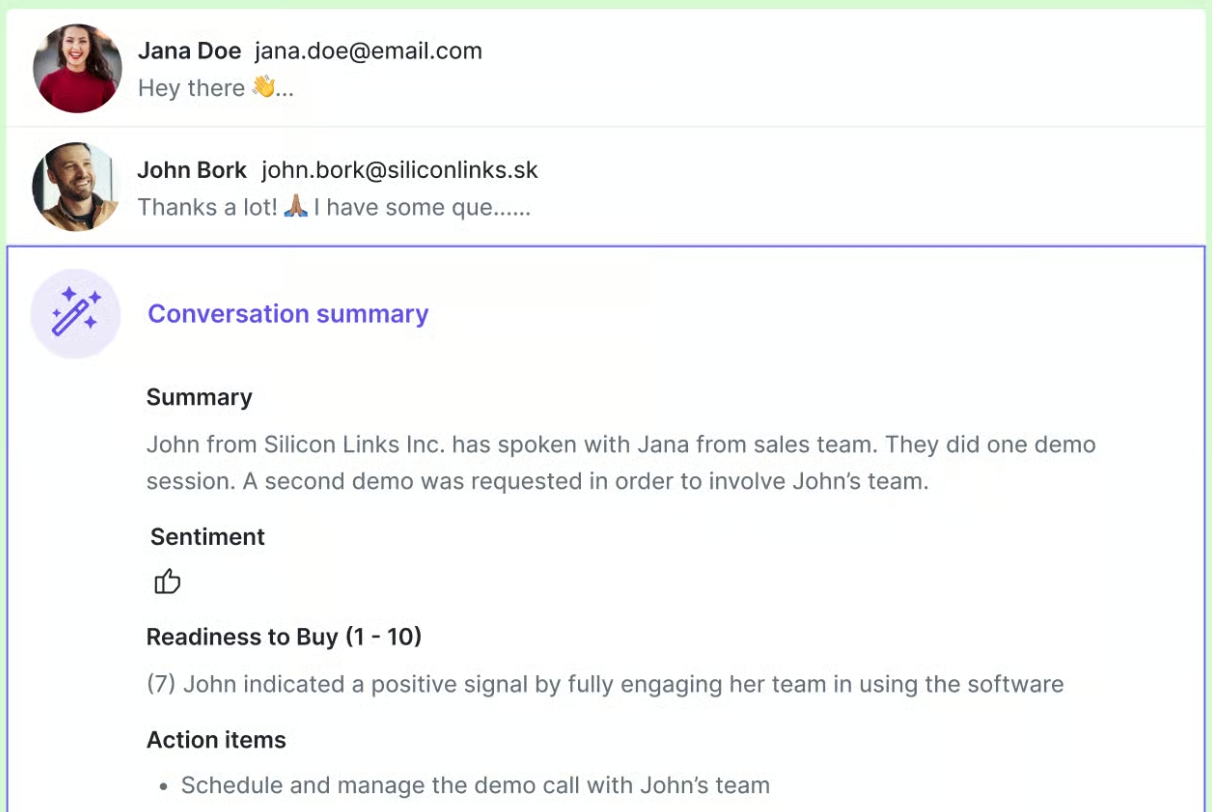
Pipedrive's AI is sales-specific. The AI Sales Assistant surfaces win probability predictions, deal activity reminders, and next-action suggestions. The AI email writer generates drafts from brief prompts with configurable tone and length. AI email summarization condenses threads into key themes, sentiment scores, and readiness-to-buy ratings (though this feature is still labeled BETA). The AI report generator lets managers create pipeline analyses from natural language queries. AI email creation and summarization require Premium plans, while the AI report generator and AI Sales Assistant are available on all plans.
Source: Pipedrive
Neither platform's AI solves the upstream problem: the quality of the data feeding the CRM in the first place.
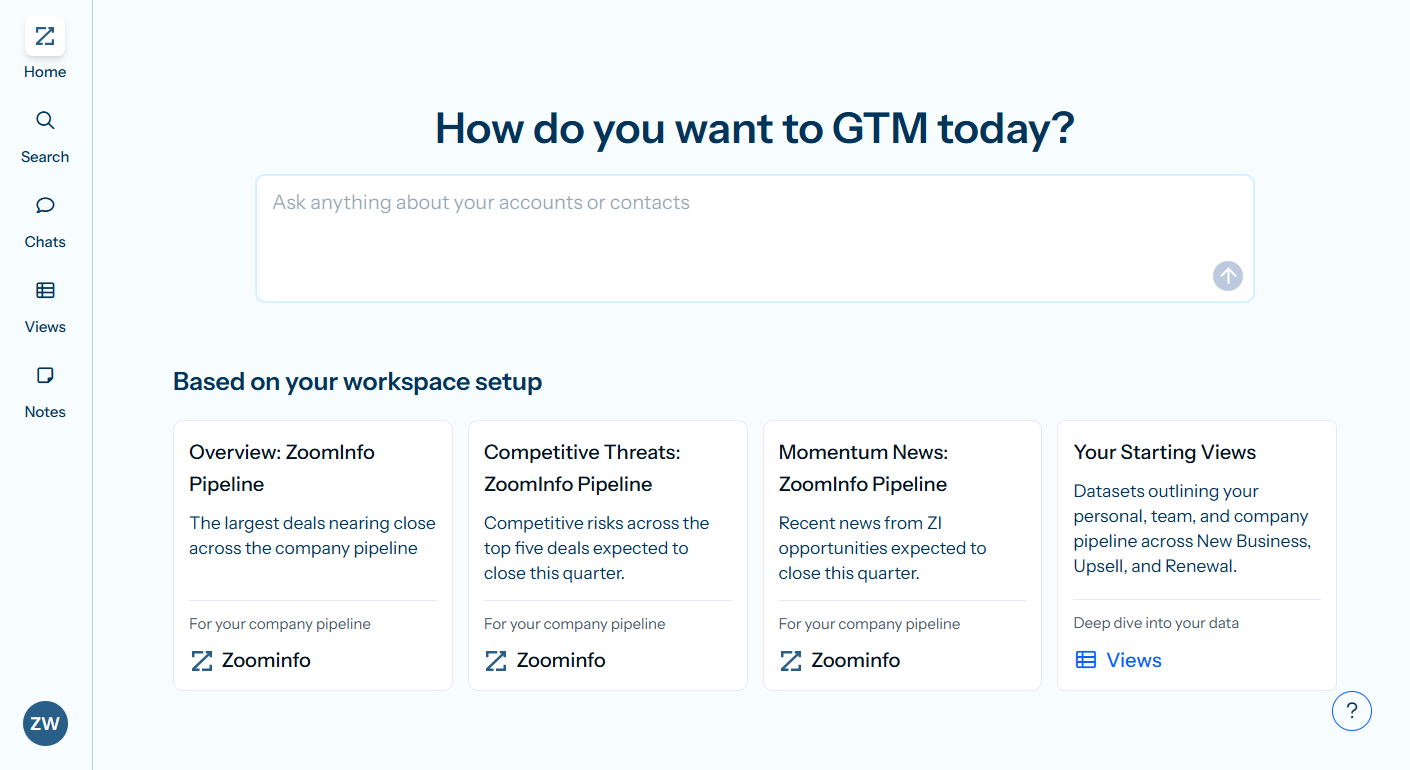
ZoomInfo's AI operates at a different layer. The GTM Context Graph processes 1.5B+ data points daily, combining ZoomInfo's third-party B2B data with a customer's CRM records, conversation transcripts, and behavioral signals. ZoomInfo's AI doesn't just score contacts based on CRM activity. It analyzes your deal history, your recorded calls (via Chorus), your intent signals, and verified external data to surface why deals move or stall. In GTM Workspace, AI agents handle account research, outreach drafting, CRM updates, and signal monitoring, so reps spend time selling instead of searching.
Seismic's sales team boosted productivity by 54%, saved 11.5 hours per week, and attributed 39% of pipeline to ZoomInfo signals. (Seismic case study)
The data problem neither CRM solves alone
A CRM is only as useful as the data inside it. Both Freshsales and Pipedrive rely on the data your team enters manually or imports from spreadsheets. Over time, that data decays: people change jobs, companies merge, phone numbers go stale. Neither platform maintains a continuously verified external database of B2B contacts.
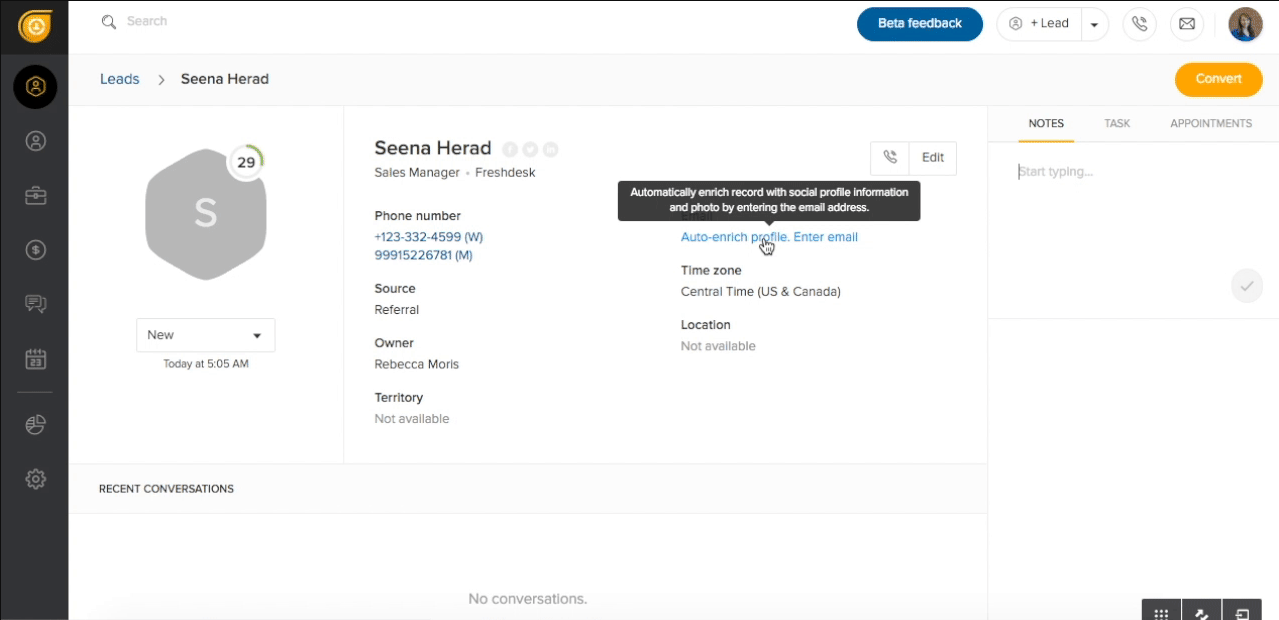
Freshsales has no built-in prospecting database. Your reps find contacts through their own research, inbound leads, or third-party tools, then enter them manually. Auto-profile enrichment fills in some gaps from publicly available data, but it's not a substitute for a verified contact database.
Source: Freshworks
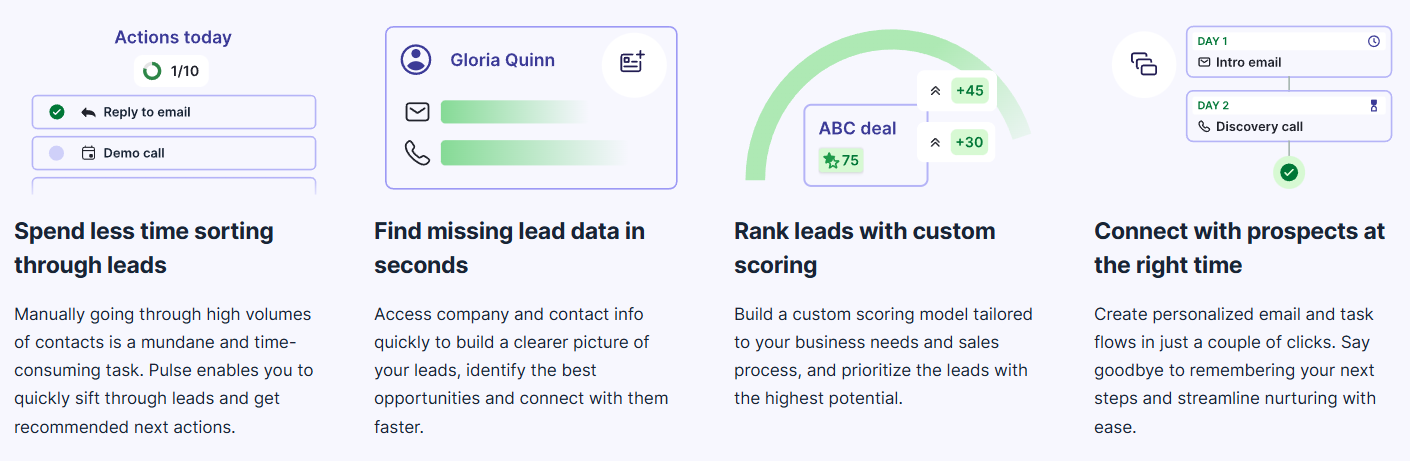
Pipedrive goes further with Prospector, part of the LeadBooster add-on ($32.50/company/month on Lite and Growth; included on Premium and Ultimate). Prospector provides access to over 400 million profiles and 10 million companies, with an AI engine that verifies and updates up to 800,000 profiles daily. It's a meaningful step beyond Freshsales, giving reps verified emails, direct-dial phones, and social profiles from within the CRM. The newer Pulse toolkit adds data enrichment, custom lead scoring, and automated sequences.
Source: Pipedrive
ZoomInfo operates at a different scale. The platform covers 500M contacts, 100M companies, 135M+ verified phone numbers, 120M direct-dial phone numbers, and 200M+ verified business email addresses. This data comes from multiple sources: automated ML scanning of 28 million site domains daily, third-party partner data covering 95 million businesses, a community of 200,000+ ZoomInfo Lite users who share data back, and an in-house Data Training Lab of 300+ human researchers. First-party data reaches up to 95% accuracy.
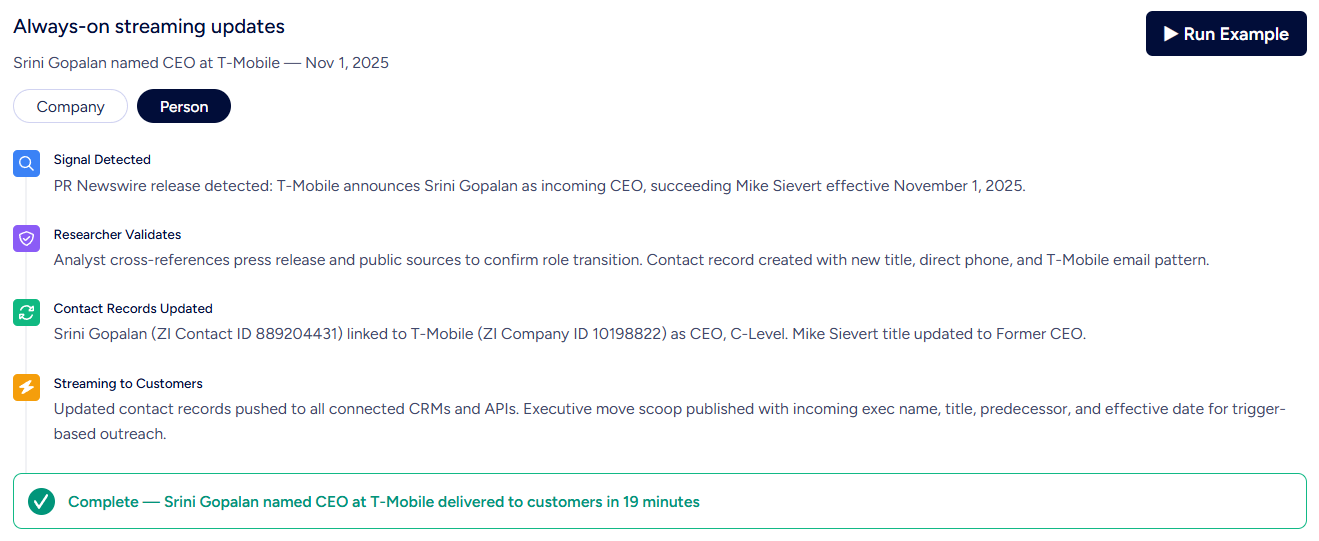
In a Fortune 500 competitive RFP analyzing 25 million contacts across vendors, an independent consultant concluded that "no other competitor came even close."
Vensure scaled prospecting with ZoomInfo's data: "ZoomInfo gives us the information we need to execute. We don't have to go through and spend our time digging. It's already there, so we can be three steps ahead." (Vensure case study)
Beyond raw contact data, ZoomInfo layers in signals that neither CRM provides natively. Buyer Intent data tracks signals from 210 million IP-to-Organization pairings and 6 trillion+ new keyword-to-device pairings sourced monthly. WebSights resolves anonymous website traffic to companies. Technographics profile the tech stack of 30+ million companies. These signals feed the GTM Context Graph, letting your team prioritize accounts that are actually in-market rather than working a static list.
Communication tools built in vs. bolted on
Sales teams spend most of their day communicating, not updating CRM fields. How each platform handles communication directly affects adoption.
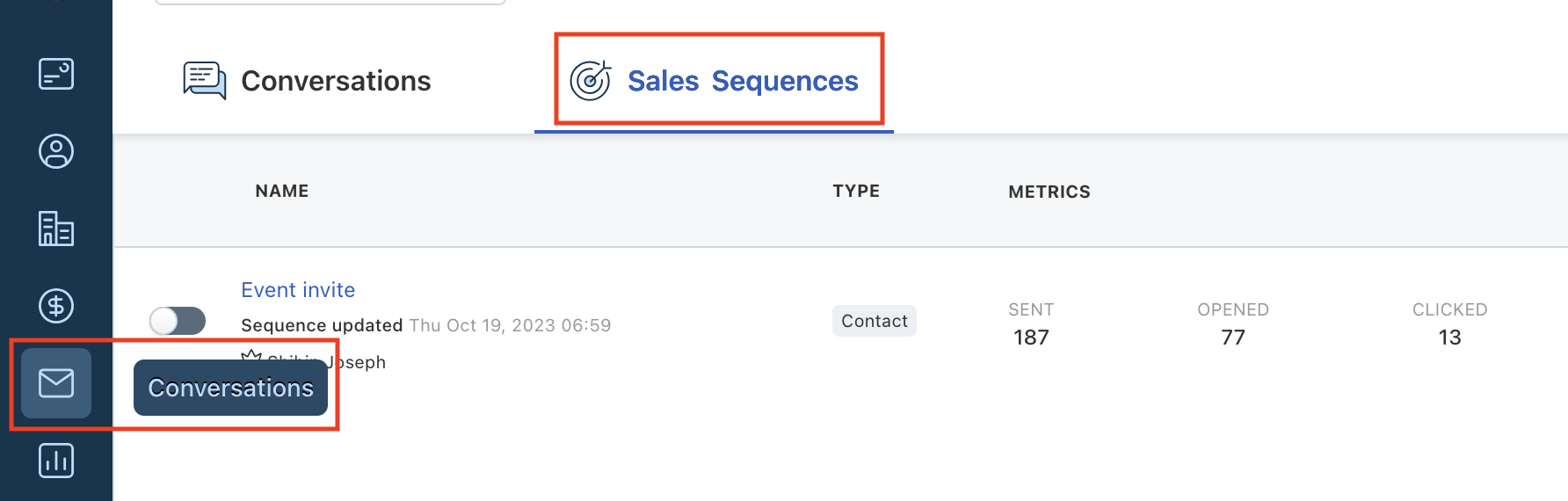
Freshsales has the stronger built-in communication stack of the two CRMs. Phone, email, live chat, WhatsApp, Apple Business Chat, and SMS are all native channels inside Freshsales, not integrations requiring separate licensing. Built-in cloud telephony includes call recording and automatic logging. The Sales Sequences feature (Pro and above) supports three types of automated cadences: Outbound (step-by-step with outcome branching), Classic (time-based), and Smart (behavior-triggered). A rep can call, email, and message a prospect without leaving the CRM.
Source: Freshworks
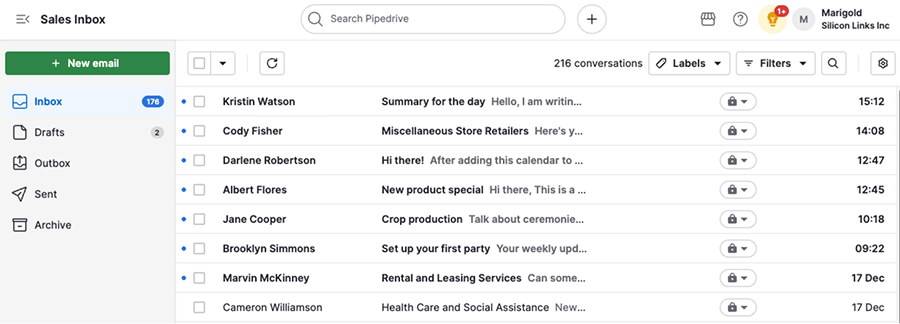
Pipedrive takes a lighter approach. Email sync connects Gmail, Outlook, or any IMAP account to the Sales Inbox, with automatic linking to deals and contacts. Email templates, group email (up to 100 contacts), scheduling, and open/click tracking are included on Growth plans and above. For calling, Pipedrive relies on telephony integrations rather than a built-in phone system. The meeting Scheduler integrates with Zoom, Microsoft Teams, and Google Meet. Smart Docs handles document generation, tracking, and eSignatures within the CRM.
What Pipedrive lacks in native communication breadth, it compensates for in workflow simplicity. The Sales Inbox is a dedicated email client inside the CRM where every email is automatically associated with the correct deal. The contact timeline shows a visual history of all communications, making it easy to pick up where a colleague left off.
Source: Pipedrive
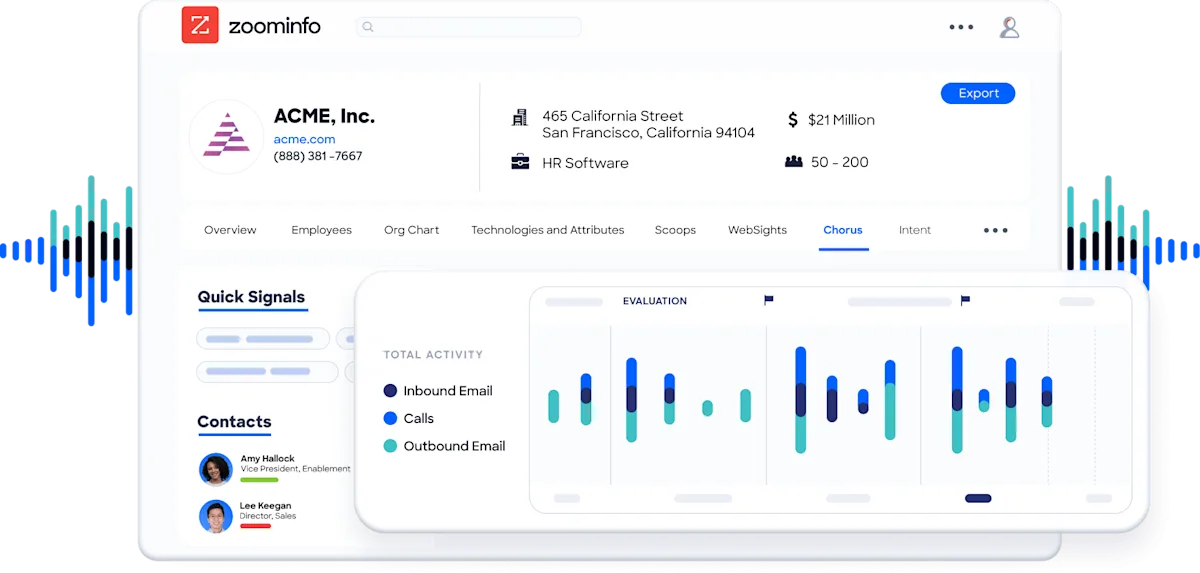
ZoomInfo adds a dimension neither CRM offers: conversation intelligence. Chorus records, transcribes, and analyzes every customer call and meeting, extracting deal intelligence, competitive mentions, and coaching opportunities. This conversation data feeds the GTM Context Graph, so the AI understands not just that a call happened, but what was said, what it meant, and how it connects to deal outcomes. ZoomInfo also includes multi-channel outreach through GTM Workspace, where AI agents draft personalized emails and messages based on full account context.
Automation and workflow comparison
Both CRMs offer automation that reduces manual work, but at different depths.
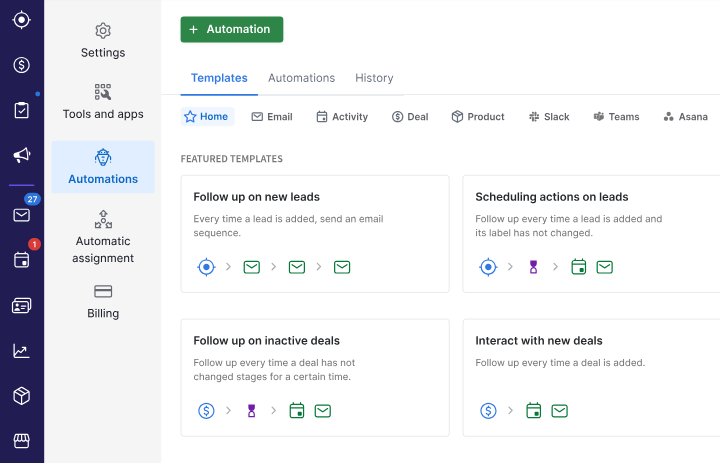
Pipedrive's Automations are available on Growth plans and above. Every automation has a trigger event and one or more action events. Triggers include deal creation, updates, deletions, and date-based events. Actions can create or update records, send emails, add notes, fire webhooks, or send Slack and Teams notifications. If/else branching and "wait until event" conditions add logic without requiring third-party tools. Pre-built templates cover common workflows like deal progression and lead assignment. Usage limits scale by plan: 50 automations on Growth, 150 on Premium, 250 on Ultimate.
Source: Pipedrive
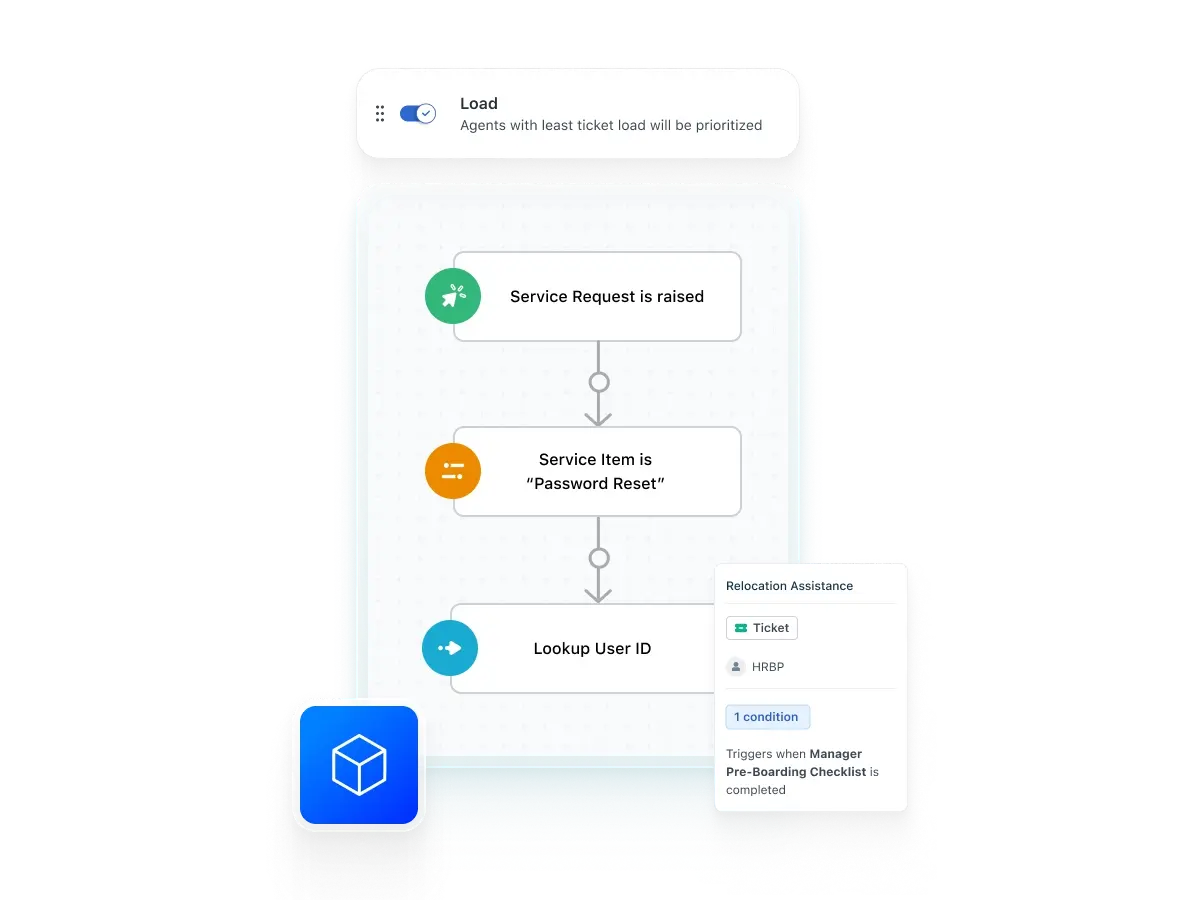
Freshsales offers Basic Workflows on Growth ($9/user/month) and Advanced Workflows on Pro ($39/user/month). These cover event-based and time-based triggers, with actions that create, update, or route records. Freshsales also supports auto-assignment rules and territory management (Pro and above). The automation is functional but less visual than Pipedrive's builder. Where Freshsales gains an edge is cross-product automation: because it connects to Freshdesk and Freshservice, you can trigger workflows that span sales, support, and IT operations.
Source: Freshworks
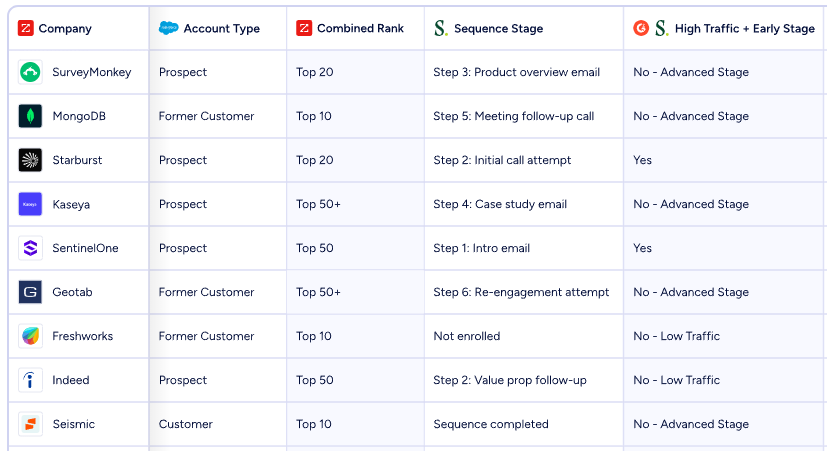
ZoomInfo approaches automation from the data layer. In GTM Studio, marketers and RevOps teams build plays that fire automatically when buying signals hit thresholds. These aren't simple if-then rules. They route accounts, launch multi-channel campaigns, and assign sellers in real time based on actual buying signals. Expansion plays that used to take 3 weeks now launch in 30 minutes. Because the automation draws on the GTM Context Graph, plays target accounts matching your actual win patterns rather than static criteria.
Impartner saw a 45% increase in website engagement and saved 15 hours by using ZoomInfo's automation. "ZoomInfo has literally changed the way we go to market." (Impartner case study)
Pricing reflects different markets
The pricing structures tell you who each platform is built for.
Freshsales is the most affordable entry point with a free plan for up to 3 users that includes Kanban views, email templates, and built-in phone and chat. Paid plans start at $9/user/month (Growth), which adds Contact Lifecycle Stages, basic workflows, a product catalog, and one CPQ license. $39/user/month (Pro) unlocks Freddy AI (contact scoring, deal insights, AI email writing), sales sequences, multiple pipelines, and territory management. $59/user/month (Enterprise) adds custom modules, forecasting insights, sandbox environments, and audit logs. All prices are billed annually.
Pipedrive has no free plan but starts at $14/seat/month (Lite), which includes customizable pipelines, the Leads Inbox, Pulse toolkit, API access, and AI-powered report creation. Growth adds email sync, automations, sequences, and the meeting scheduler. Premium includes LeadBooster (Prospector, Chatbot, Live Chat, Web Forms), Smart Docs, Projects, AI email creation, phone support, and higher limits. Ultimate adds contact data enrichment, security alerts, and the highest usage limits. Annual billing offers up to 42% discount over monthly.
Notable pricing differences: Freshsales includes unlimited pipelines on all paid plans. Pipedrive includes unlimited pipelines on all plans, including Lite. Freshsales bundles CPQ on every paid plan. Pipedrive bundles Prospector only on Premium and above (or as a $32.50/company/month add-on on lower plans). Freshsales' free tier is useful for very small teams. Pipedrive's 14-day trial offers full access but has no permanent free option.
ZoomInfo uses custom-quoted, consumption-based pricing with no published dollar amounts for paid tiers. However, ZoomInfo Lite is a permanent free tier (not a trial) that includes access to the B2B database with 10 monthly export credits, the Chrome extension, HubSpot integration, CRM data enrichment, and WebSights Lite with up to 10 website visitor reveals per day.
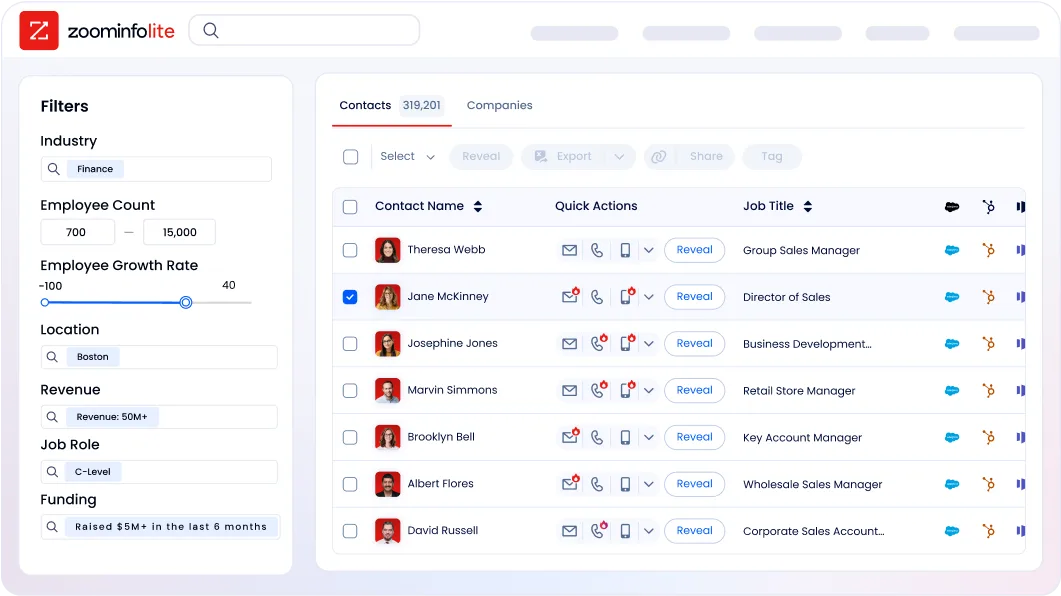
A 7-day free trial of the full platform is also available. Paid plans scale around seats, credits, and feature tiers (Professional, Advanced, Enterprise), with pricing determined by usage patterns and company size. ZoomInfo is a premium investment, but teams consistently report measurable ROI: Snowflake achieved 200% higher conversion rates on top-scoring accounts, and Databricks reached prospects 50% faster.
Reporting and analytics
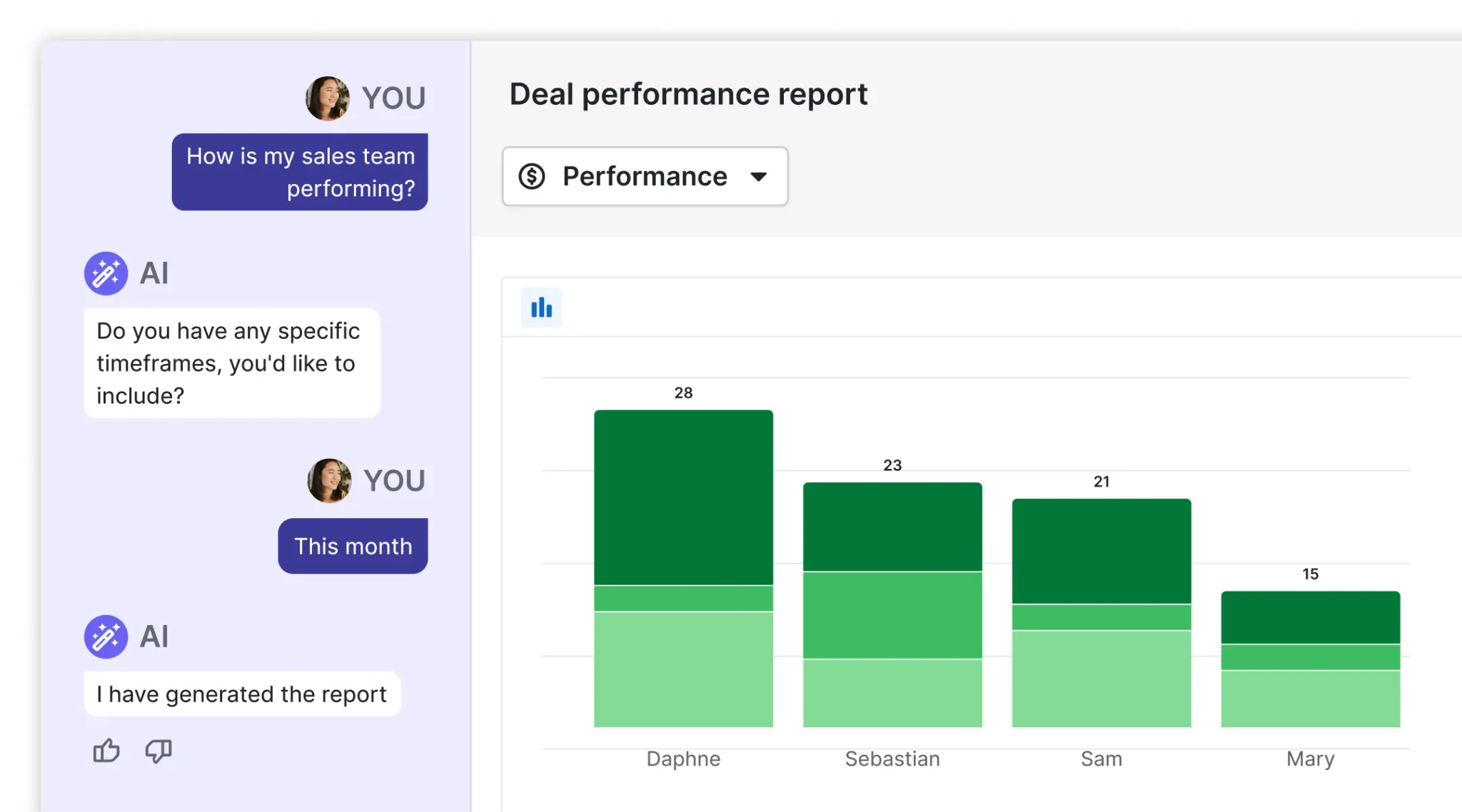
Pipedrive's Insights is organized into Reports, Dashboards, and Goals. Reports are fully customizable and cover revenue forecasts, conversion metrics, deal velocity, and team performance. Dashboards collect reports into a single view that can be shared via link with anyone, including non-Pipedrive users. The AI report generator produces reports from natural-language queries on all plans. Goals track revenue targets or activity counts with visual progress tracking. Report limits scale by plan: 15 per user on Lite, 50 on Growth, 250 on Premium, 500 on Ultimate.
Source: Pipedrive
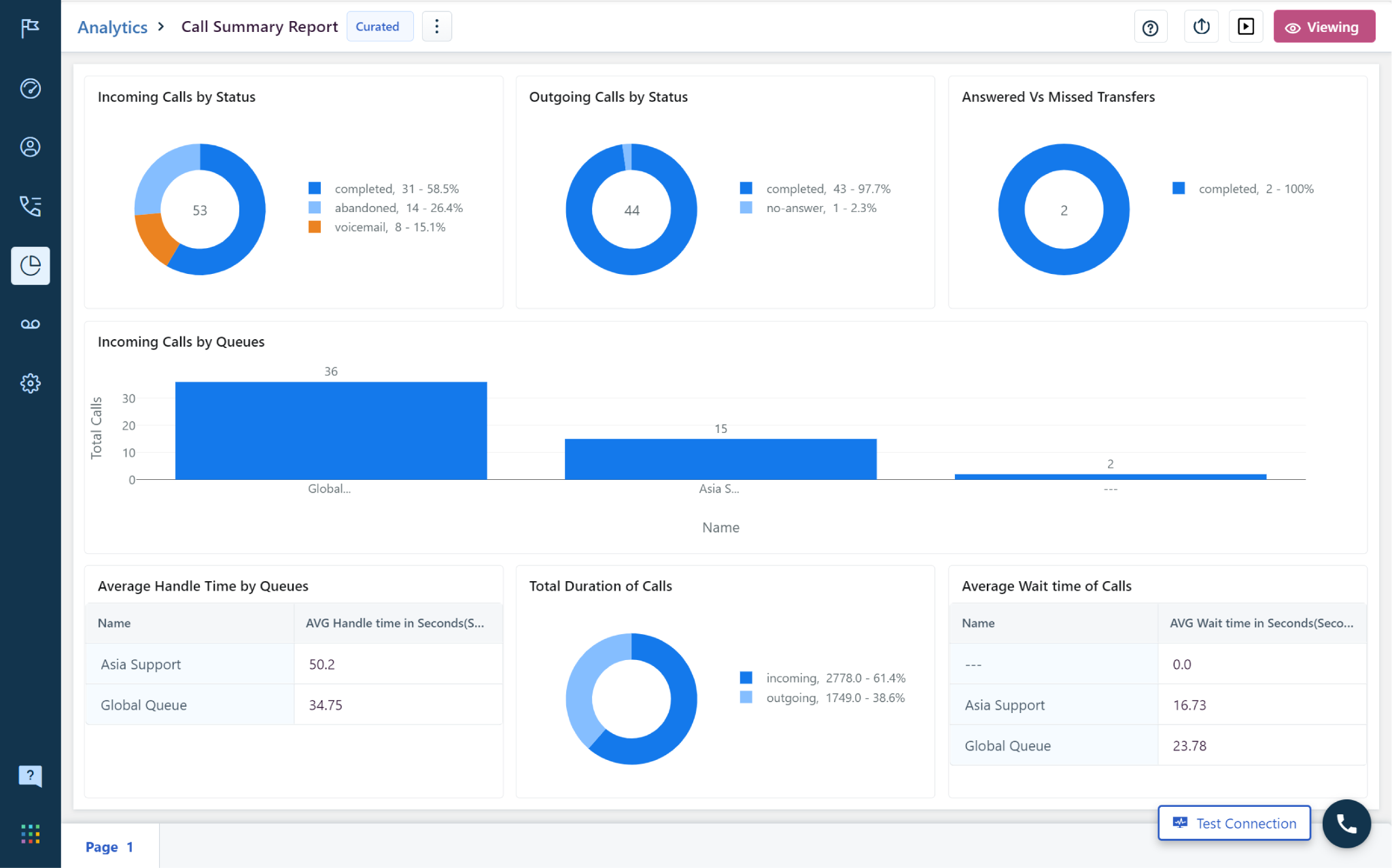
Freshsales includes Curated Reports on Growth plans with pre-built sales reports. Custom reports are available on Pro and above. Multiple review sources (G2, TrustRadius, Capterra) flag reporting as underpowered for large organizations that need custom dashboards without upgrading to higher tiers. Freshsales' reporting is functional but less flexible than Pipedrive's at comparable price points.
Source: Freshworks
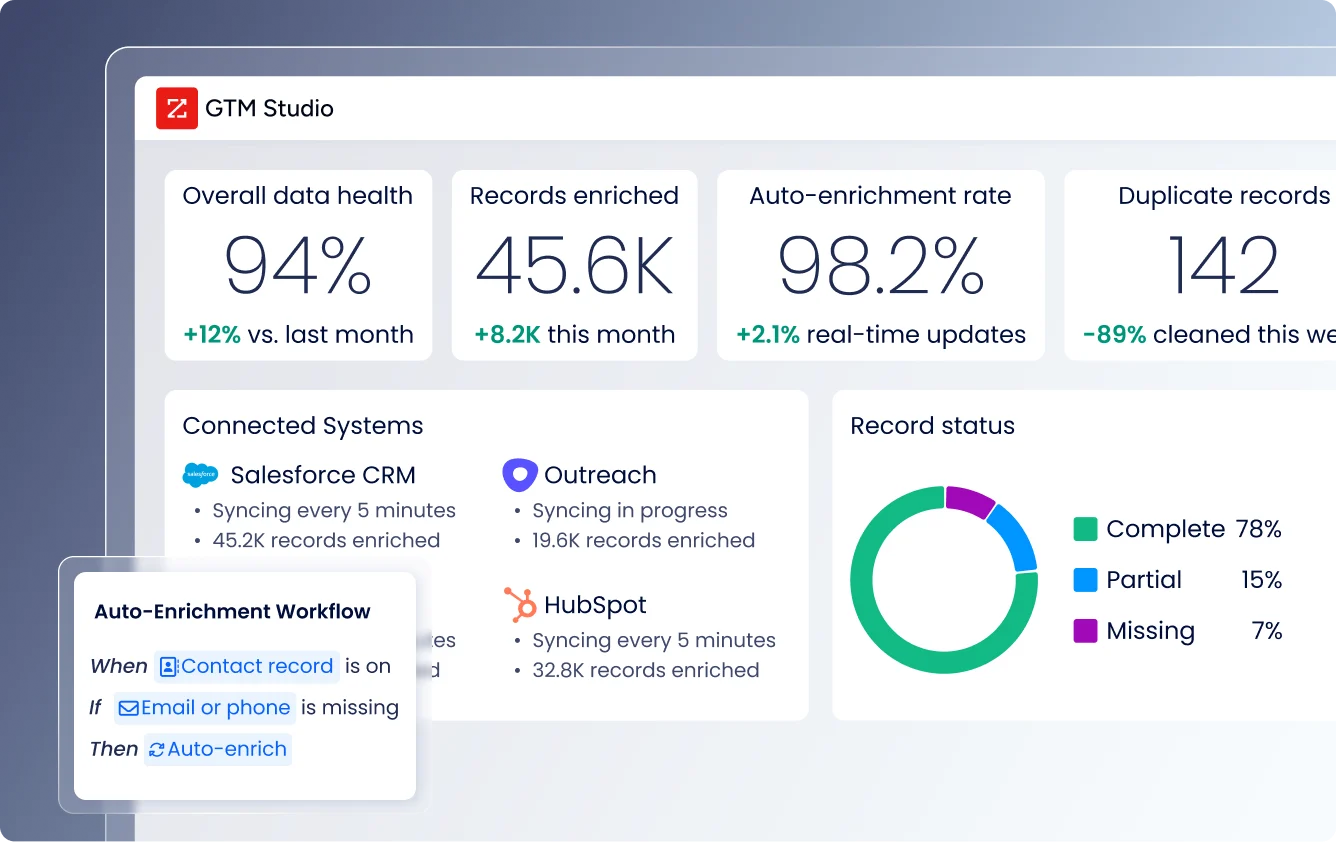
ZoomInfo provides analytics through GTM Studio's dashboards, which track engagement, funnel progression, and top-performing segments. The reporting isn't limited to CRM activity. It spans buyer intent signals, website visitor data, conversation intelligence, and pipeline attribution across channels, giving leaders visibility into the full go-to-market motion rather than just what happened inside the CRM.
Integration ecosystems
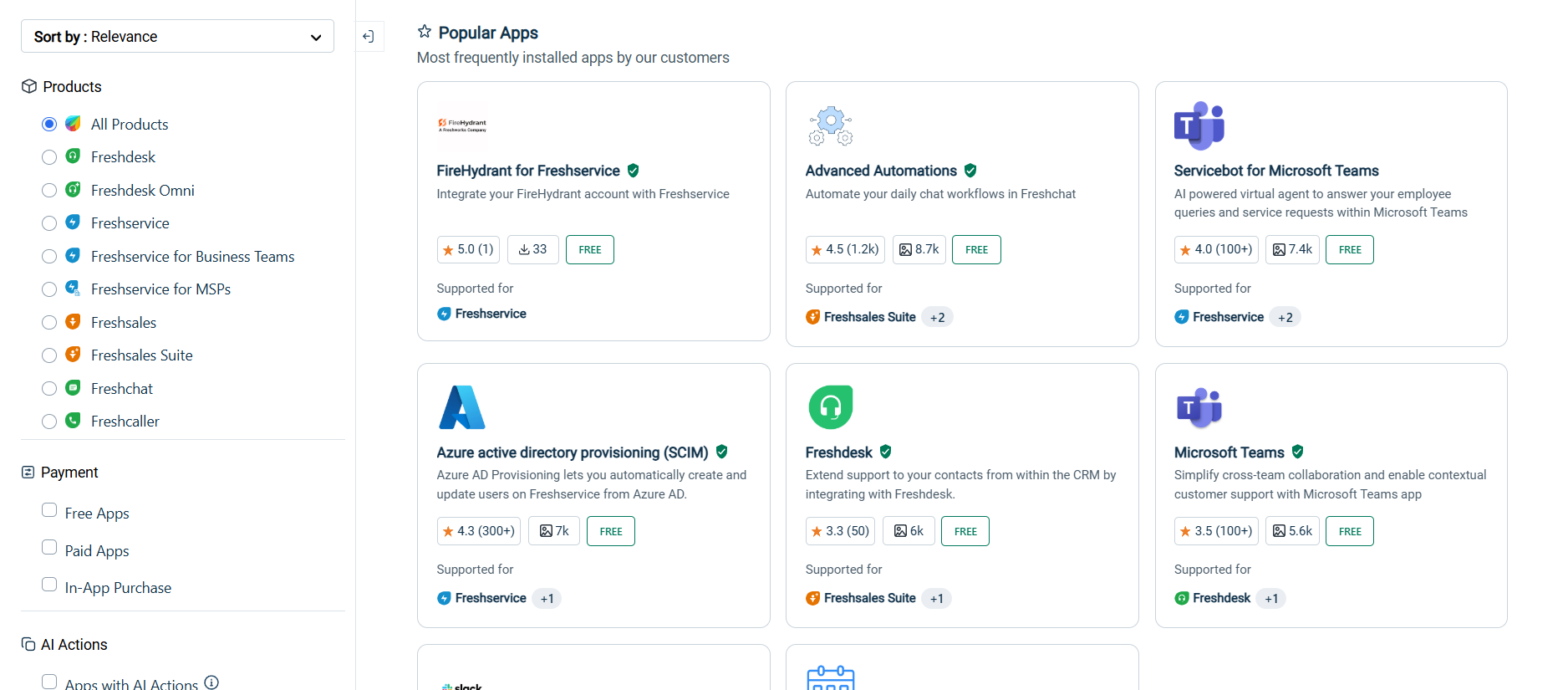
Freshworks has the largest marketplace with over 1,200 public apps spanning the full product suite. Key integrations include Microsoft Teams (7,400+ installs for the Servicebot), Azure AD, Slack, Jira, Salesforce, and Google Calendar. The Freshworks Developer Platform offers REST APIs, serverless computing, OAuth support, and a UI design library. The ecosystem's breadth reflects the multi-product company. The drawback, noted by G2 reviewers, is that some third-party integrations can feel limited or unreliable in enterprise use cases.
Source: Freshworks
Pipedrive offers 500+ integrations through its marketplace. Key connections include Zapier, Make, Google Meet, Microsoft Teams, Mailchimp, PandaDoc, DocuSign, QuickBooks, Xero, and Slack. The RESTful API is available on all plans (including Lite), with full documentation, OAuth 2.0 authentication, and an interactive developer hub. API v2 has been released with a migration guide.
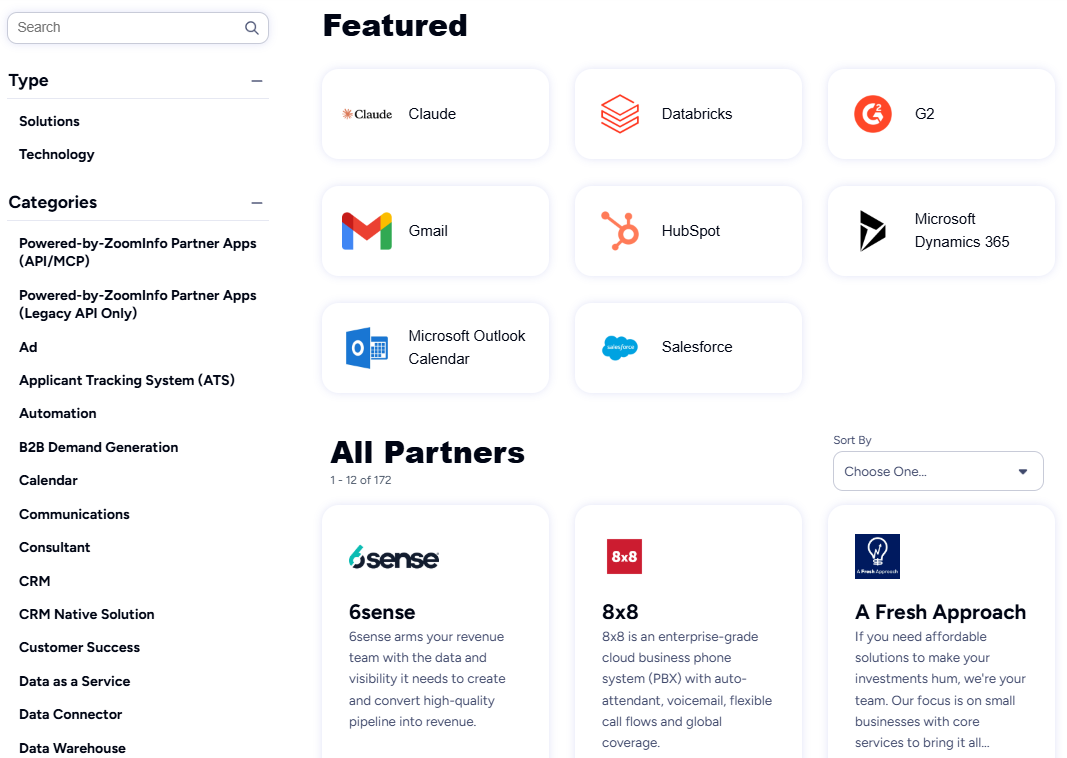
ZoomInfo takes a different approach. Rather than competing on marketplace app count (the App Marketplace lists 120+ partner integrations), ZoomInfo focuses on deep, data-level connections with the tools teams already use: Salesforce, HubSpot, Microsoft Dynamics 365, Snowflake, Outreach, Salesloft, and more.
The Enterprise API and MCP server give programmatic access to ZoomInfo's data and intelligence from any application or AI agent. API access is included in all relevant plans. As one customer put it: "The plug-and-play aspect of the API means I can integrate it very easily into any process and get information at a moment's notice" (BDO Canada case study).
Security and compliance
Both platforms maintain security certifications suitable for regulated industries.
Freshworks holds SOC 2 Type 2, SOC 1 Type 2, ISO 27001:2022, ISO 27701:2019, and Cyber Essentials Plus. Data is encrypted with AES-256 at rest and TLS 1.2 in transit, hosted on AWS with multi-availability-zone redundancy. Freshworks maintains a Trust Center and is certified under the EU-US Data Privacy Framework.
Pipedrive holds ISO 27001:2022, ISO 27701:2019, SOC 2 Type 2, and maintains GDPR, DORA, and EU Data Act compliance. Data is hosted on AWS in Europe and US with separate databases per customer. Pipedrive also maintains a Trust Center and a SecurityScorecard grade A.
ZoomInfo maintains ISO 27001, ISO 27701, SOC 2 Type II, TRUSTe GDPR and CCPA certifications, all renewed annually. As a registered data broker in California and Vermont, ZoomInfo's compliance infrastructure is built into the data layer itself.
Freshworks vs. Pipedrive vs. ZoomInfo: Which should you choose?
The right choice depends on where your biggest bottleneck sits: managing the full customer lifecycle, closing more deals, or finding the right prospects in the first place.
Choose Freshworks (Freshsales) if:
You want one vendor for sales, support, IT, and marketing
Your team values built-in phone, chat, WhatsApp, and email in the CRM
You need a free plan for a very small team to start with
Cross-department workflows (sales to support to IT) matter to your business
CPQ built into every paid plan is valuable for your quoting process
Choose Pipedrive if:
Your primary need is a fast, intuitive sales pipeline tool
Your team is small to mid-sized and values simplicity over feature breadth
Visual deal management and activity-based selling fit your sales process
You want strong mobile capabilities for field sales
You prefer a CRM designed by salespeople, for salespeople
Choose ZoomInfo if:
Your biggest challenge is finding and reaching the right prospects with accurate data
You need buyer intent signals, verified direct dials, and business emails at scale
You want AI that understands why deals move, not just what happened in the CRM
Your team builds on data, whether through ZoomInfo's native tools, your CRM, or custom applications via API and MCP
You're ready to invest in the data foundation that makes any CRM more effective
See how ZoomInfo works with a free trial, or start with ZoomInfo Lite at no cost.
The comparison between Freshworks and Pipedrive is real, but it's also incomplete. Both are capable CRMs that serve their audiences well. Freshworks gives you breadth across the customer lifecycle. Pipedrive gives you depth in sales execution. But the upstream problem (finding the right buyers with accurate data and understanding why they buy) is what ZoomInfo solves. The most effective sales teams don't choose between a good CRM and good data. They use both.
Freshworks vs. Pipedrive vs. ZoomInfo FAQ
What is the main difference between Freshworks and Pipedrive?
Freshworks is a multi-product SaaS company offering CRM (Freshsales), customer support (Freshdesk), IT service management (Freshservice), and marketing automation (Freshmarketer) under one roof. Pipedrive is a dedicated sales CRM built for small and mid-sized sales teams, focused entirely on pipeline management and deal closing. Freshworks gives you breadth across business functions; Pipedrive gives you depth in sales execution.
Which platform is cheaper for a small sales team?
Freshsales has the lowest entry point with a free plan for up to 3 users, while paid plans start at $9/user/month. Pipedrive has no free plan but starts at $14/seat/month with more sales-specific features at the entry tier, including unlimited pipelines, the Pulse prospecting toolkit, and API access. For a 5-person team on annual billing, Freshsales Growth costs $45/month while Pipedrive Lite costs $70/month.
Does Pipedrive have a built-in prospecting database?
Yes. Pipedrive's Prospector (part of the LeadBooster add-on) provides access to over 400 million profiles and 10 million companies, with daily verification of up to 800,000 profiles. It's included on Premium and Ultimate plans, or available as a $32.50/company/month add-on on lower tiers. Freshsales does not include a comparable prospecting database. ZoomInfo offers the largest B2B database, covering 500M contacts, 135M+ verified phone numbers, and 200M+ verified business email addresses.
Which platform has better AI features?
Pipedrive's AI is focused on sales: an AI Sales Assistant for deal prioritization, AI email writing, AI email summarization (still in beta), and AI report generation from natural language. Freshsales' Freddy AI covers contact scoring, deal insights, and email drafting within the CRM, plus deeper capabilities across Freshdesk and Freshservice. ZoomInfo's AI operates at a different level, with a GTM Context Graph that analyzes CRM records, conversation intelligence, buyer intent, and verified B2B data to surface why deals move or stall.
Can I use ZoomInfo with Freshsales or Pipedrive?
Yes. ZoomInfo integrates with major CRMs and provides API access on all relevant plans. The ZoomInfo MCP server also enables AI agents and custom applications to access ZoomInfo's data programmatically. Teams commonly use ZoomInfo to enrich their CRM data, identify in-market buyers, and feed accurate contact information into their existing sales workflow regardless of which CRM they use.
Which platform is best for teams that need both sales and customer support?
Freshworks is the only option among the three that natively covers both. Freshsales (CRM) connects with Freshdesk (support), Freshchat (messaging), and Freshcaller (phone) under one vendor, sharing a common data layer. Pipedrive has no native customer support features. ZoomInfo is not a customer support tool, though its data can inform account management and customer success workflows.
Does either CRM offer a permanent free plan?
Freshsales offers a free plan for up to 3 users with Kanban views, email templates, and built-in phone and chat. Pipedrive does not have a permanent free plan, only a 14-day free trial. ZoomInfo offers ZoomInfo Lite, a permanent free tier with access to its B2B database, 10 monthly export credits, a Chrome extension, HubSpot integration, and website visitor identification.
Which platform has better mobile apps for field sales?
Pipedrive has the stronger mobile experience for field teams, with features like in-app calling with automatic logging, a "Nearby" feature showing geographically close clients, a business card scanner, offline mode, and audio notes. Freshsales' mobile app is capable but oriented more toward staying connected on the go than being a primary work surface for field reps.
More CRM comparisons:
