
Gong captures every customer interaction (calls, emails, meetings) for 5,000+ companies worldwide, then turns those conversations into deal intelligence, coaching insights, and forecasts. Its Revenue Graph processes billions of customer interactions to show revenue teams what buyers actually say, not just what reps log in the CRM.
But Gong's intelligence grows more valuable when it connects to the rest of your stack.
On its own, Gong captures and analyzes conversations. Connected to the right tools, it feeds verified B2B data into your pipeline, syncs deal signals to your CRM, routes coaching moments to your team's channels, automates workflows across disconnected apps, powers outbound sequences with conversation context, and delivers the full Revenue Graph into your data warehouse for analysis.
This guide covers the strongest integration for each job Gong users most commonly need done:
Enrich Gong's Revenue Graph with verified B2B contact data, buyer intent signals, and company intelligence
Sync conversation intelligence bidirectionally with your enterprise CRM for deal management
Connect Gong to your mid-market CRM for pipeline and marketing automation
Route deal signals, coaching moments, and forecast alerts into your team's collaboration channels
Link outbound sequence engagement data with Gong's conversation intelligence for full-cycle visibility
Extend Gong's processed call data and AI summaries to any app in your stack without code
Deliver the complete Revenue Graph into your data warehouse for cross-system revenue analytics
Each section walks through how the integration connects with Gong, what data flows between the platforms, pricing, and who benefits most.
Best Gong Integrations at a Glance |
|---|
Best Gong Integration for B2B Data Enrichment and Go-to-Market Intelligence Enriches Gong's Revenue Graph with verified contact data, buyer intent signals, and company intelligence, giving revenue teams accurate data to prospect with and signals to prioritize accounts that are actively in-market. |
Best Gong Integration for Enterprise CRM Deal Intelligence. Turns conversation intelligence into structured pipeline data with bidirectional activity sync, AI field population, deal risk signals as custom properties, and Agentforce agents querying Gong's Revenue Graph via MCP. |
Best Gong Integration for CRM Activity Sync and Mid-Market Pipeline Management Pushes call intelligence into deal records and contact timelines with bidirectional sync, AI deal signals as custom properties, and Gong Engage running natively on HubSpot for sequencing and marketing automation. |
Best Gong Integration for Real-Time Revenue Signal Delivery and Team Collaboration Routes deal signals, AI-detected call alerts, coaching notifications, and forecast reminders into the channels where your revenue team already works, with rules-based notification logic and call clip sharing. |
Best Gong Integration for Outbound Sequence Signal Coverage Connects outbound sequence engagement signals with Gong's conversation intelligence, adding email opens, reply rates, and meeting bookings to the Revenue Graph while surfacing Gong call briefs inside Outreach prospect records. |
Best Gong Integration for No-Code Workflow Automation Across 8,000+ Apps Extends Gong's processed call data and AI summaries to any application in your stack (including tools with no native Gong connector) while pushing external engagement events back into the Revenue Graph. |
Best Gong Integration for Enterprise Revenue Analytics and Cross-System Intelligence Delivers the complete Revenue Graph into your Snowflake instance via zero-copy data sharing, making conversation intelligence metrics queryable alongside CRM, product usage, and financial data in your existing BI tools. |
What Is Gong?
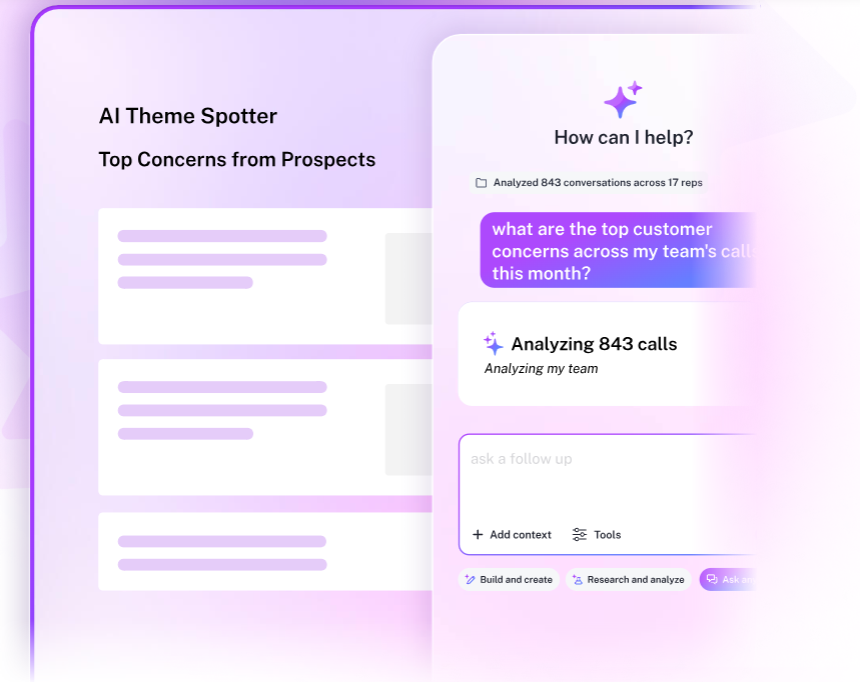
Gong is an AI operating system for revenue teams, a platform where humans, agents, and tools work together to close more deals.
Source: Gong
Gong launched in 2015 and has grown from a conversation intelligence tool into a full Revenue AI platform, serving 5,000+ companies including Fortune 10 enterprises. Gartner named it a Leader in the inaugural 2025 Magic Quadrant for Revenue Action Orchestration, placing it highest on Ability to Execute and furthest on Completeness of Vision, and ranked it #1 across all four evaluated use cases in the companion Critical Capabilities report.
Gong's integration ecosystem is a core strength.
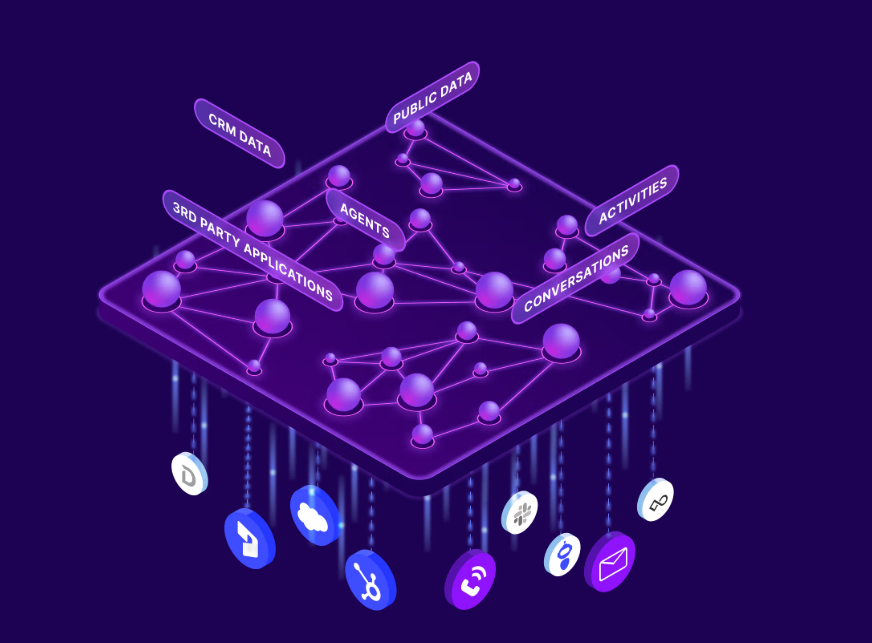
The Gong Collective marketplace lists over 300 technology integration partners, with partner growth doubling over the prior year. The platform's foundation is the Gong Revenue Graph, a data engine that captures every customer interaction across calls, emails, meetings, and digital engagement signals, then connects them to the right accounts and deals.
Source: Gong
Gong exposes a REST API for custom integrations, supports webhooks for event-driven automation, and has introduced Model Context Protocol (MCP) support as both client and server, letting AI agents from Salesforce, Microsoft, HubSpot, and others query Gong directly. Gong Data Cloud lets customers export data to Snowflake and Databricks for analytics.
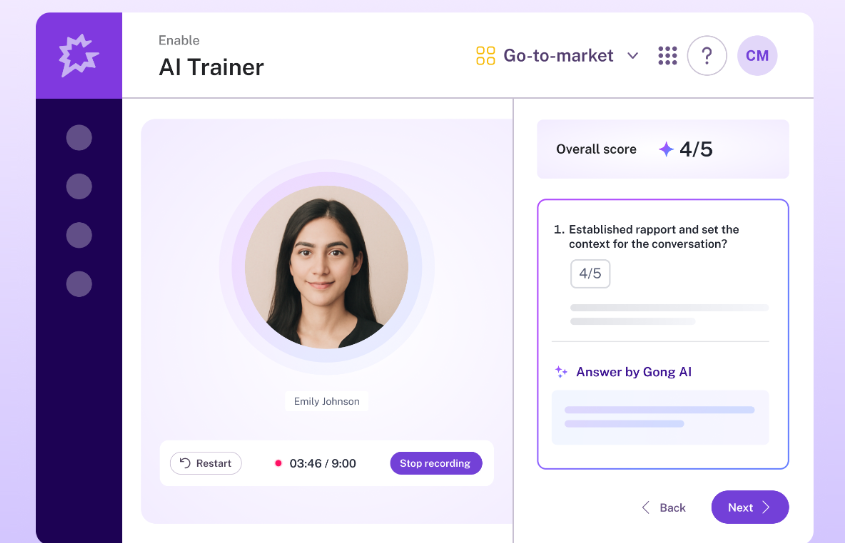
The current product suite spans six components: Gong Engage (sales engagement), Gong Forecast (revenue forecasting), Gong Enable (sales enablement), Gong Agents (15+ AI agents included at no additional cost), the Revenue Graph (data engine), and the Gong Collective (integration marketplace). Integration categories include:
Source: Gong
CRM and deal management: Salesforce, HubSpot, Microsoft Dynamics 365 with bidirectional sync
B2B data enrichment and contact intelligence: ZoomInfo, LeadIQ, Cognism, Apollo
Sales engagement: Outreach, Salesloft, native Gong Engage
Team communication: Slack, Microsoft Teams
Web conferencing and telephony: Zoom, Google Meet, Microsoft Teams, RingCentral
Workflow automation: Zapier, Workato, Tonkean
Data warehousing and analytics: Snowflake, Databricks, BigQuery
AI interoperability: MCP server and client for Salesforce Agentforce, Microsoft 365 Copilot, and other AI agents
With that ecosystem as context, here are the seven integrations we selected as the best for extending Gong across the categories that matter most to revenue teams.
1. ZoomInfo: Best Gong Integration for B2B Data Enrichment and Go-to-Market Intelligence
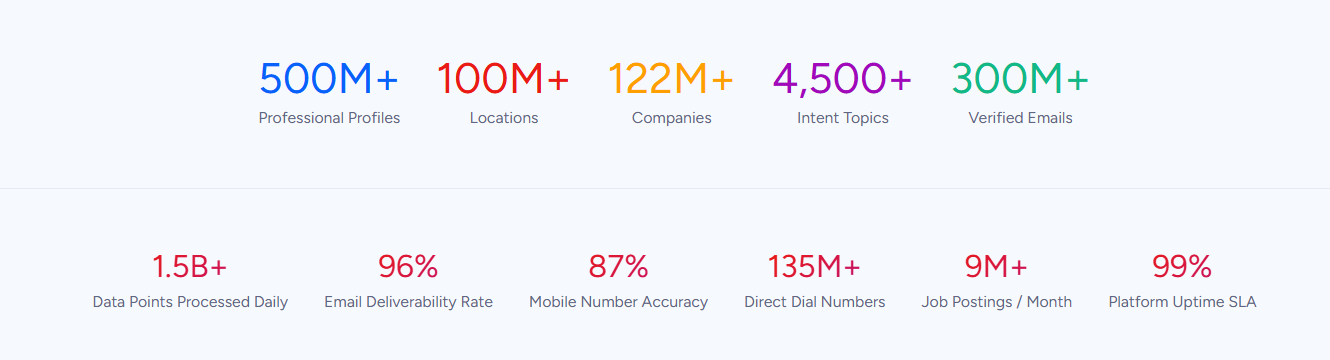
ZoomInfo is a B2B data and go-to-market platform built on 500M contacts, 100M companies, 135M+ verified phone numbers, and 200M+ verified business email addresses. It integrates natively with Gong to enrich your revenue intelligence with verified contact data, company intelligence, buyer intent signals, and technographic insights.
Source: ZoomInfo
Connecting the two platforms unlocks:
Verified B2B data powering Gong's Revenue Graph, with direct dials and business emails that actually connect, enriching the contact records behind every recorded conversation
Buyer intent signals surfacing accounts in-market right now, so reps prioritize Gong-tracked deals backed by buying activity instead of static pipeline lists
Conversation intelligence flowing into ZoomInfo's GTM workflows, with Gong-recorded calls automatically imported into ZoomInfo's GTM Workspace for insights and recommendations
Gong Engage outreach fueled by verified contacts, with ZoomInfo records exportable directly into Gong Engage flows for prospecting sequences built on accurate data
How ZoomInfo Integrates with Gong
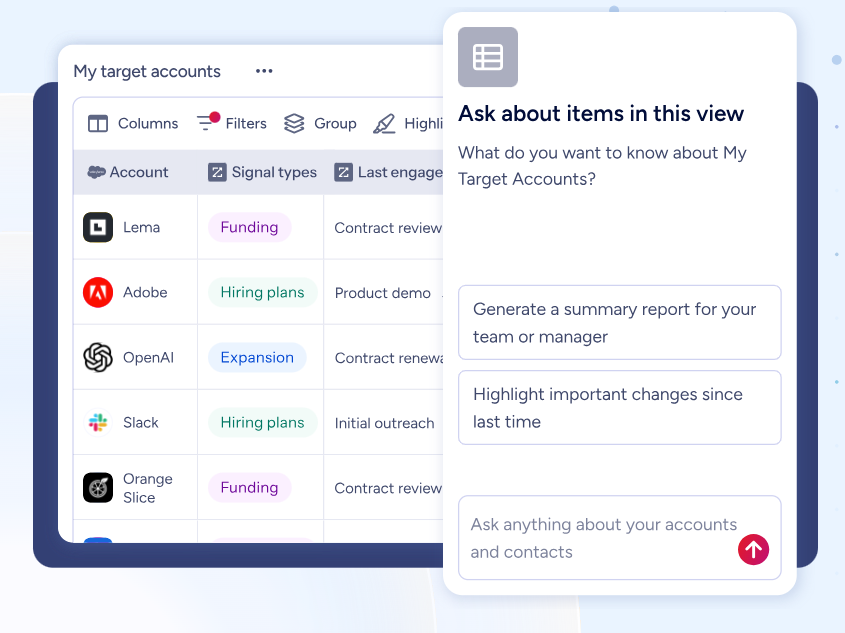
ZoomInfo connects to Gong through a native integration listed in both the ZoomInfo App Marketplace and the Gong Collective, with bidirectional data flow between the platforms. The integration supports two primary data paths: ZoomInfo contacts and intelligence flowing into Gong Engage for outreach, and Gong conversation recordings flowing into ZoomInfo's GTM Workspace for analysis.
Because both platforms maintain first-party connectors, setup requires standard OAuth authorization without middleware or third-party connectors. ZoomInfo's GTM Workspace, the AI workspace for sellers, includes the same native Gong connection.
Source: ZoomInfo
Contact and Company Data Enrichment: Feed Gong Verified Data It Cannot Generate Independently
Gong's Revenue Graph captures every customer interaction, but the contact records behind those interactions are only as good as what exists in your CRM. When a prospect appears on a Gong-recorded call with an outdated title, a missing direct dial, or no company context, Gong's AI agents work with incomplete information.
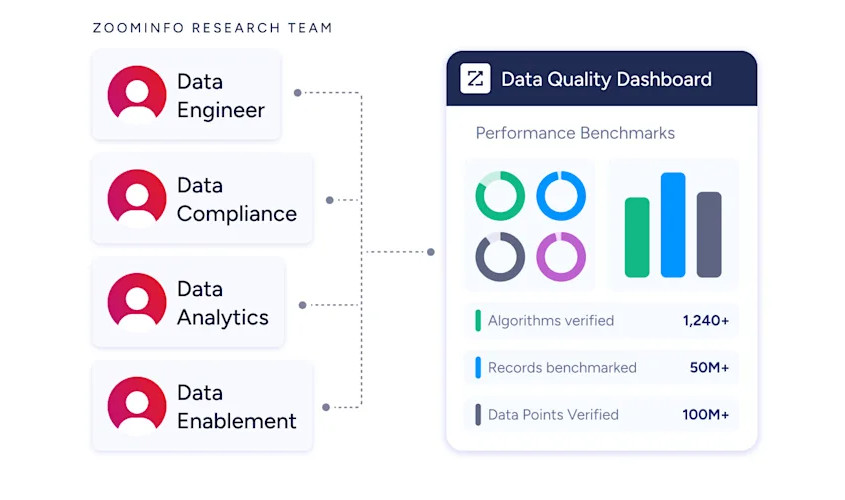
ZoomInfo closes that gap. It provides verified business emails, direct dials, job titles, seniority levels, and department information for 500M contacts, plus company data spanning 100M companies with revenue, employee count, industry, headquarters, and parent-child corporate hierarchy. A verification pipeline backed by 300+ human researchers reaches up to 95% accuracy on first-party data.
ZoomInfo in action: A Gong-recorded discovery call reveals three new stakeholders who joined the evaluation. ZoomInfo enriches each with verified direct dials, current titles, and department data, then exports them into a Gong Engage multi-threading sequence. The AE reaches all three decision-makers within 24 hours instead of spending a day researching each one manually.
Buyer Intent Data: Know Which Gong-Tracked Accounts Are Actively In-Market
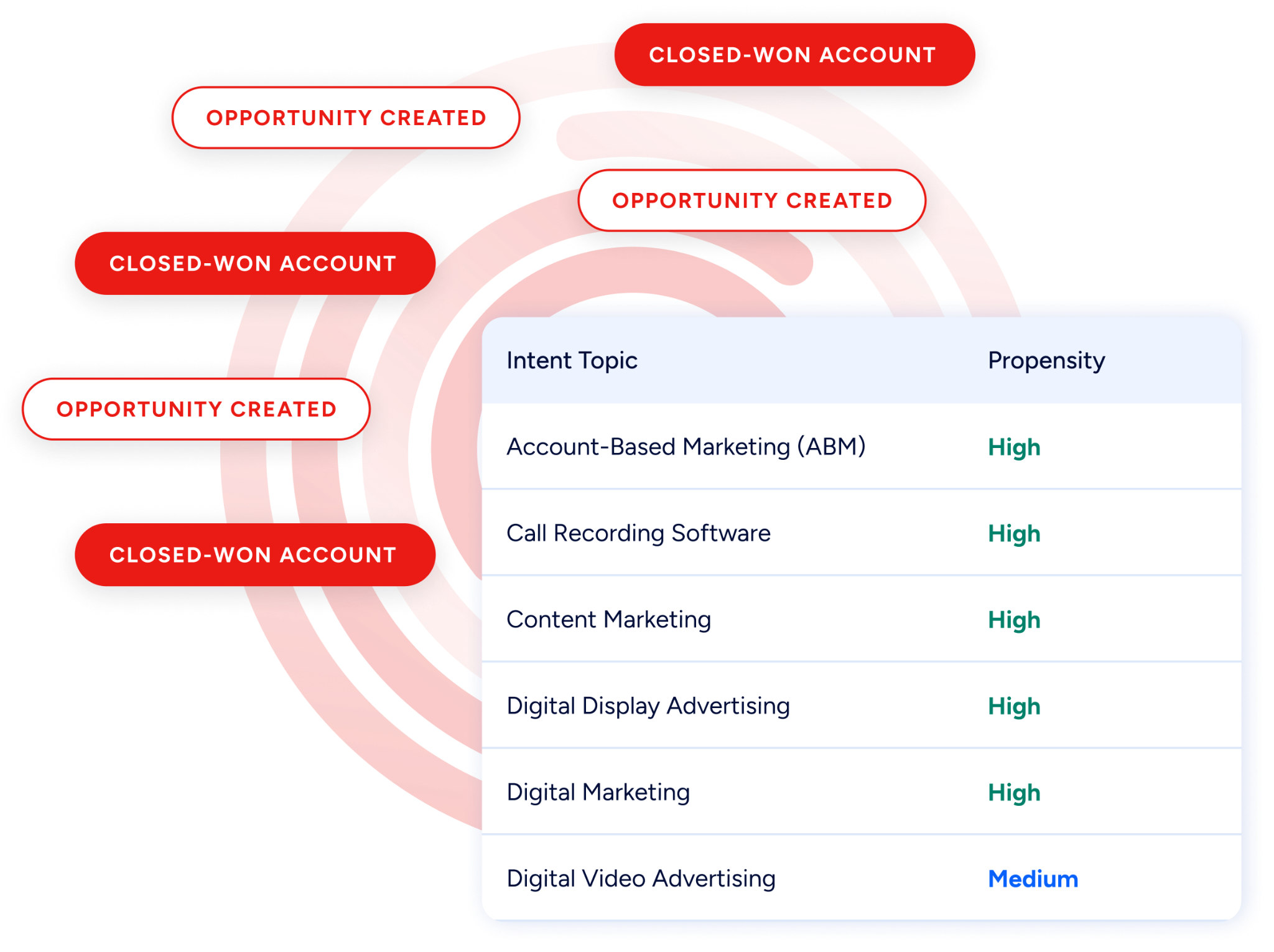
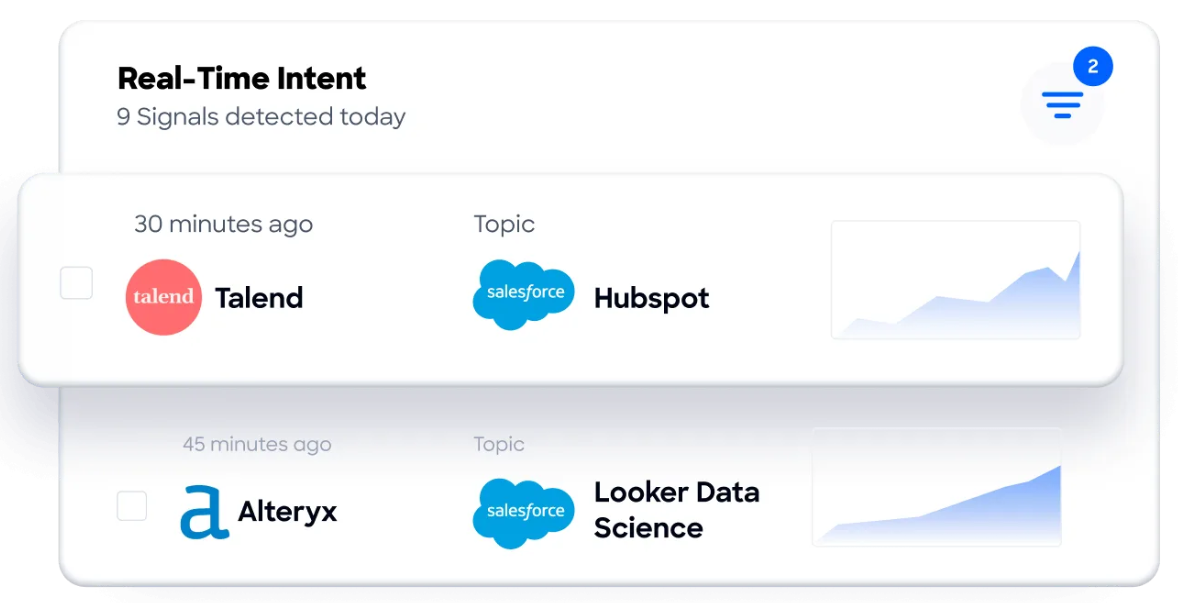
ZoomInfo's Buyer Intent tracks signals from 210 million IP-to-Organization pairings and 6 trillion+ keyword-to-device pairings monthly, revealing which companies are actively researching topics relevant to your product.
Source: ZoomInfo
Layered with Gong's conversation intelligence, intent data adds a dimension Gong cannot capture on its own: what accounts are doing outside your conversations. A deal that looks healthy in Gong's call analysis might be at risk if the account is also researching competitors. An account that went quiet on calls might be signaling renewed interest through topic research activity.
Guided Intent, exclusive to ZoomInfo, identifies the research topics historically correlated with deal success in your business, so the signals calibrate to your actual win patterns rather than generic keyword thresholds.
Source: ZoomInfo
ZoomInfo in action: ZoomInfo detects a target account researching "revenue intelligence platforms" for two weeks. The intent signal surfaces alongside the account's Gong conversation history, where the last call showed strong interest but stalled on budget approval. The AE re-engages with a business case referencing the prospect's active research, and the deal moves forward while the buyer is still evaluating.
Conversation Intelligence Powering ZoomInfo's AI Recommendations
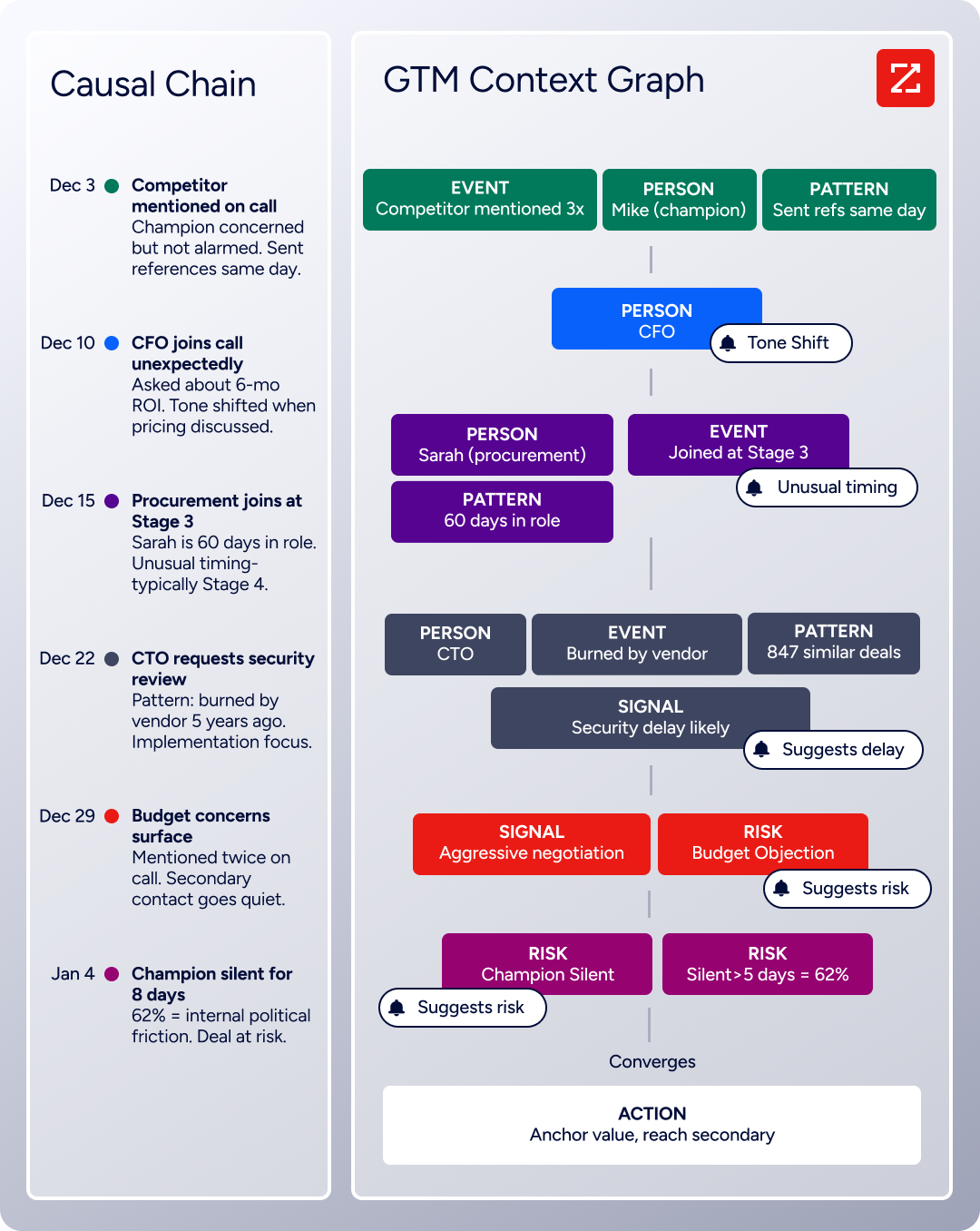
The integration also flows in reverse: Gong-recorded calls automatically import into ZoomInfo's GTM Workspace for insights and recommendations. ZoomInfo's GTM Context Graph, which processes 1.5B+ data points daily, combines conversation data from Gong with ZoomInfo's third-party intelligence, CRM records, and behavioral signals to surface the full context behind each account.
Source: ZoomInfo
This means the AI drafting your next outreach in GTM Workspace knows what was discussed on the last Gong call, what intent signals the account is showing, which competitors were mentioned, and which stakeholders are most engaged.
Direct Export to Gong Engage Flows
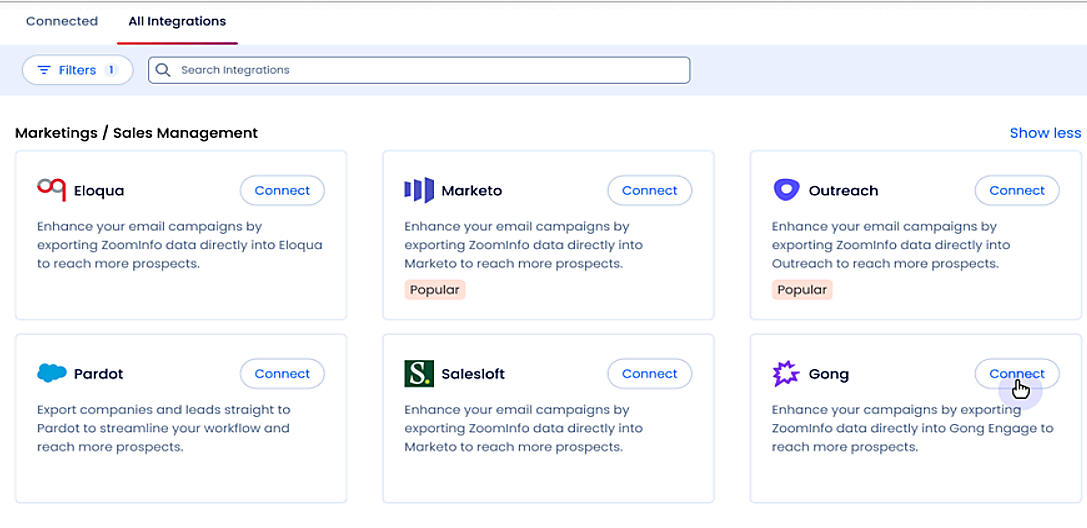
ZoomInfo contacts can be exported directly to Gong Engage flows, connecting verified prospect data with Gong's sales engagement platform. Reps build targeted prospect lists in ZoomInfo using company, technographic, and intent filters, then push qualifying contacts into Gong Engage sequences with a single action.
Because the contacts arrive with verified emails and direct dials, the outreach starts with accurate data rather than CRM records that may be months old.
Source: ZoomInfo
Seismic's sales team attributed 39% of active pipeline to opportunities identified or influenced by ZoomInfo signals, reporting 54% productivity gains and saving 11.5 hours per week per seller. (Seismic Case Study)
ZoomInfo Pricing
ZoomInfo uses a consumption-based pricing model with custom quotes based on usage, users, credit volume, and features.
Plans are organized into Sales, Marketing, and standalone product lines, each in Professional, Advanced, and Enterprise tiers. The native Gong integration is available through ZoomInfo's standard integration capabilities, with Advanced adding intent signals and website visitor tracking.
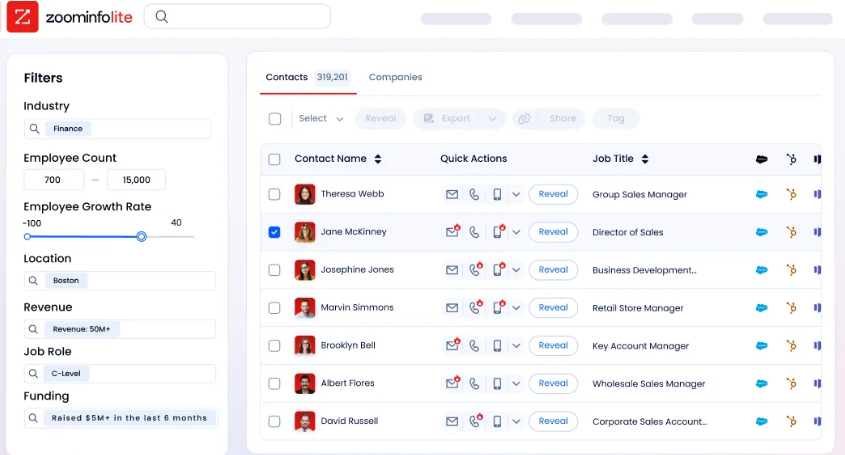
ZoomInfo Lite is a permanent free tier (no credit card, no time limit) with 10 monthly export credits, searches, the Chrome extension, and CRM integrations, a practical way to evaluate the data quality before committing. A separate 7-day free trial covers paid features.
Source: ZoomInfo
Who Should Use the ZoomInfo Integration?
Revenue teams whose Gong-tracked pipeline depends on accurate contact data: enrichment is the difference between verified direct dials that connect and a 30% bounce rate that damages sender reputation and wastes Gong Engage sequences on bad numbers
Sales leaders who want intent signals alongside conversation intelligence: knowing what accounts are researching outside your calls gives Gong's deal analysis the external context it cannot capture from conversations alone
Organizations using Gong Engage for outbound prospecting that need verified, enriched contact data flowing directly into outreach flows instead of relying on stale CRM exports
2. Salesforce: Best Gong Integration for Enterprise CRM Deal Intelligence
Salesforce is the world's #1 CRM by IDC revenue market share, serving over 150,000 companies. It integrates with Gong to turn conversation intelligence into structured pipeline data: automated field population, deal risk signals as CRM properties, and Agentforce-driven revenue workflows inside your Salesforce instance.
Source: Salesforce
Key integration capabilities include:
Bidirectional activity sync where every Gong-recorded call and email analysis appears as an Activity on the corresponding Salesforce Contact, Account, and Opportunity records
AI Data Extractor field population that reads call transcripts and pushes confirmed budget, agreed next steps, and competitor mentions into custom Salesforce fields
Deal risk signals as Salesforce custom properties from Gong's AI Deal Predictor scores and AI Deal Monitor flags, enabling pipeline dashboards and automated workflows based on conversation-derived intelligence
Agentforce AI agents querying Gong via MCP, connecting Salesforce's AI to Gong's Revenue Graph through the Model Context Protocol server
How Salesforce Integrates with Gong
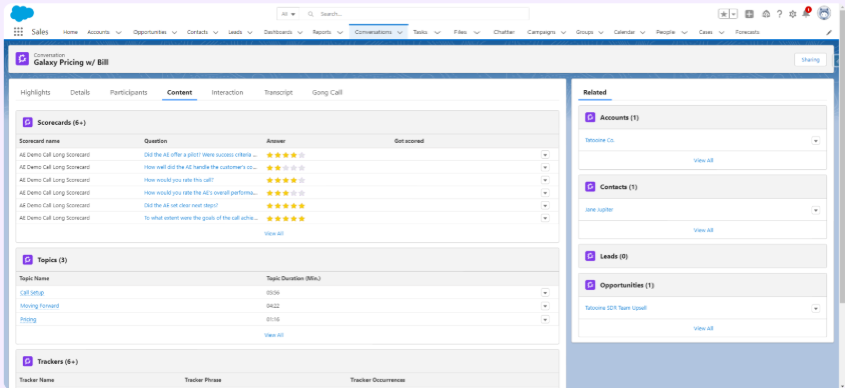
The Gong-Salesforce integration ships as a managed AppExchange package. The package installs from the AppExchange, provisions Gong's custom Salesforce objects, embeds the Gong call player inside Salesforce records, creates Salesforce Flows for data enrichment, and establishes bidirectional sync. The integration supports Gong's full product surface: Gong Pro, Gong Engage, and Gong Forecast all connect to Salesforce.
Source: Salesforce
1. Bidirectional Activity Sync and CRM Record Association.
Every Gong-recorded call appears automatically as an Activity logged against the corresponding Salesforce Contact, Account, and Opportunity records.
Reps no longer need to log calls manually. In reverse, Salesforce deal stage, contact role, and company attributes flow into Gong to provide CRM context alongside each recording. Admins can validate mapping rules in simulation before activation, a useful safeguard for organizations with complex Salesforce structures.
2. AI Data Extractor: Transcript-to-Salesforce Field Population.
The AI Data Extractor reads call transcripts after each recorded conversation and identifies deal-critical information: confirmed budget ranges, agreed next steps, competitor names, technical objections. It pushes that data into custom Salesforce fields your RevOps team has mapped.
Managers reviewing pipeline in Salesforce see fields populated from conversation evidence rather than rep impressions entered at deal creation.
3. Deal Risk Signals as Salesforce Custom Properties.
Gong's pipeline intelligence agents (AI Deal Monitor and AI Deal Predictor) generate scores and risk flags that push into Salesforce as custom Opportunity properties. Teams build pipeline dashboards, list views, and Salesforce Flow automations that respond to what Gong's AI detected in conversations.
When AI Deal Monitor detects signals suggesting a deal is at risk, that flag surfaces in Salesforce and can trigger a task for the account manager, a Slack notification, or an escalation to a manager's review queue.
4. Salesforce Agentforce Querying Gong via MCP.
Gong operates as an MCP server, exposing the Revenue Graph as a queryable resource that Salesforce Agentforce agents can call directly without a custom data pipeline. Agentforce agents connected to the Gong MCP server pull deal conversation intelligence, account interaction history, and deal briefs from Gong and fold that context into Agentforce workflows on demand.
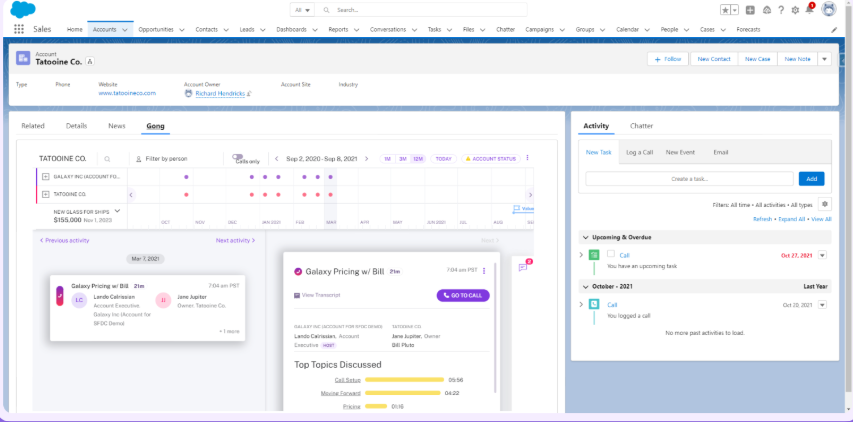
5. Embedded Gong Call Player in Salesforce Records.
The managed package embeds the Gong call player inside Salesforce record pages. Managers and reps listen to recordings, review AI-generated summaries, and access conversation intelligence without leaving Salesforce.
Source: Salesforce
Salesforce Pricing
Salesforce uses per-user annual contracts:
Pro Suite: $100/user/month (annual), includes AppExchange access for the Gong managed package
Enterprise: $175/user/month (annual), adds workflow automation via Salesforce Flows so Gong deal signals can trigger automated actions
Unlimited: $350/user/month (annual), full AI suite and Premier Success
Agentforce 1: $550/user/month (annual), unmetered Agentforce for AI agent deployments connecting to Gong via MCP
The Gong integration is available on any Gong Foundation plan, and standard integrations are included at no additional cost.
Who Should Use the Salesforce Integration?
Enterprise revenue teams running pipeline reviews and deal execution in Salesforce that want Gong's conversation intelligence populating CRM records automatically instead of depending on reps to log calls and update fields
RevOps teams that need Gong's deal risk signals visible as Salesforce Opportunity properties for pipeline dashboards and Flow automations
Organizations using Salesforce Agentforce that want those AI agents to draw on Gong's Revenue Graph for deal and account context via MCP
3. HubSpot: Best Gong Integration for CRM Activity Sync and Mid-Market Pipeline Management
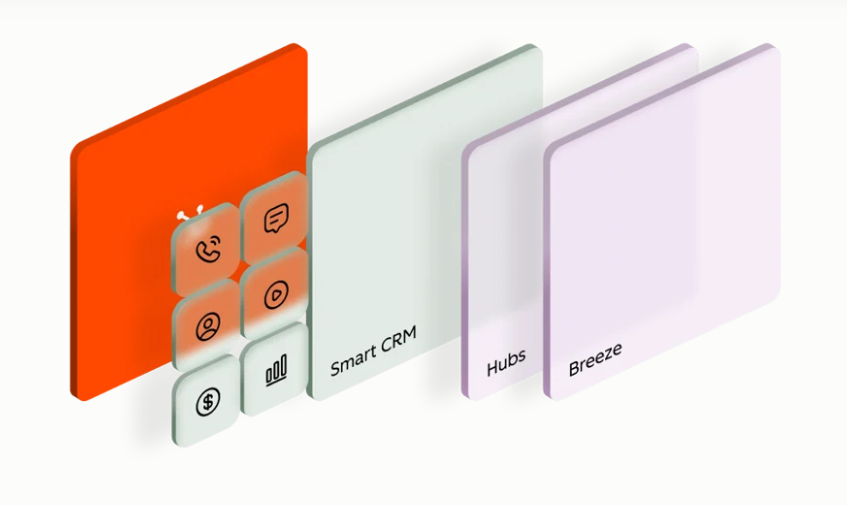
HubSpot is a CRM and marketing automation platform that integrates with Gong to push call intelligence into deal records, contact timelines, and workflow triggers automatically. The integration syncs Gong-recorded calls bidirectionally with HubSpot, surfaces AI deal signals as custom properties, and supports Gong Engage running natively on HubSpot as its CRM backend.
Source: HubSpot
Key integration capabilities include:
Bidirectional sync of Gong-recorded calls and meetings into HubSpot Activities attached to the correct Contact, Company, and Deal records
HubSpot deal stage, contact, and company data flowing into Gong to contextualize each recording with the right CRM objects
Gong AI deal signals surfacing as HubSpot custom deal properties that can trigger marketing and sales automation workflows
Gong Engage running natively on HubSpot as its CRM backend for sequencing, call outcome logging, and email activity sync
How HubSpot Integrates with Gong
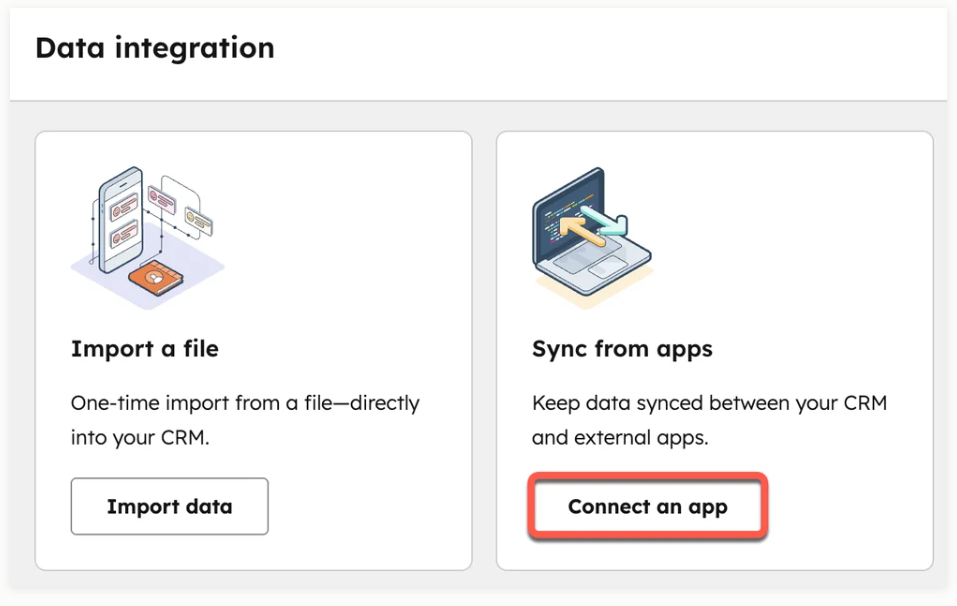
Gong provides a native HubSpot integration with full support across Gong Pro, Engage, and Forecast. The connection activates through Gong's admin center using HubSpot's standard OAuth flow. No API keys or custom connectors required.
1. Bidirectional Call and Meeting Sync.
Every call and meeting Gong records pushes automatically into HubSpot as an Activity record associated with the correct Contact, Company, and Deal objects. Gong's automatic business-context mapping applies configurable association rules to match each interaction.
In reverse, HubSpot deal stage, contact role, and company attributes flow into Gong. When a manager reviews a call inside Gong, they see the deal stage, mapped contacts, and company context without opening HubSpot in a separate tab.
2. Gong AI Deal Signals as HubSpot Custom Properties.
AI Deal Monitor risk flags and AI Deal Predictor health scores sync into HubSpot as custom deal properties. Because HubSpot combines CRM and marketing automation in one platform, Gong signals activate more than CRM tasks: stalled deals can automatically enroll associated contacts into a re-engagement nurture sequence, turning a conversation intelligence signal into a marketing motion with no manual handoff.
3. Gong Engage Running Natively on HubSpot.
Gong Engage connects to HubSpot as a native CRM backend. When reps run multi-step sequences, log call outcomes via the Gong Dialer, or send AI-composed follow-up emails in Engage, all activities sync back to the associated HubSpot contact and deal records. The Gong Anywhere Chrome Extension embeds Engage functionality inside HubSpot's browser interface.
Source: HubSpot
HubSpot Pricing
HubSpot uses a hybrid model combining per-seat fees and flat monthly fees at Professional and Enterprise tiers. The Gong integration does not require a specific HubSpot tier for basic CRM activity sync.
Sales Hub Starter: $20/seat/month (monthly) or $9/seat/month (annual), includes CRM and activity logging sufficient for Gong activity sync
Sales Hub Professional: $100/seat/month (monthly) or $90/seat/month (annual), adds workflow automation so Gong AI deal signals can trigger automated actions
Sales Hub Enterprise: $150/seat/month (annual only), adds custom objects and field-level permissions
To trigger marketing automation from Gong signals, Marketing Hub Professional ($800/month annual, includes 2,000 marketing contacts) is also required. The Gong integration is included at no additional cost on any Gong Foundation plan.
Who Should Use the HubSpot Integration?
Mid-market teams using HubSpot as their primary CRM that want Gong-recorded calls to appear on deal and contact timelines automatically without manual logging
Teams that want Gong's AI deal signals to trigger both CRM and marketing automation workflows from one platform, which HubSpot's combined CRM and marketing engine enables
Organizations running Gong Engage for sequencing that want all outreach activity synced back to HubSpot as the single system of record
4. Slack: Best Gong Integration for Real-Time Revenue Signal Delivery and Team Collaboration
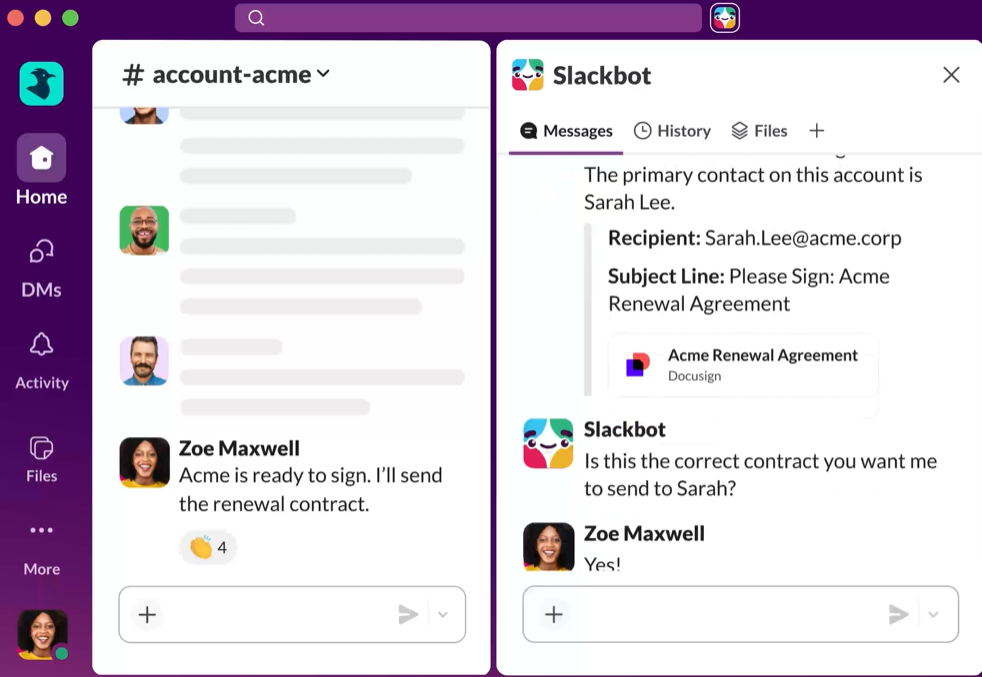
Slack is a channel-based messaging platform that integrates with Gong to route deal signals, coaching moments, and forecast alerts into the channels where your revenue team already works. Instead of requiring managers and RevOps professionals to keep Gong open, the integration pushes conversation intelligence into Slack in real time.
Source: Slack
Key integration capabilities include:
Rules-based call notifications that fire when Gong's AI detects specific conditions: competitor mentions, pricing objections, deal risk signals, or stage-relevant milestones
Call recording and clip sharing into any Slack channel, enabling asynchronous review without requiring recipients to hold a Gong seat
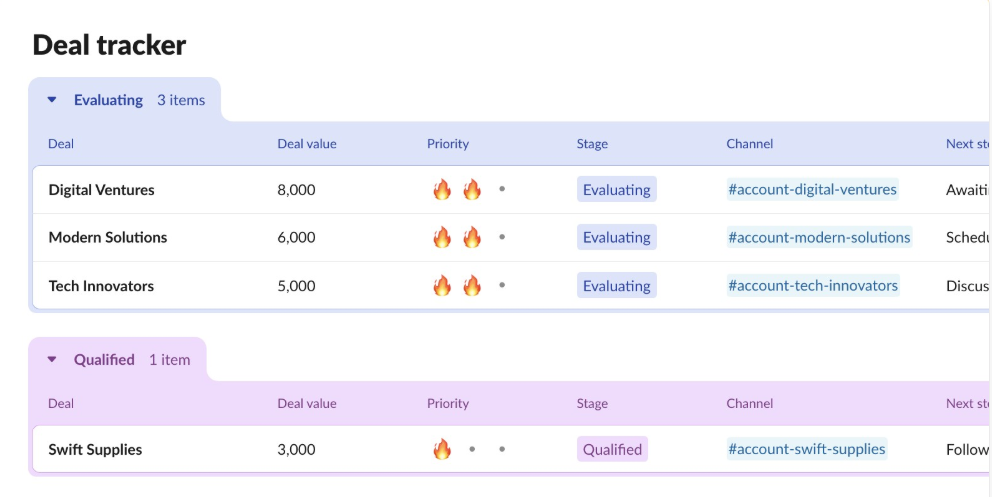
Gong Forecast deal change notifications, pipeline risk alerts, and submission reminders delivered to designated channels
Direct message notifications when teammates comment on Gong recordings or @-mention a user in a coaching note
How Slack Integrates with Gong
Gong provides a native Slack integration that connects via OAuth. No third-party middleware required. The integration is available on Gong's standard plans; Forecast-specific alerts require the Forecast license.
1. Rules-Based Call Signal Notifications.
Gong's notification rules engine fires Slack alerts when AI-detected signals appear in recorded calls. Rules can target specific rep teams, geographies, or deal types, and route to any Slack channel.
The trigger logic uses Gong's contextual intelligence rather than keyword matching: a prospect saying "we need procurement to sign off" and one saying "we're waiting on legal to review the agreement" would both trigger a "legal or procurement risk" rule despite sharing no exact phrasing.
A competitive intelligence team can route all competitor mentions to a dedicated channel. A sales manager can receive a DM when any call on a high-value deal hits a risk signal.
2. Call Recording and Clip Sharing.
Gong users can share full recordings or trimmed clips from Gong to any Slack channel. This lets teams review calls asynchronously without every participant holding a Gong seat. A rep shares a two-minute clip of a prospect's competitive objection in a sales enablement channel; product marketing watches without opening Gong; the enablement manager responds with coaching guidance in the Slack thread.
3. Gong Forecast Pipeline Alerts.
Gong Forecast pipeline events surface as Slack notifications: deal stage changes, risk indicators from AI Deal Monitor, and submission deadline reminders. A sales leader can configure a pipeline alerts channel that fires when committed deals trigger risk indicators, giving them time to intervene before the issue surfaces in the forecast call.
4. Coaching Comment Notifications via DMs.
When a teammate comments on a Gong call recording or @-mentions a user in a coaching note, that user gets a direct Slack message. For managers who leave timestamped coaching guidance at specific moments in a recording, the Slack notification pulls the rep back into the coaching workflow through the tool they already check throughout the day.
Source: Slack
Slack Pricing
Slack uses per-seat pricing:
Pro: $7.25/user/month (annual), unlimited message history, unlimited app integrations
Business+: $15/user/month (annual), adds SAML SSO, custom retention policies, 24/7 priority support
Enterprise+: Custom pricing, multi-workspace management, native DLP, HIPAA compliance
Any paid Slack plan supports the full Gong integration. Slack's Free plan caps app integrations at 10 and limits message history to 90 days, which constrains the integration's usefulness.
Who Should Use the Slack Integration?
Revenue teams that already live in Slack and want Gong's deal signals, call alerts, and coaching notifications delivered into channels rather than requiring a separate Gong session
Organizations with cross-functional stakeholders (product, marketing, customer success) who need access to call intelligence but don't hold Gong licenses, since Slack's clip-sharing workflow works without a Gong seat
Sales leaders who need forecast submission reminders and pipeline risk alerts in real time through the tool they already monitor throughout the day
5. Outreach: Best Gong Integration for Outbound Sequence Signal Coverage
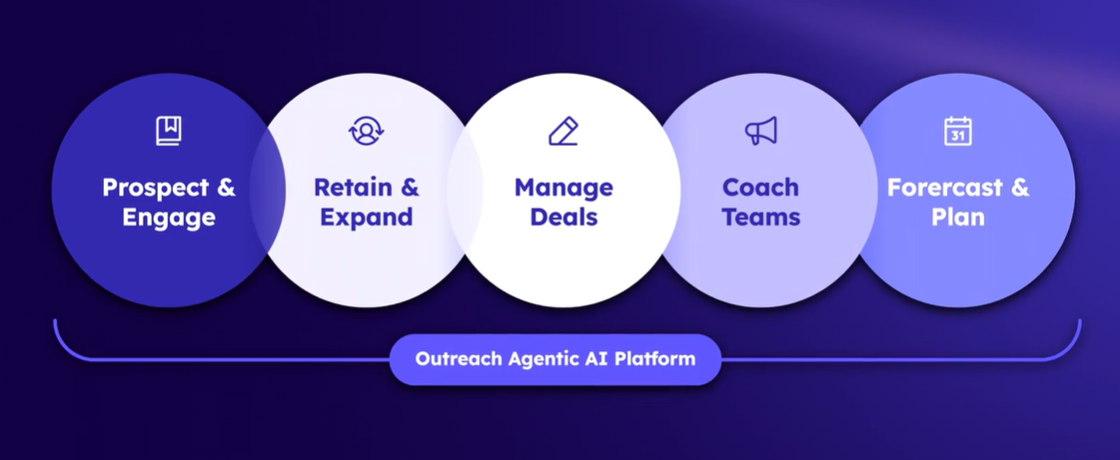
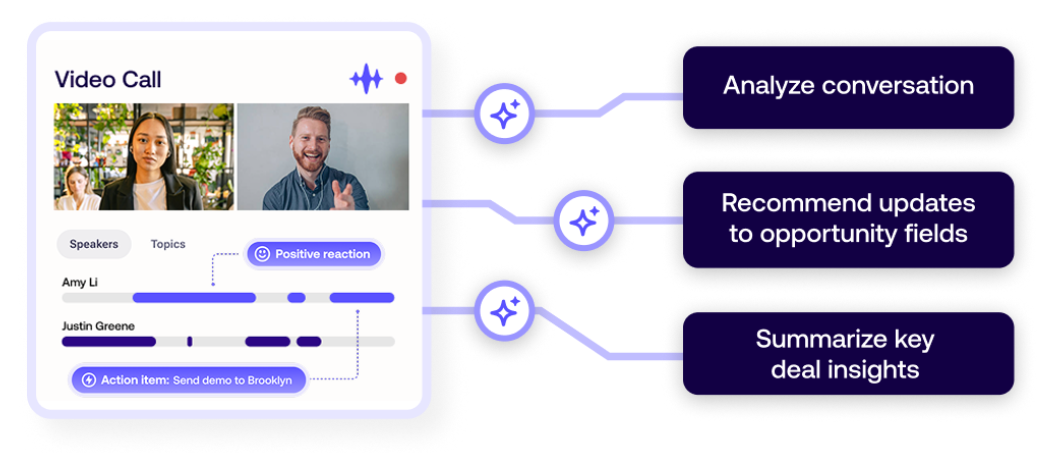
Outreach is a revenue workflow platform that integrates with Gong to connect outbound sequence engagement signals with conversation intelligence, giving revenue teams visibility into how buyer engagement unfolds across both sequence touchpoints and live conversations.
Source: Outreach
Key integration capabilities include:
Outreach engagement signals feeding Gong's Revenue Graph: email opens, reply rates, meeting bookings, and sequence outcomes enrich Gong's deal intelligence dataset
Gong call recordings, AI briefs, and next steps linking to Outreach prospect records, giving reps conversation context when planning sequence steps
Gong deal risk signals informing which Outreach sequences to activate, pause, or adjust at the account and contact level
Consolidated Salesforce activity timelines where records from both platforms land on shared Opportunity and Contact objects
How Outreach Integrates with Gong
Outreach and Gong connect through an API-based integration listed in the Gong Collective. This is a direct API connection that does not require Salesforce as an intermediary. Setup runs through Gong's admin settings, and all standard Gong integrations are included at no additional cost. Outreach bundles API access into its paid plan tiers.
1. Outreach Engagement Signals Feeding Gong's Revenue Graph.
Without Outreach connected, Gong's Revenue Graph reflects only what Gong captures natively: recorded calls, emails, and calendar events. With the integration, engagement activity from Outreach Sequences flows into the Revenue Graph.
A prospect who never picks up the phone but opens a sequence email four times generates behavioral signals that AI Deal Monitor cannot see without the Outreach connection. This matters most for early-pipeline deals where the only engagement may be outbound sequence touchpoints rather than live calls.
2. Gong Conversation Intelligence in Outreach Prospect Records.
Gong's AI-generated call briefs, call recordings, and agreed next steps link to corresponding Outreach prospect records.
An AE inside Outreach planning the next sequence step can access the Gong conversation brief directly, in context. If the last Gong call revealed procurement timeline concerns, that signal is available when the AE decides what comes next rather than buried in a separate interface.
3. Gong Deal Risk Signals Driving Sequence Decisions.
Gong's AI Deal Monitor scans continuously for risk indicators: a champion who has gone quiet, a key stakeholder who dropped off meeting attendee lists, budget constraint language in transcripts. When those signals appear, teams respond by activating re-engagement sequences in Outreach or pausing active sequences targeting disengaged stakeholders.
This creates a feedback loop: Gong detects risk from conversations, teams respond via Outreach, and new engagement data feeds back into the Revenue Graph.
4. Consolidated Salesforce Activity Timeline.
Both Gong and Outreach push activity records to Salesforce independently. The result is a Salesforce Opportunity record that reflects the full deal engagement arc: Gong's call and meeting history alongside Outreach's sequence execution history, without reps logging either manually.
Source: Outreach
Outreach Pricing
Outreach uses a per-user pricing model with annual contracts. No dollar amounts are publicly listed; all pricing requires contacting Outreach sales:
Amplify Core: Includes Research & Personalization Agents, Smart Data Enrichment, Integrated Dialer, Sequences & Triggers, and API access (250,000 API calls included)
Amplify Plus: Adds Smart Meeting & Deal Assist, Real-time Transcription, AI-Assisted Coaching, and Deal Health Score
Amplify Pro: Adds Scenario Planning, Forecast Rollups, AI Projection, and multi-currency support
On the Gong side, the Outreach integration is included at no additional charge.
Who Should Use the Outreach Integration?
Sales teams running multi-touch sequences in Outreach that need Gong's deal risk signals to inform which sequences to activate, pause, or adjust
Revenue organizations that want Gong's Revenue Graph to reflect the full buyer engagement arc, including Outreach sequence touchpoints and email engagement, not just recorded conversations
AEs who want Gong call briefs inside Outreach when planning sequence steps, so conversation context informs the next outreach move without switching platforms
6. Zapier: Best Gong Integration for No-Code Workflow Automation Across 8,000+ Apps
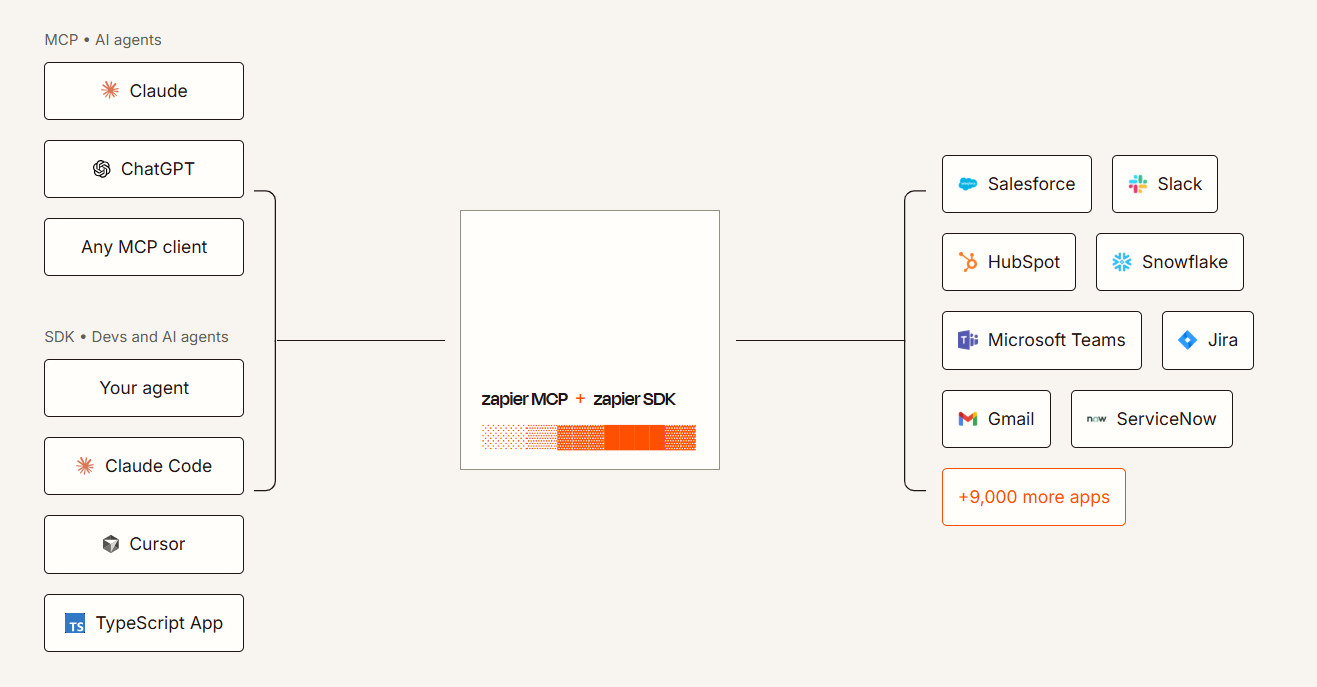
Zapier is a no-code workflow automation platform that connects Gong's processed call data, AI summaries, and external engagement signals to any application in your tech stack (including tools with no native Gong connector).
Source: Zapier
Key integration capabilities include:
Triggering multi-app workflows when Gong finishes processing a call recording
Routing Gong's AI-generated call briefs and next steps to apps outside Gong's native partner ecosystem
Pushing external buyer engagement events (document views, proposal opens) back into Gong's Revenue Graph
Connecting Gong to niche, internal, or long-tail tools not covered by the Gong Collective's 300+ native integrations
How Zapier Integrates with Gong
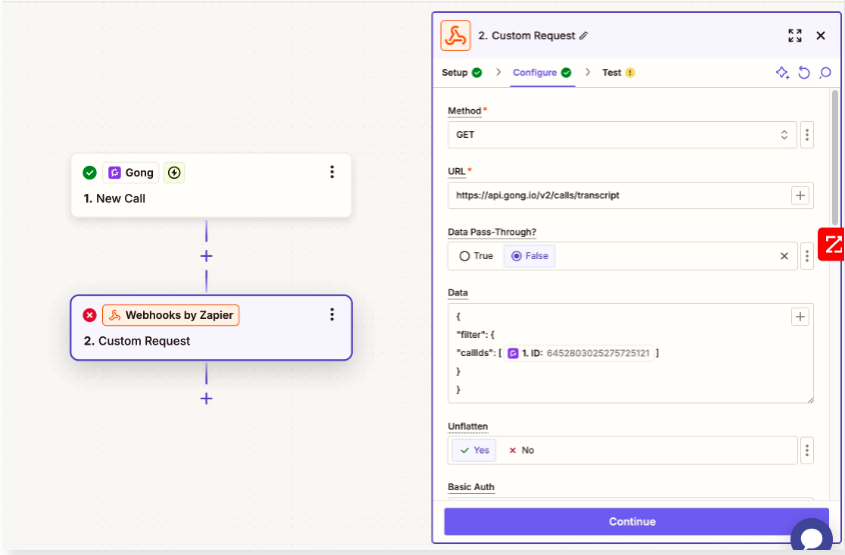
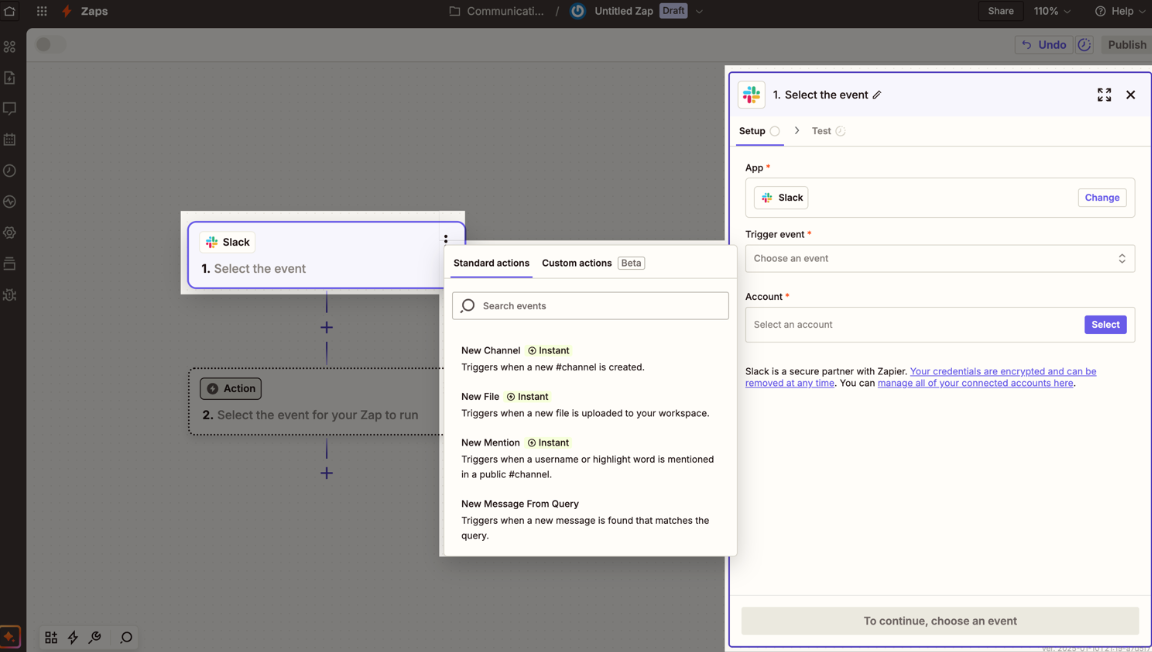
Gong and Zapier connect through a native integration listed in the Gong Collective. Authentication uses Zapier's standard OAuth flow. Once connected, Gong call completion events become Zapier triggers, and Zapier actions can send structured engagement data back into Gong's Revenue Graph.
Source: Zapier
1. New Gong Call as a Multi-App Workflow Trigger.
When Gong finishes processing a call, that event triggers a Zap that fans out across multiple action steps connected to any of Zapier's 8,000+ integrated applications. A single completed call can create a follow-up task in Asana, log a call brief to a Notion database, update an Airtable record with deal topics discussed, and push a formatted Slack message to the account owner.
The value is for tools outside Gong's native Collective integrations: internal project trackers, niche CRMs, custom Airtable bases, or any tool adopted before Gong entered the stack.
2. Gong AI Summaries Routed to Any Destination.
Gong's AI agents produce structured output: AI Briefer generates briefs for calls, deals, and accounts; AI Tasker surfaces action items
Zapier intercepts those outputs and routes them to downstream workflows. A revenue team managing post-call commitments in a spreadsheet can have each call's AI summary auto-populated. A CS team tracking handoff notes in a project tool can have action items mapped to new tasks.
3. External Engagement Events Pushed Back into Gong's Revenue Graph.
The Revenue Graph ingests digital interaction signals beyond calls and emails. For teams using tools outside Gong's native capture scope (a document-sharing platform that tracks proposal views, a custom video portal monitoring demo completions), Zapier creates a path to send those events into Gong as digital interaction signals. This enriches the data available to Gong's AI Deal Monitor and AI Deal Predictor.
Source: Zapier
Zapier Pricing
Zapier uses task-based pricing where each action step counts as one task:
Free: 100 tasks/month with single-step Zaps only; 15-minute polling interval
Professional: Starts at $19.99/month (annual) for 750 tasks, multi-step Zaps, conditional logic, and 2-minute polling
Team: Starts at $69/month (annual) for 2,000 tasks, shared workspaces, 1-minute polling
Enterprise: Custom pricing with unlimited users and advanced admin controls
Estimate your task consumption before committing: a team recording 200 calls per month with a 5-step Zap per call consumes 1,000 tasks monthly. Zapier's pay-per-task overages bill at 1.25x the plan's per-task cost.
Who Should Use the Zapier Integration?
RevOps teams that need Gong call data flowing into tools outside the Gong Collective, including internal project trackers, databases, or niche industry applications
Non-technical teams that need custom post-call workflows without engineering resources or direct API work
Organizations tracking buyer engagement in tools outside Gong's native capture scope that want those signals pushed into the Revenue Graph to improve deal intelligence
7. Snowflake: Best Gong Integration for Enterprise Revenue Analytics and Cross-System Intelligence
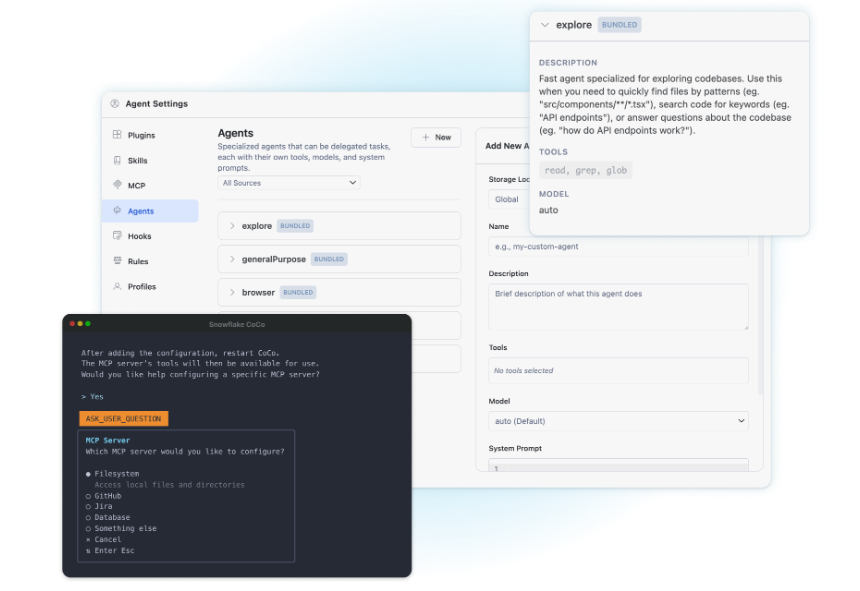
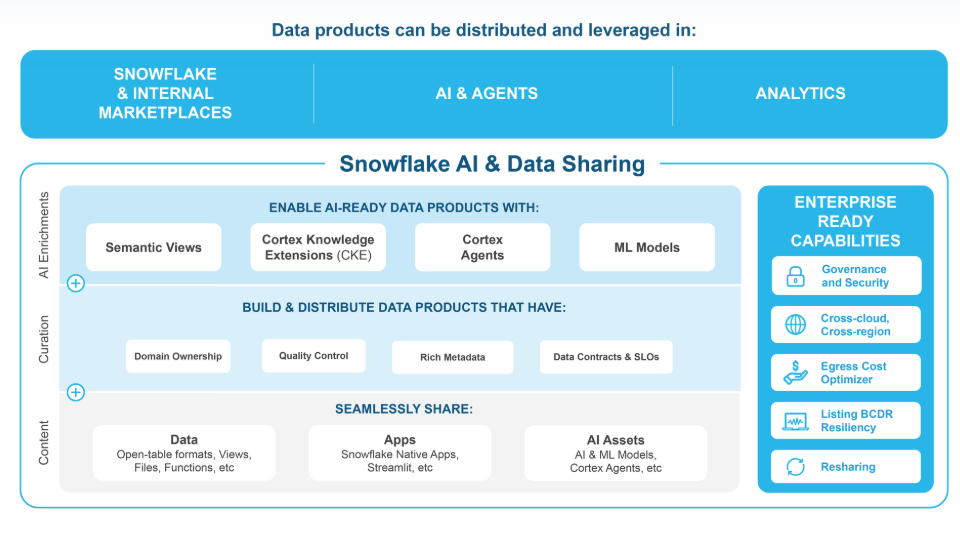
Snowflake is a cloud-native data platform that connects to Gong through zero-copy data sharing, delivering the complete Revenue Graph into your data warehouse with no data duplication and no storage overhead.
Source: Snowflake
Key integration capabilities include:
Zero-copy Revenue Graph delivery via Gong Data Cloud, sharing Gong's full interaction dataset into your Snowflake instance without moving or copying data
Conversation intelligence metrics in BI tools, making talk-to-listen ratios, keyword frequency, coaching scores, and call activity volumes queryable from Tableau, Looker, Power BI, and any Snowflake-connected tool
Cross-system revenue analysis correlating Gong's interaction data with CRM records, product usage telemetry, and financial data in a single query environment
Pre-built query templates for win rate analysis, pipeline health tracking, and rep performance benchmarking
How Snowflake Integrates with Gong
The integration runs through Gong Data Cloud, built on Snowflake's zero-copy sharing architecture. Unlike Gong's Databricks and BigQuery integrations (which copy data), the Snowflake integration shares data at the metadata layer:
Revenue Graph tables appear inside your Snowflake account without consuming storage quota or requiring ETL pipelines. Gong refreshes the shared data daily.
1. Zero-Copy Revenue Graph Sharing.
Gong's full Revenue Graph dataset (conversations, call participants, transcript-level topics, smart trackers, coaching scorecards, email interactions, CRM context mappings, and deal activity) lands in your Snowflake account as live, read-only tables.
Because data is shared rather than copied, there is no storage duplication and no ETL lag. The tables appear instantly once the share is established. This eliminates the pipeline dependencies, schema drift risk, and storage overhead of approaches that write exports to S3 or GCS and then load via Fivetran or a custom loader.
2. Conversation Intelligence Metrics in BI Tools.
With Revenue Graph data living natively in Snowflake, any connected BI tool (Tableau, Looker, Power BI, Sigma) can query Gong's metrics directly.
Teams build dashboards showing talk-to-listen ratios by rep, keyword frequency trends, coaching scorecard distributions, and engagement cadence patterns, all correlated against pipeline and revenue data in the same Snowflake environment. A single SQL query can pull Gong call outcomes alongside deal stage movement and closed revenue.
3. Cross-System Revenue Analysis.
Snowflake's SQL environment becomes the assembly point for analysis no single platform can produce. Because Gong's data lands alongside CRM records, product usage telemetry, and financial close data, analysts can ask cross-system questions: Which combination of call behaviors and engagement patterns correlates with closed-won deals at 120% of quota?
Which coaching interventions produce faster ramp-to-quota? These questions live in the gap between what Gong's dashboards show and what CRM reporting shows.
4. Pre-Built Query Templates.
Gong provides SQL query templates for common analytical workflows: win rate analysis by team segment, pipeline health tracking, forecast accuracy comparison, and rep performance benchmarking. Templates can be imported into Snowflake, parameterized for specific segments, and scheduled as views that refresh on the same daily cadence as the data share.
Source: Snowflake
Snowflake Pricing
Snowflake uses consumption-based pricing with no fixed per-seat licensing. All editions support inbound data sharing for the Gong Revenue Graph:
Standard: Entry-level edition with full data sharing, consumption-based compute and storage pricing. A 30-day free trial with $400 in credits is available.
Enterprise: Adds multi-cluster warehouses for high-concurrency BI workloads, extended Time Travel (up to 90 days), and dynamic data masking
Business Critical: Adds Tri-Secret Secure encryption, private connectivity, and HIPAA/PCI DSS compliance support
Gong Data Cloud is a separately priced license on the Gong side. Snowflake does not charge for receiving a data share; you pay compute only when querying the shared tables.
Who Should Use the Snowflake Integration?
RevOps and analytics teams already running Snowflake that want Gong's conversation intelligence available for SQL-based reporting alongside CRM, product, and financial data without building a custom pipeline
Organizations running cross-system revenue analysis that need to join Gong behavioral signals with CRM stage data, product telemetry, and financial close records in one query environment
Teams building BI dashboards that correlate coaching scores, call activity volumes, or deal engagement patterns with pipeline and revenue outcomes
Final Verdict
The best Gong integrations feed your Revenue Graph verified data, push conversation intelligence into the platforms where your team acts, and make deal signals visible across your stack:
ZoomInfo: verified B2B data, buyer intent signals, and technographic intelligence enriching every conversation; the highest-impact integration on this list if your pipeline depends on data accuracy and knowing which accounts are in-market
Salesforce: the deepest CRM integration in Gong's ecosystem, with bidirectional sync, AI field population, deal risk signals as custom properties, and Agentforce querying the Revenue Graph via MCP
HubSpot: CRM and marketing automation for mid-market teams, with Gong AI signals triggering both pipeline workflows and marketing sequences from one platform
Slack: deal alerts, coaching notifications, and forecast reminders where your team already works, with clip sharing for cross-functional visibility
Outreach: outbound sequence engagement enriching the Revenue Graph and Gong call intelligence informing sequence decisions
Zapier: no-code reach into 8,000+ apps where native connectors stop, with the ability to push external engagement signals back into Gong
Snowflake: zero-copy delivery of the full Revenue Graph for enterprise analytics alongside your entire data stack
These integrations compound: you might run ZoomInfo for data enrichment and intent, Salesforce for CRM intelligence, Slack for notifications, and Snowflake for analytics on the same Gong instance, each adding a layer that makes the others more valuable.
If you connect just one, start with the data layer that powers everything else. ZoomInfo's native integration with Gong feeds your Revenue Graph with verified contact data, buyer intent signals, and company intelligence from a B2B database spanning 500M contacts and 100M companies. ZoomInfo Lite is a permanent free tier, so you can see what verified data and live intent signals do for your Gong pipeline before spending anything.
Frequently Asked Questions
How many integrations does Gong support?
The Gong Collective marketplace lists over 300 technology integration partners spanning CRM, email, calendar, web conferencing, telephony, buyer intent, contact enrichment, content, account insights, BI, workflow automation, and sales engagement.
Beyond the Collective, Gong's REST API supports custom integrations, webhooks enable event-driven automation, and MCP support lets external AI agents query Gong directly. Partner growth doubled over the prior year.
Do Gong integrations work on all plans?
All standard integrations come included on any Gong plan. However, what integrations can do depends on which Gong applications you license. Forecast-specific alerts (pipeline notifications to Slack, deal predictor scores to CRM) require the Forecast add-on.
Engage capabilities (outreach sequences syncing to HubSpot or Salesforce) require the Engage add-on. The core Foundation license covers conversation intelligence, call recording, and basic CRM sync.
How does Gong's Revenue Graph work with third-party integrations?
The Revenue Graph captures every customer interaction (calls, emails, meetings, digital engagement signals) and maps each one to the correct accounts, deals, and contacts using configurable association rules.
hird-party integrations extend this in two directions: outbound (pushing Revenue Graph data to CRM, Slack, Snowflake, and other tools) and inbound (pulling engagement signals from Outreach, Zapier-connected apps, and buyer intent platforms into the Revenue Graph). Gong supports MCP as both client and server, so external AI agents can query the Revenue Graph and contribute signals to it.
Can I connect Gong to tools that are not in the Collective marketplace?
Yes. Gong's REST API covers call recording upload, call data retrieval (participants, topics, trackers, scorecards, transcripts), team member statistics, and CRM data import. Webhooks fire when calls match configured filter rules.
For no-code solutions, Zapier connects Gong to 8,000+ apps through trigger-based automation. Workato and Tonkean offer additional iPaaS options for enterprise workflow automation. The MCP server, once generally available, will let any MCP-compatible AI agent query Gong directly.
Does Gong use customer data to train AI models?
No. Gong explicitly commits that customer data is never used to train generative AI models. The platform holds ISO/IEC 42001:2023 certification for AI Management Systems, one of the first revenue AI platforms to achieve this standard. Additional certifications include SOC 2 Type II, ISO 27001, ISO 27701, PCI DSS, and HIPAA support, with bring-your-own-key encryption and granular data retention and redaction controls.
How does Gong handle multilingual sales teams?
Gong supports 70+ languages through its AI Translator agent, which surfaces insights in a manager's preferred language regardless of the language the call was conducted in. This matters for global organizations where managers need visibility into teams operating across regions. Transcription, AI analysis, and coaching insights all work across supported languages.
What is the best way to enrich Gong's Revenue Graph with verified B2B data?
A dedicated B2B data platform provides direct enrichment for Gong's conversation intelligence. ZoomInfo's native integration feeds your Revenue Graph with data from 500 million contacts, 100 million companies, 135 million+ verified phone numbers, and 200 million+ verified business email addresses, backed by a verification pipeline with 300+ human researchers.
Gong-recorded calls import into ZoomInfo's GTM Workspace for AI insights, and ZoomInfo contacts export into Gong Engage flows for prospecting sequences built on accurate data. For teams where pipeline accuracy determines revenue outcomes, ZoomInfo closes the gap between what Gong captures in conversations and what your reps need to act on those insights.
Explore further:
