
If you're comparing HubSpot vs. Spiro, you're probably a manufacturing or distribution company trying to answer a surprisingly difficult question: which CRM will my sales team actually use?
That question leads to several more:
Do you need a broad platform covering marketing, sales, and service, or a CRM built for how manufacturers sell?
Is your biggest problem finding new prospects, or managing relationships with existing accounts?
How important is it that your CRM talks directly to your ERP system?
Are you willing to trade feature breadth for higher adoption among reps who hate data entry?
Does your team need better data on who to contact and when, or better tools for managing deals they already have?
In short, here's what we recommend:
HubSpot is the full-suite CRM platform for companies that want marketing, sales, and service under one roof. Its Smart CRM connects six product hubs sharing a single data layer, with AI tools (Breeze) running across all of them. For teams that run inbound marketing campaigns, nurture leads through automated workflows, and need multi-channel customer service alongside their sales pipeline, HubSpot delivers genuine breadth.
But that breadth comes with complexity. Pricing scales quickly across per-seat, per-hub, and per-contact dimensions, and the platform assumes your sales process fits its structure rather than adapting to yours.
Spiro is the manufacturing CRM built on a simple premise: if reps won't enter data, the CRM should capture it for them. By automatically logging emails, calls, and meetings and syncing order history directly from your ERP, Spiro gives sales leaders visibility into accounts without depending on rep discipline. For manufacturers where repeat orders drive revenue and the ERP is the source of truth, Spiro eliminates the adoption problem that kills most CRM deployments.
The trade-off is scope: Spiro is restricted to North American manufacturers with teams of 10 or more, has no marketing automation to speak of, and requires replacing your existing CRM entirely.
Both platforms solve real problems. But they share a common gap: neither generates the prospecting intelligence you need to find new business. HubSpot stores the contacts you already have. Spiro manages the accounts already buying from you. Neither tells you which companies are actively researching solutions like yours right now, or gives you verified direct-dial numbers for the decision-makers at those companies.
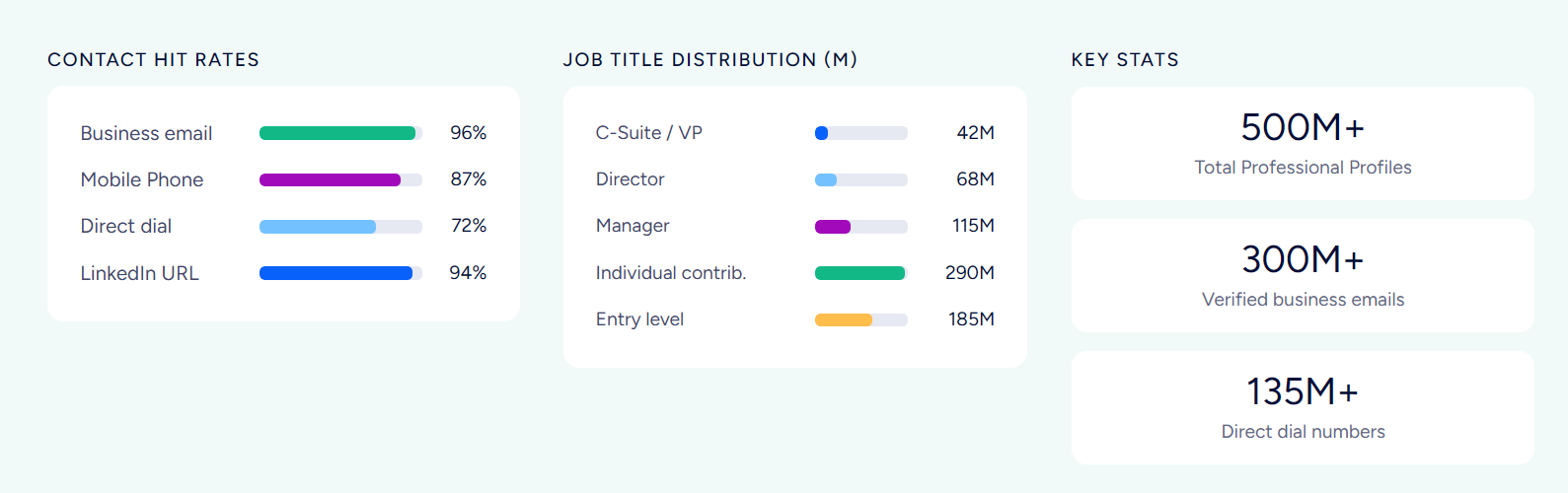
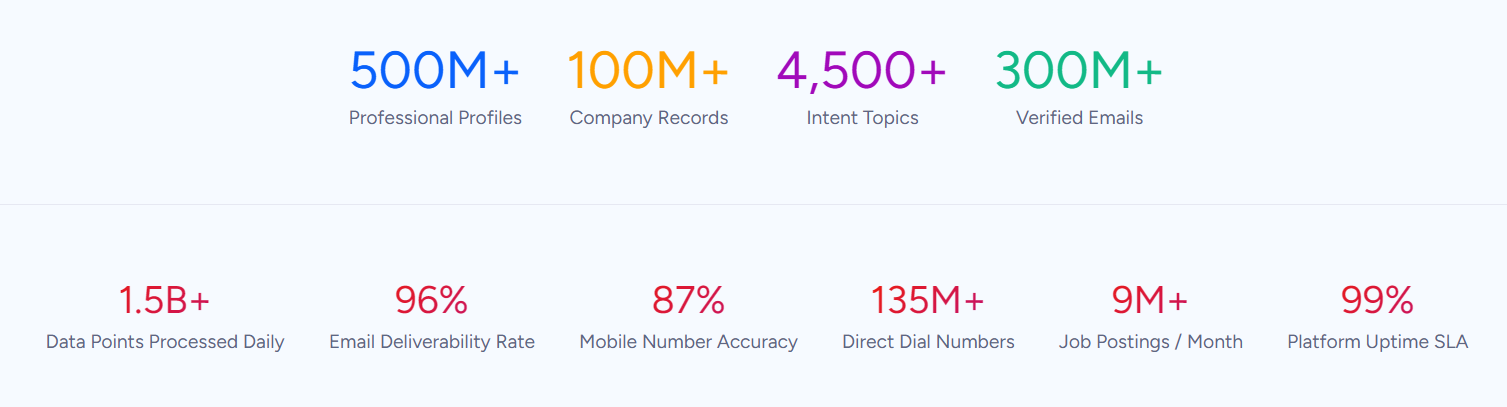
ZoomInfo is an all-in-one AI GTM platform that fills this gap with B2B data covering 500M contacts, 100M companies, 135M+ verified phone numbers, and 200M+ verified business emails. Its GTM Context Graph processes 1.5B+ data points daily, combining this data with your CRM records, conversation transcripts, and behavioral signals to reveal not just who your buyers are, but when they're in-market and why they're likely to buy.
Your team accesses this intelligence through GTM Workspace for sellers, GTM Studio for marketers and RevOps, or APIs and MCP in any front-end. ZoomInfo integrates directly with HubSpot and works alongside any CRM, so you don't have to choose between a great CRM and great data.
If better prospecting data and buying signals would change how your team finds new business, start a free trial.
HubSpot vs. Spiro vs. ZoomInfo at a glance
HubSpot | Spiro | ZoomInfo | |
|---|---|---|---|
Primary function | All-in-one CRM and marketing platform | Manufacturing CRM with automatic data capture | All-in-one AI GTM platform |
Best for | Scaling companies running inbound marketing and multi-channel sales | Manufacturers managing repeat-order accounts with ERP integration | Teams that need verified contact data, buying signals, and prospecting intelligence |
CRM included | Yes (Smart CRM with 6 hubs) | Yes (manufacturing-specific) | No (integrates with HubSpot, Salesforce, Dynamics) |
ERP integration | Limited (third-party connectors) | Native (SAP, Epicor, Infor, NetSuite, SYSPRO, and more) | N/A |
B2B contact database | None (stores your own contacts only) | None (captures from email and ERP only) | 500M contacts, 200M+ verified emails, 135M+ verified phones |
Marketing automation | Full-featured (email, social, landing pages, workflows) | Basic email campaigns only | Account-based marketing and advertising |
Buyer intent signals | None | None | Yes (intent data, website visitor tracking, buying signals) |
AI capabilities | Breeze AI (agents for marketing, sales, service) | AI assistant, auto-capture, ask Spiro | GTM Context Graph, AI-drafted outreach, AI account summaries |
Free plan | Yes (permanent, limited features) | No (demo only) | Yes (ZoomInfo Lite, permanent) |
Starting price | $15/seat/month (Starter, annual) | $1,500/user/year | Custom-quoted |
Two CRM philosophies, one shared blind spot
HubSpot and Spiro sit at opposite ends of the CRM spectrum. The choice between them reveals what you value most.
HubSpot was built for inbound. The platform assumes your buyers find you through content, landing pages, and search, then move through a marketing-to-sales handoff that HubSpot orchestrates with workflows, lead scoring, and automated sequences. It works well when your growth depends on generating and converting new leads at scale. The Smart CRM connects every interaction across marketing, sales, and service, keeping handoffs between teams smooth.
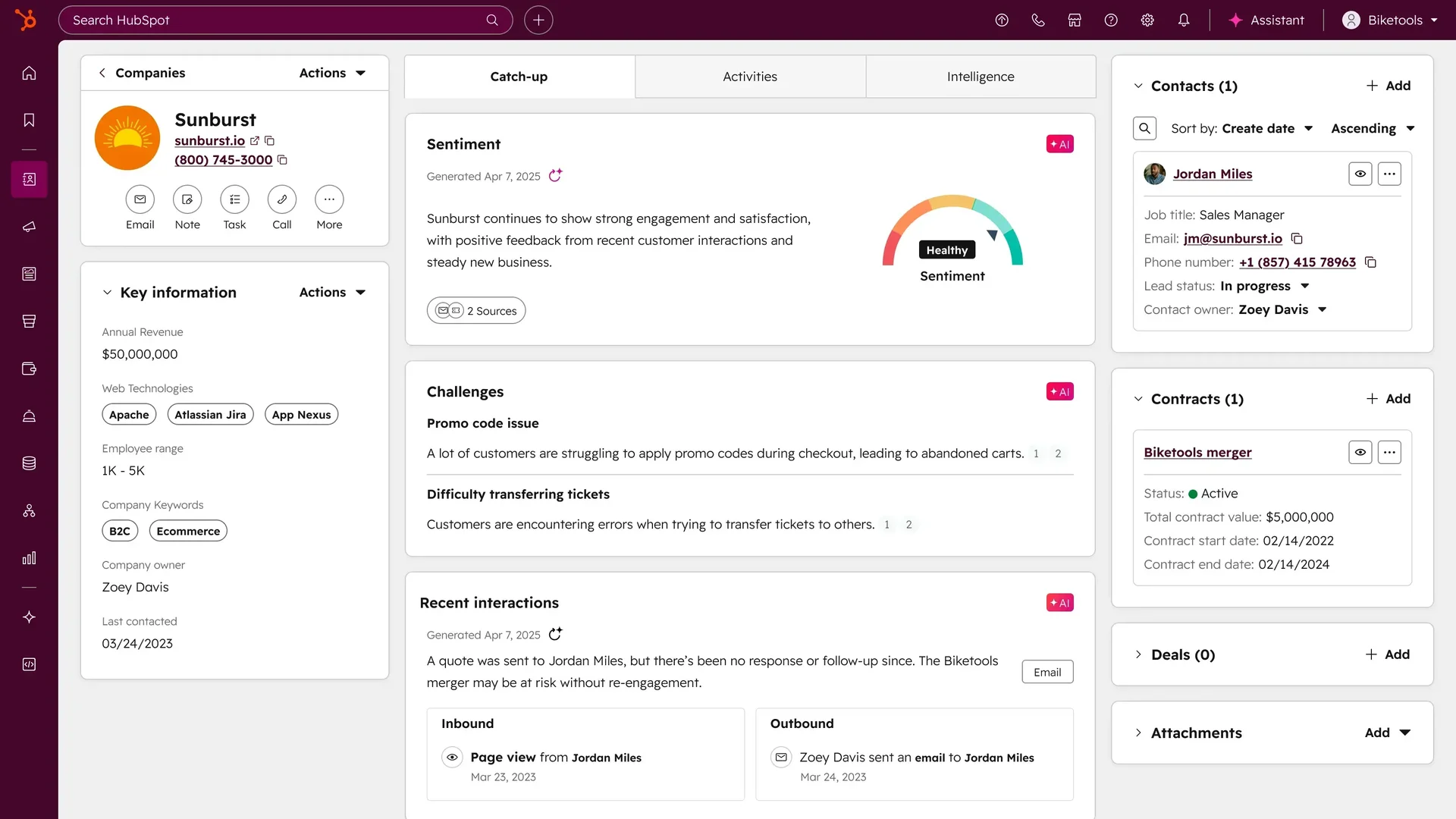
Source: HubSpot
Spiro was built for manufacturers who already know their customers. The platform assumes your revenue comes from repeat orders, that your ERP holds the real sales history, and that your reps will never reliably enter data into a CRM. So Spiro captures everything automatically: emails sync without BCC, calls log without clicking a button, and ERP orders appear on account records without anyone exporting a spreadsheet.
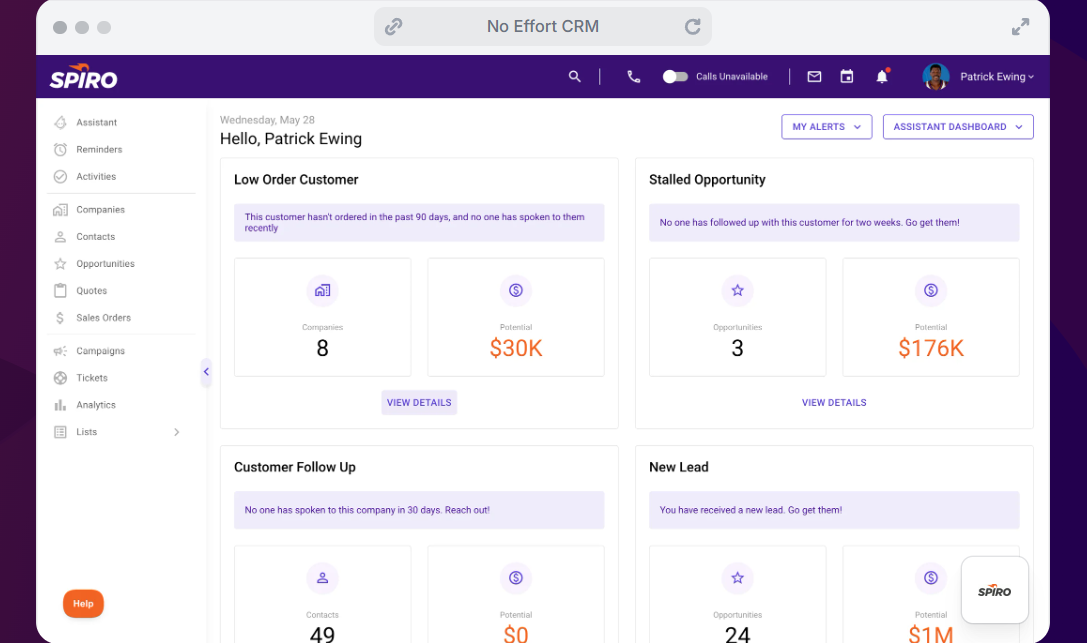
Source: Spiro
Both philosophies are sound. But they share a blind spot: neither platform helps you find the right people to contact in the first place. HubSpot waits for leads to arrive. Spiro manages the accounts you already have. Neither provides a database of verified contacts at companies you haven't reached yet, or signals showing when those companies are researching what you sell.
That gap is what ZoomInfo exists to fill. With 120M direct-dial phone numbers and 200M+ verified business email addresses, ZoomInfo gives your team a starting point that neither CRM provides on its own.
HubSpot covers more ground, Spiro goes deeper in manufacturing
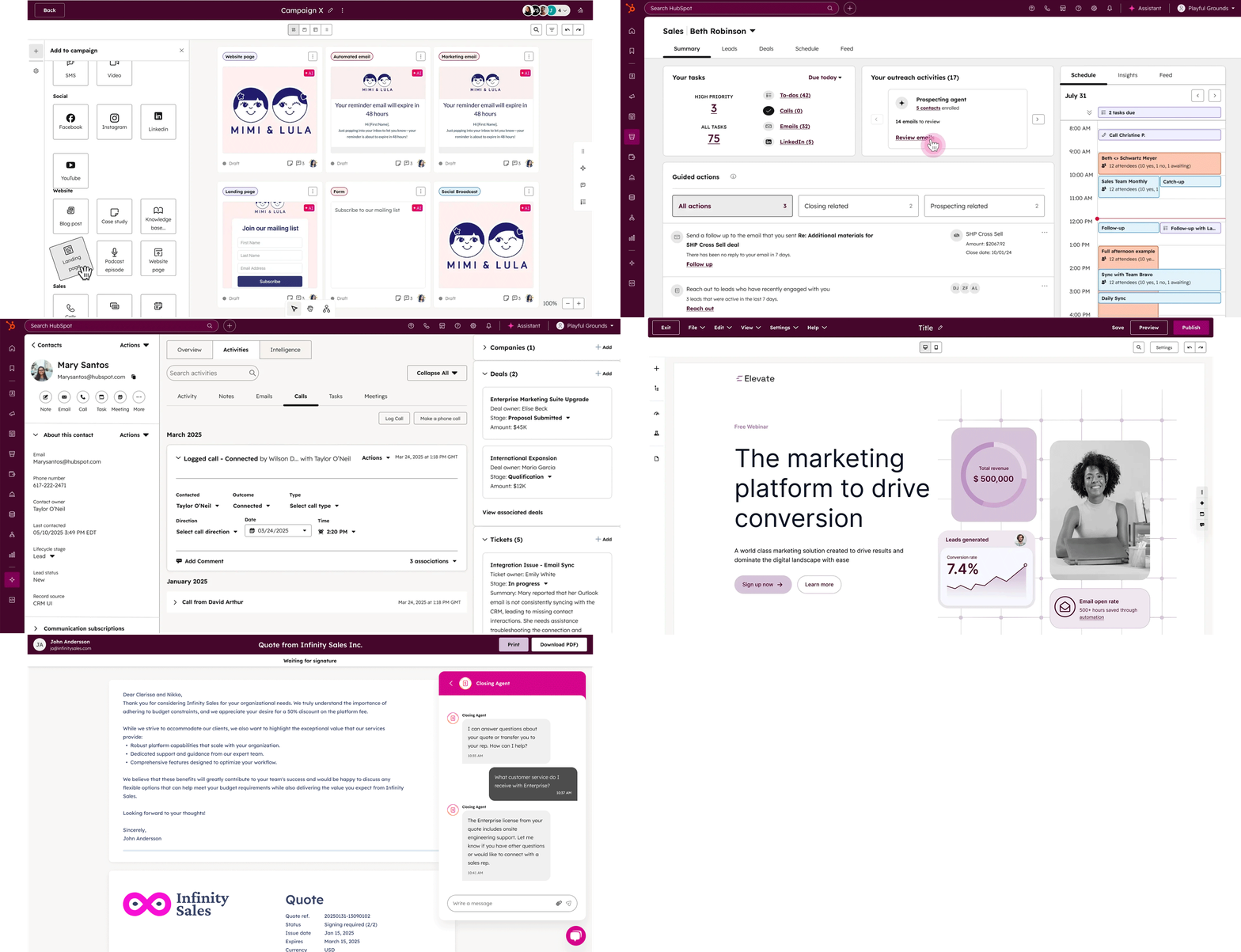
HubSpot's feature list is long. Marketing Hub handles email campaigns, social media, landing pages, SEO, and marketing automation. Sales Hub covers pipeline management, sequences, call tracking, CPQ, and forecasting. Service Hub adds ticketing, knowledge bases, and customer health scores. Content Hub handles websites and blogs. Commerce Hub manages quotes, invoices, and payments. Every hub shares the same contact database.
Source: HubSpot
For a company that needs marketing automation, sales pipeline management, customer service, and content management in one system, HubSpot delivers. You won't find this breadth anywhere else at this price point.
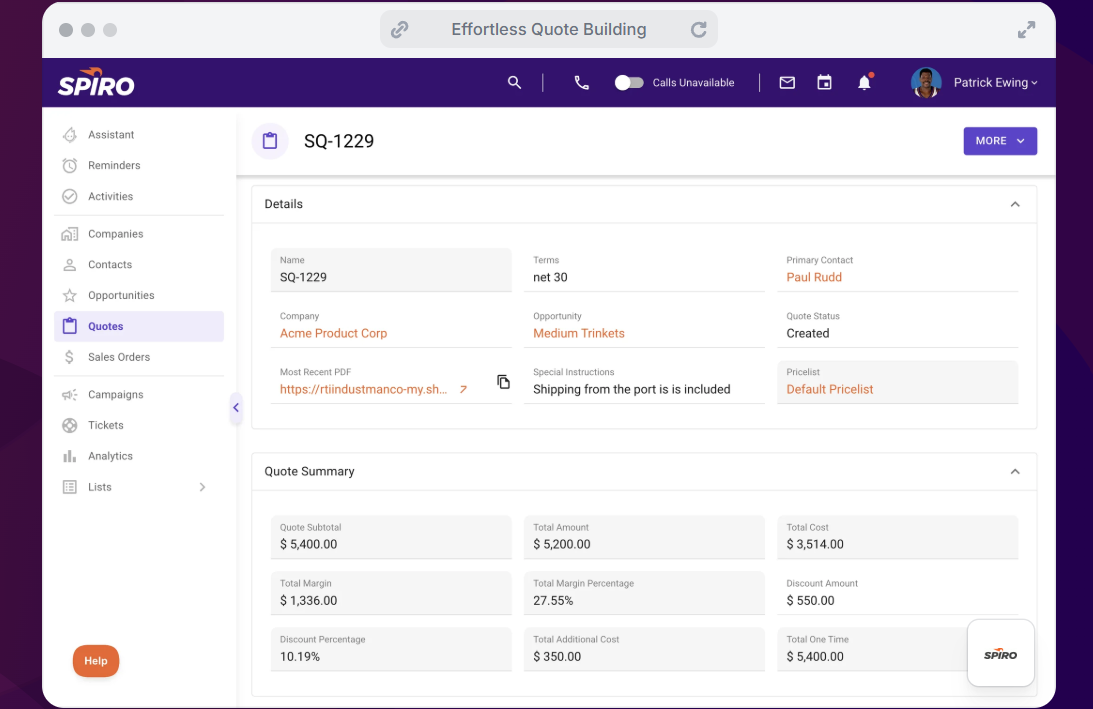
Spiro doesn't try to compete on breadth. Instead, it goes deep on the problems manufacturers face. ERP integration syncs order history, invoices, and product data directly onto customer records. AI-flagged reorder alerts warn reps when a regular buyer goes quiet. Route planning helps outside reps optimize field visits using live CRM and ERP data. Quoting pulls real-time pricing from the ERP so reps send accurate proposals without toggling between systems.
Source: Spiro
HubSpot doesn't do any of these natively. You can connect an ERP to HubSpot through third-party connectors, but you won't get order history on account records, reorder alerts based on purchasing patterns, or ERP-synced quoting without significant custom development.
The question is whether you need the broad platform or the vertical depth. For a SaaS company running content marketing and inbound sales, HubSpot is the clear fit. For a manufacturer whose sales team lives between their ERP and their phone, Spiro speaks their language.
The adoption problem is real, and the platforms address it differently
CRM adoption is where good intentions go to die. A 2024 benchmark survey from Spiro found that manufacturers were losing revenue due to customer visibility gaps caused in large part by CRMs their teams refused to use.
HubSpot addresses adoption through design. The interface is clean and consistent across all hubs. A permanently free CRM tier lets teams start without commitment. HubSpot Academy offers free certifications and training. The learning curve is real (especially for advanced workflows and reporting), but the basic experience is approachable enough that most users can be productive quickly.

Source: HubSpot
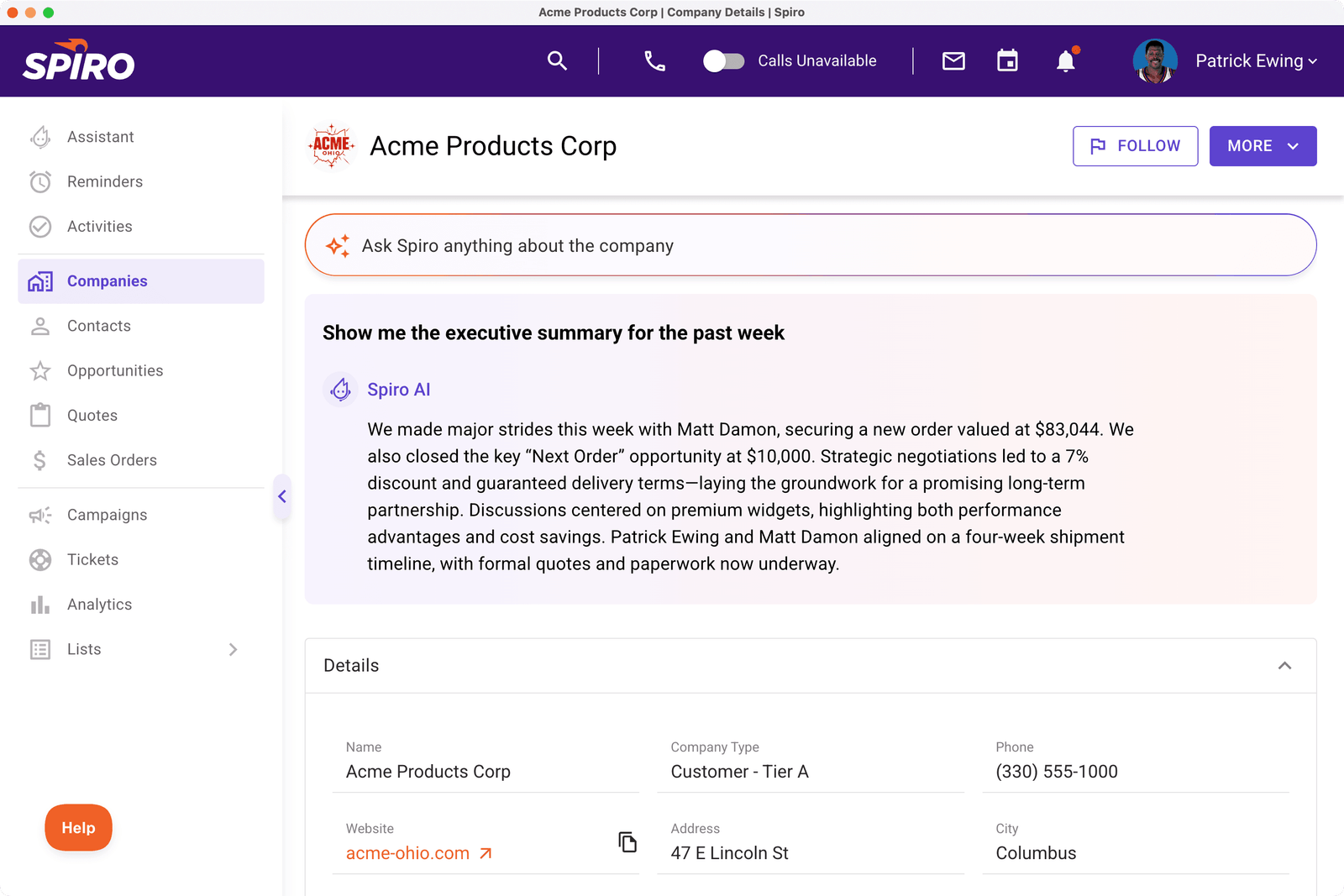
Spiro addresses adoption by removing the need for it. The platform's architecture ensures that sales teams get CRM benefits even without actively using it. Emails sync automatically. Calls log without clicking anything. ERP data flows in without exports. The AI writes executive summaries for every account, so managers don't need to chase reps for updates.
Source: Spiro
For teams where the biggest risk is that reps simply won't use the CRM, Spiro's automatic capture is a structural advantage. For teams where the CRM needs to do more than track activity (run campaigns, automate workflows, manage service tickets), HubSpot's broader feature set is worth the adoption investment.
Where both platforms fall short: prospecting and data intelligence
Here's the scenario neither platform handles well: your sales leader wants to break into a new territory, target companies using a competitor's product, or find the VP of Operations at 200 manufacturers in the Midwest. Where does that data come from?
HubSpot's database contains only the contacts your team has already collected through forms, imports, or manual entry. It doesn't generate new contacts. Spiro's database contains contacts captured from your team's emails and your ERP. It doesn't reach beyond your existing relationships.
This is where ZoomInfo changes the equation. The platform provides 500M contacts and 100M company profiles, verified through a multi-source pipeline backed by 300+ human researchers and achieving up to 95% accuracy on first-party data. But the data is only the starting point.
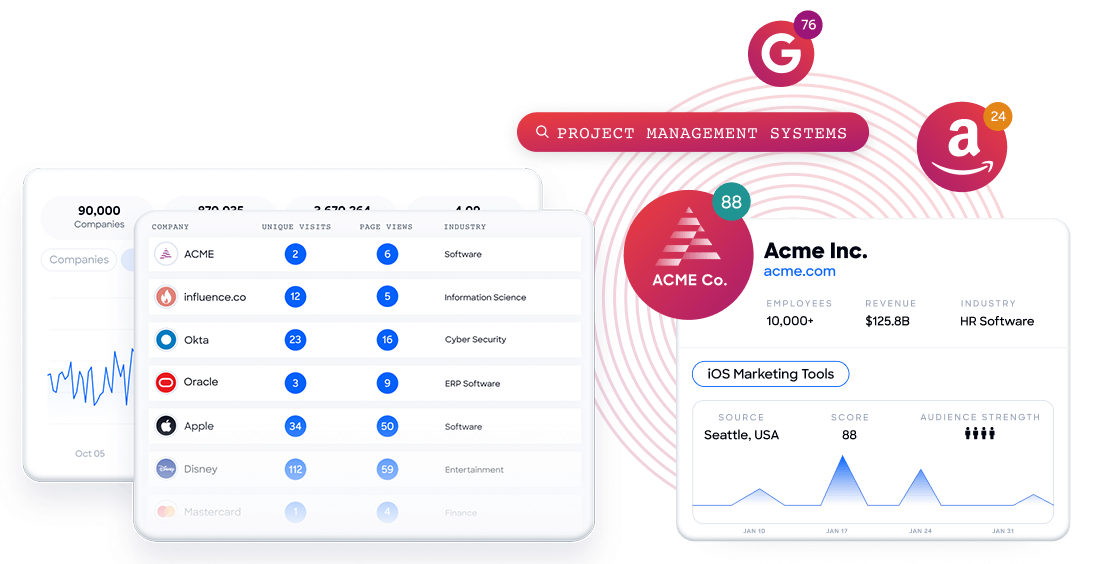
ZoomInfo's Buyer Intent tracks signals from 210 million IP-to-Organization pairings to identify when companies are researching topics related to what you sell. WebSights resolves anonymous website visitors to companies, telling you who's looking at your pricing page before they fill out a form. Guided Intent, exclusive to ZoomInfo, identifies the topics historically correlated with closed deals in your segment rather than requiring you to guess which keywords matter.
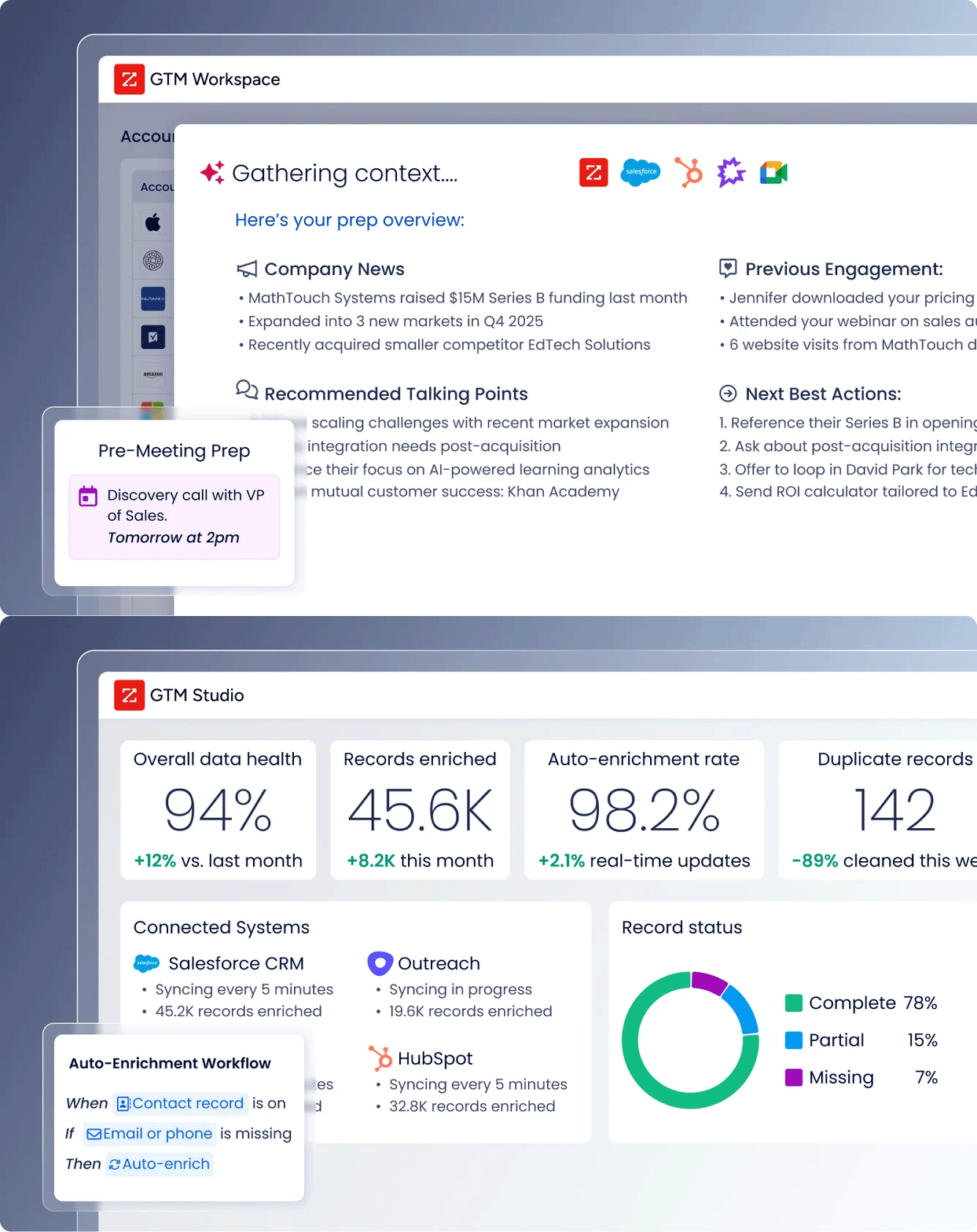
For sellers, GTM Workspace consolidates prioritized accounts, AI-drafted outreach, and buying signals into a single surface. For marketers and RevOps teams, GTM Studio lets you describe audiences in plain language, launch multi-channel plays, and measure pipeline impact without engineering support. And for teams that want this intelligence inside their existing tools, APIs and MCP deliver the same data into any application.
ZoomInfo integrates natively with HubSpot and works alongside any CRM. It's not a replacement for either platform. It's the prospecting and intelligence layer that makes whichever CRM you choose more effective.
For a detailed head-to-head breakdown of these two platforms, see our HubSpot vs. ZoomInfo comparison.
Seismic attributed 39% of active pipeline to opportunities identified or influenced by ZoomInfo signals, while boosting productivity by 54%. (Seismic Case Study)
AI capabilities take different shapes
All three platforms invest in AI, but their approaches reflect their core identities.
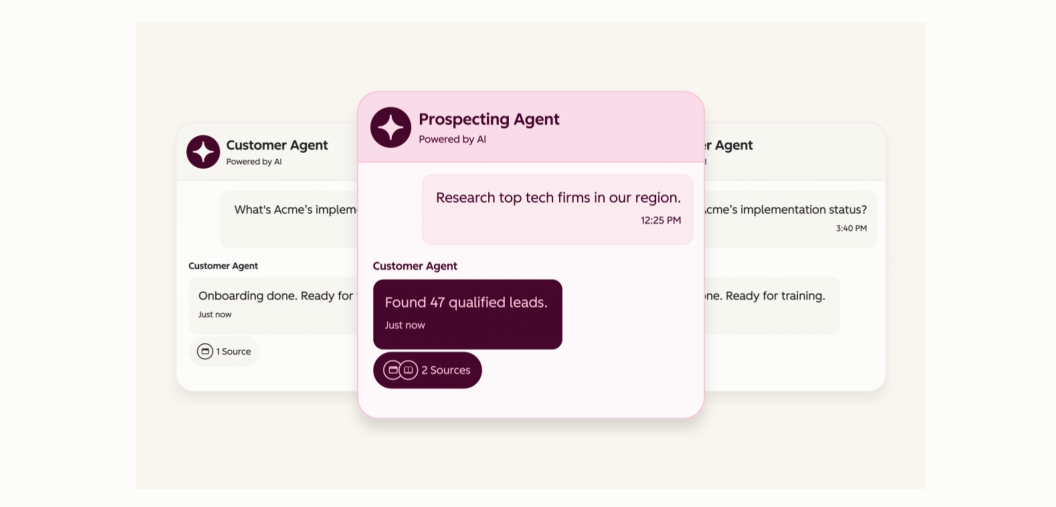
HubSpot's Breeze AI runs across the entire platform. The Customer Agent resolves over 50% of customer conversations autonomously. The Prospecting Agent drafts personalized outreach using the complete HubSpot customer history. The Data Agent answers natural-language questions about your CRM data. Because Breeze operates on HubSpot's unified data layer, it can reference marketing engagement, deal history, and service interactions when generating outputs. The limitation: Breeze only knows what's inside your HubSpot instance. It can't tell you about companies or contacts that haven't entered your system yet.
Source: HubSpot
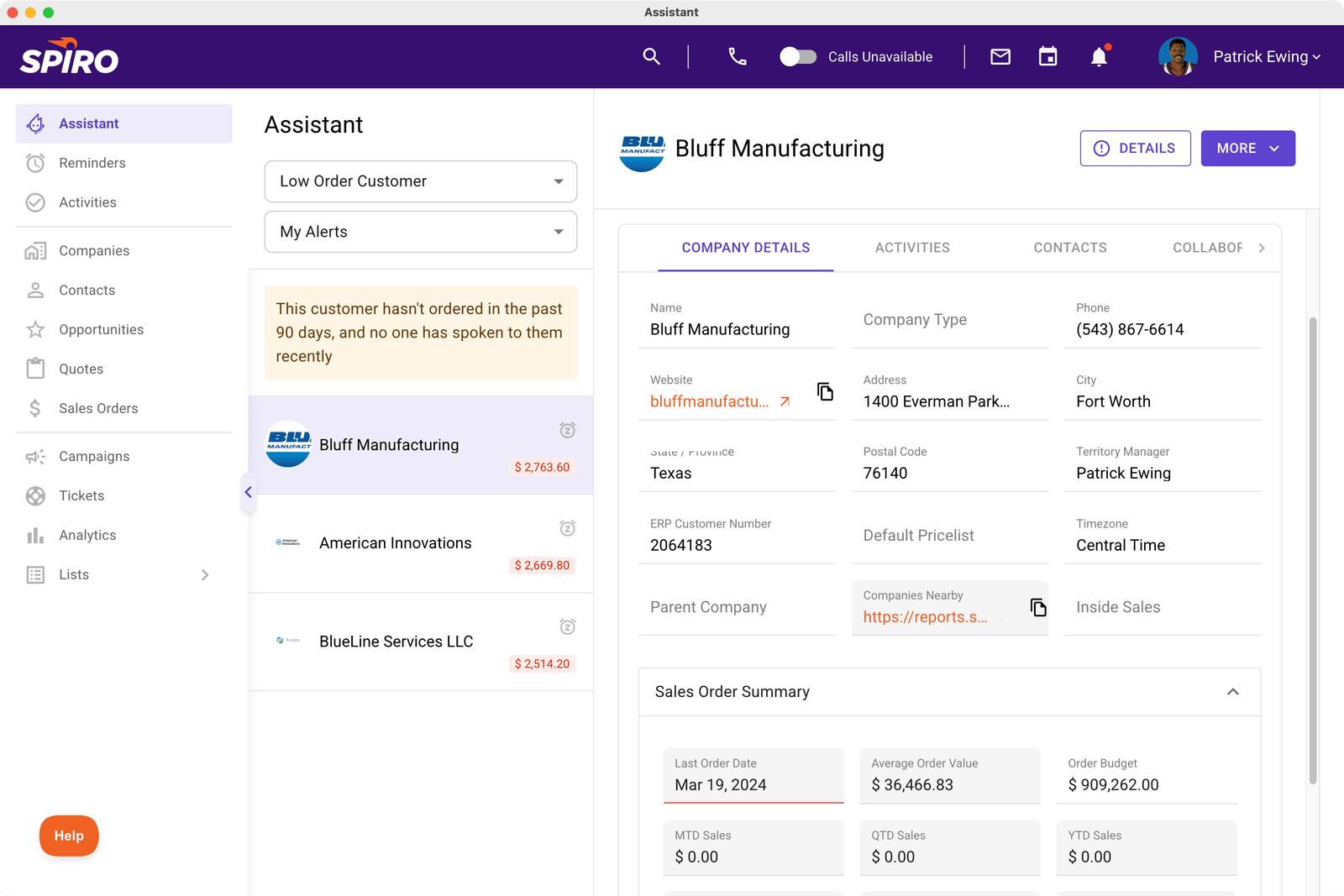
Spiro's AI focuses on a narrower set of problems. The AI Assistant flags stalled quotes, inactive accounts, and missed follow-ups. Ask Spiro lets reps query account history in natural language, even during live video meetings. Smart Assistant Rules create proactive reminders that auto-resolve when the triggering condition is met (a rep makes the call, the customer responds). The AI drafts follow-up emails after calls and generates weekly executive summaries for every account. These features are tightly scoped to the manufacturing sales workflow, and they work well within that scope.
Source: Spiro
ZoomInfo's AI operates on a different data foundation. The GTM Context Graph processes 1.5B+ data points daily, combining ZoomInfo's B2B data with your CRM records, conversation transcripts, and behavioral signals. The result is AI that doesn't just know what happened in a deal but understands why it happened. When a CFO joins a call and asks about ROI, the GTM Context Graph connects that signal to patterns across thousands of similar deals to predict what's likely to happen next and recommend what your rep should do.
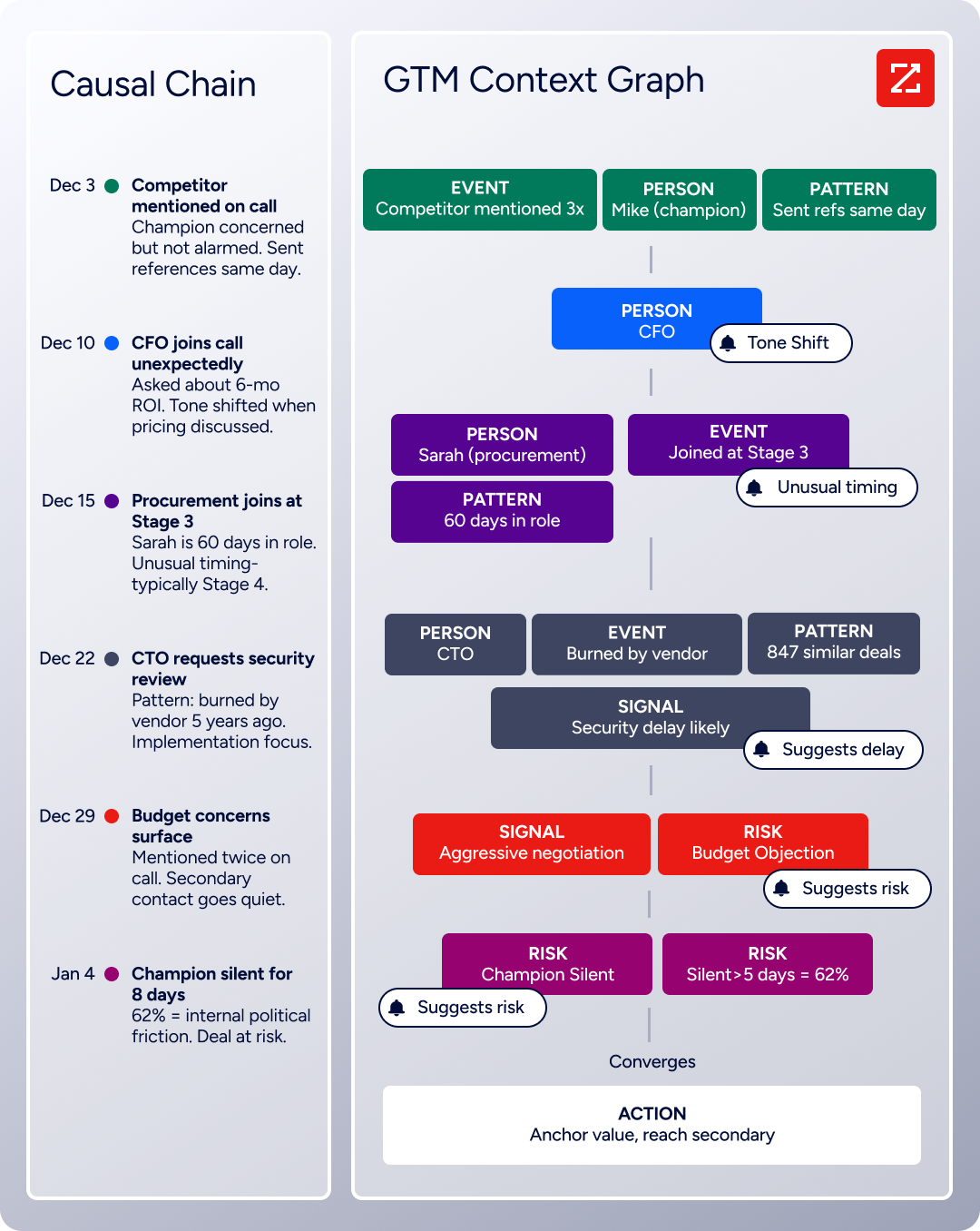
This distinction matters in practice. HubSpot's AI helps you work better with the contacts you have. Spiro's AI helps you stay on top of the accounts you manage. ZoomInfo's AI helps you find the right accounts to pursue and understand the buying signals that indicate when to act.
"ZoomInfo's not just a contact data company anymore. They've built a full system of execution that works the list, writes the outreach, triggers the play, and drives predictable growth." — Ian Brodie, CEO & Co-Founder (Levanta Case Study)
Pricing structures reflect what each platform values
HubSpot's pricing is the most complex of the three. The platform uses a hybrid model combining per-seat charges, per-hub subscriptions, and marketing contact tiers. Starter plans begin at $15/seat/month (annual), but the features most growing teams need live at the Professional tier: Marketing Hub Professional costs $800/month (annual) with a $3,000 mandatory onboarding fee, and Sales Hub Professional costs $90/seat/month (annual) with a $1,500 onboarding fee. A critical detail: if you subscribe to multiple hubs at different tiers, HubSpot bills all Core Seats at the highest tier rate. This can significantly increase total costs for organizations mixing Starter and Professional across departments.
Spiro's pricing is simpler but not cheap. Full licenses cost $1,500/user/year, with Read Only at $1,000/user/year and Email Sync Only at $500/user/year. The base license covers the core CRM, AI assistant, analytics, and email campaigns. But per-user add-ons stack up: Spiro Phone ($350/user/year), Notetaker ($420/user/year), and Routes ($480/user/year) bring the all-in cost to $2,750/user/year for field reps who need everything. Organizational modules like Quotes ($9,000/year) and Tickets ($5,000/year) are flat fees regardless of team size. Setup starts at $5,000.
ZoomInfo uses consumption-based pricing with no published dollar amounts. Pricing scales around seats, data credits, API consumption, and AI activity. This makes direct cost comparison difficult, but ZoomInfo offers two free entry points: ZoomInfo Lite (a permanent free tier with 10 monthly export credits, access to the B2B database, and basic prospecting tools) and a 7-day free trial of the full platform.
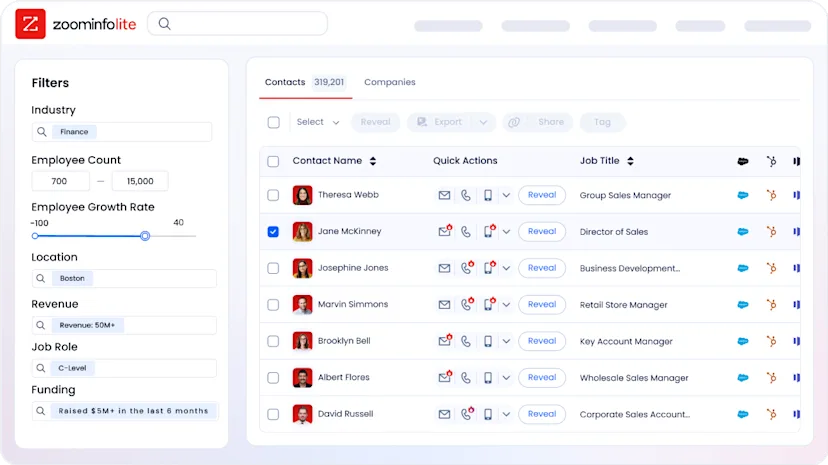
The pricing comparison that matters most isn't ZoomInfo versus HubSpot or Spiro. It's what your total GTM stack costs with and without ZoomInfo powering the data layer. A CRM full of stale contacts and no buying signals is expensive at any price.
Integration ecosystems serve different needs
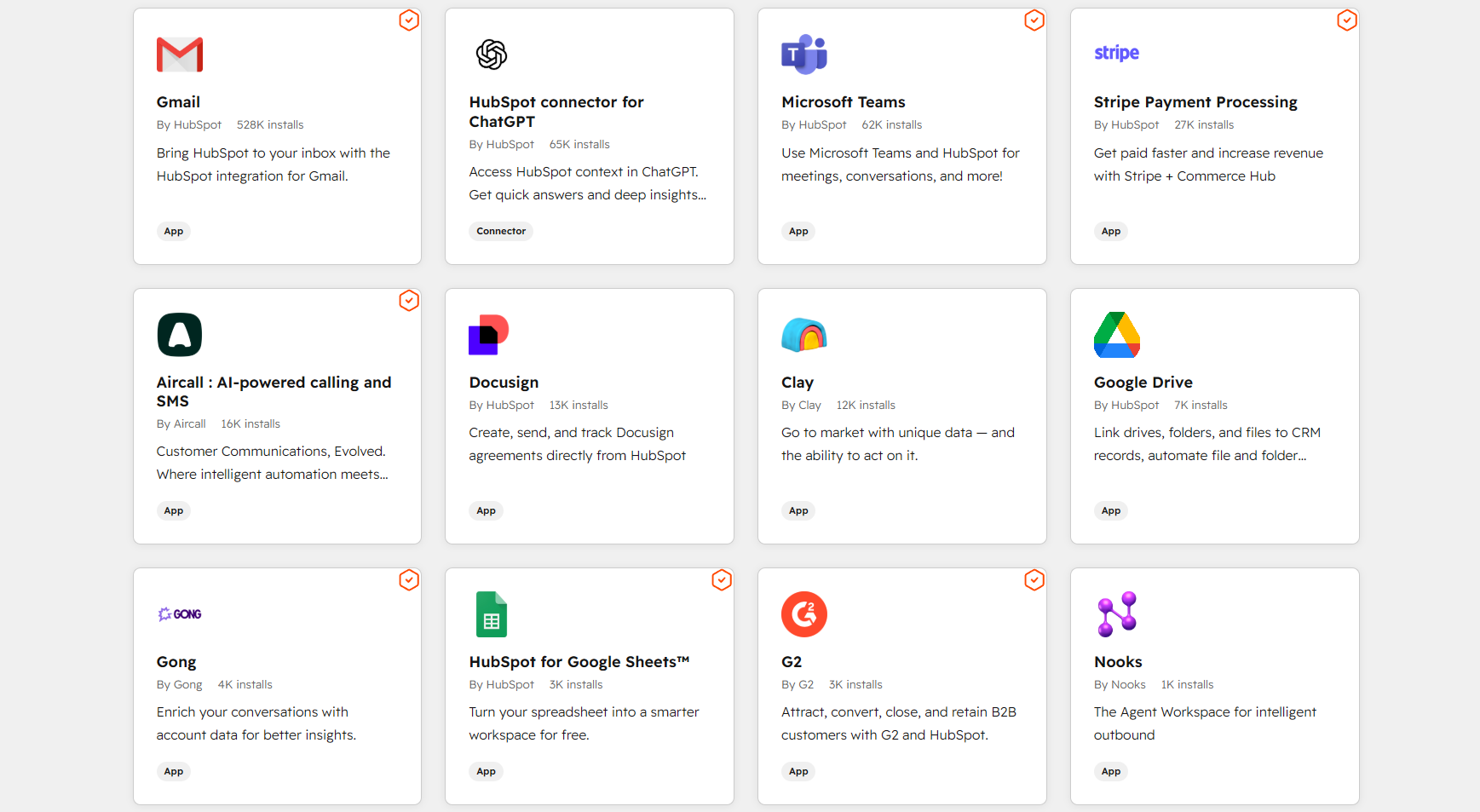
HubSpot's integration advantage is large. The App Marketplace offers 2,000+ integrations with 2.5 million active installs. Whatever tool your team uses (Slack, Shopify, Salesforce, Zoom, Google Workspace), there's likely a native connector. For technical teams, HubSpot provides a full developer platform with REST APIs, webhooks, custom UI extensions, and the ability to run JavaScript and Python natively inside workflows.
Source: HubSpot
Spiro's integration strategy is narrow by design. The platform focuses on the integrations that matter most to manufacturers: ERP connectors for SAP, Epicor, Infor, NetSuite, SYSPRO, JobBOSS, Acumatica, and Dynamics 365, plus email and calendar sync with Gmail, Office 365, and Exchange. Communication tools like Microsoft Teams, Zoom, and RingCentral connect for meeting and call capture. Spiro exposes a REST API for custom integrations, but the ecosystem is small compared to HubSpot's.
ZoomInfo takes a different approach: access from anywhere. The platform integrates with 120+ tools across CRM, marketing automation, sales engagement, and data warehouse categories, including native connectors for Salesforce, HubSpot, and Microsoft Dynamics. The Enterprise API provides programmatic access to ZoomInfo's data and intelligence for any custom application. And the MCP server connects AI models directly to ZoomInfo's B2B data with no custom coding, currently supporting Claude and ChatGPT. API access is included in all relevant plans.
BDO Canada achieved an 87% reduction in time spent on data dashboard updates using ZoomInfo's API: "The plug-and-play aspect means I can integrate it very easily into any process and get information at a moment's notice." — Jerry Wilson, Senior Marketing Intelligence Analyst (BDO Canada Case Study)
Support models reveal who each platform is built for
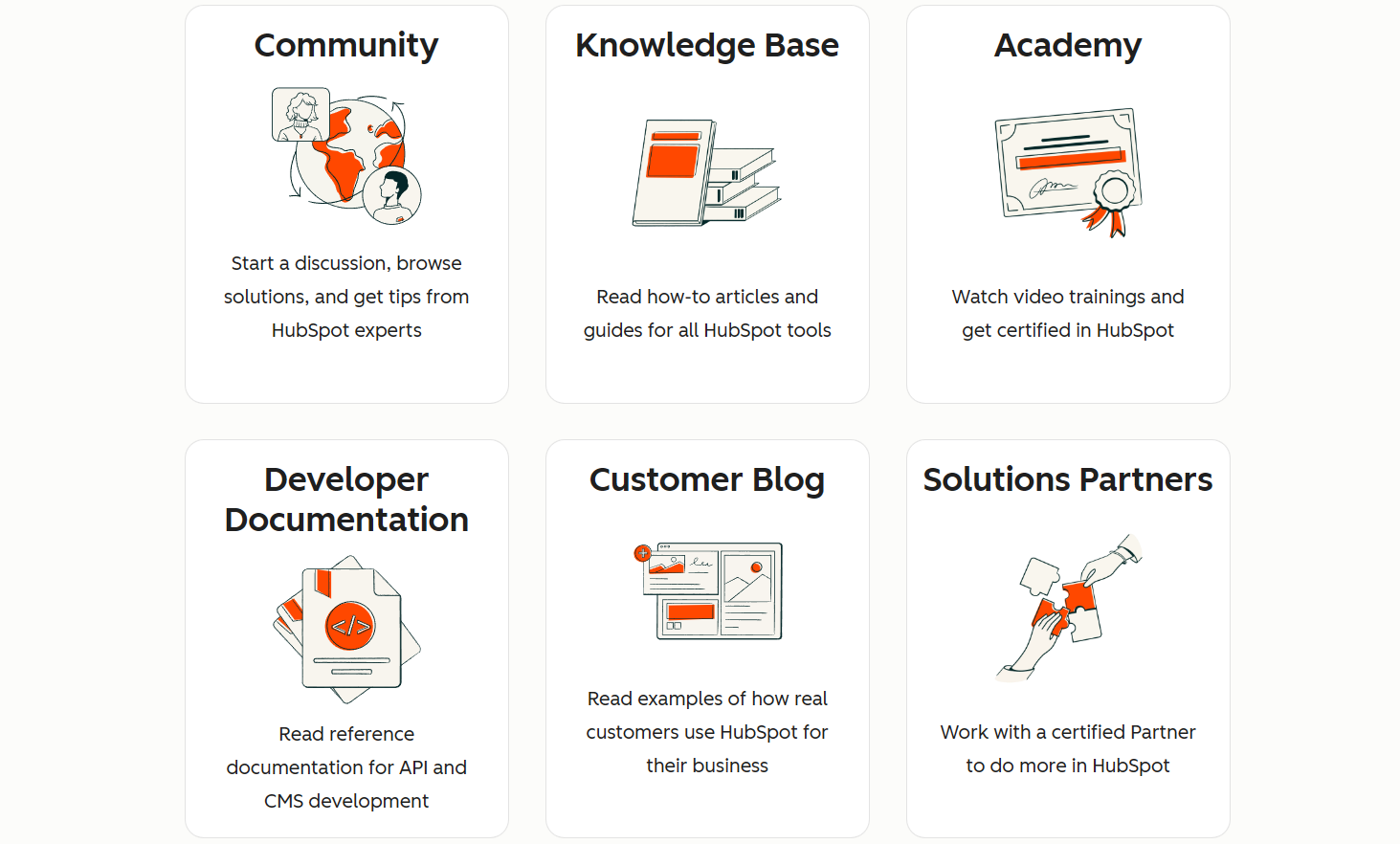
HubSpot's support scales with your subscription. Free users get community forums only. Starter adds email and chat. Professional and Enterprise unlock phone support. Beyond direct support, HubSpot maintains an extensive Knowledge Base in 17+ languages, a Solutions Partner ecosystem for implementation help, and HubSpot Academy with over 200,000 certified professionals. The self-serve resources are excellent, but complex implementations depend heavily on the partner ecosystem since HubSpot's own professional services generate only about 2% of total revenue.
Source: HubSpot
Spiro takes the opposite approach. Customer Success is included with every subscription at no extra charge. Every customer gets a named, US-based Customer Success Manager. The engagement follows a structured cadence: biweekly meetings during early adoption, monthly check-ins in year one, then quarterly strategic reviews. Spiro handles all implementation internally with no handoff to third-party consultants. The same team that sets up your ERP integration and migrates your data supports you long-term. For mid-market manufacturers without dedicated IT resources, this hands-on model removes a significant barrier.
ZoomInfo provides support through its Help Center, ZoomInfo University (role-specific learning paths and certifications), direct support via phone, and professional services through ZoomInfo Labs. The company redesigned its onboarding program from 30 to 90 days, producing a 25% improvement in customer satisfaction scores. Enterprise customers get dedicated support and guided onboarding.
Security and compliance at a glance
All three platforms maintain enterprise-grade security, but with different certification profiles.
HubSpot holds SOC 2 Type II, HIPAA attestation, TRUSTe certification, and GDPR/CCPA compliance. Data is encrypted with AES-256 at rest and TLS 1.2/1.3 in transit. EU data center available. SSO and 2FA supported.
Spiro holds SOC 2 Type II certification and is GDPR-compliant. Infrastructure runs on Heroku and AWS with encrypted data at rest and in transit. SSO via Okta, Google, and Microsoft. Spiro is not HIPAA-compliant.
ZoomInfo holds ISO 27001, ISO 27701, SOC 2 Type II, TRUSTe GDPR, and TRUSTe CCPA certifications, all renewed annually. As a B2B data provider, ZoomInfo is also a registered data broker in California and Vermont, maintaining a dedicated Trust Center with published compliance documentation.
HubSpot vs. Spiro vs. ZoomInfo: Which should you choose?
The right choice depends on where your biggest gap is.
Choose HubSpot if:
You need marketing automation, sales pipeline management, and customer service in one platform
Your growth depends on generating inbound leads through content and digital campaigns
You want a large integration ecosystem connecting to every tool your team uses
Your sales process fits a standard pipeline model rather than a repeat-order model
You have the budget for Professional or Enterprise tiers and the team to use advanced features
Choose Spiro if:
You're a North American manufacturer with 10+ salespeople and an ERP system
Your revenue comes primarily from repeat orders and long-term account relationships
Your biggest problem is that reps don't use your current CRM and leadership has no visibility
You need order history, reorder alerts, and quoting that syncs with your ERP
You want implementation from the vendor's own team, not third-party consultants
Add ZoomInfo if:
You need to find new prospects beyond your existing contacts and accounts
You want verified direct-dial phone numbers and emails for decision-makers at target companies
Knowing which companies are researching your category would change how you prioritize outreach
You want AI-powered account intelligence and buying signals integrated into your CRM workflow
You're building an outbound motion and need data that your CRM alone can't provide
Start with ZoomInfo Lite for free or try the full platform for 7 days.
HubSpot and Spiro each solve the CRM problem well for different audiences. But CRM is only half the equation. The other half is knowing who to sell to, when to reach out, and what's happening in your target accounts before your competitors find out. That's the layer ZoomInfo provides, and it works alongside whichever CRM fits your business.
"ZoomInfo gives us the information we need to execute. It's already there, so we can be three steps ahead." — William Kenimer, Vice President of Revenue Operations (Vensure Case Study)
HubSpot vs. Spiro vs. ZoomInfo FAQ
What is the core difference between HubSpot, Spiro, and ZoomInfo?
HubSpot is a full-suite CRM platform combining marketing automation, sales pipeline management, customer service, and content tools under one roof. Spiro is a manufacturing-focused CRM that automatically captures sales activity and syncs with ERP systems, built for teams that need account visibility without manual data entry. ZoomInfo is an all-in-one AI GTM platform that provides verified contact data, company insights, and buying signals to power prospecting and pipeline generation. ZoomInfo integrates with both HubSpot and other CRMs rather than replacing them.
Which platform is best for a manufacturing company?
Spiro is designed for manufacturers, with native ERP integration (SAP, Epicor, Infor, NetSuite, and others), automatic data capture that eliminates the CRM adoption problem, and features like reorder alerts and route planning designed for manufacturing sales teams. HubSpot can serve manufacturers but requires custom configuration and third-party connectors to replicate ERP integration. ZoomInfo complements either choice by providing the prospecting data and buying signals that help manufacturing sales teams find new accounts beyond their existing customer base.
Can ZoomInfo replace HubSpot or Spiro?
No. ZoomInfo is not a CRM. It does not manage deals, store customer service tickets, or run marketing automation workflows. ZoomInfo provides the B2B data, contact intelligence, and buying signals that feed into a CRM. It integrates natively with HubSpot and works alongside other CRMs. The strongest setup combines a CRM (HubSpot or Spiro, depending on your needs) with ZoomInfo's data layer to ensure your team has both the management tools and the prospecting intelligence they need.
How does pricing compare across the three platforms?
HubSpot uses a hybrid model of per-seat and per-hub pricing, with Starter plans beginning at $15/seat/month (annual) and Professional tiers reaching $800/month for Marketing Hub plus $90/seat/month for Sales Hub, with mandatory onboarding fees of $1,500 to $7,000. Spiro charges $1,500/user/year for a full license, with add-ons for phone, notetaker, and route planning that can bring the all-in cost to $2,750/user/year, plus a setup fee starting at $5,000. ZoomInfo uses consumption-based pricing based on seats, credits, and AI usage, but offers a permanent free tier (ZoomInfo Lite) and a 7-day free trial.
Does Spiro work outside of manufacturing?
No. Spiro explicitly states it is not a fit for companies outside manufacturing, teams under 10 people, those outside North America, or those unwilling to fully replace their current CRM. The platform's ERP integration, order-based analytics, and account management features are designed specifically for manufacturers and distributors with repeat-order revenue models.
Which platform has the best AI capabilities?
Each platform's AI serves a different purpose. HubSpot's Breeze AI spans marketing, sales, and service with agents that automate customer support, draft outreach using CRM history, and answer data questions in natural language. Spiro's AI flags stalled quotes and inactive accounts, drafts follow-up emails, and generates executive summaries automatically. ZoomInfo's GTM Context Graph (processing 1.5B+ data points daily) identifies buying signals, recommends accounts, and generates AI-powered outreach based on both third-party intelligence and your CRM data. HubSpot's AI is broadest, Spiro's is most manufacturing-specific, and ZoomInfo's operates on the largest external data foundation.
Can I use ZoomInfo with HubSpot?
Yes. ZoomInfo has a native HubSpot integration listed in both the ZoomInfo App Marketplace and HubSpot's App Marketplace. The integration syncs verified contact and company data, enriches CRM records, and delivers buying signals directly into HubSpot workflows. ZoomInfo Lite (the free tier) also includes HubSpot integration. This combination gives teams HubSpot's CRM and marketing tools powered by ZoomInfo's B2B data and intelligence.
Which platform is easiest to adopt for a sales team that hates CRM?
Spiro is designed for this scenario. Its automatic data capture means the CRM has accurate data regardless of whether reps actively use it, because emails, calls, and ERP orders log without any manual input. HubSpot requires more active use to deliver value, though its interface is intuitive. ZoomInfo's GTM Workspace is designed for seller adoption with AI that handles administrative work, but it serves a different function (prospecting and signals) than a CRM.
See how HubSpot measures up against other platforms:
