
Choosing between Intentsify vs. Bombora for your B2B intent data often comes down to five questions:
Do you need intent data as a signal feed, or do you also need help acting on those signals?
Is knowing which companies are researching enough, or do you need to know which people within those companies are involved?
Are you willing to run programs yourself, or would you rather have a team manage activation for you?
Does your existing tech stack already include the contact data and execution tools to turn intent signals into pipeline?
How important is it that your intent models are customized to your products rather than built from a generic topic taxonomy?
In short, here's what we recommend:
Intentsify is the choice for B2B marketing teams that want intent data paired with managed execution. Its Orbit Intelligence platform processes 1.1 trillion intent signals per month from nine sources and uses AI to build custom intent models calibrated to each customer's products, not a generic topic list. Intentsify's key capability is Buying Group Intent, which identifies which personas within a buying committee are actively researching. Their managed service model handles everything from digital advertising to content syndication to email campaigns.
The trade-off: no self-serve platform to adjust campaigns in real time, high pricing that can limit smaller budgets, and persona-level contact data restricted to the U.S. due to GDPR constraints.
Bombora is the choice for teams that already have an established tech stack and need a recognized intent data feed plugged into it. Bombora built and operates the Data Co-op, a consent-based network of 200+ publishers and 5,500+ B2B media sites where 86% of the data is shared exclusively with Bombora. Its Company Surge scoring identifies accounts researching topics above their historical baseline, and the data flows into 100+ partner platforms including Salesforce, HubSpot, 6sense, and LinkedIn.
The trade-off: intent signals are account-level only (no individual identification), there's no native activation capability, and getting started requires a sales conversation with no self-serve option.
Both platforms deliver good intent data. But intent signals alone don't close deals. Your team still needs verified contact data for the people they need to reach, execution tools that turn signals into coordinated outreach, and an intelligence layer that connects intent data to deal outcomes. That's where a GTM platform fills the gap.
ZoomInfo is an AI-powered GTM platform built on the largest B2B dataset in the industry: 500M contacts, 100M companies, 135M+ verified phone numbers, and 200M+ verified business emails. That data foundation fuels ZoomInfo's GTM Context Graph, an intelligence layer that unifies your CRM records, conversation transcripts, and behavioral signals with the 1.5B+ data points ZoomInfo processes daily.
This captures why deals move or stall, so the AI drafting your next follow-up understands the concern behind the conversation, your next GTM play targets accounts matching your actual win patterns, and your next forecast reflects buying evidence rather than rep optimism.
Your team can use this intelligence through GTM Workspace for sellers, GTM Studio for marketers and RevOps, or APIs and MCP in any front-end. For teams that need intent data, contact data, and execution in one platform, ZoomInfo eliminates the need to stitch together multiple vendors.
If a platform combining intent signals, verified contacts, and AI-powered execution sounds like what your GTM team needs, see ZoomInfo in action with a free trial.
Intentsify vs. Bombora vs. ZoomInfo at a glance
Intentsify | Bombora | ZoomInfo | |
|---|---|---|---|
Core approach | Intent data + managed activation | Intent data infrastructure | AI-powered GTM platform |
Intent signal scale | 1.1T signals/month from 9 sources | ||
Topic coverage | Custom topics + Guided Intent | ||
Intelligence depth | Persona and buying group level | Account level only | Full context (account + persona + deal intelligence) |
Contact data | 382M records (U.S. persona data) | No native contact database | 500M contacts, 135M+ verified phones |
Activation tools | Managed ads, lead gen, email, events | None (data layer only) | Native GTM Workspace, GTM Studio, ad platform |
Free entry point | None | None | ZoomInfo Lite (free) + 7-day trial |
Analyst recognition | Forrester Wave Leader + IDC MarketScape Leader | Forrester Wave Leader + Gartner MQ Leader | |
Best for | Teams wanting managed intent-to-pipeline programs | Teams needing an intent data feed for existing tools | Teams wanting data, intelligence, and execution in one platform |
How each platform sources intent signals
The quality of intent data depends on where signals come from and how they're processed. The three platforms take different approaches.
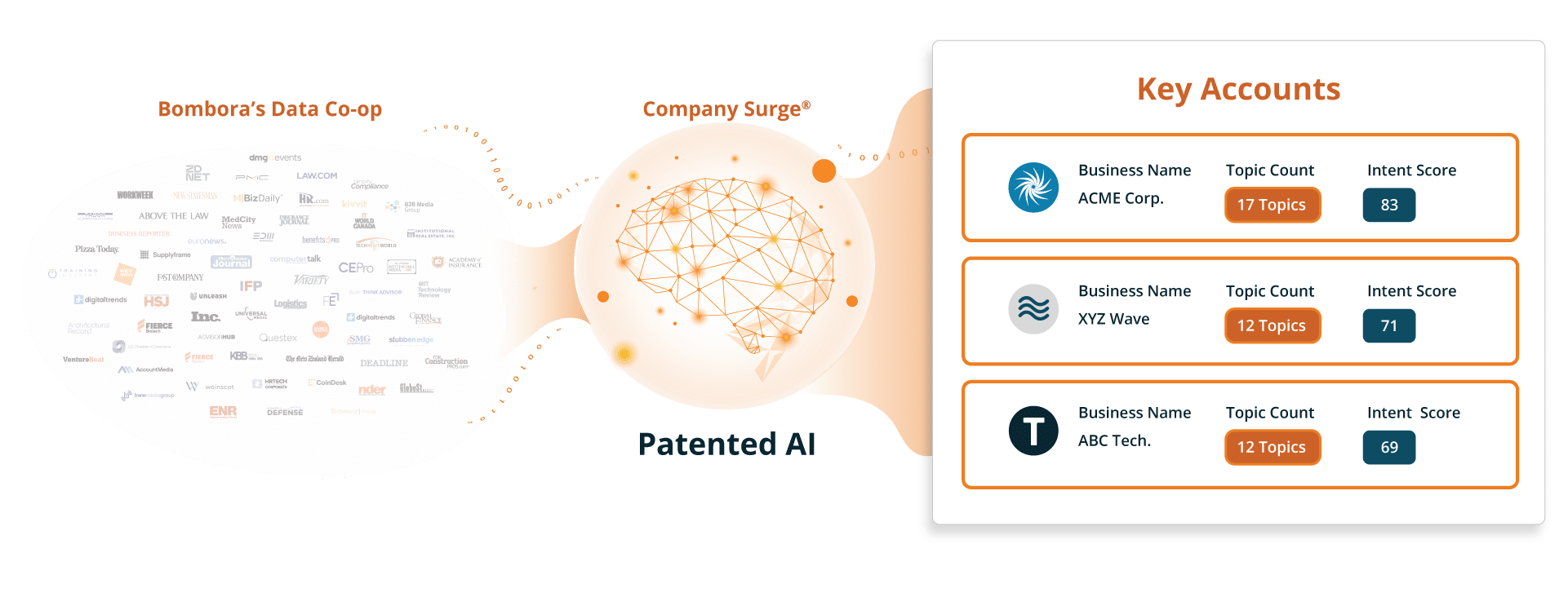
Bombora collects signals through its proprietary Data Co-op, a cooperative network where B2B publishers share anonymized content consumption data. Bombora places a JavaScript tag directly on publisher pages, capturing engagement from gated content, paywalled articles, whitepapers, form fills, downloads, and registrations. This gives Bombora visibility into research activity that bidstream-based competitors (which rely on ad auction metadata) miss entirely.
The Co-op's defining trait is exclusivity: 86% of the data goes to Bombora alone for deriving intent, meaning no other provider can reproduce the same signals. Consent is collected in 100% of events, positioning the data as durable as privacy regulations tighten.
Source: Bombora
Company Surge applies a patented methodology that measures each company's current content consumption against its own historical baseline. Rather than flagging absolute activity volume, the system detects statistically significant deviations, identifying when a company's research on a given topic spikes above normal. Scores range from 0 to 100, with 60+ indicating a surge. The approach accounts for the fact that a technology company will naturally consume more software content than a restaurant chain; baselines are company-specific.
For a closer look at how Bombora performs in practice, see our Bombora review.
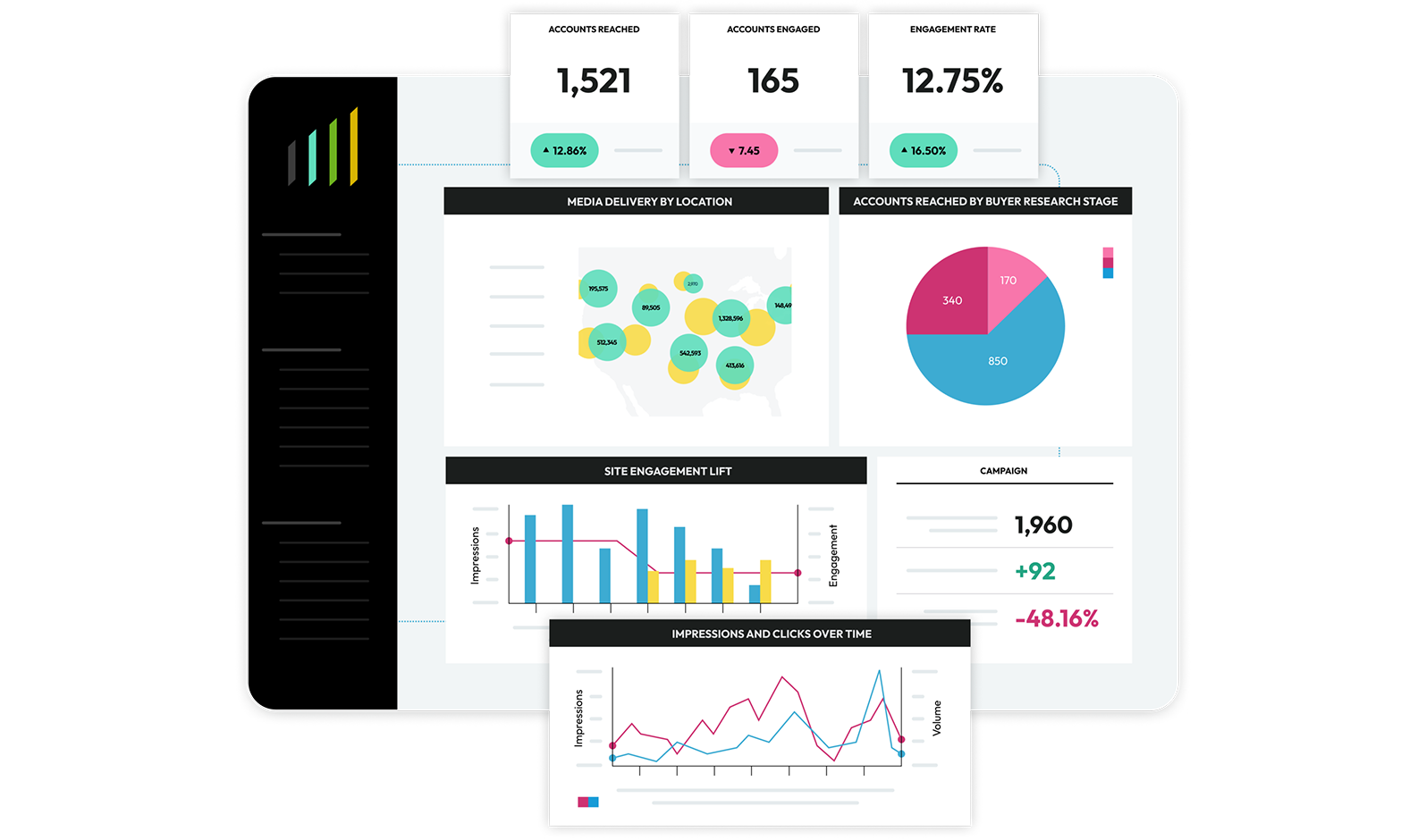
Intentsify aggregates signals from nine sources across 460,000+ B2B content sites, including content consumption, ad engagement, social activity, website visits, and business events. The breadth of collection is designed to triangulate intent rather than rely on a single signal type.
Source: Intentsify
What separates Intentsify is how it calibrates models. Rather than selecting from a pre-built topic taxonomy, Intentsify's AI scans a customer's own websites and PDFs to identify and weight the most relevant topics and keywords. The result is a custom intent model for each business. If you sell endpoint security software, your intent model reflects the specific language, competitor names, and use cases relevant to your product, not a generic "cybersecurity" topic. Intentsify secured two U.S. patents in September 2025 protecting these AI-driven scoring methods.
ZoomInfo operates its own intent collection infrastructure, tracking signals from 210 million IP-to-Organization pairings and 6 trillion+ keyword-to-device pairings sourced monthly. ZoomInfo's distinguishing feature is Guided Intent, which identifies topics historically correlated with deal success in your business rather than requiring manual topic selection. Instead of guessing which topics matter, the system learns from your closed-won deals which research patterns predict a purchase.
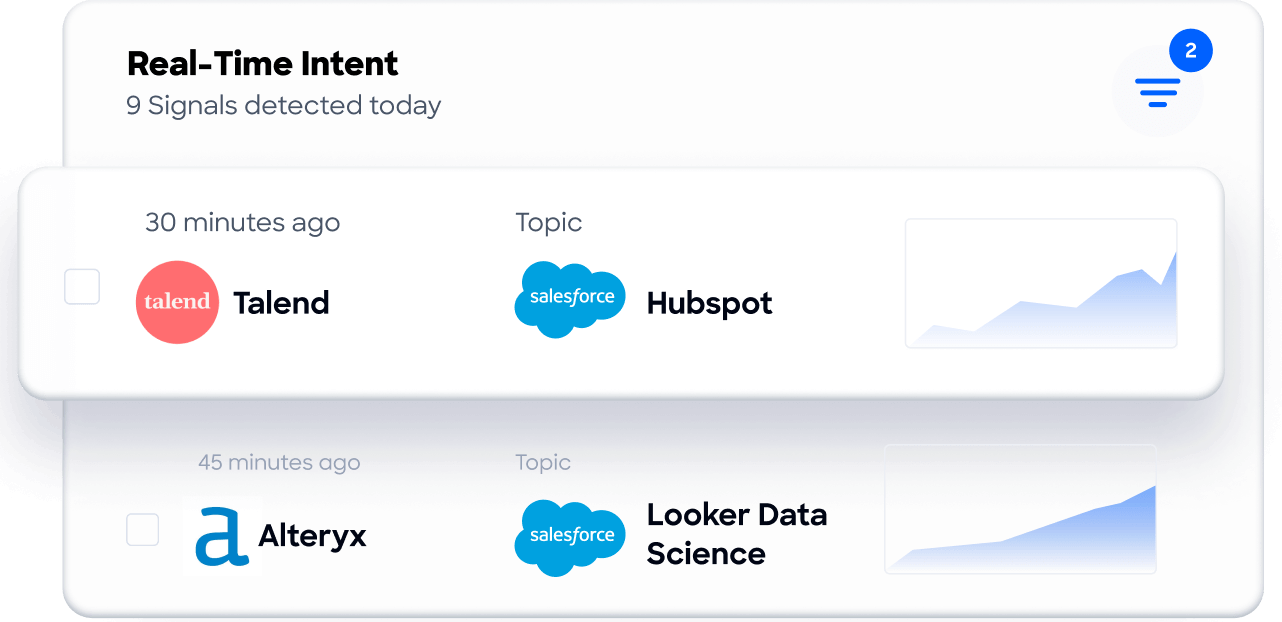
The structural difference: Bombora and Intentsify sell intent data that feeds into your existing tools. ZoomInfo's intent signals are one layer in a platform that also includes the contact data, company intelligence, and execution tools needed to act on those signals immediately.
From account-level to full-context intelligence
How deep each platform can see into a buying decision is one of the biggest differences between them.
Bombora's Company Surge operates at the account level. It can tell you that Acme Corp is researching "CRM software" with above-normal intensity. It cannot tell you who at Acme Corp is doing that research, their job title, or where they sit in the buying process. Buyers needing person-level intelligence must combine Bombora with separate identity resolution tools or contact databases. Bombora does offer Identity and Enrichment and Digital Audiences products that address the activation gap, but these are separate products layered on top of the core intent feed, not native to Company Surge itself.
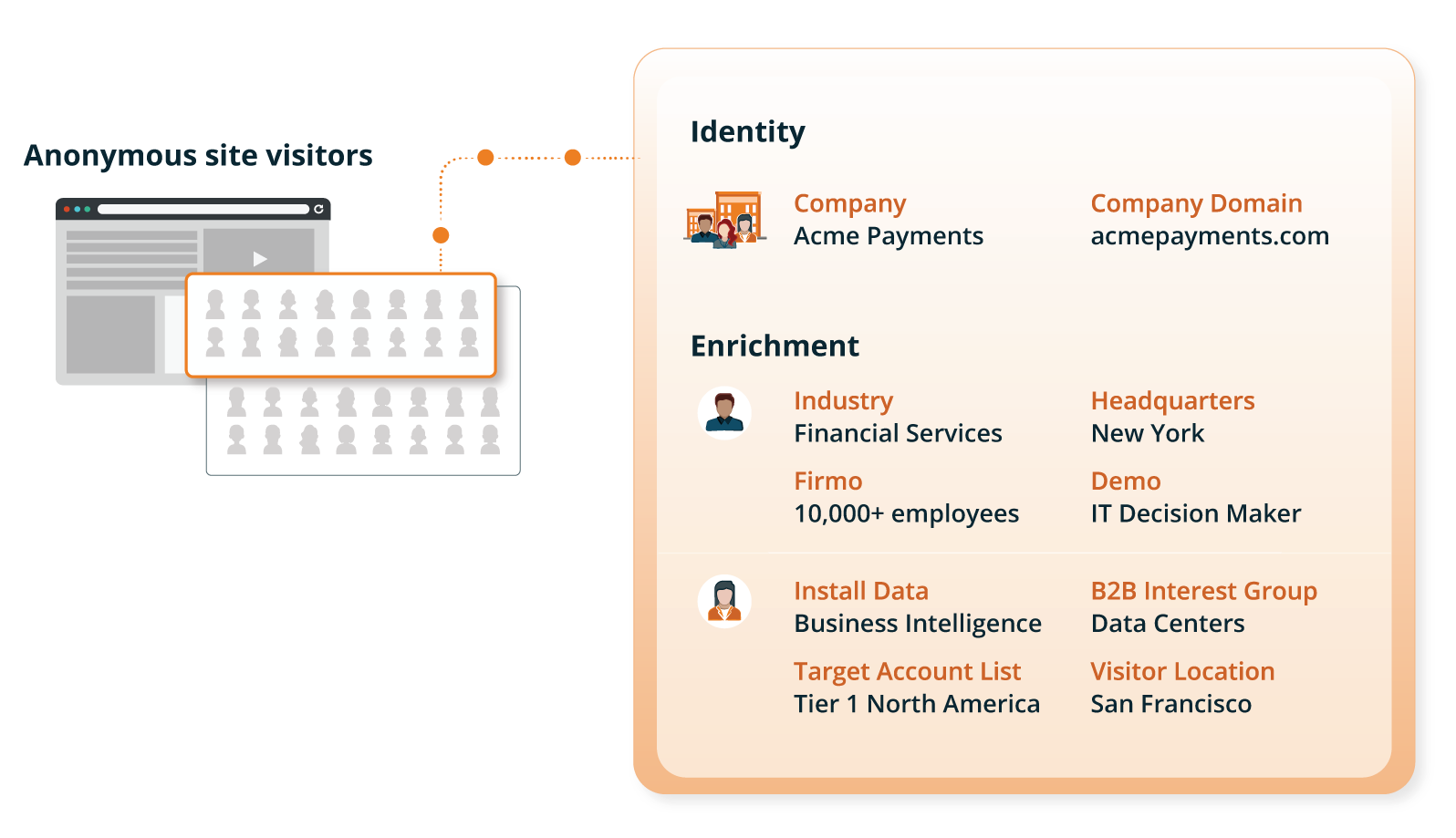
Source: Bombora
Intentsify goes deeper with Buying Group Intent, which the company describes as the first offering to provide intent data at the buying-group and persona level. Instead of just flagging that a company is in-market, it identifies which roles (CIO, VP of Engineering, procurement lead) are actively researching and assigns individual topic scores tracking each persona's interest levels over time. The system also produces an aggregated buying-group interest score (high, medium, or low) across the committee, and can surface new titles and functions not included in initial targeting. This matters for enterprise sales teams running multi-threaded outreach, though persona-level contact data is currently limited to U.S. customers.
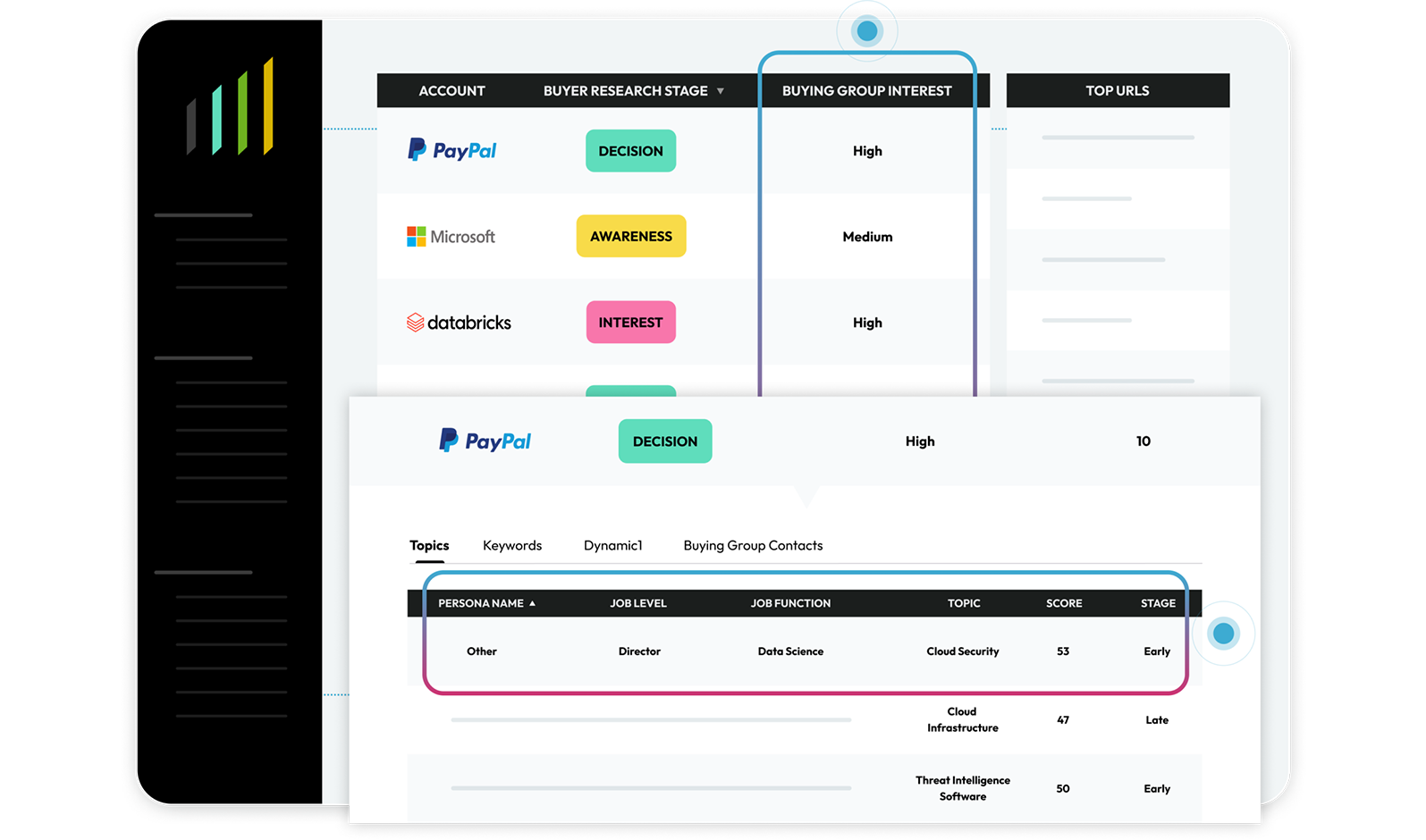
Source: Intentsify
ZoomInfo takes a different approach. Rather than delivering intent signals in isolation, the GTM Context Graph (an intelligence layer processing 1.5B+ data points daily) fuses intent data with CRM records, conversation intelligence from Chorus (capturing every call, meeting, and email), and behavioral signals to surface the full context behind account activity. The system doesn't just identify that a company is researching or that a persona is active. It captures why a deal moved to the next stage (the CFO joined the call and asked about ROI), why a champion went quiet (internal budget freeze), and which signal combinations match the patterns behind your actual closed-won deals.
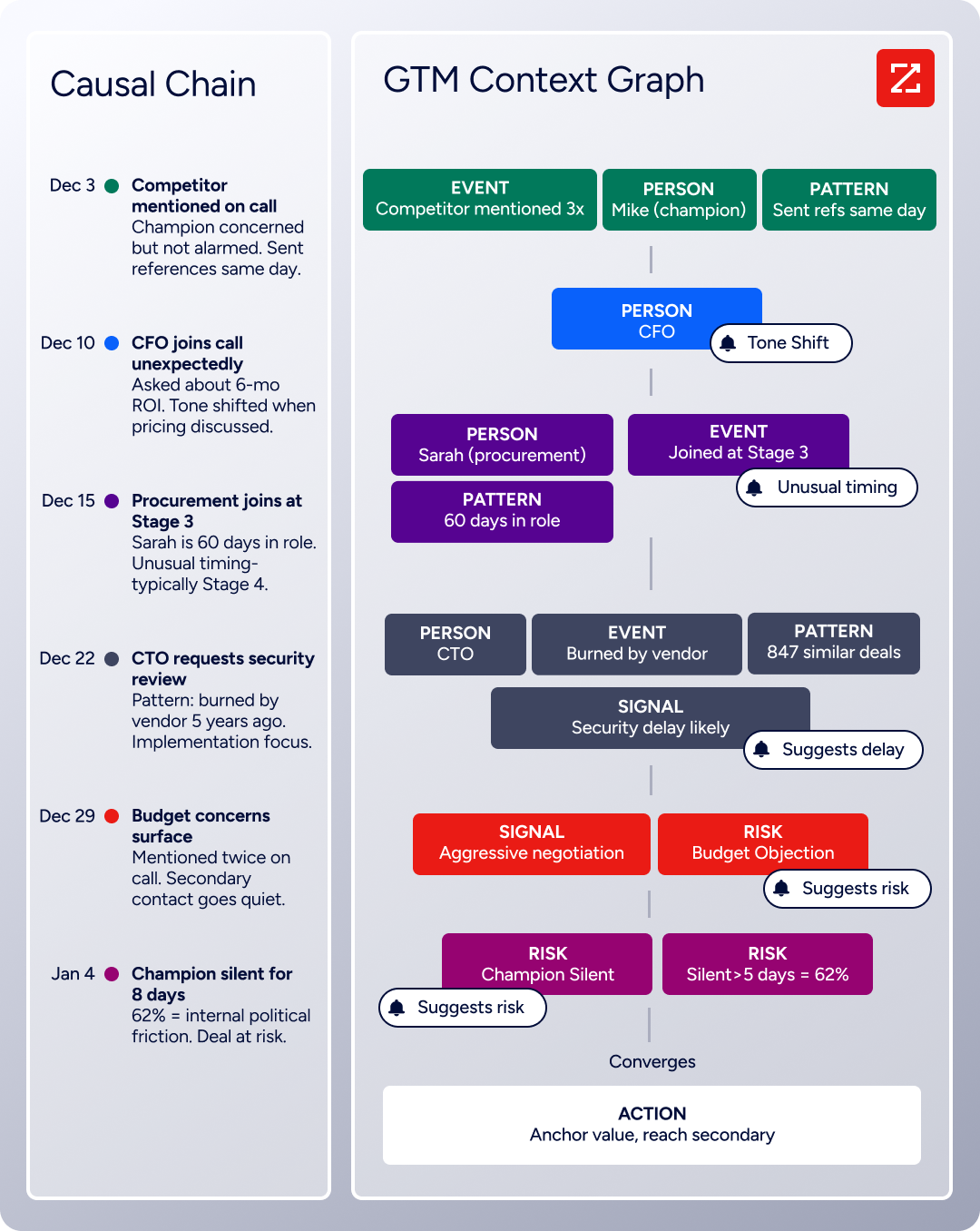
This distinction matters in practice. Account-level intent tells your team where to look. Persona-level intent tells them who to reach. Full-context intelligence tells them why the deal is moving, what to say next, and which accounts are most likely to close.
Seismic's sales team attributed 39% of active pipeline to ZoomInfo signals while saving 11.5 hours per week per seller: "That combination of our internal CRM data, external signals, and AI has helped us craft very specific account- and persona-based messages." (Seismic)
What happens after the signal fires
Intent data creates value only when teams act on it. The three platforms answer the question "now what?" very differently.
Bombora stops at the data layer. As a self-described "data company, not a platform," it provides no native tools for reaching the accounts it identifies. No email sequences, no ad campaigns, no lead routing. Your team exports Bombora data to whatever CRM, marketing automation, or sales engagement tool they already use. This is deliberate: Bombora believes intent data should work inside any tool, and its 100+ partner integrations reflect that philosophy. The downside is that teams without an existing stack will need to build that infrastructure separately. Intent data sitting in a dashboard that nobody acts on is expensive noise.
Intentsify fills this gap with managed activation services. Once intent signals identify in-market buying groups, Intentsify's team can execute digital advertising (display, native, video, CTV, streaming audio, DOOH), content syndication lead generation with a six-step verification process, email marketing timed to active research windows, and event marketing across the full event lifecycle. This means you don't need to hire a platform administrator or learn another tool. The trade-off is control: campaigns take 2-3 weeks to set up according to G2 users, and real-time self-serve adjustments aren't available.
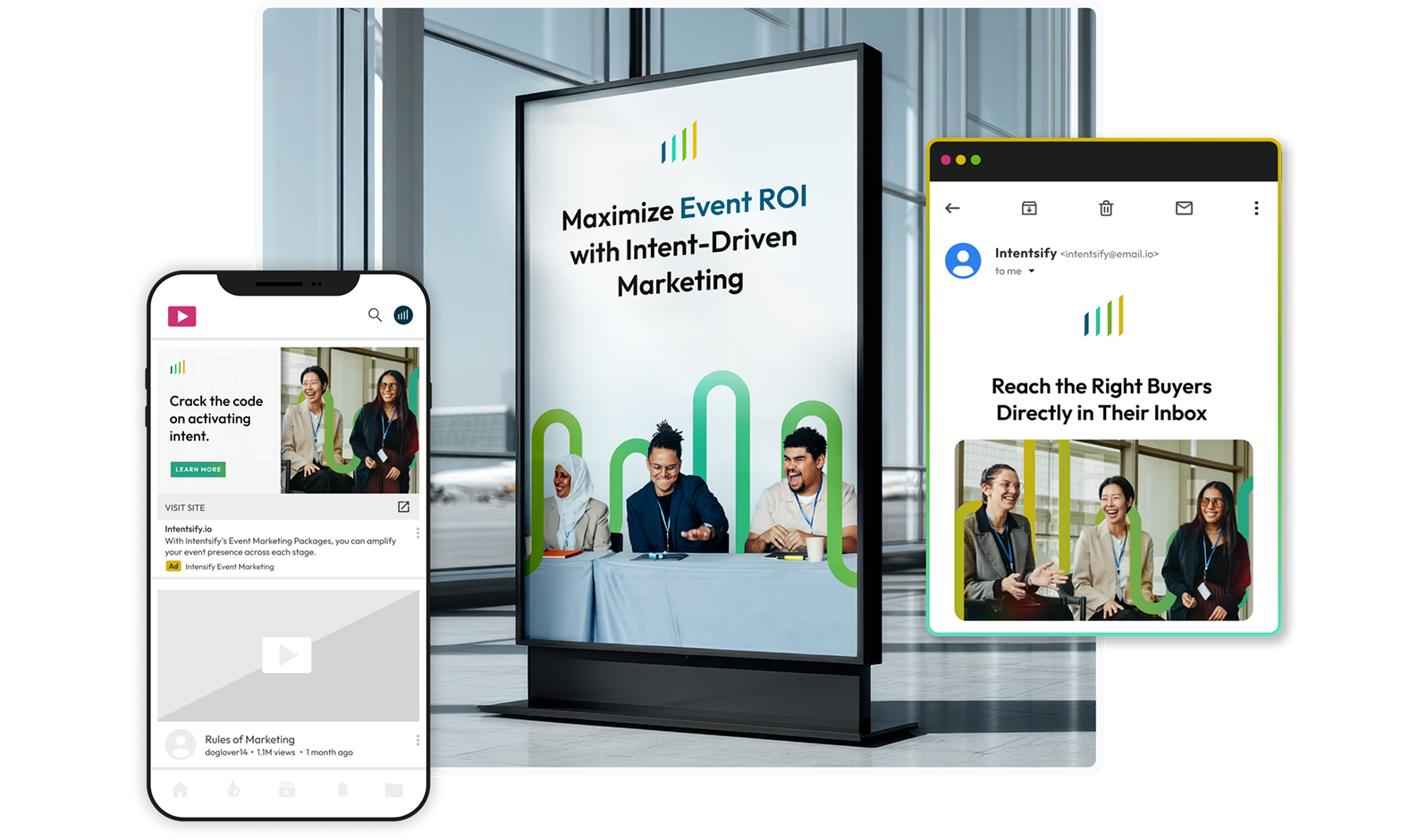
Source: Intentsify
ZoomInfo provides native execution tools that let teams act on signals immediately. GTM Workspace delivers an AI-powered action feed where intent signals, company news, and buying group intelligence arrive with pre-drafted outreach already written. GTM Studio lets marketers and RevOps teams describe audiences in plain language and launch multi-channel plays (email, calls, ads, direct mail) that execute automatically when signals fire. The platform's native demand-side platform runs display ads based on 300+ company attributes across major networks, and FormComplete reduces web forms to a single field while auto-appending the rest from ZoomInfo's data.
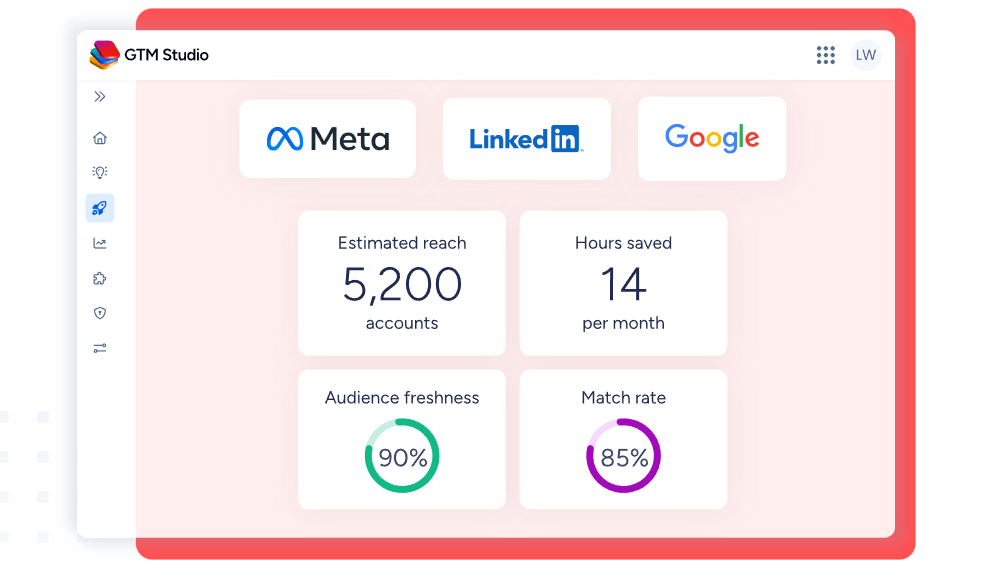
The practical difference is time-to-action. With Bombora, you detect intent, export the data, enrich it with contacts from another source, load it into your outreach tool, and then reach out. With Intentsify, you detect intent and wait for the managed team to launch a campaign. With ZoomInfo, the signal, the contacts, and the outreach tools live in the same platform.
Redwood Logistics achieved a 99% reduction in cost-per-click and a 310% increase in clickthrough rate using ZoomInfo's audience data. "It's not just the data itself. It's more about the right data at the right time to help us reach out with the right message across that full buyer journey." (Redwood Logistics)
Integration approaches and access flexibility
How intent data reaches your team's daily workflows determines whether it gets used.
Bombora has the widest integration footprint of any pure intent data provider. Its data is embedded inside 100+ partner platforms spanning ad tech, martech, sales management, and CRM. Key integrations include Salesforce, HubSpot, 6sense, LinkedIn, Marketo, Apollo, and Cognism. The Developer Portal provides API access with endpoints for intent data, authentication, reference data, and webhooks. This breadth means that regardless of what tools your team uses, Bombora data can likely flow into them. One result is that many B2B professionals consume Bombora data without knowing it, because it powers the intent signals inside platforms they already use.
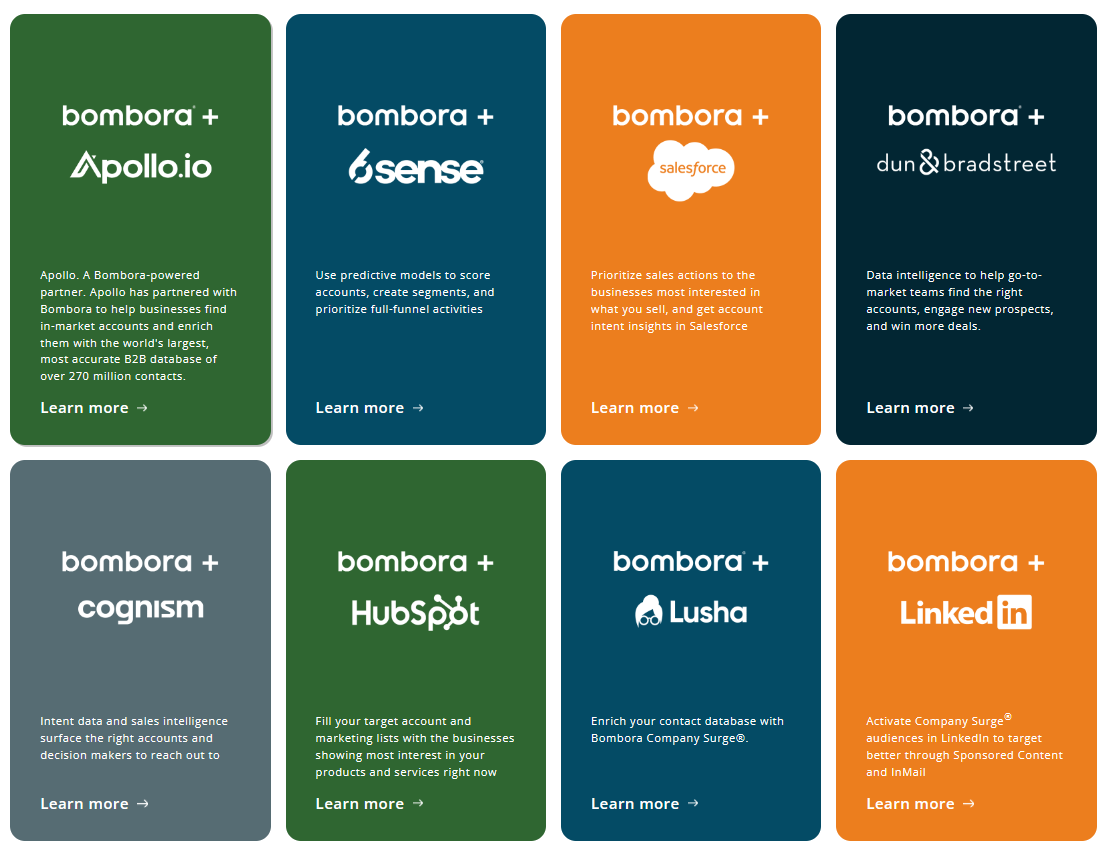
Source: Bombora
Intentsify takes a more curated approach. Direct integrations with Salesforce, HubSpot, Marketo, and Convertr cover the core CRM and marketing automation layer. Beyond these, data can be delivered into any CDP, data lake, data warehouse, or proprietary system through file delivery or API. Intentsify can also ingest existing third-party intent subscriptions (including Bombora) to layer additional signal sources into its models. The managed service model means Intentsify's team handles much of the integration work, which reduces setup burden but also means fewer out-of-the-box connectors compared to Bombora's partner network.

Source: Intentsify
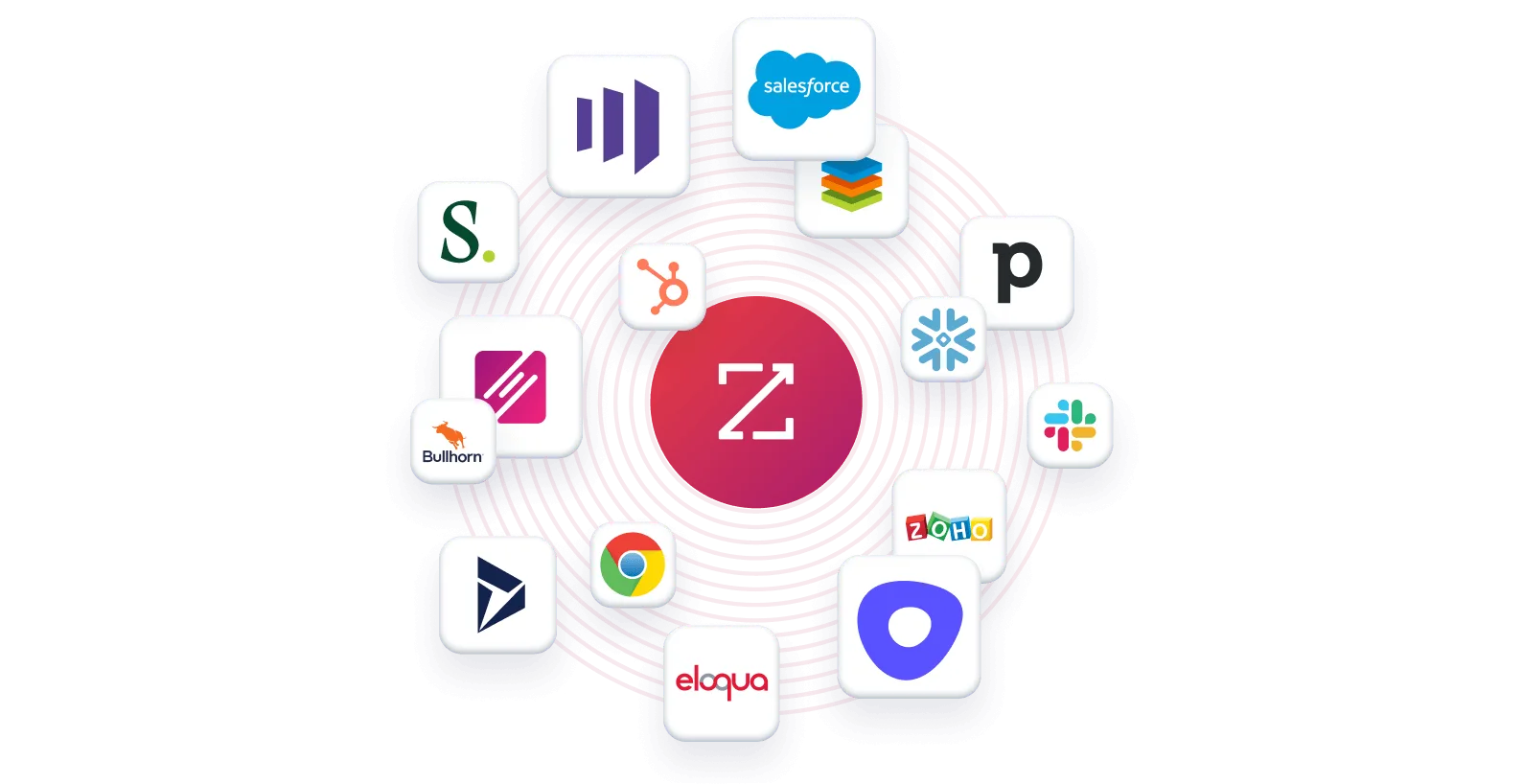
ZoomInfo provides access three ways: native products, marketplace integrations, and open infrastructure. The App Marketplace lists 120+ partner integrations covering CRM, marketing automation, sales engagement, data warehouse, and communications tools. ZoomInfo's differentiator here is programmatic access. The Enterprise API exposes search, enrichment, AI intelligence, audience management, and engagement data through documented endpoints. The MCP server connects AI models directly to ZoomInfo's data with no custom coding, currently supporting Claude and ChatGPT. API access is included in all relevant plans, so the same data and intelligence powering ZoomInfo's native products is available to any custom agent, internal tool, or partner application.
BDO Canada used ZoomInfo's API to activate data within internal systems, achieving an 87% reduction in time spent on data dashboard updates. "The plug-and-play aspect of the API means I can integrate it very easily into any process and get information at a moment's notice." (BDO Canada)
Pricing and getting started
All three platforms use custom-quoted pricing, but they differ in how easy it is to evaluate them before committing.
Bombora has no public pricing, no free trial, and no self-serve tier. Every engagement starts with a sales conversation. Products are sold modularly (Company Surge, Identity and Enrichment, Digital Audiences, B2beacon, Insights Suite), with pricing negotiated based on the combination of products, topic volume, and integration requirements. B2beacon is the one product positioned for on-demand campaign measurement without long-term commitments. For teams evaluating intent data for the first time, the lack of a trial means committing budget based on demos and case studies alone.
For a detailed breakdown of what Bombora's products cost and what's included in each module, see our Bombora pricing breakdown.
Intentsify similarly has no public pricing and no free trial. The company operates on annual contracts that auto-renew unless cancelled 30 days before the renewal date. For audience and data products, monthly, quarterly, or annual commitment options are available. Campaign pricing follows performance-based models including cost per lead, cost per acquisition, cost per click, and impression-based billing. Implementation fees are charged separately from subscription fees. G2 reviewers note that cost per lead can be "fairly expensive", which can limit scaling for budget-conscious teams.
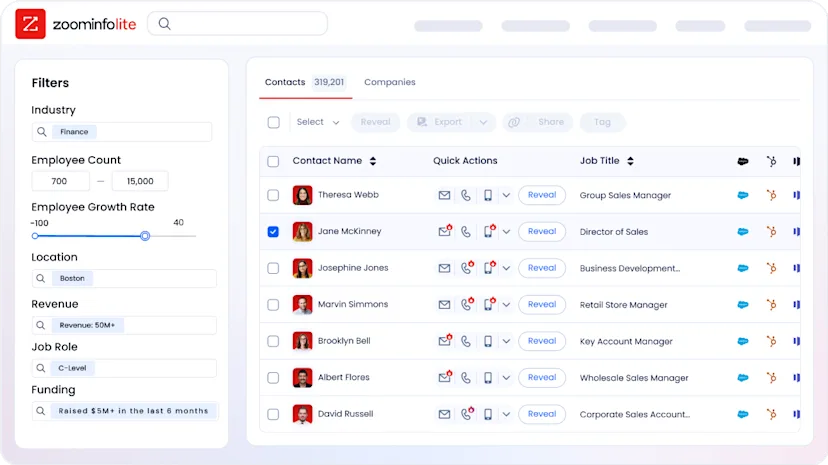
ZoomInfo uses consumption-based pricing scaled around seats, credits, and AI activity. Paid plans aren't publicly priced either, with tiers ranging from Professional through Advanced to Enterprise for both Sales and Marketing product lines. However, ZoomInfo offers two entry points the others don't: ZoomInfo Lite, a permanent free tier with access to ZoomInfo's B2B database, 10 monthly export credits, the Chrome extension, and WebSights Lite (up to 10 website visitor reveals per day); and a 7-day free trial of the full platform with no credit card required. These let teams evaluate the platform with real data before committing budget.
The pricing philosophies reflect each platform's market approach. Bombora and Intentsify gate access behind sales conversations because they serve mid-market and enterprise teams with established budgets. ZoomInfo's free tier and trial serve both enterprise evaluation and smaller teams that want hands-on experience first.
Intentsify vs. Bombora vs. ZoomInfo: Which should you choose?
The right choice depends on what your team needs beyond the intent signal itself.
Choose Intentsify if:
You want intent data paired with managed activation programs (advertising, lead gen, email, events) without hiring additional headcount
Persona-level buying group intelligence is a priority, and your primary market is the U.S.
You prefer a hands-off model where a dedicated team runs your intent-driven programs
Custom, product-specific intent models matter more to you than a generic topic taxonomy
You have the budget for managed services
Choose Bombora if:
You need a recognized intent data feed plugged into your existing tech stack
Data exclusivity matters, with 86% of Co-op data shared exclusively with Bombora
Your team already has CRM, marketing automation, and sales engagement tools capable of acting on intent signals
Account-level intelligence is sufficient for your prioritization model
Privacy compliance and consent-driven data collection are non-negotiable requirements
Choose ZoomInfo if:
You want intent data, verified contact data, and execution tools in one platform instead of stitching together multiple vendors
Your team needs to act on signals immediately through native outreach, advertising, and workflow automation
You want AI-powered intelligence that captures why deals move, not just which accounts are researching
Programmatic access matters, with API and MCP delivering data to any tool, workflow, or AI agent
You want to evaluate the platform before committing, starting with a free tier or trial
See how ZoomInfo combines data, intelligence, and execution with a free trial.
"ZoomInfo's not just a contact data company anymore. They've built a full system of execution. GTM Intelligence works the list, writes the outreach, triggers the play, and helps drive predictable growth." (Ian Brodie, CEO & Co-Founder, Levanta)
Intentsify and Bombora are both Forrester-recognized leaders in B2B intent data, and each has earned that recognition. Bombora created the category and built an extensive data cooperative. Intentsify advanced it with persona-level intelligence and managed activation. But for teams that need more than signals (verified contacts, native execution, and contextual intelligence that connects data to deal outcomes), ZoomInfo offers a single platform where intent is one layer in a complete GTM system, not a separate data feed that requires assembly.
Intentsify vs. Bombora vs. ZoomInfo FAQ
What is the core difference between Intentsify, Bombora, and ZoomInfo?
Bombora is a pure intent data provider that feeds account-level signals into your existing tools via 100+ partner integrations. Intentsify combines intent data with managed activation services (advertising, lead generation, email, events) and offers persona-level buying group intelligence. ZoomInfo is a full GTM platform that includes its own intent data alongside 500M contacts, 100M companies, conversation intelligence, and native execution tools for sales and marketing.
Which platform has the best intent data quality?
All three were named Leaders in The Forrester Wave: Intent Data Providers For B2B, Q1 2025. Intentsify received the highest score in the current offering category across 21 criteria. Bombora was called "the gold standard for account-level intent data feeds" by Forrester. ZoomInfo received the highest possible scores across eight criteria and was noted for having "the largest R&D investment of any provider in this evaluation."
Can Bombora's intent data work alongside Intentsify or ZoomInfo?
Yes. Bombora's data is designed to be embedded in other platforms, and its 100+ integrations include many tools that Intentsify and ZoomInfo customers also use. Intentsify can directly ingest existing Bombora subscriptions to layer additional signals into its models. ZoomInfo operates its own intent data collection but integrates with many of the same platforms Bombora powers.
Which platform provides person-level (not just account-level) intent data?
Bombora operates at the account level only, identifying companies that are researching but not specific individuals. Intentsify offers persona-level buying group intelligence identifying which roles within a buying committee are actively researching, though this contact data is limited to U.S. customers. ZoomInfo provides Person-Level Intent, identifying named contacts associated with research activity, across its full database of 500M contacts globally, combined with Account-Level Intent signals and conversation intelligence through its GTM Context Graph.
Do any of these platforms offer a free trial or free tier?
Bombora and Intentsify do not offer free trials or free tiers. Both require a sales conversation to get started. ZoomInfo offers ZoomInfo Lite, a permanent free tier with 10 monthly export credits and access to its B2B database, plus a separate 7-day free trial of the full platform with no credit card required.
Which platform is best for teams with a limited existing tech stack?
ZoomInfo is the best fit for teams without an established stack, since it provides contact data, intent signals, execution tools, conversation intelligence, and CRM integrations in one platform. Intentsify's managed service model can also work for leaner teams, since Intentsify handles campaign execution on your behalf. Bombora requires existing CRM, marketing automation, or sales engagement tools to activate its data, making it less suited for teams building their infrastructure from scratch.
How do the platforms handle international coverage?
Bombora's Data Co-op consists primarily of English-language B2B publishers, with stronger signal depth in North America than other regions. Intentsify provides intent data across North America, EMEA, APAC, and LATAM, but persona-level contact data and device-level targeting are restricted to U.S. customers due to EU compliance requirements. ZoomInfo covers 34M+ company profiles outside North America and 200M+ international professional profiles, with 45M+ mobile numbers outside North America.
Which platform has the strongest compliance and security posture?
All three take compliance seriously but with different approaches. Bombora's consent-driven Data Co-op collects consent in 100% of events and meets GDPR and CCPA standards. Intentsify holds SOC 2 Type II certification and is GDPR and CCPA compliant, with a public Trust Center. ZoomInfo maintains the broadest certification stack: ISO 27001, ISO 27701, SOC 2 Type II, and TRUSTe GDPR and CCPA validations, all renewed annually.
More related alternatives and breakdowns:
