
Choosing between Odoo and Salesforce comes down to five questions:
Do you need a CRM, or an entire business operations platform that includes CRM?
Is your priority managing sales pipelines, or running everything from accounting to manufacturing under one roof?
Are you willing to pay enterprise prices for specialization, or do you want broad functionality at a fraction of the cost?
Does your team have the technical resources for implementation, or do you need something closer to plug-and-play?
How important is accurate, verified B2B data in your sales and marketing workflows?
Here's what we recommend:
Odoo is the all-in-one business platform for companies that want CRM, accounting, inventory, manufacturing, HR, eCommerce, and marketing in a single system. Built on open-source foundations with 28 million active users and a €5 billion valuation, Odoo delivers breadth at prices that undercut enterprise competitors by an order of magnitude (starting at €11.90/user/month). The tradeoff: implementation requires real configuration work, and individual modules don't match the depth of dedicated single-purpose tools.
Salesforce is the world's #1 CRM by market share, built for organizations where sales, service, and marketing are the central business challenges. With $41.5 billion in annual revenue, 150,000+ customers, and AI agents that resolve 85% of support requests without human escalation, Salesforce goes deep on customer relationship management. But that depth brings complexity and cost that can overwhelm teams who don't need enterprise CRM.
Both platforms give you tools to manage customer relationships. Neither tells you whether you're talking to the right customers in the first place. Your CRM is only as good as the data inside it, and most CRM databases decay at roughly 22% per year. That's where a different kind of platform becomes essential.
ZoomInfo is a B2B intelligence platform that keeps your Odoo or Salesforce CRM fueled with accurate, verified data. With 500M contacts, 100M companies, 135M+ verified phone numbers, and 200M+ verified business email addresses, ZoomInfo provides the data foundation that makes CRM workflows work. Its GTM Context Graph processes 1.5B+ data points daily, connecting your CRM records with conversation intelligence, intent signals, and behavioral data to show not just what's happening in your pipeline, but why deals move or stall. You can access that intelligence through GTM Workspace for sellers, GTM Studio for marketers and RevOps, or APIs and MCP in any tool you already use.
If accurate B2B data and deal intelligence sound like the missing layer in your CRM strategy, see how ZoomInfo works.
Odoo vs. Salesforce at a glance
Odoo | Salesforce | ZoomInfo | |
|---|---|---|---|
Core function | All-in-one ERP and business platform | Enterprise CRM and AI platform | B2B data and GTM intelligence |
CRM depth | Capable but not specialized | Industry-leading | Enriches and powers any CRM |
Business operations | Full ERP: accounting, inventory, manufacturing, HR, eCommerce | Limited to customer-facing functions | Not applicable (data and intelligence layer) |
AI capabilities | Document OCR, lead scoring, natural language queries | Agentforce autonomous agents, Atlas Reasoning Engine | GTM Context Graph, AI-drafted outreach, predictive account scoring |
Data quality | Whatever you put into it | Whatever you put into it | 500M contacts, 95% accuracy, 300+ human researchers |
Ecosystem | 120+ marketplace integrations, native Salesforce and HubSpot connectors | ||
Open source | Yes (Community edition) | No | No |
Starting price | Free (one app); €11.90/user/mo for all apps | Free (2 users); $25/user/mo Starter | Consumption-based; free Lite tier available |
Best for | SMBs wanting one system for everything | Mid-market to enterprise sales, service, and marketing teams | Sales and marketing teams that need verified buyer data and deal intelligence |
Odoo covers everything, Salesforce goes deep on CRM
This is the fundamental difference. Odoo and Salesforce aren't competing on the same axis.
Odoo is an ERP that happens to include CRM.
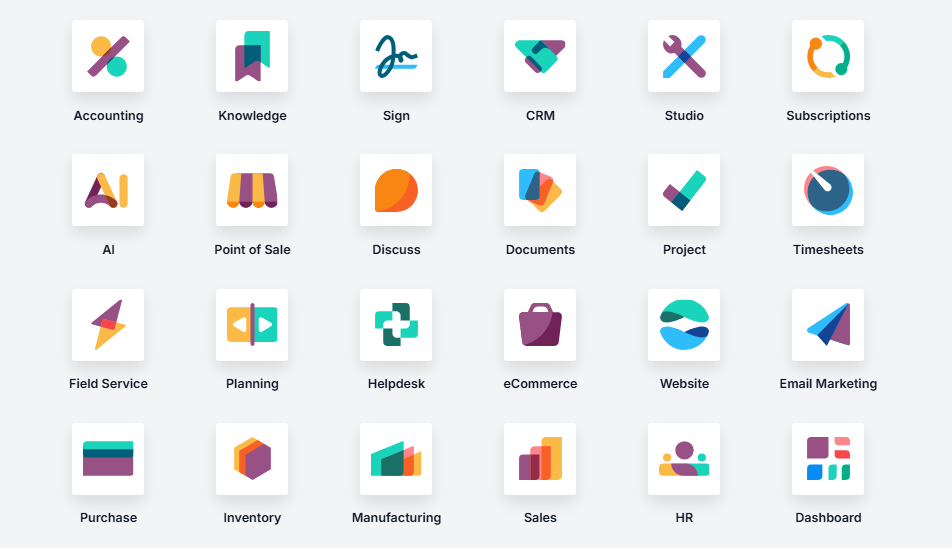
When you adopt Odoo, you get a platform covering accounting, inventory, manufacturing, HR, eCommerce, project management, point of sale, and marketing automation alongside its CRM. Every module shares a single database, so a sales order confirmed in CRM triggers a delivery in Inventory, posts to Accounting, and reserves stock in the warehouse. No middleware, no API sync delay, no duplicate records.
That integration goes deep. A manufacturing company using Odoo can trace a customer inquiry from the CRM pipeline through quotation, production scheduling, quality inspection, delivery, invoicing, and payment collection without leaving the platform. Salesforce can't do that.
Source: Odoo
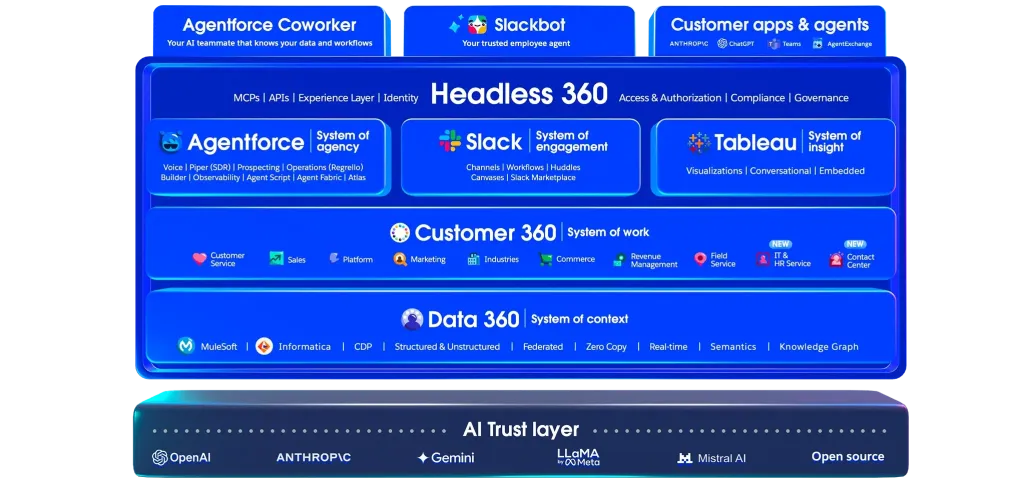
Salesforce is a CRM that has expanded into an enterprise platform, but its center of gravity stays in customer-facing operations.
Sales Cloud, Service Cloud, Marketing Cloud, and Commerce Cloud each go far deeper than their Odoo equivalents. Sales Cloud alone offers AI-powered deal insights, conversation intelligence, revenue lifecycle management, territory planning, and commission tracking. Salesforce has held the Gartner Magic Quadrant Leader position for Sales Force Automation for 19 consecutive years.
But ask Salesforce to run your general ledger, manage warehouse inventory, or schedule a production line, and you'll reach for third-party tools. Salesforce's world begins and ends with the customer relationship.
Source: Salesforce
The question isn't which platform is better. It's whether your primary challenge is running an entire business or mastering customer engagement.
CRM capabilities compared
Within CRM specifically, Salesforce has a clear advantage in sophistication.
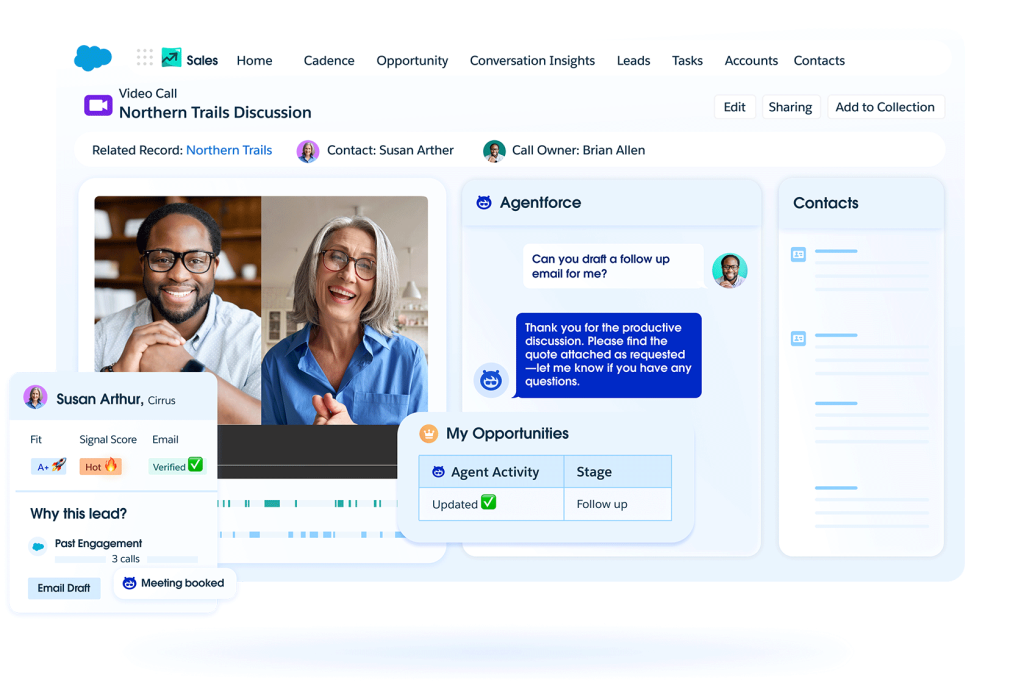
Salesforce's CRM offers Einstein lead and opportunity scoring, conversation intelligence with Call Explorer, revenue lifecycle management covering CPQ through billing, and Agentforce agents that autonomously prospect, coach, and generate quotes 75% faster.
The platform supports 17 industry-specific cloud solutions with pre-built data models for financial services, healthcare, manufacturing, and retail. The AppExchange marketplace hosts 9,000+ apps with 14 million+ installs.
Source: Salesforce
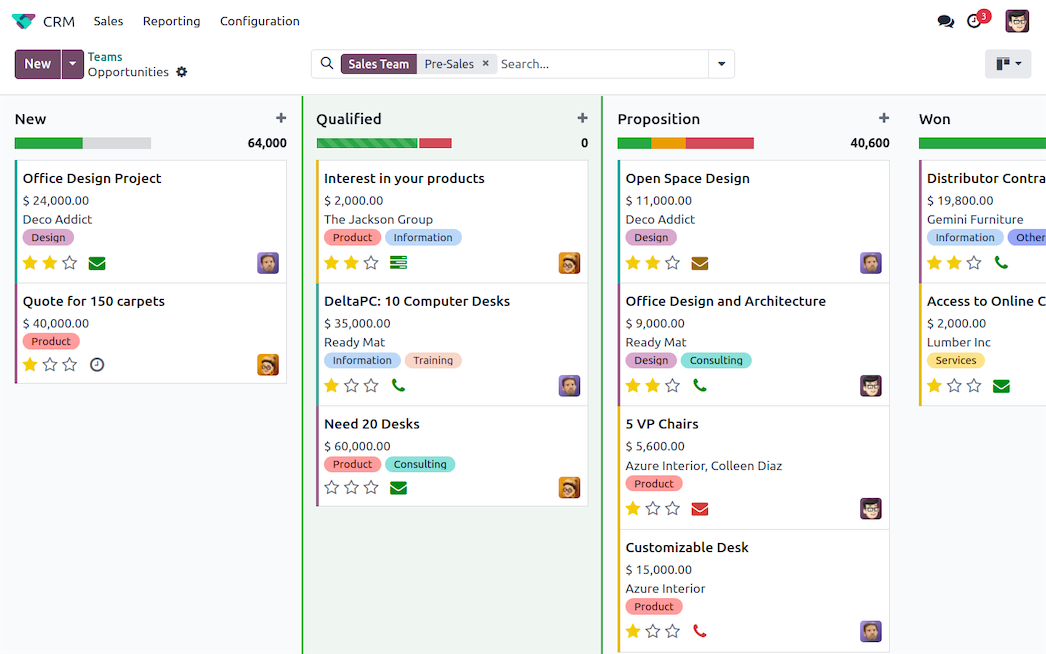
Odoo's CRM covers the essentials well.
It provides Kanban pipeline management, predictive lead scoring, lead mining and enrichment, VoIP integration, and electronic signature on quotes. Quotations flow into sales orders, which trigger delivery, invoicing, and accounting entries without leaving the platform. The point of sale module works offline, handles restaurant floor plans, and syncs with inventory and accounting.
Source: Odoo
Where Odoo falls short is in the areas Salesforce has spent two decades refining: advanced sales analytics, multi-touch attribution, territory management, conversation intelligence, and the partner ecosystem. Salesforce's integration with Slack (5.2 billion messages sent weekly) and Tableau analytics adds collaboration and reporting layers Odoo doesn't match.
Where Odoo wins is the connection to everything else. A sale in Odoo's CRM doesn't need a Zapier workflow to trigger a manufacturing order, debit inventory, or post a journal entry. It just happens, because CRM and ERP share one database.
Your CRM is only as good as your data
Both Odoo and Salesforce face the same problem: they manage the data you put into them, but neither tells you whether that data is accurate, complete, or current.
A CRM with outdated contacts, missing phone numbers, and stale company records doesn't drive revenue. It creates busywork. Reps call numbers that don't connect. Emails bounce. Pipeline forecasts reflect what was true six months ago, not what's happening now.
This is the problem ZoomInfo solves.
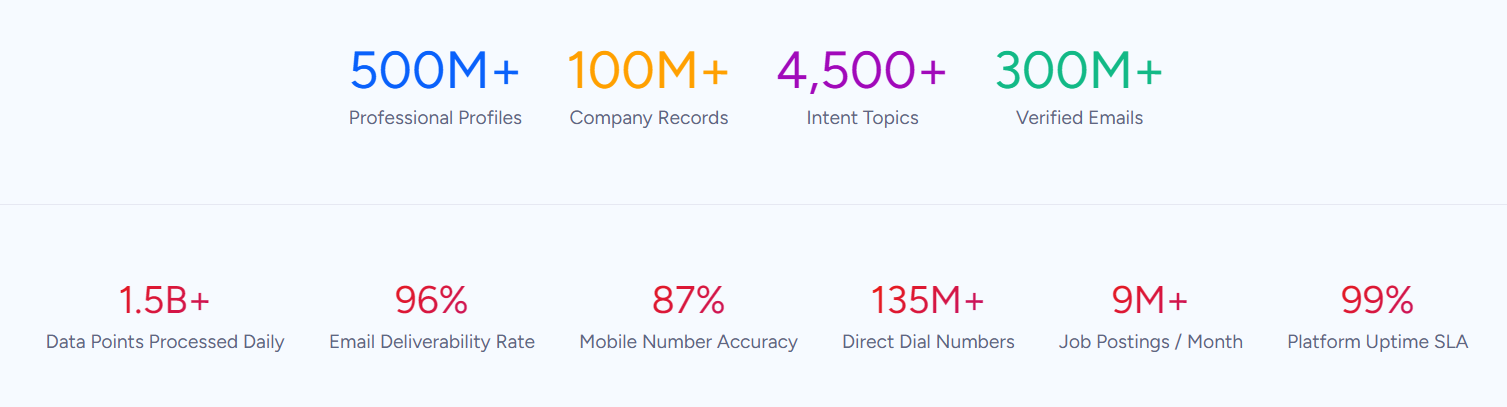
With 500M contacts, 100M companies, 135M+ verified phone numbers, and 200M+ verified business email addresses, ZoomInfo provides the verified data that makes CRM workflows productive. A multi-source verification pipeline backed by 300+ human researchers delivers up to 95% accuracy on first-party data.
In a Fortune 500 competitive RFP analyzing 25 million contacts across vendors, an independent consultant concluded that "no other competitor came even close."
Source: ZoomInfo
ZoomInfo integrates natively with both platforms. Salesforce is a featured integration with CRM enrichment, lead routing, and signal-triggered workflows. Odoo users can connect through ZoomInfo's Enterprise API or MCP server to feed verified contact and company data into their pipeline.
But ZoomInfo goes beyond data delivery.
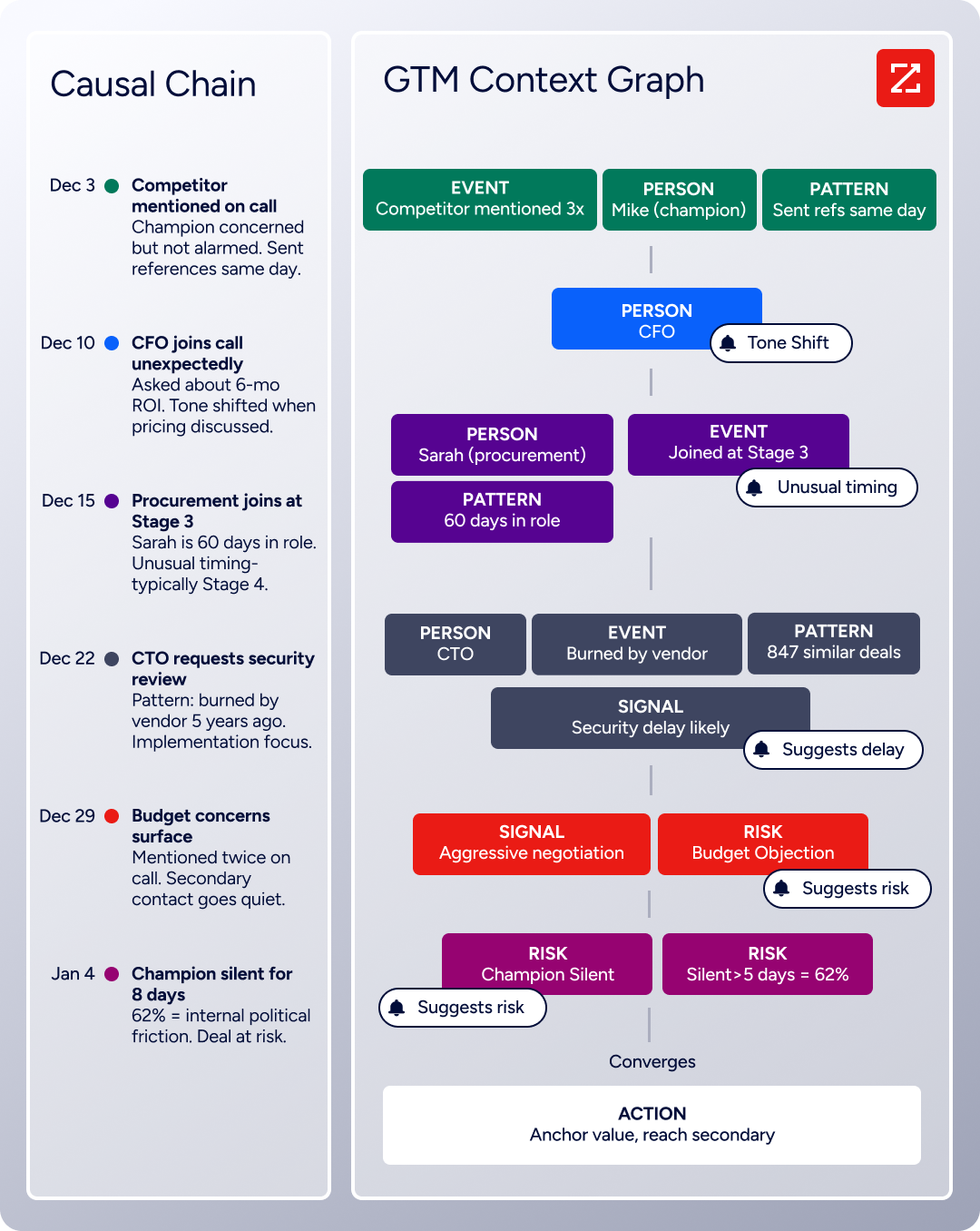
The GTM Context Graph processes 1.5B+ data points daily, connecting your CRM records with conversation transcripts, intent signals, and behavioral data to show why deals move or stall. A CRM records that a deal moved from Stage 3 to Stage 4. ZoomInfo reveals that the CFO joined the last call and asked about six-month ROI, that the company is researching your competitor, and that three new VPs were hired last quarter. That context turns CRM data from a record-keeping system into a decision-making tool.
Source: ZoomInfo
Seismic's sales team attributed 39% of active pipeline to opportunities identified or influenced by ZoomInfo signals, boosted productivity by 54%, and saved 11.5 hours per week. (Seismic)
For a closer look at how Salesforce and ZoomInfo work together specifically, see our Salesforce vs. ZoomInfo comparison.
AI capabilities take different approaches
All three platforms invest heavily in AI, but their approaches reflect different priorities.
Salesforce has placed the largest bet.
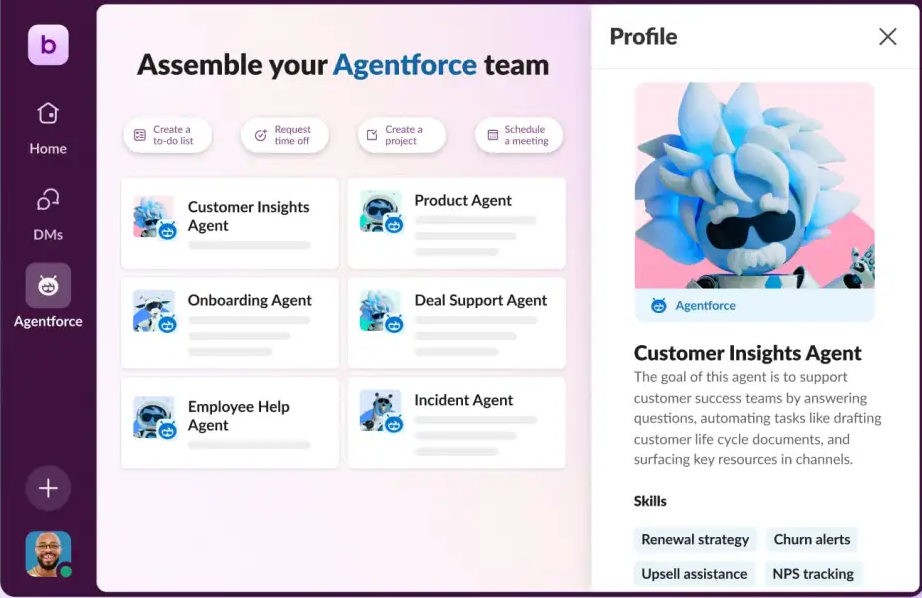
Agentforce is an autonomous AI agent platform powered by the Atlas Reasoning Engine, which uses a reason-act-observe-adapt loop to handle tasks without constant human prompting. Pre-built agents cover sales prospecting, customer service, marketing campaigns, IT service, and field operations. Agentforce has reached $800M in ARR with 29,000 deals closed. The Einstein Trust Layer provides zero data retention with LLM partners, PII masking, and toxicity detection.
Source: Salesforce
Odoo has shipped AI features since version 18, focused on practical automation.
AI-powered invoice digitization claims a 98% recognition rate and uses a feedback loop where corrections build vendor-specific templates over time. Predictive lead scoring uses historical win/loss data already in the CRM. Natural-language "Ask AI" queries work across modules, and an AI-assisted website builder lets users describe layout changes in plain language.
Odoo 20 (expected late 2026) targets agentic AI that executes workflows proactively and a native MCP server for connecting external AI assistants.
ZoomInfo's AI focuses on intelligence rather than workflow automation.
The GTM Context Graph uses twenty years of data unification infrastructure to reason across CRM records, conversation intelligence, and third-party signals. GTM Workspace delivers AI-drafted outreach that addresses specific objections from prior conversations. Guided Intentidentifies topics historically correlated with deal success rather than requiring manual topic selection. Account Research via the API or MCP generates AI-synthesized account briefs (company overview, financials, competitors, buying committee) in seconds. Agent Teams build on that intelligence to run full GTM plays end to end, with coordinated specialist agents sharing account context and acting within the approvals and limits you set, rather than stopping at a single AI-generated brief.
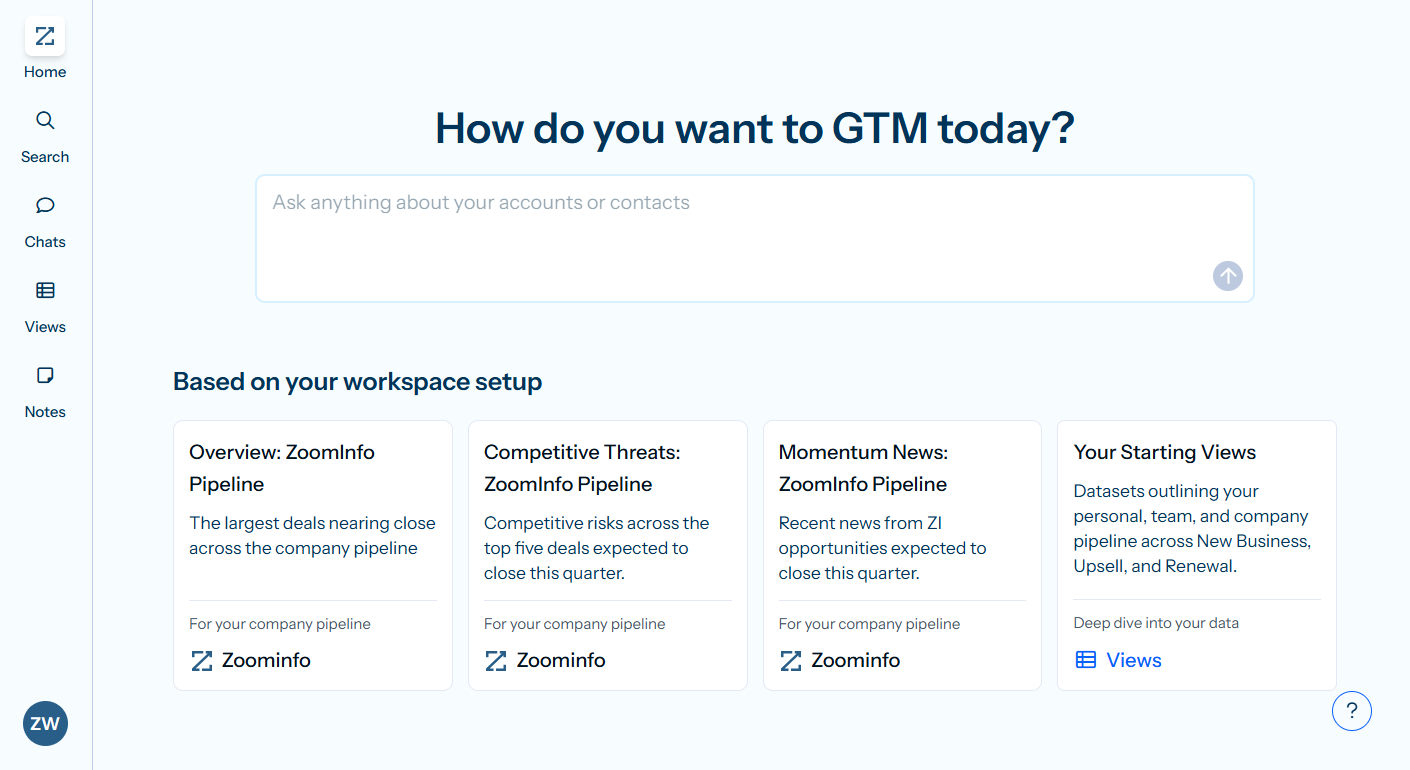
Salesforce's AI acts on customer engagement workflows. Odoo's AI automates internal business operations. ZoomInfo's AI powers the intelligence that makes both platforms' actions more effective.
"They've built a full system of execution. GTM Intelligence works the list, writes the outreach, triggers the play, and helps drive predictable growth." — Ian Brodie, CEO & Co-Founder (Levanta)
Implementation and learning curve
Getting value from either platform requires work. How much work differs.
Odoo is approachable for simple deployments.
The three-step website configurator can produce a working online store in minutes. A small business can start with CRM on the free plan and add modules as needed. But complexity grows with scope. Deploying Odoo as a full ERP across accounting, inventory, manufacturing, and HR requires careful configuration, and Odoo's flexibility means there are many ways to set things up wrong.
G2 reviewers consistently flag that implementations take longer than expected and that advanced customization creates developer dependency. Most mid-market deployments go through a certified implementation partner, with consulting packs ranging from €280 (4 hours) to €9,180 (200 hours).
Salesforce has a steeper entry but a larger support infrastructure.
The platform offers 1,500+ Trailhead badges and 6+ million learners for training. A basic Sales Cloud deployment can run in weeks. But enterprise multi-cloud implementations routinely take 3–12 months, and over 70% of deployments are led by partners, adding cost. The Trailblazer Community spans 20 million members across 1,300+ local groups in 90 countries. For organizations that can invest in the learning curve, the resources exist.
ZoomInfo is built for speed.
GTM Workspace deploys in weeks, not months. The redesigned onboarding program runs 30–90 days and produced a 25% improvement in customer satisfaction scores. ZoomInfo University provides role-specific learning paths and certifications. For teams that want immediate access, the ZoomInfo Lite free tier opens the B2B database without a sales process.
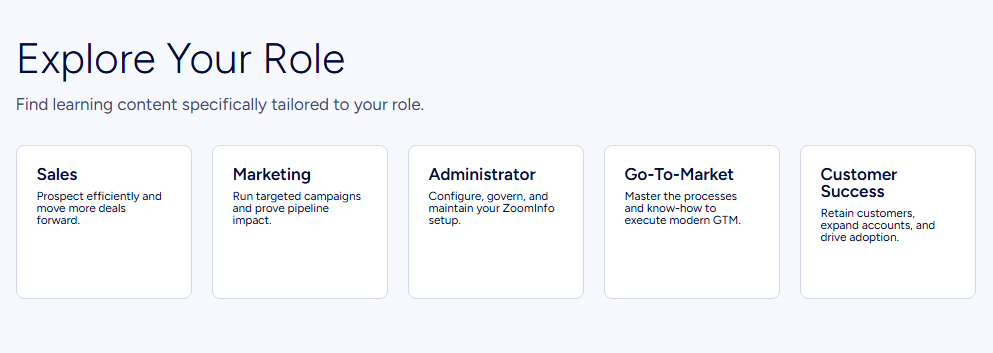
Source: ZoomInfo
Integrations and ecosystem
How each platform connects to the rest of your tech stack reveals its architectural philosophy.
Salesforce has the broadest ecosystem.
The AppExchange marketplace hosts 9,000+ apps with 14+ million installs, and 91% of customers use at least one partner app. MuleSoft provides enterprise API management with hundreds of pre-built connectors. Native integrations with Google Workspace, Microsoft Outlook and Teams, and Slack cover daily collaboration workflows. The REST API, SOAP API, Bulk API 2.0, GraphQL API, and Pub/Sub API give developers broad programmatic access.
Odoo relies less on third-party integrations because it covers more ground natively.
When your CRM, accounting, inventory, and eCommerce share one database, there's less to integrate. The 40,000+ community-developed apps extend functionality, and iPaaS platforms like Zapier, Make, and n8n connect Odoo to external tools. The JSON-2 API provides full CRUD operations on any Odoo model, though API access requires the Custom plan (€17.90/user/month).
A notable gap: native connectors to Salesforce, HubSpot, and Shopify require third-party apps or custom development.
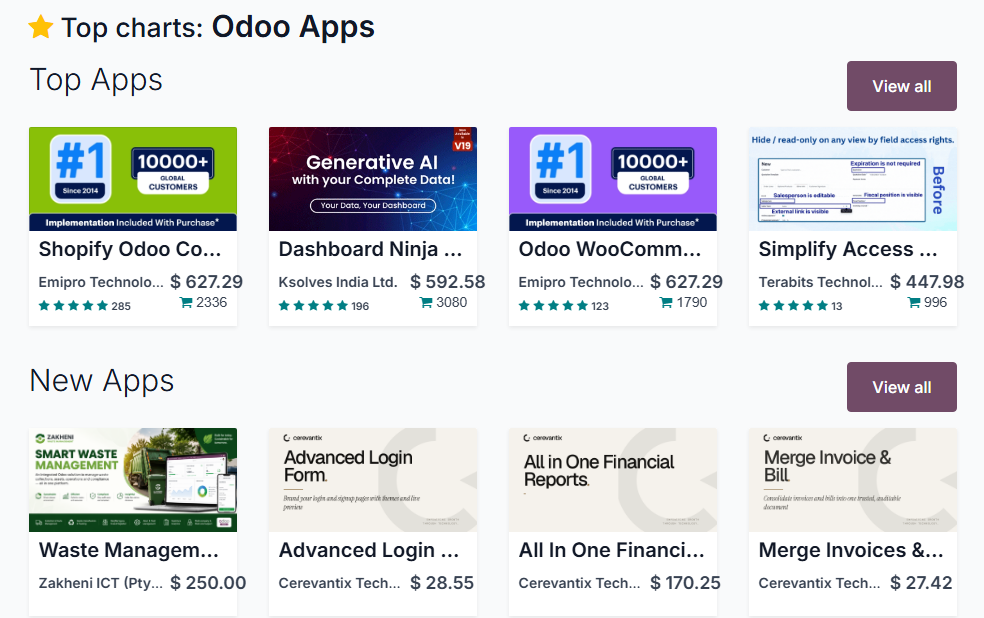
Source: Odoo
ZoomInfo integrates with both.
The ZoomInfo App Marketplace lists 172+ integration partners. Salesforce, HubSpot, and Microsoft Dynamics 365 are featured native integrations. Cloud Partners deliver ZoomInfo data into AWS, Google Cloud, Snowflake, and Databricks. The MCP server connects AI models to ZoomInfo's B2B data without custom coding, and works through Claude, ChatGPT, and other MCP-compatible tools. API access is included in all relevant plans.
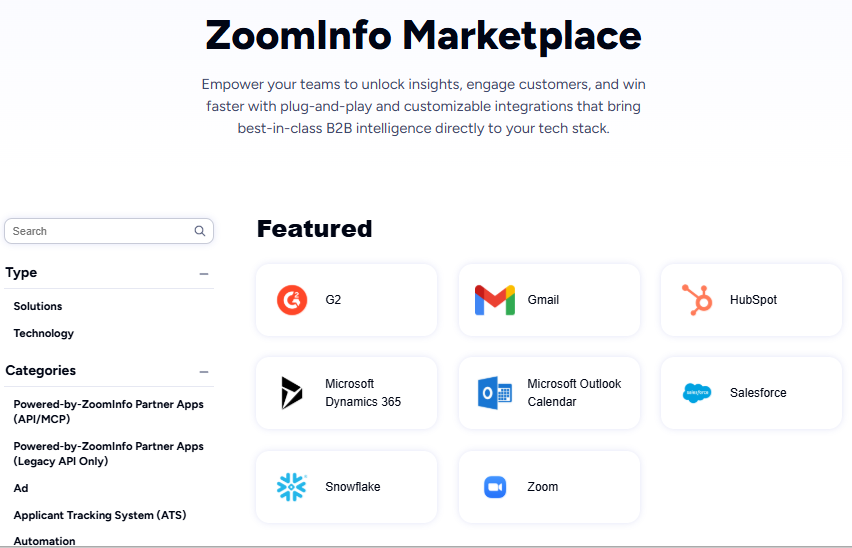
Source: ZoomInfo
BDO Canada reduced time spent on internal data dashboard updates by 87% using ZoomInfo's API. "The plug-and-play aspect of the API means I can integrate it very easily into any process and get information at a moment's notice." (BDO Canada)
Security and compliance
Enterprise buyers need to know their data is protected. The three platforms sit at different maturity levels.
Salesforce has the broadest compliance posture.
Certifications include ISO 27001/27017/27018, SOC 1/2/3, FedRAMP (Government Cloud), and HITRUST. Salesforce Shield adds event monitoring, platform encryption with BYOK, and field audit trail as a premium add-on. Hyperforce provides regional data residency across the US, UK, Germany, India, Japan, and other regions.
Odoo covers the fundamentals.
The platform holds CSA STAR Level 1 certification and maintains PCI-DSS compliance for payment processing. All data is encrypted with AES-256 at rest and 256-bit SSL/TLS in transit. Backups replicate across at least three data centers.
However, Odoo lacks ISO 27001 or SOC 2 certifications, which may matter for regulated industries. The option to self-host or use Odoo.sh with customer-selected hosting regions offers flexibility for data residency.
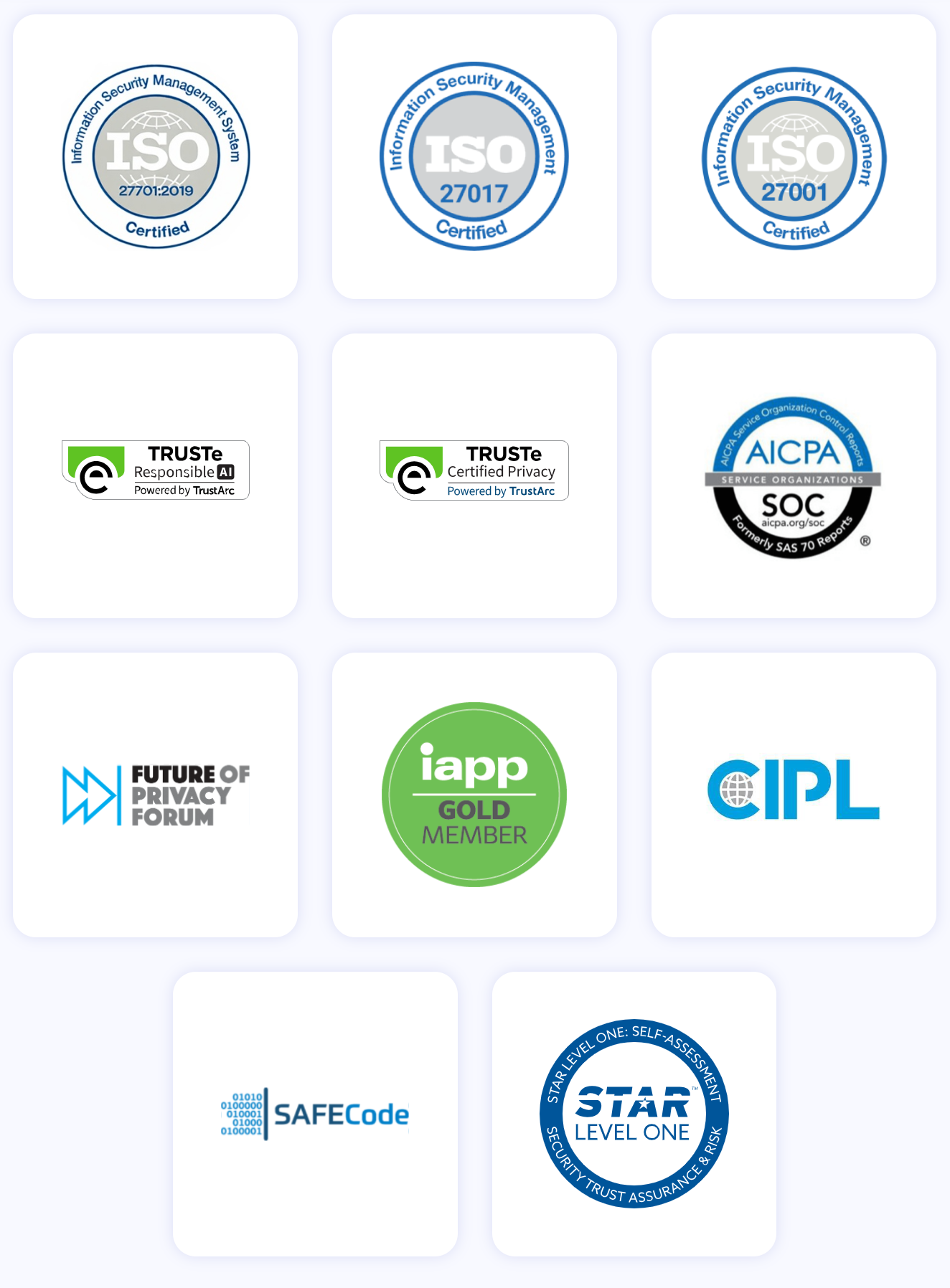
ZoomInfo maintains ISO 27001, ISO 27701, SOC 2 Type II, TRUSTe GDPR, and TRUSTe CCPA certifications, all renewed annually. As a registered data broker in California and Vermont, ZoomInfo has built compliance into its data collection and delivery infrastructure from the start.
The pricing gap is massive
The cost difference between Odoo and Salesforce isn't incremental. It's structural.
Odoo's Standard plan costs €11.90/user/month (billed annually) and includes every app in the platform: CRM, accounting, inventory, manufacturing, HR, marketing, and more. No per-module upsell. The Community edition is free and open source.
Salesforce's comparable entry point, Starter Suite, costs $25/user/month.
But Starter is stripped down. Most organizations need at least Enterprise at $175/user/month for AI features, workflow automation, and pipeline insights. Add Marketing Cloud (starting at $1,500/org/month), Service Cloud add-ons ($75–$150/user/month for digital engagement and contact center), and a Premier Success Plan at 30% of net license fees, and annual costs climb fast.
For a 50-person company, the math looks roughly like this: Odoo Standard runs about €7,140/year. Salesforce Enterprise for the same team runs about $105,000/year, before add-ons.
Odoo's pricing also scales differently. The One App Free plan gives unlimited users on a single application at no cost. A company that only needs CRM pays nothing. Adding a second app triggers paid pricing, but the per-user cost stays flat regardless of which modules you use.
Salesforce charges separately for each cloud, and features within each cloud are often gated behind higher tiers or add-ons. Agentforce AI costs an additional $2 per conversation or $500 per 100,000 Flex Credits. Data Cloud charges $500 per 100,000 credits on top of CRM licensing. These costs compound in ways that are hard to predict before signing.
Neither approach is wrong. Odoo prices for breadth and accessibility. Salesforce prices for depth and enterprise value. The right choice depends on what you need.
Who each platform is built for
The choice becomes clearer when you look at who gets the most value from each platform.
Odoo works best for companies with 6–250 employees in manufacturing, retail, distribution, professional services, and food and beverage.
It fits when the primary pain is running the business across departments: when sales, purchasing, inventory, accounting, and HR all need to share data without stitching together five SaaS subscriptions. Companies with at least one technical resource (or a budget for a certified partner) get the best outcomes.
Odoo is not the right fit for large enterprises needing SOC 2 compliance, companies wanting zero-configuration deployment, or organizations embedded in the Microsoft ecosystem.
Salesforce serves mid-market and enterprise organizations where customer engagement is the primary challenge.
It's built for dedicated sales teams, customer service operations, marketing organizations, and IT departments that need workflow automation. 17 industry-specific clouds with pre-built data models serve financial services, healthcare, manufacturing, retail, and more. Salesforce requires dedicated administration and real investment in training and implementation.
It's not the right fit for small businesses on tight budgets or teams that need one tool for both CRM and back-office operations.
ZoomInfo serves B2B sales and marketing teams at enterprise and upper mid-market companies who need verified buyer data, intent signals, and deal intelligence.
Named customers include Adobe, Microsoft, AWS, Snowflake, and JPMorgan. ZoomInfo is not a CRM or ERP replacement. It's the data and intelligence layer that makes either platform more effective, whether accessed through GTM Workspace, GTM Studio, or APIs and MCP inside your existing tools. Agent Teams take this further, running complete GTM plays end to end: specialist agents share each account's current context and act within the approvals and limits you set, in GTM Studio and headless through GTM.AI.
Snowflake uses ZoomInfo for at least one-third of the most critical data features in their Account Propensity Scoring model, feeding over 70 company and technographic data fields. Accounts monitored using ZoomInfo-powered scores showed 90% higher opportunity open rates and 2x higher customer conversion rates. (Snowflake)
Odoo vs. Salesforce vs. ZoomInfo: Which should you choose?
The right platform depends on what problem you're solving.
Choose Odoo if:
You need a single system for CRM, accounting, inventory, manufacturing, HR, and eCommerce
Your budget favors breadth over depth in any single function
You want open-source transparency and the option to self-host
You're a growing SMB (6–250 employees) that wants to avoid stitching together multiple SaaS tools
You have technical resources for implementation or a budget for a certified partner
Choose Salesforce if:
Sales, service, and marketing are your primary business challenges
You need the deepest CRM capabilities available, backed by 19 years of Gartner MQ leadership
You're ready to invest in a platform that requires dedicated administration and training
Your organization needs enterprise-grade security certifications and compliance
You want access to the largest enterprise app ecosystem in CRM
Add ZoomInfo to either if:
You need verified B2B data to fill and maintain your CRM
You want to know which accounts are in-market before your competitors reach them
Your sales team needs AI-driven deal intelligence, not just a record of what happened
You want the same data and context available in your CRM, in your outreach tools, and in any AI agent you build
Data accuracy and pipeline quality are priorities, not afterthoughts
Try ZoomInfo free and see verified B2B intelligence in action.
The most productive B2B teams don't choose between managing operations and mastering customer engagement. They build a stack where each layer does what it does best. Odoo or Salesforce handles the workflow. ZoomInfo provides the intelligence that makes every workflow more effective. The data layer isn't optional, and it's not something either CRM can build on its own.
Odoo vs. Salesforce vs. ZoomInfo FAQ
What is the fundamental difference between Odoo, Salesforce, and ZoomInfo?
Odoo is an all-in-one ERP covering CRM, accounting, inventory, manufacturing, HR, and eCommerce in a single system.
Salesforce is the world's leading CRM, focused on sales, service, marketing, and commerce with deep AI capabilities.
ZoomInfo is a B2B data and intelligence platform that provides verified contact and company data, intent signals, and deal intelligence to power sales and marketing workflows inside either CRM.
Which platform is more affordable?
Odoo costs far less. Its Standard plan runs €11.90/user/month for access to all apps, and the Community edition is free. Salesforce's entry-level Starter Suite costs $25/user/month, but most teams need Enterprise at $175/user/month for meaningful features, plus add-on costs for Marketing Cloud, Service Cloud features, and AI agents. ZoomInfo uses consumption-based pricing, with a permanent free Lite tier for basic access.
Can Odoo replace Salesforce for CRM?
Odoo's CRM covers pipeline management, lead scoring, quotation generation, and email integration. For many SMBs, that's sufficient. But Salesforce offers far deeper CRM capabilities, including conversation intelligence, multi-touch attribution, territory management, autonomous AI agents, and 19 consecutive years of Gartner Magic Quadrant leadership.
Organizations whose primary challenge is customer engagement rather than back-office operations will find more value in Salesforce.
Do I need ZoomInfo if I already have Odoo or Salesforce?
Neither Odoo nor Salesforce creates or verifies B2B contact data. Both manage the data you enter, but neither ensures it's accurate, complete, or current.
ZoomInfo provides 500M contacts with up to 95% accuracy, buyer intent signals, and deal intelligence that makes CRM workflows productive. It integrates natively with Salesforce and connects to Odoo via API.
Which platform has better AI capabilities?
Salesforce's Agentforce is the most advanced for CRM-related AI, with autonomous agents that handle prospecting, customer service, and marketing without constant human prompting. Odoo's AI focuses on operational automation like invoice digitization and lead scoring. ZoomInfo's AI powers the intelligence layer, using its GTM Context Graph to show why deals move or stall and to surface in-market buyers before competitors reach them.
Is Odoo suitable for enterprise-scale companies?
Odoo fits SMBs and lower mid-market companies with 6 to 250 employees best. Its database architecture has a scalability ceiling at high concurrency, though Odoo 20 targets read-replica support for 10,000+ concurrent users. Odoo also lacks the compliance certifications (ISO 27001, SOC 2) that many enterprises require. Salesforce and ZoomInfo both have stronger enterprise credentials.
How do the platforms handle integrations differently?
Odoo minimizes integration needs by covering CRM, accounting, inventory, and other functions in a single database. Salesforce has the largest third-party ecosystem with 9,000+ AppExchange apps and MuleSoft for enterprise API management. ZoomInfo integrates with both platforms and 172+ other tools, delivering verified data into whatever system your team uses, including through an MCP server for AI agents.
Which combination of platforms makes the most sense?
For SMBs running operations and sales from one system, Odoo plus ZoomInfo provides broad business management with verified B2B data. For organizations focused on customer engagement, Salesforce plus ZoomInfo combines the deepest CRM with the strongest data foundation. ZoomInfo works as the intelligence layer in either stack.
See how Odoo stacks up elsewhere:
