
If you're comparing SalesLogix (now Infor CRM) and Salesforce, you're weighing two fundamentally different bets on how a CRM should work. One is built to live inside your ERP. The other is built to be your entire business platform.
Before you commit to either, ask yourself these questions:
Are you already running Infor ERP, and is native CRM-to-ERP integration your top priority?
Do you need a CRM that handles sales, service, marketing, commerce, and AI agents on a single platform, or would that breadth overwhelm your team?
How important is mobile access for your field sales reps?
Are you prepared to invest in a dedicated Salesforce administrator, or do you need a system your existing IT team can manage alongside your ERP?
Is your CRM data accurate enough to actually drive decisions, or are your reps spending hours researching prospects before every call?
In short, here's what we recommend:
SalesLogix (Infor CRM) is the right CRM for mid-market manufacturers and distributors already running Infor ERP. Its core advantage is native, bi-directional, real-time integration through Infor ION with multiple Infor ERP systems, giving sales reps direct visibility into inventory, pricing, order status, and customer creditworthiness without switching applications. Infor claims the lowest TCO on the market for organizations in its ecosystem, and offers cloud, on-premise, or hybrid deployment for companies that need flexibility. However, Infor CRM has approximately 0.4% CRM market share with roughly 3,870 tracked customers, limited mobile capabilities, and a value proposition that weakens substantially outside the Infor ERP ecosystem.
Salesforce is the #1 CRM by IDC 2024 H1 revenue market share worldwide, serving over 150,000 companies with $41.5 billion in FY26 revenue. Its platform spans Sales Cloud, Service Cloud, Marketing Cloud, Commerce Cloud, and the new Agentforce AI agent platform, all backed by a 9,000+ app marketplace and a 20 million member community. While Salesforce offers unmatched breadth and innovation, its pricing starts at $25 to $550/user/month before add-ons, implementation typically requires partners, and the full value of the platform demands dedicated administration.
Both platforms manage your sales pipeline. Neither one fills it. A CRM records deals, but it doesn't tell you who to call next, whether that company is actively researching solutions, or which contacts on the buying committee actually pick up the phone. That intelligence has to come from somewhere.
ZoomInfo is an all-in-one AI GTM platform built on the most comprehensive B2B data in the industry: 500M contacts, 100M companies, 135M+ verified phone numbers, and 200M+ verified business email addresses. ZoomInfo's GTM Context Graph, an intelligence layer that fuses this data with your CRM records, conversation transcripts, and behavioral signals, processing 1.5B+ data points daily to reveal not just what happened in a deal, but why. Whether you choose Infor CRM or Salesforce, ZoomInfo provides the prospecting intelligence, verified contact data, and buyer intent signals that turn your CRM from a record-keeping system into a revenue engine. Access it through the GTM Workspace for sellers, GTM Studio for marketers and RevOps, or APIs and MCP in any front-end.
If feeding verified, intent-enriched data directly into your CRM sounds like the missing piece, see how ZoomInfo works with your sales stack.
SalesLogix vs. Salesforce vs. ZoomInfo at a glance
SalesLogix (Infor CRM) | Salesforce | ZoomInfo | |
|---|---|---|---|
Primary function | ERP-integrated CRM | Full enterprise CRM platform | B2B data intelligence and GTM execution |
Market share | ~0.4% (~3,870 customers) | #1 worldwide (150,000+ customers) | 35,000+ companies, 133 G2 No. 1 rankings |
Deployment | Cloud, on-premise, or hybrid | Cloud only (multi-tenant) | Cloud (SaaS) |
AI capabilities | Early-stage (Velocity Suite) | Agentforce with Atlas Reasoning Engine | GTM Context Graph with AI agents |
Mobile experience | Limited | Full native iOS/Android app | Full mobile app and Chrome extension |
CRM integration | Native to Infor ERP | Native CRM (is the CRM) | Integrates with Salesforce, HubSpot, Dynamics |
Pricing | Not published (custom quotes) | $25–$550/user/month | Custom-quoted, consumption-based |
Free option | No free trial or plan | Free Suite (up to 2 users) | ZoomInfo Lite (permanent free plan) |
Best for | Mid-market Infor ERP customers | Companies of any size needing full CRM | Sales teams needing verified data and buyer signals |
Two CRM philosophies: ERP-native vs. cloud-first
SalesLogix and Salesforce represent two different answers to the same question: where should customer data live?
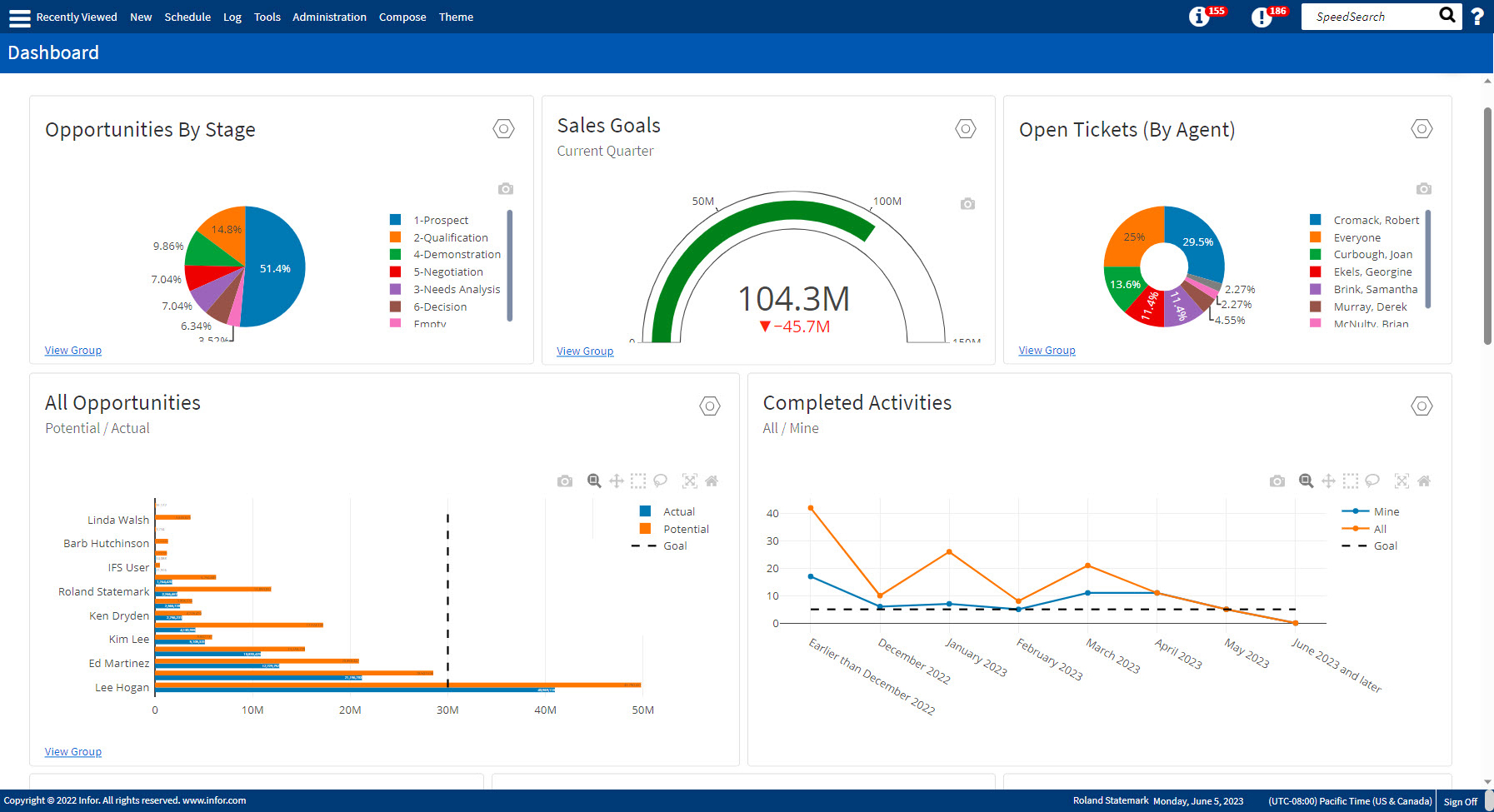
Infor CRM says customer data should live next to your operational data. When Infor acquired Saleslogix from Swiftpage in 2014, then-CEO Charles Phillips described the vision as building "the first truly end-to-end demand-to-supply chain, from lead to ship". The CRM is the customer-facing lens on enterprise data, not a separate platform. Sales reps see real-time inventory, pricing, and order status pulled directly from the ERP.
Source: Infor
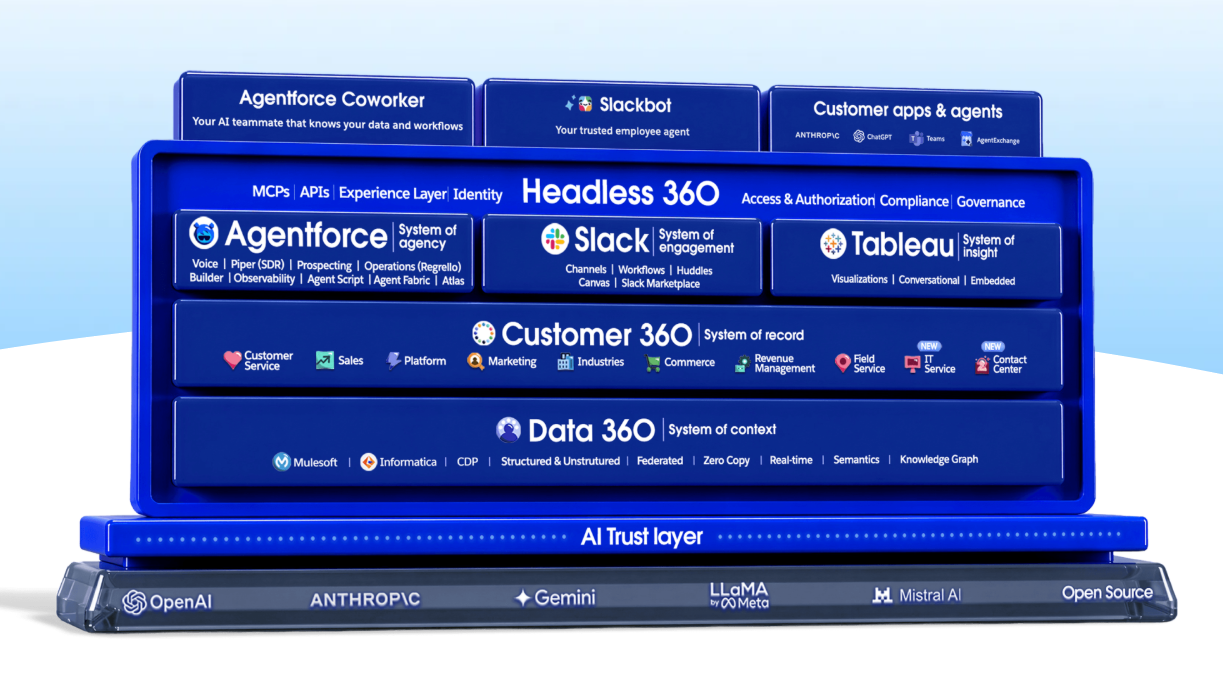
Salesforce says customer data should be the center of everything else. Founded in 1999 with a vision to end installed enterprise software, Salesforce built the cloud CRM category itself. Today it has evolved from "the world's #1 CRM" to what CEO Marc Benioff calls "the operating system for the Agentic Enterprise", where AI agents work alongside human employees across sales, service, marketing, and commerce.
Source: Salesforce
For a 200-person manufacturer running Infor CloudSuite Industrial, Infor CRM's approach makes intuitive sense. The CRM and ERP share master data, there's one vendor to call for support, and sales reps can check production lead times before making promises to buyers. For a 5,000-person enterprise running multiple business units across countries, Salesforce's breadth and ecosystem are difficult to match.
The choice between them isn't about which is "better." It's about which philosophy fits how your business actually operates.
SalesLogix wins on ERP integration, Salesforce wins on breadth
Infor CRM has one clear advantage: if you run Infor ERP, no other CRM matches its native integration depth.
The Back Office Extension (ICBOE) synchronizes accounts, contacts, products, quotes, sales orders, shipments, invoices, receivables, and RMAs between CRM and ERP through Infor ION in real time. A sales rep can see whether a customer has outstanding receivables before placing a follow-up call. A service agent can check production status without opening the ERP.
The platform also offers features that larger CRMs typically gate behind premium plans. Infor CRM SLX bundles sales, service, and support in a single price, including territory management, forecasting, and mobile access. For budget-conscious mid-market companies, this all-inclusive approach avoids the add-on creep that inflates CRM costs elsewhere.
But step outside the Infor ecosystem and the picture changes. When used with non-Infor ERP systems, customers report requiring third-party translation layers that reviewers describe as "far from efficient". The product has approximately 0.4% CRM market share, which limits the pool of implementation partners, third-party integrations, and community resources available.
Salesforce occupies the opposite position. Its breadth is staggering: Sales Cloud, Service Cloud, Marketing Cloud, Commerce Cloud, Data Cloud, Tableau, Slack, MuleSoft, and 17 industry-specific clouds. The AppExchange marketplace has 9,000+ partner apps with 14+ million installs, and 91% of customers use at least one AppExchange app.
Source: Salesforce
Salesforce has held the Gartner Magic Quadrant Leader for Sales Force Automation for 19 consecutive years. Infor CRM does not appear in dedicated CRM analyst reports, reflecting its positioning as an embedded component rather than a standalone market leader.
The trade-off is real: Salesforce's breadth comes with complexity. Over 70% of implementations are partner-led, and meaningful configuration beyond out-of-the-box requires trained administrators. Infor CRM's narrower scope means a smaller learning curve for teams focused on sales and service within a defined ERP environment.
AI capabilities reveal a generational gap
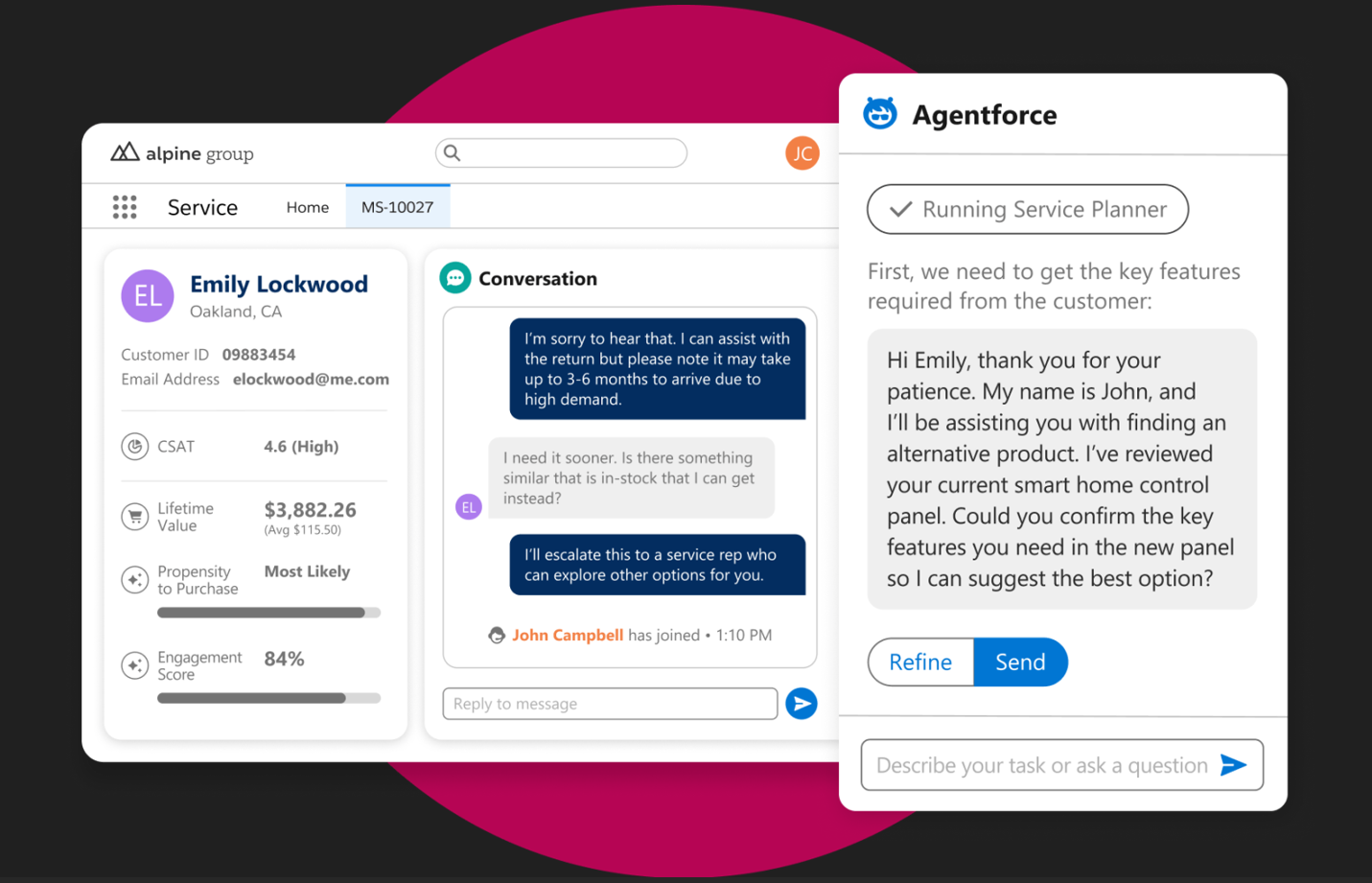
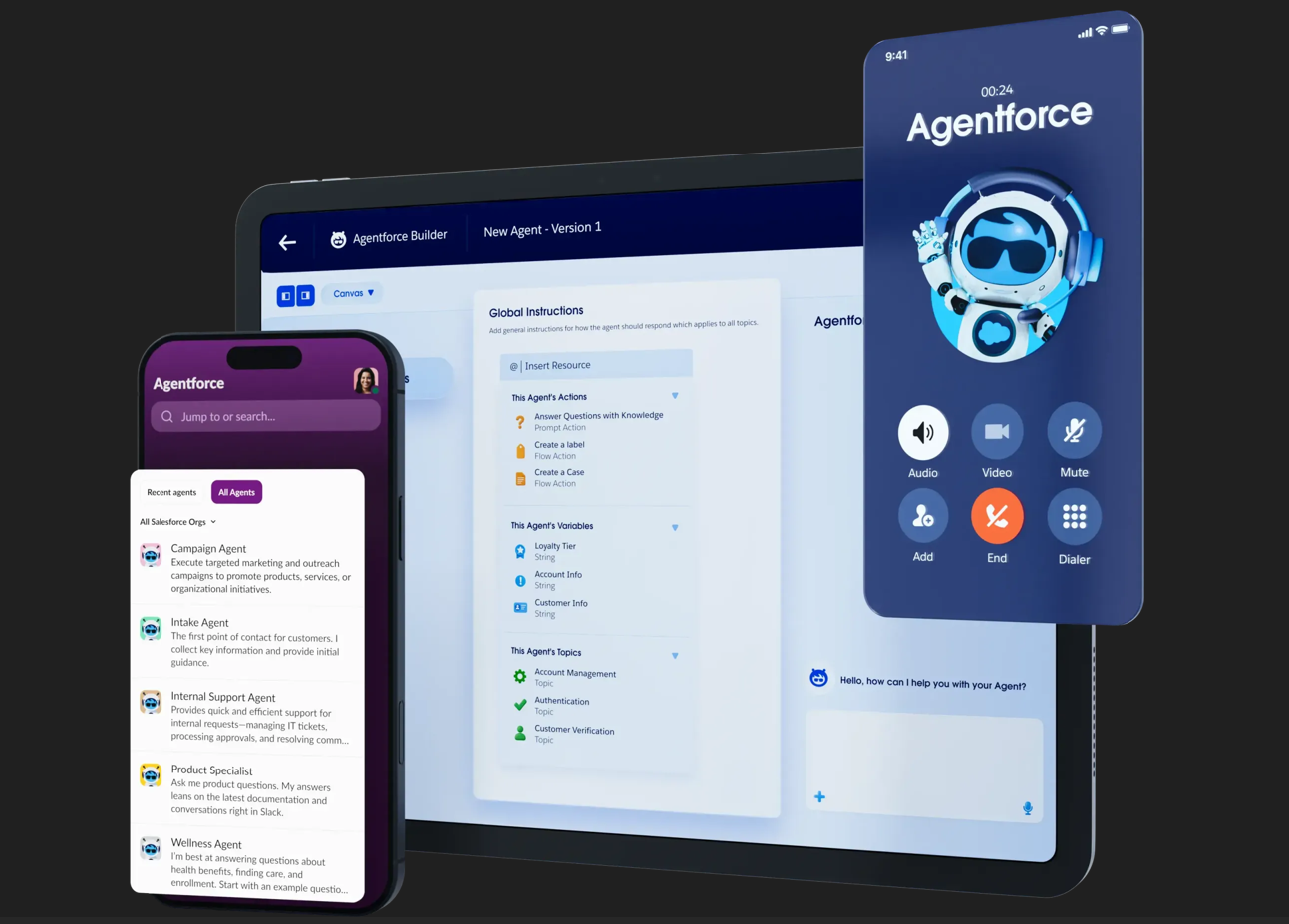
Salesforce has bet its future on Agentforce, an autonomous AI agent platform powered by the proprietary Atlas Reasoning Engine. Pre-built agents handle everything from autonomous case resolution (Salesforce reports 85% of its own support requests resolved without human escalation) to AI-powered sales coaching and conversational shopping.
Source: Salesforce
The Einstein Trust Layer addresses enterprise AI concerns with zero data retention with LLM partners, PII masking, and toxicity detection. Custom agents can be built through Agentforce Builder using natural language, with no additional licensing cost for the builder itself.
Infor CRM is earlier in its AI journey. The V10 release added AI-driven customer insights and enhanced KPI tracking, and the broader Infor Velocity Suite includes an Agentic Orchestrator and industry-specific AI agents. Infor's GenAI Embedded Experiences are being built into product workflows for summarization, auto-drafted emails, and anomaly alerts.
But the capabilities that define modern AI-powered CRM, such as autonomous deal coaching, predictive next-best-action recommendations, and automated call summaries, are not yet clearly shipping in Infor CRM. Salesforce is years ahead in this area, though that lead comes with corresponding complexity and cost. Agentforce consumption requires Flex Credits at $500 per 100,000 credits or $2 per conversation on top of base licensing.
Pricing tells two different stories
Salesforce publishes its pricing openly. The plans for Sales Cloud illustrate the range:
Edition | Price (USD/user/month) |
|---|---|
Free Suite | $0 (max 2 users) |
Starter Suite | $25 |
Pro Suite | $100 |
Enterprise | $175 |
Unlimited | $350 |
Agentforce 1 | $550 |
Most mid-market and enterprise teams need at least the Enterprise plan ($175/user/month) for AI capabilities, pipeline insights, and workflow automation. The Unlimited plan ($350/user/month) adds conversation intelligence and Premier Success support. Add-ons accumulate quickly: Digital Engagement at $75/user/month, Contact Center at $150/user/month, and Premier Success Plans at 30% of net license fees. A June 2025 restructuring raised Enterprise and Unlimited prices by an average of 6%.
Infor CRM does not publish pricing at all. The product page offers a "Watch Demo" button but no self-serve trial signup and no rate card. Contracts are negotiated based on user count, deployment model, and required modules. Several capabilities, including CPQ, Birst analytics, and campaign management are sold as separate add-ons rather than bundled into the core CRM license. Infor's marketing claim of "lowest TCO on the market" is plausible for organizations already on Infor ERP, where native integration eliminates middleware licensing costs. For everyone else, the TCO calculation depends entirely on the negotiated deal.
The meaningful comparison isn't just license cost. It's total cost of ownership including implementation, training, support, and the integrations you'll need to connect your CRM to the rest of your tech stack. Salesforce implementations routinely run 100-150% of annual license costs. Infor's implementation costs are not publicly documented, but the product's complexity and relatively small partner ecosystem mean finding experienced implementers may take longer.
The data quality problem both CRMs share
Here's what neither Infor CRM nor Salesforce will tell you on their pricing pages: a CRM is only as valuable as the data inside it.
Salesforce's own research found that trust in data is the #1 bottleneck for AI adoption. Forbes estimates 91% of CRM data is incomplete. And Salesforce CEO Marc Benioff acknowledged at Dreamforce 2025: "You have got to get your data right."
Infor CRM faces the same challenge from a different angle. Its ERP integration delivers operational data (orders, invoices, inventory), but it doesn't solve the upstream problem: finding the right prospects, verifying their contact information, and knowing when they're in-market. Capterra reviewers flag a "lack of easy reporting" and the product's marketing automation is only now arriving with the V10 release. The research tools available to sales reps are limited compared to dedicated prospecting platforms.
Both platforms record deals. Neither tells you which companies are actively researching solutions in your category right now, who the decision-makers are, whether their phone numbers are valid, or how their buying committee is structured. That gap between what your CRM knows and what your sales team needs to know is where deals stall, forecasts miss, and reps waste hours on manual research.
ZoomInfo fills the intelligence gap
ZoomInfo addresses the problem from the other direction. Instead of managing deals (that's your CRM's job), it identifies, enriches, and prioritizes the buyers your reps should be talking to.
The foundation is data. ZoomInfo operates the most comprehensive B2B data platform in the industry, covering 500M contacts, 100M companies, 135M+ verified phone numbers, 120M direct-dial phone numbers, and 200M+ verified business email addresses. That data is verified through a multi-source pipeline backed by 300+ human researchers and reaches up to 95% accuracy on first-party data. In a Fortune 500 competitive RFP analyzing 25 million contacts across vendors, the independent consultant concluded that "no other competitor came even close."
But comprehensive data is only the starting point. ZoomInfo's GTM Context Graph, an intelligence layer that unifies this B2B data with a customer's own CRM records, conversation transcripts, email interactions, and behavioral signals. It captures the connections between signals and outcomes across every deal. Your CRM records that a deal moved to Stage 3. The GTM Context Graph understands why it moved, what the CFO said on the last call that accelerated it, and which accounts showing similar patterns are most likely to close.
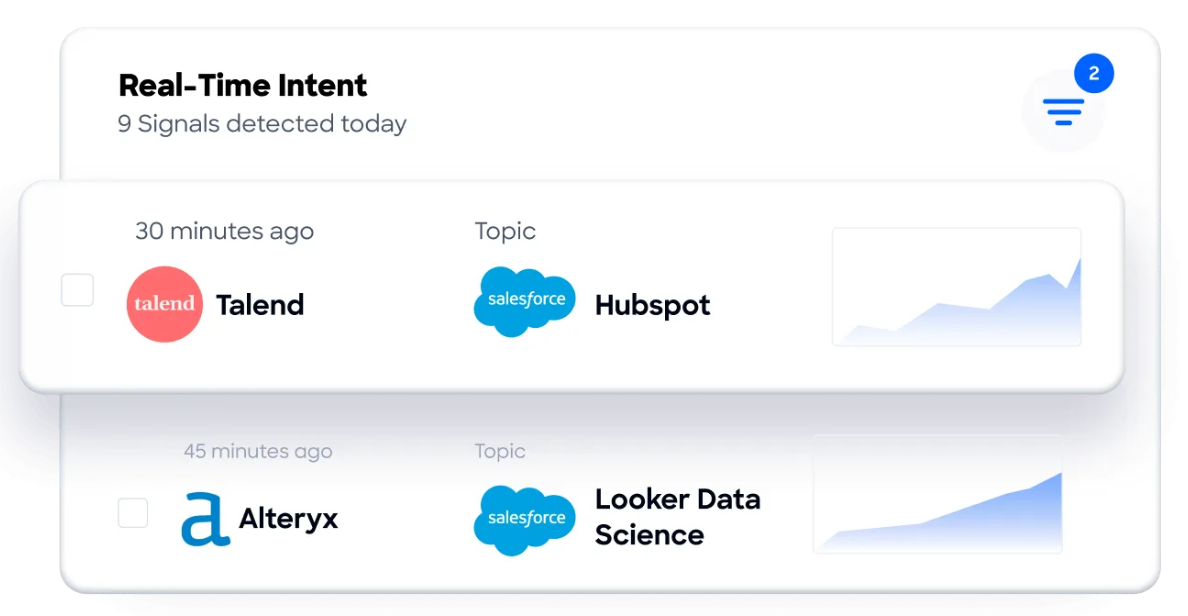
Buyer Intent data tracks signals from 210 million IP-to-Organization pairings and 6 trillion+ keyword-to-device pairings sourced monthly. Guided Intent, exclusive to ZoomInfo, identifies topics historically correlated with deal success rather than requiring manual topic selection. WebSights resolves anonymous website traffic to companies, including buying team identification and direct contact info.
Source: ZoomInfo
For sales teams running either Infor CRM or Salesforce, ZoomInfo provides the layer those CRMs were never designed to deliver: verified contact data that actually connects, intent signals that reveal in-market buyers before they fill out a form, and AI-generated account intelligence that saves hours of manual research.
"ZoomInfo's not just a contact data company anymore. They've built a full system of execution. GTM Intelligence actually works the list, writes the outreach, triggers the play, and helps drive predictable growth." (Ian Brodie, CEO & Co-Founder, Levanta)
How ZoomInfo works with your CRM
ZoomInfo isn't a CRM replacement. It's the intelligence layer that makes your CRM effective. The platform delivers its data and insights through three access lanes, each designed for a different workflow.
For sellers: GTM Workspace. An AI-powered execution workspace where prioritized accounts, AI-drafted outreach, and deal intelligence converge in a single view. Specialized AI agents handle account research, outreach generation, CRM updates, and signal monitoring. Reps see their complete book of business across CRM data, ZoomInfo intelligence, and market signals without toggling between tools.
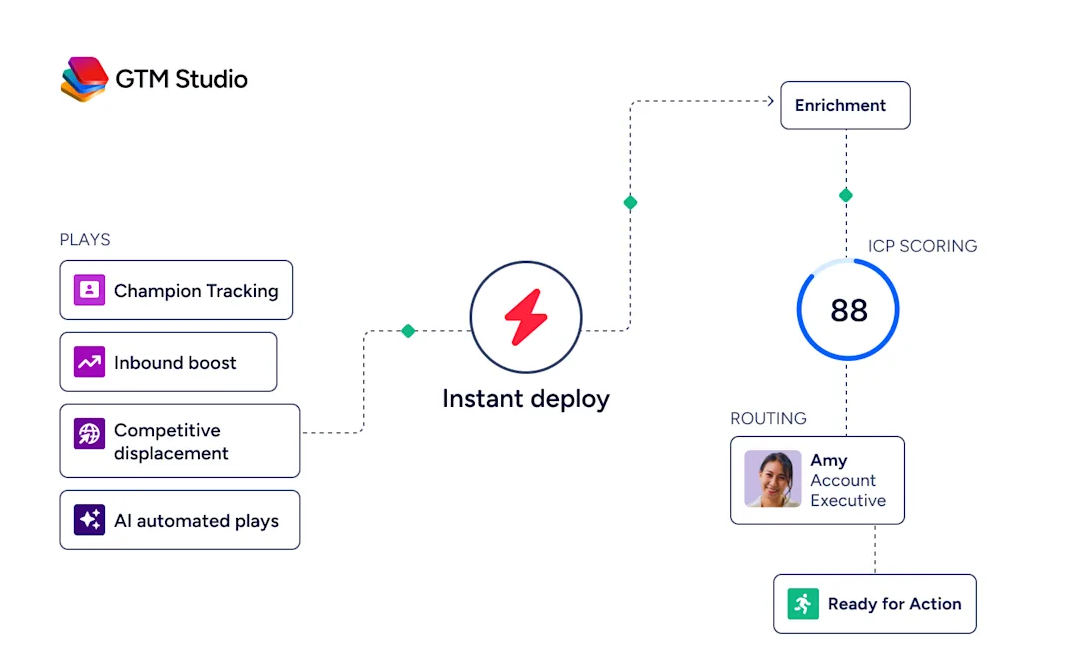
For marketers and RevOps: GTM Studio. A builder environment where audience definition, campaign orchestration, and pipeline measurement happen in natural language. Expansion plays that used to take 3 weeks now launch in 30 minutes, without engineering support. Plays run continuously and self-improve from engagement signals.
Source: ZoomInfo
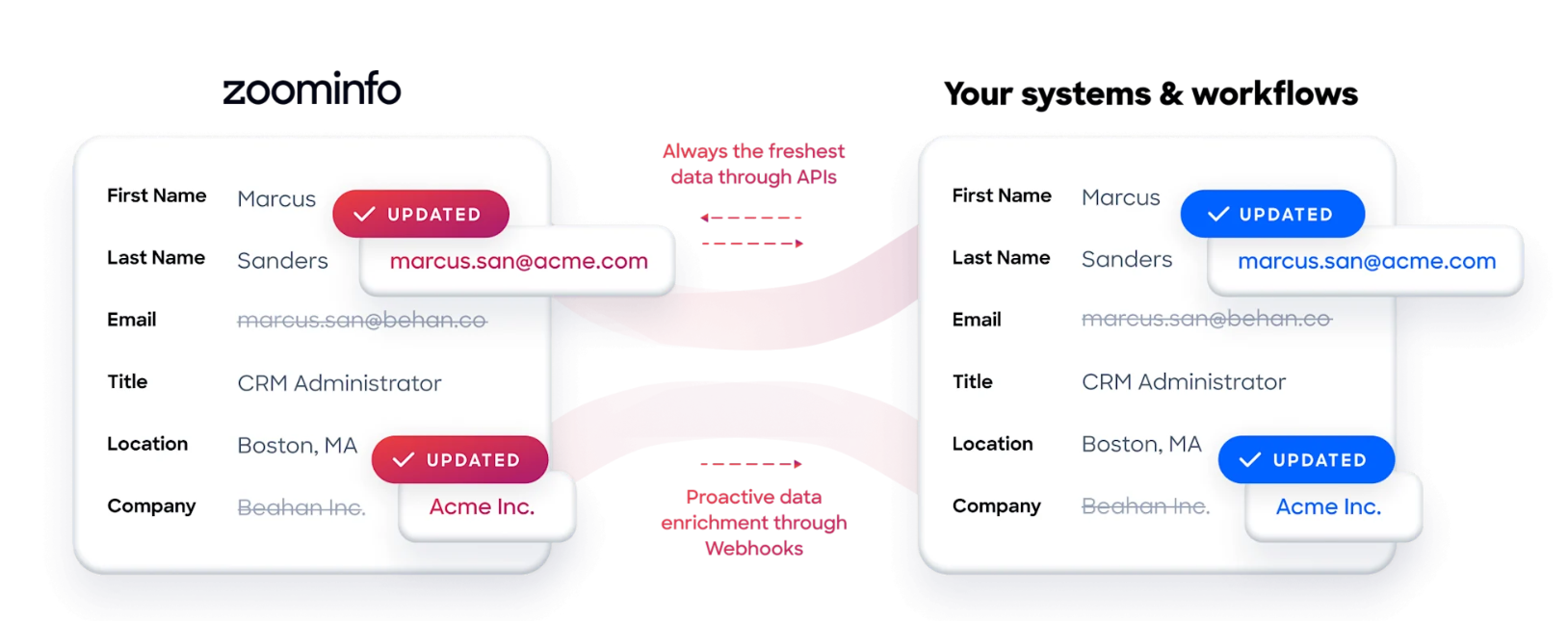
For any tool or custom build: APIs and MCP. ZoomInfo's data and GTM Context Graph can be consumed inside any third-party application, any AI agent, any custom workflow. API Access is included in all relevant plans. The MCP server connects AI models directly to ZoomInfo data with no custom coding required.
Source: ZoomInfo
The Salesforce integration is particularly deep. ZoomInfo feeds enriched contact and company data directly into Salesforce records, surfaces intent signals within the Salesforce interface, and syncs engagement data bidirectionally. For Infor CRM users, ZoomInfo's open APIs and data services provide enrichment and prospecting intelligence that can flow into the CRM through standard integration methods.
For a direct comparison of Salesforce and ZoomInfo as standalone platforms, see our Salesforce vs. ZoomInfo breakdown.
"ZoomInfo is our one source of truth for account data, and even more so for contact data. There's no other provider in the market that provides you with that level of detail." (Thor Sanderson, Senior Manager of Sales Technology Enablement, Smartsheet)
The results speak across platforms
The difference ZoomInfo makes is measurable regardless of which CRM sits underneath.
Seismic attributed 39% of active pipeline to opportunities identified or influenced by ZoomInfo signals, reported 54% productivity gains, and saved 11.5 hours per week per seller. Their Chief Business Officer, Toby Carrington, described the impact: "That combination of our internal CRM data, external signals, and AI that's given all that context has helped us craft very specific account- and persona-based messages. And people have responded to them right away."
Source: ZoomInfo
Snowflake uses ZoomInfo for at least one-third of the most critical data features in their account propensity scoring model, feeding over 70 company and technographic data fields. Accounts monitored using ZoomInfo-powered scores showed 90% higher opportunity open rates and 2x higher customer conversion rates.
GTM Workspace users report boosting pipelines by 23%, booking nearly 60% more meetings per week, and being first to engage with an account in over half of cases. Thomson Reuters increased closed-won deals by 40% and achieved 115% average quota attainment each month.
These outcomes aren't about the CRM. They're about the data and intelligence powering it.
"It brings time back to our day, something we're all begging for. And it helps us reach the company's goals and get more clients faster." (William Kenimer, VP of Revenue Operations, Vensure)
SalesLogix vs. Salesforce vs. ZoomInfo: Which should you choose?
The answer depends on where you are and what you need most.
Choose SalesLogix (Infor CRM) if:
You're already running Infor ERP and want native CRM-to-ERP integration
Your sales process depends on real-time visibility into inventory, pricing, and order status
You need deployment flexibility (cloud, on-premise, or hybrid)
Your team is under 1,000 CRM users and prefers a single-vendor support model
Budget is a primary concern and you want sales, service, and forecasting bundled in one price
Choose Salesforce if:
You need a full-platform CRM spanning sales, service, marketing, commerce, and AI agents
Your organization is ready to invest in dedicated Salesforce administration
You want access to the largest CRM ecosystem, with 9,000+ apps and a 20 million member community
AI-powered autonomous agents (Agentforce) align with your digital transformation strategy
You need industry-specific solutions across 17 verticals
Add ZoomInfo to either CRM if:
Your reps spend more time researching prospects than selling to them
You need verified direct-dial phone numbers and business emails that actually connect
You want to know which companies are actively researching solutions in your category
Your CRM data is incomplete, outdated, or missing key contacts on buying committees
You want AI that understands why deals move, not just that they moved
Start with ZoomInfo Lite for free, or request a demo to see how ZoomInfo powers your CRM.
The CRM you choose determines how you manage customer relationships. The data you feed it determines whether those relationships produce revenue. SalesLogix and Salesforce each solve the management problem in ways suited to different organizations. ZoomInfo solves the intelligence problem that both leave open.
"It's not just the data itself. It's more about the right data at the right time to help us reach out with the right message across that full buyer journey." (Chelsea Kenyon, Senior Director of Digital Strategy, Redwood Logistics)
SalesLogix vs. Salesforce vs. ZoomInfo FAQ
Is SalesLogix still available, or has it been replaced?
SalesLogix was acquired by Infor in September 2014 and rebranded as Infor CRM (also marketed as Infor CRM SLX). The product is actively developed and supported, with version 10 released in early 2026 featuring AI-driven insights, enhanced KPI tracking, and new email marketing capabilities. It is most commonly used by companies with 50 to 200 employees and $10M to $50M in revenue, particularly in manufacturing and distribution.
Which CRM is better for a manufacturing company?
It depends on your ERP. If you run Infor ERP (CloudSuite Industrial, M3, Distribution SX.e, or LN), Infor CRM offers native bi-directional integration that no other CRM matches, with real-time visibility into inventory, pricing, and order status inside the CRM. If you run a non-Infor ERP or need broader capabilities across sales, service, marketing, and AI, Salesforce is the stronger choice, with dedicated Manufacturing Cloud and 17 industry-specific solutions.
How does Salesforce's pricing compare to Infor CRM's?
Salesforce publishes its pricing openly, ranging from free (up to 2 users) to $550/user/month for the Agentforce 1 edition, with most teams needing at least the $175/user/month Enterprise plan. Infor CRM does not publish pricing; contracts are negotiated based on user count, deployment model, and required modules. Infor claims the lowest total cost of ownership for organizations already running Infor ERP, primarily because native integration eliminates middleware licensing costs.
Can ZoomInfo replace a CRM like Salesforce or Infor CRM?
No. ZoomInfo is not a CRM. It does not manage sales pipelines, customer service tickets, or quote-to-order workflows. ZoomInfo is a B2B data intelligence and GTM execution platform that provides verified contact data, buyer intent signals, and AI-powered account insights. It integrates with CRMs to fill the data quality and prospecting intelligence gaps that CRM platforms were not designed to solve.
Does ZoomInfo integrate with both Salesforce and Infor CRM?
ZoomInfo has a native, deep integration with Salesforce that enriches CRM records, surfaces intent signals, and syncs engagement data bidirectionally. For Infor CRM, ZoomInfo's open APIs and data services can deliver enrichment and prospecting intelligence through standard integration methods. API Access is included in all relevant ZoomInfo plans.
Which platform has the best mobile experience?
Salesforce offers a full native mobile app for iOS and Android with Apple Intelligence integration. ZoomInfo provides a mobile app and Chrome extension for on-the-go prospecting. Infor CRM has the weakest mobile experience of the three, with G2 reviewers noting there is no native iOS or Android app with feature parity, and Gartner Peer Insights confirming mobile capabilities are limited.
What is the biggest limitation of SalesLogix (Infor CRM)?
The platform's value proposition depends heavily on being part of the Infor ERP ecosystem. Outside that ecosystem, the core integration advantage disappears and third-party connectors are described by reviewers as far from efficient. The product also has approximately 0.4% CRM market share, which limits the availability of implementation partners, third-party integrations, and community resources compared to Salesforce.
How does ZoomInfo's data quality compare to what CRMs provide natively?
CRMs store the data your team enters or imports, but they do not independently verify, enrich, or update it. ZoomInfo maintains 500M contacts and 100M companies through a multi-source verification pipeline backed by 300+ human researchers, reaching up to 95% accuracy on first-party data. In a Fortune 500 competitive RFP analyzing 25 million contacts across vendors, an independent consultant concluded that no other competitor came even close to ZoomInfo's data quality.
More Salesforce comparisons:
