

If you're comparing Altvia vs. Salesforce for your private capital firm, here's the irony: Altvia is built on Salesforce. You're not choosing between two separate systems. You're choosing between configuring Salesforce yourself and buying a pre-built layer that does it for you.
That distinction matters more than it sounds. The real questions you should be asking are:
Do you want a CRM pre-configured for LP relationships, fund pipelines, and capital calls? Or do you need a platform that handles CRM, marketing, commerce, and service across your organization?
Is your firm's primary challenge managing investor relationships and deal flow, or unifying sales, marketing, and operations data across departments?
How important is it that your CRM speaks the language of private capital (soft circles, re-ups, co-invest appetite) out of the box?
Do you have the internal resources (or budget for consultants) to build and maintain a custom Salesforce configuration?
Where does your deal sourcing and LP targeting data come from, and how does it get into your CRM?
In short, here's what we recommend:
Altvia is the specialist choice for private equity, venture capital, and fund-of-funds firms that need a CRM, LP portal, virtual data room, and analytics designed around how GPs work. Its modules cover the fund lifecycle (fundraising, investor relations, deal management) with terminology that matches the private capital world. The trade-off: pricing is opaque, add-on costs accumulate, and the Salesforce underpinning means administration still carries Salesforce's learning curve.
Salesforce is the platform for firms that need more than private capital workflows. With 17 industry-specific clouds (including Financial Services Cloud), Salesforce can be configured for any business process. Its Agentforce AI agents, AppExchange ecosystem, and native integration with Slack, Tableau, and Marketing Cloud give it range. But that range comes with complexity: configuration requires dedicated administrators, implementation timelines stretch from weeks to months, and pricing layers across clouds, add-ons, and consumption credits can be hard to predict.
Both platforms give you a place to manage relationships and track deals. Neither solves the upstream problem: finding the right prospects, identifying companies in-market, and enriching your CRM with verified contact data. That's where ZoomInfo comes in.
ZoomInfo is a GTM platform built on a B2B dataset of 500M contacts, 100M companies, 135M+ verified phone numbers, and 200M+ verified business email addresses. Whether you choose Altvia or Salesforce as your CRM, ZoomInfo provides the data layer that powers prospecting, deal sourcing, and account research. Its GTM Context Graph combines this third-party data with your CRM records, conversation transcripts, and behavioral signals to show not just what's happening in your pipeline, but why. ZoomInfo integrates with Salesforce (and by extension, Altvia) through native CRM connectors, APIs, and MCP, so the same data layer works regardless of which CRM you pick.
If enriching your CRM with verified contacts, intent signals, and company intelligence sounds like the missing piece, see how ZoomInfo works with your stack.
Altvia vs. Salesforce vs. ZoomInfo at a glance
Altvia | Salesforce | ZoomInfo | |
|---|---|---|---|
Core purpose | Private capital CRM and fund management platform | General-purpose CRM and enterprise platform | B2B data intelligence and GTM platform |
Architecture | Built on Salesforce (verticalized layer) | Cloud-native multi-tenant platform | Standalone platform with CRM integrations |
Private capital workflows | Native (LP management, deal flow, capital calls) | Configurable via Financial Services Cloud or custom build | Not applicable (data layer, not workflow layer) |
LP/investor portal | Included (ShareSecure, 120K+ users) | Requires custom build or third-party add-on | Not applicable |
B2B contact data | Relies on Preqin/PitchBook integrations | Relies on third-party enrichment | 500M contacts, 200M+ verified emails, 135M+ verified phones |
AI capabilities | AIMe (private capital-specific assistant) | Agentforce (autonomous agents across all clouds) | GTM Context Graph + AI agents in GTM Workspace |
Pricing transparency | Opaque (demo required) | Published tiers ($25–$550/user/month for Sales Cloud) | Custom-quoted (free tier available) |
Implementation time | Weeks to months (Salesforce configuration required) | Weeks to 12 months depending on scope | Deploys in weeks |
Best for | PE, VC, fund-of-funds, family offices | Any industry, any company size | Sales, marketing, and RevOps teams at B2B companies |
Altvia is Salesforce, verticalized
This is the most important thing to understand about this comparison. Altvia is built on Salesforce's Force.com platform. It uses Salesforce's database, security model, and API infrastructure, then adds private capital-specific data models, workflows, and user interfaces on top.
What does that mean in practice? If you buy Altvia, you get the Salesforce ecosystem (AppExchange apps, API access, the Salesforce mobile app) plus Altvia's private capital layer. If you buy Salesforce directly, you get the raw platform and either configure it yourself or hire consultants to build what Altvia provides out of the box.
The decision comes down to build versus buy.
Building on Salesforce directly gives you flexibility. You can configure Sales Cloud, layer on Financial Services Cloud for industry-specific data models, add Marketing Cloud for campaign automation, and connect Tableau for analytics.
Source: Altvia
You can customize every workflow to match your exact process. But you own every configuration decision, every maintenance cycle, and every upgrade path. Over 70% of Salesforce implementations are partner-led, which means significant consulting spend.
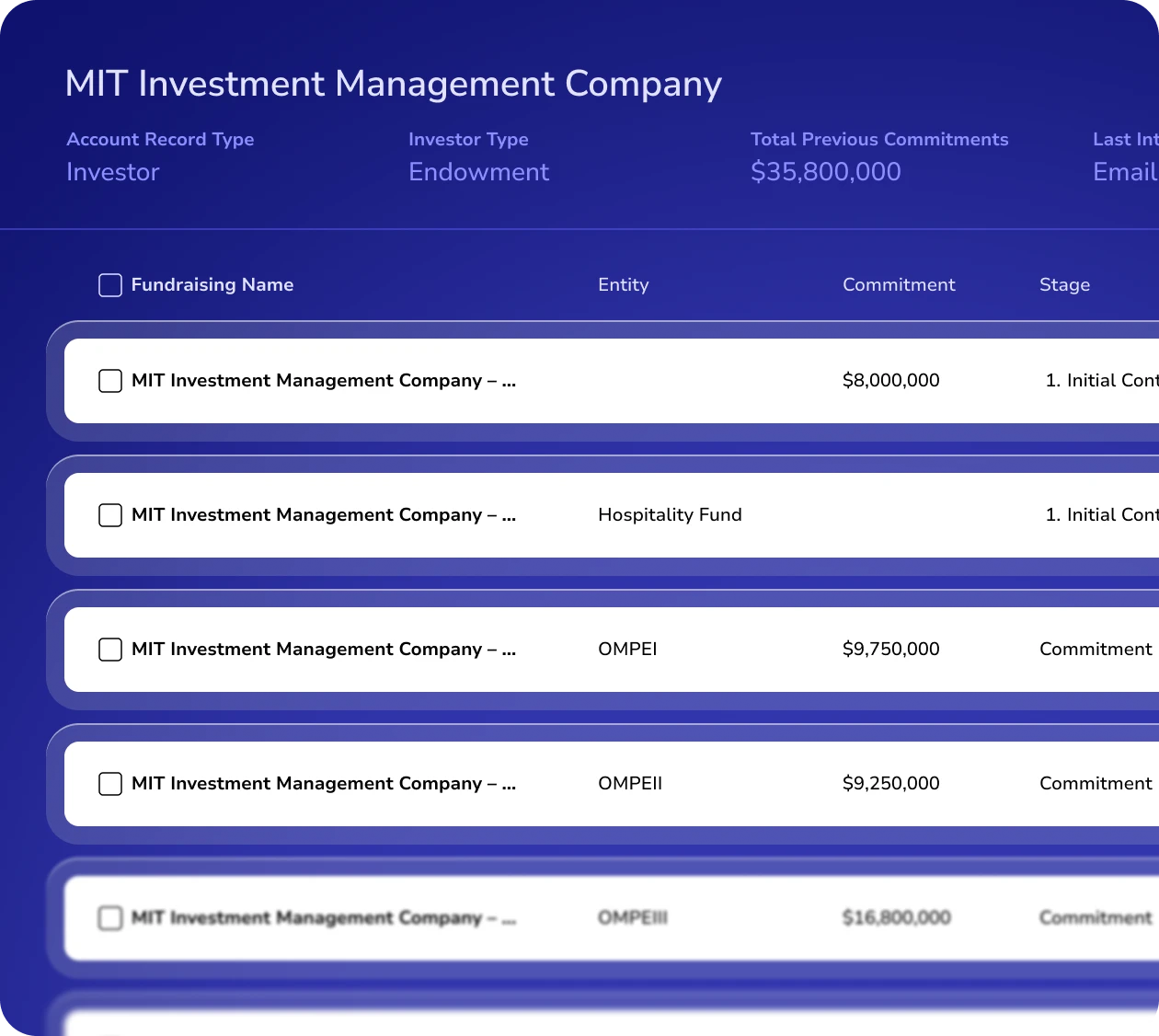
Buying Altvia gives you a head start. LP commitment tracking, fund-level relationship hierarchies, re-up history, soft circles, side letter management, and deal pipeline views ship pre-built.
Source: Altvia
But you trade flexibility for speed. Altvia's opinionated configurations mean less room to customize beyond their intended patterns.
Where Altvia pulls ahead: the LP relationship layer
Altvia's clearest advantage is its investor relations infrastructure.
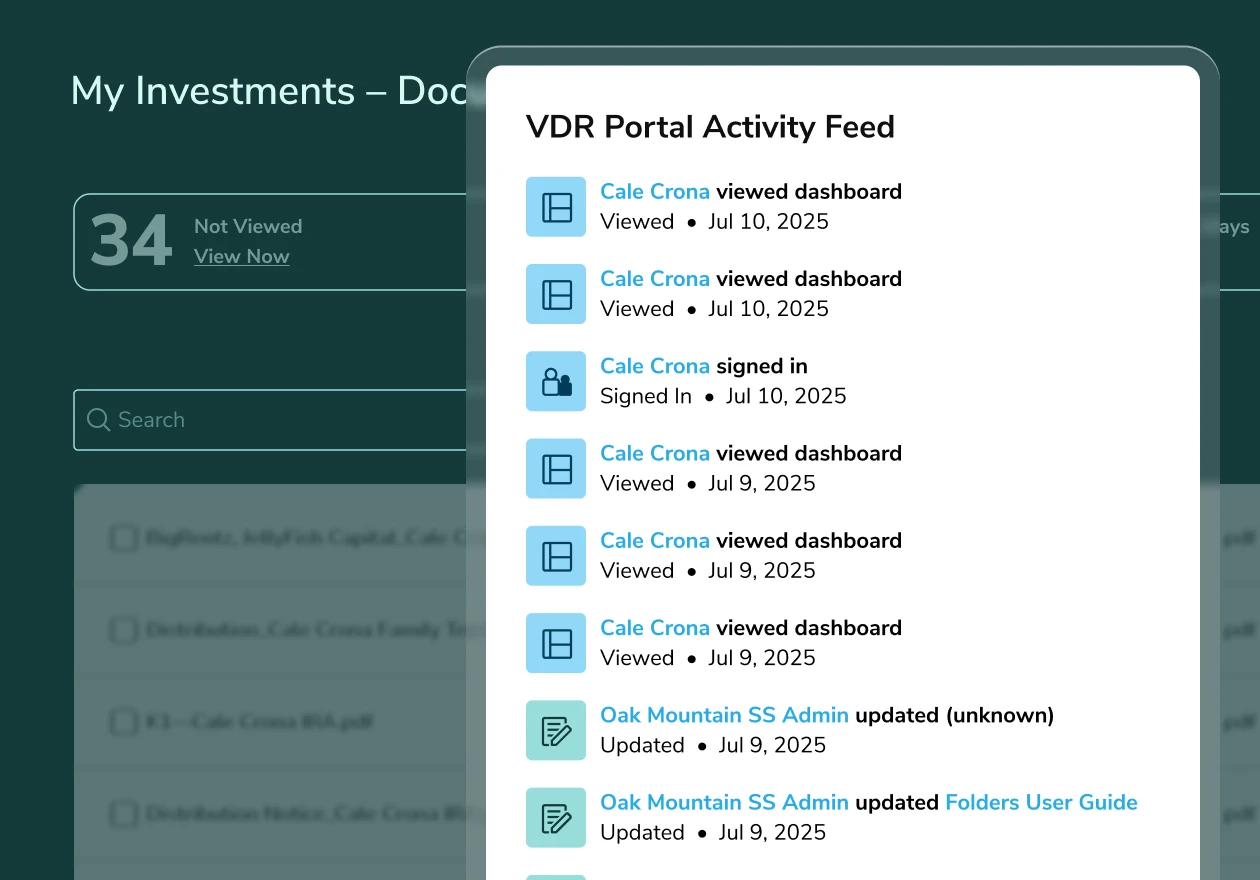
The ShareSecure LP Portal gives limited partners a branded, self-serve destination to access capital call notices, K-1s, quarterly reports, and fund documents.
Source: Altvia
The portal handles both the virtual data room function (secure document sharing during deal processes) and ongoing LP communications in one module. GPs can track what LPs have opened, downloaded, or viewed, turning document distribution into data about LP engagement.
The CRM speaks private capital natively. View LP commitments, re-ups, and mandate history in one place. Track soft circles and allocations. Capture co-invest appetite and check size preferences. Manage fundraising stages from intro to commitment with visibility across partners and IR teams.
Source: Altvia
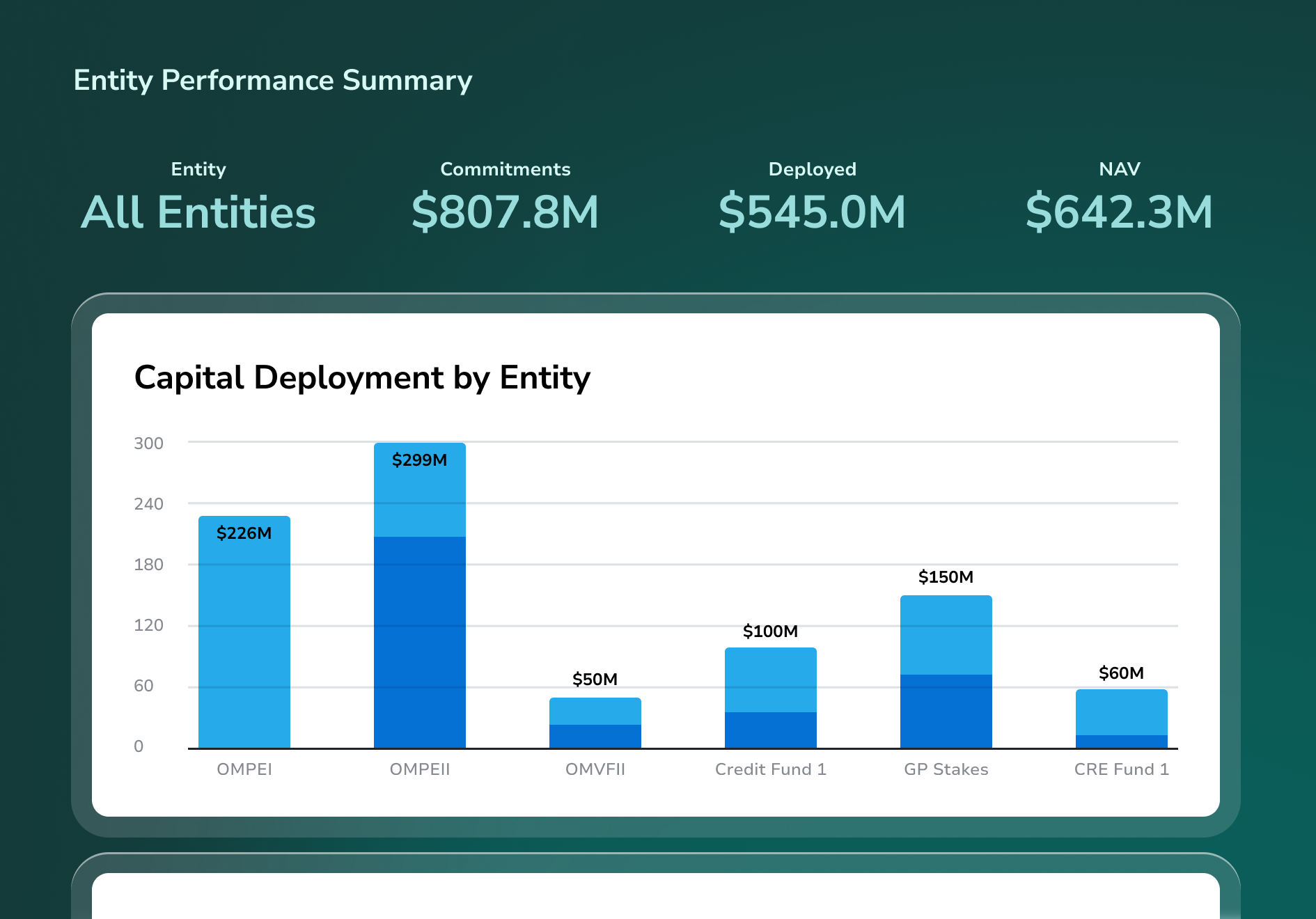
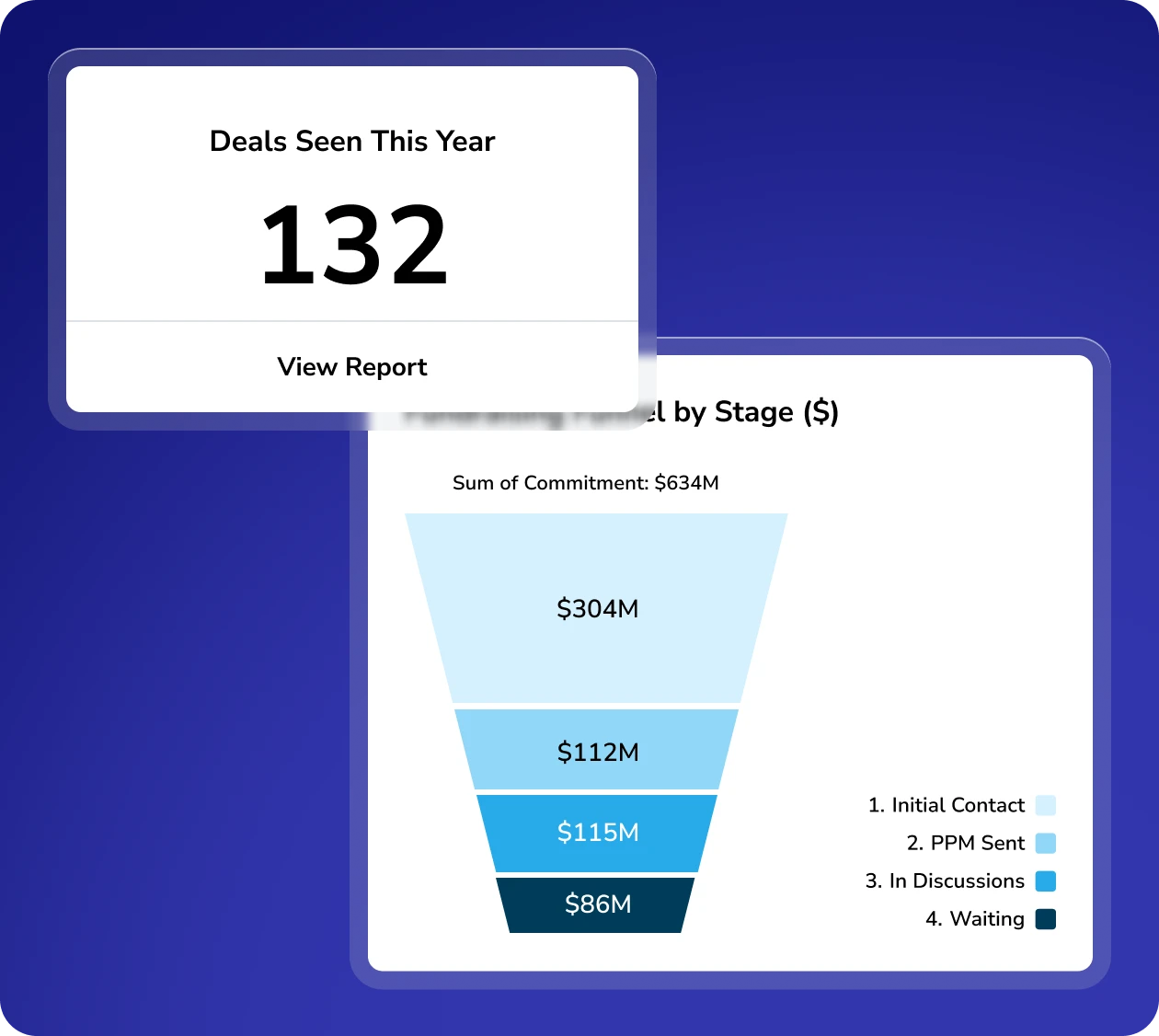
For deal teams, Kanban-style pipeline views track every deal touchpoint. Standardize deal stages from teaser to LOI and centralize diligence materials and IC prep.
Source: Altvia
Salesforce can replicate all of this. Financial Services Cloud provides some industry-specific data models. Custom objects, flows, and Lightning components can build LP portals and deal pipelines. But the configuration work is substantial, and the ongoing maintenance of a custom build falls on your team or your consultants.
Where Salesforce pulls ahead: platform breadth and AI
Salesforce's advantage is breadth. If your firm needs more than private capital workflows, Salesforce offers capabilities Altvia doesn't address.
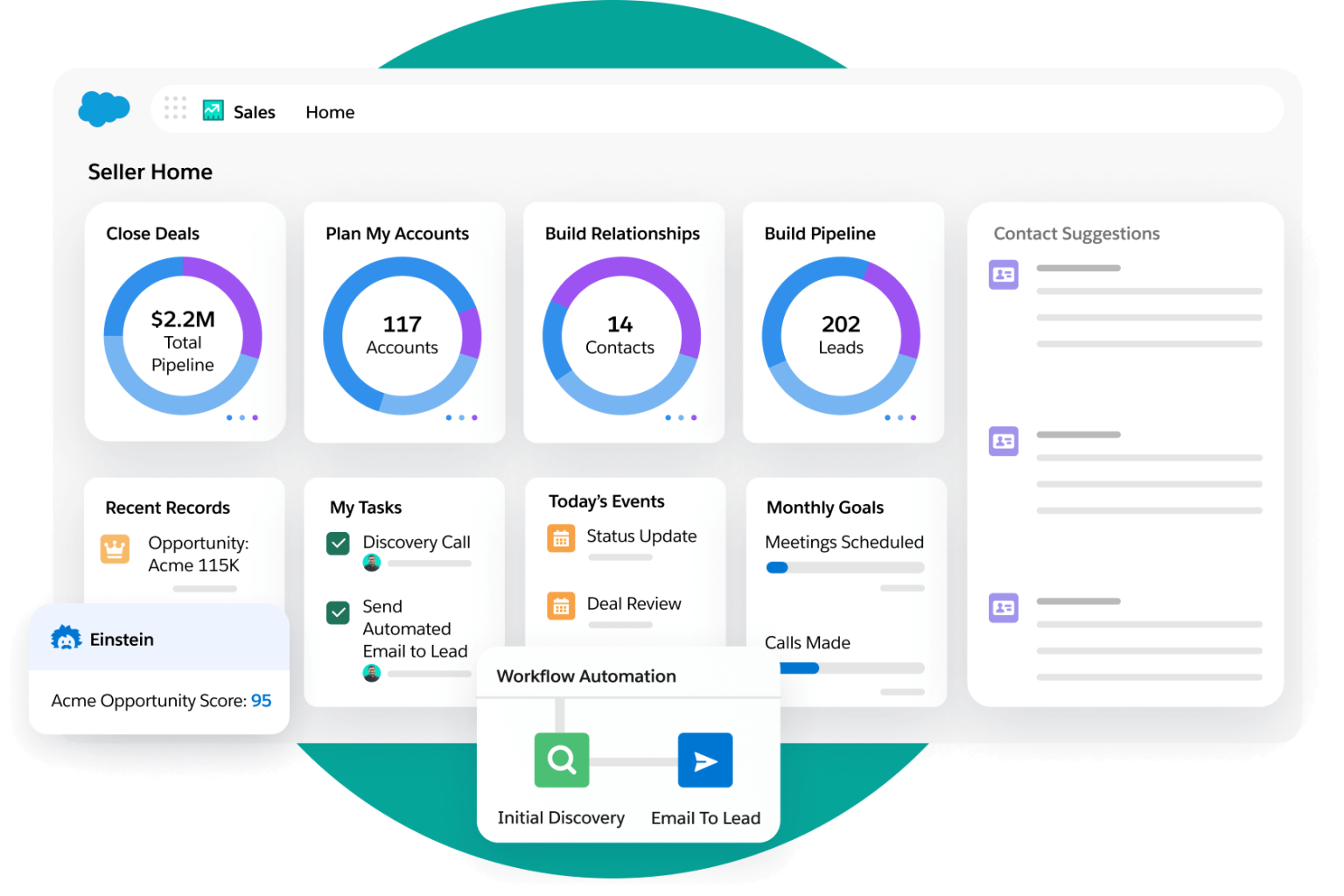
Sales Cloud handles pipeline management, forecasting, and territory planning. Service Cloud manages customer support across every channel. Marketing Cloud runs cross-channel campaigns, B2B lead nurturing, and personalization.
Source: Salesforce
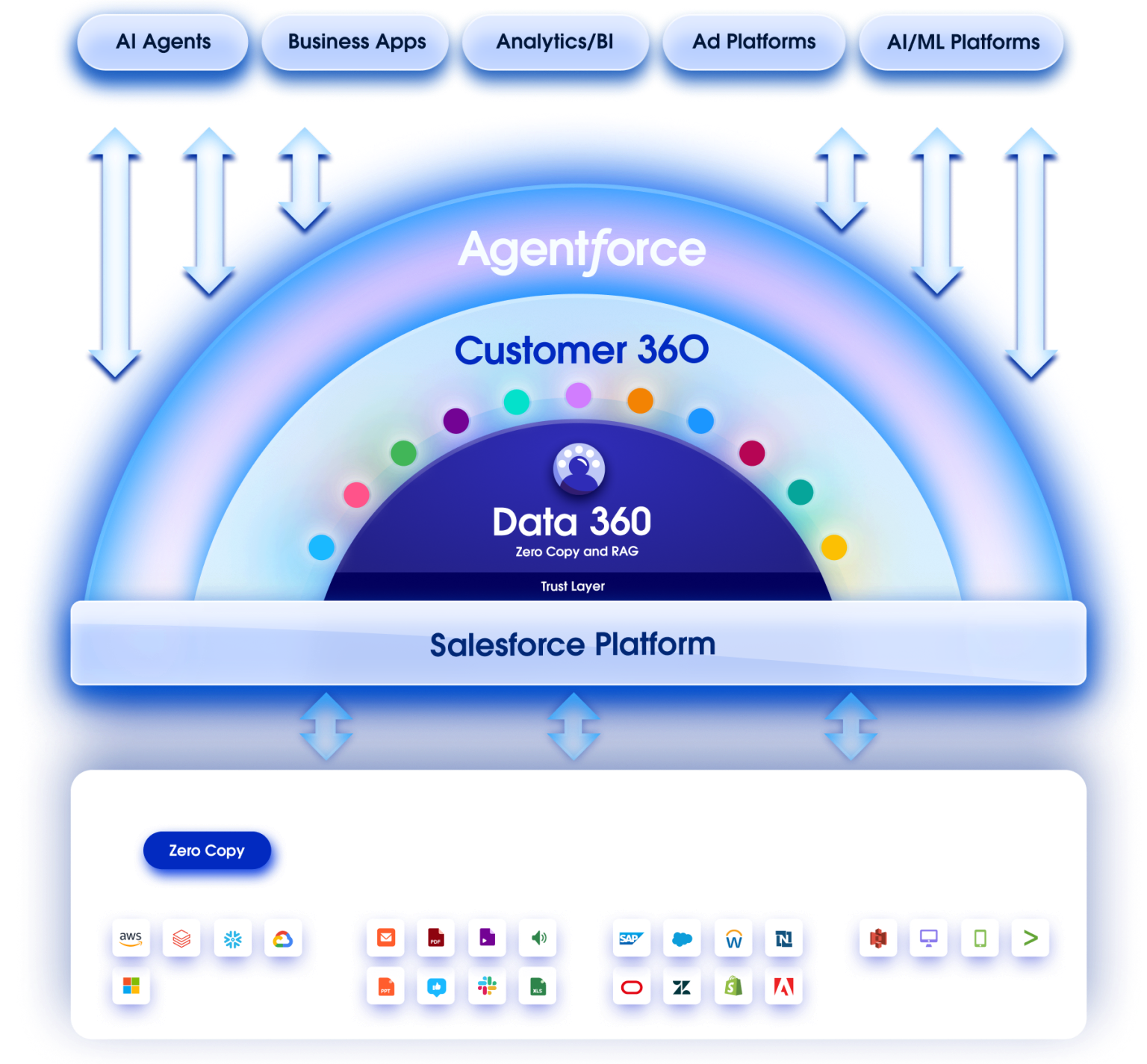
Commerce Cloud powers digital storefronts. And Data Cloud unifies data across all of them, ingesting 112 trillion records in FY26.
Source: Salesforce
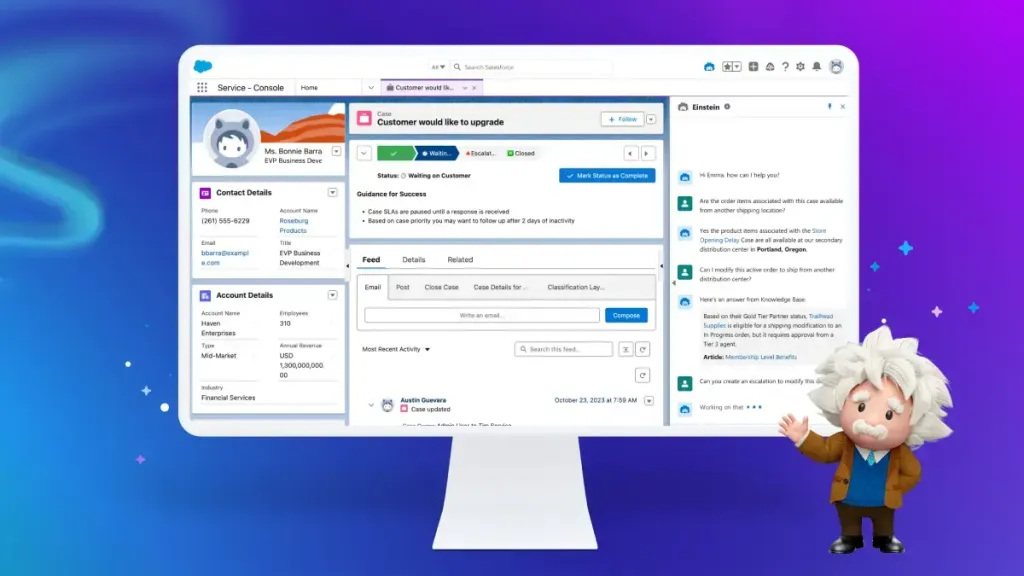
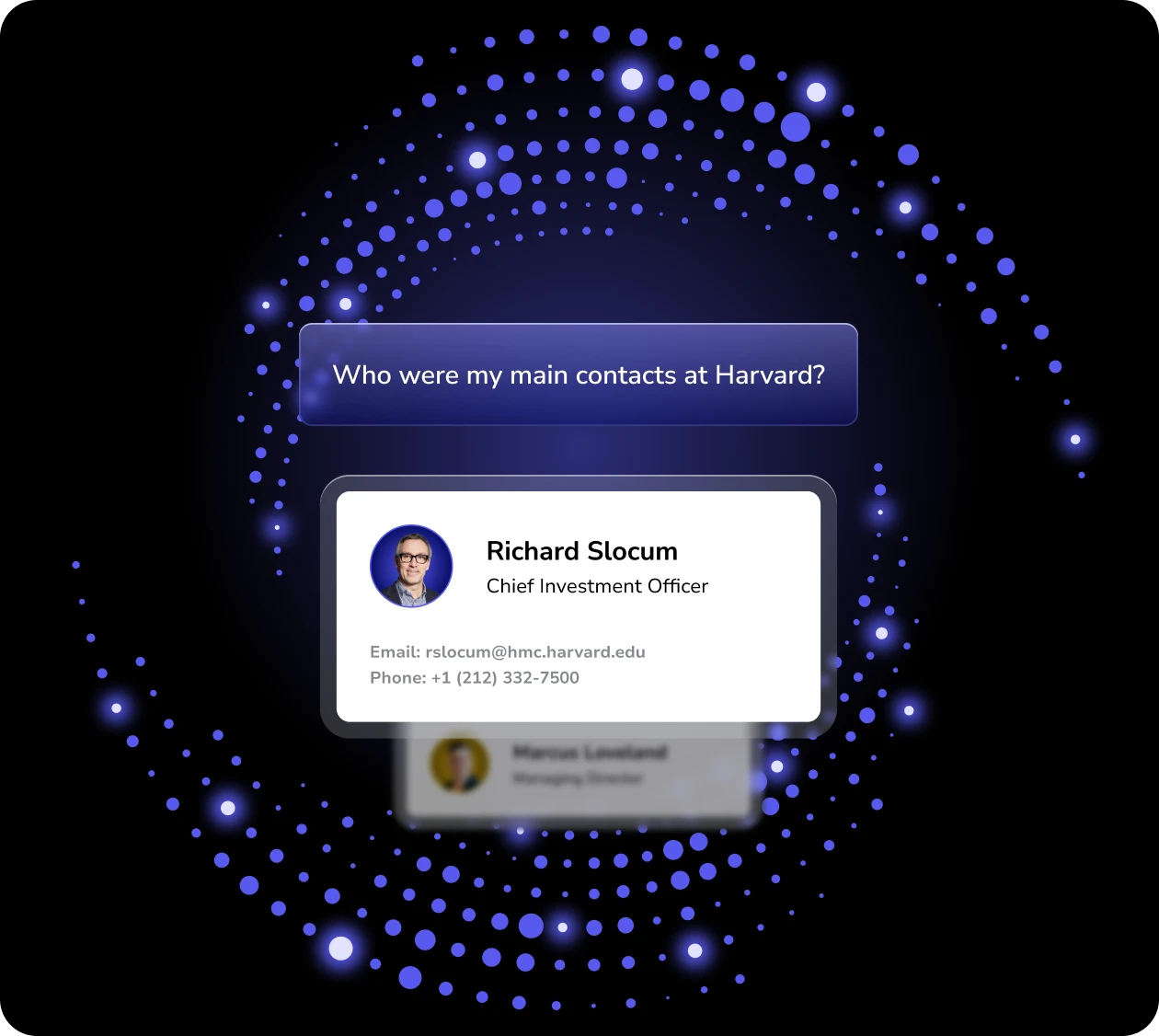
Then there's Agentforce. These aren't chatbots. They're autonomous agents powered by the Atlas Reasoning Engine that handle account research, draft outreach, manage pipelines, and resolve support cases. Salesforce uses Agentforce to resolve 85% of its own support requests without human escalation.
Source: Salesforce
Altvia has its own AI play. AIMe is a private capital-specific assistant that lets users query LP contact history, log calls via voice, and summarize deals in natural language. It draws on each firm's own CRM data rather than generic training data. And in May 2026, Altvia announced MCP support, connecting its data to Claude, ChatGPT, Copilot, and Gemini.
Source: Salesforce
But the gap in AI investment is real. Salesforce has delivered 2.4 billion Agentic Work Units and built a product line (Agentforce Builder, Agentforce Script, pre-built agents for sales, service, marketing, and commerce) that Altvia, as a smaller company, cannot match.
Source: Salesforce
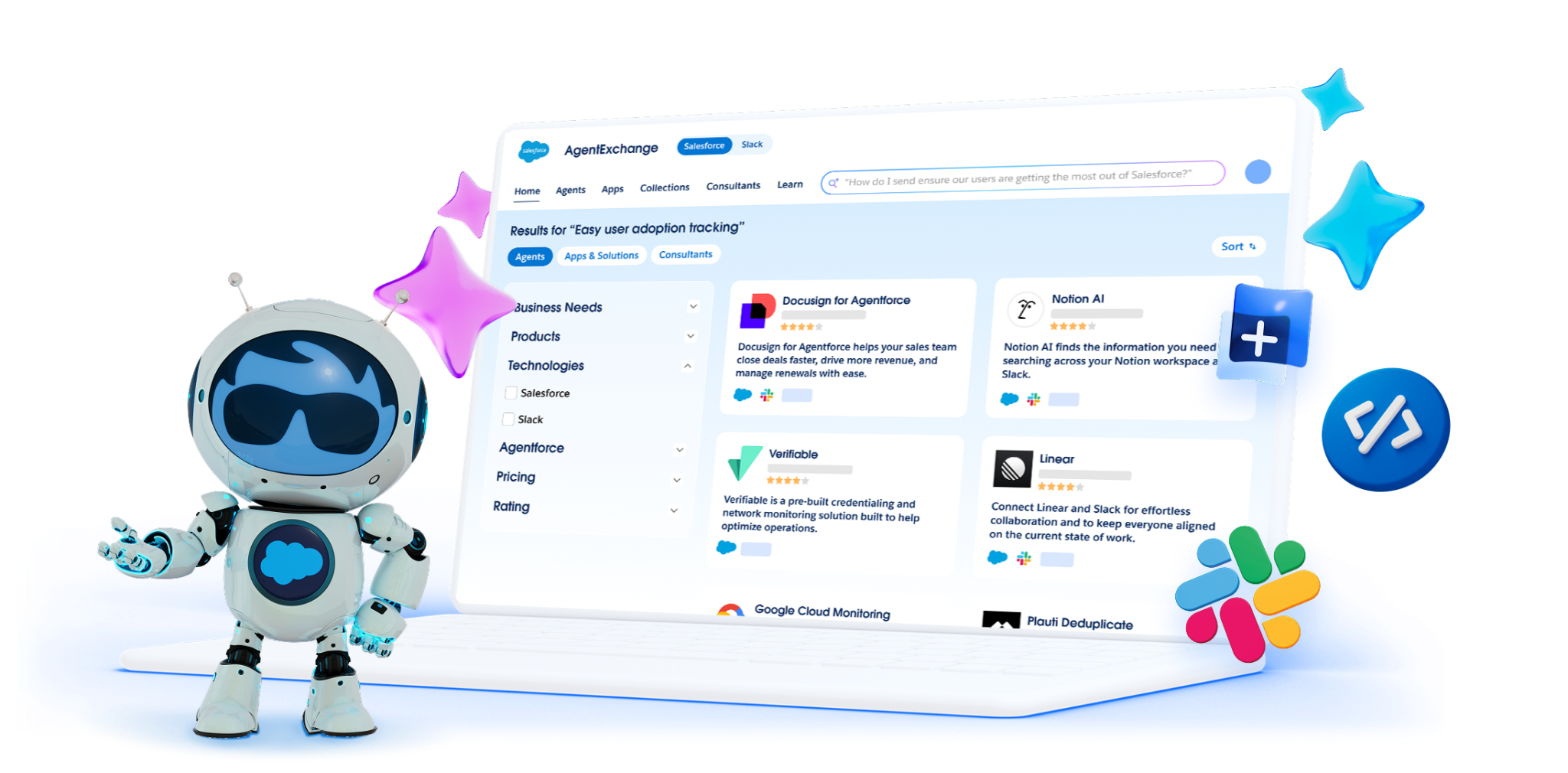
The AppExchange ecosystem reinforces this. 9,000+ partner apps and 14+ million installs mean Salesforce can be extended for almost any use case. Altvia benefits from this ecosystem because it runs on Salesforce, but Altvia's own 4,000+ integrations are largely inherited from that Salesforce foundation.
The data problem neither CRM solves
Here's what gets lost in the Altvia vs. Salesforce debate: both platforms are containers for data. Neither generates the data your firm needs to source deals, target LPs, or identify companies in-market.
Altvia can layer in Preqin or PitchBook data for LP targeting. Salesforce connects to any data source through MuleSoft or AppExchange integrations. But these are connections to third-party data, not data the platforms create or verify.
This is the gap ZoomInfo fills. With 500M contacts, 100M companies, 135M+ verified phone numbers, and 200M+ verified business email addresses, ZoomInfo provides the contact data that makes either CRM more effective.
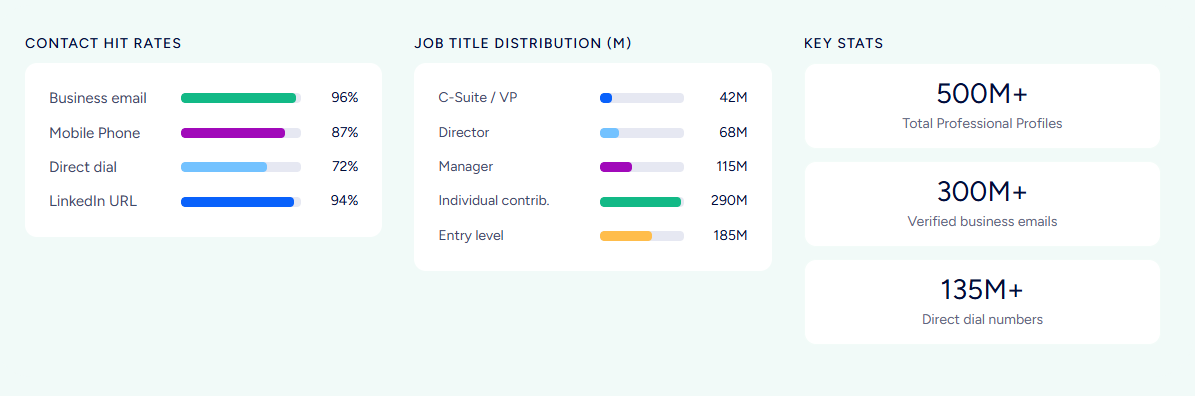
The data flows through a verification pipeline backed by 300+ human researchers and reaches up to 95% accuracy on first-party records.
For private capital firms, this means:
Deal sourcing gets sharper. ZoomInfo's technographics track 30,000+ technologies across 30 million companies. If your fund targets companies using a specific tech stack, running a specific infrastructure, or reaching a certain headcount threshold, ZoomInfo surfaces those targets with verified contact data attached.
LP targeting becomes data-driven. Buyer Intent signals, tracked from 210 million IP-to-Organization pairings, can reveal when institutional allocators are researching private capital strategies. Combined with 300+ company attributes, firms can identify and prioritize LP prospects based on buying signals rather than static lists.
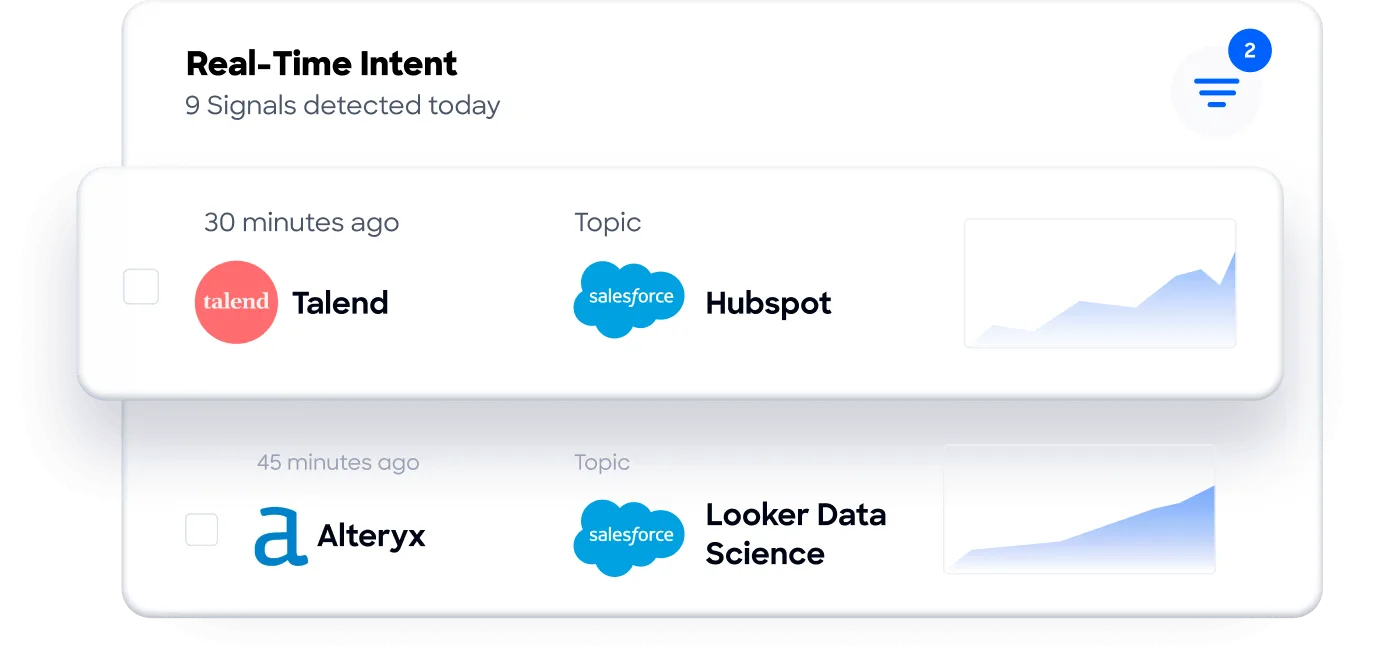
CRM enrichment runs continuously. ZoomInfo's native Salesforce integration keeps contact and company records current. Since Altvia runs on Salesforce, the same enrichment workflows apply. Job change alerts, verified direct dials, and updated org charts flow into your CRM automatically, keeping your records fresh.
Seismic's sales team attributed 39% of active pipeline to opportunities identified or influenced by ZoomInfo signals and reported 54% productivity gains. (Seismic Case Study)
For a side-by-side look at how Salesforce and ZoomInfo compare as standalone platforms, see our Salesforce vs. ZoomInfo comparison.
The GTM Context Graph adds intelligence your CRM can't
CRMs record that a deal moved stages. They don't capture why.
ZoomInfo's GTM Context Graph processes 1.5 billion+ data points daily, combining ZoomInfo's third-party B2B data with your CRM records, call recordings from Chorus, email interactions, and behavioral signals. The result: context behind deal movements. Which stakeholder joined a call and changed the dynamic. Which competitor was mentioned and what it signals about risk. Which engagement patterns match your historical wins.
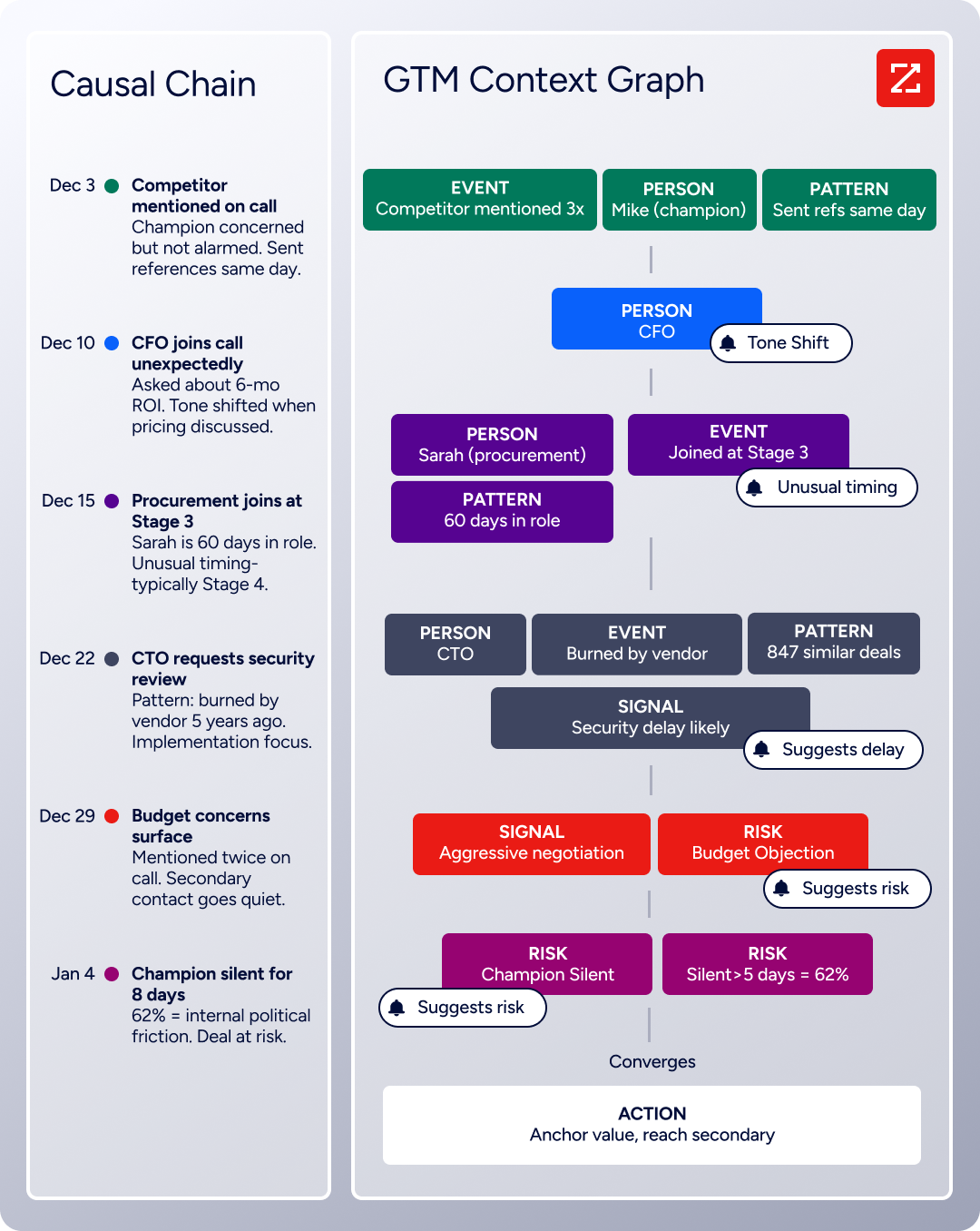
As ZoomInfo's CPO Dominik Facher writes: "The CRM recorded the state change. It has no record of why it happened." The GTM Context Graph makes that context machine-readable, so AI can reason about your deals rather than just report on them.
This intelligence reaches your team three ways:
GTM Workspace gives sellers a workspace with prioritized accounts, AI-drafted outreach, and deal tools. Databricks reached prospects 50% faster. Thomson Reuters increased closed-won deals by 40%.
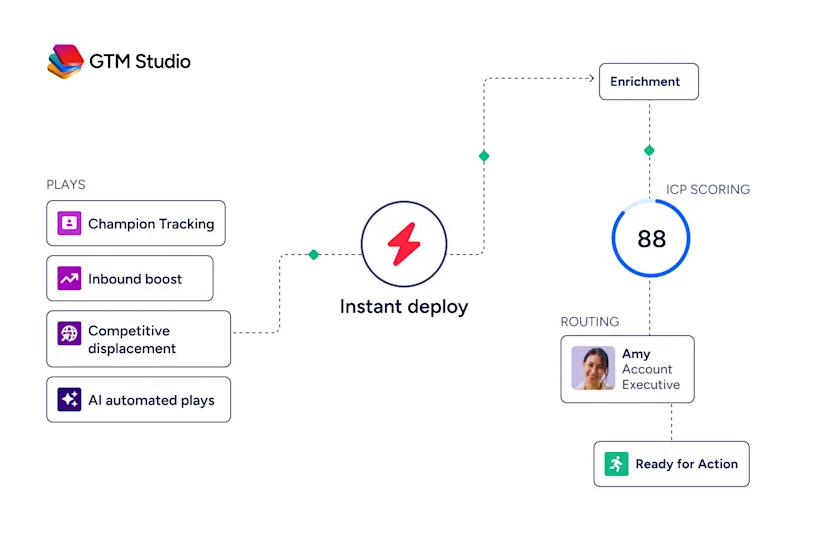
GTM Studio gives marketers and RevOps teams an interface for audience building, campaign management, and pipeline measurement in natural language.
APIs and MCP expose the same intelligence to any application, workflow, or AI agent. A large financial services firm is already building an internal app using ZoomInfo's MCP server.
Redwood Logistics achieved a 99% reduction in CPC and a 310% increase in CTR by using ZoomInfo for precision targeting. (Redwood Logistics Case Study)
Pricing: opaque vs. layered vs. custom
None of these platforms makes pricing simple.
Altvia publishes no pricing. The only entry point is a demo request form. Contracts are negotiated individually. G2 reviewers have flagged that features like campaigns carry additional costs beyond the core subscription. Without published benchmarks, total cost of ownership is hard to estimate before engaging sales.
Salesforce publishes starting prices for most products. Sales Cloud tiers range from a free suite (limited to 2 users) to $550/user/month for the Agentforce 1 edition. But the published price is rarely the final cost. Premier Support costs 30% of net license fees. Agentforce consumption adds $2 per conversation or $500 per 100,000 Flex Credits. Data Cloud credits, Marketing Cloud, and add-on modules each carry separate pricing. Implementation costs, typically partner-led, add another layer. A mid-size firm running Sales Cloud Enterprise ($175/user/month) with Financial Services Cloud, Data Cloud, and partner implementation support could face a total cost well above the per-seat sticker price.
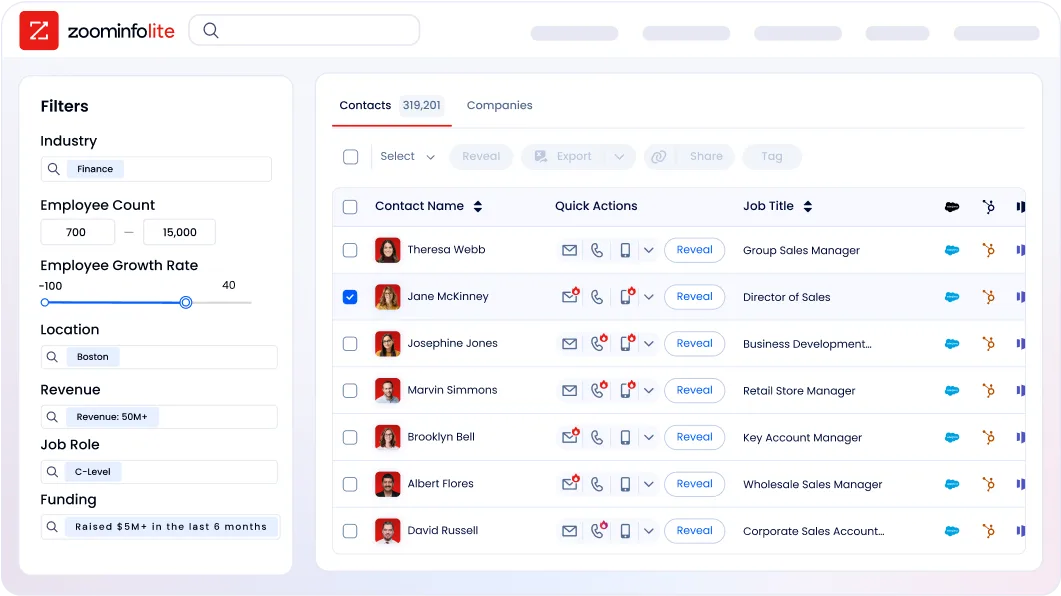
ZoomInfo uses custom-quoted, consumption-based pricing with no published dollar amounts for paid tiers. However, ZoomInfo offers two free entry points: ZoomInfo Lite (a permanent free tier with 10 monthly export credits, no credit card required) and a 7-day free trial of the full platform. For paid plans, pricing scales around seats, credit volume, and selected features across Sales, Marketing, and Enterprise tiers. API access is included in all relevant plans.
Implementation and learning curve
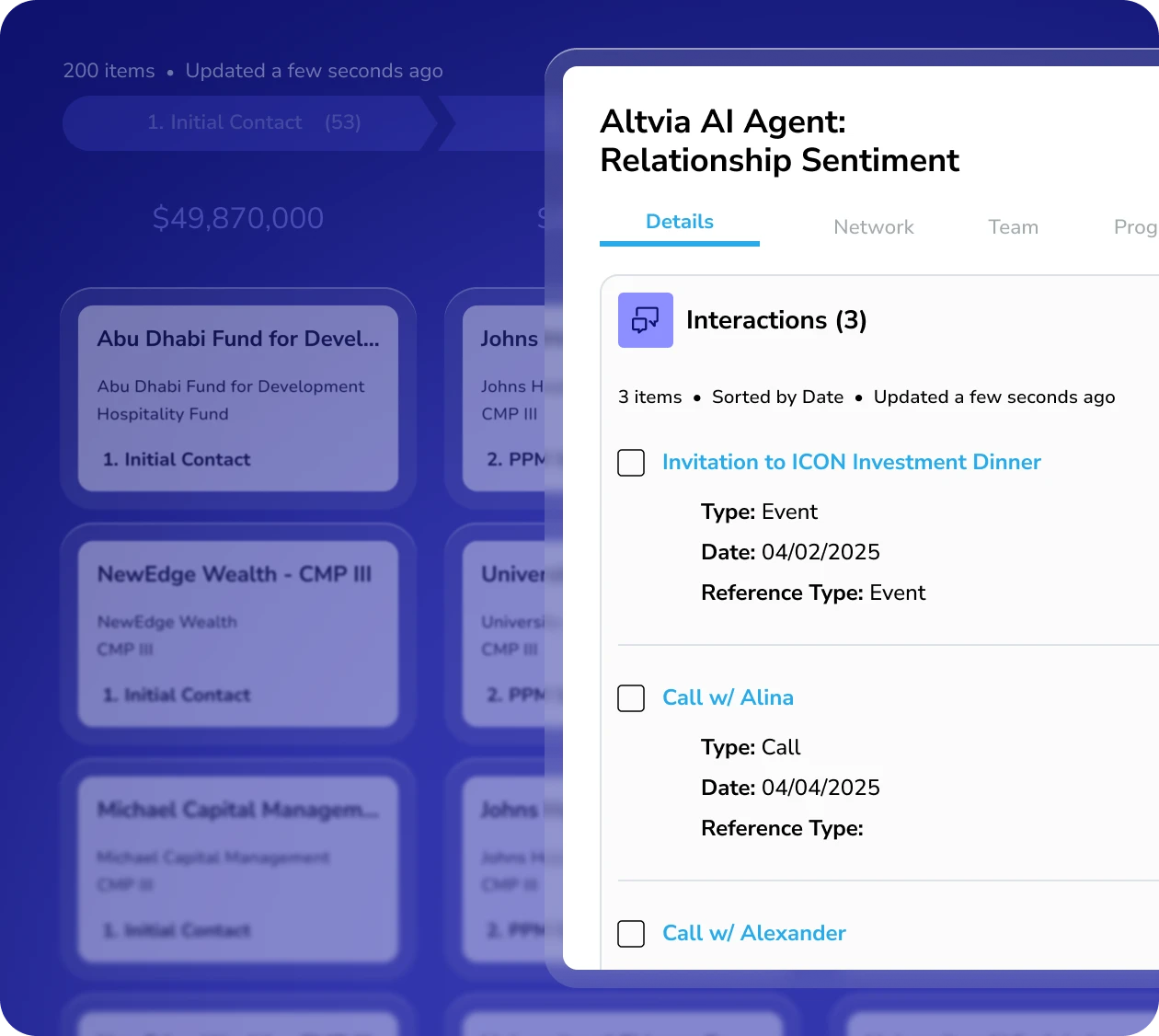
Altvia front-loads complexity in the setup phase. Steve Darrington describes "80% of the success is due to the implementation", meaning the upfront configuration work matters. But once configured, the platform works intuitively.
Source: Altvia
Altvia provides implementation sessions with a dedicated project manager, and each client gets a named Customer Success Manager. The AIMe assistant requires "no learning curve" for daily use.
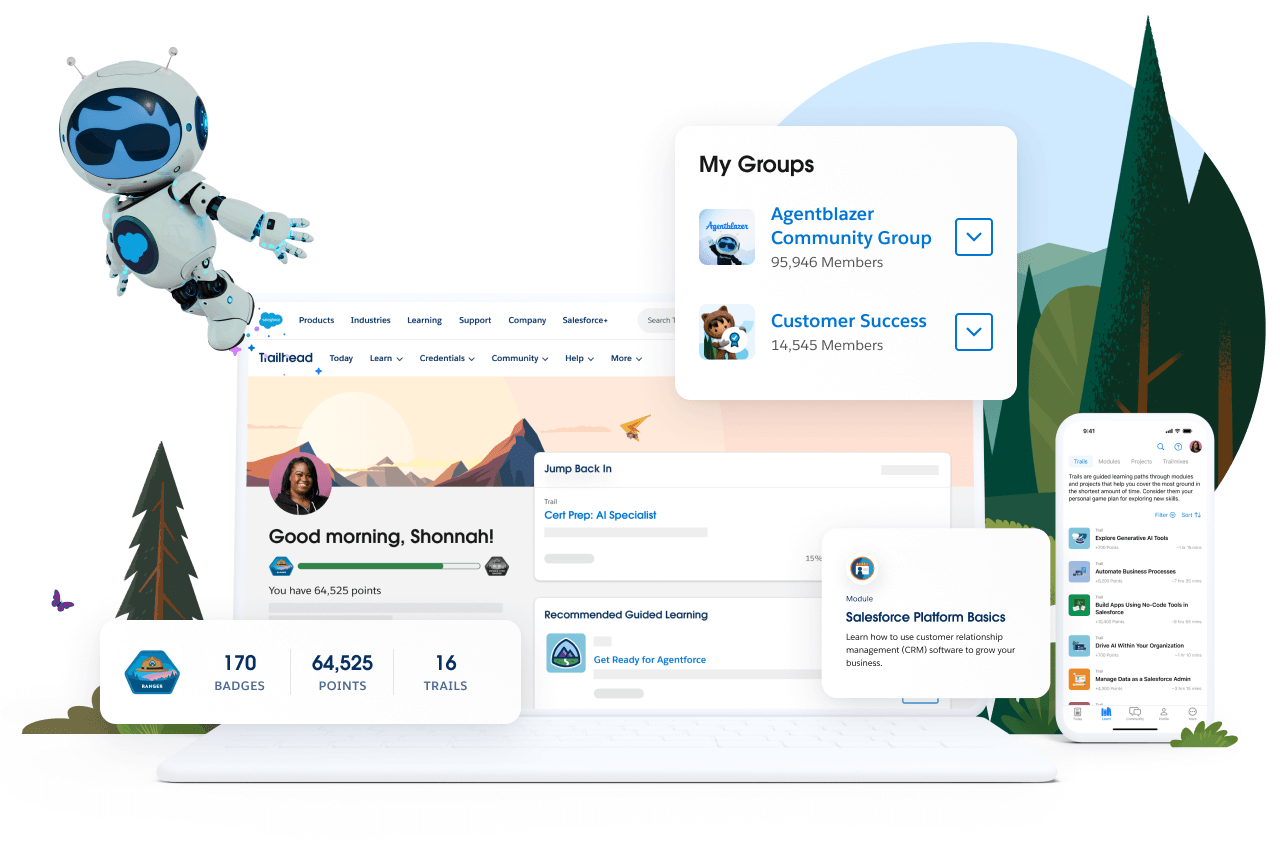
Salesforce varies widely depending on scope. A basic Sales Cloud deployment can go live in weeks. A multi-cloud enterprise implementation with Financial Services Cloud, Data Cloud, Marketing Cloud, and custom configurations can take 3 to 12 months.
Source: Salesforce
The learning curve is steep enough that Salesforce built Trailhead, a free learning platform with 6+ million learners and 1,500+ badges, to address it. Ongoing administration requires trained staff or external consultants.
ZoomInfo is the fastest to deploy. GTM Workspace "deploys in weeks, not months". ZoomInfo redesigned its onboarding program to 90 days, producing a 25% improvement in customer satisfaction scores and winning Rocketlane's Golden Comet award for Best Customer Onboarding Team of 2024.
ZoomInfo University provides role-specific learning paths for Sales, Marketing, and Administrator roles.

Security and compliance
All three platforms take security seriously, but the approaches differ.
Altvia runs on AWS and Salesforce infrastructure, inheriting their SOC 1/2/3 and ISO 27001/27017/27018 certifications. Altvia's own practices align with SOC 2 trust service principles. The LP Portal adds 2FA, encryption, dynamic watermarks, and custom permissions.
The company maintains GDPR and CCPA compliance and participates in the EU-U.S. Data Privacy Framework. For private capital firms handling sensitive LP data, the portal's document-level access controls and activity audit trails matter.
Salesforce holds ISO 27001/27017/27018, SOC 1/2/3, FedRAMP, and HITRUST certifications. The Einstein Trust Layer provides zero data retention with LLM partners, PII data masking, toxicity detection, and full audit trails. Salesforce Shield adds Event Monitoring, Platform Encryption with BYOK, and Field Audit Trail for indefinite retention. Hyperforce supports regional data residency across multiple countries.
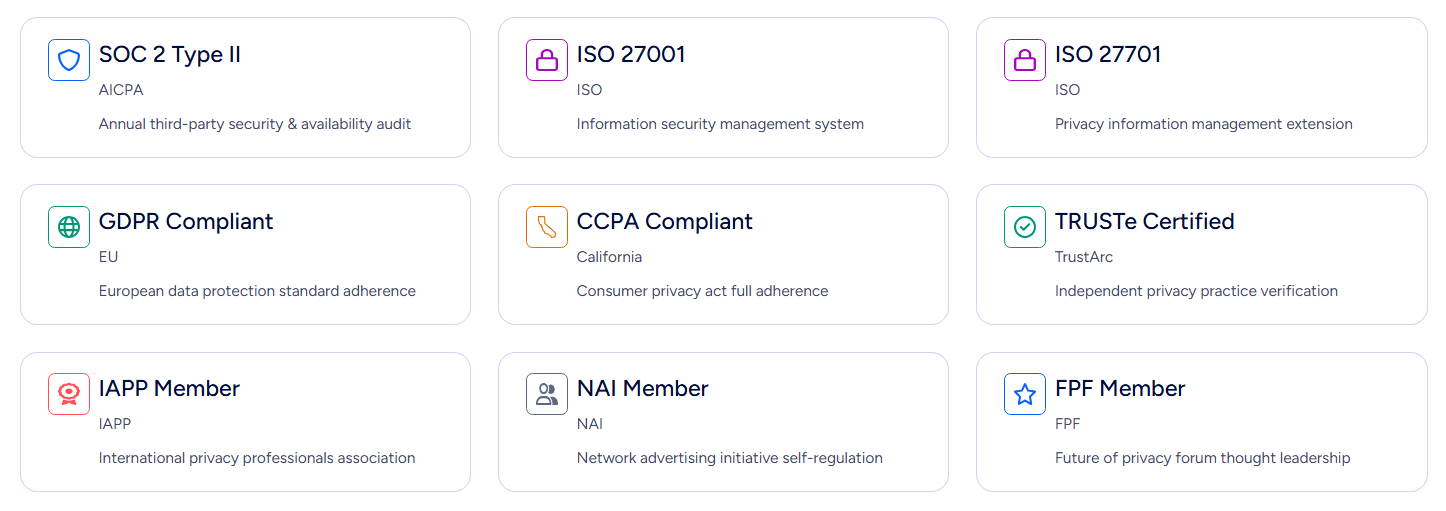
ZoomInfo holds ISO 27001, ISO 27701, SOC 2 Type II, and TRUSTe GDPR and CCPA validations, all renewed annually. ZoomInfo is a registered data broker in California and Vermont, with a dedicated Trust Center. For private capital firms subject to SEC regulation or LP due diligence requirements, all three platforms provide the compliance documentation investors expect.
Altvia vs. Salesforce vs. ZoomInfo: Which should you choose?
These three tools serve different functions, and the right combination depends on your firm's size, complexity, and priorities.
Choose Altvia if:
You're a private equity, venture capital, or fund-of-funds firm focused on LP management and deal flow
You want a CRM that speaks private capital (soft circles, re-ups, capital calls) without months of custom configuration
An integrated LP portal and virtual data room are critical to your investor relations workflow
You prefer a high-touch vendor relationship with a dedicated Customer Success Manager
Your firm's technology needs center on fund management rather than broad enterprise software
Choose Salesforce if:
Your firm needs capabilities beyond private capital CRM (marketing automation, service, commerce, analytics)
You have the budget and internal resources (or partner relationships) to build and maintain a custom Salesforce configuration
You want access to Salesforce's AI platform (Agentforce) and app marketplace (AppExchange)
Standardization across multiple departments or business lines is a priority
You're willing to invest in implementation complexity for long-term flexibility
Add ZoomInfo to either if:
You need verified B2B contact data, intent signals, and company intelligence to power deal sourcing and LP targeting
You want AI that reasons about your pipeline context, not just records it
Your team needs prospecting tools that work inside your CRM rather than alongside it
Current, verified contact data is critical to your outreach
You're building custom AI agents or workflows that need access to B2B data via API or MCP
Start with ZoomInfo Lite for free or request a full platform trial to see how the data layer transforms your CRM.
The smartest approach for most private capital firms isn't choosing one platform. It's choosing the right CRM for your workflows (Altvia for pre-configured simplicity, Salesforce for flexibility) and pairing it with the data layer (ZoomInfo) that makes your CRM useful for prospecting, deal sourcing, and relationship building. A CRM without good data is a filing cabinet. Good data without a CRM is a spreadsheet. Together, they're a system that finds, wins, and grows the relationships your firm depends on.
"ZoomInfo gives us the information we need to execute. We don't have to go through and spend our time digging. It's already there, so we can be three steps ahead." (William Kenimer, VP of Revenue Operations, Vensure; Vensure Case Study)
Altvia vs. Salesforce vs. ZoomInfo FAQ
What is the key difference between Altvia and Salesforce?
Altvia is a private capital technology platform built on Salesforce's Force.com infrastructure. It provides pre-configured CRM workflows, an LP portal, virtual data room, and analytics designed for PE, VC, and fund-of-funds firms. Salesforce is the underlying general-purpose CRM platform that can be configured for any industry, including financial services. Choosing between them is a build-versus-buy decision for private capital workflows.
Can Altvia and Salesforce be used together?
They already are, by design. Altvia runs on Salesforce, so firms using Altvia automatically have access to the Salesforce ecosystem, including AppExchange apps, APIs, and Salesforce's mobile app. What firms cannot do is run Altvia alongside a separate Salesforce Sales Cloud instance for the same users without complexity, since Altvia is its own Salesforce-based application.
How does ZoomInfo fit into the Altvia vs. Salesforce comparison?
ZoomInfo is not a CRM. It is a B2B data intelligence platform with 500M contacts, 100M companies, and 135M+ verified phone numbers. It integrates natively with Salesforce and, by extension, Altvia's Salesforce-based platform. ZoomInfo provides the prospecting data, intent signals, and company intelligence that neither CRM generates on its own, making it a complementary layer rather than a competitor to either.
Which platform is best for a small PE firm just starting out?
Altvia is designed to scale from smaller GPs to large firms. One customer described how Altvia "helped us start small and grow into a system that has allowed us to scale while institutionalizing our processes." Salesforce also offers a free suite and Starter tier at $25/user/month, but configuring it for private capital workflows requires additional investment. ZoomInfo Lite provides a permanent free tier with access to its B2B database and 10 monthly export credits.
How do the platforms handle LP reporting and investor communications?
Altvia includes a dedicated LP Portal (ShareSecure) with over 120,000 portal users worldwide, supporting branded document distribution, self-serve investor access, and engagement tracking. Salesforce does not include an LP portal natively but supports building one through custom development or third-party add-ons. ZoomInfo does not provide LP reporting, but its data enrichment can keep LP contact records current and accurate.
What AI capabilities does each platform offer?
Altvia offers AIMe, a private capital-specific assistant that queries firm data in natural language, logs calls via voice, and connects to Claude, ChatGPT, and other AI tools via MCP. Salesforce offers Agentforce, an autonomous AI agent platform with $800M ARR that handles sales, service, marketing, and custom use cases across the platform. ZoomInfo provides the GTM Context Graph, an AI layer that processes 1.5 billion+ data points daily to surface deal insights, buyer intent, and recommended actions through GTM Workspace, GTM Studio, or any third-party tool via API and MCP.
Is Salesforce's pricing more transparent than Altvia's?
Salesforce publishes starting prices for most products, with Sales Cloud ranging from free to $550/user/month. However, actual costs depend on add-ons like Premier Support (30% of license fees), Agentforce consumption credits, Data Cloud, and implementation partner fees. Altvia publishes no pricing at all, requiring a demo and sales engagement for any commercial details. ZoomInfo also uses custom-quoted, consumption-based pricing for paid plans but offers a permanent free tier and a 7-day free trial.
How long does it take to implement each platform?
Altvia implementations vary but require upfront configuration, with the vendor providing dedicated project managers. Salesforce ranges from weeks for simple Sales Cloud to 3-12 months for multi-cloud enterprise deployments. ZoomInfo's GTM Workspace deploys in weeks, and the company's redesigned 90-day onboarding program won an industry award for customer onboarding.
See how Salesforce compares against other CRMs and platforms:
