

Choosing between Act! and Salesforce for your CRM often comes down to five questions:
Are you a small team managing a few hundred relationships, or a growing organization with complex sales processes across departments?
Do you need built-in email marketing and automation, or a platform that scales into service, commerce, and custom applications?
Is your budget under $100/user/month, or can you invest more for a broader platform?
Do you have IT staff to manage a complex CRM, or do you need something you can configure yourself?
How important is having accurate, verified B2B data flowing into your CRM so your team contacts the right people?
In short, here's what we recommend:
Act! is built for small businesses and independent professionals who want CRM and email marketing in one package. Since inventing the CRM category in 1987, Act! has served relationship-driven businesses like insurance agents, financial advisors, and small manufacturers.
Its front-office platform combines contact management, sales pipeline tracking, interactive quotes, and marketing automation starting at $30/user/month. The trade-off: Act!'s interface shows its age, third-party integrations are limited, and AI features are still early compared to larger platforms.
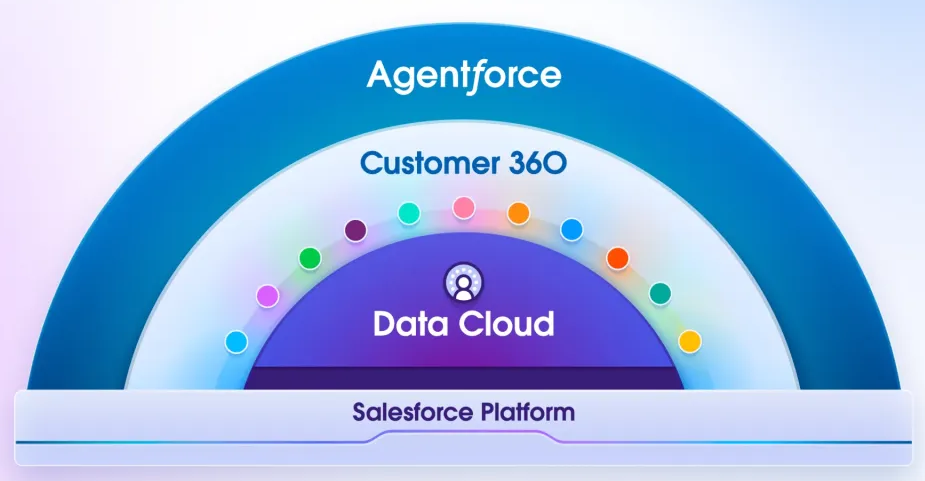
Salesforce is the world's #1 CRM by market share, serving over 150,000 companies from startups to global enterprises. Its Customer 360 platform spans sales, service, marketing, commerce, and analytics, with Agentforce AI agents that handle tasks autonomously.
Salesforce's depth has no equal, but neither does its complexity. Meaningful deployments require dedicated administrators, pricing starts at $25/user/month but climbs fast as you add features, and over 70% of implementations are partner-led, adding real cost.
Both platforms manage customer relationships and sales pipelines. But a CRM is only as effective as the data inside it. If your team spends hours searching for accurate contact information, guessing which accounts to prioritize, or writing outreach from scratch, the CRM becomes a filing cabinet instead of a revenue engine. That's the gap ZoomInfo fills.
ZoomInfo is a B2B data and GTM intelligence platform that gives your CRM the data it needs to produce results. Built on 500M contacts, 100M companies, 135M+ verified phone numbers, and 200M+ verified business emails, ZoomInfo's GTM Context Graph combines this data with your CRM records, conversation transcripts, and behavioral signals to show not just what's happening in your pipeline, but why.
Sellers reach this intelligence through GTM Workspace, marketers and RevOps teams through GTM Studio, and any tool or AI agent through APIs and MCP. ZoomInfo integrates with Salesforce and other major CRMs, turning your relationship management system into a data-driven revenue platform.
If feeding your CRM with verified data sounds like the missing piece, see how ZoomInfo works.
Act! vs. Salesforce vs. ZoomInfo at a glance
Act! | Salesforce | ZoomInfo | |
|---|---|---|---|
Primary function | SMB CRM + email marketing | Enterprise CRM platform | B2B data and GTM intelligence |
Email marketing | Built-in (2,500-50,000 sends/month) | Separate Marketing Cloud ($1,500+/org/month) | Multi-channel orchestration via GTM Studio |
AI capabilities | AI Writing Assistant, AI History Summary | Agentforce autonomous agents, Einstein AI | GTM Context Graph, AI outreach and account intelligence |
B2B contact database | None | None | 500M contacts, 200M+ verified emails, 135M+ verified phones |
Intent data | None | None | Buyer intent from 210M IP-to-Org pairings |
Integrations | Limited native; Zapier-based | 9,000+ apps via AppExchange | 120+ integrations plus API and MCP access |
Starting price | $30/user/month | $25/user/month (Starter Suite) | Custom-quoted; free tier available |
Free plan | 14-day trial | Free Suite (2 users) | ZoomInfo Lite (permanent free tier) |
Learning curve | Moderate | Steep | Moderate (90-day onboarding program) |
Best for | Small businesses, 1-10 users | Mid-market to enterprise | Sales and marketing teams needing verified B2B data |
Built for different scales of business
Act! and Salesforce target different buyers, and the gap between them is wider than the pricing suggests.
Act! is built for the business owner who is also the salesperson, the marketer, and the customer service rep.
The Perfect-Fit CRM selector scopes the product for teams of 1 to 10+ users. Most customer testimonials come from solo practitioners or small teams. Several customers have used the product for 15-35+ years.
That loyalty reflects a product that knows its audience: relationship-driven professionals in insurance, financial services, and manufacturing who need organized contact management without IT overhead.
Salesforce serves a different universe. With $41.5 billion in annual revenue and over 76,000 employees, it powers everything from two-person startups (via the free CRM) to PepsiCo, FedEx, and Volkswagen. But the platform was built for large enterprises, and the full value surfaces when you have dedicated administration, multi-department workflows, and the budget to invest in the broader ecosystem.
The scale difference matters in practice. An insurance agent can sign up for Act! today and manage contacts by tomorrow. A mid-market company deploying Salesforce should budget 3-12 months for implementation and plan on partner-led configuration.
CRM and contact management compared
At the contact record level, both platforms do the same job: centralize customer data so your team knows the full history before every interaction.
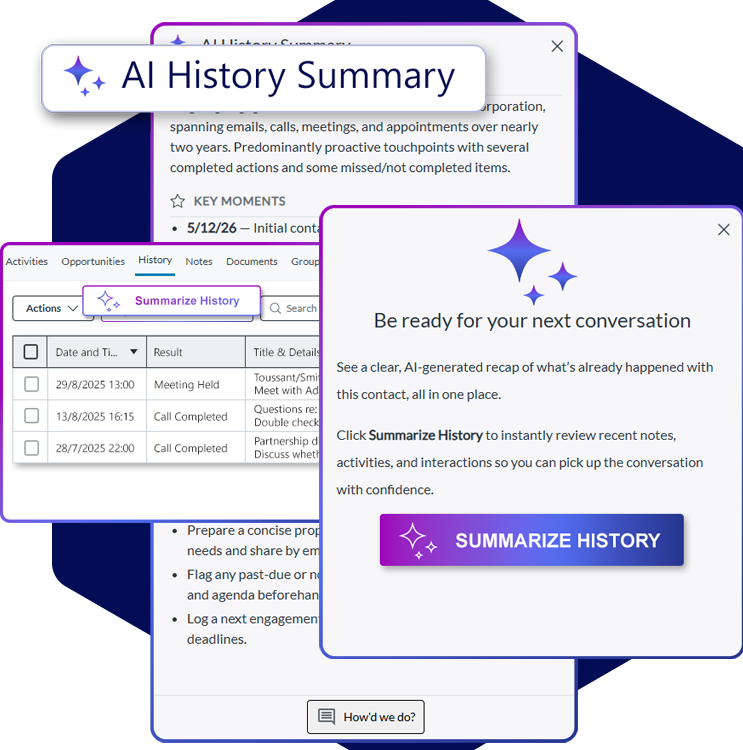
Act!'s contact management is its strongest feature, refined through nearly 40 years of SMB use. Each contact record collects calls, emails, notes, tasks, documents, and quotes. The AI History Summary generates a recap of recent interactions with suggested next steps, so you walk into calls prepared without scrolling through old records.
Source: Act!
Custom Industry Tables let businesses attach structured data (insurance policies, mortgage details, service contracts) to contacts using 11 pre-built industry templates. The Act! Sidebar for Outlook logs emails to contact records automatically.
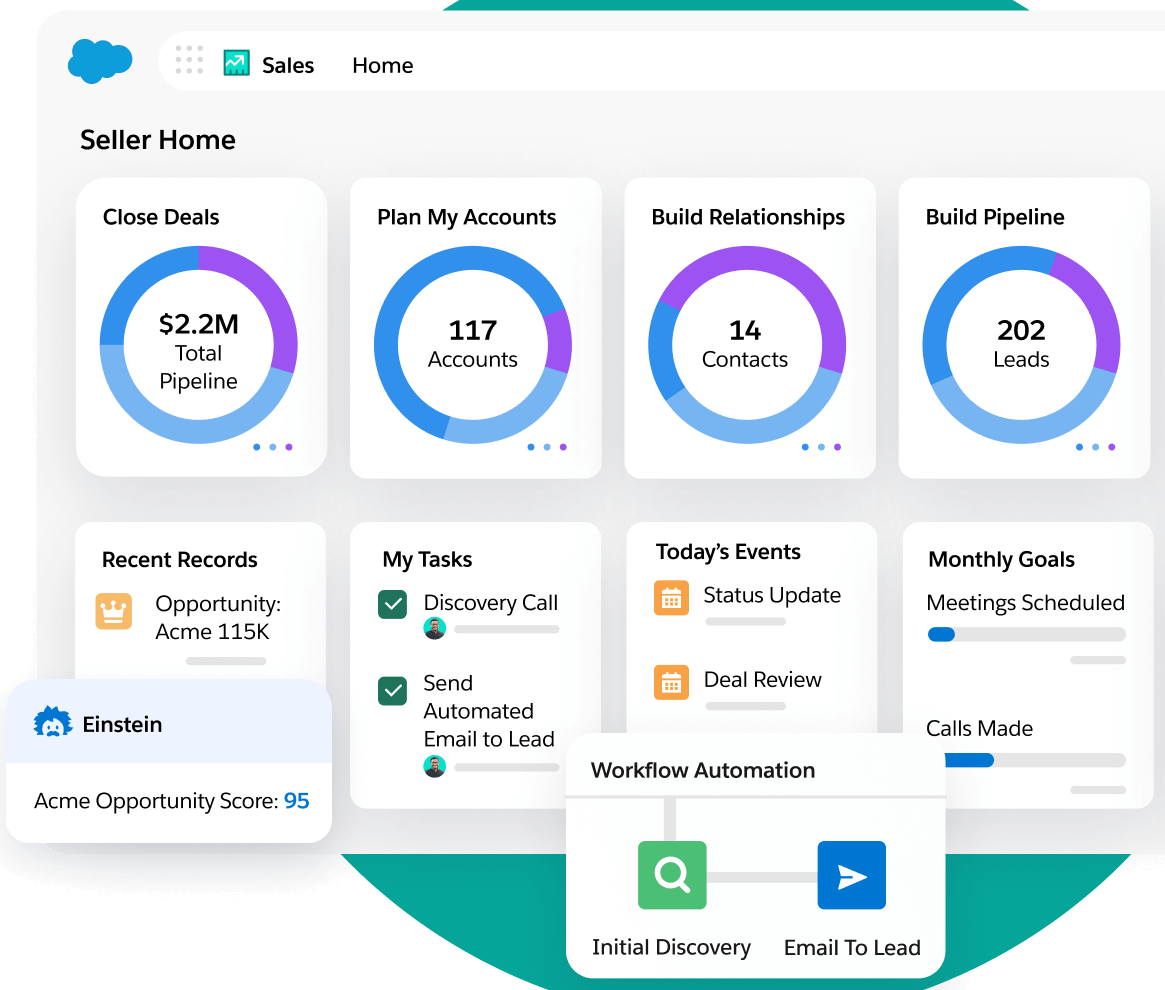
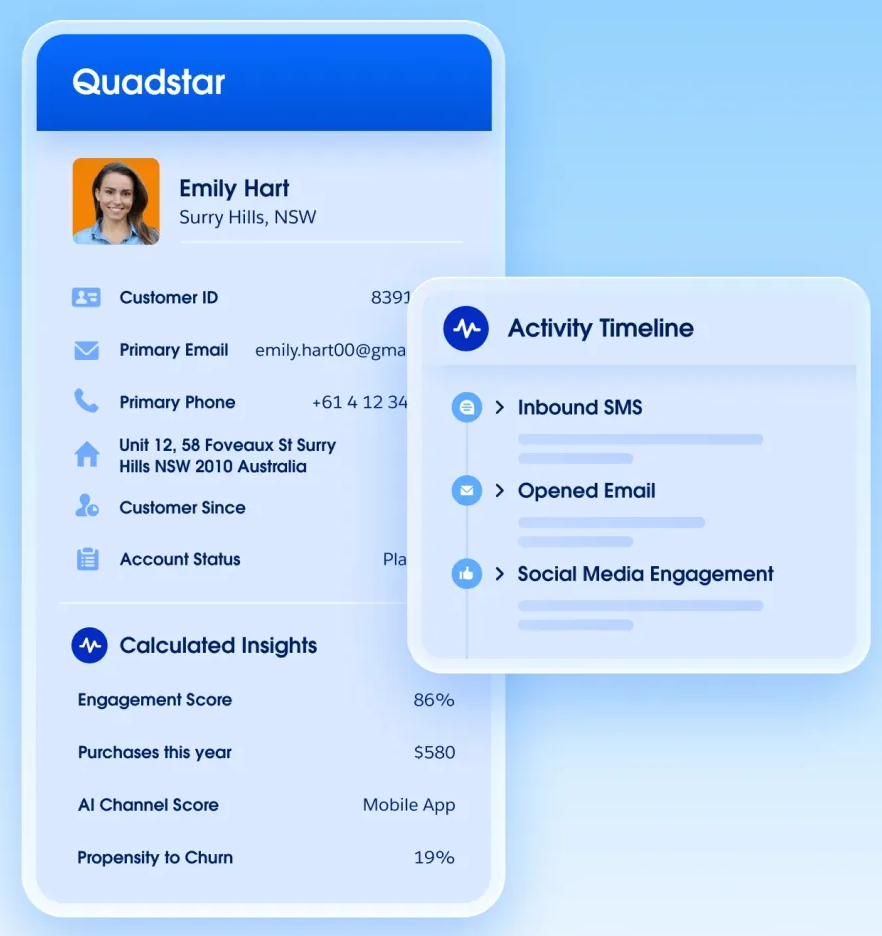
Salesforce's Sales Cloud takes contact management several layers deeper. Einstein Activity Capture auto-syncs emails and calendar events from Gmail or Outlook. Pipeline Management provides AI deal insights and change signals. Forecast Management delivers real-time rollups with AI overlays.
Source: Salesforce
The platform supports territory hierarchies, multi-stakeholder deal tracking, and Revenue Lifecycle Management from CPQ through billing.
The difference is scope, not quality. Act! handles the contact-to-close workflow well for small teams. Salesforce handles it for organizations where dozens of reps work thousands of accounts across multiple regions, products, and deal stages.
The intelligence gap in both CRMs
Here's what neither Act! nor Salesforce solves on its own: where do the contacts come from, and how do you know which ones are worth pursuing?
Act! assumes you already have your contacts or will find them yourself. You import a list, add them manually, or capture them through web forms. Salesforce assumes the same, though its AppExchange lets you plug in data providers. But the CRM itself is a container.
It organizes and tracks relationships. It doesn't tell you which of the 10,000 companies in your target market are researching solutions like yours right now.
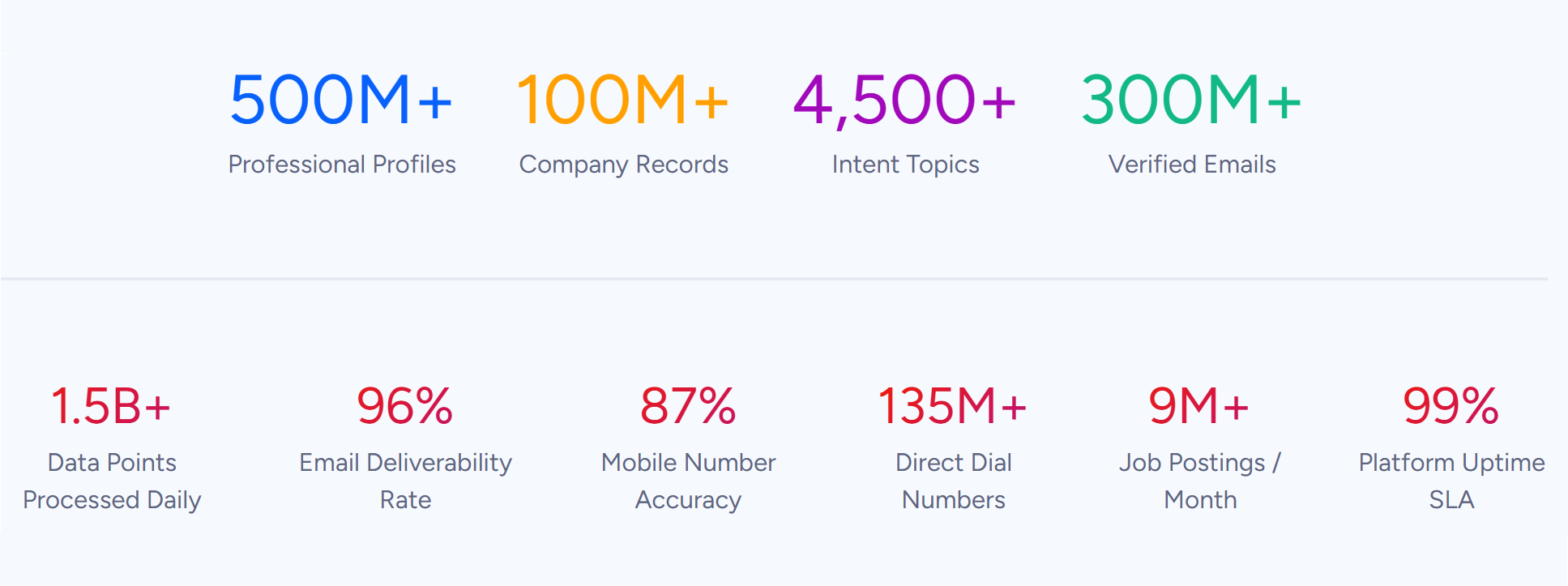
ZoomInfo was built to solve this problem. The platform's 500M contacts and 100M company profiles are verified through a multi-source pipeline backed by 300+ human researchers, reaching up to 95% accuracy on first-party data. In a Fortune 500 competitive RFP analyzing 25 million contacts across vendors, an independent consultant concluded that "no other competitor came even close."
Source: ZoomInfo
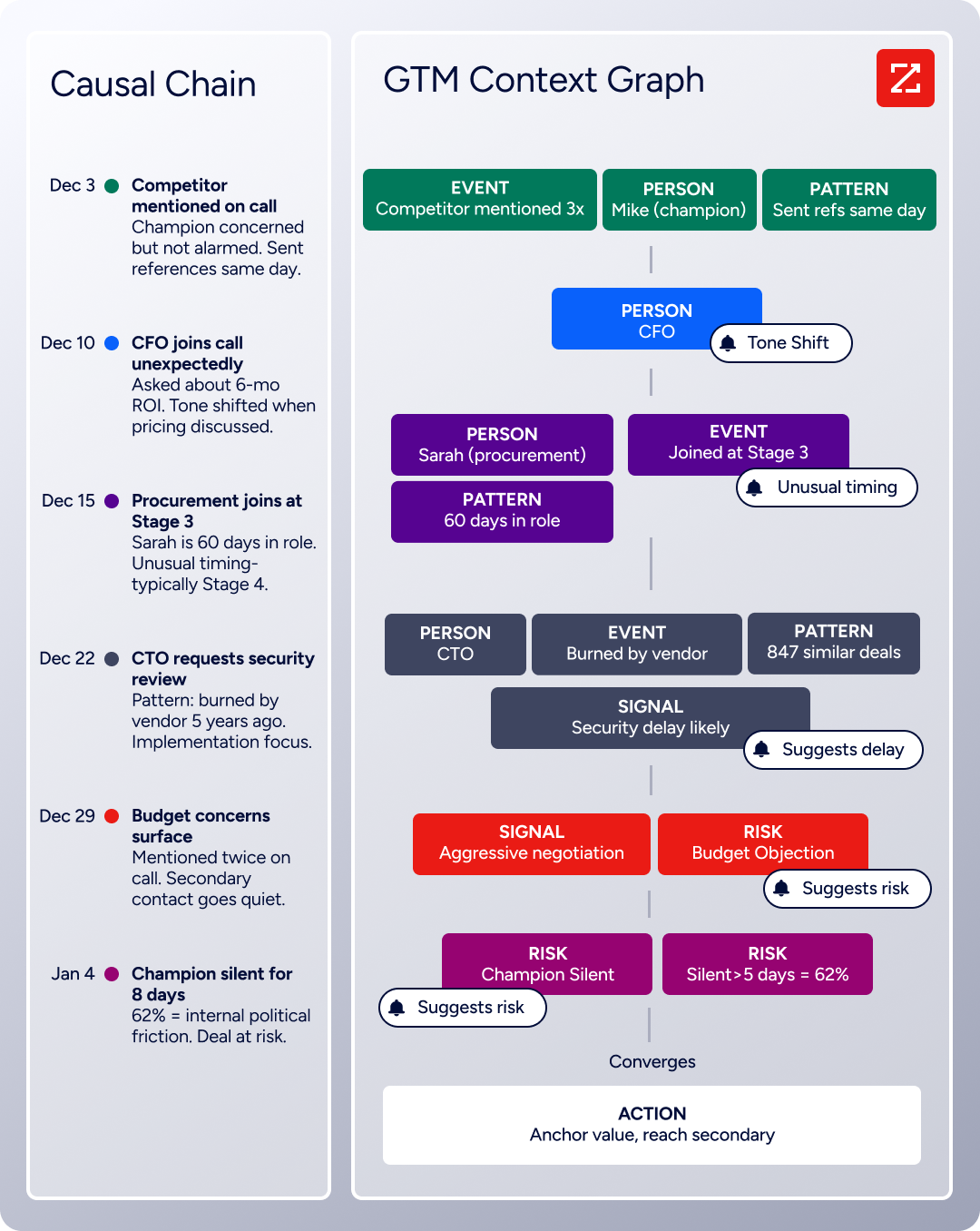
That data feeds the GTM Context Graph, which processes 1.5B+ data points daily and combines ZoomInfo's third-party intelligence with your CRM records, conversation transcripts, and behavioral signals. The result: your CRM doesn't just show you that a deal moved to Stage 3.
Source: ZoomInfo
The GTM Context Graph reveals why it moved (what the executive said on the last call that signals urgency) and which accounts in your pipeline match the pattern behind your closed-won deals.
Seismic's sales team attributed 39% of active pipeline to opportunities identified or influenced by ZoomInfo signals, boosted productivity by 54%, and saved 11.5 hours per week per seller. (Seismic Case Study)
Email marketing and automation take different approaches
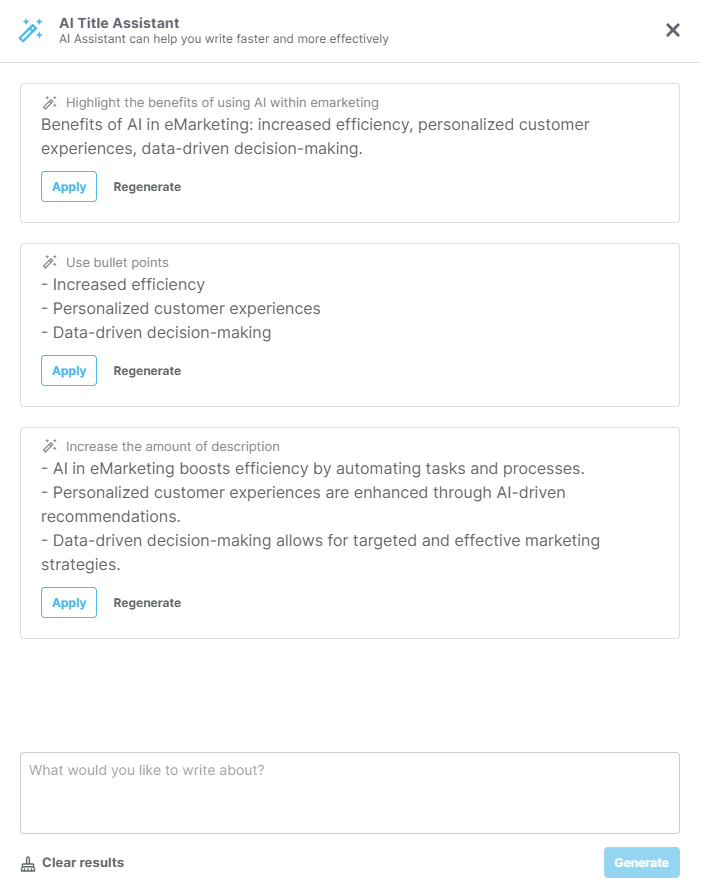
Act!'s standout advantage over Salesforce is built-in email marketing. The Standard plan includes 2,500 sends/month with a 170+ template library and drag-and-drop editing. The Professional plan adds response-driven Nurture Marketing, an AI Writing Assistant, and landing pages.
Source: Act!
The Ultimate plan unlocks full marketing automation with lead scoring, progressive profiling, and website activity tracking at 50,000 sends/month. The most distinctive feature is the Automated Marketing-to-CRM Workflow: when a prospect engages with an email, form, or website page, Act! creates a prioritized sales activity for the rep. No separate platform required.
Salesforce takes a modular approach. Marketing Cloud is a separate product starting at $1,500/org/month for Marketing Cloud Growth. B2B Marketing Automation (Account Engagement) starts at $1,250/org/month. These tools offer journey orchestration, CDP capabilities, and AI personalization. But they're priced and designed for teams with dedicated marketing operations staff.
Source: Salesforce
For a five-person insurance brokerage, Act!'s bundled email marketing at $60/user/month delivers what they need. For a 200-person SaaS company, Salesforce's Marketing Cloud offers capabilities Act! can't match. The choice follows the same pattern as the rest of the platform: Act! bundles essentials for small teams, Salesforce offers depth for organizations ready to invest.
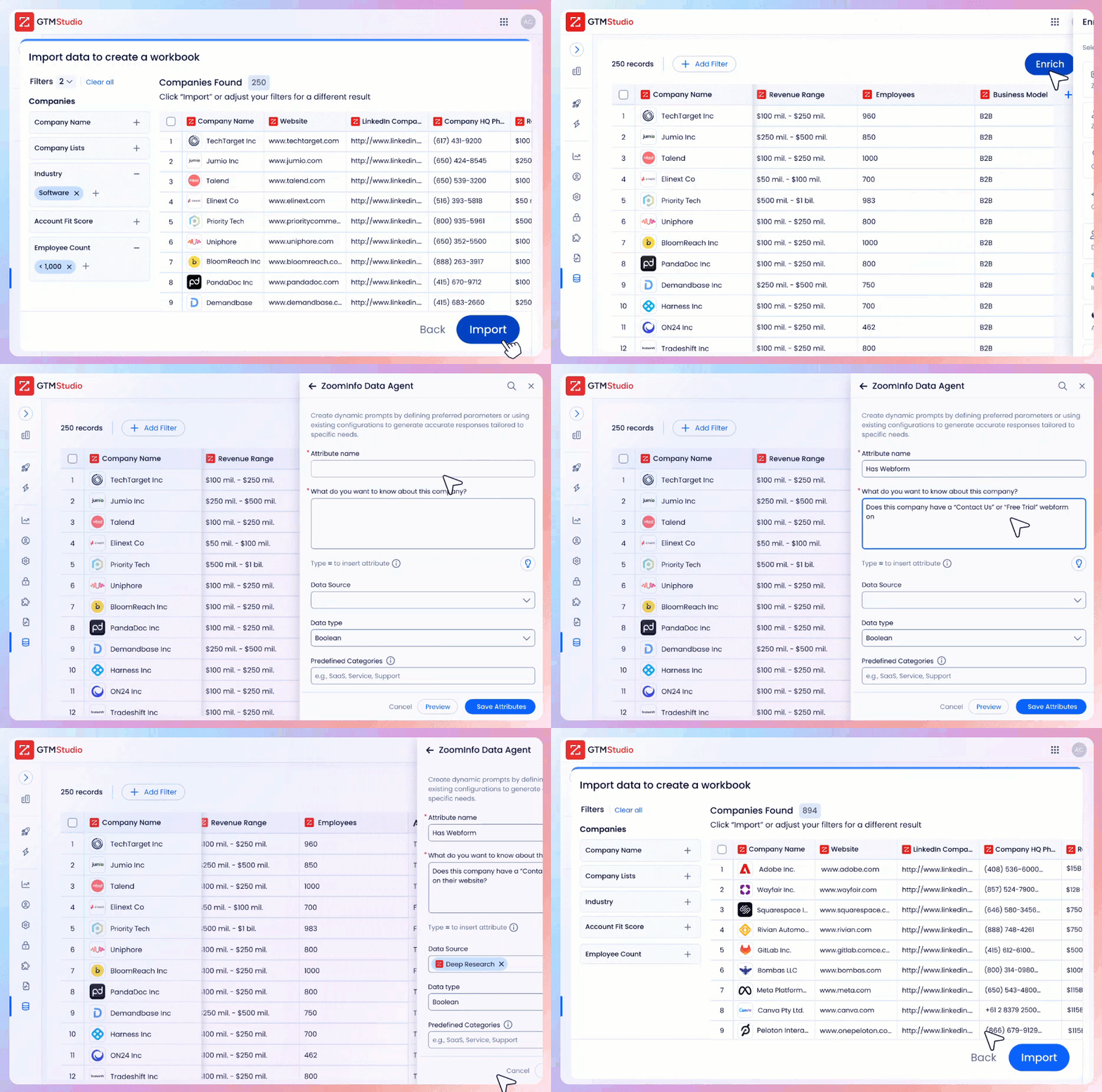
ZoomInfo's GTM Studio adds a layer that neither provides: audience building from verified B2B data, multi-channel campaigns triggered by buying signals, and pre-built GTM plays that launch in minutes rather than weeks. Marketers describe audiences in natural language, and GTM Studio targets accounts matching actual win patterns, not just keyword thresholds.
Source: ZoomInfo
Redwood Logistics achieved a 99% reduction in cost-per-click and a 310% increase in click-through rate using ZoomInfo's audience insights, saving 20-25 hours per week. (Redwood Logistics Case Study)
AI capabilities are at different stages of maturity
Act!'s AI features are early but practical. The AI History Summary gives instant contact briefings on the Professional and Ultimate tiers. The AI Writing Assistant generates email and landing page content in the template designer. Both are included in plan pricing with no usage fees.
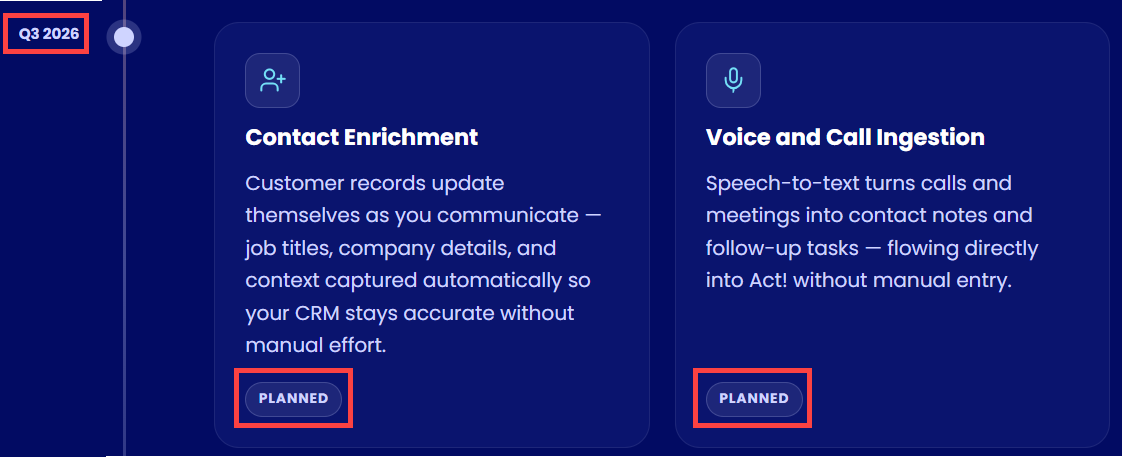
The roadmap includes Contact Enrichment, Voice and Call Ingestion, and Calendar Intelligence, but these are still planned or exploratory.
Source: Act!
Salesforce has bet its future on AI. Agentforce is an autonomous AI agent platform powered by the Atlas Reasoning Engine. Pre-built agents handle prospecting, lead engagement, sales coaching, and automated quoting.
Source: Salesforce
The Einstein Trust Layer enforces zero data retention with LLM partners, PII masking, and audit trails. Salesforce uses Agentforce internally, resolving 85% of support requests without human escalation.
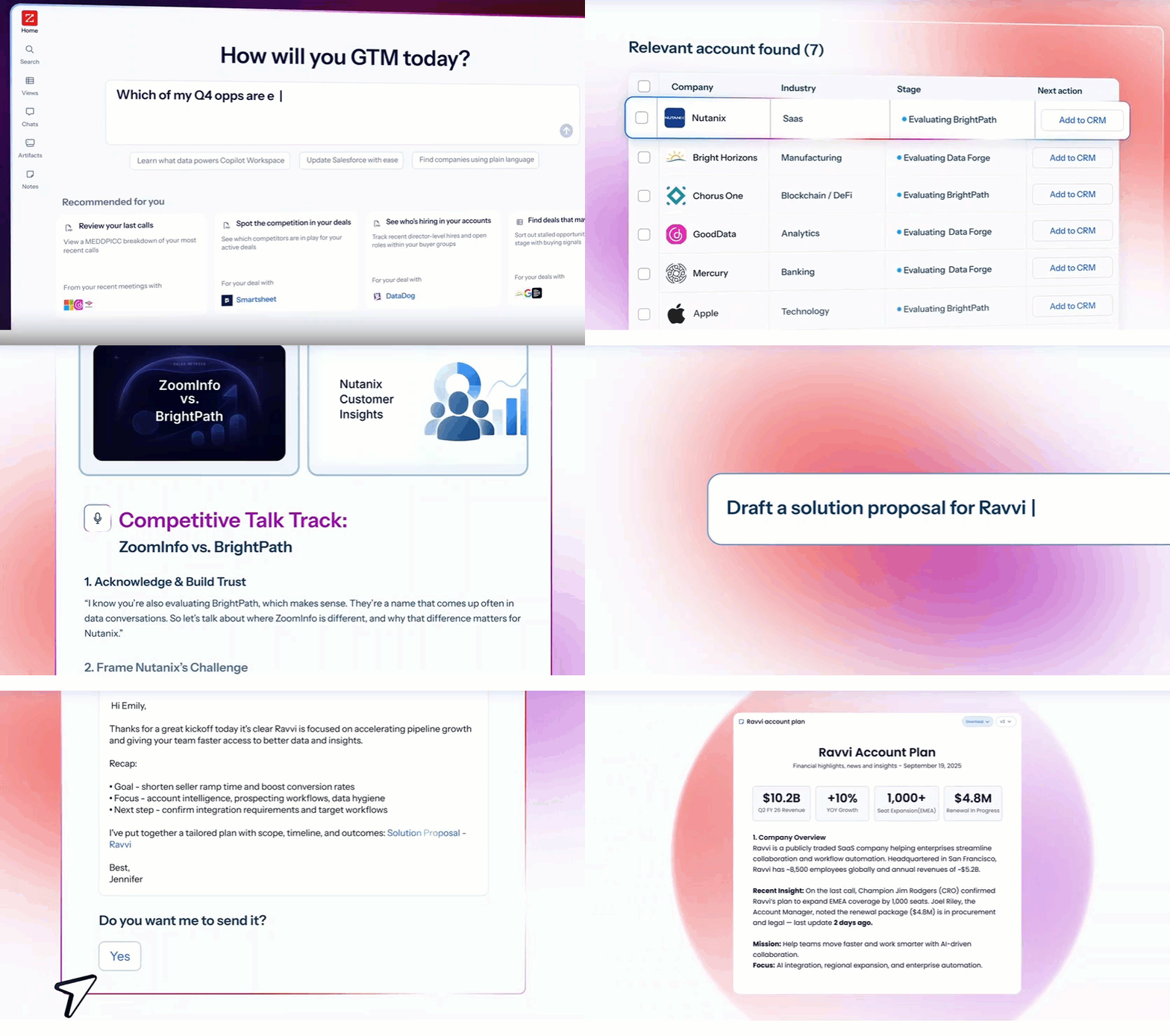
ZoomInfo's AI is designed for go-to-market execution. Rather than general-purpose agents, the GTM Context Graph applies AI where it changes outcomes: identifying which accounts to pursue, explaining why deals move or stall, drafting outreach that addresses concerns raised in recent conversations, and predicting which signal combinations match your win patterns.
AI agents in GTM Workspace handle account research, outreach generation, CRM updates, and signal monitoring, built on Anthropic's Claude. The difference: ZoomInfo's AI reasons across both your internal data and external intelligence (org changes, funding rounds, intent signals, hiring patterns) that no CRM captures on its own.
Source: ZoomInfo
Pricing tells you who each platform is for
The pricing structures reveal each platform's target market.
Act! keeps it straightforward. Three tiers, all billed annually:
Plan | Price | What you get |
|---|---|---|
$30/user/month | Full CRM, 2,500 email sends/month, basic interactive quotes | |
$45/user/month | AI features, 25,000 sends/month, nurture marketing, accounting integration | |
$60/user/month | Marketing automation, lead scoring, 50,000 sends/month, Custom Industry Tables |
Add-ons include SMS messaging from $19/month and Enhanced Support at $10/user/month for Standard users. A 14-day free trial is available with no credit card required.
Salesforce pricing is layered:
Edition | Price | What you get |
|---|---|---|
$0 (max 2 users) | Basic lead, account, and opportunity management | |
$25/user/month | Unlimited users, AI email sync, lead routing | |
$100/user/month | Customization, quoting, forecasting, AppExchange | |
$175/user/month | AI sales features, pipeline insights, automation | |
$350/user/month | Full AI suite, conversation intelligence, Premier Success |
But the license fee is just the starting point. Agentforce actions cost $0.10-$0.15 each via Flex Credits. Premier Support adds 30% of net license fees. Marketing Cloud starts at $1,500/org/month. The June 2025 restructuring raised list prices for Enterprise and Unlimited by an average of 6%. A mid-sized company can reach $50,000/month once it adds AI capabilities, marketing automation, and support.
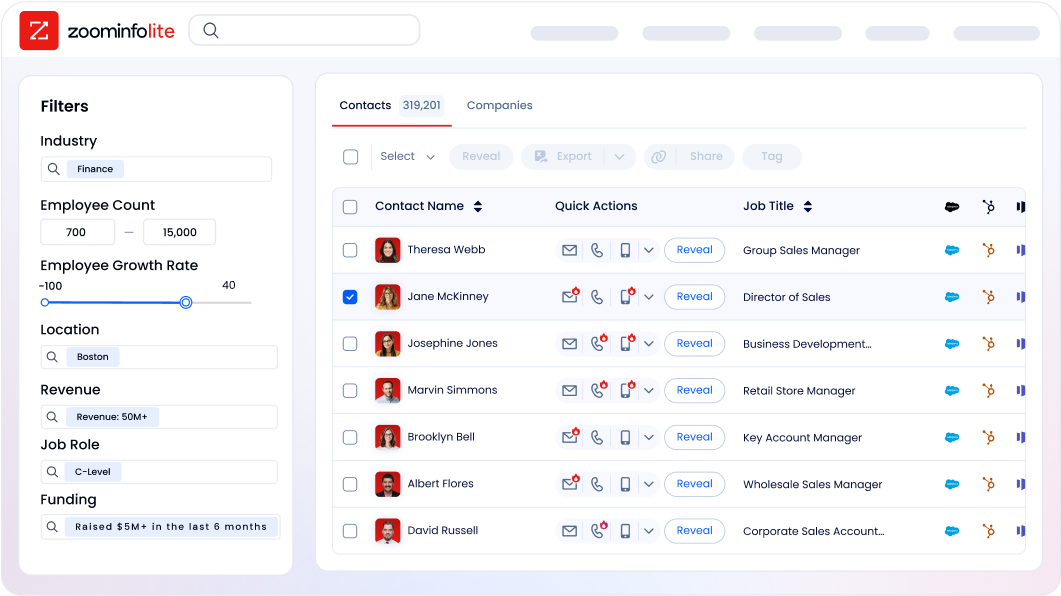
ZoomInfo uses custom-quoted, consumption-based pricing with no published prices for paid tiers. ZoomInfo Lite is a permanent free tier with access to the B2B database, 10 monthly export credits, advanced search filters, and HubSpot integration. A 7-day free trial of the full platform is also available.
Source: ZoomInfo
The cost comparison gets clearer when you consider what each dollar buys. Act!'s $60/user/month Ultimate plan includes CRM, marketing automation, interactive quotes, and payments in one subscription. Getting comparable capability from Salesforce requires Sales Cloud Pro Suite ($100/user/month) plus Account Engagement ($1,250/org/month) at minimum.
ZoomInfo sits in a different category because it solves a different problem: the intelligence that makes whichever CRM you choose effective.
Integration ecosystems reflect platform maturity
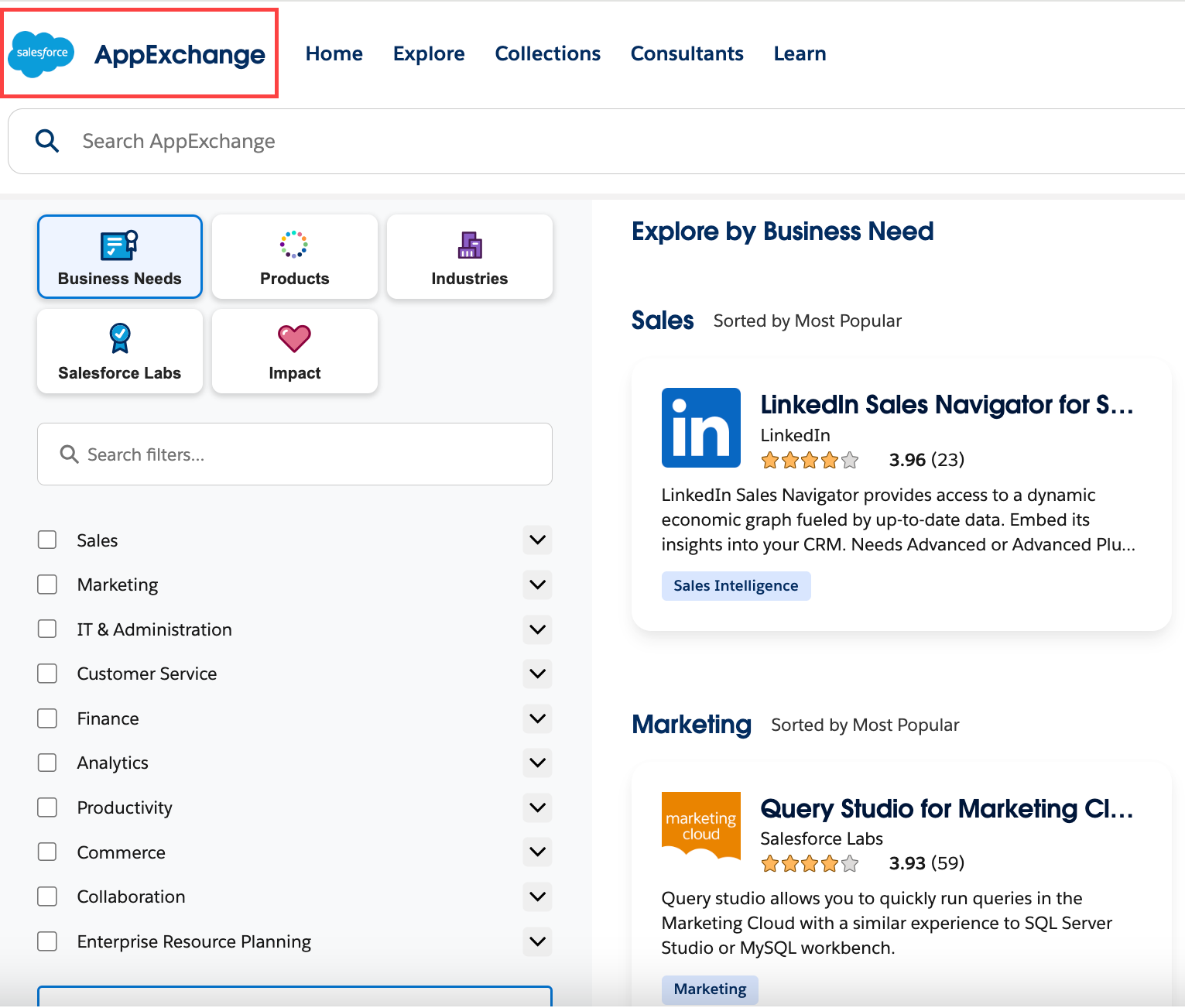
Salesforce's integration ecosystem leads the CRM industry. AppExchange hosts 9,000+ partner apps with 14+ million installs, and 91% of customers use at least one AppExchange app. Native integrations include Google Workspace, Microsoft Outlook and Teams, and Slack.
Source: Salesforce
MuleSoft provides API management with hundreds of pre-built connectors. The platform offers REST, SOAP, Bulk, Metadata, and Pub/Sub APIs.
Act!'s integration story is more modest. Native integrations cover Outlook, Gmail, Google Contacts, QuickBooks, Xero, Shopify, BigCommerce, Freshdesk, Zendesk, and social platforms. Many connections route through Act! Connect (powered by Zapier), linking to hundreds of additional apps.
The API 2.0 Platform (near GA as of Q2 2026) aims to close the gap, and the existing JSON-based REST API follows the OpenAPI Specification. But today, teams with complex tech stacks will find Act!'s integration depth limited next to Salesforce.
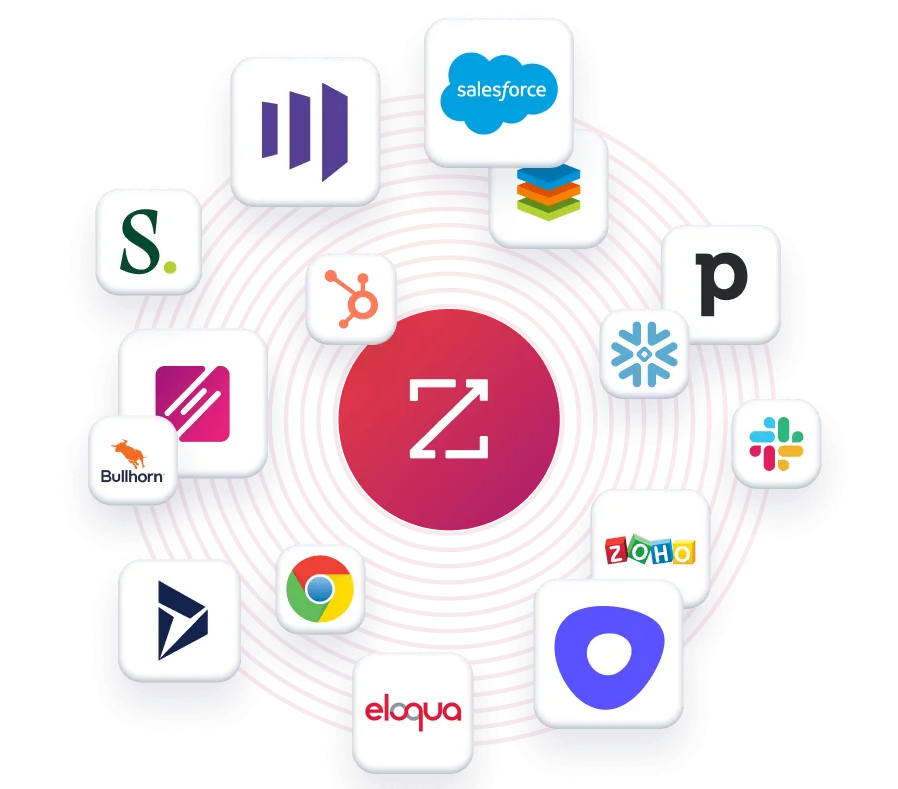
ZoomInfo connects to both platforms and extends them. The ZoomInfo App Marketplace lists 120+ integrations including Salesforce, HubSpot, and Microsoft Dynamics 365.
Source: ZoomInfo
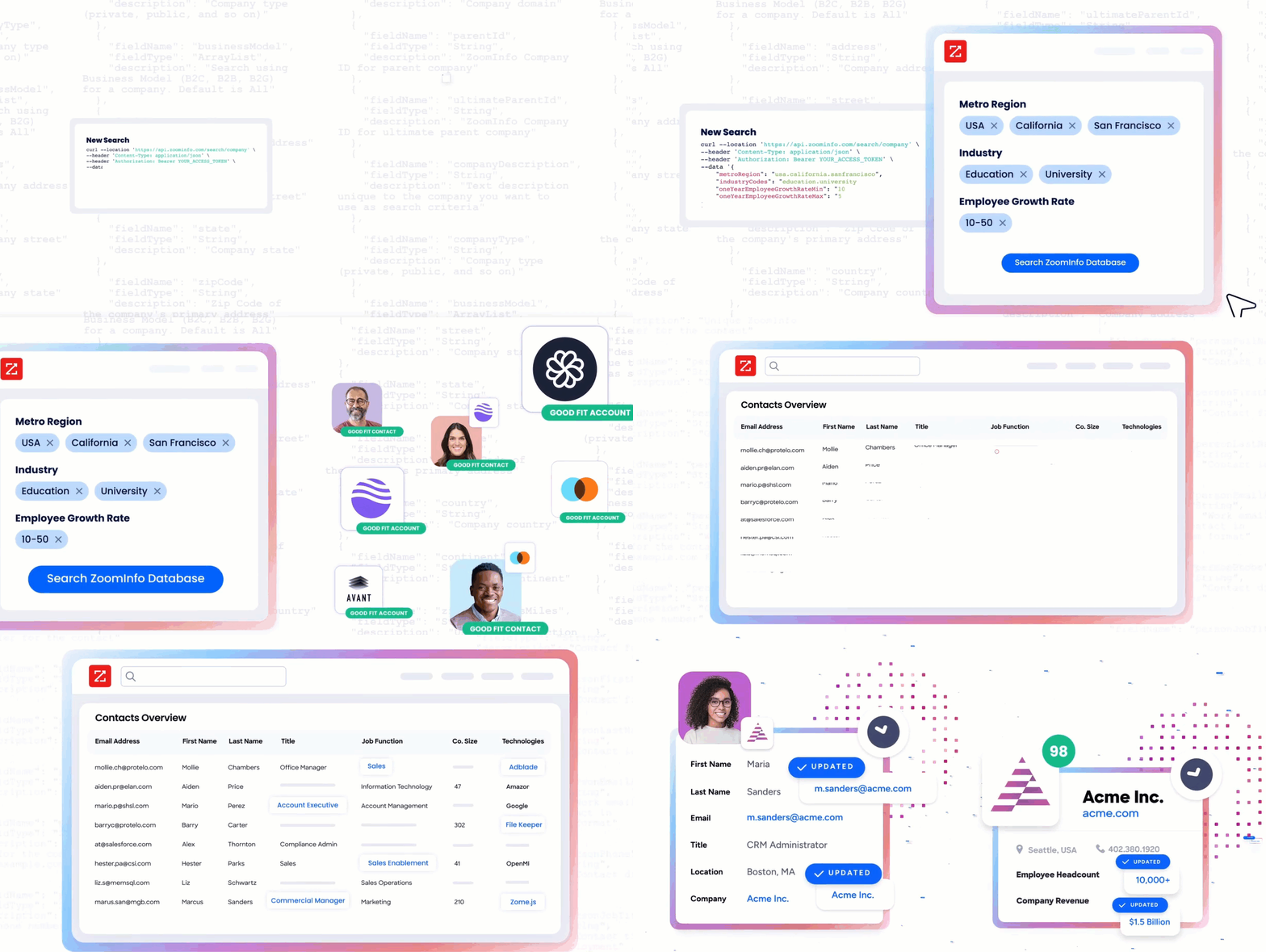
The Enterprise API gives programmatic access to ZoomInfo's data across any system. The MCP server connects AI models to ZoomInfo's B2B data with no custom coding. API access is included in all relevant plans, and the same intelligence behind ZoomInfo's own products is available in any third-party application.
Source: ZoomInfo
BDO Canada's Senior Marketing Intelligence Analyst Jerry Wilson described the integration: "The plug-and-play aspect of the API means I can integrate it very easily into any process and get information at a moment's notice," achieving an 87% reduction in time spent on internal data dashboard updates. (BDO Canada Case Study)
Support and onboarding differ by design
Act! includes a dedicated Account Manager and a free 45-minute onboarding session with every subscription (described as "a real human, not a chatbot"). Standard Support covers phone and live chat during business hours.
Enhanced Support (included with Ultimate, $10/user/month for others) adds priority queuing, extended hours including Saturdays, and full feature guidance by phone. A worldwide network of Act! Certified Consultants handles complex customizations.
Salesforce structures support in three tiers. Standard (free) includes Trailhead, documentation, and community access. Premier (30% of net license fees) adds 1:1 expert coaching, health checks, and 1-hour response time for critical issues. Signature (custom pricing) provides a dedicated Customer Success Manager and 24/7 support with 15-minute response.
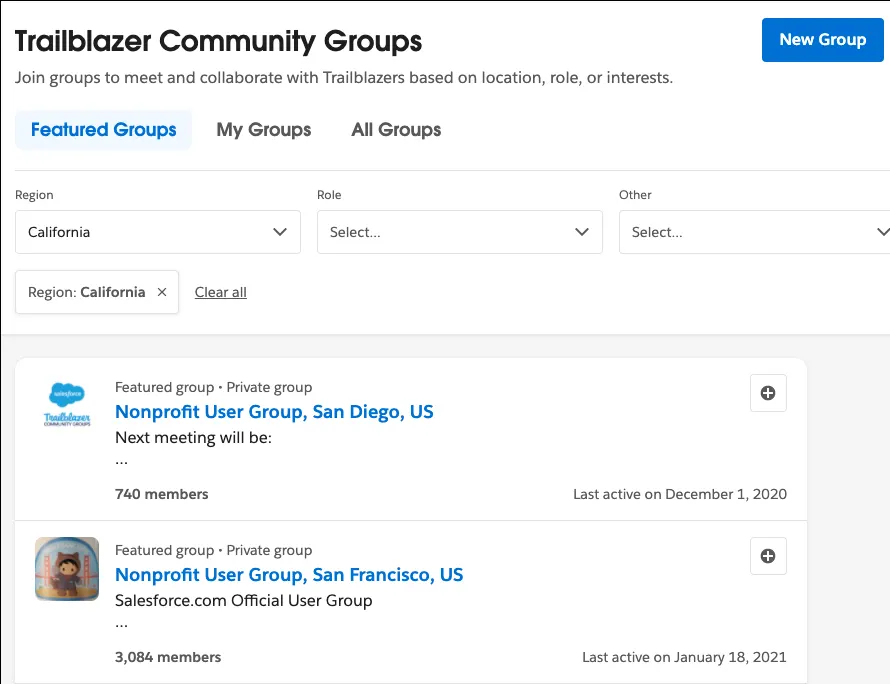
The Trailblazer Community of 20 million members is a real resource, with 80% of users reporting it helps them extend capabilities and reduce costs. Trailhead offers 6+ million learners and 1,500+ badges.
Source: Salesforce
ZoomInfo redesigned its onboarding program from 30 to 90 days across planning, technical implementation, education, and adoption, producing a 25% improvement in customer satisfaction scores and winning Rocketlane's Golden Comet award for Best Customer Onboarding Team of 2024. ZoomInfo University provides role-specific learning paths, certifications, and live webinars.

Source: ZoomInfo
How ZoomInfo makes either CRM more effective
The real question isn't just which CRM to use. It's whether your CRM has the intelligence it needs to produce results.
A CRM tracks what your team already knows. ZoomInfo tells your team what they don't: which companies are researching solutions in your category (Buyer Intent from 210 million IP-to-Organization pairings), who the decision-makers are and how to reach them (120M direct-dial phone numbers), and which anonymous website visitors are worth pursuing (WebSights resolves anonymous traffic to companies and contacts).

Source: ZoomInfo
For Act! users, ZoomInfo fills the data gap that the platform's limited integrations leave open. Instead of researching contacts manually, a small team can use ZoomInfo to build targeted prospect lists with verified direct dials and emails, then push those contacts into Act! for relationship management and email marketing.
For Salesforce users, ZoomInfo extends an already strong platform. Snowflake feeds over 70 ZoomInfo company and technographic data fields into their Account Propensity Scoring model inside Salesforce. The result: accounts monitored using ZoomInfo-powered scores showed 90% higher opportunity open rates and 2x higher customer conversion rates.
For a closer look at how these two platforms stack up and complement each other, see our Salesforce vs. ZoomInfo comparison.
In both cases, ZoomInfo adds what no CRM generates on its own: verified contact data at scale, real-time buying signals, and AI that understands why deals move.
Smartsheet's Senior Manager of Sales Technology Enablement Thor Sanderson called ZoomInfo "our one source of truth for account data, and even more so for contact data. There's no other provider in the market that provides you with that level of detail." (Smartsheet Case Study)
Act! vs. Salesforce vs. ZoomInfo: Which should you choose?
The right choice depends on your team's size, budget, and primary challenge.
Choose Act! if:
You're a small business or independent professional managing a few hundred to a few thousand relationships
You want CRM and email marketing in one package under $60/user/month
You work in insurance, financial services, manufacturing, or professional services
You need something you can configure yourself without IT staff
A dedicated Account Manager and hands-on onboarding matter to you
Choose Salesforce if:
You need a platform that scales from sales into service, marketing, commerce, and custom applications
Your organization has (or will hire) dedicated CRM administrators
You want access to the largest app ecosystem in CRM with 9,000+ integrations
Autonomous AI agents for sales, service, and marketing are a priority
You can invest in the implementation time and budget the platform requires
Add ZoomInfo if:
Your team spends too much time searching for accurate contact information
You need to know which accounts are in-market before competitors reach them
Data quality in your CRM is holding back your sales and marketing results
You want AI that doesn't just organize data but reveals why deals move or stall
You need verified B2B data flowing into whichever CRM you use
See how ZoomInfo powers your CRM with a free trial or explore ZoomInfo Lite at no cost.
Act! and Salesforce each solve the CRM problem well for their respective audiences. Act! bundles what small businesses need at a price they can afford. Salesforce offers depth and scale that no other CRM matches.
But the most effective sales organizations don't just manage relationships. They feed their CRM with verified intelligence that tells reps who to call, when to call them, and what to say. That's the layer ZoomInfo provides, and it works with whichever CRM you choose.
Want more Act! and Salesforce comparisons? Here are our picks:
Act! vs. Salesforce vs. ZoomInfo FAQ
What is the fundamental difference between Act!, Salesforce, and ZoomInfo?
Act! is an SMB-focused CRM that bundles contact management, sales pipeline tracking, and email marketing in one platform starting at $30/user/month. Salesforce is the world's largest CRM platform, spanning sales, service, marketing, commerce, and analytics with autonomous AI agents.
ZoomInfo is a B2B data and intelligence platform that provides verified contact data, buyer intent signals, and AI go-to-market tools. ZoomInfo complements your CRM; it doesn't replace it.
Which platform is cheapest to get started with?
Act! starts at $30/user/month with a 14-day free trial. Salesforce offers a free plan for up to 2 users, with paid plans starting at $25/user/month for the Starter Suite.
ZoomInfo offers a permanent free tier (ZoomInfo Lite) with 10 monthly export credits and access to the B2B database, plus a separate 7-day full-feature trial. Salesforce costs climb fast once you add Marketing Cloud, AI features, and premium support.
Can ZoomInfo replace Act! or Salesforce as my CRM?
No. ZoomInfo is not a CRM. It does not manage customer relationships, track deal stages, or handle post-sale service workflows the way Act! and Salesforce do. ZoomInfo provides the intelligence layer (verified B2B data, buyer intent signals, conversation intelligence, AI outreach) that makes your CRM more effective. It integrates with Salesforce and other major CRMs.
Which platform is best for email marketing?
Act! is the strongest choice for small teams wanting built-in email marketing. Its Ultimate plan includes marketing automation with lead scoring, progressive profiling, and 50,000 sends/month at $60/user/month. Salesforce's Marketing Cloud is more capable but starts at $1,500/org/month and requires dedicated marketing operations staff.
ZoomInfo's GTM Studio handles multi-channel campaign orchestration with audiences built from verified B2B data and triggered by buyer intent signals.
How do the AI capabilities compare?
Act!'s AI is early-stage: an AI Writing Assistant and AI History Summary, with Contact Enrichment and Voice Ingestion still on the roadmap. Salesforce's Agentforce is the most mature, with autonomous AI agents that handle prospecting, coaching, quoting, and customer service, generating $800M in annual recurring revenue.
ZoomInfo's AI is built for go-to-market execution, reasoning across first-party CRM data and third-party intelligence to identify which accounts to pursue, explain why deals move or stall, and generate outreach informed by conversation context.
Which platform is best for a small insurance agency or financial advisory practice?
Act! is built for this audience. Its Custom Industry Tables provide spreadsheet-like structures for tracking insurance policies, mortgage details, and compliance documentation on contact records.
The bundled pricing (CRM, email marketing, and marketing automation from $30-60/user/month) suits small teams without IT staff. Salesforce offers a Financial Services Cloud, but it requires more investment and administration.
Do I need ZoomInfo if I already use Salesforce?
Salesforce manages your customer relationships and sales processes. ZoomInfo fills the intelligence gaps Salesforce doesn't cover: verified B2B contact data at scale (500M contacts, 135M+ verified phone numbers), real-time buyer intent signals showing which accounts are researching your category, and conversation intelligence that captures why deals move or stall.
Major Salesforce customers like Snowflake and Palo Alto Networks use ZoomInfo alongside Salesforce for this reason.
How do integration ecosystems compare across the three platforms?
Salesforce has the largest ecosystem by far, with 9,000+ apps on AppExchange and 14+ million installs. Act! has limited native integrations and relies on Zapier-based connections, though its API 2.0 Platform is nearing launch.
ZoomInfo offers 120+ integrations through its App Marketplace, plus an Enterprise API and MCP server that deliver its intelligence into any application, workflow, or AI agent. ZoomInfo integrates with Salesforce and includes API access in all relevant plans.
