

ZeroBounce is an email verification and deliverability platform that serves over 500,000 customers and has validated more than 30 billion emails since 2017.
The platform does what its name suggests: it scrubs email lists of invalid addresses, spam traps, and risky contacts so your campaigns reach real inboxes. But for teams whose needs extend beyond list hygiene into prospecting, sales intelligence, and go-to-market execution, a verification tool is only one piece of the puzzle.
To create this ZeroBounce review, we analyzed the platform thoroughly. We believe it's the right choice if:
You need to clean existing email lists before sending campaigns
You want to reduce bounce rates and protect sender reputation
You require real-time email validation at the point of form entry
You need deliverability tools like warmup, blacklist monitoring, and inbox placement testing
Your primary concern is email data quality rather than lead generation
However, ZeroBounce might not be the best choice if:
You need to build prospect lists from scratch, not just verify existing ones
You require company intelligence, org charts, and buying signals alongside contact data
You want verified phone numbers and direct dials, not just email addresses
You need multi-channel go-to-market execution across sales, marketing, and operations
Your team needs AI-driven account prioritization and outreach automation
In that case, consider ZoomInfo: a GTM intelligence platform that starts where verification ends. Instead of cleaning email lists after the fact, ZoomInfo provides 200M+ verified business email addresses alongside 500M contacts, 135M+ verified phone numbers, intent signals, technographics, and AI-powered execution tools.
It's the difference between fixing your contact data and starting with the right data in the first place.
We've included a detailed look at ZoomInfo later in this review as the next step for teams that need more than list verification. If you're ready to explore a go-to-market intelligence platform, you can start with ZoomInfo's free trial here.
What is ZeroBounce?
ZeroBounce is an email validation and deliverability platform founded in 2015 by Liviu Tanase in Santa Barbara, California. Tanase saw that email list decay and high bounce rates were persistent problems for businesses running email marketing, and built ZeroBounce as a validation-first solution from the start.
Growth came fast. ZeroBounce made the Inc. 5000 list at No. 851 in 2019, then jumped to No. 40 in 2020 with over 7,000% three-year growth. It kept appearing on the Inc. 5000 through 2025 at No. 2,434, and CEO Tanase was named to the Forbes Next 1000 list in 2022.
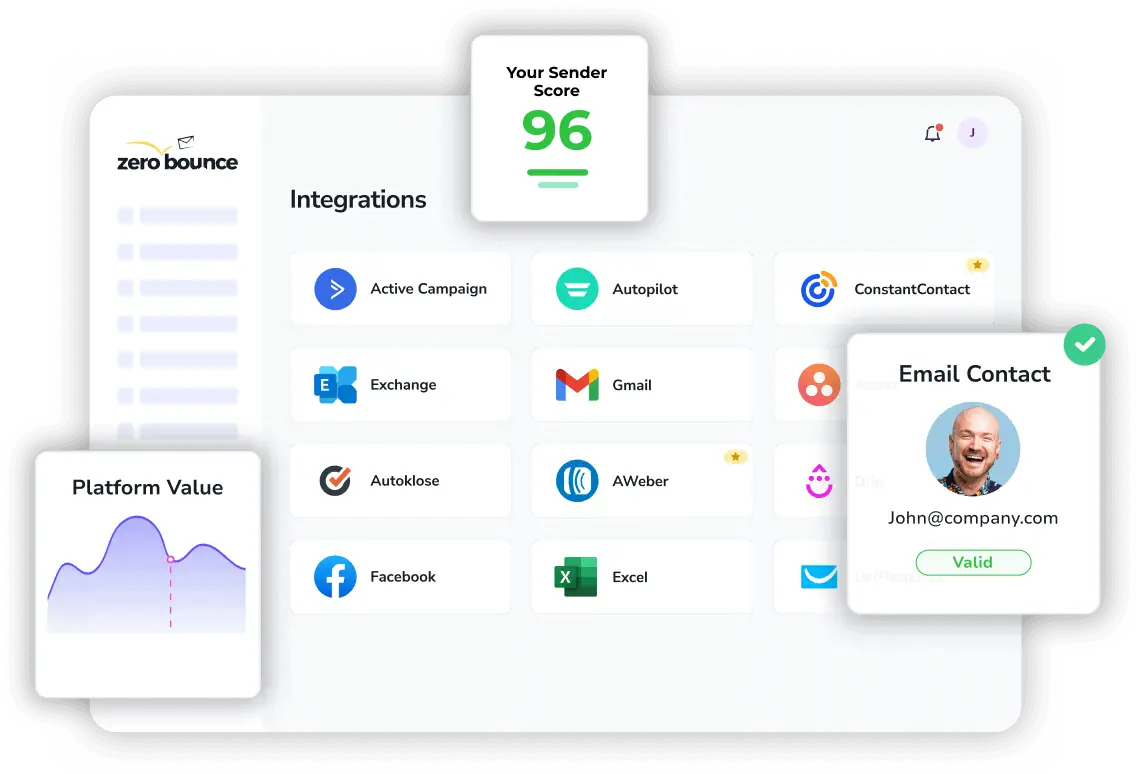
Source: ZeroBounce
The platform rests on two pillars. The first is email data quality: Email Validation scrubs lists of invalid addresses, spam traps, and catch-all domains; Email Activity Data reveals which subscribers are engaging; Email Scoring uses AI to assess ambiguous catch-all addresses; and Email Finder discovers new verified contacts.
The second pillar is deliverability: Email Warmup, DMARC Monitor, Blacklist Monitor, Inbox Placement Test, and Email Server Tester. In late 2024, all of these tools were bundled under ZeroBounce ONE, a single subscription at $99/month.
ZeroBounce serves email marketers, developers integrating real-time validation via API, agencies cleaning lists for multiple clients, and enterprise organizations managing lists of a million or more contacts.
ZeroBounce Pros & Cons
Pros | Cons |
|---|---|
99.6% guaranteed validation accuracy | Pricing can feel expensive for high-volume lists |
Industry-low 1.69% unknown rate via anti-greylisting | Bulk validation for very large lists can take up to 48 hours |
Full deliverability toolkit beyond just validation | Validation results only considered current for 30 days |
99.99% API uptime with 1.09-second average response time | Catch-all resolution uneven in Latin American markets |
24/7 live chat with 20-second average wait time | Email Finder consumes 20 credits per query (vs. 1 for validation) |
SOC 2 Type 2, ISO-27001, HIPAA, GDPR compliance | Dashboard design functional but dated |
Credits never expire | Limited to email (no phone or company intelligence) |
60+ native integrations with major ESPs and CRMs | Free tier limited to 100 monthly validations |
ZeroBounce Review: How It Works & Key Features
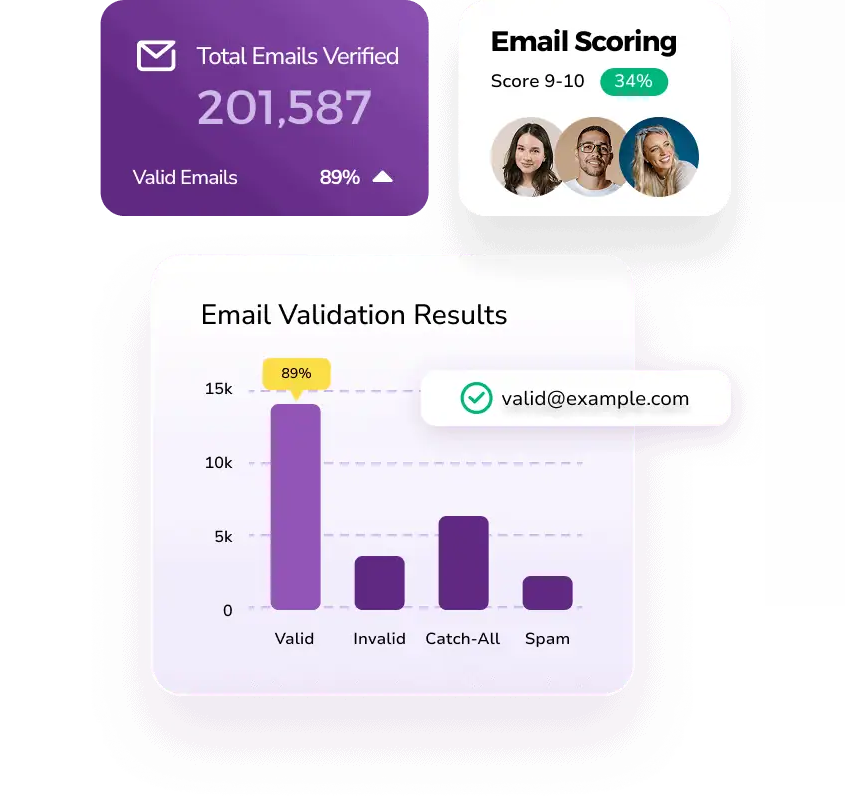
Email Validation: ZeroBounce scrubs lists through a layered verification pipeline that classifies addresses into 30+ status types.
Email Validation is ZeroBounce's core product. Rather than returning a simple valid/invalid binary, the platform runs each address through multiple checks: syntax verification, DNS and MX record lookup, SMTP-level mailbox probing, and threat classification for spam traps, abuse accounts, disposable addresses, toxic domains, and role-based emails.
Source: ZeroBounce
The system returns 30+ distinct status and sub-status codes, giving technical users granular data for segmentation.
What sets ZeroBounce apart here is its anti-greylisting system. Many mail servers temporarily reject unknown senders, causing other validators to mark these addresses as "unknown." ZeroBounce queues and retries until the greylisting window passes. Unknown results are not charged, so customers only pay for actionable data.
For Yahoo and AOL addresses, which historically resist standard mailbox pinging, ZeroBounce launched Verify+ in April 2024. This add-on extends the 99.6% accuracy guarantee to cover these providers. The same capability was later extended to catch-all domains, converting ambiguous results into definitive verdicts.
Processing speed varies by domain complexity. 250,000 emails on popular domains process in under 10 minutes; 1 million take under 45 minutes. Complex domains take longer: 250,000 in 2.3 hours or less, 1 million in 5 hours or less. The real-time API validates individual addresses in about 3 seconds, with a batch endpoint handling up to 200 emails at once.
AI Email Scoring: ZeroBounce uses machine learning to grade catch-all addresses that standard validation cannot resolve.
Email Scoring tackles a problem unique to catch-all domains, which accept all inbound mail regardless of whether a specific mailbox exists. Standard validation cannot tell whether these addresses will bounce, so most validators mark all catch-alls as risky or undeliverable, forcing marketers to suppress entire segments that may contain valid contacts.
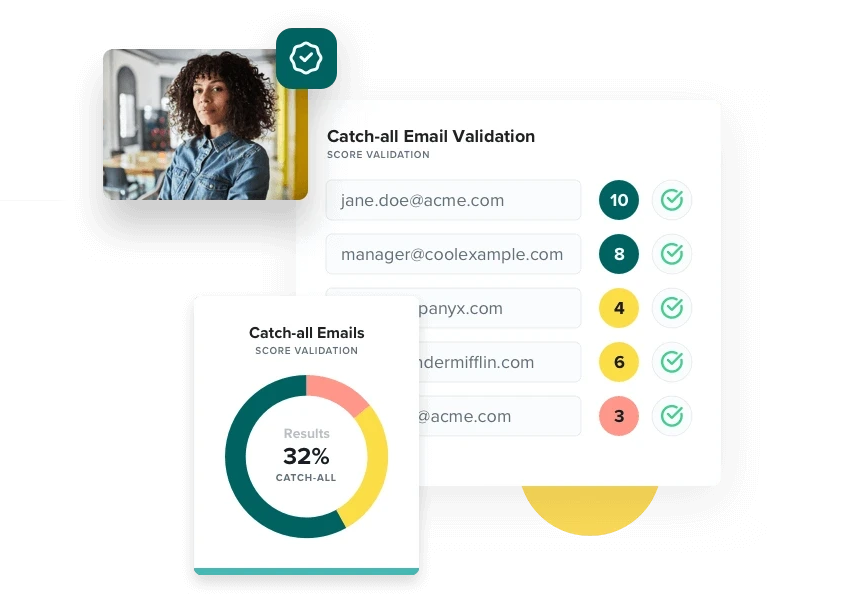
Source: ZeroBounce
ZeroBounce's AI assigns each catch-all address a quality score from 0 to 10. The company publishes expected bounce rates per tier: addresses scoring 0 average roughly 40% bounce rates, those scoring 5 drop to about 7%, and those scoring 10 reach about 1.3%. This gives marketers a concrete framework for deciding which catch-all addresses to mail and which to suppress.
The AI model adjusts periodically as email trends evolve rather than relying on a static rule set, and it does not store, cache, or share data with third parties.
Deliverability Toolkit: ZeroBounce bundles warmup, blacklist monitoring, inbox placement testing, DMARC monitoring, and server diagnostics.
Beyond list cleaning, ZeroBounce ships a full set of deliverability tools:
Email Warmup builds sender reputation for new or damaged domains by gradually increasing sending volume and generating positive engagement signals (opens, replies, marks as important) via a network of seed addresses. The system offers both an automated managed mode and a self-managed manual mode.
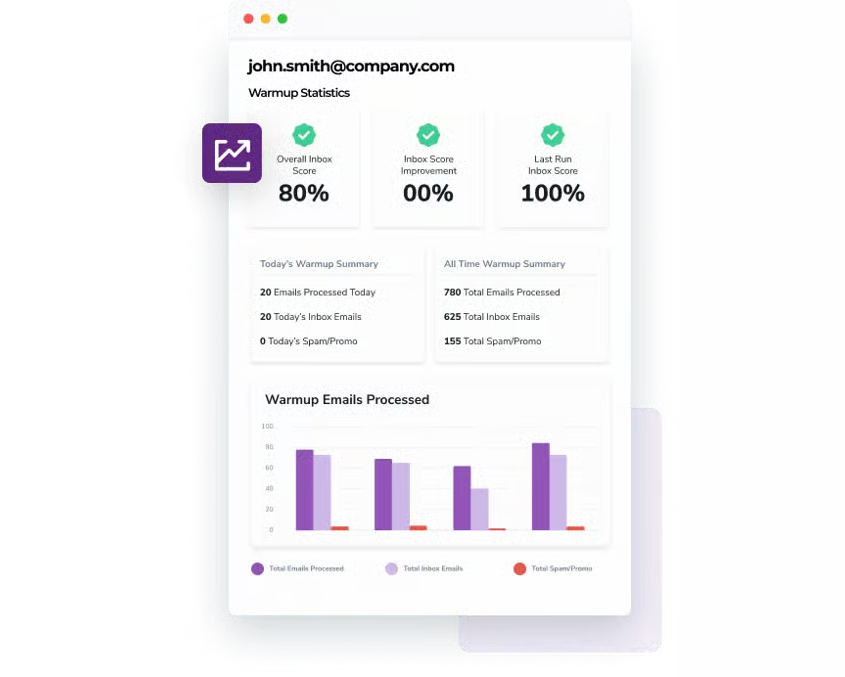
Source: ZeroBounce
Blacklist Monitor tracks whether a domain, IPv4 address, or IPv6 address appears on any of over 200 blacklist providers. Free accounts get one monitor scanning every 24 hours; ZeroBounce ONE subscribers get scans every 8 hours. Alerts include direct links to each blacklist provider for delisting requests.
Inbox Placement Test shows whether a campaign will land in the inbox or spam folder across 20+ mailbox providers, including Gmail, Outlook, Yahoo, iCloud, and regional providers like mail.ru, Yandex, and GMX. Results map to specific spam engines (Cloudmark, Spamhaus, Proofpoint, Kaspersky) so teams can identify exactly which filtering layer is causing rejection.
DMARC Monitor provides multi-domain DMARC monitoring with a guided setup wizard, unlimited email monitoring, lifetime reporting, and real-time alerts for suspicious activity. This addresses the authentication requirements that Google and Yahoo now mandate for email senders.
Email Server Tester runs 100+ health checks across headers, DNS records, SMTP settings, RFC compliance, DMARC analysis, and email ports to diagnose infrastructure problems causing delivery failures.
Email Finder and Activity Data: ZeroBounce discovers new contacts and identifies which subscribers are most engaged.
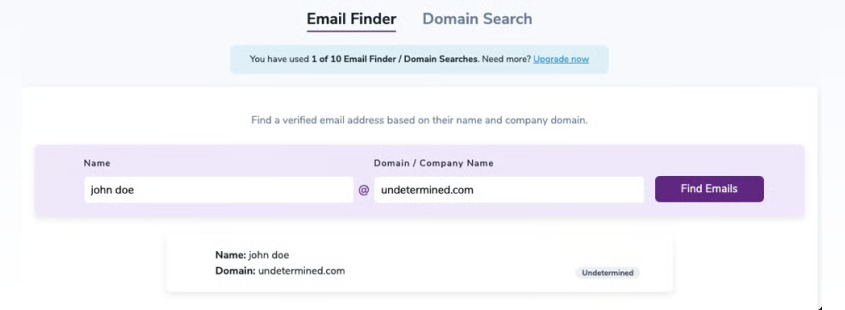
Email Finder discovers email addresses using a person's name and company domain. It generates candidate patterns, tests each against the validation engine, and returns only addresses confirmed as valid.
Source: ZeroBounce
Unknown results are not charged, and the tool never uses stored customer validation data to power searches. Each successful query consumes 20 credits. Free accounts receive 10 queries per month; business domain sign-ups unlock 100.
Email Activity Data appends engagement signals to validated addresses, revealing which contacts have recently interacted with their inboxes. Results include last known activity date (bucketed into 30, 60, 90, 180, 365, or 365+ days), activity type (open, click, or buyer), activity count, and whether engagement was detected in email, on the web, or both. Credits are only consumed when a match is returned.
Pricing: ZeroBounce offers pay-as-you-go credits and a bundled monthly subscription.
ZeroBounce runs on a credit-based system with two purchase paths:
ZeroBounce ONE ($99/month or $79/month billed annually) includes per month: 10,000 validation/scoring credits, 10,000 Email Finder/domain searches, 100 inbox placement tests, 100 email server tests, 250 warmup seeds, 10 blacklist monitors, and 1 DMARC Monitor domain.
Subscribers also receive a 15% discount on additional credit purchases. Validation credits roll over and never expire; unused tests, monitors, and warmup seeds do not.
Pay-As-You-Go credits start at $39 for 2,000 credits, $69 for 5,000, and $129 for 10,000. Credits never expire, and purchases are non-refundable.
A free account with 100 monthly validations is available with no credit card required, though sign-up requires a business or premium domain email address.
Where ZeroBounce Falls Short
ZeroBounce does its job well, but several limitations reveal a platform built for email verification rather than broader go-to-market needs.
Verification solves yesterday's problem. ZeroBounce cleans email lists you already have. But if those lists were built from incomplete data, purchased from unreliable vendors, or assembled through manual research, no amount of verification fixes the underlying quality problem.
You pay to verify addresses, pay again when they decay, and pay again to find replacements. Teams that need both discovery and verification run two separate workflows with two separate budgets.
Email-only scope. ZeroBounce works only with email. It does not provide phone numbers, direct dials, company attributes, org charts, technographics, or buying intent signals. Sales teams that need to call prospects, understand company hierarchies, or identify when accounts are in-market must use separate tools, creating data silos and extra coordination work.
Email Finder has limited depth. While the Email Finder was improved in late 2024, users comparing it to dedicated sales intelligence tools find the coverage limited. It discovers addresses by testing name-and-domain patterns, not by querying a large contact database. For teams building outbound prospecting lists at scale, this pattern-matching approach may not surface enough contacts.
Pricing adds up at volume. G2 and Capterra reviewers consistently note that pricing feels expensive for large lists, particularly when combining validation, AI scoring, and warmup. The Email Finder's 20-credit-per-query cost makes prospecting far more expensive than standard validation. Teams validating millions of records monthly face large budget commitments before volume discounts kick in.
Bulk processing can be slow. Capterra reviewers report processing times up to 48 hours for very large lists, a real constraint for teams that need to validate a fresh acquisition list before a send.
30-day result validity. Validation results are considered current for only 30 days, meaning teams with irregular maintenance cycles must re-validate and spend more credits. There is no automated system to detect stale data and trigger re-validation.
These limitations are not failures. They reflect a platform focused on email hygiene. But they leave a clear gap for teams that need verified contact data as part of a larger intelligence and execution platform, not as a standalone cleaning step.
Beyond Email Verification: ZoomInfo
ZoomInfo addresses ZeroBounce's scope limitations by approaching the contact data problem from the opposite direction. Instead of verifying emails after the fact, ZoomInfo provides already-verified contact data as part of a broad B2B intelligence platform.
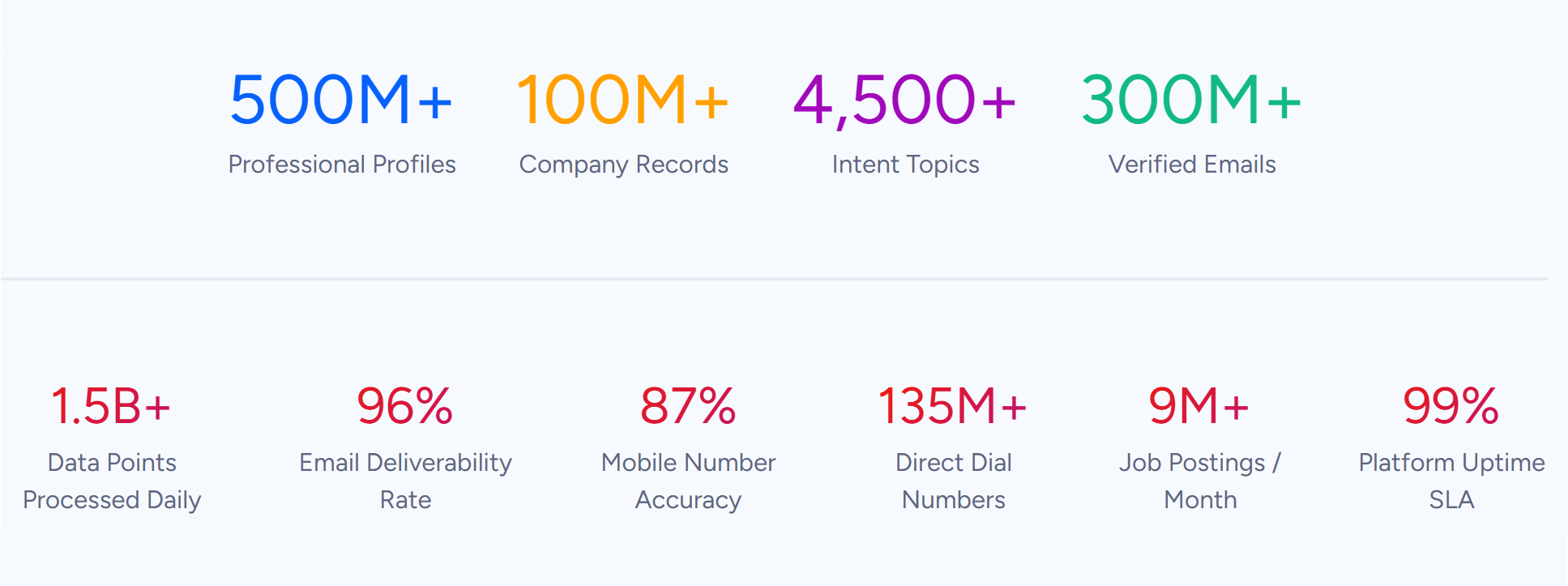
ZoomInfo is a GTM intelligence platform built on a data foundation spanning 500M contacts, 100M companies, 135M+ verified phone numbers, 120M direct-dial phone numbers, and 200M+ verified business email addresses.
Source: ZoomInfo
That data runs through a multi-source verification pipeline backed by 300+ human researchers and reaches up to 95% accuracy on first-party data. In a Fortune 500 competitive RFP analyzing 25 million contacts across vendors, the independent consultant concluded that "no other competitor came even close."
Where ZeroBounce validates one dimension (email addresses), ZoomInfo provides verified data across multiple dimensions at once, then layers intelligence and execution on top.
Verified Contact Data at Scale: ZoomInfo provides already-verified emails, direct dials, and mobile numbers without requiring a separate validation step.
ZoomInfo's data covers three dimensions at once: identity data (who buyers are and how to reach them), company context (size, industry, org charts, technographics), and dynamic signals (buying activity and behavioral indicators showing when accounts are in-market).
The contact data includes 120M direct-dial phone numbers and 200M+ verified business email addresses with 95%+ accuracy. In 2025 alone, ZoomInfo added 10.2 million contacts through enhanced title classification, expanded international mobile coverage by 1.8 million numbers across six European markets, and verified location data for 160 million contacts.
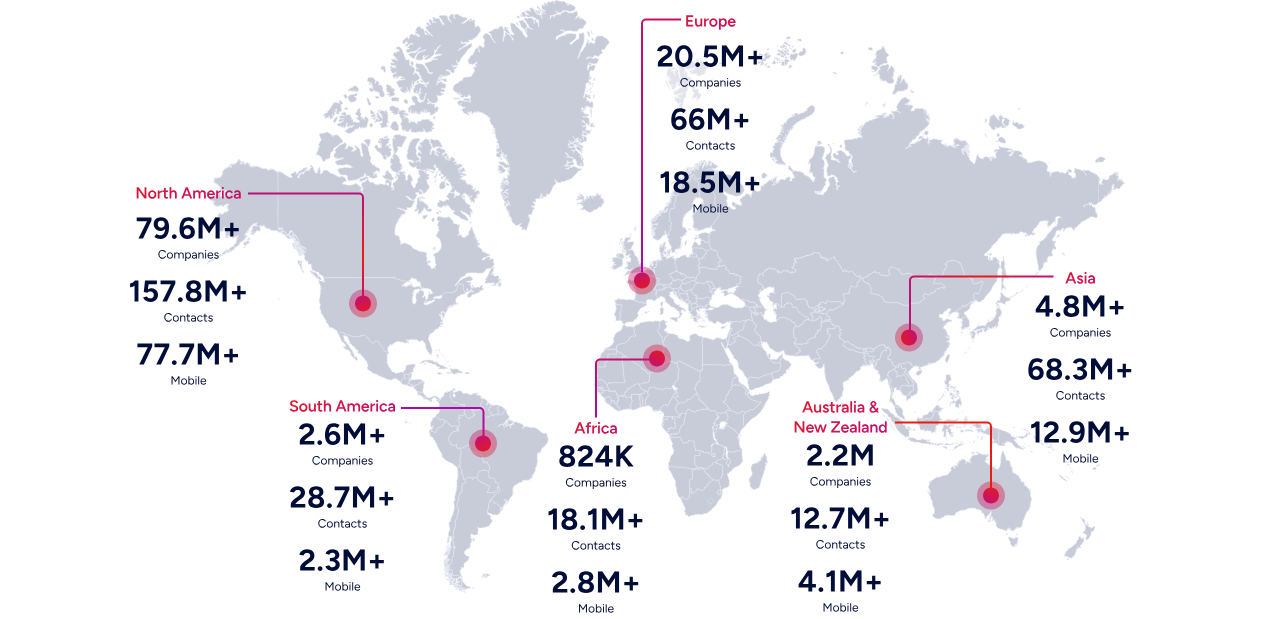
This matters because the data arrives already verified. Teams using ZoomInfo for prospecting don't need a separate validation tool.
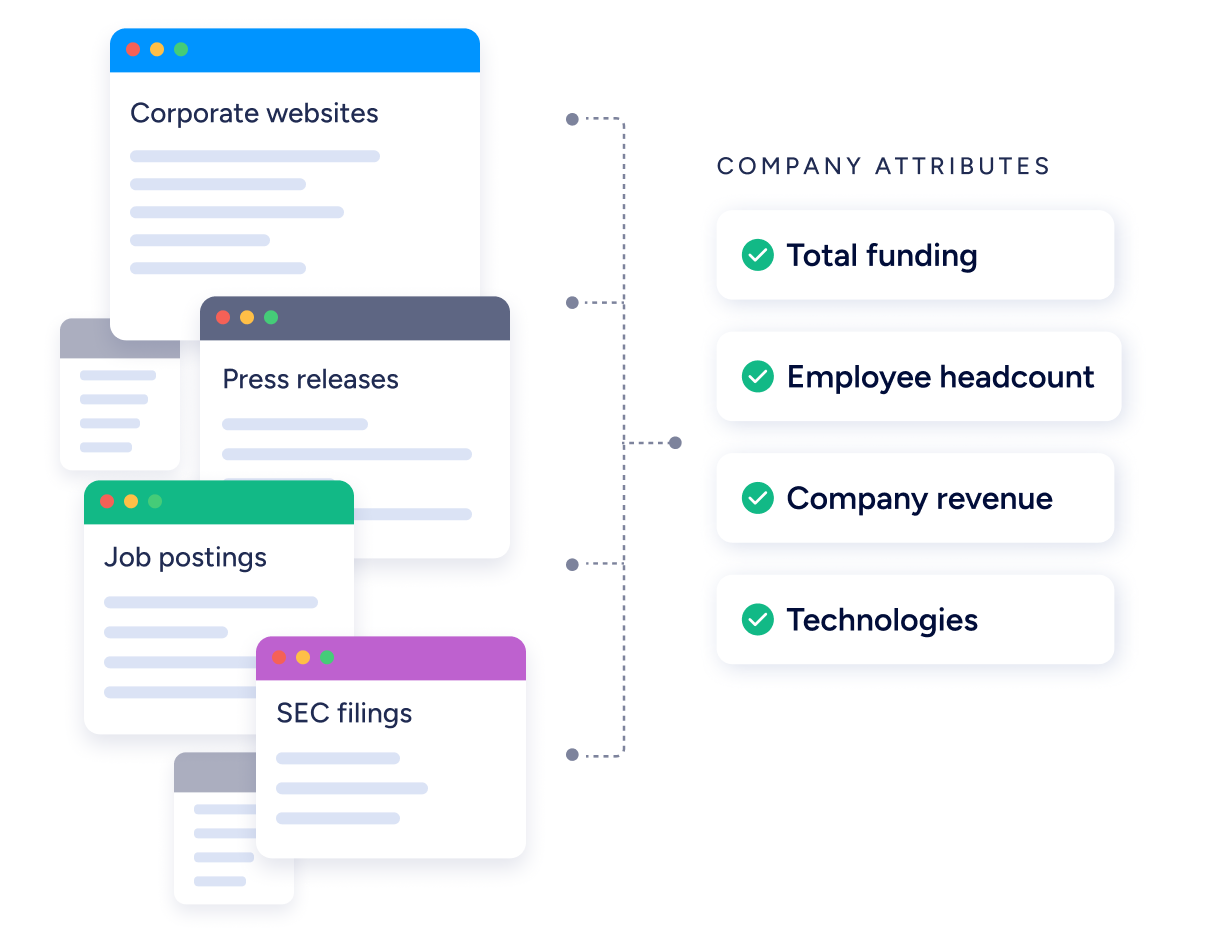
The emails and phone numbers come from a pipeline that aggregates, verifies, and continuously updates records from automated ML scanning of 28 million site domains daily, third-party partners covering 95 million businesses, a community of 200,000+ users who share data back, and an in-house Data Training Lab of 300+ researchers.
Source: ZoomInfo
"ZoomInfo is our one source of truth for account data, and even more so for contact data. There's no other provider in the market that provides you with that level of detail." (Smartsheet)
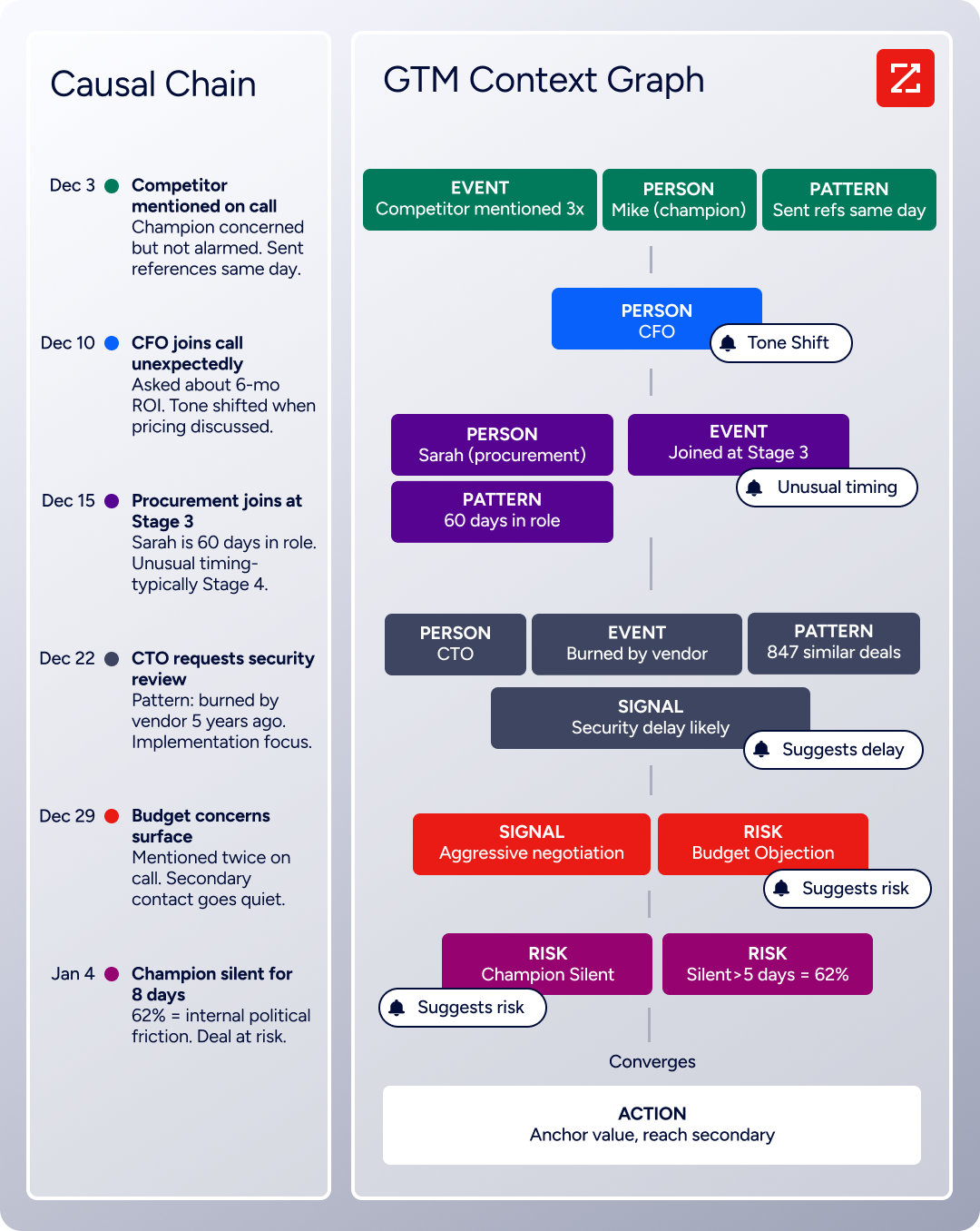
GTM Context Graph: ZoomInfo combines B2B data with CRM records, conversation intelligence, and behavioral signals to reveal why deals move.
Beyond contact verification, ZoomInfo's GTM Context Graph processes 1.5B + data points daily, unifying ZoomInfo's third-party data with a customer's CRM records, conversation transcripts, email interactions, and behavioral signals into one intelligence layer.
Source: ZoomInfo
A CRM records that a deal moved stages. The GTM Context Graph captures why it happened: perhaps the CFO joined the last call and asked about ROI, or a champion went quiet due to internal politics.
This intelligence powers features like Buyer Intent Data (tracking signals from 210 million IP-to-Organization pairings), WebSights (resolving anonymous website visitors to companies), and Guided Intent (identifying topics historically correlated with deal success).
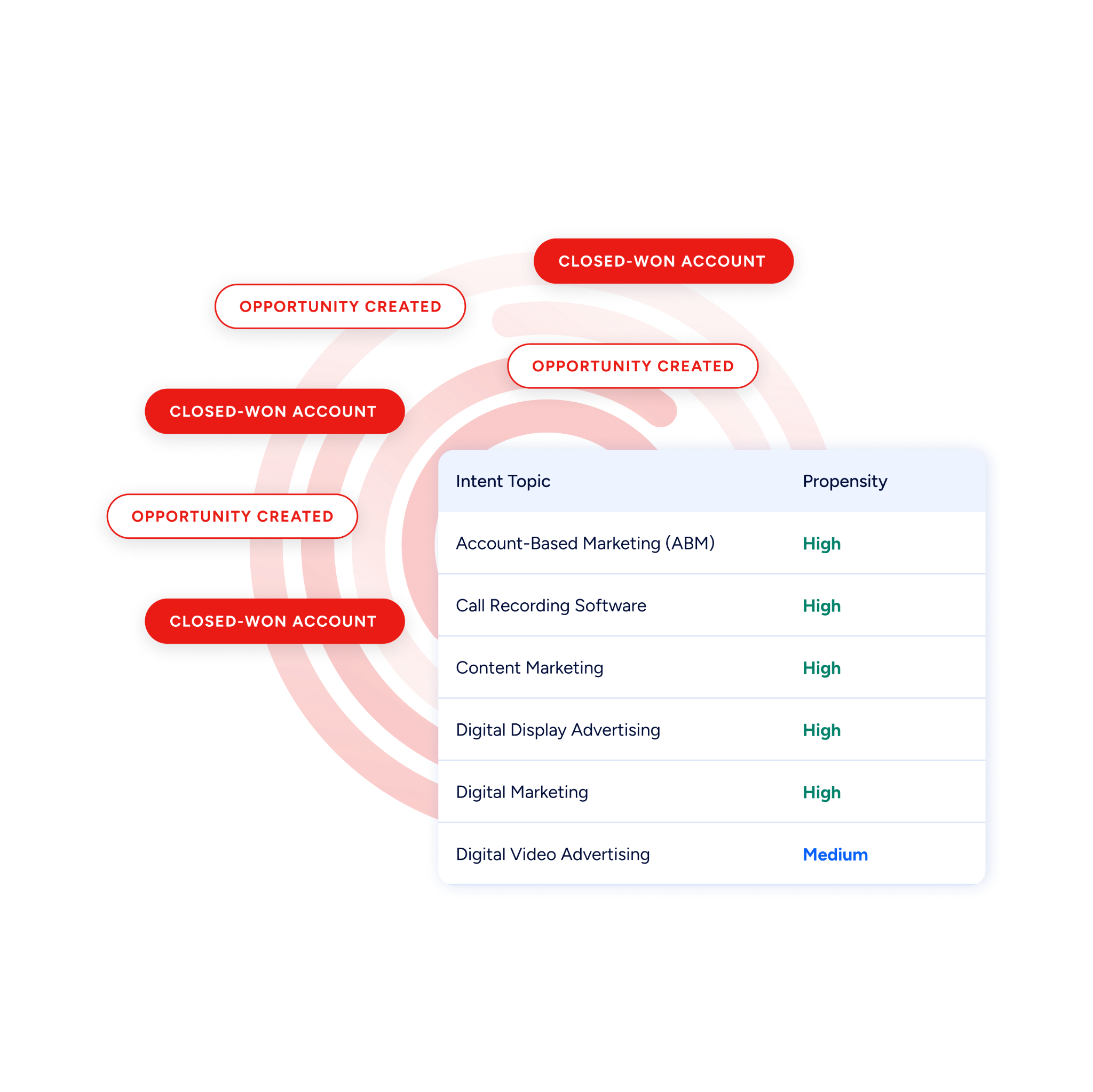
For teams that currently use ZeroBounce to clean lists before campaigns, ZoomInfo's intent signals can tell them which accounts to target in the first place.
"That combination of our internal CRM data, external signals, and AI that's given all that context has helped us craft very specific account- and persona-based messages. And people have responded to them right away." (Seismic)
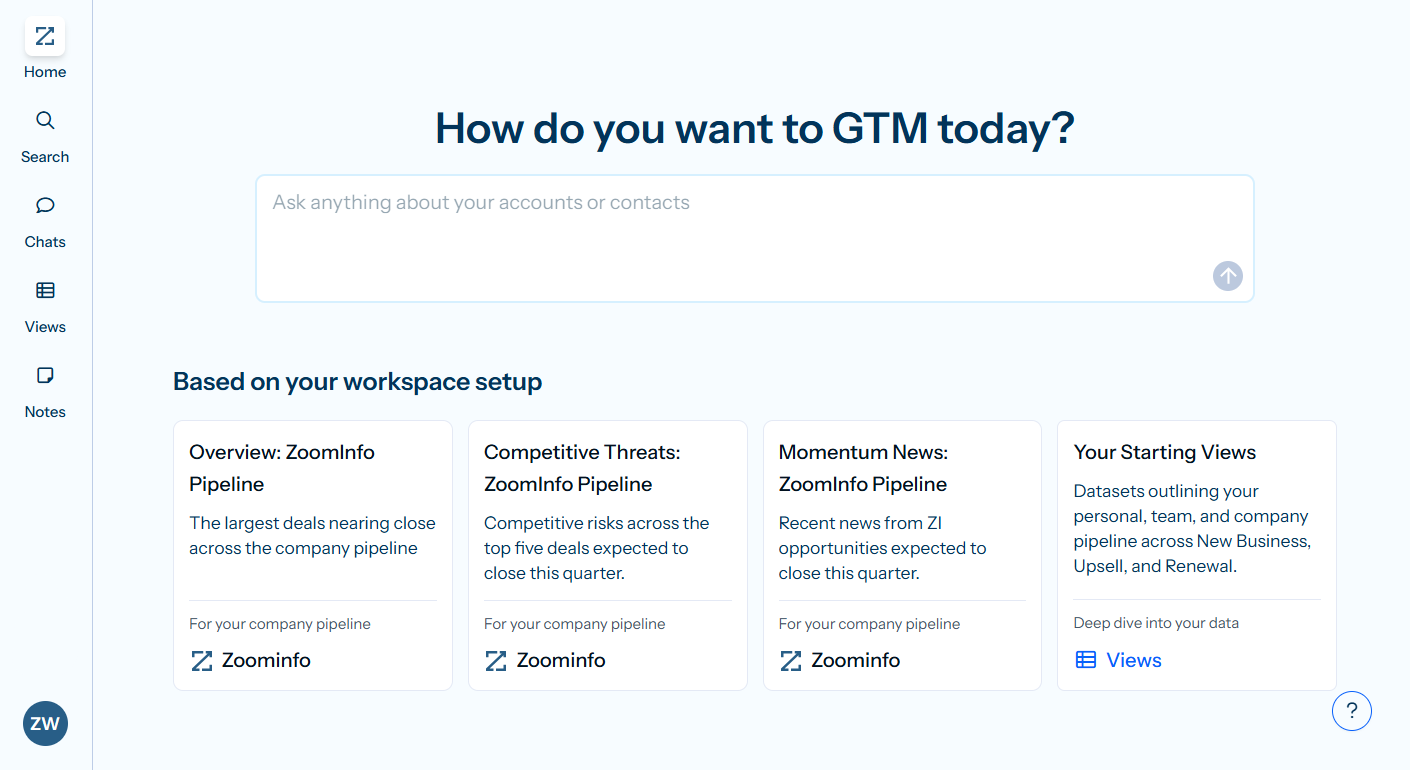
Execution Across Sales, Marketing, and Operations: ZoomInfo delivers its intelligence through dedicated workspaces for every GTM role.
ZoomInfo's intelligence is accessible through three channels. GTM Workspace gives sellers a single surface where prioritized accounts, AI-drafted outreach, and deal execution come together.
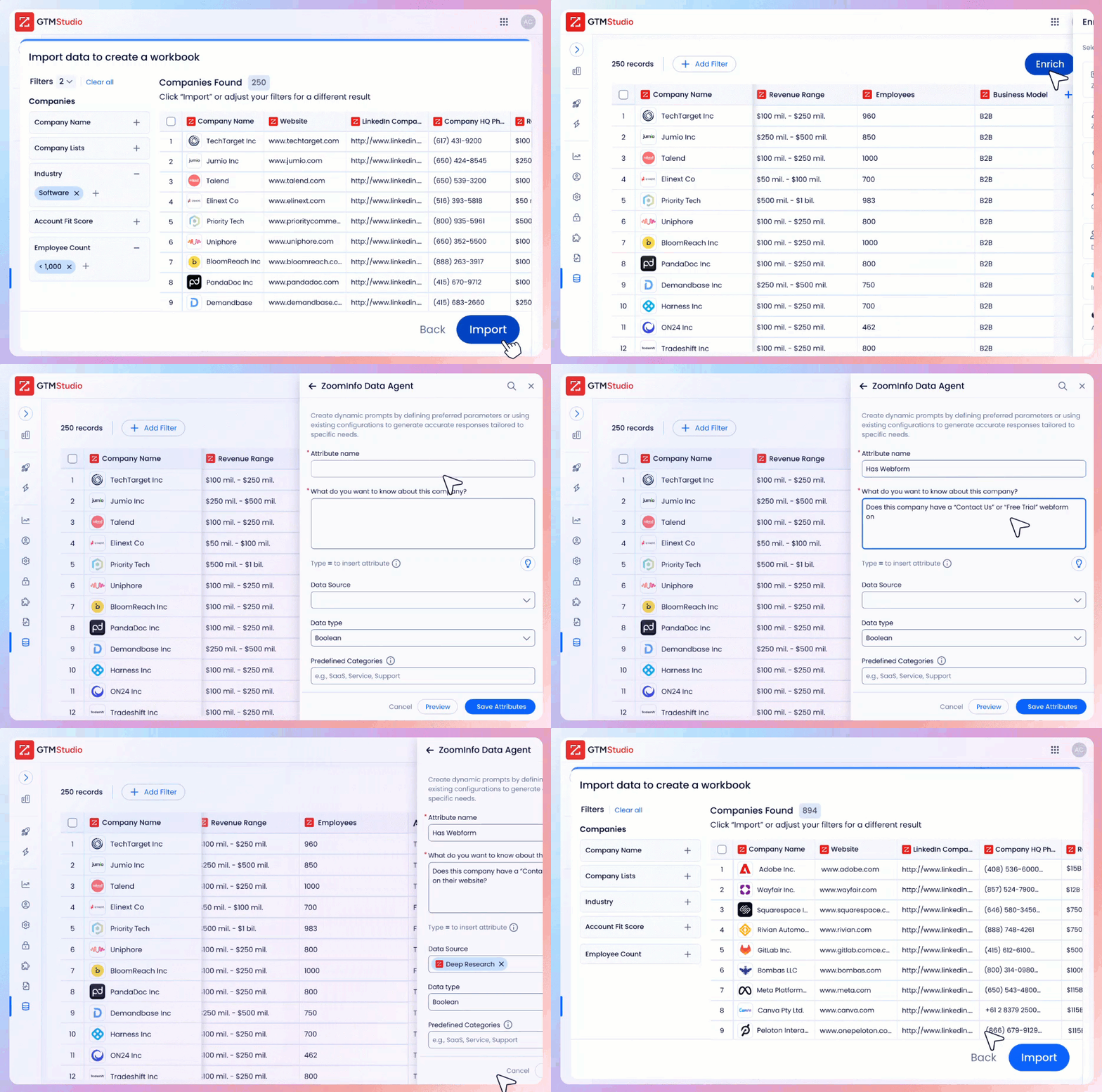
GTM Studio gives marketers, RevOps, and GTM engineers a builder environment for audience definition, campaign orchestration, and pipeline measurement in natural language. For teams building beyond ZoomInfo's own products, APIs and MCP expose the same intelligence to any custom agent, internal tool, or partner platform.
Source: ZoomInfo
On the marketing side, ZoomInfo's FormComplete reduces signup forms to a single field and auto-fills the rest, preventing bad email addresses from entering the system at all. Smartsheet reported a 40%+ increase in form fills, 84% increase in MQLs, and 59% increase in win rate using this approach.
For operations teams, ZoomInfo Operations automates CRM data quality through multi-vendor enrichment from about 60 vendors, deduplication, and entry-point protection that blocks bad data before it gets in.
Pricing: ZoomInfo uses custom-quoted, consumption-based pricing with free entry points.
ZoomInfo uses a consumption-based pricing model with no publicly listed prices. Costs depend on usage patterns, number of users, monthly credit volume, features, and contract length. Annual contracts are standard.
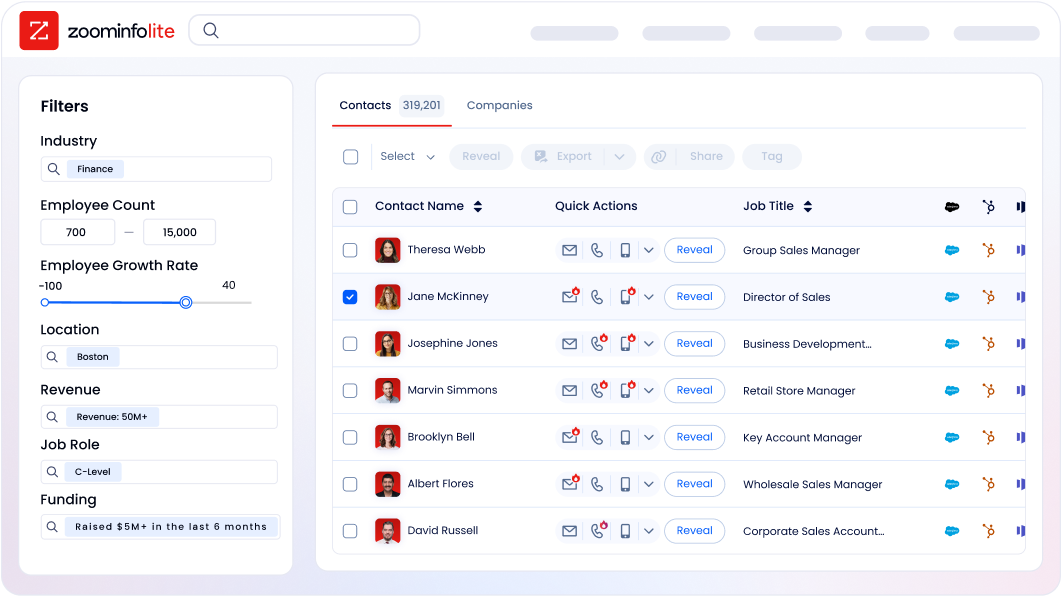
Two free entry points are available. ZoomInfo Lite is a permanent free tier (not a trial) that includes access to ZoomInfo's B2B database with 10 monthly export credits, individual and company searches, email addresses, the ReachOut Chrome Extension, and WebSights Lite with up to 10 website visitor reveals per day. A separate 7-day free trial provides broader access to core features with no credit card required.
Source: ZoomInfo
ZeroBounce or ZoomInfo: Comparison Summary
ZeroBounce | ZoomInfo | |
|---|---|---|
Primary focus | Email verification & deliverability | GTM intelligence platform |
Email data | Validates emails you already have | Provides 200M+ already-verified business emails |
Phone numbers | Not available | 135M+ verified phone numbers, 120M direct dials |
Company data | Basic data enrichment (name, gender) | 100M companies with attributes, org charts, technographics |
Intent signals | Not available | Buyer intent from 210M IP-to-Org pairings |
AI capabilities | Catch-all scoring, email warmup | GTM Context Graph, AI-drafted outreach, account prioritization |
Integrations | 60+ ESPs and CRMs | 120+ via App Marketplace, plus API and MCP access |
Free tier | 100 monthly validations | ZoomInfo Lite (permanent, 10 exports/month) |
Paid pricing | $99/month (ZeroBounce ONE) or PAYG from $39 | Custom-quoted, consumption-based |
Security certifications | SOC 2 Type 2, ISO-27001, HIPAA, GDPR, CCPA | SOC 2 Type II, ISO 27001, ISO 27701, GDPR, CCPA |
Best for | Teams cleaning existing email lists | Teams building and executing a full GTM strategy |
Final Verdict
The choice between ZeroBounce and ZoomInfo depends on where your data needs begin and end.
Choose ZeroBounce if your primary challenge is email list hygiene. It's the right tool when you have existing contact lists that need cleaning before campaigns, when you need to protect sender reputation through ongoing validation, or when you want a full deliverability toolkit (warmup, blacklist monitoring, inbox placement testing, DMARC monitoring) in one platform.
ZeroBounce's 99.6% accuracy guarantee, industry-low unknown rate, and ability to validate historically problematic Yahoo, AOL, and catch-all addresses make it one of the most capable email verification services available. For email marketers, developers building validation into signup flows, and agencies managing list hygiene for multiple clients, ZeroBounce delivers what it promises.
Choose ZoomInfo if your needs go beyond email verification into prospecting, sales intelligence, and go-to-market execution. ZoomInfo eliminates the verification step by providing already-verified contact data, then adds the company intelligence, buying signals, and AI-powered execution tools that turn data into pipeline.
For sales teams building prospect lists, marketing teams running account-based campaigns, and operations teams maintaining CRM data quality, ZoomInfo provides the data and intelligence layer that a verification tool alone cannot.
Get started with ZoomInfo here.
The distinction is straightforward. ZeroBounce cleans the contacts you have. ZoomInfo gives you the contacts you need, already verified, with the intelligence to know which ones matter right now.
ZeroBounce FAQ
How accurate is ZeroBounce's email validation?
ZeroBounce guarantees 99.6% accuracy across more than 30 detected email types, backed by a money-back guarantee. The platform reported a 1.69% average unknown rate for 2024, consistently below competitors. Its anti-greylisting system queues and retries validation attempts that other tools would mark as unknown, converting more ambiguous results into definitive valid or invalid verdicts.
Does ZeroBounce validate Yahoo and AOL email addresses?
Yes. ZeroBounce launched Verify+ in April 2024, making it the first email validation service that can accurately validate Yahoo and AOL addresses, including long-disabled mailboxes. Without Verify+, accuracy on these providers can fall to 96%. With it enabled, the full 99.6% accuracy guarantee applies. This capability was later extended to catch-all domain validation.
What is ZeroBounce ONE and how much does it cost?
ZeroBounce ONE is a bundled subscription at $99 per month (or $79 per month billed annually) that consolidates all of ZeroBounce's tools into a single plan. It includes 10,000 validation credits, 10,000 Email Finder searches, 100 inbox placement tests, 100 email server tests, 250 warmup seeds, 10 blacklist monitors, and 1 DMARC Monitor domain per month.
Subscribers also receive a 15% discount on additional credit purchases. ZoomInfo uses a custom-quoted pricing model with a permanent free tier (ZoomInfo Lite) and a 7-day free trial for evaluating paid features.
How long does ZeroBounce take to process bulk email lists?
Processing time depends on domain complexity. Lists of 250,000 emails on popular domains process in under 10 minutes, and 1 million take under 45 minutes. Complex domains take longer: 250,000 in 2.3 hours or less, 1 million in 5 hours or less. Some users report processing times up to 48 hours for very large lists with complex domains.
Does ZeroBounce have an API for real-time validation?
Yes. ZeroBounce's real-time API validates individual addresses in about 3 seconds, with a batch endpoint handling up to 200 emails at once. The API reports 99.99% uptime and a 1.09-second average response time, with SDK wrappers available in 16 programming languages including Python, Java, PHP, Ruby, Go, Rust, and C#. ZoomInfo also offers API and MCP access for programmatic data consumption, though its focus is contact and company intelligence rather than email validation.
Can ZeroBounce find email addresses, not just validate them?
Yes. ZeroBounce's Email Finder discovers email addresses using a person's name and company domain by generating and testing patterns against the validation engine. It returns only addresses confirmed as valid.
However, each successful query consumes 20 credits (versus 1 credit for standard validation), and the tool's coverage is limited compared to dedicated sales intelligence platforms. ZoomInfo provides access to 200M+ verified business email addresses alongside 135M+ verified phone numbers, company attributes, and buying signals as part of its core platform.
What security certifications does ZeroBounce hold?
ZeroBounce holds SOC 2 Type 2, ISO-27001, HIPAA, GDPR, CCPA, PCI-DSS, and EU-US Data Privacy Framework certifications. The platform runs on proprietary, ZeroBounce-owned hardware rather than shared cloud providers, with EU-based servers for European customer data. Customer data is automatically deleted after 30 days.
ZoomInfo maintains a comparable compliance stack with ISO 27001, ISO 27701, SOC 2 Type II, TRUSTe GDPR, and TRUSTe CCPA certifications, all renewed annually.
Does ZeroBounce offer a free plan?
ZeroBounce offers a permanent free account with 100 monthly email validations, 10 email scores, 1 Email Finder query, 1 domain search, and 1 inbox placement test. No credit card is required, but sign-up requires a business or premium domain email address.
ZoomInfo offers ZoomInfo Lite as a permanent free tier with access to its B2B database, 10 monthly export credits, and features like the ReachOut Chrome Extension and WebSights Lite.
Related breakdowns to help you choose:
