
Plenty of companies adopt RevOps as a title and a reorg, then wonder why nothing changed. Moving a few ops people under one leader doesn't fix the disconnected processes, conflicting reports, and sales-versus-marketing friction underneath. Skip the operating model and RevOps becomes a coordination layer with nothing beneath it.
A RevOps framework is that structure. This guide covers:
What a RevOps framework is, and how it differs from strategy and the function
The four pillars every framework rests on
The framework models you can layer on top
How to apply a framework to your own team
What Is a RevOps Framework?
A RevOps framework is the repeatable operating model that connects an organization's people, process, technology, and data across the entire revenue lifecycle. It's the blueprint that defines how sales, marketing, and customer success plan, execute, and measure growth as one system rather than three separate ones.
Two ideas are worth separating up front:
Revenue operations is the function, the team and the discipline that owns cross-functional revenue alignment.
The framework is the structure that function runs on, the pillars, workflows, and data model that turn a mission statement into a way of working.
A team can exist without a framework. It just won't scale, because every decision gets made from scratch and nothing compounds. The framework is what makes the work repeatable, which is the whole point of operations.
RevOps Framework vs Strategy vs the RevOps Function
These three terms get used interchangeably, and the confusion is why so many RevOps efforts stall. Each is a distinct layer.
Layer | What it is | The question it answers |
RevOps function | The team and discipline | Who owns revenue alignment? |
RevOps strategy | The plan and priorities | What are we trying to achieve this year? |
RevOps framework | The operating model | How does the whole system actually run? |
The function sets up the team. The RevOps strategy sets the direction. The framework is the connective tissue that makes both executable, the standing structure that outlives any single quarter's plan.
If you're still standing up the team itself, ZoomInfo's guide to building an effective RevOps function covers the hiring and org design. This page covers the model that team should build once it exists.
The Four Pillars of a RevOps Framework
Credible RevOps frameworks share the same four pillars. Get all four working together and the revenue engine runs as one system. Neglect one and the other three inherit the weakness.
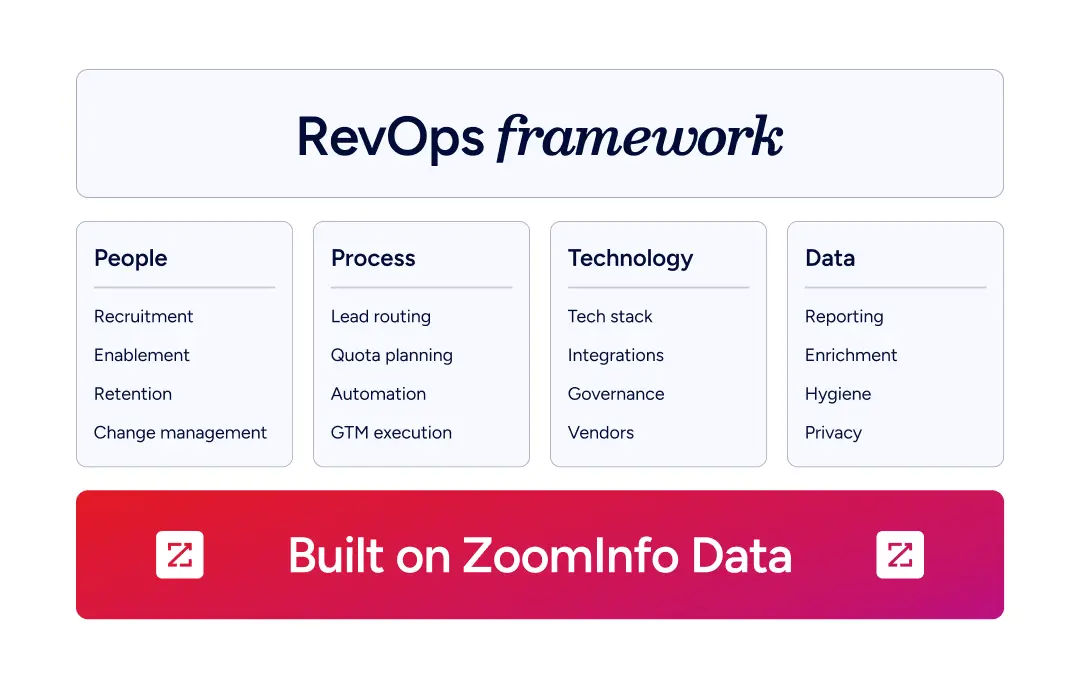
People and alignment
Revenue doesn't move without the people running the motion, so the framework starts with them. This pillar covers:
How the RevOps team is organized and how sales team structure maps to the go-to-market model
The sales enablement that keeps reps sharp, plus change management and knowledge sharing
The sales and marketing alignment that decides whether the funnel hands off cleanly or leaks at every seam
Compensation, since sales incentives steer behavior more than any playbook does
Process
The process pillar is where a framework earns its keep, because it turns one-off effort into a repeatable motion. It governs the workflows that carry revenue from first touch to renewal:
Lead routing and lead scoring at the top of the funnel
The annual planning sequence of territory planning, capacity planning, and quota planning
The sales automation that removes manual drag
Continuous process optimization rather than a one-time mapping exercise
It's also where RevOps challenges tend to surface first.
Technology
Technology is the pillar that makes the other three operable at scale, since none of them work by spreadsheet forever. It covers:
The RevOps tech stack and the revenue operations software that runs each motion
The integrations that let those tools share data instead of hoarding it
Vendor management and governance
Avoiding the tech stack problems that come from buying tools faster than you can connect them
The goal is a stack that reduces complexity, not one that adds a login for every problem.
Data
Data is the pillar the other three quietly depend on, which is why it belongs at the foundation of the model. It covers:
The data enrichment that keeps records current
Commercial reporting and diagnostics
Governance and privacy controls that keep the whole thing compliant
When this pillar is strong, every decision the framework produces rests on something real. When it's weak, the framework produces confident decisions built on stale records, which is worse than no framework at all.
The pillars are not a checklist to complete once. They're four systems that have to stay in balance, because a framework is only as strong as its weakest pillar.
The Revenue Lifecycle a RevOps Framework Governs
The four pillars are the vertical view of a framework. The horizontal view is the customer lifecycle the framework governs end to end, from a marketing-sourced lead through a closed deal to renewal and expansion.
This is the coordination a framework exists to deliver. Marketing hands leads to sales on shared definitions, sales moves them through a defined sales funnel, and customer success picks up the account without a cold restart. Each pillar shows up at every stage: the same data follows the account through, the same GTM metrics measure each transition, and the same go-to-market operations discipline keeps handoffs from leaking. A framework that governs the full lifecycle is what makes sales forecasting trustworthy, because the number reflects one connected system instead of three teams guessing separately.
The Main RevOps Framework Models
The four pillars are the operating structure. On top of that structure, teams usually adopt a named model that shapes how they view the revenue motion itself. These aren't competing choices so much as different lenses, and the right one depends on your GTM motion and where your growth comes from.
The Bowtie model. Popularized by Winning by Design, the bowtie extends the traditional funnel past the closed deal into onboarding, retention, and expansion, framing growth as one continuous lifecycle. It suits recurring-revenue businesses where customer expansion and net revenue retention drive as much growth as new logos do.
The revenue waterfall. This model breaks the funnel into strictly defined stages with conversion benchmarks at each transition. It's the strongest choice when the priority is pipeline visibility and forecasting discipline, because it standardizes how you measure lead conversion and velocity at every step.
The lead-to-revenue lifecycle. A lifecycle model maps the full buyer journey on shared stages and definitions across marketing, sales, and CS. It earns its place when the problem you're solving is handoff friction and inconsistent data across the buyer journey, rather than raw funnel math.
Account-based revenue. An account-based model centers the framework on high-value accounts instead of individual leads, coordinating account-based marketing and sales into plays built around buying-group coverage. It fits complex, multi-threaded deals where depth of engagement beats volume of outreach.
Pirate Metrics (AARRR). Coined by investor Dave McClure, AARRR breaks growth into acquisition, activation, retention, revenue, and referral. It's a diagnostic lens more than a full operating model, useful for pinpointing exactly where drop-off happens in a largely digital or product-led journey.
Revenue architecture. The broadest of the set, this model designs the entire go-to-market structure at once, from roles to process to technology. It suits organizations in a genuine transformation, rebuilding foundations rather than tuning a working system.
You don't have to pick one and commit forever. Many teams run the four pillars as their operating base and adopt whichever model best fits their motion, then revisit the choice as the RevOps AI survey findings and their own maturity shift what "good" looks like.
How to Apply a RevOps Framework
A framework is only useful once it's running. Here's the sequence to move from concept to operating model.
1. Assess your current maturity
Start honest about where you are, because the next step depends on it.
Score each pillar as it stands today. Ad hoc, defined, or optimized is enough granularity to begin. A team with strong tooling but no shared data model is in a very different spot than one with clean data and no automation.
Use data maturity as the honest floor. A framework can't outperform the data underneath it, so a weak data pillar caps everything above it.
2. Align every team on shared metrics
A framework fails the moment two teams define the same metric differently.
Agree on one definition for each core sales KPI and one source of truth for it. If marketing and sales count a qualified lead differently, the framework is broken before it starts.
Tie the metrics to outcomes, not activity, so the framework measures whether the revenue engine is actually moving.
3. Map and standardize the process
With metrics agreed, document how work actually flows.
Map the real workflows across the lifecycle, then standardize the handoffs, lead routing rules, and stage definitions so everyone operates from the same script.
Fix the data silos that force teams to reconcile information by hand, since that reconciliation is where operational time quietly disappears.
4. Unify the data layer
The data pillar is the foundation, so make it trustworthy before you build on it.
Consolidate to one governed view through CRM data enrichment and data integration across systems, so every pillar reads from the same records.
Validate against a verified external source rather than trusting the CRM alone, because CRM data quality decays fast and quietly.
5. Instrument the technology stack
Now wire the tools to the process, not the other way around.
Choose stack components that serve the mapped workflows, and connect them so data flows without manual export. A framework built around tool limitations inherits those limitations.
Fold in AI for RevOps where it removes real drag, using revenue intelligence to surface patterns the team would otherwise miss.
6. Govern and iterate
A framework is a living system, so build the review loop in from the start.
Set a quarterly cadence to reassess each pillar and rebalance where one has fallen behind.
Treat the framework as continuous rather than a one-time build. As ZoomInfo CRO James Roth argued in the company's Predictions for Go-To-Market in 2026, the advantage now goes to teams that keep reinvesting in the motions that work, which means the operating model has to keep evolving with them.
How Better Data Underpins the Framework
Every pillar of a RevOps framework rests on the data pillar, and that's the pillar teams tend to underbuild. Process runs on the records it can see. Technology is only as useful as the data flowing through it. The people running the motion can only act on what the system tells them. Get the data layer wrong and the whole framework produces confident, well-structured, incorrect decisions.
Why the CRM alone can't anchor a framework
Your CRM records what your team has already touched, and it records it thinly and imperfectly. A framework anchored only to internal records inherits every gap in those records, then propagates the gap across all four pillars. This is why data quality sits underneath framework design rather than beside it, and why closing the gap usually means enrichment from a verified B2B data provider.
Where ZoomInfo fits
ZoomInfo supplies the foundation layer a framework runs on, and it maps cleanly onto the pillars through three capabilities.
Data pillar. Verified B2B data on more than 100M companies, with the firmographic and technographic data every other pillar reads from. The RevOps-relevant distinction is continuous enrichment rather than batch append. When records refresh on an ongoing basis, the routing rules, scoring models, and territory assignments built on top of them stay accurate instead of drifting out of date between quarterly cleanups.
Technology pillar. GTM Studio gives RevOps a codeless lane to build enrichment, routing, and segmentation plays against your ideal customer profile without opening an engineering ticket, which is the fix for the two-week cycle that kills GTM self-service. With enrichment sources included in one place, it also collapses the multi-vendor sprawl that makes a stack brittle, so this pillar runs on one contract instead of stitched-together APIs.
Process and analytics. The GTM Context Graph fuses that verified data with your CRM records and live signals into one reasoning layer. RevOps depends on models like churn risk, territory assignment, and expansion scoring. All of them run on current data rather than a stale snapshot. That same go-to-market intelligence reaches every tool and team the framework governs.
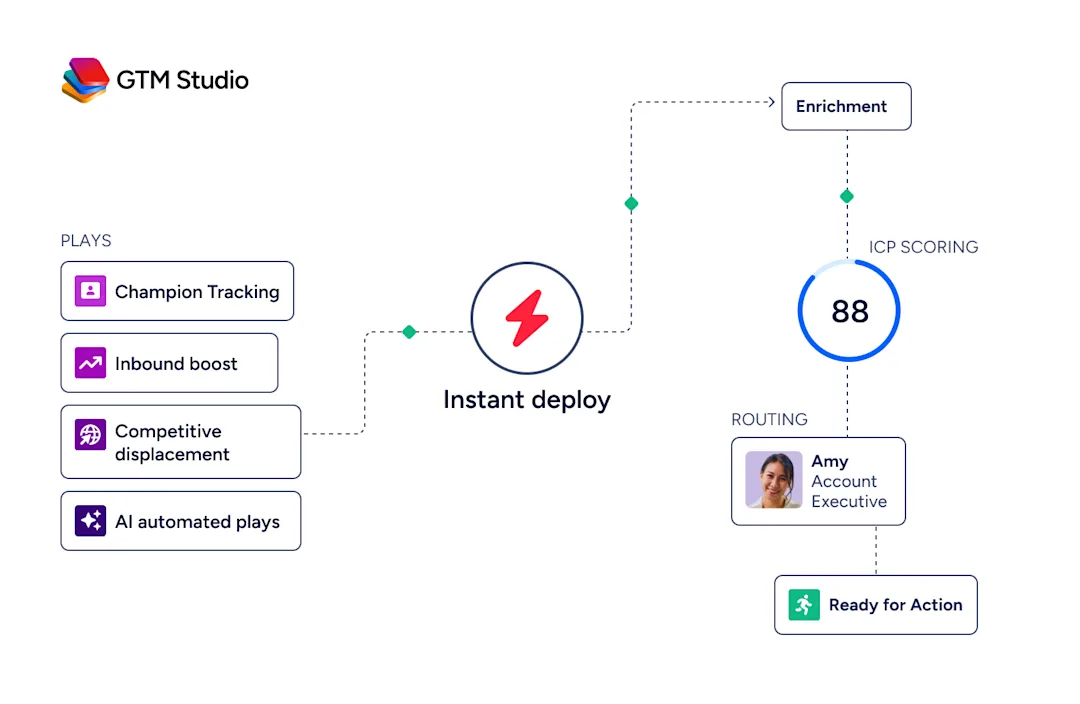
The payoff is a framework where all four pillars read from one trusted source instead of four conflicting ones, which is the difference between an operating model and an org chart.
RevOps Framework Best Practices
A few principles keep a framework durable as the business changes.
Balance all four pillars. A framework is only as strong as its weakest pillar, so resist the pull to over-invest in technology while neglecting data or people.
Start from the data layer. Every other pillar depends on it, so validate and unify data before building process and tooling on top.
Standardize definitions first. Agree on one meaning and one source for every core metric before you automate anything, because automation just scales whatever confusion already exists.
Map process to the full lifecycle. Design the framework across marketing, sales, and customer success together, since the handoffs between them are where revenue leaks.
Review quarterly. Reassess each pillar on a set cadence and rebalance, treating the framework as a living system rather than a one-time build.
Build the Framework on Verified Data
A RevOps framework turns a renamed team into a working revenue engine. The four pillars give it structure, the lifecycle view gives it reach, and a named model gives it a lens, but all of it rests on the data layer underneath.
Underbuild that layer and the framework produces well-organized guesses. Get it right and every pillar operates on the same trusted reality, which is what makes growth repeatable instead of accidental.
Talk to our team to see how ZoomInfo's verified B2B data gives every pillar of your framework one source to run on.
RevOps Framework FAQs
How is a RevOps framework different from a GTM framework?
A GTM framework defines how you take a product to market: segments, positioning, channels, and motion. A RevOps framework defines how the teams running that motion operate as one system, so the GTM plan doesn't fall apart in execution.
Do small businesses need a RevOps framework?
Yes, though a lighter version. A small team can skip formal pillars and governance, but it still needs shared metric definitions, clean data, and clear handoffs, because those habits are cheaper to build early than to untangle later.
How long does it take to implement a RevOps framework?
It depends on scope. Aligning metrics and cleaning the data layer can take a few weeks, while the full operating model across all four pillars usually runs a few months, then iterates indefinitely.
Who owns the RevOps framework?
The RevOps function owns it day to day, backed by an executive sponsor, usually a CRO or VP of RevOps, with authority to enforce shared definitions. Ownership sits with RevOps, accountability with revenue leadership.
How do you know if your RevOps framework is working?
The clearest signal is trust in the numbers: the forecast holds, reps stop keeping private spreadsheets, and reviews argue about decisions rather than whose data is right. If every QBR opens with a debate over definitions, it exists on paper but not in practice.
