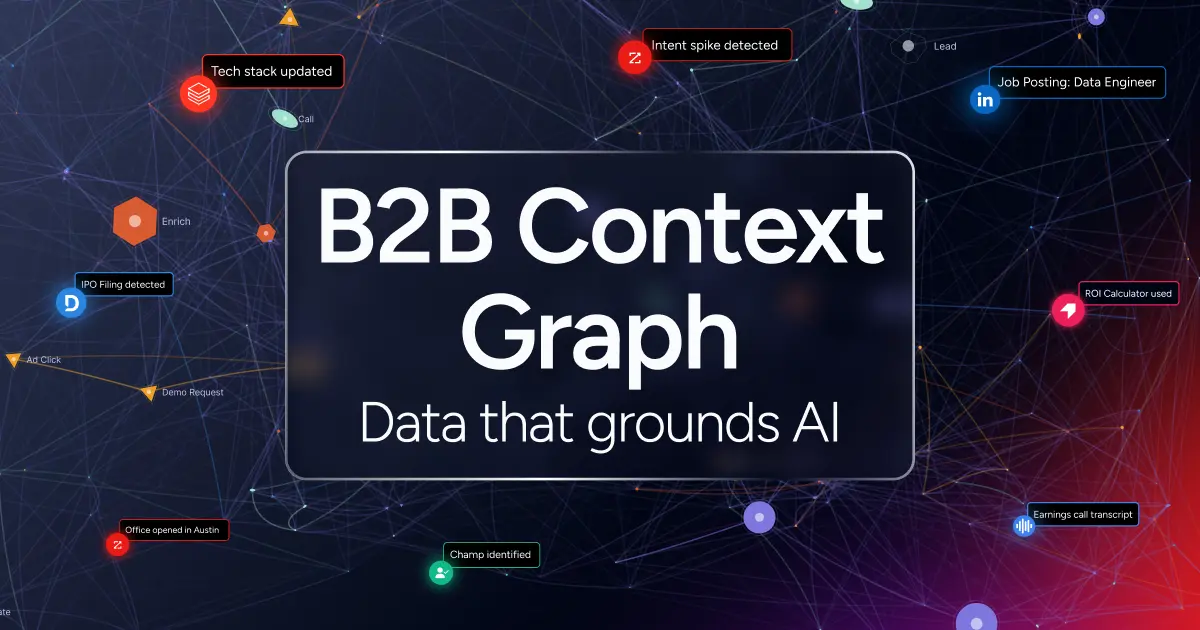

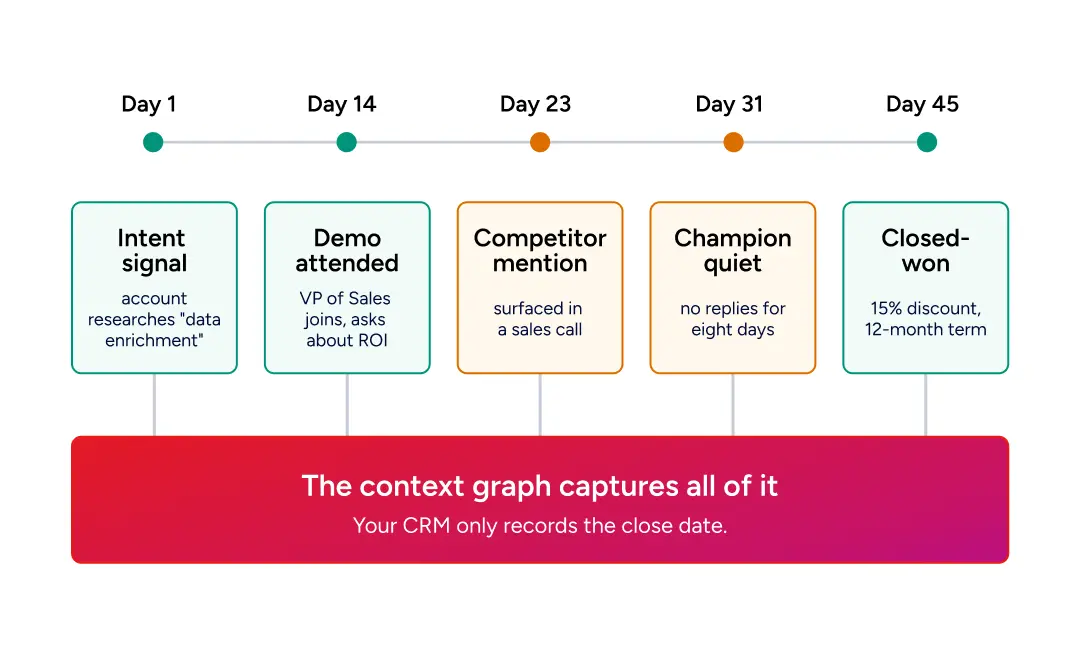
Your CRM knows Account X closed last quarter. It doesn't know why a champion pushed for the demo, what tipped procurement, or which signals showed up two weeks before the call.
That gap is where GTM teams lose their most valuable intelligence, and where AI agents inherit a blind spot they can't reason past.
A B2B context graph closes that gap. This article covers what a context graph is, why your CRM can't replace it, and how ZoomInfo's GTM Context Graph powers AI for revenue teams.
What Is a B2B Context Graph?
A context graph is a data structure that captures not just relationships between entities, but the signals, decisions, and timing that shaped them.
A traditional database stores records. A knowledge graph connects those records with labeled relationships (Company A is a customer of Company B). A context graph goes further. It captures the operational context around every interaction.
In a B2B setting, a single deal might connect to an email open, a demo attended, a third-party intent signal, a competitor mention on a sales call, and the resulting pipeline movement. Every connection carries temporal metadata: when it happened, what preceded it, and what happened next.
The key components:
Nodes: entities like companies, contacts, deals, campaigns, web pages, and content assets.
Edges: relationships between nodes, enriched with context about how and when those relationships formed.
Decision traces: recorded sequences of actions, signals, and outcomes that capture institutional memory about what works.
Temporal structure: time-stamped layers that let the graph represent change over time, not a static snapshot.
That structure turns every deal in your pipeline into a pattern your team can learn from.
Context graph vs. knowledge graph
The terms are sometimes used interchangeably, but they solve different problems.
Feature | Knowledge Graph | Context Graph |
Primary focus | What is true (entities and relationships) | Why things happened (decisions and sequences) |
Data type | Static facts and taxonomies | Dynamic signals, behaviors, and outcomes |
Temporal awareness | Limited (snapshots) | Native (time-series across every edge) |
Update frequency | Periodic batch updates | Continuous, event-driven |
AI utility | Fact retrieval and entity linking | Decision support and pattern recognition |
Typical query | "Who are the decision-makers at Account X?" | "What sequence of signals preceded closed-won deals in this segment?" |
Think of it as the difference between knowing who your buyers are and knowing what made them buy.
Why Context Graphs Matter for GTM AI Now
Fragmented GTM data is not a new problem. Reps have worked around bad data for two decades. They mentally merged duplicate accounts, recognized the same contact across three systems, and filled in missing context from memory. Human judgment papered over the gaps.
That workaround stops working the moment AI enters the GTM stack. Three reasons context graphs went from nice-to-have to required:
AI can't infer the way a rep can. A rep recognizes when two records describe the same account or person. AI treats every variation as a separate entity, runs separate outreach against each one, and reports separate pipeline against each one. The mental merging a human did invisibly is now a structural data problem the agent can't solve on its own.
Agents compound errors instead of catching them. A rep questions a pipeline forecast that looks wrong. An agent runs with the bad data, executes fifty downstream actions on top of it, and the team finds out when something visible breaks. AI scales bad data at the speed of automation.
Speed has collapsed the tolerance for messy data. An agent that produces an account brief in ten seconds can't pause for a rep to clean up a duplicate record first. The acceptable speed of "good enough" data has dropped to zero. Either the data underneath is resolved, or the agent's output isn't trustworthy.
The foundation that worked for human-led GTM doesn't work for AI-led GTM. Context graphs are what fills that gap.
Why Your CRM Can't Be a Context Graph
Go-to-market teams are drowning in tools and starving for context.
According to an analysis by ZoomInfo CPO Dominik Facher, the average enterprise runs 42+ GTM tools. The theory was that integrating all of them back to the CRM would produce a unified view. It hasn't.
Institutional knowledge ends up scattered across systems, locked in individual reps' heads, or lost entirely when people leave. When a senior AE walks out the door, their deal notes, relationship history, and buyer intelligence walk with them. The CRM keeps the skeleton (account name, deal stage, close date) and none of the reasoning that made those deals work.
When Sales Operations tries to unify GTM data, the same four problems show up every time:
Entity duplication. A single enterprise account can have 15+ records across the GTM stack: variations like "Company Inc.," the acronym, a divisional name, a typo. Some have opportunities attached. Some have contacts. None of them agree.
Contact mismatches. The same person appears as a full name in Salesforce, an abbreviated initial in Chorus, and an email address in Outreach. They changed titles three months ago, but only one system has the update.
Hierarchy confusion. Is a subsidiary a separate account or a child of the parent? Your CRM has them apart. Your data warehouse has them as one. Call recordings are mapped to the wrong ones.
Missing normalization. Outreach says "VP of Sales." Salesforce says "Sales Leader." ZoomInfo says "Head of Sales." Same role, three labels.
Every scaled GTM organization has some version of this. Integration doesn't fix it. It moves the mess around faster.
The CRM was never built to be a context foundation. It was built to record state changes. AI needs the full trace: what was tried, what worked, what failed, and why.
How ZoomInfo Powers GTM AI With the Context Graph
ZoomInfo's GTM Context Graph is where the architecture above runs in production. It's the foundation under every product in the ZoomInfo stack and the layer that gives AI agents access to verified B2B intelligence through GTM AI, ZoomInfo's agent-native platform. Agent Teams runs complete GTM plays on this foundation, with coordinated specialist agents sharing context and acting within admin-set controls.
The graph fuses ZoomInfo's proprietary B2B data, the most comprehensive in the industry, with a customer's own first-party data:
CRM records
Conversation intelligence from Chorus
Email interactions
Product usage signals
Engagement history and other behavioral signals
Three things make this possible at the scale GTM teams need.
Entity resolution built on twenty years of B2B data infrastructure
ZoomInfo has spent twenty years building the largest B2B data unification platform in the world, covering:
Entity resolution
Semantic normalization
Hierarchy management
Identity matching
Data quality at scale
The same infrastructure that resolves and verifies hundreds of millions of companies and contacts on the third-party side is now applied to a customer's calls, emails, CRM, and product usage. That's how the four CRM problems above get solved automatically: duplicate accounts collapsed, mismatched contacts linked, hierarchies mapped, role titles normalized.
As ZoomInfo CEO Henry Schuck puts it, "reasoning without verified data is fluent guesswork." Entity resolution is the part you can't bolt on. Without it, no context graph is reliable enough for AI to trust.
Conversation intelligence as a context capture engine
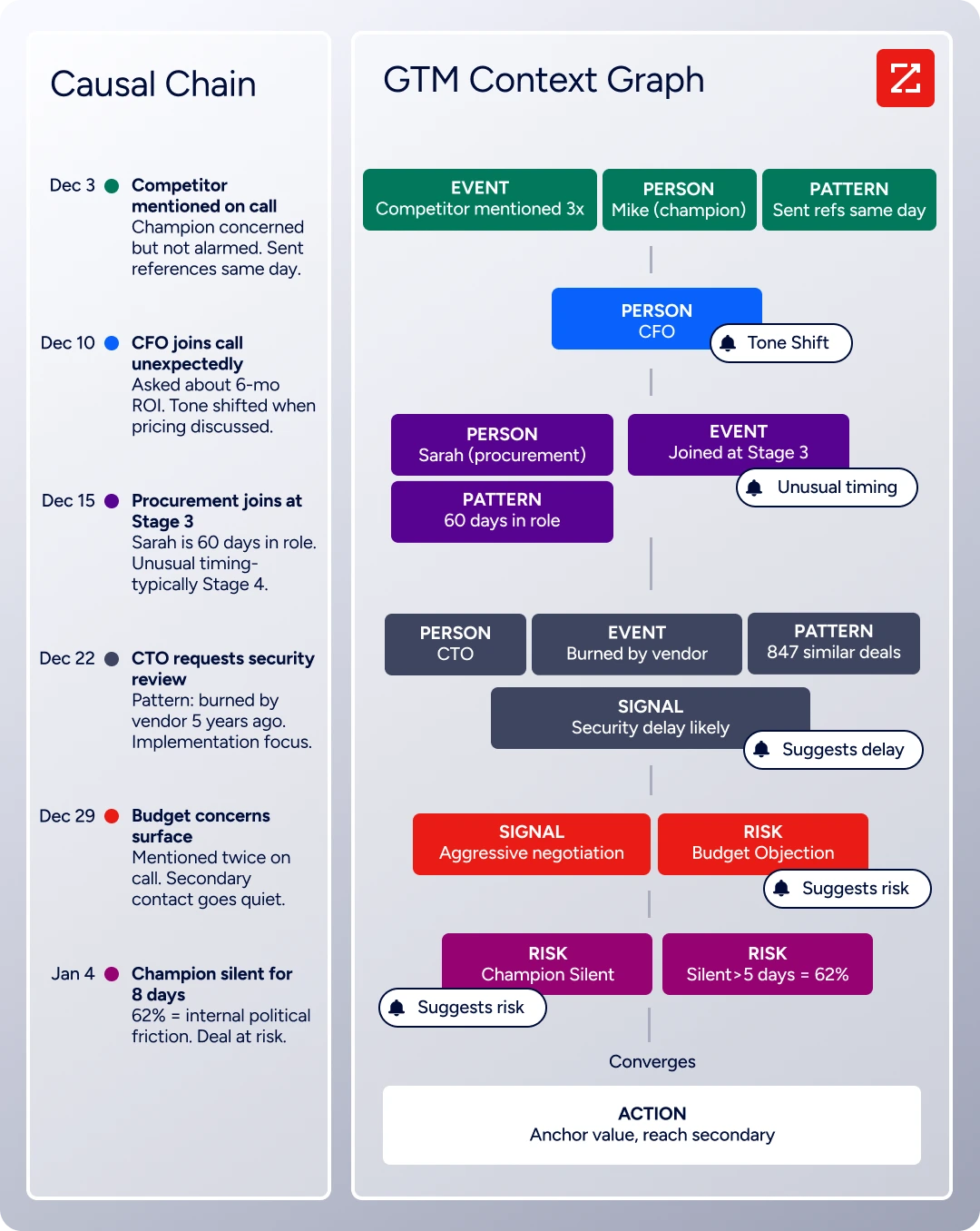
Chorus captures every call, meeting, and email, then extracts the decision traces behind them. Not just who said what, but why things happened:
Why a deal accelerated (executive sponsorship secured on a specific call)
Why a champion went quiet (internal budget battle with IT)
What a competitive mention predicts (a 34% longer negotiation cycle, based on pattern-matching against similar deals)
Those signals feed directly into the GTM Context Graph, turning trapped call data into causal context AI can reason from.

First-party and third-party unification in one graph
Your internal data shows what's happening inside the account. ZoomInfo's external data shows what's happening outside:
Org changes
Funding rounds
Hiring patterns
Neither is complete alone. The GTM Context Graph unifies both, resolving across every system to create a single intelligence layer any AI agent in your stack can query.
Once the graph exists, it runs wherever your team works. Across the ZoomInfo stack:
GTM Studio for marketers, RevOps, and GTM engineers—where Agent Teams runs complete plays end to end
GTM Workspace for sellers and account managers
ZoomInfo Copilot for AI-driven prospecting and outreach
And across any AI agent through GTM AI, or headless through the API. Native MCP integrations cover Claude, Claude Code, Codex, Vertex AI, and Perplexity, with pre-built skills like Account Research, Build List, Buying Committee, and Enrich Contact. The graph isn't locked inside ZoomInfo's UI.
Use Cases for B2B Revenue Teams
Four ways revenue teams are using the GTM Context Graph today:
Account research and prioritization. Agent Teams can take this further, running the full play from signal to outreach. Instead of manually piecing together firmographic data, intent signals, and engagement history from multiple tools, sales teams query the context graph for a unified account view that includes the decision traces behind previous interactions.
CRM hygiene and data enrichment. The context graph continuously resolves and enriches CRM records, catching duplicates, filling gaps, and linking related entities across systems.
AI agent-driven outreach. Agent Teams uses the GTM Context Graph as its primary intelligence layer, running complete plays—like reactivating a past champion who changed jobs—that reflect the actual context of the buyer relationship, not just a name and title. Any AI agent your team uses, from Claude to Perplexity to a custom build, can query the same foundation.
Pipeline forecasting. By analyzing the decision traces behind historically successful deals, Agent Teams can identify lookalike accounts and automatically build pipeline from closed-won patterns.
Challenges of Building a Context Graph
A context graph is powerful in theory. At enterprise scale, three things make it hard.
Data quality compounds faster than integration can clean it
A context graph is only as reliable as the signals it ingests. If your CRM is full of duplicates, your marketing automation platform has stale contacts, and your intent data is unverified, the graph amplifies those problems instead of solving them.
Integration complexity makes it worse. Every GTM tool has its own data model, API, and update cadence. Building reliable pipelines that capture signals consistently across dozens of systems takes serious engineering investment, and the pipelines themselves become a maintenance burden the moment any source schema changes.
This is why ZoomInfo treats identity resolution and data quality as prerequisites, not features.
Governance and privacy can't be retrofitted
Context graphs capture detailed behavioral and decision data, which raises legitimate governance questions:
Who owns the data in the graph?
What signals are you allowed to capture and retain?
How do you stay compliant with GDPR, CCPA, and other privacy regulations when your graph connects personal contact data to behavioral traces?
You need governance policies in place before the first signal lands in the graph. That means:
Defined retention periods
Consent frameworks for behavioral data
Access controls that limit who can query sensitive decision traces
Adoption is the silent failure mode
A context graph only delivers value if your team uses it. That means rethinking workflows, retraining reps, and building trust in the graph's outputs.
Sales reps who've spent years building their own account intelligence in spreadsheets and personal notes won't immediately trust a system-generated context layer. Adoption needs:
Executive sponsorship
Concrete proof of value (a rep seeing an insight they would have missed on their own)
Gradual integration into existing workflows, not a wholesale replacement
Build Your GTM Context Graph Today
The hard part of GTM AI isn't the concept of a context graph. It's the foundation underneath: clean, resolved, verified data with the right signals layered on top.
ZoomInfo's GTM Context Graph is that foundation, already running in production for revenue teams across the GTM stack. Agent Teams builds on it to run complete GTM motions end to end.
Start a free trial and see what the GTM Context Graph can do for your GTM AI motion.
Frequently Asked Questions About Context Graphs
Do context graphs replace CRM systems?
No. Context graphs complement CRMs by adding the intelligence layer that CRMs lack. Your CRM remains the system of record for deals, contacts, and pipeline stages, while the context graph captures the signals, sequences, and reasoning that the CRM can't store.
What data do you need to build a context graph?
You need three categories of data: entity data (companies, contacts, deals), interaction data (emails, calls, meetings, website visits, content engagement), and signal data (intent signals, technographic changes, funding events). The critical prerequisite is identity resolution to ensure that data from all sources maps to the correct entities.
How do context graphs support AI agents?
AI agents need structured context to produce useful outputs. Without a context graph, an agent can only work with its training data and whatever prompt context you provide. With a context graph, Agent Teams can query historical decision traces, buyer behaviors, and account intelligence to run complete plays grounded in your actual business data.
How do I connect the GTM Context Graph to my AI tools?
Through GTM AI, ZoomInfo's agent-native platform. It exposes the GTM Context Graph through an MCP server, APIs, and pre-built skills (Account Research, Build List, Buying Committee, Enrich Contact, and more). Agent Teams runs in GTM Studio or headless through GTM.AI, coordinating specialist agents that share context across every step. Native MCP integrations include Claude, Claude Code, Codex, Vertex AI, and Perplexity.
