
ActiveCampaign is one of the most widely adopted marketing automation platforms for small and mid-market businesses, serving 180,000+ customers across 170+ countries with a platform spanning email marketing, SMS, WhatsApp, CRM, and AI-powered automation.
Its Active Intelligence engine, launched in 2025, shifted the platform from traditional automation (run what you build) to autonomous marketing (build what you need), giving smaller teams campaign intelligence that once required enterprise budgets.
But a marketing automation platform only knows what happens inside it.
ActiveCampaign tracks email opens, form submissions, automation enrollments, and website visits. On its own, it cannot verify whether a prospect's phone number still works, detect which accounts are researching your product category this week, sync pipeline updates from your CRM, or connect your storefront data to your nurture campaigns.
The right integrations close those gaps. They feed your automation platform verified data it cannot generate on its own, capture activity happening in your CRM and commerce tools, and extend your workflows to the platforms where your team and customers spend their time.
This guide covers the strongest integration for each of the jobs ActiveCampaign users most commonly need done:
Enrich contact records with verified B2B data, buyer intent signals, and company intelligence
Align marketing automation with enterprise CRM pipeline activity
Power ecommerce lifecycle campaigns with real purchase data
Surface lead and deal activity in your team's primary workspace
Trigger lifecycle automations from meeting bookings
Connect your stack to 8,000+ apps without writing code
Capture paid social leads and route them into nurture sequences instantly
Each section walks through how the integration connects with ActiveCampaign, what data flows between the platforms, pricing, and who benefits most.
Best ActiveCampaign Integrations at a Glance |
|---|
Best ActiveCampaign Integration for B2B Data Enrichment and Go-to-Market Intelligence Enriches ActiveCampaign contact records with verified B2B data from the largest B2B database available (500M contacts, 135M+ verified phone numbers), buyer intent signals, and company intelligence, giving your marketing automation accurate data and the signals to target accounts that are actively in-market. |
Best ActiveCampaign Integration for Enterprise Sales and Marketing Pipeline Alignment Syncs contacts, leads, and opportunities bidirectionally between Salesforce and ActiveCampaign, logging marketing engagement on CRM records and triggering nurture sequences based on actual pipeline stage changes. |
Best ActiveCampaign Integration for Ecommerce Purchase-Data Automation Connects storefront activity (orders, abandoned carts, lifetime value) to ActiveCampaign's automation builder through a native Deep Data integration, enabling purchase-driven lifecycle campaigns and revenue attribution. |
Best ActiveCampaign Integration for Real-Time Team Notifications on Lead and Deal Activity Routes lead score milestones, deal stage changes, and automation enrollment decisions into Slack channels with a native bot and interactive approval buttons, so your team acts on signals without leaving Slack. |
Best ActiveCampaign Integration for Booking-Triggered Lifecycle Automation Turns meeting bookings into automated lifecycle events, syncing invitee data, triggering pre- and post-meeting sequences timed to the actual meeting date, and creating CRM deals when intent is highest. |
Best ActiveCampaign Integration for Extending Your Stack to 8,000+ Apps Without Code Connects ActiveCampaign to over 8,000 applications through no-code automation, enabling multi-step workflows, conditional routing, and bidirectional data sync with tools that lack native ActiveCampaign connectors. |
Best ActiveCampaign Integration for Paid Social Lead Capture Syncs Facebook and Instagram Lead Ad form submissions into ActiveCampaign in real time through a native connector, triggering nurture sequences and lead scoring while intent is fresh. |
What Is ActiveCampaign?
ActiveCampaign is a marketing automation platform and CRM that combines email marketing, SMS, WhatsApp, landing pages, and sales automation for small and mid-market businesses.
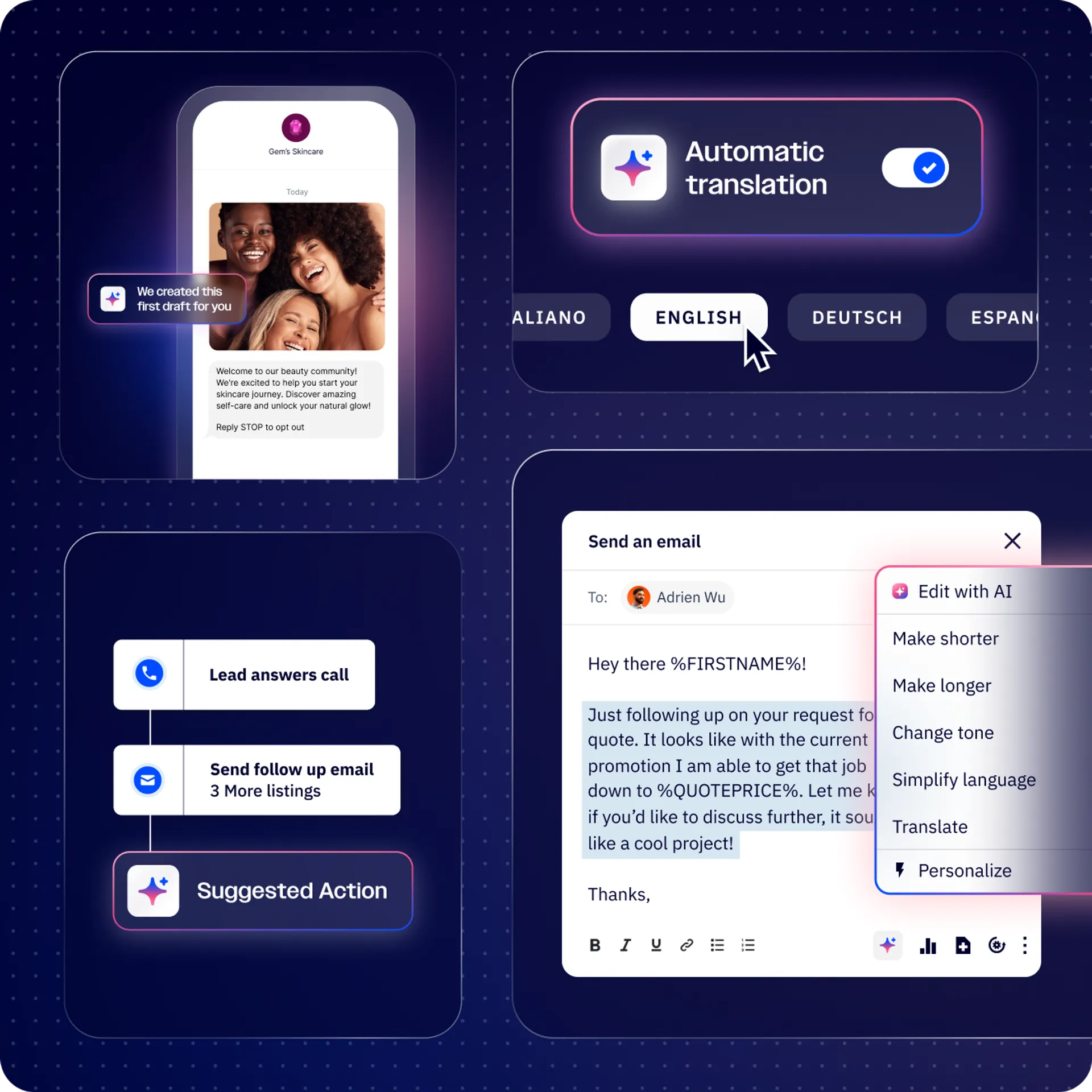
The company calls itself "the autonomous marketing platform", built on Active Intelligence, a system-wide AI engine that handles goal-directed campaign creation, optimization, and insights. ActiveCampaign serves 180,000+ businesses and orchestrated 120 billion+ customer experiences in 2025, backed by 14,500+ positive reviews across aggregator platforms and 300+ G2 badges in the Spring 2026 reports.
Source: ActiveCampaign
ActiveCampaign's integration ecosystem is one of its core strengths.
The ActiveCampaign App Marketplace lists over 1,000 integrations spanning CRM, ecommerce, scheduling, advertising, communication, and developer tools, with 40+ new integrations added in 2025.
On the technical side, ActiveCampaign offers a REST API (v3) covering contacts, deals, campaigns, automations, lists, segments, and custom objects, plus a GraphQL API for ecommerce operations. Webhooks deliver real-time notifications for contact, campaign, deal, and SMS events.
App Studio provides a self-serve developer portal for building custom integrations. ActiveCampaign also operates a Remote MCP Server that connects the platform to AI assistants including Claude and ChatGPT, making it the first marketing platform in Claude's official connector directory.
The integration categories available to ActiveCampaign users include:
CRM and sales: Salesforce, Microsoft Dynamics 365, Pipedrive, Zendesk Sell
Ecommerce: Shopify, WooCommerce, BigCommerce, Stripe, Square
Scheduling and meetings: Calendly, Acuity Scheduling
Team communication: Slack, Microsoft Teams
Advertising and lead capture: Facebook Lead Ads, Google Ads, LinkedIn Ads
Workflow automation: Zapier, Make, webhooks
Content and forms: WordPress, Webflow, Typeform, Jotform
With that ecosystem as context, here are the seven integrations we selected as the best options for extending ActiveCampaign across the categories that matter most.
1. ZoomInfo: Best ActiveCampaign Integration for B2B Data Enrichment and Go-to-Market Intelligence
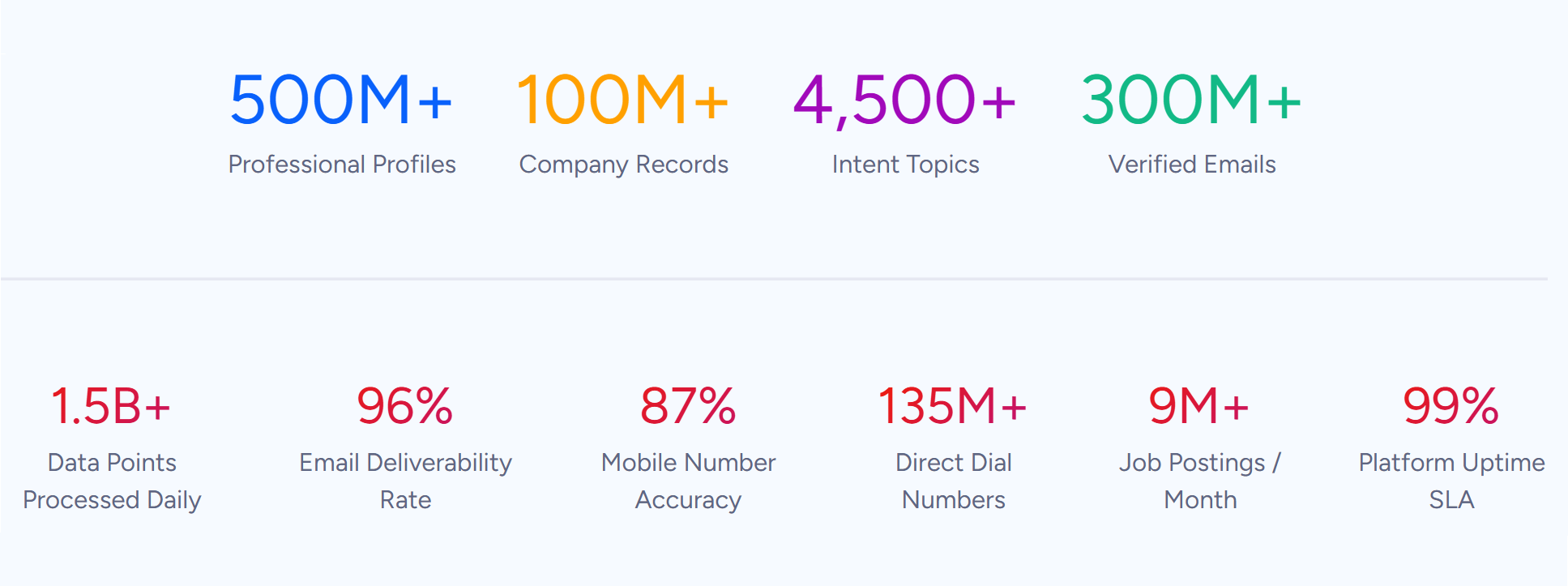
ZoomInfo is an AI-powered go-to-market platform built on the largest B2B data foundation available: 500M contacts, 100M companies, 135M+ verified phone numbers, and 200M+ verified business email addresses.
Source: ZoomInfo
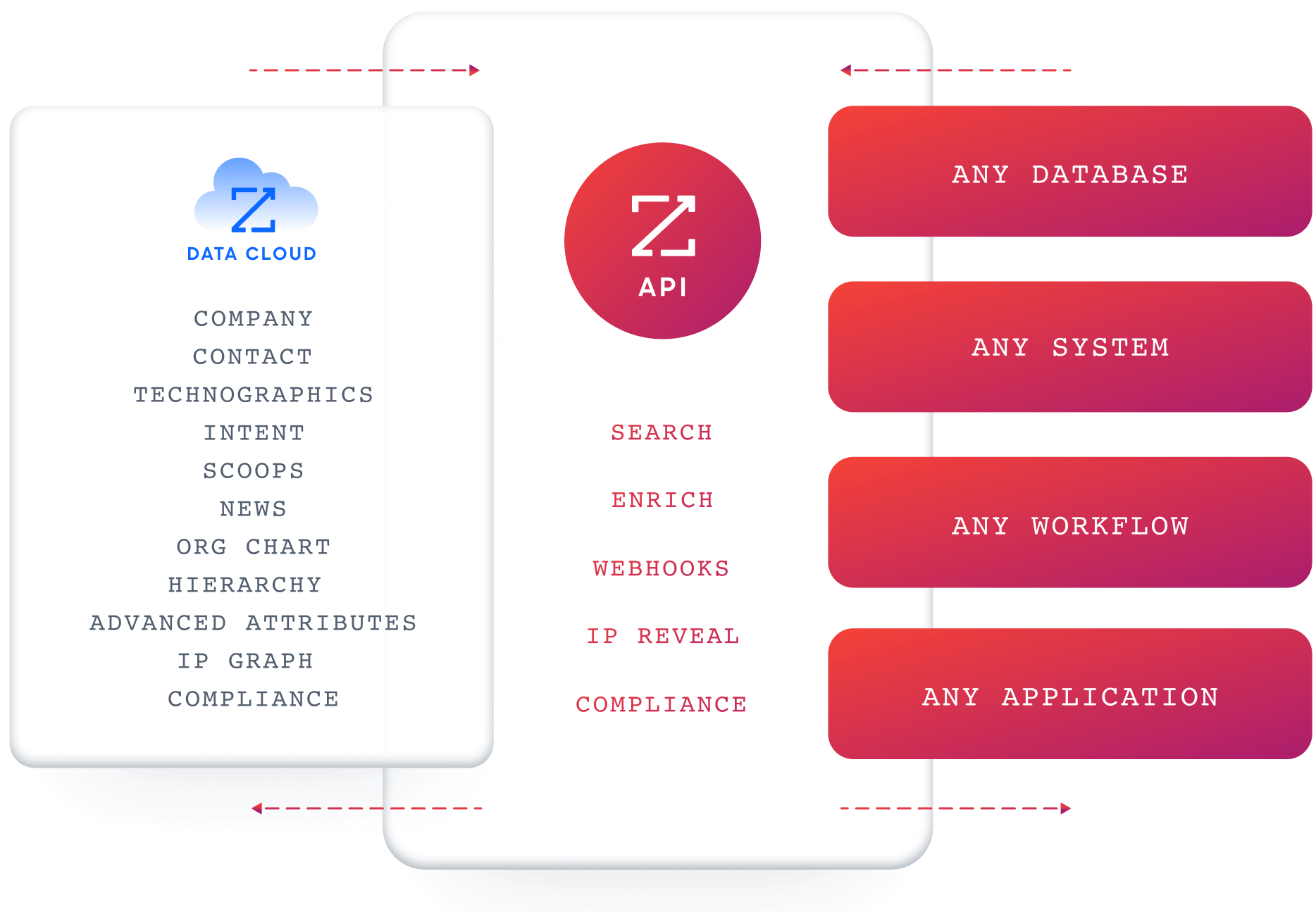
It connects with ActiveCampaign through workflow automation platforms including Zapier and other middleware connectors, enriching your marketing automation with verified contact data, company intelligence, buyer intent signals, and technographic insights.
Connecting the two platforms unlocks:
Marketing automation powered by verified data, not just behavioral signals from email opens and form submissions
Segmentation and scoring enriched with company intelligence, including industry, employee count, technology stack, and organizational structure
Real-time buying signals feeding your automation triggers, so your sequences reach prospects while they are actively researching
A continuous pipeline between prospecting and nurture, eliminating manual CSV imports and data entry
How ZoomInfo Integrates with ActiveCampaign
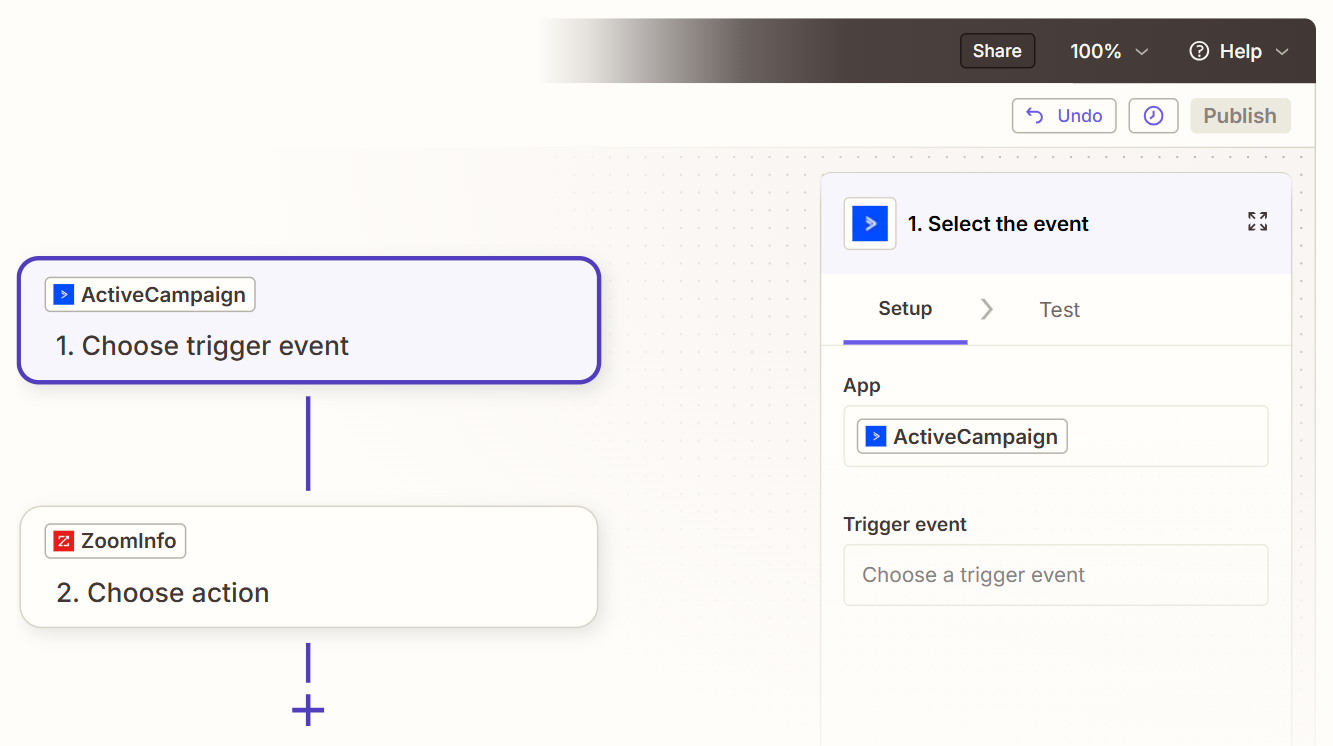
ZoomInfo connects to ActiveCampaign through third-party automation platforms such as Zapier, Tray, and other middleware connectors. These platforms handle the data flow between the two systems, mapping ZoomInfo's enrichment outputs to ActiveCampaign contact fields and triggering workflows in both directions.
Source: ZoomInfo
For technical teams, ZoomInfo's Enterprise APIs and MCP server provide additional ways to push B2B intelligence into ActiveCampaign programmatically, since ActiveCampaign also exposes a full REST API and its own MCP server. The middleware route requires no custom development and works for non-technical marketing teams.
Source: ZoomInfo
Contact Data Enrichment: Fill the Gaps ActiveCampaign Cannot Fill on Its Own
ActiveCampaign captures behavioral data: emails opened, links clicked, forms submitted, pages visited. What it cannot do on its own is verify whether a phone number still works, catch a job change, or reveal a company's technology stack.
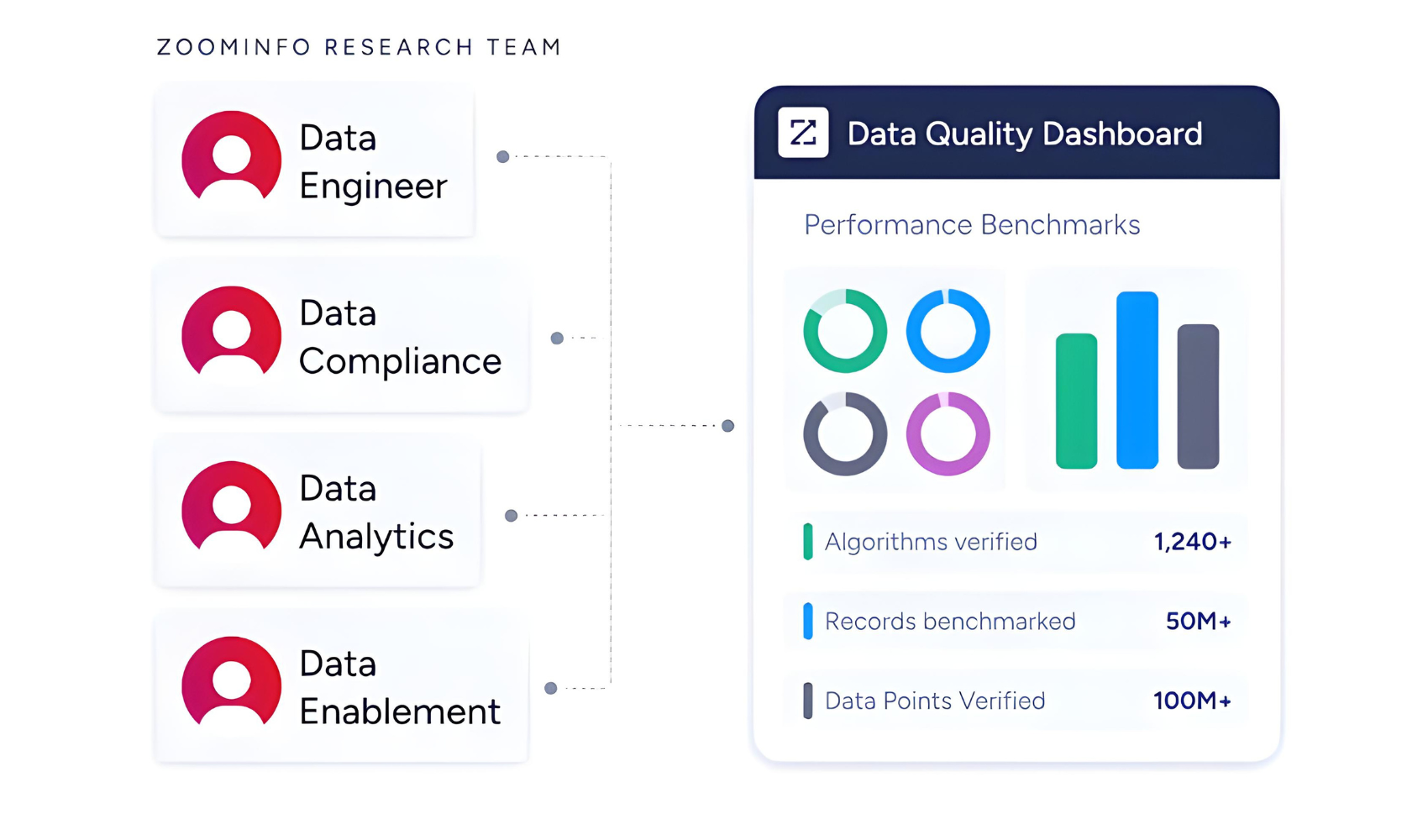
Through the integration, ZoomInfo appends verified business emails, direct dials, titles, departments, and seniority levels, plus company attributes and technographic data covering 30,000+ technologies, to ActiveCampaign contact records. The data flows through a verification pipeline backed by 300+ human researchers, reaching up to 95% accuracy on first-party data.
Source: ZoomInfo
ZoomInfo in action: A prospect fills out an ActiveCampaign form with only a name and work email. ZoomInfo enriches the record with their direct dial, current title, company profile (a 400-person fintech running Salesforce and Marketo), and department structure. Your automation scores and routes the lead based on company size and tech stack instead of treating every form fill identically.
Buyer Intent Signals: Trigger Automations When Accounts Start Researching
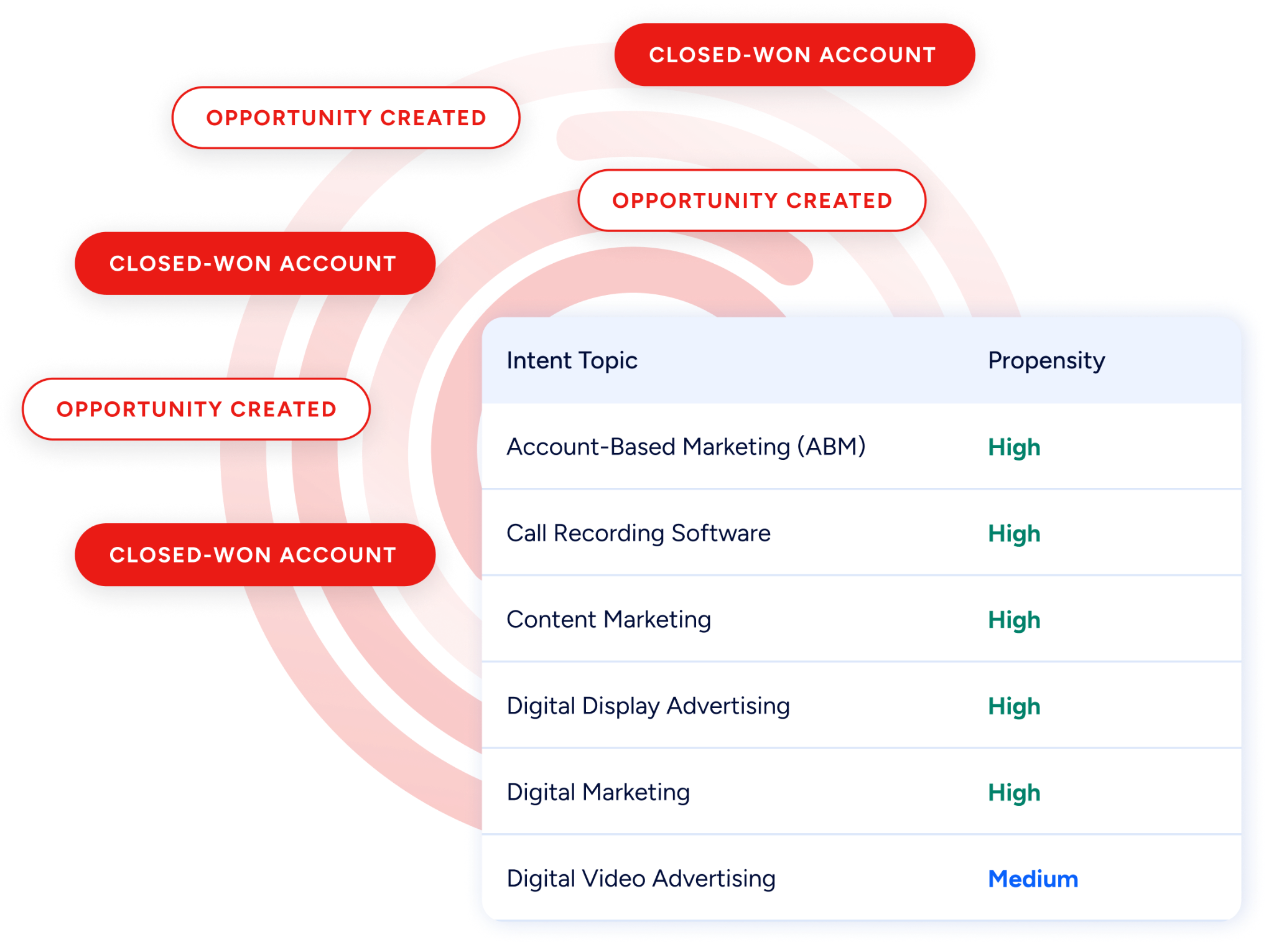
ZoomInfo's Buyer Intent tracks signals from 210 million IP-to-Organization pairings and 6 trillion+ new keyword-to-device pairings monthly, revealing which companies are actively researching topics relevant to your product.
Source: ZoomInfo
Those signals sync to ActiveCampaign contact records through the middleware connectors, where they update lead scores, trigger high-intent automation sequences, and surface priority accounts. Guided Intent, exclusive to ZoomInfo, identifies the research topics historically correlated with deal success in your business, so signals reflect your actual win patterns rather than generic keyword thresholds.
ZoomInfo in action: ZoomInfo detects a target account researching "marketing automation migration" for two consecutive weeks. The signal syncs to ActiveCampaign, raises the contact's lead score, and enrolls the primary contact in a switching-focused nurture sequence while the buyer is still evaluating options.
Prospecting-to-Nurture Pipeline: Move Verified Leads into ActiveCampaign Sequences
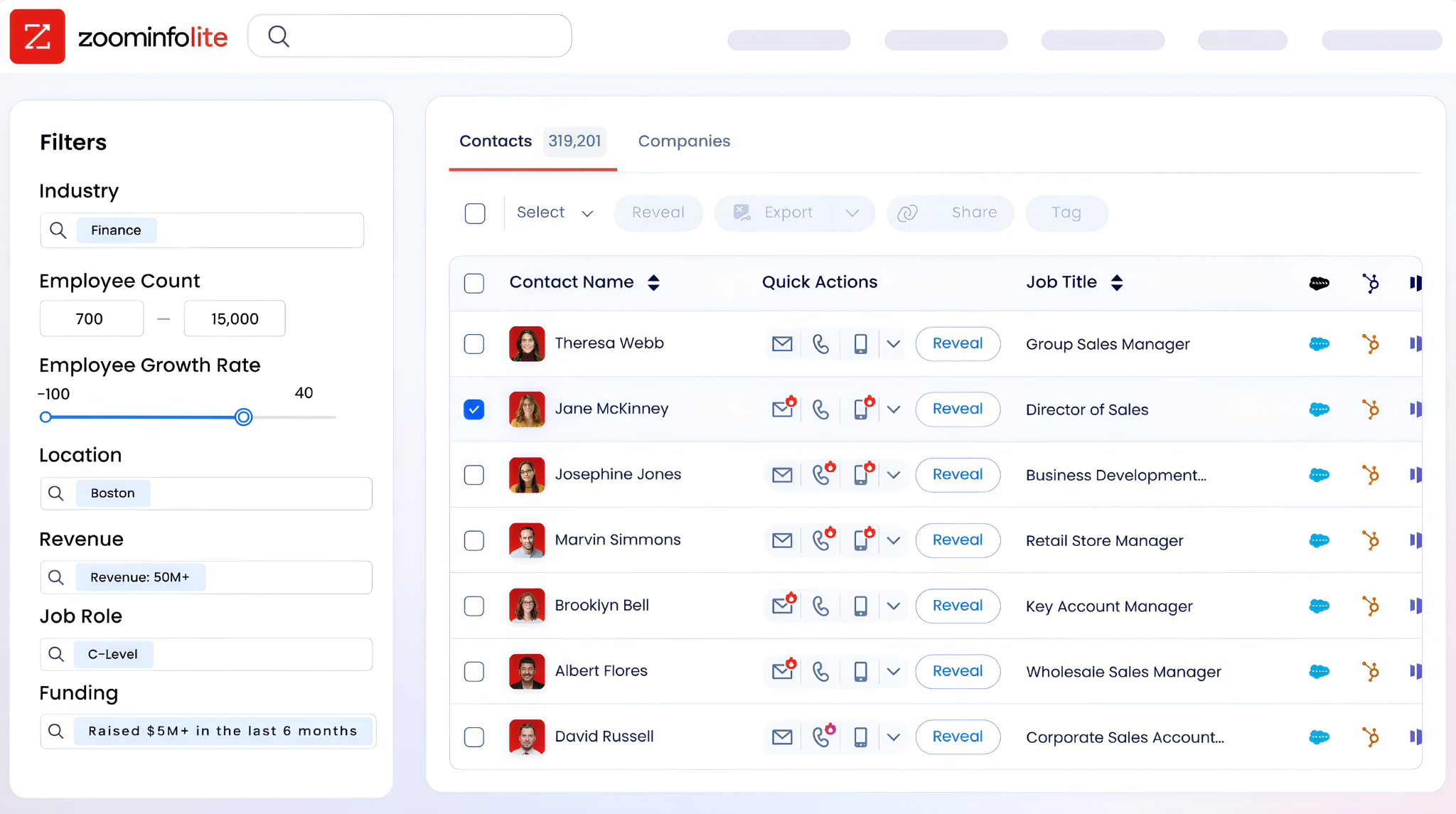
ZoomInfo's Contact & Company Search provides access to 300+ company attributes for building targeted prospect lists. Through the middleware connection, those verified contacts flow into ActiveCampaign with list assignments, tags, and custom field values applied at entry, enrolling directly into the appropriate nurture sequences without manual CSV imports.
This creates a continuous pipeline where prospecting in ZoomInfo and nurturing in ActiveCampaign operate as a coordinated system: every contact entering ActiveCampaign carries verified data from day one, and every enrichment update keeps the record current.
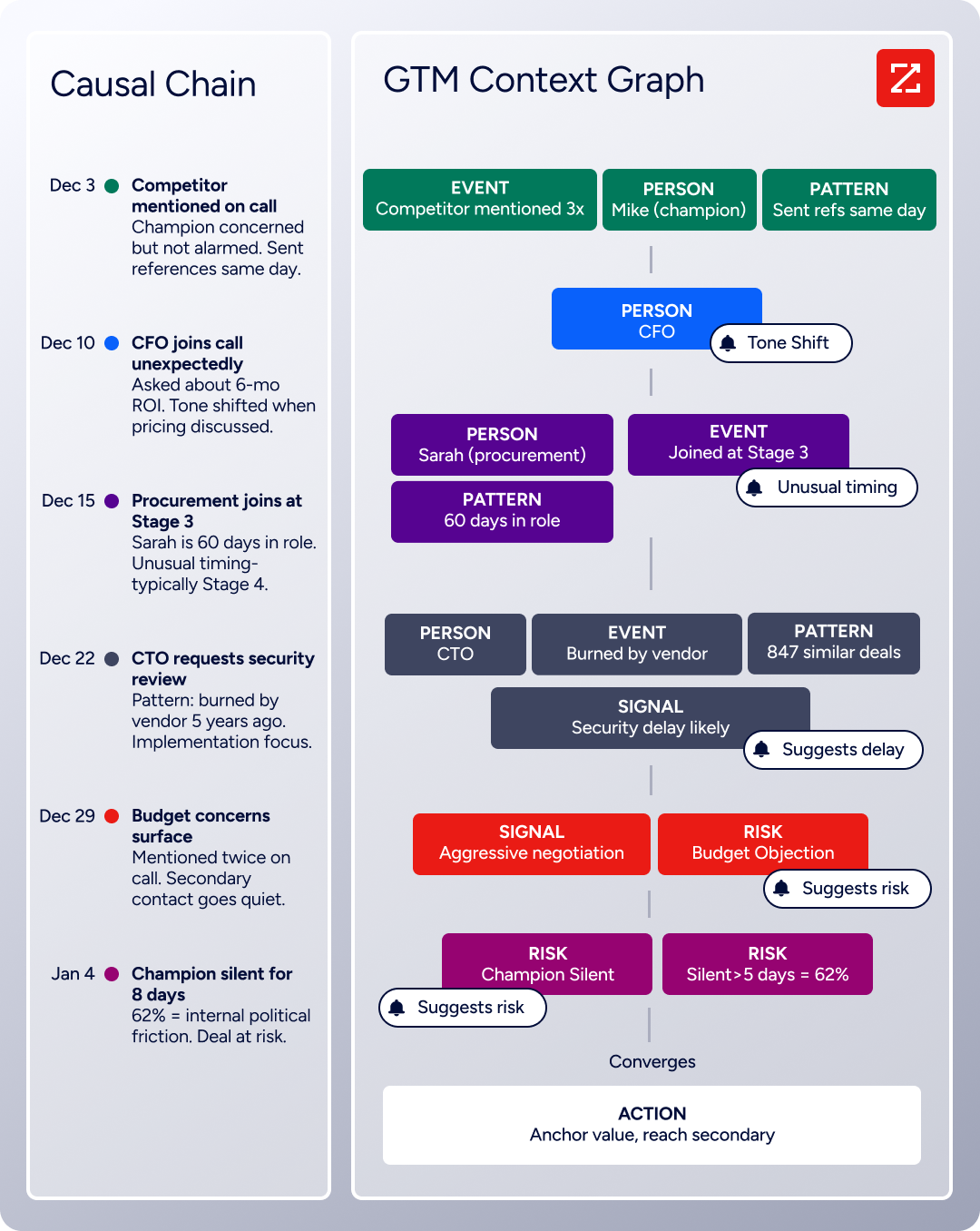
Beyond the middleware-based enrichment, the same intelligence layer powers ZoomInfo's wider go-to-market platform: the GTM Context Graph processes 1.5B+ data points daily and combines B2B data with CRM records, conversation transcripts, and behavioral signals, while GTM Studio, APIs, and MCP expose the same intelligence to any tool or AI agent.
Source: ZoomInfo
Seismic's sales team attributed 39% of active pipeline to opportunities identified or influenced by ZoomInfo signals, reporting 54% productivity gains and saving 11.5 hours per week per seller. (Seismic Case Study)
ZoomInfo Pricing
ZoomInfo uses a consumption-based pricing model with custom quotes based on usage, users, credit volume, and features.
It is organized into Sales, Marketing, and standalone product lines, each in Professional, Advanced, and Enterprise tiers. Advanced adds buyer intent signals and website visitor tracking, while Enterprise includes custom integrations, advanced workflows, and AI-generated account summaries.
ZoomInfo Lite is a permanent free tier (no credit card, no time limit) with 10 monthly export credits, searches, and the Chrome extension, making it a practical way to evaluate data quality before committing. A separate 7-day free trial covers paid features including intent data and AI capabilities.
Source: ZoomInfo
The middleware connector (Zapier, Tray, or equivalent) may carry its own subscription cost depending on the platform and volume of automated workflows.
Who Should Use the ZoomInfo Integration?
B2B marketing teams using ActiveCampaign whose contact data lacks company-level depth: enrichment is the difference between a lead score based on email opens alone and one informed by company size, industry, technology stack, and buying intent.
Revenue teams that need intent data powering ActiveCampaign lead scoring and segmentation instead of relying on behavioral signals from emails and website visits alone.
Marketing operations teams building prospecting-to-nurture pipelines where verified contacts from ZoomInfo's database flow directly into ActiveCampaign sequences without manual imports or data entry.
2. Salesforce: Best ActiveCampaign Integration for Enterprise Sales and Marketing Pipeline Alignment
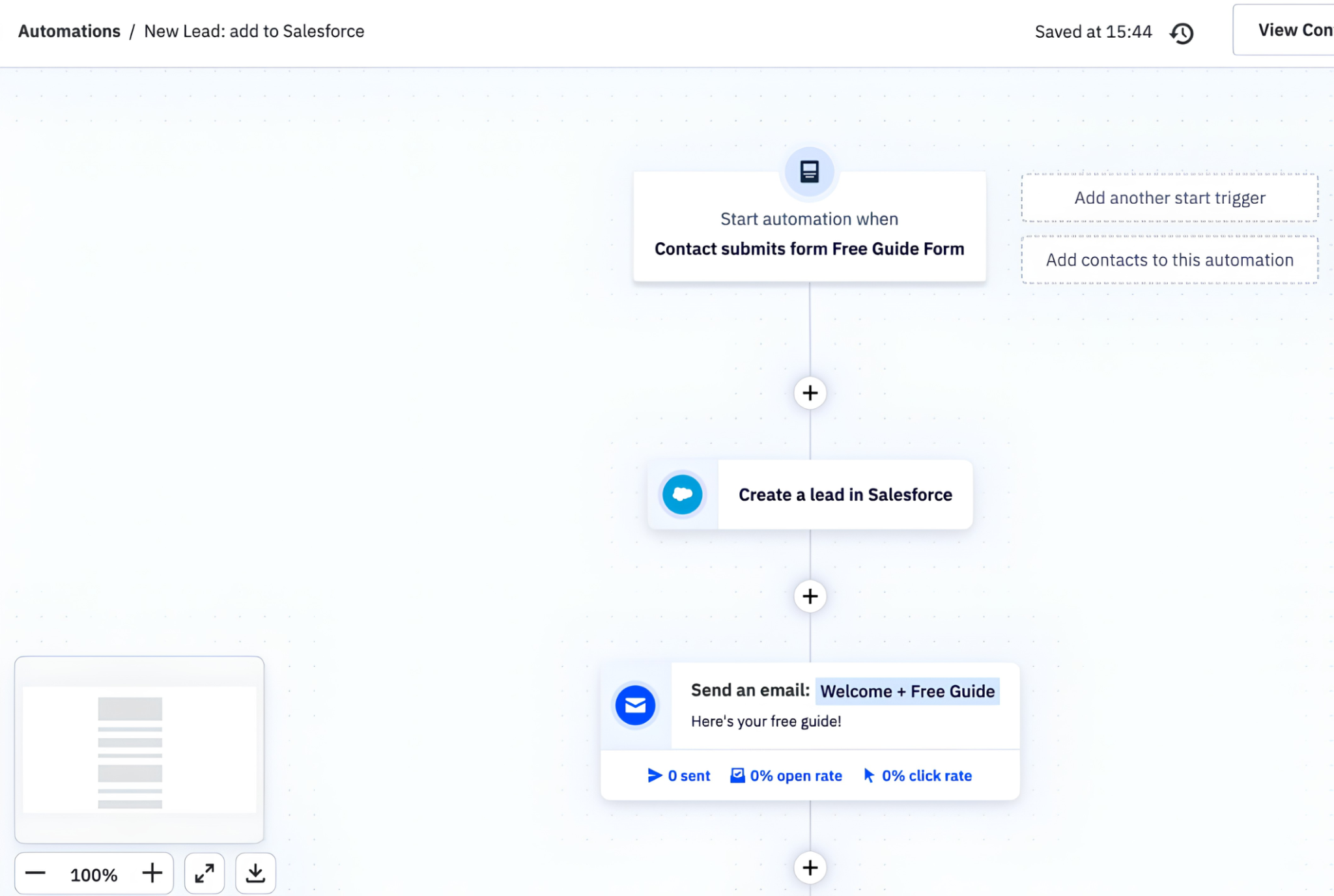
Salesforce is the #1 CRM by IDC revenue market share. It integrates with ActiveCampaign through a native bidirectional connector, closing the gap between marketing-driven contact journeys and CRM-based sales execution. The integration is a native first-party connector gated to ActiveCampaign's Enterprise plan, with dedicated sync paths for Salesforce Leads, Contacts, and Person Accounts.
Source: Salesforce
Key integration capabilities include:
Bidirectional contact and lead sync with near real-time Salesforce-to-ActiveCampaign flow and batched ActiveCampaign-to-Salesforce updates
Salesforce Opportunity sync to ActiveCampaign Deals for pipeline visibility across both platforms
Marketing engagement activity (email opens, clicks, form submissions) logged as timestamped events on Salesforce records
CRM-stage-triggered automation enrollment, where Salesforce field changes start ActiveCampaign sequences
How Salesforce Integrates with ActiveCampaign
The native Salesforce integration is built directly into ActiveCampaign and requires no third-party middleware. It handles three Salesforce object types: Leads, Contacts, and Person Accounts (the last relevant for organizations in financial services or healthcare).
1. Bidirectional Contact and Lead Sync.
Salesforce-to-ActiveCampaign runs near real-time: a new lead appears in ActiveCampaign fast enough to enroll in a follow-up automation before the conversation window closes. ActiveCampaign-to-Salesforce batches updates every 10 to 11 minutes or when 100 contacts accumulate. Field mapping covers standard and custom fields in both directions, including lead score values, behavioral tags, and source attribution.
2. Opportunity-to-Deal Pipeline Visibility.
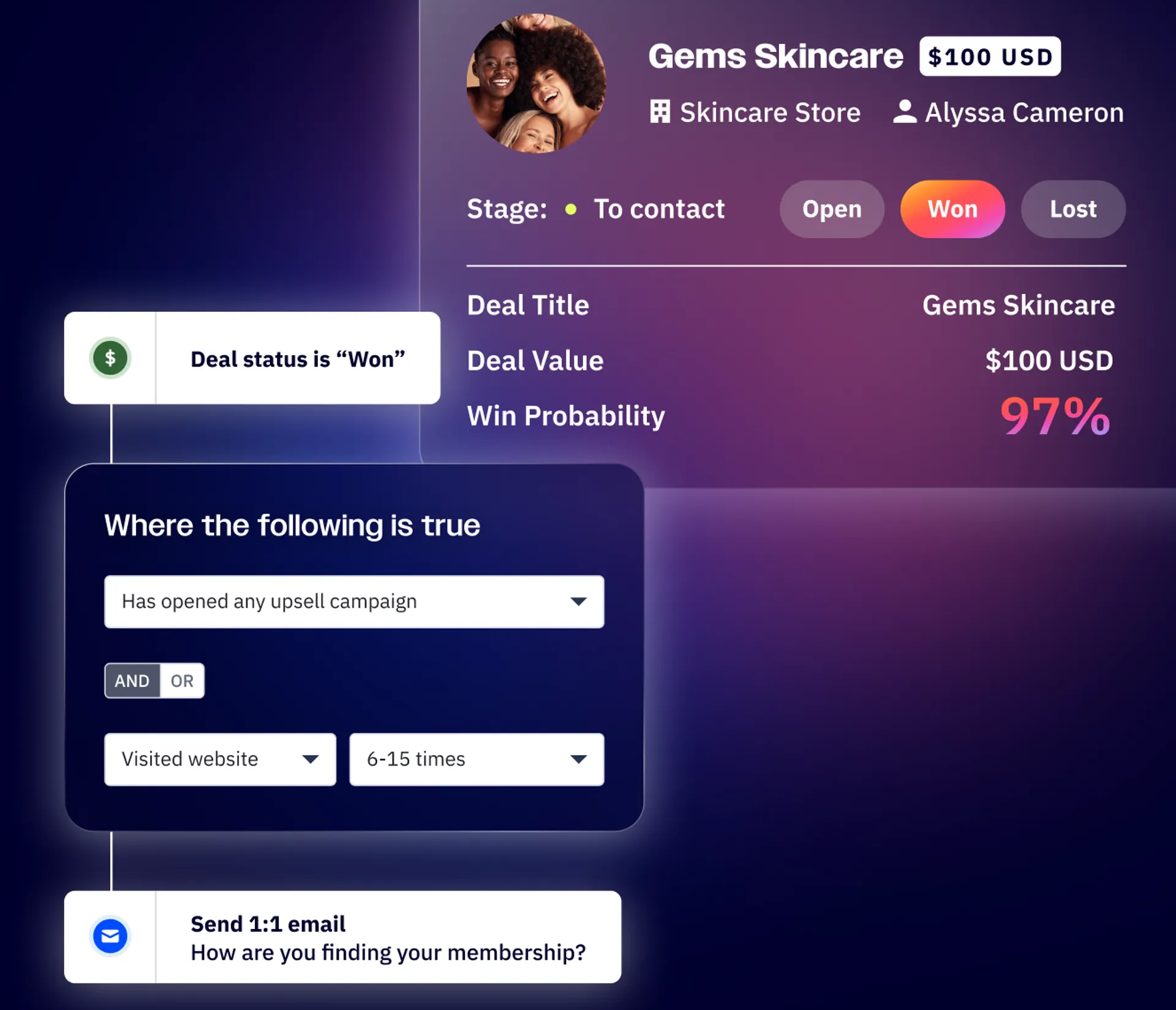
The integration maps Salesforce Opportunities to Deals in ActiveCampaign's built-in CRM, keeping pipeline state consistent across both platforms. ActiveCampaign automations can use deal stage as a trigger condition: nurture for Proposal Sent contacts looks different from reactivation for Closed Lost opportunities from the prior quarter.
Source: ActiveCampaign
3. Marketing Engagement Logged in Salesforce.
Email opens, link clicks, and form submissions from ActiveCampaign campaigns appear as timestamped activity events on the Salesforce Lead or Contact record. An account executive reviewing a lead before a discovery call sees which emails the lead opened and which links they clicked, context that informs conversation strategy and follow-up urgency without requiring a login to ActiveCampaign.
4. CRM-Stage-Triggered Automation Sequences.
When a Salesforce field value changes (Lead Status from New to Qualified, Opportunity Stage from Discovery to Proposal Sent, a Closed Lost stage recorded), ActiveCampaign enrolls the affected contact in the corresponding automation sequence. Marketing responds to actual sales pipeline state rather than elapsed time or fixed segmentation rules.
Salesforce Pricing
Salesforce uses per-user, per-month pricing with annual contracts:
Starter Suite: $25/user/month (monthly or annual billing)
Enterprise: $175/user/month (annual contract required)
Unlimited: $350/user/month (annual contract required)
On the ActiveCampaign side, the Salesforce integration requires the Enterprise plan, which is custom-priced and requires a sales conversation.
Who Should Use the Salesforce Integration?
Organizations where Salesforce is the system of record and account executives need marketing engagement history visible on Lead and Contact records before discovery calls.
Marketing ops teams that want CRM-stage-aware automations responding to actual Lead Status or Opportunity Stage changes rather than time-based triggers.
Enterprise B2B teams with long deal cycles where marketing re-engagement adjusts based on where a deal sits in the pipeline, including distinct sequences for Closed Lost re-engagement versus active pipeline acceleration.
3. Shopify: Best ActiveCampaign Integration for Ecommerce Purchase-Data Automation
Shopify is a subscription-based commerce platform serving 4.6M + merchants across 175 countries that integrates with ActiveCampaign through a native Deep Data connection.
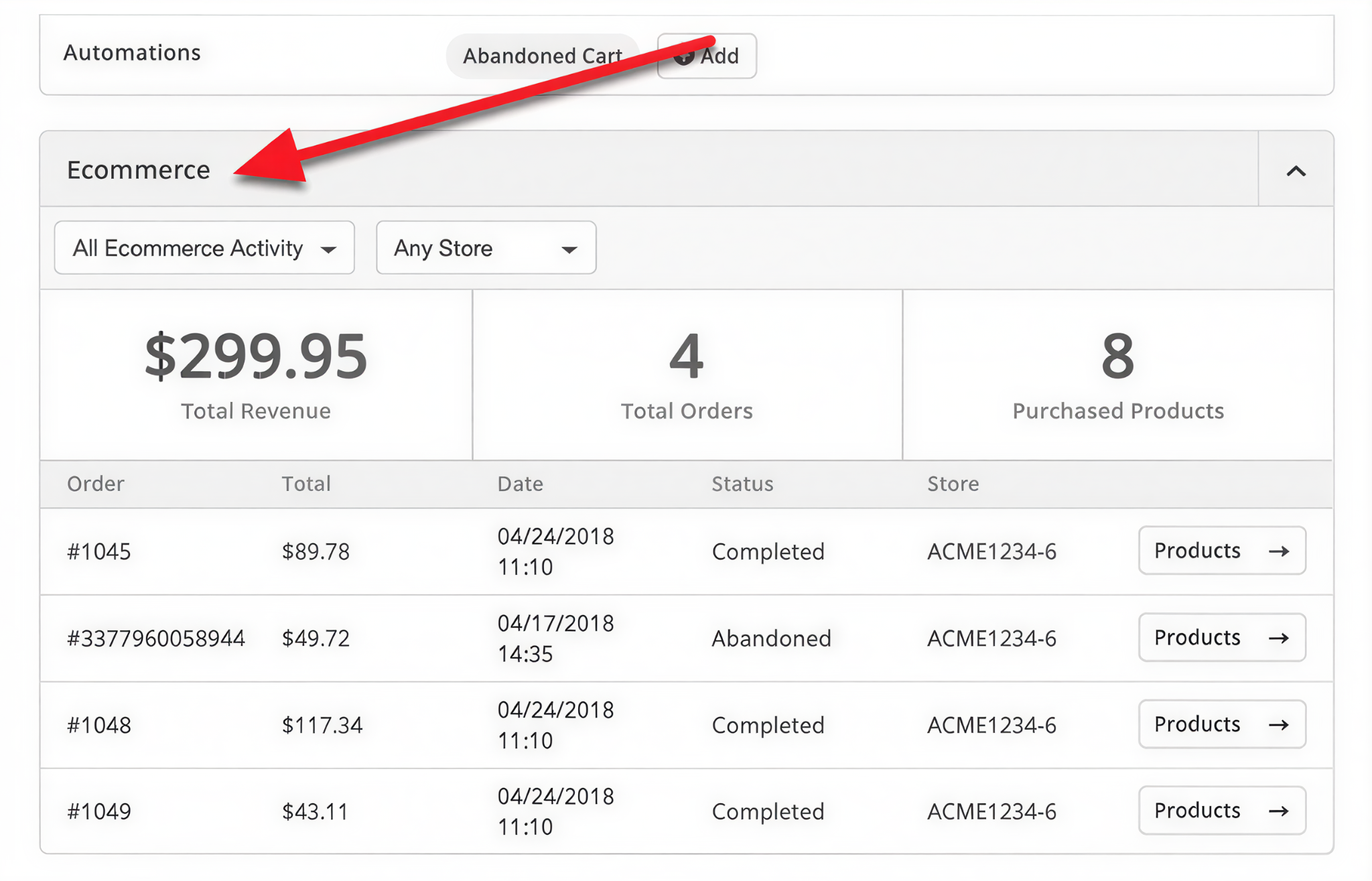
When the integration is active, every Shopify order, abandoned cart session, and cumulative purchase pattern becomes a live trigger and segmentation signal inside ActiveCampaign. This is a native first-party connector available on all ActiveCampaign paid plans.
Source: Shopify
Key integration capabilities include:
Deep Data purchase sync capturing order value, products by name and SKU, order count, and cumulative lifetime value on ActiveCampaign contact records
Abandoned cart recovery automation with product-level context (names, images, prices from the abandoned session)
Post-purchase lifecycle sequences triggered by completed orders, personalized to the specific products in each transaction
Purchase-behavior segmentation by total spend, product category, purchase frequency, or days since last order
How Shopify Integrates with ActiveCampaign
The native Deep Data integration connects through OAuth, syncing historical order data into existing contact records and subscribing to real-time webhooks for new events. No API keys need manual management; the sync runs continuously once connected.
1. Deep Data Purchase Sync and Contact Enrichment.
Every Shopify order generates a structured event record on the ActiveCampaign contact, storing order value, product names and SKUs, total order count, and running lifetime value.
This data becomes available as personalization variables in any email template or automation branch. Subject lines can reference the contact's last product purchased, and automation routing can segment contacts by cumulative lifetime value without manual tagging.
2. Abandoned Cart Recovery with Product-Level Context.
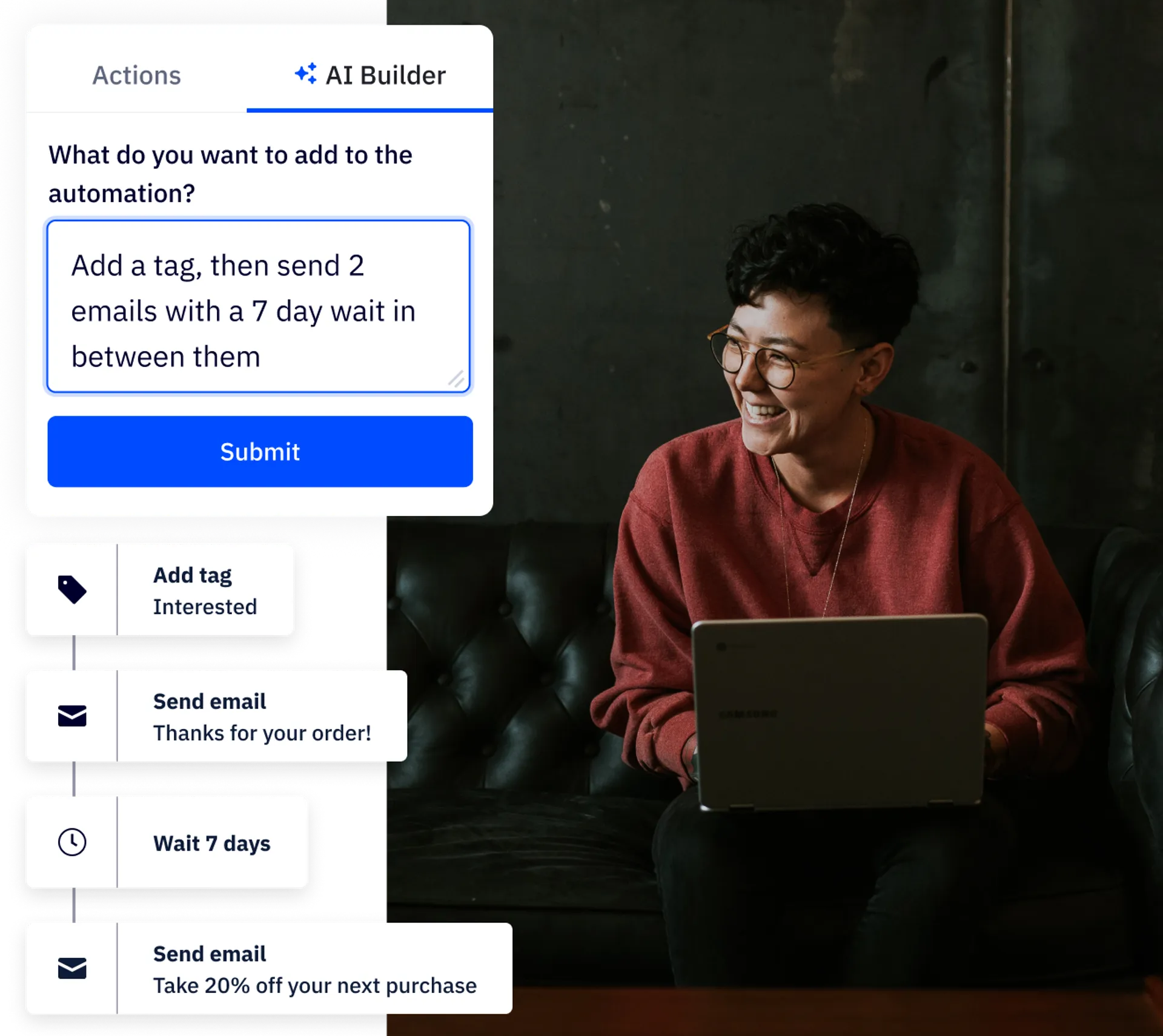
When a visitor adds items to their cart and leaves before checkout, ActiveCampaign fires an abandoned cart automation containing the specific product names, images, and prices from that session. The automation builder lets brands configure wait times, add conditional branches (suppressing the second email if the purchase completes), and personalize discount logic based on cart value.
Source: ActiveCampaign
3. Post-Purchase Lifecycle Automation.
Completed orders trigger post-purchase branches covering thank-you emails, review requests, cross-sell sequences, and loyalty enrollment. A contact who bought a coffee grinder enters a sequence featuring compatible accessories, while a yoga mat buyer sees related fitness products.
These routing decisions use Shopify purchase data that Deep Data already synced; no external segmentation tool or manual list update is needed.
4. Purchase-Behavior Segmentation and Revenue Attribution.
Dynamic segments update automatically as new orders sync: contacts crossing the $1,000 lifetime-value threshold enter VIP lists without manual intervention. On ActiveCampaign Plus and above, revenue attribution reporting links specific campaigns to downstream Shopify orders without configuring a separate analytics pipeline.
Shopify Pricing
Shopify uses tiered monthly subscriptions. All plans support the ActiveCampaign Deep Data integration:
Basic: $25/month
Grow: $65/month
Advanced: $399/month
Plus: from $2,300/month
Revenue attribution on the ActiveCampaign side requires the Plus plan or above; merchants on Starter can connect Shopify and sync purchase data but won't see campaign-to-order attribution until they upgrade.
Who Should Use the Shopify Integration?
DTC and ecommerce brands on Shopify that want abandoned cart recovery, post-purchase sequences, and re-engagement campaigns triggered by actual transaction events rather than time-based drips.
Teams that need purchase-behavior segmentation by lifetime value, product category, or order recency, with segments that update automatically as new orders sync.
Marketers on ActiveCampaign Plus or above who want to connect campaign performance to Shopify revenue without configuring a separate analytics pipeline.
4. Slack: Best ActiveCampaign Integration for Real-Time Team Notifications on Lead and Deal Activity
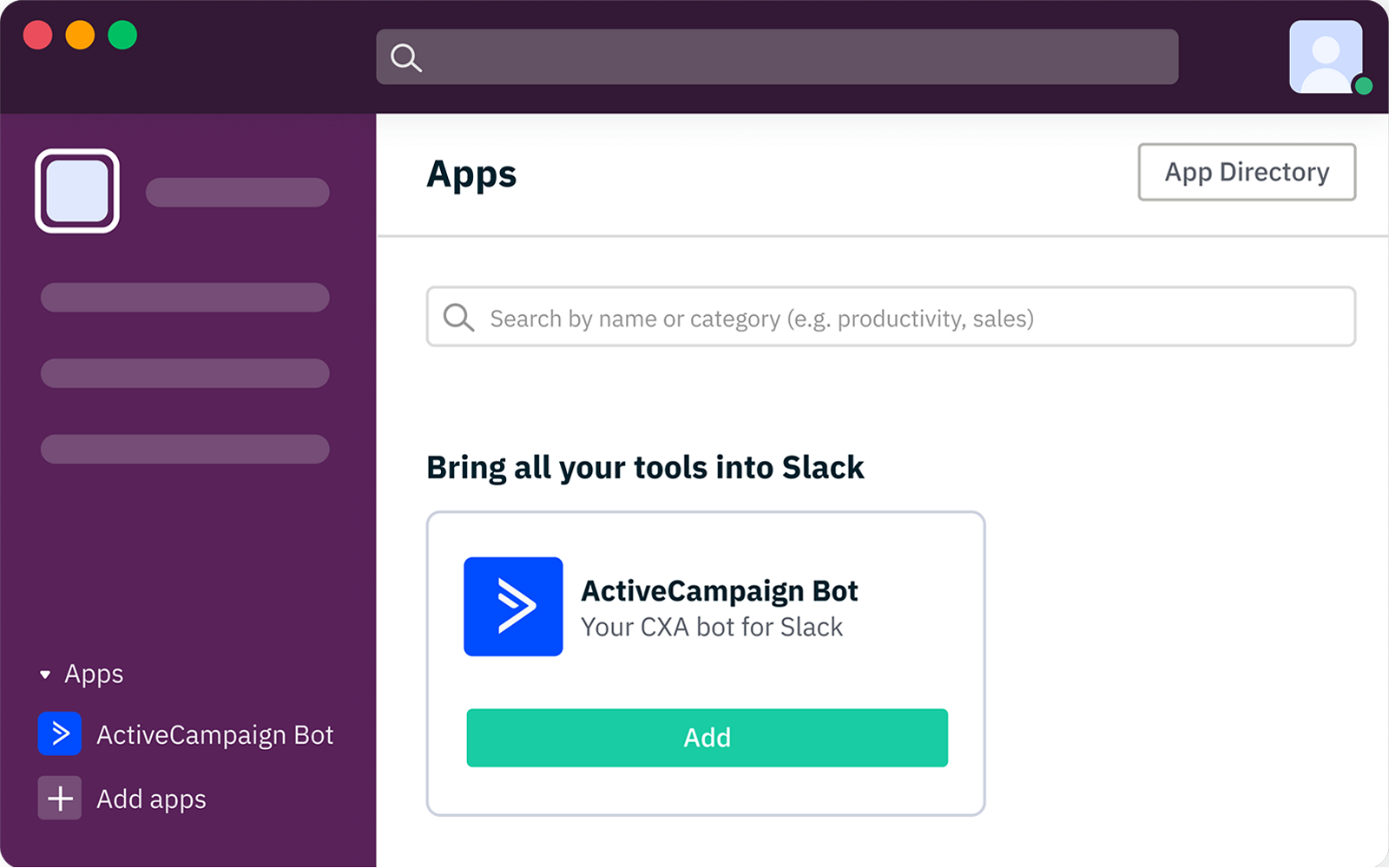
Slack is a team communication platform that integrates with ActiveCampaign to route lead scoring milestones, deal stage changes, and automation enrollment decisions into the channels where sales and marketing teams already work. ActiveCampaign maintains a native first-party Slack integration with a dedicated ActiveCampaign bot in the Slack Marketplace.
Source: Slack
Key integration capabilities include:
Lead score threshold alerts posting contact details and direct links to ActiveCampaign records in designated Slack channels
Deal pipeline stage change notifications delivered to deal owners or shared team channels
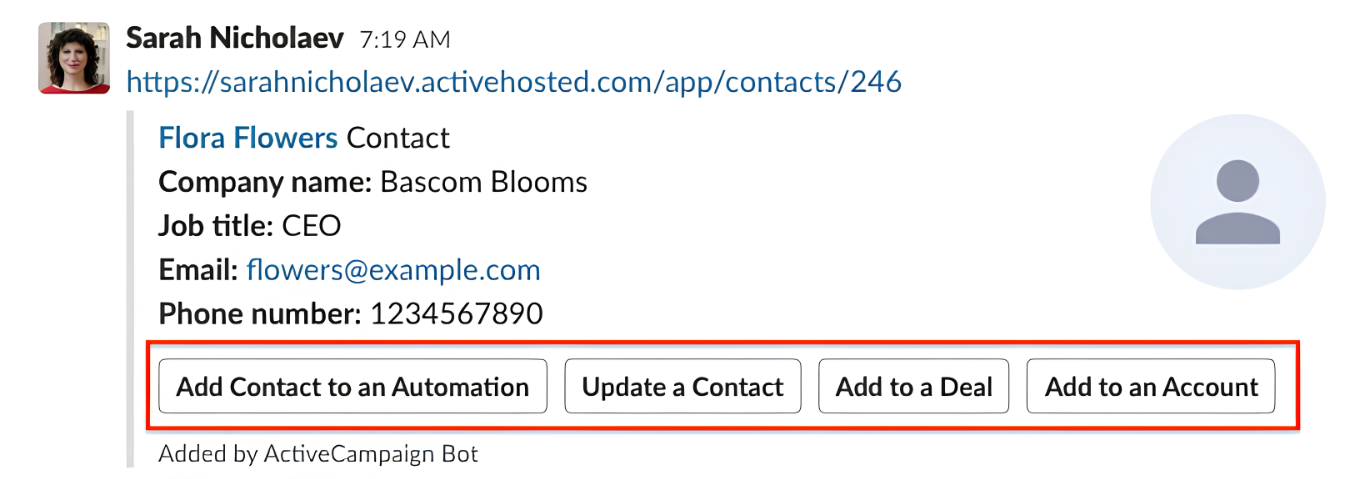
An ActiveCampaign bot for Slack enabling contact search, deal creation, and field updates via Slack shortcuts
Interactive approve/reject buttons that gate sensitive automation enrollments from within Slack
How Slack Integrates with ActiveCampaign
The integration connects through a standard OAuth flow. Once authorized, ActiveCampaign's automation engine can post messages, trigger interactive approval flows, and respond to commands from the bot. The connection is bidirectional: ActiveCampaign pushes notifications into Slack, and Slack sends commands back through bot shortcuts and interactive buttons. This is a native first-party connector.
Source: Slack
1. Lead Score Threshold and Automation Stage Alerts.
When a contact crosses a defined scoring threshold or enters a high-intent automation stage, ActiveCampaign posts a formatted message to any connected Slack channel carrying the contact name, email, lead score, tag summary, and a direct link to the record. The moment a lead hits the handoff threshold, the relevant channel sees the alert without anyone pulling a report or opening ActiveCampaign.
2. Deal Pipeline Stage Change Notifications.
Each deal stage change in ActiveCampaign's CRM can fire a Slack notification to the deal owner, a team channel, or both. If a deal stalls beyond a configured timeframe, a time-based automation in ActiveCampaign posts a follow-up alert. The channel becomes a shared view of pipeline motion without requiring a standing meeting or manual report.
3. ActiveCampaign Bot for Slack.
The bot lets Slack users search for contacts by name or email, pull up record summaries (list memberships, lead score, tags, recent activity), create deals linked to contacts, and update standard or custom fields through Slack's global shortcut interface. Reps working mid-thread can check or update a contact record without switching to ActiveCampaign in a browser tab.
4. Interactive Approval Workflows.
ActiveCampaign automations can pause at a designated step and post an approval request to a Slack channel.
The message includes Approve and Reject buttons; clicking Approve continues the automation, clicking Reject skips the enrollment. Approval decisions happen in Slack rather than a queue inside ActiveCampaign, and Slack's conversation history creates a timestamped audit trail of who approved what and when.
Slack Pricing
Slack uses per-seat pricing with a Fair Billing Policy that credits inactive users:
Free: $0 (90-day message history, 10-app integration cap)
Pro: $7.25/user/month (annual), unlimited history and apps
Business+: $15/user/month (annual), SAML SSO, custom retention
Enterprise+: Custom pricing
The ActiveCampaign integration works on any paid Slack plan. The Free plan's 10-app cap makes Pro the practical minimum for teams running multiple integrations.
Who Should Use the Slack Integration?
Sales and marketing teams that already live in Slack and want lead handoff signals and deal activity surfaced where they work, without logging into ActiveCampaign separately.
Teams running sequences that require human sign-off (pricing campaigns, win-back sequences, sensitive personalized outreach) and want approval decisions via Slack buttons rather than an in-platform queue.
Organizations that need passive pipeline visibility across a distributed team, with deal stage changes and stalls surfaced in a shared channel rather than a standing CRM review meeting.
5. Calendly: Best ActiveCampaign Integration for Booking-Triggered Lifecycle Automation
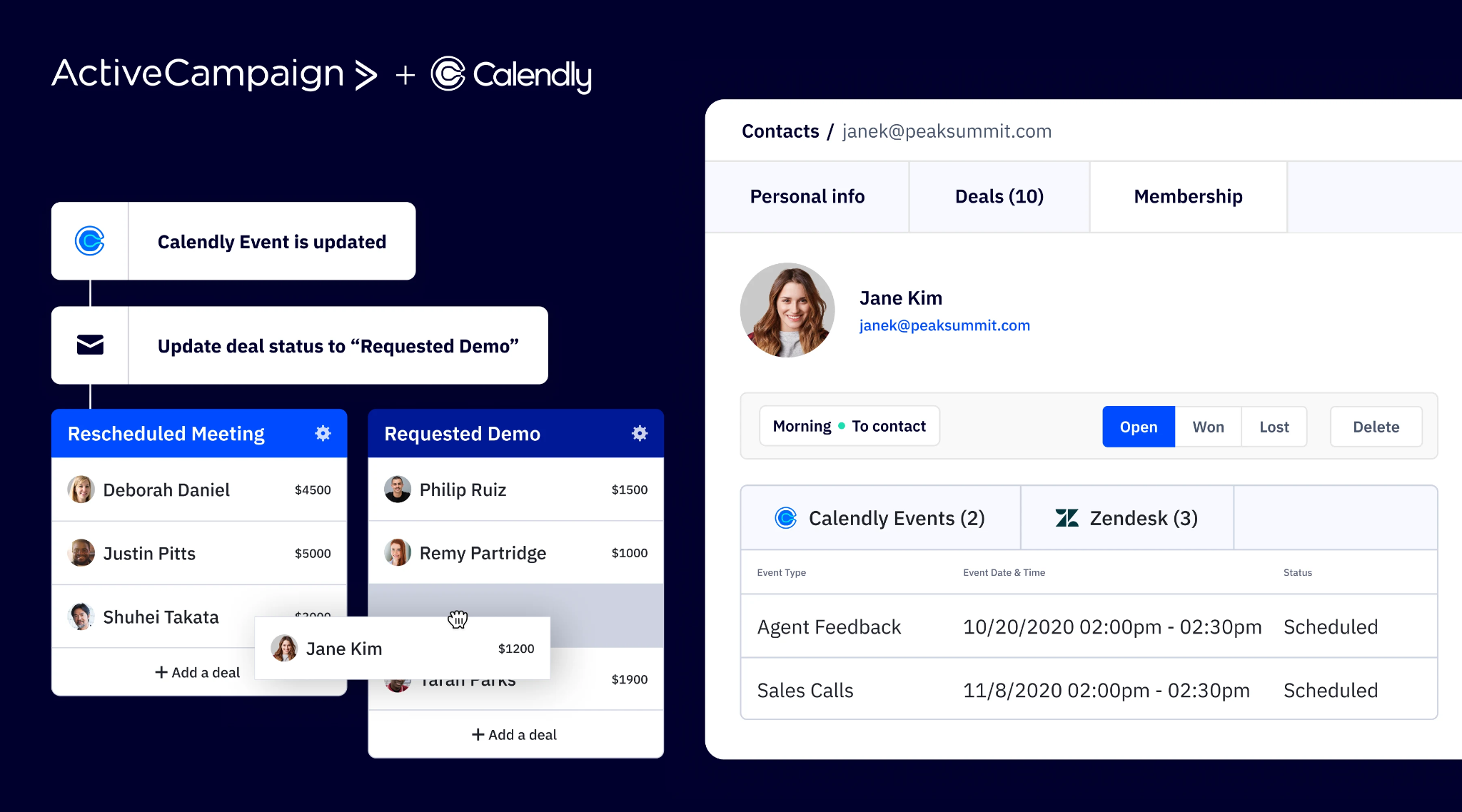
Calendly is a scheduling platform that integrates with ActiveCampaign through a native first-party integration, turning every meeting booking into an automated lifecycle event. Contact data syncs, multi-step sequences fire, and CRM deals are created without manual entry.
Source: Calendly
Key integration capabilities include:
Real-time booking-to-contact sync mapping invitee details and qualifying form responses to ActiveCampaign contact fields
Booking-triggered lifecycle sequences covering pre-meeting preparation, internal rep briefings, and post-meeting follow-ups timed to the actual meeting date
Automatic deal creation in ActiveCampaign's CRM when high-intent meeting types (discovery calls, demos) are booked
Active Intelligence natural-language control of Calendly from within the ActiveCampaign interface
How Calendly Integrates with ActiveCampaign
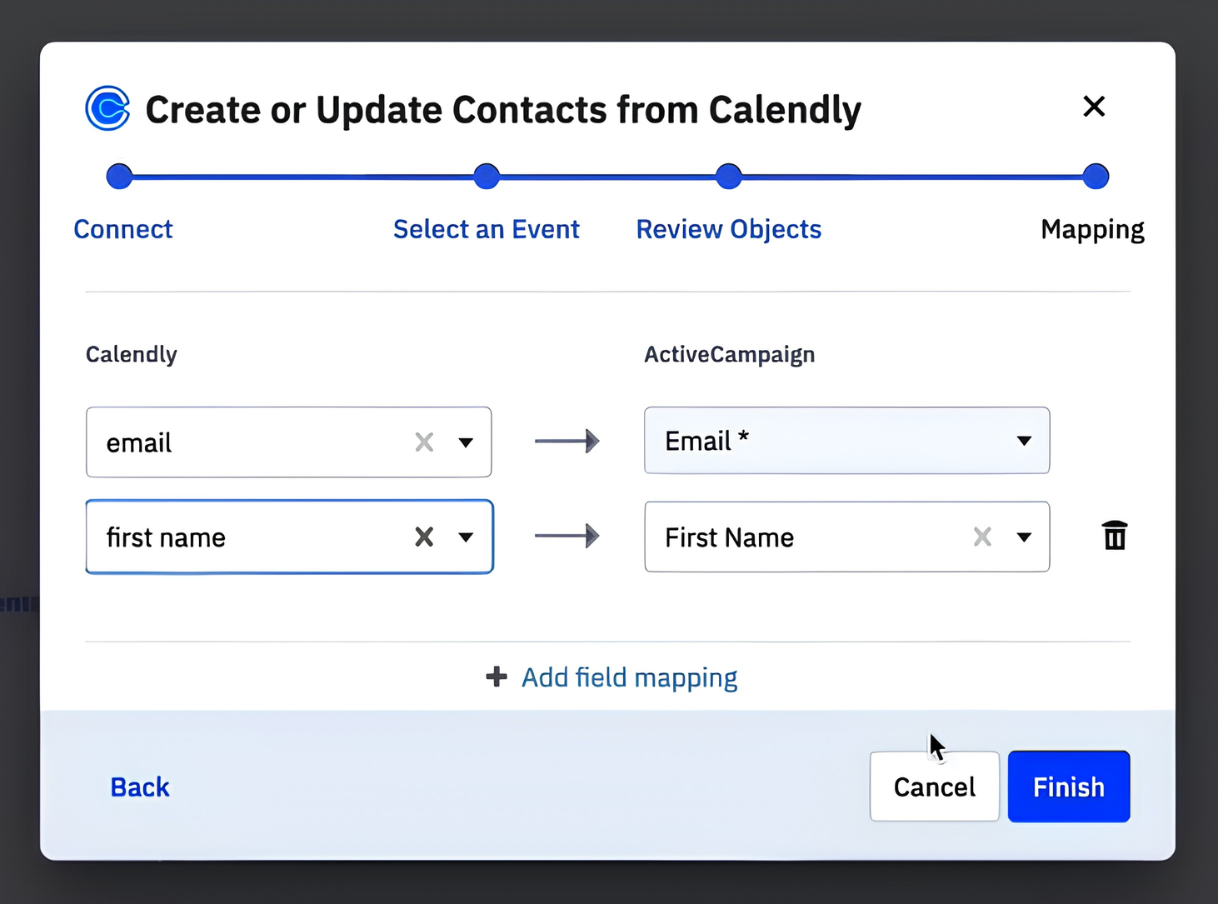
Calendly connects through a native integration listed in both the ActiveCampaign app marketplace and Calendly's integrations directory. The connection operates through Calendly's webhook system, firing real-time notifications when meetings are booked, rescheduled, or canceled. This is a native first-party connector.
Source: Calendly
1. Real-Time Booking-to-Contact Sync with Field Mapping.
When an invitee books a meeting, the webhook fires to ActiveCampaign carrying the invitee's name and email, meeting type, scheduled date, and every response from qualifying questions on the booking form.
Those answers map to ActiveCampaign custom fields, so by the time a rep gets the meeting notification, the contact record already reflects who this person is and what context they carry. If the contact already exists, the record updates rather than creating a duplicate.
2. Booking-Triggered Multi-Step Lifecycle Sequences.
The booking event triggers ActiveCampaign automations spanning three phases: immediate confirmation with pre-meeting resources, internal rep notification with qualifying answers, and post-meeting follow-up. Because ActiveCampaign receives the actual meeting date from the webhook, post-meeting automations fire relative to the scheduled meeting rather than the booking date.
This timing distinction matters: a "follow-up 2 hours after the meeting" trigger is a different experience than "2 hours after the booking was made."
3. Automatic Deal Creation and Pipeline Routing.
ActiveCampaign automations triggered by the booking webhook create new Deals in designated pipelines, assign them to the correct rep (mapped by the Calendly event type booked), and initiate deal-level task tracking. Calendly's Round Robin event type distributes meetings across team members, and the assigned rep's details appear in the webhook for accurate deal assignment.
4. Active Intelligence Scheduling Control.
Calendly has a dedicated connector for Active Intelligence, enabling natural-language commands to list available event types, retrieve scheduling links, create new meeting formats, or update existing bookings from within the ActiveCampaign interface. This removes a context-switching step for teams already working inside Active Intelligence to build campaigns.
Calendly Pricing
Calendly uses per-seat pricing with no usage-based charges on meeting volume:
Standard: $10/seat/month (annual), includes webhooks required for the integration
Teams: $16/seat/month (annual), adds Salesforce CRM integration and Round Robin scheduling
Standard is the minimum tier to activate the native ActiveCampaign integration, since webhooks are gated to paid plans.
Who Should Use the Calendly Integration?
Teams that book discovery calls, demos, or consultations as part of the pipeline and want those bookings to automatically create deals and assign them to the correct rep without manual entry.
Marketing and sales teams running lifecycle automations that need meeting booking events to trigger pre-meeting preparation and post-meeting follow-ups timed to the actual scheduled meeting date, not the booking date.
6. Zapier: Best ActiveCampaign Integration for Extending Your Stack to 8,000+ Apps Without Code
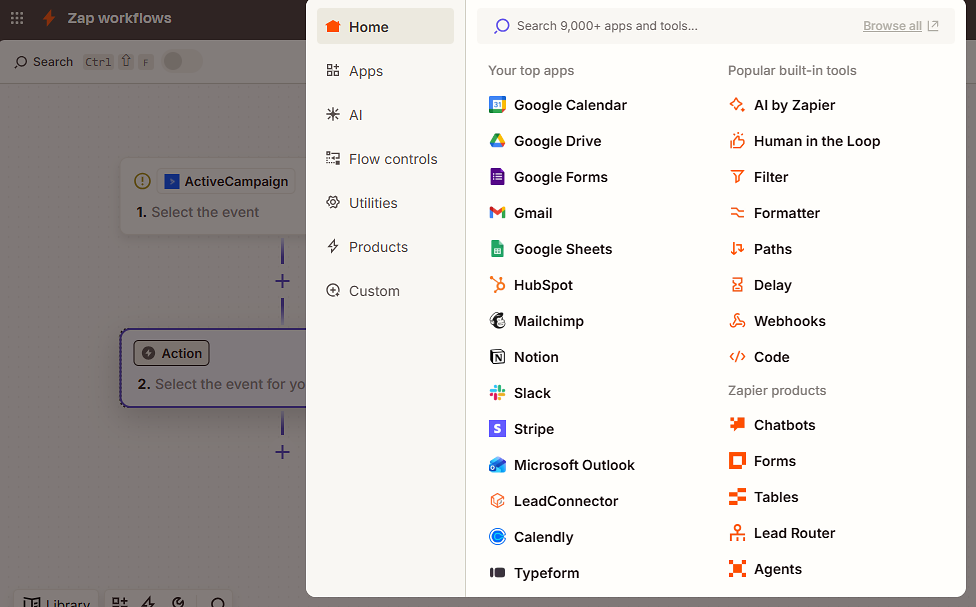
Zapier is a no-code automation platform that integrates with ActiveCampaign to extend its native 1,000+ app connections to over 9,000+ applications, letting any tool in your stack push data into or pull data from ActiveCampaign without developer involvement. The integration is a native, first-class connector in ActiveCampaign's app marketplace.
Key integration capabilities include:
Contact creation from any Zapier-connected trigger source (Google Forms, Typeform, Stripe, webinar platforms) with list assignments and tags applied at entry
Multi-app automation chains linking three to five tools in a single workflow around a shared trigger
ActiveCampaign automation events pushing data to tools that lack native connectors (ClickUp, Airtable, Notion, vertical SaaS platforms)
Bridge connectivity for apps that haven't built first-party ActiveCampaign integrations
How Zapier Integrates with ActiveCampaign
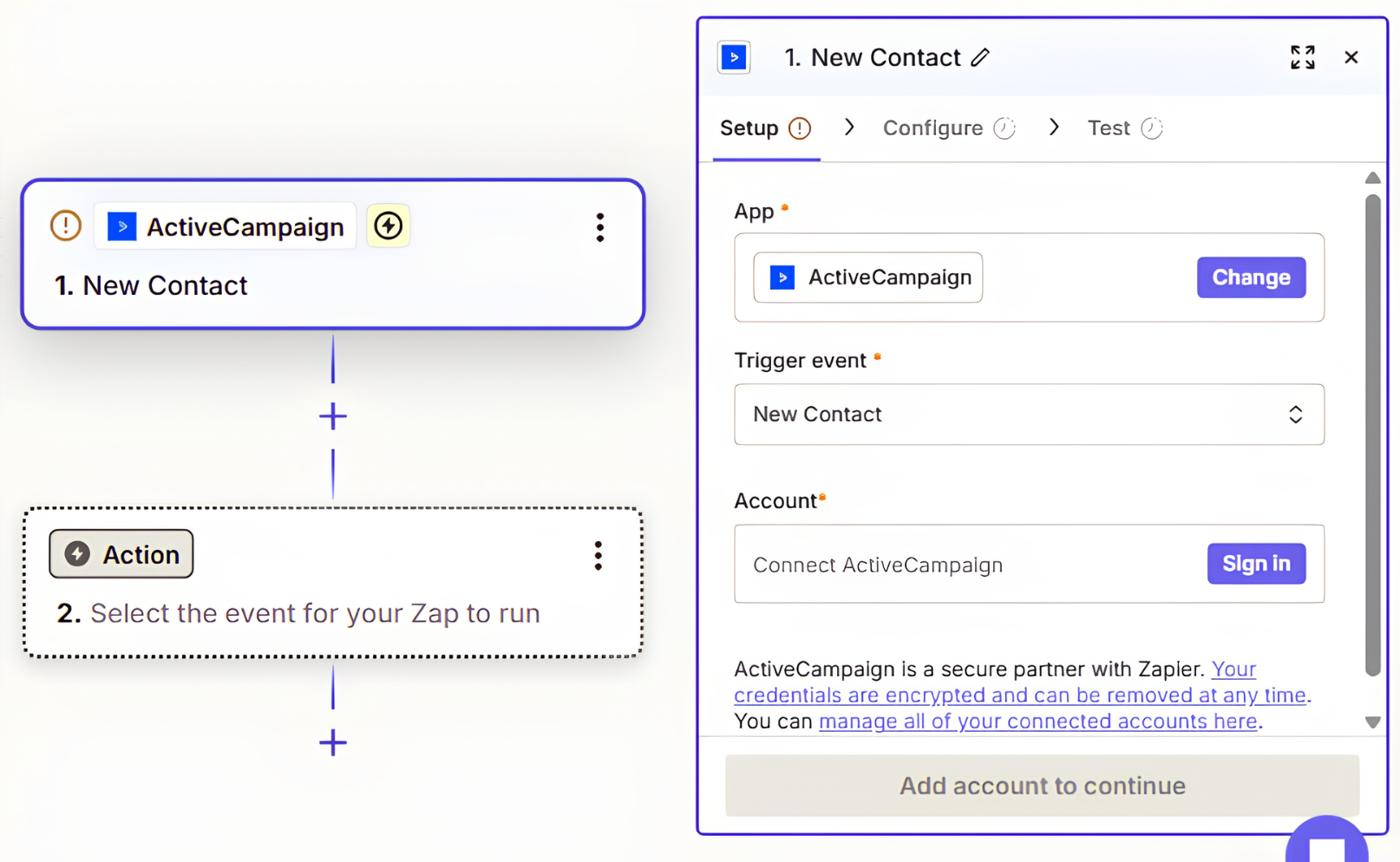
Zapier connects to ActiveCampaign through OAuth. Once authenticated, the ActiveCampaign app surfaces triggers (new contact added, tag applied, automation completed, deal stage changed) and actions (create or update contact, add to list, add tag, create deal, create note). No code is required on either side. This is a native first-party connector.
1. Contact Creation and List Management from Any Source.
A single workflow handles lead capture from Typeform, webinar registrations from Demio, payments from Stripe, and bookings from Calendly: the external app fires a trigger, Zapier maps fields, and ActiveCampaign's "Create or Update Contact" action upserts the record.
The "or update" behavior deduplicates against existing email addresses, keeping the database clean while recording every touchpoint. The pre-built Zap template library includes hundreds of ActiveCampaign-specific templates that reduce setup to under five minutes for standard use cases.
2. Multi-App Automation Chains.
A single Zap can receive a deal-won event from ActiveCampaign and create an Asana project, post a Slack notification, write a tracking record to Google Sheets, and enroll the contact in an onboarding automation.
Paths add conditional branching based on ActiveCampaign field values: a contact crossing a lead score of 50 follows one path (sales task in Asana, Slack alert to the rep), while a contact crossing 25 follows a different one (added to a nurture list, no sales task).
3. Routing ActiveCampaign Events to External Tools.
When ActiveCampaign fires an automation event (a contact completing a series, a deal advancing, a tag applied), Zapier picks it up and pushes it to any downstream app. A contact completing an onboarding sequence can generate a customer success record, create an Airtable row, or fire a ClickUp task without those tools needing native ActiveCampaign integrations.
Zapier Pricing
Zapier uses task-based pricing where each action step counts as one task:
Free: 100 tasks/month, 2-step Zaps only, 15-minute polling
Professional: from $19.99/month (annual), 750 tasks, multi-step Zaps, 2-minute polling
Team: from $69/month (annual), 2,000 tasks, shared workspaces
Enterprise: custom pricing
Multi-step Zaps and Webhooks by Zapier (for near-real-time triggers) both require Professional or higher. Overage billing runs at 1.25x the plan's per-task rate for usage beyond the plan ceiling.
Who Should Use the Zapier Integration?
Teams whose lead capture spans tools without native ActiveCampaign integrations, including niche webinar platforms, industry-specific form builders, or internal systems.
Non-technical marketing or operations teams that need to build and modify cross-tool automations on their own without developer involvement or IT tickets.
Organizations where post-automation workflows span three or more apps and none of those tools connect directly to each other.
7. Facebook Lead Ads: Best ActiveCampaign Integration for Paid Social Lead Capture
Facebook Lead Ads is Meta's native lead capture advertising format that integrates with ActiveCampaign through a native first-party connector to sync paid social prospects into nurture sequences instantly. The integration covers both Facebook and Instagram ad placements through a single connected account and is available on all paid ActiveCampaign plans at no additional cost.
Source: Facebook Lead Ads
Key integration capabilities include:
Real-time contact sync from Facebook and Instagram Lead Ad form submissions into ActiveCampaign
Duplicate-safe handling that logs repeat ad conversions as activity events on existing records rather than creating new contacts
Immediate automation triggering from form submission, launching welcome sequences, lead scoring, and deal creation within seconds
Pre-filled contact data from Meta profiles (name, email, phone) arriving more complete than manually typed form submissions
How Facebook Lead Ads Integrates with ActiveCampaign
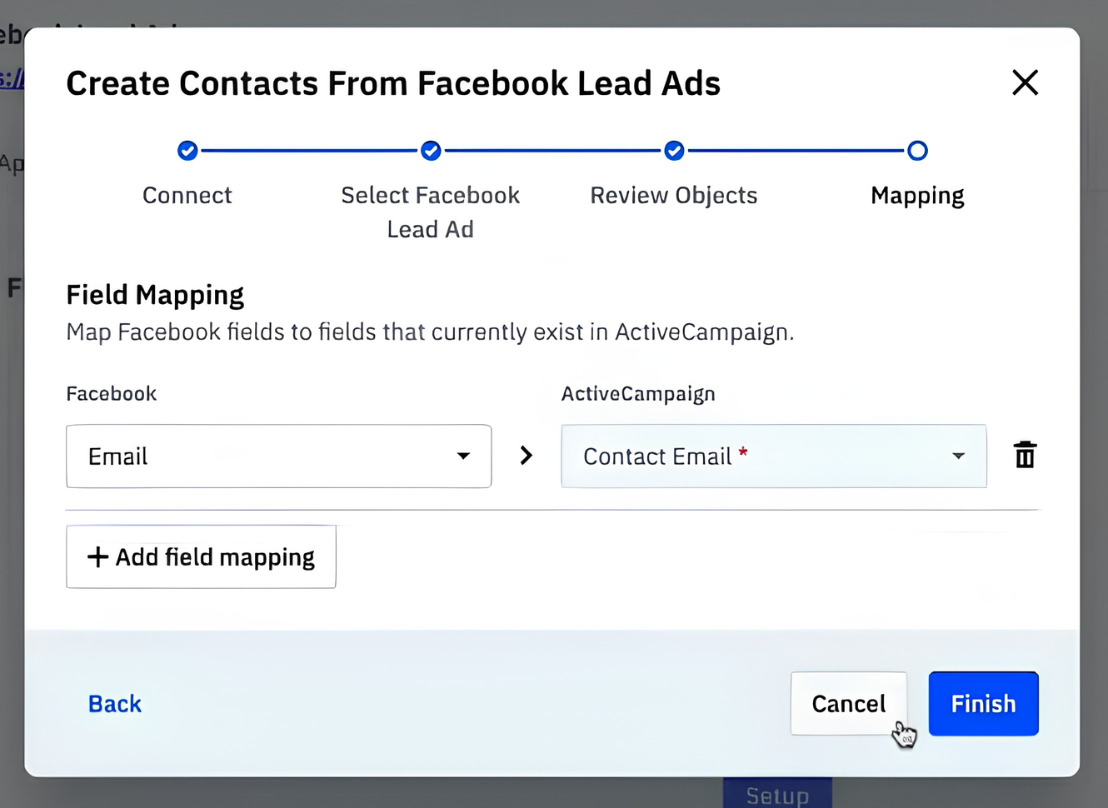
The native integration connects through an OAuth flow linking a Meta Business account to ActiveCampaign. Field mapping routes Instant Form responses to ActiveCampaign contact fields. Notifications fire the moment a user taps Submit, not on a polling interval. This is a native first-party connector requiring no middleware.
1. Real-Time Form-to-Contact Sync with Duplicate-Safe Handling.
Standard fields that Meta auto-populates from the user's Facebook profile (name, email, phone) arrive in ActiveCampaign within seconds. Custom qualifying questions on the form (company size, decision timeline, product interest) map to ActiveCampaign custom fields.
If the email already exists in the database, the integration logs the submission as an activity event on the existing contact instead of creating a duplicate, preserving database cleanliness and keeping the full behavioral timeline intact.
2. Immediate Automation Enrollment at Peak Intent.
The form submission appears as an automation trigger inside ActiveCampaign's builder. The moment a prospect submits (still in the Facebook or Instagram app), ActiveCampaign can fire a welcome sequence, notify a sales rep, award lead scoring points, create a CRM deal, and apply source tags.
Speed matters here: because Instant Forms pre-populate user data, submission friction is low, and the engagement window closes fast. Reaching that prospect within minutes, before they forget the interaction, is where the native real-time sync outperforms CSV exports or delayed polling.
3. Cross-Placement Coverage with Unified Configuration.
A single connected account covers Facebook Feed, Instagram Stories, Reels, and Marketplace placements without separate integration configurations per surface.
Both Facebook and Instagram ad placements feed into the same ActiveCampaign contact database, so segmentation, lead scoring, and automation triggers work from a complete behavioral profile regardless of which placement captured the lead.
Facebook Lead Ads Pricing
Facebook Lead Ads operates on Meta's auction model with no fixed CPL, no minimum spend, and no subscription cost. Costs depend on bid, estimated conversion probability, and ad quality score. Campaigns can be paused or stopped at any time with no cancellation penalties. The native ActiveCampaign integration is free; no third-party connector cost applies.
Who Should Use the Facebook Lead Ads Integration?
Businesses running paid social on Facebook or Instagram that currently export leads manually or on a delay and want new contacts enrolled in ActiveCampaign nurture sequences in real time.
High-volume, top-of-funnel acquisition models (real estate, insurance, home services, education, ecommerce) where speed of follow-up after a form submission directly determines conversion rates.
Teams running retargeting campaigns against existing contacts that need repeat ad conversions logged as activity events rather than duplicate contacts that inflate the contact count and subscription cost.
Final Verdict
The best ActiveCampaign integrations close the gaps your marketing automation platform cannot fill on its own:
ZoomInfo: verified B2B data, buyer intent, and company intelligence enriching every contact record; the highest-impact integration on this list if your automation depends on data quality
Salesforce: bidirectional CRM sync with marketing engagement logged on sales records and pipeline-stage-triggered automations
Shopify: storefront data powering purchase-driven lifecycle campaigns, abandoned cart recovery, and revenue attribution
Slack: lead alerts, deal updates, and approval gates surfaced in the channels your team already uses
Calendly: meeting bookings driving lifecycle automations with deals created when intent is highest
Zapier: no-code reach into 8,000+ apps where native connectors stop
Facebook Lead Ads: paid social leads captured and enrolled in nurture sequences in real time
These integrations also work together: you might run ZoomInfo for data enrichment, Shopify for purchase data, Slack for notifications, and Zapier for stack extensions on the same ActiveCampaign account, each adding a layer of intelligence or automation that makes the others more effective.
If you connect just one, make it the data layer everything else depends on. ZoomInfo's free Lite tier includes 10 monthly export credits and access to the B2B database, so you can evaluate data quality and start enriching your ActiveCampaign contacts before committing to a paid subscription.
Frequently Asked Questions
How many integrations does ActiveCampaign support?
ActiveCampaign's App Marketplace lists over 1,000 integrations spanning CRM, ecommerce, scheduling, advertising, communication, and developer tools.
Beyond the marketplace, ActiveCampaign's REST API, GraphQL API (for ecommerce operations), webhooks, and App Studio support custom integrations with any platform that has an API. A Remote MCP Server also connects the platform to AI assistants including Claude and ChatGPT.
Do ActiveCampaign integrations work on the Starter plan?
Many integrations work on ActiveCampaign's Starter plan, including Shopify, Facebook Lead Ads, Slack, and Zapier. However, Starter limits automations to 5 actions per workflow, which restricts the depth of integration-driven sequences. Premium CRM integrations (Salesforce, Microsoft Dynamics 365, Zendesk Sell) require the Enterprise plan. Revenue attribution and advanced segmentation require Plus or above.
How does ActiveCampaign's Deep Data integration work with ecommerce platforms?
Deep Data integrations (like the Shopify connector) sync structured transaction data (order values, product SKUs, abandoned cart contents, and cumulative lifetime value) directly onto ActiveCampaign contact records.
This data becomes available as segmentation filters, automation triggers, and personalization variables throughout the platform. The sync runs continuously via webhooks, so contact profiles update as new orders arrive without manual imports.
Can I connect ActiveCampaign to tools that are not in the App Marketplace?
Yes. ActiveCampaign's REST API covers contacts, deals, campaigns, automations, lists, segments, and custom objects, supporting custom integrations with any system that can make HTTP requests.
For no-code solutions, Zapier connects ActiveCampaign to 8,000+ apps, and Make provides an alternative with visual branching logic. ActiveCampaign's webhooks deliver real-time event notifications for contact, campaign, deal, and SMS activity to any external endpoint.
Does ActiveCampaign support AI-powered integrations?
ActiveCampaign's Active Intelligence layer includes dedicated connectors for select integration partners (including Calendly) that enable natural-language control of connected tools from within the ActiveCampaign interface.
The platform also operates a Remote MCP Server that connects to Claude, ChatGPT, and any MCP-compatible AI assistant, letting users retrieve campaign stats, update contacts, trigger automations, and manage tags through conversational prompts.
How does pricing work when combining ActiveCampaign with integrations?
ActiveCampaign uses contact-based pricing where cost scales with the number of contacts stored, regardless of how many integrations are connected. Integrations are included at no additional per-integration fee.
However, some integration partners have their own pricing: Salesforce charges per user, Zapier charges per automation task, Calendly charges per seat, and Slack charges per user. Model the total cost across both platforms when evaluating an integration.
What is the best way to enrich ActiveCampaign contact data for B2B teams?
Connecting a dedicated B2B data platform provides the most thorough enrichment. ZoomInfo's integration with ActiveCampaign (via middleware connectors like Zapier) feeds verified emails, direct-dial phone numbers, company attributes, technographic profiles, and buyer intent signals into your contact records.
The enrichment flows through a verification pipeline backed by 300+ human researchers, covering 500 million contacts and 100 million companies.
ActiveCampaign's Active Intelligence provides AI-driven insights from engagement data, but for teams where marketing effectiveness depends on knowing who their contacts are, connecting a platform built for B2B intelligence closes the gap between what ActiveCampaign captures and what your automations need to act on.
Keep exploring:
