
Choosing between Braze and Salesforce for customer engagement comes down to five questions:
Do you need a dedicated engagement platform, or a full CRM suite that includes engagement as one of many capabilities?
Is real-time, mobile-first messaging your priority, or do you need to manage the entire customer lifecycle from first touch to renewal?
Does your team have engineering resources for a complex implementation, or do you need marketers to be self-sufficient?
Are you engaging consumers, business buyers, or both?
How confident are you that your data accurately reflects who your customers are, what they need, and when they're ready to act?
In short, here's what we recommend:
Braze is the platform B2C brands choose for real-time, cross-channel customer engagement at scale. Its journey builder lets marketers design multi-step campaigns across email, mobile push, SMS, WhatsApp, and in-app messaging from a single interface, with AI that optimizes send time, channel, and content for each user. A three-time Gartner MQ Leader for Multichannel Marketing Hubs, Braze serves 2,713 global brands and processes 8.5 billion monthly active users. The tradeoff: Braze does engagement and nothing else. No CRM, no sales pipeline, no commerce engine. Everything else lives in a separate tool.
Salesforce is the enterprise platform for organizations that want engagement, CRM, commerce, analytics, and AI agents under one roof. Marketing Cloud handles cross-channel campaigns and journey orchestration. Sales Cloud manages your pipeline. Data Cloud unifies customer profiles across every touchpoint. Agentforce deploys autonomous AI agents that resolve support cases, coach reps, and create campaigns without human intervention. A $41.5 billion business serving over 150,000 companies, Salesforce holds Gartner MQ Leader positions across six product categories. The tradeoff: that breadth comes with complexity. Implementations typically require partners and take months, and pricing escalates quickly across multiple clouds.
Both platforms are strong engagement engines. But engagement quality depends on data quality. The best journey builder delivers little if your contact records are incomplete, your segments rest on stale information, or you're targeting accounts that aren't in-market.
ZoomInfo is an AI-powered go-to-market platform that provides the intelligence layer both engagement platforms depend on. With 500M contacts, 100M companies, 135M+ verified phone numbers, and 200M+ verified business emails, ZoomInfo identifies the right accounts and decision-makers before you engage them. Its GTM Context Graph combines this data with your CRM records, conversation transcripts, and behavioral signals, revealing not just what happened in a deal but why it happened and what should happen next. For Salesforce users, ZoomInfo integrates directly to enrich every CRM record. For any B2B team evaluating engagement platforms, ZoomInfo answers the question neither Braze nor Salesforce was built to solve: who to engage, and when.
If B2B data and intelligence are the missing piece in your engagement stack, see how ZoomInfo works.
Braze vs. Salesforce vs. ZoomInfo at a glance
Braze | Salesforce | ZoomInfo | |
|---|---|---|---|
Core function | Cross-channel customer engagement | Full CRM + engagement + commerce + AI agents | B2B data intelligence + GTM execution |
Primary audience | B2C/B2B2C marketers and growth teams | Enterprise across all functions | B2B sales, marketing, and RevOps teams |
Messaging channels | Email, push, SMS/RCS, WhatsApp, in-app, web, LINE, KakaoTalk | Email, push, SMS, WhatsApp, in-app, social, ads | Multi-channel outreach via GTM Workspace + integrations |
AI capabilities | BrazeAI (personalization, decisioning, agents) | Agentforce (autonomous agents across all clouds) | GTM Context Graph (intent signals, contextual AI, AI-drafted outreach) |
CRM included | No | Yes (Sales Cloud, Service Cloud) | No (integrates with Salesforce, HubSpot, Dynamics) |
Data foundation | First-party behavioral data | First-party CRM + CDP (Data Cloud) | 500M contacts, 100M companies, intent signals, technographics |
Starting price | Custom (no public pricing) | Free CRM; $25/user/month (Starter) | Free tier (ZoomInfo Lite); custom for paid plans |
Implementation timeline | 3-6 months (enterprise) | Weeks to 12 months depending on scope | Deploys in weeks |
Best for | Real-time consumer engagement at scale | Full customer lifecycle management | Identifying the right accounts and contacts to engage |
Engagement specialist vs. enterprise suite
Braze and Salesforce approach customer engagement from opposite directions.
Braze was founded in 2011 on the thesis that mobile would reshape how brands communicate with consumers. The platform reflects that origin.
It is a single, vertically integrated system built to do one thing: deliver the right message to the right person at the right time across every channel they use.
Salesforce was founded in 1999 as a cloud CRM and has spent 27 years acquiring and building its way into every corner of enterprise software.
Marketing Cloud (built on the 2013 ExactTarget acquisition) is one module in a portfolio that includes Sales Cloud, Service Cloud, Commerce Cloud, Data Cloud, Tableau, Slack, MuleSoft, and the recently acquired Informatica.
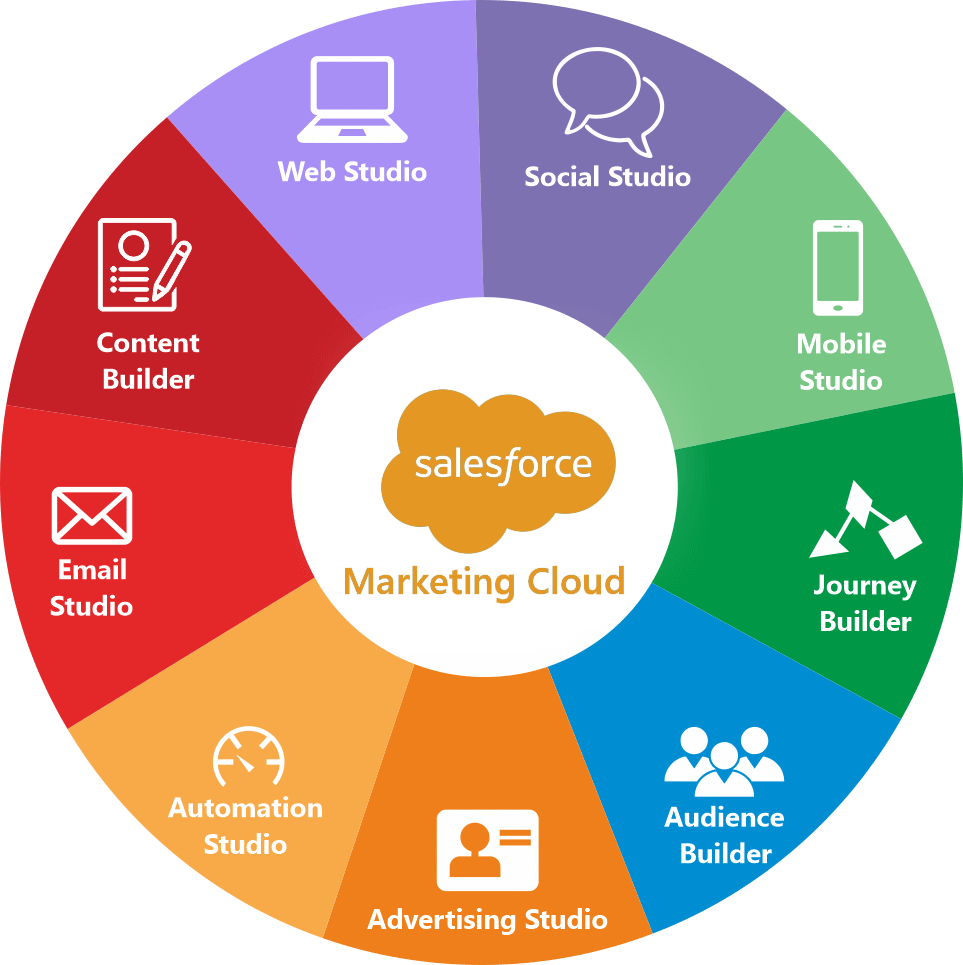
Source: Scideas Solutions
The practical difference shows up immediately. A marketer who signs up for Braze gets a single platform where every channel, every journey, and every AI feature shares the same data model. There is no stitching together modules that were originally separate companies.
A marketer who signs up for Salesforce gets a broader system, but navigating it takes longer. Marketing Cloud Engagement handles B2C cross-channel campaigns. Account Engagement (formerly Pardot) handles B2B. Personalization is a separate product. Intelligence (formerly Datorama) is another. Each has its own interface, pricing, and learning curve. Salesforce has worked to unify these through Data Cloud and Agentforce, but the seams from acquisitions still show.
The question for buyers isn't which approach is better in the abstract. It's which one matches their organization. Teams that need focused engagement and want to be live in months gravitate toward Braze. Organizations building a unified system across sales, service, marketing, and commerce (and willing to invest the time and budget) gravitate toward Salesforce.
Cross-channel messaging: native depth vs. assembled breadth
Braze built every messaging channel natively on a single architecture.
Email, mobile push (ranked #1 on G2 for Push Notification Software), SMS/RCS, WhatsApp, in-app messages, web push, Content Cards, LINE, and KakaoTalk all connect to the same customer profile. When a user clicks an email, that signal can trigger a follow-up push notification within the same journey with no integration lag.
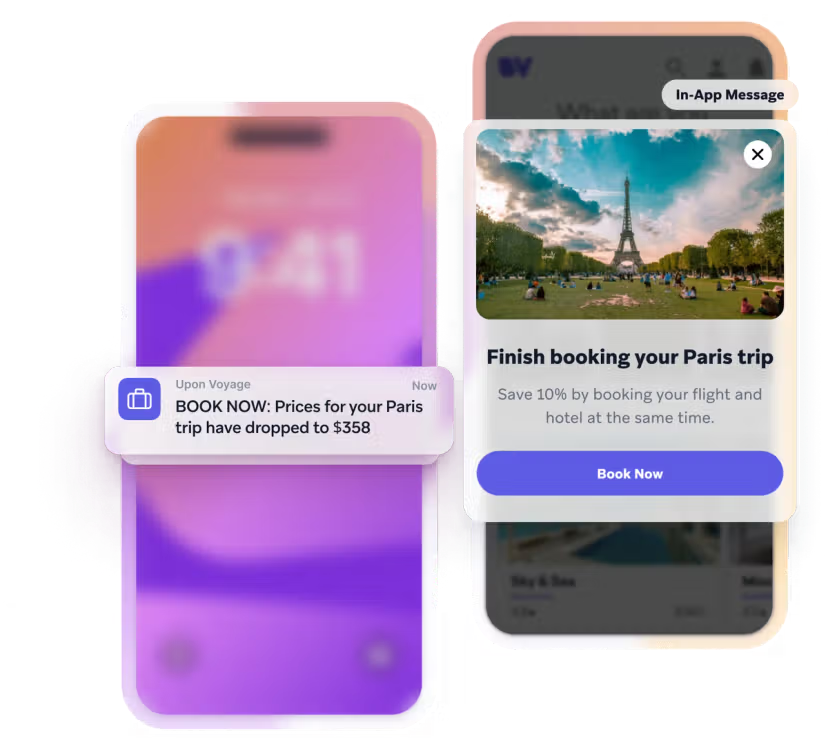
Source: Braze
The regional channel coverage matters. Braze's native LINE support targets Japan, Thailand, and Taiwan. Native KakaoTalk covers South Korea. For global B2C brands with audiences across Asia-Pacific, running these channels inside the same journey builder as email and push eliminates the need for separate regional tools.
Braze also connects owned channels to paid media. Audience Sync pushes first-party segments to Meta, Google, TikTok, Snapchat, Pinterest, LinkedIn, Criteo, and The Trade Desk, with real-time suppression that stops ads the moment a customer converts on an owned channel.

Source: Braze
On email, Braze delivered over 100 billion messages during Cyber Week 2025 with 100% uptime and was named a Leader in The Forrester Wave for Email Marketing Service Providers Q2 2026.
Salesforce Marketing Cloud Engagement covers email, push, SMS, WhatsApp, and in-app messaging with Journey Builder for multi-step orchestration. The Digital Engagement add-on ($75/user/month) extends Service Cloud into chat, Facebook Messenger, Apple Messages, and LINE. Commerce Cloud adds storefront messaging. Slack adds internal communications with 5.2 billion messages sent weekly.
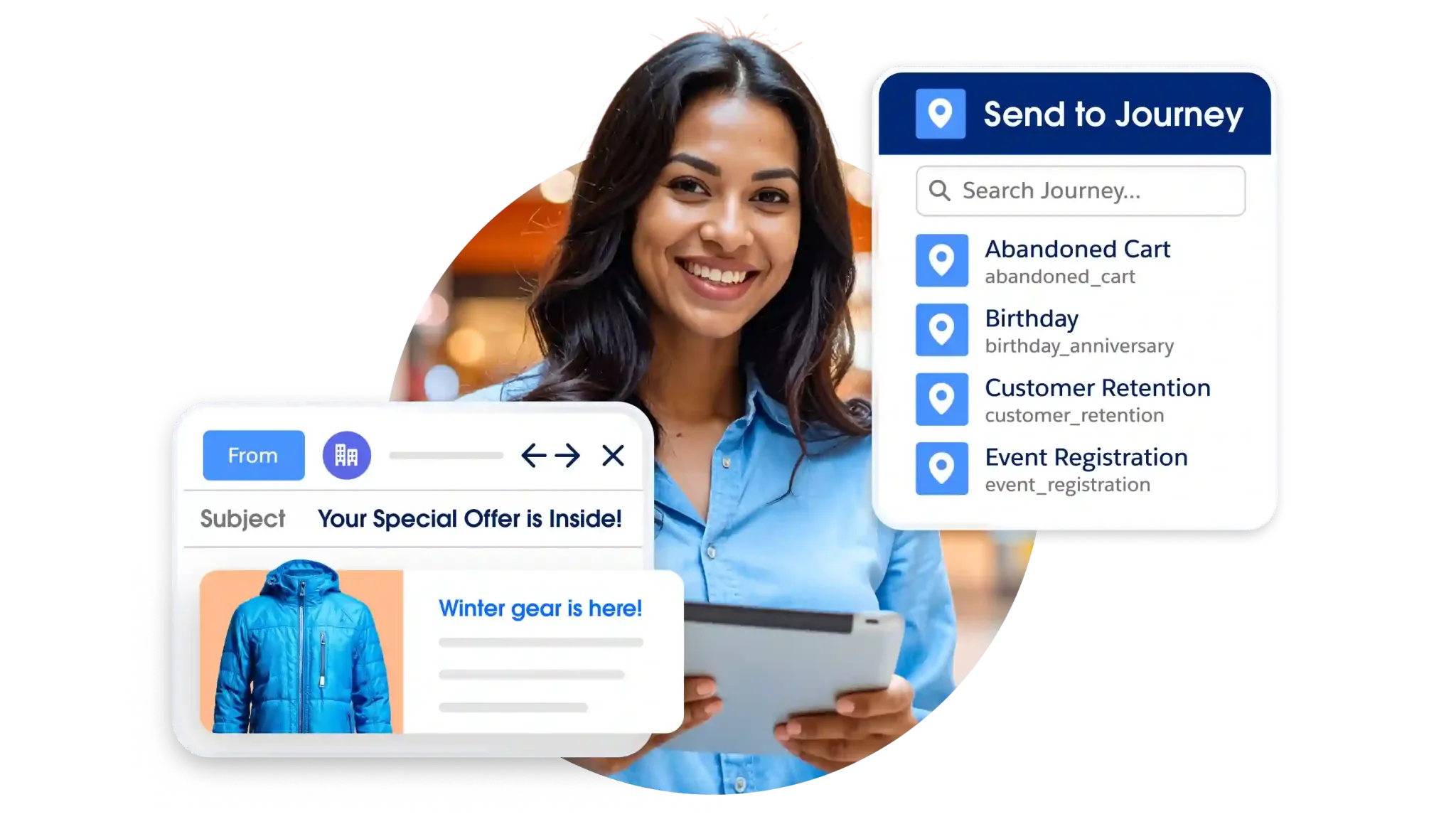
Source: Salesforce
The channel count is competitive, but the experience differs. Salesforce's messaging channels are spread across products built (or acquired) at different times. A marketer running email campaigns in Marketing Cloud Engagement and managing chat support in Service Cloud works in two different interfaces on two different data models. Data Cloud unifies the underlying customer profiles, but the daily workflow still involves switching between products.
Braze's advantage is consistency. Salesforce's advantage is scope. Braze gives marketers a single interface for all customer messaging. Salesforce gives the organization a single platform for messaging, sales, service, commerce, and analytics, though each piece comes with its own setup and learning curve.
AI capabilities: embedded intelligence vs. agentic ambition
Both platforms invest heavily in AI, but with different philosophies.
BrazeAI is embedded across the engagement platform.

Source: Braze
Intelligent Timing determines each user's optimal send time from historical engagement patterns. Intelligent Channel identifies which channel each person responds to most. Personalized Paths routes individual users to the journey branch most likely to convert them, not just the aggregate winner.
BrazeAI Decisioning Studio, built on the $325M OfferFit acquisition, uses reinforcement learning to optimize channel, timing, content, and incentive for each individual.
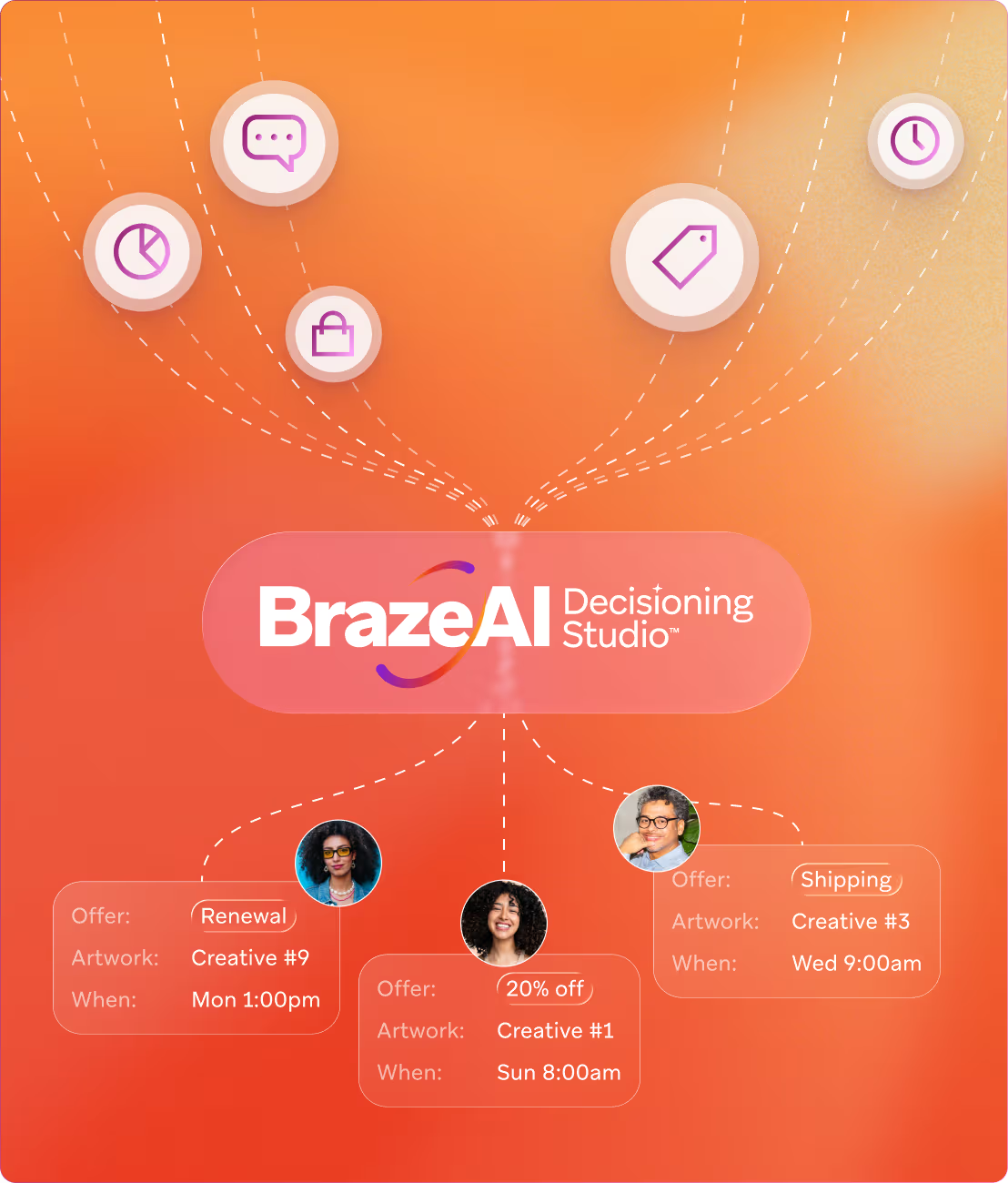
Source: Braze
BrazeAI Operator lets marketers build campaigns using natural language. Describe what you want, and the AI generates the journey structure, writes the copy, and configures the logic.
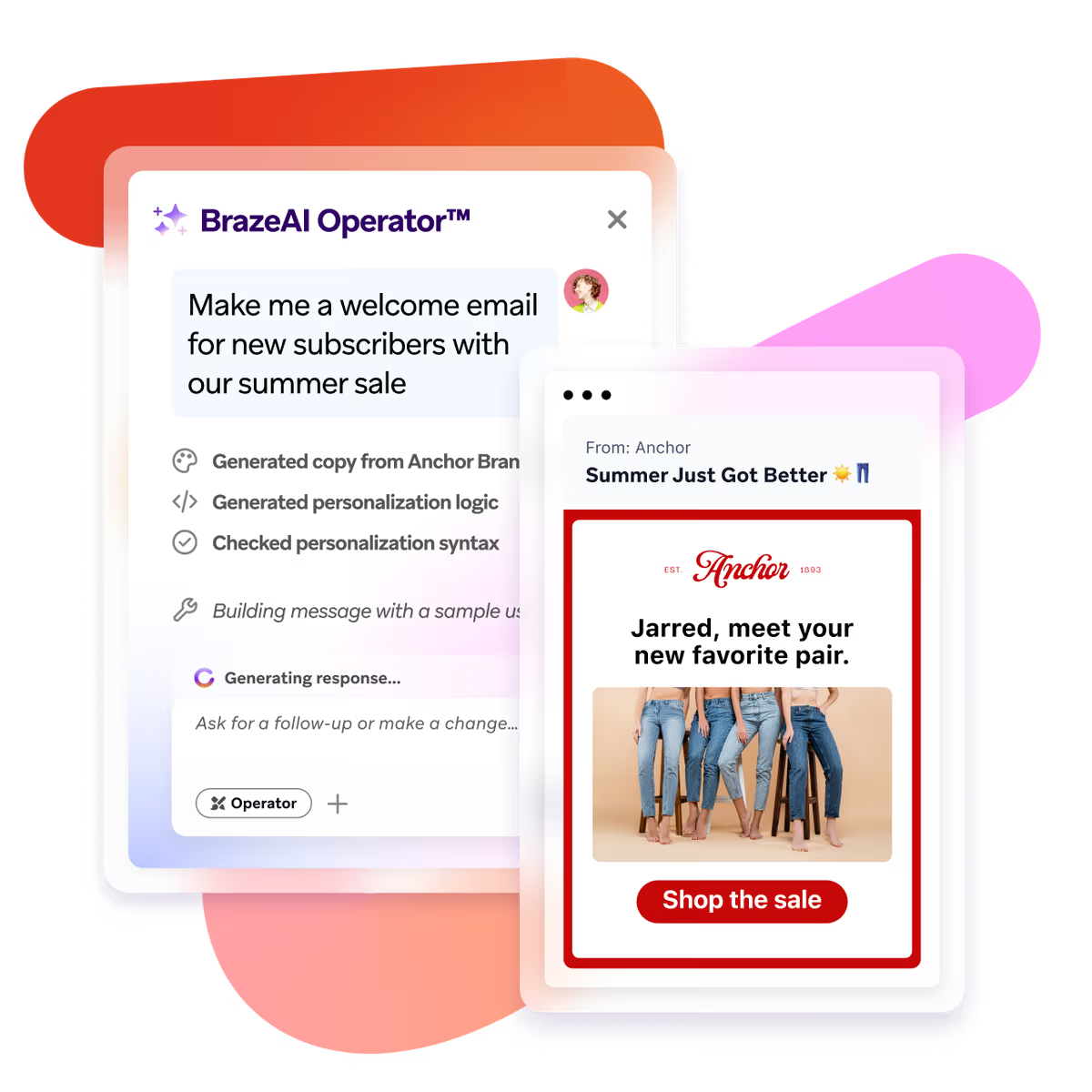
Source: Braze
Agentforce is Salesforce's bet on autonomous AI agents that work across the entire platform. Powered by the Atlas Reasoning Engine, these agents don't just recommend actions; they take them.
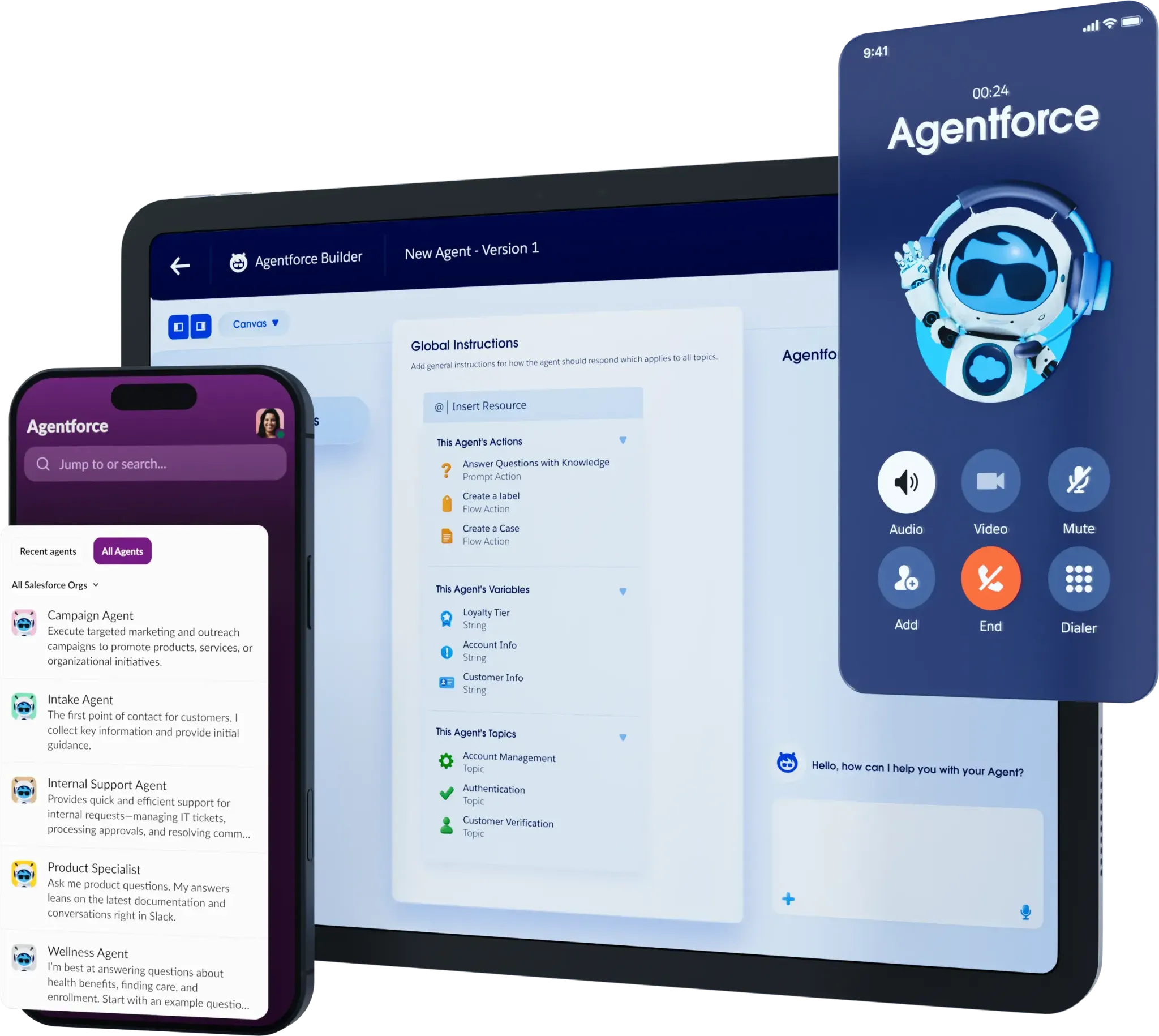
Source: Salesforce
The Service Agent resolves 85% of Salesforce's own support requests without human escalation. The Sales Agent handles prospecting, account research, and follow-up. The Marketing Agent creates campaigns from natural-language briefs.
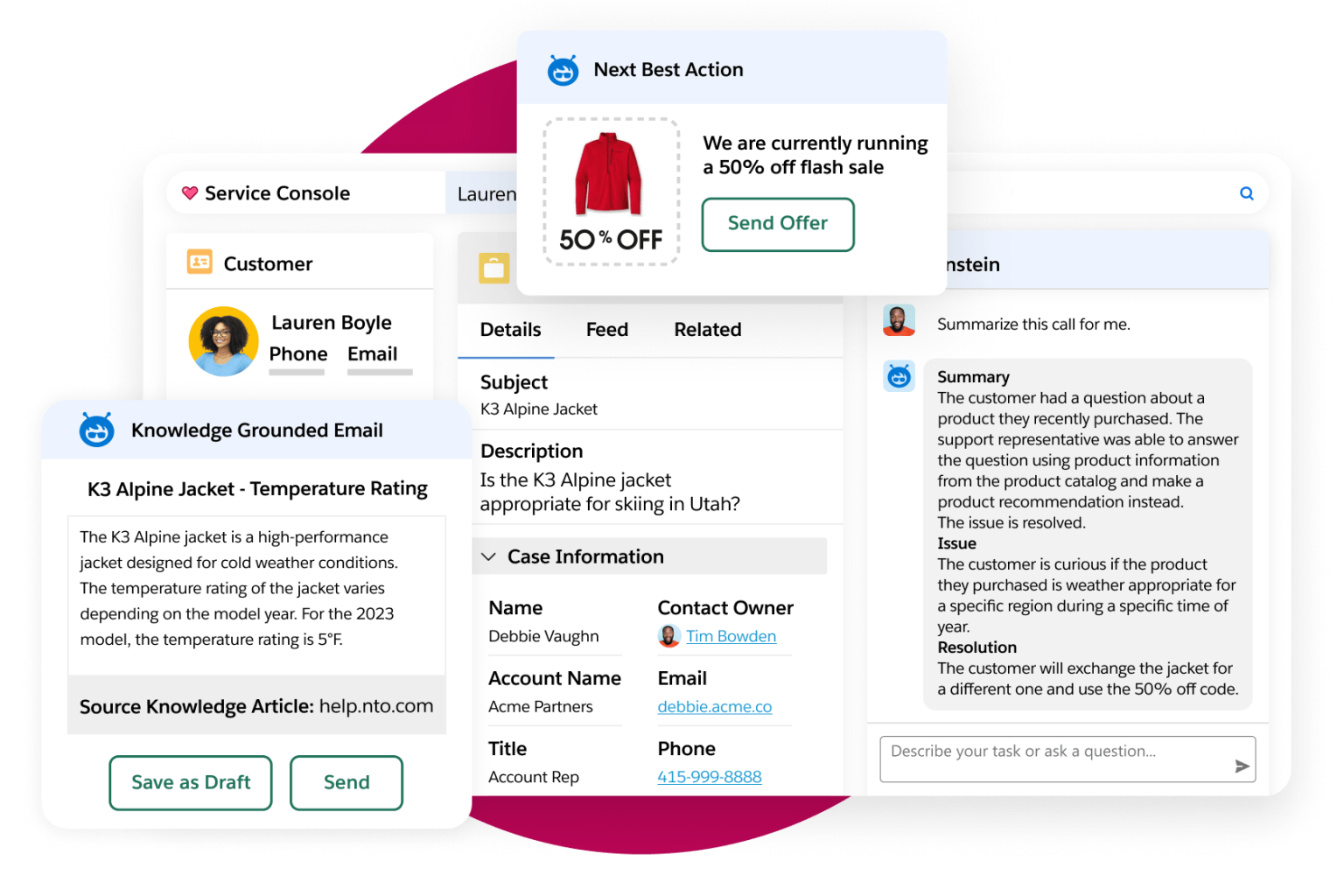
Source: Salesforce
Salesforce's AI vision is broader: autonomous agents across sales, service, marketing, commerce, and IT, not just message optimization.
Both platforms share a limitation: their AI operates on the data they already have. BrazeAI optimizes based on behavioral engagement data (clicks, opens, purchases). Agentforce reasons over CRM records and customer interactions. Neither platform knows independently which accounts are in-market, who the decision-makers are, or what signals indicate buying readiness across the broader market.
ZoomInfo's GTM Context Graph fills this gap. It processes 1.5B+ data points daily, combining B2B data with CRM records, conversation intelligence, and behavioral signals. The result is AI that understands not just what happened in a deal, but why it happened. A CRM records a stage change.
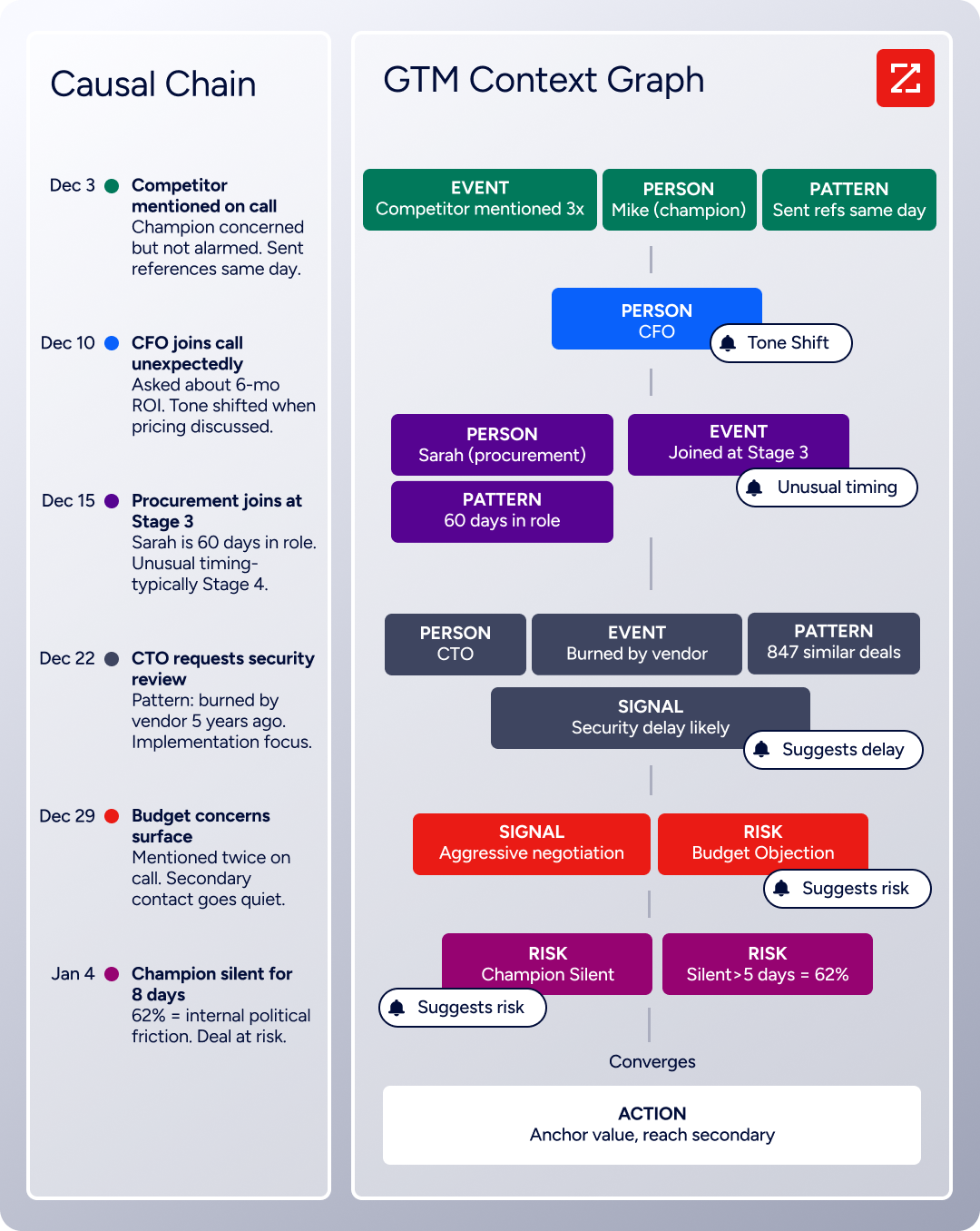
The GTM Context Graph captures that the CFO joined the last call and asked about ROI, that the company just announced new funding, and that three competitors' intent signals spiked in the same week. That contextual reasoning flows directly into outreach, prioritization, and forecasting.
For teams using Salesforce, this intelligence enriches the CRM data that Agentforce reasons over. For any B2B team, it answers questions engagement-platform AI cannot: which accounts are worth pursuing, which stakeholders are receptive, and what's driving their decisions right now.
Seismic's sales team attributed 39% of active pipeline to opportunities identified or influenced by ZoomInfo signals, while boosting productivity by 54%. (Seismic)
The data question both platforms leave unanswered
Braze and Salesforce both excel at the "how" of customer communication: which channel, which message, which timing, which journey. Neither platform independently solves the "who" and "when."
Braze's Data Platform ingests customer data through Cloud Data Ingestion from Snowflake, Redshift, BigQuery, and Databricks, and supports zero-copy segmentation against live warehouse data without duplicating it. It is a strong activation layer. But Braze doesn't generate or verify the data itself. It depends on whatever data your organization feeds it.
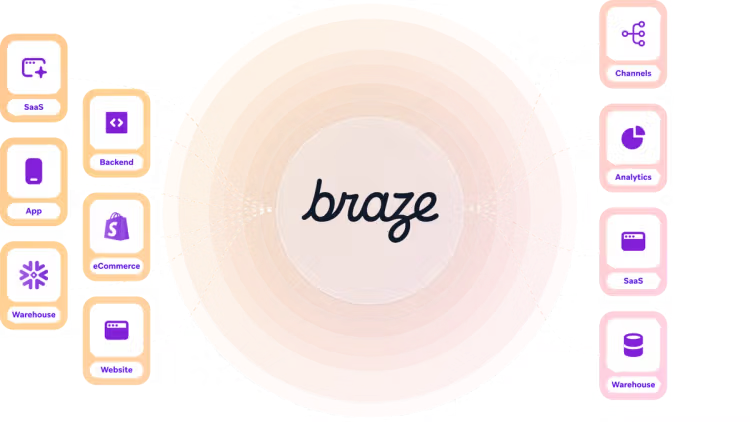
Source: Braze
Salesforce Data Cloud unifies customer profiles from 200+ connectors, resolves identities across sources, and makes data available across every Salesforce cloud. It ingested 112 trillion records in FY26.
But Data Cloud organizes and activates data you already have. It doesn't verify that your contacts are still at the company, that the phone numbers still connect, or that the accounts you're targeting are actively in-market.
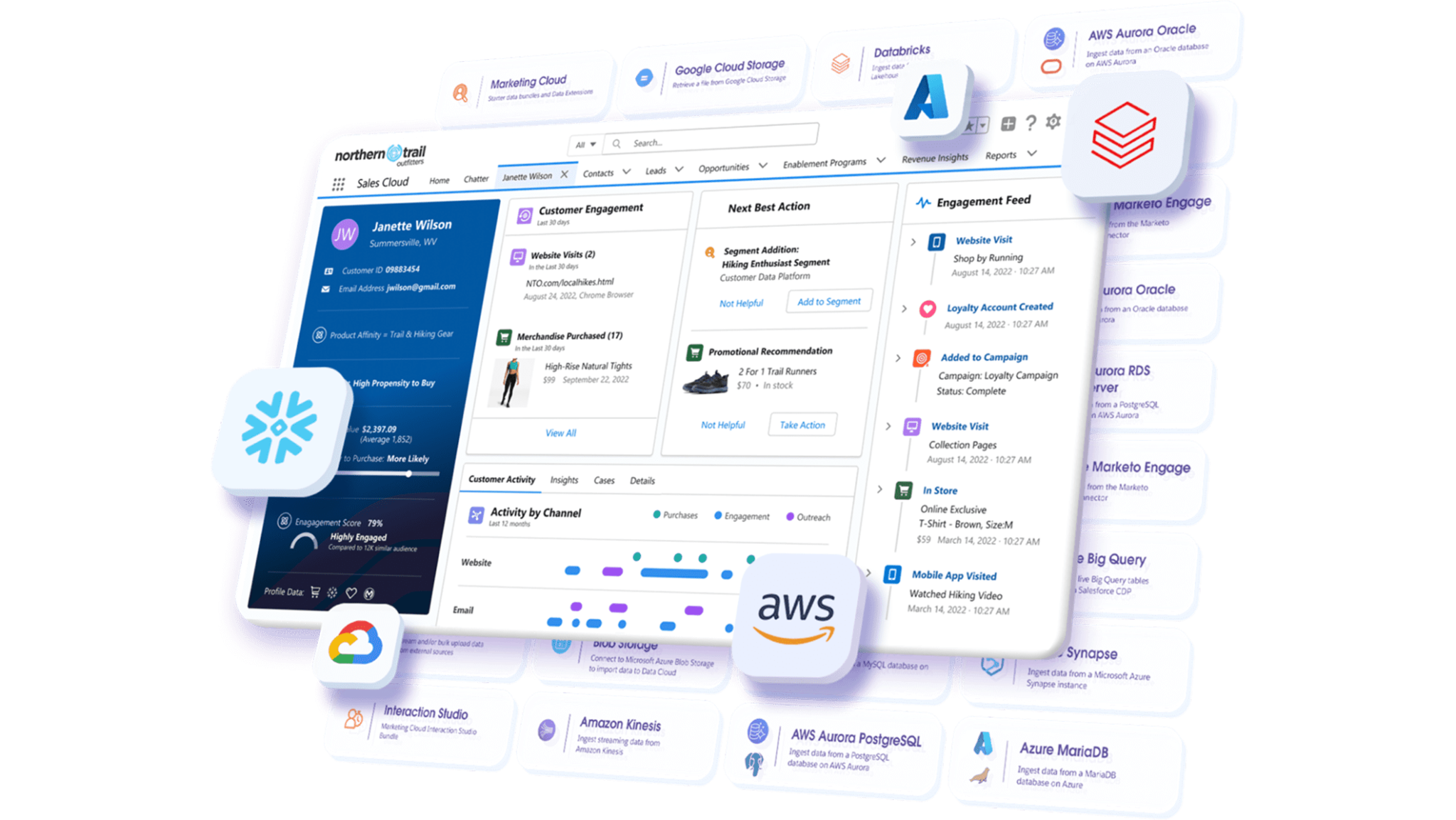
Source: Salesforce
For a closer look at how Salesforce and ZoomInfo's data capabilities compare directly, see our Salesforce vs. ZoomInfo breakdown.
This matters because B2B data decays fast. People change jobs. Companies restructure. Buying committees shift. A campaign targeting last quarter's org chart is targeting yesterday's company.
ZoomInfo approaches this from the opposite direction. Instead of activating the data you have, ZoomInfo generates and verifies the data you need.
Its verification pipeline uses automated ML scanning of 28 million site domains daily, 300+ human researchers, and a community of 200,000+ ZoomInfo Lite users who share data back, achieving up to 95% accuracy on first-party data.
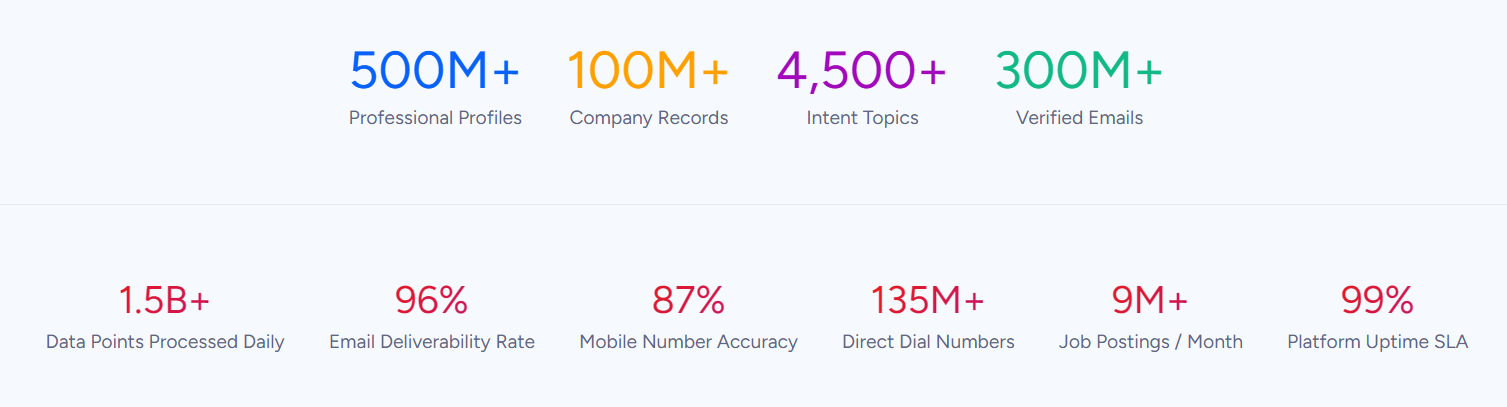
On top of contact and company data, ZoomInfo provides intelligence that engagement platforms don't:
Buyer Intent Data tracking signals from 210 million IP-to-Organization pairings and 6 trillion+ keyword-to-device pairings monthly. Guided Intent, exclusive to ZoomInfo, identifies topics historically correlated with deal success rather than requiring manual topic selection.
Technographics profiling the tech stack of 30+ million companies across 30,000+ technologies.
Website Visitor Tracking that resolves anonymous traffic to companies and buying team contacts.
Org charts and department structures showing decision-makers with verified direct dials and business emails.
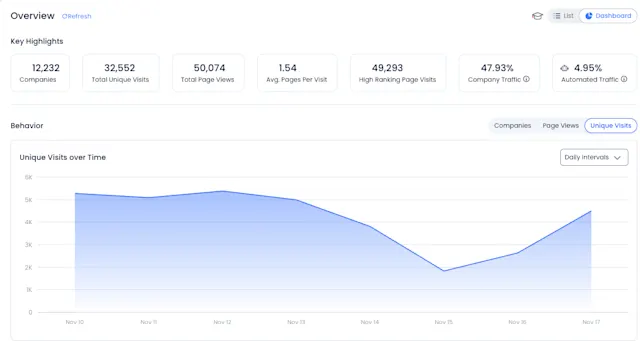
For Salesforce users, ZoomInfo's native integration enriches leads, contacts, and accounts directly within Sales Cloud and Marketing Cloud, keeping data current without manual research.
The data advantage is externally validated. In a Fortune 500 competitive RFP analyzing 25 million contacts across vendors, the independent consultant concluded that "no other competitor came even close." ZoomInfo was named a Leader in the Forrester Wave for Intent Data Providers B2B (Q1 2025) with the highest possible scores across eight criteria, and a Leader in the Gartner Magic Quadrant for ABM Platforms for the second consecutive year.
Snowflake uses ZoomInfo for at least one-third of the most critical data features in their Account Propensity Scoring model. Accounts monitored using ZoomInfo-powered scores showed 90% higher opportunity open rates and 2x higher customer conversion rates. (Snowflake)
Journey orchestration: Canvas vs. Journey Builder
Journey orchestration is where engagement platforms earn their keep. Both Braze and Salesforce offer visual, multi-step journey builders, each with different strengths.
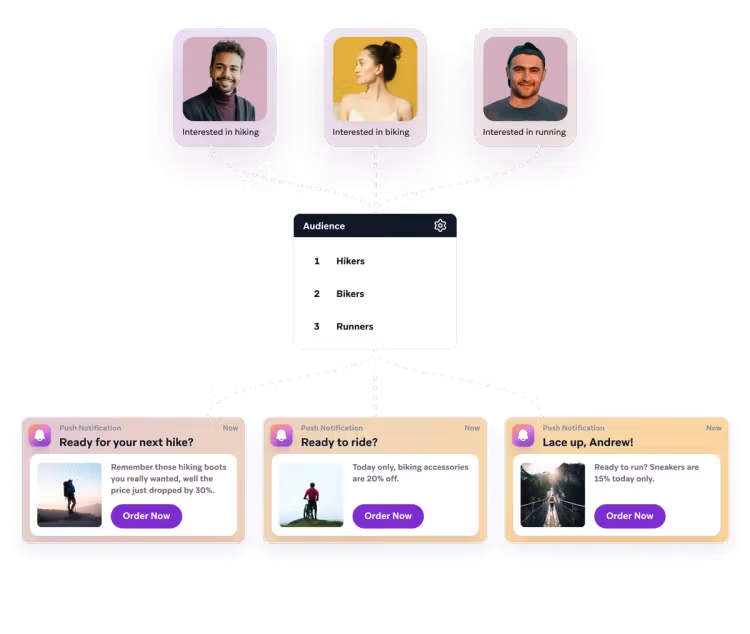
Braze Canvas is a drag-and-drop builder where marketers assemble modular steps: messages, delays, action paths, audience paths, decision splits, experiment paths, user updates, audience sync, and AI agent steps. Every channel can be mixed within a single Canvas.
Source: Braze
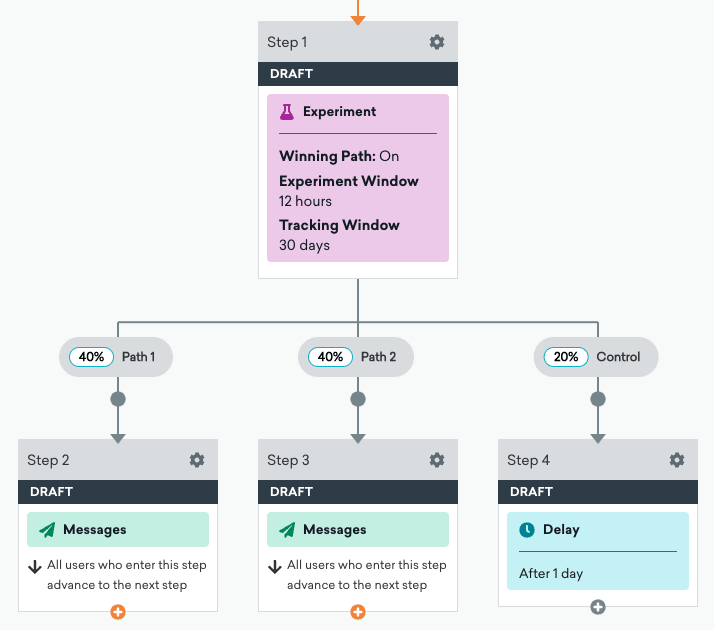
Action Paths support evaluation windows up to 31 days, and Experiment Paths can be placed at any node within a journey, not just at entry.
Source: Braze
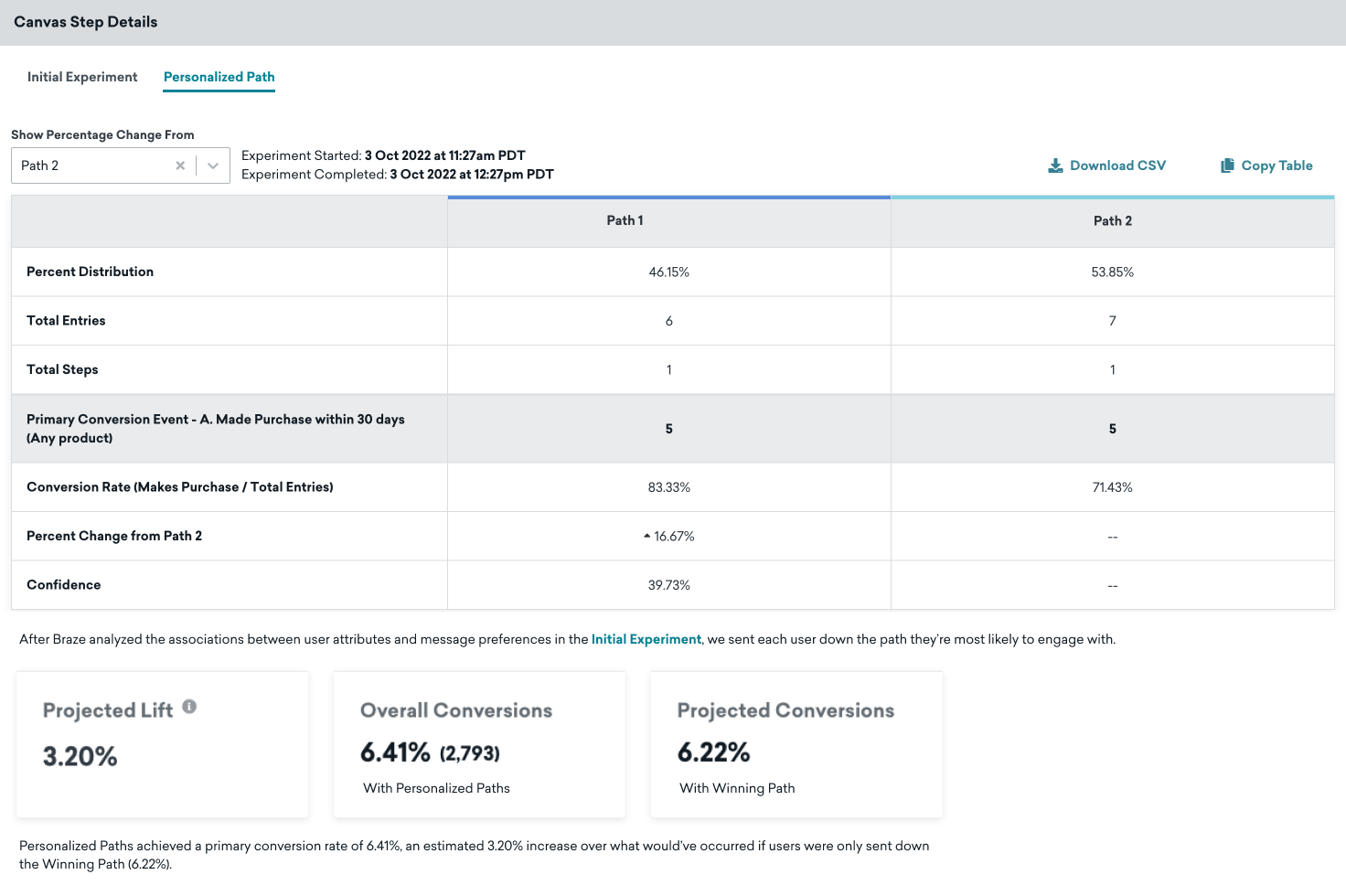
The standout feature is Personalized Paths. It trains a predictive model during an initial experiment phase, then routes each user to the path most likely to convert them. Most journey builders pick an aggregate winner and send everyone down the same path. Canvas picks a winner for each person.
Source: Braze
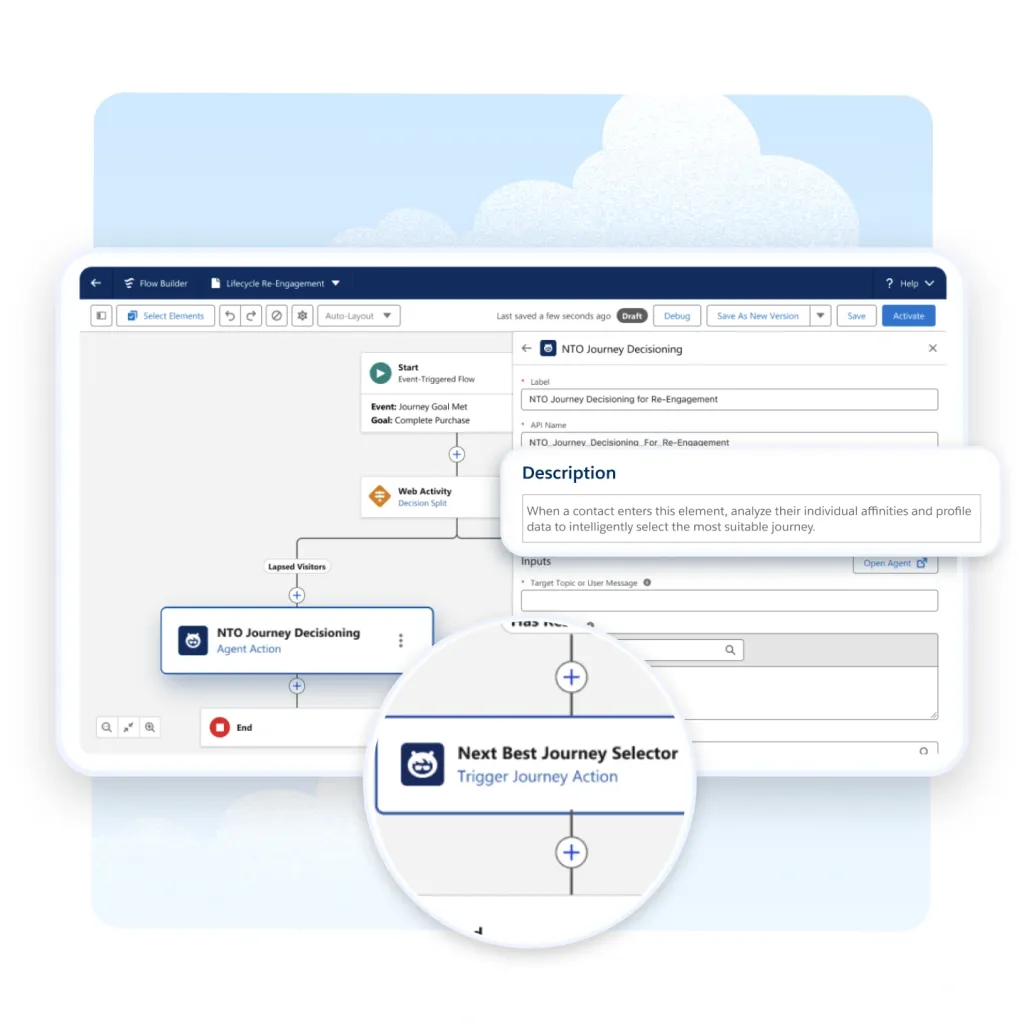
Salesforce Journey Builder (part of Marketing Cloud Engagement) handles multi-step, event-driven journeys across email, SMS, push, and WhatsApp with branching logic, wait states, and decision splits. For B2B, Account Engagement provides separate lead nurturing workflows with scoring and grading.
Source: Salesforce
Salesforce's advantage is contextual breadth. Journey Builder can trigger based on Sales Cloud opportunity changes, Service Cloud case updates, or Commerce Cloud purchase events. A journey that sends a follow-up email after a support case closes, adjusts outreach based on deal stage, then triggers an Agentforce agent for escalation happens within one platform. That cross-cloud visibility is something Braze cannot replicate on its own.
Braze's advantage is speed and experimentation. Canvas is faster to configure, supports more granular in-journey testing, and Personalized Paths pushes optimization beyond what most journey builders offer.
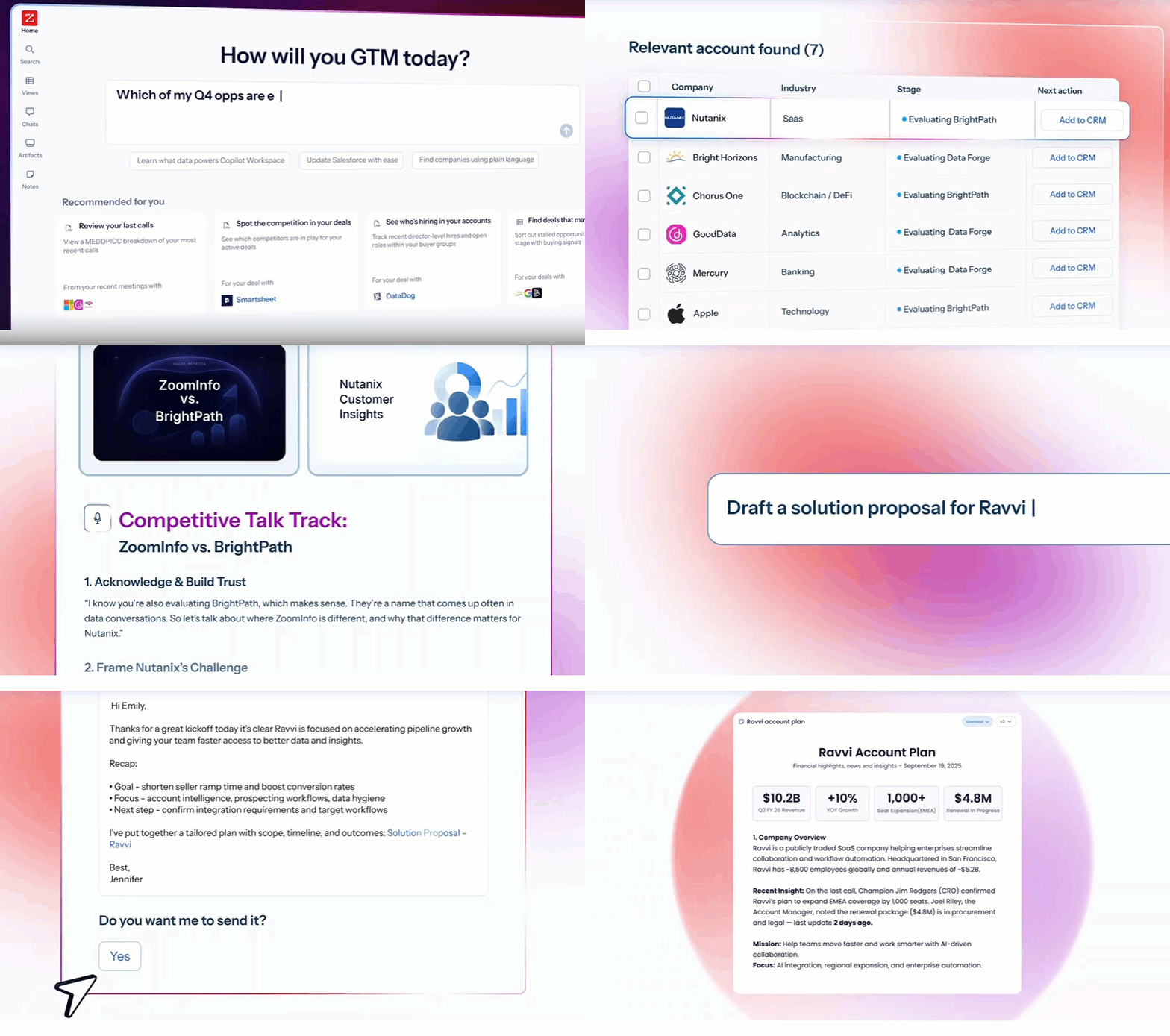
For B2B teams using either platform, ZoomInfo adds a layer neither journey builder provides on its own: the ability to trigger journeys based on external market signals. When an account spikes on intent topics, when a champion changes jobs, when a competitor's technology gets replaced, these signals should start engagement journeys. ZoomInfo's GTM Studio detects these signals and routes them into engagement platforms for execution, while GTM Workspace puts AI-drafted outreach directly in sellers' hands.
Pricing: custom quotes vs. tiered complexity
Both Braze and Salesforce require negotiation. Neither offers straightforward pricing.
Braze uses value-based pricing tied to three dimensions: platform edition, monthly active users, and Flexible Credits consumed across channels and AI features. There is no public rate card. There are no per-seat charges for dashboard users. Four editions (Go, Select, Pro, Enterprise) add capabilities at each tier. Email and push are included in all editions; SMS, WhatsApp, and other channels consume credits. G2 reviewers note add-on creep around segmentation extensions, premium support, and AI credit pricing that can be hard to forecast. A 30-day free trial is available but limited.
Salesforce pricing is public at the edition level but complex in practice. Sales Cloud and Service Cloud each start at $25/user/month (Starter) and scale to $550/user/month (Agentforce 1). Marketing Cloud Growth starts at $1,500/org/month. Marketing Cloud Engagement Pro+ starts at $2,000/org/month and Enterprise+ can reach $30,000/org/month. Data Cloud credits cost $500 per 100,000 credits. Agentforce runs on either Flex Credits ($500 per 100,000) or $2 per conversation.
Then add Premier Success at 30% of net license fees. Add implementation partners, which handle over 70% of deployments. Add the Digital Engagement add-on at $75/user/month and AI for Service at $125/user/month. Salesforce itself acknowledged its pricing "needed to be easier to understand, more predictable, and more flexible" when restructuring Data Cloud pricing in September 2025.
ZoomInfo uses a consumption-based pricing model with custom quotes for paid tiers. ZoomInfo Lite provides a permanent free tier (not a trial) with access to the B2B database, 10 monthly export credits, the Chrome extension, and website visitor tracking. A 7-day free trial of the full platform is also available. Paid plans scale with seats, credits, and features. API access is included in all relevant plans.
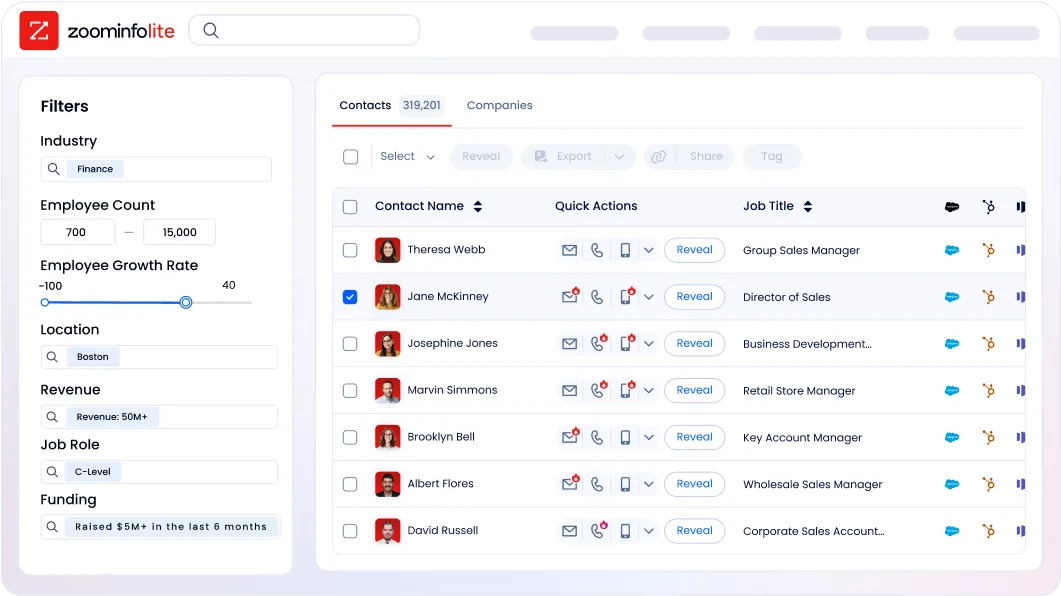
For teams already investing in Braze or Salesforce, ZoomInfo's value becomes measurable quickly. Every enriched CRM record, every intent signal that triggers a campaign, and every verified direct dial that connects a rep to a decision-maker has a direct impact on pipeline and revenue.
Integration ecosystems
How well each platform connects to your existing stack matters as much as what it can do on its own.
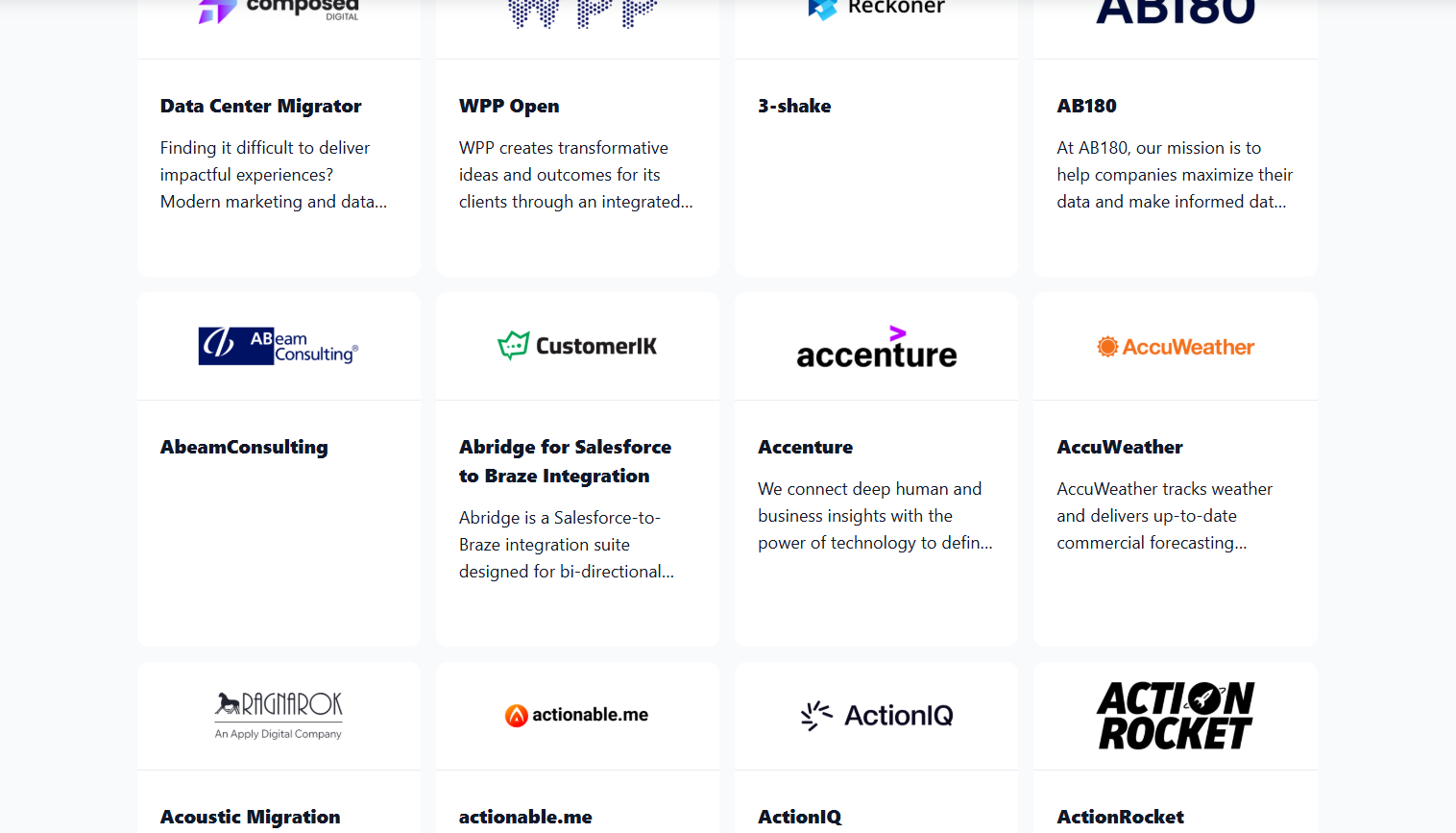
Braze operates through the Braze Alloys partner network, connecting to CDPs (Segment, mParticle, Amplitude, Tealium), data warehouses (Snowflake, Databricks, BigQuery), attribution platforms (Adjust, AppsFlyer, Branch), and paid media platforms.
The Alloys marketplace includes delivery partners like Deloitte Digital, Publicis, and VML. The REST API supports programmatic campaign triggers, user management, and data export. Data Transformation converts inbound webhooks into Braze API calls without custom code, and Connected Content pulls live data into messages at send time.
Source: Braze
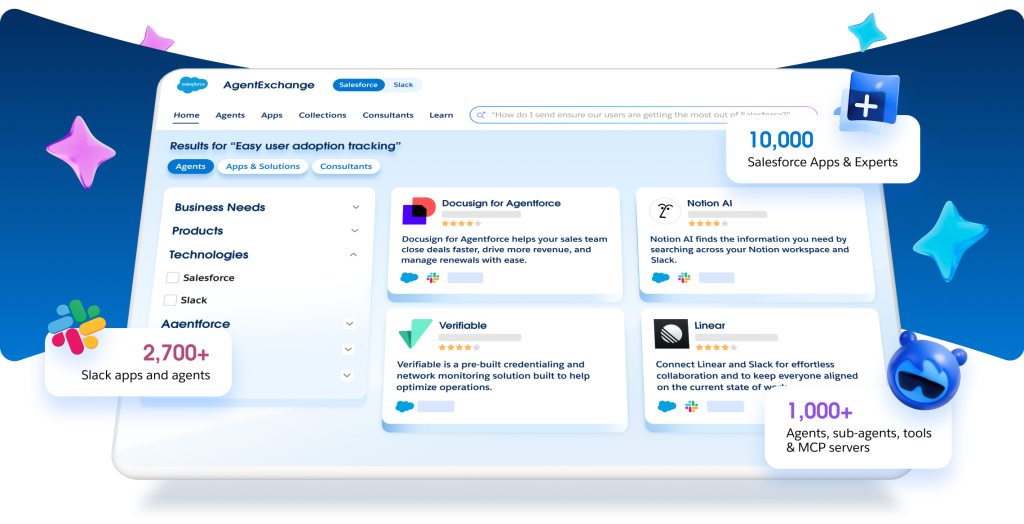
Salesforce has the largest integration ecosystem in enterprise software. AppExchange lists 9,000+ apps with 14+ million installs, and 91% of customers use at least one AppExchange app.
Source: Salesforce
MuleSoft provides enterprise integration with hundreds of pre-built connectors and API management. Native integrations with Google Workspace, Microsoft Outlook and Teams, and Slack are built in. For complex enterprise environments, Salesforce's integration depth is hard to match, though MuleSoft is a separate purchase and custom integrations require developer resources.
ZoomInfo integrates with 120+ tools across CRM, marketing automation, sales engagement, and data warehouses.
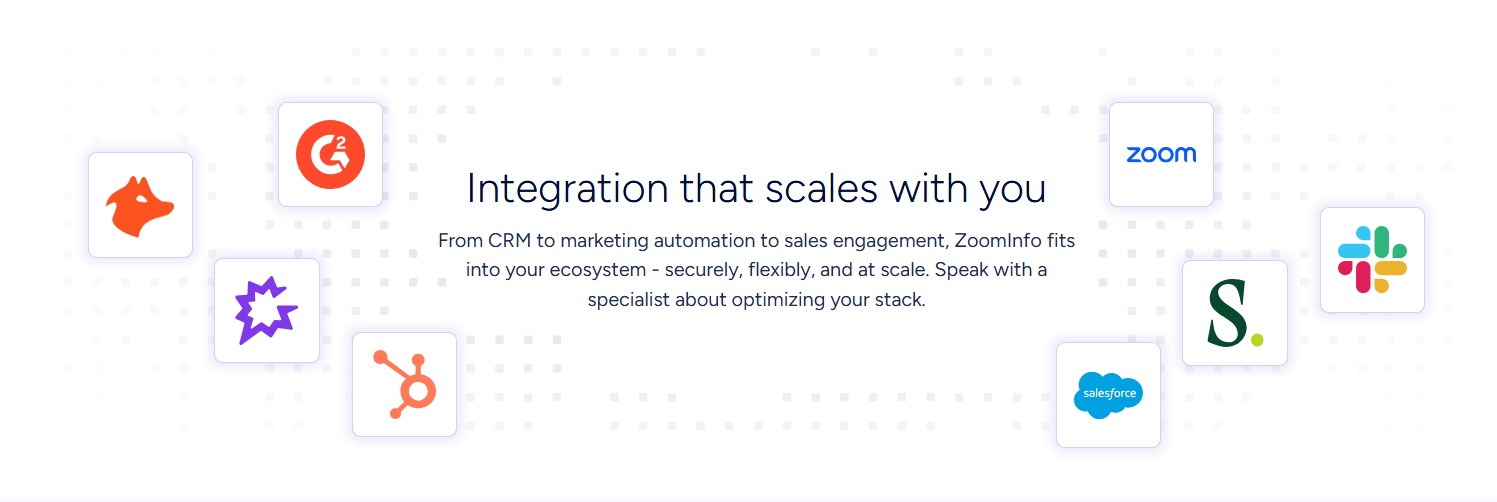
The Salesforce integration is particularly deep, enriching leads, contacts, and accounts directly within Sales Cloud and Marketing Cloud. HubSpot and Microsoft Dynamics 365 integrations provide similar functionality for non-Salesforce shops. Cloud Partners enable direct data ingestion into AWS, Google Cloud, Snowflake, and Databricks.
The Enterprise API and MCP server represent ZoomInfo's broader access strategy. The MCP server connects AI models directly to ZoomInfo data as a native tool, currently supporting Claude and ChatGPT. This positions ZoomInfo as infrastructure for any tool in your stack, not just a standalone product.
"The plug-and-play aspect of the API means I can integrate it easily into any process and get information at a moment's notice." Jerry Wilson, Senior Marketing Intelligence Analyst at BDO Canada, which achieved an 87% reduction in time spent on data dashboard updates. (BDO Canada)
Braze vs. Salesforce vs. ZoomInfo: Which should you choose?
The right choice depends on what problem you're solving and where you are in building your go-to-market stack.
Choose Braze if:
You need focused, real-time cross-channel customer engagement
Your primary channels are mobile push, in-app, email, SMS, and WhatsApp
You want marketers to be self-sufficient without heavy engineering support after initial implementation
You already have a separate CRM and data warehouse
Speed of experimentation and personalization depth matter more than platform breadth
Choose Salesforce if:
You need a unified platform across sales, service, marketing, commerce, and analytics
Your organization is ready for a significant implementation investment
You want AI agents that work autonomously across the entire customer lifecycle
You're building on or already invested in the Salesforce ecosystem
Industry-specific compliance requirements and global scale are priorities
Use ZoomInfo with either if:
Your go-to-market motion depends on B2B data quality
You need verified contact data, org charts, and direct dials for your target accounts
You want intent signals that reveal which accounts are in-market before you engage them
You're building AI-powered workflows that need accurate data as their input
You want a single intelligence layer that works across any engagement platform, CRM, or custom tool
See how ZoomInfo powers your go-to-market strategy.
Braze and Salesforce both answer how to engage your customers. ZoomInfo answers who to engage and when. For B2B and B2B2C organizations, combining an engagement platform with a dedicated intelligence layer isn't optional. It's the difference between campaigns that feel targeted and campaigns that actually are.
"It's not just the data itself. It's the right data at the right time to help us reach out with the right message across that full buyer journey." Chelsea Kenyon, Senior Director of Digital Strategy at Redwood Logistics, which saw a 99% reduction in CPC and 310% increase in CTR. (Redwood Logistics)
Braze vs. Salesforce vs. ZoomInfo FAQ
Is Braze a competitor to Salesforce?
Braze competes directly with Salesforce Marketing Cloud in cross-channel customer engagement. Both are Leaders in the Gartner Magic Quadrant for Multichannel Marketing Hubs. But Salesforce is a broader platform that also includes CRM, sales automation, service, commerce, and analytics. Braze focuses on engagement alone, which gives it depth in that area but means it requires separate tools for everything else.
Which platform is better for B2B marketing?
Salesforce has the stronger B2B marketing story through Account Engagement (formerly Pardot), which provides lead scoring, nurturing, and multi-touch attribution designed for longer B2B sales cycles. Braze is built primarily for B2C and B2B2C engagement where real-time behavioral triggers and mobile-first messaging are the priority. ZoomInfo complements both by providing the B2B data layer (500M contacts, 100M companies, intent signals, and technographics) that powers effective account targeting regardless of which engagement platform you choose.
How do Braze and Salesforce compare on pricing?
Neither publishes fully transparent pricing. Braze charges based on platform edition, monthly active users, and channel credits, with no public rate card. Salesforce uses a multi-cloud model where each product (Sales Cloud, Marketing Cloud, Data Cloud, Agentforce) has its own pricing tier, and costs compound as you add capabilities. Marketing Cloud Engagement starts at $2,000/org/month for Pro+ and scales to $30,000/org/month for Enterprise+. Both platforms require sales conversations for accurate quotes.
Can ZoomInfo integrate with both Braze and Salesforce?
ZoomInfo integrates directly with Salesforce via a native connector that enriches leads, contacts, and accounts within the CRM. For Braze, ZoomInfo data can flow through shared infrastructure like CDPs, data warehouses, or direct API integrations to power audience segmentation and targeting. ZoomInfo's API and MCP server make its intelligence accessible in virtually any platform or custom tool.
What does ZoomInfo add that Braze and Salesforce don't provide?
ZoomInfo provides the B2B data intelligence layer that engagement platforms depend on but don't generate. This includes verified contact data with direct phone numbers and business emails, company attributes and technographics, buyer intent signals, website visitor identification, and org chart intelligence. Braze and Salesforce engage people once you know who they are. ZoomInfo identifies who they are and when they're ready to engage.
Which platform has the strongest AI capabilities?
Each platform's AI serves a different purpose. BrazeAI optimizes engagement timing, channel selection, content personalization, and journey routing based on behavioral data. Salesforce Agentforce deploys autonomous agents across the full customer lifecycle, from prospecting through service resolution. ZoomInfo's GTM Context Graph provides the intelligence layer that feeds AI with B2B data and contextual reasoning about why deals move or stall. The strongest AI strategies combine these layers: ZoomInfo for intelligence, and Braze or Salesforce for execution.
How long does implementation take for each platform?
Braze enterprise implementations typically run 3 to 6 months, with significant engineering work required for data integration, identity management, and custom event design. Salesforce varies widely. Simple Sales Cloud deployments can take weeks, while multi-cloud enterprise rollouts with Data Cloud and Marketing Cloud can take 6 to 12 months, with over 70% of implementations led by partners. ZoomInfo typically deploys in weeks, and its CEO described GTM Workspace as deploying "in weeks, not months."
Do I need all three platforms?
Not necessarily. If you're a pure B2C company with no outbound sales motion, Braze or Salesforce Marketing Cloud paired with your existing CRM may be sufficient. If you're a B2B or B2B2C company where identifying the right accounts, accessing verified decision-maker contacts, and timing outreach to buying signals directly impacts revenue, adding ZoomInfo to your engagement platform creates a measurably stronger go-to-market operation.
More CRM comparisons worth a look:
