

Choosing between Brevo and Salesforce Marketing Cloud comes down to budget, complexity, and ecosystem. But if you're marketing to businesses rather than consumers, most comparisons miss a question: does your marketing platform actually know who your buyers are?
Before picking a platform, consider these questions:
Do you need an affordable, self-serve marketing platform, or enterprise orchestration that justifies dedicated specialists?
Is your business already running on Salesforce CRM, or are you evaluating marketing tools independently?
Are you marketing to individual consumers, or targeting specific companies and their decision-makers?
Do you already have a clean, verified database of your target accounts, or is identifying the right prospects still a challenge?
Is knowing when accounts are actively evaluating solutions important to your campaign timing?
In short, here's what we recommend:
Brevo is the right choice for small and mid-sized businesses that need multichannel marketing without enterprise complexity. From a single platform, it covers email, SMS, WhatsApp, push notifications, live chat, a built-in CRM, and a loyalty program. Pricing is based on email volume rather than contact count, with unlimited contacts on every plan, including a permanent free tier. For growing teams that need to consolidate four or five separate subscriptions into one vendor, Brevo offers real breadth at an accessible price. The tradeoff: automation logic and analytics hit a ceiling that larger organizations will notice.
Salesforce Marketing Cloud is built for enterprises that need multi-channel journey orchestration at scale. Journey Builder lets teams create multi-step campaigns that react to customer behavior in real time across email, SMS, push, advertising, and web. Einstein AI provides predictive insights and send-time optimization. Integration with Salesforce CRM gives marketing, sales, and service teams a shared view of every customer. But the platform's complexity demands certified specialists, implementation timelines run months rather than days, and pricing starts at $1,500/org/month for the Marketing Cloud Growth edition.
Both platforms handle campaign execution well. But for B2B marketing teams, there's an upstream challenge that determines whether those campaigns generate pipeline or noise: knowing which accounts to target, when they're ready to buy, and how to reach the decision-makers. Neither Brevo nor Salesforce Marketing Cloud was built to solve that problem.
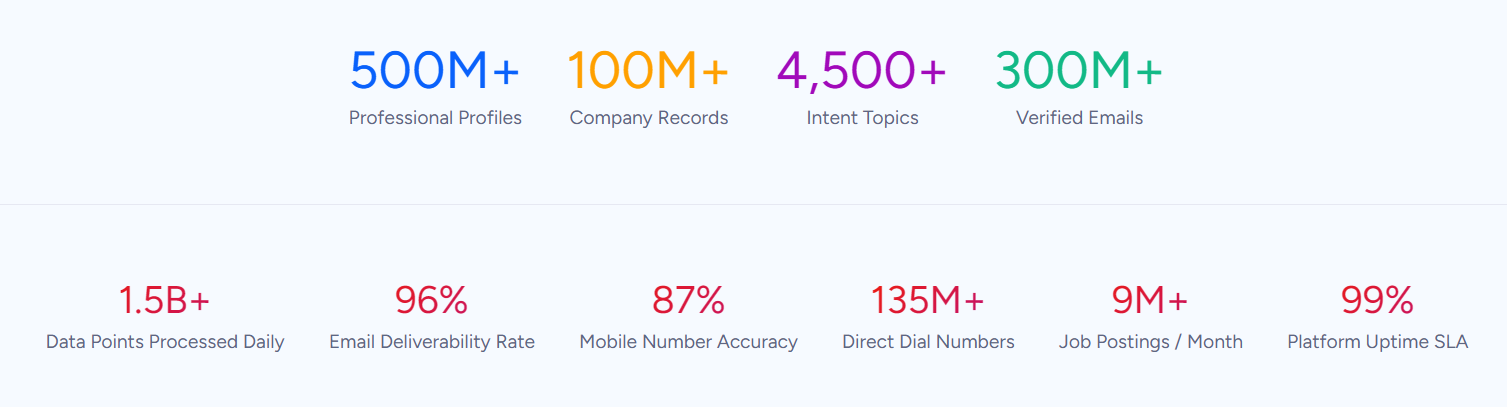
ZoomInfo is a B2B data and GTM platform built on a data foundation of 500M contacts, 100M companies, 135M+ verified phone numbers, and 200M+ verified business email addresses. Its GTM Context Graph, an intelligence layer processing 1.5B+ data points daily, unifies this data with your CRM records, conversation transcripts, and behavioral signals to reveal the full context of your accounts (not just what happened, but why). That intelligence flows everywhere your team works: sellers act through the GTM Workspace, marketers and RevOps build plays in GTM Studio, and any third-party tool (including Brevo or Salesforce) connects through APIs and MCP. For B2B teams, ZoomInfo doesn't replace your marketing platform. It provides the upstream intelligence that determines whether your campaigns reach the right accounts at the right time.
If building your marketing campaigns on verified B2B intelligence sounds like what's been missing, see how ZoomInfo works.
Brevo vs. Salesforce Marketing Cloud vs. ZoomInfo at a glance
Brevo | Salesforce Marketing Cloud | ZoomInfo | |
|---|---|---|---|
Primary function | Multichannel marketing & CRM platform | Enterprise marketing orchestration | B2B data intelligence & GTM platform |
Channels | Email, SMS, WhatsApp, push, chat, phone, wallet | Email, SMS, push, ads, social, in-app, web | Display ads, email (via integrations), forms, website ID |
AI capabilities | Aura AI (content, send-time, segmentation) | Einstein (predictive scoring, journey optimization) | GTM Context Graph (intent, signals, account intelligence) |
Free plan | Yes (300 emails/day, unlimited contacts) | Free trial only | ZoomInfo Lite (permanent, 10 credits/month) |
Starting price | $9/month | $1,500/org/month | Custom-quoted |
Pricing model | By email volume sent | Per organization, billed annually | Consumption-based (seats + credits) |
Contact data | Whatever you import or capture | Whatever exists in your Salesforce CRM | 500M contacts with verified emails and direct dials |
Integrations | 150+ (Shopify, WooCommerce, Zapier) | Deep Salesforce ecosystem, AppExchange | 172+ (Salesforce, HubSpot, Dynamics, API/MCP) |
Learning curve | Low | Steep | Moderate |
Best for | SMBs and mid-market businesses | Enterprises in the Salesforce ecosystem | B2B teams that need to identify and reach buyers |
Brevo wins on accessibility, Salesforce wins on orchestration depth
Brevo and Salesforce Marketing Cloud approach campaign execution from opposite ends of the spectrum.
Brevo has made multichannel marketing accessible to non-technical teams.
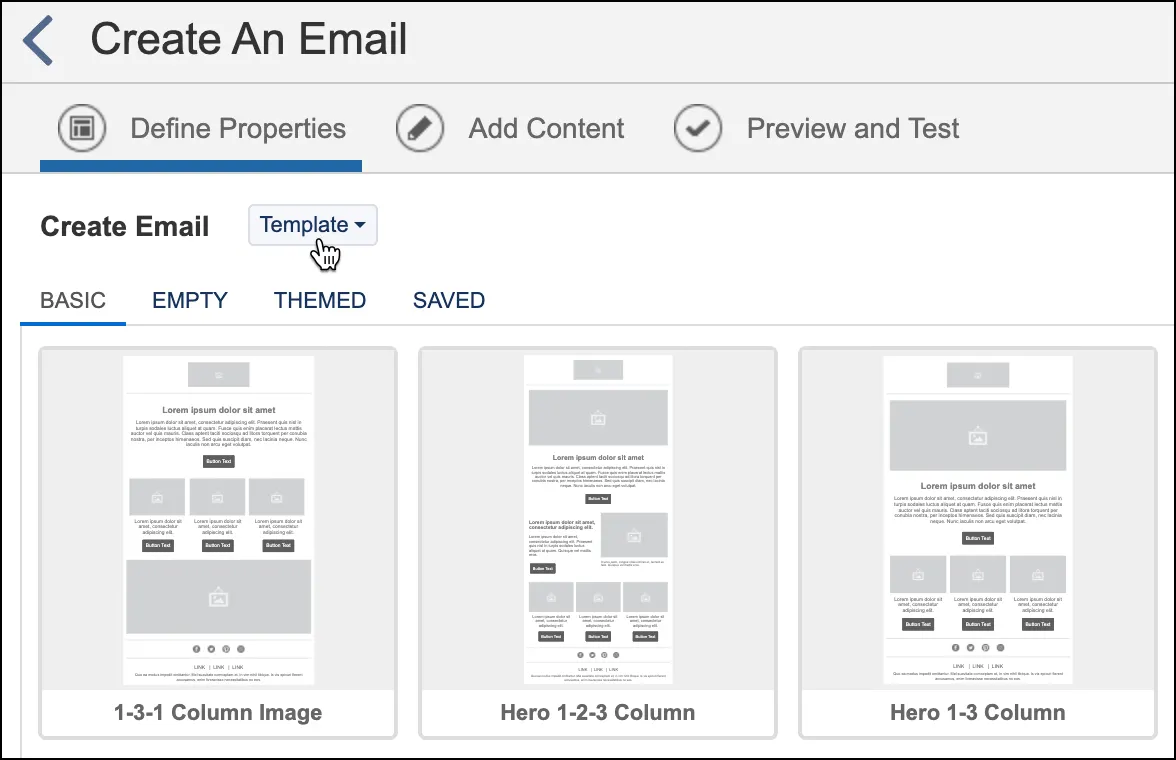
The drag-and-drop editor with 50+ responsive templates gets campaigns out the door quickly. The visual automation workflow builder comes with pre-built templates for welcome series, abandoned carts, and birthday emails.
What separates Brevo from most email tools at this price point is channel breadth: email, SMS, and WhatsApp all live inside the same automation workflow, so a marketer can build a sequence that sends an email, waits 24 hours, and follows up with an SMS without switching tools.

Source: Brevo
Brevo is also a certified WhatsApp Business Solution Provider, giving businesses an official WhatsApp profile with direct API access rather than routing through third-party intermediaries. For ecommerce and retail businesses, this matters. WhatsApp messages see 98% average open rates, and having that channel integrated into the same automation engine as email and SMS eliminates the need for a separate vendor.
But Brevo's simplicity has limits.
G2 reviewers and Capterra reviewers consistently note that multi-step workflows and dynamic segmentation feel restrictive compared to enterprise platforms. Campaign analytics lack granularity for conversion-level exploration, and comparing campaign performance across time periods requires workarounds.
Salesforce Marketing Cloud operates in a different league.
Journey Builder is the centerpiece: a visual canvas where marketers design multi-step, multi-channel customer journeys with branching logic based on real-time behavior. A customer who opens an email gets one path; a customer who ignores it gets a follow-up via SMS or a retargeting ad on Facebook. Decision splits, wait times, A/B tests, and CRM updates all happen within a single journey, orchestrated automatically.
Email Studio provides content creation with AMPscript (Salesforce's proprietary scripting language) for conditional logic inside emails. Mobile Studio handles SMS, MMS, push notifications, in-app messaging, and geofenced messaging. Advertising Studio connects CRM data to Facebook, Google, LinkedIn, and Twitter for audience targeting and retargeting. Automation Studio handles the backend data management that keeps it all running.
Source: Salesforce
The cost of this power is complexity.
The platform has a steep learning curve that often requires certified specialists. The user interface feels inconsistent across modules because many were built through separate acquisitions. And the data model (Data Extensions, Subscriber Keys) demands solid technical understanding to use fully. Many organizations need implementation partners just to get started, adding months and significant cost to the initial setup.
In B2B, the upstream intelligence matters more than the delivery mechanism
Both Brevo and Salesforce Marketing Cloud are campaign execution platforms. They assume you already know who to target. You import your contact lists, build your segments, and run your campaigns.
For B2C marketers (ecommerce, retail, restaurants), this works. Your customers come to you through purchases, signups, and website visits. The contact database builds itself. The job is engagement and retention.
For B2B marketers, the problem is different.
Your buyers don't browse your website and fill out forms the way consumers do. They research anonymously. They involve five to ten stakeholders in a purchasing decision. They move through evaluation cycles that can last months. And by the time they raise their hand, they've often already narrowed their shortlist.
Neither Brevo nor Salesforce Marketing Cloud can tell you which companies are researching your category right now. Neither knows who the VP of Operations is at a target account, what their direct phone number is, or that they just started evaluating your competitor. Both platforms will send your email reliably. Neither can tell you whether it should have been sent at all.
This is the problem ZoomInfo was built to solve.
ZoomInfo operates a B2B data platform covering 500M contacts, 100M companies, 135M+ verified phone numbers, 120M direct-dial phone numbers, and 200M+ verified business email addresses. That data is verified through a multi-source pipeline backed by 300+ human researchers and reaches up to 95% accuracy on first-party data.
Source: ZoomInfo
But ZoomInfo is more than a database.
Its intent data tracks signals from 210 million IP-to-Organization pairings and 6 trillion+ new keyword-to-device pairings monthly to identify when companies are actively researching topics related to your solution. Guided Intent, exclusive to ZoomInfo, identifies the topics historically correlated with your closed-won deals rather than requiring manual topic selection.
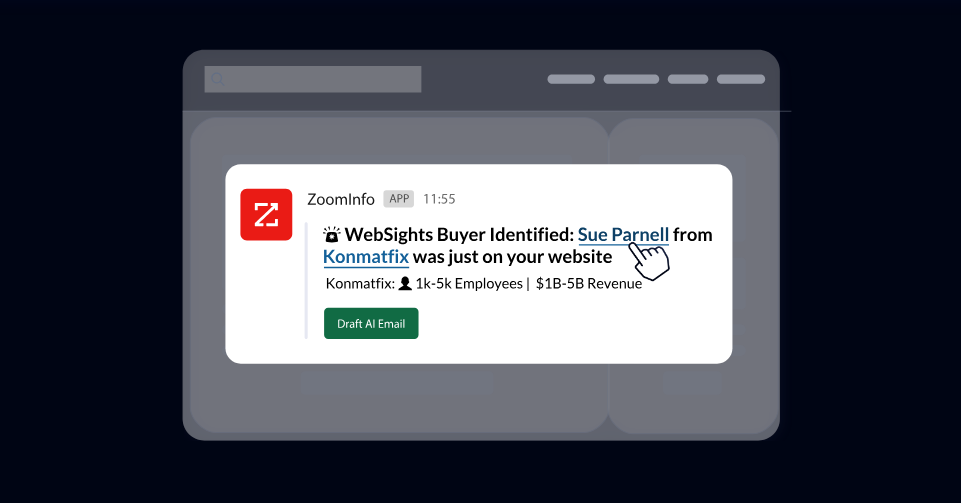
WebSights resolves anonymous website traffic to companies, identifying not just which organizations are visiting but which individuals from those companies are on your site. FormComplete reduces web forms to a single field and auto-appends the rest from ZoomInfo's database, removing the friction that kills B2B conversion rates.
Source: ZoomInfo
The data advantage is not self-reported.
In a Fortune 500 competitive RFP analyzing 25 million contacts across vendors, the independent consultant concluded that "no other competitor came even close." ZoomInfo has been named a Forrester Wave Leader for Intent Data Providers, a Leader in the Gartner Magic Quadrant for ABM Platforms for two consecutive years, and the only vendor positioned in the Customers' Choice quadrant in Gartner's Voice of the Customer report, with a 4.7/5.0 average rating.
For B2B marketing teams, this intelligence determines whether your campaigns reach the right people. Your Brevo or Salesforce Marketing Cloud campaigns can be well designed and well timed, but if they're going to the wrong accounts or missing the decision-makers, the execution is wasted.
ZoomInfo's combination of CRM data, external signals, and AI-driven context helped Seismic craft account- and persona-based messages that generated immediate responses, with 39% of active pipeline attributable to opportunities identified or influenced by ZoomInfo signals. (Seismic)
Three different approaches to AI and intelligence
All three platforms have AI capabilities, but they solve different problems at different levels of the marketing stack.
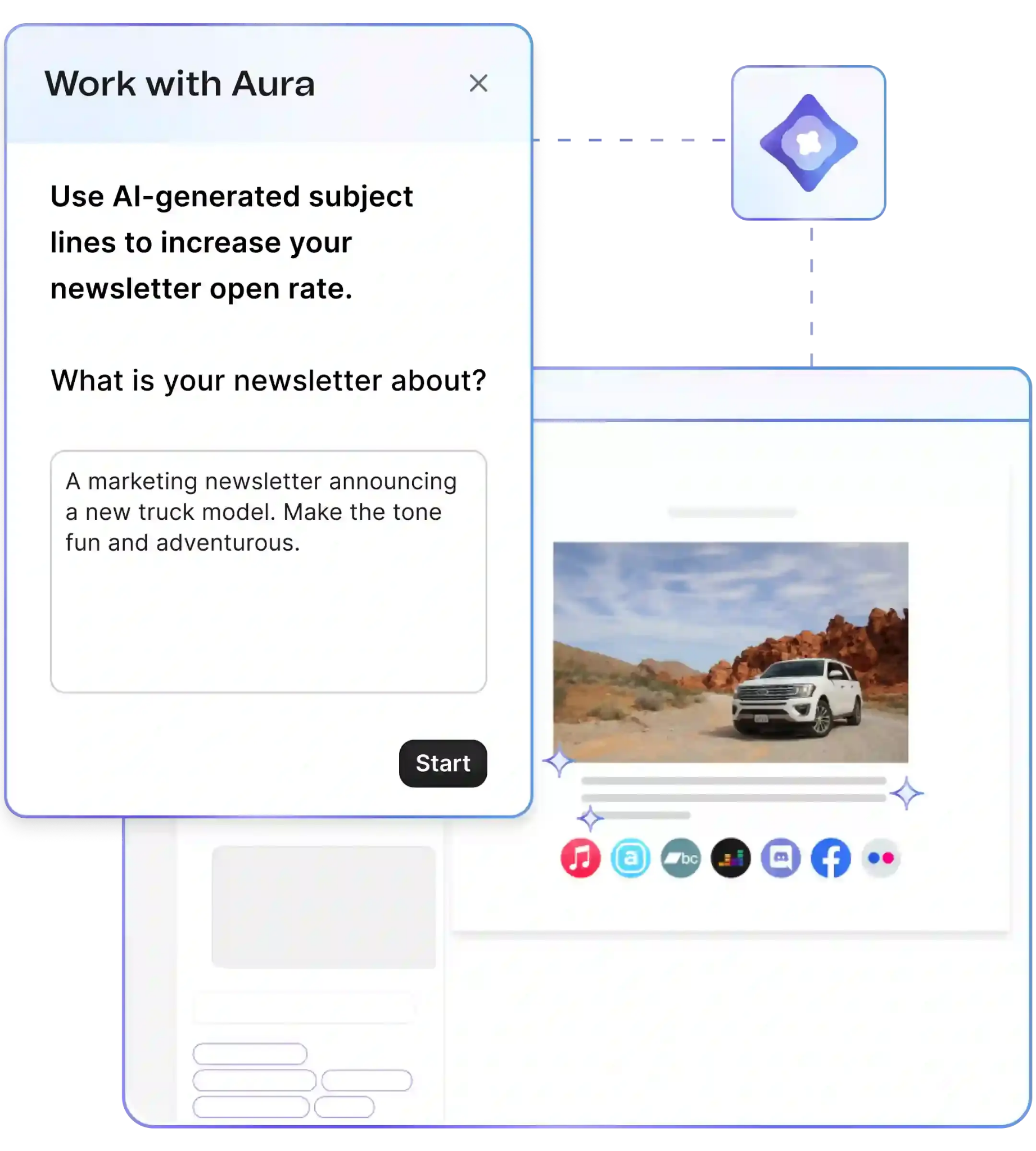
Brevo's Aura AI operates at the campaign execution layer.
The Marketing Agent generates subject lines and body copy from prompts, identifies optimal send times per recipient using predictive analysis, auto-segments audiences from real-time data, and delivers dynamic product recommendations within campaigns. The Data Analyst agent lets marketers query campaign and customer data in plain language. The MCP Server connects Brevo's data to external AI assistants like Claude and ChatGPT for managing campaigns from within AI interfaces.
Brevo's AI makes campaign creation faster and improves delivery timing. But it works only with the data you've already collected. If your contact database is incomplete or your segments are based on guesswork, Aura optimizes around those limitations rather than solving them.
Source: Brevo
Salesforce Marketing Cloud's Einstein operates at the journey optimization layer.
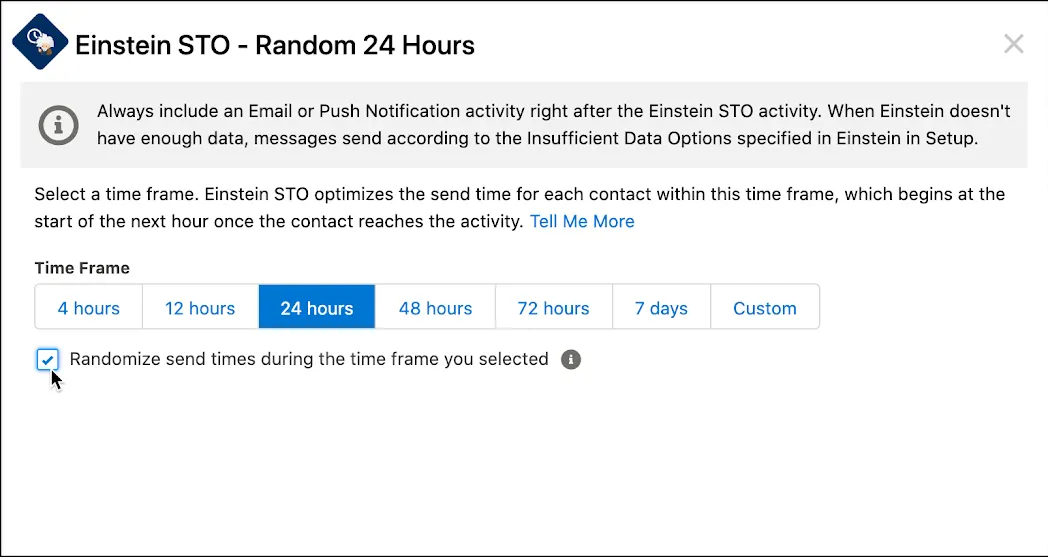
Einstein Send Time Optimization analyzes historical engagement data per contact to determine the best delivery windows. Engagement Scoring predicts likelihood of opens and clicks. Engagement Frequency identifies how many messages to send before fatigue sets in. Path Optimizer tests different journey paths against each other and automatically routes contacts down the winning path.
Einstein's predictions improve with scale. But like Brevo's AI, Einstein works with whatever data exists in your Salesforce instance. If your CRM data is incomplete (Forbes estimates 91% of CRM data is), the predictions inherit those gaps.
Source: Salesforce
ZoomInfo's GTM Context Graph operates at the intelligence layer, upstream of both campaign creation and journey optimization.
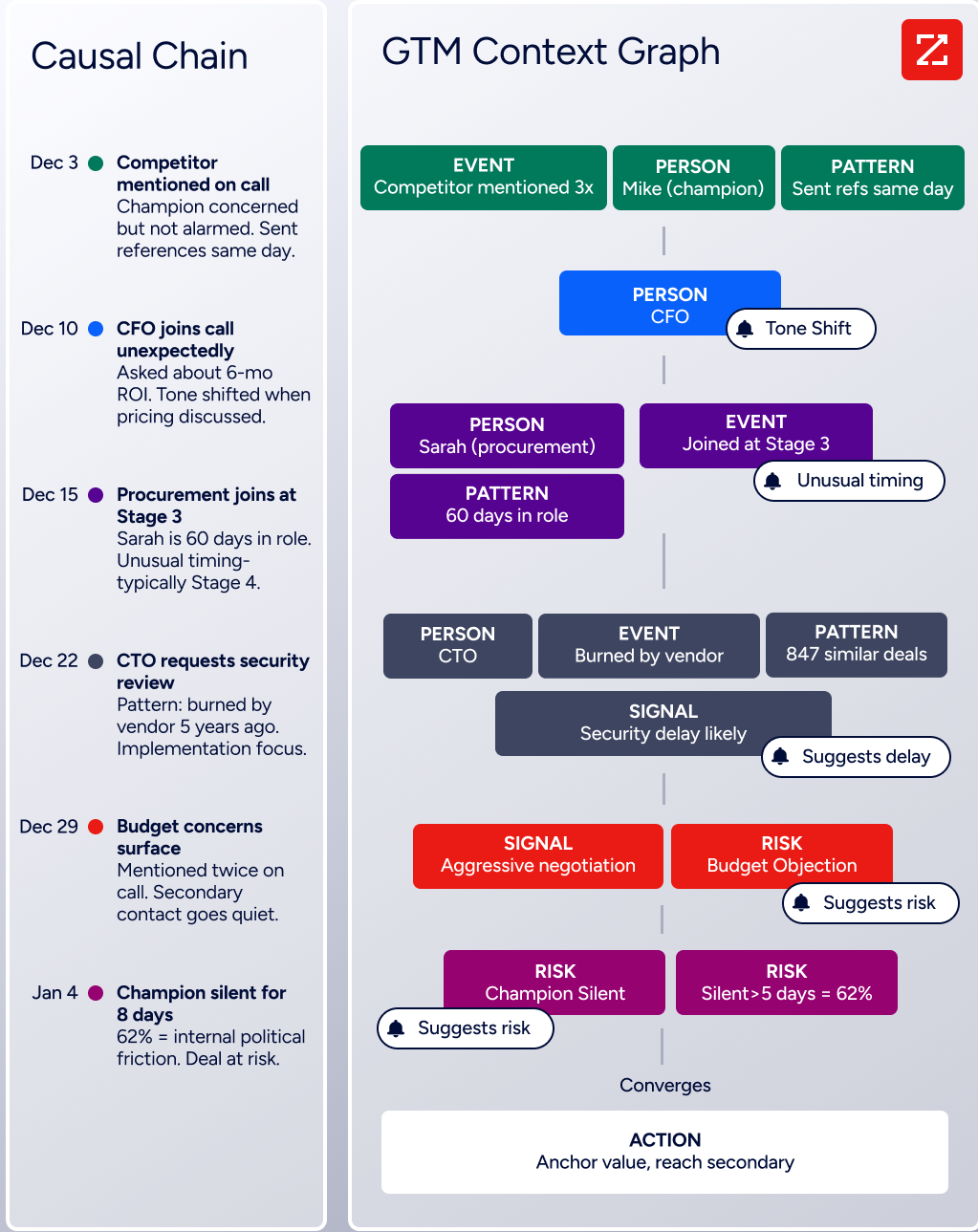
The GTM Context Graph fuses ZoomInfo's B2B data with a customer's CRM records, conversation transcripts, email interactions, and behavioral signals into a single graph that captures not just what happened in a deal, but why it happened.
A CRM records that a deal's stage moved from 3 to 4. The GTM Context Graph knows that the CFO joined the last call and asked about six-month ROI, that the VP of Operations went quiet for eight days due to an internal budget battle, and that the company just started researching a competitor. That context flows into everything downstream: which accounts to target, what messages to send, and how to prioritize the pipeline.
Source: ZoomInfo
Through GTM Studio, marketers and RevOps teams describe audiences in natural language and launch plays targeting accounts that match proven win patterns. Through GTM Workspace, sellers get AI-drafted outreach that addresses the specific concerns the intelligence engine identified. Through APIs and MCP, the same intelligence flows into any third-party tool, including Brevo or Salesforce.
The difference: Brevo and Salesforce optimize how you reach the people you already know about. ZoomInfo tells you who you should be reaching and why now is the moment.
Redwood Logistics achieved a 99% reduction in cost-per-click and a 310% increase in click-through rates by using ZoomInfo's audience insights to target the right accounts with the right message across the buyer journey. (Redwood Logistics)
Integration ecosystems determine your workflow
How each platform connects to the rest of your stack matters as much as what it does on its own.
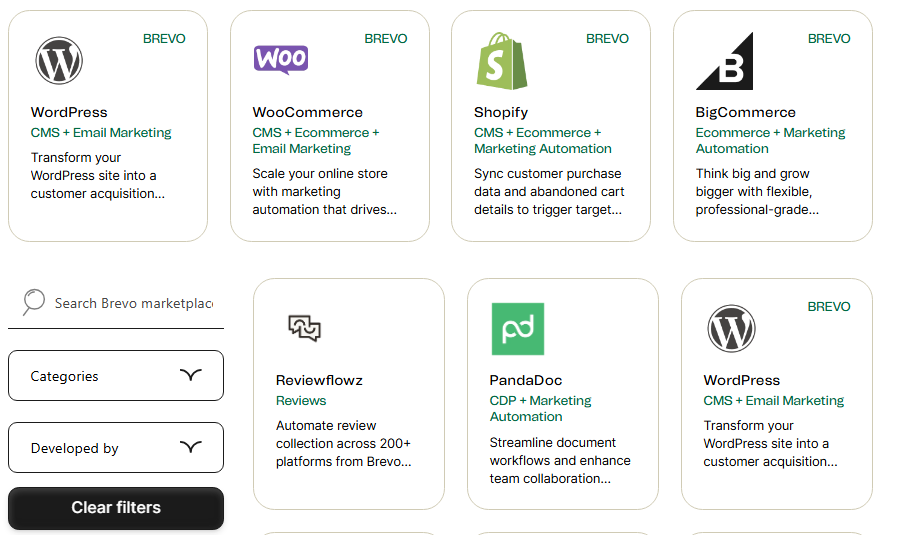
Brevo connects to 150+ third-party tools through its app marketplace.
Ecommerce integrations are the strongest: Shopify, WooCommerce, BigCommerce, PrestaShop, and Magento all have native plugins that sync product data, order history, and customer events for abandoned cart workflows and product recommendations. WordPress, Stripe, Zapier, and Make round out the core ecosystem. The REST API exposes the full platform programmatically, with official SDKs for Node.js, PHP, Python, Java, C#, Go, and Ruby.
Brevo's integrations lean toward ecommerce and SMB tools. CRM integrations beyond its own built-in CRM (for instance, with Salesforce) exist but are not the platform's primary strength.
Source: Brevo
Salesforce Marketing Cloud benefits from the entire Salesforce ecosystem.
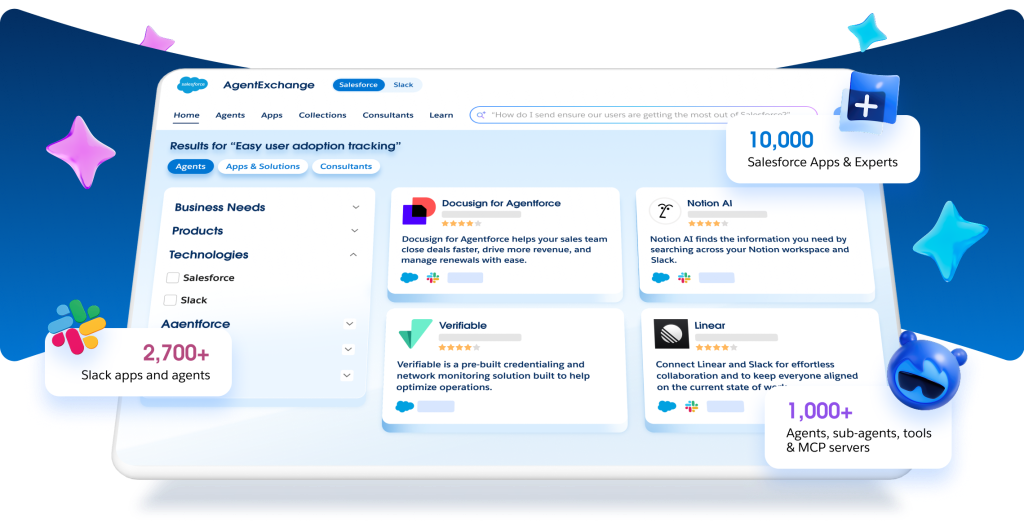
Marketing Cloud Connect enables bidirectional data synchronization with Sales Cloud and Service Cloud, creating a shared customer view across marketing, sales, and support. The AppExchange marketplace hosts thousands of third-party applications. REST and SOAP APIs provide programmatic access, and Automation Studio handles complex ETL workflows.
For organizations already running Salesforce CRM, this integration depth is the primary argument for choosing Marketing Cloud. Customer data flows between systems. Journey Builder can trigger actions based on CRM events. Sales reps see marketing engagement history on every contact record. If you're not in the Salesforce ecosystem, achieving this integration level requires significant effort and cost.
Source: Salesforce
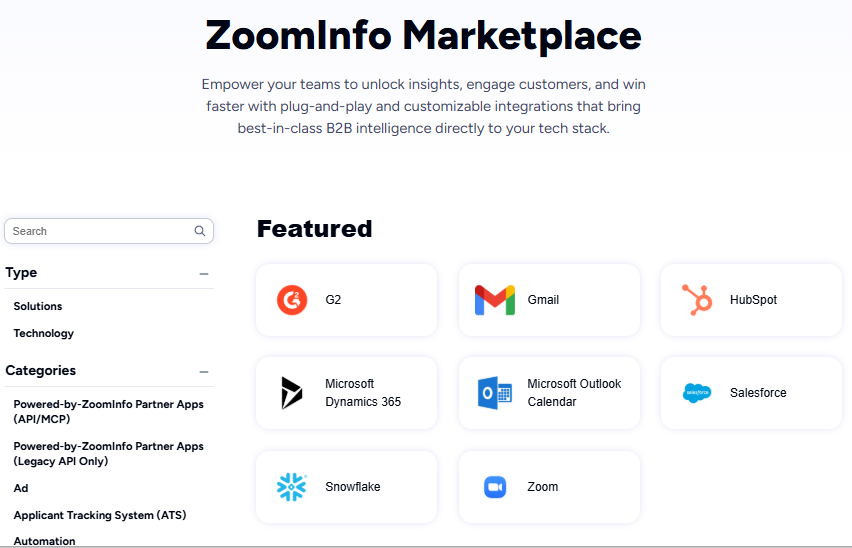
ZoomInfo operates a marketplace with 172+ partner integrations spanning CRM, marketing automation, sales engagement, data warehouses, and communications. The critical point: ZoomInfo integrates natively with both Salesforce and with platforms in Brevo's orbit.
The native Salesforce integration enriches CRM records, automates lead routing, and feeds ZoomInfo's intent signals directly into the Salesforce ecosystem, which then flows into Marketing Cloud's Journey Builder and campaign tools. HubSpot and Microsoft Dynamics 365 have similar native integrations. Cloud data platforms (Snowflake, AWS, Google Cloud, Databricks) receive ZoomInfo data directly through the Cloud Partners program.
For teams building beyond pre-built integrations, ZoomInfo's Enterprise API and MCP server make its intelligence accessible in any tool or AI agent. The MCP server connects AI models directly to ZoomInfo's B2B data as a native tool, currently supporting Claude and ChatGPT. API access is included in all relevant plans, so the intelligence works everywhere, not just inside ZoomInfo's own products.
Source: ZoomInfo
Impartner saw a 45% increase in website engagement and saved 15 hours by using ZoomInfo's automation for account-based marketing. "ZoomInfo has literally changed the way we go to market," said Jeremy Melius, Sr. Director of Marketing Operations. (Impartner)
Transactional messaging and deliverability
One area where Brevo has a structural advantage over Salesforce Marketing Cloud is transactional email.
Brevo includes transactional messaging natively on any paid plan: order confirmations, shipping notifications, password resets, and payment receipts via REST API or SMTP relay, with a claimed send capacity of 120,000 emails per minute and a 99.8% successful API request rate.
Transactional messaging also extends to SMS and WhatsApp under the same API surface, so businesses can send an order confirmation via email and a shipping alert via WhatsApp without managing two vendor relationships.
The free plan includes full transactional API access with 300 emails per day. Most competitors either charge transactional messaging as a paid add-on or require a separate vendor entirely.

Source: Brevo
Salesforce Marketing Cloud handles transactional messaging through triggered sends in Email Studio and via its REST API. The infrastructure is capable, but it's part of a much larger, more complex platform. For businesses whose primary need is reliable transactional email alongside marketing campaigns, Salesforce's approach requires more setup and carries a higher cost floor.
Deliverability infrastructure also differs.
Brevo's enterprise solution page claims a 99% deliverability rate and offers a dedicated Deliverability Specialist on the Professional plan. Salesforce Marketing Cloud provides dedicated IP options and sender reputation management tools, but deliverability support is generally part of higher-tier Success Plans.
For the B2B context, ZoomInfo improves deliverability indirectly but meaningfully.
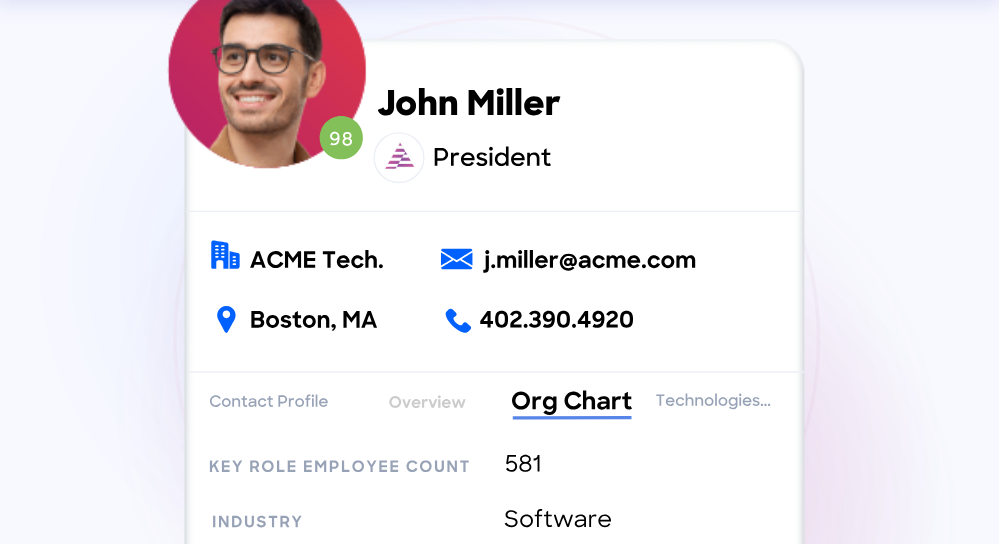
When your contact data is verified at the source (ZoomInfo's 200M+ verified business email addresses go through a multi-source verification pipeline), your bounce rates drop before a single campaign sends. Clean data protects sender reputation across whichever platform you use.
Source: ZoomInfo
The pricing gap reveals who each platform is for
The price difference between Brevo and Salesforce Marketing Cloud is not incremental. It's structural, and it reflects different target markets.
Brevo uses a volume-based model: you pay for emails sent, not contacts stored.
Contacts are unlimited on every plan, including the permanent free tier. This is a deliberate bet against contact-count competitors. A growing business can build a list of 100,000 contacts without paying more, so long as monthly send volume stays within their plan.
The free plan includes 300 emails per day with no credit card required. Starter begins at $9/month for 5,000 emails. The Standard plan starts at $18/month and adds automation, A/B testing, and AI send-time optimization. Professional, at $499/month, unlocks WhatsApp campaigns, push notifications, phone support, and a dedicated Deliverability Specialist. Enterprise pricing is custom.
Several commonly needed features require upgrading or purchasing add-ons. Removing Brevo's logo costs $10.80/month on the Starter plan. Marketing automation is not available until Standard. Multi-user access requires Professional. And the Sales CRM, while included at a basic level, needs a separate add-on ($27.92/month for Sales Essentials) for pipeline management and sales automation.
Salesforce Marketing Cloud prices by organization and bills annually.
The Starter Suite begins at $25/user/month for basic CRM and email marketing. But the real Marketing Cloud starts at the Growth edition at $1,500/org/month and scales to the Advanced edition at $3,250/org/month. Marketing Cloud Engagement (the full email/mobile/journey suite) starts at $2,500/org/year for the entry tier, but most teams will need Pro+ at $2,000/org/month or higher.
The hidden costs add up.
Premium support (the Premier Success Plan) costs 30% of net license fees. Implementation typically requires consulting partners. And specialized add-ons (Personalization from $108,000/org/year, Marketing Intelligence from $3,000/org/year, Loyalty from $20,000/org/year) can push total spend well above the base subscription.
For a team sending 20,000 emails per month, Brevo's Standard plan costs roughly $18/month. A comparable Salesforce Marketing Cloud setup starts around $1,500/month before support and implementation. The question is whether the sophistication gap justifies that price gap for your business.
Brevo vs. Salesforce Marketing Cloud vs. ZoomInfo: Which should you choose?
The right choice depends on your business model, your marketing maturity, and whether you're selling to consumers or to businesses.
Choose Brevo if:
You're a small or mid-sized business that needs email, SMS, WhatsApp, and CRM in one affordable platform
Your marketing team is non-technical and needs tools they can operate without engineering support
You want unlimited contacts without paying more as your list grows
Transactional email and ecommerce integrations (Shopify, WooCommerce) are important to your workflow
You're consolidating multiple tools into one vendor to reduce cost and complexity
Choose Salesforce Marketing Cloud if:
You're an enterprise with a dedicated marketing team and the budget for a premium platform
Your organization already runs on Salesforce CRM and needs native integration across sales, service, and marketing
You need multi-step customer journeys with real-time behavioral triggers
AI (Einstein) for predictive scoring and journey optimization is a priority
You have the technical resources (or budget for partners) to manage a complex implementation
Add ZoomInfo if you're a B2B marketing team using either platform:
You need to identify which companies are in-market before they raise their hand
Your campaigns depend on reaching specific decision-makers with verified contact data
You want intent signals that reveal buying readiness, not just engagement history
Account-based marketing is central to your strategy and you need display advertising, audience orchestration, and pipeline attribution
You want intelligence that flows into any tool through API and MCP access, not locked inside a single platform
See how ZoomInfo's B2B intelligence can strengthen your marketing stack with a free trial.
The honest answer for most B2B teams is that the choice between Brevo and Salesforce Marketing Cloud is about campaign execution, and ZoomInfo is about campaign intelligence. They solve different problems. Brevo or Salesforce Marketing Cloud gets your message delivered. ZoomInfo determines whether the message reaches someone who's actually in a position to buy.
For B2C businesses, Brevo or Salesforce Marketing Cloud may be all you need. For B2B teams, the marketing platform is only as effective as the intelligence feeding it.
Smartsheet reported a 40%+ increase in form fills, 84% increase in MQLs, 26% increase in opportunity rate, and 59% increase in win rate using ZoomInfo's FormComplete and marketing intelligence. (Smartsheet)
Brevo vs. Salesforce Marketing Cloud vs. ZoomInfo FAQ
What is the core difference between Brevo, Salesforce Marketing Cloud, and ZoomInfo?
Brevo is a multichannel marketing and CRM platform for small and mid-sized businesses, covering email, SMS, WhatsApp, push notifications, live chat, and a built-in sales CRM.
Salesforce Marketing Cloud is an enterprise marketing orchestration platform with journey building, Einstein AI, and integration across the Salesforce ecosystem.
ZoomInfo is a B2B data intelligence platform that identifies which accounts to target, provides verified contact data for decision-makers, and surfaces intent signals showing when companies are actively researching your category.
Brevo and Salesforce handle campaign execution; ZoomInfo handles the upstream intelligence that shapes those campaigns.
Which platform is more affordable: Brevo or Salesforce Marketing Cloud?
Brevo is far more affordable. Its free plan includes 300 emails per day with unlimited contacts and no credit card required. Paid plans start at $9/month, with the Standard plan at $18/month.
Salesforce Marketing Cloud starts at $1,500/org/month for the Growth edition and scales to $3,250/month for the Advanced edition, with additional costs for premium support (30% of license fees) and implementation partners. For a team sending 20,000 emails per month, the price difference can be 80x or more.
Do I need ZoomInfo if I already use Brevo or Salesforce Marketing Cloud?
If you're a B2C marketer reaching consumers through ecommerce or content, your marketing platform's built-in tools may be sufficient.
If you're a B2B marketer targeting specific companies and decision-makers, ZoomInfo addresses a problem neither Brevo nor Salesforce Marketing Cloud solves: identifying which accounts are worth pursuing, finding the right contacts with verified email addresses and direct phone numbers, and knowing when those accounts are actively evaluating solutions. ZoomInfo integrates with both Salesforce and common CRM/marketing platforms, feeding its intelligence directly into your campaigns.
Which platform has the best AI capabilities?
Each platform's AI serves a different purpose.
Brevo's Aura AI focuses on campaign execution: generating content, optimizing send times per recipient, and auto-segmenting audiences. Salesforce Einstein focuses on journey optimization: predictive engagement scoring, send frequency management, and path testing. ZoomInfo's GTM Context Graph operates upstream of both, fusing B2B data with CRM records, conversation intelligence, and behavioral signals to identify which accounts to target and why they're worth pursuing now.
The three AI approaches are complementary rather than competing.
How does Brevo's pricing model differ from Salesforce Marketing Cloud's?
Brevo charges by email volume sent, not by the number of contacts stored. Contacts are unlimited on every plan, including the free tier. A business with 100,000 contacts pays the same as one with 1,000, as long as their monthly send volume is the same.
Salesforce Marketing Cloud charges per organization on an annual basis, with pricing based on the edition, contact limits, and message volume. The Growth edition starts at $1,500/org/month with 15,000 contacts, and scaling beyond that requires upgrading editions or purchasing additional blocks.
Does ZoomInfo integrate with Brevo and Salesforce Marketing Cloud?
ZoomInfo has a native integration with Salesforce CRM, which feeds data directly into the Salesforce ecosystem including Marketing Cloud. For Brevo, integration is available through shared CRM connections and automation platforms like Zapier. ZoomInfo's API and MCP server also make its intelligence accessible in any tool.
The key integration path for most B2B teams is through the CRM: ZoomInfo enriches contact and account records in the CRM, and the marketing platform pulls from that enriched data for campaign targeting and personalization.
Which platform is best for account-based marketing?
ZoomInfo is built for account-based marketing in B2B contexts. It provides display advertising through its own demand-side platform, intent data that identifies in-market accounts, contact-level website visitor identification, and AI-powered account scoring. ZoomInfo was named a Leader in the Gartner Magic Quadrant for ABM Platforms for two consecutive years.
Salesforce Marketing Cloud supports ABM through its Advertising Studio and CRM integration but requires more manual setup. Brevo does not position itself as an ABM platform, though its segmentation and automation tools can support basic account-level campaigns.
Which platform is easiest to get started with?
Brevo has the lowest barrier to entry. Its free plan requires no credit card, and most users can launch their first campaign within hours using the drag-and-drop editor and pre-built templates. It has earned G2 recognition for "Fastest Implementation Enterprise" and Capterra's "Ease of Use 2026" award.
ZoomInfo Lite offers a permanent free tier for individual users to search contacts and companies. Salesforce Marketing Cloud has the steepest learning curve, with implementations typically requiring months and often the involvement of certified partners or consultants.
See how Brevo stacks up elsewhere:
