
Choosing between CallRail and Invoca for call tracking and conversation intelligence comes down to five questions:
Are you an SMB or agency tracking calls across a handful of campaigns, or an enterprise managing call intelligence across a national contact center?
Do you need transparent, self-serve pricing you can sign up for today, or are you prepared for a custom-quoted enterprise contract?
Is your primary goal marketing attribution (which ad drove this call), or do you need AI that scores call quality, coaches agents, and routes callers based on their digital journey?
How important is it that your call data feeds directly into ad platforms, CRMs, and contact center systems without manual work?
Do you already have the B2B intelligence to understand who's calling, their buying intent, and where they fit in their company's org chart?
In short, here's what we recommend:
CallRail is the platform for SMBs and marketing agencies that need to prove which campaigns drive phone calls. Its Dynamic Number Insertion, AI-powered Conversation Intelligence, and transparent modular pricing (starting around $45/month) make it easy to set up call tracking, qualify leads with AI summaries, and report ROI to clients, all without a sales conversation. CallRail serves 225,000+ businesses and has held G2's top spot in inbound call tracking for eight consecutive years. But its geographic coverage is limited to four countries, and its AI features sit behind higher-priced tiers that can push costs well beyond the advertised starting price.
Invoca is built for enterprises where phone calls are high-value revenue events. Its Signal AI extracts structured outcomes from every call (appointment booked, policy sold, competitor mentioned), PreSense passes a caller's digital journey to agents before the phone rings, and Quality Management scores 100% of calls automatically. Invoca holds HIPAA, PCI DSS, SOC 2 Type 2, and ISO 27001 certifications, and Forrester named it a Leader in Revenue Execution. The tradeoff is cost and complexity: pricing requires a custom quote, implementation needs a dedicated onboarding team, and the platform assumes you have marketing operations staff.
Both platforms close the attribution gap between digital marketing and phone conversations. But neither answers a broader question: beyond knowing which ad drove the call, do you know who's calling, what their company is researching, and how to reach similar accounts before they start searching?
ZoomInfo is an AI GTM platform that adds B2B intelligence to your call tracking stack. With 500M contacts, 100M companies, 135M+ verified phone numbers, and 200M+ verified business emails, ZoomInfo's GTM Context Graph combines your CRM records, conversation transcripts, and behavioral signals to reveal not just what happened on a call, but who the caller is, what their company is researching, and which accounts match the patterns behind your closed-won deals. Whether you use CallRail or Invoca for inbound attribution, ZoomInfo turns reactive call tracking into proactive revenue work, accessible through GTM Workspace for sellers, GTM Studio for marketers, or APIs and MCP in any tool.
If adding B2B intelligence to your call tracking stack sounds like the missing piece, see how ZoomInfo works with a free trial.
CallRail vs. Invoca vs. ZoomInfo at a glance
CallRail | Invoca | ZoomInfo | |
|---|---|---|---|
Primary focus | Call tracking & marketing attribution for SMBs | AI conversation intelligence for enterprise | B2B data intelligence & GTM execution |
Call tracking | DNI with keyword-level attribution | DNI with Signal AI outcome detection | Not a call tracking platform (Chorus for sales calls) |
AI capabilities | Conversation Intelligence, Convert Assist, Voice Assist | Signal AI, AI Voice Agent, AI Messaging Agent, Quality Management | GTM Context Graph, AI agents, Chorus conversation intelligence |
Geographic coverage | US, Canada, UK, Australia | US, UK (expanding) | Global (200M+ international profiles) |
Compliance | SOC 2 Type II, HIPAA, ISO 42001 | SOC 2 Type 2, HIPAA, PCI DSS, ISO 27001 | ISO 27001, ISO 27701, SOC 2 Type II, GDPR, CCPA |
Integrations | 700+ (HubSpot, Google Ads, Salesforce) | Hundreds via Invoca Exchange (Google, Genesys, Five9, Salesforce) | 172+ Marketplace apps + API/MCP access |
Pricing | ~$55–$215/month (public, modular) | Custom quote only (enterprise) | Custom quote (consumption-based) |
Free trial | 14-day free trial, no credit card | Free trial available, custom terms | 7-day free trial + permanent free Lite tier |
Best for | SMBs, agencies, local service businesses | Enterprise brands in high-value verticals | B2B sales, marketing, and RevOps teams |
SMB simplicity vs. enterprise scale
CallRail and Invoca solve the same problem (attributing phone calls to marketing sources) but for different buyers.
CallRail was founded in 2011 when co-founder Andy Powell couldn't find an affordable tool to prove that digital ads were generating phone calls for his BMW repair shop directory. That origin still defines the product.
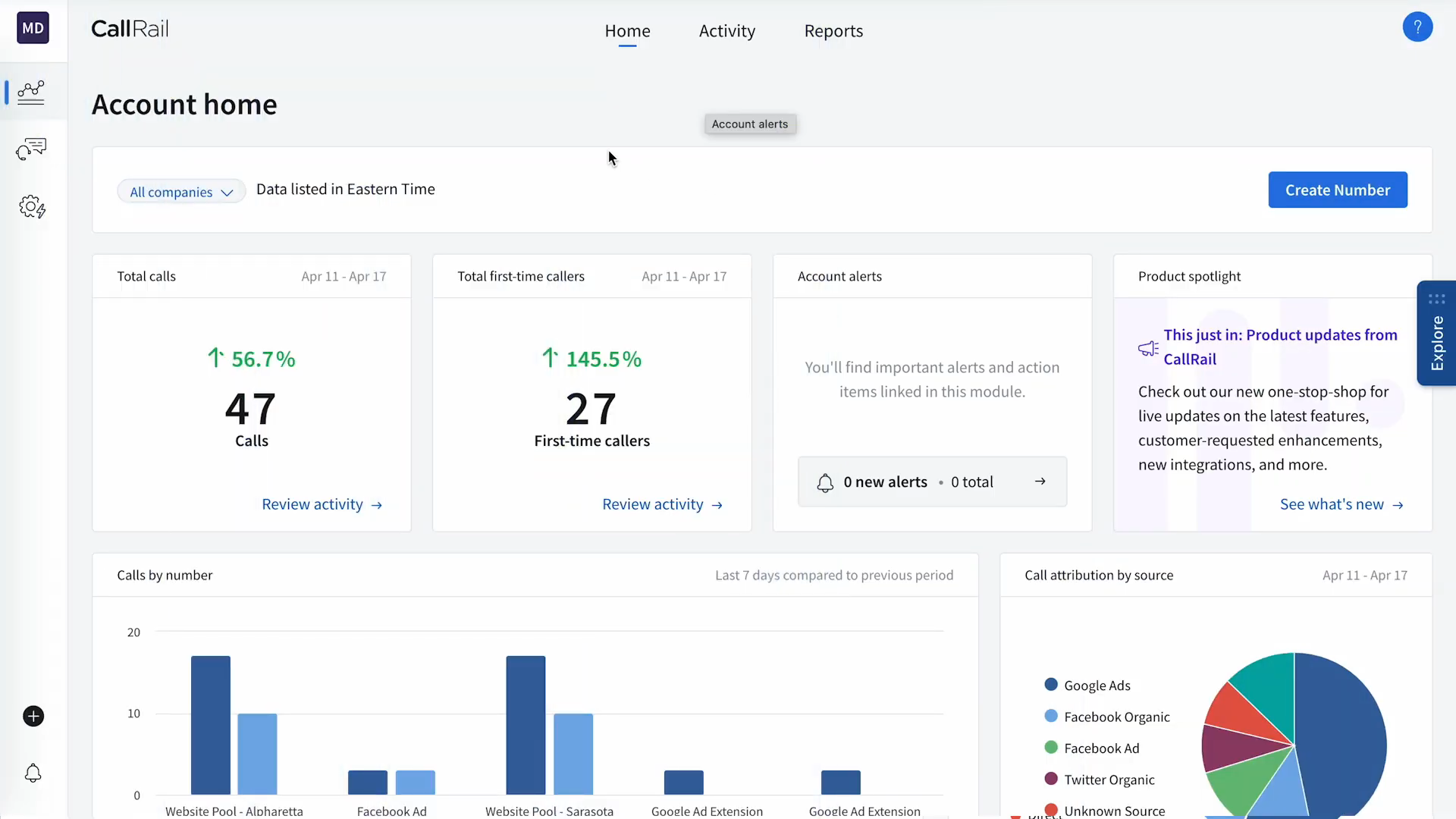
CallRail is designed so a marketing agency can sign up, install a JavaScript snippet, and see keyword-level call attribution within hours. No sales call required. No implementation team. G2 reviewers describe setup as needing as little as two minutes.
The platform targets "high-consideration" industries where a conversation is required to close a sale (real estate, home services, legal, healthcare, and automotive), and where the buyer is a local business or the agency managing its marketing.
Source: CallRail
Invoca started in 2008 as RingRevenue, focused on pay-per-call performance marketing. It has since evolved into a conversation intelligence platform serving enterprises like Mayo Clinic, Verizon, AutoNation, DIRECTV, and Humana.
These organizations have dedicated marketing operations teams, national contact centers, and paid media budgets large enough to justify a platform that requires custom implementation plans and quote-based pricing. When Invoca acquired DialogTech in 2021, it consolidated much of the enterprise call intelligence market.
Source: Invoca
The practical difference shows up on day one. A five-person marketing agency can have CallRail running across ten client accounts by lunch. An enterprise deploying Invoca across a 200-seat contact center with Signal AI, PreSense, and Genesys integration will measure implementation in weeks, with a dedicated onboarding team assigned from the start.
Neither approach is wrong. CallRail chose accessibility. Invoca chose depth. The question is which your business needs.
Call attribution: both close the gap, at different depths
Both CallRail and Invoca use Dynamic Number Insertion (a JavaScript snippet that swaps phone numbers on your website based on visitor source) to attribute calls to specific campaigns, keywords, and channels.
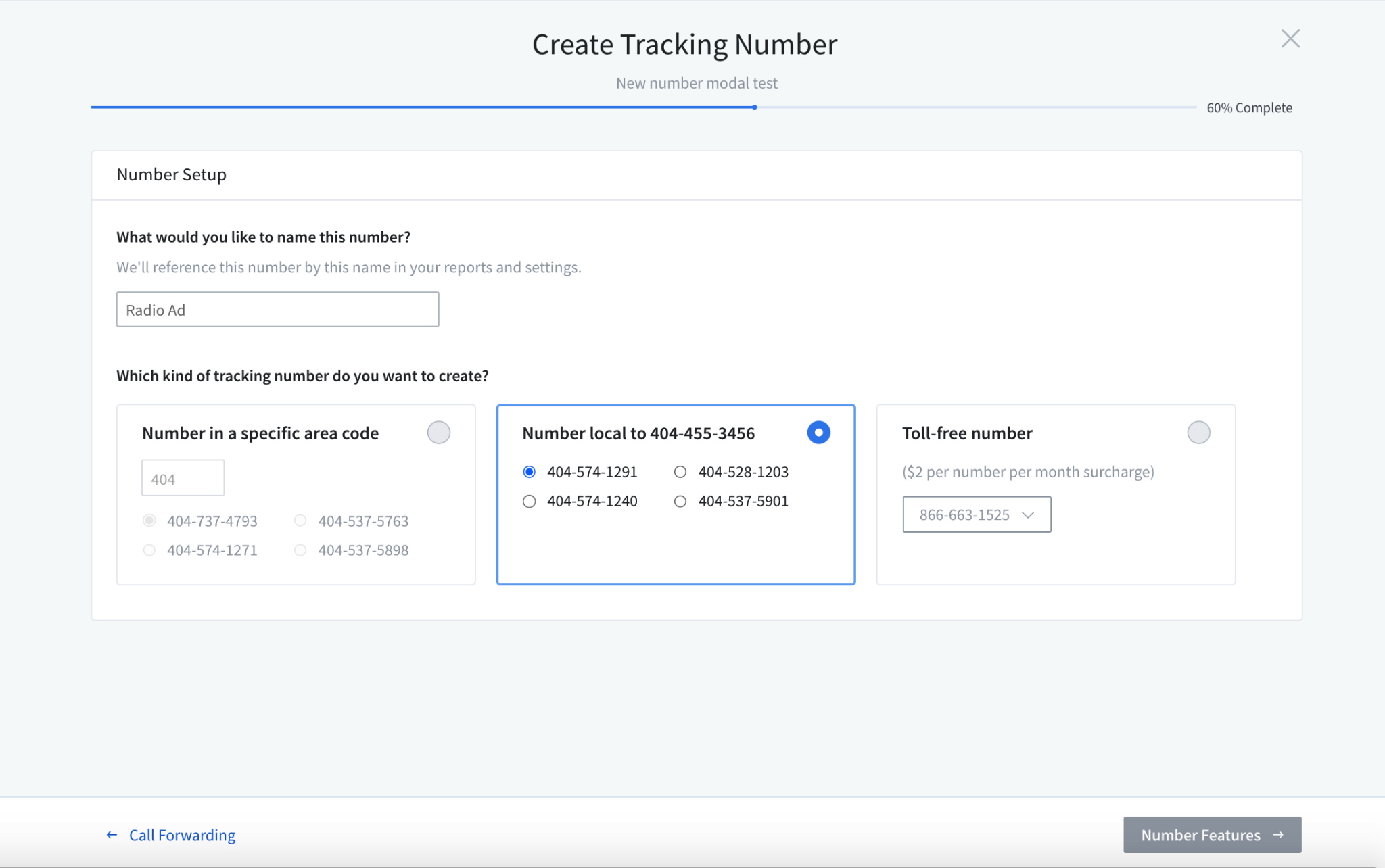
CallRail supports three attribution levels: source-level (one number per channel), campaign-level (triggered by URL parameters), and visitor-level (a pool of numbers assigned per session for full keyword attribution).
Its five attribution models (First Touch, Lead Creation, 50/50, W-Shaped, and Qualified) bring pipeline-oriented attribution to SMBs. The Google Ads integration pushes call conversions back as offline conversions with a 90-day lookback window, feeding Smart Bidding directly. CallRail also tracks offline channels (billboards, print, radio) with static tracking numbers. And in June 2026, CallRail became the first to offer ChatGPT ad attribution for SMBs.
Source: CallRail
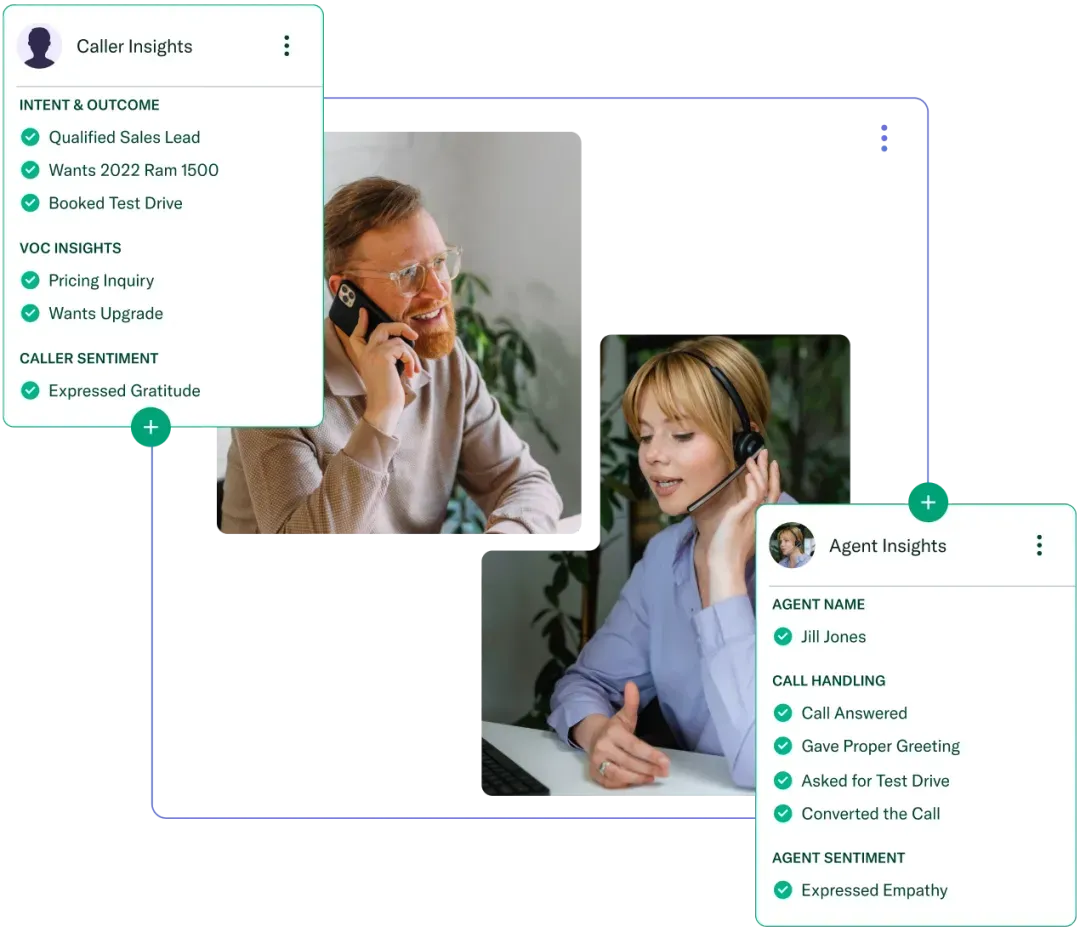
Invoca goes deeper. Beyond standard DNI and keyword attribution, its Signal AI adds an outcome layer: it doesn't just track that a call happened, it detects whether the caller booked an appointment, purchased a policy, mentioned a competitor, or followed the compliance script.
Those structured outcomes ("Signals") are pushed to Google Ads, Meta, Microsoft Ads, and TikTok in real time, so ad platforms can optimize for revenue events rather than raw call volume. Invoca also covers channels most attribution tools can't touch: CTV and streaming ads via integrations with tvScientific, iSpot, and Innovid. Like CallRail, Invoca has integrated with ChatGPT Ads for AI search attribution.
Source: Invoca
The distinction matters most in what gets sent back to ad platforms. CallRail sends call events. Invoca sends call outcomes. For a business spending $10,000/month on Google Ads, the difference between "this keyword generated 50 calls" and "this keyword generated 12 booked appointments worth $34,000" can reshape an entire budget allocation.
Conversation intelligence: call summaries vs. structured signals
Both platforms transcribe calls and apply AI analysis. The implementations diverge.
CallRail's Conversation Intelligence uses AssemblyAI's speech model to transcribe calls with speaker labeling, then applies automation rules to flag keywords, score leads, and tag calls.
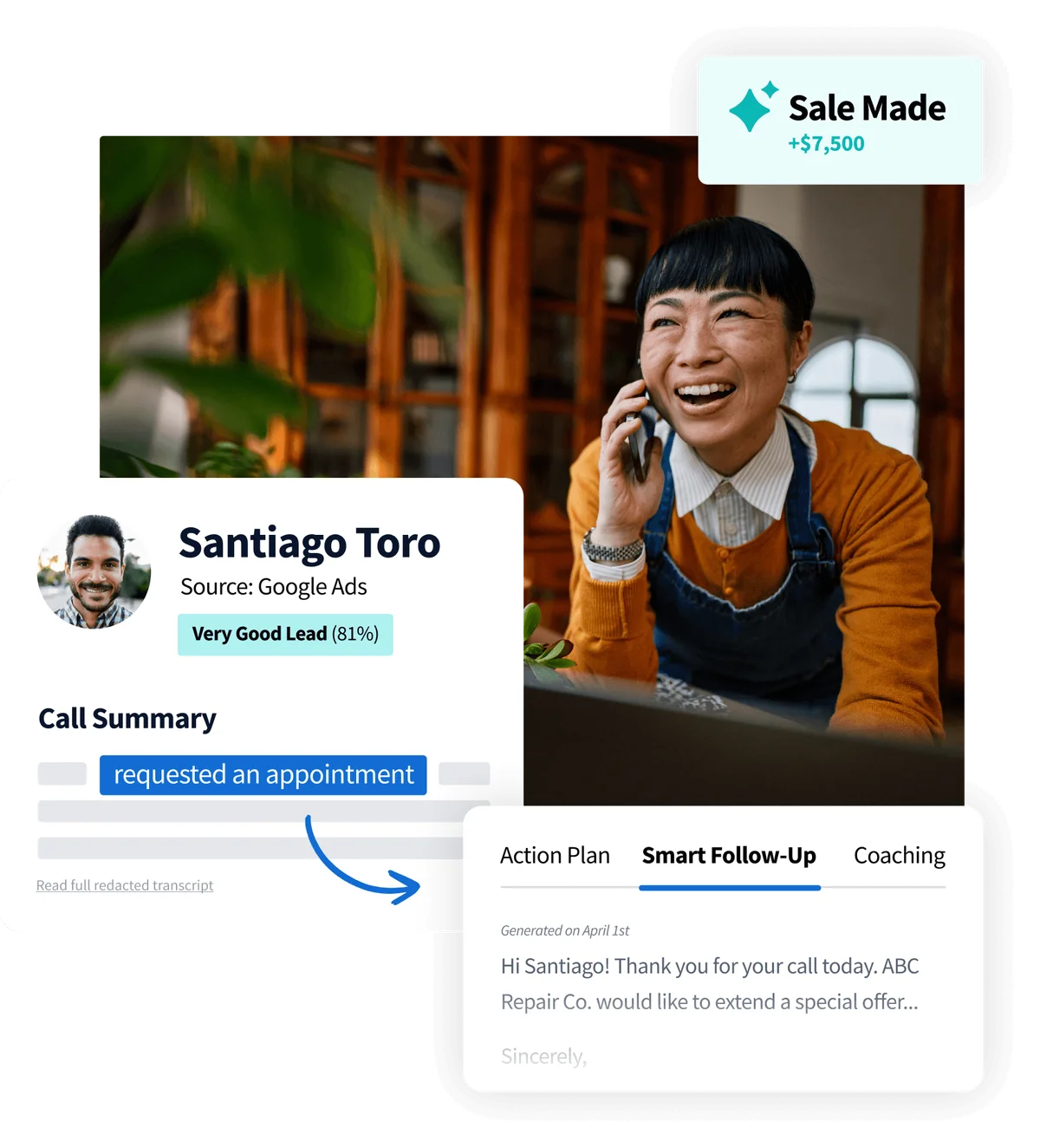
The Premium tier adds AI call summaries, dual sentiment scoring (caller and agent rated separately), and self-reported attribution that captures how callers say they found the business.
CallRail's Convert Assist goes further, generating AI action plans, follow-up drafts, and coaching suggestions that evolve across a lead's full call history, not just the most recent conversation.
Source: CallRail
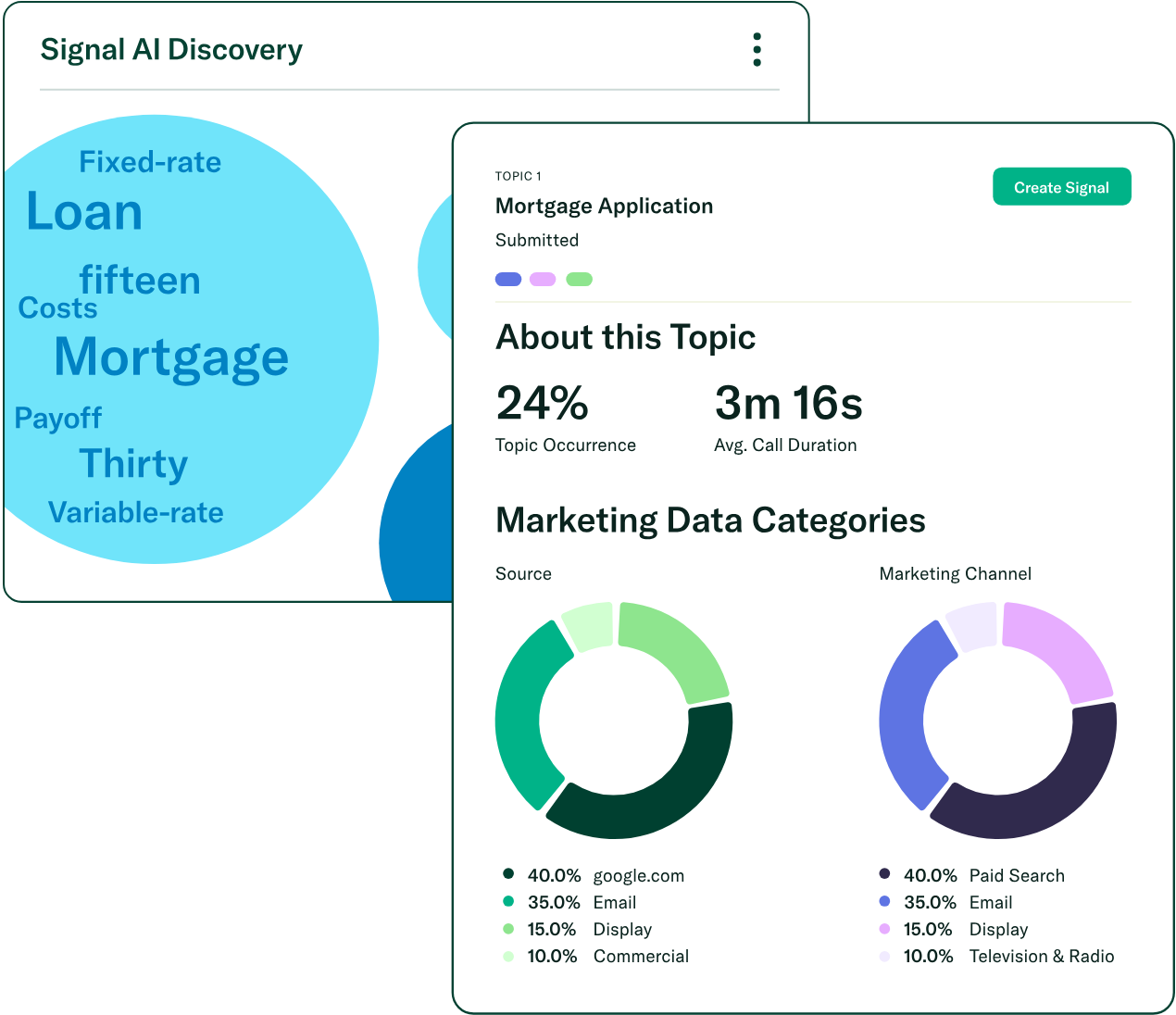
Invoca's Signal AI is a multi-layer pipeline: generative AI transcription trained on nearly 1 million hours of supervised audio, custom Signal creation via Signal AI Studio (a no-code interface where users type what they want to detect, like "Did the caller book an appointment?", and the system trains a model on their own calls), Signal AI Discovery (unsupervised ML that clusters thousands of calls to surface unexpected trends), and Signal AI Autocapture (entity recognition that extracts structured data like vehicle year, make, and model from conversations).
Source: Invoca
The difference in approach reflects the difference in buyer. CallRail gives an SMB marketer a fast read on whether calls are good leads. Invoca gives an enterprise marketing ops team a programmable AI layer that feeds structured conversion signals into their martech and ad tech stack.
Contact center capabilities set Invoca apart
This is where the gap between the two platforms is widest.
CallRail deliberately exited the contact center space in January 2026 when it sunset Lead Center (its VoIP/softphone product), replacing it with a RingCentral integration.
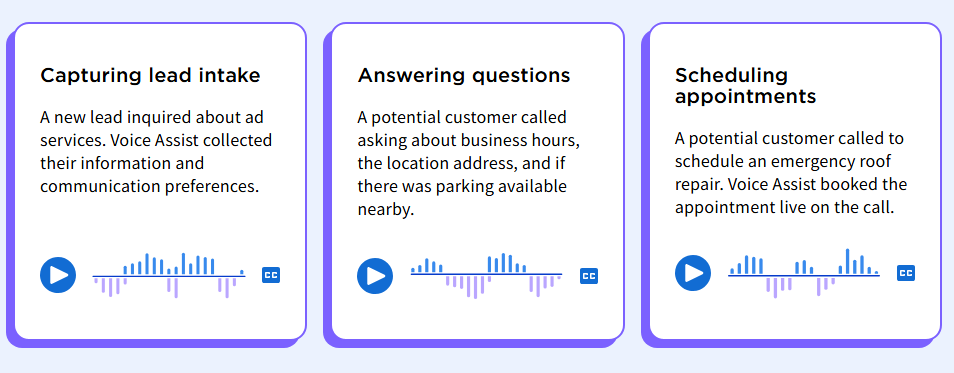
CallRail's AI answering product, Voice Assist, handles overflow and after-hours calls, capturing leads, qualifying them, and sending SMS follow-ups. But it's designed for small teams, not contact centers. At $95/month for 50 answered calls, it fills a staffing gap for small businesses rather than replacing agents.
Source: CallRail
Invoca is building a contact center intelligence platform.
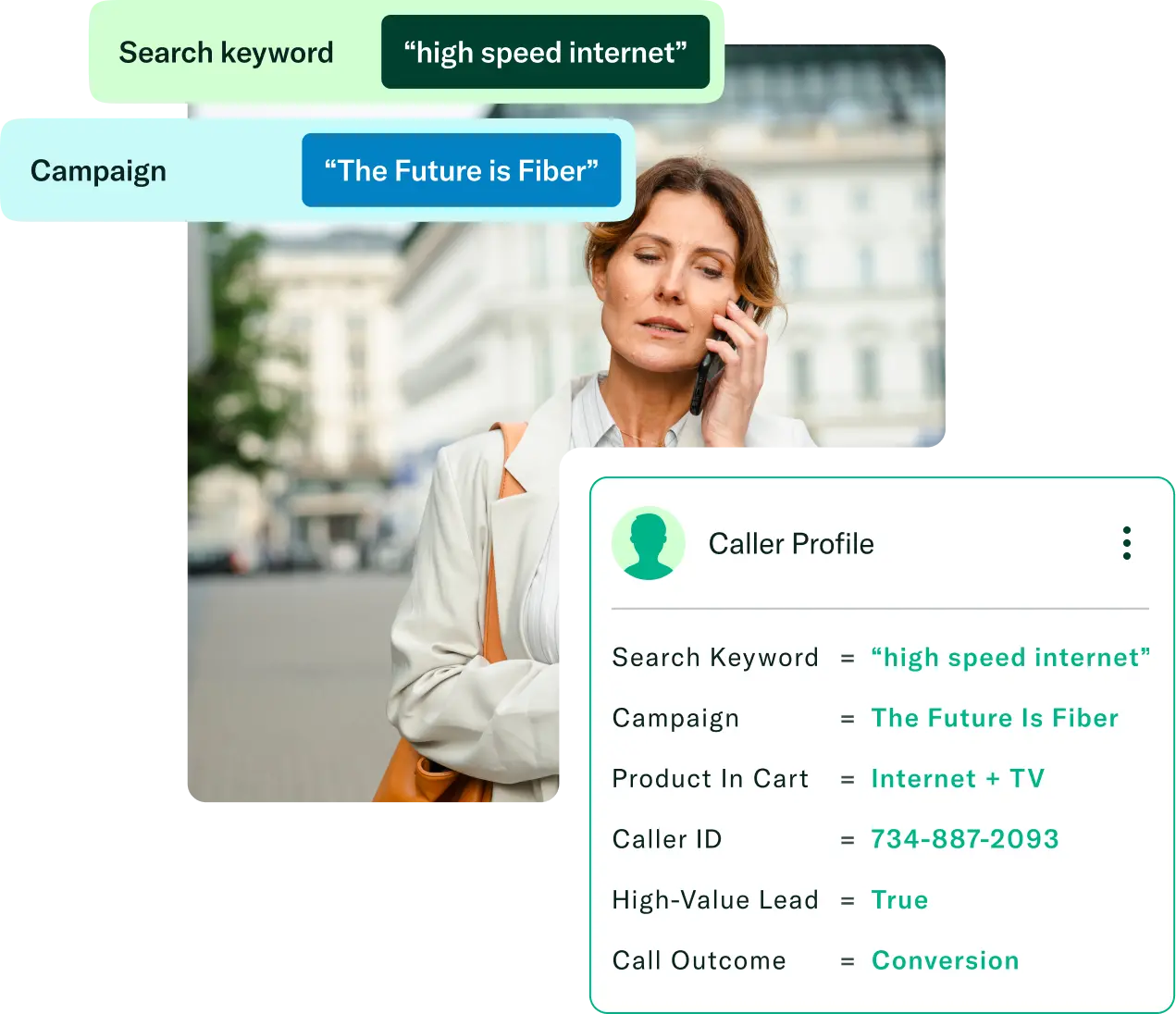
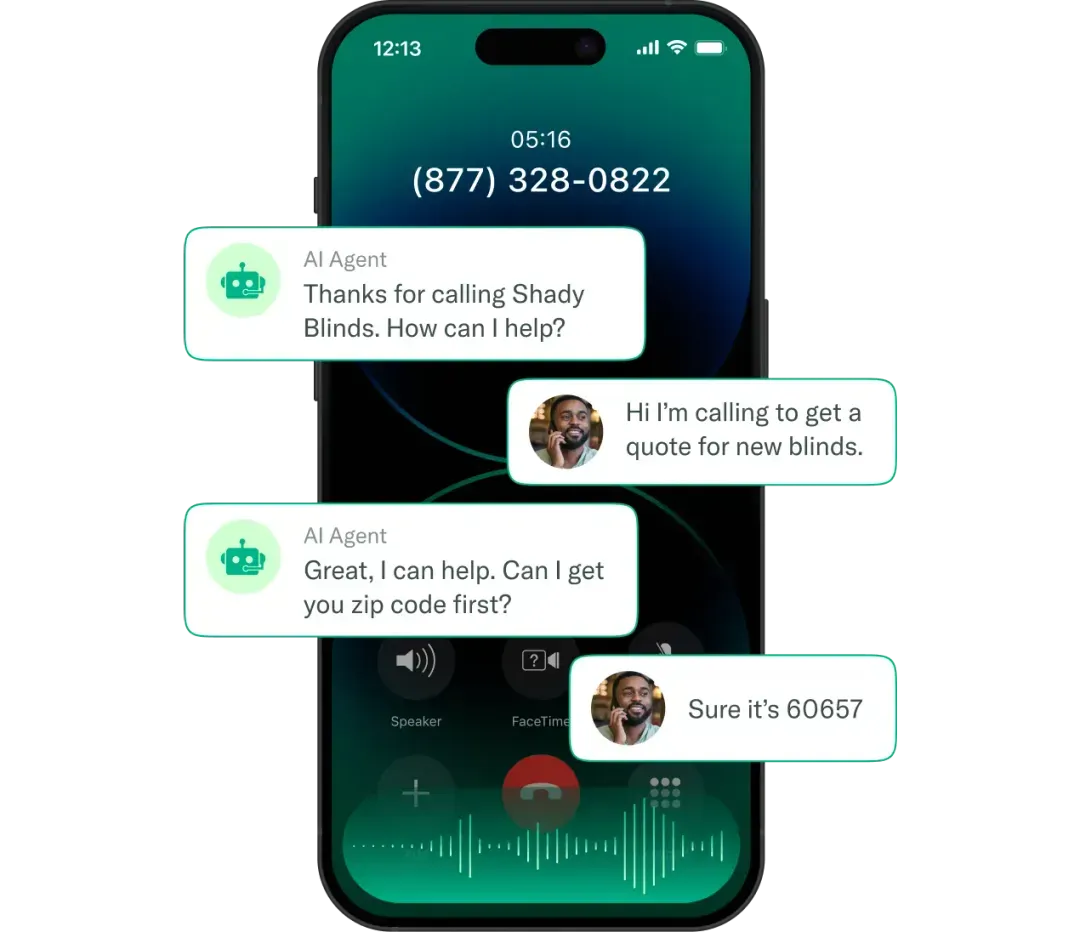
PreSense captures a caller's pre-call digital journey (search keywords, ads clicked, pages viewed, cart contents) and delivers it to agents via screen pop before the call connects. Quality Management scores 100% of calls with AI scorecards, and Agent Voice ID identifies agents by voiceprint at roughly 95% accuracy without telephony integrations.
The AI Messaging Agent engages web form and phone leads via SMS, qualifying intent and booking appointments around the clock. The AI Voice Agent handles inbound calls with context from the caller's digital journey, determining next steps on the fly rather than following static scripts.
Source: Invoca
If your call tracking needs are "which Google Ads keyword drove this call," CallRail covers it. If you're running a contact center and need to score every agent interaction, route callers by intent, and tie agent behavior to revenue outcomes, Invoca is the platform for that job.
Pricing comparison: transparent vs. enterprise-quoted
CallRail publishes its pricing and offers self-serve signup. Plans range from roughly $55/month (Call Tracking only) to $215/month (all products bundled), with each plan including 5 local tracking numbers and 250 call minutes. A 14-day free trial requires no credit card.
The caveat: the base plan's included allowances are tight. Real-world usage generates overages on minutes, phone numbers, and transcription. G2 and Capterra reviewers flag unexpected billing increases, and AI features (Conversation Intelligence, Convert Assist, Voice Assist) are locked behind higher tiers or priced as add-ons.
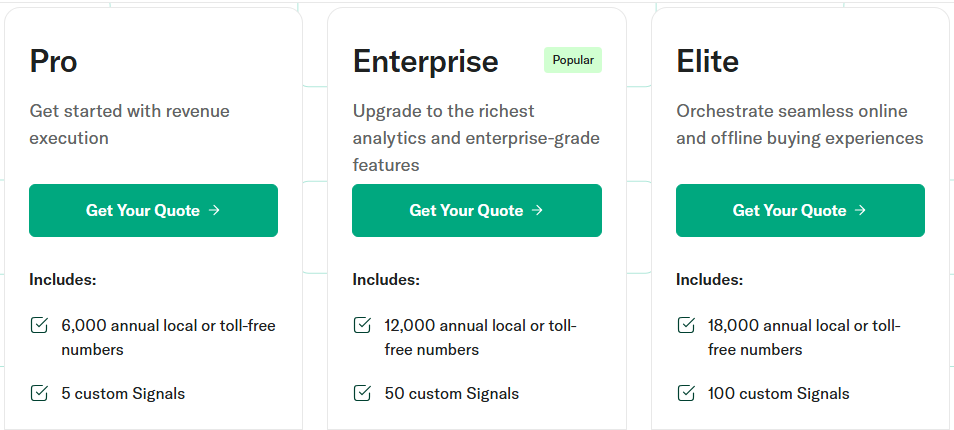
Invoca does not publish pricing. Both the Pro and Enterprise tiers show "Get Your Quote" rather than dollar figures.
The Enterprise tier includes 12,000 annual phone numbers, 50 custom Signals, transcription, AI call summaries, sentiment analysis, Quality Management, and Agent Voice ID. Signal AI, PreSense, and premium integrations (Salesforce, Adobe) are add-ons with separate quotes. Contracts auto-renew for 12 months with a 10% annual price escalation, and fees are non-refundable.
Source: Invoca
G2 reviewers consistently flag cost as a top concern, describing Invoca as "significantly higher than others" and "difficult for small business owners to justify." This isn't a flaw. It reflects a platform built for organizations where a single call can be worth thousands of dollars, and where ROI is measured by close-rate improvements, not monthly subscription costs.
The pricing philosophies reveal each platform's market bet. CallRail bets on volume: 225,000+ customers at accessible monthly rates. Invoca bets on depth: fewer customers at higher contract values, justified by enterprise AI and compliance. Both reached $100M+ ARR taking these different paths.
ZoomInfo adds the intelligence layer both platforms lack
CallRail and Invoca both answer the question "which marketing drove this call." Neither answers "who is this caller in the B2B landscape, what is their company researching, and which similar accounts should we be reaching proactively?"
That's the gap ZoomInfo fills.
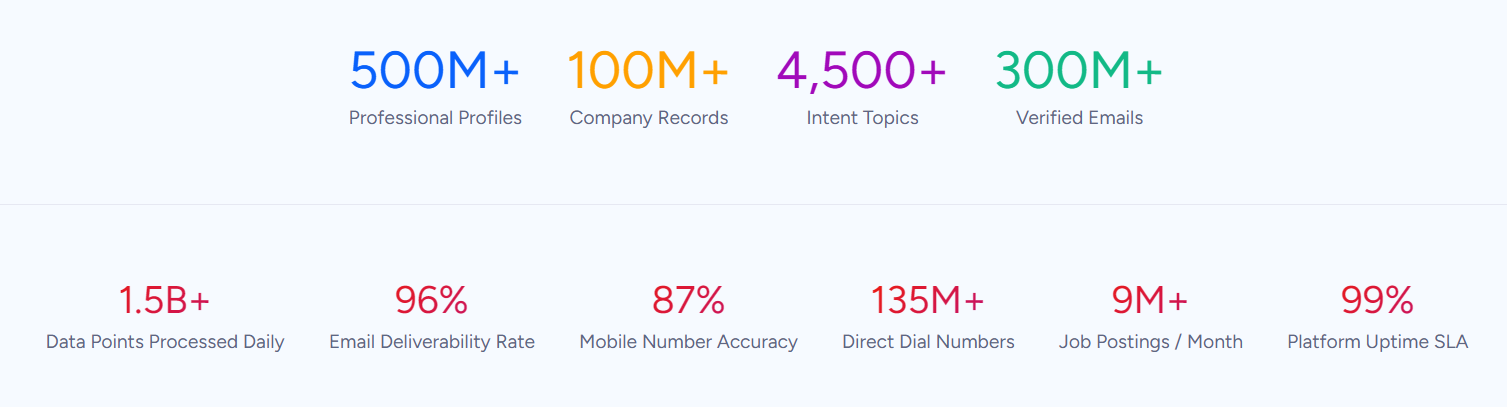
ZoomInfo is an AI GTM platform built on the largest B2B dataset available: 500M contacts, 100M companies, 135M+ verified phone numbers, and 200M+ verified business emails, verified through a multi-source pipeline backed by 300+ human researchers and reaching up to 95% accuracy on first-party data.
Source: ZoomInfo
Its GTM Context Graph processes 1.5B+ data points daily, combining this data with your CRM records, conversation transcripts, and behavioral signals to capture not just what happened in a deal, but why it happened.
For teams already using CallRail or Invoca, ZoomInfo adds three capabilities that call tracking platforms don't provide:
Account-level intelligence before the call.
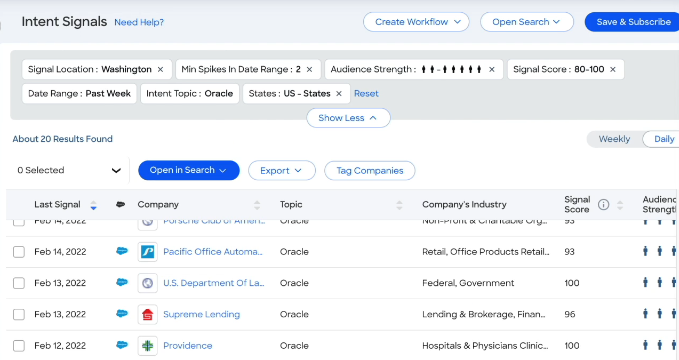
ZoomInfo's Buyer Intent data tracks signals from 210 million IP-to-Organization pairings to identify which companies are researching topics relevant to your business, before they ever pick up the phone. Instead of waiting for inbound calls to measure demand, you see demand forming in real time.
Source: ZoomInfo
B2B data enrichment on every caller.
When a call comes through CallRail or Invoca, you get a phone number and a name. ZoomInfo enriches that record with company attributes, org charts, tech stack, and seniority data, turning a call log entry into a complete account picture.
Proactive outbound execution.
CallRail and Invoca are inbound-first platforms. ZoomInfo's GTM Workspace gives sellers AI-powered outreach, account prioritization, and deal execution in one workspace. GTM Studio lets marketers build and launch multi-channel campaigns targeting accounts that match your actual win patterns. Both draw from the same GTM Context Graph, and both can be powered by the same intelligence available through APIs and MCP in any third-party tool.
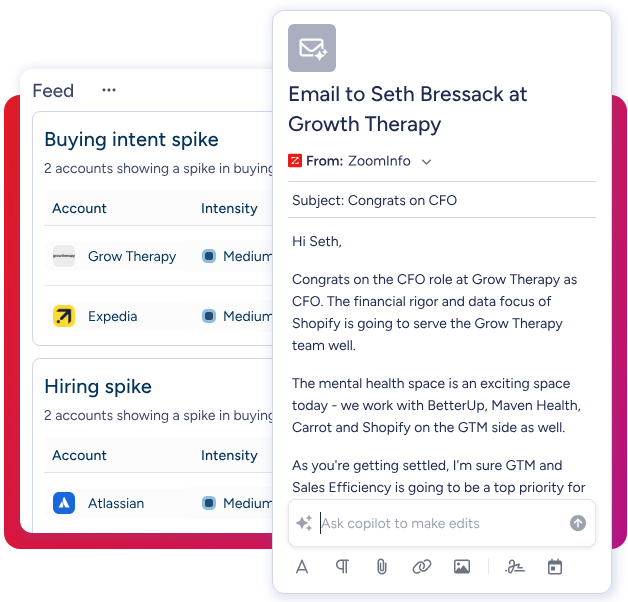
Source: ZoomInfo
Seismic's sales team attributed 39% of active pipeline to opportunities identified or influenced by ZoomInfo signals, boosted productivity by 54%, and saved 11.5 hours per week. (Seismic case study)
Call tracking tells you which marketing is working. ZoomInfo helps you act on that intelligence across every channel.
Support and compliance comparison
CallRail offers live chat, phone, and ticket support Monday through Friday.
Its compliance certifications include SOC 2 Type II, HIPAA with BAAs for healthcare accounts, and ISO 42001 for AI governance (the first in its category to achieve this). Support quality is a known concern: reviews on G2 and Capterra cite slow response times and unresolved issues spanning over a week, a frustration for agencies whose client tracking depends on uptime.
Invoca provides dedicated onboarding teams, videoconference, phone, and email support, and 24/7 platform monitoring.
Its compliance certifications cover a wider set: SOC 2 Type 2, ISO 27001, HIPAA with BAA, PCI DSS, GDPR, CCPA, and TRUSTe, with 99.999% reported uptime. G2 reviewers praise onboarding but note that post-onboarding support shifts to a ticket-only model.
ZoomInfo holds ISO 27001, ISO 27701, SOC 2 Type II, TRUSTe GDPR, and TRUSTe CCPA certifications, all renewed annually.
Support includes a Help Center, ZoomInfo University, and dedicated phone support, plus professional services through ZoomInfo Labs. Enterprise customers receive a structured 90-day onboarding program that won Rocketlane's Best Customer Onboarding Team award.
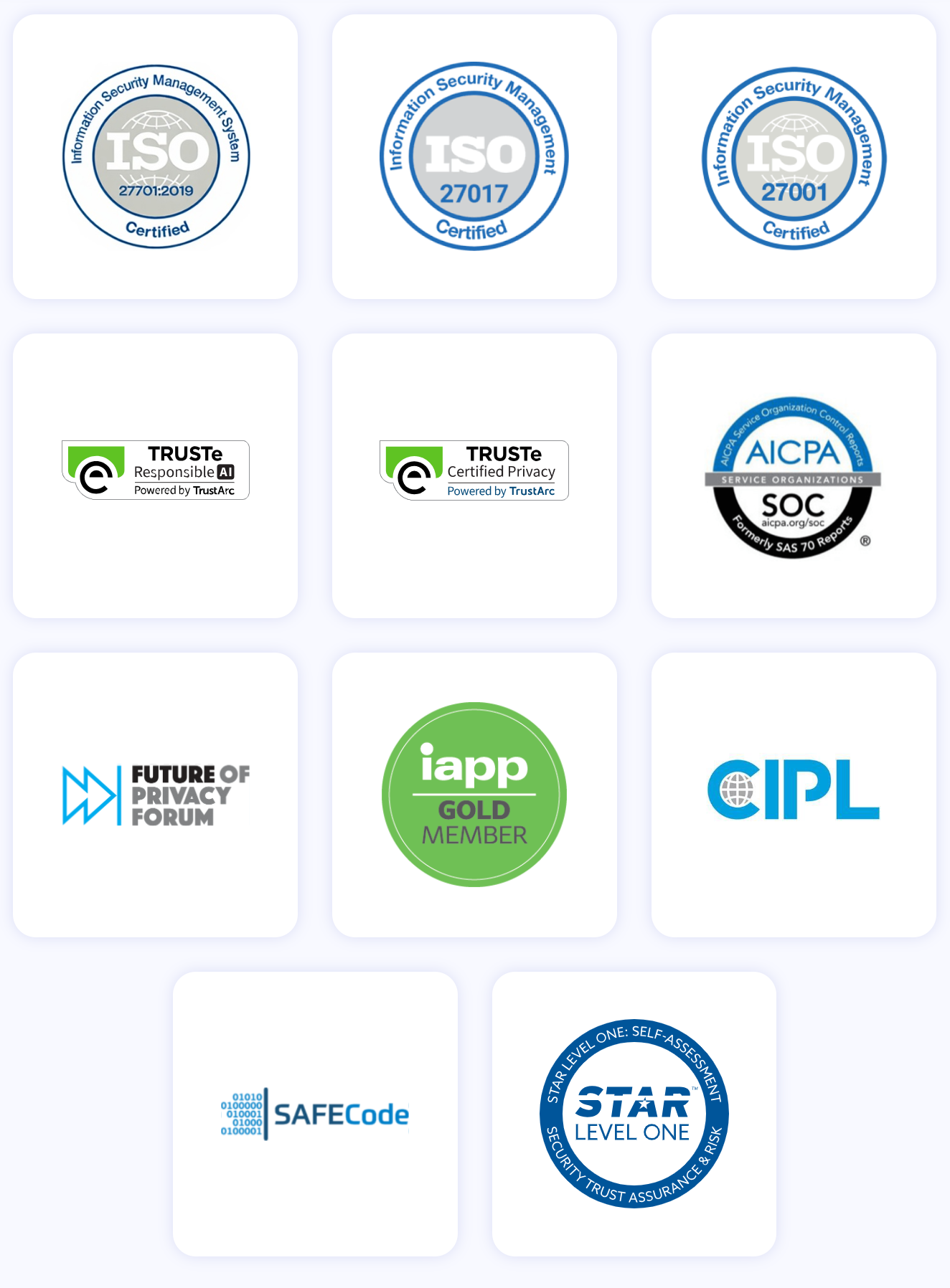
For regulated industries (healthcare, financial services, insurance), Invoca's PCI DSS and ISO 27001 certifications provide the broadest compliance coverage among the call tracking platforms. CallRail's HIPAA support covers healthcare specifically. ZoomInfo's ISO 27701 certification addresses data privacy management for organizations handling personal data at scale.
CallRail vs. Invoca vs. ZoomInfo: Which should you choose?
The choice depends on your business size, call volume, and what you need from call data.
Choose CallRail if:
You're an SMB or marketing agency managing call tracking across multiple clients
Transparent, self-serve pricing matters more than enterprise features
You need fast setup with minimal technical resources
Your primary goal is proving which campaigns drive phone calls
You operate in the US, Canada, UK, or Australia
Choose Invoca if:
You're an enterprise with a dedicated marketing operations team and contact center
You need AI that detects call outcomes (not just call volume) and feeds them to ad platforms
Pre-call digital journey data for agent screen pops would improve your close rates
100% automated QA scoring is more valuable than manual call review
HIPAA, PCI DSS, and ISO 27001 compliance are requirements
Add ZoomInfo if:
You want to know who's calling before they call, including their company, buying intent, and position in the org chart
Your GTM strategy spans both inbound call tracking and proactive outbound
You need B2B data enrichment on every lead that comes through your call tracking platform
You want AI that connects conversation intelligence to account-level intelligence
Your team builds with APIs, and ZoomInfo's MCP server and Enterprise API can embed B2B intelligence in any tool
Explore ZoomInfo with a free trial or the permanent ZoomInfo Lite tier.
CallRail and Invoca both close the attribution gap between digital marketing and phone conversations. The right choice between them depends on scale: CallRail makes call tracking accessible to any business; Invoca makes it enterprise-grade.
ZoomInfo doesn't replace either platform. It adds the B2B intelligence layer that turns call attribution data into a complete revenue picture, connecting who's calling to why they're calling and which similar accounts your team should reach next.
CallRail vs. Invoca vs. ZoomInfo FAQ
What is the main difference between CallRail and Invoca?
CallRail is designed for SMBs and marketing agencies, with self-serve signup, transparent pricing starting around $45/month, and fast setup for call tracking and marketing attribution.
Invoca is built for enterprises with dedicated marketing operations teams, offering AI-powered conversation intelligence (Signal AI), pre-call digital journey data for agents (PreSense), and 100% automated quality management, all through custom-quoted pricing with dedicated onboarding support.
How does ZoomInfo fit into a call tracking stack?
ZoomInfo is not a call tracking platform. It's an AI GTM platform that complements CallRail or Invoca by adding B2B intelligence: 500M contacts, 100M companies, buyer intent signals, and the GTM Context Graph.
Where CallRail and Invoca tell you which marketing drove a call, ZoomInfo tells you who the caller is in the B2B landscape, what their company is researching, and which similar accounts your team should target proactively.
Which platform is more affordable for a small business?
CallRail is more accessible, with public pricing starting around $55/month and a 14-day free trial requiring no credit card. Invoca does not publish pricing and requires a custom quote, with G2 reviewers consistently noting the cost is hard for small businesses to justify. ZoomInfo offers a permanent free tier (ZoomInfo Lite) with 10 monthly export credits and a 7-day paid trial, though its full platform is enterprise-priced.
Can CallRail or Invoca track calls from offline marketing channels?
Both platforms track offline channels using static tracking numbers assigned to specific placements. CallRail supports billboards, direct mail, print, TV, and radio. Invoca extends this with dedicated CTV and streaming ad attribution through integrations with tvScientific, iSpot, and Innovid. Both platforms also now offer attribution for AI search channels like ChatGPT.
Which platform has better AI capabilities?
Invoca's AI is more extensive. Signal AI trains custom models on a business's own calls to detect specific outcomes. Signal AI Discovery surfaces unexpected trends through unsupervised ML. Quality Management scores 100% of calls with AI scorecards and biometric agent identification.
CallRail's AI (Conversation Intelligence, Convert Assist, and Voice Assist) works well for call summaries, lead qualification, and after-hours coverage, but is designed for SMB scale rather than enterprise contact center automation.
Do any of these platforms require long-term contracts?
CallRail offers month-to-month plans with no long-term commitment, though annual plans (charged upfront and nonrefundable) offer modest savings. Invoca contracts are non-cancellable by default, auto-renew for 12 months, and include a 10% annual price escalation. ZoomInfo uses annual contracts as standard, with multi-year commitments available for pricing advantages.
Which platform has the broadest compliance certifications?
Invoca holds the broadest set relevant to call tracking: SOC 2 Type 2, ISO 27001, HIPAA with BAA, PCI DSS, GDPR, CCPA, and TRUSTe. CallRail holds SOC 2 Type II, HIPAA with BAA, and ISO 42001 (the first in its category for responsible AI governance). ZoomInfo holds ISO 27001, ISO 27701, SOC 2 Type II, and TRUSTe GDPR/CCPA certifications, renewed annually.
What happens if my business outgrows CallRail?
CallRail is optimized for SMBs and agencies. If your call volume scales to enterprise levels and you need multi-location QA, agent-level performance analytics, or contact center integrations (Genesys, Five9), Invoca is the natural step up. Adding ZoomInfo alongside either platform provides the B2B intelligence (buyer intent, account data, and proactive outbound) that call tracking platforms alone don't offer.
Keep comparing your options:
