
Comparing CiviCRM and SugarCRM starts with a question most reviews skip: these platforms were built for different organizations solving different problems.
Before choosing, answer these honestly:
Are you a nonprofit managing donors, members, and volunteers, or a B2B company managing sales pipelines and customer accounts?
Do you need open-source flexibility with full data ownership, or commercial support with a polished interface?
Is your priority constituent engagement (fundraising, events, memberships) or revenue growth (pipeline, forecasting, ERP integration)?
Do you have technical staff to manage a self-hosted system, or do you need a vendor-managed cloud platform?
Beyond managing the relationships you already have, do you need intelligence about who to contact next, when to reach out, and what to say?
In short, here's what we recommend:
CiviCRM is built for nonprofits and civic organizations that want full control over their constituent data without per-seat licensing fees. As free, open-source software used by 14,000+ organizations worldwide, it consolidates donor tracking, event registration, membership management, bulk email, and case management in a single system that runs inside WordPress, Drupal, or Joomla. The trade-off: a dated interface, a steep learning curve, and implementation expertise that can make "free software" surprisingly expensive to deploy.
SugarCRM (now rebranding as SugarAI) is built for B2B companies in manufacturing, wholesale, and distribution that need a sales CRM connected to their ERP system. Its Sugar sales-i product analyzes ERP order data to surface cross-sell opportunities, churn risks, and reorder signals inside the CRM. Named a Leader by Nucleus Research six years running, SugarCRM serves relationship-driven industrial sales well. But it requires a 15-user minimum, carries a learning curve for non-technical users, and its interface lags behind newer competitors.
Both platforms manage relationships well. Neither generates intelligence about who those relationships should be with. For B2B organizations, the gap between managing existing contacts and finding new opportunities is where revenue is won or lost.
ZoomInfo is a go-to-market intelligence platform that provides the intelligence layer CRMs cannot generate on their own. Built on 500M contacts, 100M companies, 135M+ verified phone numbers, and 200M+ verified business emails, ZoomInfo's GTM Context Graph combines this data with your CRM records, conversation transcripts, and behavioral signals to show not just what happened in your accounts, but why. Sales teams use GTM Workspace for daily execution. Marketers and RevOps use GTM Studio to design and launch plays. Developers can pipe the same data into any tool through APIs and MCP. ZoomInfo integrates with SugarCRM and other major CRMs, adding intelligence to your existing system of record.
If B2B data and go-to-market intelligence sound like what's missing from your CRM strategy, ZoomInfo is worth evaluating.
CiviCRM vs. SugarCRM vs. ZoomInfo at a glance
CiviCRM | SugarCRM | ZoomInfo | |
|---|---|---|---|
Core function | Constituent relationship management | Sales CRM with ERP intelligence | Go-to-market intelligence platform |
Contact database | Your data only (self-hosted) | Your data only (cloud or on-premises) | 500M contacts, 100M companies + your CRM data |
Data ownership | Full ownership (self-hosted) | Vendor-hosted or on-premises option | Vendor-hosted with API/MCP access |
Key strength | Zero licensing cost, full customization | ERP-connected sales intelligence | B2B data and buyer intent signals |
Learning curve | Steep (requires technical expertise) | Moderate to steep | Moderate (deploys in weeks) |
Best integrations | WordPress, Drupal, Joomla, Backdrop | 180+ ERP systems | Salesforce, HubSpot, Dynamics + 172 marketplace partners |
AI capabilities | Community-developed (n8n, self-hosted AI) | Embedded AI for prioritization and guidance | GTM Context Graph processing 1.5B+ data points daily |
Security certifications | Operator-dependent (self-hosted); GDPR extension | SOC 2 Type II, ISO 27001, GDPR, CCPA | ISO 27001, SOC 2 Type II, ISO 27701, TRUSTe GDPR/CCPA |
Pricing model | Free open-source software | $59–$135/user/month (15-user minimum) | Custom-quoted, consumption-based; free tier available |
Built for | Nonprofits and civic organizations | B2B manufacturers, wholesalers, distributors | B2B sales, marketing, and RevOps teams |
These platforms serve fundamentally different organizations
The CiviCRM vs. SugarCRM comparison exposes a core question: what kind of organization are you?
CiviCRM was founded in 2005 as an open-source alternative to expensive proprietary CRMs for the nonprofit sector.
Its data model revolves around constituents, not customers. One person in CiviCRM can be a donor, a volunteer, an event attendee, and a member at the same time, with all those interactions visible on a single contact record. The platform has processed 116 million donations and 24 million event registrations across its install base.
It handles the workflows nonprofits need: donation pages with zero platform fees, membership management with automated renewals, event registration with waitlists and tiered pricing, case management for service delivery, and CiviMail for constituent communications drawn from live CRM data.
SugarCRM was founded a year earlier in 2004, originally as open-source, but has since gone fully commercial.
Its data model revolves around deals. Accounts, contacts, leads, and opportunities flow through a sales pipeline built for B2B selling cycles that can span months. SugarCRM has narrowed its focus to manufacturing, wholesale, and distribution, industries where ERP integration matters more than marketing automation breadth.
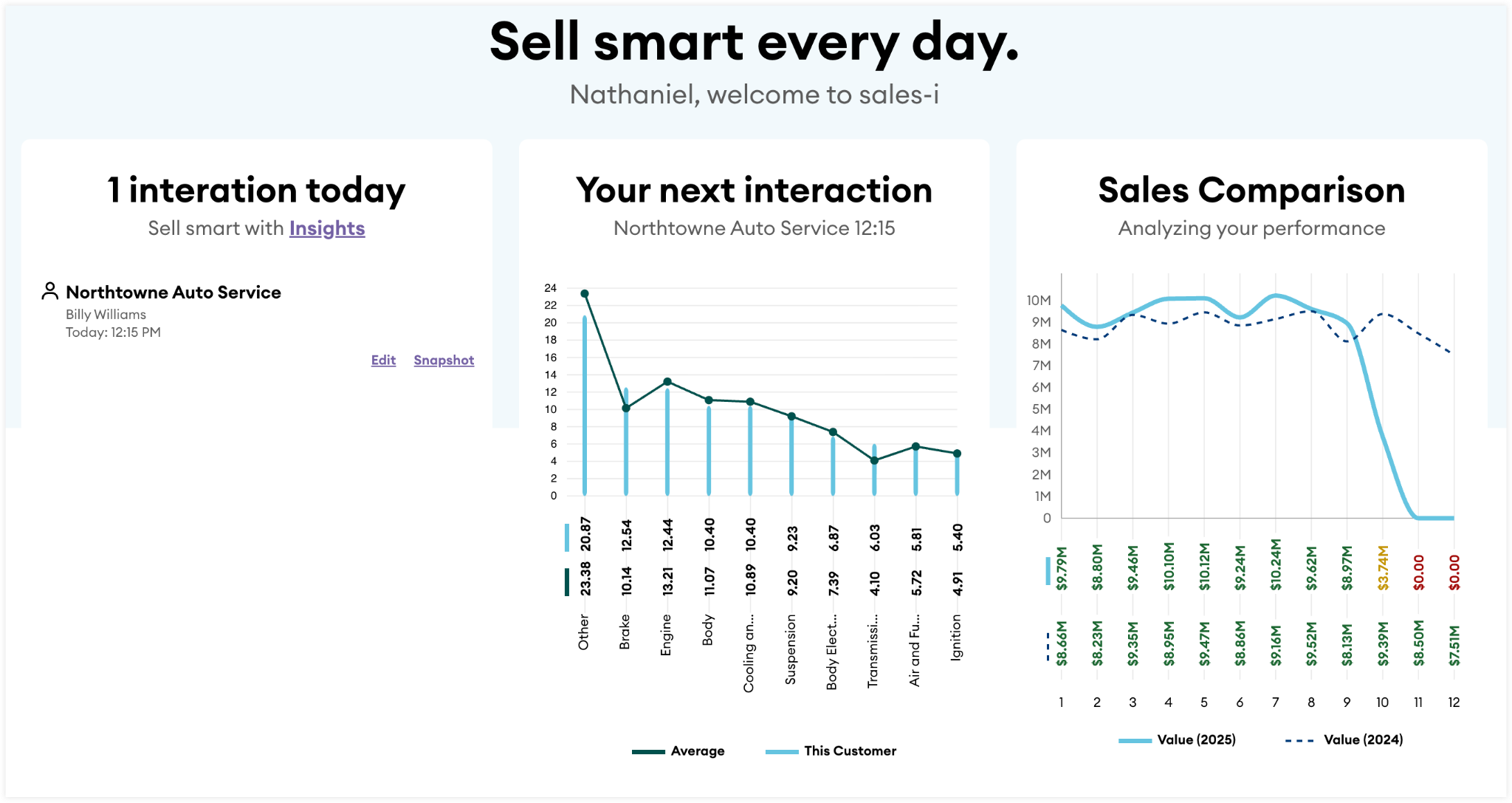
The key differentiator is Sugar sales-i, which ingests ERP transaction data to surface buying patterns, cross-sell opportunities, and churn risks without separate BI tools. The company reports 4,000+ customers across 120+ countries.
Source: SugarCRM
These aren't competing approaches to the same problem. A homeless shelter managing caseworkers and grant reporting has no use for ERP-connected sales intelligence. A valve manufacturer managing 500 B2B accounts has no use for membership renewal workflows.
The question isn't which platform is "better." It's which matches your organization's actual work.
Open source vs. commercial: more than a pricing decision
CiviCRM and SugarCRM both started as open-source projects. They've since diverged completely.
CiviCRM remains fully open source under the GNU AGPL v3 license.
Any organization can download, install, modify, and extend the software without paying licensing fees. The 7-person Core Team is funded by the community through partnerships, memberships, and services like CiviCRM Spark (hosted CiviCRM starting at $15/month) and CiviAcademy ($129 for lifetime training access).
The 2024 Annual Report disclosed a cash-basis loss of $99,831, and UI modernization budgets were suspended for 2026 due to funding shortfalls. This transparency is admirable, but it raises questions about the pace of product investment for buyers planning long-term.

Source: CiviCRM
The open-source model gives organizations a guarantee no commercial vendor can match: your data and customizations can never be taken away. If CiviCRM LLC disappeared tomorrow, the software would continue to exist. The founding vision states it plainly: organizations should "own their data and their code" and "modify and extend their CRM without restriction."
SugarCRM abandoned its open-source roots and now operates as a private company backed by Accel-KKR, a technology-focused private equity firm.
The commercial model funds product development, professional support, and the rebrand to SugarAI announced in April 2026. A new Chief Product Officer was appointed in October 2025 to accelerate AI development, and the IDC MarketScape named SugarCRM a Leader in Worldwide Sales Intelligence. That kind of R&D investment requires commercial revenue.
For nonprofits, CiviCRM's open-source model fits mission-driven budget discipline. For B2B companies, SugarCRM's commercial model provides the support and product velocity that dedicated funding makes possible. Neither model is wrong; they reflect different priorities.
Contact management reflects each platform's DNA
How each platform handles contacts reveals what it was designed for.
CiviCRM structures contacts around three core types: Individuals, Organizations, and Households.
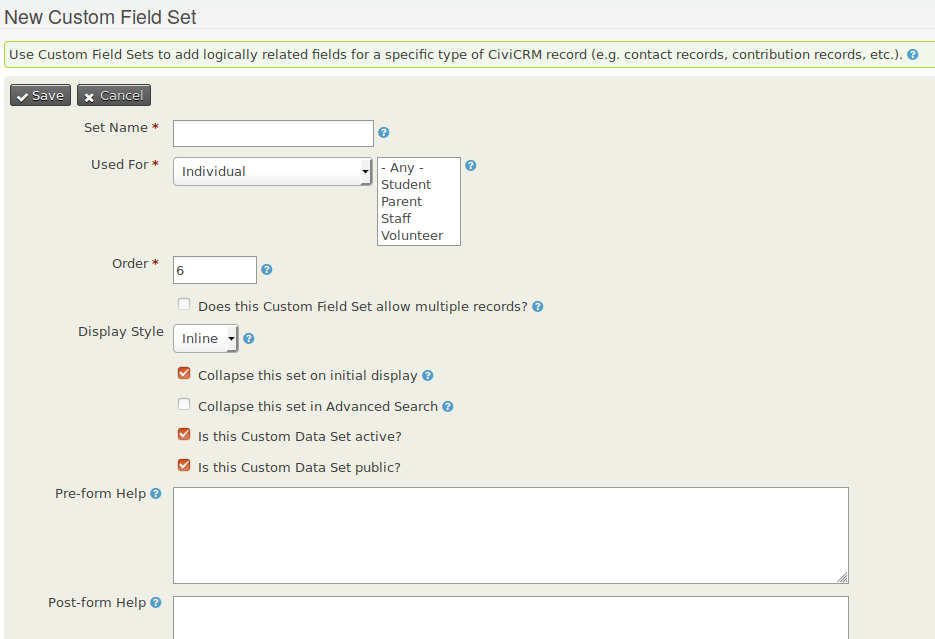
Each record accumulates activities from every module: donations flow into the Contributions tab, event registrations into the Events tab, membership status into the Memberships tab. Smart Groups auto-populate based on saved search criteria (for example, "all contacts who donated in the last 12 months and attended at least one event") and feed into CiviMail for targeted outreach. Custom fields spanning 20+ field types let organizations extend the data model without writing code.
This makes CiviCRM effective for organizations where the same person relates to them in multiple ways. A trade association member who also volunteers, donates annually, and joins advocacy campaigns appears as one record.
Source: CiviCRM
SugarCRM structures contacts around Accounts, Contacts, Leads, and Opportunities in a sales pipeline model.
Each record tracks pipeline activity: which deals are open, what stage they're in, what the rep's last interaction was. Sugar sales-i layers ERP transaction data on top, showing what the customer purchased, when, and at what margin. Guided workflows assign tasks based on deal size and timelines, keeping sales teams on process.
ZoomInfo approaches contacts from a different angle.
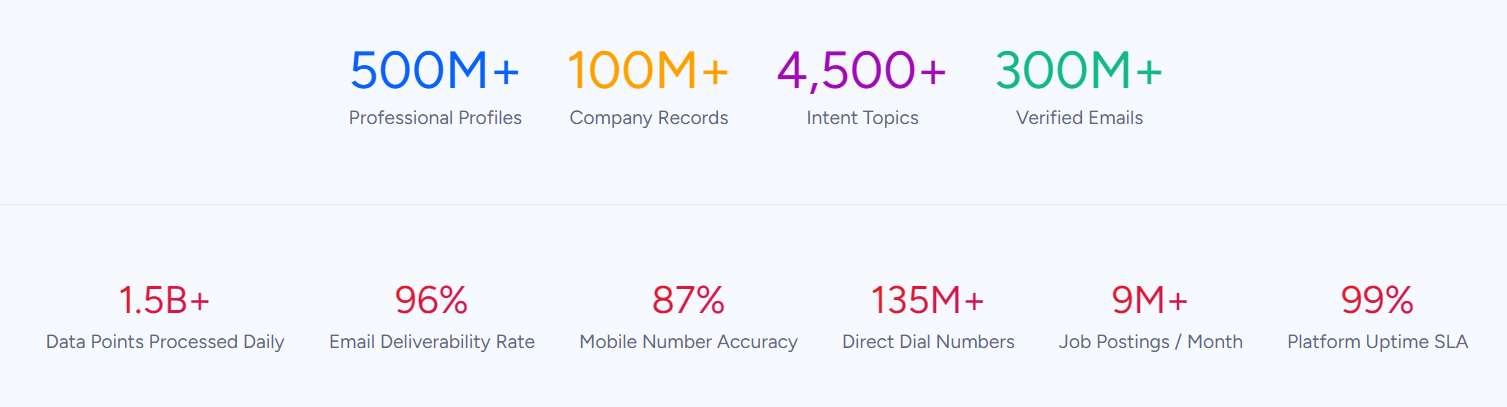
Rather than storing only the contacts your team has already identified, ZoomInfo starts with 500M contacts and 100M companies, verified through a multi-source pipeline backed by 300+ human researchers and achieving up to 95% accuracy on first-party data. When you open GTM Workspace, you see not just your existing accounts but which accounts are in-market, which contacts hold decision-making authority, and which signals suggest they're ready to buy, before your team has spoken to them.
In a Fortune 500 competitive RFP analyzing 25 million contacts across vendors, the independent consultant concluded that "no other competitor came even close."
Source: ZoomInfo
Seismic's sales team attributed 39% of active pipeline to opportunities identified or influenced by ZoomInfo signals, while boosting productivity by 54% and saving 11.5 hours per week per seller. (Seismic)
CRMs record what happened. Intelligence platforms tell you what to do next.
This is where the comparison shifts from CiviCRM vs. SugarCRM to a broader question about what your organization needs.
CiviCRM stores the constituent data your team enters: donation amounts, event attendance, membership renewals, case histories. SugarCRM stores the sales data your reps log: deal stages, call notes, forecasts, account interactions. Both are record systems. They capture your organization's history with its contacts.
Neither tells you who you're missing.
A nonprofit using CiviCRM knows every donor who has given. It doesn't know which corporate foundations in its region have funded similar causes. A manufacturer using SugarCRM knows every account its reps are working. It doesn't know which companies just hired a new VP of Operations and started researching its product category.
ZoomInfo fills that gap for B2B organizations.
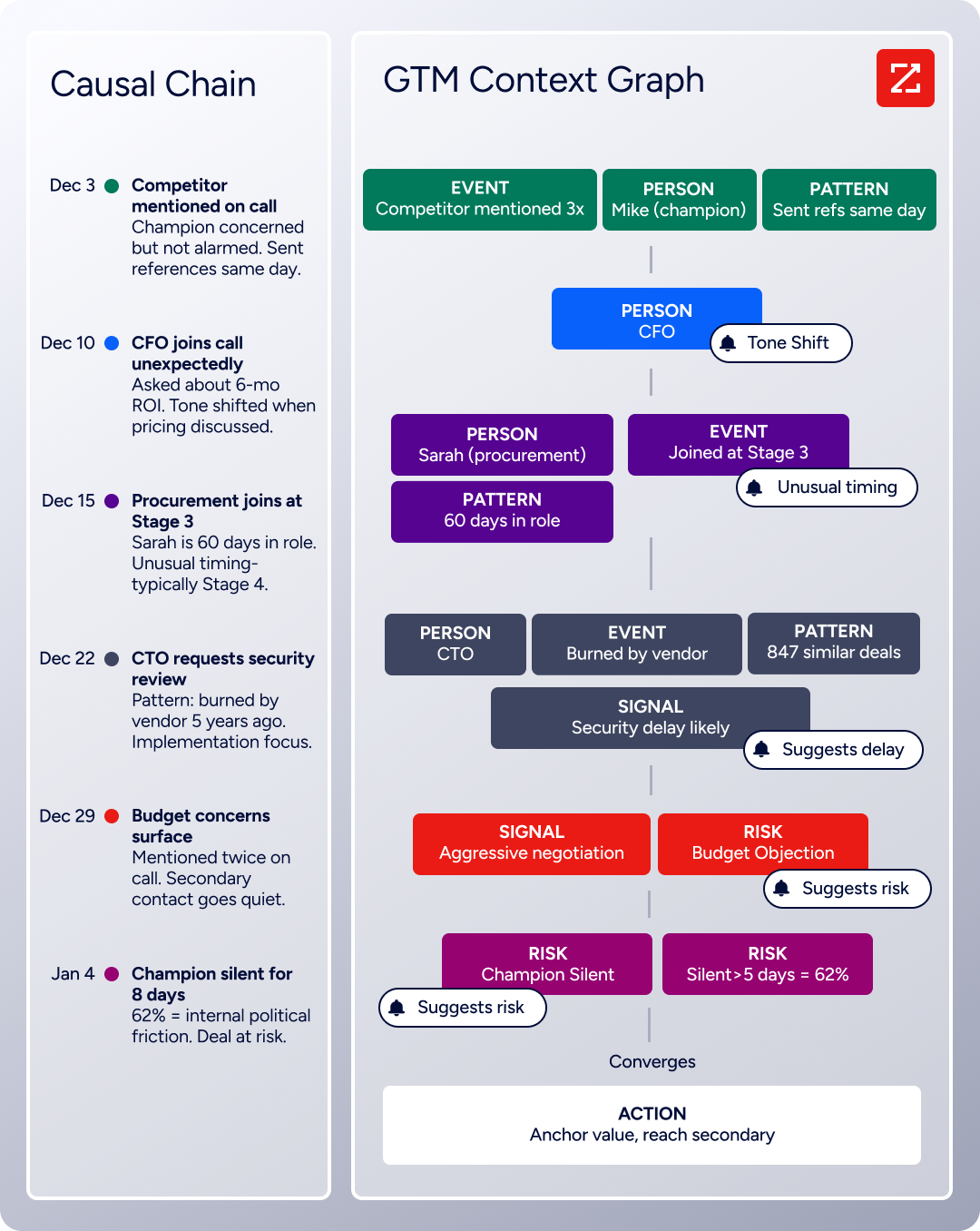
The GTM Context Graph processes 1.5B+ data points daily, combining ZoomInfo's third-party intelligence with your CRM records, conversation transcripts, and behavioral signals. The result: a layer that shows not just what happened in your accounts, but why.
A CRM records that a deal moved to Stage 3. The GTM Context Graph connects the dots: executive sponsorship entering at this stage, combined with ROI-focused questions on the last call, matches the pattern behind closed-won deals in your segment, and links to third-party signals showing the company is hiring and researching your competitors.
Source: ZoomInfo
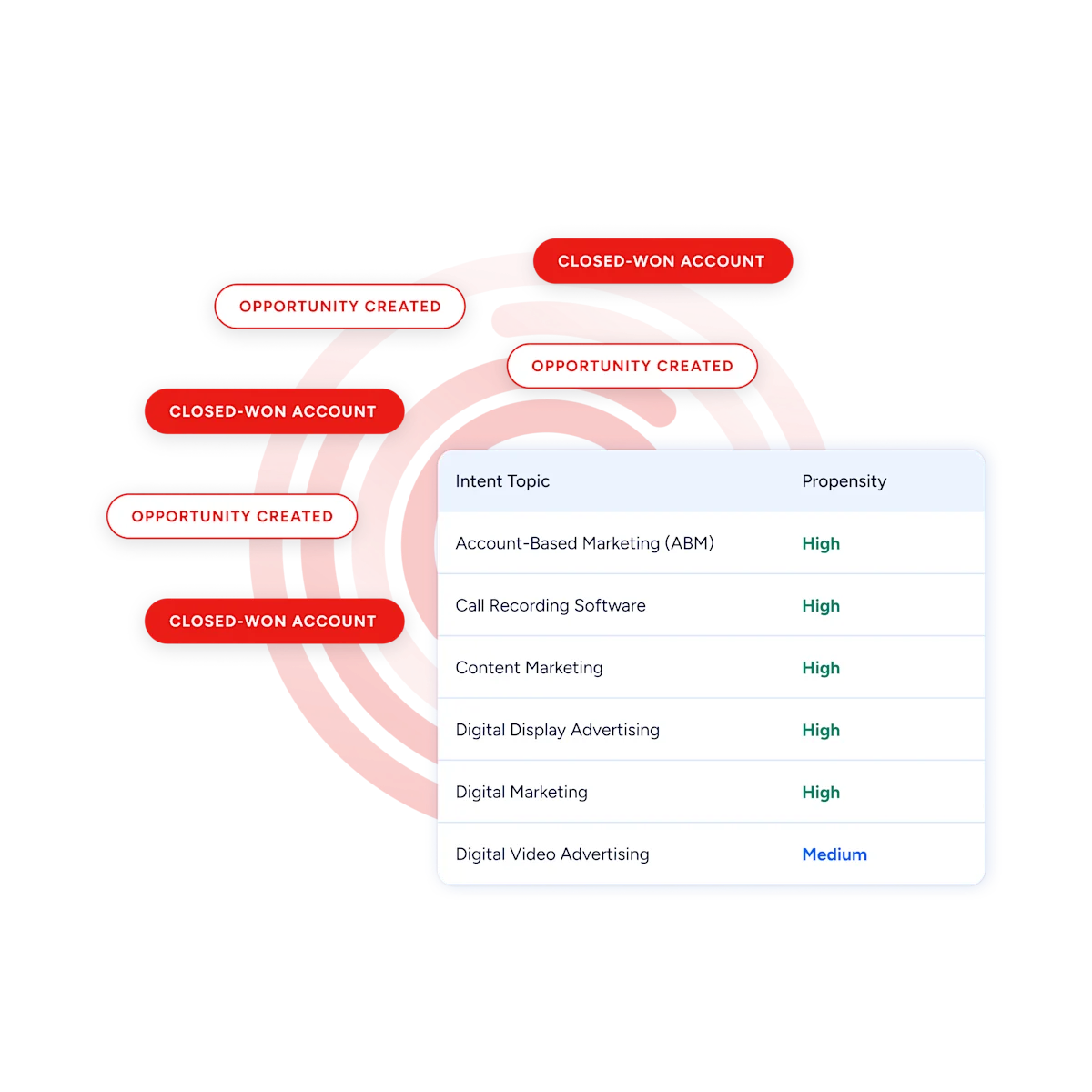
Buyer Intent data tracks signals from 210 million IP-to-Organization pairings and 6 trillion+ new keyword-to-device pairings sourced monthly, showing which companies are researching your product category. WebSights resolves anonymous website traffic to companies, including buying team identification and direct contact info.
Guided Intent (exclusive to ZoomInfo) identifies topics historically correlated with your closed-won deals rather than requiring you to select topics manually.
Source: ZoomInfo
This intelligence plugs into your CRM. ZoomInfo connects with Salesforce, HubSpot, Microsoft Dynamics, and the SugarCRM ecosystem. Your CRM stays the system of record. ZoomInfo makes that record worth acting on.
SpringDB used ZoomInfo for precise data targeting, achieving 2x–3x increases in campaign conversions, a 300% increase in database usability, and a 30–50% uplift in average deal size. "You'll get 10x the value if you think of ZoomInfo as a full platform and not just a tool for one team," said Founder and CEO John Kotsuros. (SpringDB)
Pricing tells you who each platform was built for
The pricing structures make each platform's target market clear.
CiviCRM charges nothing for the software. The core download is free, with no contact limits, no email caps, and no per-seat fees. For organizations that want a managed experience, CiviCRM Spark prices per instance (not per seat), with unlimited users on every plan:
Plan | Monthly Price | Key Limits |
|---|---|---|
Starter | $15/month | 5,000 contacts; no bulk email |
Essentials | $30/month | 5,000 contacts; 10,000 emails/month |
Pro | $50/month | 10,000 contacts; 50,000 emails/month |
Spark includes a 30-day money-back guarantee and a promise: "No price increases. Not gonna happen."
But "free software" and "no cost" are different things. CiviCRM requires a running CMS, server infrastructure, and configuration of scheduled jobs, payment processors, mail handling, and CMS permissions.
The System Administrator Guide spans chapters on Setup, CiviMail, Payment Processors, Upgrades, and CMS Integration. Organizations without in-house technical staff typically hire an implementation partner. Capterra reviewers note an "unreasonable expectation that users will have time and expertise," and a September 2025 Real Talk post acknowledged that new users often confuse the open-source model with zero-cost.
SugarCRM publishes its pricing. Sugar Sell comes in three tiers, all requiring a 15-user minimum and annual billing:
Tier | Price | Annual Minimum (15 users) |
|---|---|---|
Standard | $59/user/month | $10,620/year |
Advanced | $85/user/month | $15,300/year |
Premier | $135/user/month | $24,300/year |
Standard covers account, contact, and pipeline management. Advanced adds mail/calendar integration, case management, and standard support. Premier adds forecasting, geo mapping, news feeds, and a LinkedIn connector.
Key AI features (lead prioritization, Revenue Intelligence, Generative AI, Sentiment Analysis) are asterisked on the Advanced tier, meaning they require Premier or separate purchase. Sugar Market and Sugar Serve pricing requires a direct quote. On-premises deployment (Sugar Enterprise) starts at $85/user/month with a 10-user minimum.
ZoomInfo uses custom-quoted, consumption-based pricing with no published rates. Pricing scales around license agreements, data access, API consumption, and AI activity.
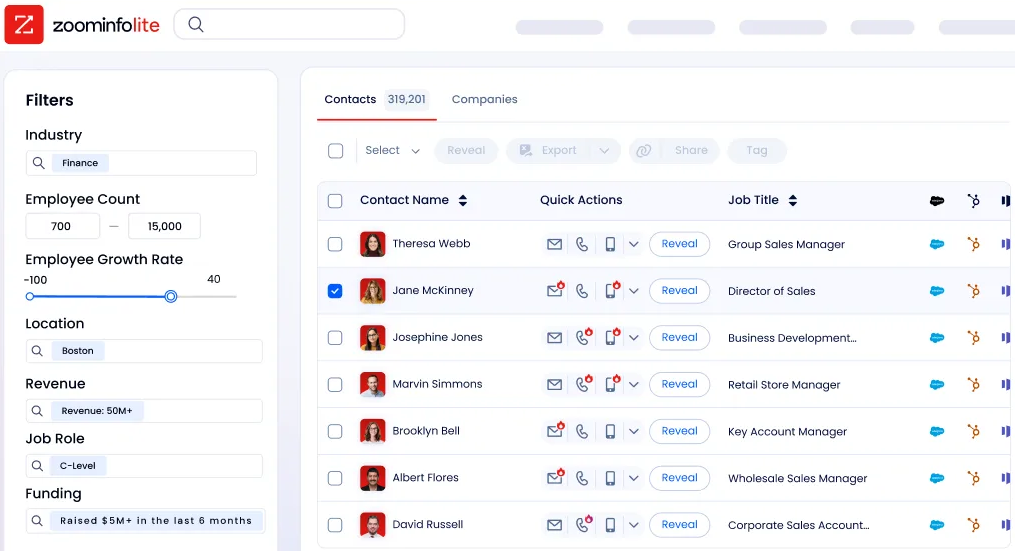
ZoomInfo Lite provides a permanent free tier with access to the B2B database, 10 monthly export credits, individual and company searches, a Chrome extension, and HubSpot integration. A 7-day free trial offers broader feature access with no credit card required.
Source: ZoomInfo
Integration ecosystems point in different directions
Where each platform integrates reveals what it considers essential.
CiviCRM integrates with content management systems. It runs as a native module inside WordPress, Drupal, Joomla, and Backdrop, sharing the same database and user authentication. Form submissions, event registrations, and membership sign-ups create CiviCRM records in real time without middleware.
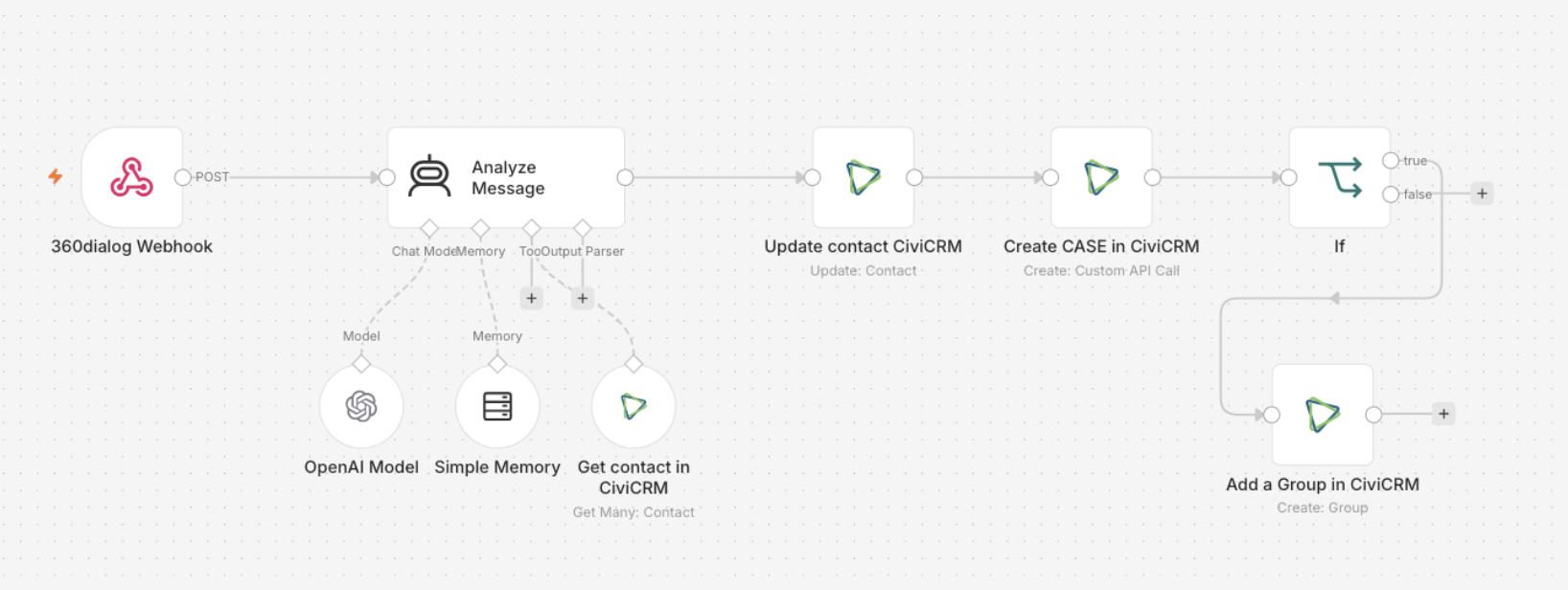
Payment processor extensions connect Stripe, PayPal, iATS, and TSYS. A verified n8n integration connects CiviCRM to automation and AI workflows. The CiviRules extension (2,572 active installs) provides no-code conditional automation. But outside CMS and payment integrations, CiviCRM's native integration library is limited compared to commercial alternatives.
Source: CiviCRM
SugarCRM integrates with ERP systems.
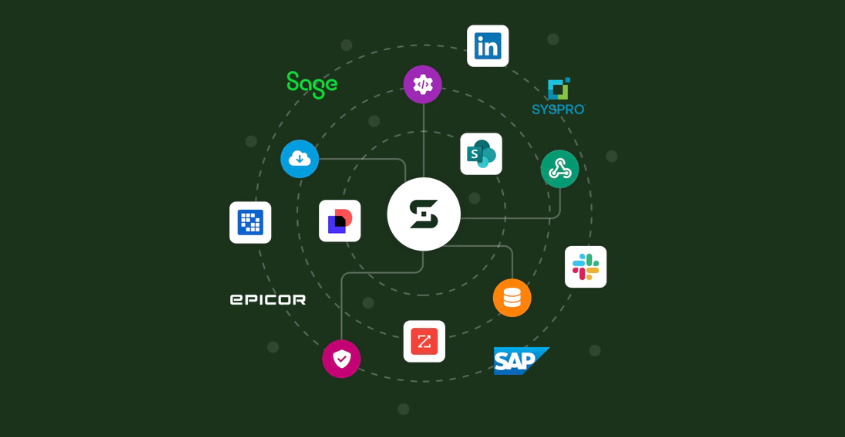
The company offers 180+ ERP integrations as a core differentiator, connecting manufacturing and distribution ERPs (SAP, Oracle, Epicor, Sage, Syspro, and others) to the sales CRM. The SugarAI Marketplace extends into telephony, marketing, reporting, and finance tools. A Sugar for Syspro partnership delivers pre-built CRM-to-shop-floor connectivity. SugarCRM exposes a versioned REST API (v10–v11.25) with OAuth 2.0 authentication and Web Logic Hooks for outbound event notifications.
Source: Sugar AI
ZoomInfo integrates with the go-to-market stack.
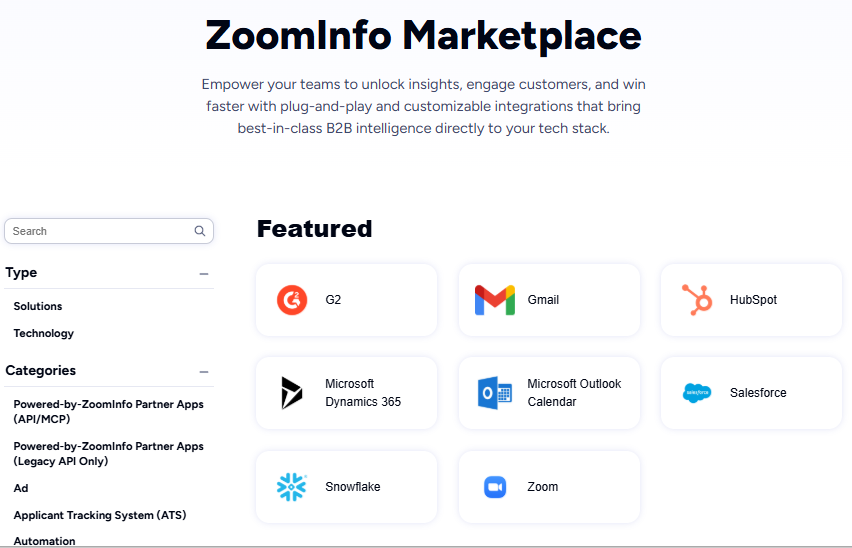
The App Marketplace lists 172+ partners across CRM, marketing automation, sales engagement, data warehouse, and communications categories. Native integrations with Salesforce, HubSpot, and Microsoft Dynamics sync intelligence into existing workflows. Cloud Partners deliver ZoomInfo data into AWS, Google Cloud, Snowflake, and Databricks. For teams building custom tools, the Enterprise API and MCP server expose the same data to any agent or third-party application, including Claude and ChatGPT.
Source: ZoomInfo
BDO Canada's Senior Marketing Intelligence Analyst Jerry Wilson: "The plug-and-play aspect of the API means I can integrate it very easily into any process and get information at a moment's notice," resulting in an 87% reduction in time spent on data dashboard updates. (BDO Canada)
Security and compliance take different forms
Each platform's security model reflects its deployment architecture.
CiviCRM's security is operator-dependent.
As self-hosted software, organizations handle SSL/TLS enforcement, filesystem permissions, PHPIDS intrusion detection, and password policies. The platform publishes security releases on a set schedule (1st or 3rd Wednesday of each month) and provides a GDPR extension with consent recording, data anonymization, and terms enforcement.
For organizations on CiviCRM Spark, hosting is available in North America or Europe with GDPR and CCPA compliance and a published Data Processing Agreement. The self-hosted model gives organizations data sovereignty by design, which advocacy groups and international NGOs particularly value.
SugarCRM holds certifications including SOC 2 Type II, ISO/IEC 27001:2022, CSA STAR Registry, GDPR, CCPA, and EU-US Data Privacy Framework.
All data is encrypted in transit and at rest. Role-Based Access Control and Multi-Factor Authentication are enforced across all access points. SugarCloud customers select their AWS region (Australia, Germany, UK, or US) at onboarding, with 99.5% uptime backed by AWS infrastructure. Development and QA environments use anonymized data. A full sub-processors list is published.
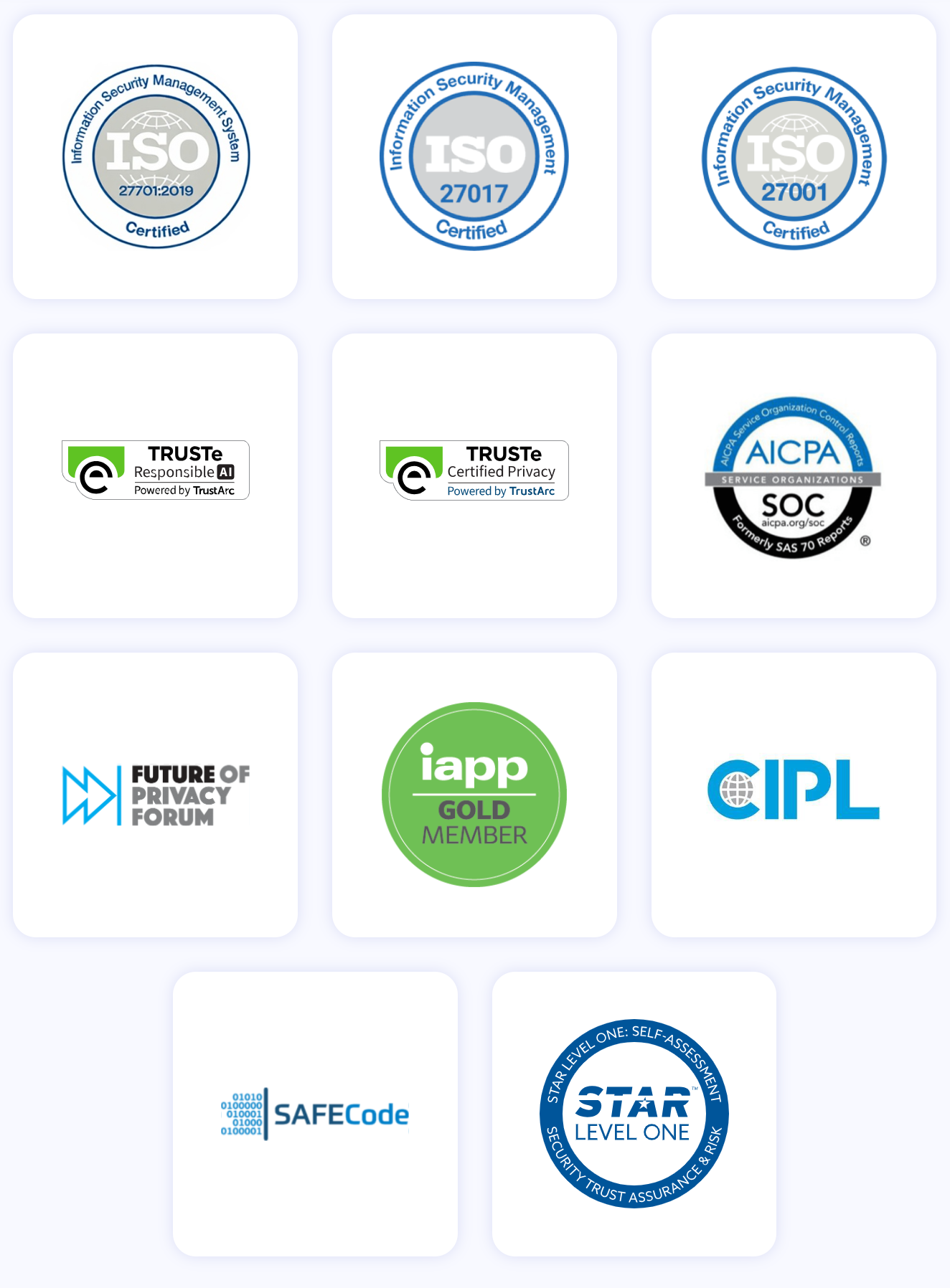
ZoomInfo maintains certifications renewed annually: ISO 27001, SOC 2 Type II, ISO 27701, TRUSTe GDPR, and TRUSTe CCPA. The company is a registered data broker in California and Vermont and maintains a Trust Center.
For nonprofits handling sensitive constituent data, CiviCRM's self-hosted model provides data sovereignty by architecture. For B2B companies in regulated industries, both SugarCRM and ZoomInfo offer the third-party audited certifications that enterprise procurement teams require.
The user experience gap
CiviCRM is candid about its interface.
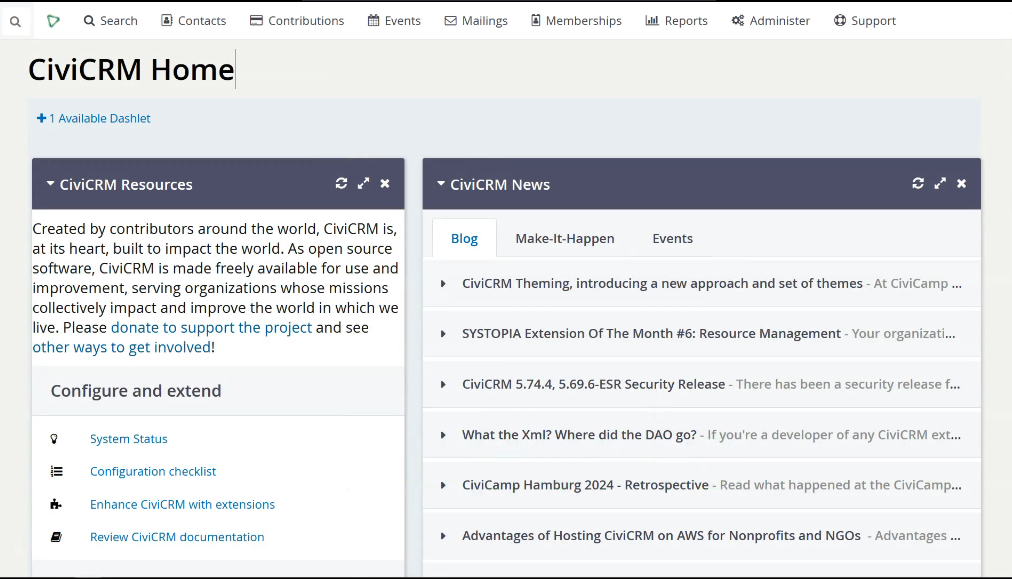
A July 2026 blog post quoted user feedback directly: "The interface is dated compared to other CRM products," "The menu is a bit intense," and "Fairly complex config and menu structure." The RiverLea theme (shipped in CiviCRM 6, March 2025) is a step forward, and the Lighthouse Navigation initiative is redesigning navigation with unified global search and role-based menus.
But the platform still exposes overlapping search interfaces, and no native mobile app exists. CiviAcademy and an AI documentation bot help with onboarding, but most organizations need an implementation partner to get started.
Source: CiviCRM
SugarCRM positions Sugar Sell as a platform that surfaces prioritized work queues instead of requiring reps to dig through dashboards. No-code configuration lets administrators tailor modules, layouts, and workflows without developer involvement.
But G2 and Capterra reviewers consistently note the interface feels less intuitive than newer competitors, and the mobile app is slower and less capable than the desktop experience. SugarClub provides community forums, training through Sugar University, and a "Grow Adoption Framework" for post-implementation support.
ZoomInfo invested in a redesigned onboarding program covering 30 to 90 days across planning, technical setup, education, and adoption.
The redesign produced a 25% improvement in customer satisfaction scores and won Rocketlane's Golden Comet award for Best Customer Onboarding Team of 2024. ZoomInfo University provides role-specific learning paths and product certifications.
Source: ZoomInfo
CiviCRM vs. SugarCRM vs. ZoomInfo: Which should you choose?
The choice depends on what your organization does and what it needs to do better.
Choose CiviCRM if:
You're a nonprofit, NGO, or civic organization managing constituents
You value data sovereignty and full control over your CRM code and data
Your budget prioritizes low licensing costs, even if implementation requires investment
You're already running WordPress, Drupal, or Joomla and want an integrated CRM
You need donor management, membership tracking, event registration, and case management in one system
You have technical staff or access to a CiviCRM implementation partner
Choose SugarCRM if:
You're a B2B company in manufacturing, wholesale, or distribution
Your ERP system holds customer purchasing data that should inform sales decisions
You need sales pipeline management with AI-powered prioritization and forecasting
You have at least 15 sales users and can commit to annual billing
You want both cloud and on-premises deployment options
Your sales reps need pre-call preparation powered by ERP transaction history
Add ZoomInfo if:
You need B2B data beyond what's already in your CRM
Identifying in-market buyers before they contact you is critical to your pipeline
Your sales team spends too much time researching accounts instead of selling
You want intelligence that shows reps who to contact, when, and what to say
You need your CRM enriched with verified contact data, intent signals, and company intelligence
You want to access B2B intelligence in any tool through APIs and MCP
Try ZoomInfo free or explore ZoomInfo Lite for permanent free access to the B2B database.
CiviCRM and SugarCRM both serve their markets well. For nonprofits, CiviCRM offers a combination of low cost, data sovereignty, and constituent management depth that commercial CRMs don't match. For B2B manufacturers and distributors, SugarCRM's ERP-connected sales intelligence is a differentiator in an industry where most CRMs don't speak the language of purchase orders and reorder cycles.
But for B2B organizations that want their sales and marketing powered by more than manually entered CRM data, ZoomInfo provides the intelligence layer that turns contact records into closed deals. The same GTM Context Graph powers every access point, whether your team works in ZoomInfo's GTM Workspace, launches plays from GTM Studio, or pipes intelligence into SugarCRM or any other tool through the API.
CiviCRM vs. SugarCRM vs. ZoomInfo FAQ
What is the fundamental difference between CiviCRM, SugarCRM, and ZoomInfo?
CiviCRM is a free, open-source CRM built for nonprofits and civic organizations. It covers donor management, memberships, events, case management, and bulk email.
SugarCRM is a commercial B2B sales CRM for manufacturers, wholesalers, and distributors, with AI-powered pipeline management and 180+ ERP integrations.
ZoomInfo is a B2B intelligence platform with 500M contacts, 100M companies, buyer intent signals, and a GTM Context Graph that integrates with CRMs to deliver intelligence beyond what any CRM generates on its own.
Which platform is cheapest to get started with?
CiviCRM has no licensing cost. The software is free under the GNU AGPL v3 license, and the hosted CiviCRM Spark option starts at $15/month with unlimited users. Implementation, hosting, and partner support costs vary widely.
SugarCRM starts at $59/user/month with a 15-user minimum, meaning a minimum annual commitment of $10,620.
ZoomInfo uses custom-quoted pricing but offers a permanent free tier (ZoomInfo Lite) with 10 monthly export credits and basic database access.
Can CiviCRM be used for B2B sales?
CiviCRM was designed for constituent relationship management, not B2B sales pipelines. It lacks deal stages, sales forecasting, ERP integration, and guided selling workflows. While technically customizable for any purpose, organizations with B2B sales processes will find SugarCRM or other sales-focused CRMs a better fit for managing pipeline and revenue operations.
Does SugarCRM work for nonprofits?
SugarCRM's pricing (15-user minimum at $59/user/month) and feature focus (pipeline management, ERP integration, B2B intelligence) make it a poor fit for most nonprofits. The platform lacks native donation management, membership tracking, event registration, or the constituent relationship model nonprofits require. CiviCRM or other nonprofit-specific CRMs are better choices.
How does ZoomInfo integrate with these CRMs?
ZoomInfo connects with SugarCRM through its marketing automation integrations and CRM connector ecosystem. For CiviCRM, there is no native integration, as CiviCRM serves nonprofits while ZoomInfo serves B2B sales teams.
ZoomInfo's Enterprise API and MCP server allow custom integrations with any system that supports REST APIs or the Model Context Protocol. Direct native integrations exist for Salesforce, HubSpot, and Microsoft Dynamics.
Which platform has the strongest AI capabilities?
ZoomInfo leads with its GTM Context Graph processing 1.5B+ data points daily, AI-generated account summaries, buyer intent analysis, and AI agents in GTM Workspace that automate account research, outreach drafting, and CRM updates.
SugarCRM offers AI-powered lead prioritization, sentiment analysis, and generative AI, though most AI features require the Premier tier or separate purchase. CiviCRM has early-stage community-developed AI capabilities through its n8n integration and explorations into self-hosted AI models, but these don't compare to the commercial alternatives.
Does CiviCRM require technical expertise to set up?
Yes. CiviCRM requires a running CMS (WordPress, Drupal, Joomla, or Backdrop), server infrastructure, and configuration of scheduled jobs, payment processors, mail handling, and CMS permissions.
The project acknowledges that the interface is "dated compared to other CRM products" and the menu structure is complex. Most organizations without IT staff hire a CiviCRM implementation partner. The Spark hosted option reduces setup complexity for smaller organizations.
Can I use ZoomInfo without a separate CRM?
Yes. ZoomInfo works as a standalone platform through GTM Workspace (for sellers) and GTM Studio (for marketers and RevOps), providing contact search, account research, buyer intent monitoring, and AI-powered outreach without a separate CRM.
The platform delivers the most value when integrated with a CRM, where enriched contact data, intent signals, and activity tracking flow into existing sales workflows and create a single source of truth for customer relationships.
Other CiviCRM matchups worth a look:
