
More revenue teams are pulling prospecting and enrichment into the AI tools they already work in, and Clay's MCP server is one way to do it. It exposes Clay's data infrastructure and Ops-managed workflows as tools inside assistants like Claude and ChatGPT, so a rep can find contacts, reveal emails and phone numbers, and push them to a sequence, all in natural language.
This page covers what Clay MCP does, where it fits, and what to plan around, then sets it against ZoomInfo's MCP server so you can decide which one belongs in your stack. The two solve overlapping problems from different starting points: Clay orchestrates many data providers and can act on your systems, while ZoomInfo connects the same AI tools to first-party verified data and grounded AI research.
What Clay MCP Is
Clay MCP is Clay's Model Context Protocol server. It surfaces Clay's data and Ops-managed workflows as native tools inside MCP-compatible AI assistants, so reps can run prospecting and enrichment through prompts instead of the Clay UI. Clay's positioning is that reps get the right data faster while Ops keeps control of logic, compliance, and spend.
The core promise on Clay's MCP page is a single natural-language surface that pulls data from 200+ providers and pre-built workflows into the tools reps already use, then finds contacts, returns verified emails and phone numbers, and pushes them to a sequence. Per Clay's documentation, it connects to Claude, ChatGPT, Codex, Copilot, and Glean.
Clay's wider platform also runs agents. Claygents are custom GTM agents you point at manual tasks like company research, lead qualification, and signal detection, returning structured data for custom plays. Account Research Agents run over your Audiences to synthesize your CRM, data warehouse, and call recordings into account intelligence, with a reasoning trace for every decision. Through the MCP, reps can reason across those Audiences alongside the find and enrich workflows.
The attributes below trace to Clay's published pages.
Attribute | Detail |
What it connects | Clay's own database plus 200+ connected data providers |
AI clients | Claude, ChatGPT, Codex, Copilot, Glean |
Enrichment model | Waterfall across 200+ vendors for emails and phone numbers |
Reusable logic | Functions (best-rep playbooks packaged for the whole team) |
Agents | Claygents (custom GTM agents) and Account Research Agents that run over Audiences |
Action | Push to sequencer and write back to CRM, governed by Ops rules |
Governance | Ops-set budget guardrails, compliance logic, and CRM write rules |
People Search | Up to 1,000 results returned per People Search |
How Clay MCP Works
Clay frames the server around three workflows that chain together inside the AI tool, with an Ops governance layer wrapped around all of them. The value is that reps stay in one interface while Ops controls what gets spent, written, and shared.
Find and enrich in natural language
Reps search Clay's company and people database in natural language to surface contacts matching an ICP, then layer on first-party signals to prioritize. Enrichment runs through a waterfall across Clay's 200+ vendors, which is Clay's mechanism for improving fill rates on emails and phone numbers so reps reach real inboxes and direct lines rather than dead ends.
Turn playbooks into Functions
Functions let Ops package a top rep's workflow (lead scoring, account prep, and similar logic) into something the whole team can call by name. Clay's pitch here is distribution without added Ops overhead: reps invoke governed GTM logic through a prompt, and Ops maintains it centrally.
Governance and write-back
This is where Clay MCP goes beyond read access. Reps can check contacts against the CRM for duplicates, keep only net-new and validated records, draft outreach, and push straight to the sequencer and CRM. Ops sets the write rules, budget guardrails, and compliance logic, so reps move quickly while spend and data flow stay controlled.
Where Clay MCP Fits
Clay MCP is a strong fit when the priority is breadth of sources and the ability to act on your systems from inside the AI tool. The following describe the situations where it is the stronger choice.
You want one MCP surface that aggregates many data providers and runs waterfall enrichment to maximize coverage.
You need reps to push to a sequencer and write back to the CRM from the AI tool, with Ops holding the write rules.
You want to standardize prospecting by packaging your best reps' playbooks into Functions the whole team can run.
You need Ops-level control over enrichment spend and compliance across a wide set of connected vendors.
What to Plan Around With Clay MCP
Clay MCP's aggregation-and-action model carries trade-offs worth sizing before you commit. These are practical considerations rather than gaps, and they follow directly from how the product is designed.
Output quality and cost depend on which of the 200+ providers you enable and how your waterfall and credits are configured, so results are only as good as the sources behind them.
The governance and Functions value assumes Ops builds and maintains those workflows first, which is setup effort before reps see the payoff.
Clay's MCP page documents capabilities rather than per-tool credit costs or rate limits, so you size spend through Clay's broader pricing and credit model rather than a published per-call table.
Deep native intelligence such as org charts and technographics comes from orchestrating connected providers rather than a single owned-and-verified source.
ZoomInfo MCP: Verified Data and AI Research in the Same AI Tools
ZoomInfo MCP connects the same AI tools to ZoomInfo's B2B intelligence directly, so an assistant researching an account draws from verified data your revenue team already trusts instead of a web search. It covers 600M+ contacts and 100M+ companies, along with verified emails and direct dials, intent, scoops, org charts, and technographics.
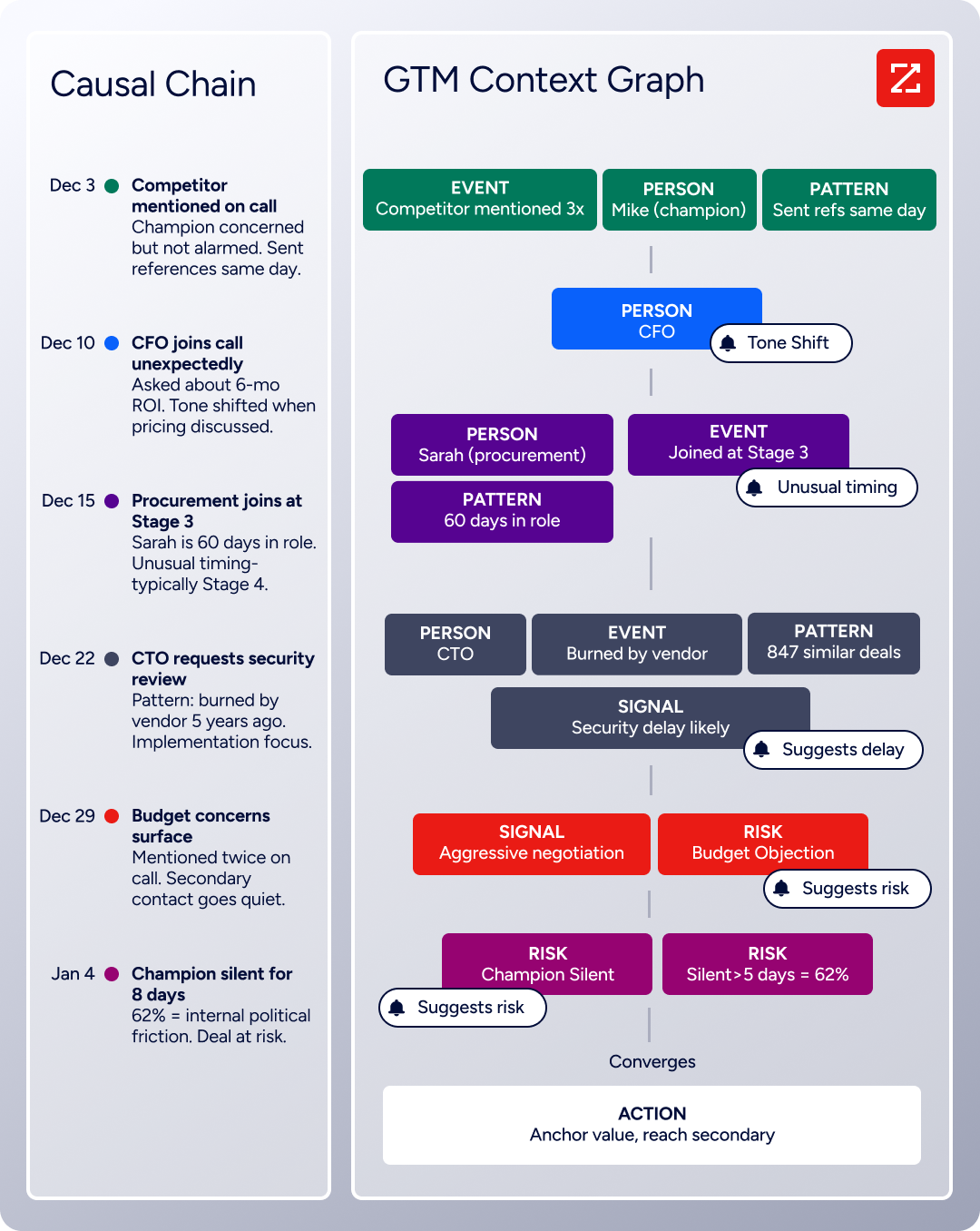
Upstream of the server sits the GTM Context Graph, the intelligence layer that processes 1.5B+ data points daily by combining ZoomInfo's data with your first-party data. That grounding is what powers the AI research agents a rep can call through the MCP surface.
What it connects to
ZoomInfo MCP exposes search, enrich, discover, and research tools. Search, Lookup, Find Similar, and Recommended Contacts are free. Enrich tools return full firmographic and contact detail on up to 25 records per call. Three context agents (Account Research, Contact Research, and Conversation Intelligence) synthesize large payloads into a targeted briefing, blending ZoomInfo's data with your organization's first-party CRM and conversation history.
What it costs
MCP is included with every ZoomInfo subscription at no additional cost, and usage counts against your existing credit pools. Enrich tools consume one bulk data credit per new record, and Records Under Management means re-enriching a record within 12 months is free, across any ZoomInfo surface. The research agents consume AI action credits proportional to the work, typically 5 to 15 credits per call. Admins can cap both credit types per user.
Where it runs and how it is governed
ZoomInfo MCP works with a broad set of clients: Claude, Claude Code, Claude Cowork, ChatGPT, Codex, Cursor, Microsoft Copilot, Amazon Quick, Gemini Enterprise, Perplexity, and Slack, plus any custom MCP client. Each user authenticates with their own ZoomInfo login (app-level authentication is available for teams that need it), and all calls respect existing package entitlements. The tools are read-only, so nothing is written back to your CRM or systems. For write-back, bulk exports, and batch pipelines, ZoomInfo points you to the GTM CLI or REST API rather than MCP.
Admins toggle MCP access per user in the Admin Portal, and every call is scoped to the signed-in user rather than a shared credential. One point to plan for is data retention: ZoomInfo data passes through your AI provider's infrastructure, so retention is governed by your agreement with that provider, and enterprise teams should disable training-data collection where the provider allows it.
See the full ZoomInfo MCP server tool list and credit model.
Clay MCP vs. ZoomInfo MCP
The two servers overlap on finding and enriching contacts inside an AI tool, but diverge on where the data comes from, how much intelligence sits behind it, and whether the tool acts on your systems. The table maps the dimensions that decide most evaluations.
Dimension | Clay MCP | ZoomInfo MCP |
Core model | Orchestration over 200+ providers plus Clay's own database | First-party data owned and verified by ZoomInfo |
Data depth | Clay database and connected providers via waterfall | 600M+ contacts, 100M+ companies, verified emails and direct dials, intent, scoops, org charts, technographics |
AI research | Claygents and Account Research Agents that reason over connected sources, your CRM, and call data, with a reasoning trace per decision | Packaged Account Research, Contact Research, and Conversation Intelligence that reason over ZoomInfo's verified data plus your first-party CRM and calls |
Action on systems | Push to sequencer and write back to CRM, governed by Ops rules | Read-only (write and bulk handled by ZoomInfo CLI or REST API) |
Governance | Ops-set budget guardrails, compliance, and CRM write rules | Per-user admin credit limits and package entitlement enforcement |
AI clients | Claude, ChatGPT, Codex, Copilot, Glean | Claude, Claude Code, Claude Cowork, ChatGPT, Codex, Cursor, Copilot, Amazon Quick, Gemini Enterprise, Perplexity, Slack |
Credit model | Clay credits across connected providers | Bulk data credits (1 per new record, 12-month RUM) and AI action credits for research |
Access | Clay subscription | Any ZoomInfo subscription with bulk credits, no extra MCP cost |
Weighing the platforms beyond MCP? See the full Clay vs. ZoomInfo breakdown.
Choosing Between Clay MCP and ZoomInfo MCP
The decision comes down to what you want the AI tool to do. If the job is to aggregate many sources and act on your systems, Clay MCP is built for that. If the job is to ground AI reasoning in verified data and research, ZoomInfo MCP is built for that. The two are not mutually exclusive, and often sit side by side in the same stack.
Choose Clay MCP if:
You want a single MCP that aggregates 200+ providers with waterfall enrichment for coverage.
You need governed write-back to the CRM and sequencer from inside the AI tool.
You want to distribute best-rep playbooks as Functions across the team.
You want to build and customize your own GTM agents (Claygents) with control over prompts and a full reasoning trace.
Ops needs central control of enrichment spend and compliance across many vendors.
Choose ZoomInfo MCP if:
You want verified first-party data at the source, with intent, scoops, org charts, and technographics native.
You want packaged research agents (Account Research, Contact Research, Conversation Intelligence) that reason over ZoomInfo's verified data together with your CRM and calls, with little setup.
You need a broad AI client ecosystem, including Cursor, Amazon Quick, Gemini Enterprise, and Slack.
You want MCP included on your existing subscription, with RUM so you are not charged twice for the same record.
A team running both gets the aggregation and action layer from Clay alongside verified data and grounded research from ZoomInfo, with each doing the part it is strongest at.
Working in scripts or agent workloads instead? Compare the best CLI tools for sales.
Final Take
Clay MCP is an orchestration and action layer: it aggregates many data providers, packages workflows into Functions, and can write results back to your CRM and sequencer under Ops governance. That makes it a fit for teams that want breadth of sources and the ability to act on their systems from inside an AI tool.
ZoomInfo MCP is a verified-intelligence layer: it connects the same AI tools to first-party data ZoomInfo owns and maintains, with packaged research agents that reason over that verified data alongside your CRM and calls, and it runs on your existing subscription. Both platforms offer agentic research, so the deciding factor is usually the data foundation beneath it: orchestrated across connected sources with Clay, or owned and verified at the source with ZoomInfo. If that verified foundation and low-setup research matter most, ZoomInfo MCP is the stronger base, and it complements rather than competes with an aggregation layer when both are in play.
Start building with GTM AI to connect ZoomInfo's MCP to Claude or ChatGPT on your own data, or walk through how to connect Claude to your CRM step by step.
FAQ
What is Clay MCP?
Clay MCP is Clay's Model Context Protocol server. It exposes Clay's data (its own database plus 200+ connected providers) and Ops-managed workflows as tools inside AI assistants, so reps can find contacts, enrich them with emails and phone numbers, and push them to a sequence using natural language.
What AI tools does Clay MCP work with?
Per Clay's documentation, Clay MCP connects to Claude, ChatGPT, Codex, Copilot, and Glean.
Can Clay MCP write back to my CRM?
Yes. Clay MCP can check contacts against your CRM for duplicates, keep only net-new and validated records, and push straight to your sequencer and CRM. Those write actions are governed by rules Ops defines centrally.
How is ZoomInfo MCP different from Clay MCP?
Both do agentic research, so the split is the data foundation and what each tool acts on. Clay MCP orchestrates 200+ third-party providers and can write back to your CRM and sequencer. ZoomInfo MCP runs on first-party data ZoomInfo owns and verifies (600M+ contacts, 100M+ companies, plus intent, scoops, org charts, and technographics) and is read-only, so write-back and bulk work go through the ZoomInfo CLI or REST API.
Does ZoomInfo MCP work with Claude and ChatGPT?
Yes, along with Claude Code, Claude Cowork, Codex, Cursor, Microsoft Copilot, Amazon Quick, Gemini Enterprise, Perplexity, Slack, and any custom MCP client. All connect to the same server endpoint and authenticate with your own ZoomInfo login.
Does ZoomInfo MCP cost extra?
No. MCP is included with every ZoomInfo subscription at no additional cost. Usage draws on your existing credit pools: one bulk data credit per new record enriched (with a 12-month Records Under Management window so re-enrichment is free), and AI action credits for the research agents. Search, Lookup, Find Similar, and Recommended Contacts tools are free.
Can I use Clay MCP and ZoomInfo MCP together?
Yes. They address different layers, aggregation and action versus verified data and research, so many teams run both against the same prospecting and enrichment workflows.
Other tools worth evaluating side by side:
