
Teams that run Constant Contact for email marketing and Salesforce as their CRM usually hit the same problems within a quarter:
contacts added through email sign-up forms never appear in Salesforce, so sales reps work leads that marketing already engaged without knowing it,
campaign engagement data lives in Constant Contact while deal records live in Salesforce, leaving both teams with an incomplete picture of the buyer,
and someone manually exports a CSV every week to keep the two systems loosely aligned, introducing duplicates and stale records with every upload.
However, the two platforms ended up coexisting (a marketing team that adopted Constant Contact years before the company standardized on Salesforce, a nonprofit running both for different functions, or separate departments choosing tools independently), the longer they operate without a connection, the wider the data gap grows.
Connecting Constant Contact and Salesforce eliminates that gap.
New contacts captured through Constant Contact sign-up forms and landing pages flow into Salesforce as leads so reps can follow up without waiting for a manual handoff. Email engagement data (opens, clicks, bounces) attaches to Salesforce records so sales teams can see which prospects are engaging with marketing content.
Campaign membership syncs between platforms so reporting reflects the full funnel from first email touch to closed-won deal.
A native Constant Contact connector exists on the Salesforce AppExchange, and third-party solutions like SyncApps by Cazoomi offer bidirectional sync. Automation tools (Zapier, Make) and custom API development round out the options. Each method differs in setup complexity, sync direction, data coverage, and cost.
One problem no connection method solves: the sync moves contact records between systems, but it does not verify whether those records are accurate, complete, or current.
That is where ZoomInfo comes in.
ZoomInfo integrates natively with Salesforce through the AppExchange and offers API and MCP access that can feed verified, enriched contact data into any system in the stack, so the records flowing between Constant Contact and Salesforce are accurate and complete before a single email is sent or a lead is assigned.
This article covers the Constant Contact-Salesforce integration landscape: which methods are available, what data each one handles, how to set them up, the use cases that justify connecting both platforms, and the limitations to plan for. It also covers how ZoomInfo fits as a data enrichment layer for both platforms.
Integration Overview
Source: Constant Contact
Does a native integration exist?
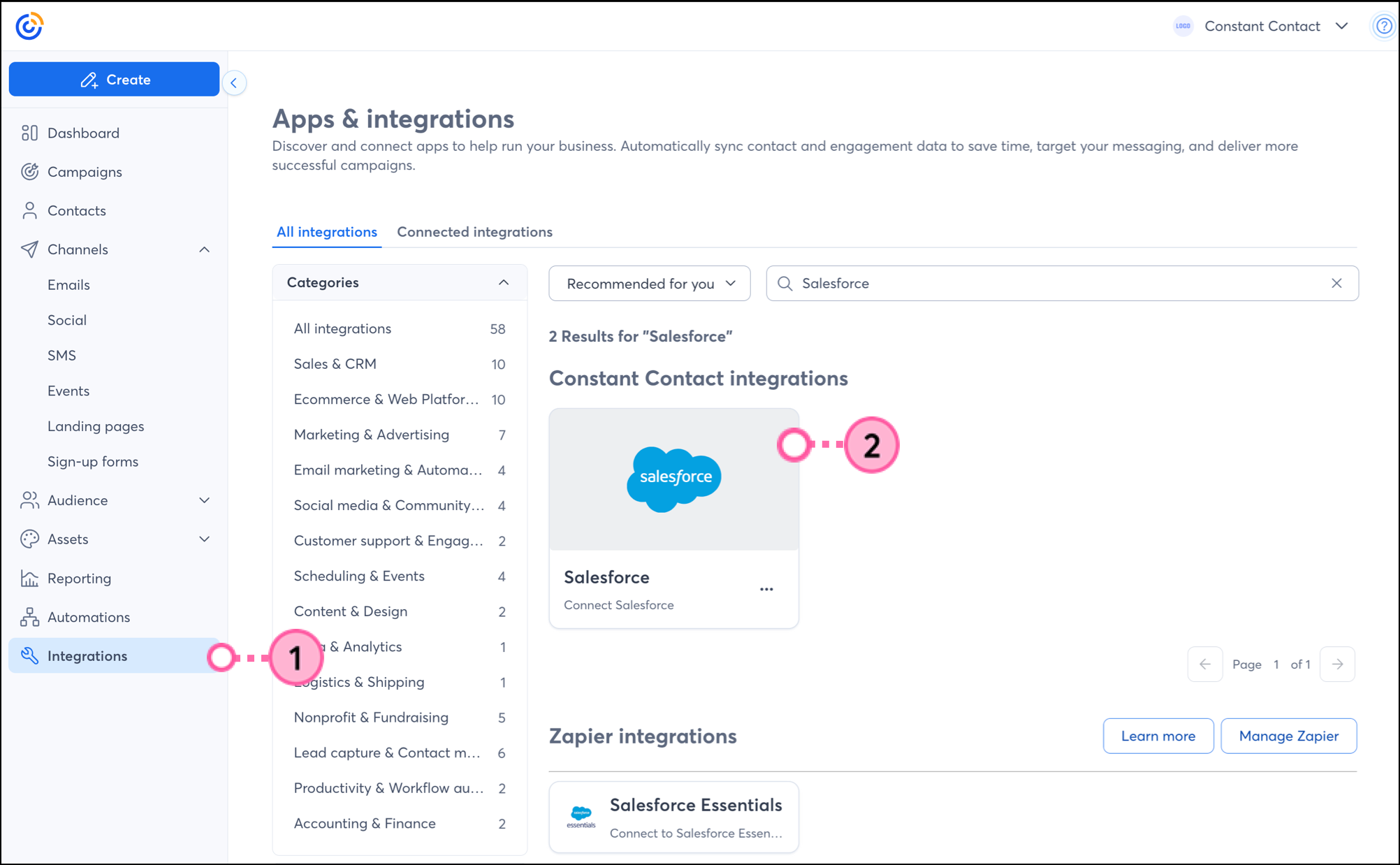
Yes. Constant Contact offers a native connector on the Salesforce AppExchange (Constant Contact for Salesforce v1.0) that syncs contacts between the two platforms. Third-party AppExchange solutions like SyncApps by Cazoomi extend the native connection with bidirectional sync and campaign tracking.
What data can sync?
Contacts, leads, email engagement metrics (opens, clicks, bounces), campaign membership, and list membership. The specific fields and objects depend on the method. The native connector handles contact and lead sync with basic engagement data.
Third-party middleware adds campaign-level reporting, custom field mapping, and bidirectional updates.
Is the sync bidirectional?
It depends on the method. The native AppExchange connector primarily syncs contacts from Salesforce to Constant Contact and pushes engagement data back.
Third-party solutions like SyncApps by Cazoomi offer full bidirectional sync. Zapier and Make default to one-way per workflow; bidirectional requires duplicate workflows.
Is it real-time or batch?
The native connector runs on a schedule. Zapier triggers within 1 to 15 minutes of an event. Make scenarios can run on triggers or configurable schedules. Middleware solutions run on scheduled intervals. Custom API integrations can approach real-time through polling or event-driven patterns on the Salesforce side.
What are the available methods?
Native AppExchange connector, third-party middleware (SyncApps by Cazoomi), automation platforms (Zapier, Make), and custom API development using the Constant Contact V3 API and Salesforce REST API.
Method | Setup Difficulty | Data Flow | Real-time? | Approximate Cost |
|---|---|---|---|---|
Native AppExchange Connector | Low | Primarily Salesforce to CC + engagement data back | Scheduled | Free (included with both platforms) |
SyncApps by Cazoomi | Medium | Bidirectional | Scheduled (configurable intervals) | From ~$49/mo |
Zapier | Low | One-way per Zap | Near real-time (1-15 min) | From $19.99/mo |
Make | Medium | Configurable per scenario | Near real-time or scheduled | From $10.59/mo |
Custom API | High | Fully customizable | Polling or near real-time | Developer time + hosting |
One distinction worth settling upfront: the native connector and SyncApps handle ongoing scheduled sync and can manage existing records, making them suitable for both initial setup and long-term operation.
Zapier and Make only act on new events after activation, making them ongoing-sync tools but not migration tools. Custom API development has no ceiling on either job.
Integration Methods
Native AppExchange Connector (Constant Contact for Salesforce)
How it works: The Constant Contact for Salesforce connector, available on the Salesforce AppExchange, links a Constant Contact account to a Salesforce org.
It syncs contacts between the two platforms, maps Salesforce leads and contacts to Constant Contact email lists, and pushes email engagement data (opens, clicks, bounces, unsubscribes) back into Salesforce so reps can see marketing activity on their records.
What it syncs: Salesforce Leads and Contacts sync to Constant Contact as email subscribers. Email campaign engagement metrics flow back to Salesforce as activity records. List membership maps between Constant Contact lists and Salesforce campaigns or custom fields.
Fits: ongoing sync for teams that need basic contact sharing and engagement visibility; suitable for initial list population and continued updates.
Setup process:
Install the Constant Contact for Salesforce app from the AppExchange. System Administrator access in Salesforce is required.
In Salesforce, navigate to the Constant Contact integration settings and authenticate with your Constant Contact account credentials via OAuth.
Map Salesforce Lead and Contact fields to Constant Contact subscriber fields (name, email, phone, company, and any custom fields both platforms share).
Select which Salesforce records to sync: define filters by record type, campaign membership, or custom criteria to control which contacts flow to Constant Contact.
Choose the Constant Contact lists that should receive synced contacts and configure how engagement data maps back to Salesforce activity records.
Run an initial sync to populate Constant Contact with existing Salesforce contacts, then let the scheduled sync handle ongoing changes.
Strengths: No cost beyond existing Constant Contact and Salesforce subscriptions. Official AppExchange listing with Salesforce security review. Simple setup for teams that need the basics: contacts out, engagement data back. No third-party vendor to manage.
Limitations: Limited customization of field mapping and sync logic compared to middleware. Sync runs on a schedule, not in real time. Advanced campaign reporting and bidirectional updates may require a more capable solution. Custom objects and complex data relationships are not supported.
Best for: Small to mid-size teams that need a no-cost connection between Constant Contact and Salesforce for contact sharing and basic engagement tracking, without complex sync requirements.
SyncApps by Cazoomi (Bidirectional Middleware)
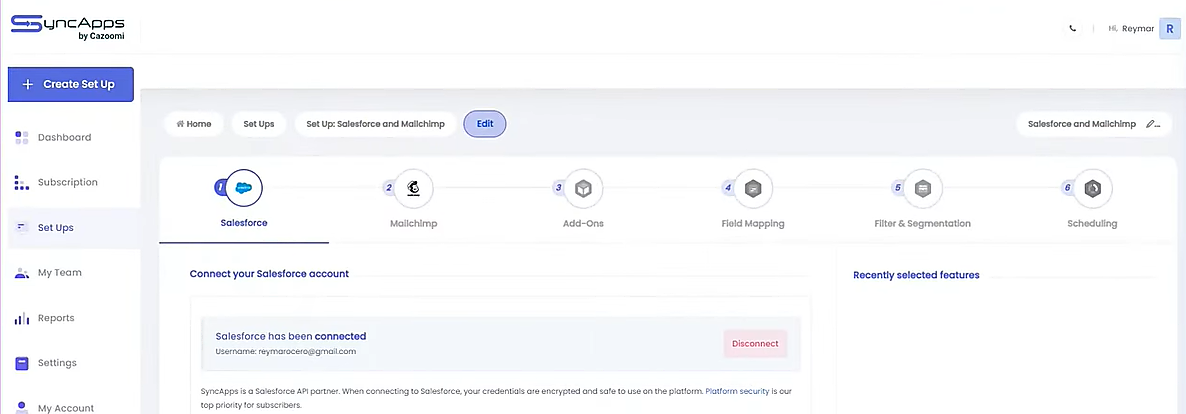
How it works: SyncApps by Cazoomi is integration middleware built for connecting CRM and marketing platforms. It provides bidirectional sync between Constant Contact and Salesforce with field mapping, conflict resolution, and campaign tracking.
Source: YouTube
SyncApps maps the data models of both platforms, handling the structural differences between Salesforce's Lead/Contact/Account model and Constant Contact's subscriber list model.
What it syncs: Contacts and leads (bidirectional), email engagement data, campaign membership, list membership, custom fields, and tags. SyncApps can sync Salesforce Campaigns with Constant Contact lists, so campaign membership stays aligned across both systems. Unsubscribes in Constant Contact reflect back to Salesforce to prevent re-marketing to opted-out contacts.
Fits: both initial migration (full historical sync) and ongoing bidirectional sync.
Setup process:
Create a SyncApps account and select the Constant Contact-Salesforce integration template.
Authenticate both platforms via OAuth, granting SyncApps permission to read and write data in each.
Map fields between Salesforce Leads/Contacts and Constant Contact subscribers. SyncApps auto-maps standard fields (name, email, phone) and lets you manually map custom fields.
Configure sync direction (one-way or bidirectional), conflict resolution rules (e.g., "most recently updated record wins"), and filtering criteria (which records to include or exclude).
Set the sync schedule (frequency options vary by plan tier).
Run an initial sync to align existing records, then let the scheduled sync handle ongoing changes.
Strengths: Built for CRM-to-email-marketing sync, with pre-configured templates for Constant Contact and Salesforce. Handles bidirectional sync with conflict resolution out of the box.
Syncs campaign membership and unsubscribe status across both platforms, preventing compliance gaps. Can migrate historical data alongside ongoing sync.
Limitations: Adds a monthly subscription cost on top of both platform subscriptions. Pricing scales with record count and sync frequency. Less flexible for non-marketing use cases. Requires familiarity with both platforms' data models to configure field mapping correctly.
Best for: Teams running both platforms long-term that need bidirectional sync with campaign tracking, unsubscribe management, and historical data migration. Organizations where marketing and sales both update contact records and need changes reflected in both systems.
Zapier
Source: HubSpot
How it works: Zapier connects Constant Contact and Salesforce through event-driven automations called Zaps. Each Zap pairs a trigger (an event in one app) with one or more actions (what happens in the other).
Both platforms are well-supported Zapier connectors, with multiple trigger and action options covering common marketing-to-CRM workflows.
What it syncs: Contacts, leads, campaign responses, and list membership. Each object type and sync direction requires its own Zap. Custom fields can be mapped manually in the setup flow.
Engagement-level data (individual email opens, clicks) is more limited through Zapier than through the native connector or middleware, since Zapier acts on trigger events rather than pulling aggregate engagement metrics.
Fits: ongoing sync of new records only; not a migration tool for historical data.
Setup process:
Create a Zapier account and connect both your Constant Contact and Salesforce accounts using OAuth.
Choose a trigger app (e.g., Constant Contact) and select the trigger event (e.g., "New Contact" or "New Contact Activity").
Choose the action app (Salesforce) and select the action (e.g., "Create Lead" or "Update Contact").
Map fields between the two platforms. Zapier displays available fields from both sides and lets you pull data from the trigger step into the action fields.
Test the Zap with a sample record to verify the field mapping produces the expected result in Salesforce.
Turn the Zap on. For bidirectional sync, create a second Zap with the trigger and action apps reversed, and add a filter to prevent infinite loops.
Strengths: Fastest setup with no technical knowledge required. A template library covers common Constant Contact-Salesforce workflows. Reliable for simple, single-object syncs. Zapier's filter and formatting steps can add conditional logic (e.g., only sync contacts from a specific list).
Limitations: Each Zap handles one trigger-action pair, so syncing contacts, campaign responses, and list membership requires separate Zaps (each counting against your plan's task allocation). Bidirectional sync needs duplicate Zaps with loop-prevention logic. No built-in deduplication.
Historical records created before the Zap was activated do not sync. Engagement data depth is limited compared to middleware.
Best for: Small teams that need a quick, low-cost connection between specific workflows (e.g., new Constant Contact subscriber creates a Salesforce Lead). Teams that want to automate one or two data flows without investing in middleware.
Make (Formerly Integromat)
Source: HubSpot
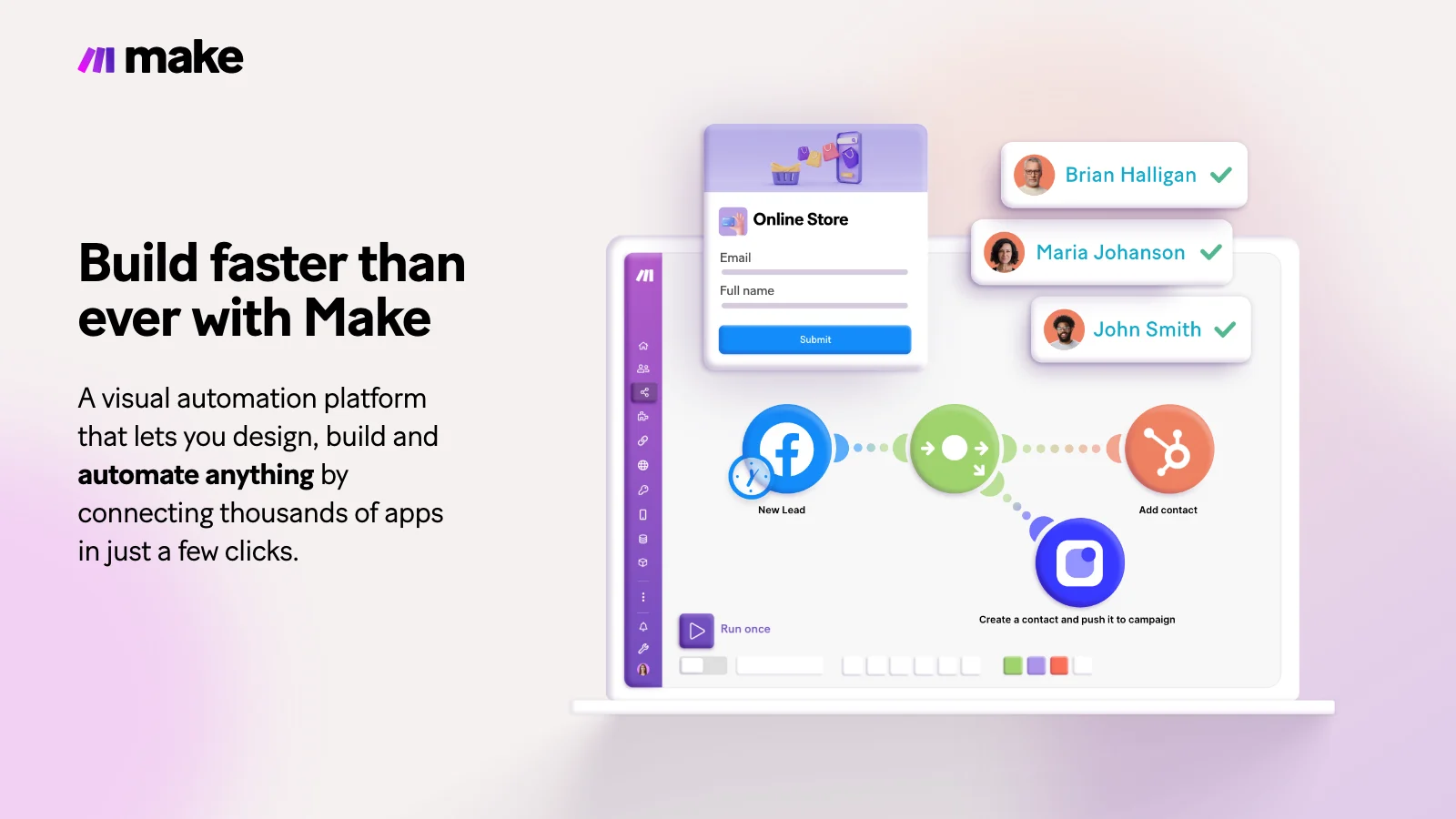
How it works: Make uses a visual scenario builder where modules (app actions) connect in a flowchart. Each module represents a step: watch for a trigger, transform data, create or update a record. Scenarios can branch, filter, loop, and handle errors, offering more control than Zapier's linear structure.
Both Constant Contact and Salesforce have dedicated Make modules.
What it syncs: Contacts, leads, campaign data, list membership, and custom fields. Make supports iterators for batch processing, routers for conditional paths, and aggregators for combining records before writing, allowing more complex data transformation between the two platforms than Zapier.
Fits: ongoing sync with conditional logic; not a migration tool for historical data.
Setup process:
Create a Make account and add Constant Contact and Salesforce as connections via OAuth.
Build a new scenario. Drag the Constant Contact module onto the canvas and select a trigger (e.g., "Watch Contacts" or "Watch List Subscribers").
Add a Salesforce module and select an action (e.g., "Create/Update Record").
Connect the two modules and map fields. Make provides functions for transforming data between platforms (e.g., formatting phone numbers, mapping Constant Contact list membership to Salesforce campaign membership).
Add error-handling modules to catch failures (e.g., log to a spreadsheet or send a notification when a sync fails).
Set the scenario to run on every trigger event or on a time-based schedule.
Strengths: Fine control over data transformation and conditional routing. The visual builder makes complex workflows easier to follow than code. Batch operations and error handling are built in. Per-operation pricing is lower than Zapier at higher volumes.
Limitations: Steeper learning curve than Zapier's guided setup. Bidirectional sync still requires careful loop-prevention configuration. Both the Constant Contact V3 API and Salesforce REST API impose rate limits, and high-volume scenarios may need throttling.
Best for: Teams with conditional sync requirements (e.g., only sync contacts tagged with a specific label, or route subscribers to different Salesforce record types based on list membership). Mid-size teams whose sync volumes make Zapier's per-task pricing expensive.
Custom API Integration
How it works: Both platforms provide comprehensive APIs.
Constant Contact's V3 REST API covers contacts, contact lists, tags, custom fields, email campaigns, campaign reporting, events, segments, and social posting, with OAuth 2.0 authentication.
Salesforce's REST API covers all standard and custom objects, with Platform Events and Change Data Capture for event-driven sync. A custom integration connects these APIs directly, with your own middleware handling authentication, field mapping, transformation, conflict resolution, and error recovery.
What it syncs: Anything both APIs expose. This is the only method that supports complex sync scenarios like mapping Constant Contact engagement data to custom Salesforce objects, syncing event registrations to Salesforce Campaigns, or enforcing business rules that go beyond field mapping.
Fits: either one-time migration or ongoing sync; the only method with no ceiling on either.
Setup process:
Register API credentials in both platforms: a Constant Contact developer application with OAuth 2.0, and a Salesforce External Client App with OAuth 2.0.
Design the data model mapping between Constant Contact and Salesforce objects, including how Constant Contact lists map to Salesforce Campaigns, how subscriber fields map to Lead/Contact fields, and a cross-reference table for matching record IDs.
Build the sync service: a server-side application that polls the Constant Contact API for new or updated contacts and engagement data, transforms records according to the mapping, and writes changes to Salesforce (or the reverse direction, or both).
Implement conflict resolution logic for bidirectional sync (timestamp-based, source-priority, or field-level rules).
Add logging, error handling, and retry logic. Constant Contact enforces API rate limits of 10,000 requests per day and 4 requests per second. Salesforce's API request allocation scales by edition and license count (starting at 100,000 for Professional and Enterprise editions).
Deploy, monitor, and maintain the integration over time.
Strengths: Full control over what syncs, when, and how. Can implement complex business logic (e.g., sync event registrants to a specific Salesforce Campaign, trigger Constant Contact automations from Salesforce deal stage changes).
No per-record or per-operation fees from a third-party connector. Constant Contact's V3 API is well-documented with an interactive API reference and official SDKs in C#, PHP, Python, Ruby, and TypeScript.
Limitations: Requires development resources to build and maintain. You own the infrastructure, monitoring, and error recovery.
Constant Contact's API does not support webhooks for standard integrations (webhooks are scoped to Technology Partners only), so real-time event notifications from Constant Contact require polling. Salesforce versions its API with each seasonal release. The initial build takes weeks, not hours.
Best for: Organizations with custom data models, complex campaign reporting requirements, or business logic that must be enforced during sync. Teams with in-house developers and a long-term commitment to running both platforms with tight integration.
Key Use Cases
1. New Email Subscribers Become Salesforce Leads
When a prospect signs up through a Constant Contact sign-up landing page or embedded form, the integration creates a Salesforce Lead with the captured information so the sales team can follow up without waiting for a manual handoff. If the subscriber came from a paid campaign, the lead source carries over for attribution.
Best integration method: Zapier or native AppExchange connector (one-directional, event-triggered or scheduled).
2. Email Engagement Scoring in Salesforce
Marketing sends a nurture sequence through Constant Contact. The integration syncs engagement data (opens, clicks, bounces) to the corresponding Salesforce Contact or Lead records.
Sales reps can see which prospects opened the last three emails or clicked through to the pricing page, helping them prioritize follow-up based on demonstrated interest rather than guesswork.
Best integration method: Native AppExchange connector or SyncApps by Cazoomi (scheduled sync of engagement metrics).
3. Salesforce Campaign Membership Drives Constant Contact List Targeting
A sales manager creates a Salesforce Campaign for a product launch and adds target contacts. The integration syncs those Campaign members to a Constant Contact list, so marketing can send a targeted email sequence to exactly the audience sales identified, without manually exporting and importing a CSV.
Best integration method: SyncApps by Cazoomi or custom API (bidirectional campaign-list mapping).
4. Event Registration Tracking Across Both Platforms
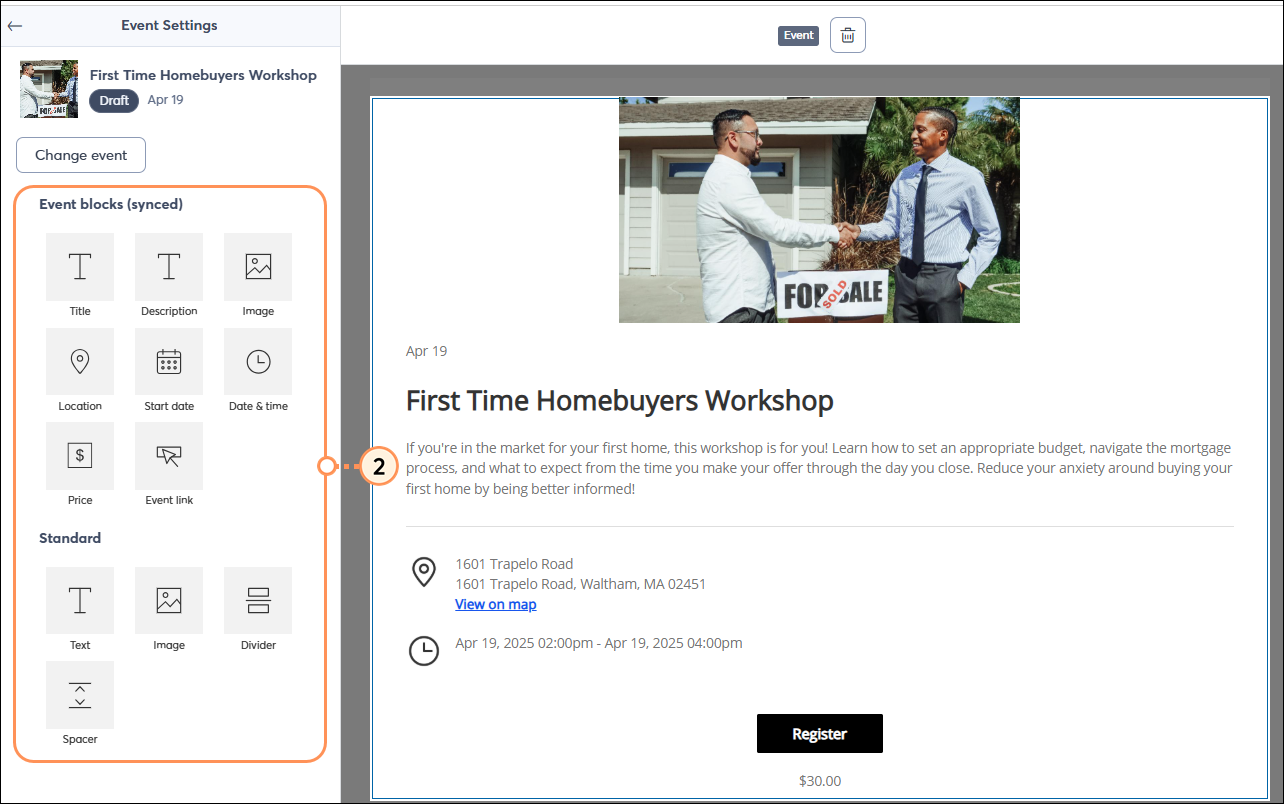
Constant Contact's built-in event management tools handle registration, ticketing, and payment processing.
Source: Constant Contact
The integration syncs registrants to Salesforce as Campaign members with an "Event Registered" status, giving sales visibility into which prospects are attending. Post-event follow-up can be triggered from Salesforce based on attendance status.
Best integration method: Custom API or SyncApps by Cazoomi (event registrants mapped to Salesforce Campaign members).
5. Unsubscribe Compliance Across Both Systems
When a contact unsubscribes from Constant Contact emails, the integration updates the corresponding Salesforce record to reflect the opt-out, preventing sales from re-adding the contact to future marketing lists.
This keeps both systems aligned on consent status and reduces the risk of sending emails to contacts who opted out.
Best integration method: SyncApps by Cazoomi or native connector (bidirectional unsubscribe status sync).
Limitations and Considerations
Data That Doesn't Sync Easily
Constant Contact and Salesforce model contacts differently.
Constant Contact treats all subscribers as a flat list with tags and list membership.
Salesforce separates contacts into Leads (unqualified) and Contacts tied to Accounts, with a formal conversion process between them.
Deciding whether a Constant Contact subscriber maps to a Salesforce Lead or Contact requires logic that most simple connectors handle only through pre-configured rules, not dynamic evaluation.
Constant Contact's email template content, automation path configurations, and AI-generated analytics do not transfer to Salesforce.
Full email HTML, design assets, and campaign scheduling data stay inside Constant Contact. What syncs is the metadata: who received what, who engaged, and how.
Sync Conflicts
Bidirectional sync creates the risk of conflicting updates. If marketing updates a contact's phone number in Constant Contact while a sales rep changes the same number in Salesforce, which change wins? Without explicit conflict resolution rules, one update overwrites the other.
The native connector and Zapier offer limited conflict handling. SyncApps and custom builds allow configurable resolution rules (timestamp-based, source-priority, or field-level), but these must be set up intentionally.
Pricing Implications
Constant Contact enforces API rate limits of 10,000 requests per day and 4 requests per second. Salesforce's API limits begin at 100,000 requests per 24 hours for Professional and Enterprise editions, plus per-license allocations.
Third-party tools carry their own costs.
Zapier charges by the number of tasks (each synced record counts as a task). Make charges by operations. SyncApps pricing scales with record count and sync frequency.
For teams syncing thousands of contacts with frequent campaign engagement data, these costs compound.
Constant Contact's own pricing scales by contact count ($12/mo for Lite at 500 contacts, escalating steeply above 10,000 contacts), so large syncs that inflate the Constant Contact contact count can trigger plan upgrades.
Permissions and Access
Setting up the integration requires admin access on both sides. In Salesforce, System Administrator access is needed to install AppExchange packages and configure Connected Apps or External Client Apps for API access.
In Constant Contact, account admin rights are needed to authorize OAuth connections and configure integration settings. If your Salesforce org uses field-level security or sharing rules, the integration user's profile must have access to every field you intend to sync.
Maintenance
Both platforms update independently.
Constant Contact's V3 API replaced the deprecated V2 API and may introduce breaking changes with future versions.
Salesforce versions its API with each seasonal release (the current version is Summer '26, API version 67.0). Custom fields added after initial setup will not sync unless the integration configuration is updated.
Third-party tools may change pricing, deprecate connectors, or alter authentication methods. Plan for periodic reviews of the integration's health and accuracy.
What No Method Fixes: The Data Itself
Every method above moves records between Constant Contact and Salesforce. None of them checks whether those records are accurate, complete, or current. A lead with a dead email address in Salesforce syncs as a subscriber with a dead email address in Constant Contact, and the next campaign bounces.
A contact with the wrong job title travels just as reliably as a clean one. The integration ensures both systems agree; it does not ensure they are right.
Where ZoomInfo Fits In
Every method in this guide moves data between Constant Contact and Salesforce. None of them improves the data being moved.
When the integration is live but email campaigns bounce because addresses are stale, leads arrive in Salesforce with missing titles and no company context, and marketing sends nurture sequences to contacts who changed jobs two quarters ago, the bottleneck is no longer the connector.
That is the gap ZoomInfo closes.
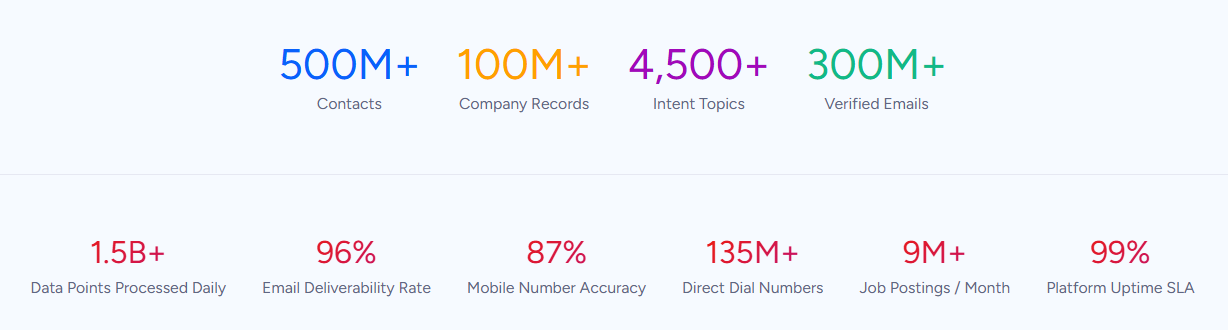
ZoomInfo is a B2B data and go-to-market platform built on 500M contacts, 100M companies, 135M+ verified phone numbers, and 200M+ verified business email addresses. That data is verified through a multi-source pipeline backed by 300+ human researchers and reaching up to 95% accuracy on first-party data.
For teams running a Constant Contact-Salesforce integration, ZoomInfo addresses the data quality layer that no connector handles.
ZoomInfo integrates natively with Salesforce through the AppExchange, providing CRM enrichment, lead routing, and real-time data updates inside Salesforce records.
Before a contact ever syncs to Constant Contact, ZoomInfo ensures the Salesforce record has a verified business email (so the marketing email actually lands), an accurate job title (so the content is relevant), and current company details (so segmentation reflects reality).
The same data feeds ZoomInfo's GTM Context Graph, which processes 1.5B+ data points daily and combines third-party intelligence with CRM records, conversation transcripts, and behavioral signals to surface not just what happened in a deal, but why.
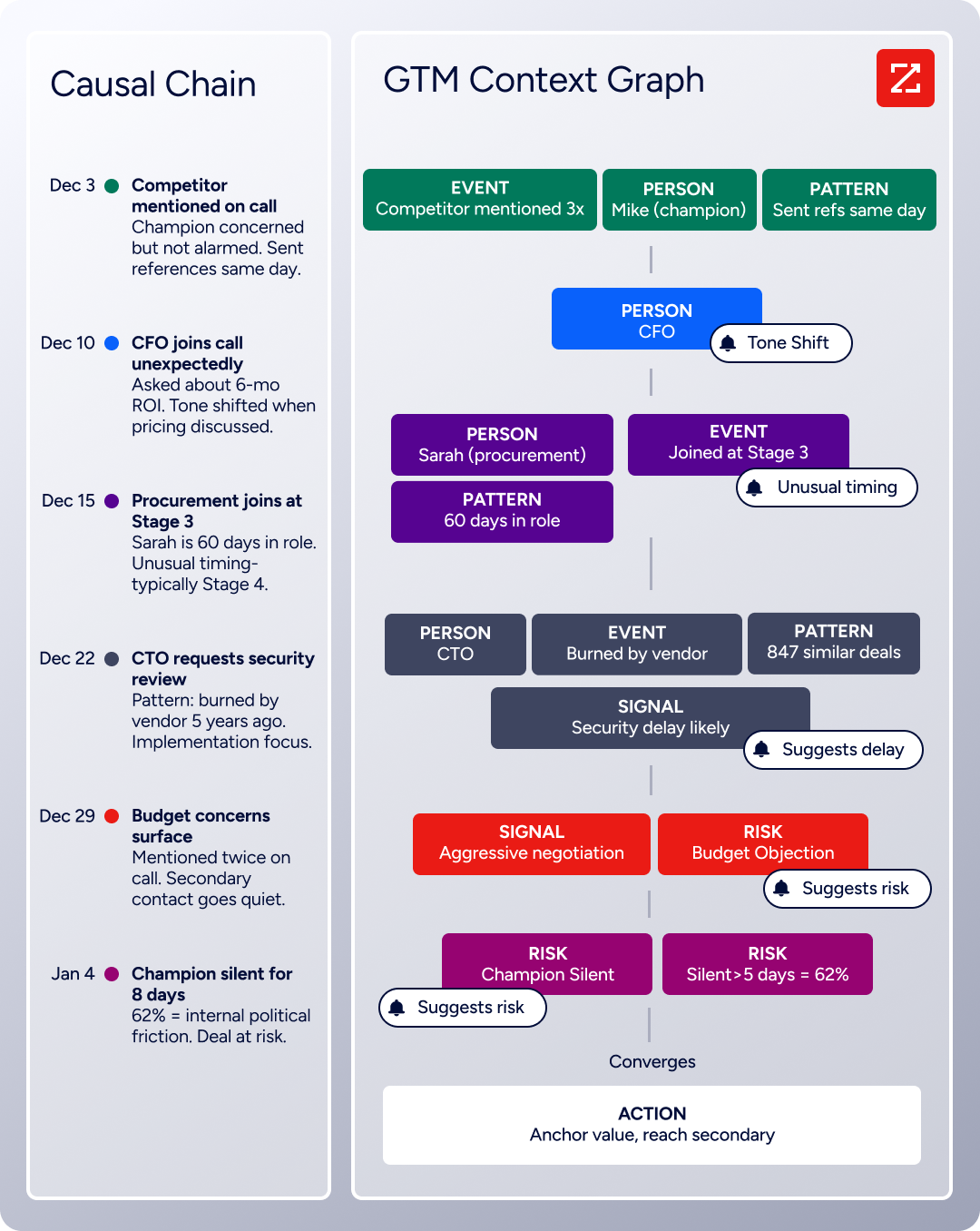
In practice, a team running both platforms can use ZoomInfo to enrich Salesforce records before they sync to Constant Contact. Verified emails mean marketing campaigns reach real inboxes instead of bouncing.
Accurate titles and company data mean Constant Contact's segmentation builder can target the right personas with the right content.
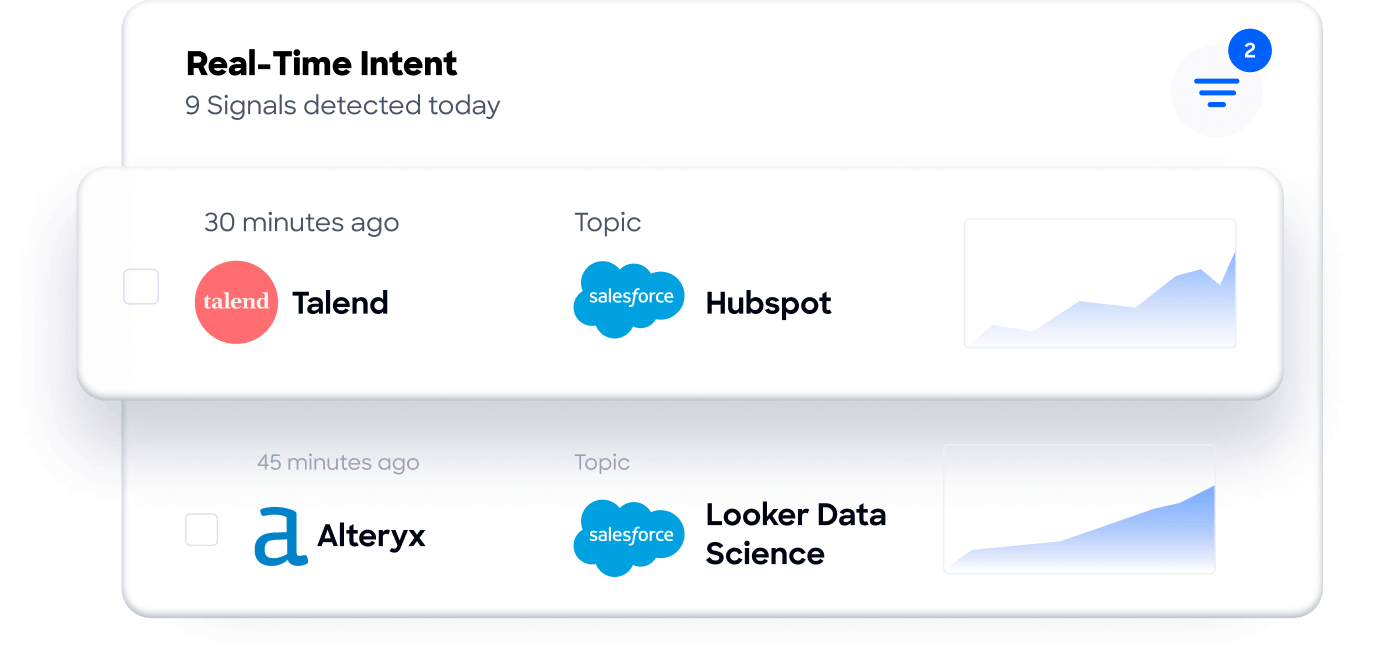
Buyer Intent data from ZoomInfo, tracking signals from 210 million IP-to-Organization pairings, can prioritize which accounts receive campaigns through Constant Contact, so marketing focuses send volume on prospects who are actively researching relevant solutions.
Enriched records also make the integration itself more reliable. Fewer blank email fields mean fewer sync errors and fewer bounce-backs that damage Constant Contact's 97% deliverability rate. Consistent formatting across records reduces the false positives that create duplicate subscribers.
For teams using ZoomInfo's API or MCP access, the same verified data can feed any custom workflow or AI agent, extending enrichment beyond what the native Salesforce connector covers.
Seismic's sales team attributed 39% of active pipeline to opportunities identified or influenced by ZoomInfo signals, while boosting productivity by 54% and saving 11.5 hours per week. (Seismic)
Final Verdict
A native Constant Contact-Salesforce connector exists on the AppExchange, and third-party middleware extends it with bidirectional sync and campaign tracking. For most teams, the right choice depends on scale and complexity.
Small teams syncing subscribers and basic engagement data should start with the native AppExchange connector. It is free, officially supported, and requires no third-party tool or engineering resources.
Teams that need bidirectional sync with conflict resolution, campaign membership mapping, and unsubscribe compliance should look at SyncApps by Cazoomi or similar middleware that handles the structural differences between the two data models.
Teams with simple, event-driven sync needs (e.g., new subscriber creates a Salesforce Lead) should consider Zapier or Make for fast, low-cost setup without middleware overhead.
Organizations with complex data models, custom reporting requirements, or business logic that must be enforced during sync should invest in a custom API integration using Constant Contact's V3 API and Salesforce's REST API.
Before committing to a method, clarify why both platforms need to coexist.
If the answer is temporary (a marketing team evaluating Salesforce Marketing Cloud as a replacement for Constant Contact), keep the sync simple and plan for consolidation.
If the answer is structural (Constant Contact serves as the email and event platform for its ease of use and 97% deliverability rate while Salesforce handles the full sales pipeline), invest in a method that supports bidirectional sync and keeps consent status aligned.
Either way, the quality of the contact data in both systems determines whether the integration delivers value or just replicates problems across two platforms.
ZoomInfo, with its native Salesforce integration and API and MCP access, is the data enrichment layer that keeps records accurate while the connector keeps them aligned.
FAQ
Does Constant Contact have a native Salesforce integration?
Yes. A native Constant Contact connector is available on the Salesforce AppExchange (Constant Contact for Salesforce v1.0). It syncs contacts between the two platforms and pushes email engagement data back to Salesforce records.
The connector is included at no cost with both platform subscriptions. For bidirectional sync and campaign tracking, third-party solutions like SyncApps by Cazoomi extend the native connector's capabilities.
Can I sync historical contacts between Constant Contact and Salesforce?
The native AppExchange connector and middleware solutions like SyncApps can handle existing records during an initial sync. Zapier and Make only process records created after the workflow is activated.
For large-scale historical migration, middleware tools or a custom script using the Constant Contact V3 API's bulk activity endpoints (which support async CSV import/export) and Salesforce's Bulk API 2.0 are the recommended paths.
How do I prevent duplicate contacts when syncing?
Use a shared unique identifier (email address is the most common) as a matching key. Before creating a record in the target system, the integration should check whether a matching record already exists. SyncApps includes deduplication logic by default. Zapier provides a "Search" step before the "Create" step for this purpose.
Custom API integrations should use upsert logic with each platform's native upsert capabilities. Constant Contact's API supports a create-or-update operation on contacts, which serves as a built-in deduplication mechanism.
What happens to unsubscribes when both systems are connected?
When a contact unsubscribes from Constant Contact emails, the integration should update the corresponding Salesforce record to reflect the opt-out. SyncApps handles this bidirectionally. The native connector pushes unsubscribe data back to Salesforce.
Without this sync, there is a compliance risk: a sales rep could re-add an opted-out contact to a marketing list through Salesforce, triggering unwanted emails. Ensuring unsubscribe status flows in both directions is critical for CAN-SPAM and GDPR compliance.
Does the integration support Constant Contact's event management features?
Not through the native connector or Zapier in a meaningful way. Constant Contact's built-in event management (RSVP, ticketing, payment processing) generates registrant data that can be synced to Salesforce as Campaign members through a custom API integration or middleware like SyncApps.
The event details themselves (ticket types, payment status, check-in data) typically require custom development to map into Salesforce objects.
What are the API rate limits I need to consider?
Constant Contact's V3 API enforces 10,000 requests per day (resetting at UTC midnight) and 4 requests per second. Salesforce's API limits start at 100,000 requests per 24 hours for Professional and Enterprise editions, plus per-license allocations.
Both platforms return 429 status codes when limits are exceeded. High-volume syncs (thousands of contacts with frequent engagement updates) may require batching, throttling, or higher-tier plans on either platform. Technology Partners on Constant Contact's platform receive higher rate limits.
Can Constant Contact's automation paths be triggered by Salesforce data?
Not directly. Constant Contact's Automation Path Builder supports triggers based on Constant Contact events (list additions, tag changes, email clicks, form submissions), but it cannot natively listen for Salesforce events like deal stage changes or task completions.
You can create an indirect trigger: use Zapier or Make to add a tag or move a contact to a specific list in Constant Contact when a Salesforce event occurs, and configure that list addition or tag as the trigger for a Constant Contact automation path.
How does ZoomInfo improve a Constant Contact-Salesforce integration?
ZoomInfo solves the data quality problem that no sync tool addresses. Contact records in CRMs decay as people change jobs, email addresses go inactive, and company details shift. ZoomInfo enriches Salesforce records with verified contact data, company attributes, technographics, and intent signals through its native Salesforce integration.
Those enriched records then sync to Constant Contact with accurate emails, correct titles, and current company details, which reduces bounce rates, improves segmentation accuracy, and ensures marketing campaigns reach the right people.
The result: the data flowing between both systems is accurate and complete, making the integration more valuable and the marketing it supports more effective.
Build out your Salesforce stack:
