
Choosing between Constant Contact vs. Marketo for your marketing often comes down to five questions:
Are you a small business sending newsletters and event invitations, or an enterprise running multi-touch B2B campaigns across long sales cycles?
Do you need a platform you can learn in an afternoon, or are you willing to invest months mastering a system that rewards the effort?
Is your marketing primarily about staying in touch with existing contacts, or about scoring, nurturing, and routing leads through a pipeline?
Can you afford to pay a premium for automation depth, or do you need something functional at $35 a month?
Do you have a dedicated marketing operations person, or is marketing one of twelve things the business owner handles before lunch?
In short, here's what we recommend:
Constant Contact is built for small businesses and nonprofits that need to send professional marketing emails without a marketing department. Its drag-and-drop editor, 200+ templates, and 97% email deliverability rate let you go from zero to a live campaign in under an hour. Built-in event management, SMS marketing, and social media scheduling give small teams multichannel reach from one dashboard. The trade-off is depth: automation is limited to a single trigger per path, custom automation paths require the Premium plan, and pricing climbs fast as contact lists grow.
Marketo (officially Adobe Marketo Engage) is the enterprise standard for B2B marketing automation, built for organizations running demand generation programs across six-to-eighteen-month sales cycles. Its campaign engine handles multi-dimensional lead scoring, engagement programs with content exhaustion logic, and bidirectional CRM sync with Salesforce and Microsoft Dynamics. A Forrester study found Marketo customers saw 267% ROI on average. But that capability comes with real costs: a steep learning curve, the need for a dedicated Marketo administrator, and quote-based pricing that prices out smaller organizations.
Both platforms handle marketing execution (sending emails, managing contacts, running campaigns). But the effectiveness of any campaign depends on something neither platform provides on its own: knowing who to target, when they're ready to buy, and what matters to them right now. That's the data question, and it's where ZoomInfo fills the gap.
ZoomInfo is a B2B data and go-to-market platform with 500M contacts, 100M companies, 135M+ verified phone numbers, and 200M+ verified business emails. By combining this data with your CRM records, conversation transcripts, and behavioral signals, ZoomInfo's GTM Context Graph (which processes 1.5B+ data points daily) shows the context behind your accounts, including why deals move or stall and which actions to take next. Whether you run campaigns through Constant Contact or Marketo, ZoomInfo enriches your contact database, identifies in-market buyers through intent signals, and flags the accounts worth prioritizing. Your team uses it through GTM Workspace for sales execution, GTM Studio for marketing and RevOps workflows, or APIs and MCP in any other front-end, including Marketo, where ZoomInfo is a LaunchPoint integration partner.
If verified data and buying signals are what your campaigns are missing, see how ZoomInfo works with your platform.
Constant Contact vs. Marketo vs. ZoomInfo at a glance
Constant Contact | Marketo | ZoomInfo | |
|---|---|---|---|
Primary function | Email marketing & multichannel campaigns for SMBs | Enterprise B2B marketing automation | B2B data intelligence & go-to-market platform |
Target buyer | Small businesses, nonprofits, solopreneurs | Mid-market and enterprise B2B marketing teams | B2B sales, marketing, and RevOps teams |
Learning curve | Minimal, productive in under an hour | Steep, months to proficiency | Moderate, 90-day onboarding |
Automation depth | Single-trigger paths, up to 50 steps | Unlimited scoring models, nested programs, trigger + batch campaigns | Signal-triggered plays and automated workflows |
CRM integration | Salesforce, Shopify, WooCommerce, 300+ apps | Native bidirectional sync with Salesforce and Dynamics | Native integrations with Salesforce, HubSpot, Dynamics, plus 172+ marketplace partners |
Lead scoring | Not available | Multi-dimensional behavioral + demographic scoring | Predictive Account Fit Score, buyer intent scoring |
Data enrichment | Not available | Basic via third-party connectors | 500M contacts, 200M+ verified emails, enrichment from 25+ sources |
Pricing | Starting at $12/month (Lite) | Quote-based, enterprise pricing | Custom-quoted, consumption-based |
Free option | 30-day trial (100 email sends) | No free trial | ZoomInfo Lite (permanent free tier) + 7-day trial |
They serve fundamentally different markets
Comparing Constant Contact to Marketo is like comparing a reliable sedan to a commercial truck. Both get you somewhere. They're built for different jobs.
Constant Contact was founded in 1995 as one of the first email marketing tools designed for small businesses. Three decades later, that's still its core audience. The platform assumes the user is a business owner, not a marketer. Templates are organized by industry. The editor works by dragging blocks. Phone support is available six days a week on every paid plan. Everything is designed so someone without marketing training can produce professional-looking campaigns.
Marketo was founded in 2006 to bring enterprise marketing automation to teams that couldn't afford the capital expenditure of on-premise systems like Eloqua. Adobe acquired it in 2018 for $4.75 billion, and it's now the B2B marketing engine within Adobe Experience Cloud. The platform assumes the user is a marketing operations professional who will dedicate months to learning proprietary concepts like Smart Campaigns, Engagement Streams, and Tokens. Adobe's own onboarding guidance says as much: users who skip training routinely spend consulting hours on basic concepts.
The market split is stark. Capterra's review base for Constant Contact is dominated by organizations with 2–50 employees in education, hospitality, and religious institutions. Marketo's customer base skews toward software, professional services, financial services, and manufacturing companies running large-scale demand generation. Choosing between them usually isn't a matter of preference, but of which one matches your organization's size, complexity, and resources.
Automation depth is the clearest dividing line
This is where the platforms diverge most sharply, and where the wrong choice costs the most time.
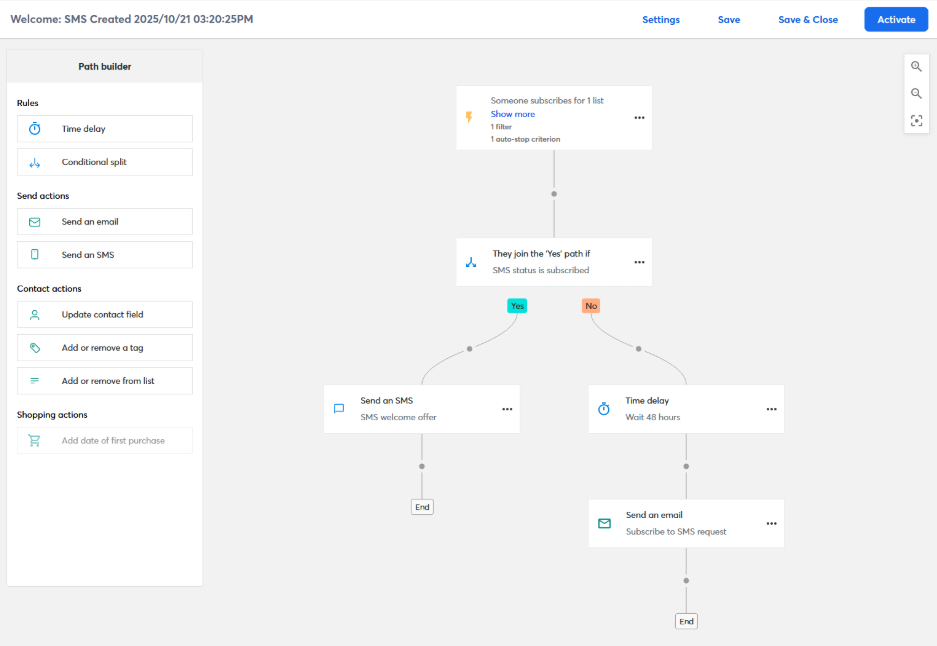
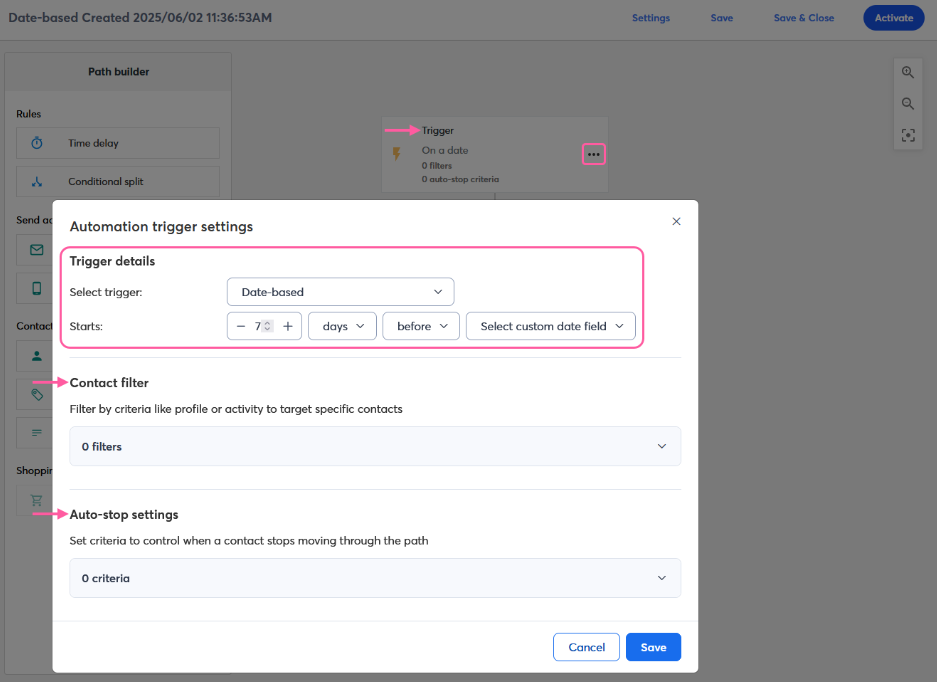
Constant Contact's automation is built around the Automation Path Builder, a visual drag-and-drop canvas. Each path starts with a single trigger: a contact joining a list, clicking a link, making a purchase, or reaching a date. From there, you add send steps (email or SMS), time delays, and conditional splits. Paths can contain up to 50 steps, which is plenty for welcome series, birthday campaigns, and post-purchase follow-ups.
Source: Constant Contact
The limitations appear quickly for anything more complex. The Standard plan restricts you to three active automation paths using pre-built templates only. Custom paths require Premium. And every path is limited to a single trigger, so you can't build behavioral logic that responds to combinations of actions. For a nonprofit running a welcome series and a birthday campaign, this works. For a B2B team trying to nurture leads through a six-month buying cycle with branching based on engagement patterns, it doesn't.
Source: Constant Contact
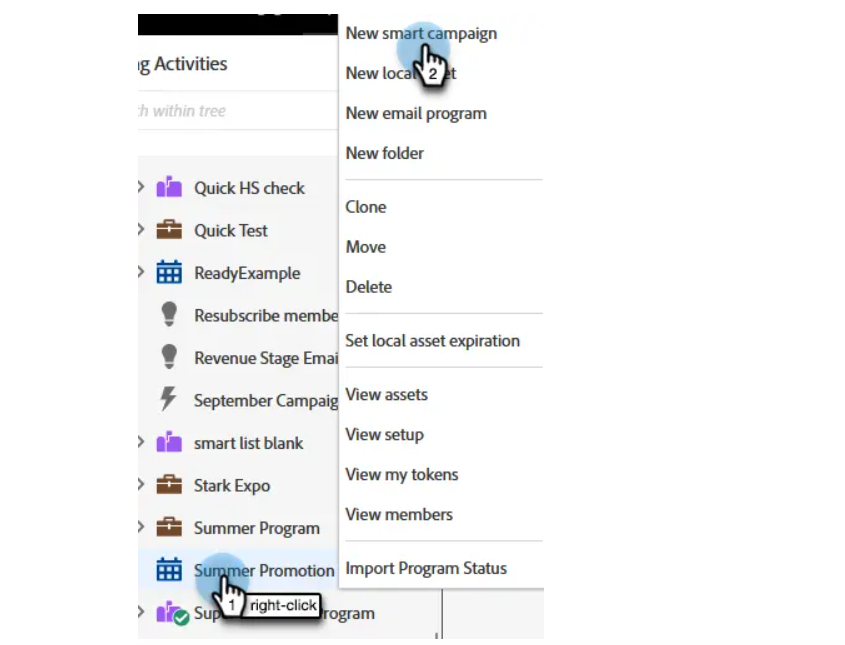
Marketo's automation operates at a different level. The Smart Campaign is the core unit: a Smart List defines who qualifies (using 150+ filters and real-time triggers), a Flow defines what happens (scored actions, CRM updates, email sends, webhook calls, conditional branching), and a Schedule controls when. Trigger campaigns fire instantly when a qualifying event occurs. Batch campaigns run against snapshots on a set cadence. You can combine triggers and filters in the same campaign, and multiple triggers use OR logic, enabling precise responses to complex buying behavior.
Source: Adobe
Engagement Programs add another layer: multi-stream nurture tracks with configurable cadence, automatic content exhaustion detection, and per-person pause/resume controls. When a lead consumes all available content in a stream, the system flags them as "Exhausted," a clear signal to add new content or hand off to sales. Each piece of content receives an Engagement Score from 0 to 100, calculated from opens, clicks, unsubscribes, and success metrics, so marketers can identify which assets drive engagement.

Source: Adobe
The gap between these platforms isn't incremental. It's structural. Constant Contact automates marketing tasks. Marketo automates marketing systems.
For a complete look at Marketo's campaign engine, features, and limitations, see our Marketo review.
Email creation takes different approaches
Both platforms let you build emails without writing HTML. The experience of doing so is quite different.
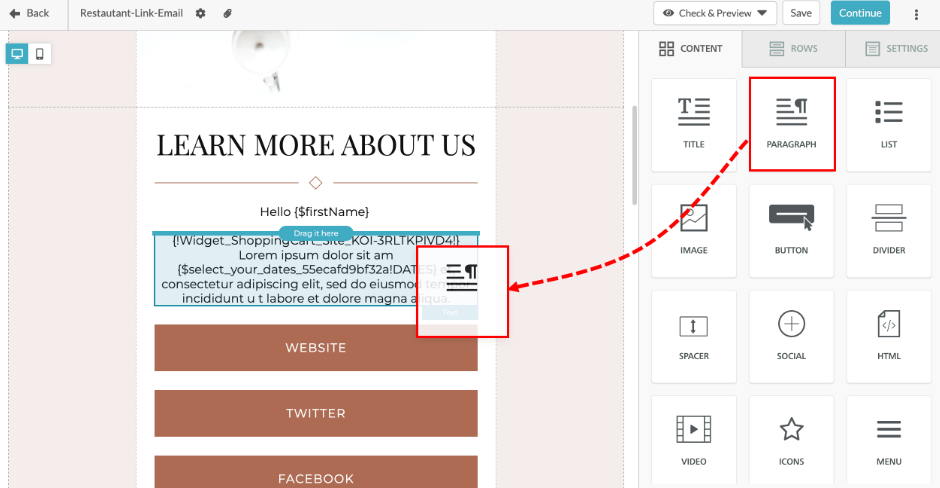
Constant Contact gives you a drag-and-drop editor with thirteen content block types, ten responsive column layouts, and a BrandKit that applies your logo, colors, and fonts consistently.
Source: Constant Contact
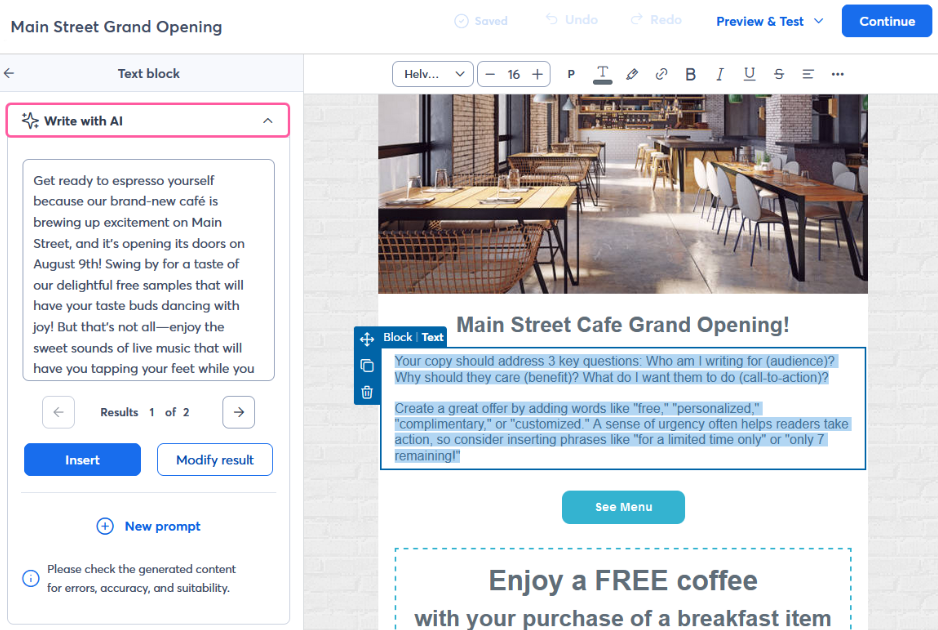
An AI Content Generator can produce a full email draft from a short prompt (layout, copy, and images included). A/B testing on subject lines is available on Standard and above. For a small business that needs to send a professional-looking newsletter quickly, the workflow is fast.
Source: Constant Contact
Where Constant Contact falls short is personalization at scale. Dynamic content blocks are Premium-only. Capterra reviewers note the editor has limited customization options (difficulty resizing images, inflexible block positioning) compared to newer platforms.
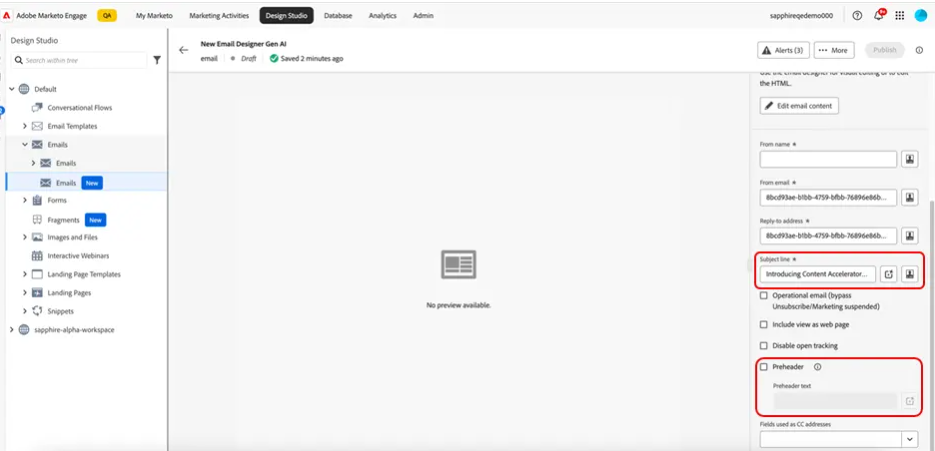
Marketo recently launched a new Email Designer with drag-and-drop editing, out-of-the-box templates, and an AI Assistant that generates subject lines, preheaders, or full emails. The AI accepts structured inputs like buying group role (Practitioner, Influencer, Decision Maker) and marketing journey stage (Discover, Evaluate, Commit), reflecting Marketo's B2B orientation.
Source: Adobe
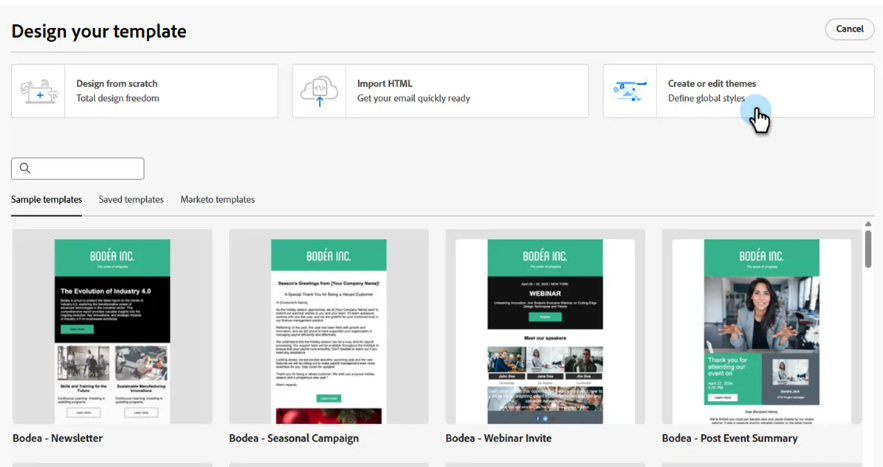
Where Marketo goes further is content governance. Brand themes enforce fonts, colors, and logos across an organization.
Source: Adobe
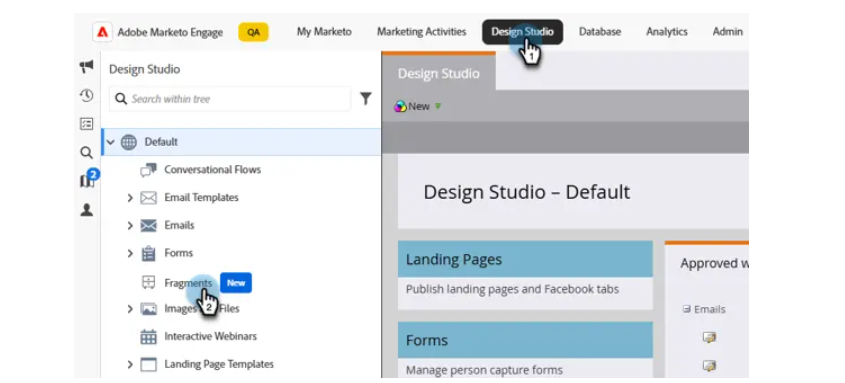
Content locking in templates prevents editors from modifying non-brand elements. Reusable fragments (headers, footers, disclaimers) propagate updates everywhere they're used. Conditional content serves different images or copy to different audience segments within a single email. For a ten-person marketing team running campaigns across multiple business units, these controls prevent brand drift.
Source: Adobe
Neither platform solves the data problem
Here's what both Constant Contact and Marketo assume: that you already know who to market to and that your contact data is accurate. Neither assumption holds up well in practice.
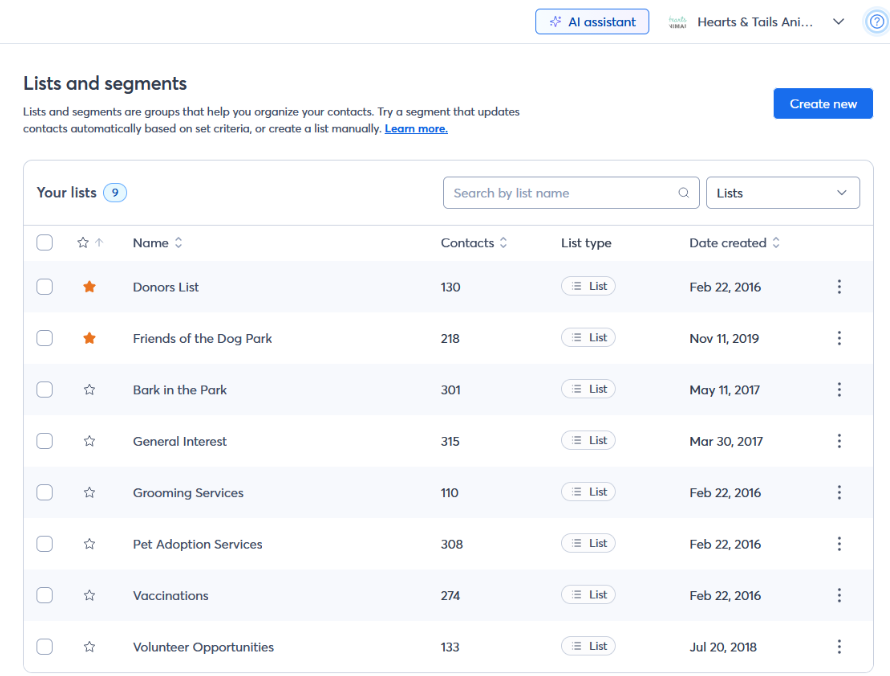
Constant Contact's contact management works through lists, tags, and segments. Segments auto-refresh before each send, filtering contacts across ten criteria categories. But the platform doesn't tell you which contacts are worth targeting in the first place. It doesn't enrich records with firmographic data. It doesn't signal when a prospect is researching your product category. You're marketing to whoever happens to be on your list, regardless of whether they're a good fit or in-market right now.
Source: Constant Contact
Marketo adds lead scoring, which helps prioritize existing contacts by engagement level and demographic fit. But scoring only works if the underlying data is complete and current. Multiple TrustRadius reviewers note that Marketo's batch-based architecture introduces delays in lead routing and scoring updates. And the platform doesn't provide the contact data itself; enrichment depends on connecting third-party data providers.
ZoomInfo fills this gap for both platforms. The database (500M contacts, 100M companies, 135M+ verified phone numbers, and 200M+ verified business emails) gives marketing teams access to buyers they wouldn't otherwise find. In a Fortune 500 competitive RFP analyzing 25 million contacts across vendors, the independent consultant concluded that "no other competitor came even close."

Source: ZoomInfo
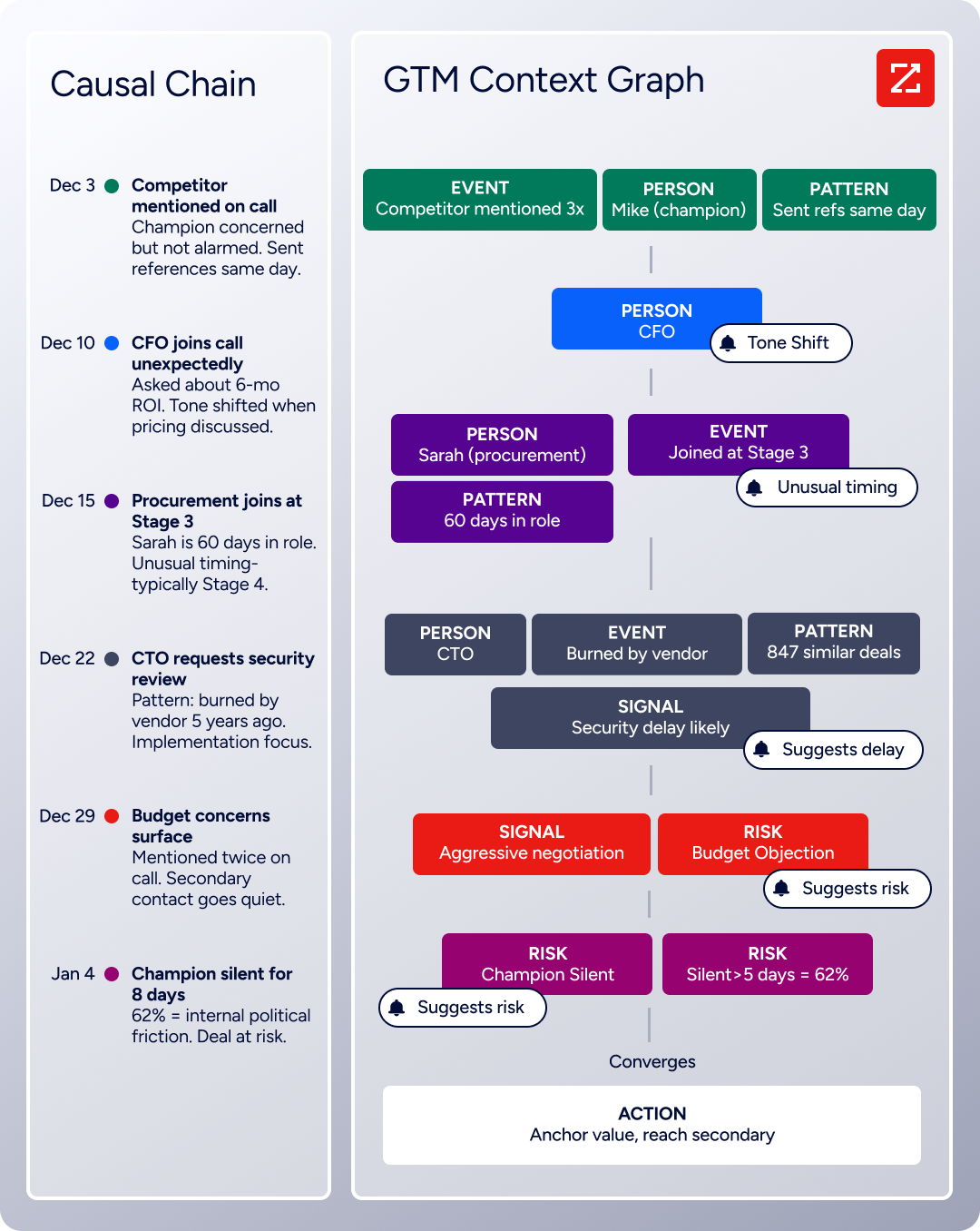
The GTM Context Graph takes this further. It combines ZoomInfo's external data with your CRM records, conversation transcripts, and behavioral signals to show why deals move or stall. Buyer Intent data tracks signals from 210 million IP-to-Organization pairings and 6 trillion+ new keyword-to-device pairings sourced monthly, showing which companies are researching your product category before they fill out a form.
Source: ZoomInfo
For Marketo users, ZoomInfo is a LaunchPoint integration partner, feeding enriched contact data and intent signals into Marketo's lead scoring and campaign engine. For Constant Contact users, ZoomInfo's data can populate and enrich contact lists through API connections, so campaigns reach verified contacts when they matter.
Seismic's sales team attributed 39% of active pipeline to opportunities identified or influenced by ZoomInfo signals, reporting 54% productivity gains and 11.5 hours saved per week per seller. (Seismic Case Study)
Lead scoring and sales alignment separate the two platforms
If your marketing exists to generate and qualify leads for a sales team, this section decides which platform you need.
Constant Contact does not offer lead scoring. Contacts are organized by lists, tags, and segments, which is useful for targeting, but the platform doesn't score prospects by behavior or profile and doesn't automate handoffs to sales when a lead reaches a qualification threshold. The platform is designed for broadcast communication, not pipeline management.
Marketo was built around lead lifecycle management. Multi-dimensional scoring models track behavioral signals (email opens, page visits, form fills, webinar attendance) separately from demographic/firmographic attributes (job title, company size, industry). Scores update automatically through Smart Campaign flow steps, and threshold triggers fire alerts to sales reps or create CRM tasks when leads reach qualification criteria.
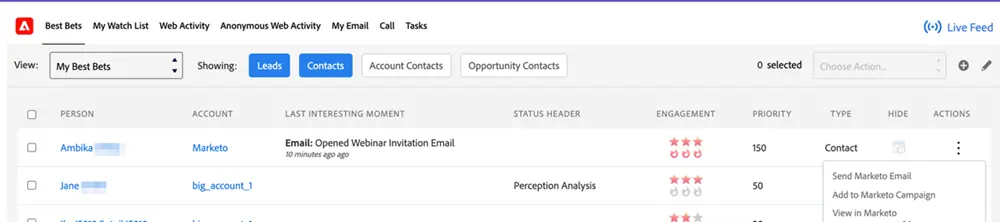
Sales Insight embeds this intelligence inside Salesforce. Reps see a Best Bets list ranking the highest-scoring, most-engaged leads with inline actions to send emails, add to campaigns, or add to watchlists. Stars represent lead score relative to other leads; Flames represent how recently and quickly a lead has engaged. This lets sales teams work the right opportunities rather than wasting time on cold leads.
Source: Adobe
ZoomInfo adds a data layer that enhances any scoring model. Account Fit Score scores accounts 0–100 based on company attributes that predict conversion, drawn from 300+ company attributes. Intent signals identify which of those accounts are in-market now.
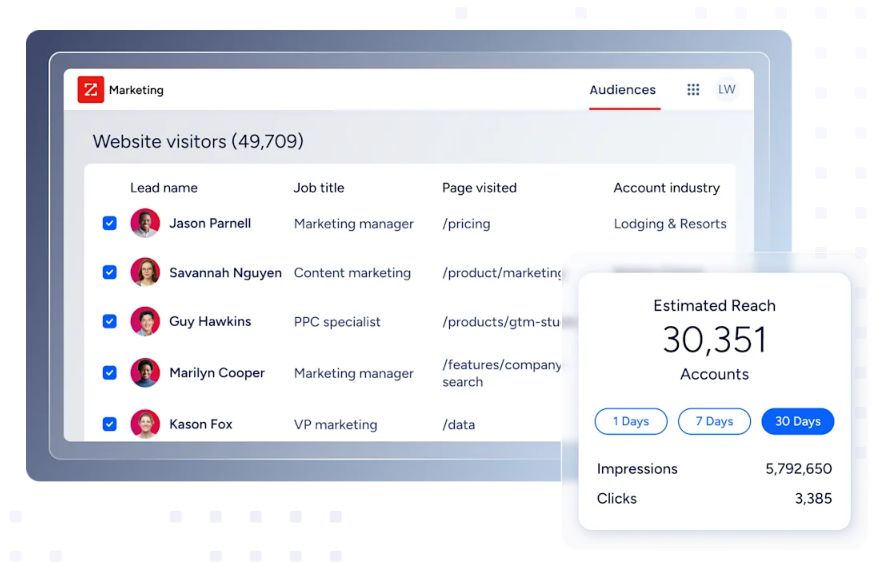
Source: ZoomInfo
And GTM Workspace delivers this intelligence to sellers in one place: prioritized accounts, AI-drafted outreach, and deal execution without tool-switching.
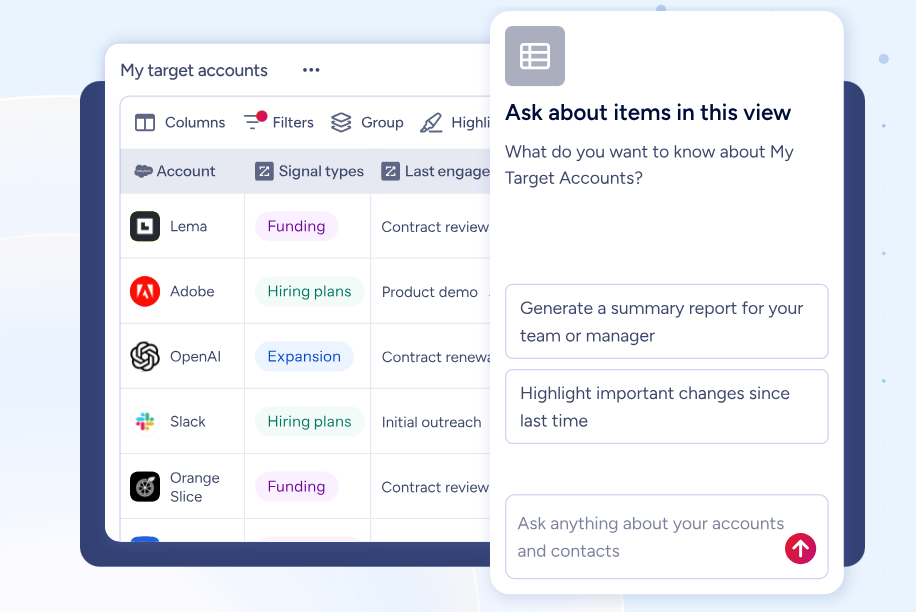
Source: ZoomInfo
For teams running Marketo, ZoomInfo's intent data and enrichment feed into scoring models, improving the accuracy of every MQL/SQL handoff. For teams on Constant Contact that need lead scoring, ZoomInfo provides the account prioritization and buyer identification that Constant Contact doesn't.
Snowflake used ZoomInfo data to power its Account Propensity Scoring model, feeding over 70 company and technographic data fields. Accounts monitored using ZoomInfo-powered scores showed 90% higher opportunity open rates and 2x higher customer conversion rates. (Snowflake Case Study)
Pricing reveals who each platform is built for
The pricing structures make the market segmentation explicit.
Constant Contact uses a contact-tier model. The Lite plan starts at $12/month for up to 500 contacts, Standard at $35/month, and Premium at $80/month. These prices climb with contact count: at 2,501–5,000 contacts, you're paying $80/month (Lite), $110/month (Standard), or $200/month (Premium). Email send allowances are capped at 10x contacts (Lite), 12x (Standard), or 24x (Premium) per billing cycle.
Two pricing details catch users off guard. First, the contact tier is based on the highest active contact count ever recorded; deleting contacts doesn't lower your bill. Second, exceeding send limits for two consecutive months triggers an automatic tier upgrade to the next billing tier without warning. Nonprofits receive a 30% discount on prepaid plans, making it one of the most affordable options for nonprofits.
Marketo publishes no prices. All four packages (Grow, Select, Prime, Ultimate) are quote-based, billed per 1,000 contacts, and sold through Adobe Sales. No free trial exists. Key features are tier-gated: Lifecycle Modeler and Workspaces require Prime or Ultimate. Marketo Measure (multi-touch attribution) requires Ultimate. Full Dynamic Chat AI capabilities require a separate Prime add-on. Total cost of ownership includes not just licensing but typically a dedicated Marketo administrator and implementation consulting.
For a detailed breakdown of what Marketo actually costs across tiers and add-ons, see our Marketo pricing guide.
ZoomInfo uses custom-quoted, consumption-based pricing based on data access, API consumption, and AI activity. No prices are published.
However, ZoomInfo offers something neither competitor does: a permanent free tier called ZoomInfo Lite with access to 100M+ verified profiles, 10 monthly export credits, individual and company searches with advanced filters, and a Chrome extension. A 7-day free trial with expanded access is also available.
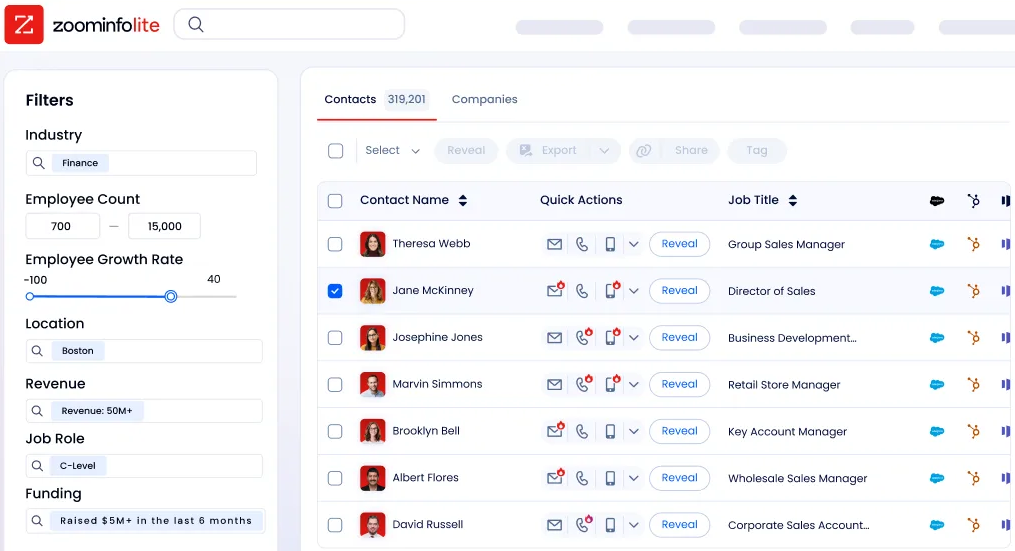
The pricing comparison tells you the market: Constant Contact is priced for small businesses spending less than $200/month on marketing. Marketo is priced for enterprises that can fund dedicated marketing operations staff. ZoomInfo adds a data layer that improves the ROI of whichever campaign platform you choose, and lets you start evaluating it for free.
Multichannel reach takes different shapes
Both platforms extend beyond email, but their channel strategies reflect their different audiences.
Constant Contact bundles email, SMS, social media scheduling, event management, landing pages, and paid advertising into a single platform. Social publishing covers Facebook, Instagram, LinkedIn, and TikTok from one editor.
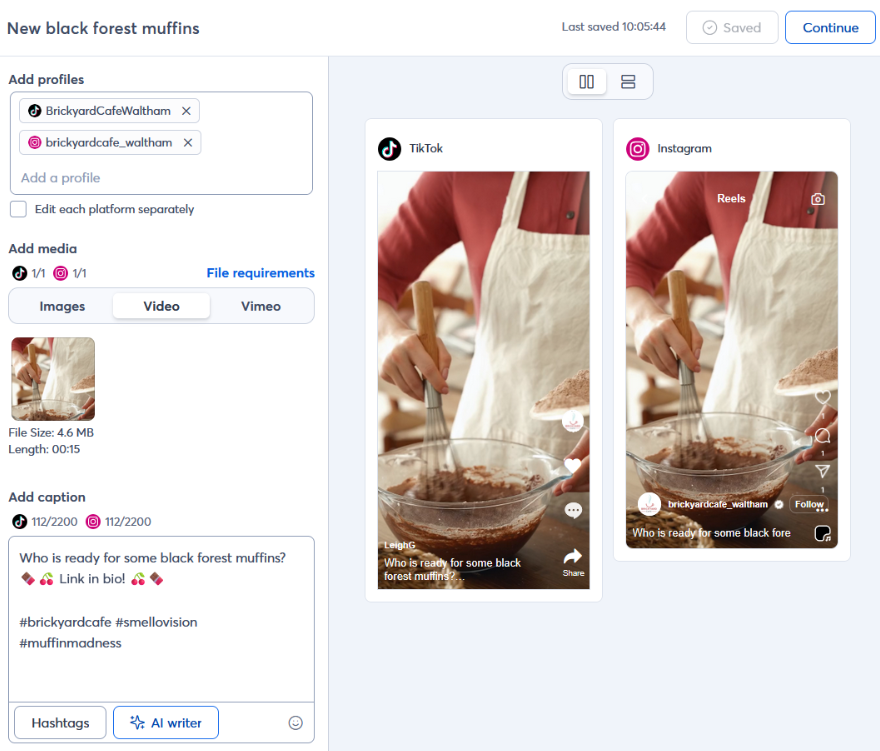
Source: Constant Contact
An AI tool generates scheduled social content from image uploads or prompts for a full week. Facebook and Instagram ads run from a simplified ad editor. Google Ads (Premium only) and TikTok ads are available. The event management toolset handles ticket sales, payment processing through Stripe or PayPal, promo codes, and automatic attendee list building (a feature rare among email marketing platforms at this price point).
For a small business running a monthly newsletter, seasonal promotions, and quarterly events, Constant Contact covers most channels without requiring additional tools.
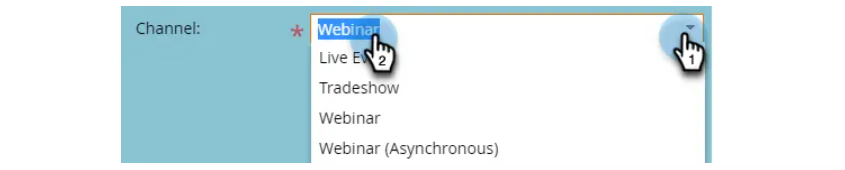
Marketo orchestrates campaigns across email, web, mobile push, SMS (via Vibes integration), ads (Google, Facebook, LinkedIn), and webinars. Interactive Webinars, powered by Adobe Connect, eliminate the need for a separate webinar platform; registration, delivery, engagement tracking, and post-event follow-up all happen within Marketo.
Source: Adobe
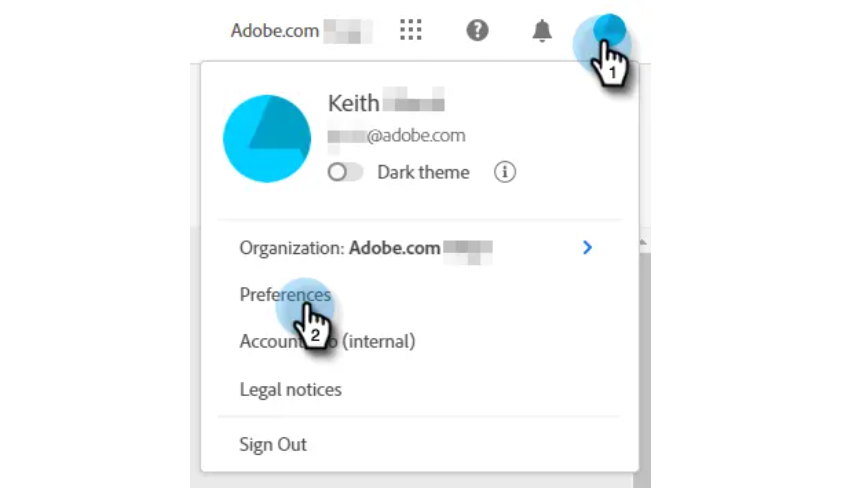
Dynamic Chat adds AI-powered chatbot and live chat capabilities, with conversation data flowing into lead records and Smart Lists.
Source: Adobe
Marketo's multichannel value isn't just breadth; it's orchestration. All channels are coordinated through the same Smart Campaign engine, meaning a single campaign can trigger an email, update a lead score, fire a webhook, alert a sales rep, and add the contact to a retargeting audience based on how they respond.
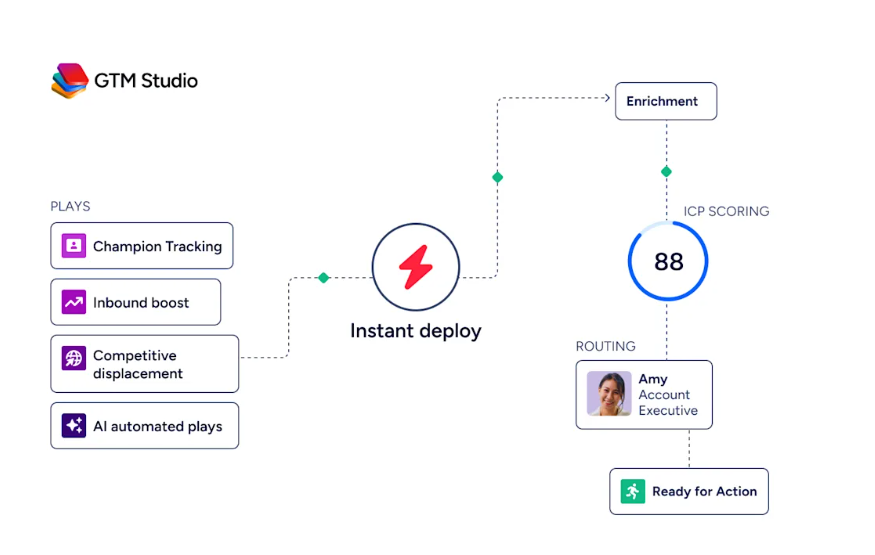
ZoomInfo adds cross-channel campaigns through GTM Studio, which runs pre-built plays across email, calls, ads, and direct mail, all triggered by buyer behavior and intent signals.
Source: ZoomInfo
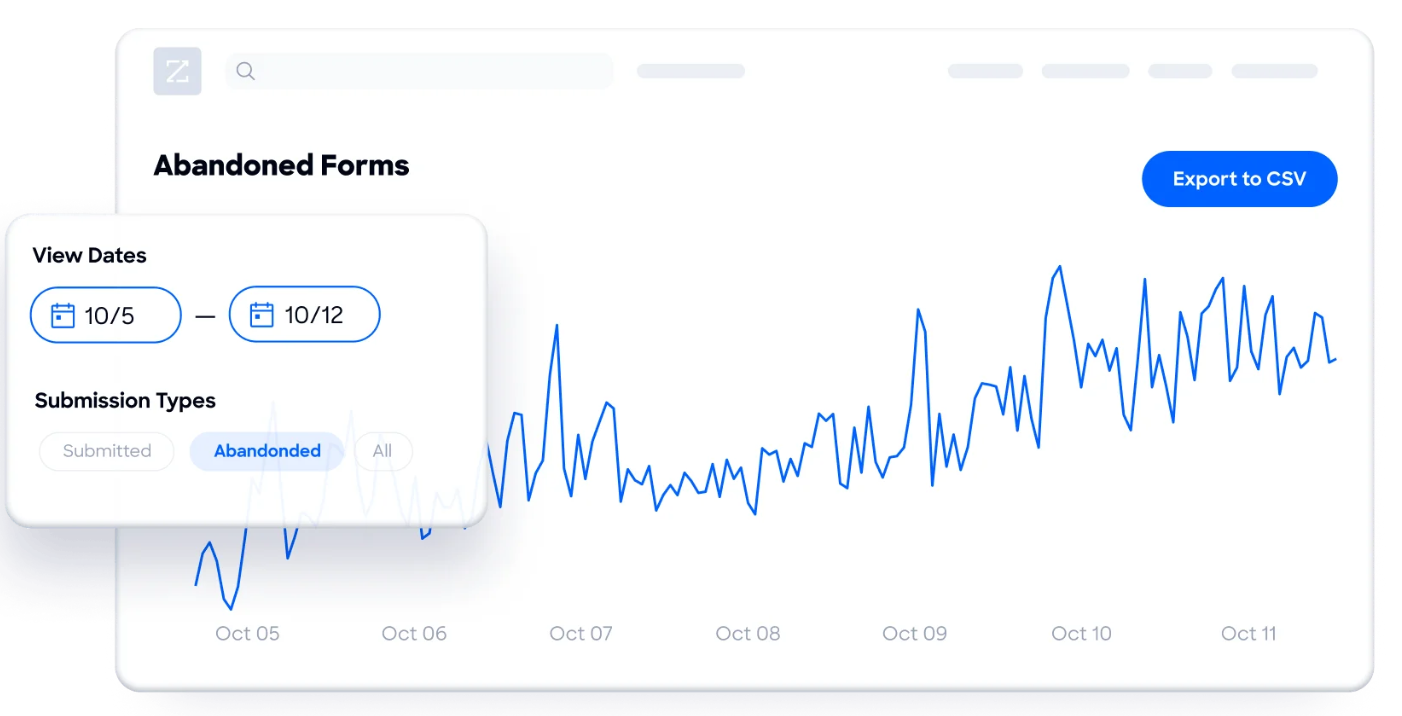
A Demand-Side Platform deploys display ads based on 300+ company attributes, with audiences that auto-update as signals change. FormComplete reduces web forms to a single field while auto-appending the rest from ZoomInfo's data. Smartsheet reported a 40%+ increase in form fills and 84% increase in MQLs after implementation.
Source: ZoomInfo
Support and onboarding reflect each platform's audience
How a platform handles support tells you who it's designed for.
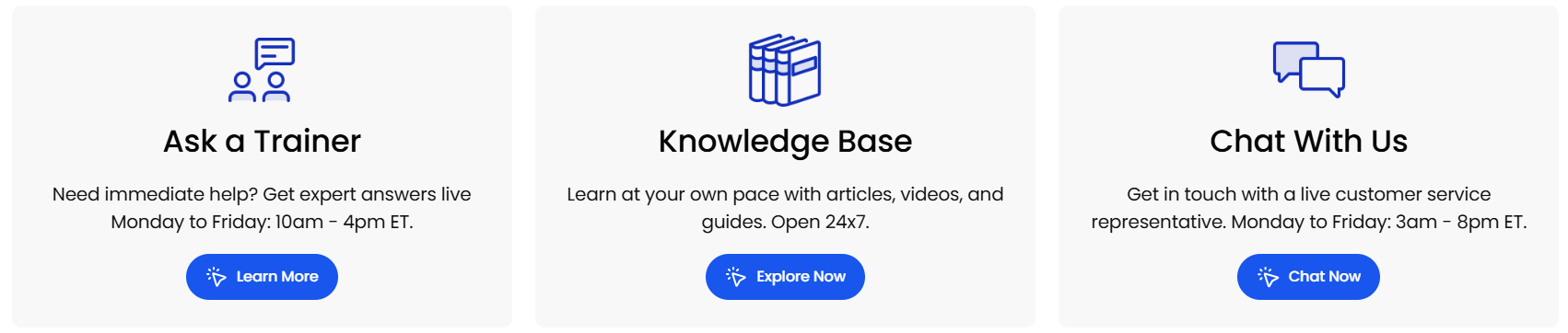
Constant Contact offers live phone support six days a week (Monday to Friday 8am–8pm ET, Saturday 10am–6pm ET) on every paid plan, not just premium tiers. Live chat runs Monday to Friday 3am–8pm ET. An "Ask a Trainer" program provides guided help during business hours. For non-technical users who need a human to walk them through a problem, this stands out.
Source: Constant Contact
One friction point: cancellation requires calling customer service. There is no self-service cancellation option.
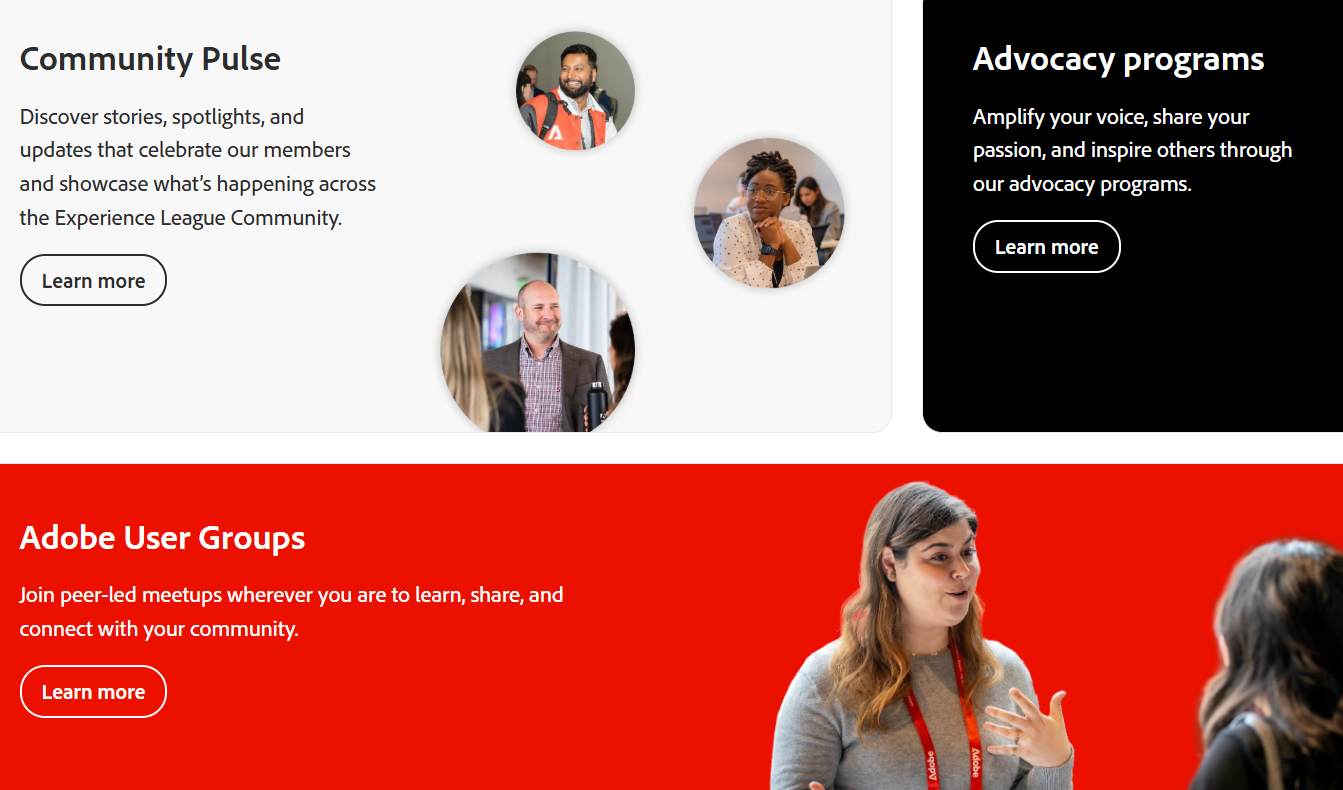
Marketo structures support by tier and spend. Every customer gets a baseline support level, but Service Level Targets vary widely: mission-critical issues get a 1-hour first-contact target on the base tier versus 15 minutes on Premier Elite. Upgraded Premier Support tiers (Business, Enterprise, Elite) are separate subscriptions. The Adobe Experience League documentation is extensive, and the Marketo Nation community provides active peer support. But the support model assumes you have staff who can navigate enterprise documentation and troubleshoot complex configurations.
Source: Adobe
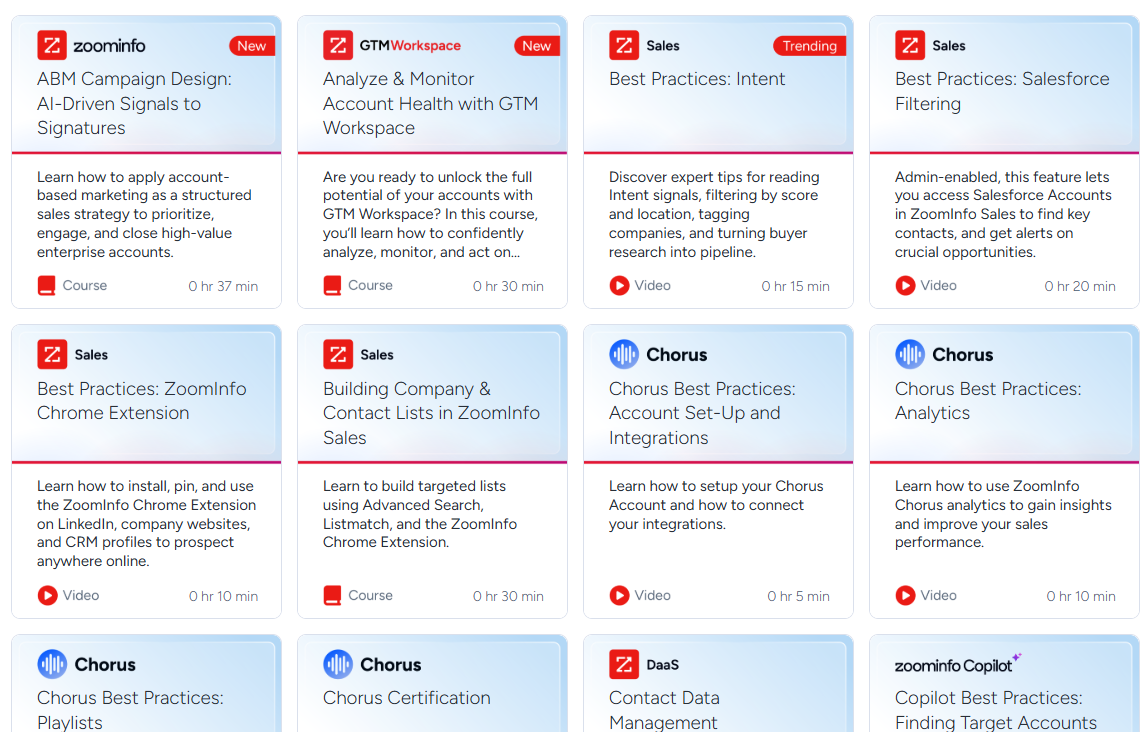
ZoomInfo restructured its onboarding from 30 to 90 days, which improved satisfaction scores by 25%. ZoomInfo University offers role-specific learning paths, product certifications, and on-demand courses. The Help Center provides a knowledge base, phone, and contact form, and professional services are available through ZoomInfo Labs. GTM Workspace "deploys in weeks, not months".
Source: ZoomInfo
Integration ecosystems serve different architectures
The tools your marketing platform connects to determine how well it fits your existing stack.
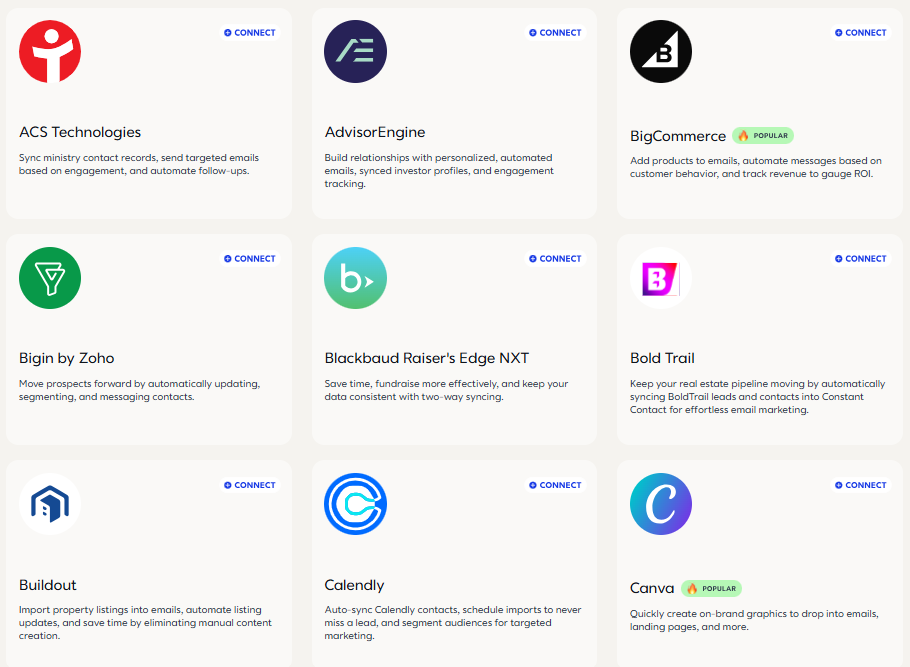
Constant Contact offers 300+ integrations spanning Shopify, WooCommerce, Salesforce, Wix, Squarespace, Etsy, DonorPerfect, and Xero, among others. A V3 REST API with 99.99% uptime provides programmatic access to contacts, campaigns, events, segments, and reporting. The API supports OAuth 2.0 with four authentication flows and official SDKs in C#, PHP, Python, Ruby, and TypeScript. Standard rate limits are 10,000 requests per day and 4 requests per second.
Source: Constant Contact
The integration philosophy is breadth: connect to the tools small businesses already use (Shopify for e-commerce, DonorPerfect for nonprofits, WordPress for websites) through simple connectors.
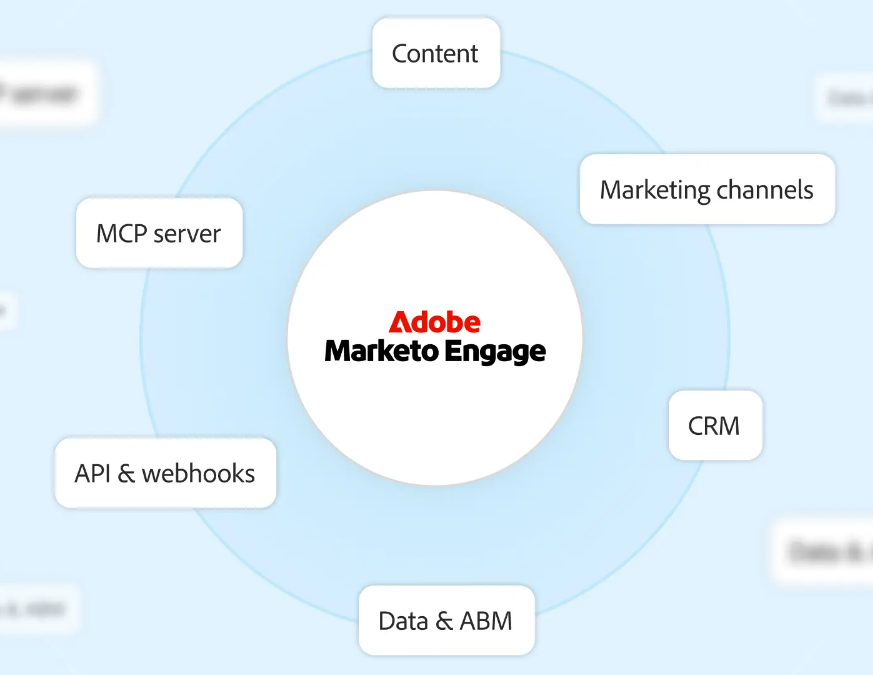
Marketo integrates natively with Salesforce, Microsoft Dynamics, and Veeva CRM through bidirectional continuous sync running every five minutes. The LaunchPoint marketplace provides pre-built connectors for ad platforms (Google, Facebook, LinkedIn), webinar tools (Zoom, ON24), SMS (Vibes), and data/ABM platforms like ZoomInfo.
Source: Adobe
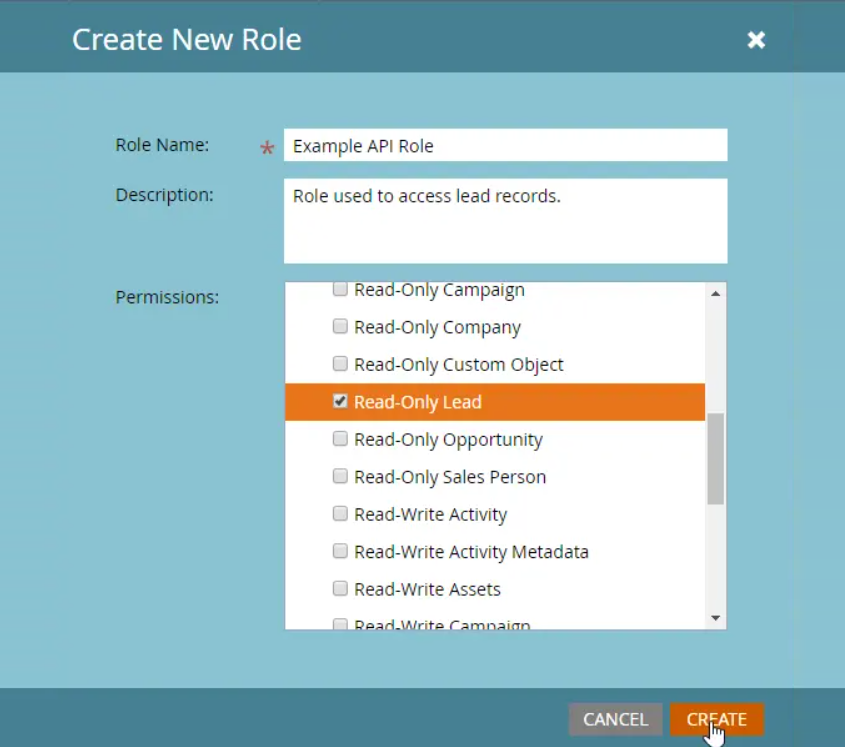
The REST API offers 50,000 API calls per day on most tiers, with a separate Bulk Extract API for large-scale data operations. Within Adobe Experience Cloud, Marketo connects to Adobe Real-Time CDP, Adobe Journey Optimizer B2B Edition, and Adobe Analytics.
Source: Adobe
Marketo's integration philosophy is depth: bidirectional CRM sync, webhook-driven event architecture, and integration with Adobe's broader platform.
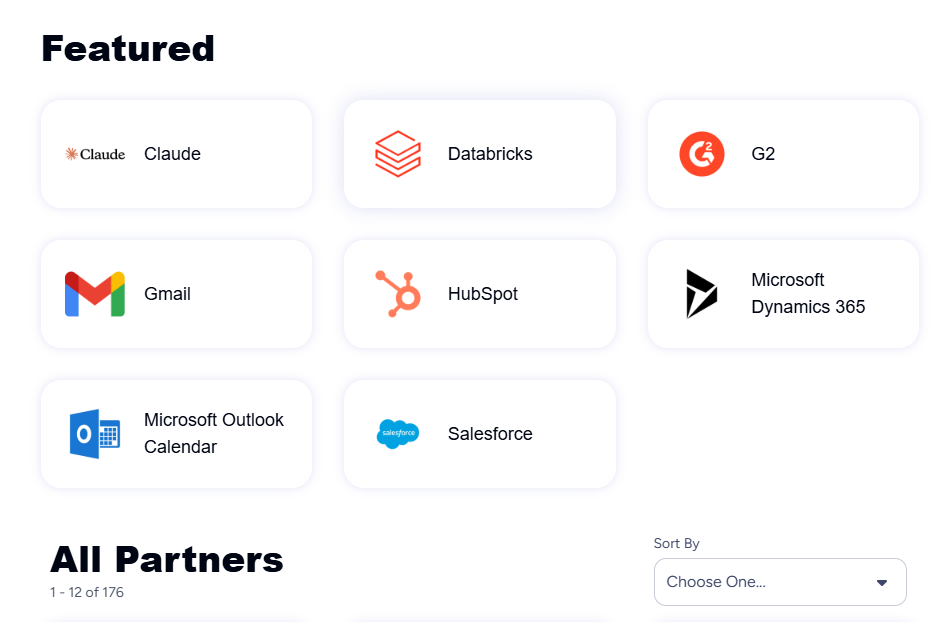
ZoomInfo takes an open-architecture approach. The App Marketplace lists 172+ integration partners across CRM, marketing automation, sales engagement, revenue intelligence, and data warehouse categories.
Source: ZoomInfo
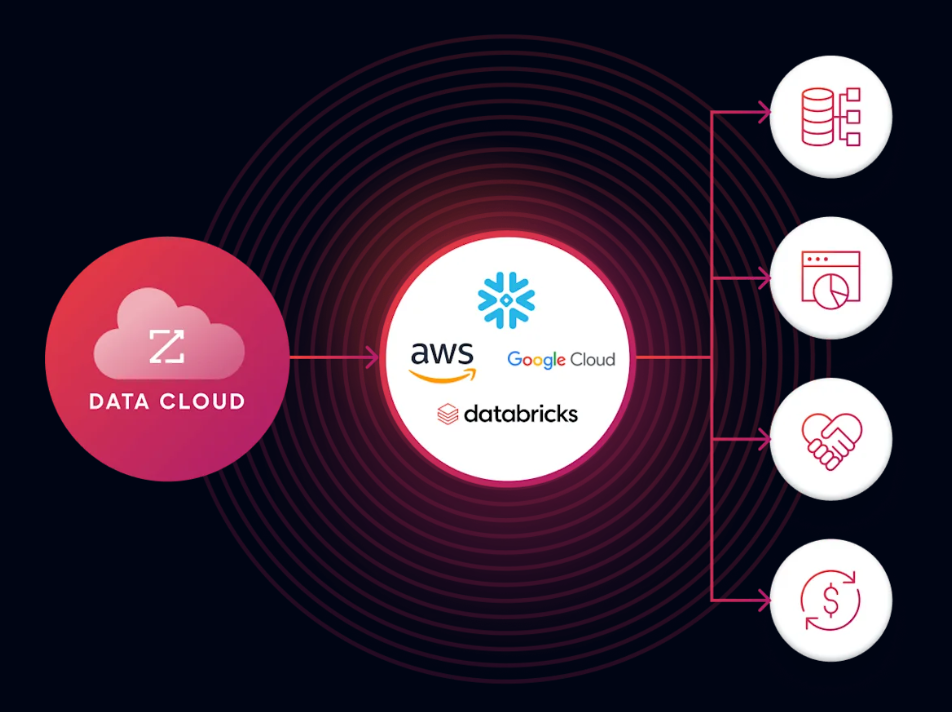
The Enterprise API provides structured search-then-enrich access to ZoomInfo's B2B data. The MCP server enables direct connections from AI agents (Claude, ChatGPT) to ZoomInfo data. Cloud Partners enable direct data ingestion into AWS, Google Cloud, Snowflake, and Databricks.
Source: ZoomInfo
The key integration point: ZoomInfo connects to both Constant Contact (via API) and Marketo (via LaunchPoint partnership), serving as the data layer that enriches whichever campaign platform you choose.
BDO Canada's Senior Marketing Intelligence Analyst Jerry Wilson: "The plug-and-play aspect of the API means I can integrate it very easily into any process and get information at a moment's notice." The company saw an 87% reduction in time spent on data dashboard updates. (BDO Canada Case Study)
Reporting and analytics show different priorities
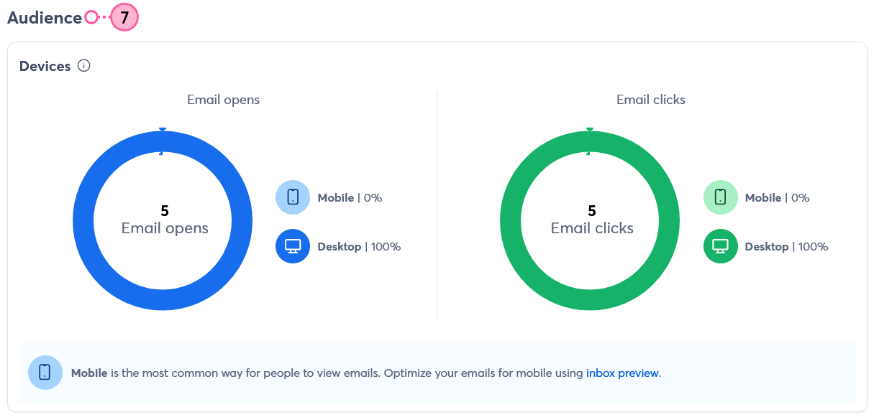
Constant Contact provides campaign-level reporting right after a send: open rates, click rates, bounces, unsubscribes, and spam reports. Every metric links to the individual contacts behind it, making re-targeting and follow-up actionable. A click heat map shows link-level click distribution. Bot-click filtering removes automated security-scanner clicks and shows a "Bot clicks removed" line item. A Report Builder (Standard and above) lets users assemble custom reports with flexible date ranges and export to CSV.
Source: Constant Contact
For small businesses, this is useful: you can see who clicked what, which campaigns perform best, and where your engagement is real versus inflated by bots.
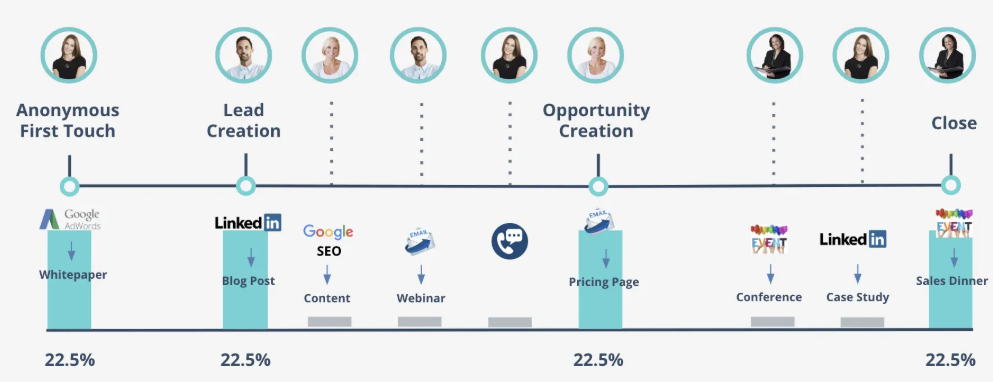
Marketo adds attribution and pipeline analytics. Marketo Measure (Ultimate tier) provides multi-touch attribution with six models running simultaneously: First Touch, Lead Creation, U-Shaped, W-Shaped, Full Path, and Custom. The system captures touchpoints across paid media, website activity, CRM activities, webinars, and offline channels, then assigns fractional revenue credit to each interaction. On the Ultimate tier, Attribution AI replaces rules-based models with pattern recognition to surface incremental scoring.
Source: Adobe
However, multiple review sources note that Marketo's native reporting is weak outside the attribution module. Many teams rely on third-party BI tools to fill gaps, adding cost and complexity.
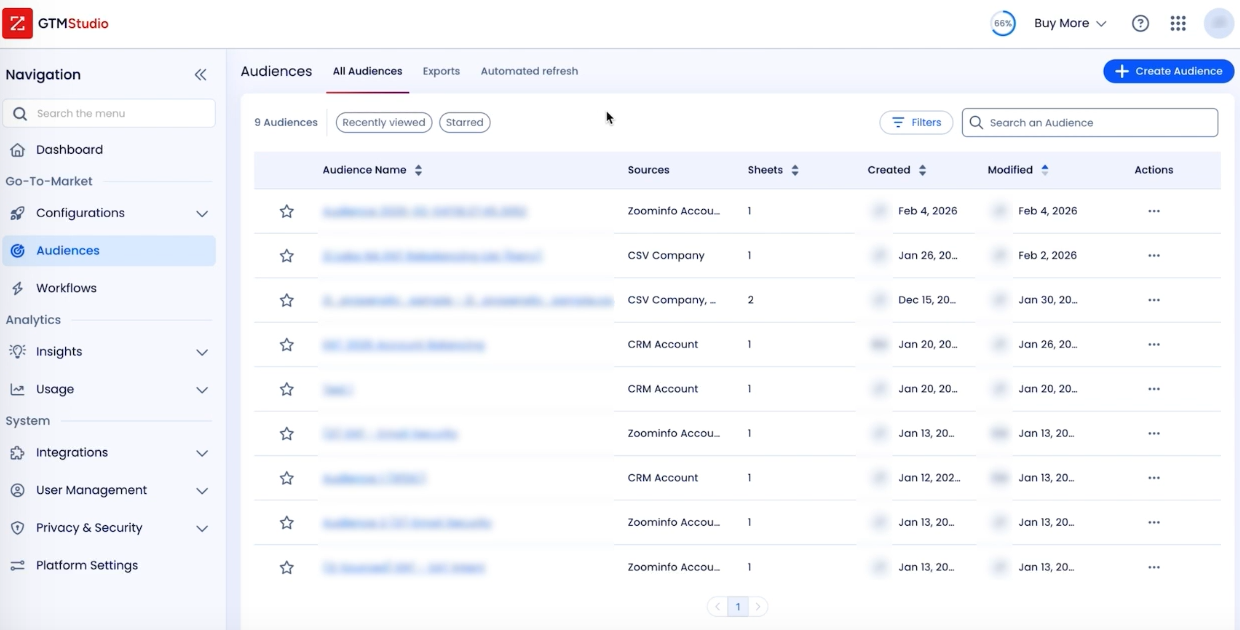
ZoomInfo provides analytics through GTM Studio's dashboards, tracking engagement, funnel progression, and top-performing segments. The value isn't in replacing Constant Contact's or Marketo's campaign reporting; it's in adding the data those reports can't provide: which accounts show intent, which contacts are verified, and where buying signals cluster.
Source: ZoomInfo
Constant Contact vs. Marketo vs. ZoomInfo: Which should you choose?
The choice depends on your organization's size, marketing complexity, and what your campaigns need to accomplish.
Choose Constant Contact if:
You're a small business or nonprofit with fewer than 50 employees
You need to send newsletters, event invitations, and seasonal promotions
You want phone support you can call when something breaks
Your marketing needs are straightforward: email, social, SMS, events
You don't have (or need) a dedicated marketing operations person
Budget is under $200/month for your marketing platform
Choose Marketo if:
You're a mid-market or enterprise B2B organization with complex sales cycles
Lead scoring, nurturing, and CRM-integrated pipeline management are requirements
You have or plan to hire a dedicated Marketo administrator
Multi-touch revenue attribution matters to your leadership team
You need enterprise governance: sandboxes, approval workflows, role-based access
Your organization is already invested in the Adobe ecosystem
Use ZoomInfo with either platform if:
You need verified B2B contact data to fill your campaigns with the right prospects
You want to know which accounts are researching your product category
Your lead scoring and segmentation suffer from incomplete or stale data
You want to identify in-market buyers before they fill out a form
You need a data layer that works across your go-to-market stack, not just one tool
Start with ZoomInfo Lite for free, or request a demo to see the full platform.
Constant Contact and Marketo are both strong at what they do. Constant Contact makes marketing accessible for small teams. Marketo makes marketing orchestration possible for enterprise teams. But the quality of every campaign (regardless of platform) depends on the quality of the data behind it. ZoomInfo provides that data: verified contacts, buying signals, account intelligence, and the context to act on it. The marketing platform you choose is the engine. ZoomInfo is the fuel.
Levanta CEO Ian Brodie: "ZoomInfo's not just a contact data company anymore. They've built a full system of execution. GTM Intelligence actually works the list, writes the outreach, triggers the play, and helps drive predictable growth." (Levanta Case Study)
Constant Contact vs. Marketo vs. ZoomInfo FAQ
What is the fundamental difference between Constant Contact, Marketo, and ZoomInfo?
Constant Contact is an email marketing and multichannel campaign platform designed for small businesses and nonprofits; it handles sending newsletters, managing events, and scheduling social posts. Marketo (Adobe Marketo Engage) is an enterprise B2B marketing automation platform built for lead scoring, multi-stream nurturing, and revenue attribution across long sales cycles. ZoomInfo is a B2B data intelligence platform that provides verified contact data, buyer intent signals, and account insights. It integrates with both Constant Contact and Marketo to improve the quality and targeting of campaigns on either platform.
Which platform is more affordable for a small business?
Constant Contact is far more affordable, with plans starting at $12/month for up to 500 contacts. Marketo does not publish pricing and requires a custom quote through Adobe Sales; it is built for enterprise budgets and typically requires a dedicated administrator. ZoomInfo offers a permanent free tier (ZoomInfo Lite) with access to over 100 million verified profiles and 10 monthly export credits, plus a 7-day free trial for expanded access.
Can I use ZoomInfo with Constant Contact or Marketo?
Yes. ZoomInfo integrates with both platforms. For Marketo, ZoomInfo is a LaunchPoint integration partner, feeding enriched contact data and intent signals into lead scoring and campaign execution. For Constant Contact, ZoomInfo data can populate and enrich contact lists through API connections. ZoomInfo's intelligence also works through GTM Studio, GTM Workspace, and APIs/MCP in any other tool in your stack.
Which platform has better marketing automation?
Marketo has far deeper automation capabilities than Constant Contact. Marketo's Smart Campaigns support unlimited triggers, 150+ filters, conditional branching, and multi-stream engagement programs with content exhaustion tracking. Constant Contact's Automation Path Builder is limited to a single trigger per path, with only three active paths on Standard (pre-built templates only) and custom paths restricted to Premium.
Does Constant Contact offer lead scoring?
No. Constant Contact does not include lead scoring. It organizes contacts through lists, tags, and dynamic segments, but does not score contacts by engagement or automate sales handoffs based on qualification thresholds. Marketo offers multi-dimensional lead scoring as a core feature. ZoomInfo adds predictive Account Fit Scoring and buyer intent signals that can supplement either platform's targeting.
Which platform is best for nonprofits?
Constant Contact is the strongest choice for nonprofits at this price point. It offers a 30% prepay discount for nonprofit organizations, built-in event management with ticket sales and RSVP tracking, and phone support on every paid plan. Marketo's enterprise pricing and complexity make it impractical for most nonprofits. ZoomInfo's B2B data focus is primarily relevant to nonprofits that run business development or partnership programs.
How do the platforms handle CRM integration?
Marketo offers native bidirectional sync with Salesforce and Microsoft Dynamics, running continuously with a five-minute pause between sync cycles and supporting leads, contacts, accounts, opportunities, and custom objects. Constant Contact integrates with Salesforce and 300+ other apps, but the integrations are simpler (contact sync, not full bidirectional lifecycle management). ZoomInfo provides native CRM integrations with Salesforce, HubSpot, and Microsoft Dynamics for data enrichment and lead routing.
Which platform requires the most technical expertise?
Marketo has the steepest learning curve. Adobe's own guidance acknowledges that onboarding can feel overwhelming, and users who skip training spend consulting hours on basics. The platform uses proprietary concepts (Smart Lists, Smart Campaigns, Tokens, Engagement Streams) with no direct equivalent in other tools. Constant Contact is designed for non-technical users and most people are productive within an hour. ZoomInfo falls between them, with a 90-day onboarding program and role-specific training through ZoomInfo University.
Keep comparing Constant Contact:
