
Choosing between Constant Contact and HubSpot for your marketing often comes down to five questions:
Do you need a simple email marketing tool, or a full customer platform spanning sales, service, and marketing?
Is your team one or two people who need to send campaigns quickly, or a growing organization that needs automation, CRM, and pipeline management in one place?
How important is it that your marketing data connects to your sales pipeline and customer records?
Are you willing to pay more upfront for a platform you can grow into, or do you need the lowest entry cost right now?
Do you have the B2B contact data and buying signals to target the right accounts, or are you marketing into a partially blind audience?
In short, here's what we recommend:
Constant Contact is built for small businesses and nonprofits that need to send professional email campaigns without a marketing team. Its drag-and-drop editor, 200+ templates, and 97% email deliverability rate make it easy to get campaigns out the door within hours. Add built-in event management, social media scheduling, and phone support on every paid plan, and you have a platform designed for people who want results without complexity. The downsides: automation is limited to simple workflows, segmentation is gated behind higher tiers, and pricing climbs steeply as your contact list grows.
HubSpot is a full customer platform that connects marketing, sales, service, and content under one CRM. Its Marketing Hub offers advanced automation workflows, multi-touch attribution, and AI tools through Breeze, while its free CRM gives teams a shared view of every customer interaction. The tradeoff is complexity and cost: Professional-tier marketing starts at $800/month (annual) with a $3,000 mandatory onboarding fee, and the platform's depth can overwhelm teams that just need to send newsletters.
Both platforms handle the "send" side of marketing well. But for B2B teams, the bigger question is whether you're reaching the right people in the first place. That's a data problem neither Constant Contact nor HubSpot was built to solve.
ZoomInfo is a B2B go-to-market platform that gives your marketing the foundation it needs before you hit send. With 500M contacts, 100M companies, 135M+ verified phone numbers, and 200M+ verified business emails, ZoomInfo provides the largest B2B dataset available. Its GTM Context Graph combines this data with your CRM records, conversation transcripts, and behavioral signals to reveal not just who your buyers are, but which ones are actively in-market. That intelligence flows into GTM Workspace for sellers, GTM Studio for marketers and RevOps, or directly into your existing tools through APIs and MCP. For B2B teams using Constant Contact or HubSpot to execute campaigns, ZoomInfo ensures those campaigns target verified contacts at accounts showing buying intent.
If building campaigns on verified B2B data and real-time buying signals sounds like the missing piece, see how ZoomInfo works.
Constant Contact vs. HubSpot vs. ZoomInfo at a glance
Constant Contact | HubSpot | ZoomInfo | |
|---|---|---|---|
Core purpose | Email marketing and digital campaigns for SMBs | CRM and customer platform | B2B data intelligence and go-to-market execution |
Marketing automation | Basic (1–3 paths, single-trigger) | Advanced (multi-step, branching, behavioral) | Signal-triggered GTM plays and multi-channel orchestration |
CRM included | No (basic contact management only) | Yes (free CRM with unlimited contacts) | Integrates with Salesforce, HubSpot, Dynamics |
B2B contact database | No | No | 500M contacts, 200M+ verified emails, 135M+ verified phones |
Buyer intent data | No | No | Yes (210M IP-to-org pairings, Guided Intent) |
AI capabilities | AI content generator, subject line recommendations | Breeze AI agents across all hubs | GTM Context Graph, AI-powered account research and outreach |
Event management | Built-in (ticketing, RSVP, payments) | No native event tools | No |
Starting price | $12/mo (Lite, 500 contacts) | $0 (free CRM); Marketing Hub Starter $15/seat/mo | Custom pricing (free tier: ZoomInfo Lite) |
Free plan | 30-day trial only | Permanent free CRM | ZoomInfo Lite (permanent, 10 exports/mo) |
Best for | Small businesses and nonprofits sending email campaigns | Scaling companies unifying marketing, sales, and service | B2B teams that need verified contact data and buying signals |
Two different problems, two different tools
Constant Contact and HubSpot are often compared because they both send marketing emails. But that comparison hides a fundamental difference in what each platform is trying to be.
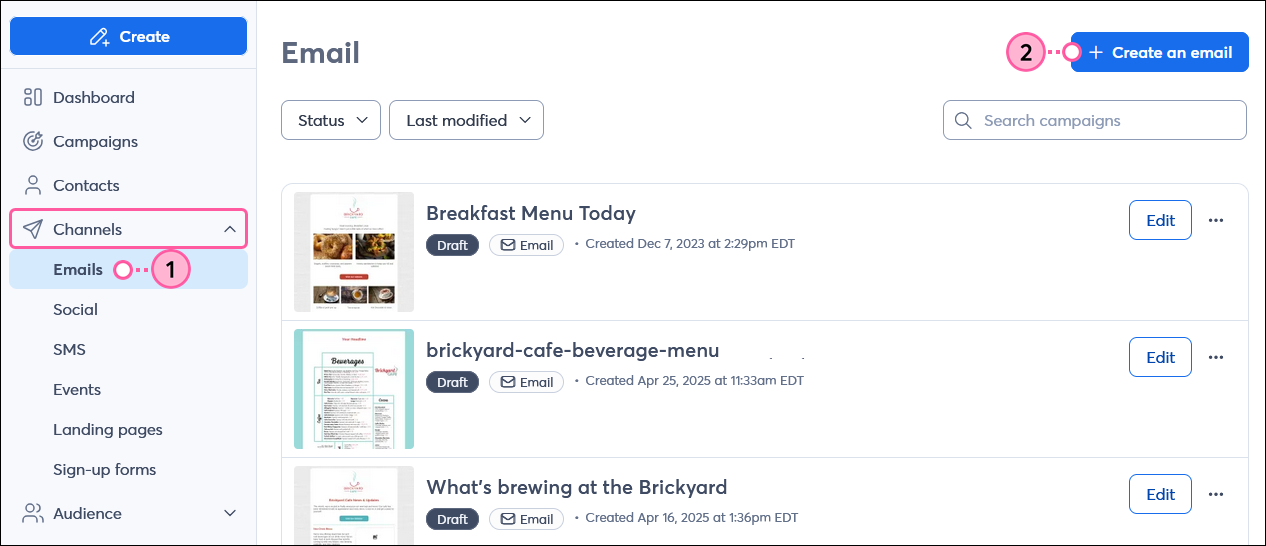
Constant Contact is an email marketing tool that expanded into adjacent channels.
It started in 1995 as one of the first platforms to make email marketing accessible to small businesses, and that DNA still defines it. The editor is simple. The templates are organized by industry. Phone support is available six days a week on every paid plan. Everything about the platform assumes you're a small business owner with limited time and no marketing team.
Source: Constant Contact
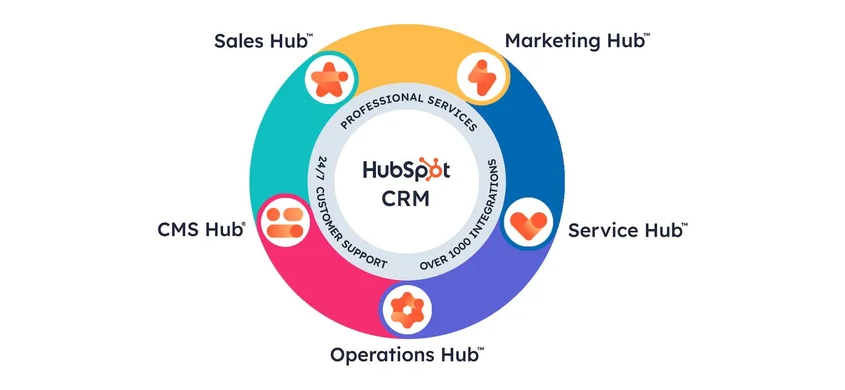
HubSpot is a customer platform that happens to include email marketing.
Founded in 2006 around the concept of "inbound marketing," HubSpot has expanded into a suite of eight connected products: Marketing Hub, Sales Hub, Service Hub, Content Hub, Data Hub, Commerce Hub, Smart CRM, and Breeze AI. Every tool shares a single database, so when a lead fills out a form, opens an email, talks to a sales rep, and submits a support ticket, the entire history lives in one record. That shared view is HubSpot's real product. Email marketing is one feature within it.
Source: HubSpot
This distinction matters for the buying decision.
If you need to send a weekly newsletter to your yoga studio's client list, Constant Contact will have you running in an afternoon. If you're building a marketing-to-sales pipeline where leads need to be nurtured, scored, routed to reps, and tracked through a deal cycle, HubSpot's connected platform is built for that workflow.
Email marketing: Constant Contact is simpler, HubSpot is deeper
Both platforms send marketing emails. The experience of building and sending those emails is where they diverge.
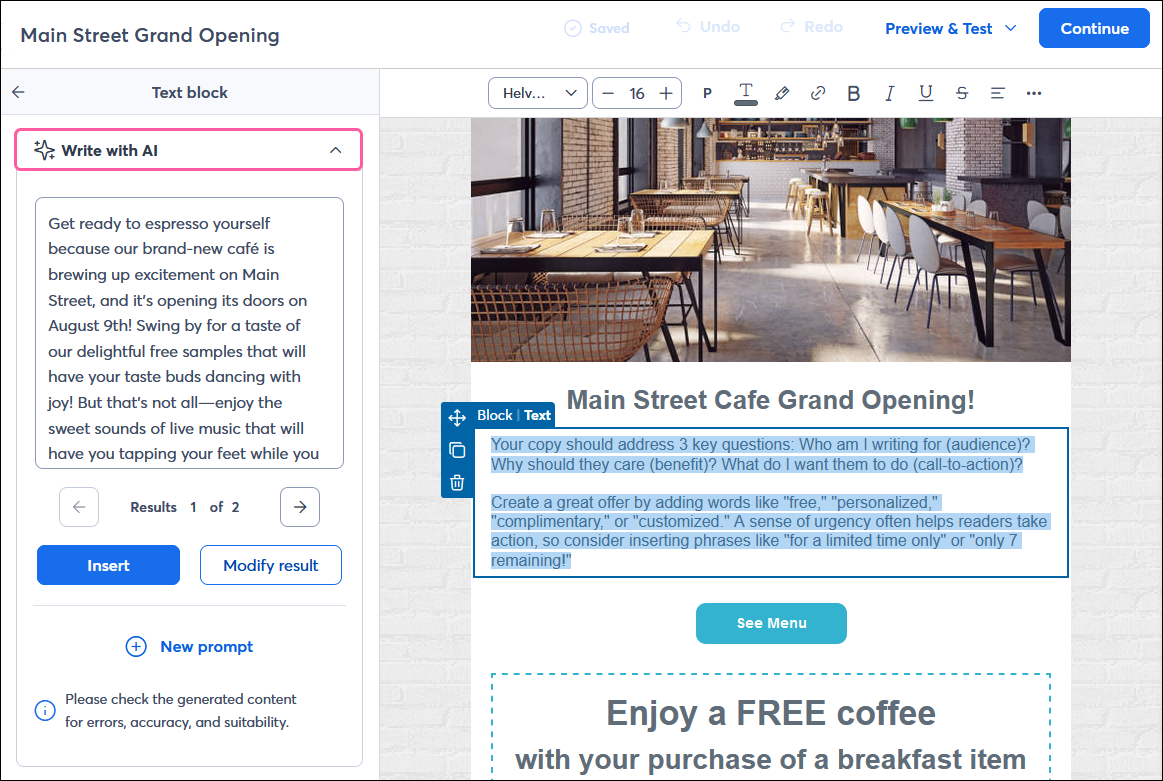
Constant Contact's drag-and-drop editor uses thirteen content block types across ten responsive column layouts, all available on every plan.
The workflow is built for speed: pick a template from the 200+ library, drop in your content, preview on desktop and mobile, and send. An AI Content Generator can produce a complete formatted email from a single prompt, and BrandKit applies your logo, colors, and fonts across campaigns. For businesses sending the same type of email regularly, the ability to save any email as a reusable template saves real time.
Source: Constant Contact
HubSpot's email editor is equally capable but assumes a more advanced use case.
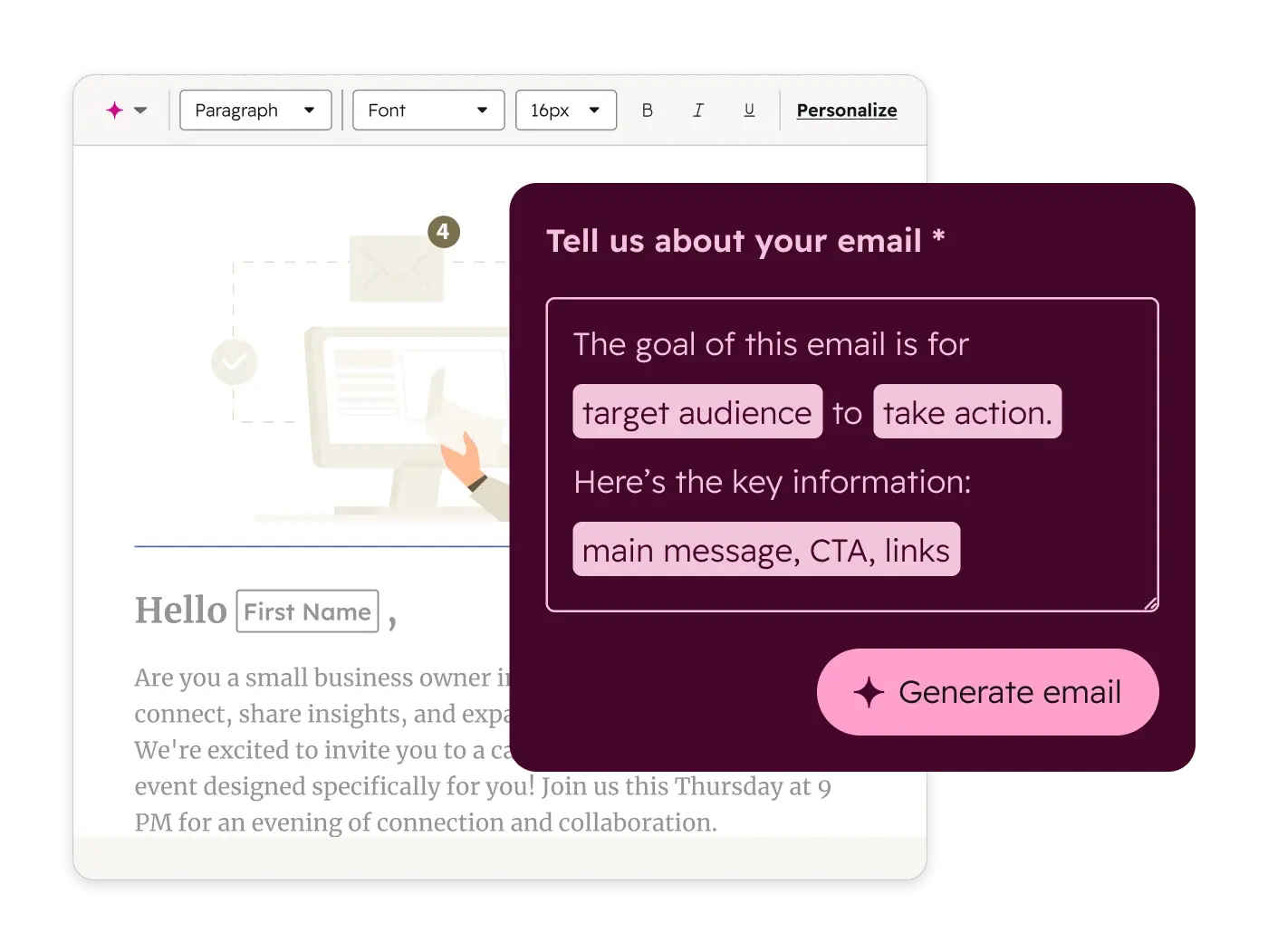
Beyond drag-and-drop editing, Marketing Hub includes smart content blocks that change based on CRM data (industry, lifecycle stage, past behavior), send-time optimization that delivers emails when each contact is most likely to engage, and A/B testing that goes beyond subject lines to test full email variations. The AI layer, Breeze, can draft emails, suggest subject lines, and adapt content to match a defined brand voice.
Source: HubSpot
The practical difference: Constant Contact's editor is faster to learn and produces professional emails quickly. HubSpot's editor is more capable but takes longer to configure, and many of its best features (smart content, personalization) require a populated CRM to work well.
Deliverability is a real differentiator for Constant Contact. The platform claims a 97% email deliverability rate backed by a dedicated deliverability team that monitors signups and list uploads for suspicious activity. Every email includes a SafeUnsubscribe® link, a branded trust signal for recipients. HubSpot's deliverability infrastructure is solid but doesn't publish a specific benchmark in the same way.
Marketing automation separates them clearly
This is where the gap between the two platforms becomes obvious.
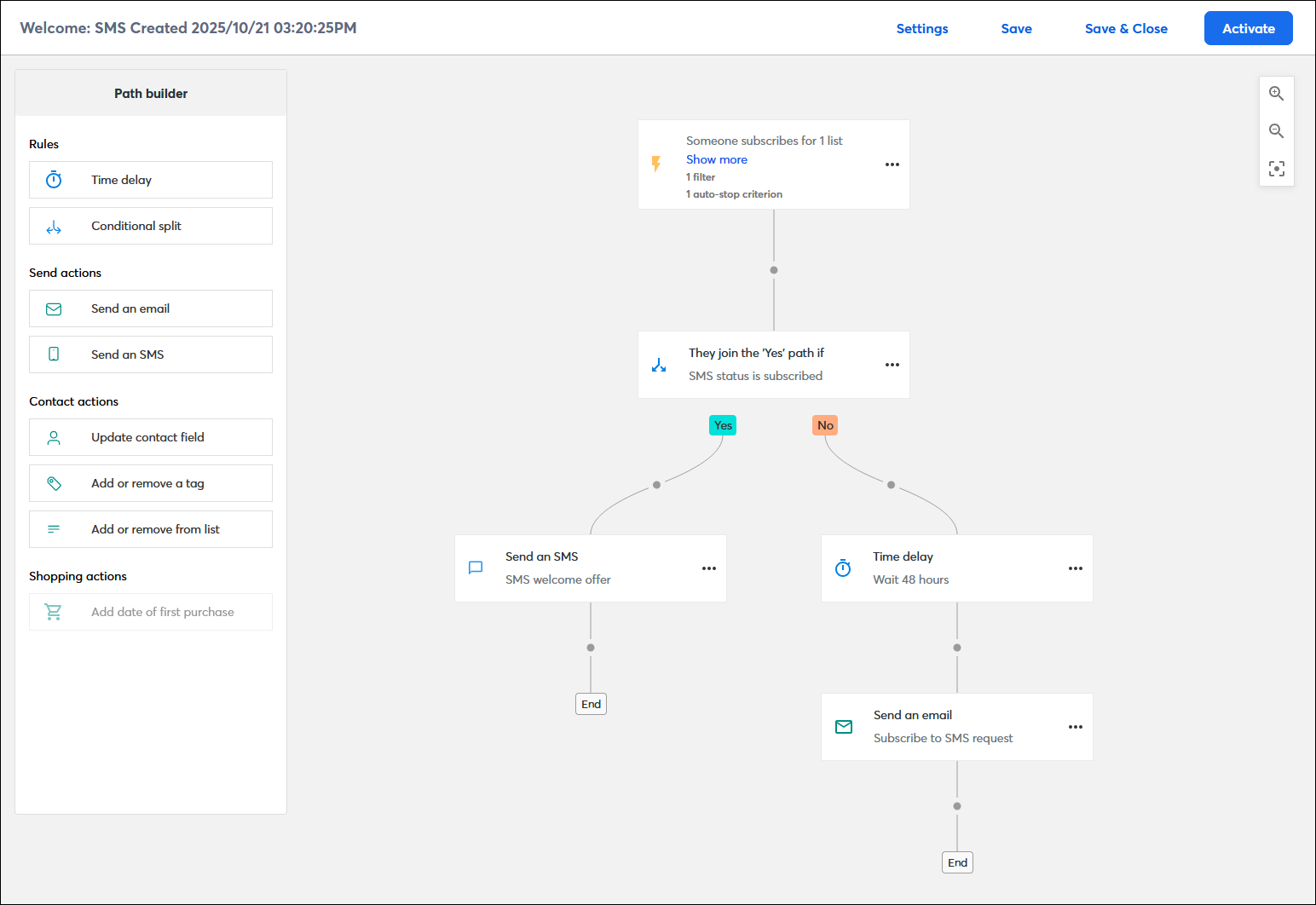
Constant Contact's Automation Path Builder is a visual canvas that handles standard lifecycle automations: welcome series, birthday emails, abandoned cart reminders, re-engagement campaigns. Each path starts with a single trigger and supports up to 50 steps, including email sends, SMS messages, time delays, and conditional splits.
The limitations are real.
The Standard plan restricts you to 3 active automation paths using pre-built templates only. Custom paths require Premium. Each path allows only one trigger, so multi-condition behavioral logic isn't possible. There's no lead scoring, no multi-trigger workflows, and no ability to branch based on complex combinations of behaviors.
Source: Constant Contact
HubSpot's Workflows operate at a different level.
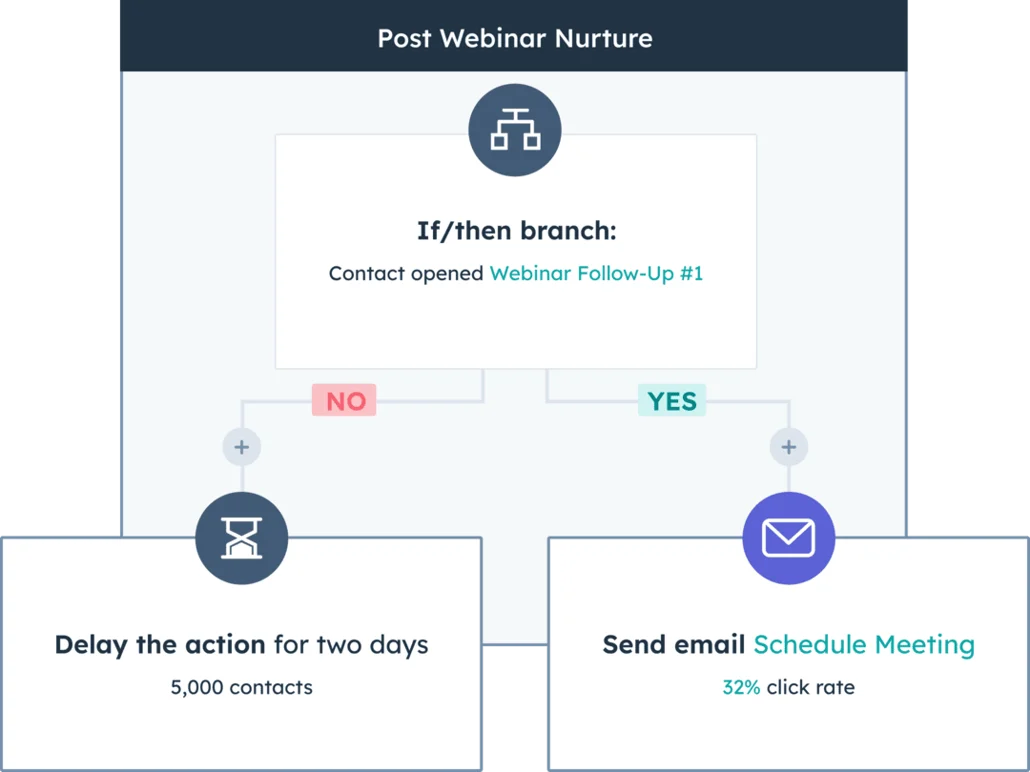
Workflows support multi-step branching sequences triggered by any combination of contact behavior, lifecycle stage, form submissions, page visits, deal stage changes, and custom properties. You can build a workflow that enrolls a contact when they visit your pricing page twice, sends a personalized email based on their industry, waits for a response, alerts a sales rep if the contact clicks a specific link, creates a deal in the CRM if they book a meeting, and moves them to a different nurture sequence if they don't engage within a week.
Source: HubSpot
For a nonprofit sending monthly donor updates with an automated thank-you email, Constant Contact's automation is more than enough. For a B2B company running lead scoring, multi-touch nurture campaigns, and marketing-to-sales handoff workflows, HubSpot is the only option of the two.
CRM and data: HubSpot's structural advantage
Constant Contact manages contacts. HubSpot manages customer relationships.
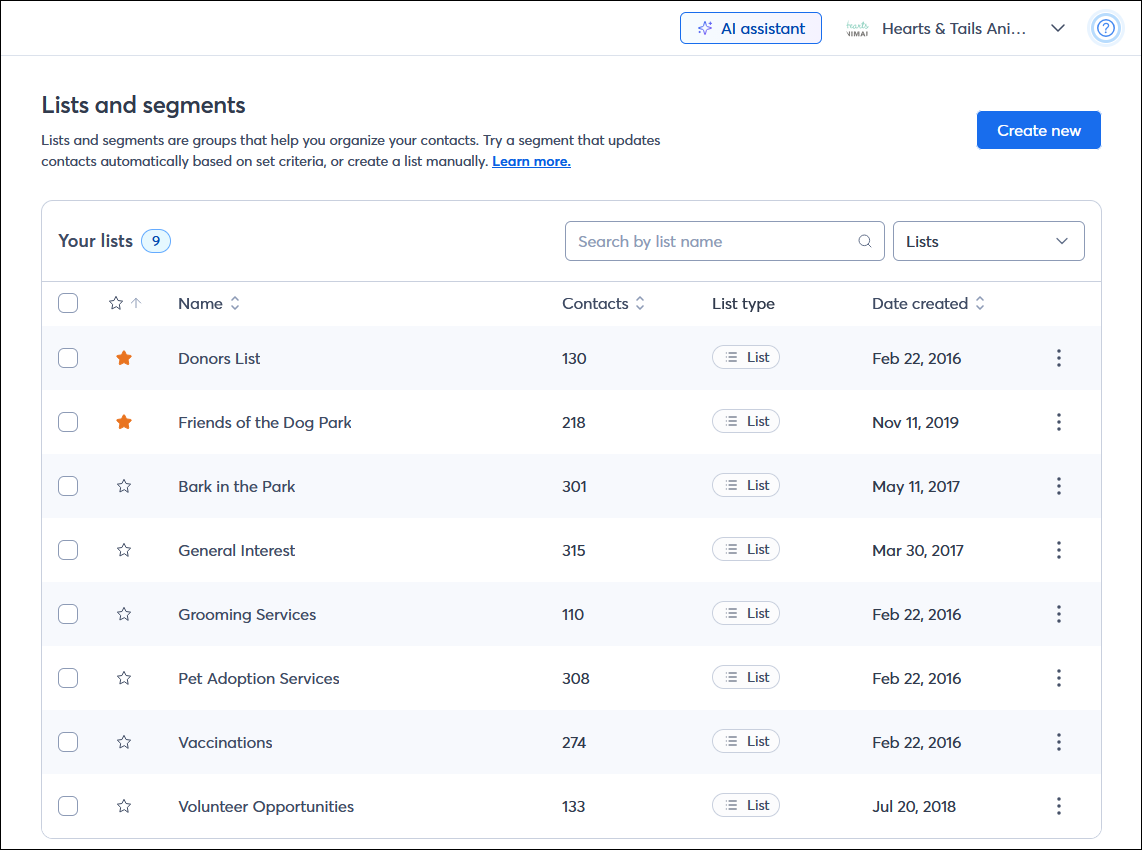
Constant Contact organizes contacts across lists, tags, and segments. Lists group contacts, tags label them across lists, and segments filter dynamically based on criteria that auto-refresh before each send.
The segmentation system draws from ten categories including email activity, SMS activity, shopping behavior, and website visits. It works for targeted email campaigns, but the limits are restrictive: 1 custom segment on Lite, 10 on Standard, unlimited on Premium.
Source: Constant Contact
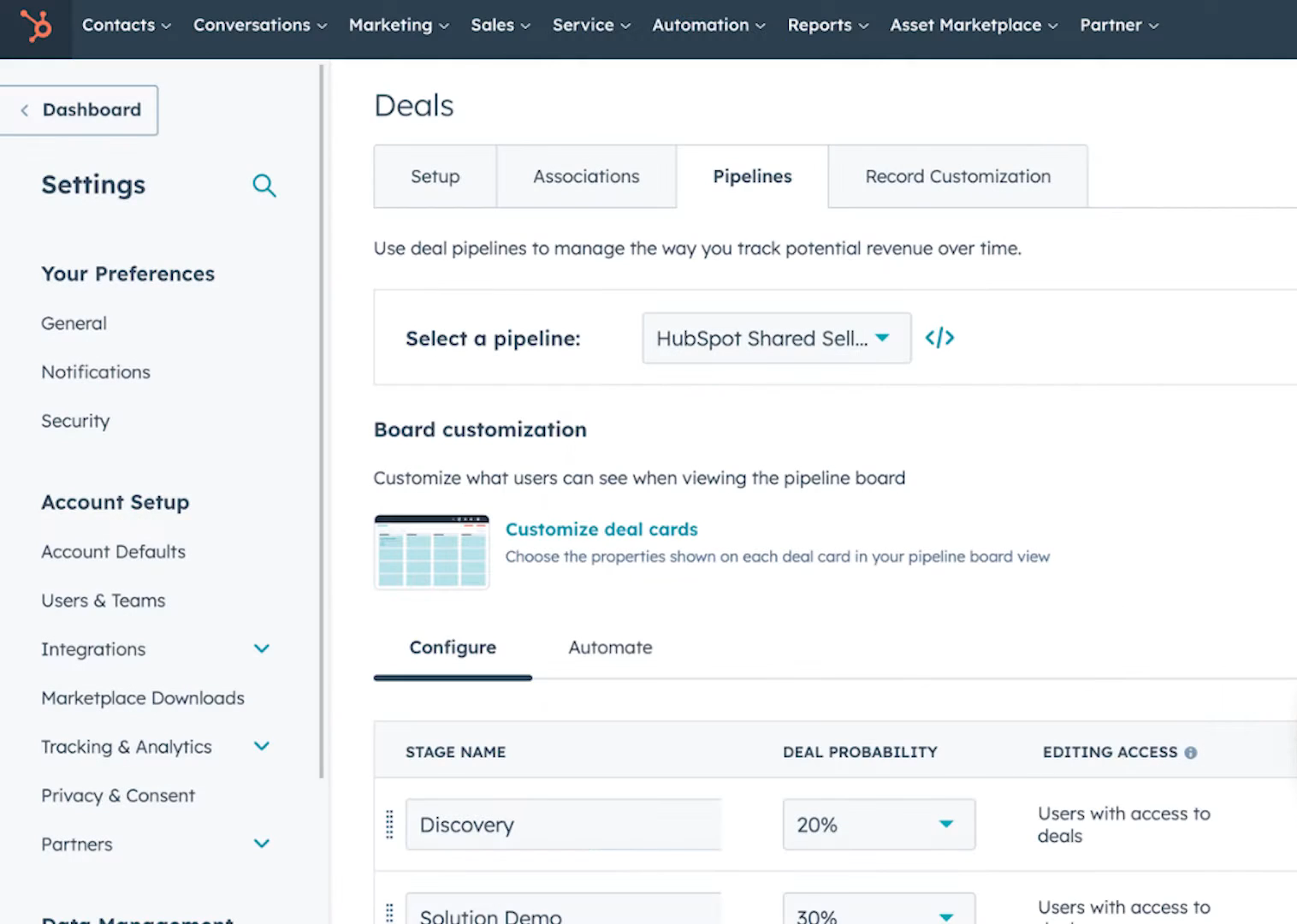
HubSpot's Smart CRM is a full customer database tracking contacts, companies, deals, tickets, and custom objects, with every interaction (emails, calls, meetings, form submissions, page visits) logged automatically. The free tier alone supports unlimited contacts up to 1 million records.
Because every HubSpot product draws from this shared database, a marketing email open, a sales call, and a support ticket all appear on the same contact record.
Source: HubSpot
This structural difference matters for segmentation.
In Constant Contact, you can segment by "opened my last three emails." In HubSpot, you can segment by "opened my last three emails AND had a sales call last month AND has an open support ticket AND works at a company with 50–200 employees." The CRM data makes marketing segments multidimensional in ways a contact list manager cannot replicate.
For B2B teams, the real gap is data
Both Constant Contact and HubSpot depend on the contacts already in your database. Neither platform tells you who you should be targeting, whether your contact data is accurate, or which companies are actively researching solutions like yours.
This is the problem ZoomInfo solves. Constant Contact and HubSpot are campaign execution platforms: they send messages to contacts you already have. ZoomInfo tells you which contacts to pursue in the first place.
The difference starts with data scale.
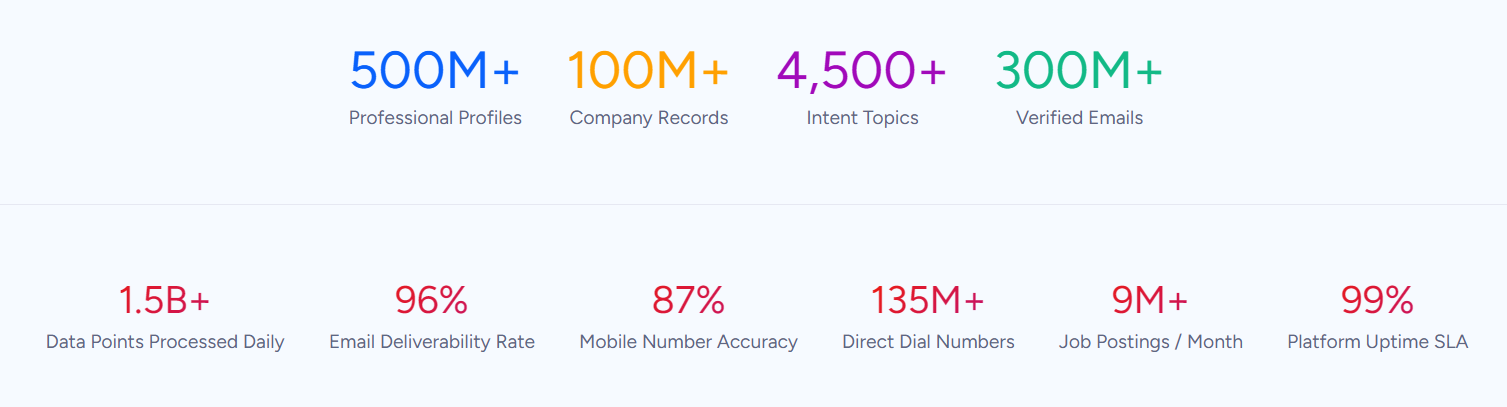
ZoomInfo maintains 500M contacts, 100M companies, 135M+ verified phone numbers, and 200M+ verified business email addresses, verified through a pipeline that includes automated ML scanning of 28 million site domains daily and 300+ human researchers. In a Fortune 500 competitive RFP analyzing 25 million contacts across vendors, the independent consultant concluded that "no other competitor came even close."
Source: ZoomInfo
Verified data is only the starting point.
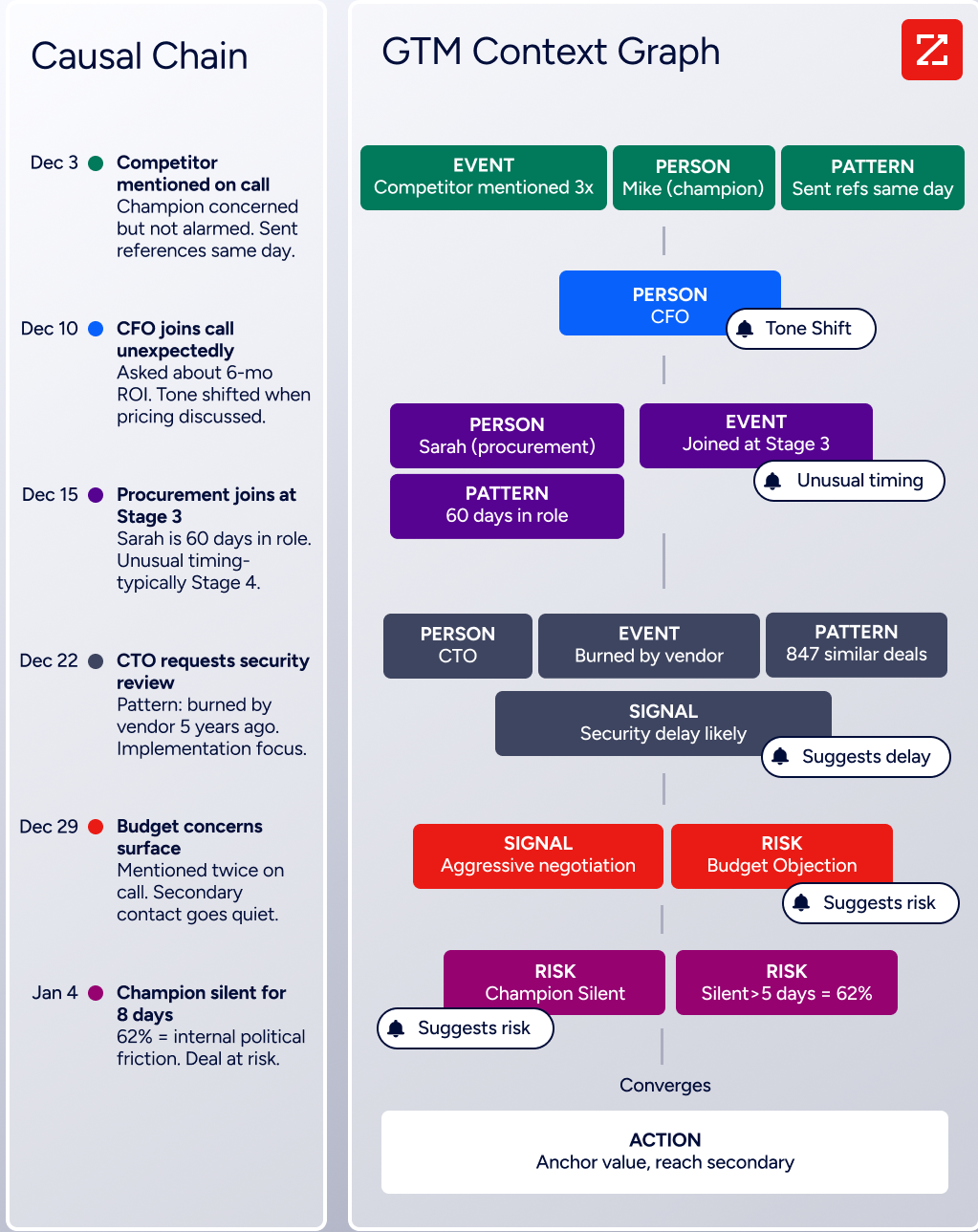
ZoomInfo's GTM Context Graph processes 1.5B+ data points daily, combining ZoomInfo's third-party intelligence with a customer's CRM records, conversation transcripts, and behavioral signals. The result: an intelligence layer that captures not just what happened in a deal, but why it happened.
A CRM records that a deal moved to Stage 3. The GTM Context Graph understands that it moved because the CFO joined the last call and asked about six-month ROI, a pattern that matches closed-won deals in your segment.
Source: ZoomInfo
That intelligence reaches teams through three channels.
GTM Workspace gives sellers a single view where prioritized accounts, AI-drafted outreach, and deal execution come together. GTM Studio lets marketers and RevOps teams define audiences in natural language, launch multi-channel plays, and watch pipeline impact in real time, without engineering tickets. And APIs and MCP expose the same intelligence to any custom tool or AI agent.
For B2B teams already using Constant Contact or HubSpot, ZoomInfo doesn't replace those platforms. It makes them more effective by ensuring the contacts in your database are verified, the accounts you're targeting are in-market, and the signals driving your campaigns reflect real buying behavior.
For a deeper look at how HubSpot and ZoomInfo compare head-to-head, see our HubSpot vs. ZoomInfo comparison.
Seismic's sales team attributed 39% of active pipeline to opportunities identified or influenced by ZoomInfo signals, reporting 54% productivity gains and 11.5 hours saved per week per seller. (Seismic Case Study)
Event management is Constant Contact's unique advantage
One area where Constant Contact stands alone: built-in event management.
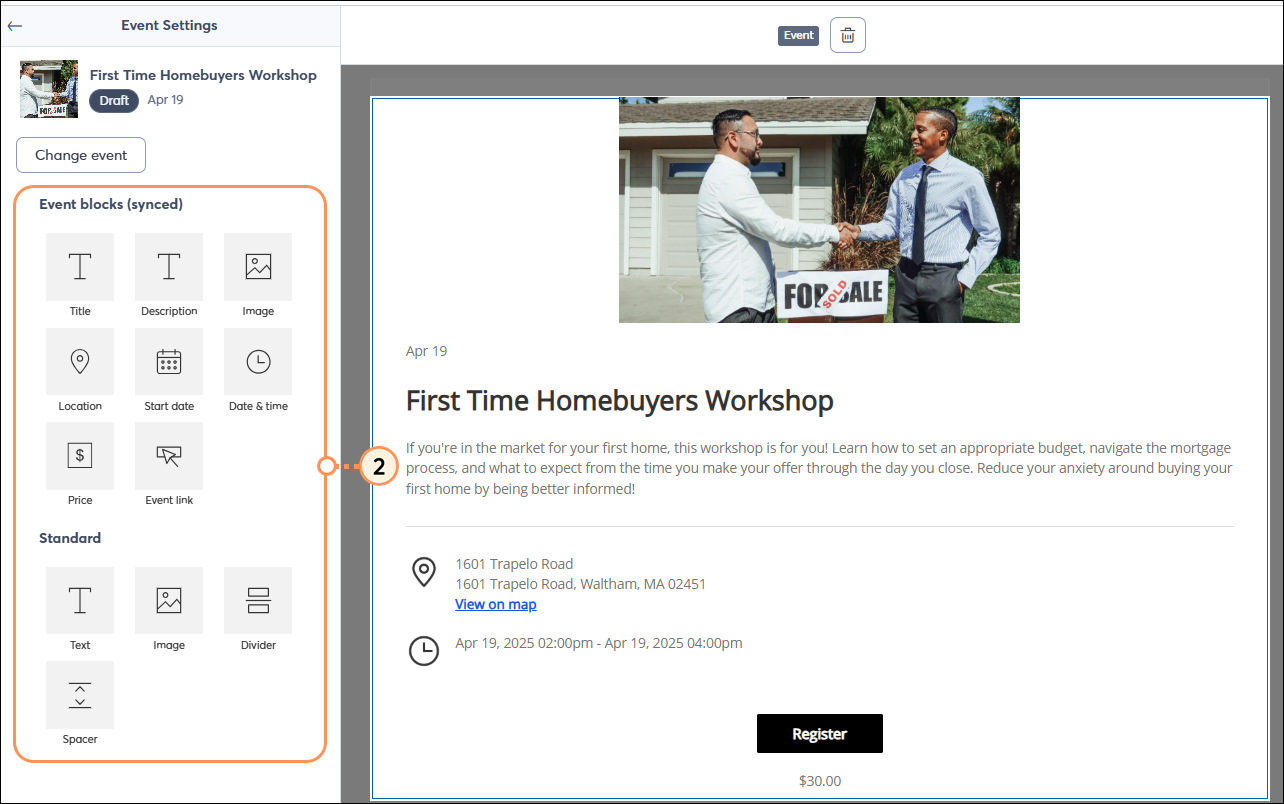
The platform lets you build branded event landing pages, sell tickets, process payments through Stripe or PayPal, send invitation emails, and automatically add attendees to your contact list, all from the same account you use for email marketing. Payment options include credit/debit cards, Google Pay, Apple Pay, Venmo, and Pay Later.
An April 2026 update added a ticketless RSVP-style event feature for lower-stakes events like open houses or community meetups. Synced event blocks mean that if you change the event date or price, the landing page and invitation emails update automatically.
Source: Constant Contact
For nonprofits running fundraisers and galas, or local businesses hosting workshops and seasonal events, this removes the need for a separate tool like Eventbrite. Combined with the 30% nonprofit prepay discount, Constant Contact becomes a strong choice for mission-driven organizations with regular events.
HubSpot has no native event management. You'd need a third-party integration to handle what Constant Contact does natively.
Social media and advertising: different scopes
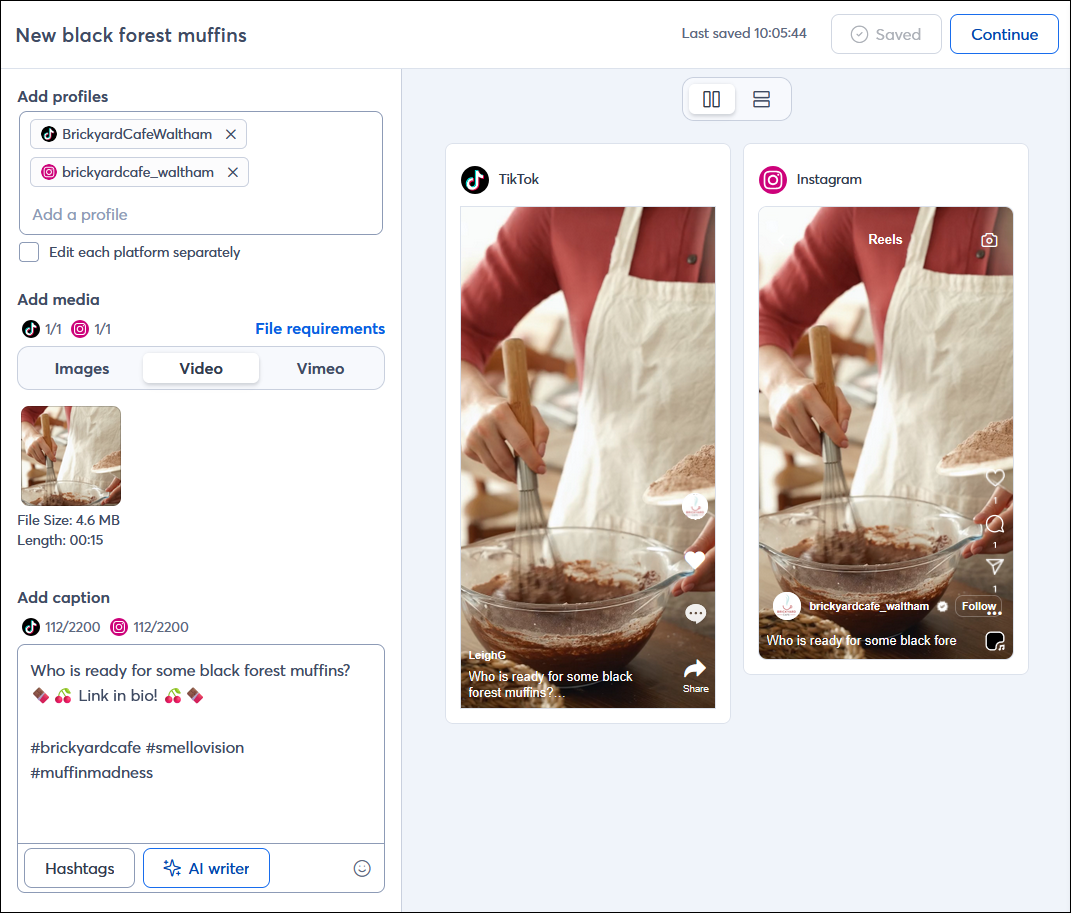
Constant Contact includes social media scheduling for Facebook, Instagram, LinkedIn, and TikTok directly from its platform.
An AI content generator can produce a full week of scheduled posts from image uploads or prompts, and a Canva integration lets you design social posts and publish them through Constant Contact. On the paid advertising side, Constant Contact supports Facebook/Instagram ads, Facebook Lead Ads, Google Ads (via Kliken), and TikTok ads, though Google Ads and Facebook Lookalike Audiences are Premium-only features.
Source: Constant Contact
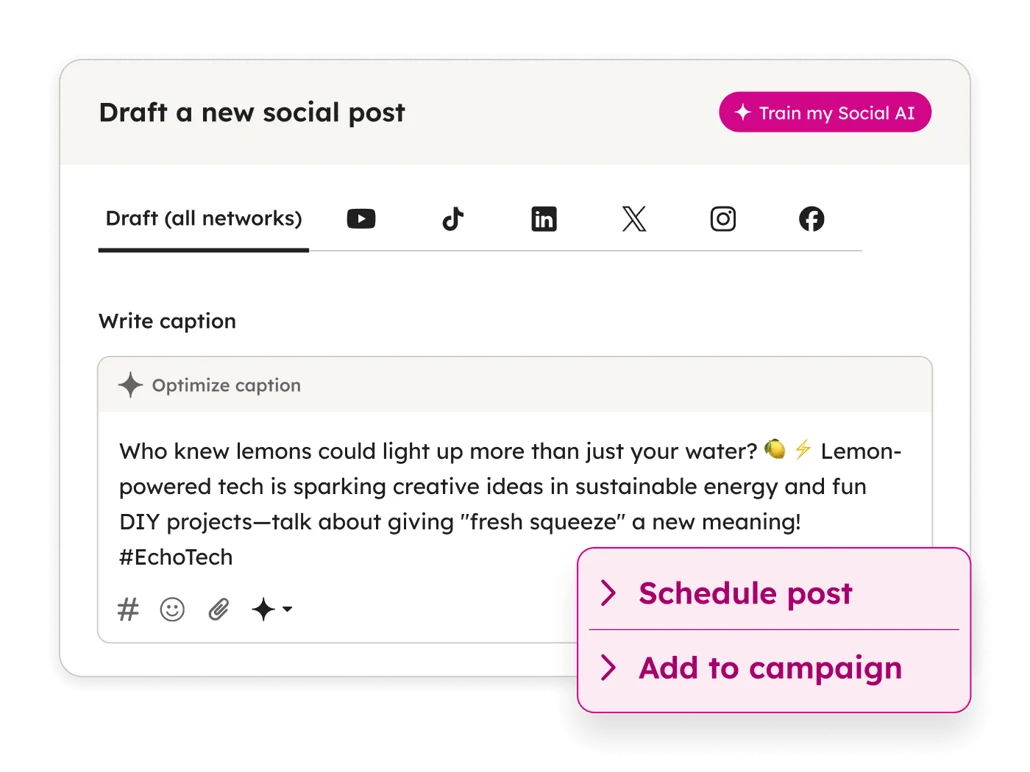
HubSpot's social media management also covers publishing, scheduling, and monitoring, with a Breeze Social Agent that automates posting.
The real difference is in advertising: HubSpot's ad tools connect to the CRM, so you can create audiences based on lifecycle stage, deal status, or any CRM property and track ad performance through to closed revenue. Constant Contact's ad tools are simpler and disconnected from any CRM context.
Source: HubSpot
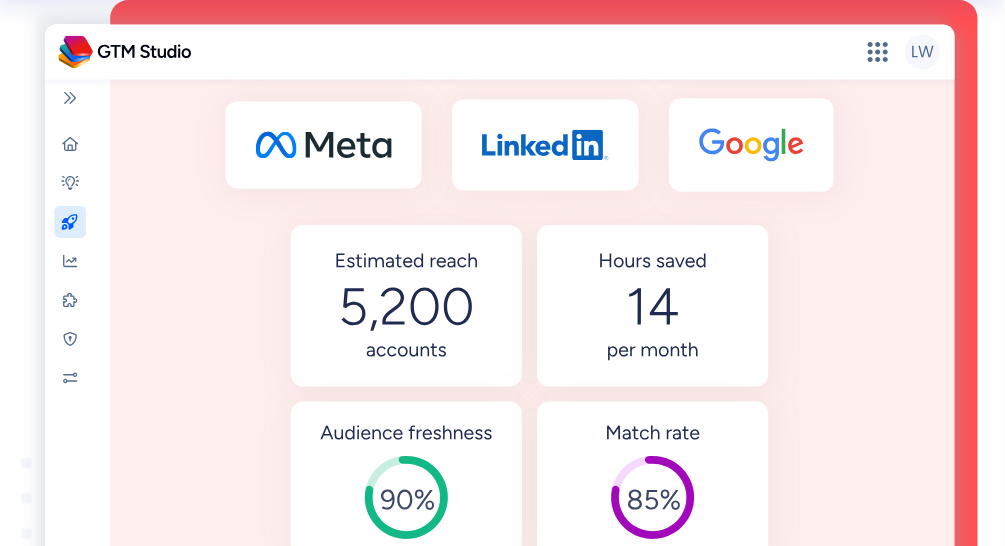
For B2B advertising, ZoomInfo offers something neither platform can match: a native demand-side platform that deploys display ads based on 300+ company attributes across major ad networks, with audiences that auto-update as data changes. Customers have reported a 900% increase in click-through rates using ZoomInfo's intent-driven audience targeting.
Source: ZoomInfo
AI capabilities reflect each platform's priorities
All three platforms have invested in AI, but each applies it to a different problem.
Constant Contact's AI tools focus on content creation for busy small business owners.
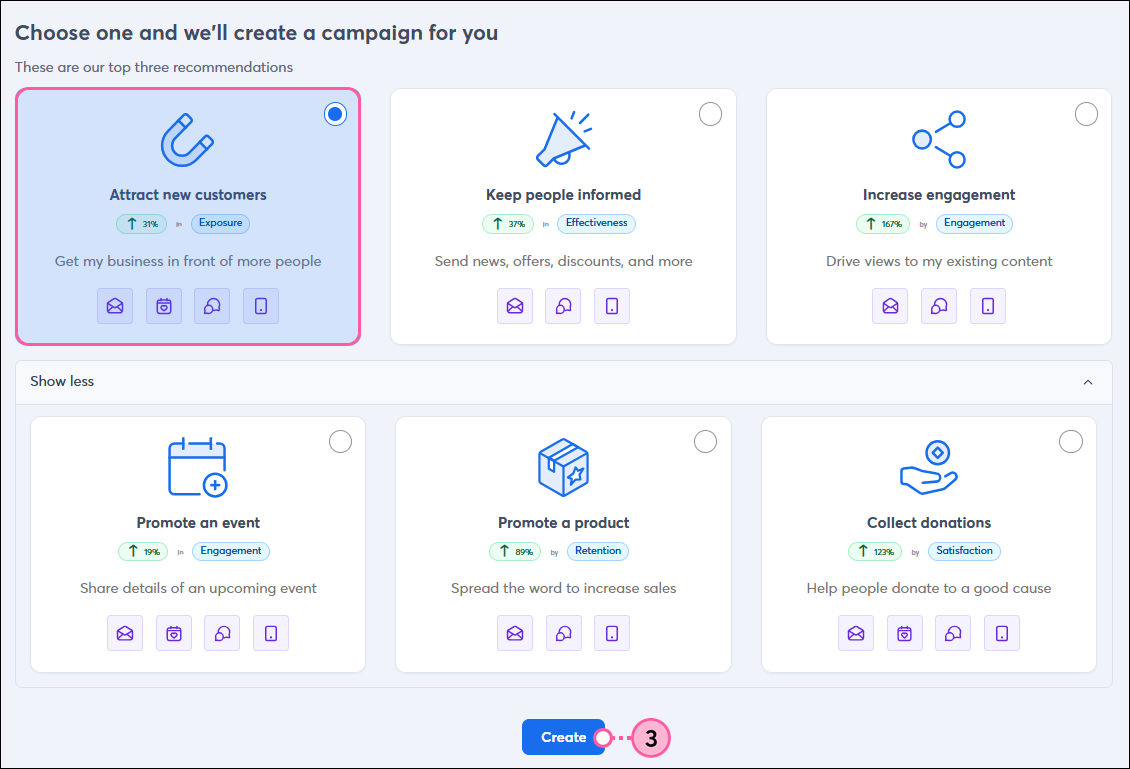
The AI Content Generator produces complete emails, social posts, and SMS messages from short prompts, drawing on a data layer built on OpenAI's ChatGPT that analyzes engagement patterns from Constant Contact's customer base. A Campaign Builder takes a marketing goal and generates a recommended channel mix, content plan, and send schedule.
The June 2026 ChatGPT app integration lets users create campaigns conversationally inside ChatGPT. Constant Contact reports that customers using AI features send marketing emails 23% faster on average.
Source: Constant Contact
HubSpot's Breeze AI is embedded across the platform and organized into three components: Breeze Assistant (an AI companion with CRM context), Breeze Agents (AI teammates that run full workflows), and embedded features (AI writing, content remix, conversation intelligence).
The Customer Agent resolves over 50% of customer conversations autonomously. The Prospecting Agent monitors buying signals and drafts personalized outreach using complete customer history. Because Breeze draws on HubSpot's full CRM data, its outputs reflect context that a standalone AI tool cannot match.
Source: HubSpot
ZoomInfo's AI operates at the intelligence layer.
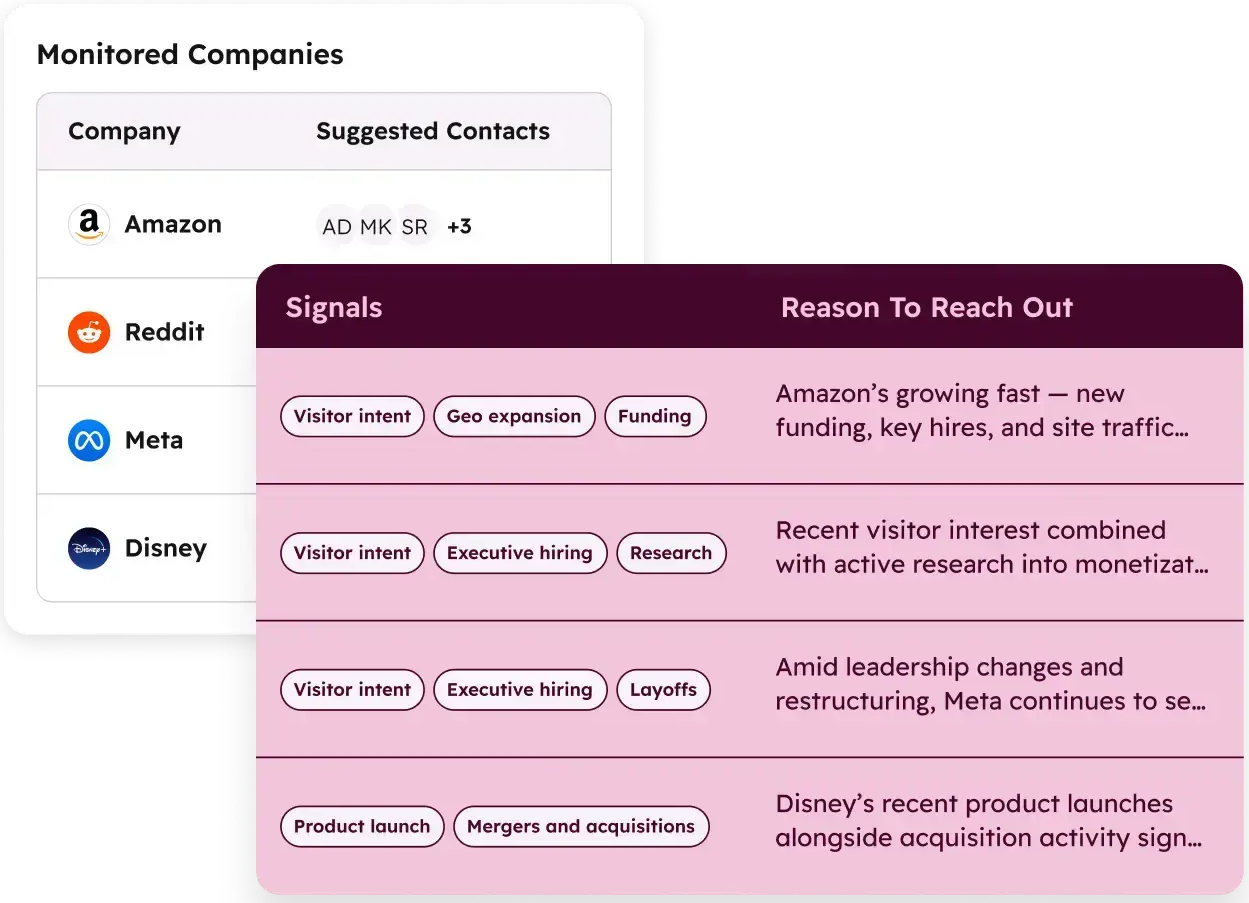
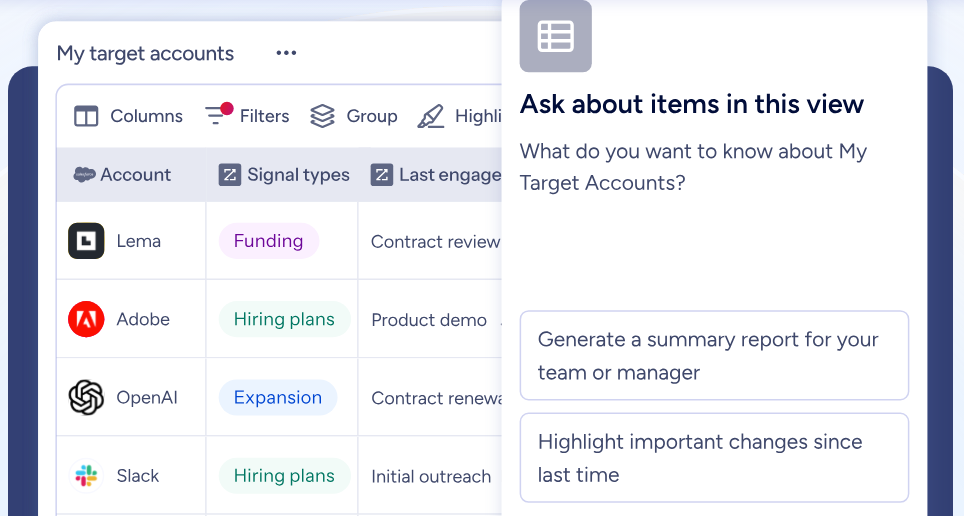
The GTM Context Graph doesn't just generate content; it reasons across billions of data points to identify which accounts match your win patterns, which contacts to engage, and what messaging will resonate based on signals from similar deals. AI agents inside GTM Workspace handle account research, outreach drafting, CRM updates, and signal monitoring.
The Copilot API exposes Account Summary, Company Insights, and Contact Recommendations programmatically, so the same intelligence powers custom builds and third-party tools.
Source: ZoomInfo
Pricing reveals what each platform values
Constant Contact uses contact-tier pricing across three plans. Entry is accessible: $12/month for Lite with up to 500 contacts.
But costs escalate with list size. At 2,500–5,000 contacts, you're paying $80/month (Lite), $110/month (Standard), or $200/month (Premium). The free plan was eliminated in June 2025, replaced by a 30-day trial capped at 100 email sends. Nonprofits get a 30% discount on 12-month prepay.
Two pricing behaviors draw complaints. If you exceed send limits for two consecutive months, Constant Contact automatically upgrades your account to the next tier without prior consent. And cancellation requires a phone call rather than self-service online.
HubSpot uses a hybrid model combining per-seat pricing, contact-based marketing tiers, and flat-fee products. The free CRM is genuinely useful: unlimited contacts, basic email, forms, and landing pages with no time limit. Starter plans begin at $15/seat/month (monthly) or $9/seat/month (annual).
But Professional tiers jump sharply: Marketing Hub Professional is $800/month (annual) with a $3,000 mandatory onboarding fee. Enterprise is $3,600/month with a $7,000 onboarding fee.
A pricing rule that catches many buyers off guard: when subscribing to multiple Hubs at different tiers, all Core Seats are billed at the rate of the highest tier. If you have Marketing Hub Professional and Sales Hub Enterprise, every Core Seat is charged at Enterprise rates.
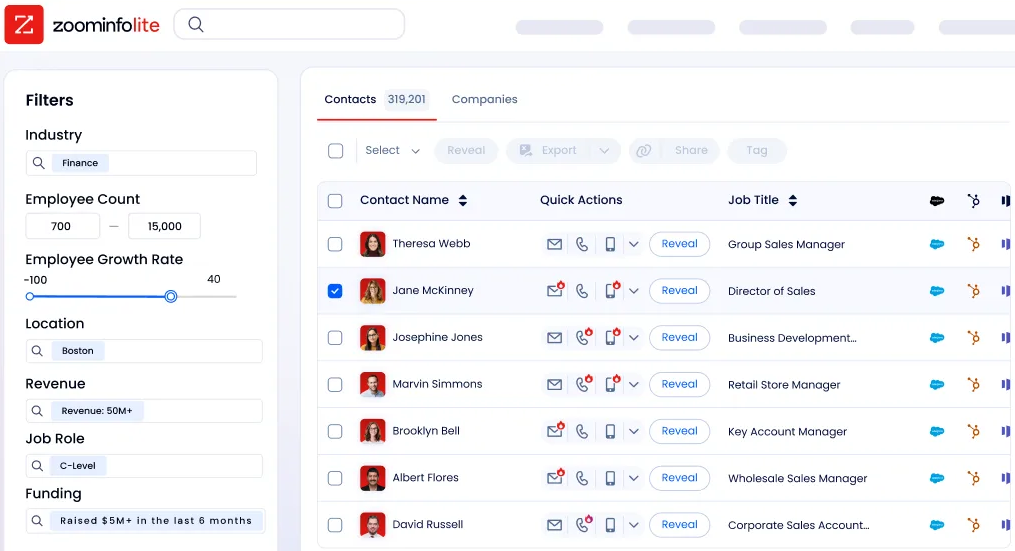
ZoomInfo uses custom-quoted, consumption-based pricing with no published prices. Costs depend on seats, credit volume, features, and contract length. ZoomInfo Lite provides a permanent free tier with access to the B2B database (including 10 monthly export credits) and a 7-day free trial is available for deeper platform access.
Source: ZoomInfo
The value calculation for ZoomInfo differs from the other two. You're not paying for email sends or CRM seats. You're paying for verified B2B data, buying signals, and the intelligence that makes every downstream marketing and sales activity more effective.
Customers like Snowflake report that accounts monitored with ZoomInfo-powered propensity scores show 90% higher opportunity open rates and 2x higher customer conversion rates.
Integration ecosystems at different scales
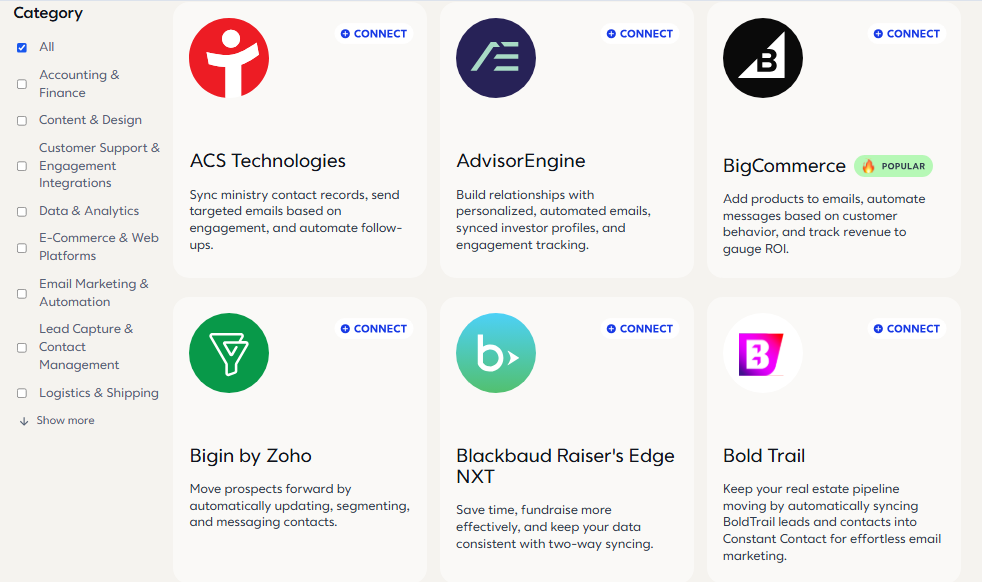
Constant Contact connects to 300+ apps across e-commerce (Shopify, WooCommerce, Etsy), CRM (Salesforce), accounting (Xero), and nonprofit tools (DonorPerfect). The V3 REST API covers contacts, campaigns, events, segments, and reporting, with official SDKs in five languages. Rate limits are 10,000 requests per day and 4 requests per second.
Source: Constant Contact
HubSpot operates at a larger scale: over 2,000 app integrations with 2.5 million active installs.
The REST API covers every CRM object and supports date-based versioning with an 18-month support window per version. Official SDKs exist for six languages. A remote MCP server (GA April 2026) gives AI agents read/write access to CRM data. Rate limits scale by tier, from 100 requests per 10 seconds on Free/Starter to 190 on Professional/Enterprise.
ZoomInfo's integration strategy centers on being infrastructure rather than a destination.
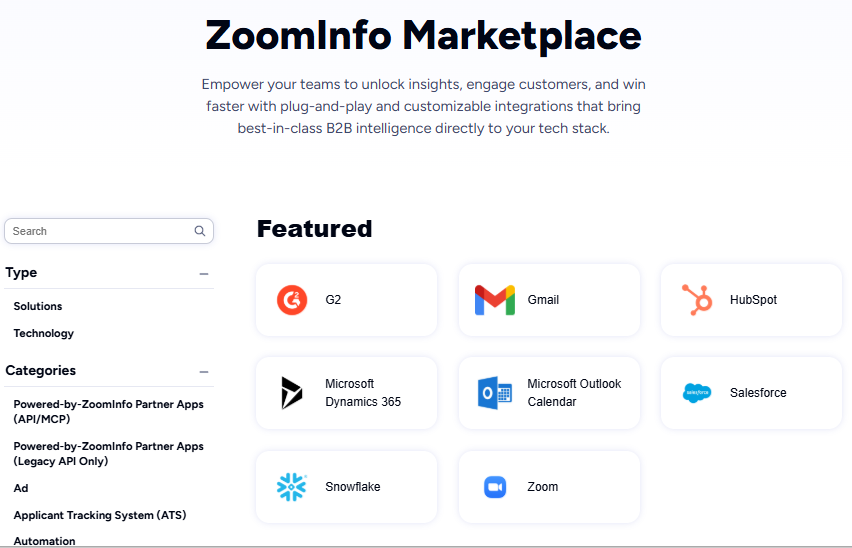
The App Marketplace lists 172+ partners, with featured integrations for Salesforce, HubSpot, Microsoft Dynamics 365, Snowflake, and Databricks. The Enterprise API covers search, enrichment, AI intelligence (Copilot API), and marketing audience management. The MCP server connects AI models to ZoomInfo's data with no custom coding, currently supporting Claude and ChatGPT. API access is included in all relevant plans.
Source: ZoomInfo
Support models match each platform's audience
Constant Contact's support is built for non-technical users who want to talk to a person.
Phone support runs Monday through Friday 8am to 8pm ET and Saturday 10am to 6pm ET, with live chat Monday through Friday 3am to 8pm ET and an "Ask a Trainer" live session program. This level of phone access on every paid plan is unusual among email marketing platforms. The tradeoff: cancellation also requires a phone call.
HubSpot tiers its support by plan. Free users get community forums only. Starter adds email and chat. Professional and Enterprise get phone support.
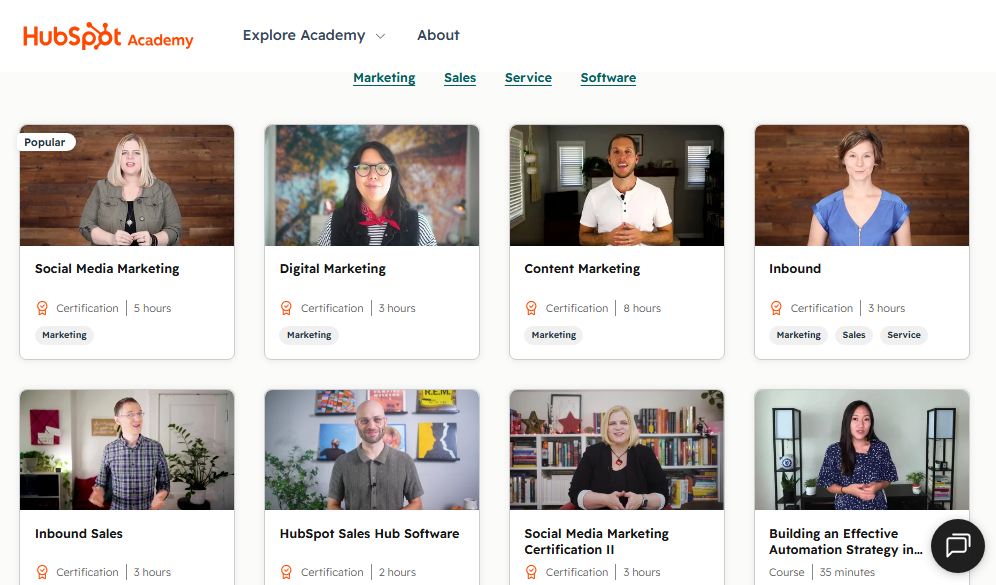
The real depth is in HubSpot Academy, which has certified over 200,000 professionals through free courses covering inbound marketing, sales, content, and platform certifications. The Solutions Partner network provides implementation support, which matters given HubSpot's thin internal professional services revenue ($67.3 million out of $3.13 billion total).
Source: HubSpot
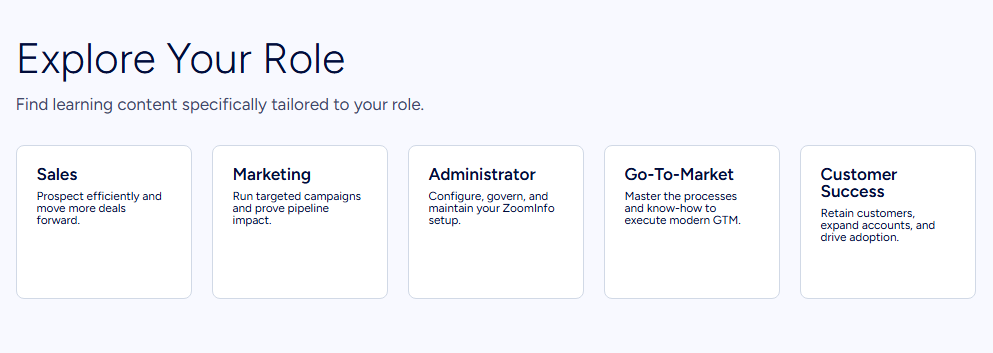
ZoomInfo offers support through a Help Center, ZoomInfo University with role-specific learning paths and certifications, direct phone support, and professional services through ZoomInfo Labs. The company redesigned its onboarding program to 90 days, producing a 25% improvement in customer satisfaction scores.
Source: ZoomInfo
Constant Contact vs. HubSpot vs. ZoomInfo: Which should you choose?
The right platform depends on what problem you're solving.
Choose Constant Contact if:
You need to send professional email campaigns without a learning curve
You're a small business or nonprofit with fewer than 5,000 contacts
Built-in event management (ticketing, RSVPs, payments) is important
You value phone support on every paid plan
Your marketing needs are email, social, and SMS, not a full CRM
Choose HubSpot if:
You need marketing, sales, and service connected under one CRM
Marketing automation with multi-step, behavioral workflows is critical
You want a free entry point you can grow into over time
Your team needs multi-touch attribution and full-funnel reporting
You're scaling past the point where point solutions work
Choose ZoomInfo if:
You need verified B2B contact data to target the right accounts
Buyer intent signals and in-market detection matter to your strategy
You want account intelligence that tells you who to engage, when, and why
You need data that powers your existing tools (CRM, marketing automation, AI agents)
You're building a B2B go-to-market engine where data quality determines pipeline quality
See how ZoomInfo's data and intelligence can power your go-to-market with a free trial.
For many B2B teams, the answer isn't one platform. Constant Contact or HubSpot handles campaign execution. ZoomInfo provides the data foundation and buying signals that make those campaigns reach the right people at the right time. When your marketing emails land on verified addresses at accounts showing buying intent, every metric improves: open rates, response rates, pipeline, and revenue.
Redwood Logistics achieved a 99% reduction in cost-per-click and a 310% increase in click-through rates using ZoomInfo's data-driven audience targeting. Chelsea Kenyon, Senior Director of Digital Strategy: "It's not just the data itself. It's more about the right data at the right time to help us reach out with the right message across that full buyer journey." (Redwood Logistics Case Study)
Constant Contact vs. HubSpot vs. ZoomInfo FAQ
What is the core difference between Constant Contact, HubSpot, and ZoomInfo?
Constant Contact is an email marketing and digital campaign tool for small businesses and nonprofits that need to send professional campaigns quickly.
HubSpot is a full customer platform connecting marketing, sales, service, and content under one CRM.
ZoomInfo is a B2B data intelligence platform providing verified contacts, company data, and buying signals that power go-to-market execution across any tool or workflow.
Which platform is cheapest to get started with?
HubSpot offers the lowest entry point with a permanent free CRM that includes basic email, forms, and landing pages with no time limit. Constant Contact starts at $12/month for the Lite plan with up to 500 contacts, but eliminated its free plan in June 2025.
ZoomInfo offers ZoomInfo Lite as a permanent free tier with 10 monthly export credits and access to its B2B database, plus a 7-day free trial for deeper access.
Can I use ZoomInfo with Constant Contact or HubSpot?
Yes. ZoomInfo integrates natively with HubSpot and can connect with Constant Contact's ecosystem through its API. ZoomInfo's role is complementary: it provides verified B2B contact data, buying signals, and account intelligence that make campaigns on either platform more effective. The data flows into your existing tools through native integrations, APIs, or MCP.
Which platform has the best marketing automation?
HubSpot has the strongest marketing automation, with multi-step branching workflows, behavioral triggers, lead scoring, and CRM-integrated nurture sequences.
Constant Contact's automation is limited to single-trigger paths with basic conditional splits, sufficient for welcome series and simple follow-ups but not for complex lifecycle marketing. ZoomInfo's automation focuses on go-to-market plays triggered by buying signals rather than traditional email workflows.
Which platform is better for nonprofits?
Constant Contact is the stronger choice for most nonprofits. It offers a 30% discount on 12-month prepay, built-in event management with ticketing and payment processing, and an interface designed for organizations without dedicated marketing staff.
HubSpot's free CRM and Starter plans can work for nonprofits but lack the event management tools and nonprofit-specific pricing.
How does Constant Contact's pricing compare to HubSpot's at scale?
Constant Contact's pricing climbs with contact count. At 5,000 contacts, plans range from $80 to $200 per month depending on the tier. HubSpot's Marketing Hub Professional starts at $800/month (annual) with a $3,000 onboarding fee, regardless of initial contact count.
For small lists, Constant Contact is far cheaper. For teams that need CRM, sales tools, and advanced automation, HubSpot's higher price covers a broader platform that would otherwise require multiple separate tools.
What kind of data does ZoomInfo provide that the other platforms don't?
ZoomInfo provides a B2B intelligence layer that neither Constant Contact nor HubSpot offers: 500M contacts with verified emails and direct-dial phone numbers, 100M company profiles with technographics, buyer intent data from 210 million IP-to-organization pairings, and website visitor identification.
The GTM Context Graph combines all of this with your CRM and conversation data to surface which accounts are in-market and why deals are progressing or stalling.
Do I need all three platforms?
Not necessarily. It depends on your business model.
B2C small businesses and nonprofits may only need Constant Contact. Growing companies with sales teams benefit from HubSpot's CRM platform.
B2B organizations that need verified contact data, buying signals, and account intelligence should add ZoomInfo to whichever campaign execution platform they use. The combination of a campaign platform (Constant Contact or HubSpot) with ZoomInfo's data layer is where B2B marketing produces the strongest results.
Keep comparing Constant Contact:
