
If you're comparing Contactually vs. Zoho CRM, here's the first thing you need to know: Contactually was permanently shut down on March 31, 2022. It's no longer available.
That doesn't make this comparison useless. Contactually pioneered ideas about relationship-driven CRM that still shape how sales professionals think about their contacts. Understanding what it did well helps you evaluate what to look for in a replacement.
The real questions you should be asking now are:
Are you a former Contactually user looking for a CRM that prioritizes relationship follow-up?
Do you need a CRM built for real estate, or would a customizable general-purpose platform work better?
Is your primary challenge managing the contacts you already have, or finding the right prospects in the first place?
How important is it that your CRM connects to the rest of your tech stack?
Would your sales process benefit more from better contact management or better contact data?
In short, here's what we recommend:
Contactually was a relationship-driven CRM built for real estate agents and brokerages. Its "Buckets" system organized contacts by follow-up frequency, and its gamified interface drove adoption rates that other CRMs couldn't match. At its peak, Contactually served 8 of the top 20 brokerages. But Compass acquired it in February 2019, redirected its resources, and shut it down three years later. It is no longer an option.
Zoho CRM is the active, full-featured CRM in this comparison. Trusted by 300,000+ businesses, it offers sales force automation, AI insights through Zia, customization via Canvas Design Studio, and native integration with 60+ Zoho applications. With a permanent free plan for 3 users and paid tiers that scale to enterprise, Zoho CRM delivers more features at a lower cost than Contactually ever did. It also offers dedicated real estate solutions, making it a natural landing spot for former Contactually users.
Both platforms address the same core problem: organizing contacts and keeping follow-ups on track. But neither solves the problem that sits upstream of every CRM: knowing who to contact, whether they're in-market, and what will make them respond.
ZoomInfo is a go-to-market platform built on one of the largest B2B databases available: 500M contacts, 100M companies, 135M+ verified phone numbers, and 200M+ verified business email addresses. Where a CRM manages relationships you already have, ZoomInfo identifies the ones worth building. Its GTM Context Graph (a system that combines your CRM records, conversation data, and behavioral signals with ZoomInfo's third-party data) reveals not just what's happening in your pipeline, but why. Sales teams access this through GTM Workspace, marketers and RevOps use GTM Studio, and developers tap APIs and MCP to embed the data into any tool. ZoomInfo doesn't replace your CRM. It makes it more effective.
If your CRM needs better data behind it, see how ZoomInfo works.
Contactually vs. Zoho CRM vs. ZoomInfo at a glance
Contactually | Zoho CRM | ZoomInfo | |
|---|---|---|---|
Status | Discontinued (March 2022) | Active | Active |
Primary function | Real estate relationship CRM | Full CRM platform | Go-to-market intelligence platform |
Contact database | Built from your email and social accounts | Built from your inputs, web forms, imports | 500M contacts, 100M companies with verified data |
AI capabilities | Basic (Best Time to Email) | Zia AI (scoring, agents, predictions) | GTM Context Graph + AI agents |
Automation | Programs (drip sequences) | Workflows, Blueprint, Cadences | GTM Workspace + GTM Studio |
Industry focus | Real estate | General (with vertical solutions) | B2B across industries |
Free plan | None (was 14-day trial) | Yes (3 users, forever) | Yes (ZoomInfo Lite, permanent) |
Pricing | Was $59-$399/user/month | Free to ~$14-40/user/month | Consumption-based pricing |
Best for | No longer available | SMBs and mid-market needing affordable CRM | B2B teams needing data, signals, and prospecting tools |
Contactually shut down, but its ideas are worth understanding
Contactually's story matters, even though the product is gone.
Founded in 2011 by Zvi Band in Washington, DC, Contactually was built on a simple observation: real estate agents depend on relationships, but most CRM tools were designed for transactional sales pipelines. The industry's main failure wasn't a lack of software. It was a lack of adoption. Agents bought CRMs, found them too demanding, and abandoned them.
Contactually's answer was the Buckets system, which organized contacts by how often an agent needed to stay in touch rather than by deal stage.
A past client might go into a 60-day bucket. A hot lead into a 7-day bucket. The system tracked actual communication history and surfaced only the contacts who were overdue, so agents weren't pestered about everyone in their database. A gamified "Bucket Game" turned the tedious work of sorting hundreds of contacts into a keyboard-shortcut-driven session complete in minutes.
The approach worked.
Then Compass acquired it in February 2019. The acquisition raised immediate concerns. Compass competed directly with many of Contactually's brokerage clients, and those clients were handing their contact databases to a rival.
Within months, support was notifying clients that resources were being redirected to Compass's internal CRM. Development stagnated. The product shut down on March 31, 2022, and Compass absorbed its technology into tools available only to its own agents.
The lesson: Contactually's design philosophy was sound. Its business reality wasn't sustainable. If you're here because you valued what Contactually did, the question is which current platform captures that relationship-first thinking while remaining available for the long term.
Zoho CRM goes wider than Contactually ever did
Contactually was deliberately narrow. No transaction management, no consumer-facing website tools, no MLS integration, no calendar sync or call recording. It did one thing well (relationship follow-up) and relied on integrations for everything else.
Zoho CRM takes the opposite approach.
It's a full CRM covering leads, contacts, accounts, deals, activities, sales forecasting, territory management, and inventory management in a single platform. Add the broader Zoho ecosystem (60+ integrated apps including Zoho Books, Zoho Desk, Zoho Campaigns, and Zoho Analytics) and you have an operating system for mid-market businesses.
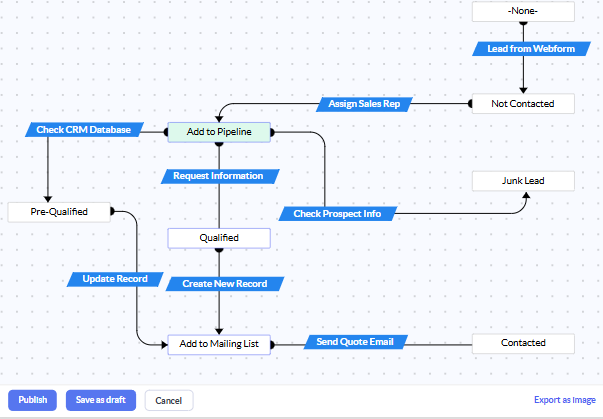
For former Contactually users, the transition requires a mental shift. Contactually's Buckets organized contacts by follow-up frequency. Zoho CRM organizes them by module (Leads, Contacts, Accounts, Deals) and uses Blueprint to enforce stage-by-stage processes.
Where Contactually's gamified interface made follow-up feel engaging, Zoho CRM's Canvas Design Studio lets you redesign the entire interface to match your workflow. It's different flexibility, but broader.
Source: Zoho
The feature gap is wide.
Zoho CRM includes CPQ for quoting, omnichannel engagement across email, phone, WhatsApp, and social media, journey orchestration via CommandCenter, and a customization layer supporting up to 500 custom modules. Contactually had none of these. It didn't try to. But for a business that needs more than follow-up reminders, Zoho CRM covers territory that Contactually never attempted.
The tradeoff: Zoho CRM's breadth comes with complexity.
G2 reviewers consistently note that while basic use is accessible, advanced configuration demands real time. Capterra reviewers flag the same pattern. Contactually's learning curve was minutes. Zoho CRM's can be weeks, depending on how much you customize.
A CRM manages your contacts, but finding the right ones is a different problem
Both Contactually and Zoho CRM share a basic assumption: you already have the contacts that matter. Contactually pulled them from your email and social accounts. Zoho CRM captures them through web forms, imports, and manual entry. Both tools help you organize and follow up with people already in your database.
ZoomInfo addresses the problem that sits upstream of both.
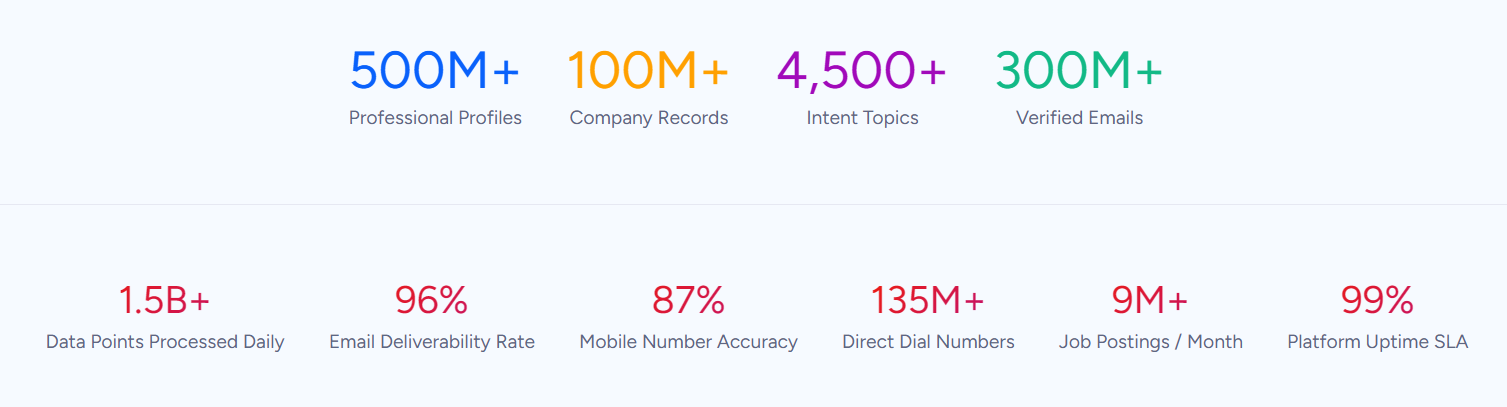
Instead of managing contacts you've already collected, ZoomInfo provides access to 500M business contacts and 100M company profiles, verified by 300+ human researchers with up to 95% accuracy on first-party data. The database includes 135M+ verified phone numbers, 120M direct dials, and 200M+ verified business email addresses.
Source: ZoomInfo
That data isn't static.
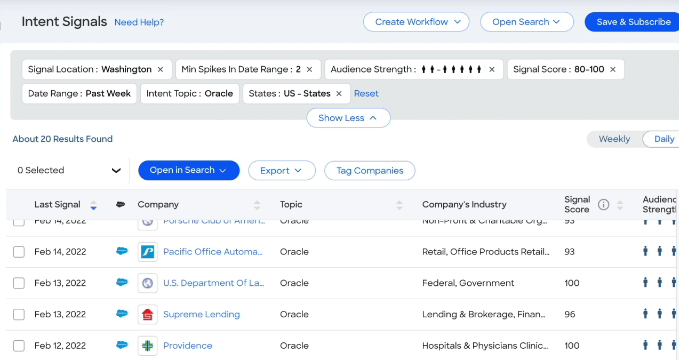
ZoomInfo's Buyer Intent tracks signals from 210 million IP-to-organization pairings and 6 trillion+ keyword-to-device pairings monthly, identifying companies actively researching solutions in your category. WebSights resolves anonymous website traffic to companies, and technographic profiles cover 30+ million companies across 30,000+ technologies.
For B2B sales teams, this changes the equation.
Contactually assumed you already knew who mattered and just needed help staying in touch. Zoho CRM assumes contacts will flow in through various channels and need managing. ZoomInfo answers a prior question: who should you be targeting, and are they ready to buy?
Source: ZoomInfo
The practical difference: a Zoho CRM user entering a new market segment has to build a contact list from scratch through networking, events, and inbound channels. A ZoomInfo user can search by industry, company size, technology stack, and buying intent, then export verified contacts directly into their CRM.
In a Fortune 500 competitive RFP analyzing 25 million contacts across vendors, the independent consultant concluded that "no other competitor came even close" to ZoomInfo's data coverage.
"ZoomInfo gives us the information we need to execute. We don't have to go through and spend our time digging. It's already there, so we can be three steps ahead." (Vensure)
AI and automation reflect three different eras
The three platforms represent distinct generations of what "intelligence" means in a sales context.
Contactually's AI was modest but useful.
Its "Best Time to Email" feature analyzed each contact's past open-rate history and recommended the best send times for each individual. It scraped over 120 social sites to enrich contact profiles automatically. Its Programs feature enabled drip campaigns with a delay that paused sequences when organic communication occurred, preventing over-contact. For its era, this was a thoughtful design. By 2026 standards, it's baseline functionality.
Zoho CRM's Zia represents the current generation of CRM AI.
Zia covers predictive lead scoring, churn prediction, best time to contact, email sentiment analysis, anomaly detection, and deal win probability. The Zia Agents Store provides seven pre-built agents (SDR, sales coach, deal analyzer, quote generator, follow-up scheduler, revenue growth specialist, and deal closure reminder) that can run as automated agents within the CRM.
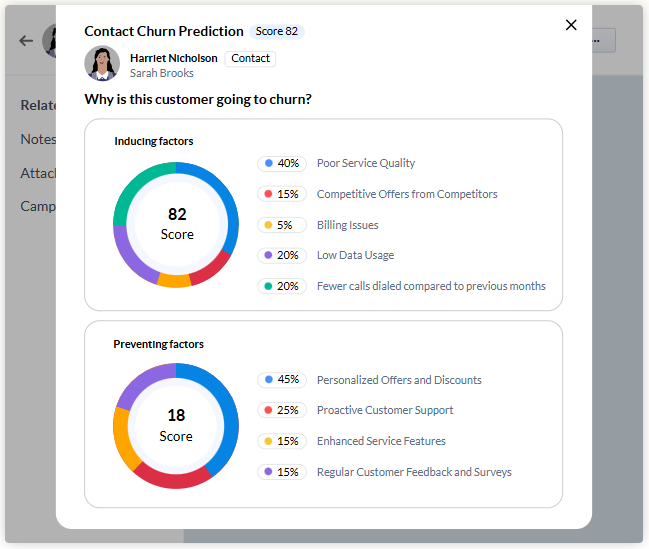
Source: Zoho
Users can describe automation logic in plain language and Zia will build the workflow rule, or upload a screenshot of a desired layout and have Zia generate a Canvas design.
Beyond AI, Zoho CRM's automation runs wide.
Blueprint enforces stage-by-stage sales processes so reps can't skip steps. Cadences coordinate multichannel follow-up sequences across email, calls, tasks, and WhatsApp, with branching logic based on customer responses. CommandCenter includes PathFinder, which visualizes the paths customers take before you design the journey you want them to take. This automation is more sophisticated than anything Contactually offered.
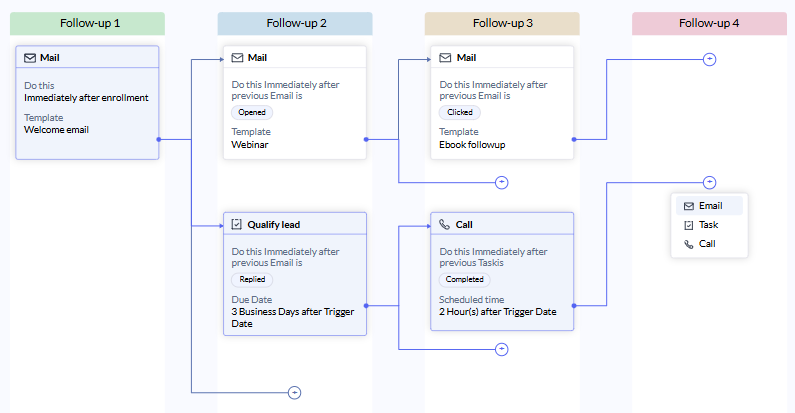
Source: Zoho
ZoomInfo's intelligence operates at a different level.
The GTM Context Graph doesn't just analyze your CRM data. It combines your CRM records, conversation transcripts, and behavioral signals with ZoomInfo's third-party data to understand why deals move or stall, not just that they did. As ZoomInfo's CPO Dominik Facher explains: "The CRM recorded the state change. It has no record of why it happened."
This reasoning produces practical results.
In GTM Workspace, AI agents handle account research, write outreach tailored to each account, monitor buying signals, and update CRM fields. GTM Studio lets marketers describe audiences in natural language, launch multi-channel go-to-market plays, and track pipeline impact in real time, with expansion plays that used to take 3 weeks launching in 30 minutes.
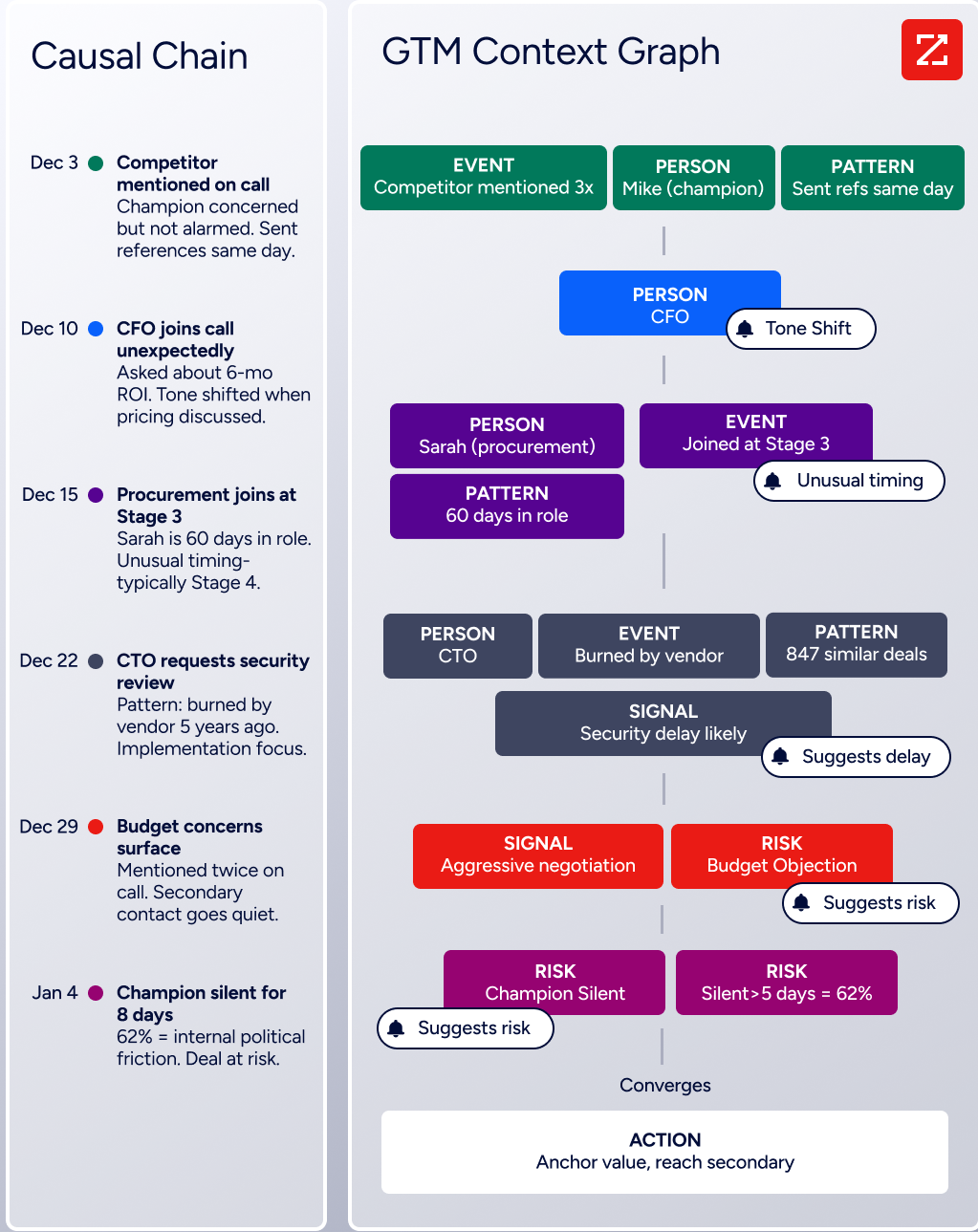
Source: ZoomInfo
"That combination of our internal CRM data, external signals, and AI that's given all that context has helped us craft very specific account- and persona-based messages. And people have responded to them right away." (Seismic)
Integration ecosystems determine how far each platform reaches
Contactually's integration approach was selective.
It had native connections to Gmail, Outlook, MailChimp, Kixie (power dialer), Spacio (open house leads), Hootsuite, and dotloop (transaction management). Beyond those, it relied on Zapier, which required a separate subscription. Hooquest summarized it accurately: "It has relatively few integrations beyond Zapier, but the few direct integrations they have are very well done ones." For a focused real estate CRM, this was adequate. For a broader business operation, it was limiting.
Zoho CRM plays a different game.
The platform connects to 1,100+ integrations through the Zoho Marketplace, plus the entire Zoho suite of 60+ applications. Native integrations include Microsoft Teams Phone, Google Workspace, and social channels. For teams building on Zoho's ecosystem, the value compounds: CRM data flows into accounting (Zoho Books), support (Zoho Desk), project management (Zoho Projects), and analytics (Zoho Analytics) without third-party middleware.
The catch, as G2 users note, is that integrating with non-Zoho systems sometimes requires custom API work, particularly in enterprise environments.
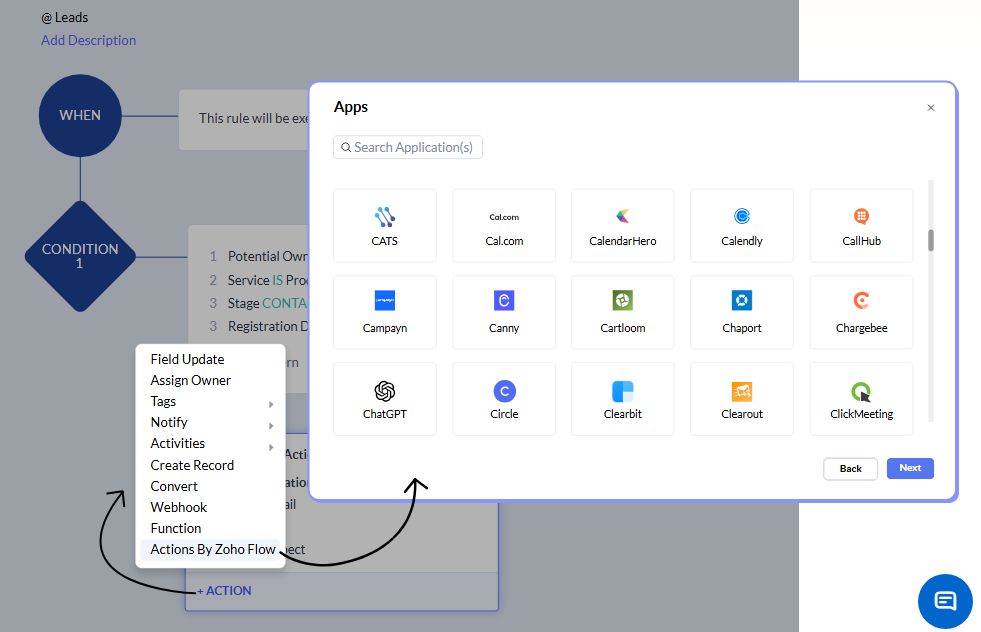
Source: Zoho CRM
ZoomInfo starts from a different premise: the data should flow everywhere.
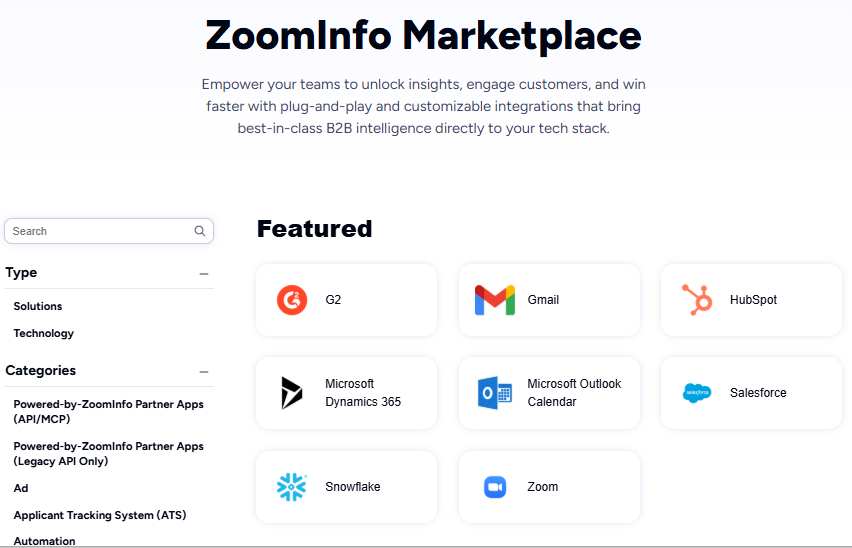
The ZoomInfo App Marketplace covers CRM (including Salesforce, HubSpot, Dynamics 365, and Zoho), marketing automation, sales engagement, revenue intelligence, and data warehouses. The Enterprise API exposes search, enrichment, audience management, and engagement data through programmatic endpoints.
And ZoomInfo MCP connects directly to AI assistants like Claude and ChatGPT, so users can query ZoomInfo data in any MCP-compatible tool.
The structural difference: Contactually and Zoho CRM are destinations where you work. ZoomInfo is infrastructure whose data flows into whatever tools you already use. API access comes included in all relevant plans, so the data isn't locked behind a premium tier.
Source: ZoomInfo
"ZoomInfo is our one source of truth for account data, and even more so for contact data. There's no other provider in the market that provides you with that level of detail." (Smartsheet)
Pricing reflects different markets and models
Contactually's pricing (no longer active) was per-user, per-month.
The Professional plan ran $59/month billed annually or $69/month billed monthly. The Accelerator plan was $99/month annually or $119/month monthly, adding a dedicated customer success manager and pre-built real estate content. The Concierge plan cost $399/month annually and included done-for-you outreach management. No free plan was ever available.
Zoho CRM's pricing is where value-conscious buyers pay attention.
The free plan supports 3 users permanently with core lead, contact, and deal management. Paid plans start at approximately $14/user/month (Standard, billed annually) and scale through Professional, Enterprise (the most popular), and Ultimate tiers.
ZoomInfo's pricing uses a consumption-based model with no publicly listed prices.
Costs depend on the number of users, credit volume (1 credit = 1 contact or company export), features accessed, and contract length. For teams evaluating the investment, the ROI is measurable: Seismic attributed 39% of active pipeline to ZoomInfo signals and reported 54% productivity gains.
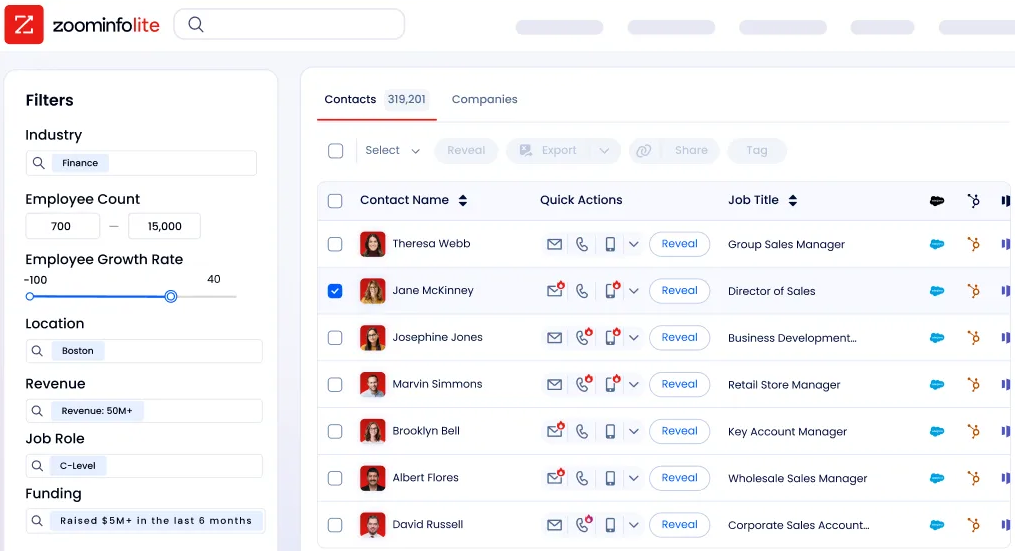
Snowflake achieved 200% higher conversion rates on accounts scored using ZoomInfo data. For individuals and small teams wanting to test the platform, ZoomInfo Lite offers a permanent free tier with access to the B2B database, 10 monthly export credits, and website visitor identification.
Source: ZoomInfo
The pricing comparison is apples-to-oranges.
Zoho CRM and Contactually are CRM tools: you're paying for contact management and automation. ZoomInfo is a data and intelligence platform: you're paying for access to verified contacts, intent signals, and go-to-market execution. Many organizations use a CRM and ZoomInfo together, with ZoomInfo feeding data into the CRM for pipeline management.
Contactually vs. Zoho CRM vs. ZoomInfo: Which should you choose?
The answer depends on where your biggest gap is.
Contactually is no longer an option.
If you valued its relationship-first design, the closest current approach is a CRM with strong follow-up automation and contact segmentation. Zoho CRM's Cadences and Blueprint cover similar ground with more sophistication. Zvi Band, Contactually's founder, also built a successor product called Relatable that applies the same Buckets philosophy, if that specific design pattern is what you're looking for.
Choose Zoho CRM if:
You need a full-featured CRM at an affordable price
You want customization without hiring developers
You're building (or already have) a broader Zoho ecosystem
Contact follow-up and pipeline management are your primary needs
You prefer month-to-month contracts over long-term commitments
You're a small to mid-market team scaling from basic tools to a complete CRM
Choose ZoomInfo if:
Your biggest challenge is finding the right prospects, not managing existing ones
You need verified B2B contact data, direct dials, and business emails at scale
You want buyer intent signals showing which accounts are in-market
AI-powered prospecting, outreach, and account research would improve your workflow
You need a data platform that feeds into your CRM, not another CRM itself
You're a B2B organization where data quality directly impacts pipeline
Try ZoomInfo Lite for free to see the data for yourself.
Use Zoho CRM and ZoomInfo together if:
You want a CRM managing your pipeline and an intelligence platform filling it
You need verified contact data enriching your CRM records automatically
You want intent signals triggering CRM workflows when accounts show buying activity
Your team spans sales, marketing, and RevOps with different needs at each stage
ZoomInfo integrates with CRMs including Zoho, so the two platforms complement rather than compete. Zoho CRM gives you pipeline management, process enforcement, and customer engagement tools. ZoomInfo gives you the data and signals to fill that pipeline with the right accounts. Together, they cover both sides of the go-to-market equation: finding opportunities and closing them.
"It's not just the data itself. It's more about the right data at the right time to help us reach out with the right message across that full buyer journey." (Redwood Logistics)
Contactually vs. Zoho CRM vs. ZoomInfo FAQ
Is Contactually still available?
No. Contactually was permanently shut down on March 31, 2022. Compass acquired it in February 2019 and redirected its engineering resources to building Compass's internal CRM, which is available only to Compass agents. The Contactually website is no longer functional. Former customers migrated to alternatives including Follow Up Boss, LionDesk, and Zoho CRM.
What made Contactually different from other CRMs?
Contactually organized contacts by follow-up frequency rather than deal stages.
Its Buckets system let agents set how often they needed to stay in touch with each group of contacts, and the CRM surfaced only those who were overdue. Gamification made routine follow-up engaging, driving adoption rates as high as 90% at some brokerages. Its Programs feature automated drip campaigns that paused when organic communication occurred, preventing over-contact.
The platform was designed for real estate agents who built their business on referrals and repeat clients.
How does Zoho CRM compare to Contactually for real estate agents?
Zoho CRM is a broader platform with more features, including sales force automation, AI scoring through Zia, Blueprint process enforcement, omnichannel communication, and a dedicated real estate vertical solution.
It lacks Contactually's gamified Buckets interface, but its Cadences feature provides multichannel follow-up automation and Blueprint enforces sales processes step by step. Zoho CRM also offers a permanent free plan for up to 3 users, while Contactually's cheapest tier was $59/month per user.
Is ZoomInfo a CRM replacement for Contactually or Zoho CRM?
No. ZoomInfo is a B2B data and intelligence platform, not a CRM. It provides contact data, company profiles, intent signals, and AI insights that feed into CRMs. ZoomInfo integrates with CRM platforms including Zoho, Salesforce, HubSpot, and Dynamics 365. It complements a CRM rather than replacing one. Organizations that need both contact management and contact discovery often pair ZoomInfo with a CRM.
How much does Zoho CRM cost compared to what Contactually charged?
Zoho CRM is cheaper. It offers a permanent free plan for up to 3 users, and paid plans start at approximately $14/user/month billed annually. Contactually had no free plan, and its cheapest option was the Professional plan at $59/month per user billed annually.
Zoho CRM users report 71% savings on licensing fees compared to alternatives, and one organization found Zoho at $30,000 versus a $1,000,000 Salesforce quote for the same deployment.
Does ZoomInfo integrate with Zoho CRM?
Yes. ZoomInfo lists Zoho among its CRM integrations for marketing and data enrichment workflows. ZoomInfo also offers API access on all relevant plans and an MCP server for AI assistants, providing multiple methods to feed ZoomInfo data into Zoho CRM or any other system in your stack.
What is ZoomInfo's GTM Context Graph?
The GTM Context Graph is ZoomInfo's system for combining its B2B data (500M contacts, 100M companies) with customer CRM records, conversation transcripts, email interactions, and behavioral signals. It processes over 1.5 billion data points daily to capture not just what happened in a deal, but why.
This reasoning powers AI-driven prospecting, outreach, and pipeline management across ZoomInfo's products, and is accessible through GTM Workspace for sellers, GTM Studio for marketers and RevOps, or APIs and MCP for any tool.
Who should choose ZoomInfo over Zoho CRM?
ZoomInfo and Zoho CRM solve different problems, so it's not an either-or choice for most B2B organizations.
Choose Zoho CRM if your main need is managing existing contacts, automating sales processes, and tracking deals through a pipeline. Choose ZoomInfo if your main need is finding verified B2B contacts, identifying in-market accounts through intent signals, and enriching your CRM data with company intelligence. Many teams use both, with ZoomInfo feeding data and intelligence into Zoho CRM for execution.
Want more Contactually and Zoho CRM comparisons? These breakdowns go deeper:
