
Demio built its position among webinar platforms as the tool data-driven marketers choose when they need to trace a webinar back to pipeline. Per-attendee engagement tracking, focus-time measurement, timed CTAs, and detailed analytics give marketing teams signals that generic video conferencing tools do not capture.
But those signals only become valuable when they reach the systems where your team works.
Demio tracks who registered, who showed up, how long they stayed focused, which polls they answered, and which CTAs they clicked. On its own, that data lives inside Demio's analytics dashboard. Without a connection to your CRM, your marketing automation platform, or your team's communication layer, post-webinar follow-up relies on manual CSV exports, delayed list uploads, and generic emails that treat every registrant the same way.
The right integrations close that gap. They push attendance data into your CRM as structured records, trigger follow-up sequences based on whether someone attended or missed the session, and alert your sales team the moment a priority prospect joins a live event.
This guide covers the strongest integration for each of the jobs Demio users most commonly need done:
Close the loop between webinar engagement and CRM pipeline with automated contact sync, list segmentation, and workflow triggers
Attribute webinar touchpoints to enterprise revenue with native campaign membership and activity timeline records
Feed webinar behavioral data into lead scoring models and ABM nurture programs
Trigger behavior-specific email follow-up sequences based on attendance, no-show, and custom registration data
Connect your webinar program to your entire marketing stack without writing code
Route real-time registration, attendance, and no-show alerts into the channels your sales team already monitors
Each section covers how the integration connects with Demio, what data flows between the platforms, pricing, and who benefits most.
Best Demio Integrations at a Glance | |
|---|---|
Best Demio Integration for Closing the Loop Between Webinar Engagement and CRM Pipeline Syncs registrants, attendees, and no-shows into separate HubSpot lists with timeline event logging and focus-time data, enabling post-webinar workflows and 1-click registration for contacts already in nurture sequences. | |
Best Demio Integration for Enterprise CRM Attribution and Revenue Pipeline Visibility Pushes webinar registration, attendance, and no-show data into native Salesforce Campaign Member records and activity timelines, giving RevOps teams the data to attribute closed revenue to specific sessions inside standard Salesforce reports. | |
Best Demio Integration for Enterprise Marketing Automation and ABM Lead Scoring Feeds webinar behavioral data into Marketo program status updates, Smart Campaign triggers, and lead scoring models, with 1-click registration for contacts receiving Marketo email invitations. | |
Best Demio Integration for Behavior-Triggered Email Follow-Up Automation. Applies attendance-based tags (Registered, Attended, No-Show) to contacts the moment a session ends, enabling automation sequences with conditional branching, custom field personalization, and 1-click registration from campaign emails. | |
Best Demio Integration for No-Code Workflow Automation Across Your Entire Marketing Stack Extends Demio's reach to 8,000+ apps with four real-time triggers, multi-step conditional workflows, and unique join link propagation that preserves per-registrant engagement attribution across every connected tool. | |
Best Demio Integration for Real-Time Webinar Notifications and Sales Alerts Routes registration, attendance, and no-show alerts into Slack channels via Zapier, compressing the time between a prospect's webinar engagement and a rep's personalized response from next-morning automation to same-session outreach. |
What Is Demio?
Demio is a webinar platform built for data-driven marketers who need to connect live event engagement to pipeline outcomes. Its positioning centers on a single promise: "Transparent webinar insights for data-driven marketers."
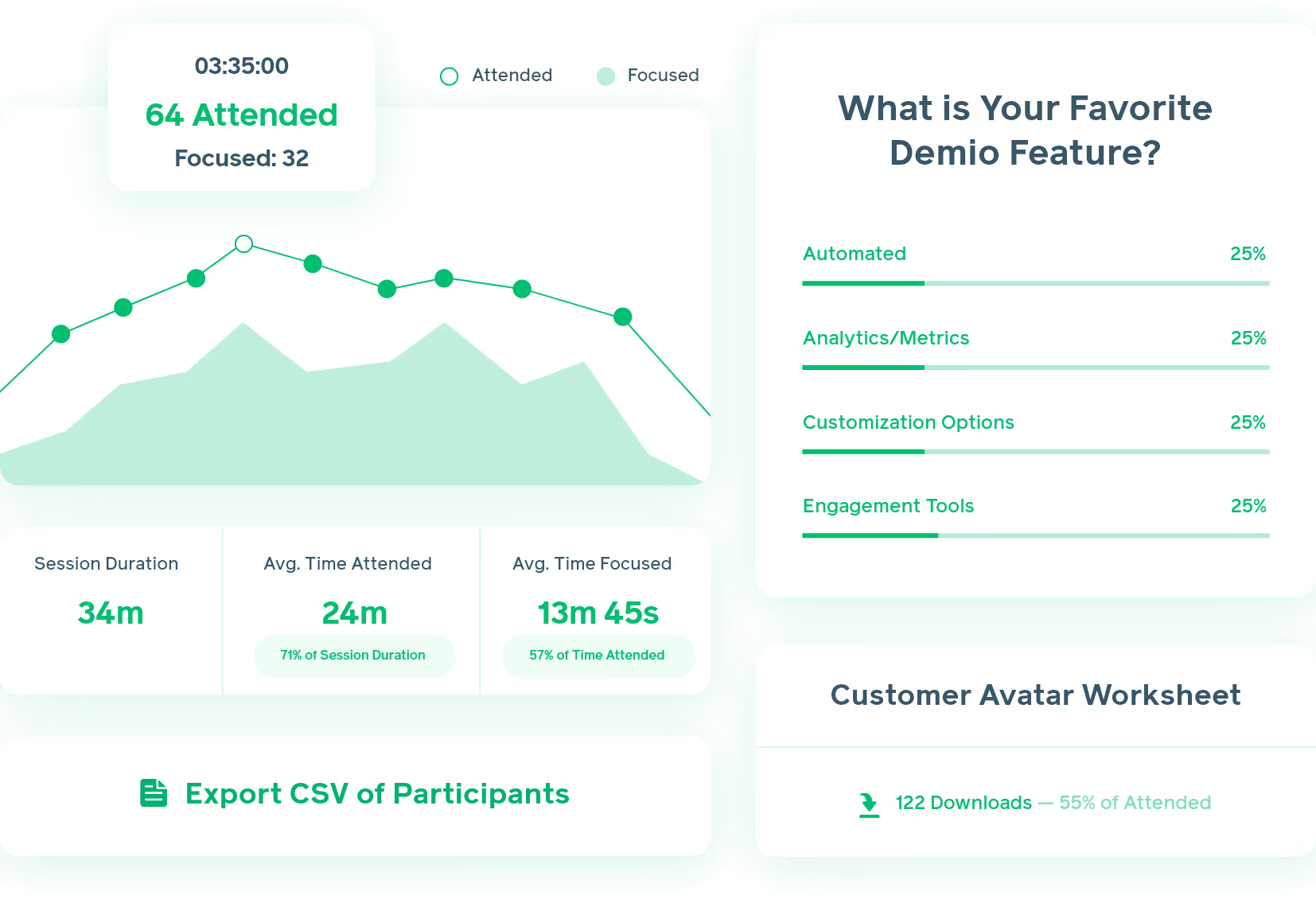
Source: Demio
The platform is a subsidiary of Banzai International (NASDAQ: BNZI), a publicly traded marketing technology company. Its product modules span live webinars, automated webinars, on-demand sessions, product demos, and virtual events, with clients including Thinkific, ActiveCampaign, Thermo Fisher Scientific, and Aiven. Demio holds G2 Best Estimated ROI Mid-Market (Spring 2025) and Capterra Top 3 in Support and Ease of Use (2024) recognitions.
Demio's integration ecosystem serves B2B marketing teams that need webinar data flowing into CRMs, marketing automation platforms, and team communication tools.
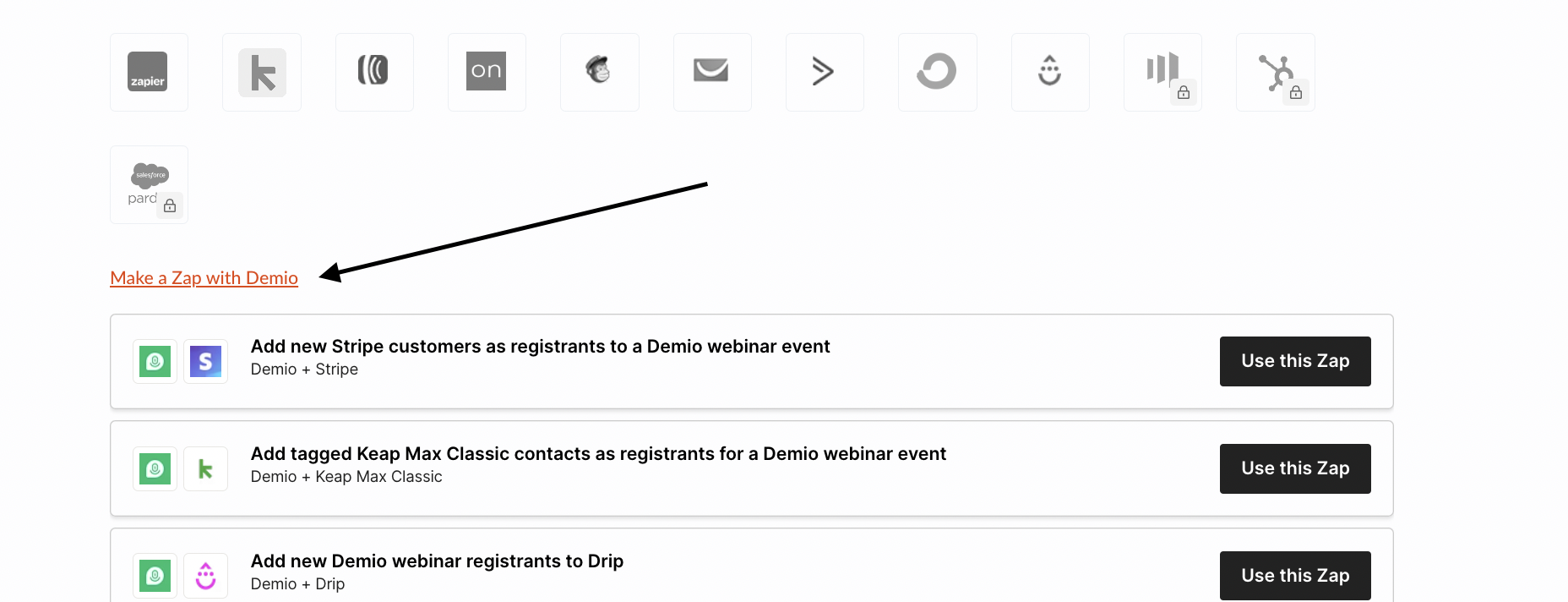
Native integrations on Starter and Growth plans include ActiveCampaign, Drip, Keap, Mailchimp, Kit (ConvertKit), AWeber, GetResponse, and Ontraport. Premium-tier integrations add HubSpot (OAuth-based, certified App Partner), Salesforce, Marketo, and Salesforce Pardot. Zapier serves as the primary iPaaS layer on Growth and above, connecting Demio to thousands of additional tools via four event triggers and one registration action.
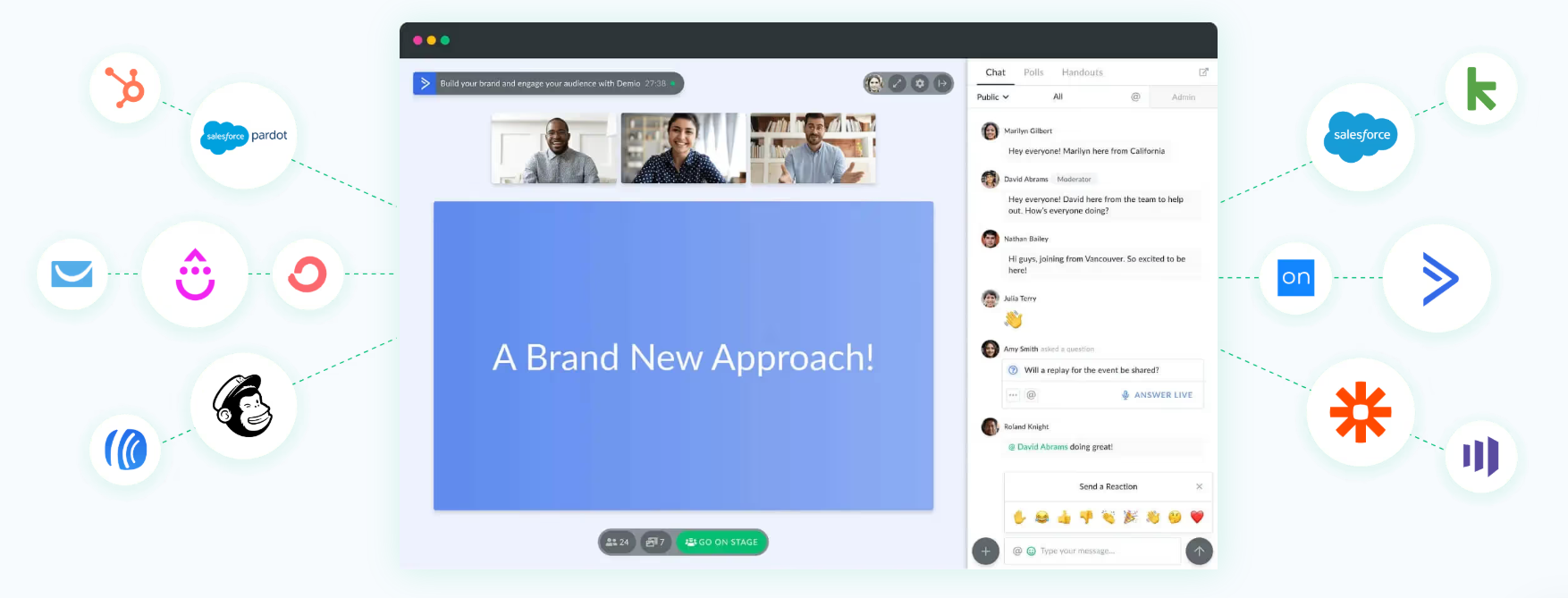
Source: Demio
The integration categories available to Demio users include:
CRM and pipeline attribution: HubSpot, Salesforce, with contact sync, list segmentation, and activity logging
Marketing automation: Marketo, Pardot, ActiveCampaign, with lead scoring and program status progression
Email marketing: Mailchimp, Drip, Kit, AWeber, GetResponse, Ontraport, Keap
Workflow automation: Zapier, extending connectivity to 8,000+ apps
Team communication: Slack (via Zapier), for real-time webinar notifications
Video production: OpenReel (Premium), for enhanced recording capabilities
With that ecosystem as context, here are the six integrations we selected as the best options for extending Demio's capabilities across the categories that matter most to marketing and revenue teams.
1. HubSpot: Best Demio Integration for Closing the Loop Between Webinar Engagement and CRM Pipeline
HubSpot is a customer platform that unifies marketing, sales, service, and CRM on a single data layer. It integrates with Demio to turn webinar engagement data into structured CRM records that drive follow-up sequences and pipeline progression. Demio earned a HubSpot Certified App Partner badge in August 2023, making this the most complete native webinar integration in HubSpot's ecosystem.
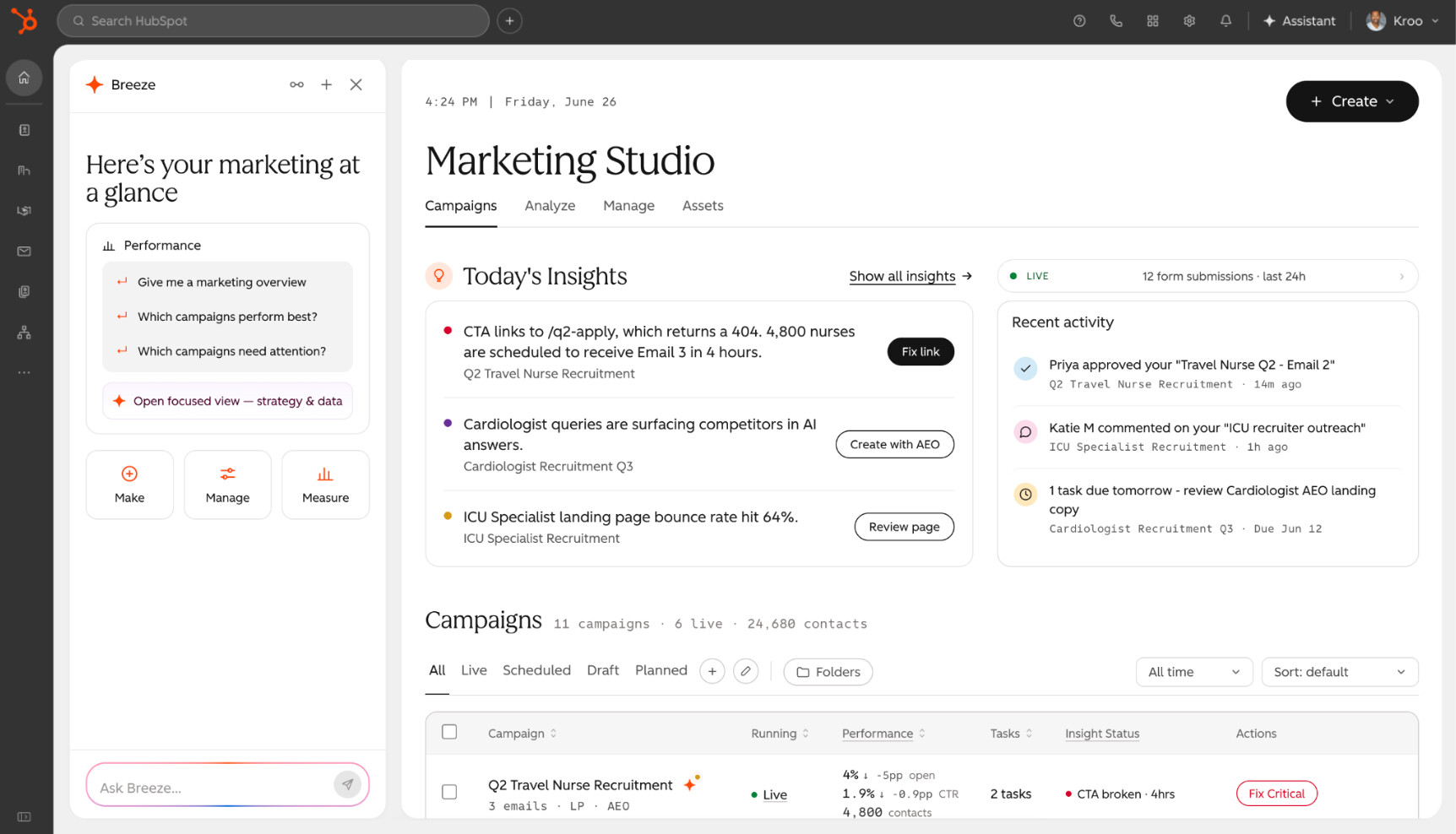
Source: HubSpot
Key integration capabilities include:
Bidirectional contact sync with 1-click registration that enrolls existing HubSpot contacts in Demio sessions without a form fill
Three-list attendance segmentation (Registered, Attended, No-Show) enabling separate post-webinar email sequences and sales tasks
Contact timeline logging where every Demio action (from registration through replay views) appears on the HubSpot contact record alongside emails, calls, and deals
Field mapping including join/exit timestamps, focus-time percentage, UTM source, and GDPR opt-in status feeding HubSpot lead scoring rules
Workflow automation triggered by attendance behavior, enrolling attendees in high-intent nurture and routing no-shows to re-engagement flows automatically
How HubSpot Integrates with Demio
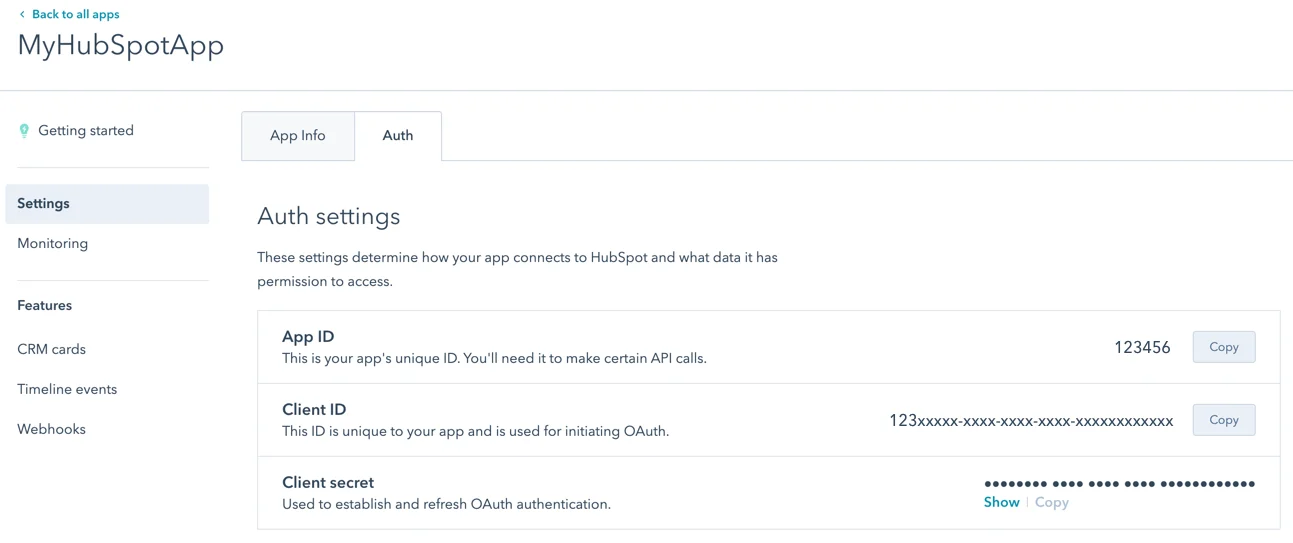
The integration is a native, OAuth-based connection available on Demio's Premium plan ($196/month per host, billed annually) and during Demio's 14-day free trial. Setup requires no API keys or middleware: hosts authenticate via OAuth from Demio's Settings panel, and the integration runs continuously across all events.
Source: HubSpot
1. Bidirectional Contact Sync and 1-Click Registration.
When a new lead registers for a Demio session, Demio creates or updates a HubSpot contact record with registration data, custom form fields, and session details. In the reverse direction, HubSpot's Workflow builder can send contacts a 1-click registration link that enrolls them in an upcoming Demio session without a form fill. This uses Demio's unique join link architecture, which assigns a personalized session URL to each registrant at registration. For leads already in nurture sequences, this cuts the friction between seeing a webinar invite and committing to attend.
2. Three-List Attendance Segmentation with Timeline Logging.
After each session, the integration categorizes every registrant into one of three HubSpot lists: Registered, Attended, and No-Show. These populate automatically (typically within minutes of session close) and serve as the trigger layer for HubSpot's marketing automation Workflows. A contact on the Attended list can immediately enroll in a high-intent follow-up sequence. A contact on the No-Show list can receive a replay email within 30 minutes.
Alongside list membership, Demio records every session interaction as a timeline event on the HubSpot contact record, so a sales rep sees webinar engagement inline with email opens, call logs, and deal notes.
3. Focus-Time Field Mapping for Lead Scoring.
Demio syncs engagement attributes to custom HubSpot contact properties, including focus-time percentage, which measures the proportion of session time the attendee had the Demio browser tab active. Where most webinar platforms report binary attended/no-show status, this field lets HubSpot's lead scoring engine distinguish a contact who was engaged for 47 of 60 minutes from one who joined, tabbed away, and technically "attended."
UTM source sync closes the attribution loop for paid campaigns, so demand gen reporting in HubSpot's Advanced Marketing Reporting can attribute pipeline influence back to the originating channel.
4. Workflow Automation Triggered by Attendance Behavior.
With attendance lists and field data in place, HubSpot workflows fire automatically based on Demio session outcomes. Attendees above a defined focus-time threshold generate sales tasks for their assigned rep. No-shows enter a replay-offer sequence. Contacts from European audiences have their GDPR opt-in status synced from Demio's registration form, so email enrollment workflows respect consent records automatically.
HubSpot Pricing
HubSpot operates on a tiered, per-seat subscription model. The free CRM tier supports unlimited contacts and basic email tracking:
Marketing Hub Starter: from $15/seat/month (billed annually), 1,000 marketing contacts included; does not include the marketing automation Workflows needed for attendance-triggered sequences
Marketing Hub Professional: $800/month billed annually (3 Core Seats included), $3,000 one-time onboarding fee, 2,000 marketing contacts; the recommended minimum for fully using the Demio integration's automation triggers
Marketing Hub Enterprise: $3,600/month (5 Core Seats included), $7,000 one-time onboarding fee, 10,000 marketing contacts; for teams attributing webinar-influenced pipeline at scale
The Demio Premium plan ($196/month per host, billed annually) is required for the native HubSpot connection. Growth-tier Demio users are limited to Zapier-based HubSpot connectivity, which lacks native list segmentation, timeline event logging, and 1-click registration.
Who Should Use the HubSpot Integration?
Teams running weekly webinars as a primary demand gen channel that need post-session follow-up to run automatically without manual list management or CRM imports after every event
Marketing and sales organizations already on HubSpot that want webinar engagement data (including focus-time percentage and replay-view status) feeding lead scoring models directly
Teams using HubSpot's 1-click registration workflow to reduce form-fill friction for prospects already in nurture sequences, driving higher registration-to-attendance conversion for existing pipeline
2. Salesforce: Best Demio Integration for Enterprise CRM Attribution and Revenue Pipeline Visibility
Salesforce is the world's #1 CRM by IDC revenue market share. It integrates with Demio to convert every webinar touchpoint into structured CRM data that revenue operations teams can use to attribute pipeline and closed revenue to specific sessions.
Source: Salesforce
Key integration capabilities include:
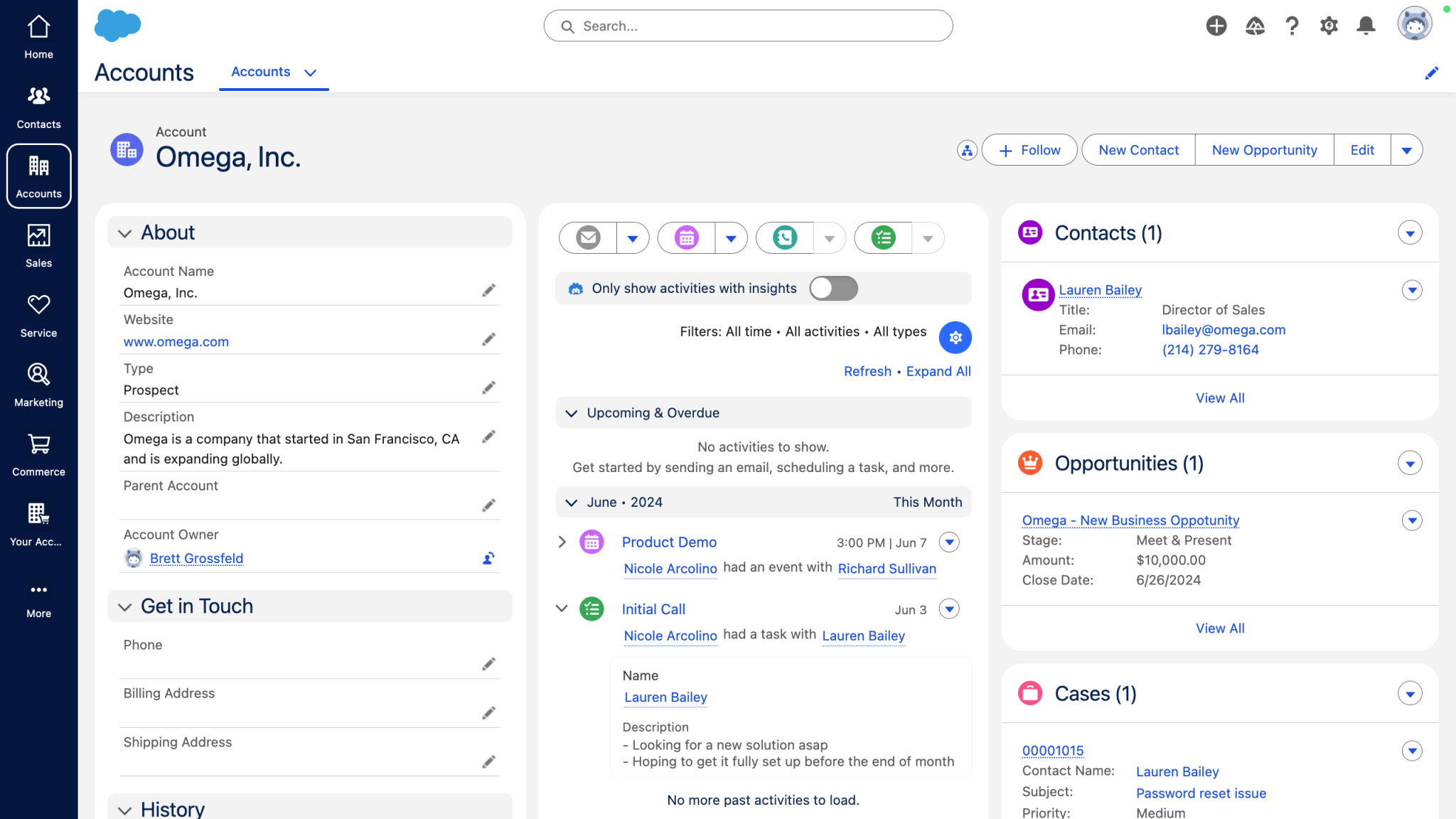
Automatic creation or update of Salesforce lead and contact records from every Demio registration, including custom form field data
Campaign membership sync that pushes registrants, attendees, and no-shows into distinct Salesforce campaigns for native revenue attribution reporting
Activity history records on the lead or contact timeline for each registration, attendance, and no-show event
Personalized join link stored in a configurable Salesforce custom field for direct resend by account executives
How Salesforce Integrates with Demio
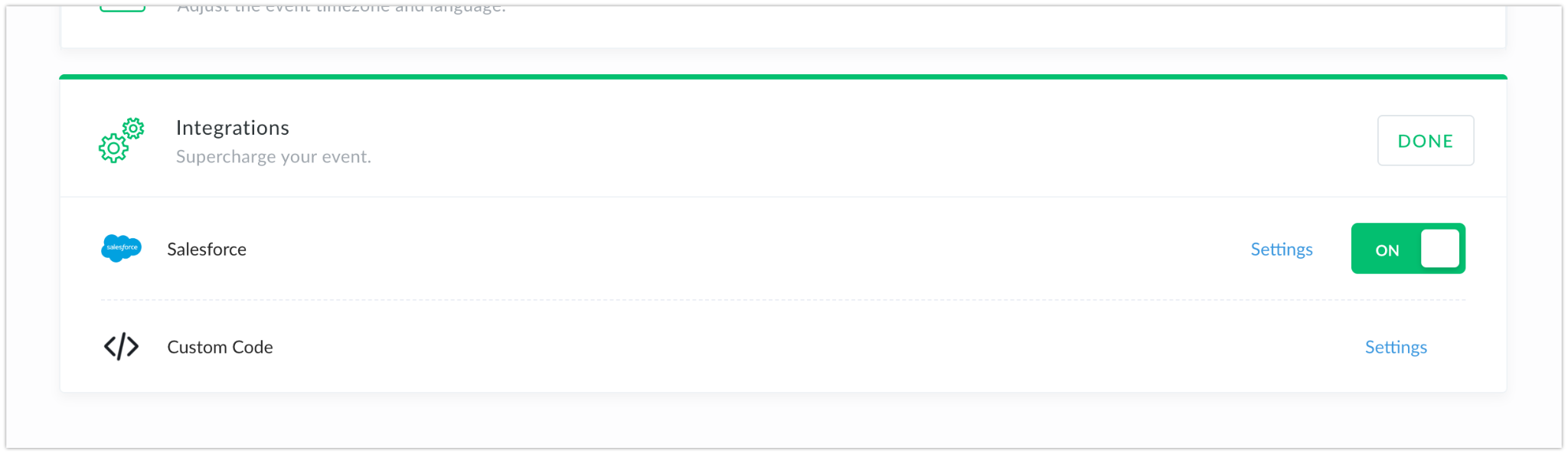
Demio connects to Salesforce through a native Premium integration configured via OAuth from Demio's Settings panel. No Zapier account or API key management is required. The integration requires Demio's Premium plan ($196/month per host, billed annually).
Source: Demio
1. Lead and Contact Record Creation from Registrations.
Every Demio registration checks Salesforce for an existing lead or contact matching that email address. If a match exists, it updates the record with registration data and any custom form fields (job title, company size, qualifying questions). If no match exists, it creates a new lead record. This eliminates the manual CSV export-import cycle, keeping Salesforce current with webinar participation at the moment of registration.
2. Campaign Membership Sync by Attendance Status.
After each session, Demio categorizes every registrant by attendance status and pushes them into distinct Salesforce campaigns. Because these are native Campaign Member records, the data participates in standard Salesforce campaign influence reports without custom configuration. Revenue operations teams can build reports that surface which webinar sessions sourced or influenced open opportunities and closed-won revenue inside Salesforce.
3. Activity History Timeline Records.
For each webinar event, the integration writes an activity record to the lead or contact's Activity Timeline. A sales rep reviewing a prospect's record sees registration, attendance, and no-show history in chronological order alongside logged calls, sent emails, and opportunity stage changes. A rep preparing for a follow-up call can see that the contact attended Tuesday's webinar without switching to a separate tool.
4. Personalized Join Link Storage.
Demio stores each registrant's unique, personalized join link in a configurable custom field on the Salesforce record. Account executives can retrieve and resend session access from Salesforce without logging into Demio. Because the link is tied to the individual, any attendance through a resent link still registers correctly in Demio's per-attendee analytics.
Salesforce Pricing
Salesforce operates on a per-user, per-month model billed annually:
Enterprise: $175/user/month, the most common entry point for B2B SaaS teams integrating Demio into a revenue ops stack
Unlimited: $350/user/month, adds the full AI suite, conversation intelligence, and Premier Success Plan
Agentforce 1: $550/user/month, includes unmetered Agentforce usage, Tableau Next, and Slack Enterprise+
The Demio Salesforce integration requires the Premium plan ($196/month per host). It is not available on Starter or Growth tiers.
Who Should Use the Salesforce Integration?
Revenue operations teams running campaign influence reporting inside Salesforce that need webinar attendance status as native Campaign Member records rather than external data requiring custom import logic
Sales reps who review Salesforce contact records before follow-up calls and need webinar engagement history visible on the Activity Timeline without cross-referencing a separate platform
Organizations already on Salesforce Enterprise or above that need a native integration keeping webinar data inside the same data model as CRM records, without Zapier middleware
3. Marketo: Best Demio Integration for Enterprise Marketing Automation and ABM Lead Scoring
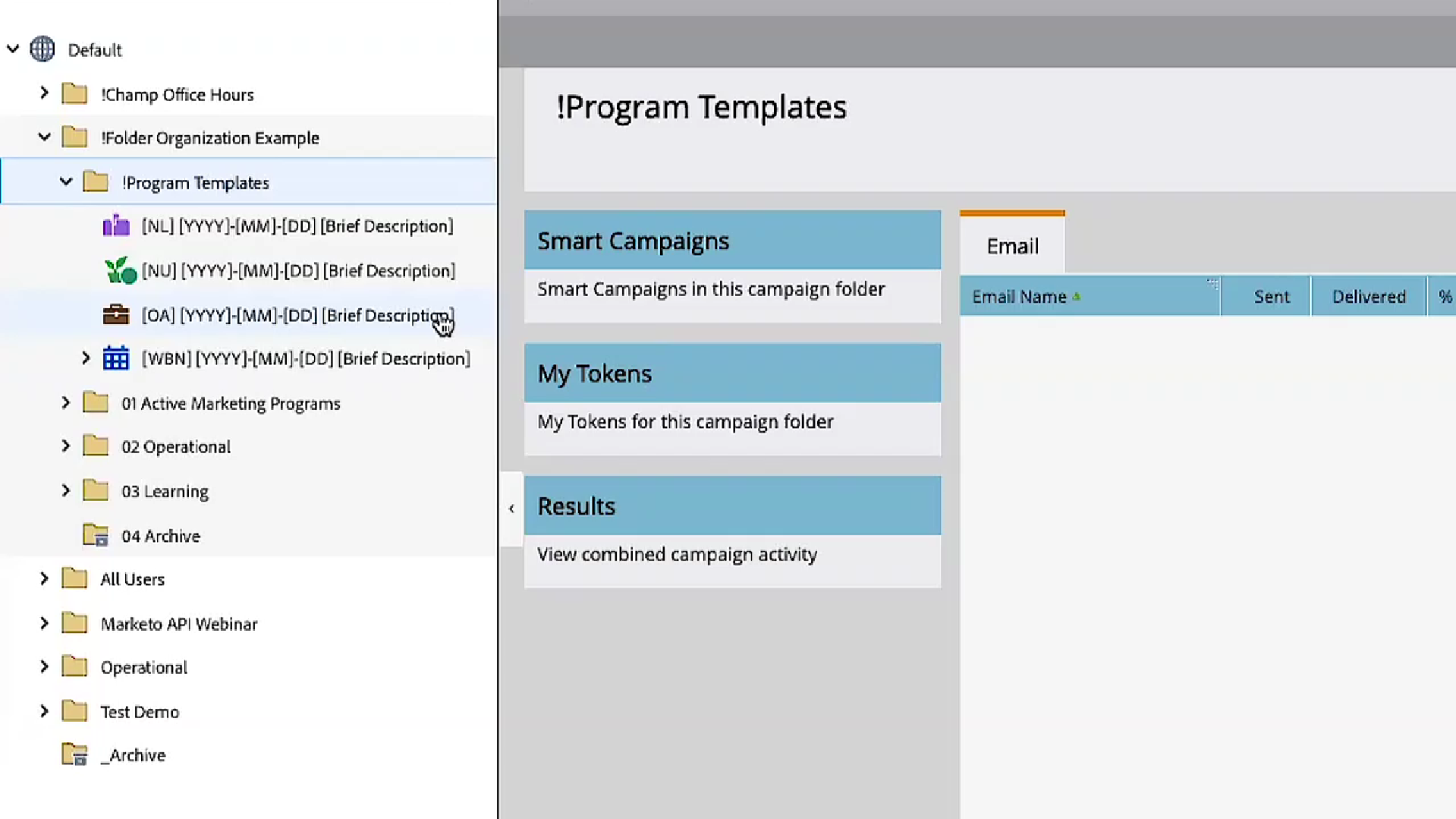
Adobe Marketo Engage is a B2B marketing automation platform that integrates with Demio to feed webinar behavioral data into lead scoring models, nurture programs, and account-based marketing workflows. Rather than treating webinar activity as an isolated event metric, the connection translates each session interaction into structured program status updates that Marketo's Smart Campaigns and Smart Lists can act on automatically.
Source: Adobe Marketo Engage
Key integration capabilities include:
Automatic program status progression from Registered to Attended or No-Show based on Demio session outcomes
Lead creation for new registrants and record updates for existing Marketo contacts, with 1-click registration links for contacts already in the database
Custom registration field passthrough from Demio form fields into corresponding Marketo lead fields
Smart List segmentation by webinar program status, enabling automatic routing into ABM nurture tracks or reactivation flows
How Marketo Integrates with Demio
The integration is a native, direct connection available exclusively on Demio's Premium plan ($196/month per host, billed annually). Authentication runs through OAuth, connecting Demio to a Marketo Engage instance. No middleware or manual CSV exports are involved.
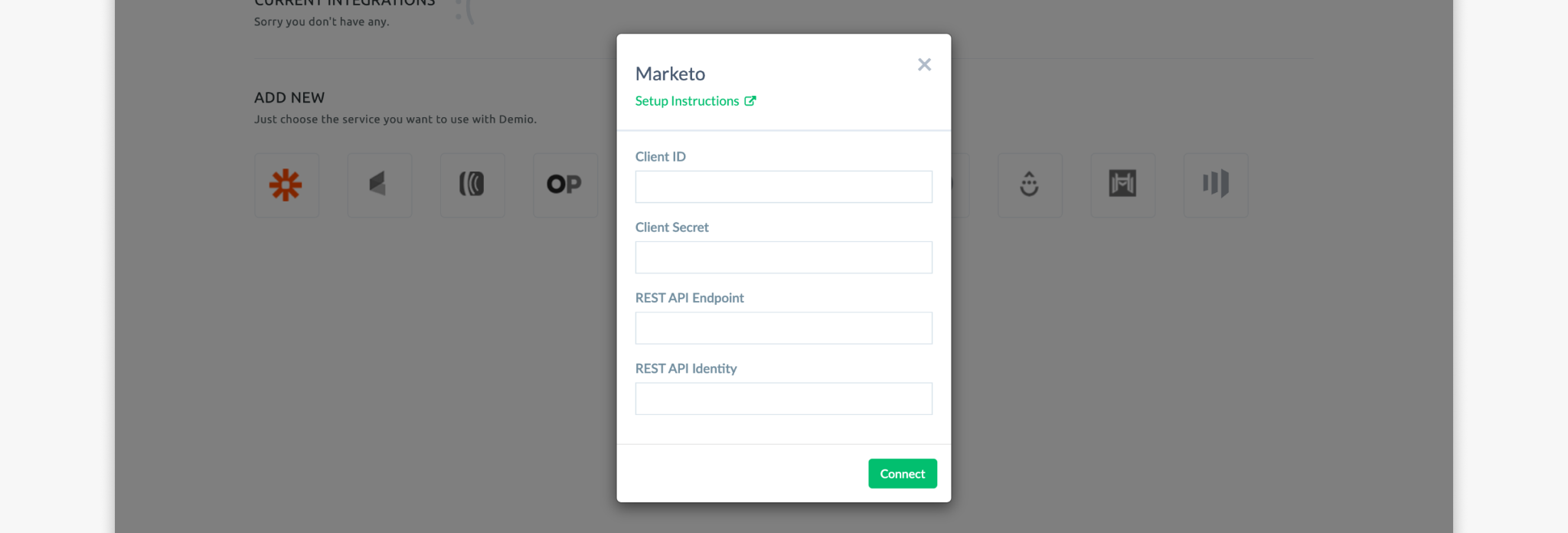
Source: Demio
1. Program Status Progression Based on Webinar Actions.
When a registrant joins the Demio session, Marketo receives an Attended status. When a registrant signs up but never joins, Marketo receives a No-Show status.
This automated progression matters because Marketo's entire automation stack (including Smart Campaigns, lead scoring flows, and engagement program enrollment logic) operates on program status as a trigger and filter condition. Without it, marketing operations teams must manually export Demio attendee lists and update Marketo records before any post-event nurturing can fire.
2. Lead Creation and 1-Click Registration for Existing Contacts.
The integration creates or updates lead records in Marketo automatically for new registrants. For outbound email campaigns inviting existing Marketo contacts to upcoming webinars, it supports 1-click registration links that let recipients register without filling out a separate form. The contact's information passes from Marketo into Demio, and the Marketo record updates with Registered program status immediately.
3. Custom Registration Field Passthrough.
Custom fields on Demio's registration forms (job function, company size, budget range, use case) map to Marketo lead fields at the moment of registration. For marketing operations teams using multi-dimensional scoring models, this enrichment feeds the demographic scoring side immediately, potentially pushing contacts across scoring thresholds and triggering MQL handoffs before the webinar has occurred.
4. Smart List Segmentation for Downstream Nurture.
Once Marketo has program status data from a Demio event, that status becomes a filter and trigger condition available across Marketo's Smart List engine. For teams running account-based marketing programs, webinar attendance from multiple contacts at the same target account contributes to that account's overall engagement signal, raising its priority ranking in Marketo's ABM system.
Marketo Pricing
Adobe Marketo Engage uses a custom, quote-based pricing model with no published dollar amounts. Pricing scales with contact database size. The four tiers are:
Grow: entry-level automation and measurement; 25 marketing user seats, 50,000 API calls/day
Select: full automation with predictive content; sandbox available as a paid add-on
Prime: adds Lifecycle Modeler, one included sandbox, and Workspaces and Partitions for multi-team governance
Ultimate: adds Marketo Measure (B2B multi-touch attribution including Attribution AI)
All tiers include API access and native CRM integrations. The Demio Premium plan ($196/month per host) is required for the native Marketo connection.
Who Should Use the Marketo Integration?
Demand gen teams already running Marketo as their primary MAP that need webinar behavioral data to participate automatically in lead scoring and Smart Campaign logic without manual post-event imports
ABM teams targeting named accounts with multiple stakeholders, where webinar attendance from any contact at a target account should contribute to that account's engagement score
Marketing ops teams managing multi-dimensional lead scoring where demographic enrichment collected at Demio registration needs to flow into scoring rules immediately
4. ActiveCampaign: Best Demio Integration for Behavior-Triggered Email Follow-Up Automation
ActiveCampaign is a marketing automation platform and CRM that integrates with Demio to convert webinar attendance data into automated email sequences triggered by each registrant's actual behavior. The integration uses attendance-based tagging to split your audience into distinct groups and fire separate automation sequences for each, without manual segmentation after the session ends.
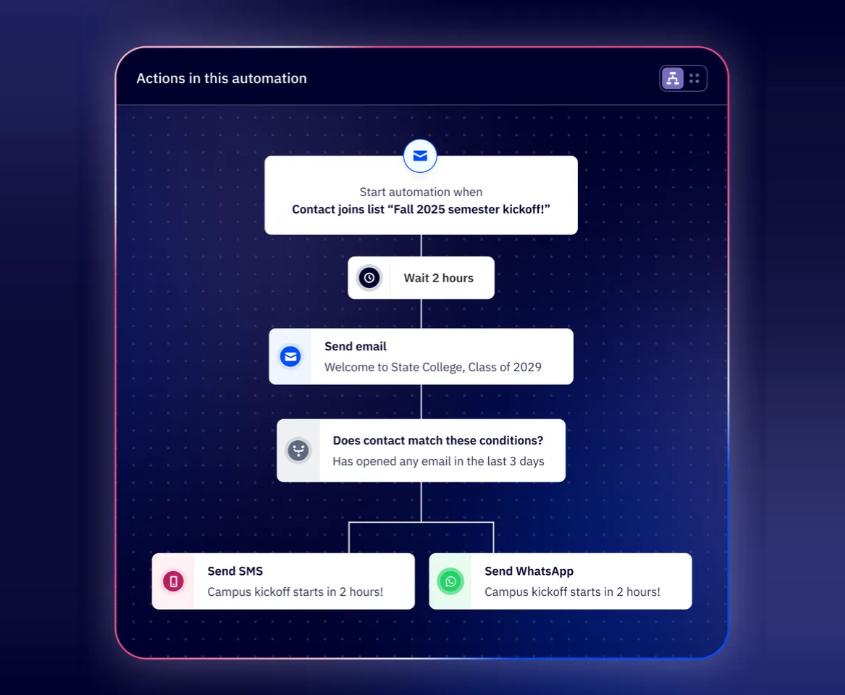
Source: ActiveCampaign
Key integration capabilities include:
Automatic contact creation and upsert with distinct tags per attendance outcome (Registered, Attended, No-Show) that gate follow-up automations
Behavior-triggered email sequences delivering separate messaging, timing, and CTAs to attendees versus no-shows
Custom registration field sync passing qualifying data (role, company size, use case) into ActiveCampaign contact fields for personalized automation routing
1-click registration for existing ActiveCampaign contacts receiving campaign emails, bypassing the Demio registration form entirely
How ActiveCampaign Integrates with Demio
The integration is a native, direct connection available on Demio's Starter and Growth plans, not just Premium. This distinguishes it from Demio's HubSpot, Salesforce, and Marketo integrations. Setup involves providing your ActiveCampaign API key and account URL in Demio's Settings panel. No Zapier layer is required.
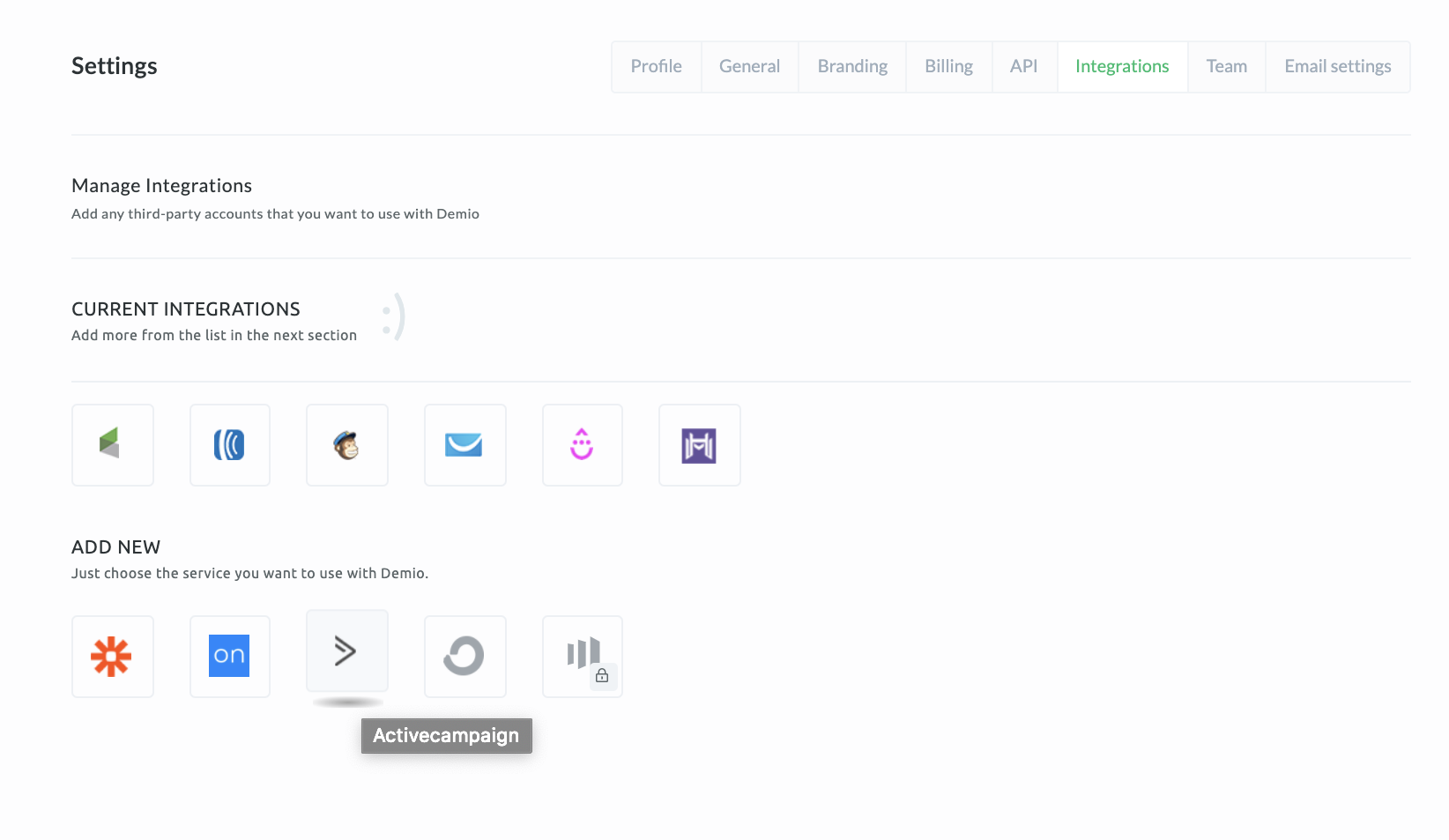
Source: Demio
1. Attendance-Based Contact Tagging and List Subscription.
When a visitor registers for a Demio event, the integration creates or updates a contact in ActiveCampaign, subscribes them to the configured list, and applies a "Registered" tag. At session end, Demio writes back to ActiveCampaign with either an "Attended" or "No-Show" tag.
These tags activate the post-webinar automation layer: in ActiveCampaign's visual automation builder, you configure separate entry points for each tag. Note that a no-show who later watches the replay does not automatically receive an updated tag in this native integration; that use case would require a Zapier layer.
2. Behavior-Triggered Automation Sequences.
Once attendance tags are in place, ActiveCampaign handles follow-up. Attendees receive sequences referencing specific content covered and directing them to next steps (a trial, a demo booking, a follow-on resource). No-shows receive separate sequences acknowledging the miss, offering a replay link, and re-engaging with softer CTAs. ActiveCampaign's automation builder supports conditional branching within these sequences based on link clicks, wait intervals, and field values.
3. Custom Registration Field Sync.
Responses to custom Demio registration fields map to corresponding ActiveCampaign contact fields at registration time. A team that asks "What's your primary use case?" can configure automations to route contacts into different post-webinar sequences based on the answer. ActiveCampaign's personalization tags can insert registration field values into email subject lines and body copy.
4. 1-Click Registration from Campaign Emails.
For contacts already in ActiveCampaign, the integration supports a 1-click registration flow. Campaign emails include a link that embeds the contact's information, so Demio pre-fills the registration form and completes sign-up without re-entry. The unique join link assigned to each registrant is stored in ActiveCampaign for subsequent reminder emails.
ActiveCampaign Pricing
ActiveCampaign uses contact-based pricing, billed monthly or annually. All plans include API access and the native Demio integration:
Starter: starts at $149/month for 10,000 contacts (annual billing); caps automations at 5 actions, which is insufficient for multi-step webinar follow-up
Plus: pricing scales with contact count (use the calculator at activecampaign.com/pricing); removes the 5-action cap with unlimited automation actions; the practical minimum for Demio use cases
Professional: adds advanced segmentation, conditional content, Predictive Sending, and revenue attribution
Enterprise: custom pricing; includes premium CRM integrations, SSO, HIPAA support, and a dedicated account team
ActiveCampaign offers a 14-day free trial (no credit card required) and a 30-day money-back guarantee.
Who Should Use the ActiveCampaign Integration?
Teams running recurring webinars that need post-session follow-up to happen automatically without manual list exports or audience segmentation after each event
Marketers whose strategy depends on treating attendees and no-shows differently, with separate messaging, timing, and offers rather than a single post-event email
Organizations that collect qualifying information at Demio registration and want that data to drive personalization and routing logic in follow-up sequences, not sit in a CSV export
5. Zapier: Best Demio Integration for No-Code Workflow Automation Across Your Entire Marketing Stack
Zapier is a no-code workflow automation platform that integrates with Demio to connect your webinar program to over 8,000 applications without writing code. Where Demio's native integrations cover a defined list of email platforms and CRMs, the Zapier connection extends that reach to nearly any tool in your stack and lets you build multi-step, conditional automations spanning registration intake, post-event follow-up, CRM updates, and internal notifications in a single workflow.
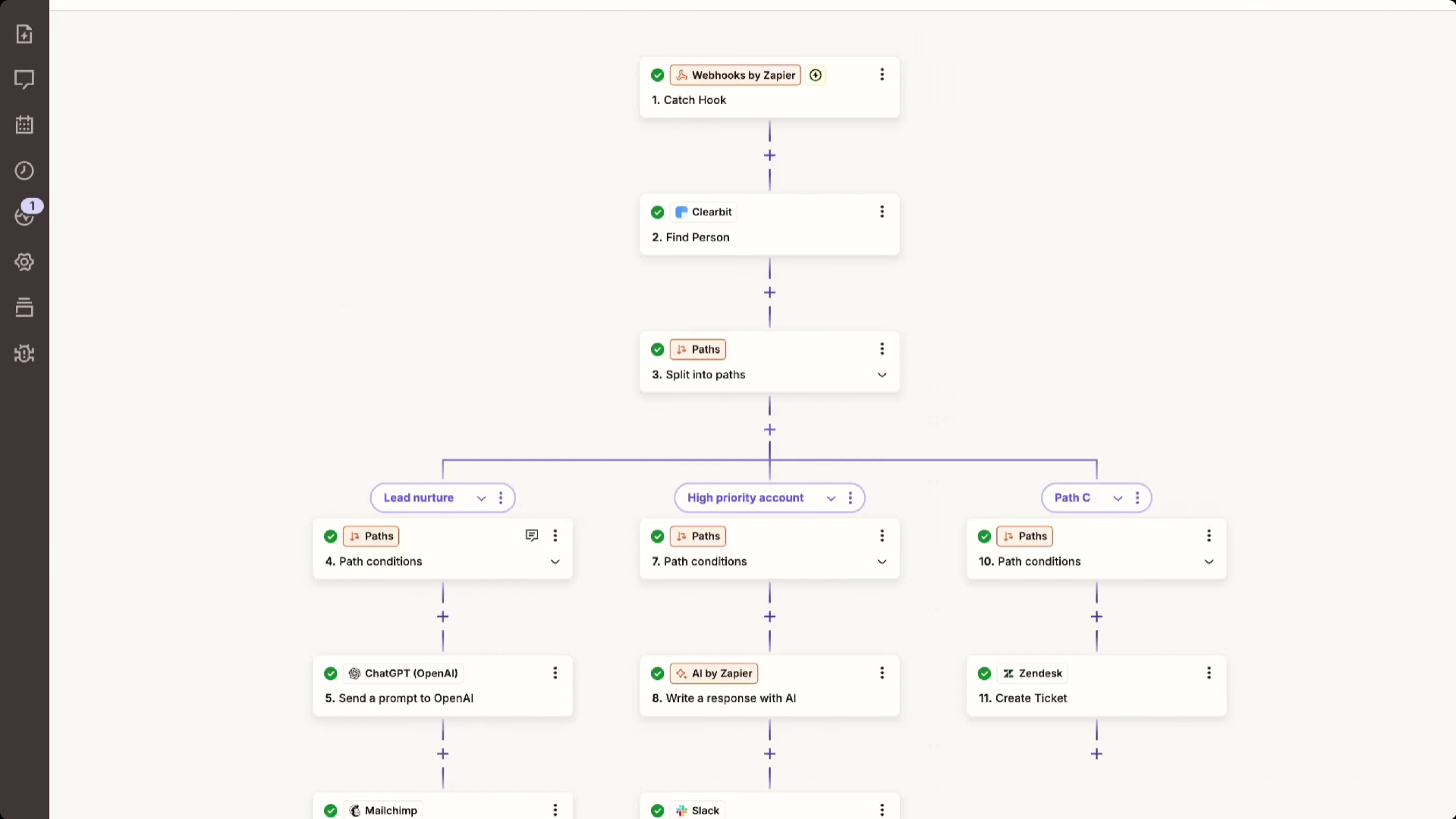
Source: Zapier
Key integration capabilities include:
Registration automation from any upstream source (form submissions, spreadsheet rows, ad platform leads, CRM events) that auto-creates Demio registrations with personalized join links
Four real-time Demio triggers: New Webinar Registration, Joins Webinar, Does Not Attend Webinar, and Webinar Update
Multi-step post-webinar sequences where a single trigger simultaneously updates a CRM record, enrolls the contact in an email sequence, sends a Slack alert, and logs the activity to a reporting sheet
Unique join link propagation that preserves Demio's per-registrant attribution layer downstream
How Zapier Integrates with Demio
The integration is a native, officially supported connection available on Demio's Growth plan and above. Setup uses API credentials: users retrieve their API Key and API Secret from Demio's Settings panel and paste them into Zapier. The connection is active in under five minutes. Zapier is Demio's primary iPaaS layer, and the only programmatic automation path available to Growth-plan teams.
Source: Demio
1. Registration Automation from Any Upstream Trigger.
Zapier's Create Registration for Webinar action takes a contact's name, email, and phone number and enrolls them into a specified Demio event, returning the registrant's personalized join link. The trigger can come from anywhere in Zapier's ecosystem: a form submission in Typeform, a new row in Google Sheets, a deal reaching a specific CRM stage, a Facebook lead ad, or a Stripe purchase. This decouples registration intake from Demio's own registration page and preserves per-registrant engagement tracking downstream.
2. Multi-Step Post-Webinar Workflows.
Demio's four Zapier triggers each represent a moment where teams need action across multiple systems. A single "Does Not Attend" trigger can simultaneously update a CRM contact property, add the contact to a re-engagement email sequence, send a Slack message to the account owner, and write a row to a Google Sheet for weekly reporting. The same logic applies to the "Joins Webinar" trigger for attendee-specific workflows.
3. Conditional Routing with Paths.
Zapier's Paths feature routes records by contact attributes. A "Joins Webinar" trigger can split: prospects in an active CRM opportunity get a Slack ping to their rep, while net-new contacts enter a standard nurture sequence. Filters block propagation unless conditions are met, and the Formatter tool fixes data mismatches between systems without code.
4. Unique Join Link Propagation.
Zapier captures each registrant's unique Demio join link and forwards it to CRM contact fields, calendar invites, or any downstream destination. This preserves the attribution chain that makes Demio's per-registrant polling, handout download, and focus-time data useful. Without this step, registrations created outside Demio's own page risk producing anonymous session data instead of named contact intelligence.
Zapier Pricing
Zapier uses task-based pricing where each action step in a Zap consumes one task:
Free: $0/month, 100 tasks/month, 2-step Zaps only, 15-minute polling interval
Professional: starts at $19.99/month (annual) for 750 tasks, multi-step Zaps, conditional logic, 2-minute polling
Team: starts at $69/month (annual) for 2,000 tasks, shared workspace with up to 25 users, SAML SSO
Enterprise: custom pricing with admin center, audit logs, and dedicated support
Plan task consumption carefully: a webinar with 500 registrants, where each triggers a 4-action Zap, consumes 2,000 tasks per event. Zapier's pay-per-task overage bills at 1.25x the plan's per-task rate.
A $150 Zapier Professional Services add-on is available on any Demio plan for assisted setup and troubleshooting.
Who Should Use the Zapier Integration?
Teams whose marketing stack extends beyond Demio's native integration list and need webinar data flowing into tools Demio doesn't connect to directly
Growth-plan users that need CRM or MAP connectivity without upgrading to Premium: Zapier provides a functional bridge to HubSpot or Salesforce, though with less depth than the native Premium connectors (CTA click data, for instance, cannot transfer via Zapier)
Organizations where registration comes from multiple upstream sources (ad forms, embedded website forms, referral pages) and needs to flow into Demio while preserving personalized join links
6. Slack: Best Demio Integration for Real-Time Webinar Notifications and Sales Alerts
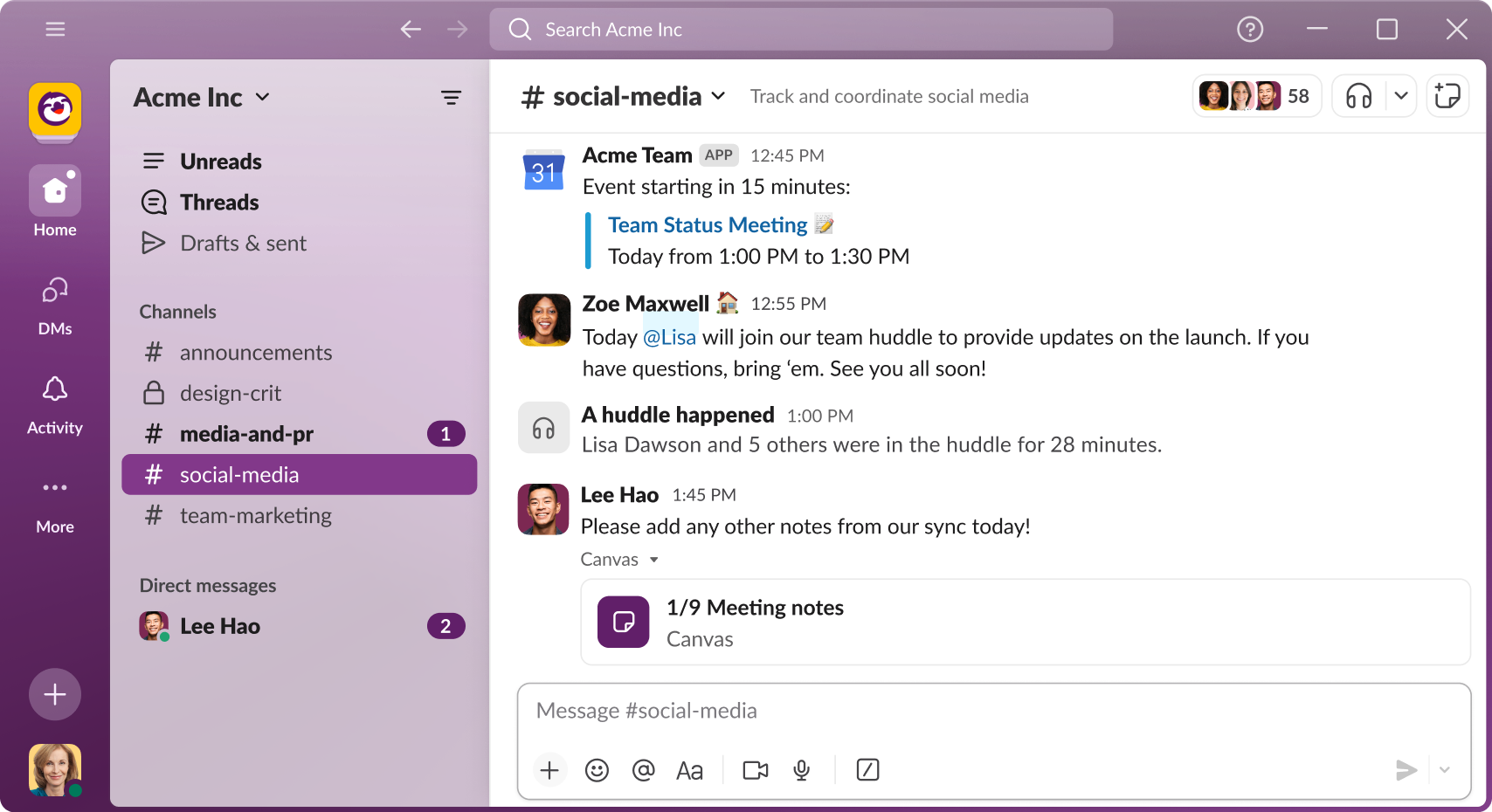
Slack is a team communication platform that connects to Demio through Zapier to route webinar activity into the channels where sales reps and SDRs already work. Instead of discovering a prospect's webinar engagement in a CRM sync the next morning, reps receive real-time alerts they can act on while engagement is fresh.
Source: Slack
Key integration capabilities include:
Instant registration alerts posted to designated Slack channels the moment a target prospect signs up for a Demio session
Live attendance pings fired in real time when a priority contact enters an active Demio webinar
Automated no-show notifications routed to the responsible rep within minutes of a session ending
Channel-based alert routing that targets the right rep or team without manual distribution
How Slack Integrates with Demio
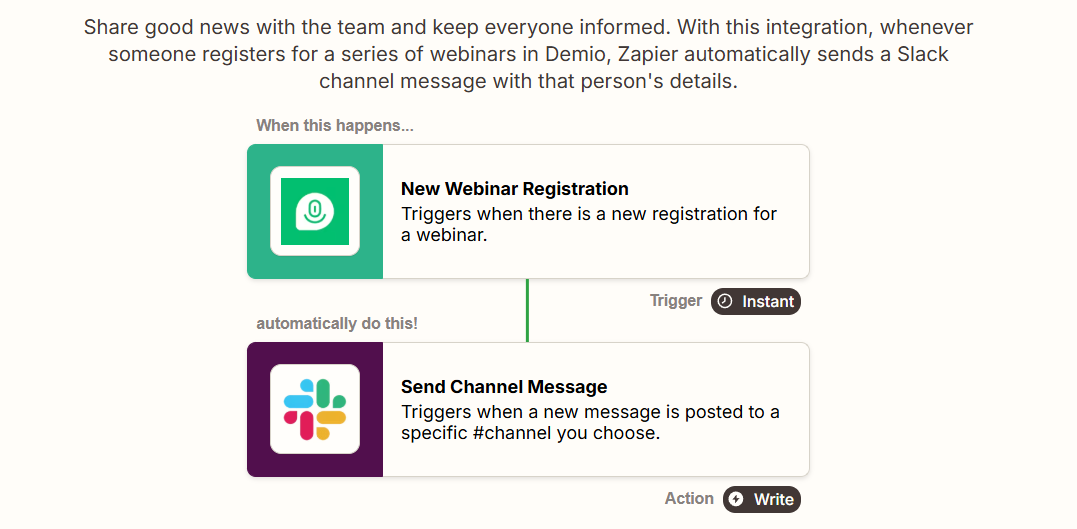
The connection runs through Zapier, requiring a Demio Growth plan or above for Zapier access. Slack works on any plan, including free, for receiving notifications. You authenticate both Demio and Slack accounts inside Zapier, select the relevant Demio event trigger, and specify where Slack messages should land.
Source: Zapier
Zapier's filtering and multi-step logic allows conditional routing, such as posting to a high-attention channel only when the registrant's email domain matches an account watchlist. This is a Zapier-powered connector, not a native direct connection.
One constraint to note: Demio's Zapier-exposed data supports name, email, and Unique Join Link fields but does not surface in-session engagement signals like CTA click data, handout download counts, or focus-time duration. Those behavioral signals live in Demio's Insights report, accessible after the session.
1. Registration Alerts to Designated Sales Channels.
When a prospect completes a Demio registration, the New Webinar Registration trigger posts a Slack message with the registrant's name, email, and any custom registration field data. Account executives monitoring a #webinar-registrations channel see immediately when a target account or active prospect has registered, giving them a preparation window before the session. Zapier filtering adds ICP qualification: configure the Zap to post to a high-priority channel only when the email domain matches an account list.
2. Live Attendance Pings During Active Sessions.
Demio's Joins Webinar trigger fires the moment a registered attendee enters a live session. For sales teams, this creates an outreach preparation window: the rep receives a Slack notification, reviews deal context, and drafts a personalized follow-up during the 45-60 minute session. By the time the session ends, the rep is ready to respond the same day rather than the following morning.
3. No-Show Alerts for Immediate Re-Engagement.
The Does Not Attend trigger fires after a session ends for each registrant who did not enter the room. Zapier routes a Slack message to the responsible rep listing the registrant and the session they missed. The rep can send a personalized re-engagement message within the hour, citing the specific topic and including a replay link. Note that this trigger fires only for Standard and Series events, not for On-Demand sessions.
Slack Pricing
Slack uses per-seat pricing with a Fair Billing Policy that credits inactive users:
Free: $0/user, 90-day searchable message history, 10-app limit; sufficient for receiving Zapier-triggered Demio notifications
Pro: $7.25/user/month (annual), unlimited message history and app integrations, 24/7 support
Business+: $15/user/month (annual), adds SAML SSO, SCIM provisioning, custom retention policies, and conditional branching in Workflow Builder
Who Should Use the Slack Integration?
Sales reps and SDRs who spend their workday in Slack and need webinar signals to surface in the channels they already monitor, rather than requiring active Demio dashboard checks
Teams running a high-velocity webinar program where the volume of registrants makes manual per-event CRM review impractical between sessions
Pipeline-focused organizations that want to compress the gap between a prospect's webinar engagement and a rep's personalized outreach from 24-48 hours to same-session contact
Also Worth Considering: ZoomInfo
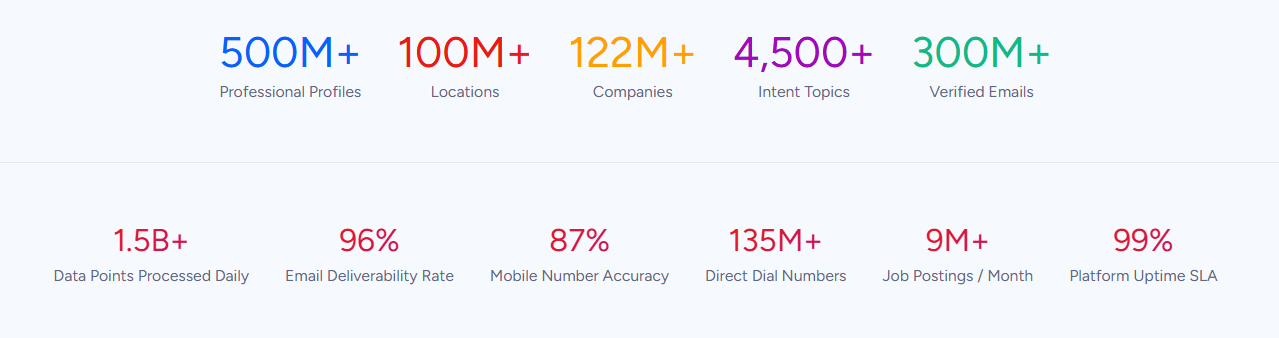
ZoomInfo is an all-in-one go-to-market platform built on a large B2B data foundation: 500M contacts, 100M companies, 135M+ verified phone numbers, and 200M+ verified business email addresses. It serves a different function from the integrations listed above, but it solves a problem that every Demio user running B2B webinars eventually encounters: your webinar captures engagement signals, but the contact data behind those signals is often incomplete, outdated, or too thin for meaningful follow-up.
ZoomInfo does not currently have a native integration with Demio. But the two platforms serve overlapping audiences. Demio's core customer is a B2B marketer running webinars for demand generation and pipeline acceleration. ZoomInfo's core customer is a go-to-market team that needs verified contact data, buyer intent signals, and company intelligence to prioritize and engage the right accounts.
When both tools are in the stack, they address different halves of the same problem: Demio captures who engaged with your content and how deeply; ZoomInfo tells you whether the contact data behind that engagement is accurate, whether the account is actively in-market, and who else in the buying committee you should reach.
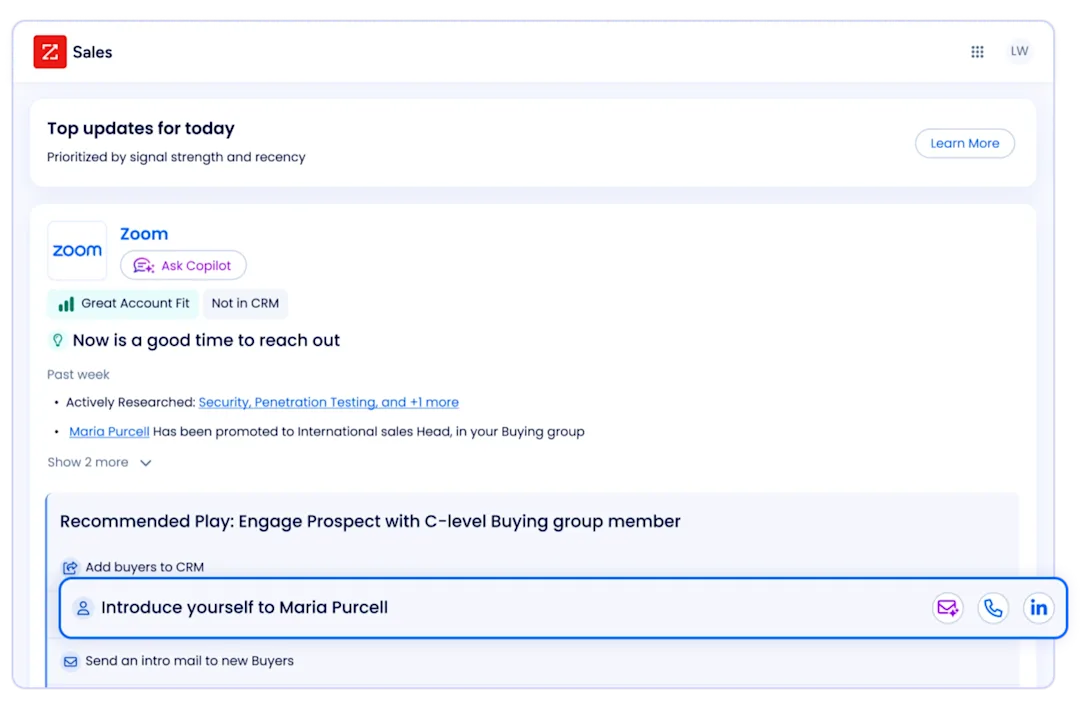
For teams already using one of Demio's CRM integrations (HubSpot, Salesforce), ZoomInfo's native integrations with both platforms can enrich the same contact records that Demio populates with webinar data. A contact who registers for a Demio session and lands in HubSpot or Salesforce can be enriched by ZoomInfo with verified direct dials, company attributes, technographic profiles, and buyer intent signals from 210 million IP-to-Organization pairings.
The enrichment runs through a verification pipeline backed by 300+ human researchers reaching up to 95% accuracy on first-party data.
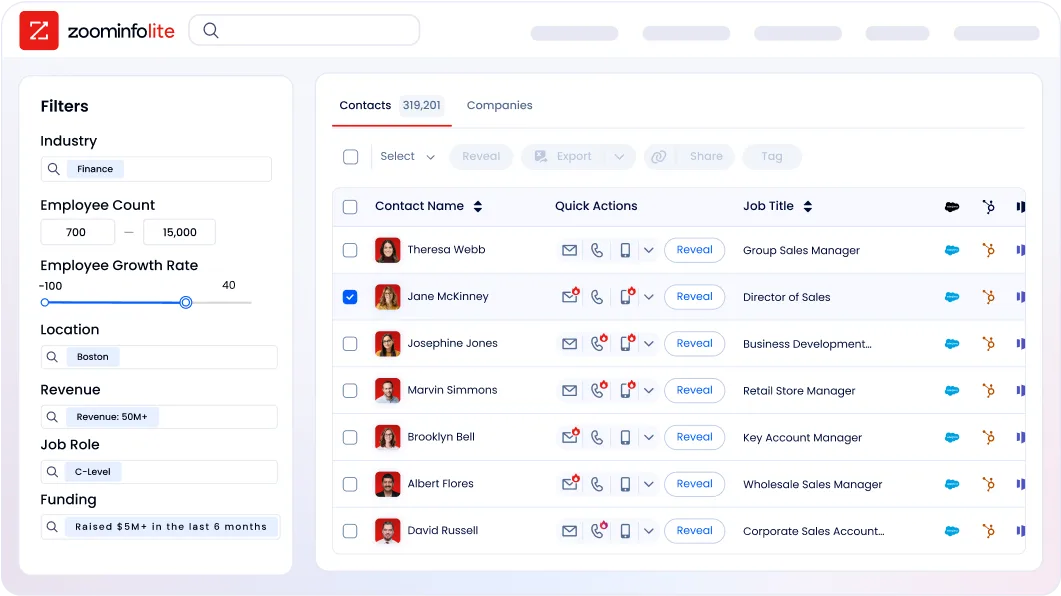
ZoomInfo uses a consumption-based pricing model with custom quotes. ZoomInfo Lite is a permanent free tier (no credit card, no time limit) with 10 monthly export credits, searches, the Chrome extension, and CRM integrations, making it a practical starting point for evaluating data quality alongside your Demio program.
Final Verdict
The best Demio integrations move webinar engagement data out of the dashboard and into the systems where your team takes action:
HubSpot: the most complete native CRM connection with three-list segmentation, focus-time lead scoring, and 1-click registration; the strongest choice for mid-market teams using HubSpot as their CRM and MAP
Salesforce: native campaign membership and activity timeline records for enterprise revenue attribution; the right call for organizations already running Salesforce
Marketo: enterprise marketing automation with program status progression, Smart Campaign triggers, and ABM lead scoring
ActiveCampaign: behavior-triggered email follow-up with attendance-based tagging, available below the Premium tier
Zapier: no-code reach into 8,000+ apps for teams whose stack extends beyond Demio's native integration list
Slack: real-time registration, attendance, and no-show alerts surfaced where your sales team already works
These integrations also work together: you might run HubSpot for CRM sync and lead scoring, Zapier to pipe registrations from external forms, and Slack for same-session sales alerts simultaneously on the same Demio instance, each adding an automation layer that makes the others more effective.
If your Demio webinars generate pipeline but your team struggles with incomplete contact data, stale records, or knowing which accounts are actually in-market, consider pairing your CRM integration with a dedicated B2B data platform. ZoomInfo Lite is free, includes CRM connectivity, and enriches the same contact records your Demio integration populates, so you can test what verified data and live intent signals do for your webinar follow-up before committing to a subscription.
Frequently Asked Questions
How many integrations does Demio support?
Demio offers native integrations with eight email marketing and marketing automation platforms (ActiveCampaign, Drip, Keap, Mailchimp, Kit, AWeber, GetResponse, Ontraport) on Starter and Growth plans, plus four Premium-tier integrations (HubSpot, Salesforce, Marketo, Pardot) and OpenReel for video production. Zapier extends connectivity to over 8,000 additional applications on Growth plans and above. Demio does not publish a public-facing API for general developer use; Zapier is the primary programmatic automation layer.
Do Demio integrations work on the Starter plan?
The Starter plan ($45/month billed annually) includes native integrations with eight email marketing platforms (ActiveCampaign, Drip, Keap, Mailchimp, Kit, AWeber, GetResponse, Ontraport). It does not include Zapier access, which requires the Growth plan ($80/month per host), or the Premium CRM integrations with HubSpot, Salesforce, Marketo, and Pardot, which require the Premium plan ($196/month per host). Teams evaluating CRM connectivity during the 14-day free trial do get access to the HubSpot integration for testing.
What data does Demio send to connected CRM and marketing automation platforms?
Depending on the integration, Demio can sync registrant contact information (name, email, custom form fields), attendance status (registered, attended, no-show), join and exit timestamps, focus-time percentage (the proportion of session time the attendee had the browser tab active), replay-view status, UTM source attribution, GDPR opt-in status, and the personalized unique join link. The depth varies by platform: HubSpot receives the most granular data through its certified native integration, while Zapier-based connections support registration, attendance, and no-show events but do not transfer CTA click data or handout download counts.
Can I connect Demio to tools that do not have a native integration?
Yes. Zapier connects Demio to over 8,000 applications on Growth plans and above. Demio exposes four Zapier triggers (New Webinar Registration, Joins Webinar, Does Not Attend Webinar, Webinar Update) and one action (Create Registration for Webinar). For tools not covered by Zapier, Demio does have an internal API (evidenced by the API Key and Secret in account settings), but no public API documentation or developer portal is available.
How does Demio's 1-click registration work with CRM integrations?
The 1-click registration feature is available with Demio's HubSpot, Marketo, and ActiveCampaign integrations. It embeds a pre-personalized registration link in emails sent from the connected platform. When an existing contact clicks the link, Demio pre-fills the registration form and completes sign-up without requiring the contact to re-enter their information. This reduces friction for leads already in nurture sequences. The feature requires that the contact already exists in the connected platform and uses Demio's unique join link architecture, which assigns a personalized session URL to each registrant.
Does connecting multiple Demio integrations cause data conflicts?
Each integration operates independently through its own connection. Teams commonly run both a native CRM integration (HubSpot or Salesforce on Premium) and Zapier simultaneously, using the CRM integration for structured contact sync and Zapier for routing notifications to Slack or updating other tools. Since each integration reads from the same Demio session data, the contact records stay consistent across platforms as long as field mapping is configured correctly during setup.
What is the best way to enrich Demio webinar contacts with verified B2B data?
Connect a dedicated B2B data enrichment platform to your CRM to give your webinar contacts the verified information your sales team needs for follow-up. ZoomInfo integrates natively with both HubSpot and Salesforce, the two CRMs that Demio's Premium plan connects to. When a Demio registrant's contact record syncs to your CRM, ZoomInfo automatically appends verified direct-dial phone numbers, business emails, company attributes, technographic profiles, and buyer intent signals. The enrichment covers 500 million contacts and 100 million companies through a verification pipeline backed by 300+ human researchers, so the data your reps use for post-webinar outreach is current and accurate rather than whatever the registrant chose to enter on a form.
