
Choosing between Dotdigital and HubSpot for marketing automation comes down to five questions:
Do you need a cross-channel marketing engine, or a CRM platform that includes marketing?
Is your primary goal automating email, SMS, and WhatsApp campaigns for ecommerce, or unifying marketing, sales, and service teams on one database?
How important is a dedicated customer success manager versus self-serve onboarding?
Are you willing to pay for only what you use, or do you want a free tier to start from?
Does your team need ecommerce integrations out of the box, or broader business workflow coverage?
In short, here's what we recommend:
Dotdigital serves mid-market ecommerce and retail brands that need cross-channel marketing automation without enterprise complexity. Its strength is the channels that drive online revenue: email, SMS, WhatsApp, web personalization, and ad retargeting, all managed from one platform with a visual journey builder.
Every customer gets a dedicated customer success manager, and native integrations with Shopify, Adobe Commerce, BigCommerce, and WooCommerce fit brands that have outgrown basic email tools. The downsides: no public pricing, no CRM or sales pipeline features, and a learning curve that reviewers on G2 and Capterra consistently flag as steep.
HubSpot is a CRM platform for companies that want marketing, sales, service, and content management on a shared database. Marketing Hub handles email, automation workflows, landing pages, social media, and ads, while the broader platform covers deal pipelines, support ticketing, CPQ, and AI agents through Breeze.
A free tier and clear interface make it accessible to startups, while enterprise features scale to 15 million contacts. The tradeoff: HubSpot's marketing automation covers more ground but doesn't match a specialist's ecommerce workflow depth, and costs climb once you move past Starter plans, with mandatory onboarding fees at Professional and Enterprise tiers.
Both platforms handle marketing automation well but approach it from different directions. Dotdigital goes deep on the channels that convert shoppers. HubSpot goes wide across every team that touches the customer. But neither solves the problem upstream of both: knowing which companies and contacts to target in the first place.
ZoomInfo is a B2B data and GTM platform with 500M contacts, 100M companies, 135M+ verified phone numbers, and 200M+ verified business emails. Its GTM Context Graph processes 1.5B + data points daily, combining this data with your CRM records, conversation transcripts, and behavioral signals to show who your buyers are and why deals move or stall.
Teams access that intelligence through the GTM Workspace (for sellers), GTM Studio (for marketers and RevOps), or APIs and MCP in any front-end. ZoomInfo integrates with HubSpot and connects to any marketing platform, so the intelligence powering your prospecting and pipeline also powers your campaigns, regardless of which automation tool you choose.
If building your campaigns on verified, enriched contact data sounds like the missing piece, see how ZoomInfo works with your existing stack.
Dotdigital vs. HubSpot vs. ZoomInfo at a glance
Dotdigital | HubSpot | ZoomInfo | |
|---|---|---|---|
Primary focus | Cross-channel marketing automation (email, SMS, WhatsApp, web, ads) | CRM platform (marketing, sales, service, content, commerce) | B2B data intelligence and GTM execution |
Marketing automation | Visual journey builder across 6+ channels | Workflows, email, social, ads, landing pages | Complements both: enriched data sharpens targeting and segmentation |
CRM / Sales tools | None | Full CRM with deal pipelines, forecasting, CPQ | GTM Workspace for sellers; integrates with HubSpot and Salesforce CRMs |
Ecommerce integrations | Native: Shopify, Adobe Commerce, BigCommerce, WooCommerce, Shopware | Basic: Shopify via Data Sync; others via marketplace | Not ecommerce-focused; B2B company and contact intelligence |
AI capabilities | WinstonAI (content generation, predictions, recommendations) | Breeze AI (agents for sales, service, content, data) | GTM Context Graph with AI account insights, outreach, and signal detection |
Free plan | 14-day trial only | Permanent free CRM with basic marketing tools | ZoomInfo Lite (permanent free tier) + 7-day full trial |
Pricing transparency | No public pricing; custom quotes only | Published tiers; complex per-seat + per-contact model | No public pricing; custom quotes |
Support model | Dedicated CSM for every customer | Tiered: community only (free) to phone support (Pro/Enterprise) | Tiered; dedicated CSM at Enterprise |
Best for | Mid-market ecommerce and retail brands | Scaling companies needing unified marketing + sales + service | B2B teams needing verified contact data, intent signals, and pipeline insights |
Dotdigital goes deep on ecommerce marketing, HubSpot goes wide across the business
This is the core difference, and it shapes everything else.
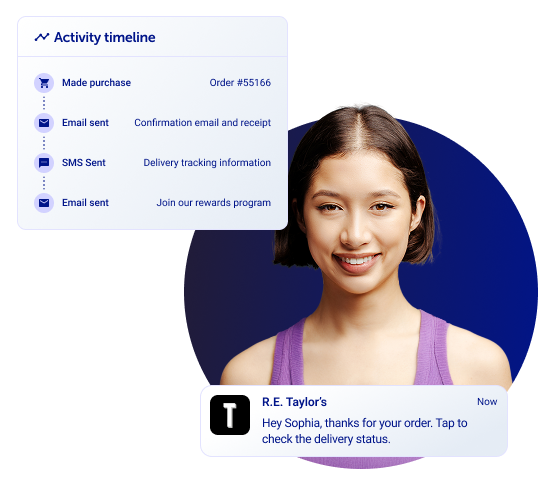
Dotdigital was built to solve one problem: helping ecommerce and retail brands send the right message, on the right channel, at the right moment in the shopping journey. Its marketing automation platform connects to your store's real-time data (browse events, cart activity, purchase history) and triggers campaigns across email, SMS, WhatsApp, web personalization, and paid ads from a single visual canvas.
Source: Dotdigital
If a shopper abandons a cart on your Shopify store, Dotdigital can fire an email within minutes, follow up with an SMS the next day, and retarget them on Meta, all from one automated program.
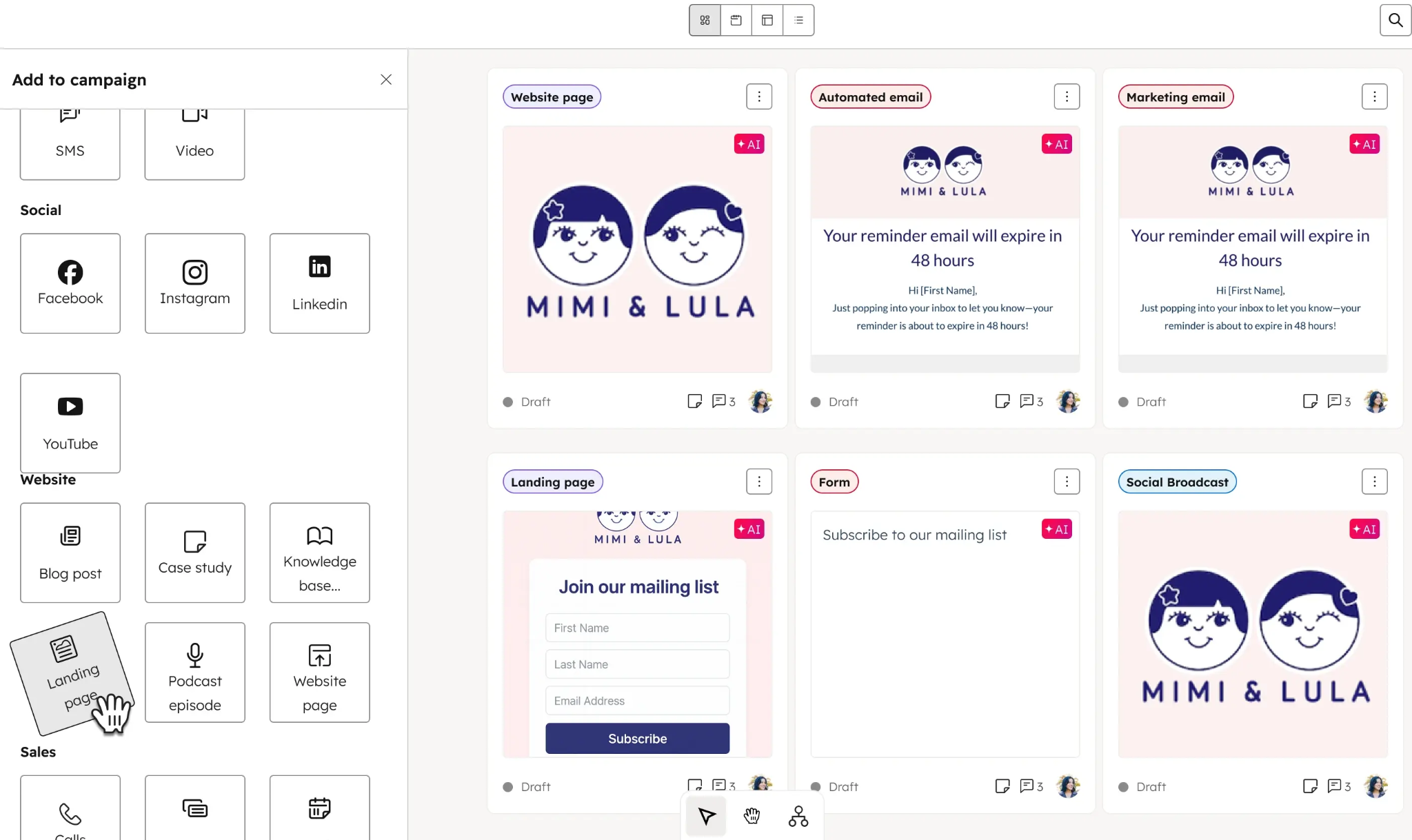
HubSpot approaches marketing as one function within a larger business system. Marketing Hub handles email, landing pages, social media, ads, and automation workflows, but shares a database with Sales Hub, Service Hub, Content Hub, and Commerce Hub.
Source: HubSpot
When a lead fills out a form, the sales team sees it instantly. When a customer opens a support ticket, the marketing team can suppress them from promotional campaigns. This cross-team visibility is HubSpot's main advantage.
The question is whether you need depth in marketing execution or breadth across teams. A DTC brand running on Shopify with a 200,000-person email list will get more from Dotdigital's ecommerce automation. A B2B SaaS company with separate marketing, sales, and support teams will get more from HubSpot's unified platform.
Marketing automation: specialist precision vs. platform breadth
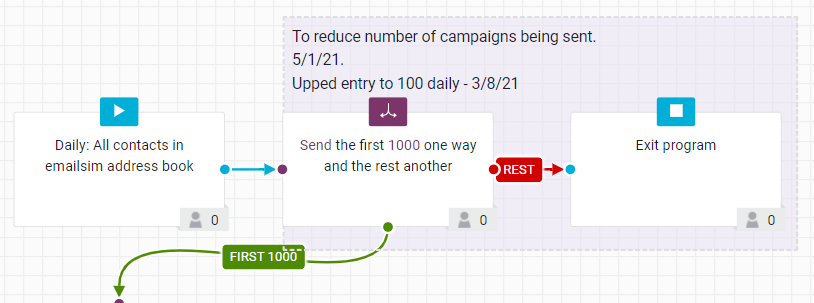
Dotdigital's Program Builder is a visual, node-based workflow canvas where marketers drag and connect action nodes (send email, send SMS, send WhatsApp), delay nodes, decision branches, and quantity splits.
Source: Dotdigital
Programs send across all supported channels from a single workflow, with enrollment rules based on segments, date fields, or API triggers. Exit conditions use the full segment builder, so a shopper who completes a purchase gets automatically removed from an abandonment program mid-flow.
What makes this distinctive is per-node revenue attribution. The program analytics view overlays revenue data at each campaign node on the workflow canvas. Marketers see which step in a journey generated conversions, not just the program's total.
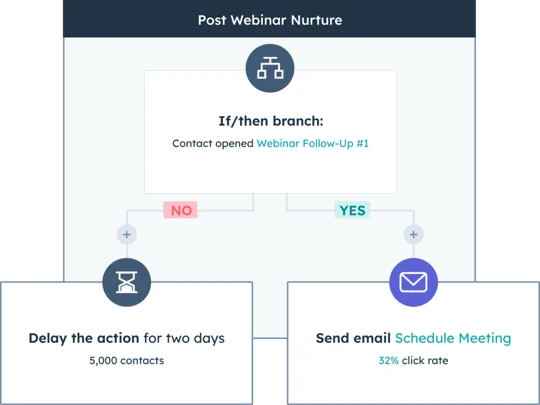
HubSpot's marketing automation Workflows offer a similar visual builder with branching logic, but the triggers and actions extend beyond marketing. A workflow can create a deal in the CRM, assign a sales task, update a contact property, or trigger a notification in Slack.
Source: Hubspot
This cross-functional reach helps companies running lead nurture sequences that hand off to sales, but HubSpot's workflows lack the ecommerce-specific depth (browse abandonment triggers from real-time store data, per-node revenue attribution on the canvas) that Dotdigital provides natively.
For ecommerce, Dotdigital's automation is more granular. For cross-team orchestration, HubSpot's automation is more versatile.
The data problem neither platform fully solves
Both Dotdigital and HubSpot execute campaigns well against the contacts in your database. But where do those contacts come from? How do you know they're accurate? And how do you identify companies showing buying intent before they ever visit your website?
This is the gap ZoomInfo fills.
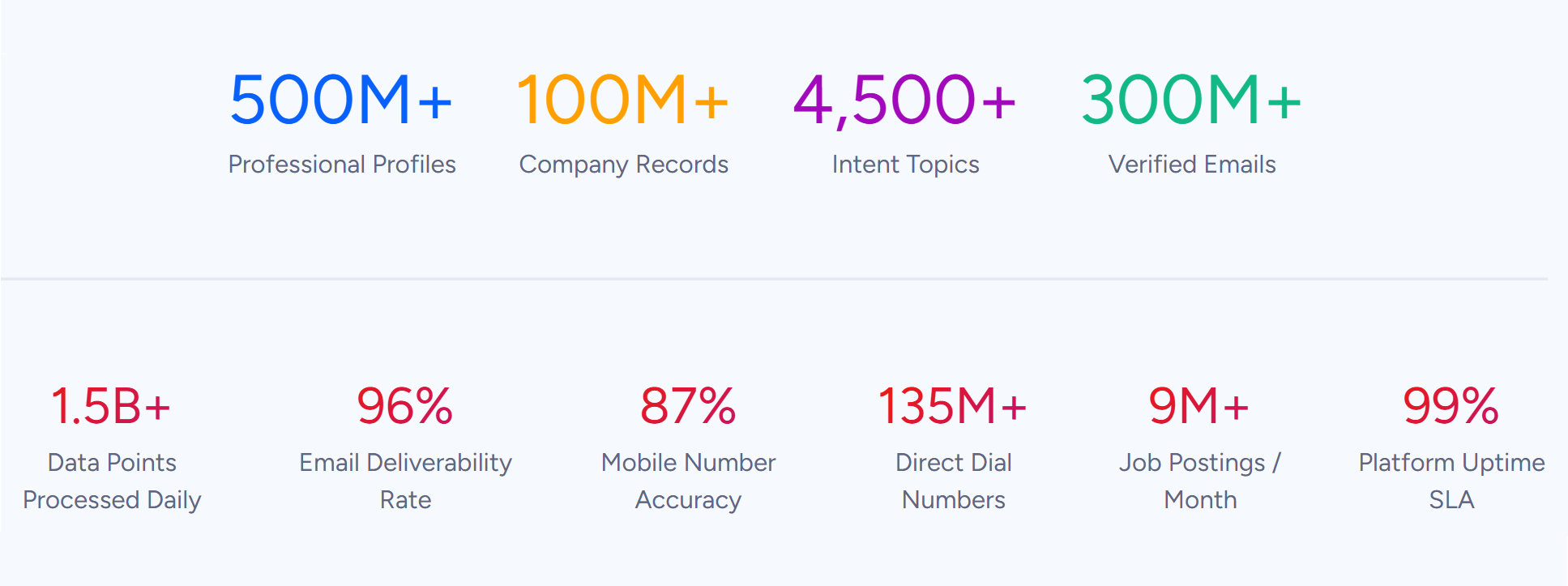
ZoomInfo operates a large B2B data platform: 500M contacts, 100M companies, 135M+ verified phone numbers, and 200M+ verified business emails. ZoomInfo verifies the data through a multi-source pipeline backed by 300+ human researchers and reaches up to 95% accuracy on first-party data.
Source: ZoomInfo
In a Fortune 500 competitive RFP analyzing 25 million contacts across vendors, an independent consultant concluded that "no other competitor came even close."
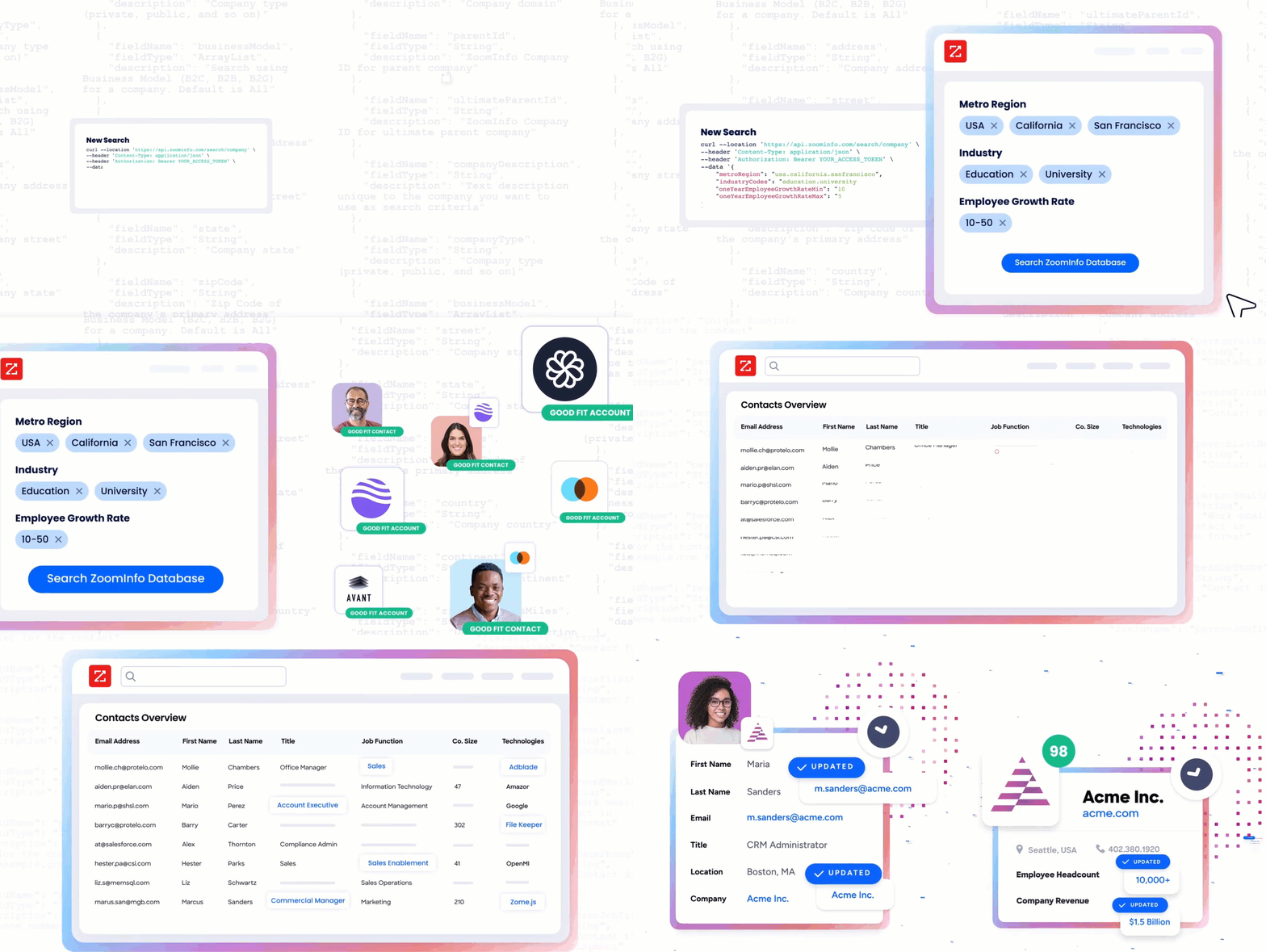
For HubSpot users, ZoomInfo integrates into the CRM, enriching contact and company records with verified firmographics, technographics, and org chart data. For Dotdigital users (or any marketing platform), ZoomInfo's APIs and MCP deliver the same intelligence into any tool.
Source: ZoomInfo
The result: your email campaigns target verified addresses instead of bouncing, your segmentation uses accurate company data instead of stale self-reported fields, and your TAM analysis reflects a continuously verified census rather than guesswork.
For a closer look at how HubSpot and ZoomInfo compare as B2B platforms, see our HubSpot vs. ZoomInfo breakdown.
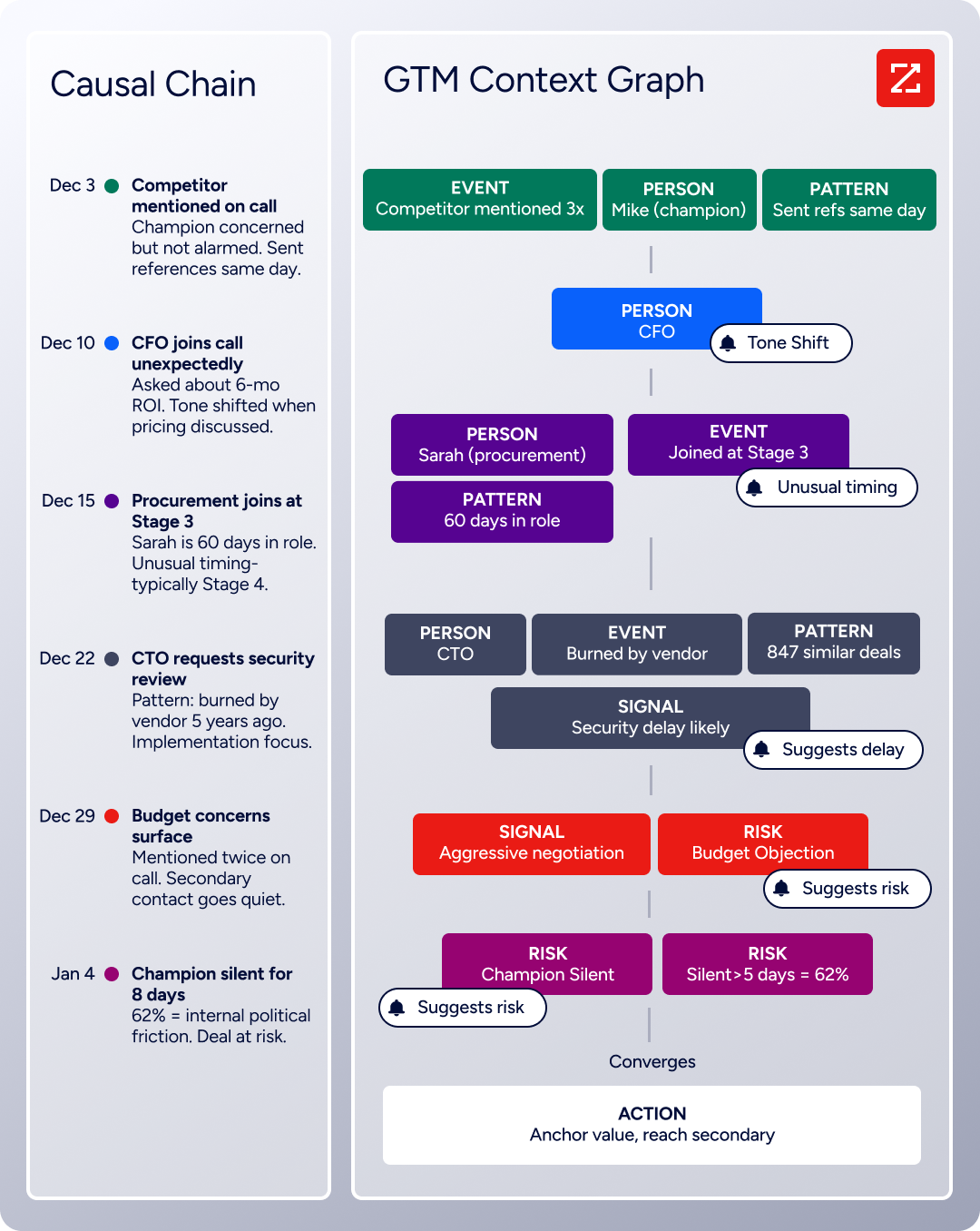
Beyond static data, ZoomInfo's GTM Context Graph processes 1.5B+ data points daily, combining third-party intelligence with your CRM records, conversation transcripts, and behavioral signals. This lets your marketing campaigns target accounts showing real buying intent, not just accounts that match a demographic profile.
Source: ZoomInfo
Seismic's sales team attributed 39% of active pipeline to opportunities identified or influenced by ZoomInfo signals, while saving 11.5 hours per week per seller. (Seismic Case Study)
Email marketing goes head to head
Email is the core channel for both platforms, and both handle it well, with different strengths.
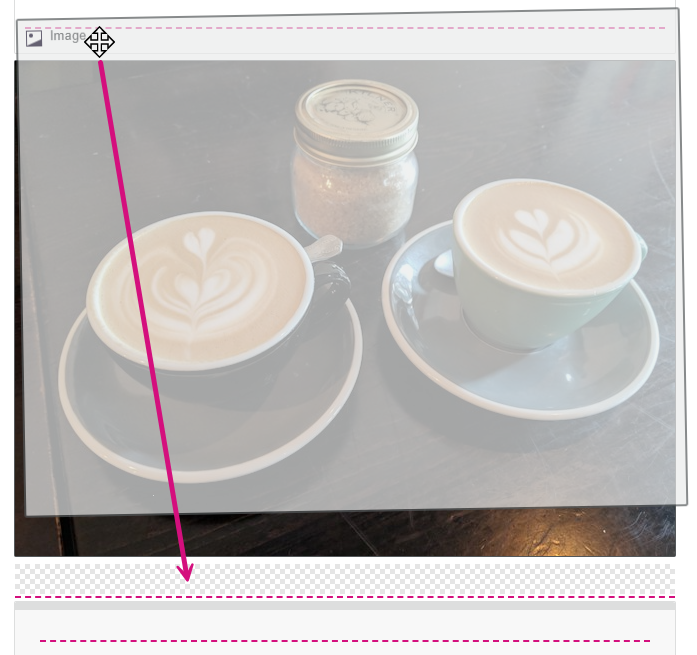
Dotdigital's EasyEditor is a drag-and-drop builder with free templates, source code access for advanced users, and three personalization mechanisms: dynamic content blocks that swap based on contact data, external dynamic content pulled from a server at render time, and Liquid markup for conditional logic.
Source: Dotdigital
Dotdigital also offers send-time optimization, which analyzes 90 days of per-contact engagement history and delivers each email at that person's predicted optimal time within a 24-hour window. This works per-contact, not per-campaign, and handles international audiences without manual time-zone segmentation.
ReMail is another Dotdigital feature: set it once at send time, and it automatically resends a campaign with a new subject line to non-openers or non-clickers after a set number of days. No campaign duplication or re-scheduling needed.
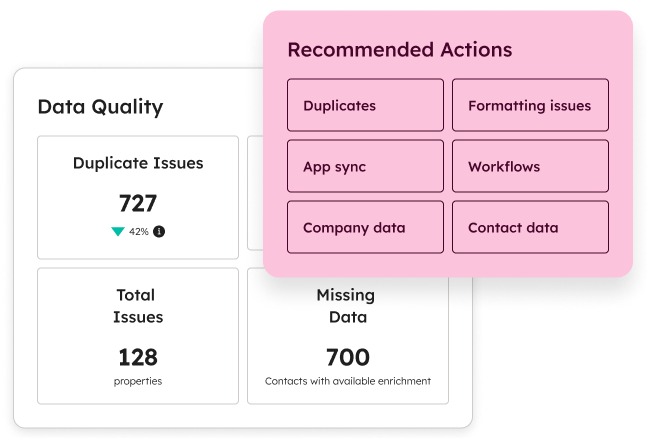
HubSpot's email editor is similarly drag-and-drop with AI writing assistance via Breeze, A/B testing, and personalization tokens that pull CRM data (name, company, lifecycle stage, deal properties).
The advantage is CRM context: because email sits inside the same platform as sales and service, you can suppress contacts in active deals, trigger emails based on support ticket status, or personalize using properties that marketing alone wouldn't have.
Source: HubSpot
HubSpot also offers send-time optimization at Professional tier and above, though Dotdigital's implementation (90-day individual engagement windows, staggered across 24 send periods) is documented in more detail.
On deliverability, Dotdigital defaults to 2048-bit DKIM keys and has updated records for Gmail/Yahoo's 2024 requirements and Microsoft's 2025 requirements. The Data Watchdog, running since 2009, screens every contact import to flag spam traps and invalid domains before they enter the system, protecting sender reputation at the platform level.
Cross-channel capabilities: where Dotdigital pulls ahead
This is Dotdigital's clearest advantage over HubSpot.
Dotdigital manages email, SMS (including two-way conversational SMS), MMS, WhatsApp, mobile app push notifications, web personalization, and paid ad retargeting from a single interface, with all channels available as nodes in the same automation program.
A single customer journey can start with an email, follow up with a WhatsApp message, trigger a push notification, and retarget on Meta, all coordinated through one workflow using the same contact data and segmentation.
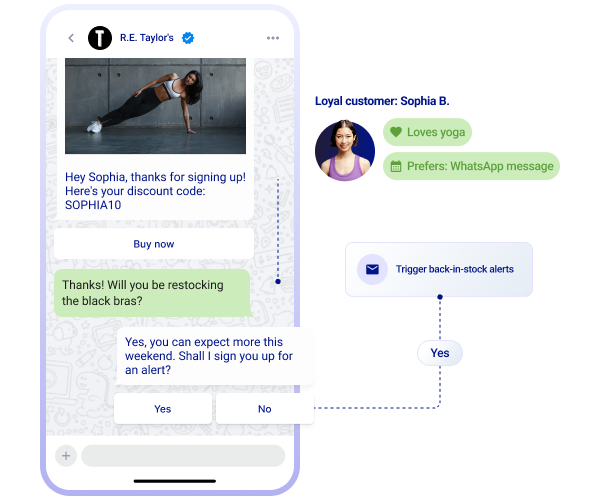
The WhatsApp integration uses the WhatsApp Business Platform API (the enterprise tier), supporting rich media messaging, two-way conversational marketing, and end-to-end encryption.
Source: Dotdigital
SMS capabilities include global delivery to 220+ countries, branded short URLs, A/B testing, and a WinstonAI email-to-SMS conversion feature that adapts email content to SMS character limits in one click.
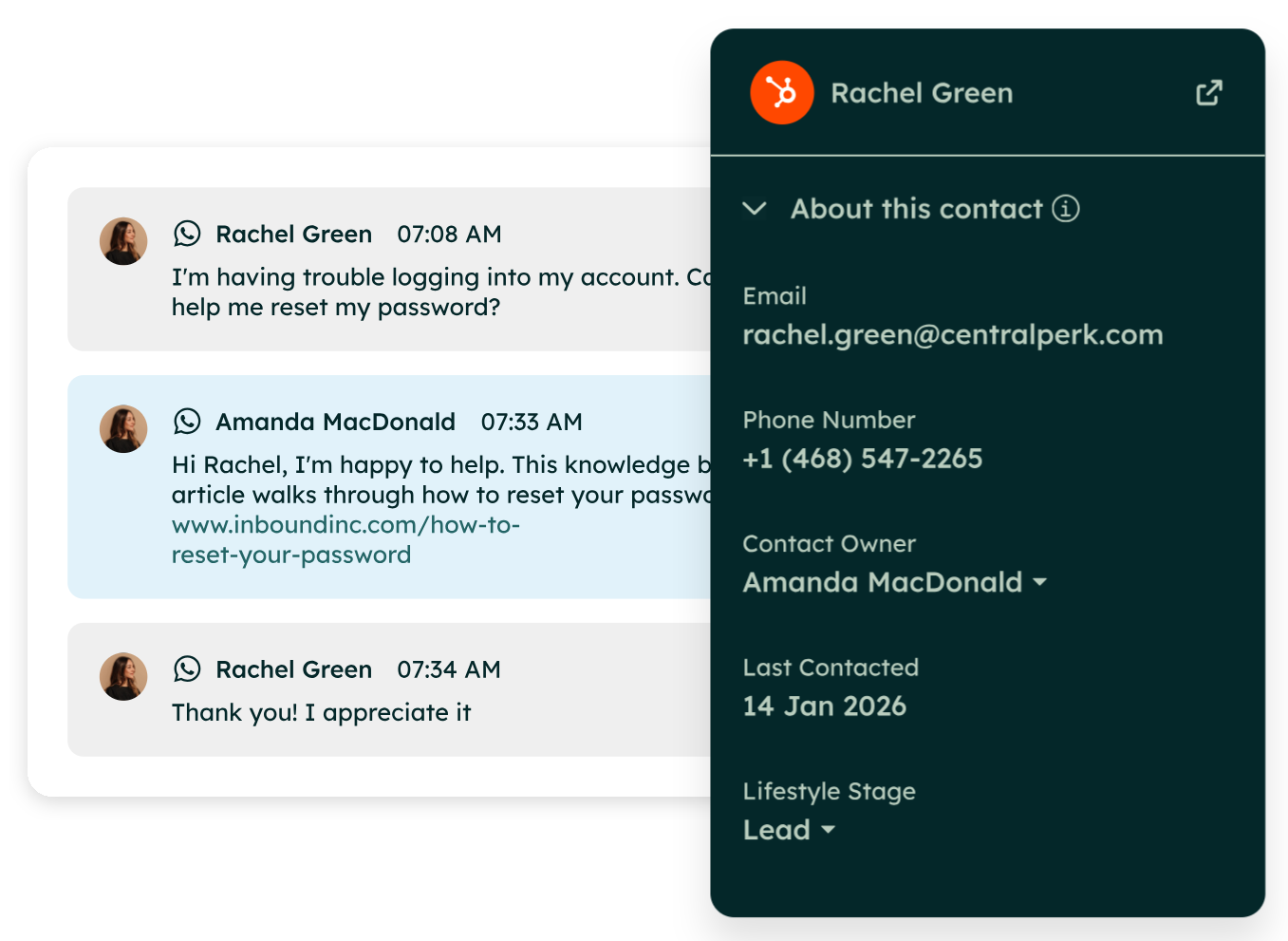
HubSpot's channel coverage is narrower for direct messaging. Marketing Hub handles email, social media publishing, and ad management natively. WhatsApp is available for customer service conversations through Service Hub (Professional and Enterprise), with 1,000 free messages included and overages charged per message.
Source: Hubspot
But WhatsApp as a marketing automation channel (triggered by behavioral data in multi-step campaigns) is not as integrated as in Dotdigital. SMS is not a native HubSpot channel; it requires third-party integrations.
For brands where SMS and WhatsApp are primary revenue drivers (particularly in ecommerce, hospitality, and retail), Dotdigital's native cross-channel coverage matters.
AI capabilities take different approaches
Both platforms have invested in AI, but the implementations reflect their different focuses.
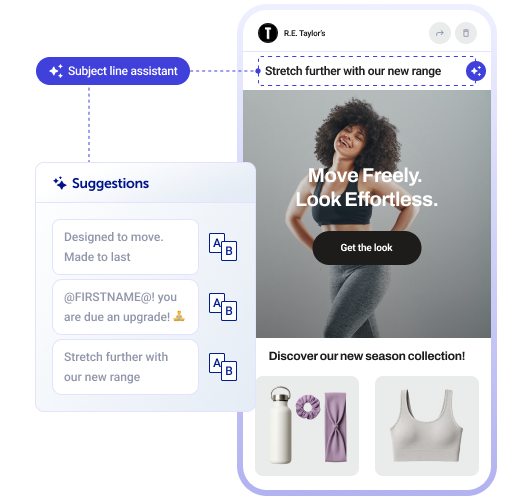
Dotdigital's WinstonAI is embedded in the marketing workflow. In the email editor, the Subject Line Assistant generates alternatives after four characters with an A/B testing button. The Campaign Assistant analyzes full email content and returns feedback: positive points, constructive criticism, a creative idea, and a tone evaluation.
Source: Dotdigital
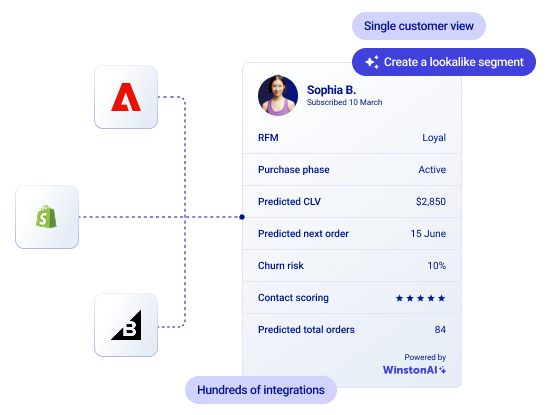
The Rewrite Assistant offers five modes (grammar, tone, length, rephrase, emoji). Beyond content, WinstonAI handles predictive analytics: churn probability scoring, predicted next order date, customer lifetime value forecasting, and 40+ AI product recommendation types across email and web.
A brand voice training feature (launched March 2026) lets marketers upload style guidelines so AI-generated content matches their brand.
WinstonAI runs on a Dotdigital-specific model instance within Azure that discards all data after each session. No customer content is retained or used to train external models. For regulated industries, this matters.
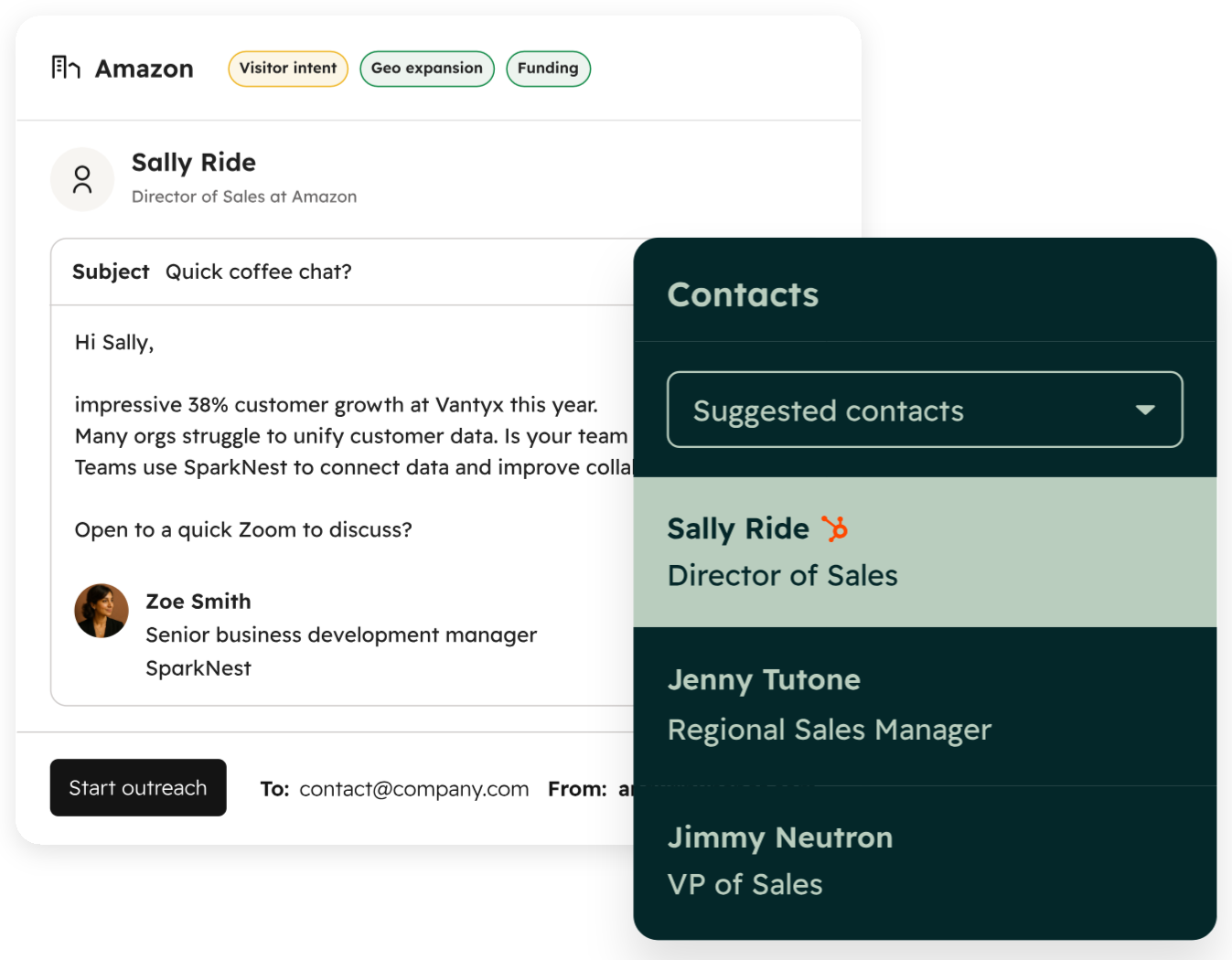
HubSpot's Breeze is broader because it spans the entire platform. The Customer Agent resolves inquiries across chat, WhatsApp, email, and voice. The Prospecting Agent monitors buying signals and drafts personalized outreach for sales teams.
Source: HubSpot
The Data Agent answers natural-language questions about your customer data across CRM records, call recordings, and email threads. Content Remix transforms a blog post into social posts, email copy, and short-form video scripts.
Breeze's advantage is that every agent draws on the full CRM data layer: a marketing email can reference a deal the sales team is working on, and a service agent can see what content a customer engaged with. WinstonAI's advantage is ecommerce-specific predictions (next purchase date, churn risk from purchase cadence) and model isolation.
Ecommerce integrations: depth vs. breadth
This is where Dotdigital's specialization shows most clearly.
Dotdigital has native connectors to Shopify, Adobe Commerce, BigCommerce, Shopware, WooCommerce, and Oracle NetSuite. These aren't basic data syncs.
Source: Dotdigital
They ingest real-time shopper behavior (browse events, cart additions, purchase completions) and make that data immediately available for segmentation and automated triggers. Multi-store and multi-brand management is a named feature, with automatic content tailoring by region, language, and currency.
The Fresh Relevance acquisition (2023) added on-site personalization: AI product recommendations, countdown timers, social proof widgets, and popovers, rendered dynamically when a page loads or an email opens.
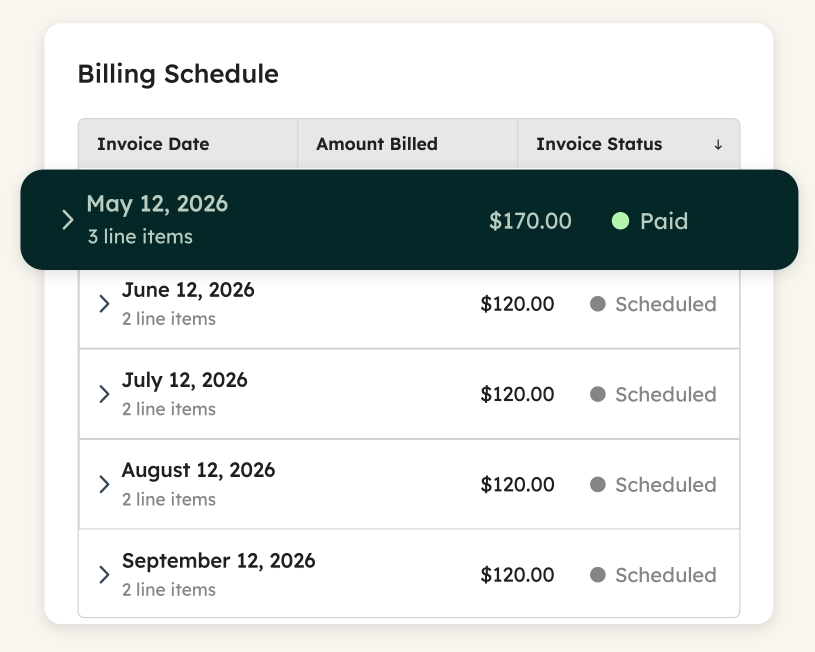
HubSpot's ecommerce coverage is thinner. Shopify syncs via Data Sync (bidirectional, real-time), and other platforms connect through the 2,000+ app marketplace. Commerce Hub handles quoting, invoicing, and payment processing, but these are B2B revenue tools (CPQ, subscriptions, billing), not ecommerce personalization features.
Source: HubSpot
HubSpot does not offer native browse abandonment triggers from ecommerce store data, on-site product recommendation engines, or real-time catalog-aware countdown timers.
For a brand running an online store, Dotdigital's ecommerce depth is the deciding factor. For a SaaS company selling subscriptions, HubSpot's Commerce Hub and CRM pipeline are the relevant tools.
Pricing structures reflect different buyers
Dotdigital does not publish pricing. The pricing page routes to a custom quote form asking for employee count, contact database size, monthly email volume, and website pageviews. Pricing is contact-based with message allowances; premium messaging (SMS, WhatsApp) and Fresh Relevance personalization are billed separately. Contracts default to 12-month auto-renewal with 30 days' notice to cancel.
Capterra reviewers note costs are "on the higher side" and flag that contract terms aren't always clearly disclosed during sales. A 14-day free trial is available (50 emails, 10 SMS, no credit card required), but there is no permanent free tier.
HubSpot publishes its pricing, but the structure is complex. Marketing Hub starts at $20/seat/month (Starter), with Professional at $890/month and Enterprise at $3,600/month. Professional includes 2,000 marketing contacts and 3 Core Seats; Enterprise includes 10,000 contacts and 5 seats.
Mandatory onboarding fees apply: $3,000 at Professional, $7,000 at Enterprise. You're billed immediately when you exceed your contact tier. A hidden cost: when subscribing to multiple Hubs at different tiers, all Core Seats are billed at the rate of the highest tier.
HubSpot's permanent free tier includes a CRM with unlimited contacts (up to 1M records), 2,000 email sends/month, basic forms, and basic landing pages, with HubSpot branding on all customer-facing tools. This free entry point is an advantage for teams evaluating the platform.
ZoomInfo uses custom-quoted, consumption-based pricing with no published dollar amounts. ZoomInfo Lite is a permanent free tier with access to the B2B database, 10 monthly export credits, and HubSpot integration. A 7-day free trial of the full platform is also available.
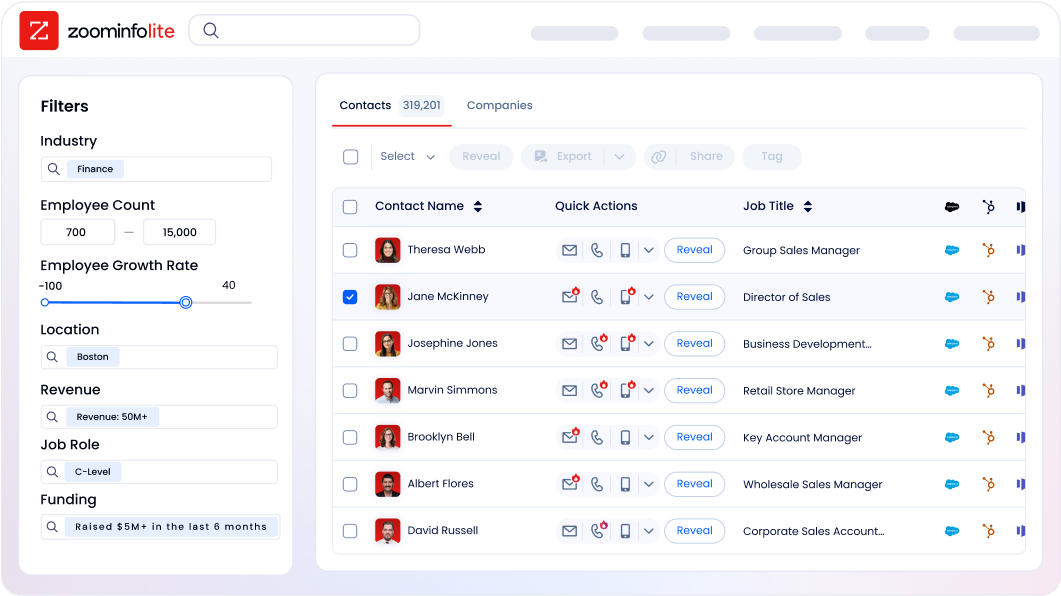
Source: ZoomInfo
Support and onboarding: different philosophies
Dotdigital's support stands out most in user reviews. Every customer, regardless of plan size, gets a dedicated customer success manager. The company commits to answering calls in under 20 seconds and responding to live chats in less than a minute, with a 98% customer satisfaction rate for technical support.
The Dotdigital Academy offers three learning tracks (Getting Started, Beyond the Basics, Certification), plus live training sessions across Americas, EMEA, and Asia Pacific.
HubSpot ties support to your subscription tier. Free users get community access only. Starter adds email and chat support. Professional and Enterprise get phone support. View-only seat users don't get email, chat, or phone regardless of account tier.
A small team on a Starter plan may find support adequate, while a larger organization on a free CRM will rely on community forums and HubSpot Academy (which is excellent: over 200,000 certified professionals, all courses free).
For teams that want personal support from day one, Dotdigital's model is more predictable. For teams comfortable with self-serve learning, HubSpot's free Academy and large community are strong resources.
Integrations and technical infrastructure
HubSpot's ecosystem is larger. The App Marketplace has over 2,000 integrations with 2.5 million active installs. The REST API covers the full CRM data model, and Data Hub allows programmable automation (custom JavaScript or Python) natively inside workflows. For teams building custom integrations or connecting a large tech stack, HubSpot offers more flexibility.
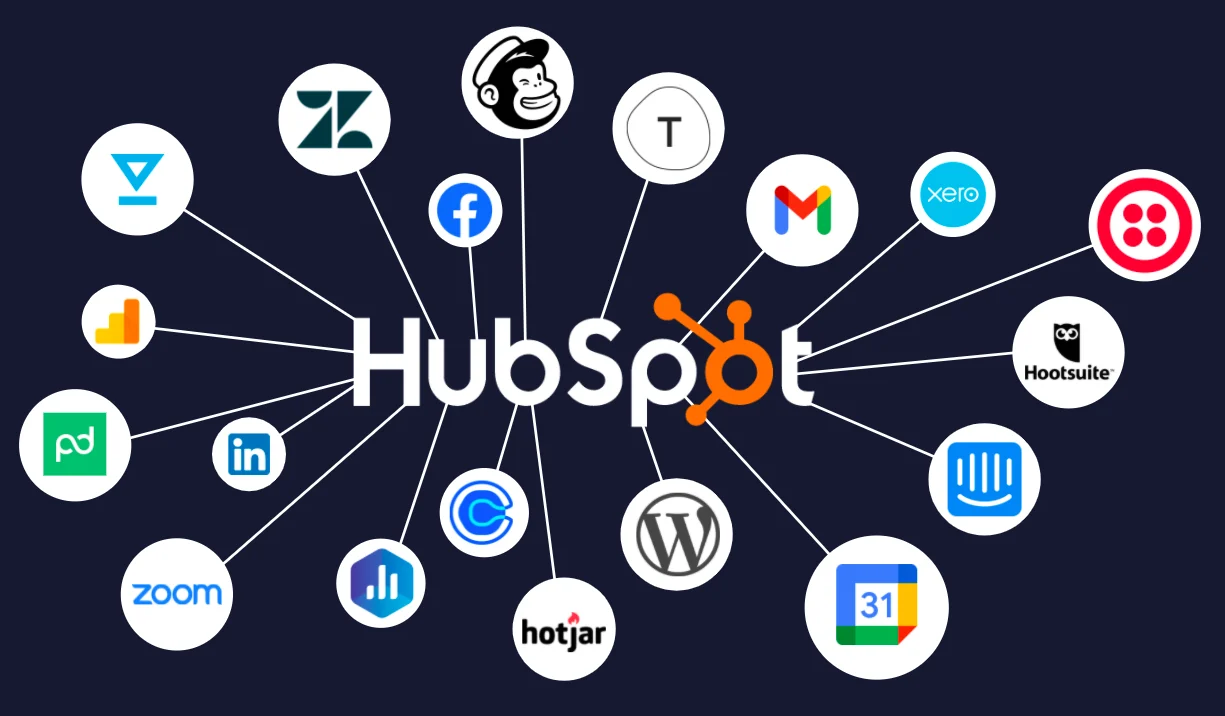
Source: Hubspot
Dotdigital's integration ecosystem is smaller but more specialized. Native connectors cover CRM, ecommerce, CMS, events, and iPaaS (Salesforce, Microsoft Dynamics, Shopify, Adobe Commerce, BigCommerce, WooCommerce, Shopware, WordPress, Drupal, Squarespace, Eventbrite, Cvent, Zapier, Microsoft Power Platform).
The Developer Hub provides REST APIs with versioned documentation. A recurring complaint on Capterra and G2 is that the API has hardcoded hourly rate limits requiring payment to increase, and reviewers call the API set "very limited in general." For technical teams building custom automation, this can be a real constraint.
ZoomInfo bridges both ecosystems. Its 120+ marketplace integrations include native connectors for HubSpot and Salesforce, plus data warehouse delivery through Snowflake, Databricks, and AWS. The Enterprise API and MCP server make ZoomInfo's data accessible to any AI agent or custom application, including Dotdigital via API or Zapier.
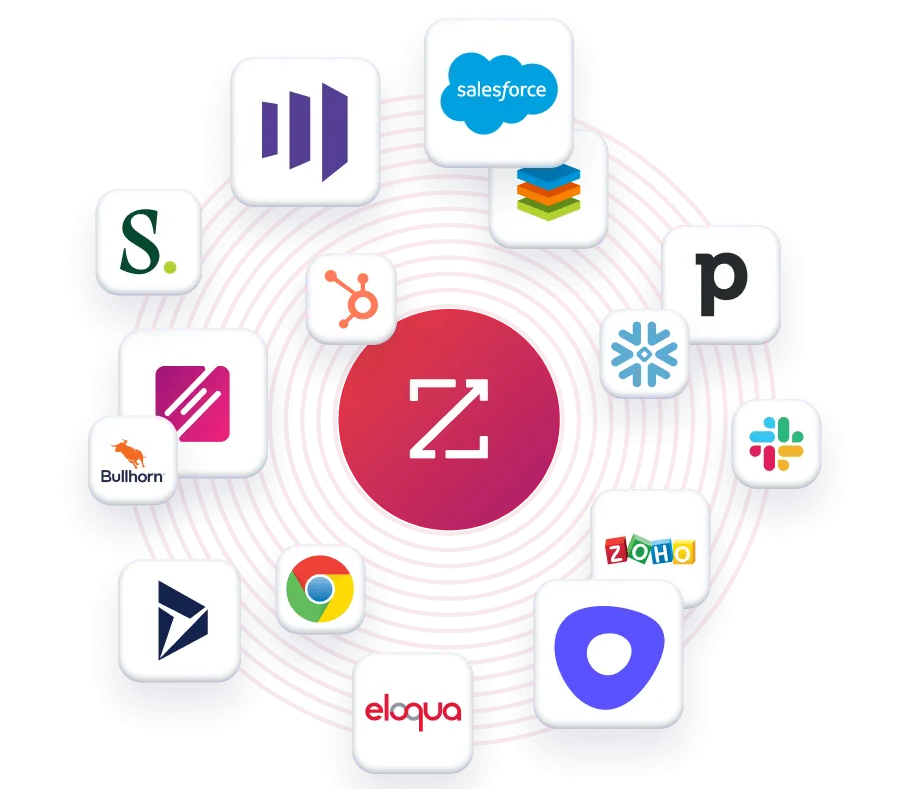
Source: ZoomInfo
"The plug-and-play aspect of the API means I can integrate it very easily into any process and get information at a moment's notice." — Jerry Wilson, Senior Marketing Intelligence Analyst, BDO Canada (BDO Canada Case Study)
Security and compliance: both take it seriously
Dotdigital holds ISO 27001, ISO 27701 (privacy information management), and ISO 14001 certifications, all audited by Alcumus ISOQAR (UKAS-accredited).
It also carries Cyber Essentials Plus certification (UK government-backed), is listed on the CSA STAR Registry, and publishes its Information Security Policy and technical security measures publicly. Infrastructure runs on Microsoft Azure and Google Cloud Platform with data residency options in the EU, US, and Australia.
HubSpot holds SOC 2 Type II and SOC 3 certifications, an independent HIPAA attestation, and EU Cloud Code of Conduct Level 2 compliance. The platform runs on AWS with an EU data center option. Encryption is AES-256 at rest and TLS 1.2/1.3 in transit. HubSpot publishes AI model cards detailing how each AI system interacts with customer data, and runs a bug bounty program on Bugcrowd.
ZoomInfo maintains ISO 27001, ISO 27701, SOC 2 Type II, TRUSTe GDPR, and TRUSTe CCPA certifications, all renewed annually. It is a registered data broker in California and Vermont, with a dedicated Trust Center.
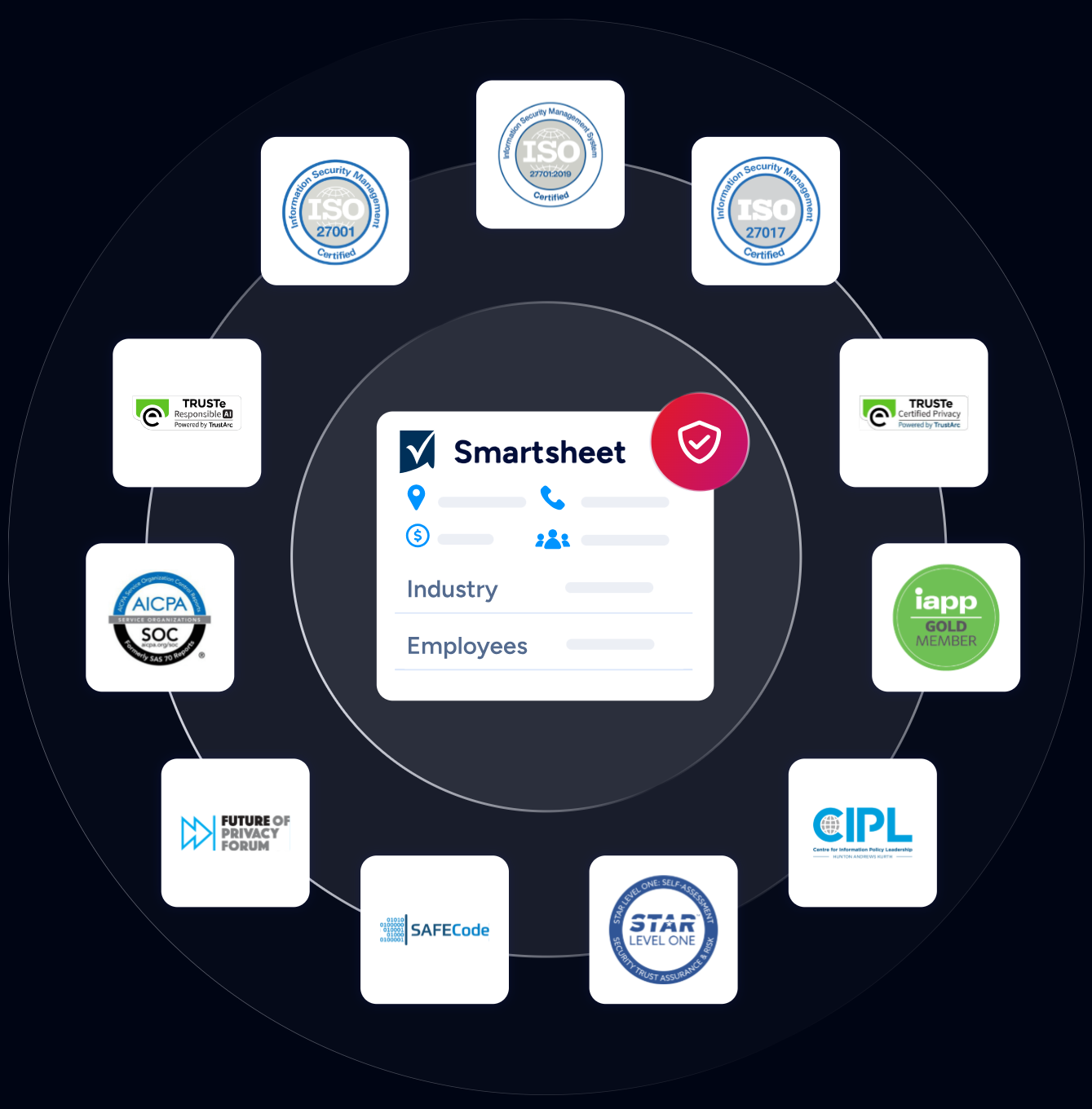
Source: ZoomInfo
All three platforms take compliance seriously. The choice is less about which is "more secure" and more about which certifications your industry requires.
Dotdigital vs. HubSpot vs. ZoomInfo: Which should you choose?
The right choice depends on what your business needs most.
Choose Dotdigital if:
You're a mid-market ecommerce or retail brand running on Shopify, Adobe Commerce, BigCommerce, or WooCommerce
Cross-channel marketing (email + SMS + WhatsApp + web personalization + ads) from a single platform is your priority
You want a dedicated customer success manager from day one
You need ecommerce-specific automation: cart abandonment, browse abandonment, AI product recommendations, and per-node revenue attribution
Your team doesn't need CRM or sales pipeline features in the same tool
Choose HubSpot if:
You need marketing, sales, and service teams working from a shared contact database
Your business involves longer sales cycles where lead nurture and handoff to sales matter
You want a free tier to start from, with the option to add sales, service, and commerce tools later
You value a large integration ecosystem (2,000+ apps) and developer flexibility
You're comfortable with a complex pricing model that scales with seats and contacts
Add ZoomInfo if:
Your campaigns need verified B2B contact data, not just the contacts already in your database
You want to target accounts showing real buying intent, not just demographic matches
Your sales and marketing teams need a shared data layer that shows who to contact, when to engage, and why
You want data that enriches your CRM continuously, whether you're on HubSpot, Salesforce, or another platform
You're building AI-powered workflows that need B2B data via API or MCP
See how ZoomInfo's data and intelligence integrate with your existing marketing stack.
Dotdigital and HubSpot both handle the execution side of marketing automation, from different angles and for different audiences. The question most teams should ask isn't which platform sends better emails. It's whether the contacts receiving those emails are accurate, complete, and worth targeting. That's the layer ZoomInfo adds: verified data and buying signals that improve campaigns on any platform.
Dotdigital vs. HubSpot vs. ZoomInfo FAQ
What is the core difference between Dotdigital and HubSpot?
Dotdigital is a cross-channel marketing automation platform built for ecommerce brands, with native integrations for Shopify, Adobe Commerce, BigCommerce, and WooCommerce. It handles email, SMS, WhatsApp, web personalization, and ad retargeting from a single workflow builder.
HubSpot is a CRM platform that includes marketing automation alongside sales pipelines, customer service, content management, and commerce tools, all sharing one contact database. Dotdigital goes deeper on marketing channels; HubSpot goes wider across business functions.
Which platform is better for ecommerce businesses?
Dotdigital is the stronger choice for ecommerce. Its native store integrations ingest real-time shopper behavior (browse events, cart activity, purchases) and trigger automated campaigns across email, SMS, WhatsApp, and web.
Features like AI product recommendations, on-site personalization via Fresh Relevance, and per-node revenue attribution in the automation builder are built for online retail. HubSpot connects to Shopify via Data Sync but lacks native browse abandonment triggers, on-site recommendation engines, and ecommerce-specific workflow depth.
How does ZoomInfo complement Dotdigital or HubSpot?
ZoomInfo is not a marketing automation platform. It provides verified B2B contact and company data (500M contacts, 100M companies, 135M+ verified phone numbers, 200M+ verified business emails), intent signals, and account intelligence. It integrates with HubSpot's CRM and connects to Dotdigital or any other platform via APIs and MCP.
ZoomInfo solves the problem upstream of campaign execution: knowing which companies and contacts to target, with data accurate enough to protect sender reputation and improve deliverability.
Which platform has better cross-channel messaging capabilities?
Dotdigital covers more direct messaging channels natively. It manages email, SMS (including two-way conversational SMS), MMS, WhatsApp, mobile app push notifications, web personalization, and paid ad retargeting from a single workflow builder. HubSpot handles email, social media publishing, and ad management natively.
WhatsApp is available through Service Hub for support conversations, but SMS requires third-party integrations. For brands where SMS and WhatsApp are primary revenue channels, Dotdigital has a clear advantage.
How do the pricing models compare?
Dotdigital does not publish pricing and requires a custom quote based on contact database size, email volume, and features needed. HubSpot publishes tiered pricing: Marketing Hub Starter starts at $20/seat/month, Professional at $890/month (with a $3,000 mandatory onboarding fee), and Enterprise at $3,600/month (with a $7,000 onboarding fee).
HubSpot offers a permanent free tier; Dotdigital offers only a 14-day trial. ZoomInfo uses custom consumption-based pricing with a permanent free tier (ZoomInfo Lite) offering 10 monthly export credits.
Which platform has better AI features?
Both have strong AI, applied differently. Dotdigital's WinstonAI handles subject line generation, campaign analysis, content rewriting, predictive analytics (churn probability, CLV, next purchase date), 40+ product recommendation types, and brand voice training. It runs on an isolated model instance that discards data after each session.
HubSpot's Breeze spans the full platform with AI agents for customer service, sales prospecting, data enrichment, and content creation. Breeze's advantage is cross-team CRM context; WinstonAI's advantage is ecommerce-specific predictions and model isolation.
Can I use all three platforms together?
Yes. A common configuration is HubSpot as the CRM and marketing hub, ZoomInfo as the data layer (enriching HubSpot contacts, surfacing intent signals, and powering prospecting), and Dotdigital as the ecommerce marketing execution layer for brands that need SMS, WhatsApp, and web personalization beyond what HubSpot provides natively.
ZoomInfo integrates with HubSpot and connects to other platforms via APIs and MCP. The three tools address different layers of the go-to-market stack and work together without overlap.
Which platform is easiest to get started with?
HubSpot has the lowest barrier to entry thanks to its permanent free tier, intuitive interface, and free Academy courses. Dotdigital has a steeper learning curve, with G2 and Capterra reviewers noting that the volume of features makes initial setup non-trivial, though its dedicated customer success manager helps offset this. ZoomInfo Lite offers a permanent free tier for individual data lookups and basic prospecting.
More HubSpot comparisons:
