
More tools haven't made pipeline easier to predict. If anything, the opposite.
GTM engineering tools are the category built to fix that, and this guide covers the nine worth building on in 2026. You'll find what each one does best, and where ZoomInfo fits as the intelligence foundation underneath all of it.
The Problem GTM Engineering Tools Are Built to Solve
According to a ZoomInfo survey of 450 GTM professionals, one in four GTM leaders doesn't trust that their data is updated in real time. Campaigns go out, sequences run, and reps make calls on data nobody can fully stand behind.
Getting that foundation right changes everything downstream. ZoomInfo's customer impact report 2025 found that SMB and mid-market teams using the GTM Intelligence Platform reduced customer acquisition cost by 31% on average, with enterprise teams reporting a 42% reduction. When verified data flows through a system where signals trigger plays automatically, the entire revenue motion gets sharper.
GTM engineering tools are how you build that system. There are five jobs they need to cover.
Data enrichment: Who are you targeting, and is that data accurate enough to act on?
Signal and intent: Which accounts are in-market right now?
Data orchestration: How do signals trigger plays without a manual step in between?
Execution: Do your sequences, ads, and outreach land with the right people at the right time?
Intelligence: Do you know why deals move or stall, not just that they did?
The tools below map to those jobs, with one covering more ground than the rest.
The Best GTM Engineering Tools in 2026
Tool | Primary GTM Role | Technical Edge | Starting Price |
ZoomInfo | Data intelligence | GTM context graph + 95% Verified accuracy | Free to start with consumption credits based on usage |
Clay | Enrichment workbench | 150+ provider waterfall enrichment + AI Claygent | From $167/month |
Apollo.io | SMB prospecting | All-in-one sequencing + database | From $49/seat/month |
Gong | Revenue intelligence | Agent Studio + CRM write-back via AI data extractor | Custom |
Hightouch | Data orchestration | Reverse ETL from Snowflake/BigQuery | Free (up to 2 syncs) |
HockeyStack | Revenue attribution | AI-driven "Odin" agent + multi-touch analytics | Custom |
6sense | Account intent | Predictive buying stage classification | Free (50 credits/month) |
Outreach | Sales execution | AI deal agents + Live sequence optimization | Custom |
HubSpot Sales Hub | Unified GTM Hub | Single data model for sales/marketing/operations | From $9/seat/month |
1. ZoomInfo: Enterprise B2B Data Intelligence and Intent Signals
GTM engineering runs on data quality. The enrichment workflows, intent triggers, and AI sequences your team depends on all draw from the same source, and if that source is stale, everything built on top of it is too. That is what ZoomInfo was built to solve, and why it sits at the top of this list.
ZoomInfo is the GTM intelligence platform that helps sales, marketing, and revenue operations teams identify who to sell to, when to reach out, and what to say. Rather than replacing your CRM, it sits on top of your existing tech stack, giving every function a sharper, more current view of their market.
The database behind it:
500M+ contacts and 100M+ companies
135M+ verified phone numbers and 200M+ verified business email addresses
Up to 95% first-party data accuracy
1.5B+ data points processed daily through the GTM Context Graph
The GTM Context Graph is where ZoomInfo separates from every other data vendor. It unifies ZoomInfo's B2B data with your CRM records, conversation transcripts, and behavioral signals to capture not just what happened in a deal, but why. Executive involvement on a call, competitor research spiking at an account, a wave of VP-level hiring: the context graph connects those signals and surfaces the right action before anyone has to ask for it.
Agent Teams run whole GTM plays on the GTM Context Graph. Each team is a group of specialist AI agents, coordinated by a supervisor agent, working inside a Playbook that sets the goal, the limits, and the approvals. In GTM Studio, a team can score open deals against MEDDIC criteria automatically. The same teams run headless through the API, CLI, or MCP.
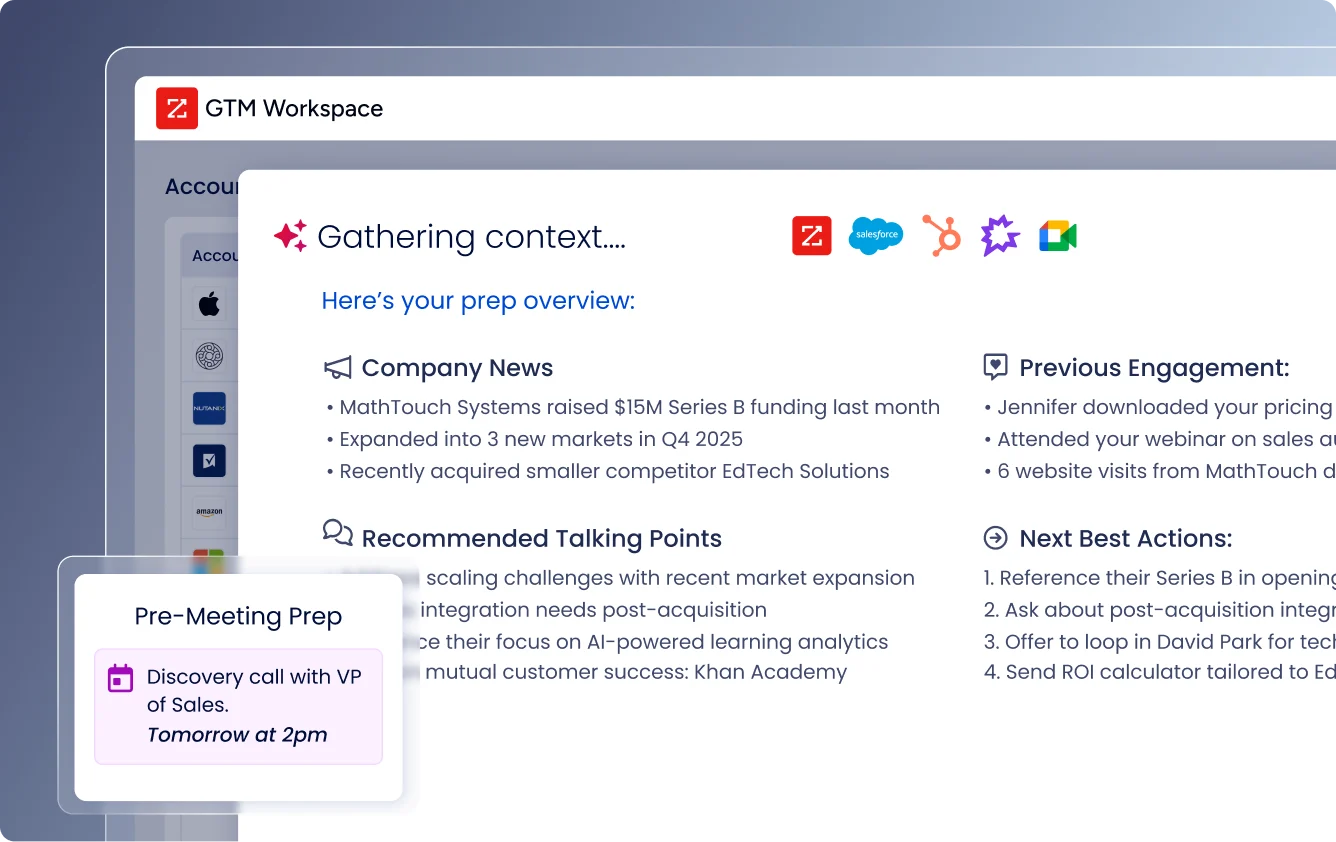
For GTM engineers, that intelligence is accessible however you work. GTM Studio handles enrichment and campaign orchestration. GTM Workspace gives sellers signal prioritization and AI-drafted outreach in one place. GTM.AI is the context layer that makes every account, contact, and signal in ZoomInfo readable by the AI tools you already use. That includes Claude, ChatGPT, Microsoft Copilot, or a custom agent, all via MCP and API.
Key Features
Conversation intelligence with 14 technology patents
Buyer intent from 210M IP-to-organization pairings and 6T+ keyword-to-device pairings monthly
Guided Intent surfacing topics historically correlated with your own deal outcomes, not manual keyword selection
Custom feeds of prioritized accounts and buyer-intent signals, with real-time alerts on account behavior changes
AI-powered email personalization and outreach suggestions trained on your own deal data
Native CRM integration for synchronized workflows, data hygiene, and bidirectional sync
120+ native integrations, including Salesforce, HubSpot, Outreach, Salesloft, Snowflake, and Databricks
Pricing
Free to start with consumption credits based on usage through GTM.AI, or flexible and custom pricing packages.
Customer reviews
"ZoomInfo gives us updated contact details and helpful company information. It’s easy to search and filter, so we can quickly find the right people.. We use it every week because it’s simple and easy to use." - Subin J. G2
"96% accurate contact details of key decision makers can be found there. Easy to use. Google chrome extension makes things easier." - Bethwell M., G2
2. Clay: Programmable Data Enrichment Across 150+ Providers
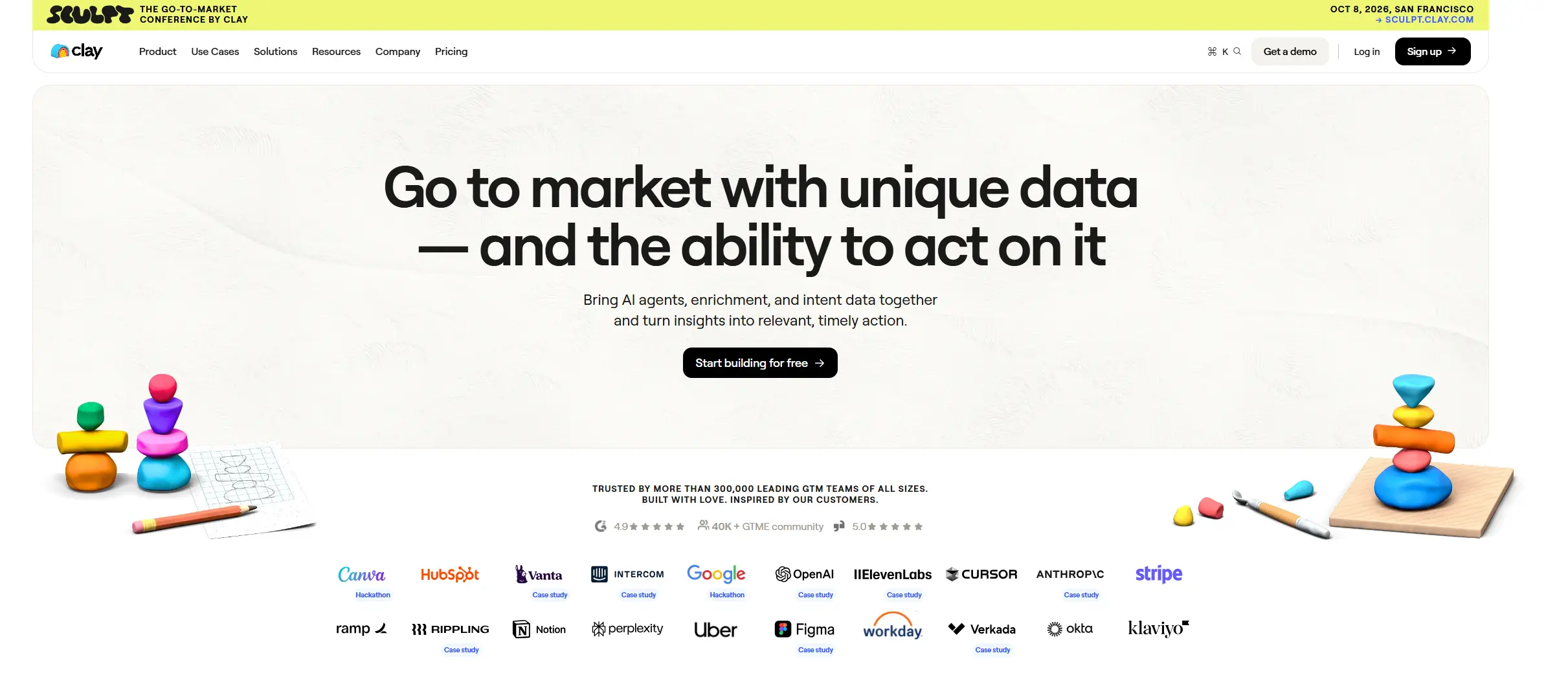
Clay is a workflow builder and data enrichment tool that lets technical operators pull from 150+ data providers, run AI research agents via Claygent, and push outputs into any sequencer or CRM. For teams that want granular control over their enrichment workflows and have the technical resources to run them, it covers a wide range of use cases.
The architecture is sequential: providers are queried one at a time and the process stops at the first match. That works for niche scenarios, but the first match isn't always the freshest, and costs compound as you stack providers across fields.
Clay also carries a real learning curve. The platform runs official cohort training and certification programs, which reflect the configuration and maintenance burden it places on whoever owns it.
Where Clay fits: custom web research, experimental data enrichment combinations, and bespoke lead generation workflows where the right provider mix is genuinely unclear.
Key Features
150+ data provider integrations in a single workflow canvas
Claygent: AI agent for web research and custom data extraction
Sequential waterfall enrichment with provider fallback logic
AI formulas for enrichment logic and sales automation at scale
API and webhook output to CRM and sequencers
Clay University and a certification program for onboarding
Pricing
Plan | Price | Actions | Data Credits |
Free | $0 | 6,000/year | 1,200/year |
Launch | From $167/month | 180,000/year | 30,000/year |
Growth | From $446/month | 480,000/year | 72,000/year |
Enterprise | Custom | Custom | Custom |
Note: Actions and Data Credits are separate currencies. Credits do not roll over between periods.
Customer Reviews
“I like the fact that with Clay, you can build your own flows inside the platform. It's also flexible enough that when a vendor is not available inside it, we can still make HTTP calls to that vendor to API keys and things of that nature, which helps build more flexible flows.” - Soheil S., G2
“I feel there can be more integrations, like more AI. Maybe something like having tools built in Clay similar to Zapier or any other would be amazing, so we don't have to rely on external tools for integrations.” - Anwesh S., G2
Evaluating Clay vs. ZoomInfo for your enrichment stack? Read the side-by-side comparison →
3. Apollo.io: Prospecting Database and Outbound Sequencing in One
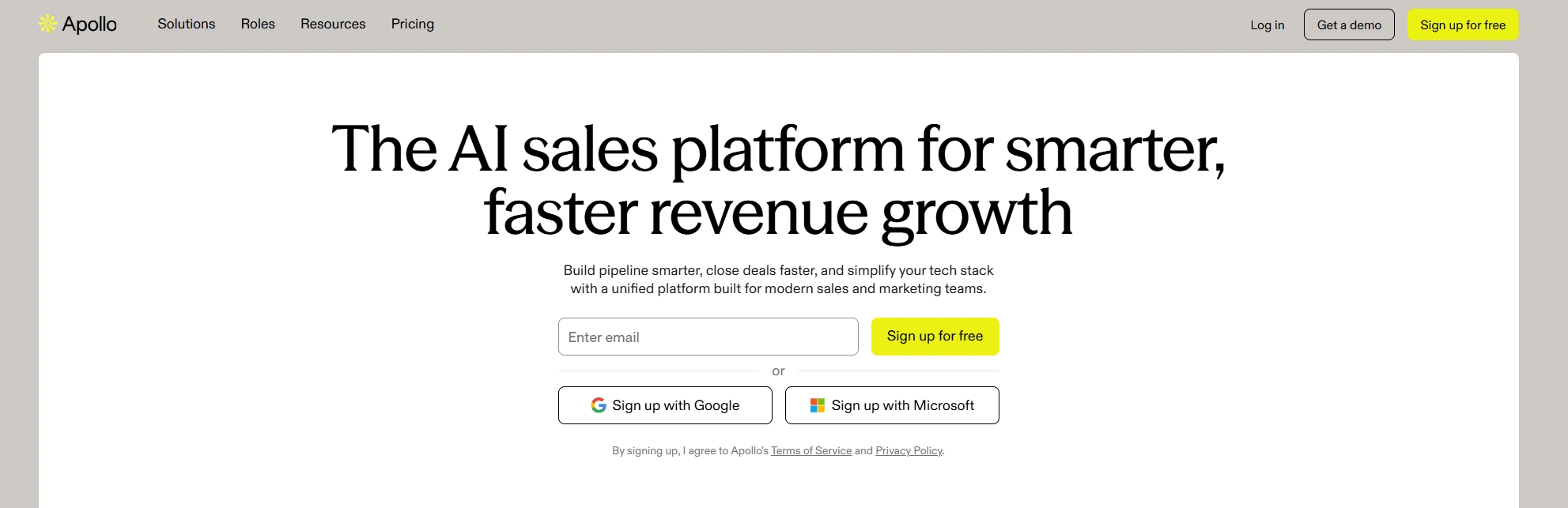
Apollo.io consolidates a B2B contact database (270M+ contacts, 70M companies), multi-channel sequences, a built-in power dialer, email deliverability tooling, and basic AI personalization into one subscription. For small outbound teams that need to move fast on a budget, that's a real advantage for lead generation.
The data model is crowdsourced, delivering approximately 80-85% email accuracy. At low volume that's manageable, but at 500 emails a day it degrades sender reputation and compounds into pipeline loss. Apollo doesn't include ABM execution, and intent data relies on third-party Bombora refreshed weekly, which misses fast-moving buying windows.
Where Apollo earns its place: SMBs, seed and Series A companies, and individual contributors who need to start prospecting immediately. The free plan provides real functionality, not a stripped demo.
Key Features
270M+ contacts and 70M companies with multi-source verification
Multi-channel sequences across email, phone, LinkedIn, and custom tasks
Built-in Power Dialer and Parallel Dialer (add-on)
Intent data via Bombora and LeadSift (1,600+ topics, weekly refresh)
Waterfall enrichment across third-party providers
AI email and sequence generation
Pricing
Plan | Price | Credits |
Free | $0 | 900/seat/year |
Basic | $49/seat/month (annual) | 30,000/seat/year |
Professional | $79/seat/month (annual) | 48,000/seat/year |
Organization | $119/seat/month (annual, min 3 seats) | 72,000/seat/year |
Note: Advanced Dialer add-on $119/month. API access requires Organization plan.
Customer Reviews
“I like Apollo.io because it makes prospecting faster and easier. The contact and company data, search filters, and outreach tools help me find the right people, build targeted lists, and stay organized in one platform.“ – Verified user, G2
“I think it still lacks AI workflows and connectors which can help us with sales automation and better outreach.” - Apoorv K, G2
Comparing Apollo and ZoomInfo for your go-to-market stack? See the full Apollo vs. ZoomInfo breakdown →
4. Gong: Revenue AI and Conversation Orchestration
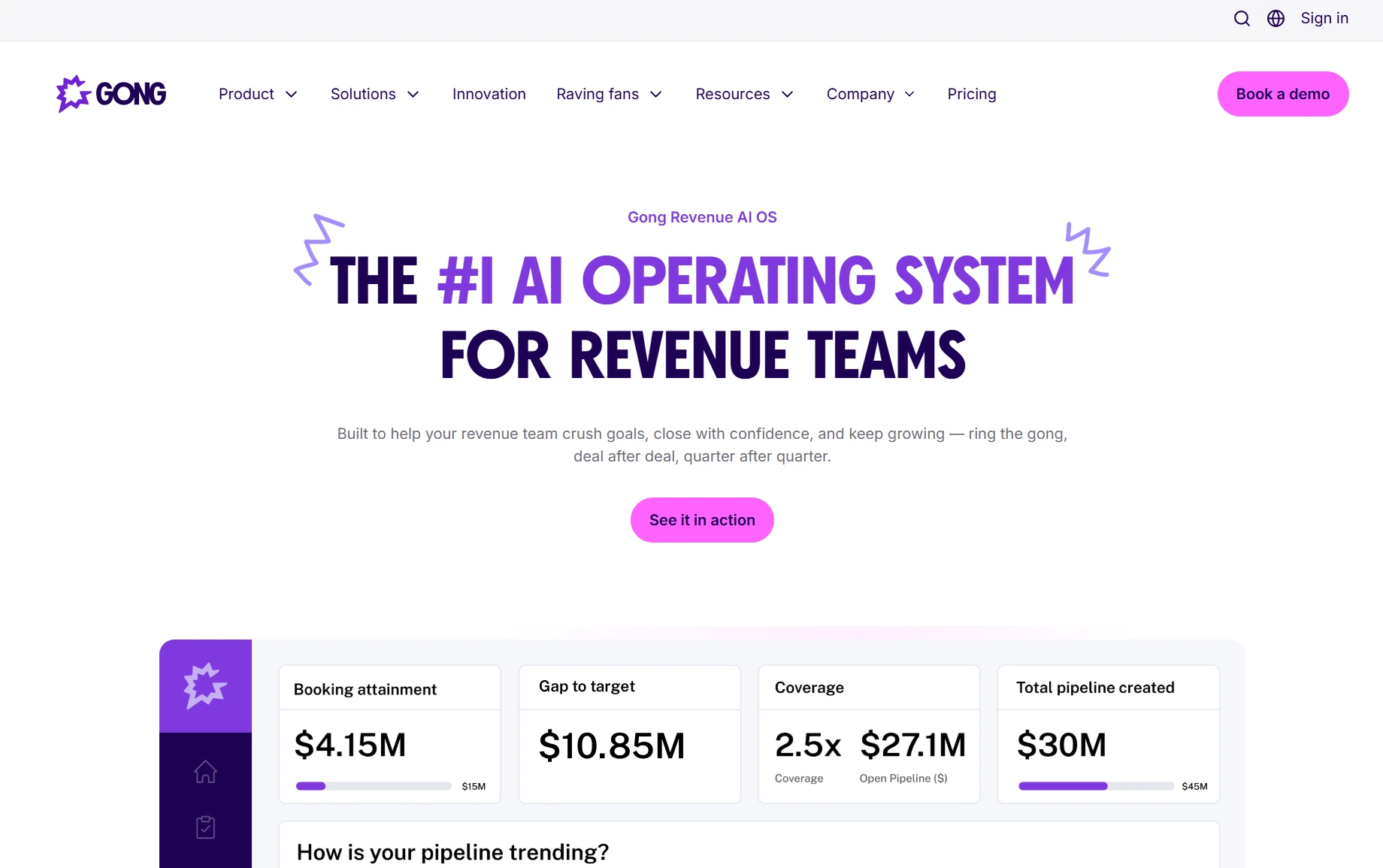
Gong earns its place not because it captures calls, every CI tool does that, but because of Agent Studio.
In 2026, Gong shifted from recording deals to engineering deal data. For GTM engineers, it's now the primary engine for turning unstructured conversation audio into structured CRM data without human intervention.
The richest source of dark data in most organizations sits in call recordings nobody has time to review. Gong's AI Data Extractor changes that by scanning thousands of hours of calls to automatically populate CRM fields, MEDDIC criteria, competitor mentions, budget confirmation, without a rep touching a single field. The CRM stops being a best guess and starts being a verified record.
Key Features
Agent Studio for configuring and deploying AI agents across the revenue lifecycle
AI Data Extractor that automatically populates CRM fields from conversation context with no manual entry
Gong Revenue Graph connecting 1.5B+ interaction signals across emails, calls, and CRM activity
AI Theme Spotter quantifying trends like competitor spikes across thousands of calls
Gong Forecast and Engage as modular add-ons for pipeline health and AI-guided sequences
Real-time in-call assistant with live Content Cards for objection handling
Pricing
Custom-quoted. Per-user licensing plus a platform fee based on number of users. Contact Gong for a proposal.
Customer Reviews
“Gong’s best features are its AI capabilities and the Agent Studio, which make it easier to analyze calls and sync everything with the CRM.” - Rishav K., G2
“It felt like the product stopped evolving. We were paying a lot for what was basically just call recording and a few dashboards, without much else to justify the cost.” - Joaquin R., G2
5. Hightouch: Reverse ETL from Data Warehouse to CRM
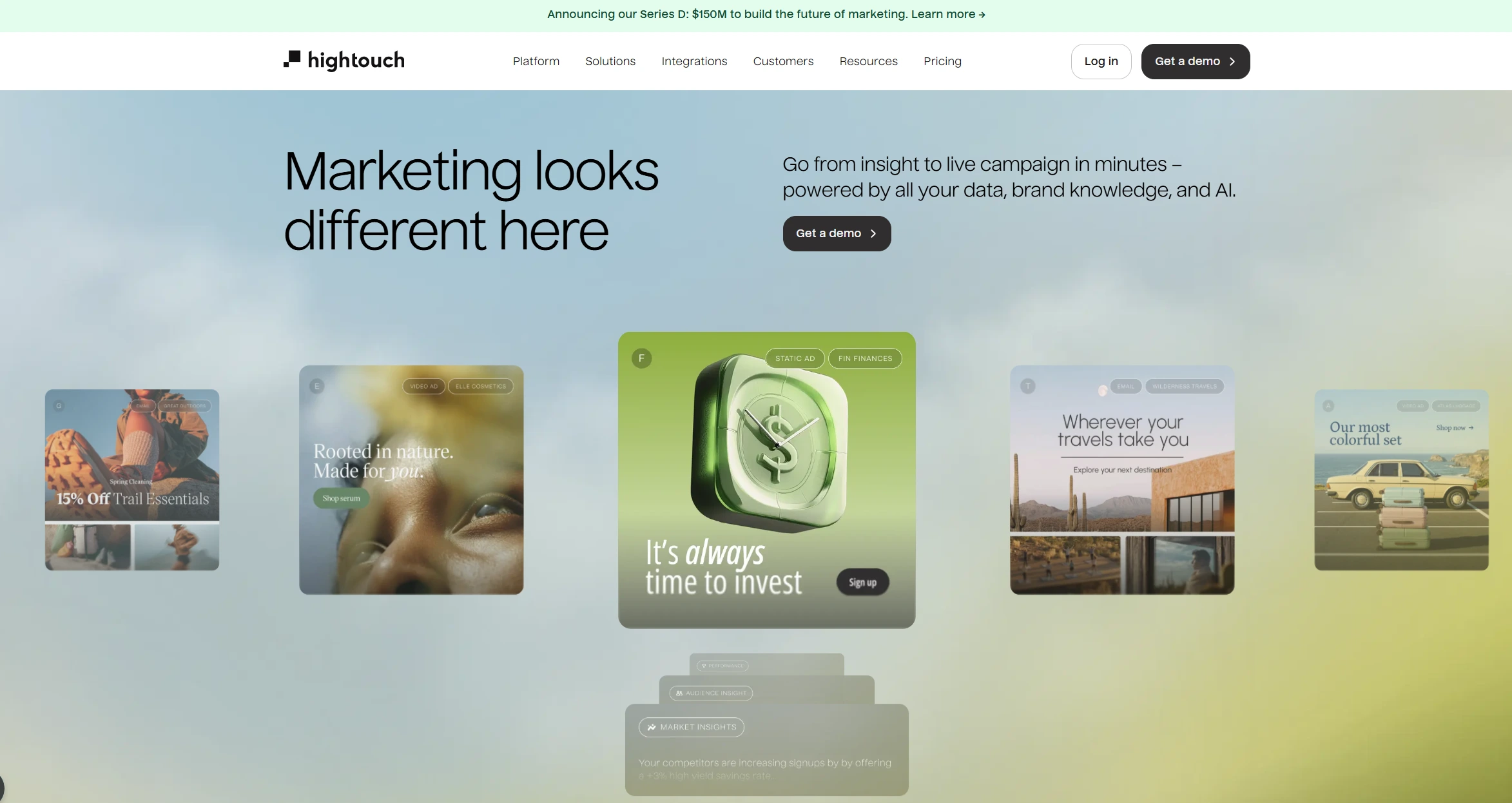
Hightouch solves a problem most GTM tool lists ignore: your data warehouse is almost certainly more accurate than your CRM, so why is your CRM still what your GTM tech stack reads from?
Reverse ETL syncs transformed data from Snowflake, BigQuery, or Databricks back into Salesforce, HubSpot, Outreach, ad platforms, and customer success tools. The practical use cases:
Sync dbt-transformed account scores into Salesforce fields your AEs actually see
Push product usage signals from your warehouse into HubSpot to trigger nurture sequences
Activate first-party audiences directly on LinkedIn or Google Ads without a CSV export
Hightouch AI Decisioning extends this into personalized, AI-driven customer journeys based on warehouse data, moving beyond batch campaigns into real-time data orchestration at scale.
Key Features
Reverse ETL syncing from Snowflake, BigQuery, Databricks, and Redshift to 200+ destinations
Native integrations with Salesforce, HubSpot, Marketo, Google Ads, LinkedIn, Braze, and Iterable
AI Decisioning for warehouse-driven personalized journeys
Visual audience builder without SQL requirement
dbt model support for pre-transformed data sync
Sync monitoring with alerting and governance controls
Pricing
Custom-quoted based on data volume and destination count Free tier: Basic Reverse ETL available with up to 2 active syncs, unlimited destinations, and unlimited user seats.
Customer Reviews
“Hightouch makes it easy to activate data directly from Snowflake into tools like Braze, Iterable, and HubSpot without custom pipelines. I can build audiences and sync attributes in a no-code way, while still having the flexibility to use SQL for complex models.“ - Rafael B. , G2
“The UI in general is not very well for big accounts: filtering is difficult, labeling and organization of personal space can get better. Making it easier to filter what is important for me, reduce load times, provide better search experience and labeling.“ - Roman P., G2
6. HockeyStack: Revenue Attribution and Pipeline Analytics
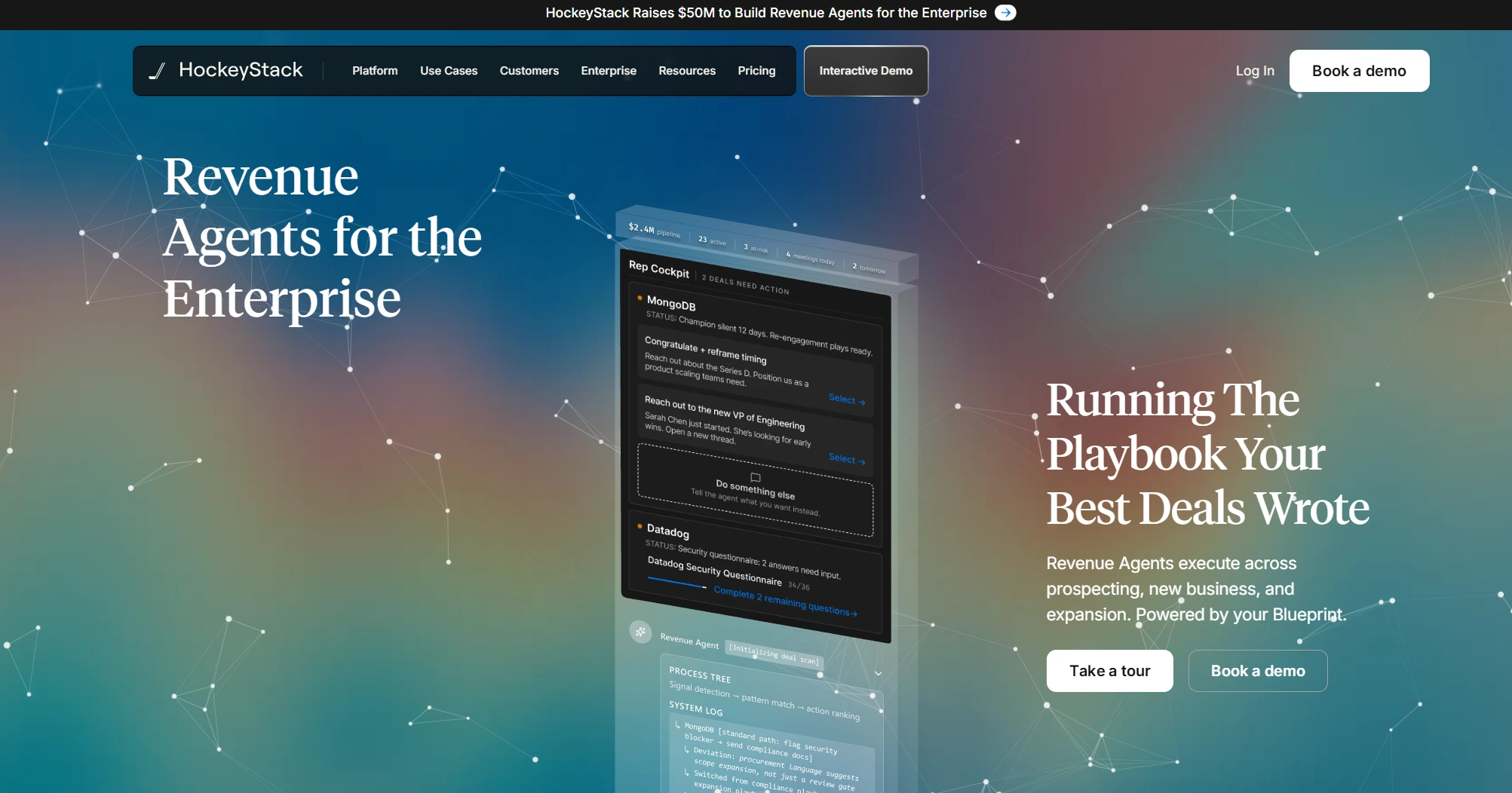
HockeyStack tells you which plays generated revenue, not just which channels generated clicks.
The platform pulls data across CRM, marketing automation, ad platforms, and product analytics, then applies multi-touch attribution that tracks the full buyer journey, including dark social, G2 views, and LinkedIn engagement that most tools miss.
Odin, the AI analyst, answers questions like "which campaigns influenced our enterprise deals last quarter?" in plain English, not SQL. For GTM engineers, HockeyStack is the analytics layer that sits above execution tools and answers whether the plays you built are actually working.
Key Features
Multi-touch attribution across the full B2B buyer journey
Odin AI analyst for natural language revenue and pipeline queries
Dark funnel visibility including anonymous and social touchpoints
Connects to CRM, MAP, ad platforms, G2, LinkedIn, and product analytics
Account-level and contact-level journey tracking
Pipeline influence and sourced revenue reporting
Pricing
Custom-quoted. Demo required.
Note: No published pricing or free tier.
Customer Reviews
“The AI Agents are headed in the right direction. They're useful and well executed. And given the state of LLMs, I imagine they will outpace their competitors with what's already established. It's useful in it's current state.” - Verified User, G2
“Some of the setup is unnecessarily complex or confusing and there isn't a straightforward UI to guide you. Initial setup wasn't bad, but it took a while to get everything to match up accurately with our data.” - Carmine M., G2
7. 6sense: Intent Data and Dark Funnel Account Identification
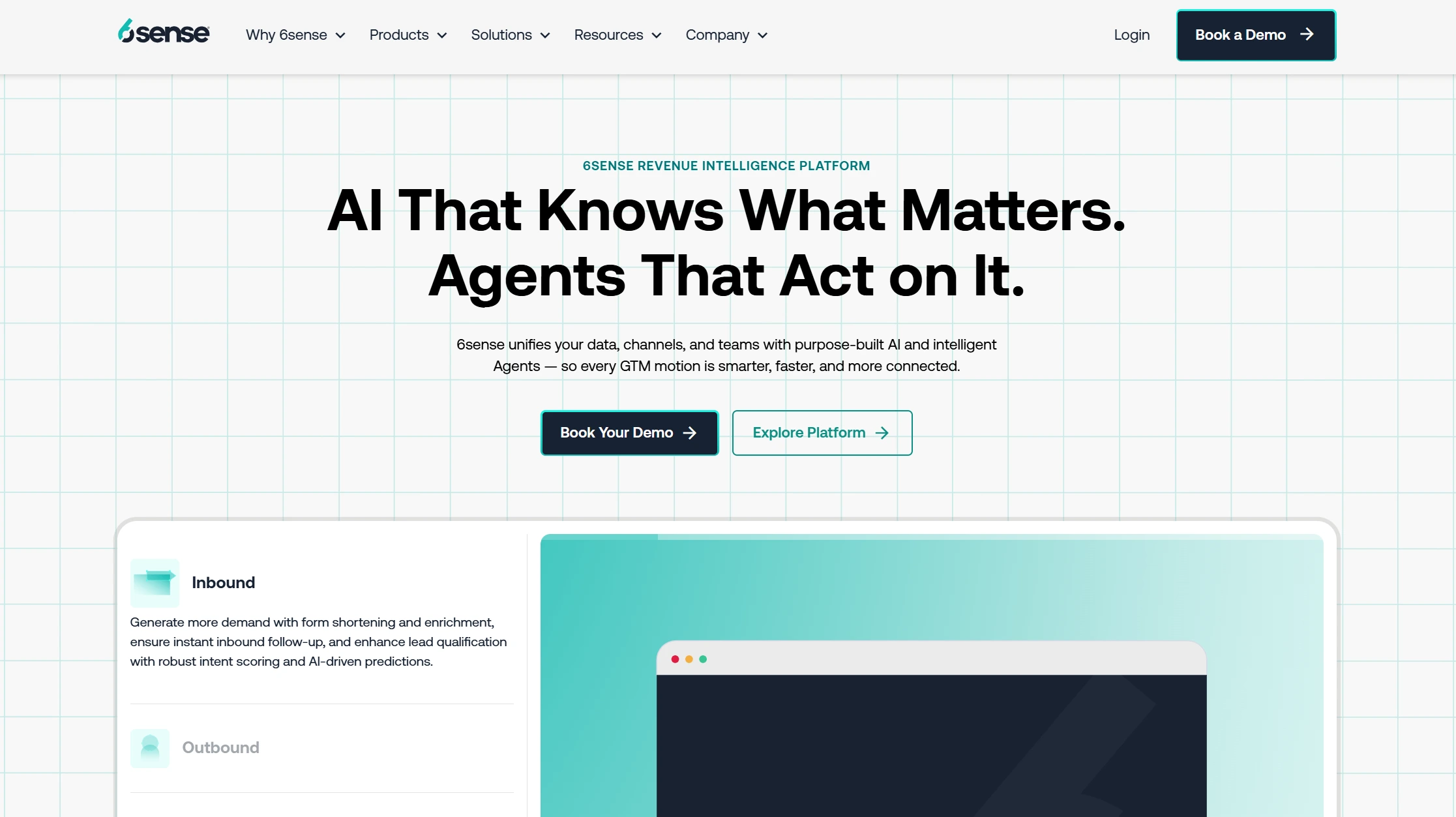
6sense core premise is accurate: up to 70% of the B2B buyer journey happens before a prospect talks to a seller.
The Signalverse ingests over one trillion buying signals daily, classifying accounts into five buying stages based on predictive models trained on each customer's own win/loss data. Marketing teams can target Decision-stage accounts with native DSP advertising across display, LinkedIn, Google, and CTV.
Where 6sense shows limits is contact execution. G2 reviewers consistently flag data quality gaps at the contact level. Intent signals only drive revenue when sales can reach the people behind them. Implementations typically require 60+ days and dedicated administrators.
6sense is strongest as the account identification layer in a marketing-led ABM program, paired with ZoomInfo for verified contact data and sales engagement execution.
Key Features
Signalverse: 1T+ buying signals daily across 40+ languages
Predictive buying stage classification (Awareness through Decision, scored 0-100)
Native DSP for display advertising with buying-stage targeting
AI Email Agents and RevvyAI for outreach generation
390M+ people profiles with 50+ filter criteria
Integrations with Salesforce, HubSpot, Marketo, Salesloft, Outreach, and Gong Engage
Pricing
Custom-quoted for paid tiers.
Free tier: 50 credits/month with company and people search, Sales Alerts, List Builder, and Chrome Extension. Intent data, predictive scoring, and CRM integrations are excluded. Advertising costs are separate from platform fees.
Customer Reviews
“I like how 6sense Sales Intelligence provides the Intent Score and Temperature, which I use to decide what company to prospect. It's fairly simple to set up and easily customizable, which is a plus for me.” - Austin R., G2
“Sometimes data can be inaccurate or it shows them surging for key words that are not relatable to the company.” - Anthony Y., G2
Weighing 6sense against ZoomInfo for your ABM stack? See the full 6sense vs. ZoomInfo comparison →
8. Outreach: Sales Engagement and Sequencing at Scale
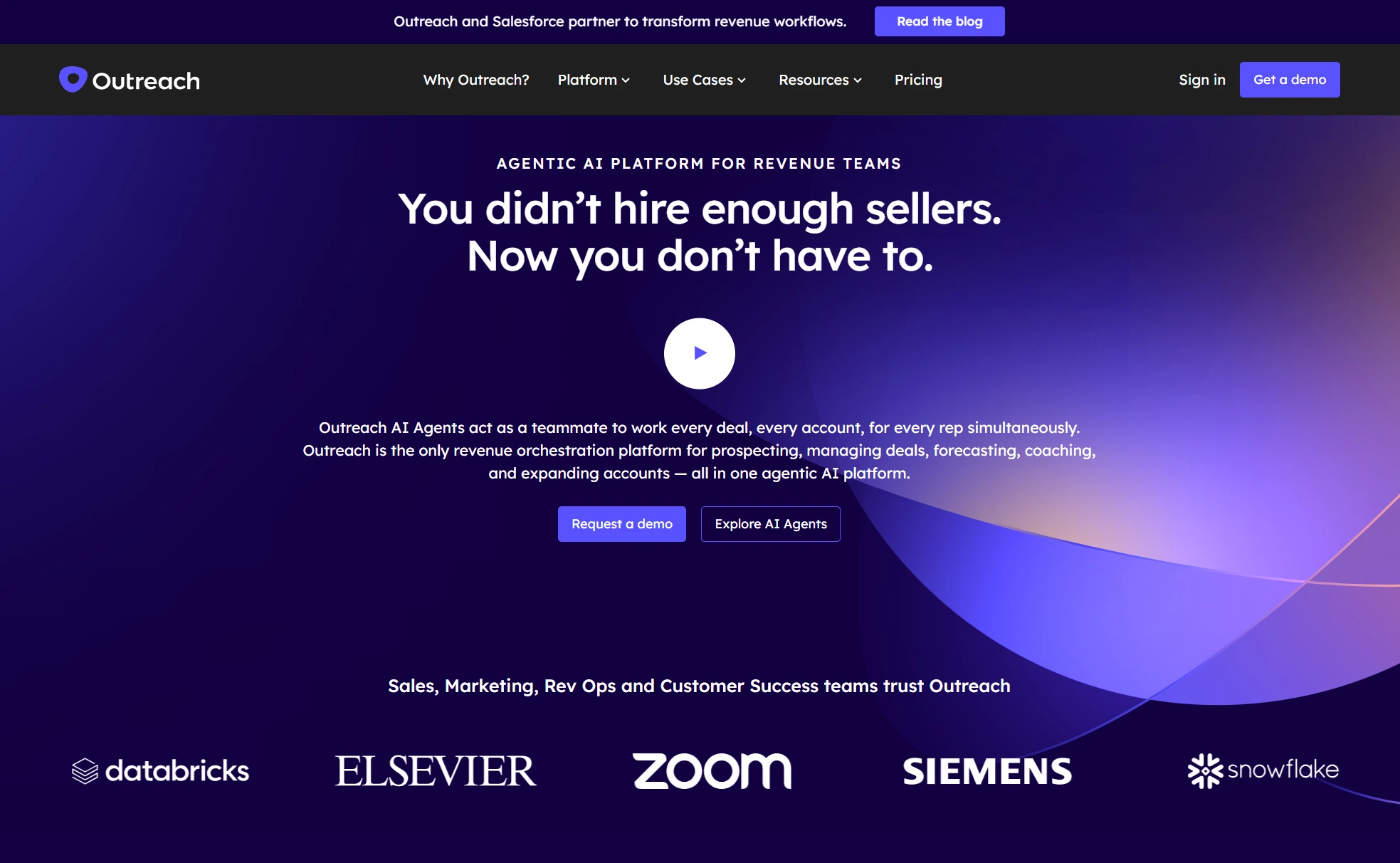
Outreach is the execution layer. If ZoomInfo is the intelligence and data foundation, Outreach is where that intelligence becomes action: structured multi-channel sequences, AI agents that update CRM fields and draft contextual emails, and deal risk surfaced before it shows in a stage change.
Kaia provides real-time conversation intelligence during live calls, not just post-call summaries. Content Cards surface during the call itself, triggered by competitor mentions or pricing objections as they happen. The Deal Health Score (updated daily from 15 activity signals) and AI Projection (10,000 scenario simulations) give revenue leaders pipeline visibility based on real activity data, not rep submissions.
Outreach doesn't provide contact data or lead generation capability on its own. Pairing it with ZoomInfo's verified contacts and intent signals, with ZoomInfo Buying Signals syncing directly into Outreach workflows, is where the combination produces results.
Key Features
Multi-channel sequences with AI scheduling and A/B testing
Kaia: real-time conversation intelligence with live Content Cards during calls
AI Revenue Agent: autonomous prospecting, outreach drafting, and CRM updating
Deal Health Score from 15 activity signals, updated daily
AI Projection with 10,000 scenario simulations for forecasting
Direct integration with Salesforce, HubSpot, Dynamics, and ZoomInfo
Pricing
Package | AI Credits | Key Capabilities |
Amplify Core | 25,000 | Core agents, engagement, conversation intelligence |
Amplify Plus | 50,000 | Advanced agents, deal management, rep coaching |
Amplify Pro | 100,000 | Full suite, forecasting, advanced managed services |
Note: Seat-based pricing plus consumption-based AI credits. No published per-seat base price. No free tier.
Customer Reviews
“Sequencing contacts and being able to add your own sequences, even at a rep level - it's super flexible and empowering for both managers and reps.” - Verified User, G2
“The main issues for me are the lack of new innovation, the limited customization when it comes to automations or lead triggering, and the overly complex admin portal and settings.” - Owen J., G2
Comparing Outreach, Salesforce, and where ZoomInfo fits as the data foundation? See the full breakdown →
9. HubSpot Sales Hub: CRM Operations and Marketing Automation
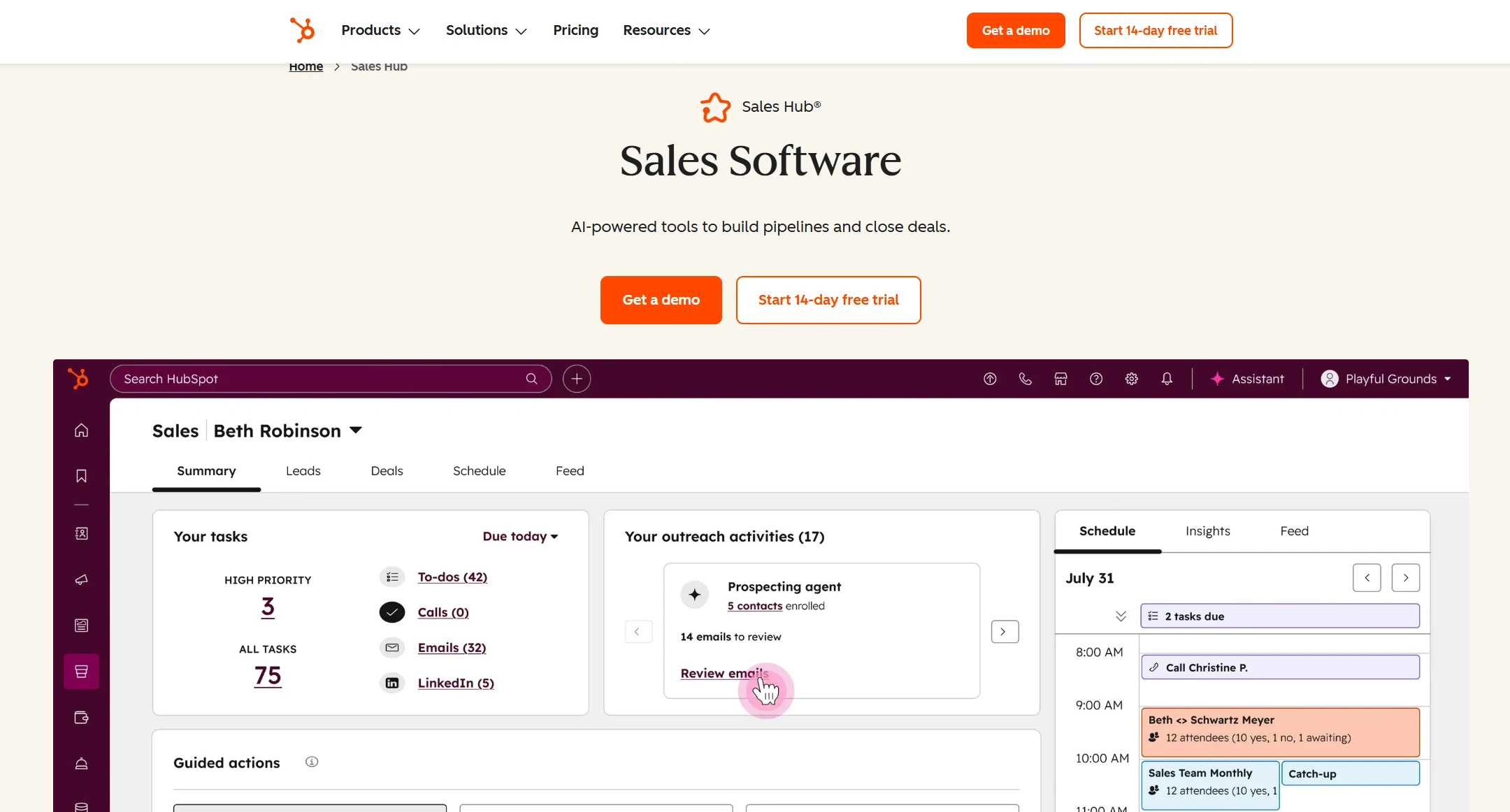
HubSpot Sales Hub earns its place specifically for GTM engineering teams that need marketing automation, CRM operations, and sales engagement connected on a single data model without Salesforce's implementation overhead.
For teams in the scaling phase, the unified approach removes the integration burden that bogs down early GTM engineering functions. Marketing, sales, and RevOps see the same contact record. Breeze AI layers in prospecting assistance and email drafting without requiring a separate tool.
HubSpot Sales Hub's limitation at scale is the same as most CRMs: it knows your own data, not the market. The Breeze Prospecting Agent works from what's already in HubSpot and can't surface which companies outside your database are actively researching your category.
ZoomInfo's GTM.AI integration connects ZoomInfo's verified intelligence directly to HubSpot's Breeze, closing that gap without changing your existing workflow.
Key Features
Unified Marketing, Sales, Service, Content, and Data Hubs on one CRM
Breeze AI: prospecting agent, customer support agent, and data agent
Sales automation across email sequences, meeting scheduling, CPQ, and deal management
Marketing automation with email, ads, landing pages, and SEO tools
Smart CRM supporting up to 15M contacts with custom objects
2,000+ app marketplace integrations
Pricing
Plan | Price (annual) | Notes |
Free | $0 | Up to 2 users |
Starter | $9/seat/month | 500 HubSpot Credits included |
Professional | $90/seat/month | Requires $1,500 onboarding |
Enterprise | $150/seat/month | Requires $3,500 onboarding |
Note: When mixing Hub tiers, all Core Seats bill at the highest tier's rate.
Customer Reviews
“What I love most about HubSpot is how integrated it can become with your whole team and audience. I can access CRM, email, and pipelines all in one space, which makes work much easier.“ - Verified User, G2
“It's hard to create custom reporting specially if you have combination of data that you want to see. Unless you have data hub, which is sad because I have to pay even if the account it already using an enterprise hub.” - Kaye M., G2
Comparing HubSpot and Salesforce and where ZoomInfo fits? See the full breakdown → | HubSpot vs. Segment vs. ZoomInfo →
How Do You Choose GTM Engineering Tools?
Here’s what to consider when choosing your GTM engineering tools.
Time to Value
Not every tool is ready at the same speed, and that gap has a real cost. Tools with sensible defaults can be live in days. Tools that require workflow design, event taxonomy setup, or custom API development take weeks to months. For example:
ZoomInfo deploys in weeks
Clay requires a dedicated technical operator to reach its potential
6sense implementations typically run 60+ days
Salesforce enterprise deployments average three to twelve months
Factor setup time into your total cost of ownership, not just the license cost.
Total Cost of Ownership
The sticker price is never the full story. Credits reset monthly, API access sits behind higher tiers, and advertising costs stack on top of the base. Run the numbers at your actual contact volume before you commit.
Clay's dual-currency model (Actions plus Data Credits) compounds at scale because credits accumulate across vendors and fields
Apollo gates API access behind its Organization plan
6sense advertising costs layer on top of the base subscription
ZoomInfo is free to start with consumption credits based on usage, with cost tied to what you use rather than stacked across vendors and fields
The teams that get burned are the ones that modeled cost at 500 contacts and then scaled to 50,000.
Stack Fit
Any tool you add needs to speak your CRM, your warehouse, and your sales engagement platforms natively. Zapier-powered integrations introduce latency and failure points. Direct API connections with bidirectional sync are what you're actually buying.
In 2026, warehouse compatibility is non-negotiable for data-mature teams. If your data enrichment and scoring models live in Snowflake or BigQuery, your GTM tools need to read from and write to those systems directly. Hightouch was built for this. ZoomInfo's Cloud Partners enable direct data ingestion into AWS, Snowflake, and Databricks.
Data Quality and Source
Data quality is the variable most buying guides treat as a footnote. It's the foundation everything else runs on.
Every tool in your GTM tech stack draws from the same data source. Enrichment waterfalls return what their providers have. AI agents reason over whatever records you give them. Sequences land or bounce based on whether the contact details in them were verified last week or last year. 70% of B2B contact data goes stale every year, and 1 in 4 GTM leaders don't trust their data is updated in real time. A GTM engineering function built on inaccurate data doesn't move faster. It automates the wrong outreach at higher volume.
Turn Your GTM Stack into a Revenue Engine with ZoomInfo
Every tool on this list handles a specific job well. What none of them provides is the verified B2B intelligence that makes the whole system work. That's the layer ZoomInfo fills:
500M+ contacts and 100M+ companies, verified through 300+ human researchers and ML scanning of 28 million site domains daily
135M+ verified phone numbers and 200M+ verified business emails
A GTM Context Graph processing 1.5B+ data points daily across CRM, intent, conversation, and behavioral signals
120+ native integrations plus an MCP server that pipes ZoomInfo's intelligence directly into Claude, ChatGPT, and Microsoft Copilot
Your team doesn't need a new workflow. They need better data inside the one they already have.
Talk to our team to learn how ZoomInfo powers your GTM stack.
Frequently Asked Questions
What are GTM engineering tools?
GTM engineering tools are the platforms used to build, automate, and optimize the revenue stack. They cover data enrichment, intent signals, data orchestration, sales engagement, conversation intelligence, and attribution. The goal is to connect sales, marketing, and RevOps so data flows without manual handoffs and signals trigger plays automatically.
Which GTM engineering tools are best for startups versus enterprise?
Startups typically start with Apollo and HubSpot Sales Hub. Enterprise teams need the verified data depth, ABM execution, and compliance infrastructure that ZoomInfo, Gong, Outreach, and 6sense provide. The gap isn't feature depth. It's data quality and the downstream impact that has on AI accuracy, automation, and forecast reliability.
What features should I look for in a GTM engineering tool?
Prioritize time to value, total cost of ownership at your actual contact volume, stack fit with your CRM and data warehouse, and data quality. Beyond those, look for native bidirectional CRM sync, API access without enterprise-tier gating, intent signal freshness, and whether the AI reasons over verified data or summarizes stale records.
How do GTM engineering tools integrate with CRMs like Salesforce and HubSpot?
The best tools offer native, bidirectional API integrations rather than Zapier connections. Native integrations mean real-time sync, field-level matching, deduplication, and no manual CSV exports. ZoomInfo includes direct API and MCP access in all relevant plans. Hightouch specializes in syncing warehouse data back into Salesforce and HubSpot through reverse ETL.
How do GTM engineering tools help with intent data and lead scoring?
Intent data identifies which companies are actively researching your category before they fill out a form. GTM tools use this to trigger automated plays: enrich the account, route it to the right rep, enroll it in the right sequence, and launch matched ads without a manual step. ZoomInfo's Guided Intent goes further by identifying the topics historically correlated with your own closed-won deals rather than relying on manual keyword selection.
What common challenges do teams face when implementing GTM engineering tools?
Data quality that degrades faster than enrichment workflows can keep up with, credit-based pricing that becomes unpredictable at volume, and integration debt from tools that don't sync natively with the CRM. The underlying issue in most cases is building automation on top of a broken data foundation. Running outreach at higher volume on stale records doesn't improve results. It scales the same bad outcomes faster.
What is the difference between GTM engineering and RevOps?
RevOps focuses on process standardization, reporting, and governance. GTM engineering builds and automates the technical systems that execute the go-to-market motion: the workflows, integrations, enrichment pipelines, and AI logic that operationalize RevOps strategy. RevOps sets the lead routing rules. GTM engineering builds the automation that executes them.
