

Hightouch has earned its place in the customer data platform space by taking a different approach. Instead of copying your data into yet another proprietary store, it sits on top of your existing data warehouse and activates what's already there.
That architectural bet (made by three former Segment engineers who saw the limits of traditional CDPs from the inside) earned Hightouch a Leader position in the Gartner Magic Quadrant for Customer Data Platforms and backing from both Snowflake and Databricks at a $1.2 billion valuation.
To write this Hightouch review, we analyzed the platform extensively. We believe it's the right choice if:
You already have a mature cloud data warehouse (Snowflake, Databricks, BigQuery, Redshift) with well-modeled customer data
You want to activate warehouse data across marketing, advertising, and CRM tools without duplicating it
Your marketing team needs self-serve audience building on top of warehouse data
You need flexible identity resolution that lives inside your own infrastructure
You value modular pricing where you pay only for the capabilities you use
However, Hightouch might not be the best choice if:
You don't have an existing data warehouse or your data infrastructure is immature
You need B2B contact and company data, not just a way to activate data you already own
Your team requires buyer intent signals, sales intelligence, and prospecting tools alongside data activation
You want a single platform covering sales execution, conversation intelligence, marketing automation, and data activation
You need direct-dial phone numbers, verified business emails, and org charts for outbound sales
In this case, consider ZoomInfo: a GTM platform that goes beyond data activation. ZoomInfo provides B2B data (500M contacts, 100M companies, 135M+ verified phone numbers, and 200M+ verified business emails), an intelligence layer called the GTM Context Graph that captures why deals move or stall, and access through GTM Workspace for sellers, GTM Studio for marketers and RevOps, and APIs and MCP for any tool or AI agent.
We've included a detailed look at ZoomInfo later in this review as the broader alternative for B2B teams that need data and GTM execution alongside data activation. If you're ready to explore that approach, start with ZoomInfo's free trial.
What is Hightouch?
Hightouch was co-founded in 2019 by Tejas Manohar, Josh Curl, and Kashish Gupta, three engineers who previously worked at Segment (the customer data platform Twilio acquired for $3.2 billion).
Their time at Segment showed them the limits of traditional CDP architecture: rigid schemas, months-long implementations, and duplicated data stores that created governance headaches.
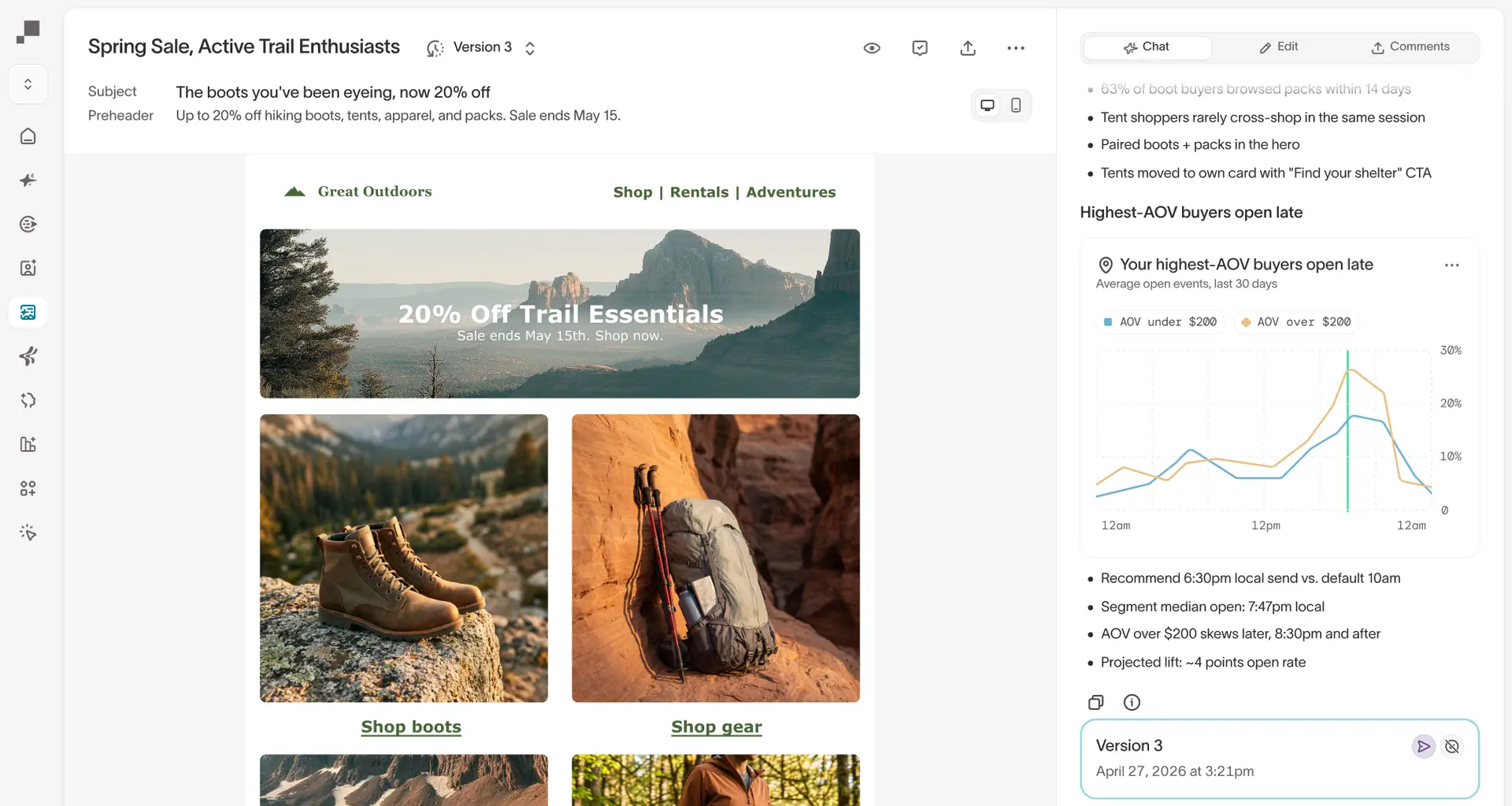
They built Hightouch to solve those problems by operating on existing data warehouses rather than copying data into a proprietary system.
The company came out of Y Combinator's 2019 batch and launched publicly in December 2020 with its first product: Reverse ETL, a category Hightouch coined for syncing data from warehouses back to business tools.
Since then, the platform has shifted identity three times: from Reverse ETL pioneer (2020–2021) to Composable CDP (2022–2024) to what Hightouch now calls an Agentic Marketing Platform (2025 onward), adding AI Decisioning powered by reinforcement learning.
Hightouch has raised $172 million across multiple rounds, reaching a $1.2 billion valuation in its February 2025 Series C led by Sapphire Ventures with participation from Databricks Ventures and Snowflake.
The platform serves 800+ paying customers including Spotify, PetSmart, Warner Music Group, Ramp, Grammarly, and DraftKings, and has processed over 7.3 trillion records synced.
Hightouch targets enterprise marketing teams at data-mature companies. The ideal buyer has a dedicated data engineering team, uses dbt for data modeling, and already stores customer data in a cloud warehouse. Marketing teams then use Hightouch's Customer Studio to build audiences, run journeys, and sync data to their existing marketing tools without writing SQL or filing engineering tickets.
Hightouch Pros & Cons
Pros | Cons |
|---|---|
Warehouse-native architecture; no data duplication | Requires a pre-existing, mature data warehouse |
Fast implementation (days to weeks vs. months) | SQL knowledge still needed for complex use cases |
250+ integrations across advertising, CRM, and marketing | Pricing can escalate quickly with data volume |
Modular pricing; buy only what you need | No native message sending; depends on downstream tools |
No-code audience builder for marketers (Customer Studio) | Audience governance tooling needs improvement at scale |
Named a Gartner Magic Quadrant Leader for CDPs | Does not provide B2B contact data or sales intelligence |
Permanent free tier with 2 active syncs | Quote-based pricing for CDP and AI features; no published rates |
AI Decisioning using reinforcement learning | AI Decisioning and Agentic Marketing features still maturing |
Hightouch Review: How It Works & Key Features
Reverse ETL: Hightouch syncs warehouse data to 250+ business tools without custom pipelines or CSV uploads.
Reverse ETL is where Hightouch started, and it remains the infrastructure layer everything else builds on. Companies spend heavily to centralize data in warehouses like Snowflake or BigQuery, but that data stays locked in analytics infrastructure.
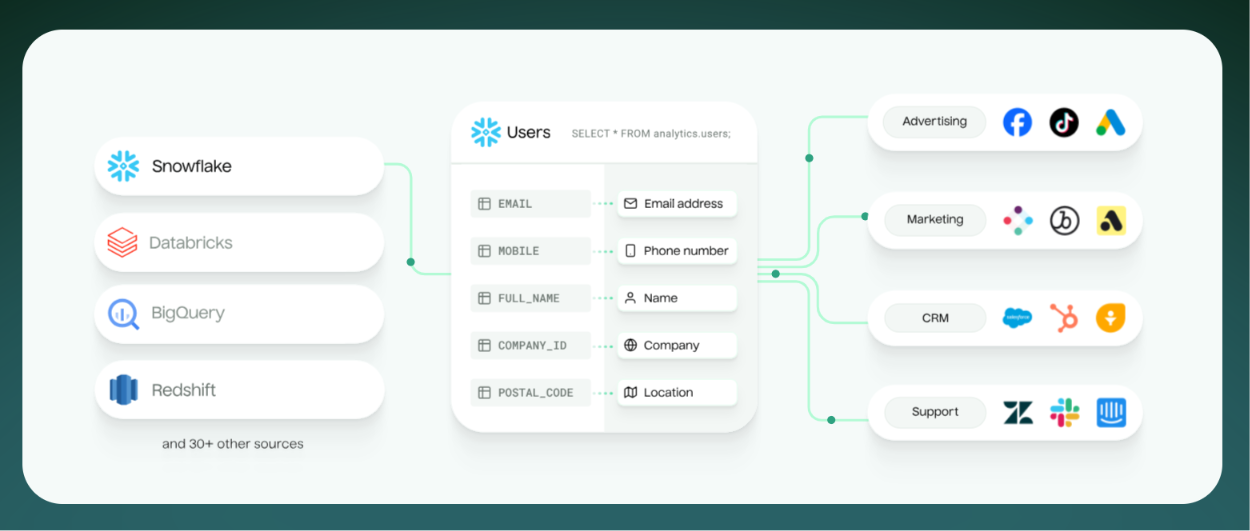
Source: Hightouch
Sales reps work from stale CRM records. Marketers upload CSVs to ad platforms. Reverse ETL connects the warehouse to the tools where teams actually work.
The setup follows three steps: connect a data source (Snowflake, Databricks, BigQuery, Redshift, Azure Synapse, and others), define a model by writing SQL or selecting a table, and configure a sync that maps fields between source and destination.
Syncs run on a schedule, trigger in real time via warehouse-native change detection, or fire programmatically through API calls and orchestration tools like dbt Cloud, Airflow, and Dagster.
Hightouch uses the warehouse's own change detection to identify modified rows since the last sync, transmitting only deltas to reduce compute costs and API calls.
The Lightning sync engine runs on the warehouse's native compute for high-performance batch processing. Hightouch says it never stores customer data; syncs run through ephemeral workers in the customer's cloud.
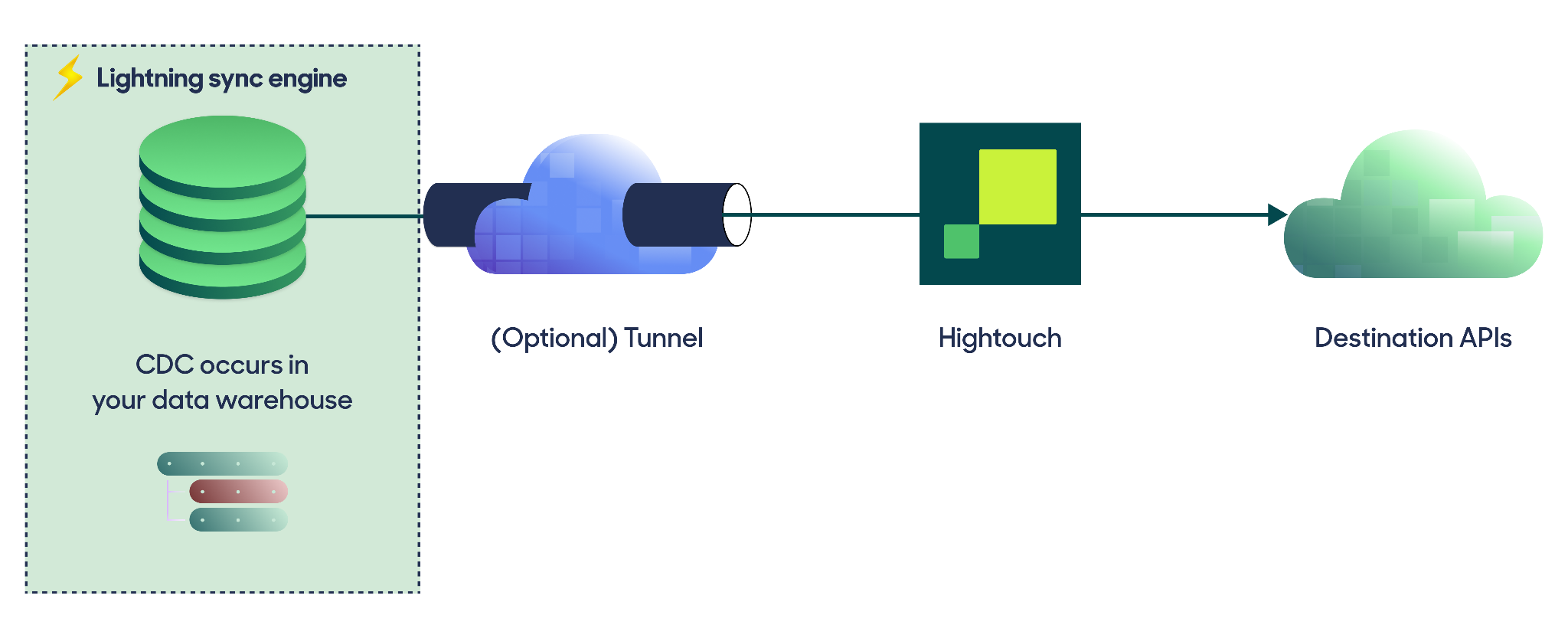
Source: Hightouch
At scale, Hightouch reports running 1 million+ daily syncs at 99.99% global uptime. The row-level live debugger lets teams trace every operation during a sync, including full API requests and responses for each processed row.
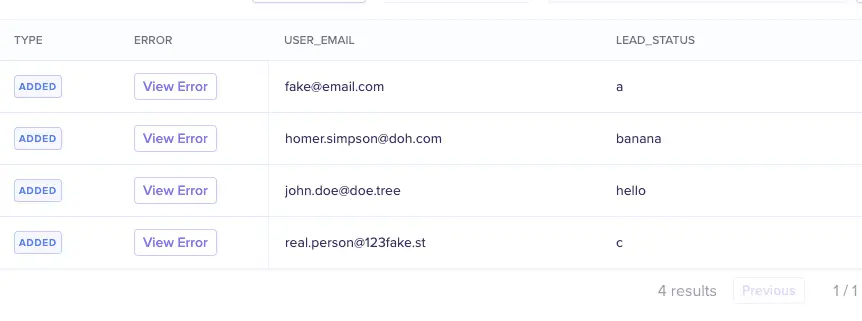
Source: Hightouch
Teams can write sync results back to the warehouse and query them in SQL, and configure alerts via Slack, email, or PagerDuty when something breaks.
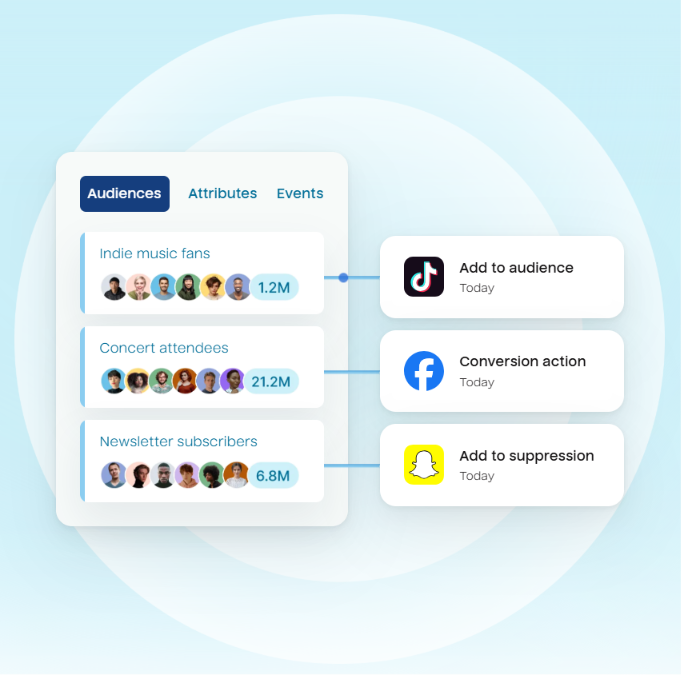
Customer Studio: A no-code interface that gives marketers self-serve access to warehouse data for audience building, journeys, and experiments.
Customer Studio bridges the gap between data teams and marketing teams. Instead of submitting tickets and waiting for engineers to pull audience lists, marketers build segments themselves through a visual interface that translates their selections into warehouse queries behind the scenes.
Source: Hightouch
The audience builder lets marketers filter by behavioral events, customer attributes, and computed traits without writing SQL. Audience size previews update in real time as filters are added.
A traits engine creates calculated fields (lifetime value, percentile rankings, behavioral scores) that serve both segmentation and personalization.
Beyond audience building, Customer Studio includes Journeys for multi-step cross-channel campaigns with branching logic, time delays, and priority management.
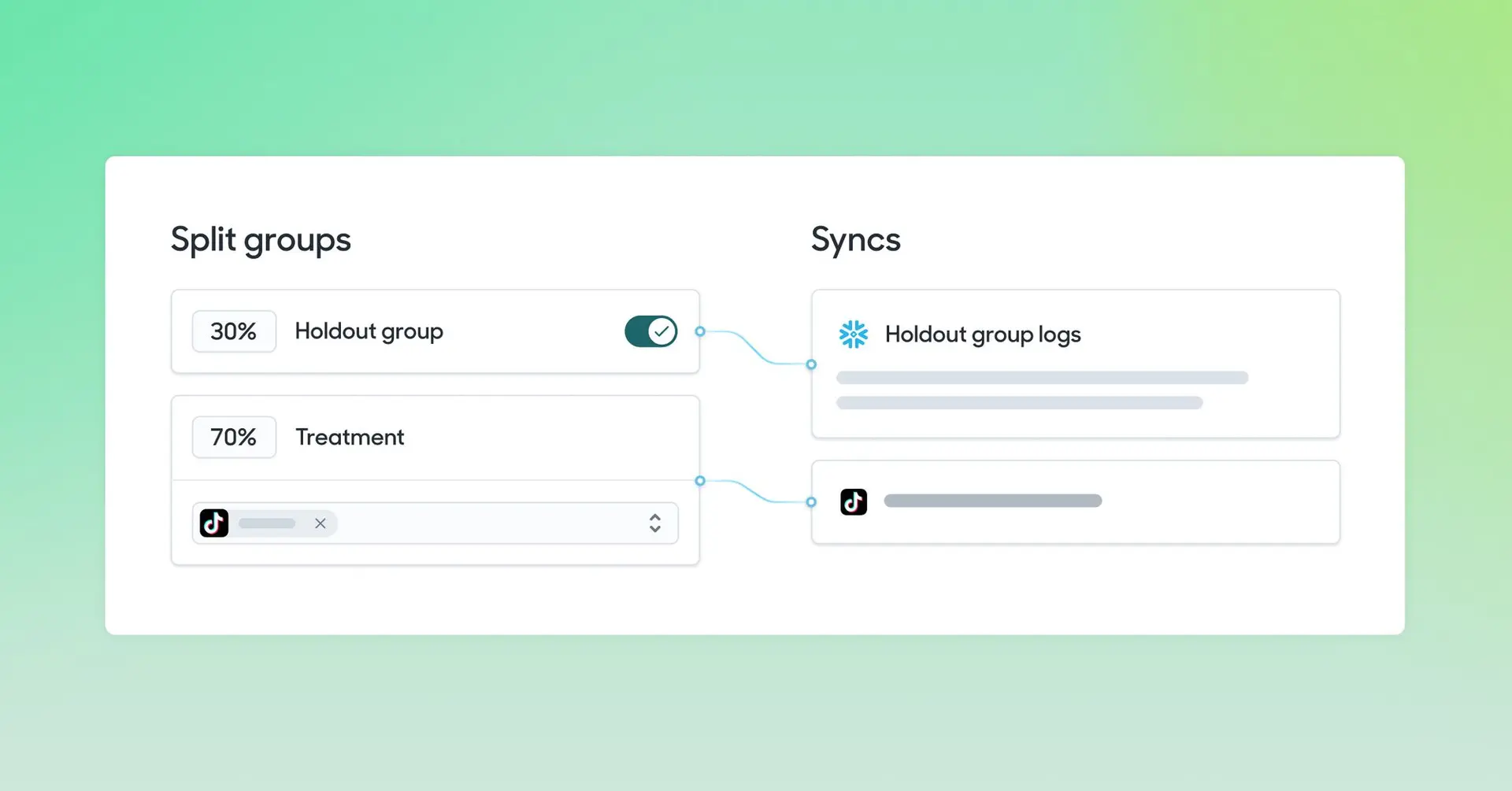
Audience Splits enable randomized multivariate testing with holdout groups built in the platform.
Source: Hightouch
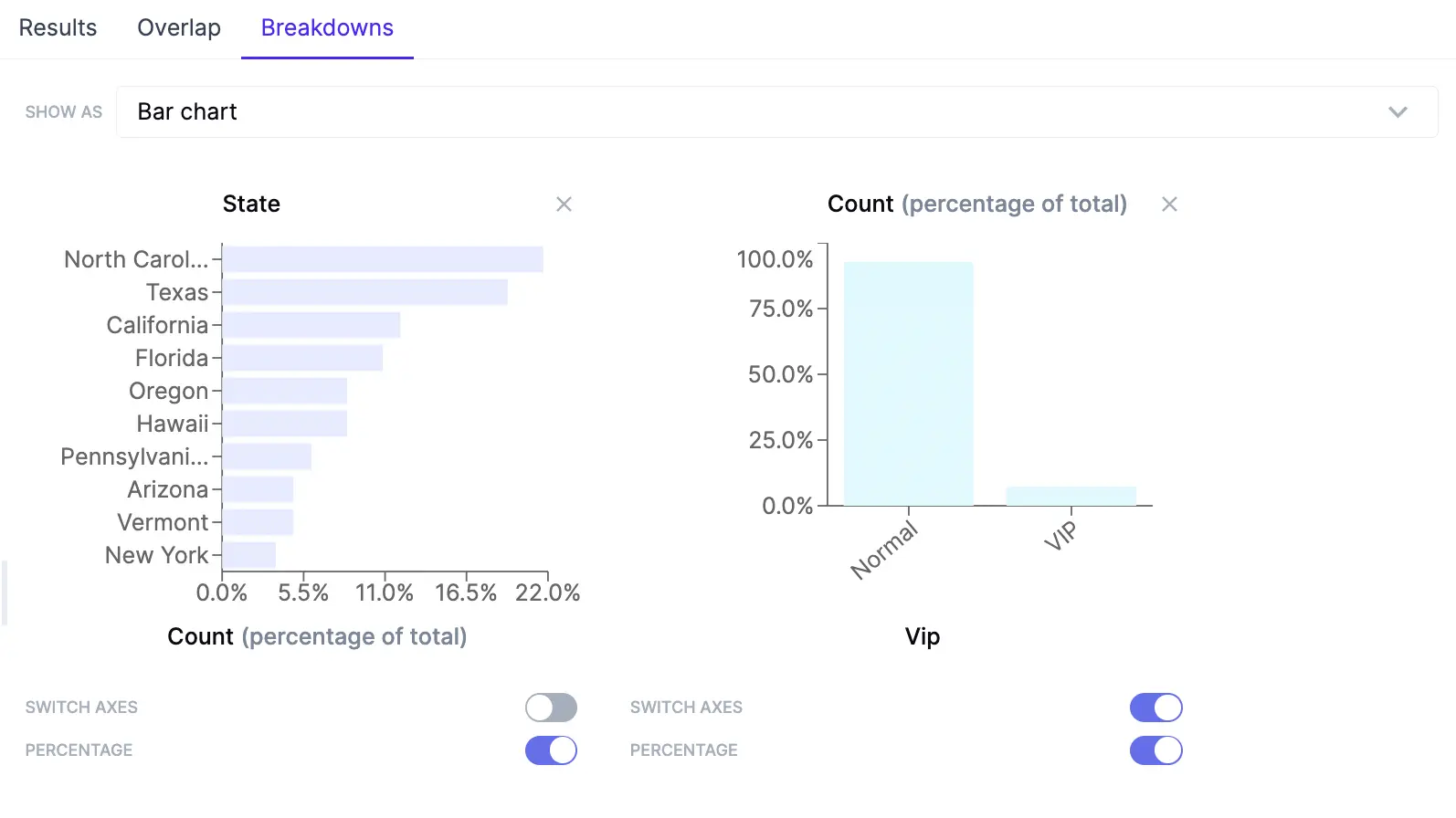
Audience Insights show the distribution of user characteristics within any segment and overlap percentages between audiences.
Source: Hightouch
Because Customer Studio reads from the warehouse without duplicating data, it can access any data object stored there: not just users and events, but product catalogs, financial data, ML model outputs, loyalty program data, and custom entities.
AI Decisioning: Reinforcement learning replaces manual campaign logic to optimize customer interactions autonomously.
AI Decisioning is Hightouch's newest product, announced alongside its February 2025 Series C. It replaces rule-based campaign logic with AI agents that learn which message, channel, timing, and creative works best for each customer.

Source: Hightouch
The system uses reinforcement learning with a contextual bandit approach rather than relying on large language models alone.
For each customer, the agent uses their full feature data as context to decide between exploiting a proven variant and exploring a new one.
LLMs play a supporting role, tagging content semantically so the RL model can generalize learnings across message categories.
Setting up AI Decisioning follows three steps: define a goal (re-engagement, cross-sell conversions, loyalty activation), provide content templates and guardrails (approved messages, frequency caps, send volume thresholds), and let agents optimize continuously.
The system picks the best message, offer, channel, creative, timing, and frequency for each customer on a 1:1 basis, including deciding whether to send at all.
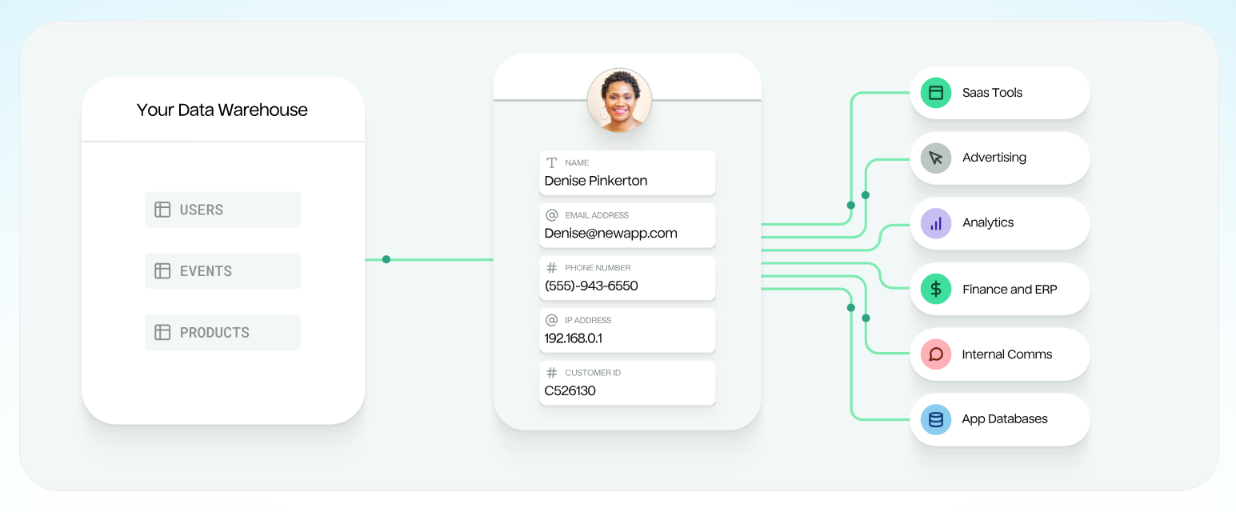
Identity Resolution and Real-Time Personalization: Hightouch stitches fragmented customer profiles and serves personalized experiences in under a second.
Identity Resolution addresses a common problem: customers interact across web, mobile, in-store, and support channels, generating different identifiers at each touchpoint. Hightouch resolves these fragmented records into unified profiles processed and stored inside the customer's own warehouse.
Source: Hightouch
The system supports both deterministic matching (exact identifier matches) and probabilistic matching (AI-powered fuzzy matching for messy data).
A visual rule builder lets teams configure match rules without code, and a Golden Record feature creates a canonical one-row-per-customer view with configurable survivorship rules.
Unlike traditional CDPs that run identity resolution in proprietary systems, Hightouch keeps the entire identity graph in the customer's warehouse.
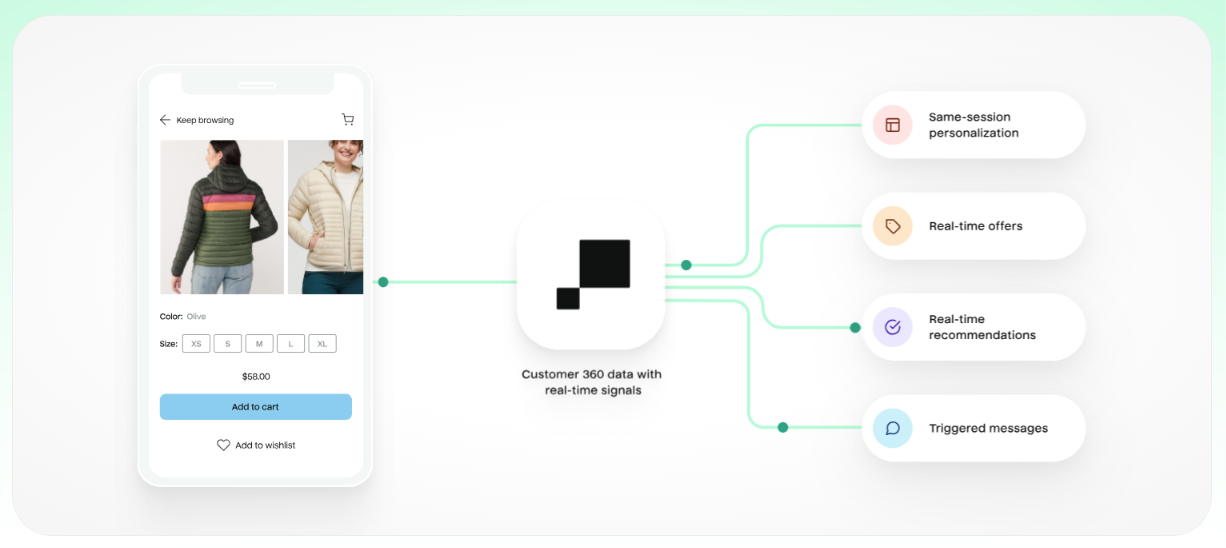
Real-time Personalization builds on this unified profile data to deliver sub-second experiences. The Personalization API materializes any SQL model into a distributed low-latency cache, serving responses at p99 latency under 30ms with peak throughput of 1 million requests per second.
Source: Hightouch
Same-session audiences merge live behavioral signals with historical Customer 360 data, enabling personalization based on what a user is doing right now combined with everything known about them from the warehouse.
Where Hightouch Falls Short
Hightouch excels at activating data that already exists in a warehouse. But several limitations surface depending on your team's needs and technical maturity.
Hard Dependency on a Mature Data Warehouse: Hightouch requires the customer to already have a cloud data warehouse with clean, well-modeled data.
Companies without a warehouse, or with poorly structured data, cannot use the product effectively. It has no fallback data store.
For organizations still building their data infrastructure, Hightouch is premature.
No Source Data of Its Own: Hightouch activates your data. It does not provide data. If your team needs B2B contact information, company intelligence, buyer intent signals, technographic data, or org charts, you must acquire that data from a separate provider and load it into your warehouse before Hightouch can do anything with it.
For B2B go-to-market teams, this is a significant gap: the platform can route and sync data, but it cannot tell you who to target or when they're in-market.
SQL Barrier for Advanced Use Cases: While Customer Studio provides a no-code audience builder, users note on G2 that complex logic and transformations still require SQL.
Non-technical marketing teams without data engineering support will hit this wall when their needs go beyond standard filtering.
Pricing Opacity and Escalation: The permanent free tier (2 active syncs) is useful for evaluation, but Composable CDP and AI Decisioning pricing is entirely quote-based with no published rates.
G2 reviewers flag that usage-based pricing can become steep as data volume and destination count increase, creating budget uncertainty for fast-growing companies.
No Native Message Sending: Hightouch does not send emails, push notifications, or SMS. It syncs data to tools that do the sending (Braze, Iterable, Salesforce Marketing Cloud).
Teams that want a single platform for both data management and campaign execution need to maintain and pay for separate messaging tools.
Audience Governance Growing Pains: As companies build hundreds or thousands of audiences, users report the need for better governance tooling: consistent naming conventions, tagging systems, version control, and search functionality to manage large audience libraries without manual overhead.
These limitations reflect Hightouch's design philosophy: do one thing well (data activation) and rely on best-of-breed tools for everything else. But for B2B teams that also need the data itself, plus intelligence on when and why to engage prospects, this philosophy leaves gaps that require additional platforms to fill.
Top Hightouch Alternative for B2B Go-to-Market Teams: ZoomInfo
ZoomInfo is a GTM platform that combines B2B data, intelligence, and execution tools: 500M contacts, 100M companies, 135M+ verified phone numbers, and 200M+ verified business emails.
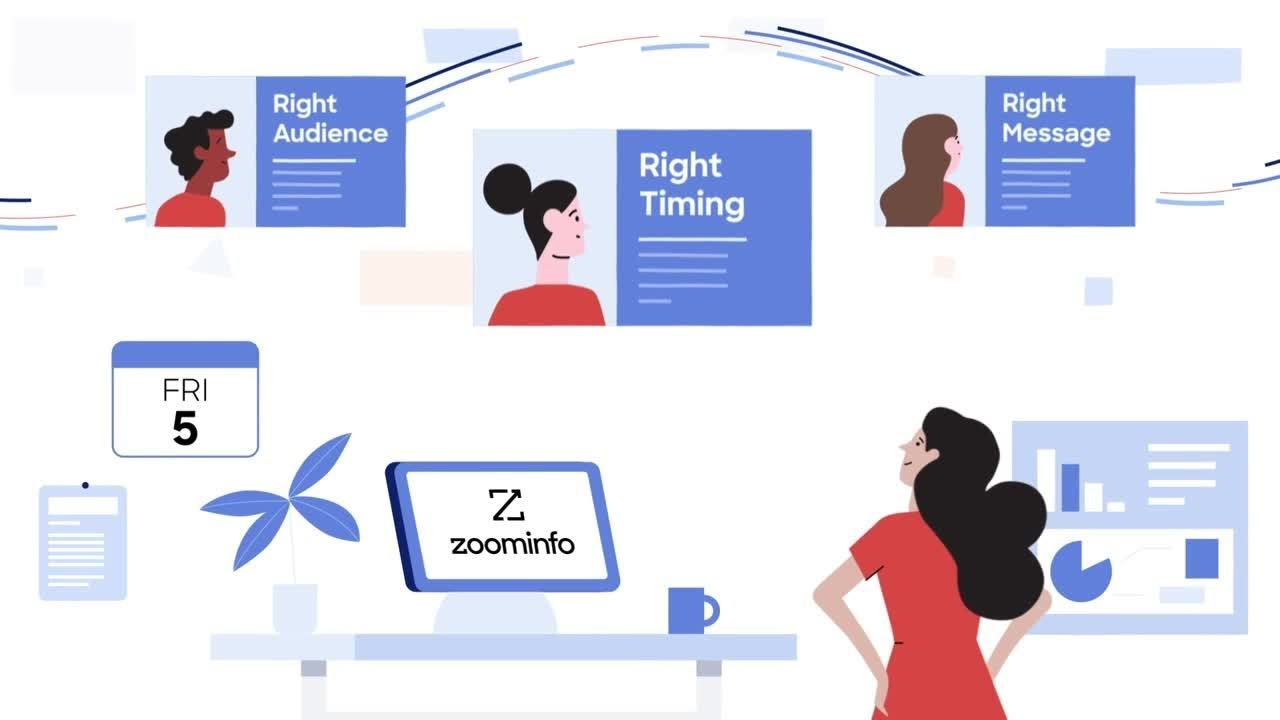
Where Hightouch activates data already in your warehouse, ZoomInfo provides the data itself, layers intelligence on top through the GTM Context Graph, and delivers it through GTM Workspace for sellers, GTM Studio for marketers and RevOps, and APIs and MCP for any tool or AI agent.
Comprehensive B2B Data: ZoomInfo provides the data foundation that warehouse-native tools depend on others to supply.
The core difference between Hightouch and ZoomInfo starts at the data layer. Hightouch routes data. ZoomInfo creates it.
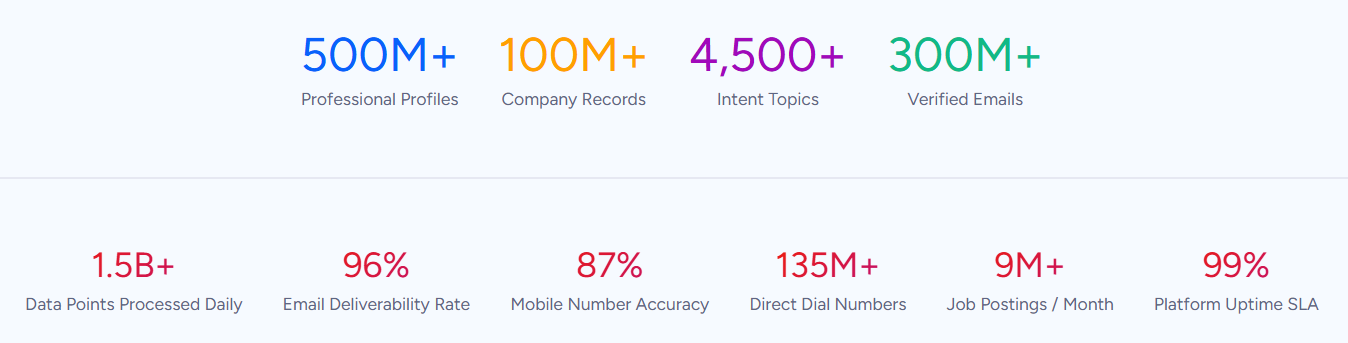
The platform maintains 500M contacts, 100M companies, 135M+ verified phone numbers, 120M direct-dial phone numbers, and 200M+ verified business email addresses.
Source: ZoomInfo
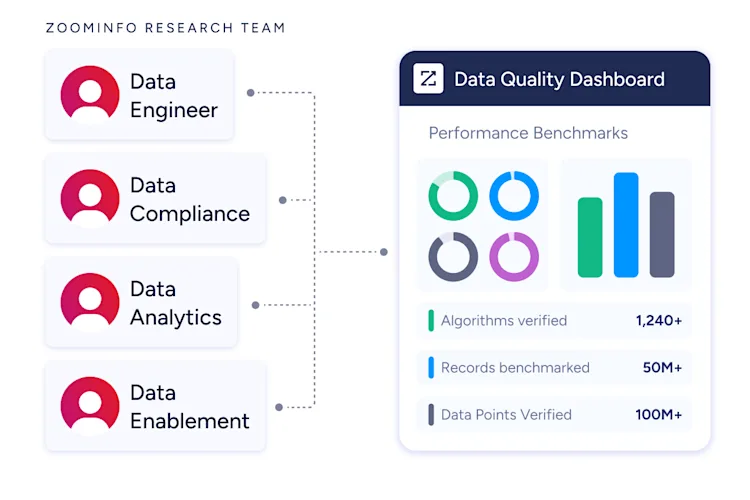
That data comes from a multi-source pipeline: automated ML scanning of 28 million site domains daily, third-party partners covering 95 million businesses, a community of 200,000+ users who share contact info from email signatures, and 300+ human researchers. First-party data hits up to 95% accuracy.
Source: ZoomInfo
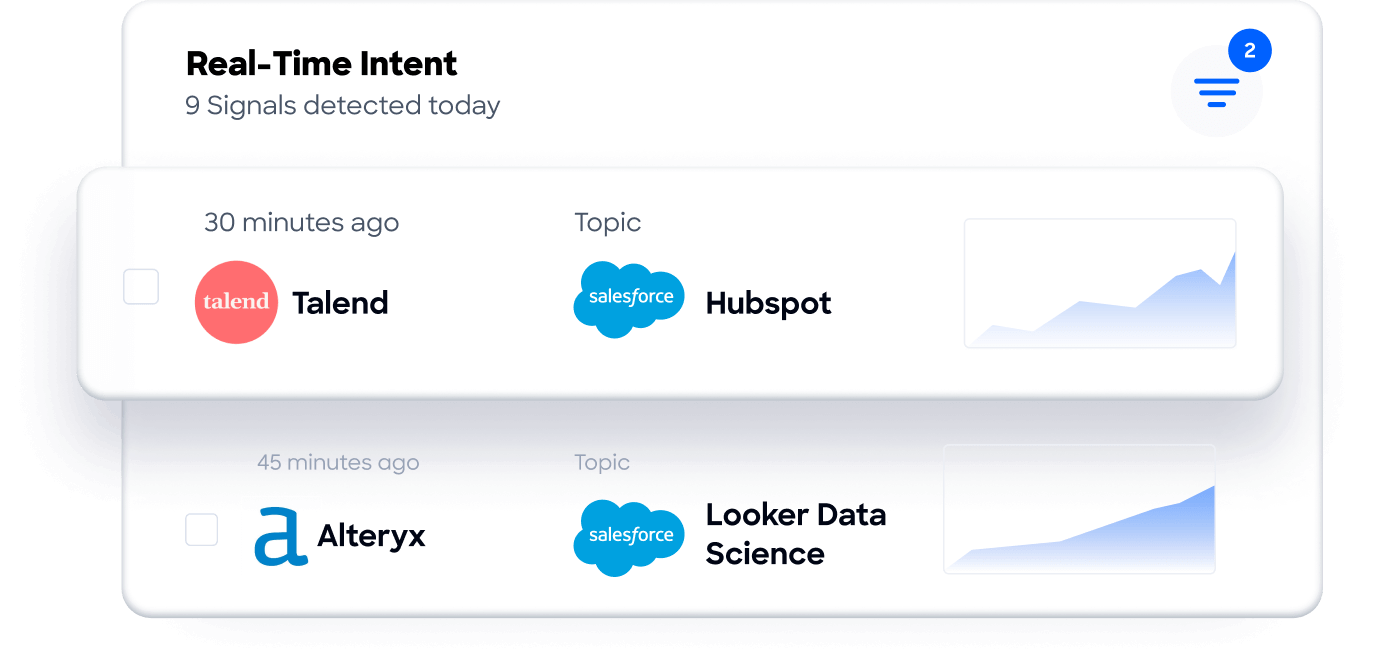
Beyond contacts and companies, ZoomInfo provides buyer intent data tracking signals from 210 million IP-to-Organization pairings and 6 trillion+ new keyword-to-device pairings sourced monthly.
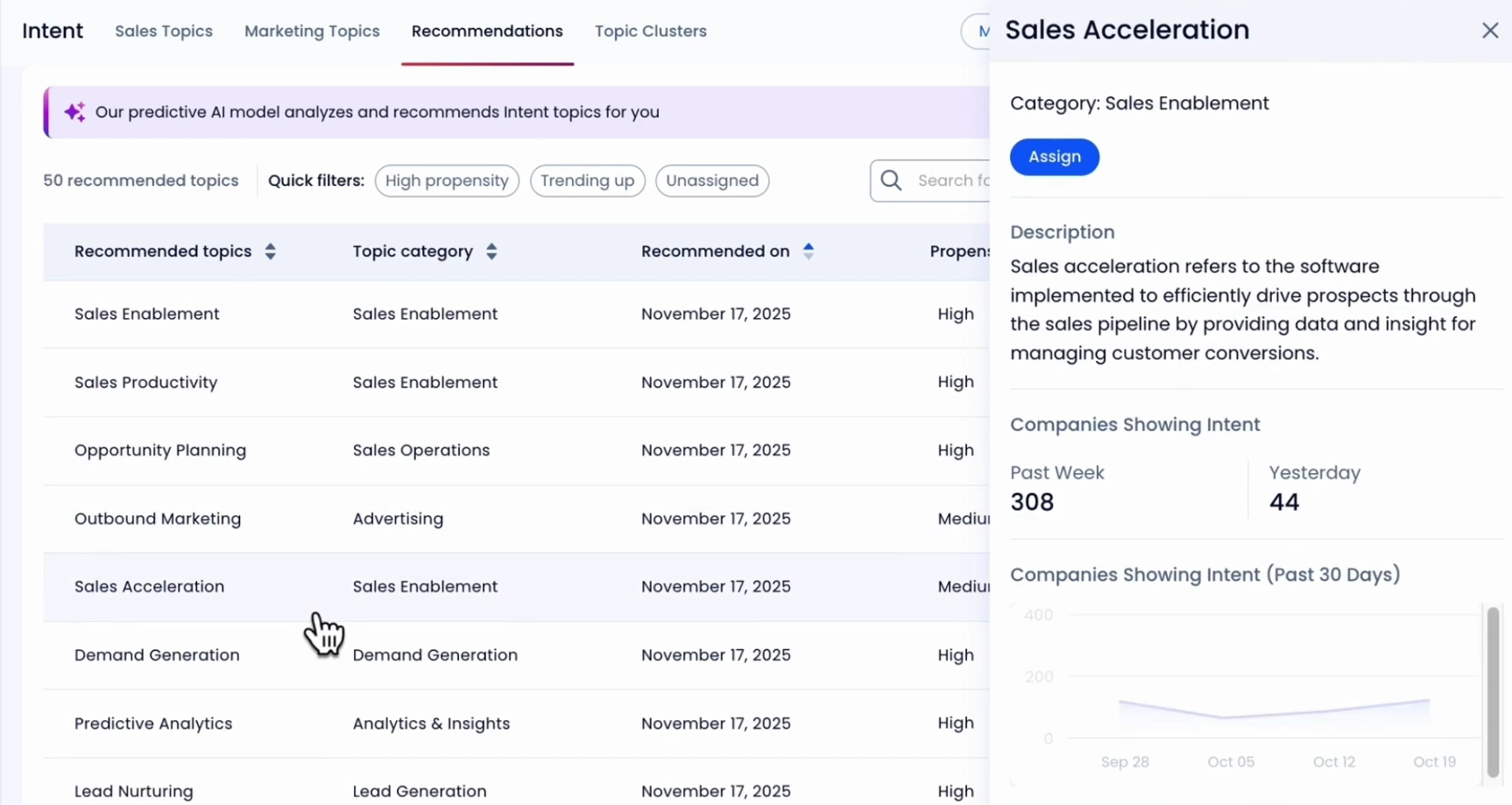
Guided Intent, exclusive to ZoomInfo, identifies topics historically correlated with deal success rather than requiring manual topic selection. Technographic profiles cover the tech stacks of 30+ million companies across 30,000+ technologies.
Source: ZoomInfo
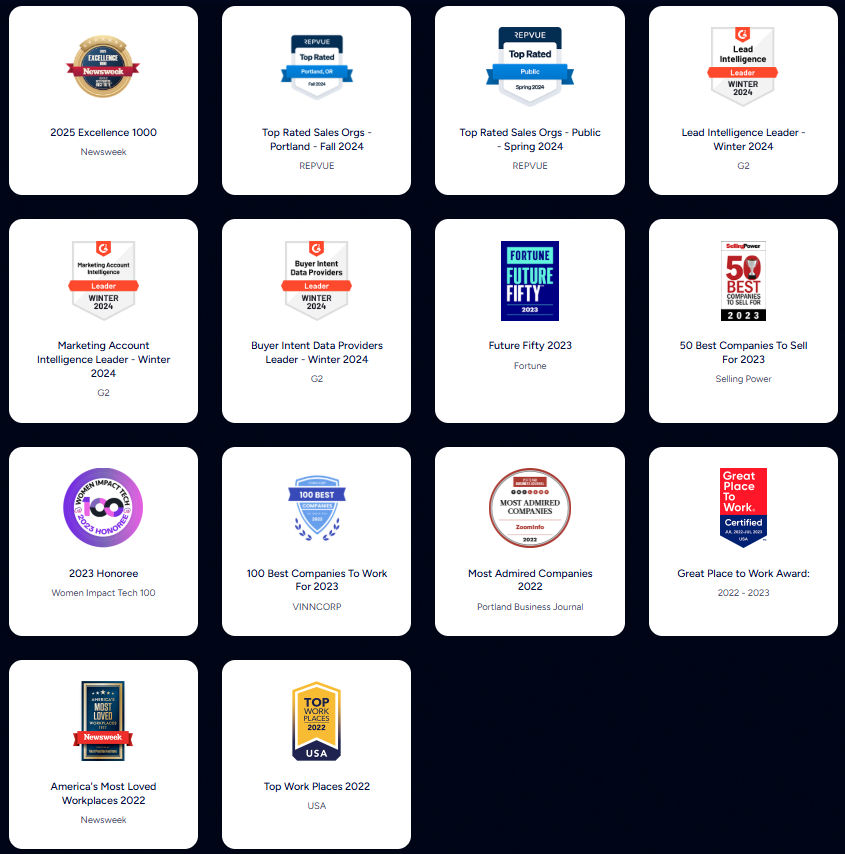
This isn't self-assessed. In a Fortune 500 competitive RFP analyzing 25 million contacts across vendors, the independent consultant concluded that "no other competitor came even close." ZoomInfo holds 133 No. 1 rankings on G2 across Sales Intelligence, Buyer Intent, and Data Quality categories.
SpringDB achieved 2x–3x campaign conversion increases, a 300% improvement in database usability, and 30–50% uplift in average deal size using ZoomInfo's enriched data for precise targeting. (SpringDB Case Study)
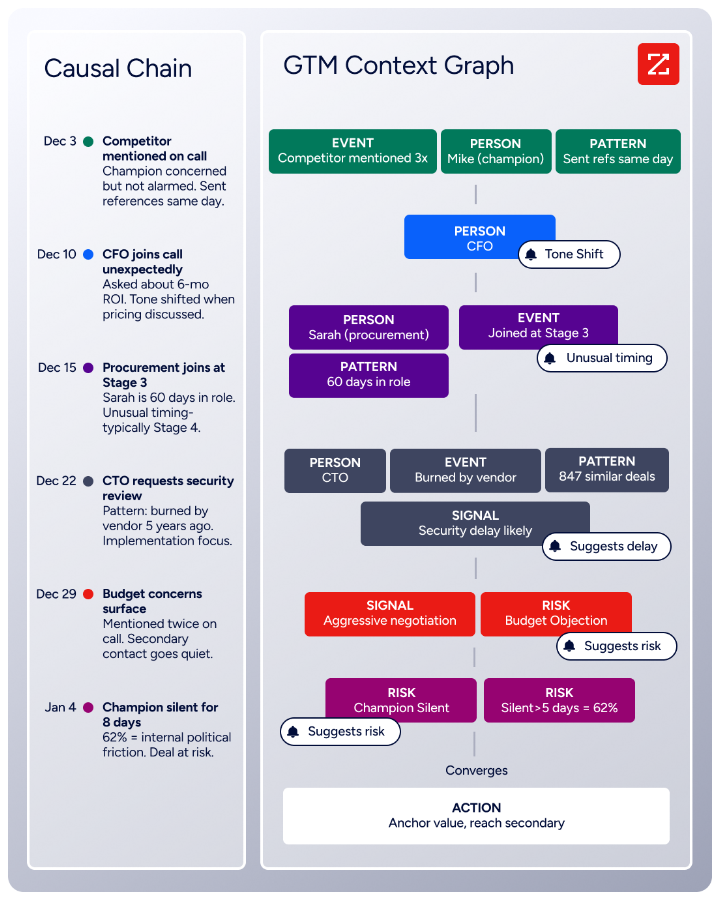
GTM Context Graph: ZoomInfo's intelligence layer captures not just what happened in a deal, but why it happened.
Hightouch's AI Decisioning optimizes marketing messages using reinforcement learning on first-party data. ZoomInfo's GTM Context Graph serves a different purpose: it combines third-party B2B intelligence with a customer's CRM records, conversation transcripts, email threads, and behavioral signals into a single intelligence layer.
Source: ZoomInfo
As ZoomInfo's Chief Product Officer Dominik Facher writes: "The CRM recorded the state change. It has no record of why it happened." A deal stage moved from 3 to 4, but the CRM doesn't know that the CFO joining the last call and asking about six-month ROI is what accelerated it.
The GTM Context Graph processes 1.5B+ data points daily to make this context machine-readable, capturing relationships between people, outcomes of actions, patterns across thousands of deals, and why anomalies happen.
This intelligence powers every downstream action. AI-drafted outreach addresses the specific concerns surfaced in conversations. GTM plays target accounts whose signal combinations match actual win patterns. Forecasts weight deals by buying evidence rather than stage labels.
Seismic attributed 39% of active pipeline to opportunities identified or influenced by ZoomInfo signals, with the sales team reporting 54% productivity gains. (Seismic Case Study)
GTM Workspace and GTM Studio: ZoomInfo provides dedicated interfaces for sellers, marketers, and RevOps, not just a data pipe.
Hightouch syncs data to your existing marketing tools and lets those tools handle execution. ZoomInfo provides its own interfaces built on the GTM Context Graph.
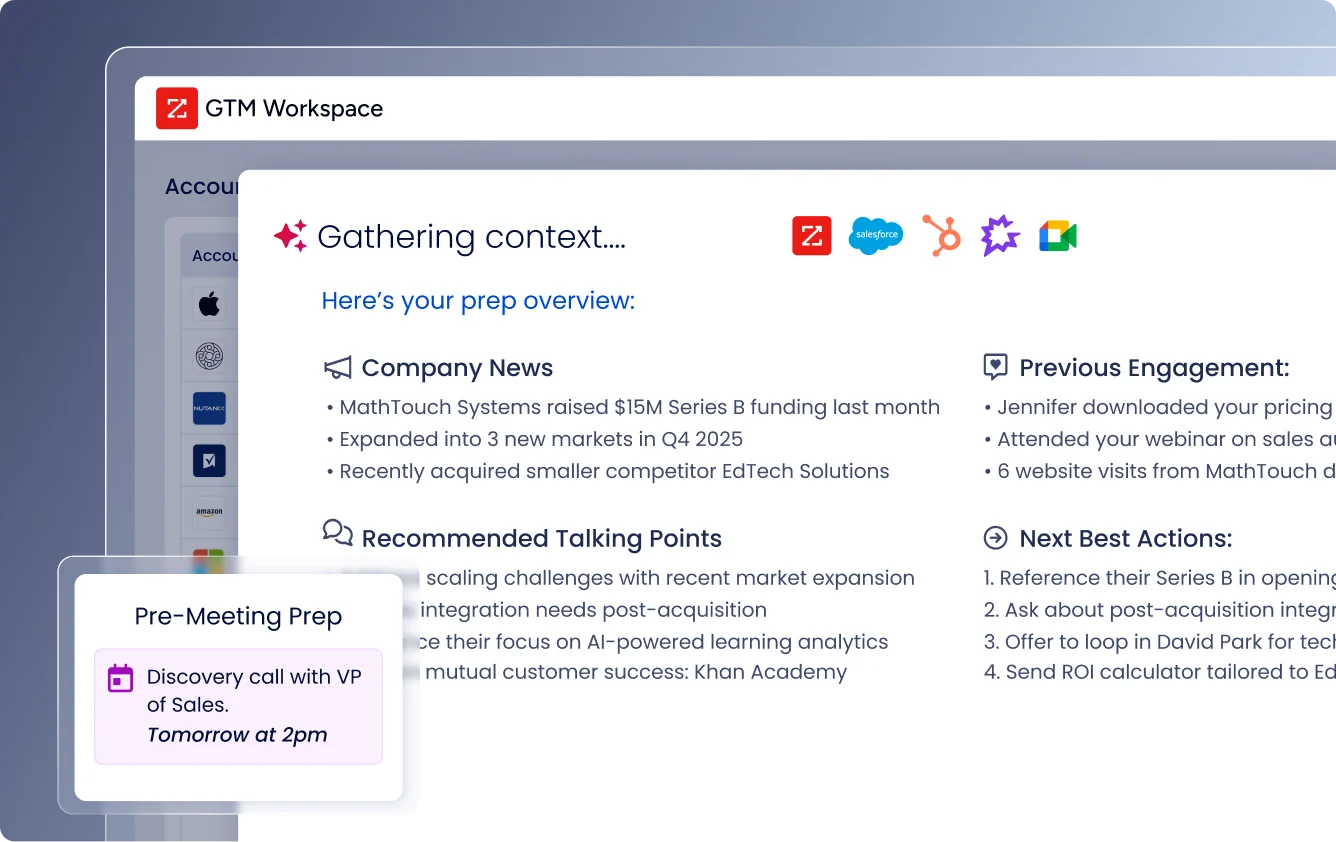
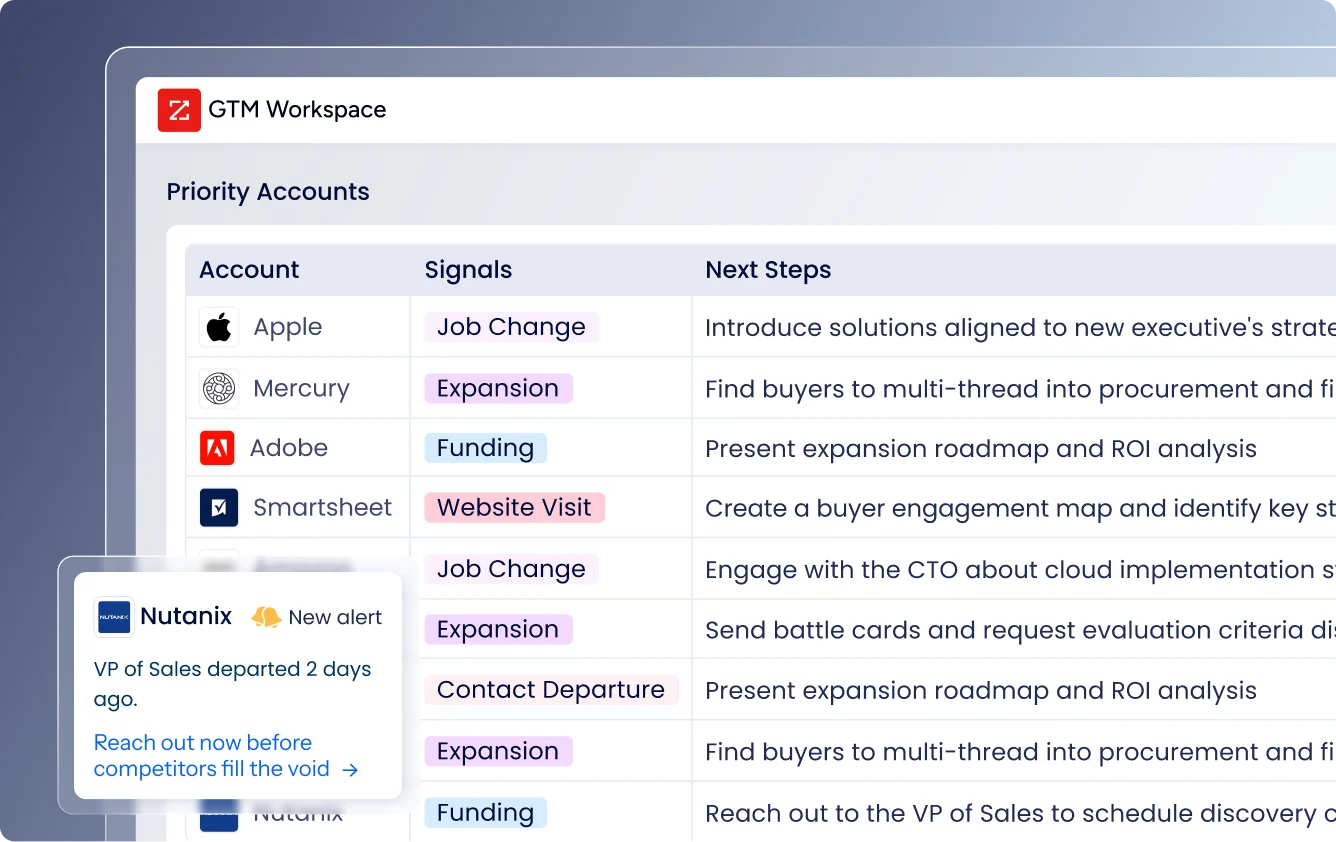
GTM Workspace gives sellers a single screen where prioritized accounts, AI-drafted outreach, deal context, and CRM updates converge.
Source: ZoomInfo
The AI agent inside Workspace (which evolved from ZoomInfo Copilot and is built on Anthropic's Claude) answers three questions for each rep: who to contact, when to engage, and what to say.
Source: ZoomInfo
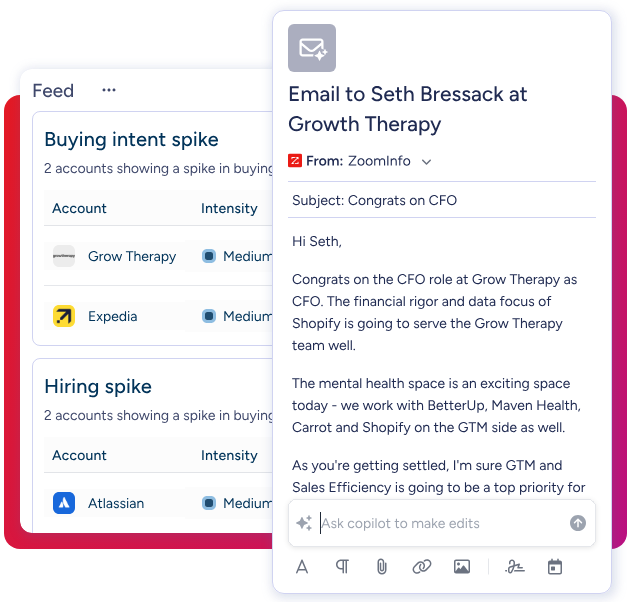
The Action Feed streams in-market buyers with pre-drafted actions on each signal. Views combine CRM data with real-time buying signals in a filterable interface.
Source: ZoomInfo
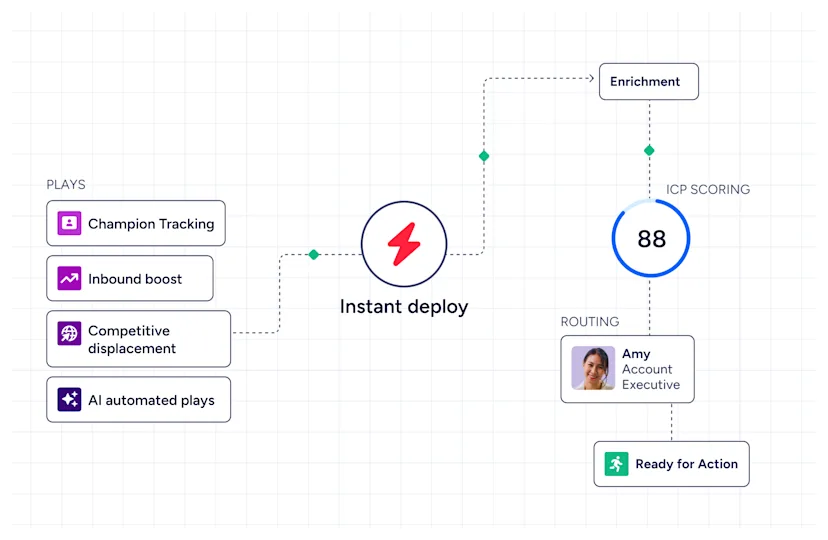
GTM Studio gives marketers, RevOps teams, and GTM engineers a canvas for designing audiences in natural language, launching multi-channel plays, and measuring pipeline impact.
Expansion plays that once took three weeks now launch in 30 minutes, and plays improve as clicks, opens, and replies feed back into targeting.
Source: ZoomInfo
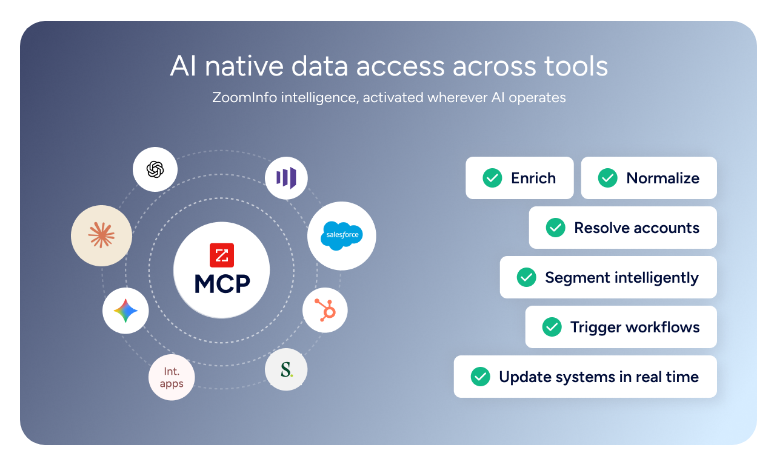
For teams that build beyond ZoomInfo's own products, APIs and MCP expose the same intelligence to any custom agent, internal tool, or partner platform. All three paths (Workspace, Studio, and APIs) draw from the same GTM Context Graph.
Source: ZoomInfo
"Anything that minimizes our team's need to switch contexts is beneficial. ZoomInfo offers a unified view, eliminating the need to navigate between systems." (Spekit Case Study)
Pricing: ZoomInfo uses consumption-based pricing with a permanent free tier and a 7-day trial.
ZoomInfo's pricing is consumption-based, scaling around data access, API consumption, and AI activity. Like Hightouch, there are no published dollar amounts for paid tiers.
The Sales product line has three tiers: Professional (contact and company data, CRM integrations, Chrome extension), Advanced (adds intent signals, Account Fit Score, automated workflows, GTM plays), and Enterprise (adds real-time intent, AI account summaries, advanced workflows, dedicated CSM). Marketing plans span Marketing Demand, ABM Lite, and ABM Enterprise.
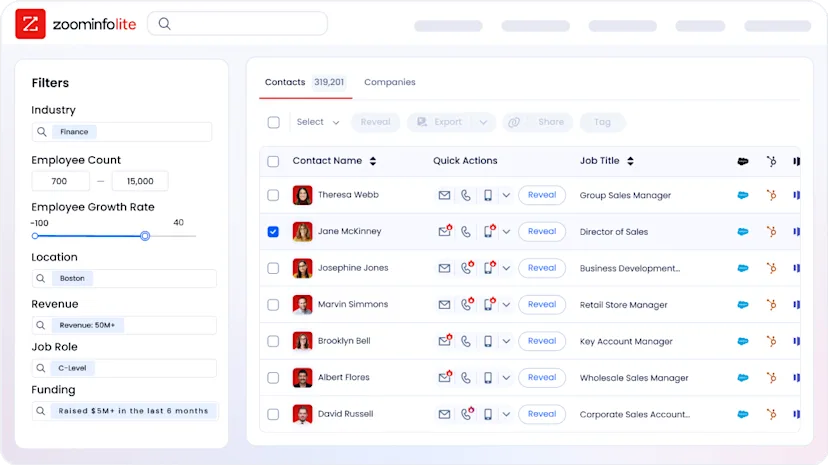
Two free entry points exist. ZoomInfo Lite is a permanent free tier (no credit card, no time limit) with access to ZoomInfo's B2B database, 10 monthly export credits, individual and company searches, the Chrome extension, and HubSpot integration.
Source: ZoomInfo
A separate 7-day free trial gives access to core platform features including intent signals and email outreach.
Hightouch or ZoomInfo: Comparison Summary
Hightouch | ZoomInfo | |
|---|---|---|
Primary focus | Warehouse-native data activation (CDP) | AI GTM platform (data + intelligence + execution) |
Data source | Activates your existing warehouse data | Provides 500M contacts, 100M companies, plus intent and technographic data |
Target audience | Enterprise marketing teams, data engineers | Sales, marketing, RevOps, and GTM engineers |
B2B prospecting data | Not included | 120M direct dials, 200M+ verified emails, org charts |
Buyer intent signals | Not included | 210M IP-to-Org pairings, 6T+ keyword-device signals monthly |
Audience building | No-code Customer Studio on warehouse data | GTM Studio with natural language audience creation |
AI capabilities | Reinforcement learning for marketing optimization | GTM Context Graph; AI agents for sales, marketing, and RevOps |
Conversation intelligence | Not included | Chorus (call recording, analysis, deal intelligence) |
Sales execution | Not included | GTM Workspace with AI-drafted outreach and deal management |
Message sending | Syncs to tools that send (Braze, Iterable, etc.) | Native email, advertising, and multi-channel orchestration |
Data warehouse requirement | Required (core dependency) | Optional (works with or without) |
Integrations | 250+ destinations | 120+ marketplace integrations plus API and MCP |
Free tier | 2 active syncs, permanently free | ZoomInfo Lite (permanent) + 7-day trial |
Pricing model | Usage-based on active syncs and data volume | Consumption-based on seats, credits, and AI activity |
Compliance | SOC 2 Type 2, ISO 27001, HIPAA, GDPR | ISO 27001, ISO 27701, SOC 2 Type II, TRUSTe GDPR & CCPA |
Final Verdict
The choice between Hightouch and ZoomInfo depends on what you need from a platform and where your data challenges actually lie.
Choose Hightouch if your organization already has a mature data warehouse and your primary challenge is getting that data into the hands of marketing teams without engineering bottlenecks.
Hightouch excels when you have rich first-party customer data in Snowflake or Databricks and need to sync it to marketing tools, ad platforms, and CRMs with full governance and no duplication.
It's particularly strong for B2C companies with large customer bases running lifecycle marketing, loyalty activation, and personalization at scale. If your data infrastructure is solid and you want a modular CDP that respects your existing architecture, Hightouch delivers.
Choose ZoomInfo if your team needs more than data activation: you need the data itself, the intelligence to know when and why to engage, and the execution tools to act on it.
ZoomInfo is the stronger choice for B2B go-to-market teams that require contact and company data, buyer intent signals, conversation intelligence, and AI-powered sales and marketing execution in one platform.
Where Hightouch assumes data exists and focuses on routing it, ZoomInfo provides the data, builds intelligence on top of it through the GTM Context Graph, and delivers it through dedicated interfaces for sellers and marketers or through APIs and MCP for any third-party tool.
Get started with ZoomInfo here.
The distinction comes down to scope. Hightouch is a specialist: warehouse-native data activation done well. ZoomInfo is the broader platform: data, intelligence, and execution in one place. Teams that already have their data sorted and need clean activation will appreciate Hightouch's architecture. Teams that need the full go-to-market stack, from knowing who to target to knowing why a deal is moving, will find that ZoomInfo covers the ground Hightouch was never designed to reach.
Hightouch FAQ
What is Hightouch used for?
Hightouch is a customer data platform that syncs data from cloud data warehouses (Snowflake, Databricks, BigQuery, Redshift) to business tools like CRMs, marketing automation platforms, and ad networks.
Its core use cases include audience segmentation, reverse ETL, identity resolution, real-time personalization, and AI-driven marketing optimization.
It does not provide contact data or send messages itself. ZoomInfo, by contrast, provides B2B data (500M contacts, 100M companies) and includes native execution tools for sales and marketing alongside data activation.
Does Hightouch have a free plan?
Yes. Hightouch offers a permanent free tier that includes 2 active syncs per month, unlimited destinations, and unlimited user seats. Sync frequency is limited to hourly on the free plan. The Composable CDP and AI Decisioning products require a quote-based paid plan.
ZoomInfo also offers a permanent free tier (ZoomInfo Lite) with access to its B2B database, 10 monthly export credits, and a Chrome extension, plus a separate 7-day free trial of paid features.
Does Hightouch require a data warehouse?
Yes. Hightouch's entire architecture depends on the customer already having a cloud data warehouse with well-modeled customer data. Without a warehouse, the platform cannot function. Companies without this infrastructure need to build it first or consider platforms that include their own data storage. ZoomInfo does not require a data warehouse; it maintains its own B2B database and can deliver data via its products, APIs, or directly into cloud data platforms.
What makes Hightouch different from traditional CDPs like Segment?
Traditional CDPs ingest and store data in their own proprietary systems, creating duplicate data stores. Hightouch operates on top of the customer's existing data warehouse, reading and activating data without copying it.
This eliminates data duplication, reduces security risk, and allows access to any data in the warehouse, not just users and events. The trade-off is that Hightouch depends on the warehouse being well-maintained and properly modeled.
How does Hightouch pricing work?
Hightouch uses usage-based pricing. The free tier covers 2 active syncs per month. The self-serve paid tier supports up to 10 active syncs (pricing not publicly disclosed).
The Composable CDP and AI Decisioning products are quote-based, with pricing tied to active syncs, data volume, and selected modules.
There are no MTU (Monthly Tracked User) caps or per-seat charges on paid plans, and customers can purchase modules individually rather than as a bundle.
Can non-technical marketers use Hightouch without SQL?
Customer Studio provides a visual, no-code audience builder that lets marketers create segments by filtering on events, attributes, and computed traits.
For standard audience building, SQL is not required. However, advanced transformations and complex logic still require SQL, which can block marketing teams without data engineering support.
ZoomInfo's GTM Studio takes a different approach, enabling audience creation through natural language prompts rather than visual filters or SQL.
What integrations does Hightouch support?
Hightouch supports 250+ integrations spanning ad platforms (Google Ads, Facebook, TikTok, LinkedIn), marketing automation (Braze, Iterable, Klaviyo, Marketo), CRMs (Salesforce, HubSpot), analytics (Amplitude, Mixpanel), and more.
It also integrates with data orchestration tools including dbt Cloud, Fivetran, Airflow, and Dagster. The platform offers a REST API, CLI, and Git sync for infrastructure-as-code workflows.
Does Hightouch include buyer intent data or sales prospecting tools?
No. Hightouch is a data activation platform, not a data provider. It does not include B2B contact databases, buyer intent signals, technographic data, or sales prospecting tools.
Teams that need these capabilities must source them separately and load the data into their warehouse before Hightouch can activate it.
ZoomInfo provides all of these natively, tracking intent signals from 210 million IP-to-Organization pairings and maintaining verified contact data for 500 million professionals.
More Hightouch comparisons:
