
Choosing between HubSpot and noCRM for your sales team comes down to five questions:
Do you need a full customer platform covering marketing, sales, and service, or just a tool that keeps your pipeline moving?
Is your priority managing customer journeys across departments, or making sure no follow-up falls through the cracks?
Do you have the budget and team to implement a multi-hub CRM, or do you need something reps can use on day one?
How important is knowing which prospects are researching solutions like yours before you reach out?
Do you want to build your own sales intelligence inside a CRM, or start with verified buyer data and AI insights?
In short, here's what we recommend:
HubSpot is the all-in-one customer platform for growing companies that need marketing automation, sales pipeline management, customer service, and content creation under one roof. Its Smart CRM connects six product hubs through a shared data layer, and the Breeze AI layer automates tasks across all of them.
The tradeoff: pricing escalates quickly across hubs and seats, onboarding fees add thousands upfront, and the platform demands real investment in setup and training.
noCRM is a sales tool for small teams that want pipeline clarity without CRM overhead. Built around a lead-first philosophy where the only required field is a title, it enforces a next-step discipline that keeps reps selling rather than filling forms. Setup takes hours, not weeks.
The tool captures leads from WhatsApp, phone, email, web forms, and business card scans, and its 4.8 Trustpilot score across 4,500+ reviews reflects genuine satisfaction among small sales teams. The tradeoff: no marketing automation, limited reporting, and a scope confined to the sales pipeline.
Both platforms help you manage deals once you have them. HubSpot gives you a system for the entire customer lifecycle. noCRM gives you a fast, focused pipeline for closing. But neither solves the upstream problem that determines whether those deals are worth pursuing: knowing who your best buyers are, when they're ready, and how to reach them.
ZoomInfo is a GTM intelligence platform that answers those questions before you open your CRM. Its B2B data covers 500M contacts and 100M companies with up to 95% accuracy on first-party data, giving your team verified direct dials and emails instead of guesswork.
The GTM Context Graph fuses this data with your CRM records, conversation transcripts, and behavioral signals to reveal not just what's happening in your deals, but why. GTM Workspace gives sellers a place where prioritized accounts, drafted outreach, and deal execution converge. And for teams already using HubSpot or another CRM, ZoomInfo's APIs and MCP deliver the same intelligence into any tool.
If verified intelligence sounds like the missing piece, start with ZoomInfo's free trial.
HubSpot vs. noCRM vs. ZoomInfo at a glance
HubSpot | noCRM | ZoomInfo | |
|---|---|---|---|
Core approach | All-in-one CRM and customer platform | Lead-first sales pipeline tool | GTM intelligence platform |
B2B data and intelligence | CRM stores your data; AI enrichment from emails and calls | No native data enrichment; manage leads you already have | 500M contacts, 100M companies, buyer intent signals, technographics |
AI capabilities | Breeze AI across all hubs (several features in Beta) | AI help center search | GTM Context Graph with AI agents for prospecting, research, and outreach |
Pipeline management | Deal pipeline with forecasting and custom objects | Lead-first pipeline with enforced next-step discipline | GTM Workspace with AI-prioritized accounts and signal-driven action feeds |
Marketing tools | Full marketing automation suite | None | Account-based marketing, native display ads, audience targeting |
Integrations | 2,000+ app marketplace | 5,000+ via Zapier; native VoIP and email | 120+ native integrations, API and MCP access for any tool |
Pricing model | Per-seat, per-hub + onboarding fees | Per-seat, three tiers | Custom-quoted, consumption-based |
Free option | Permanent free CRM (limited features, 2 users) | 15-day free trial, no free plan | ZoomInfo Lite (permanent free tier) + 7-day full trial |
Best for | Growing companies needing unified marketing, sales, and service | Small sales teams wanting simple pipeline management | Revenue teams needing verified buyer intelligence and AI execution |
The philosophy gap: a full platform vs. just enough
HubSpot and noCRM start from opposite assumptions about what a sales team needs.
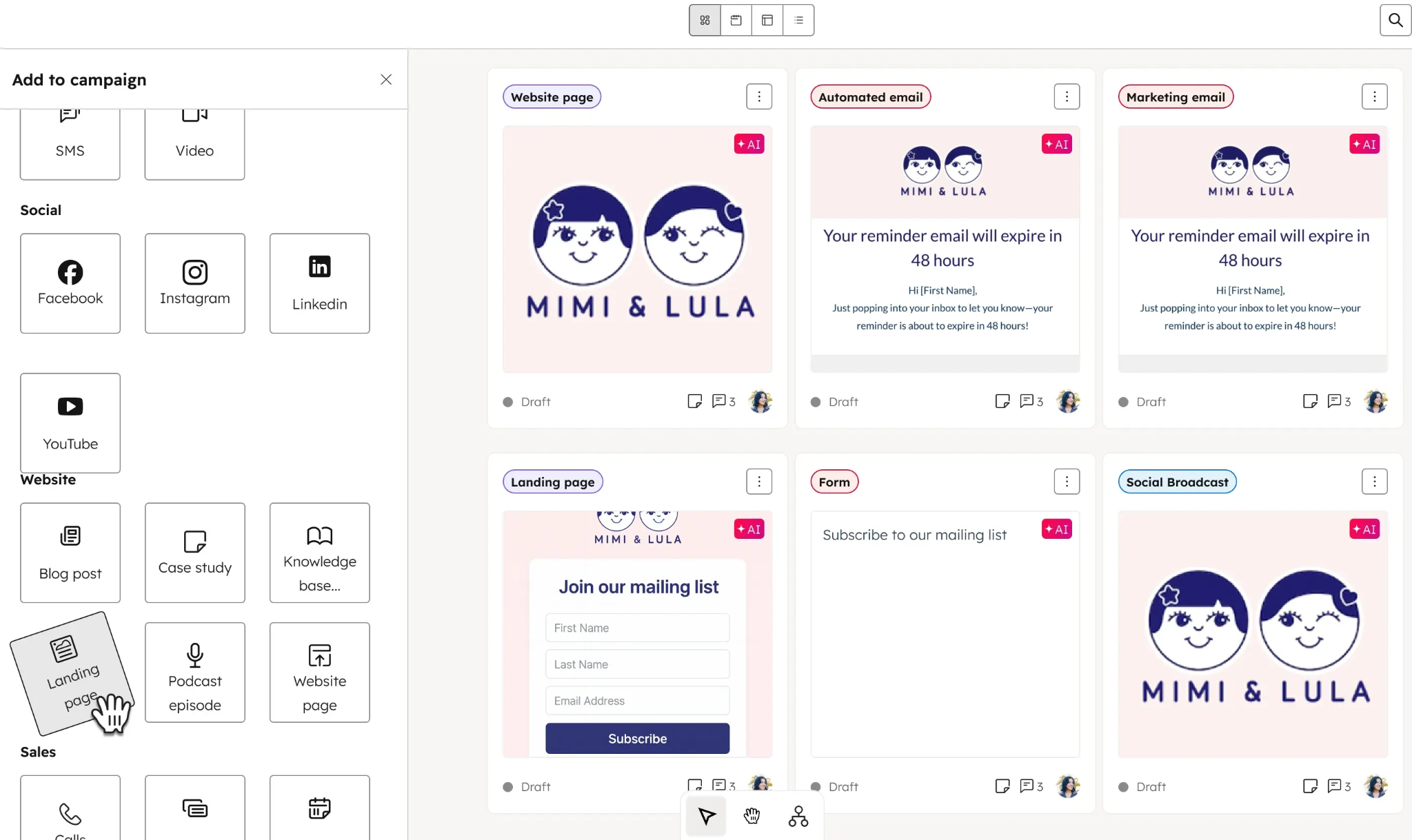
HubSpot assumes you need everything connected. Marketing generates leads, sales closes them, service retains them, and content keeps them engaged. The Smart CRM sits underneath all six hubs, so when you use two or more together, data connects automatically, letting you track the entire customer journey from first website visit to closed deal to renewed contract.
Source: HubSpot
For companies that operate across all these functions, HubSpot's shared data layer eliminates the syncing headaches of a multi-tool stack.
noCRM assumes you need none of that. Its philosophy starts with a blunt observation: "Salespeople hate CRMs." Traditional platforms force reps to build contact databases and navigate complex interfaces before they can sell. noCRM flips this by organizing everything around the live opportunity.
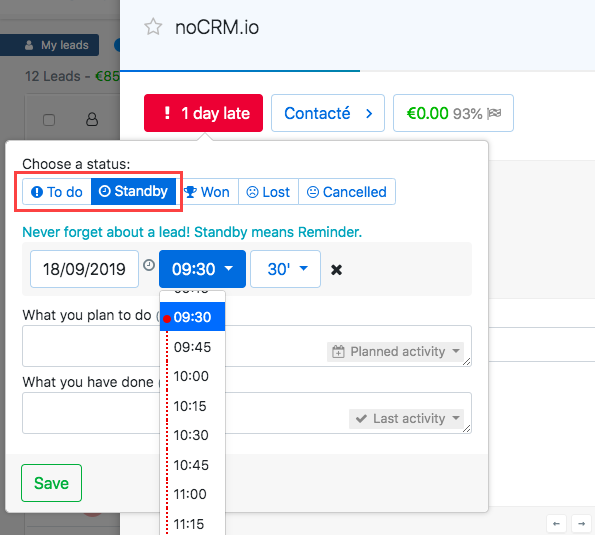
A rep creates a lead with nothing more than a title, sets a next action, and the system cycles the lead between To Do and Standby status based on reminder dates. The pipeline stays clean because only qualified leads enter it, while unqualified contacts sit in separate Prospecting Lists.
Source: noCRM
The gap between these philosophies is real. A 15-person B2B software company running inbound marketing, outbound sales, and post-sale onboarding benefits from HubSpot's connected hubs. A five-person insurance brokerage where reps make 40 calls a day will find HubSpot's breadth overwhelming and noCRM's focus liberating.
HubSpot wins on breadth, noCRM wins on speed
HubSpot's product suite is large. Marketing Hub handles email automation, social media, landing pages, and multi-touch attribution. Sales Hub covers pipelines, sequences, CPQ, and AI-guided selling. Service Hub manages ticketing, knowledge bases, and customer health scores.
Source: HubSpot
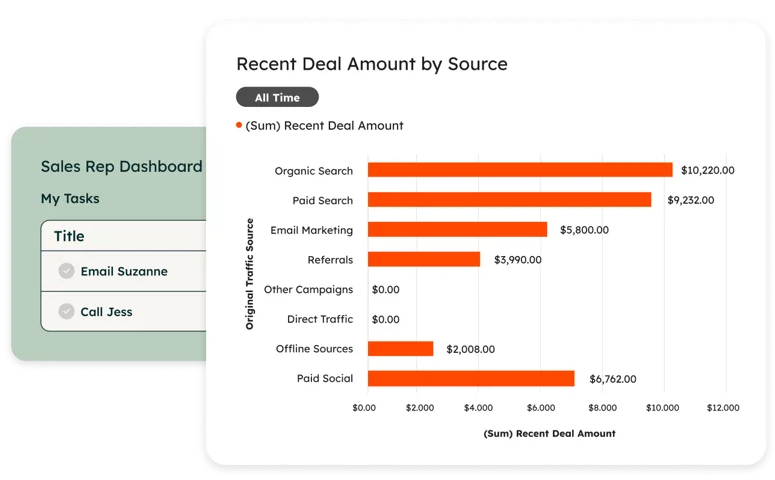
Content Hub, Data Hub, and Commerce Hub round out the platform with CMS, data management, and billing tools. The Breeze AI layer runs across all of them, with agents like the Prospecting Agent that drafts personalized outreach and the Customer Agent that reportedly resolves 65%+ of customer inquiries on its own.
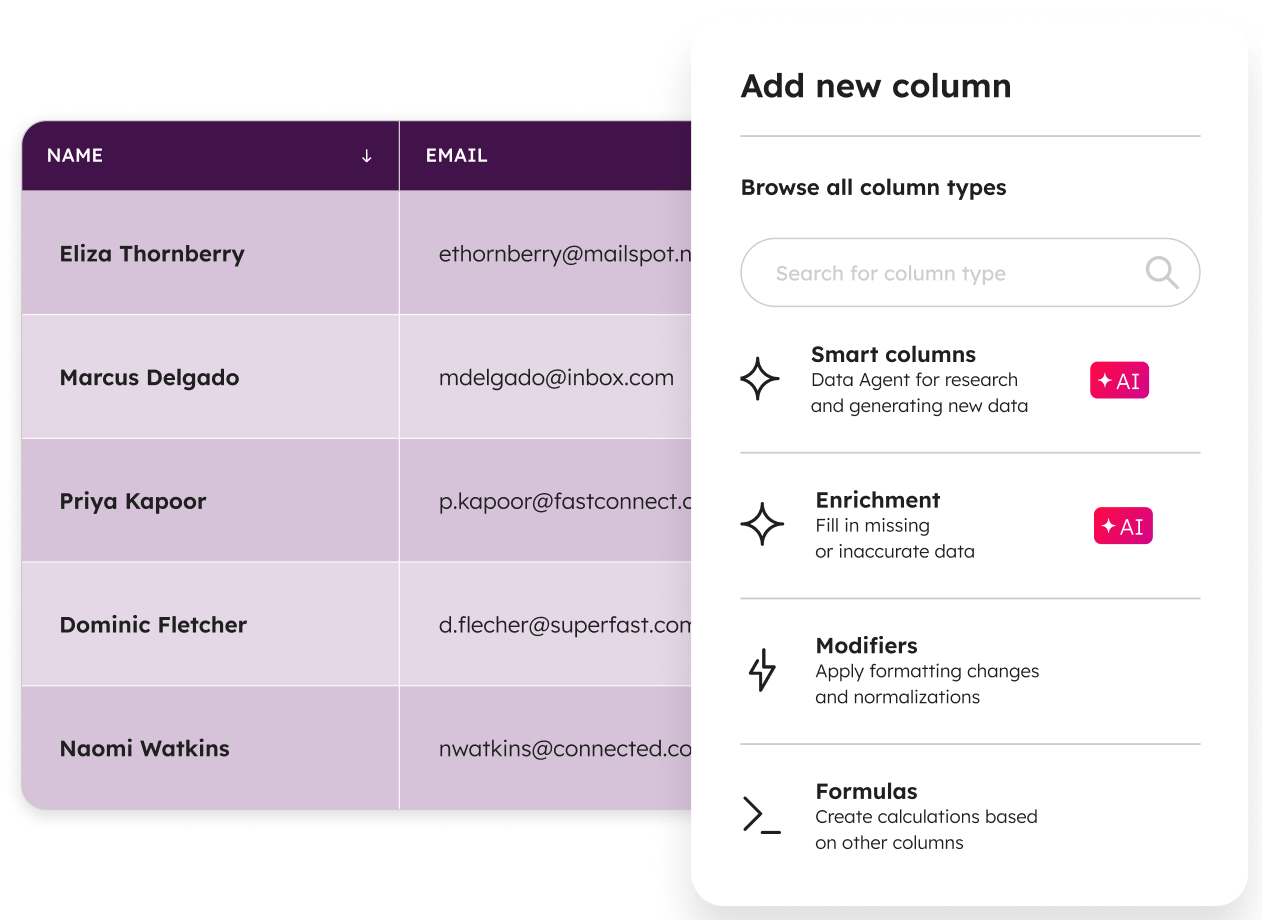
Source: HubSpot
This breadth is HubSpot's competitive advantage and its complexity tax. A company using Marketing Hub Professional, Sales Hub Professional, and Service Hub Professional faces a combined monthly cost well into the thousands, plus onboarding fees ($3,000 for Marketing Hub Professional, $1,500 each for Sales and Service Hub Professional).
And if you subscribe to multiple Hubs at different tiers, all Core Seats are billed at the rate of the highest tier, a pricing rule that catches many buyers off guard.
noCRM's strength is the inverse: it does less, so everything it does is faster. Capterra reviewers consistently cite minimal onboarding friction.
The visual drag-and-drop pipeline mirrors HubSpot's Kanban-style deal board, but without the surrounding ecosystem of hubs, custom objects, and workflow automations that require configuration. Reps capture leads from WhatsApp, phone, email, business card scanning, LinkedIn, and web pages and start selling immediately.
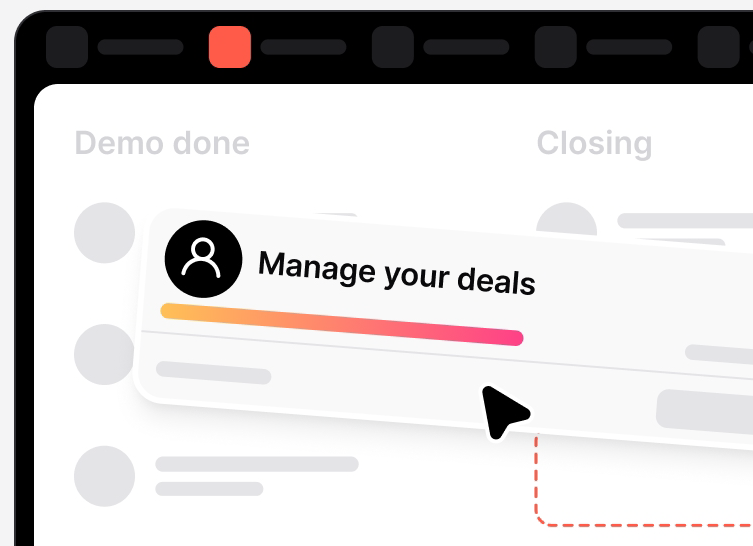
Source: noCRM
The telesales and outbound calling workflow deserves mention. With native integrations for CloudTalk, JustCall, and Aircall, noCRM supports one-click calling, automatic call logging, and AI-generated call summaries. Call Campaigns add structured outbound dialing with conditional lead assignment, making it practical for high-volume phone teams.
The intelligence gap neither platform fills
Here's what both platforms share: they manage deals you already know about. HubSpot's Smart CRM stores your contacts, tracks their behavior, and enriches records from emails and calls. noCRM tracks your pipeline and enforces follow-up discipline. Both assume you've already identified the right buyers.
But for B2B sales teams, the hardest part isn't managing the pipeline. It's filling it with the right opportunities. Who are the decision-makers at your target accounts? Are they researching solutions like yours? What's their tech stack? Did their VP of Sales just change jobs? These questions determine whether your outreach lands or gets ignored, and neither HubSpot nor noCRM answers them at scale.
HubSpot's Smart CRM does offer AI-powered data enrichment from emails, calls, and web data. That enrichment improves existing records, but it doesn't generate the intelligence a sales team needs to identify new accounts, verify contact accuracy, or detect buyer intent signals before a prospect visits your website.
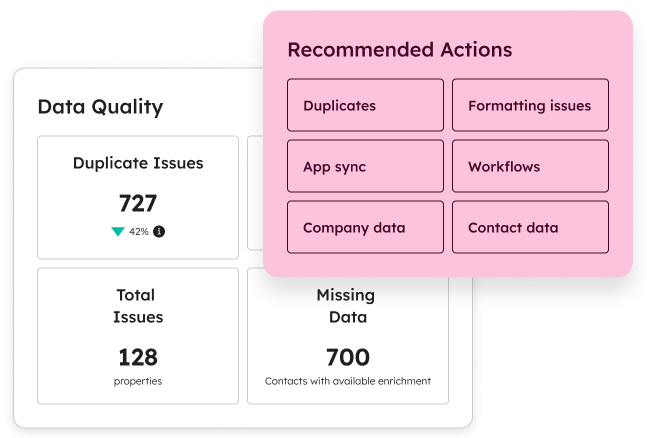
Source: HubSpot
noCRM is even more explicit about this boundary. It captures leads you encounter (via WhatsApp, web forms, phone calls), but it has no native data layer. It doesn't tell you who to call, what companies match your ideal customer profile, or which accounts are in-market. It manages the deal once you have it. Nothing more.
ZoomInfo solves the intelligence problem
This is where ZoomInfo changes the equation. Instead of waiting for buyers to come to you, ZoomInfo identifies them before they raise their hand.
The data covers three dimensions. Identity data tells you who the buyers are: 500M contacts, 135M+ verified phone numbers, 120M direct dials, and 200M+ verified business email addresses. Company context tells you where they work: 100M companies with org charts and technographics covering 30,000+ technologies across 200+ categories.
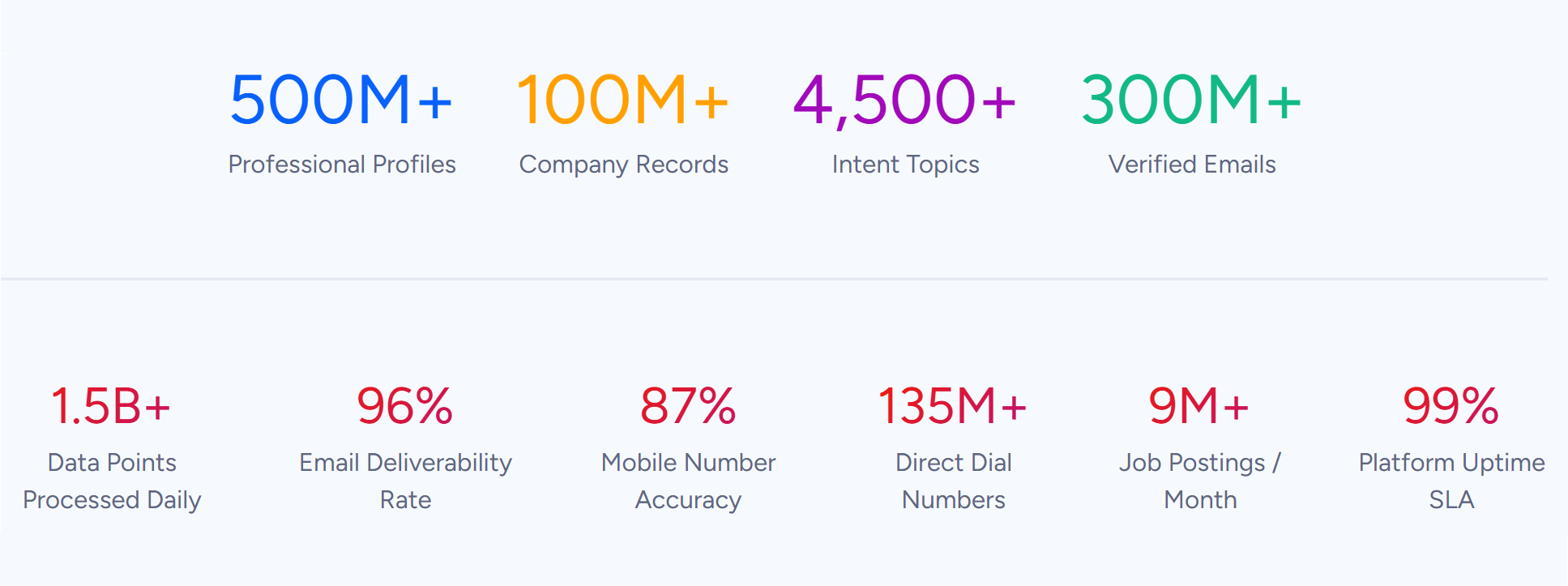
Source: ZoomInfo
Dynamic signals tell you when they're ready: buyer intent data tracking activity from 210 million IP-to-Organization pairings and 6 trillion+ keyword-to-device pairings sourced monthly. A multi-source pipeline backed by 300+ human researchers verifies this data at scale.

Source: ZoomInfo
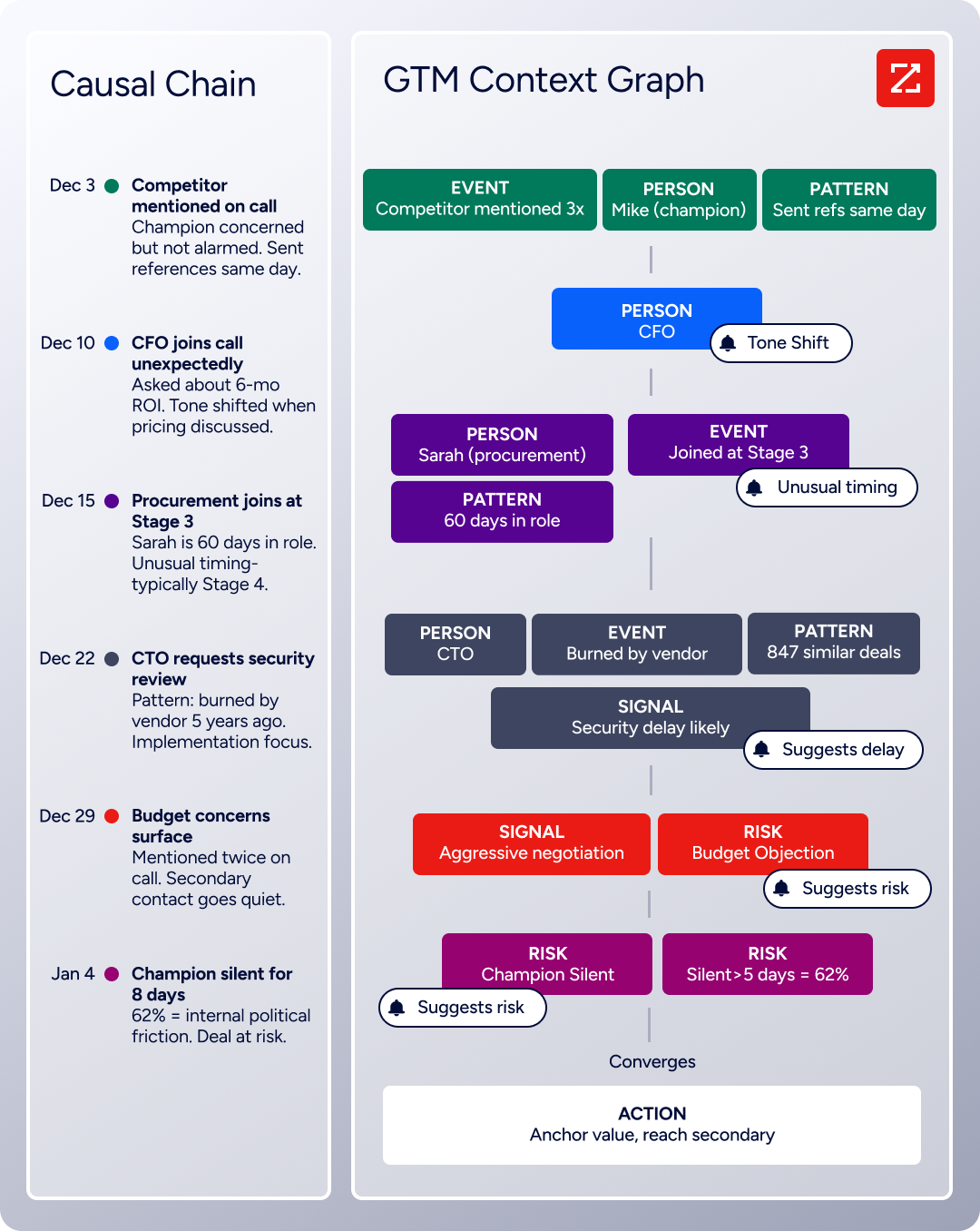
What makes this data useful beyond its volume is the GTM Context Graph, which processes 1.5B+ data points daily. It combines ZoomInfo's third-party intelligence with your CRM records, conversation transcripts, and behavioral signals to capture why deals move or stall.
Source: ZoomInfo
A CRM records that a deal advanced to Stage 4. The Context Graph reasons that executive sponsorship entering at that stage, combined with ROI-focused questions on the last call, matches the pattern behind closed-won deals in your segment.
That reasoning flows into every action downstream: the follow-up email addresses the specific concern raised, the play targets accounts whose signal combinations match your actual win patterns, and the forecast reflects buying evidence rather than stage labels.
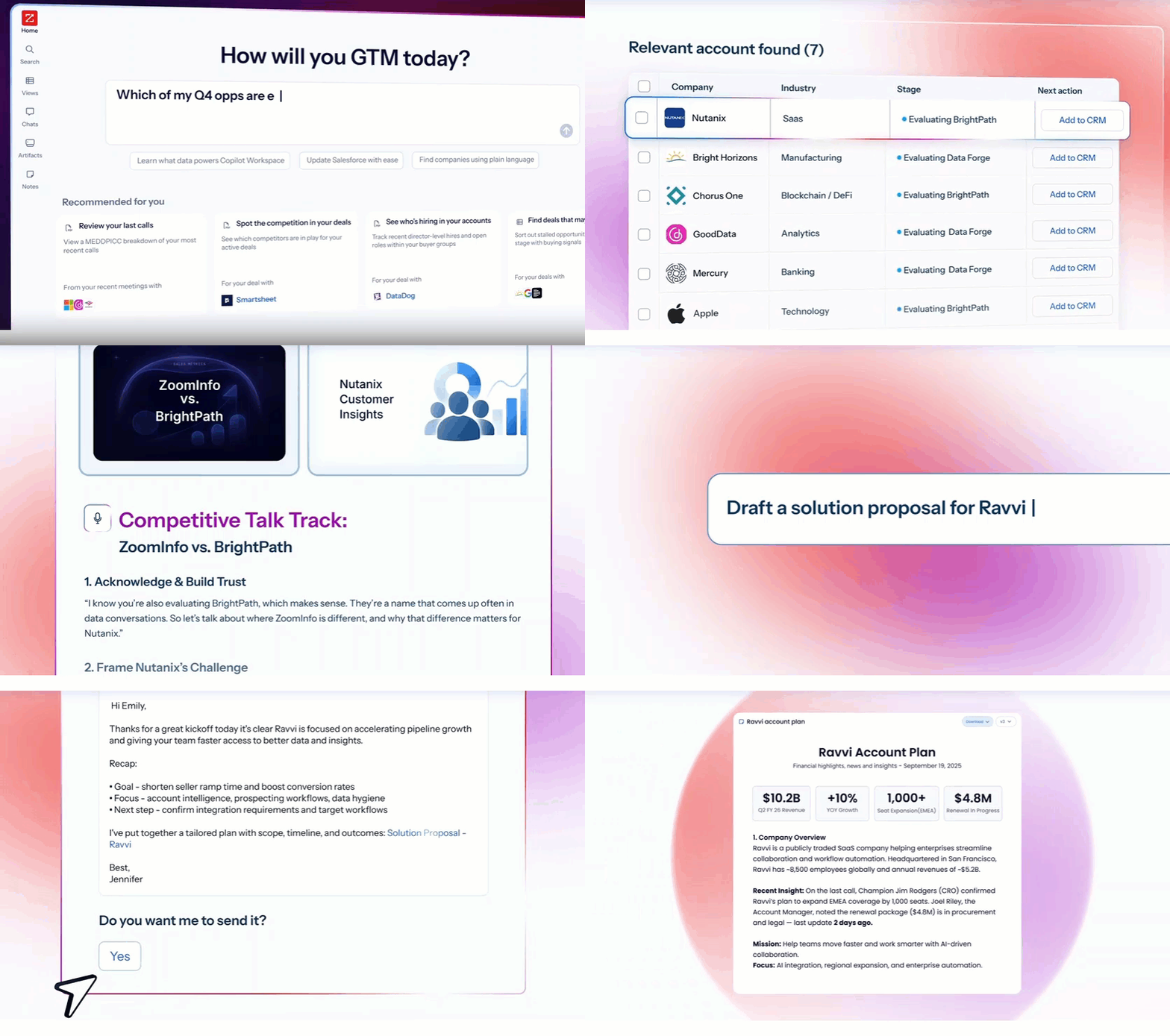
For sellers, GTM Workspace delivers this intelligence in one place. AI agents handle account research, draft outreach, monitor signals, and update CRM fields. The Action Feed streams in-market buyers matched to target criteria, with pre-drafted actions on every signal.
Source: ZoomInfo
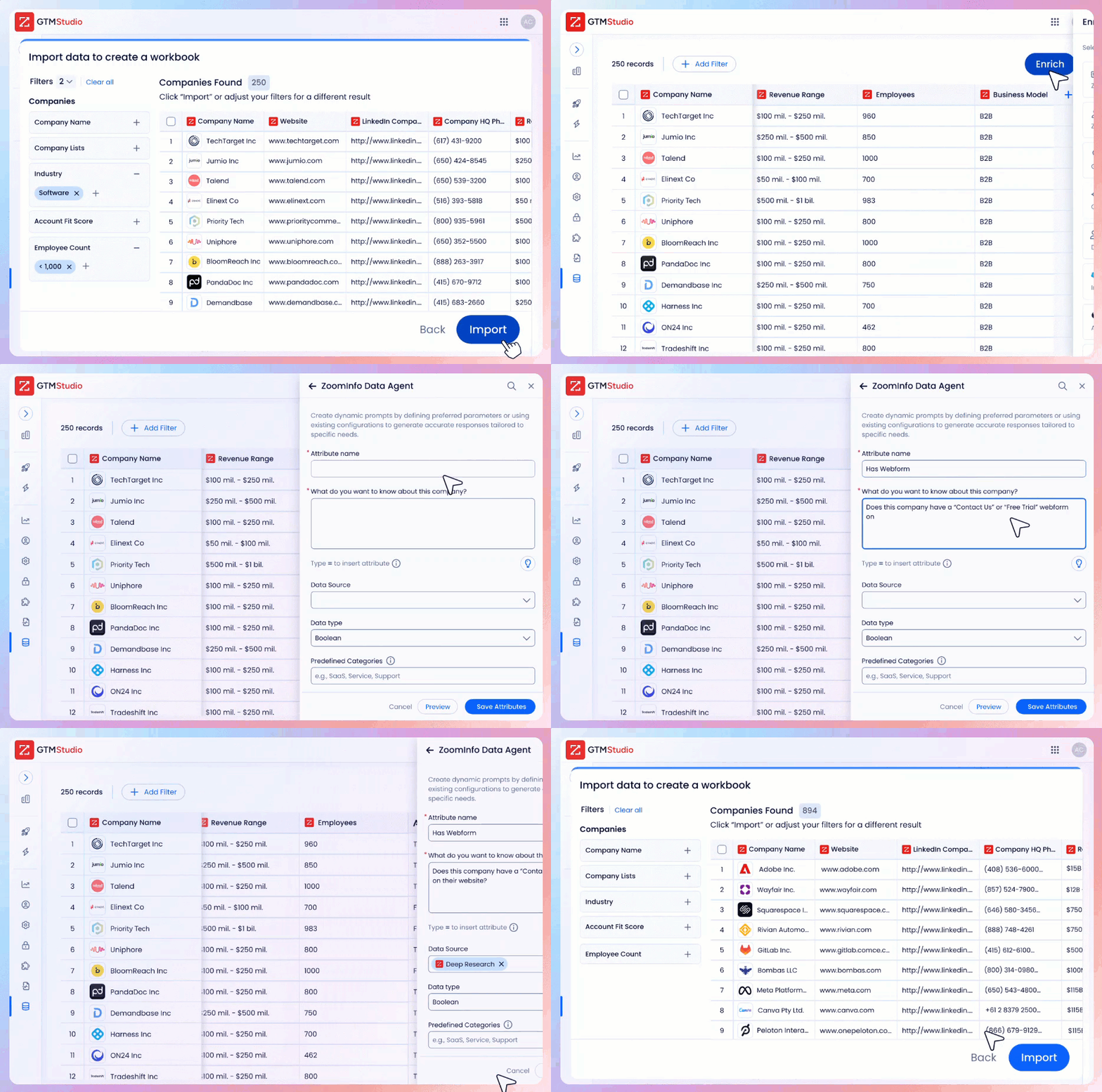
For marketers and RevOps, GTM Studio enables audience building and campaign execution in natural language, with expansion plays that once took 3 weeks now launching in 30 minutes.
Source: ZoomInfo
And for teams already using HubSpot, ZoomInfo integrates directly. The native HubSpot integration syncs verified contact data, intent signals, and enrichment into HubSpot's CRM. ZoomInfo's APIs and MCP extend this access to any tool, including custom agents built on Claude or ChatGPT.
For a deeper look at how HubSpot and ZoomInfo compare head-to-head, see our HubSpot vs. ZoomInfo comparison.
Seismic's sales team attributed 39% of active pipeline to opportunities identified or influenced by ZoomInfo signals and boosted productivity by 54%. As their Chief Business Officer put it: "That combination of our internal CRM data, external signals, and AI that's given all that context has helped us craft very specific account- and persona-based messages. And people have responded to them right away." (Seismic)
Pricing reflects different markets
The three platforms serve different budgets because they solve different problems.
HubSpot uses a hybrid model combining per-seat and per-hub pricing. The free CRM is useful for individuals, with unlimited contacts up to 1M records. But paid tiers escalate quickly.
Sales Hub Professional costs $100/seat/month (monthly) or $90/seat/month (annual) with a $1,500 one-time onboarding fee. Marketing Hub Professional runs $890/month (monthly) or $800/month (annual) with a $3,000 onboarding fee.
The Starter Customer Platform bundles all Starter hubs at $15/seat/month (annual), a reasonable entry point, but most growing teams outgrow Starter's limits within a year. You can only cancel at the end of the commitment term, not mid-contract.
noCRM uses straightforward per-seat pricing across three tiers: Starter, Expert, and Dream. The model is simple: all users in the same account must be on the same plan, annual billing saves up to 40%, and there are no onboarding fees, setup charges, or add-on products
The 15-day free trial (extendable to 30 days) includes full access to all features of the chosen tier. The main pricing catches: companies without a valid EU VAT number pay 20% French VAT, and wire transfer customers cannot access the discounted annual rate.
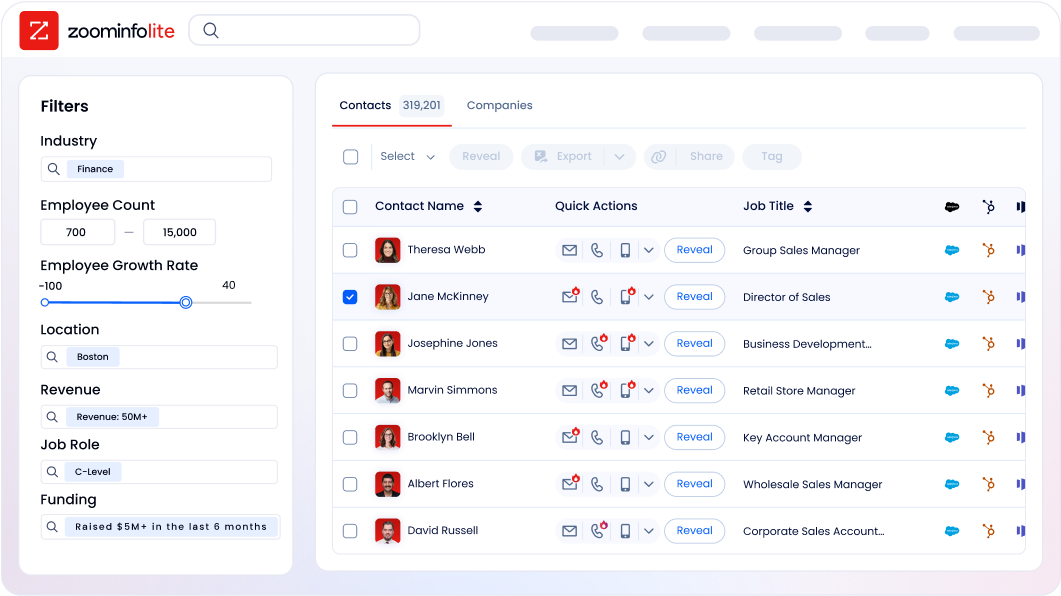
ZoomInfo uses custom-quoted, consumption-based pricing with no publicly listed prices. Costs scale around data access, API consumption, AI activity, and seats. The permanent ZoomInfo Lite free tier provides access to the B2B database with 10 monthly export credits, plus the Chrome extension, HubSpot integration, and WebSights Lite.
Source: ZoomInfo
A separate 7-day free trial unlocks the full platform. ZoomInfo costs more, but the returns are documented: Snowflake achieved 90% higher opportunity open rates and 2x higher customer conversion rates on accounts scored with ZoomInfo data.
Vensure scaled prospecting with ZoomInfo's verified data. Their VP of Revenue Operations noted: "ZoomInfo gives us the information we need to execute. We don't have to go through and spend our time digging. It's already there, so we can be three steps ahead." (Vensure)
Integration ecosystems tell different stories
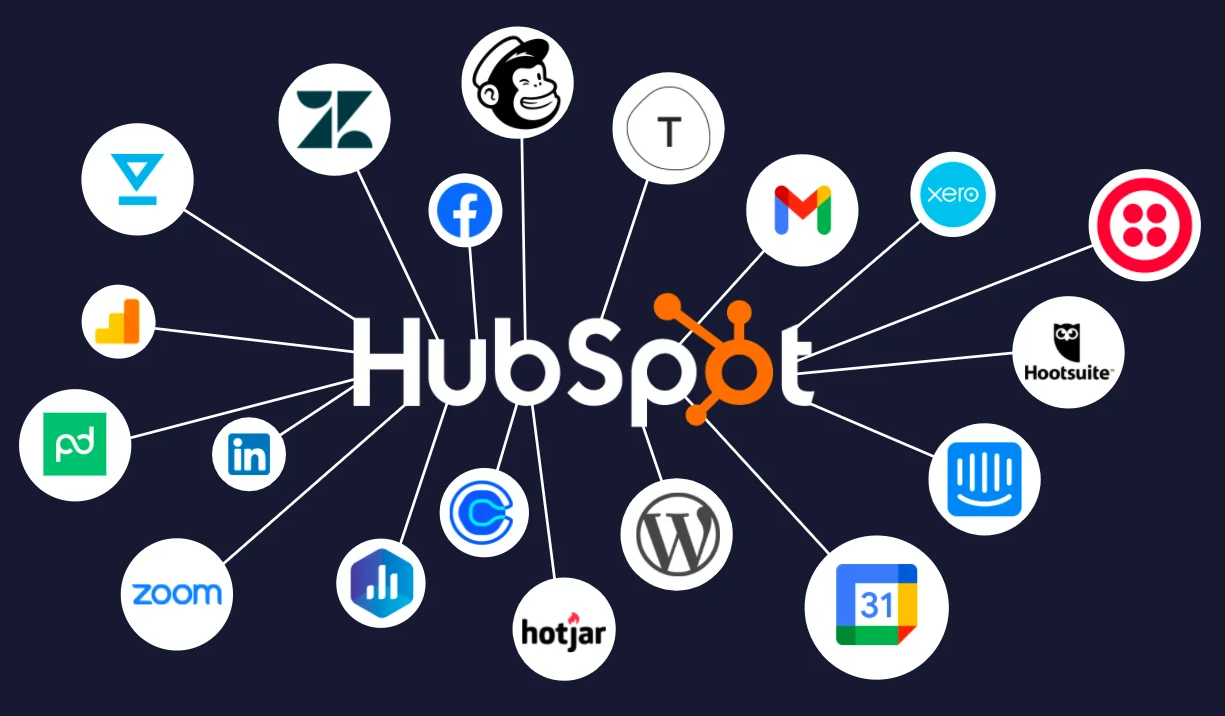
HubSpot's App Marketplace lists 2,000+ apps with over 2.5 million active installs. Its REST API covers the full CRM data model, and a developer platform supports custom apps, UI extensions, and marketplace publishing. Whether you need a connection to Shopify, QuickBooks, or a niche vertical tool, HubSpot likely has it.
Source: Hubspot
This ecosystem is one of HubSpot's real competitive advantages and a reason many companies choose it as their central platform.
noCRM's integration approach relies on Zapier and Make for 5,000+ connections, with native integrations limited to VoIP providers (CloudTalk, JustCall, Aircall), email (Gmail, Outlook, Yahoo), calendar services, and sibling products within the Positive Group (Sarbacane, Rapidmail, Signitic).
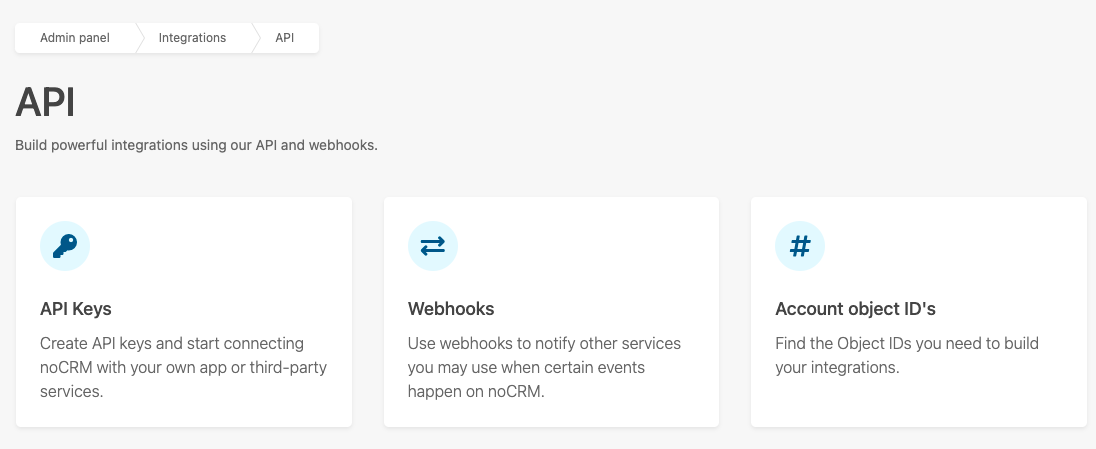
The REST API is well-documented, with a Simplified API layer for common operations and webhook support for event-driven workflows. For a lightweight tool at this price point, the integration surface is reasonable, but it lacks the bidirectional sync that HubSpot's native integrations provide.
Source: noCRM
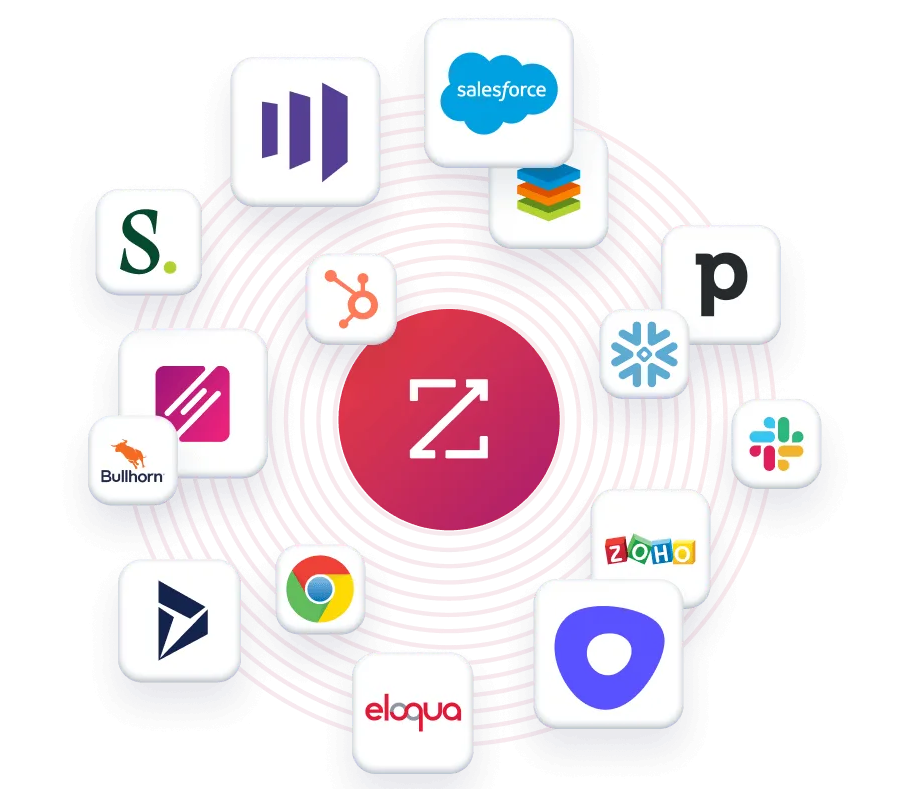
ZoomInfo's integration strategy centers on being infrastructure: feeding intelligence to whatever tools your team already uses. The App Marketplace lists 120+ partner integrations, including native connections to Salesforce, HubSpot, Microsoft Dynamics 365, Snowflake, and Outreach.
Source: ZoomInfo
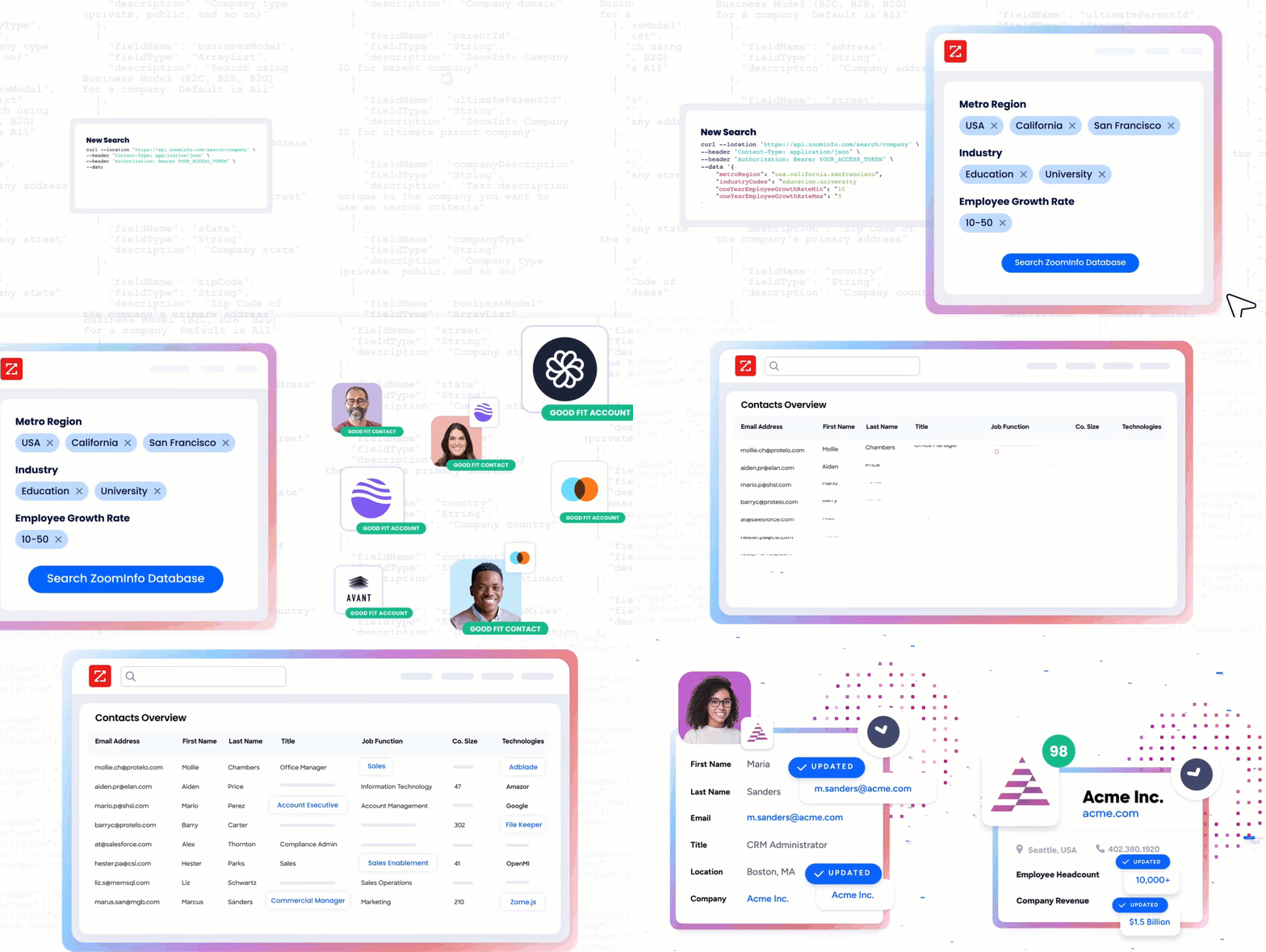
The Enterprise API exposes search, enrichment, AI intelligence, and audience management endpoints. The MCP server makes ZoomInfo's data available to AI models as a native tool, with no custom coding required. API access is included in all relevant plans, so the intelligence works wherever your team works.
Source: ZoomInfo
Smartsheet's Senior Manager of Sales Technology Enablement described the integration value: "ZoomInfo is our one source of truth for account data, and even more so for contact data. There's no other provider in the market that provides you with that level of detail." (Smartsheet)
Data sovereignty matters for some buyers
noCRM carries a strong European sovereignty identity. The product is 100% made and hosted in Europe, ISO 27001 certified, and subject to European data jurisdiction. Positive Group ranked top 3 in the EU Score sovereignty framework, an independent non-profit certification. For European buyers with GDPR, data residency, or digital sovereignty requirements, this is a verified differentiator.
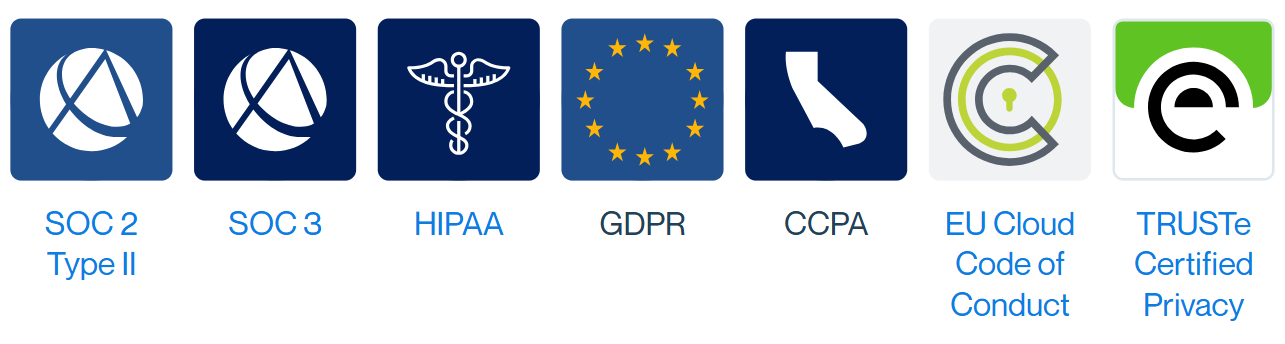
HubSpot hosts primarily on AWS in the United States, with an EU Data Center available for customers requiring EU data localization. Certifications include SOC 2 Type II, HIPAA attestation, GDPR compliance, CCPA compliance, and EU Cloud Code of Conduct Level 2.
Source: HubSpot
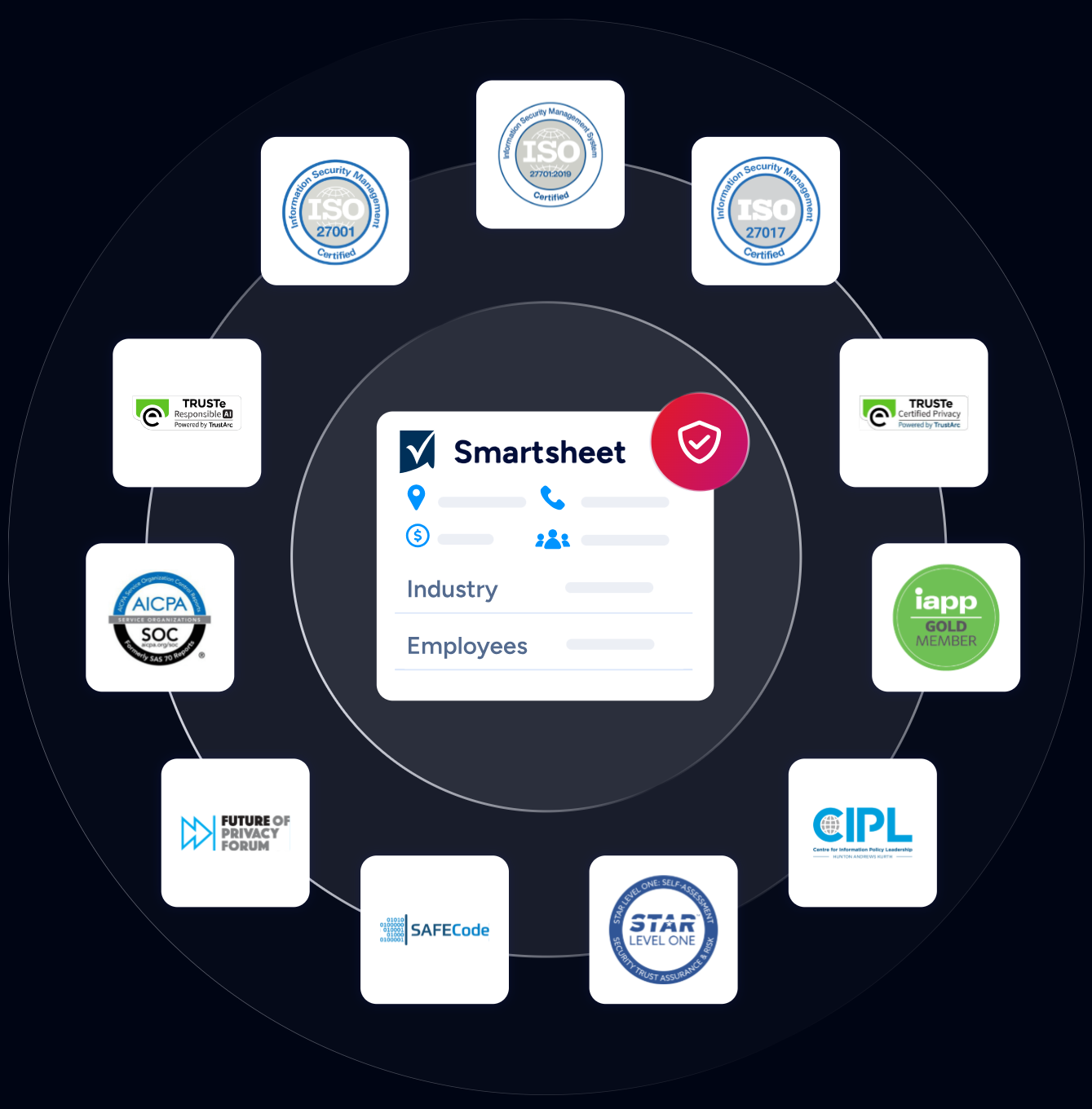
ZoomInfo maintains certifications renewed annually: ISO 27001, ISO 27701, SOC 2 Type II, TRUSTe GDPR, and TRUSTe CCPA. The company is a registered data broker in California and Vermont, with a dedicated Trust Center that documents its data handling practices.
Source: ZoomInfo
HubSpot vs. noCRM vs. ZoomInfo: Which should you choose?
The right choice depends on what problem you're solving.
Choose HubSpot if:
You need marketing, sales, and service teams working from shared customer data
You want a single platform for the entire customer lifecycle
Your team can invest in setup, onboarding, and ongoing configuration
You're scaling beyond 20 employees and need workflow automation across departments
You value a large integration ecosystem and active developer community
Choose noCRM if:
You have a small sales team (1-20 reps) focused on closing, not marketing
Your priority is pipeline speed and follow-up discipline over platform breadth
You need to be productive the same day without dedicated CRM administration
Your reps work by phone, WhatsApp, or email and need fast lead capture
European data sovereignty is a requirement
Choose ZoomInfo if:
You need verified B2B data and buyer intent signals to identify the right accounts
You want AI that tells you who to contact, when to engage, and what to say
You're building an outbound motion and need more than your CRM's stored contacts
You want intelligence that works inside your existing CRM (HubSpot, Salesforce, Dynamics) or as a standalone GTM Workspace
You need programmatic access to B2B intelligence for custom tools or AI agents
Try ZoomInfo with a permanent free Lite tier or a 7-day full trial.
HubSpot and noCRM each solve their chosen problem well. HubSpot connects the full customer journey under one roof. noCRM keeps pipeline management fast and frictionless.
But for revenue teams that want to stop guessing and start selling to the right buyers at the right time, ZoomInfo adds the intelligence layer that makes everything downstream work better. Whether you use it alongside HubSpot, alongside noCRM, or as your primary GTM platform through GTM Workspace, the advantage starts with knowing more about your buyers than anyone else.
HubSpot vs. noCRM vs. ZoomInfo FAQ
What is the main difference between HubSpot, noCRM, and ZoomInfo?
HubSpot is a full customer platform with six integrated hubs covering marketing automation, sales, service, content, data management, and commerce. noCRM is a lightweight sales tool built around lead-first pipeline management with enforced next-step discipline, designed for small teams that want to sell without CRM overhead.
ZoomInfo is a B2B intelligence platform that provides verified contact data on 500M contacts and 100M companies, buyer intent signals, and AI-powered prospecting, helping teams identify and engage the right buyers before they enter the pipeline.
Which platform is cheapest for a small sales team?
noCRM is the most affordable starting point, with per-seat pricing across three tiers and no onboarding fees. HubSpot's free CRM works for individuals, but paid Sales Hub plans start at $20/seat/month for Starter and $90-100/seat/month for Professional, plus onboarding fees at Professional and Enterprise tiers.
ZoomInfo uses custom pricing, but its permanent free Lite tier provides 10 monthly export credits and access to the B2B database at no cost.
Can ZoomInfo work alongside HubSpot or noCRM?
ZoomInfo integrates natively with HubSpot, syncing verified contact data, intent signals, and enrichment directly into the CRM. API access is included in all relevant ZoomInfo plans, so teams using HubSpot can push ZoomInfo intelligence into their existing workflows.
For noCRM users, ZoomInfo data can be exported to populate prospecting lists, though there is no direct native integration between the two platforms.
Which platform is best for outbound prospecting?
ZoomInfo is built for outbound prospecting at scale, with 120M direct-dial phone numbers, 200M+ verified business emails, buyer intent data, and AI agents that draft personalized outreach.
HubSpot Sales Hub includes sequences and the Breeze Prospecting Agent for automated outreach, but relies on contacts already in the CRM or manually sourced. noCRM supports outbound calling campaigns with VoIP integrations and prospecting lists, but has no native contact database or intent data.
How do the platforms handle data quality and enrichment?
ZoomInfo runs the most thorough data verification operation in this category. It uses automated ML scanning of 28 million site domains daily, third-party partner data, a community of users who share data back, and 300+ human researchers, achieving up to 95% accuracy on first-party data.
HubSpot's Smart CRM enriches records using AI from emails, calls, and web data, with automatic duplicate detection and merging. noCRM offers basic duplicate detection but does not provide data enrichment, since the product focuses on managing leads rather than sourcing or verifying them.
Which platform is best for European companies with data sovereignty requirements?
noCRM has the strongest European sovereignty positioning, with 100% European hosting, ISO 27001 certification, and a top-3 ranking in the EU Score sovereignty framework. HubSpot hosts primarily in the US but offers an EU Data Center option for customers requiring EU data localization.
ZoomInfo is US-hosted with ISO 27001, ISO 27701, SOC 2 Type II, and TRUSTe GDPR certifications, providing a compliance stack for regulated industries.
Which platform has the shortest setup and learning curve?
noCRM is the fastest to set up, with teams typically productive within hours. Its lead-first interface requires no CRM administration or complex configuration. HubSpot's Starter tier is relatively intuitive, but Professional and Enterprise features require real setup and training investment.
ZoomInfo's GTM Workspace deploys in weeks according to the company, and ZoomInfo Lite can be used immediately, though the full platform's breadth across data, intent signals, and AI agents requires onboarding to use well.
Do any of these platforms offer a permanent free tier?
HubSpot offers a permanent free CRM with basic tools across all hubs, capped at 2 user seats. ZoomInfo offers ZoomInfo Lite, a permanent free tier with 10 monthly export credits, access to the B2B database, the Chrome extension, HubSpot integration, and WebSights Lite. noCRM does not offer a permanent free plan, only a 15-day free trial (extendable to 30 days), after which a paid subscription is required.
More HubSpot comparisons:
