
Kompyte is a competitive intelligence and sales enablement platform. Backed by Semrush since 2022, it offers always-on competitor monitoring, AI-filtered insights, and Battlecards that surface inside the tools reps already use. For product marketers managing a CI program across dozens of competitors, it compresses what used to be days of manual research into roughly an hour per week.
But as your go-to-market strategy matures, you may find that Kompyte's strengths in digital change tracking and Battlecard delivery don't cover every competitive intelligence need. Its analytics and reporting lag behind some alternatives, AI summaries can be inconsistent on complex content, and the platform is optimized for one workflow: monitoring competitors externally and pushing that information to sales reps.
That's where this guide comes in. Whether you're looking to:
Enrich your competitive strategy with B2B data and AI-powered account intelligence
Integrate win/loss analysis natively with your competitive enablement program
Build a dedicated CI program with AI that generates finished competitive content
Monitor competitors across every marketing channel at SMB-friendly price points
Understand the real reasons deals are won or lost through expert-conducted buyer interviews
Establish competitive awareness on a budget with community-powered company intelligence
Generate deal-specific competitive positioning tailored to each individual prospect
We'll explore solutions that excel in these areas.
Some teams might use these tools to complement their existing Kompyte setup with deeper capabilities in a specific area, while others might replace Kompyte entirely with a platform better suited to their competitive intelligence needs. This isn't about finding a "better" platform; it's about finding the right fit for your go-to-market requirements.
The Best Kompyte Alternatives |
|---|
Best Alternative for Comprehensive B2B Data and AI-Powered GTM Intelligence We chose ZoomInfo because it adds a data and intelligence layer that Kompyte's digital monitoring model doesn't address: a comprehensive B2B database, buyer intent signals, and an AI-powered GTM Context Graph that reveals why deals move or stall. |
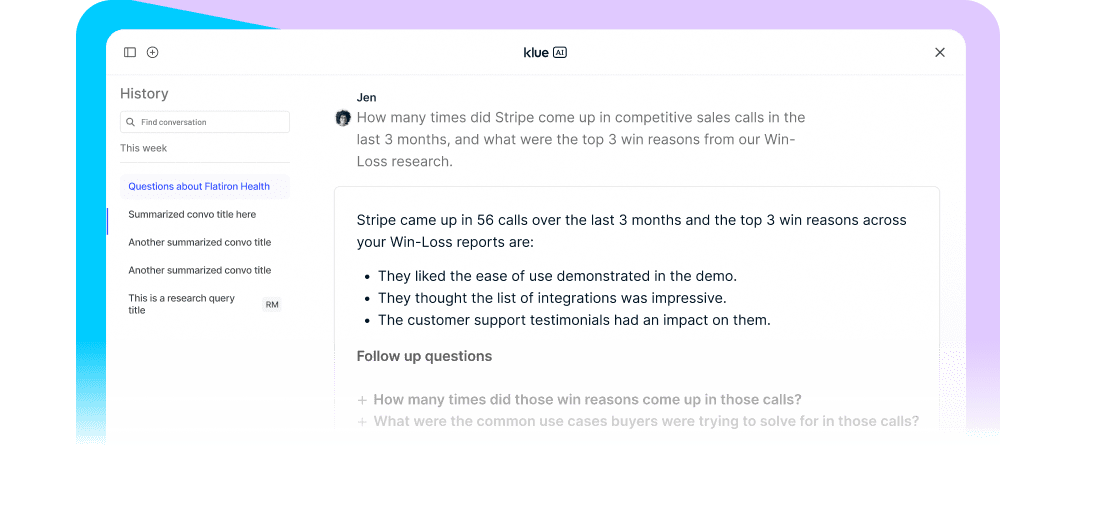
Best Alternative for Enterprise CI Programs With Native Win/Loss Intelligence We chose Klue because it combines competitive enablement with integrated win/loss analysis in a single platform, with proactive Deal Tips and revenue impact reporting that go beyond Kompyte's Battlecard adoption metrics. |
Best Alternative for AI-Powered Competitive Content Generation We chose Crayon because its Sparks AI goes beyond noise filtering to generate finished battlecard updates, SWOT analyses, and talk tracks from 15M+ analyzed data points, with direct revenue attribution through its Influenced Revenue metric. |
Best Alternative for Affordable Multi-Channel Competitor Monitoring We chose Competitors App because it delivers website, email, social, SEO, and ad monitoring in a single per-competitor subscription at a fraction of enterprise CI pricing, with white-label options for agencies. |
Best Alternative for Expert-Conducted Buyer Interview Intelligence We chose Clozd because it goes directly to the buyers who made the decision, surfacing the real reasons deals are won or lost through expert-led and AI-assisted interviews that CRM data and automated monitoring consistently miss. |
Best Alternative for Budget-Conscious Entry-Level Company Intelligence We chose Owler because its permanently free tier and community-powered Competitive Graph covering 45M+ relationships give budget-constrained teams structured competitive awareness without the overhead of a formal CI program. |
Best Alternative for AI-Native, Account-Specific Competitive Intelligence We chose Aomni because it generates competitive briefs tailored to each prospect's context using autonomous AI agents, combining research and outreach into a single workflow that generic battlecards can't replicate. |
What is Kompyte?
Source: Kompyte
Kompyte, operating as "Kompyte by Semrush" since its 2022 acquisition, is a competitive intelligence and sales enablement platform built around one promise: helping sales teams win more competitive deals through always-current Battlecards that surface where reps already work.
Its key features include:
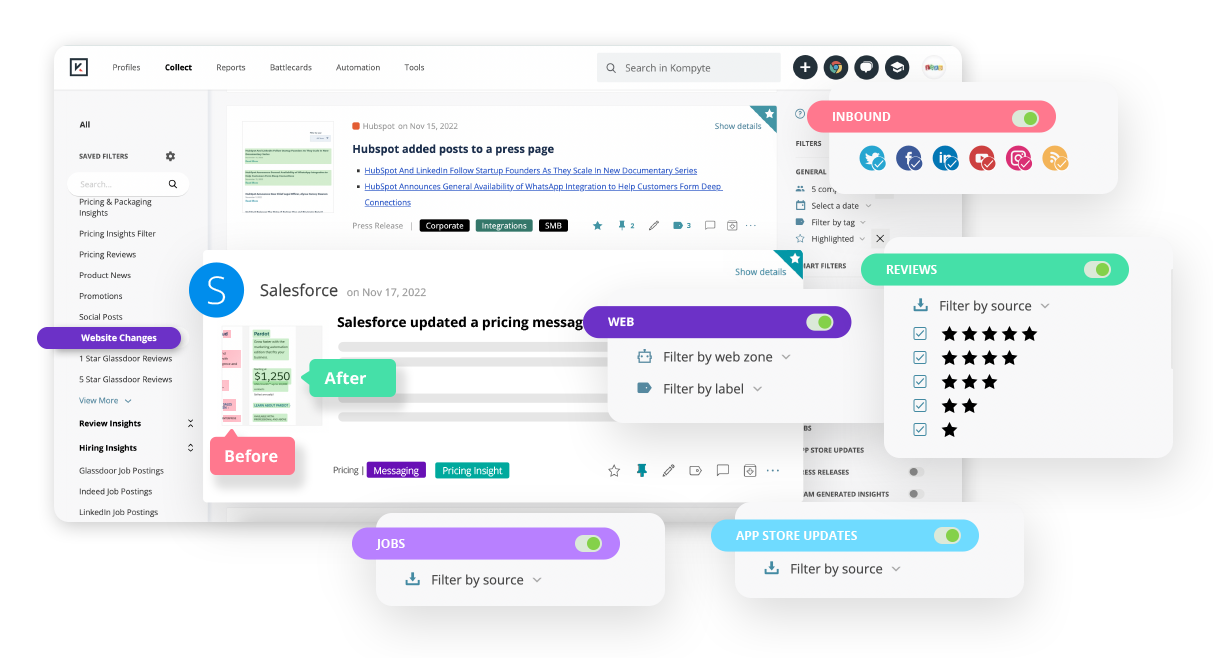
CI automation engine that monitors competitors across websites, reviews, social media, job postings, app stores, and paid search ads, with AI filtering refined since 2014 that reduces tracking to roughly one hour per week
Unlimited Battlecards on all plans with bi-directional CRM integrations (Salesforce, HubSpot) and distribution through Slack, Teams, Highspot, Showpad, and Seismic
KompyteGPT AI layer providing AI Daily Summaries, Auto Summarize for insights and PDF documents, and AI-powered Battlecard creation
Win/loss analysis combining CRM data with qualitative buyer interviews through the IcebergIQ partnership
Battlecard Adoption Analytics tracking rep usage and correlating it to win rates
Fast implementation deployed in 1-2 weeks with first insights in 24-48 hours
When a competitor changes their pricing page, publishes a new case study, or launches a Google Ads campaign, Kompyte's AI filters the noise, classifies the change into one of 30+ web zones, and surfaces it in a consolidated Collect Feed. From there, insights flow into Battlecard traits, get shared via Slack or email digests, or get summarized by KompyteGPT.
For B2B SaaS companies with 10+ sales reps who face named competitors regularly, Kompyte provides a solid foundation for competitive enablement. But as your GTM strategy evolves, you may need deeper data intelligence, more sophisticated win/loss analysis, account-specific competitive positioning, or a tool that fits a different budget or team structure. That's why we explored tools that excel where Kompyte's approach falls short.
Looking for an AI GTM platform that combines comprehensive B2B data with competitive intelligence? ZoomInfo gives your team the data foundation, buyer intent signals, and AI-driven insights to win more deals. Request a demo today.
How We Curated Our List of Kompyte Alternatives
After testing Kompyte and researching the competitive intelligence market, we focused on tools that address gaps Kompyte's digital monitoring and Battlecard delivery model may not cover. While Kompyte automates competitor tracking and arms sales reps with competitive content, some teams need stronger capabilities for:
Enriching competitive strategy with B2B data, buyer intent signals, and AI-powered account intelligence that goes beyond monitoring what competitors publish
Running native win/loss analysis programs that connect buyer interview insights directly to competitive enablement without relying on third-party research partnerships
Generating finished competitive content (battlecard updates, SWOT analyses, talk tracks) from AI, not just filtering noise from raw signals
Monitoring competitors across every marketing channel at price points accessible to small teams and agencies
Understanding the actual reasons deals are won or lost through expert-conducted buyer interviews that surface insights CRM data consistently misses
Establishing competitive awareness on a limited budget with community-powered company intelligence
Generating deal-specific competitive positioning tailored to each prospect rather than maintaining generic competitor-level battlecards
Each tool on this list leads in one of these areas. You might use them alongside Kompyte or switch entirely; it depends on what your team needs most.
DISCLAIMER: We aren't covering every competitive intelligence tool on the market! Our focus is on highlighting the best alternatives that address some of Kompyte's limitations for various use cases. The goal is to provide insights into tools that cater to specific business needs. |
|---|
1. ZoomInfo: Best Alternative for Comprehensive B2B Data and AI-Powered GTM Intelligence
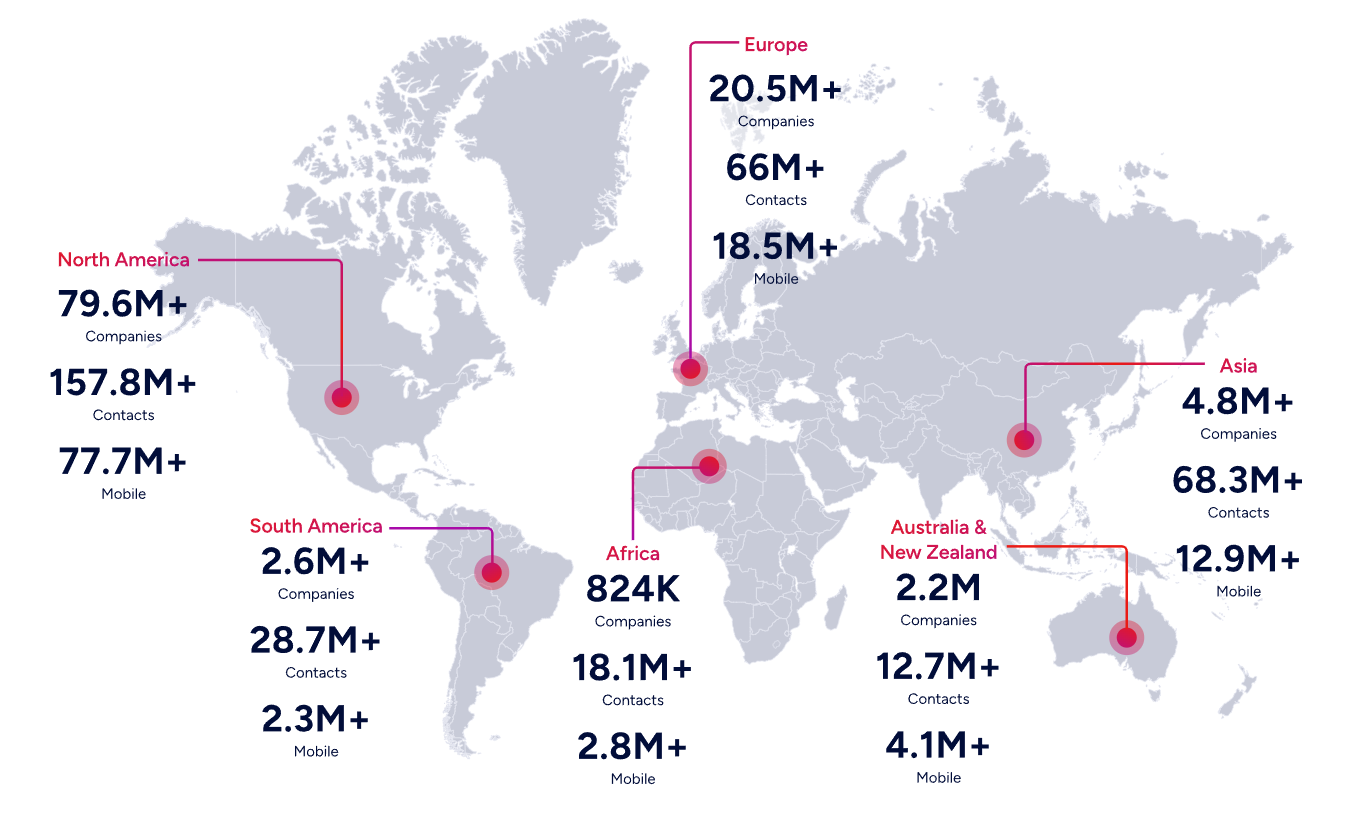
ZoomInfo is an AI GTM platform built on a large data foundation: 500M contacts, 100M companies, 135M+ verified phone numbers, and 200M+ verified business email addresses. Its GTM Context Graph processes 1.5B+ data points daily, unifying this data with your CRM records, conversation transcripts, and behavioral signals to reveal the full context of your accounts (not just what happened in a deal, but why it happened and what to do next). Your team accesses this intelligence through GTM Workspace for sellers, GTM Studio for marketers and RevOps, or APIs and MCP in any tool or AI agent.
While Kompyte tracks what competitors publish and delivers that intelligence to sales reps, ZoomInfo provides a different kind of competitive advantage: the data and intelligence infrastructure that powers your entire go-to-market motion. Its key features include:
Comprehensive B2B data: 500M contacts, 100M companies, 135M+ verified phone numbers, 120M direct-dial phone numbers, and 200M+ verified business email addresses, verified through a multi-source pipeline backed by 300+ human researchers with 95% accuracy on first-party data
The GTM Context Graph: An intelligence layer that processes 1.5B+ data points daily, fusing ZoomInfo's B2B data with your CRM records, conversation intelligence, and behavioral signals to capture not just what happened in a deal, but why it happened
Buyer Intent Data: Tracks signals from 210 million IP-to-Organization pairings and 6 trillion+ new keyword-to-device pairings sourced monthly, with Guided Intent that identifies topics historically correlated with deal success
Universal access: Available through GTM Workspace for sellers, GTM Studio for marketers and RevOps, or APIs and MCP in any tool or AI agent
While Kompyte answers "what are competitors doing?", ZoomInfo answers "who should we target, who's in-market right now, and how do we win?" The two platforms address different dimensions of the competitive challenge, making ZoomInfo a strong complement or alternative depending on where your GTM gaps are.
Why Choose ZoomInfo Over Kompyte for GTM Intelligence
Kompyte tracks competitor activity across digital channels and delivers that intelligence to sales reps via Battlecards. ZoomInfo provides the data and intelligence infrastructure that powers your entire go-to-market motion. Here's where ZoomInfo steps up.
Data-Driven Account Intelligence: Know Your Buyers Before the Competition Does
Kompyte tells you what competitors are doing. ZoomInfo tells you who your buyers are, where they work, how to reach them, and when they're actively in-market. This distinction matters: even the best competitive Battlecard is useless if your team is reaching the wrong contacts, at the wrong time, with incomplete account context.
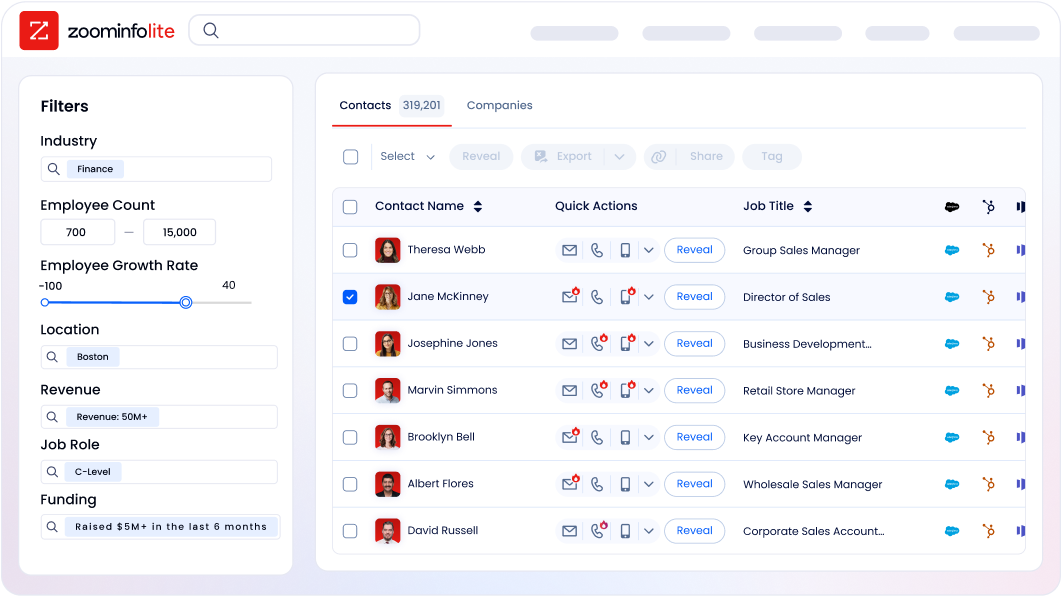
ZoomInfo's Contact & Company Search provides access to 300+ company attributes for market segmentation, including department org charts with decision-makers' direct dials and verified emails, contact tracking with job-change alerts, and one-click CRM export. The data is verified through a pipeline that aggregates from automated ML scanning of 28 million site domains daily, third-party partner data covering 95 million businesses, and an in-house Data Training Lab of 300+ human researchers.
In a Fortune 500 competitive RFP analyzing 25 million contacts across vendors, the independent consultant concluded that "no other competitor came even close."
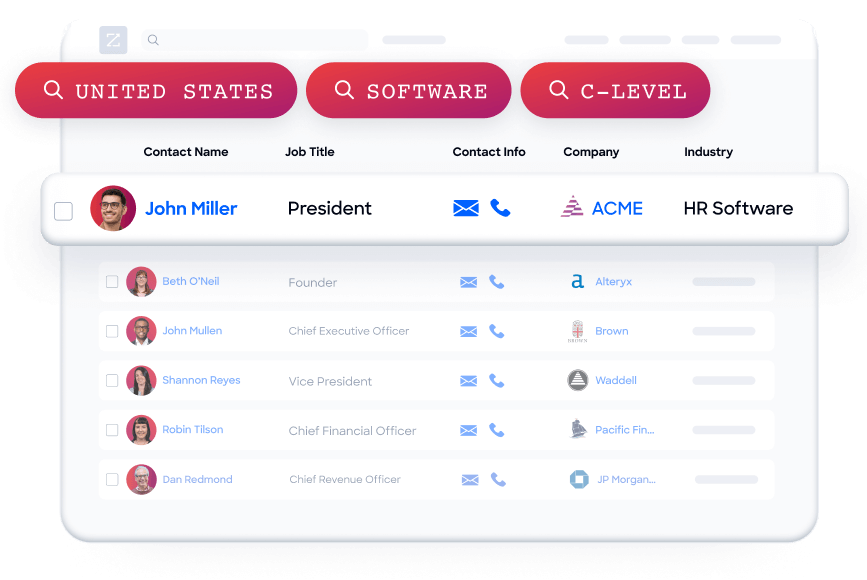
ZoomInfo in Action: Your team is preparing for a competitive deal against a rival tracked in Kompyte. While Kompyte tells you the competitor recently updated their pricing page, ZoomInfo tells you exactly who the buying committee members are at the target account, provides their direct dial numbers and verified emails, shows you the company's tech stack, reveals their recent funding round, and surfaces that three VP-level stakeholders are actively researching solutions in your category. You walk into the deal with complete account intelligence, not just competitive messaging.
Buyer Intent and Signal Intelligence: Identify In-Market Accounts Before Competitors Do
Kompyte monitors competitors' digital activity. ZoomInfo monitors buyer activity. ZoomInfo Intent tracks signals from 210 million IP-to-Organization pairings, identifying which companies are actively researching topics related to your solution right now.
What sets ZoomInfo's intent data apart is Guided Intent, exclusive to ZoomInfo, which identifies topics historically correlated with deal success rather than requiring manual topic selection. Combined with WebSights, which resolves anonymous website traffic to companies (with Automatic Traffic Filtering distinguishing real visitors from bots), your team gains a proactive intelligence layer that surfaces opportunities before the first conversation.
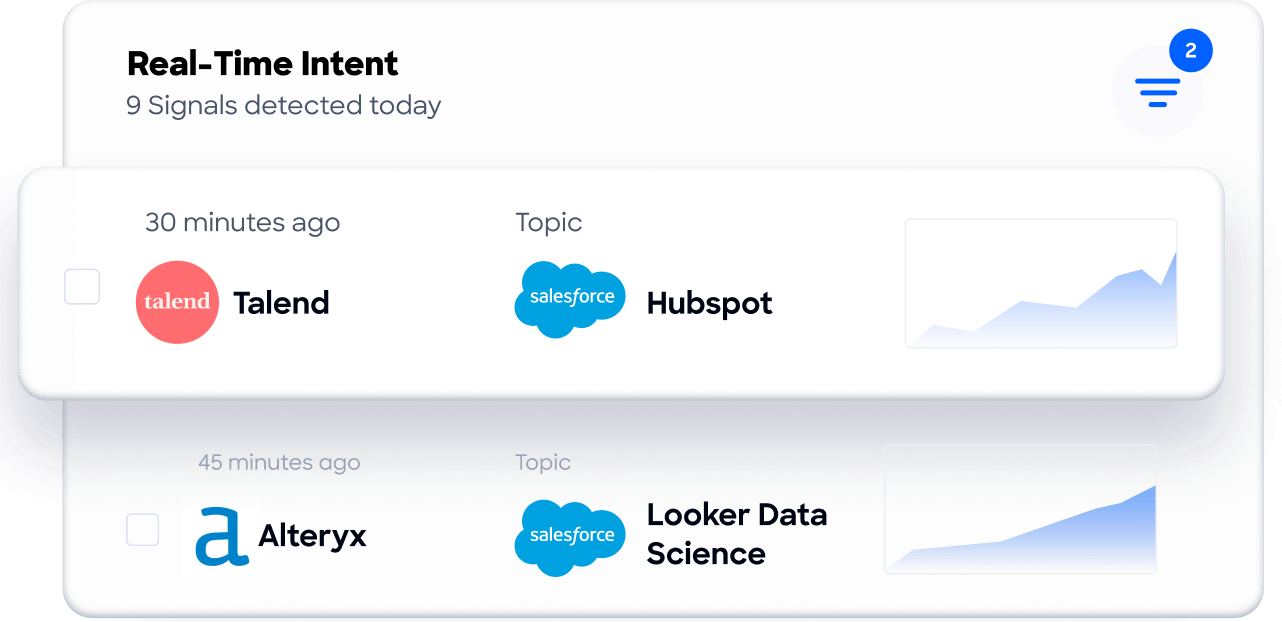
ZoomInfo in Action: A company in your target market starts researching your product category. ZoomInfo detects the intent spike, identifies the company, surfaces the buying committee with verified contact information, and triggers an automated outreach workflow through GTM Studio, all before the prospect has visited your website or appeared on any competitor's radar. This is competitive intelligence at the opportunity level, not the market-monitoring level.
The GTM Context Graph: Intelligence That Understands Why Deals Move
Kompyte's intelligence model is outside-in: it observes what competitors publish and organizes those observations for sales teams. ZoomInfo's GTM Context Graph operates both outside-in and inside-out, fusing ZoomInfo's third-party data with your CRM records, conversation transcripts, email interactions, and behavioral signals into a single intelligence layer.
As ZoomInfo's Chief Product Officer Dominik Facher writes: "The CRM recorded the state change. It has no record of why it happened." The GTM Context Graph captures that "why": the CFO joined the last call and asked about six-month ROI (which is why the deal accelerated), the VP went quiet for eight days due to an internal budget battle (which is what almost killed it). This ability to connect signals to outcomes, built on twenty years of data unification infrastructure, is something no competitive monitoring tool is designed to provide.
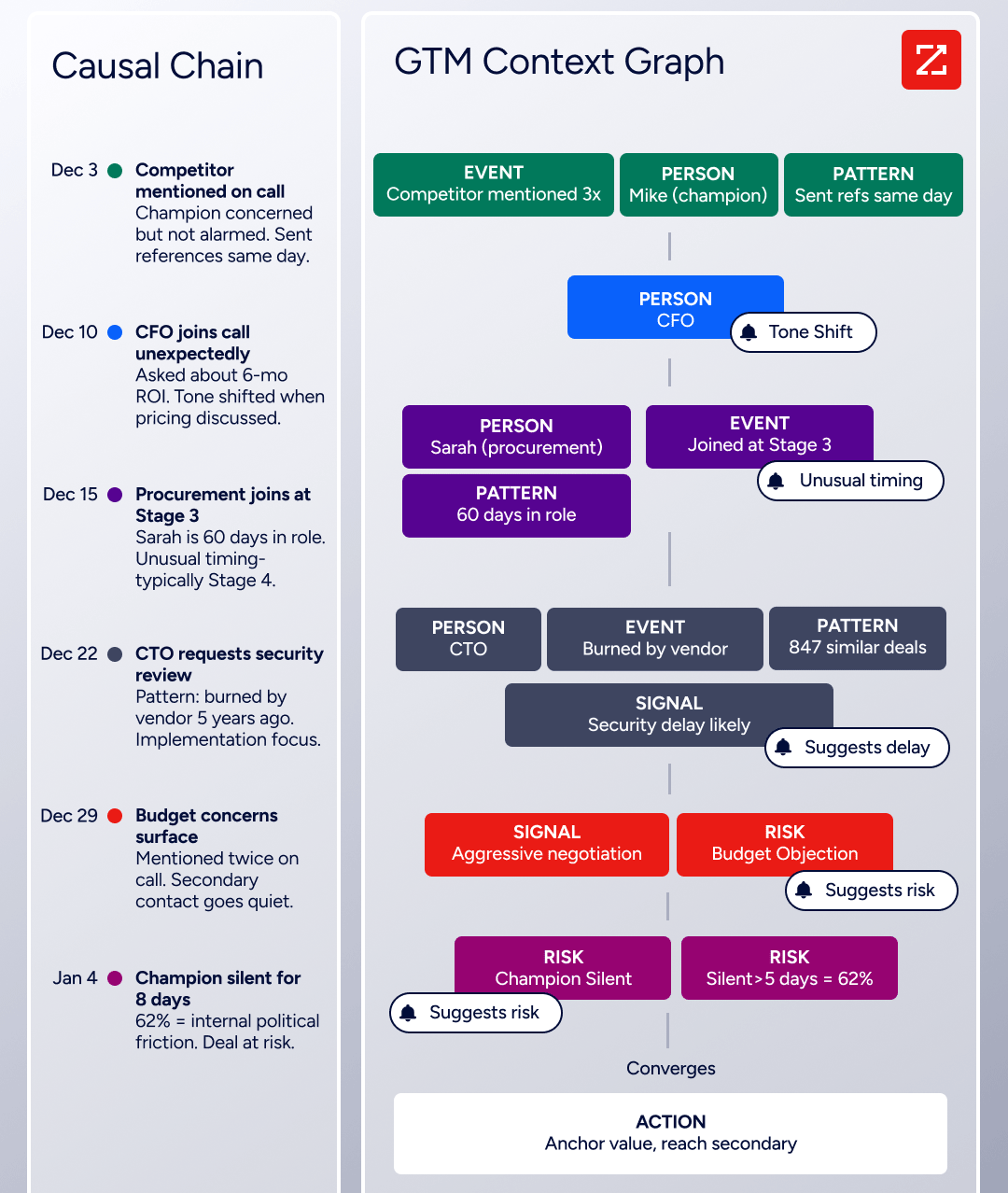
ZoomInfo in Action: Your rep opens GTM Workspace to a prioritized account feed where AI-drafted outreach already addresses the specific concern identified from the last call. A marketer in GTM Studio describes an audience in plain language and launches a multi-channel play targeting accounts matching actual win patterns. An engineer plugs the same intelligence into a custom agent via API or MCP. Every surface draws from one intelligence layer; nothing degrades based on where you access it.
ZoomInfo's data advantage isn't self-reported. ZoomInfo is a Leader in the Forrester Wave for Intent Data Providers B2B (Q1 2025), a Leader in the Gartner MQ for ABM Platforms (2024 & 2025), the only vendor in the Gartner Customers' Choice quadrant (2025), and holds 133 No. 1 rankings on G2.
"That combination of our internal CRM data, external signals, and AI that's given all that context has helped us craft very specific account- and persona-based messages. And people have responded to them right away." — Toby Carrington, Chief Business Officer (Seismic Case Study)
ZoomInfo Pricing
ZoomInfo uses a consumption-based pricing model with custom quotes based on usage patterns, number of users, monthly credit volume, features, company size, and contract length. No dollar amounts are published for paid tiers.
Sales plans come in three tiers: Professional (contact and company data, CRM integrations, Chrome extension), Advanced (adds intent signals, Account Fit Score, website visitor tracking, automated outreach workflows), and Enterprise (adds real-time buyer intent, AI-generated account summaries, advanced workflows, and a dedicated customer service manager).
Marketing plans include Marketing Demand (B2B data and audience targeting), ABM Lite (dynamic audiences, display network, social advertising), and ABM Enterprise (unlimited intent topics, AI-powered insights, full-funnel analytics).
ZoomInfo also offers ZoomInfo Lite, a permanently free tier with access to the B2B database, 10 monthly export credits, individual and company searches, and HubSpot integration. A 7-day free trial of paid features is available with no credit card required.
Who Should Use ZoomInfo?
Choose ZoomInfo if:
Your competitive challenge isn't just knowing what rivals are doing, but finding and engaging the right buyers before competitors do. ZoomInfo's data foundation gives your team a structural advantage at the point of action.
You need an intelligence layer that connects buyer intent signals, CRM data, conversation intelligence, and behavioral data into a unified view of why deals move or stall, powering AI that understands your go-to-market context.
Your team operates across sales, marketing, and RevOps and needs a platform that delivers intelligence everywhere: through a dedicated seller workspace, a marketing orchestration canvas, or APIs and MCP in any tool or AI agent you already use.
ZoomInfo combines comprehensive B2B data with the GTM Context Graph, giving every rep, marketer, and operator the intelligence to win. Request a demo or start with ZoomInfo Lite for free.
2. Klue: Best Alternative for Enterprise CI Programs With Native Win/Loss Intelligence
Source: Klue
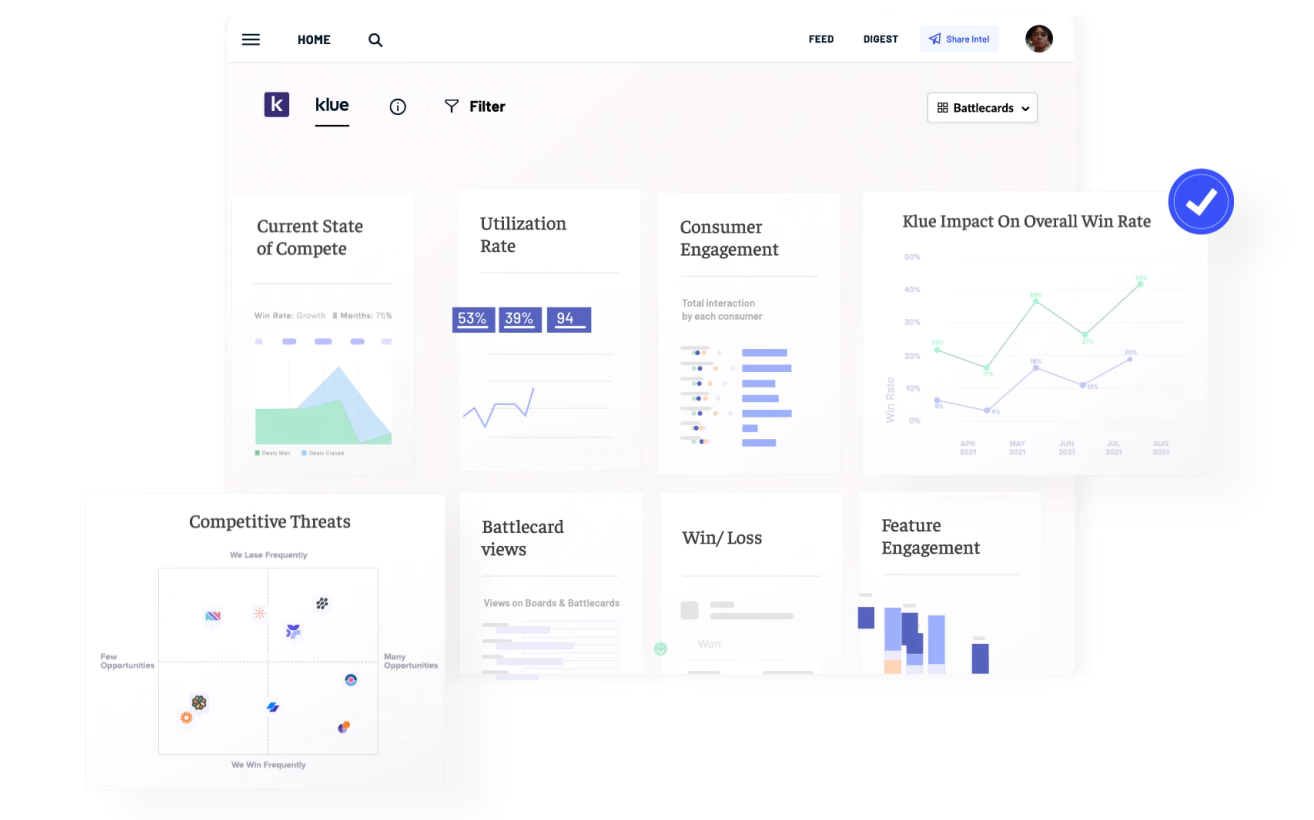
Klue is a competitive enablement platform that combines automated competitive intelligence with integrated win/loss analysis in a single product. Where Kompyte relies on an IcebergIQ partnership for qualitative win/loss research, Klue built win/loss directly into its platform through the DoubleCheck Research acquisition in January 2023 and Goldpan.ai in March 2025 for AI-driven interviewing. Its key capabilities include:
Compete Agent: An AI that monitors public sources, G2 reviews, Gong transcripts, and win/loss interviews to generate and maintain competitive battlecards automatically
Deal Tips: Proactive competitive briefings pushed to reps via Slack or email within minutes of a competitor being mentioned on a sales call
Win/Loss Cards: Live win/loss data embedded directly within each competitive battlecard
Revenue impact reporting: Tracks pipeline threat levels by competitor, content adoption rates, and revenue influenced by CI program activity
Why Choose Klue Over Kompyte for Enterprise CI Programs
Klue stands out in the following areas:
Win/Loss Analysis Is Native, Not a Third-Party Partnership Kompyte's win/loss capability relies on IcebergIQ, an external research vendor. Klue owns the win/loss methodology, the interview infrastructure, and the analysis tooling through its acquisitions. Competitive mentions surfaced in buyer interviews flow into battlecards and competitor profiles automatically, without manual hand-off between vendors. For enterprises that want win/loss data and competitive intelligence to inform each other, Klue eliminates the coordination friction that Kompyte's partnership model requires.
Proactive Deal Intelligence vs. Rep-Initiated Retrieval Kompyte's sales enablement model is pull-based: battlecards are available in Salesforce or Slack, but reps need to open them. Klue's Compete Agent inverts this. When a competitor is mentioned in a Gong call, it generates a personalized Deal Tip and pushes it to reps before their next call. This proactive delivery drives higher seller adoption than pull-based approaches, since intelligence reaches reps when they need it rather than when they remember to look for it.
Revenue Attribution Beyond Battlecard View Counts Kompyte provides Battlecard Adoption Analytics and an ROI calculator based on modeled projections. Klue tracks the competitive composition of the pipeline, correlates CI activity with closed revenue, and through its Microsoft Dynamics 365 integration, generates structured Win or Loss stories from every closed opportunity. CI leaders can report concrete revenue impact to leadership rather than relying on modeled estimates.
NOTE: We also evaluated Crayon for this enterprise archetype. While Crayon is enterprise-grade with strong competitive monitoring and AI content generation, Klue offers the most tightly integrated win/loss and battlecard system combined with revenue impact reporting, making it the better fit for large enterprise revenue teams whose CI programs need to demonstrate measurable pipeline outcomes to leadership.
For a side-by-side breakdown of how Kompyte and Klue compare across CI features, enablement, and win/loss, see our Kompyte vs Klue comparison.
Klue Pricing
Klue does not publish pricing on its website. All commercial discussions start with a demo request. Based on Klue's Terms of Use, the model is subscription-based with annual commitments. Separate Authorization Forms are available for the Competitive Intelligence (Compete Agent) and Win-Loss products, meaning teams can subscribe to one or both modules independently. Every plan includes a dedicated Customer Success Manager and a 99% monthly uptime SLA.
Who Should Use Klue?
Choose Klue if:
Your organization has a dedicated Product Marketing Manager or CI professional who needs to demonstrate the program's pipeline impact to leadership, and you want win/loss and competitive intelligence managed in one platform rather than coordinated across a CI tool and a separate research vendor.
Your sales organization operates at a scale where proactive, deal-level intelligence (Deal Tips pushed to reps the moment a competitor surfaces) changes win rates compared to a model where reps pull competitive information on their own.
Your leadership requires quantified evidence of the CI program's contribution to revenue: win-rate lift against specific competitors, pipeline threat trend reporting, and competitive content adoption tied to closed deals.
3. Crayon: Best Alternative for AI-Powered Competitive Content Generation
Source: Crayon
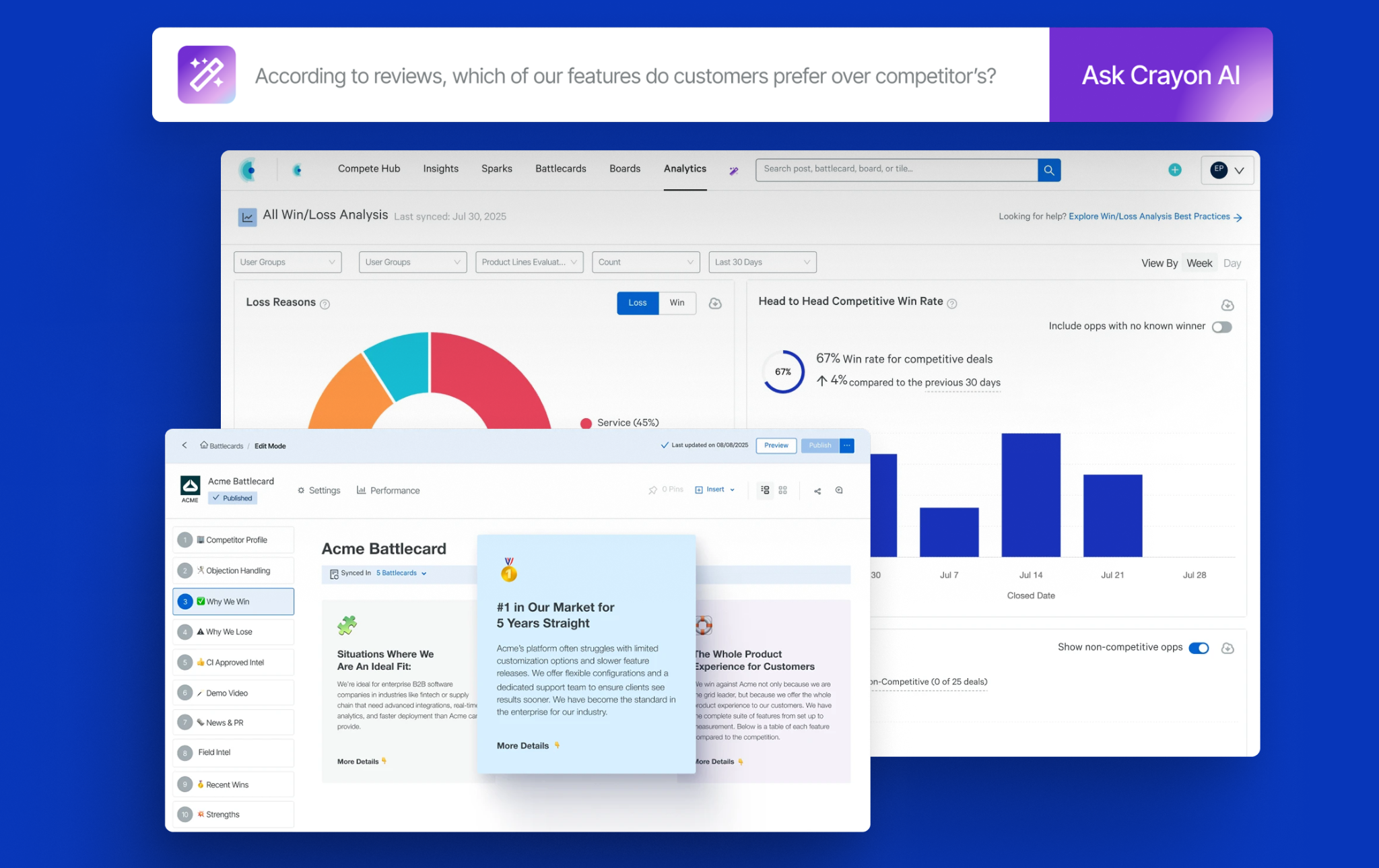
Crayon is a competitive intelligence platform built for mid-market and enterprise B2B companies that want AI to do more than filter noise. Where Kompyte's AI engine reduces raw data to relevant signals, Crayon's Sparks feature goes one step further: it analyzes competitive data across more than 100 data types and generates finished battlecard updates, SWOT analyses, and talk tracks ready for sales teams to use. Its key capabilities include:
100+ data type monitoring across competitor digital footprints, from website changes to job postings
Sparks AI: Analyzes changes in context with call recordings, win/loss transcripts, and Slack discussions to produce finished competitive content; has analyzed over 15 million data points and is used by 80% of Crayon customers
Crayon Answers: A generative AI compete assistant for sales, enabling reps to ask competitive questions in natural language from Slack
Compete Hub: A real-time feed for breaking competitive intelligence with social engagement features
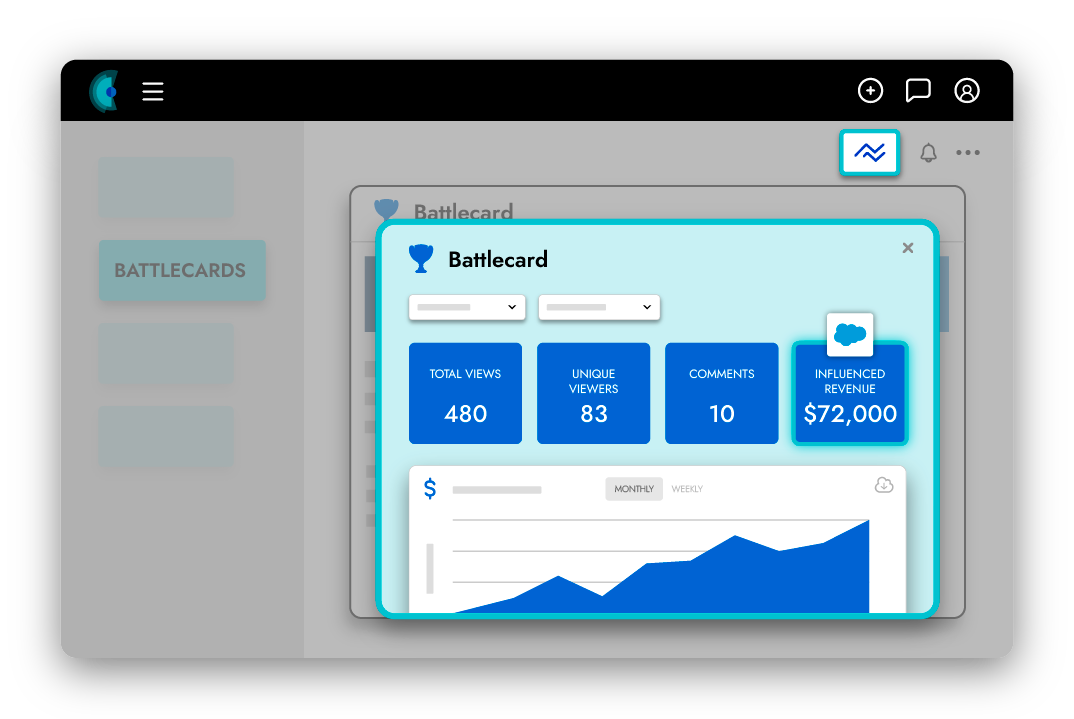
Revenue attribution through the Influenced Revenue metric and Seller Performance Matrix
Why Choose Crayon Over Kompyte for a Dedicated CI Program
Crayon stands out in the following areas:
AI That Generates Finished Content, Not Just Filtered Signals
Kompyte's KAI engine reduces a days-long manual research process to roughly one hour per week by surfacing relevant signals. Crayon's Sparks goes further: it analyzes a competitor pricing change in context with call recordings, win/loss transcripts, and Slack discussions and generates a ready-to-deploy battlecard update or SWOT analysis. Within one month of launching, 80% of Crayon customers were actively using Sparks, and it has since created 85,000+ pieces of competitive content. The practical difference: Kompyte reduces the input burden; Crayon reduces the output burden too.
Broader Sales Ecosystem Integration With Deeper CRM Connectivity Beyond the Salesforce, HubSpot, and Slack integrations Kompyte offers, Crayon adds Seismic, Guru, SharePoint, Notion, Confluence, ClickUp, and Yammer. Its Salesforce integration embeds battlecards in opportunity records, ingests deal outcome data, and tracks Influenced Revenue connecting battlecard views to deal outcomes. This broader integration footprint means CI deliverables reach reps in whichever content management or collaboration tool they already use, reducing adoption friction.
Revenue Attribution Through Direct Data Linkage Kompyte estimates "prevented losses" and "research savings" through modeled projections. Crayon's Influenced Revenue metric calculates the sum of deals where a rep viewed a competitor battlecard before closing, a direct data linkage. Its Seller Performance Matrix categorizes reps by competitive win rate and battlecard engagement, giving CI leaders visibility into which reps use competitive content and which need additional enablement.
Source: Crayon
NOTE: We also evaluated Klue and Contify for this archetype. While Klue excels at enterprise-scale CI programs with native win/loss analysis, and Contify extends beyond competitor tracking to industry trends and partner monitoring, Crayon offers the most direct path from competitor signal to sales-ready content for growing B2B revenue teams formalizing their first dedicated CI program, particularly those already using Salesforce, Slack, and Highspot.
If you're deciding between Crayon and Klue, our Crayon vs Klue comparison covers the key differences in approach, content generation, and win/loss integration.
Crayon Pricing
Crayon does not publish its pricing structure. Pricing is customized to each competitive intelligence program, determined by the number of competitors tracked, authorized users, competitive assets volume, and required features. No free trial or free plan is offered; the evaluation path is a demo with the Crayon sales team. Subscriptions auto-renew unless customers provide 60 days' written notice before expiration.
Who Should Use Crayon?
Choose Crayon if:
Your CI bottleneck is content creation, not data collection. If you're drowning in curated alerts but still spending hours turning them into battlecard updates and newsletters, Crayon's Sparks AI addresses that by generating finished competitive content from tracked signals.
Your revenue team is already embedded in Salesforce, Slack, and Highspot. Crayon's battlecard delivery and intelligence distribution are optimized for these environments and work with existing rep behavior.
You want revenue attribution for your CI program. Crayon's Influenced Revenue metric and Seller Performance Matrix make it possible to show leadership a direct connection between battlecard engagement and closed revenue.
4. Competitors App: Best Alternative for Affordable Multi-Channel Competitor Monitoring
Source: Competitors App
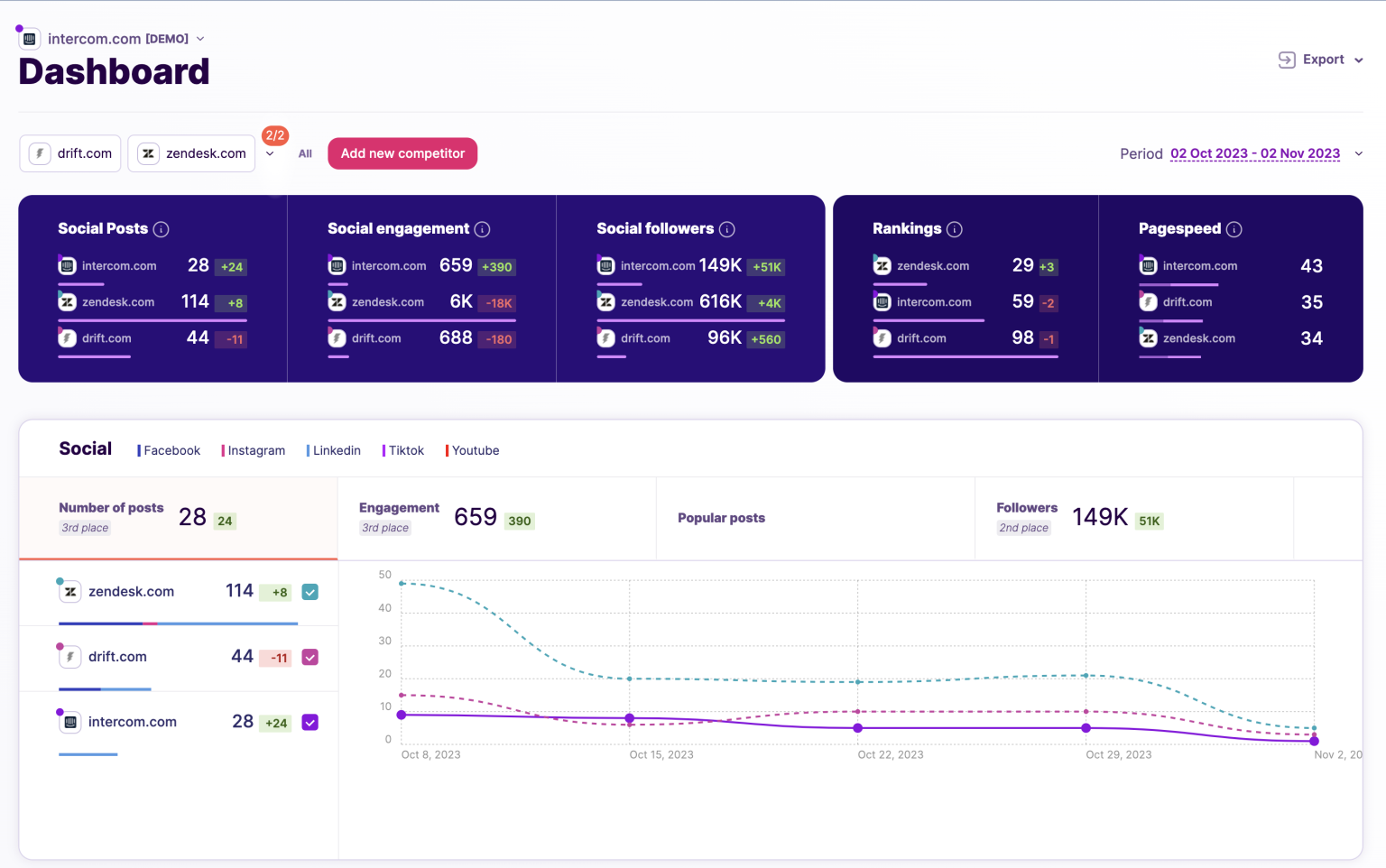
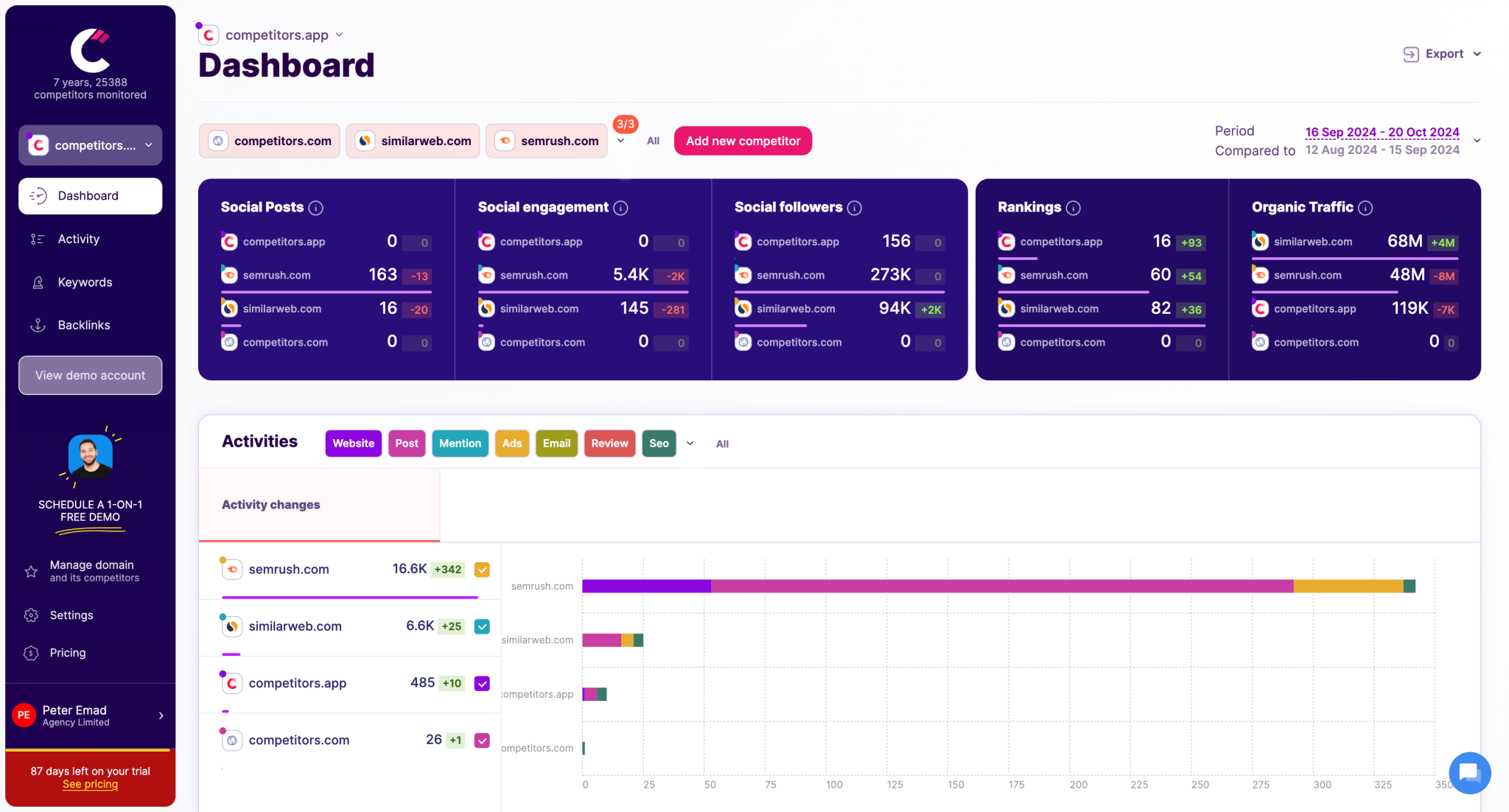
Competitors App is an automated competitor marketing monitoring platform that bundles website surveillance, email capture, social media tracking, SEO monitoring, and paid ad intelligence into a single dashboard. Where Kompyte is built around sales enablement and Battlecard delivery for teams with 10+ sales reps, Competitors App solves a different problem: how does a lean marketing team stay informed about what competitors are doing across every channel, without a five-figure annual contract? Its key capabilities include:
Website change alerts for pricing pages, product messaging, and new content
Automated email capture intercepting competitor newsletters and onboarding sequences
Social media monitoring across LinkedIn, Twitter (X), Facebook, Instagram, and TikTok with per-post engagement metrics
SEO and paid ad tracking across Google Search, Google Display, Facebook, Instagram, and LinkedIn Ads
Per-competitor pricing starting at approximately $14.95/competitor/month
Why Choose Competitors App Over Kompyte for Affordable Multi-Channel Monitoring
Competitors App stands out in the following areas:
Built for Passive Monitoring Without CI Headcount Kompyte requires a product marketer or CI manager to own the platform, curate the Collect Feed, and maintain Battlecards. Competitors App is built for the opposite scenario: the homepage promises "only 5 minutes a week to monitor your competitor's marketing changes," and the product delivers via daily and weekly email digests, meaning the platform works passively for users who never log in. Capterra reviewers confirm saving "a day of work per week" through the email digest format. There is no Battlecard maintenance, no AI training loop to configure, and no sales adoption analytics to monitor.
All-Channel Marketing Intelligence at a Fraction of Enterprise CI Cost Kompyte's average ARR per customer at acquisition was approximately $20,000. Competitors App packages website changes, social, SEO, ads, email/newsletter interception, blog tracking, and traffic benchmarking into a per-competitor subscription starting at roughly $15/month per rival. A team tracking four competitors on Business Plus pays approximately $80/month. The email and newsletter interception capability stands out: Competitors App automates the subscription process on the user's behalf, capturing every marketing email competitors send, a channel Kompyte doesn't prioritize.
White-Label Competitive Reporting for Agencies Competitors App's agency plan provides white-label tools: custom domain deployment, branded reports, and automatic client-facing email digests. This allows marketing agencies to offer competitive monitoring as a recurring client service without building their own tooling, addressing a buyer type Kompyte doesn't serve.
Source: Competitors App
NOTE: We also evaluated SpyFu and Visualping for the small-team, budget-conscious monitoring archetype. While SpyFu is a strong specialist in SEO and PPC competitive intelligence, it lacks email, social, or website content monitoring. Visualping offers reliable website-change detection, but its scope is limited to page change alerts. Competitors App is the better choice for teams that need a single subscription covering all marketing channels.
Competitors App Pricing
Competitors App uses a per-competitor, per-month pricing model. A 50% promotional rate is currently advertised with the offer to lock in that rate permanently for subscribers who sign up during the promotion.
Business, $14.95/competitor/month (promotional): All marketing channels except customer reviews. Single user. Slack integration, daily email reports, and battlecards included.
Business Plus, $19.95/competitor/month (promotional): Everything in Business plus customer reviews monitoring across 100+ review sites. 5 users included, white-label reports, Zapier integration, and AI analysis. LinkedIn tracking available as add-on at $6.95/competitor/month.
Custom, Contact Sales: Everything in Business Plus plus dedicated Account Manager, API access, premium channels, and custom feature development.
Who Should Use Competitors App?
Choose Competitors App if:
Your marketing team is small (one to five people) and you need competitive awareness without the overhead of managing a dedicated CI program. The daily email digest model means the platform works even for teams who won't log in regularly.
You're tracking two to five well-defined competitors and want consolidated visibility across their website, email campaigns, social posts, SEO rankings, paid ads, and reviews in a single subscription.
You run a digital marketing agency and want to offer competitive monitoring as a client-facing service under your own brand at an accessible price tier.
5. Clozd: Best Alternative for Expert-Conducted Buyer Interview Intelligence
Source: Clozd
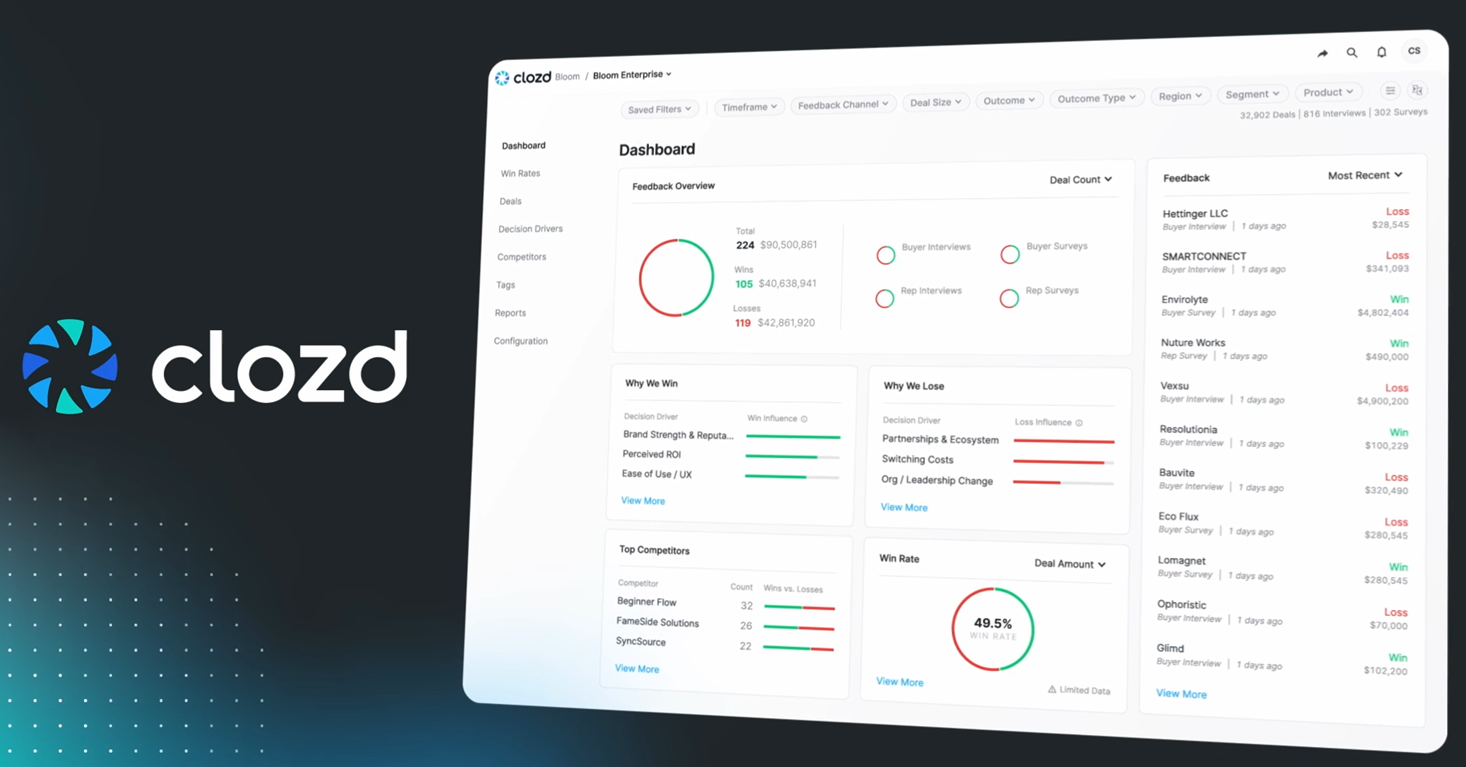
Clozd takes a different approach to competitive intelligence than Kompyte: instead of tracking what competitors do externally, it goes directly to the buyers who made the decision to find out exactly why a deal was won or lost. Its key capabilities include:
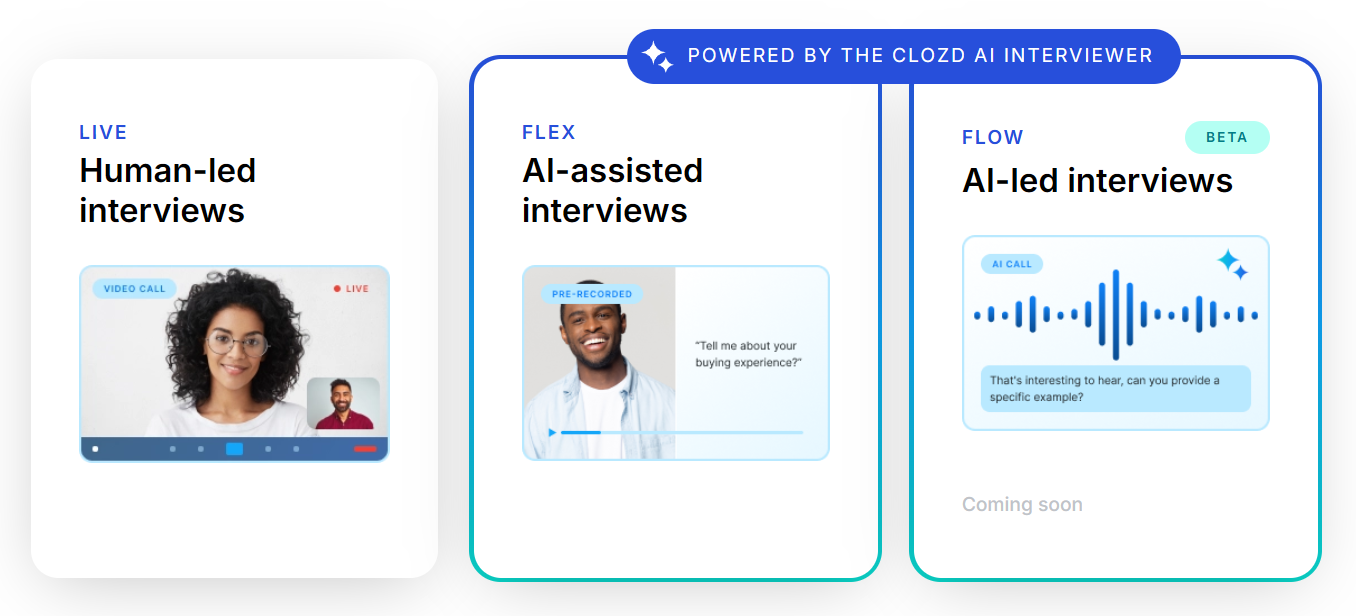
Expert-led Live Interviews: Seasoned researchers conduct structured 30-minute conversations with real buyers post-decision, surfacing deal drivers that CRM data consistently fails to capture. Clozd's research shows buyer and seller explanations for lost deals align only 15% of the time.
AI-assisted Flex Interviews: AI agents conduct asynchronous buyer interviews using pre-recorded prompts, asking follow-up questions grounded in everything the buyer has shared, enabling programs to run at volume.
Ask Clozd: A generative AI query tool that lets any stakeholder ask direct questions of the full interview corpus and receive synthesized answers.
Churn and renewal analysis alongside new-business win/loss, covering the full buyer lifecycle.
Why Choose Clozd Over Kompyte for Win/Loss Intelligence
Clozd stands out in the following areas:
Win/Loss Intelligence as a Core Product, Not a CRM Import Feature Kompyte approaches win/loss primarily as a data reporting layer: teams import deal data via CSV or use CRM sync, and for qualitative interviews, rely on IcebergIQ. Clozd is built from the ground up as an interview intelligence platform. Its Expert Network, AI Interviewer trained on 50,000+ buyer conversations, and Decision Driver taxonomy are built for extracting verified buyer reasoning.
Third-Party Neutrality Unlocks Buyer Candor Buyers are consistently more honest with a neutral third party because they don't worry about damaging a vendor relationship. According to Clozd's data, companies partnering with a third party are over 2x more likely to be satisfied with feedback quality. Nearly 70% of buyers name a different primary competitor than what's recorded in the CRM, illustrating the failure mode that CRM-sourced win/loss analysis cannot correct.
AI + Human Hybrid Scales Volume Without Sacrificing Depth Clozd's Flex Interviews resolve the traditional tradeoff between depth and scale: AI conducts asynchronous conversations, probing for context and nuance based on best practices refined through 50,000+ live interviews, while Live Interviews are reserved for high-stakes strategic deals. This hybrid model lets organizations run win/loss programs at volume without sacrificing the depth that makes buyer interviews valuable.
Source: Clozd
NOTE: Clozd is not a direct replacement for Kompyte's digital monitoring capabilities. It excels in a different layer of competitive intelligence: verified buyer reasoning. For teams evaluating Kompyte specifically because they want deeper win/loss intelligence, Clozd is the more appropriate specialist. Many organizations run both a monitoring tool and a buyer interview program as complementary parts of a full CI stack.
Clozd Pricing
Clozd does not publish pricing on its website. The commercial model combines a platform subscription (covering Flex Interviews, AI analysis, dashboards, and integrations) with expert services and program management (dedicated researchers, live interviews, outreach sequencing). A revenue ROI calculator at clozd.com/revenue-calculator is available for building a business case. Clozd holds ISO 27001 and SOC 2 Type II security certifications.
Who Should Use Clozd?
Choose Clozd if:
Your team's win/loss program currently relies on CRM self-reporting or rep-submitted deal notes, and you've noticed persistent gaps between what reps report and what buyers actually experienced.
You need win/loss intelligence that extends beyond new-business deals to cover churn, renewal dynamics, and post-implementation feedback within a single coordinated program.
Your organization runs enterprise-scale sales programs where deal sizes justify structured interview-based intelligence and the ROI of a single high-value insight justifies a managed-service investment.
6. Owler: Best Alternative for Budget-Conscious Entry-Level Company Intelligence
Source: Owler
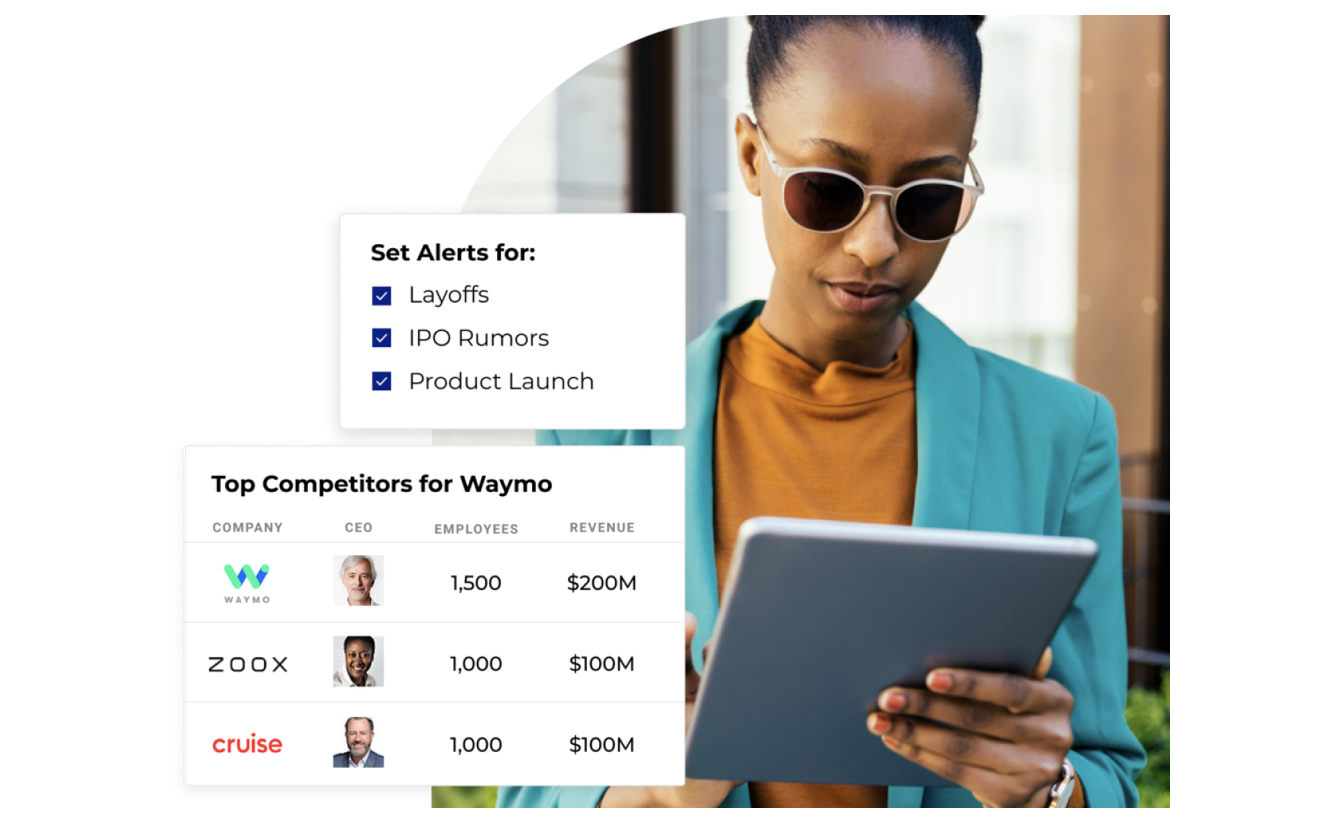
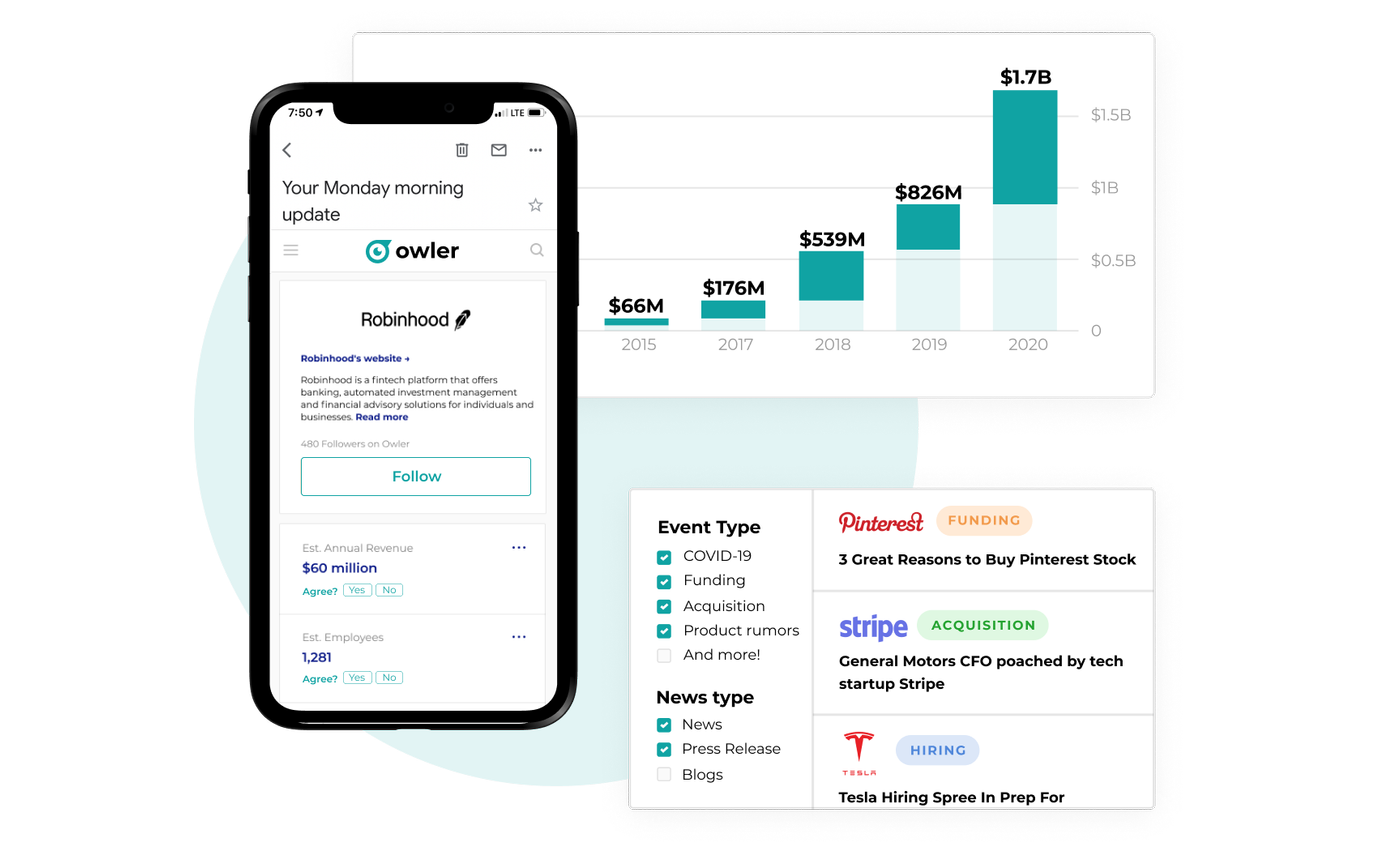
Owler is a community-powered business and competitive intelligence platform that helps professionals monitor companies, track competitor relationships, and stay informed on funding events and leadership changes, all starting from a permanently free tier. Where Kompyte requires a sales conversation and multi-seat minimum, Owler lets budget-constrained teams establish competitive awareness before they're ready to invest in a full CI program. Its key capabilities include:
A permanently free Community tier covering up to five companies with no credit card required
A Competitive Graph mapping over 45 million competitive relationships across 20 million companies
Real-time alerts for funding rounds, acquisitions, and leadership changes from a community of 5 million+ business professionals
Passive monitoring through Daily Snapshot emails and 25+ configurable Instant Insight alert categories
Owler Max with 150M+ verified contacts and AI-assisted outreach generation
Why Choose Owler Over Kompyte for Budget-Conscious Company Intelligence
Owler stands out in the following areas:
A Free Tier That Delivers Real Competitive Awareness Kompyte has no free tier, and its Essentials plan requires a quote, a minimum of 10 tracked competitors, 25 user seats, and a formal contract with auto-renewal terms. Owler's Community tier is permanently free: follow up to five companies, receive Daily Snapshot newsletters, configure real-time Instant Insight alerts, and access the competitor graph across over 20 million company profiles. This makes Owler a low-risk entry point for teams evaluating CI before committing to a formal program budget.
Community-Sourced Competitor Relationship Mapping Kompyte tracks what competitors publish. Owler maps the relational layer beneath those signals: which companies the market considers direct competitors, how relationships shift as the landscape consolidates, and what community-sourced estimates say about private company revenue and organizational stability. The Competitive Graph is built from 45 million+ competitive relationships contributed by 5 million+ professionals, creating a market-consensus view of competitive dynamics that no single vendor's tracking can replicate.
Passive Monitoring With Lower Maintenance Overhead Kompyte requires an active CI program: someone curates the Collect Feed, updates Battlecards, and trains reps. Owler delivers intelligence passively: the Daily Snapshot email arrives each morning, Instant Insight alerts fire on funding events or leadership changes, and Slack and Teams integrations push alerts into existing workflows. This set-and-forget model means the platform works even for teams that never log in to a dashboard.
Source: Owler
NOTE: We also evaluated Google Alerts for the free company-monitoring archetype. While Google Alerts offers keyword-based news tracking at zero cost, it lacks any structured company intelligence layer: no competitor graph, no funding event detection, no company profile data. Owler delivers more structured company intelligence for teams exploring CI before committing to a paid tool.
Owler Pricing
Owler Community (Free): Permanently free. Follow up to 5 companies, Daily Snapshot newsletter, Instant Insight alerts for 3 event types, competitor graph access.
Owler Pro, $39/user/month, billed annually: Unlimited company follows, advanced search and filtering, 25+ alert categories, 7+ years of historical news data, 45M+ competitive relationships.
Owler Max, Custom pricing (minimum 5 seats): All Pro features plus 150M+ verified contacts, Salesforce and HubSpot integrations, Slack and Teams integrations, and Owler AI for personalized outreach generation.
Who Should Use Owler?
Choose Owler if:
Your team is evaluating CI tooling for the first time and needs to demonstrate competitive awareness value before committing to a formal program budget. Owler's free Community tier makes that proof-of-concept frictionless.
You have a small sales team (fewer than 10 reps) without a dedicated CI function and need passive monitoring of funding events, leadership changes, and competitor relationships without weekly platform maintenance.
Your competitive intelligence use case centers on private company dynamics (revenue estimates, organizational health signals, competitor relationship mapping) rather than the digital-channel change tracking Kompyte specializes in.
7. Aomni: Best Alternative for AI-Native, Account-Specific Competitive Intelligence
Source: Aomni
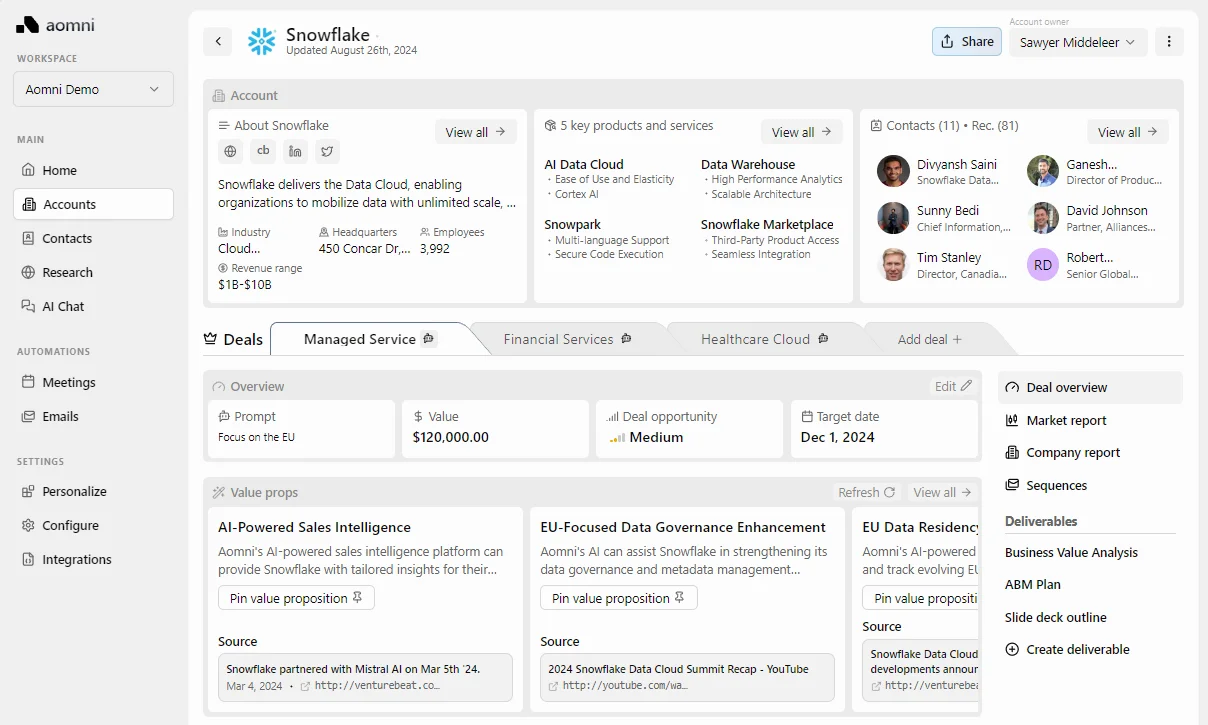
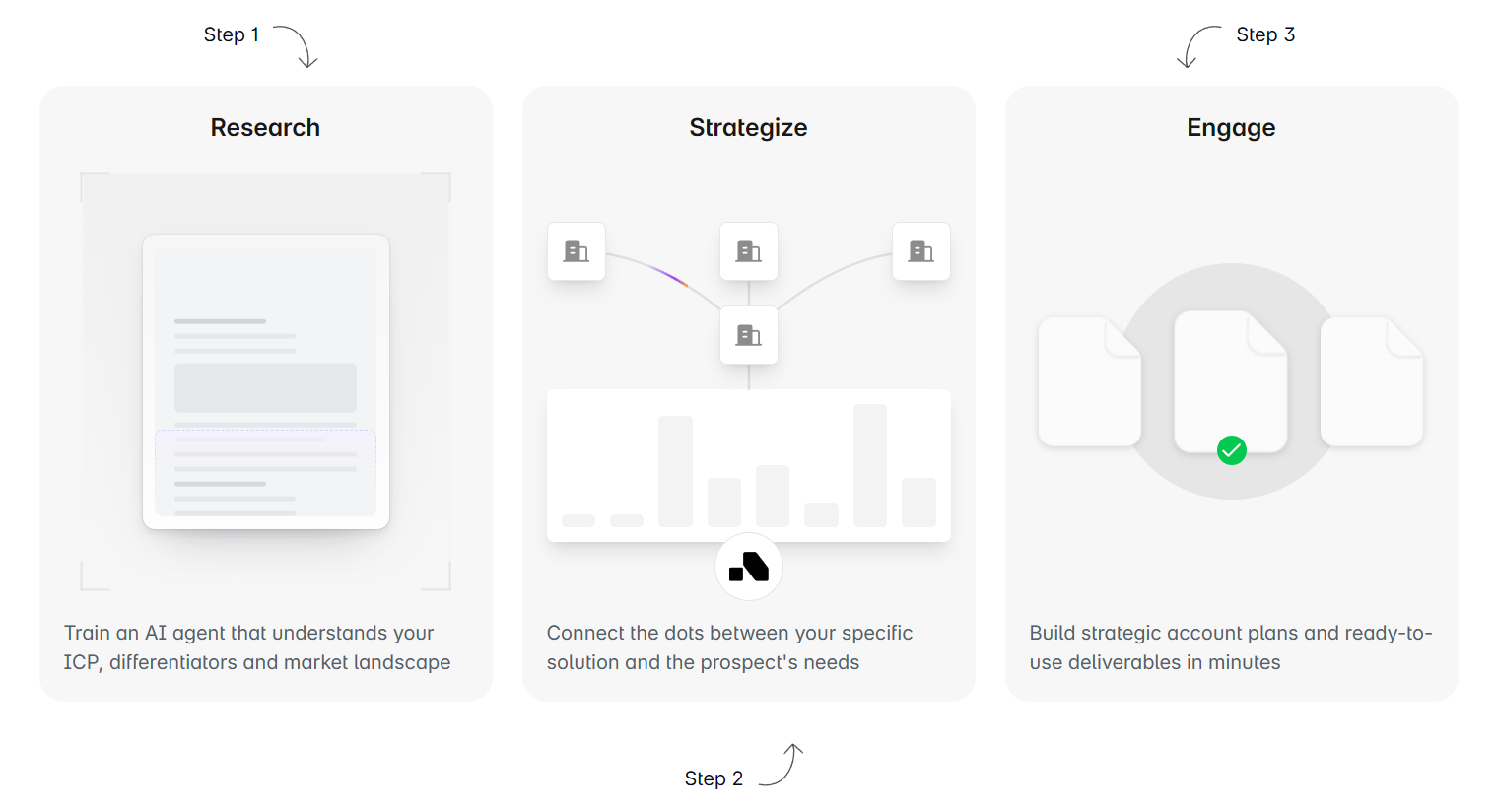
Aomni reframes competitive intelligence as a deal-level activity rather than a program-level one. Where Kompyte builds and maintains generic competitor-level Battlecards, Aomni deploys autonomous AI agents trained on your ICP and differentiators to generate competitive briefs tailored to each prospect's context, recent events, and known priorities. Its key capabilities include:
Autonomous AI research agents trained on your product positioning, ICP criteria, and competitive differentiators
Over 1,000 data points per account aggregated from 20+ sources covering company news, funding, tech stack, hiring trends, and competitive activity
Account-specific competitive battlecard generation that maps positioning to each prospect's known priorities
Automated personalized outreach generated from account research, referencing specific triggers
Named enterprise validation from WWT, AMD, Oracle, Altium, NVIDIA, and Furiosa
Why Choose Aomni Over Kompyte for AI-Native, Account-Specific Intelligence
Aomni stands out in the following areas:
Deal-Specific Competitive Intelligence vs. Market-Level Monitoring Kompyte delivers the same generic battlecard to every deal involving a given competitor. A prospect who just announced a leadership change, raised a Series B, or mentioned a rival in a press release has a completely different competitive context than a prospect at the same stage showing none of those signals. Aomni's AI agents research each prospect in real time from 20+ sources before generating tailored competitive positioning. This account-level specificity means reps walk into calls with intelligence grounded in the prospect's actual situation, not a one-size-fits-all competitor summary.
Autonomous AI Agents vs. Continuous Human Curation Kompyte's model requires a CI manager to configure tracking, review the Collect Feed, and maintain Battlecards continuously. Aomni operates differently: once teams define their positioning, ICP criteria, and differentiators, the AI agents handle continuous research on their own. As CEO David Zhang explains, Aomni's agents aggregate external data in real time, which means research outputs improve with market changes without requiring someone to update monitoring configurations.
Research-to-Outreach Pipeline in a Single Workflow Kompyte's value ends at battlecard delivery. Getting intelligence into a personalized outreach sequence is a separate process. Aomni closes that gap: the same AI agents that conduct account research also generate targeted email and LinkedIn sequences referencing specific account triggers uncovered during research. Because messaging is grounded in specific account signals rather than generic battlecard content, outreach conversion rates improve compared to template-based approaches.
Source: Aomni
NOTE: We also evaluated CI Radar and Exponentia.ai for this archetype. While CI Radar offers automated competitive tracking similar to Kompyte, and Exponentia.ai provides emerging AI-powered analysis, Aomni offers the most complete AI-native model for teams needing account-specific competitive intelligence fused with outreach generation, particularly enterprise technology vendors whose deals require prospect-level research.
For a full look at Aomni's capabilities, use cases, and how it performs in practice, read our Aomni review.
Aomni Pricing
Starter, Free: Permanent free plan with AI account research, AI sales strategy, AI chat, personalized AI sequences, and custom deliverables. Usage limits apply.
Pro, $300/month: Up to 3 seats included (additional seats at $100/seat/month). Unlimited account research and AI sequences. Email and LinkedIn integrations. CRM integrations (Salesforce, HubSpot, Pipedrive) are gated to Enterprise.
Enterprise, Custom pricing: Everything in Pro plus CRM integration, bulk research, annual pricing, tailored onboarding, and priority support.
For a detailed breakdown of what's included at each tier and how the usage limits work, see our Aomni pricing guide.
Who Should Use Aomni?
Choose Aomni if:
Your sales motion is account-based and deal-specific enough that generic competitor battlecards consistently fail to reflect the actual competitive context of each live deal, particularly if your average sales cycle exceeds three months.
Your team sells across multiple verticals without deep specialist knowledge in each. Aomni enables generalist reps to synthesize industry-specific context quickly before first contact.
You want competitive intelligence and personalized outreach generated from the same research workflow, eliminating the gap between knowing what to say and writing it.
You are comfortable with an early-stage vendor (founded 2023, $4M seed) in exchange for a differentiated AI-native research model backed by enterprise logos including Oracle, AMD, and NVIDIA.
The Final Verdict
Kompyte excels as a competitive intelligence and sales enablement platform, but different teams and go-to-market strategies have requirements that benefit from specialized solutions. Based on our research, here are the best alternatives:
ZoomInfo for comprehensive B2B data, buyer intent signals, and AI-powered GTM intelligence that powers your entire go-to-market motion
Klue for enterprise CI programs that need native win/loss analysis, proactive Deal Tips, and revenue impact reporting in a single platform
Crayon for AI-powered competitive content generation that turns raw signals into finished battlecard updates, SWOT analyses, and talk tracks
Competitors App for affordable, all-channel competitor monitoring at SMB price points with agency white-label options
Clozd for expert-conducted buyer interview intelligence that surfaces the real reasons deals are won or lost
Owler for budget-conscious entry-level company intelligence with a permanently free tier and community-powered competitor mapping
Aomni for AI-native, account-specific competitive positioning tailored to each prospect
You don't have to choose between Kompyte and these alternatives exclusively. Many organizations combine a competitive monitoring tool with a deeper data platform, a win/loss program, or an account intelligence layer to build their ideal competitive enablement stack. Consider your needs, team size, and growth plans when deciding which solution works best.
Ready to add a data and intelligence layer to your competitive strategy? ZoomInfo is an AI GTM platform that gives your revenue team the B2B data foundation, buyer intent signals, and GTM Context Graph intelligence to outmaneuver competitors at every stage of the deal. Request a demo or start with ZoomInfo Lite for free.
Kompyte Alternatives FAQ
Why do businesses look for Kompyte alternatives?
Kompyte works well as a competitive intelligence and sales enablement platform, but businesses often need deeper capabilities in specific areas. Common limitations include analytics and reporting that lag behind some competitors (G2 scores of 7.7 in Reporting versus Klue's 8.4), AI summary inconsistency on complex or unstructured content, limited coverage of niche competitors operating outside major digital channels, and a self-serve help center that creates dependency on the dedicated CSM rather than self-service documentation.
What is the best overall Kompyte alternative?
There is no single best alternative because Kompyte covers several different functions. ZoomInfo is the top choice for comprehensive B2B data and AI-powered GTM intelligence, Klue leads for enterprise CI programs with integrated win/loss analysis, and Crayon is the strongest option for AI-powered competitive content generation. The right choice depends on where your team's competitive intelligence gaps are.
Is there a free alternative to Kompyte?
Yes, several alternatives offer free tiers. Owler's Community tier is permanently free with up to five tracked companies, competitive graph access, and daily email digests. Aomni's Starter plan is also free with AI account research and personalized sequences. ZoomInfo Lite offers permanent free access to the B2B database with 10 monthly export credits. None of these free tiers replicate Kompyte's full competitive monitoring and Battlecard workflow, but they provide meaningful competitive intelligence for budget-constrained teams.
Which Kompyte alternative is best for small teams on a budget?
Competitors App is built for this scenario, offering all-channel competitor monitoring at approximately $15-$20 per competitor per month. A team tracking four rivals pays roughly $80/month, compared to Kompyte's enterprise-focused pricing (average ARR per customer at acquisition was approximately $20,000). For even leaner budgets, Owler's free Community tier provides structured company intelligence without any cost commitment.
How does Kompyte compare to Klue for enterprise CI programs?
Klue differentiates with native win/loss analysis (built through acquisitions rather than a third-party partnership), proactive Deal Tips pushed to reps when competitors surface in Gong calls, and revenue impact reporting that tracks pipeline composition and correlates CI activity with closed revenue. Kompyte offers faster implementation (1-2 weeks versus longer onboarding), inclusive pricing with no add-on charges for integrations or onboarding, and the Semrush data network for search marketing intelligence. Klue is typically the better fit for organizations with a dedicated CI owner who needs to demonstrate program ROI to leadership.
Can I use Kompyte alongside one of these alternatives?
Many organizations do exactly this. A common combination is running Kompyte (or another monitoring tool) for day-to-day competitor tracking and Battlecard delivery while using ZoomInfo for buyer data and intent signals, Clozd for periodic win/loss interview programs, or Crayon for AI-generated competitive content. The tools on this list address different layers of the competitive intelligence stack, so they often complement rather than replace each other.
Which alternative is best for understanding why deals are won or lost?
Clozd is built for this, combining expert-conducted live interviews with AI-assisted asynchronous interviews trained on 50,000+ real buyer conversations. Its research shows that buyer and seller explanations for lost deals align only 15% of the time, highlighting why CRM-sourced win/loss data and rep-submitted notes are insufficient. For teams that need win/loss integrated with competitive enablement in a single platform, Klue offers the most tightly coupled approach.
What is the best Kompyte alternative for account-based selling?
ZoomInfo provides the deepest account intelligence layer with its comprehensive B2B database, buyer intent data, and the GTM Context Graph. For deal-specific competitive positioning, Aomni generates tailored competitive briefs for each prospect using autonomous AI agents, combining account research and outreach into a single workflow. The choice depends on whether you need broad data infrastructure (ZoomInfo) or deal-specific competitive content generation (Aomni).
Other tools worth evaluating side by side:
