
In B2B, buyers compare vendors whether or not you track them. Competitive intelligence software automates the collection, analysis, and distribution of competitor and market signals, so your go-to-market teams act on them instead of chasing them.
The right platform depends on the job: arming reps with battlecards, running win-loss, monitoring competitor moves, or feeding signals into live deals.
This guide compares the 10 best competitive intelligence tools on the criteria that decide real-world value, and shows where each one fits.
What is competitive intelligence software?
Competitive intelligence software gathers information about your competitors and your market, turns it into structured insight, and delivers it to the people who need to act. It replaces manual, ad hoc research (scanning competitor websites, saving news links, rebuilding slide decks) with continuous, automated monitoring and AI-assisted analysis.
The category covers several distinct jobs, and few buyers need all of them at once:
Competitive enablement: tracking competitors and arming sales with battlecards for live deals (Klue, Crayon, Kompyte).
Market and strategy intelligence: monitoring markets, regulation, and industry trends for strategy and product teams (Contify, AlphaSense).
Win-loss analysis: interviewing buyers after a decision to learn why deals close or slip (Clozd).
Digital and web intelligence: measuring competitor traffic, SEO, ads, and audience behavior (Similarweb, Semrush).
Company tracking: following funding, hiring, and leadership changes across a set of companies (Owler).
How we evaluated these tools
Every tool below is measured against the same criteria, drawing on verified user reviews from G2, Capterra, and Gartner Peer Insights alongside each vendor's documented capabilities:
Intelligence depth and type: what the platform actually watches, and how well it fits competitive versus market versus win-loss work.
Automation and AI: how effectively it filters noise, summarizes findings, and surfaces what matters without manual curation.
Workflow delivery: whether insight reaches reps and marketers inside Slack, Microsoft Teams, the CRM, and battlecards, or sits in a repository no one opens.
Source coverage and data quality: the breadth of sources and the accuracy of what gets ingested.
Integrations: native connections to Salesforce, HubSpot, sales enablement, and BI tools.
Pricing model and transparency: published pricing, quote-based contracts, and total cost of ownership including the analyst time a platform demands.
Best-fit team: the use case and team size each platform serves best.
Comparison table
Platform | Best for | Category | Delivery & key integrations |
ZoomInfo | Competitive and market signals inside the GTM workflow | All-in-one AI GTM Platform | GTM Workspace, GTM Studio, CRM, API and MCP |
Klue | Battlecards and deal-level competitive enablement | Competitive enablement + win-loss | Slack, Teams, Salesforce, email, browser extension |
Crayon | Broad, automated competitor monitoring | Competitive tracking | Salesforce, sales enablement tools, Gong |
Kompyte | Automated tracking and battlecards for lean teams | Competitive enablement | Slack, Teams, Salesforce, HubSpot |
Contify | Cross-functional market and competitive intelligence | Market and competitive intelligence | Slack, Teams, Salesforce, HubSpot, Power BI |
AlphaSense | Research-grade market and financial intelligence | Market and research intelligence | Web app, PowerPoint and Excel add-ins |
Clozd | Structured win-loss programs | Win-loss analysis | Slack, CRM, email |
Similarweb | Competitor web traffic and digital benchmarking | Digital intelligence | Web app, API, Snowflake, Tableau |
Semrush | Competitor SEO, PPC, and traffic research | Digital and search intelligence | Web app, API, 20+ integrations |
Owler | Lightweight company and competitor alerts | Company tracking | Snapshot email, Chrome extension, CRM (Enterprise) |
The 10 best competitive intelligence software platforms
1. ZoomInfo
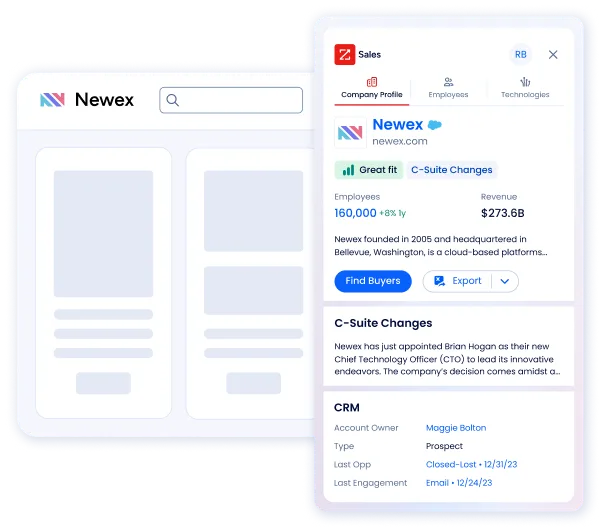
ZoomInfo is an all-in-one AI GTM Platform built as three layers: a B2B data foundation, an intelligence layer that reasons over it, and universal access that lets teams consume both in any workflow. Competitive intelligence runs through all three. The data foundation covers more than 100 million companies and tracks over 30,000 technologies across 200-plus categories, so you can see which competitor tools a target account already runs and time a displacement play accordingly.
On top of that foundation, the GTM Context Graph processes more than 1.5 billion data points a day, fusing ZoomInfo's data with your CRM records, conversation intelligence, and behavioral signals into a single reasoning layer that explains why an account is in motion, not just that it is.
That turns raw activity into competitive context: category intent and buying signals that show which accounts are evaluating alternatives, and competitor mentions that Chorus surfaces from live sales conversations so a rep knows a battlecard is needed before the next call. Teams consume it in GTM Workspace for sellers, GTM Studio for marketing and RevOps, or through the API and MCP for any tool or AI agent.
ZoomInfo is not a battlecard authoring or win-loss interview platform in the way Klue, Crayon, or Clozd are, so a formal competitive enablement program often pairs it with one of them. Where it earns its place is the step those tools depend on: turning competitive and market signals into go-to-market intelligence that reaches reps in the flow of work.
Key features:
Technographic tracking that reveals which competitor tools an account already runs and when a displacement window opens.
Category intent and buying signals that flag accounts actively evaluating competitors and alternatives.
Conversation intelligence that captures competitor mentions, objections, and deal risks from recorded sales calls.
Real-time signal alerts on funding rounds, leadership changes, and expansion moves at target and competitor accounts.
Buying committee and decision-maker mapping to see who is driving a competitive evaluation.
Automated enrichment that keeps competitor and account records current in your CRM.
Pros:
Competitive signals arrive in the workflow where deals are actually worked, which drives adoption.
One platform spans data, intelligence, and engagement, reducing tool sprawl.
Verified data foundation grounds AI recommendations that lighter tools cannot match.
Holds Leader positions in Gartner's Magic Quadrant for ABM Platforms (2024 and 2025) and Forrester's Wave for Intent Data Providers, B2B (Q1 2025).
Cons:
Not a purpose-built battlecard authoring or win-loss interview tool, so a formal CI program often pairs it with a dedicated platform.
Breadth means teams should scope which signals and workflows they will use first.
Pricing: Free to start with consumption credits based on usage.

"The AI chatbot that's given all that context has helped us craft very specific account- and persona-based messages. And people have responded to them right away."
2. Klue
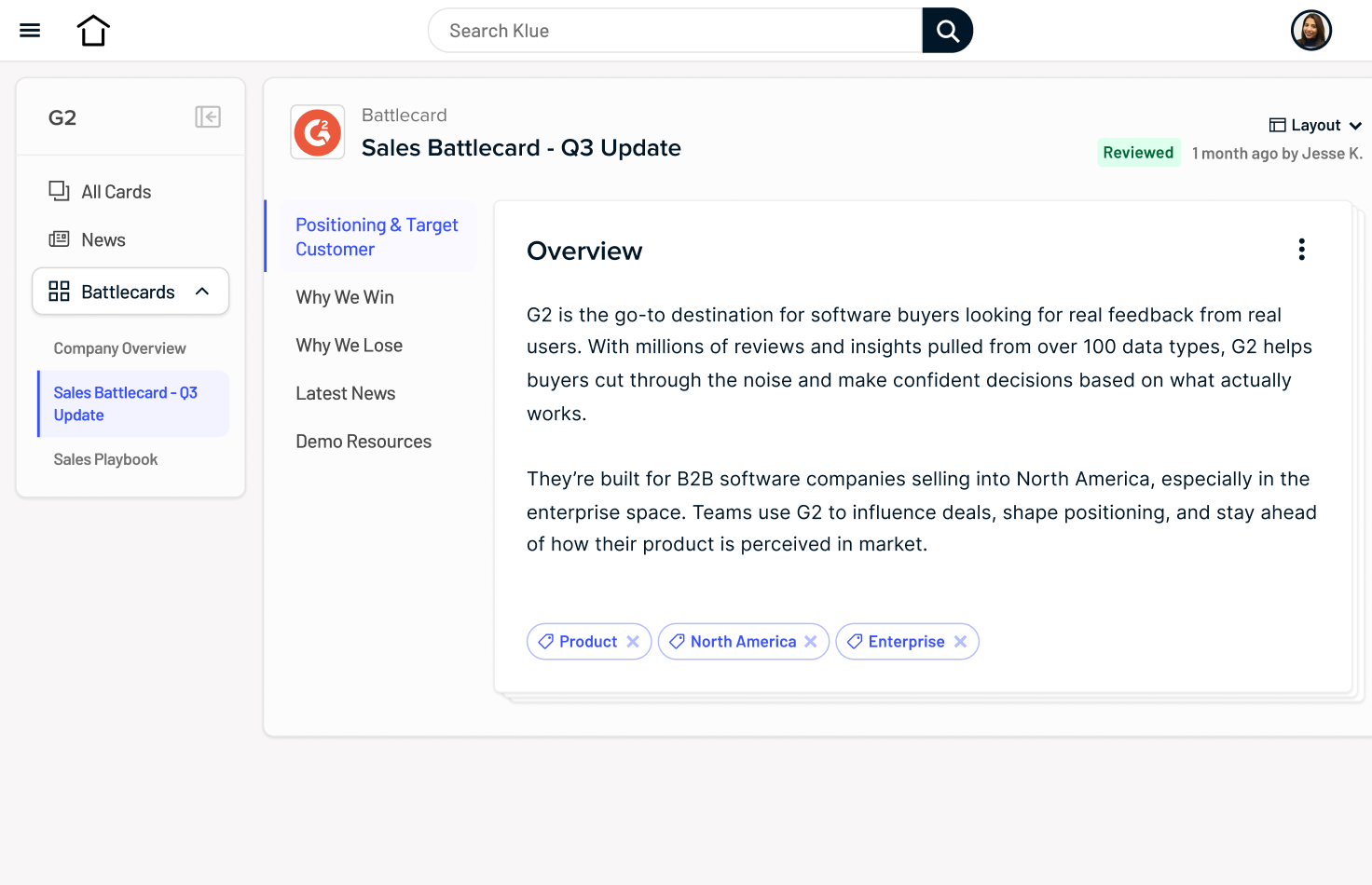
Klue is a competitive enablement platform that combines competitive intelligence and win-loss in one place, built for teams that want intel delivered proactively to reps rather than filed in a repository.
It collects insight from CRM data, sales calls, buyer interviews, and external sources, then packages it into battlecards for specific competitors, scenarios, and deals. Klue has raised $62 million from investors including Salesforce Ventures and Tiger Global, per Capterra.
Key features:
AI-assisted battlecards mapped to competitors, scenarios, and individual deals.
Competitor monitoring across websites, pricing pages, product changes, news, and reviews.
Deal-level intelligence that monitors sales calls for competitive signals and pushes guidance to reps.
Native win-loss analysis to understand who you lose to and why.
Two-way delivery through Slack, Microsoft Teams, Salesforce, and email, plus a browser extension for intel capture.
Pros:
Category-leading battlecard depth and one of the highest G2 satisfaction scores in the space.
Intel reaches reps inside their workflow, which lifts adoption.
Competitive intelligence and win-loss live in the same platform.
Cons:
Priced at the premium end and built for teams with a dedicated CI or product marketing owner.
Less suited to teams that only want lightweight monitoring.
Pricing: Custom, quote-based, and not publicly listed. Third-party procurement sources place typical entry deployments in the mid-five figures per year.
3. Crayon
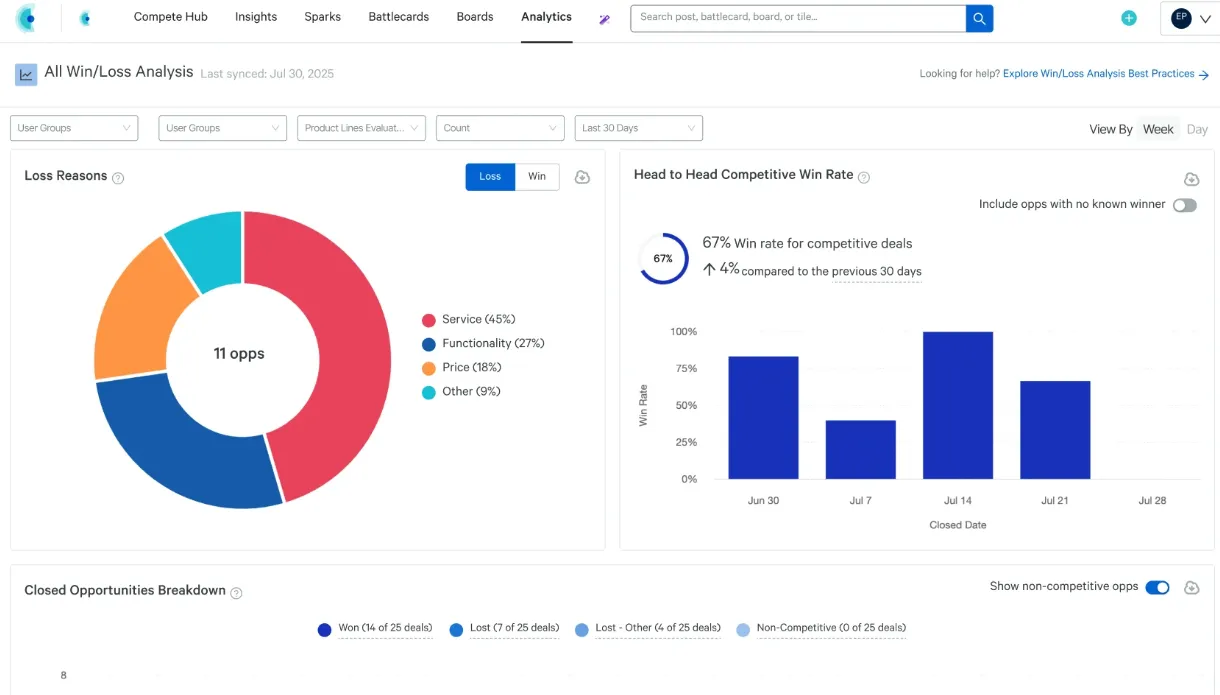
Crayon is a broad competitive intelligence platform focused on automated, real-time competitor monitoring for dedicated CI and product marketing teams.
It tracks changes across competitor websites, pricing pages, product updates, job postings, marketing campaigns, social posts, and news, then uses AI to separate signal from noise. Crayon has won multiple Product Marketing Alliance awards for competitive intelligence software and integrates with Clozd for structured win-loss.
Key features:
Automatic change detection across hundreds of digital sources with AI classification.
Dynamic battlecards distributed into Salesforce and sales enablement tools.
Win Story Insights, which analyzes call transcripts and deal notes to extract winning moments.
Win-loss and Gong conversation mentions surfaced alongside competitive tracking.
Pros:
Broadest automated coverage of competitors' digital footprint in the category.
Strong for cross-functional CI programs that go beyond sales enablement.
Well-reviewed customer success and integration ecosystem.
Cons:
Breadth of alerts requires a dedicated owner to curate, or reps get flooded with minor changes.
No free tier or self-serve trial; evaluation runs through sales.
Pricing: Custom, quote-based, and not publicly listed. Third-party estimates place dedicated deployments in the low-to-mid five figures per year, before the internal analyst time to run it.
4. Kompyte
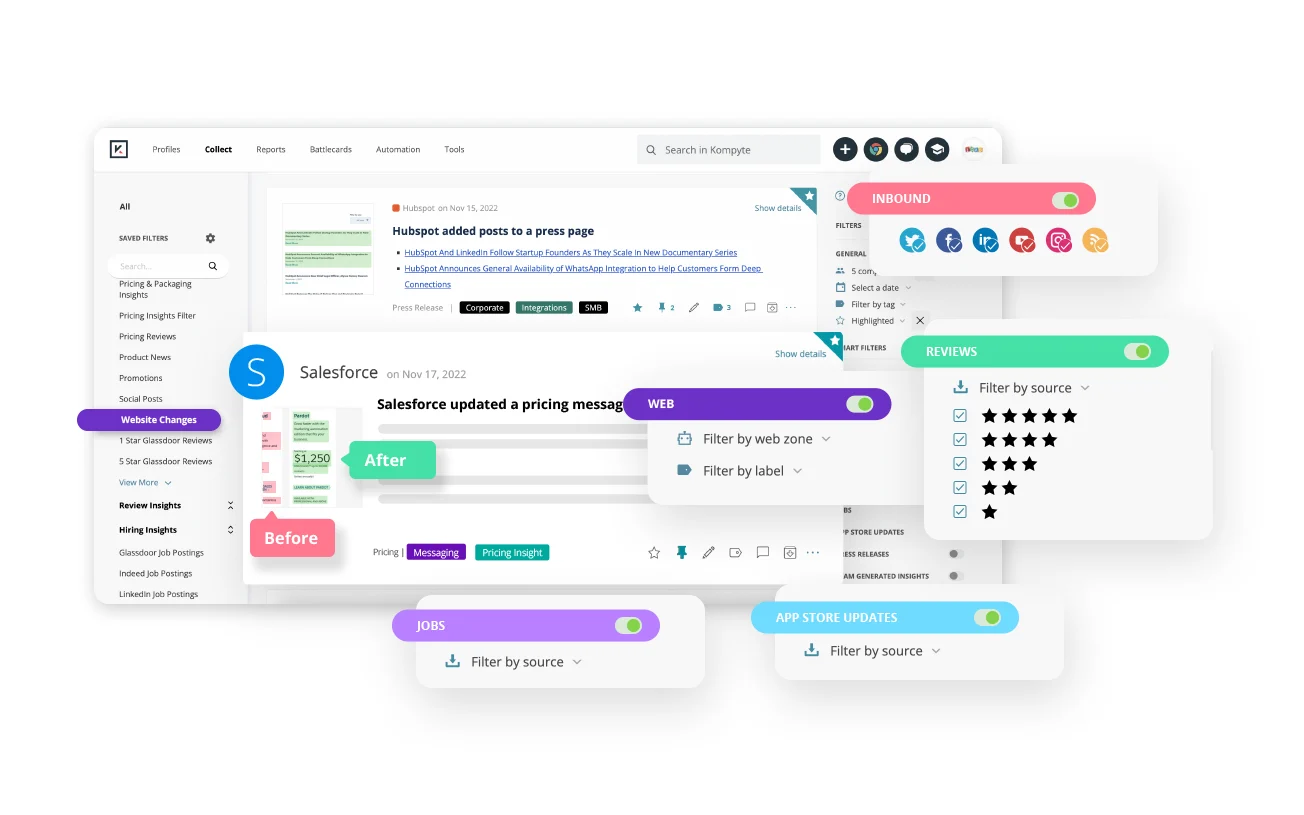
Kompyte, acquired by Semrush in 2022, automates competitive tracking and battlecard creation, and benefits from access to Semrush's web and SEO data.
Its AI agent visits competitor sites daily and classifies changes automatically, which the vendor says compresses competitive research to about an hour per week. It suits sales-focused teams and marketers who want dedicated CI automation without the largest enterprise price tag.
Key features:
Continuous monitoring of competitors' websites, reviews, social, ads, and job postings.
Kompyte GPT for AI-generated and auto-updated battlecards.
Dynamic battlecards with bi-directional Salesforce and HubSpot sync.
Win-loss analysis through its IcebergIQ research partnership.
Insight delivery into Slack, Microsoft Teams, and the CRM.
Pros:
Fast setup and a clean, sales-friendly interface.
Unlimited battlecards and reports, with no charge to change tracked competitors.
Strongest value for teams already inside the Semrush ecosystem.
Cons:
Digital-footprint monitoring is the core strength; deep strategy or market intelligence is lighter.
Still benefits from a product marketing or CI owner to run the program.
Pricing: Custom, quote-based through Semrush. Third-party reviews consistently position Kompyte below Klue and Crayon, and cheaper still for existing Semrush customers.
5. Contify
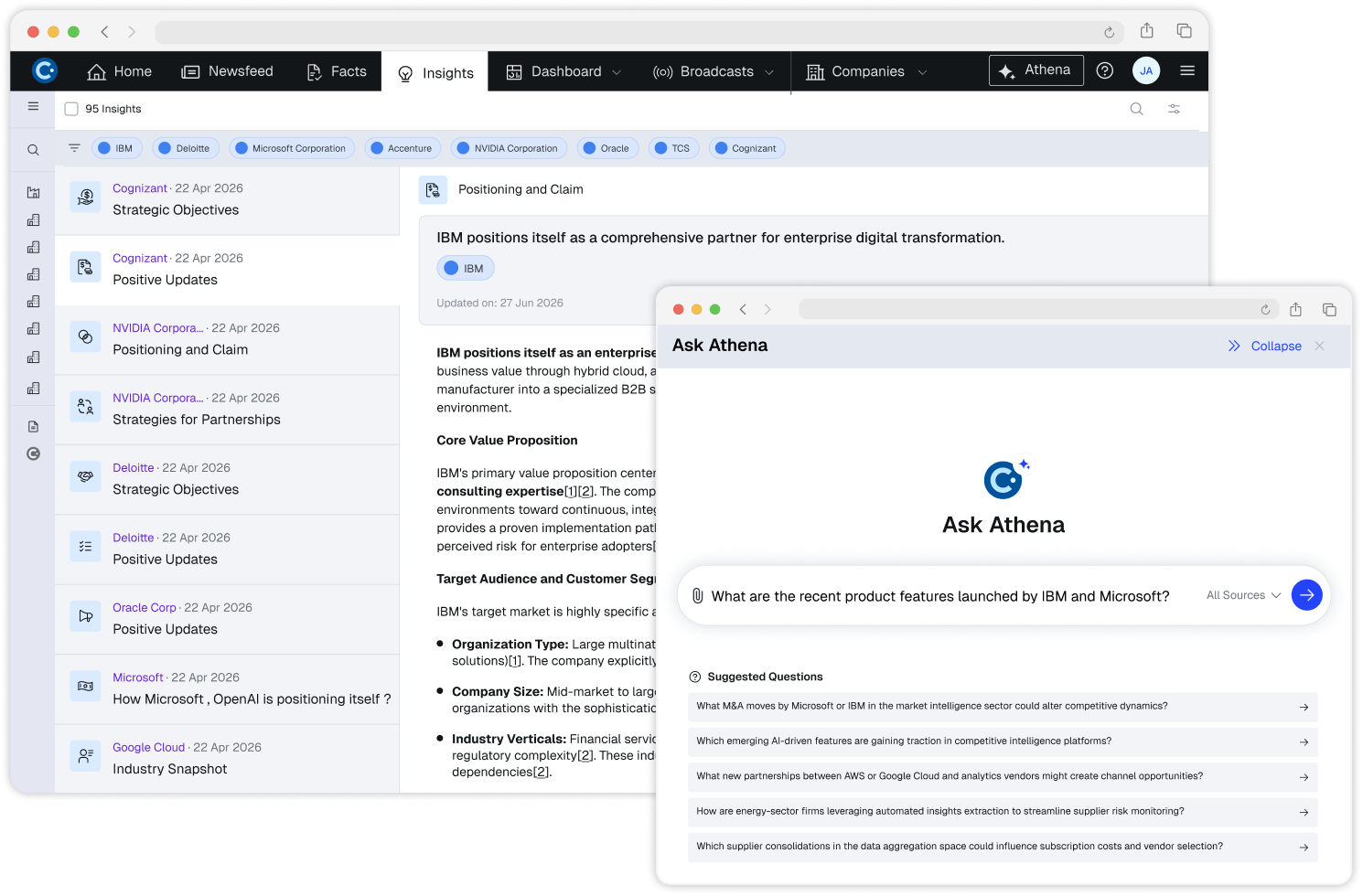
Contify is an AI-native market and competitive intelligence platform that gives strategy, product, marketing, and sales teams decision-ready insight from more than a million editorially curated sources.
It filters news, company websites, SEC filings, social media, reviews, forums, job boards, and regulatory portals down to the signals that matter, then distributes them through dashboards, newsletters, and workplace apps. Contify was named a Visionary in the inaugural Gartner Magic Quadrant for Competitive and Market Intelligence Platforms.
Key features:
Curated intelligence feeds with custom taxonomy and configurable dashboards.
Athena agentic AI engine that extracts and synthesizes insight and answers natural-language questions.
Battlecards and executive-ready intelligence newsletters.
Coverage across 100-plus languages with auto-translation into English.
Integrations with Slack, Microsoft Teams, HubSpot, Salesforce, Power BI, and FactSet.
Pros:
Strong curation that reduces alert fatigue for cross-functional teams.
Wide, multilingual source coverage for international markets.
Serves strategy and market intelligence use cases, not just sales.
Cons:
Reviewers note the interface can feel dated next to newer tools.
Best value depends on investing in the custom taxonomy setup.
Pricing: Custom, quote-based, and not publicly listed. Third-party listings put it in the low-five-figures-per-year range, varying with source count and scope.
6. AlphaSense
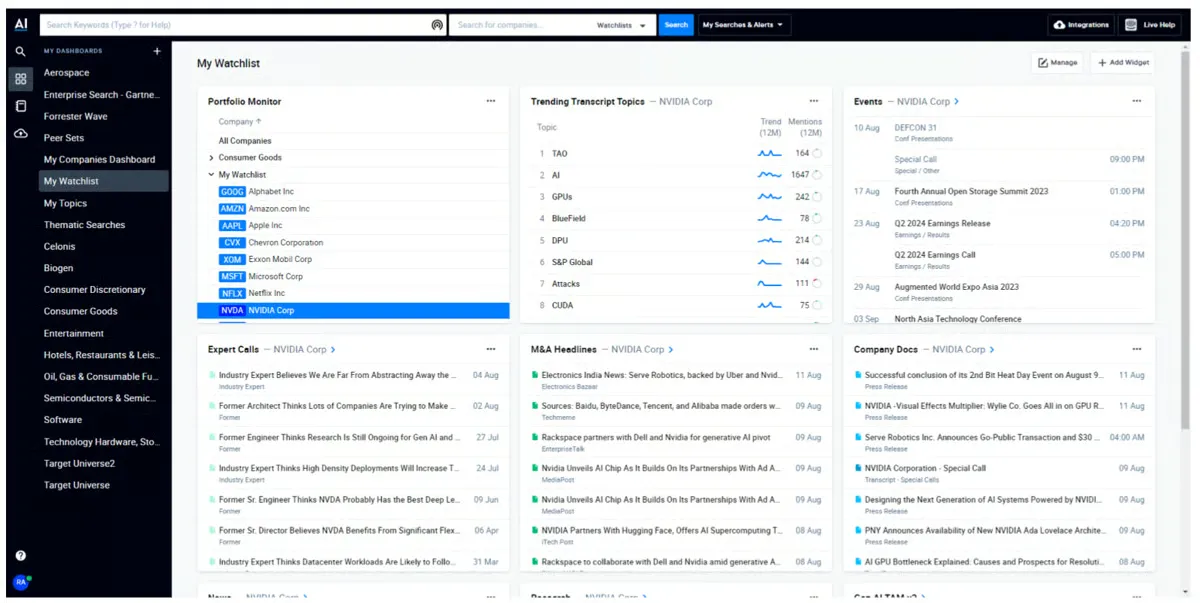
AlphaSense is a research-grade market intelligence platform for teams that need to synthesize insight across a curated universe of premium business content: SEC filings, earnings transcripts, broker research from 1,500-plus partners, news, and, since its $930 million acquisition of Tegus, a large library of expert-call transcripts.
Its generative search and Deep Research compress weeks of analysis into minutes, with sentence-level citations. AlphaSense was named a Leader in the inaugural Gartner Magic Quadrant for Competitive and Market Intelligence Platforms, positioned highest on Ability to Execute.
Key features:
AI search across more than 500 million premium business and financial documents.
Deep Research that synthesizes multi-step questions with source-traceable answers.
Tegus expert transcripts and Channel Checks for primary-research depth.
Enterprise Intelligence to index and search your own internal documents alongside external content.
PowerPoint and Excel add-ins for reports and financial models.
Pros:
Deepest research and financial-grade content set in the category.
Sentence-level citations designed to eliminate AI hallucinations.
Trusted across corporate strategy, consulting, and financial services.
Cons:
Built for research rather than acting on findings inside a sales workflow.
Enterprise pricing and a learning curve that comes with the platform's breadth.
Pricing: Custom, quote-based, priced per seat with tiered content access. Third-party reports place most seats in the five-figure-per-year range, scaling with content add-ons.
7. Clozd
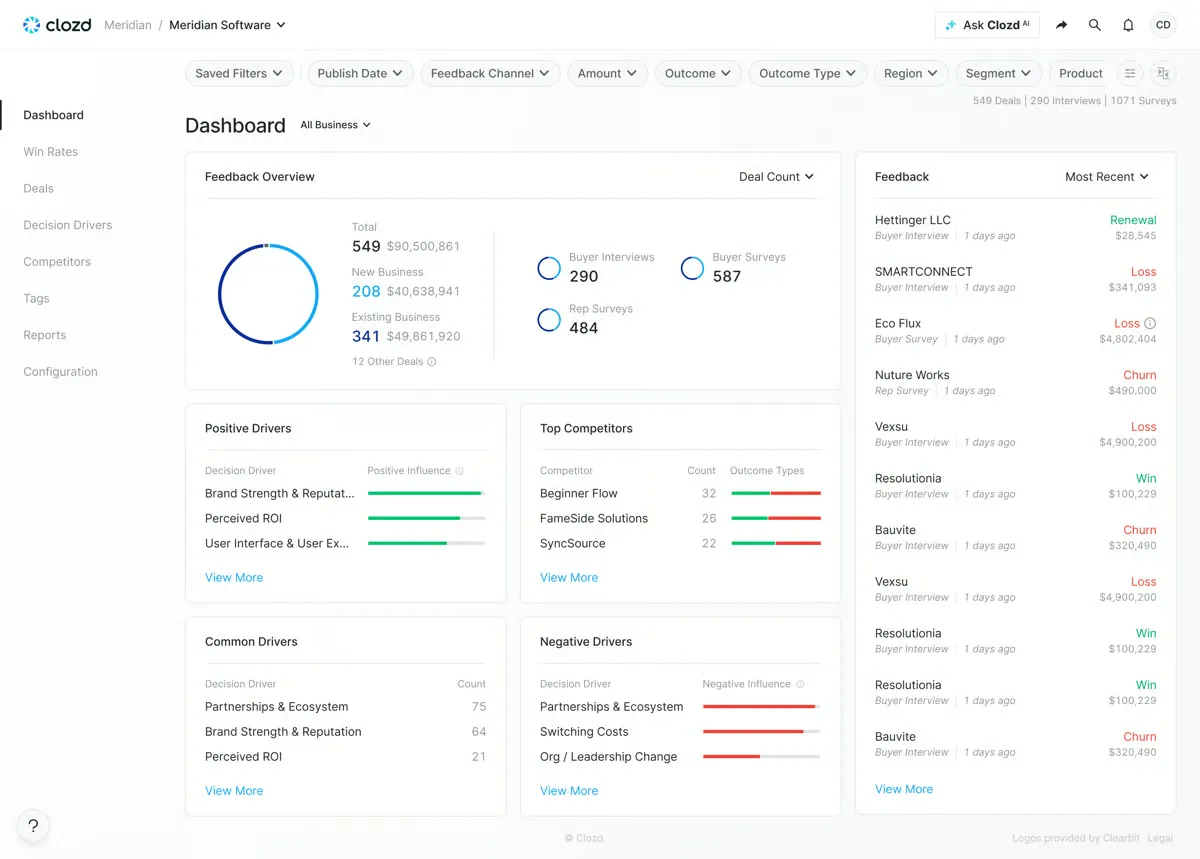
Clozd is the category standard for win-loss analysis, combining structured buyer interviews with software that helps B2B teams learn why they win and lose deals.
It runs managed and self-service programs, integrates with the CRM to automate data collection, and identifies the Decision Drivers behind outcomes so revenue, product, and marketing teams can act. According to Clozd's research, distributing win-loss insight across departments correlates with higher win rates.
Key features:
Buyer interview services plus a self-service platform for continuous win-loss.
Automated theme and Decision Driver identification with verbatim buyer feedback.
Dashboards filterable by competitor, region, and product line.
Insight distribution through Slack, CRM, and email alerts.
Pros:
Purpose-built depth and methodology for win-loss, backed by strong G2 reviews.
Combines human interviewers with software for objective, high-response-rate feedback.
Integrates with competitive platforms such as Crayon.
Cons:
Narrow by design; it answers why you win and lose, not broad competitor monitoring.
Interview-based model carries turnaround time and enterprise cost.
Pricing: Custom, based on annual interview volume and service level. Third-party estimates place enterprise programs in the five-to-six-figure range per year.
8. Similarweb
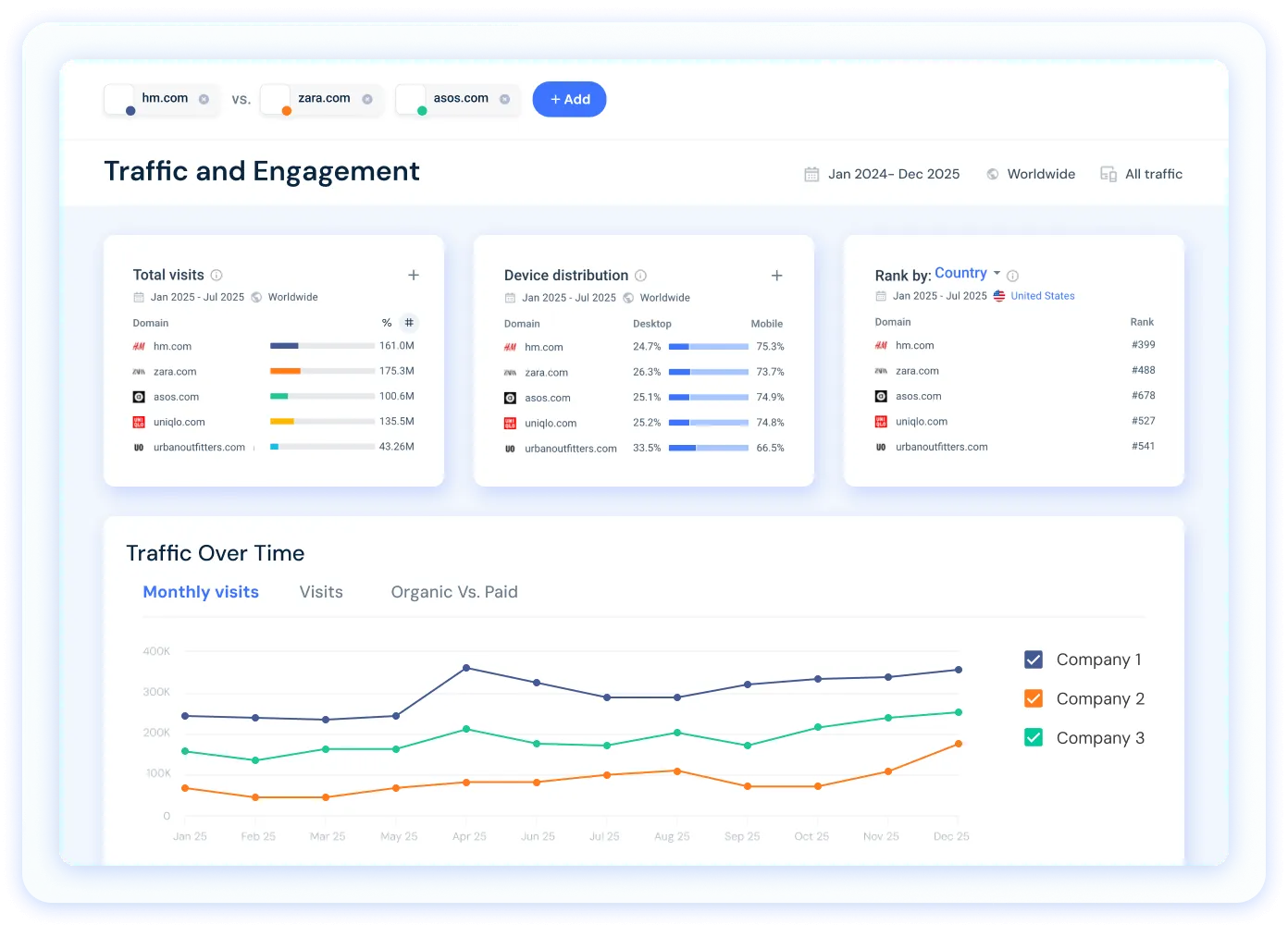
Similarweb is a digital intelligence platform that measures competitors' web and app performance based on real user behavior across more than 100 million websites and 4 million apps.
It benchmarks traffic, audience, and engagement, then extends into SEO, paid search, and shopper intelligence. Sales and strategy teams use its data to size markets, track emerging players, and enrich the CRM.
Key features:
Competitor traffic, source, and audience analysis with industry benchmarking.
SEO, keyword, and paid-search competitive research.
Ad Intelligence and shopper or retail intelligence modules.
API access, AI-workflow integrations, and BI connections such as Snowflake and Tableau.
Pros:
Unmatched depth of estimated traffic and audience data for competitor domains.
Multiple product lines for marketing, sales, ecommerce, and research.
Institutional credibility; its data is cited in investment and market research.
Cons:
Traffic figures are estimates, strongest for higher-traffic sites.
Full coverage and country-level data require higher tiers or enterprise quotes.
Pricing: Free trial available. Entry Web Intelligence plans start around $125 per month billed annually; business and enterprise packages are quote-based.
9. Semrush
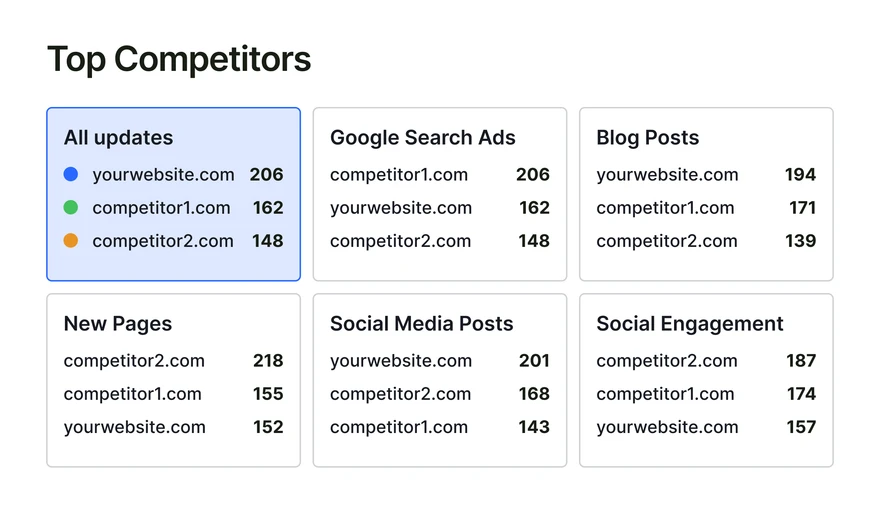
Semrush is an all-in-one SEO and marketing suite whose competitive-research strength sits in its Traffic & Market Trends (.Trends) add-on: Traffic Analytics, Market Explorer, One2Target, and EyeOn for competitor traffic, market share, audience, and activity monitoring.
Semrush also owns Kompyte for dedicated battlecards, and exposes its data to AI assistants for competitor research through natural-language prompts. It is the default choice when competitor SEO and PPC are the primary intelligence need.
Key features:
Competitor keyword, backlink, and rank research at scale.
Traffic Analytics and Market Explorer for competitor traffic and market share.
EyeOn monitoring of competitors' new content and promotions.
One2Target audience demographics and overlap analysis.
Pros:
Deepest SEO and PPC competitive dataset, with strong overall G2 ratings.
Broad toolkit under one roof for marketing teams.
Kompyte and .Trends extend it toward dedicated CI.
Cons:
Core plans focus on search; the richest competitive data sits in paid add-ons.
Costs climb with extra seats and the .Trends package.
Pricing: Plans start at $139 per month billed monthly (about $117 per month billed annually) for the base SEO plan, scaling to $549 per month for the Advanced tier. The Traffic & Market Trends (.Trends) competitive-research data is a paid add-on. A limited free plan and a 7-day trial are available.
10. Owler
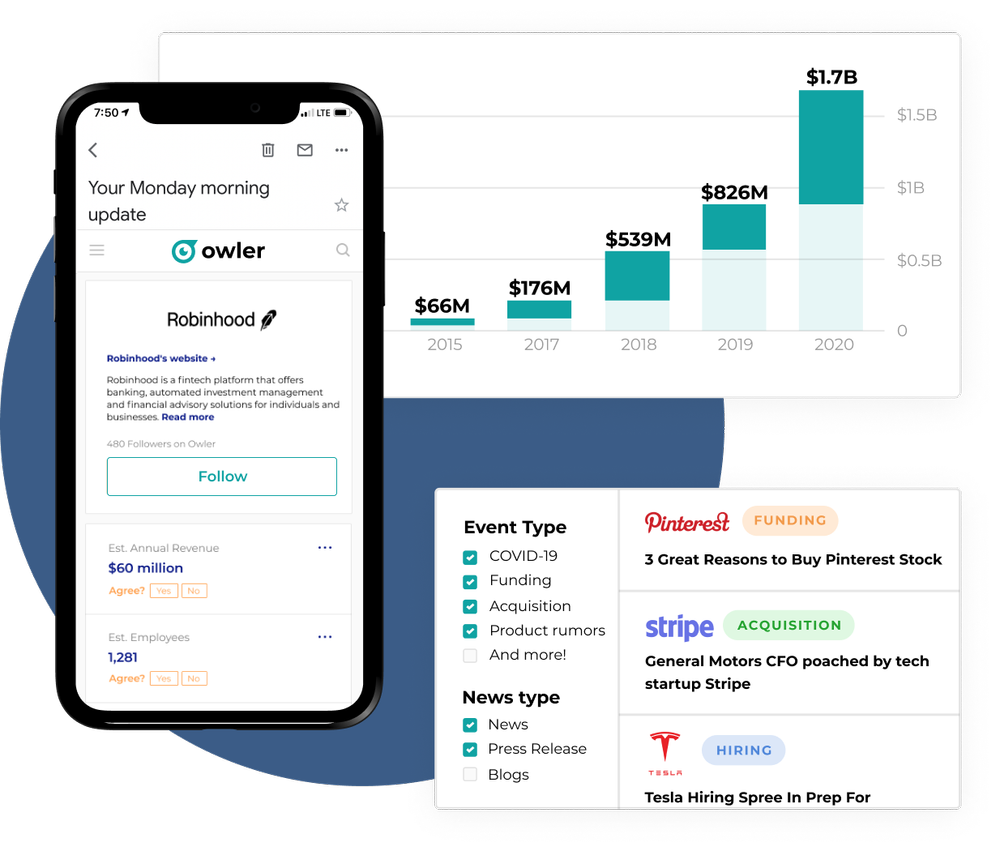
Owler is a community-powered company intelligence platform, acquired by Meltwater in 2021, that tracks competitors and prospects through crowdsourced data and news alerts.
It maintains profiles on 15 million-plus companies with revenue and headcount estimates, funding history, acquisitions, and a competitive graph that maps who competes with whom. Its signature output is a daily snapshot and real-time trigger alerts on the companies you follow.
Key features:
Company profiles with revenue, funding, acquisition, and leadership data.
Competitive graph mapping direct and indirect competitors.
20-plus trigger alerts for funding, key hires, and management changes.
Owler's Enterprise tier adds firmographic, competitor, and news APIs plus CRM and Marketo integration.
Pros:
Genuinely usable free tier for tracking a handful of competitors.
Fast, simple daily company and competitor alerts.
The cheapest paid entry point in the CI category.
Cons:
Crowdsourced data can be dated or incomplete for smaller companies.
Lightweight next to dedicated CI or market intelligence platforms.
Pricing: Free Community tier (follow up to 5 companies). Owler Pro is about $39 per user per month (roughly $468 per year billed annually). Owler Enterprise is custom-priced for teams needing API access and CRM integration.
How to choose the right competitive intelligence software
Start from the job, not the feature list. Three questions narrow the field quickly:
Who owns competitive intelligence, and where does it need to land? If the answer is a sales-first program built on battlecards, Klue and Kompyte deliver intel into Salesforce and Slack where reps work, and Crayon suits a broader, cross-functional CI function. If competitive intelligence lives with strategy or product, Contify and AlphaSense are built for market monitoring and decision-ready analysis rather than deal-level enablement.
What is the primary signal you are missing? For why-you-win-and-lose, Clozd's structured win-loss is purpose-built. For competitor traffic, SEO, and ads, Similarweb and Semrush own the digital layer. For funding, hiring, and leadership moves across a watchlist, Owler covers it cheaply. Comparing these against broader market intelligence tools and sales intelligence tools helps confirm you are buying the right layer, not a second copy of one you already have.
Do you have an owner to run it? Dedicated CI platforms reward a team with a defined process and analyst time. Without that owner, a curation-heavy platform becomes shelfware, and a lighter monitoring tool or an intelligence layer inside your existing GTM stack delivers more of the value with less overhead.
Few teams buy one tool. A common stack pairs a battlecard platform for sales, a market intelligence platform for strategy, and a signal layer that pushes competitive context into live deals. That last piece is where ZoomInfo fits: competitor technology displacement, category intent, and competitor mentions from sales calls, delivered inside the workflow where reps and marketers act on them.
Turn competitive intelligence into pipeline with ZoomInfo
Competitive intelligence software has split into clear specialisms: battlecards and enablement (Klue, Crayon, Kompyte), market and strategy intelligence (Contify, AlphaSense), win-loss (Clozd), and digital intelligence (Similarweb, Semrush, Owler). Choose by the job you need done, the owner who will run it, and how the insight reaches the people making decisions.
The gap those tools leave is the last mile: turning competitive signals into action inside live deals. ZoomInfo closes it by bringing technographic displacement, category intent, and competitor mentions from conversations into GTM Workspace, GTM Studio, and any AI agent, grounded in verified data. Run a dedicated CI platform for battlecards and win-loss, and let ZoomInfo make sure the signal reaches the rep in time to change the deal.
See how ZoomInfo turns competitive and market signals into pipeline. Book a demo.
Frequently asked questions
What is competitive intelligence software?
Competitive intelligence software automates the collection, analysis, and distribution of information about your competitors and market. It monitors competitor websites, pricing, product changes, news, and buyer feedback, then turns that into battlecards, dashboards, and alerts so go-to-market teams can act without manual research.
What is the best competitive intelligence software?
There is no single best tool, because the category serves different jobs. Klue and Crayon lead sales-enablement CI, Contify and AlphaSense lead market and research intelligence, Clozd owns win-loss, and Similarweb and Semrush cover digital intelligence. ZoomInfo is the strongest fit when you want competitive and market signals delivered inside your GTM workflow.
How much does competitive intelligence software cost?
Dedicated CI platforms such as Klue, Crayon, and Kompyte are quote-based and commonly run into five figures per year, and market intelligence platforms like AlphaSense and Clozd can run higher. Lighter tools are cheaper: Owler starts free, Similarweb from around $125 per month, and Semrush from around $140 per month.
What is the difference between competitive intelligence and market intelligence software?
Competitive intelligence focuses on specific competitors and how to win against them in deals, through tracking and battlecards. Market intelligence takes a wider view of industry trends, regulation, and market shifts for strategy and product decisions. Several platforms, including Contify, combine both.
Can ZoomInfo be used for competitive intelligence?
Yes. ZoomInfo surfaces competitive signals such as which competitor technologies an account runs, when a competitor is mentioned on a sales call, and which accounts are researching your category, then delivers them inside prospecting and deal workflows. Teams running a formal battlecard or win-loss program often pair ZoomInfo with a dedicated CI platform.
Do I need a dedicated competitive intelligence tool, or can my existing stack cover it?
If you have a competitive enablement or product marketing owner and reps who regularly meet named competitors, a dedicated platform pays off. If not, a signal layer inside your existing GTM stack plus a lightweight monitoring tool often delivers most of the value with far less overhead.
