
Tealium is one of the strongest customer data platforms available to enterprise buyers. With 850+ enterprise customers and back-to-back Leader placements in the Gartner Magic Quadrant for CDPs, the platform handles data collection, identity resolution, audience activation, and privacy compliance, processing over 9 billion events per day.
To create this Tealium review, we've analyzed it extensively. We believe it's the ideal choice if:
You need real-time customer data collection and activation across web, mobile, and server-side channels
Your organization operates in a regulated industry requiring centralized consent management
You have dedicated data engineering resources for implementation and maintenance
You want a vendor-neutral platform with 1,300+ integrations and no ecosystem lock-in
You're building AI initiatives that require governed, identity-resolved customer context
However, Tealium might not be the best choice if:
You lack dedicated technical resources for a complex enterprise implementation
You need a low-code platform that non-technical marketers can operate from day one
You need transparent, publicly listed pricing before engaging with sales
You're a small business or startup without enterprise data infrastructure needs
Your primary challenge is finding and reaching new prospects, not managing existing customer data
Tealium excels at orchestrating the first-party data your organization already collects. But for B2B companies, first-party data is only part of the picture. The other half is third-party intelligence: knowing which companies to target, when they're researching solutions, and how to reach the decision-makers within them.
This is where ZoomInfo fits alongside a platform like Tealium.
ZoomInfo is a B2B intelligence and go-to-market platform built on a large B2B dataset: 500M contacts, 100M companies, 135M+ verified phone numbers, and 200M+ verified business email addresses. While Tealium manages how your customer data flows between systems, ZoomInfo provides the external intelligence that identifies who to target, when they're in-market, and what to say when you reach them.
We've included a detailed look at ZoomInfo later in this Tealium review because it represents the natural complement for B2B enterprises that need both first-party data orchestration and third-party market intelligence. If you're ready to explore ZoomInfo's capabilities, you can start a free trial.
What is Tealium?
Tealium is a Customer Data Orchestration Platform founded in March 2008 by Mike Anderson and Ali Behnam.
Both founders previously worked at WebSideStory (later acquired by Adobe Systems), where they built analytics tag implementations for enterprises including Disney, Best Buy, Target, Cisco, Citi, and FedEx. That shared experience building enterprise tag implementations became the founding thesis: there had to be a better way to manage vendor scripts on digital properties.
Their first product, iQ Tag Management, launched in 2012, replacing hardcoded vendor tags with a single container tag managed through a UI. A year later, Tealium launched AudienceStream, which the company claims was the first Customer Data Platform, predating the formal CDP analyst category by nearly a decade.
Today, Tealium positions itself as the governed data layer between every customer touchpoint and every system that needs that data. The current homepage headline reads "Trusted Data for AI", reflecting the company's push to be seen as AI infrastructure rather than solely a CDP vendor.
The platform is built around five modules: Data Collection, Customer Data Platform, Enrichment & Orchestration, Data Cloud Activation, and Tealium for AI. It targets three buyer personas: Marketing, Data & Analytics, and AI Teams.
The company has raised approximately $277M across 10 rounds, reaching a $1.2B valuation in its 2021 Series G led by Georgian and Silver Lake Waterman.
Tealium remains privately held. Its customer base spans regulated industries including financial services, healthcare, insurance, and telecommunications, with named customers such as Legal & General, Iberia, Spark New Zealand, Vodafone, Selfridges, Gap Inc., STIHL, and BBVA Technology.
Tealium Pros & Cons
Pros | Cons |
|---|---|
- Real-time processing at enterprise scale (9B+ events/day) | - High implementation complexity and steep learning curve |
- 1,300+ pre-built integrations with no vendor lock-in | - No publicly listed pricing; requires sales engagement |
- 2x Gartner Magic Quadrant Leader for CDPs | - No free trial or free plan available |
- HIPAA BAA, SOC 2, ISO 27701 certified | - No proper staging/QA environment for testing changes |
- Hybrid CDP architecture (real-time + warehouse-native) | - UI becomes difficult to navigate in large implementations |
- Sub-300ms trigger-to-activation latency | - Not self-serve for small businesses or non-technical teams |
- Native consent management built into the data layer | - Event-based pricing can scale unpredictably |
Tealium Review: How it Works & Key Features
Data Collection & Tag Management: Tealium replaces hundreds of vendor scripts with a single governed container tag.
Tealium's founding product, iQ Tag Management, is the client-side entry point into the platform.
It replaces all hardcoded vendor scripts on a website with a single container tag, the Universal Tag (utag.js), placed once on the site. All subsequent tag configuration, deployment, and data routing happens through the iQ interface without further developer involvement for routine changes.
The architecture is client-side by design. All tag configuration and business logic lives in a static JavaScript file served from Tealium's CDN. When a visitor lands on a page, the browser processes the configuration locally and fires the appropriate vendor tags without a round-trip to an application server. The file is cached for subsequent page views, reducing both latency and network overhead.
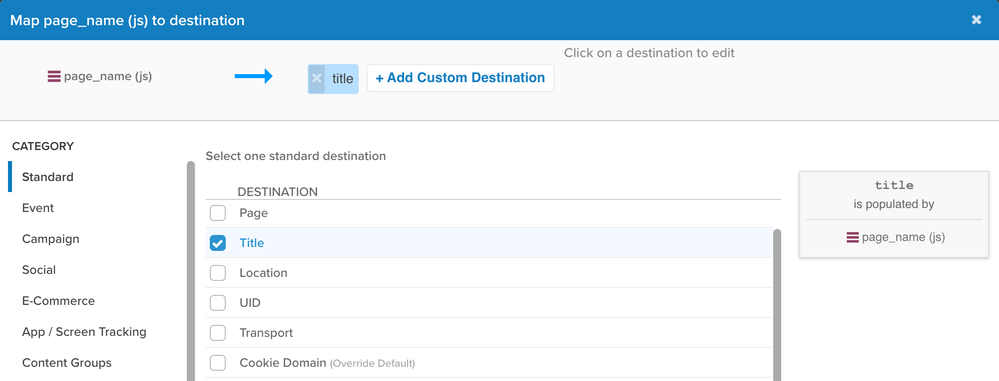
The configuration workflow follows three steps for each tag: a vendor-neutral data layer captures visitor interaction data in standardized format, load rules define when each tag fires (for example, only on purchase confirmation pages, or only when a user has given consent), and data mappings translate variables into each vendor's required field names and formats.
Source: Tealium
Beyond page loads, iQ tracks 12 pre-configured event types including clicks, form submissions, scroll depth, element visibility, and video plays (HTML5, YouTube, Vimeo). 50+ pre-built extensions cover e-commerce tracking, link tracking, privacy enforcement, currency conversion, and data transformation.
Changes move through a version-controlled workflow across dev/QA/prod environments with version history and diff tools.
Native CMP integrations for OneTrust, Didomi, and Usercentrics enforce consent structurally: tags requiring consent do not fire without it. IBM used Tealium's Hosted Data Layer to standardize collection across 24 million pages and 143 off-site domains.
Customer Data Platform: Tealium resolves anonymous visitors into unified profiles and activates audiences in real time.
AudienceStream CDP is Tealium's server-side engine for identity resolution, visitor profile enrichment, customer segmentation, and real-time activation.
It sits between data collection and downstream activation, processing billions of events daily.
The platform addresses two problems. The first is fragmented identity: customers interact across web, mobile, apps, and offline channels, generating dozens of anonymous behavioral traces with no link between them. The second is activation latency: even organizations with a unified view in a data warehouse typically cannot act on it during an active session.
Identity resolution works through visitor stitching. Every new session receives an anonymous identifier (TAPID). When a visitor provides a known identifier (email, login ID), the system merges the anonymous profile with any existing known profile by replaying all historical event data chronologically, building a complete unified journey.
This deterministic, first-party approach grows more relevant as third-party cookie deprecation reduces the viability of probabilistic cross-device matching.
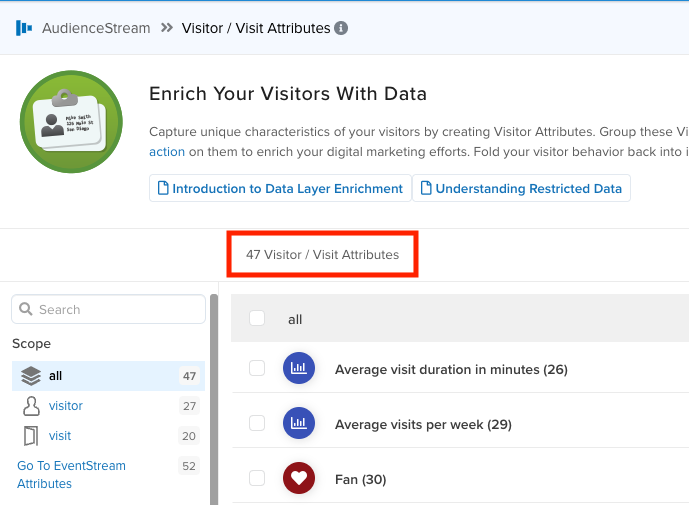
Each visitor profile accumulates attributes across eleven data types (including funnels, timelines, and badges), with support for up to 500 visitor and visit attributes per profile. Audiences are defined using AND, OR, and Excluding logic over any combination of attributes, and membership is recomputed dynamically as events arrive.
Source: Tealium
When audience membership changes, connectors transmit data to third-party APIs in real time, with support for triggered, delayed, and batched action modes, plus frequency capping to control message cadence.
For use cases requiring profile data at personalization speed, the Moments API returns targeted audiences, badges, and attributes with a benchmarked average latency of 60ms for sub-1 kB payloads.
Enrichment, Orchestration & Cloud Activation: Tealium transforms raw events into actionable context and activates data across warehouses and channels.
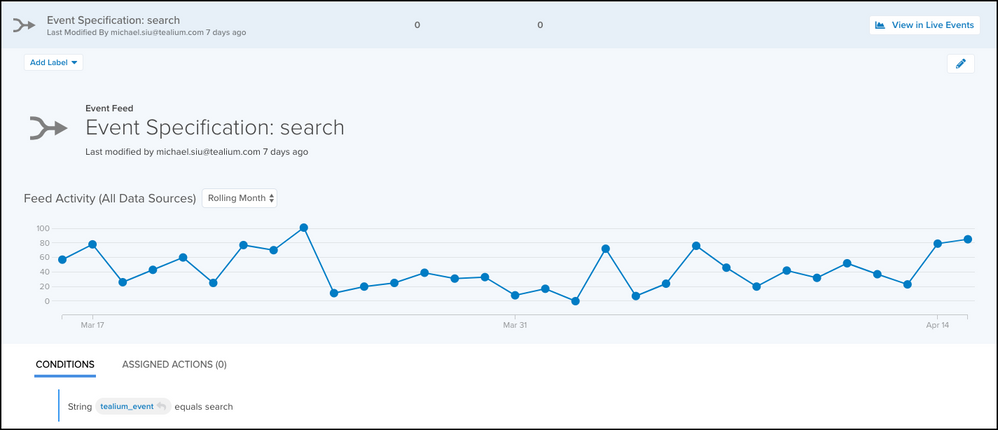
EventStream is Tealium's server-side layer for collecting, transforming, and routing real-time event data.
Source: Tealium
It processes events entirely in memory (no disk write in the hot path), holding data only until it reaches its next destination.
Enrichment rules attach to visitor, visit, or event attributes and run calculations the moment new data arrives (for example, summing purchase values for lifetime value or flagging session patterns for churn risk). Tealium Functions extend the pipeline with a serverless JavaScript environment for custom transformations, external API calls, and routing to destinations that no pre-built connector covers.
Consent enforcement runs independently of business logic, so privacy changes propagate across all activations without rewriting individual audiences or connectors. DataAccess retains both raw JSON (for ML replay and ad-hoc processing) and structured SQL-ready tables (for BI) under one governance model, with connectors to Tableau, Power BI, Snowflake, and SQL Workbench.
On the cloud activation side, Tealium connects to Snowflake, Databricks, BigQuery, and Amazon Redshift, activating warehouse-derived audiences without copying data into Tealium's storage.
The Snowflake Audience Discovery App runs inside the customer's own Snowflake account, offering three audience-building modes (visual filters, SQL with AI assistance, and natural language via Snowflake Cortex). In every mode, audience logic runs natively inside the customer's account; source data is never copied, exported, or sent outside.
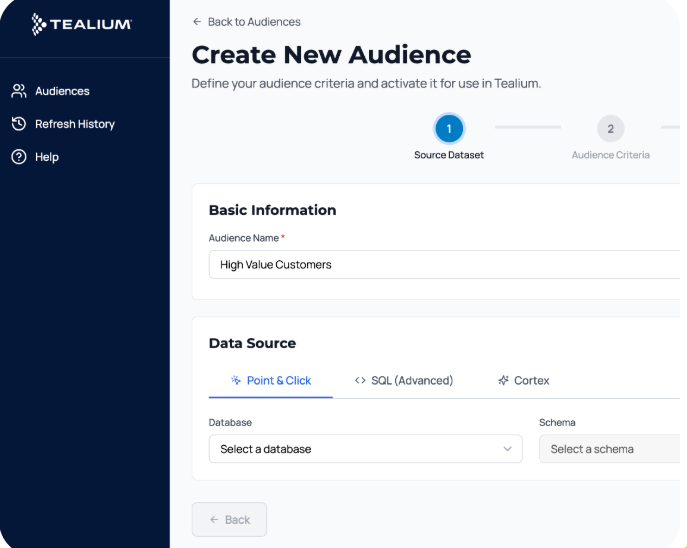
Source: Tealium
The flow also runs in reverse: Tealium streams real-time, consented event data into Snowflake tables in under 10 seconds, creating a feedback loop where the warehouse grows richer from live events and activation draws from that enriched state.
AI Capabilities: Tealium feeds models and agents with real-time, consented customer context.
Tealium for AI closes the gap between what AI models know about a customer and what the customer actually experiences.
Its job is to feed models and agents with real-time, consented customer context, write predictions back into profiles and channels, and keep every signal governed across the full loop.
The module works as a bidirectional pipeline. Events collected across web, mobile, and server-side sources are enriched with identity resolution, session history, and consent state before reaching a model. Enriched event streams route in real time to AWS Bedrock, Vertex AI, OpenAI, SageMaker, or custom endpoints.
The AI Partner Ecosystem connects to Pinecone for vector retrieval and LangChain for agent orchestration, enabling RAG pipelines grounded in live, consented customer data.
The Behavioral Insight Agent classifies intent, sentiment, and buying signals inside the event stream without exporting data. Teams define behavioral categories through a guided interface, and the agent writes classifications back to the visitor profile before the next click. This replaces behavioral models that previously took months to build with configurable categories defined through a UI.
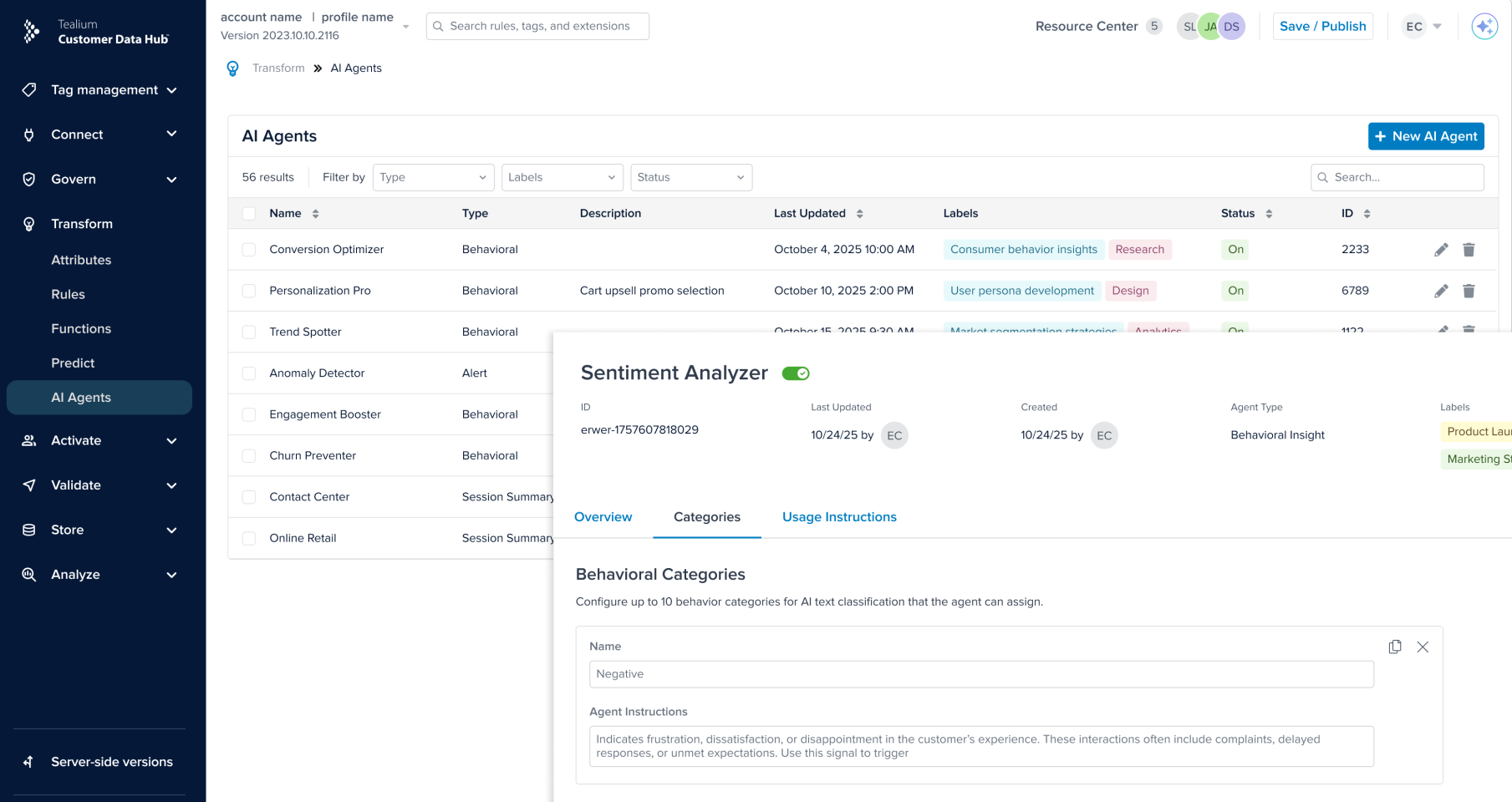
Source: Tealium
Model outputs (predictions, scores, recommendations) push into 1,300+ destinations the moment they return, with no staging step. For agentic workflows, external agent frameworks query unified profiles and consent state via Tealium's MCP server. Governance is structural: consent state travels with every event, PII detection and encryption run inline, and audit trails cover every payload sent to a model.
Recent releases include a Configuration Agent that lets teams configure Tealium from AI tools like Claude, Gemini, and OpenAI by translating natural language prompts into live platform configurations, and Tealium Prism, a native iOS/Android SDK for consent-aware, on-device AI inference.
Where Tealium Falls Short
Tealium excels at first-party customer data orchestration, but several limitations surface depending on your organization's needs.
These reflect design choices for an enterprise platform, not oversights.
High Implementation Complexity. G2 reviewers consistently note that initial setup requires significant technical expertise. Enterprise deployments with custom integrations can take one to four months, and new users find the platform's depth overwhelming.
Given the breadth of the system (tag management, CDP, enrichment, cloud activation, AI), organizations without dedicated data engineering resources will struggle to get value quickly.
Opaque Pricing. Tealium does not publish pricing on its website, and all engagements begin with a demo request. There is no free trial or free plan. For organizations evaluating multiple CDPs, this adds friction to comparisons. Event-based pricing can also grow costly at scale as data volumes increase, and organizations with high-frequency behavioral data must budget carefully for volume growth.
No Staging Environment. G2 reviewers note the absence of a dedicated staging environment for testing changes before pushing them to production. For enterprises with formal change management requirements, this creates operational risk, particularly when multiple teams make configuration changes at the same time.
UI Challenges at Scale. Both G2 and TrustRadius reviewers note that the interface becomes hard to navigate when managing large numbers of rules, data mappings, or audience attributes. Collaborative editing also suffers when multiple users make simultaneous changes.
First-Party Data Only. This is Tealium's most significant scope boundary for B2B organizations. The platform orchestrates the customer data you collect from your own digital properties, but it does not provide third-party intelligence about companies or contacts outside your existing ecosystem.
Source: Tealium
It cannot tell you which companies are researching solutions in your category, who the decision-makers are at a target account, or how to reach them.
For B2B teams that need to identify and engage new prospects, Tealium manages the data infrastructure but does not supply the market intelligence that powers prospecting, account-based marketing, or sales outreach.
These limitations follow from building a first-party data orchestration platform for enterprises. But for B2B companies, the gap between managing existing customer data and identifying new opportunities is where a third-party intelligence platform becomes essential.
The Natural Complement to Tealium: ZoomInfo
Tealium orchestrates the data flowing through your existing customer interactions.
ZoomInfo provides intelligence about the market outside your walls: who to target, when they're ready to buy, and how to reach the people who make purchasing decisions.
ZoomInfo is a B2B intelligence and go-to-market platform. Where Tealium's strength is real-time first-party data activation, ZoomInfo's strength is third-party B2B intelligence at scale.
Its GTM Context Graph unifies this data with your CRM records, conversation transcripts, and behavioral signals to capture the full context behind your accounts. That intelligence flows through GTM Workspace for sellers, GTM Studio for marketers and RevOps, or APIs and MCP for any custom tool or AI agent.
Comprehensive B2B Data: ZoomInfo provides the contact, company, and intent intelligence that first-party data cannot.
The foundation of ZoomInfo's platform is its data, spanning three dimensions: identity data (500M contacts, 135M+ verified phone numbers, 120M direct-dial phone numbers, and 200M+ verified business email addresses), company context (100M companies with firmographics, org charts, and technographics profiling 30,000+ technologies across 30M+ companies), and dynamic signals that reveal when accounts are actively in-market.
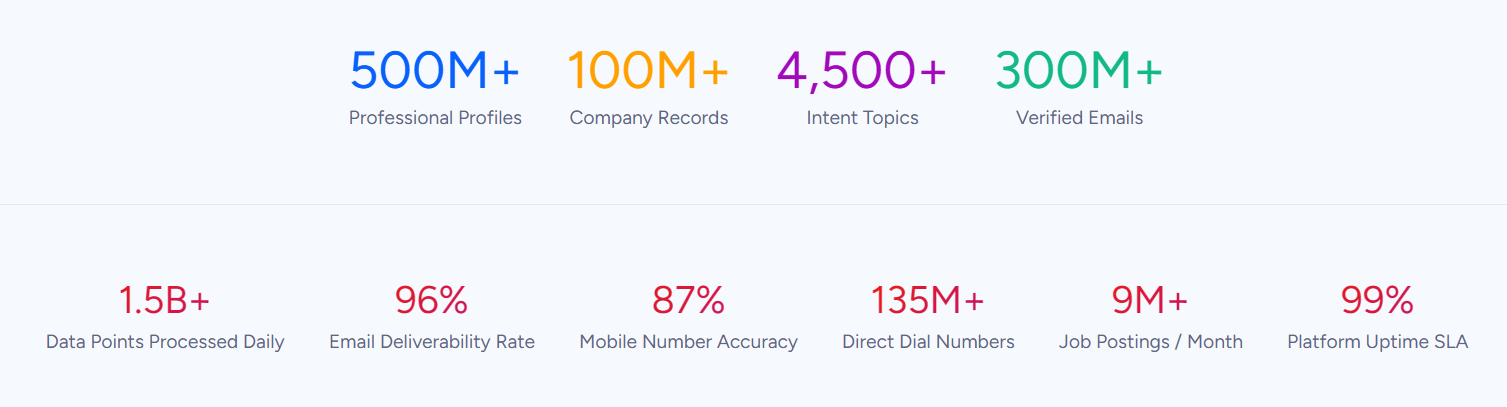
This data is verified through a multi-source pipeline: automated ML scanning of 28 million site domains daily, third-party partner data covering 95 million businesses, a community of 200,000+ users who share data back, and an in-house Data Training Lab of 300+ human researchers. First-party data reaches up to 95% accuracy.
ZoomInfo Intent tracks buying signals from 210 million IP-to-Organization pairings and 6 trillion+ new keyword-to-device pairings sourced monthly. Guided Intent, exclusive to ZoomInfo, identifies topics historically correlated with deal success rather than requiring manual topic selection.
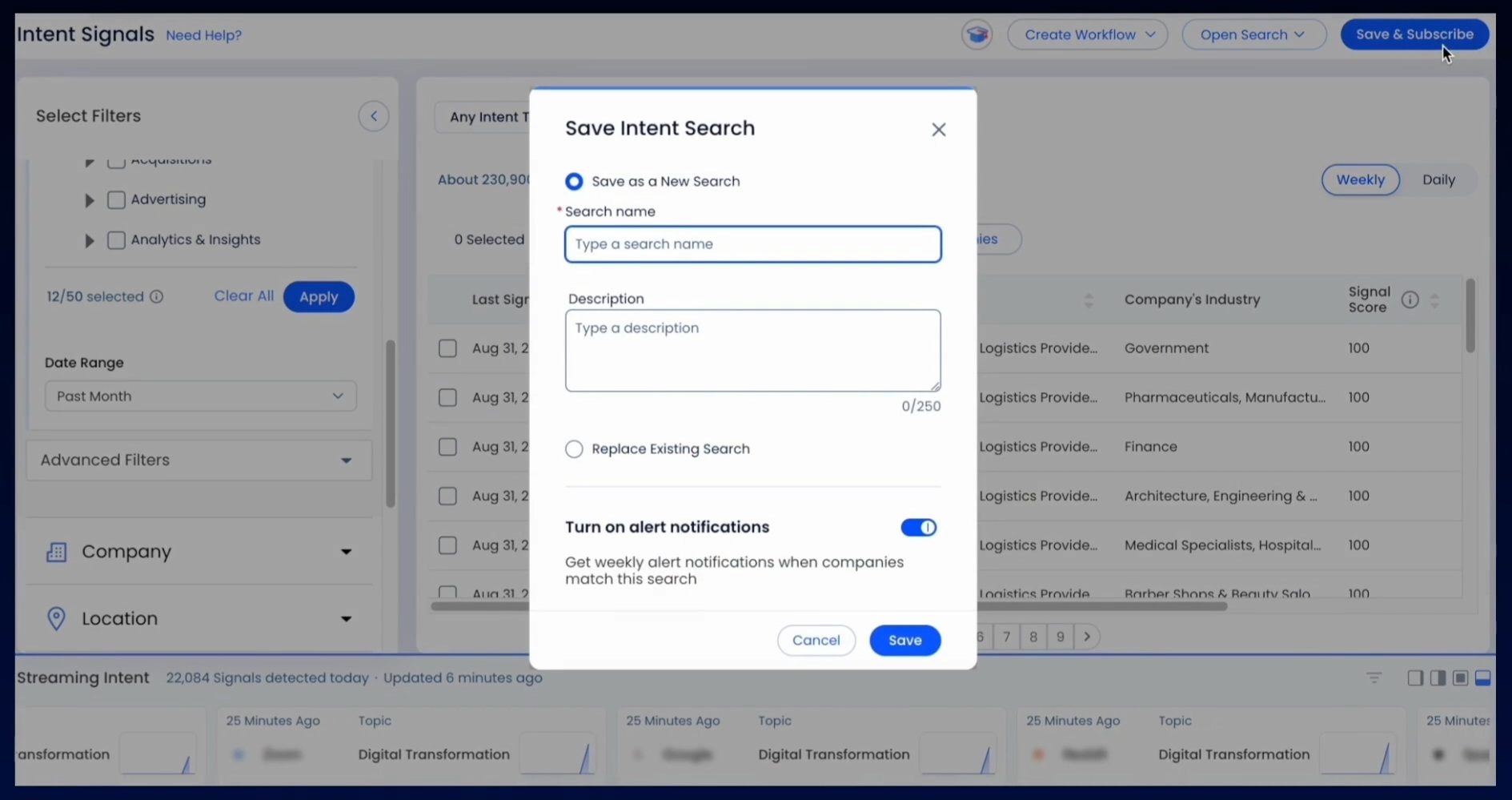
Source: ZoomInfo
For website traffic, WebSights resolves anonymous visitors to companies, including buying team identification and direct contact info.
This data advantage is externally validated. In a Fortune 500 competitive RFP analyzing 25 million contacts across vendors, the independent consultant concluded that "no other competitor came even close." ZoomInfo holds Forrester Wave Leader status for Intent Data Providers and the Gartner Magic Quadrant for ABM Platforms, and earned 133 No. 1 rankings on G2 in Summer 2025.
For B2B organizations using Tealium to manage customer data, ZoomInfo fills the gap that first-party data cannot: identifying the companies and contacts outside your existing customer base that match your ideal buyer profile and are showing buying signals.
SpringDB achieved 2x-3x increases in campaign conversions and 30-50% uplift in average deal size using ZoomInfo's enriched data for precise client targeting. "You'll get 10x the value if you think of ZoomInfo as a full platform and not just a tool for one team." (John Kotsuros, Founder and CEO, SpringDB)
GTM Context Graph: ZoomInfo's intelligence layer captures not just what happened in a deal, but why.
ZoomInfo's data becomes more than a database through its GTM Context Graph, which processes 1.5B+ data points daily.
The graph fuses ZoomInfo's third-party B2B data with a customer's own CRM records, conversation transcripts, email interactions, and behavioral signals into a single intelligence layer.
The distinction matters. A CRM records that a deal moved from stage 3 to stage 4. Conversation intelligence transcribes what the VP of Finance said on the last call. Intent data logs a spike in research activity.
The GTM Context Graph connects all three to surface why the deal moved, linking executive sponsorship entering at a critical stage with ROI-focused questions and third-party signals showing the company is hiring and researching competitors.
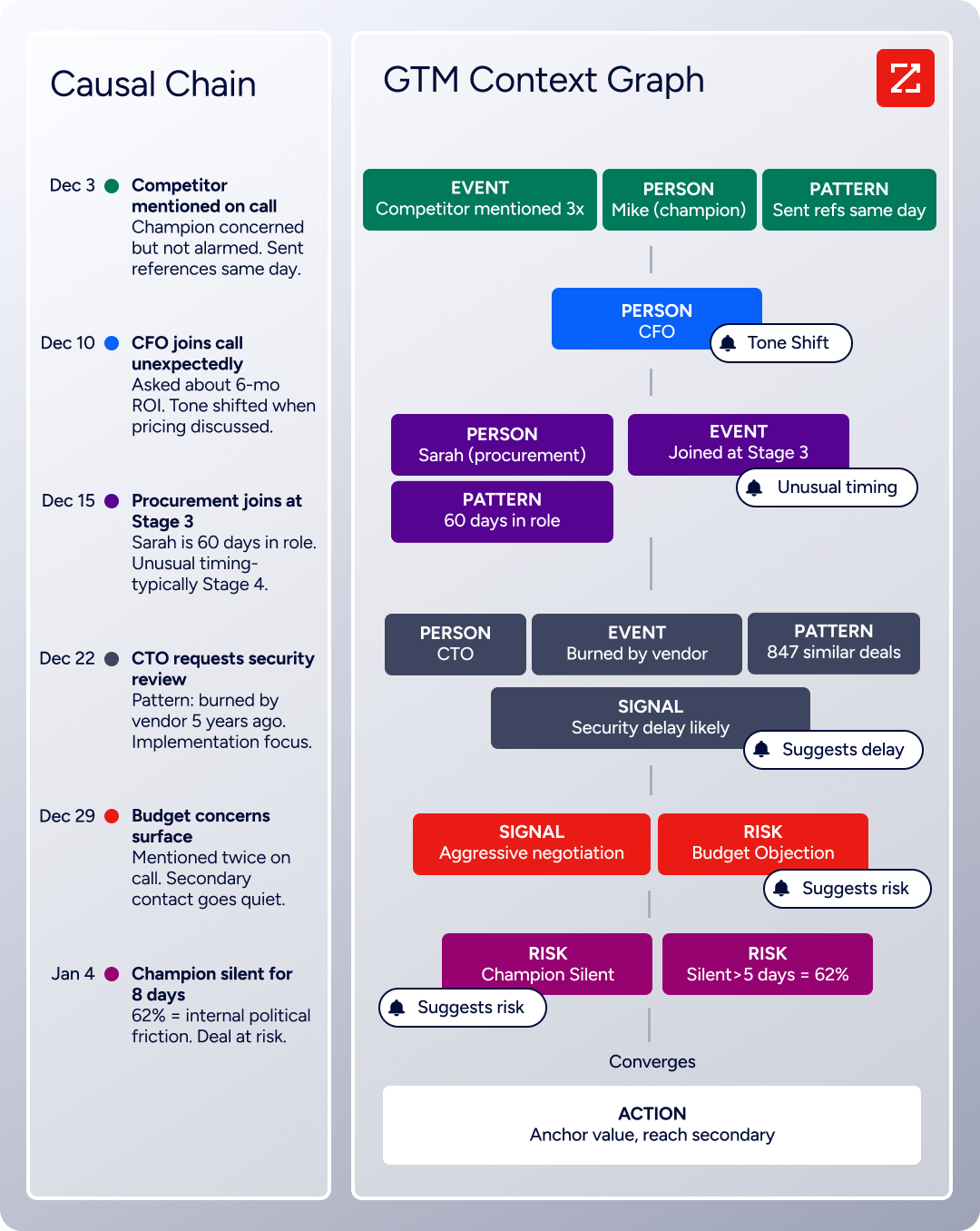
This capability exists because ZoomInfo spent two decades building data unification infrastructure (entity resolution, semantic normalization, identity matching at scale) and acquired conversation intelligence technology like Chorus to capture context from every call, meeting, and email.
The resulting intelligence tells sales teams why a deal is accelerating, which stakeholders are blocking, and what patterns across thousands of similar deals suggest happens next.
This is a different function from what Tealium provides. Tealium orchestrates behavioral data from your digital properties. ZoomInfo's GTM Context Graph connects external market intelligence with internal deal context to drive sales and marketing decisions.
Seismic attributed 39% of its active pipeline to ZoomInfo-influenced opportunities and reported 54% productivity gains. "That combination of our internal CRM data, external signals, and AI has helped us craft very specific account- and persona-based messages." (Toby Carrington, Chief Business Officer, Seismic)
Universal Access: ZoomInfo delivers intelligence through native apps, APIs, and MCP for any tool or AI agent.
ZoomInfo delivers its intelligence through three channels.
GTM Workspace gives sellers a single place where prioritized accounts, AI-drafted outreach, and deal execution converge without toggling between tools.
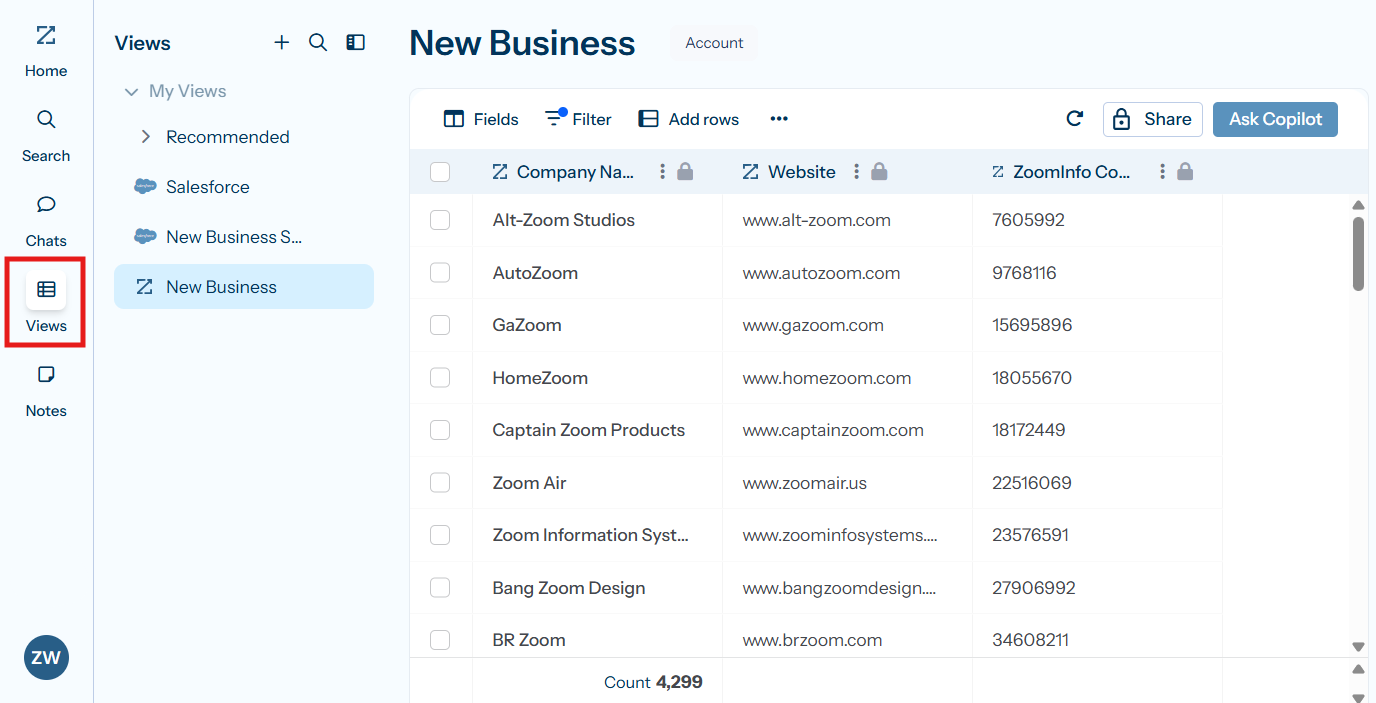
Source: ZoomInfo
GTM Studio gives marketers, RevOps, and GTM engineers a builder environment where audience definition, campaign orchestration, and pipeline measurement happen in natural language. And APIs and MCP expose the same intelligence to any custom agent, internal tool, or partner platform.
All three channels draw from one GTM Context Graph: the same data, the same intelligence, the same continuously learning model. The choice of where to work never limits the intelligence available.
For enterprises already running Tealium as their customer data infrastructure, ZoomInfo's API and MCP access is particularly relevant.
The same B2B intelligence powering ZoomInfo's native applications can be consumed by any system in the stack, including the downstream tools that Tealium activates data to. API access is included in all relevant ZoomInfo plans, and the MCP server connects to AI assistants including Claude and ChatGPT.
ZoomInfo also offers more accessible entry points than Tealium. ZoomInfo Lite is a permanent free tier with access to the B2B database, 10 monthly export credits, individual and company searches, and a Chrome extension. A 7-day free trial of the full platform is available with no credit card required.
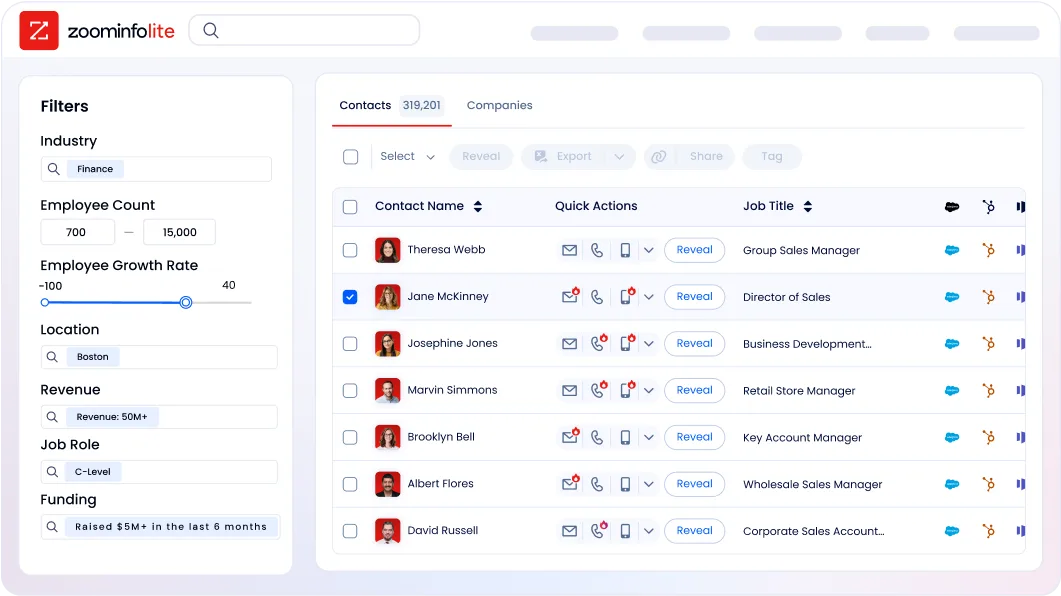
BDO Canada achieved an 87% reduction in time spent on internal data dashboard updates using ZoomInfo's API. "The plug-and-play aspect of the API means I can integrate it very easily into any process and get information at a moment's notice." (Jerry Wilson, Senior Marketing Intelligence Analyst, BDO Canada)
Tealium and ZoomInfo: Comparison Summary
Aspect | Tealium | ZoomInfo |
|---|---|---|
Primary focus | First-party customer data orchestration | Third-party B2B intelligence and GTM execution |
Data type | Behavioral events from owned digital properties | Contact, company, intent, and technographic data |
Target buyer | Data engineering, marketing ops, AI teams | Sales, marketing, RevOps, GTM engineers |
Core strength | Real-time identity resolution and audience activation | B2B data and AI-powered go-to-market |
Integration breadth | 1,300+ connectors (data destinations) | 120+ app marketplace + APIs/MCP + cloud partners |
AI capabilities | Governed context for feeding external AI models | GTM Context Graph for sales and marketing AI |
Pricing transparency | No published pricing; custom contracts only | Consumption-based; permanent free tier and 7-day trial |
Implementation timeline | 1-4 months for enterprise deployments | Deploys in weeks |
Compliance certifications | HIPAA BAA, SOC 2, ISO 27701, ISO 27001, TISAX | ISO 27001, ISO 27701, SOC 2 Type II, TRUSTe GDPR/CCPA |
Analyst recognition | 2x Gartner MQ Leader for CDPs | 2x Gartner MQ Leader for ABM; Forrester Wave Leader for Intent |
Best for | Managing and activating existing customer data | Finding and engaging new prospects with verified B2B intelligence |
Final Verdict
Tealium and ZoomInfo address different layers of the enterprise data stack. For B2B organizations with go-to-market operations, both layers matter.
Tealium is the right platform when your primary challenge is unifying and activating first-party customer data across a complex technology stack. It serves enterprises managing data collection across web, mobile, and server-side channels, enforcing consent in regulated industries, and feeding AI models with real-time, governed customer context.
The investment in implementation pays off when you need sub-second activation across 1,300+ destinations, identity resolution across devices and channels, and a data foundation that supports both real-time and warehouse-native workflows. Tealium is built for organizations with the data engineering resources to extract its full value.
ZoomInfo is the right platform when your primary challenge is identifying and engaging the right buyers at the right time. Built on a large B2B dataset, ZoomInfo provides the intelligence that first-party platforms cannot: verified contacts, company intelligence, buying intent signals, and an AI-powered GTM Context Graph that reveals why deals move or stall.
Whether your team works in GTM Workspace, GTM Studio, or through APIs and MCP in any custom tool, ZoomInfo delivers the third-party intelligence that powers prospecting, account-based marketing, and revenue operations.
Get started with ZoomInfo here.
For B2B enterprises building a complete data infrastructure, these platforms complement each other rather than compete. Tealium governs how your customer data flows between systems. ZoomInfo provides the market intelligence that tells your teams where to focus. Together, they cover both sides: understanding your existing customers and finding the next ones.
Tealium FAQ
What is Tealium used for?
Tealium is a Customer Data Orchestration Platform used by enterprises to collect, unify, and activate customer data in real time.
Its core functions include tag management (replacing hardcoded vendor scripts with a single container tag), identity resolution (stitching anonymous visitor sessions into unified profiles), audience segmentation and activation (pushing audiences to downstream tools), and consent enforcement across all data flows.
Organizations in regulated industries like financial services, healthcare, and telecommunications use it where data governance and compliance are requirements.
How much does Tealium cost?
Tealium does not publish pricing on its website. The platform operates through custom enterprise contracts negotiated based on data volumes, modules selected, and use cases. All engagements begin with a demo request.
The company offers three support tiers (Basic included, Enhanced and Premium paid), and professional services for implementation are available separately. There is no self-serve purchasing path for any component of the platform.
Does Tealium offer a free trial or free plan?
No. Tealium does not offer a free trial or free plan. The only entry point is a demo request through their website. This contrasts with some complementary platforms.
ZoomInfo, for example, offers both a permanent free tier (ZoomInfo Lite with 10 monthly export credits and database access) and a 7-day free trial of the full platform, with no credit card required for either.
How long does it take to implement Tealium?
Implementation timelines vary based on organizational complexity. Enterprise deployments with custom integrations typically take one to four months. Tealium offers three support packages (Basic, Enhanced with response time SLAs, and Premium with a dedicated Technical Account Manager).
The platform also provides documentation, Tealium University training courses, and a Developer Center with 30+ reference architectures. The recently launched Configuration Agent, which translates natural language prompts into platform configurations, signals Tealium's effort to reduce this complexity over time.
Is Tealium suitable for small businesses?
Tealium is designed for mid-market to large enterprise organizations with dedicated data engineering and marketing operations teams.
The platform's complexity, custom pricing model, and professional services dependency make it a poor fit for companies without technical resources. Small businesses and startups with simple, single-channel data needs will find the implementation investment disproportionate to their requirements.
Does Tealium integrate with data warehouses?
Yes. Tealium's Data Cloud Activation module connects natively to Snowflake, Databricks, Google BigQuery, and Amazon Redshift. The platform supports zero-copy activation (activating warehouse-derived audiences without duplicating data into Tealium's storage), reverse ETL, and bidirectional data flow.
The Snowflake Audience Discovery App runs inside the customer's own Snowflake account, supporting audience building through visual filters, SQL with AI assistance, or natural language, without data leaving the customer's environment. Tealium also streams real-time events into Snowflake tables in under 10 seconds.
What compliance certifications does Tealium hold?
Tealium holds HIPAA BAA, SOC 2 Type II, ISO 27001, ISO 27701, ISO 27018, and TISAX certifications. The platform supports GDPR, CCPA, and Global Privacy Control compliance through its native Consent Management Platform, which enforces consent centrally across all tags and data destinations.
Regional cloud deployments (including an AWS Singapore region for APAC) support data residency requirements. This compliance posture is among the strongest in the CDP category and is a primary reason Tealium holds market position in regulated industries.
Does Tealium provide third-party B2B contact or company data?
No. Tealium is a first-party data orchestration platform. It collects, unifies, and activates the customer data your organization generates from its own digital properties, but it does not maintain databases of contacts, companies, or buying signals from external sources.
B2B organizations that need third-party intelligence for prospecting, account identification, or intent monitoring typically pair their CDP with a dedicated B2B intelligence platform like ZoomInfo, which offers 500M contacts, 100M companies, verified direct-dial phone numbers and business email addresses, and real-time buyer intent signals.
Researching Tealium? These comparisons and alternatives help you decide:
