
Varicent is one of the leading Sales Performance Management (SPM) platforms on the market. It gives enterprise revenue organizations a connected system for incentive compensation management, territory design, quota setting, and seller performance insights, backed by an AI-native architecture that Forrester recognized as "the only solution evaluated with an in-depth set of AI capabilities" in its Q1 2025 Wave.
But not every revenue team needs a full enterprise SPM platform, and even those that do may find specific gaps. Varicent's steep learning curve, requirement for coding knowledge to make routine plan changes, slow calculation times on complex plans, and lack of public pricing or a free trial mean that many organizations need alternatives that better fit their size, technical capacity, or workflow.
That's where this guide comes in. Whether you're looking to:
Benchmark compensation plans against 20+ years of proprietary pay and performance data
Build and modify commission plans without coding knowledge or consultant dependency
Give reps real-time commission transparency that eliminates shadow spreadsheets
Automate commissions natively inside your Salesforce CRM without a separate integration layer
Track commissions with published, transparent pricing and a free trial before committing
Configure complex incentive plans through natural language instead of a specialized development language
Power your entire go-to-market motion with B2B data, AI intelligence, and universal access
We'll explore Varicent alternatives that excel in each of these areas.
Some organizations will replace Varicent entirely with one of these tools. Others may use a specialized ICM platform alongside a broader GTM intelligence layer to connect compensation strategy to the buyer signals and account intelligence that drive revenue. This isn't about finding a "better" platform; it's about finding the right fit for how your revenue team actually operates.
The Best Varicent Alternatives
Best Alternative for GTM Intelligence That Connects Data to Revenue Execution We chose ZoomInfo because it addresses a gap Varicent doesn't touch: the buyer intelligence, intent signals, and account context that revenue teams need to make compensation plans drive results. Its GTM Context Graph unifies B2B data with CRM, conversation, and behavioral signals. |
|---|
Best Alternative for Enterprise ICM with Proprietary Benchmarking Data We chose Xactly because its 20+ years of accumulated pay and performance benchmarks power AI-driven plan design that no competitor can replicate, combined with built-in ASC 606 compliance automation. |
Best Alternative for No-Code Compensation Management at Scale We chose CaptivateIQ because its SmartGrid engine lets compensation admins build complex plans through a spreadsheet-like interface without coding, delivering the calculation depth Varicent offers without the technical dependency. |
Best Alternative for Accessible SPM Without Enterprise Complexity We chose Everstage because it delivers commission management with a 4-6 week implementation, a free proof of concept, and real-time rep earnings through Crystal AI, all without the consulting dependency Varicent typically demands. |
Best Alternative for Salesforce-Native Commission Automation We chose Salesforce Spiff because it eliminates the integration layer for Salesforce teams. Built directly on Sales Cloud, commission calculations update the instant a deal closes, with no data pipeline to configure or troubleshoot. |
Best Alternative for Transparent, AI-Powered Commission Tracking We chose QuotaPath because it publishes pricing, offers a 30-day free trial, and includes an AI Plan Builder that generates structured comp plans from uploaded documents, giving lean RevOps teams enterprise functionality without enterprise procurement friction. |
Best Alternative for AI-Native Plan Configuration and Faster SPM Execution We chose Forma.ai because its natural language plan configuration and unified SPM architecture deliver documented 91.7% faster calculation run-times compared to legacy ICM platforms, with no coding requirements for plan admins. |
What is Varicent?
Source: Varicent
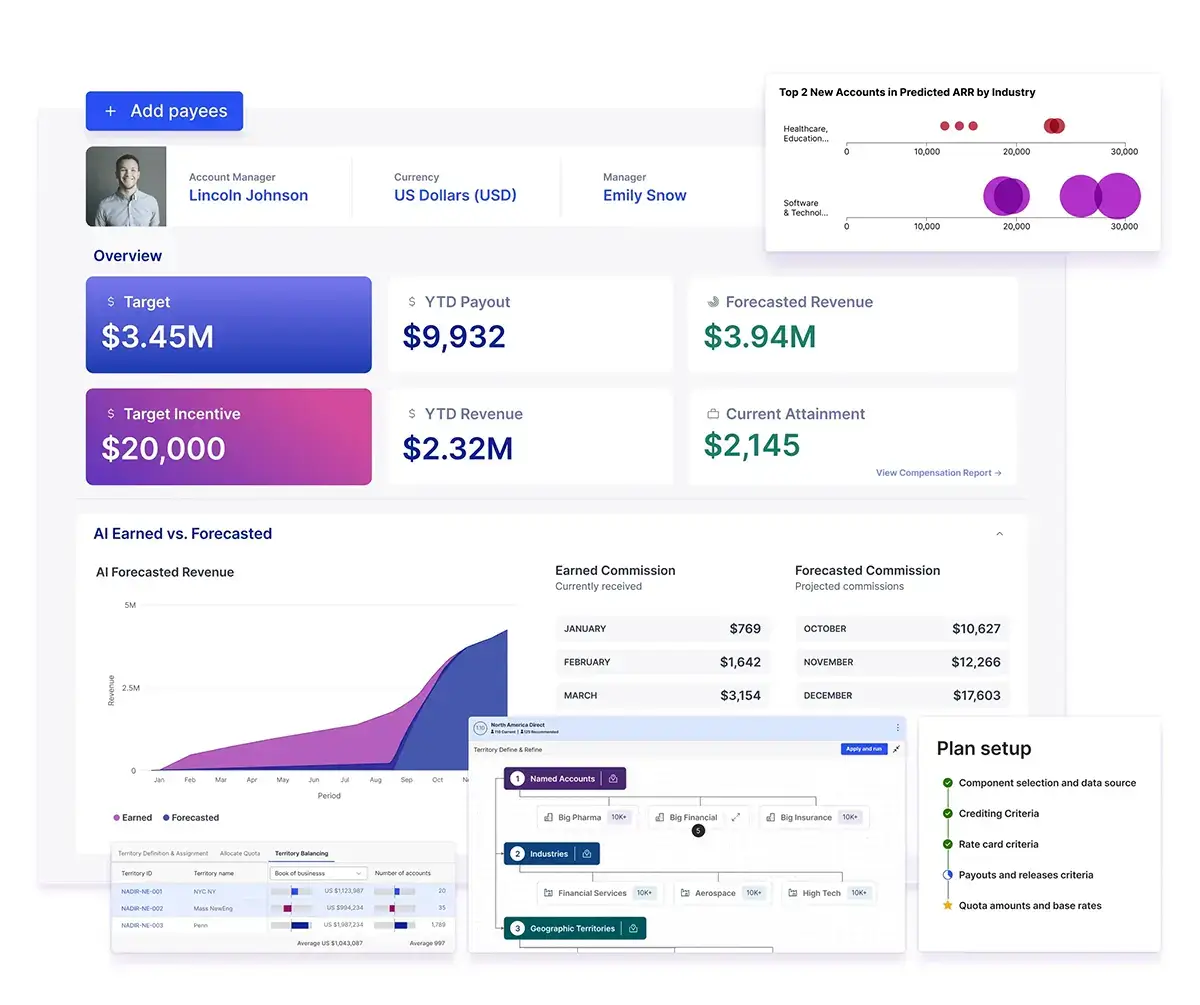
Varicent is a Sales Performance Management (SPM) platform built for enterprise revenue organizations that need to unify incentive compensation, territory design, quota setting, and seller performance insights in one connected system. The company was founded in 2005, went through an IBM investment period from 2012 to 2019, and re-emerged as an independent company in January 2020 under founder Marc Altshuller with backing from Great Hill Partners and Spectrum Equity.
Its key features include:
Incentive compensation management with automated calculations across multi-tiered, multi-currency comp plans and full audit trails
Territory and quota planning with map-based visualization, scenario modeling, and precedence-based named account assignment
Seller Insights providing real-time commission visibility, earnings projections, and AI-powered dispute resolution
AI-native architecture with GenAI assistants for plan design, data pipeline management, and compensation inquiry resolution
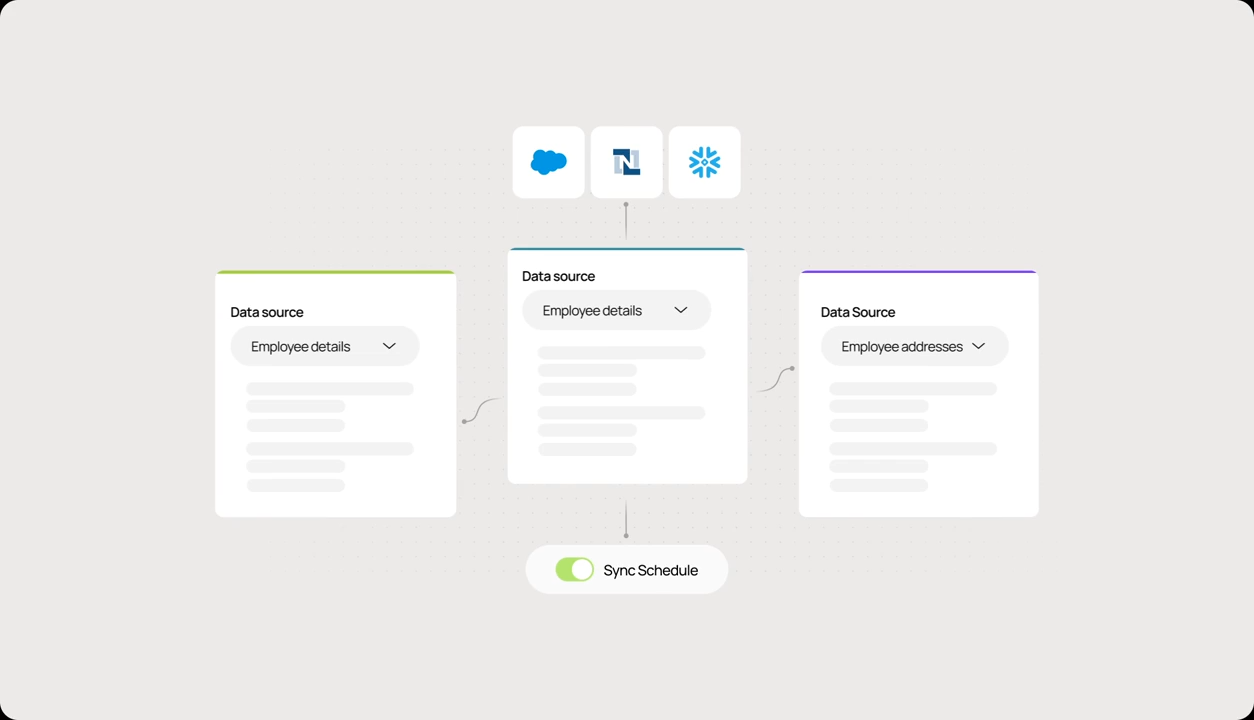
ELT data management connecting CRM, HRIS, and ERP data into a single sales planning foundation
Enterprise integrations with Salesforce, ServiceNow, Workday, HubSpot, Snowflake, and more
When a territory changes, a quota is adjusted, or a new comp plan rolls out, Varicent's connected system propagates those changes across incentive calculations, seller dashboards, and planning models automatically.
That depth comes with trade-offs. G2 reviewers consistently cite complex table dynamics and a specialized development language that requires coding knowledge for routine plan changes. TrustRadius reviewers note the platform "lacks intuitive usability" and that calculation times slow significantly with complicated plans. Varicent does not publish pricing, offer a free trial, or provide a free tier, and contracts include a 30% price increase if a subscription lapses before renewal.
For organizations with the scale, technical resources, and budget to use it fully, Varicent is a strong platform. For teams whose needs extend beyond compensation management into buyer intelligence and GTM execution, or whose size and resources don't match Varicent's enterprise requirements, the alternatives below address specific gaps.
Looking for the buyer intelligence layer that connects your sales compensation strategy to actual deal outcomes? ZoomInfo's GTM Context Graph unifies B2B data, intent signals, and conversation intelligence so your revenue team knows who to target, when to engage, and what to say. Learn more about ZoomInfo.
How We Curated Our List of Varicent Alternatives
After researching Varicent and the broader SPM market, we found that revenue teams want platforms that address specific needs where Varicent's depth may be more than they require, or where its approach leaves gaps. While Varicent excels at enterprise compensation orchestration, organizations often need more capability in:
Connecting compensation strategy to buyer data, intent signals, and account intelligence that drive revenue outcomes
Benchmarking comp plans against external market data without hiring compensation consultants
Building and modifying commission plans without coding knowledge or ongoing SI engagement
Giving reps real-time earnings transparency with deal-level commission forecasting
Automating commissions natively inside an existing CRM without maintaining a separate integration layer
Deploying a commission platform quickly with transparent pricing and a free trial before committing
Configuring complex incentive plans through natural language rather than a specialized development language
Each tool on this list addresses one or more of these areas. Some are direct ICM competitors to Varicent; others complement it by adding intelligence capabilities that compensation platforms were never designed to provide.
DISCLAIMER: We aren't covering every single SPM or ICM tool on the market! Our focus is on highlighting the best alternatives that address some of Varicent's limitations for various use cases and organization sizes. |
|---|
1. ZoomInfo — Best Alternative for GTM Intelligence That Connects Data to Revenue Execution
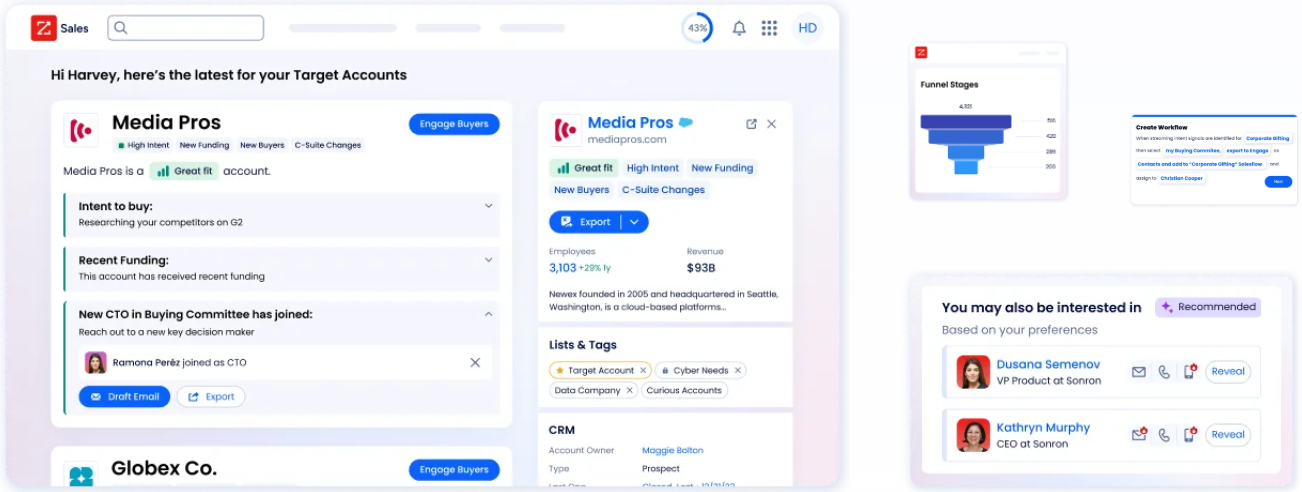
ZoomInfo is an AI GTM platform built on a large B2B data foundation: 500M contacts, 100M companies, 135M+ verified phone numbers, and 200M+ verified business email addresses. Its key features include:
B2B data covering identity, company context, and buying signals, verified through a multi-source pipeline backed by 300+ human researchers with up to 95% accuracy on first-party data
GTM Context Graph fusing ZoomInfo's B2B data with customer CRM records, conversation intelligence, and behavioral signals into a single intelligence layer that processes 1.5B+ data points daily
Buyer Intent Data tracking signals from 210 million IP-to-Organization pairings and 6 trillion+ new keyword-to-device pairings sourced monthly
GTM Workspace giving sellers prioritized accounts, AI-drafted outreach, and deal intelligence
GTM Studio giving marketers, RevOps, and GTM engineers a builder for audience definition, campaign orchestration, and pipeline measurement in natural language
Universal access through APIs and MCP that deliver the same intelligence into any tool, any AI agent, or any third-party platform
ZoomInfo and Varicent serve the same revenue organization but solve different problems. Varicent manages what happens after the sale is planned: territories, quotas, and commissions. ZoomInfo provides the intelligence that makes those plans effective: which accounts to target, which buyers are in-market, and what signals indicate a deal is likely to close. For revenue leaders evaluating their GTM stack, ZoomInfo addresses the gap between planning compensation and knowing where the revenue will come from.
Why Choose ZoomInfo Over Varicent for GTM Intelligence
Varicent orchestrates how sellers get paid. ZoomInfo ensures sellers have the intelligence to find, engage, and win the right accounts. For revenue teams whose performance challenges stem from targeting the wrong accounts, missing buying signals, or lacking the data quality that makes compensation plans actionable, ZoomInfo addresses the root cause that no ICM platform can.
B2B Data: The Foundation Compensation Plans Are Built On
Compensation plans are only as effective as the revenue they're designed around. Territory assignments that don't reflect real market opportunity produce unbalanced workloads and missed quotas. Quota targets set against incomplete account data create the misalignment that Varicent's planning tools are designed to correct after the fact.
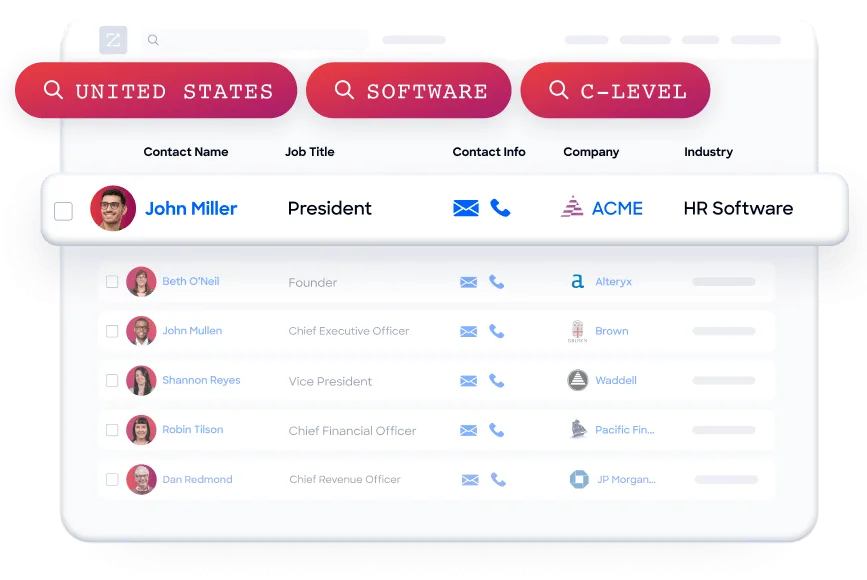
ZoomInfo addresses this at the source. The platform provides 300+ company attributes for market segmentation, including firmographics, technographics, org charts with decision-makers' direct dials and verified emails, and parent-child hierarchy relationships. When a territory plan is built on ZoomInfo's data, it reflects the actual buyable market rather than a snapshot of stale CRM records.
The data quality is externally validated. In a Fortune 500 competitive RFP analyzing 25 million contacts across vendors, the independent consultant concluded that "no other competitor came even close." ZoomInfo holds 133 No. 1 rankings on G2 Summer 2025 across Sales Intelligence, Buyer Intent, Data Quality, and Account Data Management categories. Forrester named it a Leader in Intent Data Providers for B2B (Q1 2025), and Gartner named it a Leader in ABM Platforms for the second consecutive year.
ZoomInfo in Action: Your sales planning team is designing next quarter's territory assignments. Instead of basing coverage on last year's CRM data (already stale), they pull ZoomInfo's current firmographic, technographic, and intent data to identify where actual opportunity sits. The result: territories aligned to real market potential, quotas grounded in verified account data, and sellers pointed at accounts actively researching solutions, not just accounts that happened to be in the CRM.
"ZoomInfo gives us the information we need to execute. We don't have to go through and spend our time digging. It's already there, so we can be three steps ahead." (Vensure)
The GTM Context Graph: Intelligence That Reveals Why Deals Move
Varicent's AI capabilities are built around compensation plan logic: modeling plan outcomes, resolving disputes, and automating calculation processing.
ZoomInfo's GTM Context Graph operates at a different layer. It fuses ZoomInfo's third-party data with a customer's own CRM records, conversation transcripts from Chorus, email interactions, and behavioral signals to capture not just what happened in a deal, but why it happened.
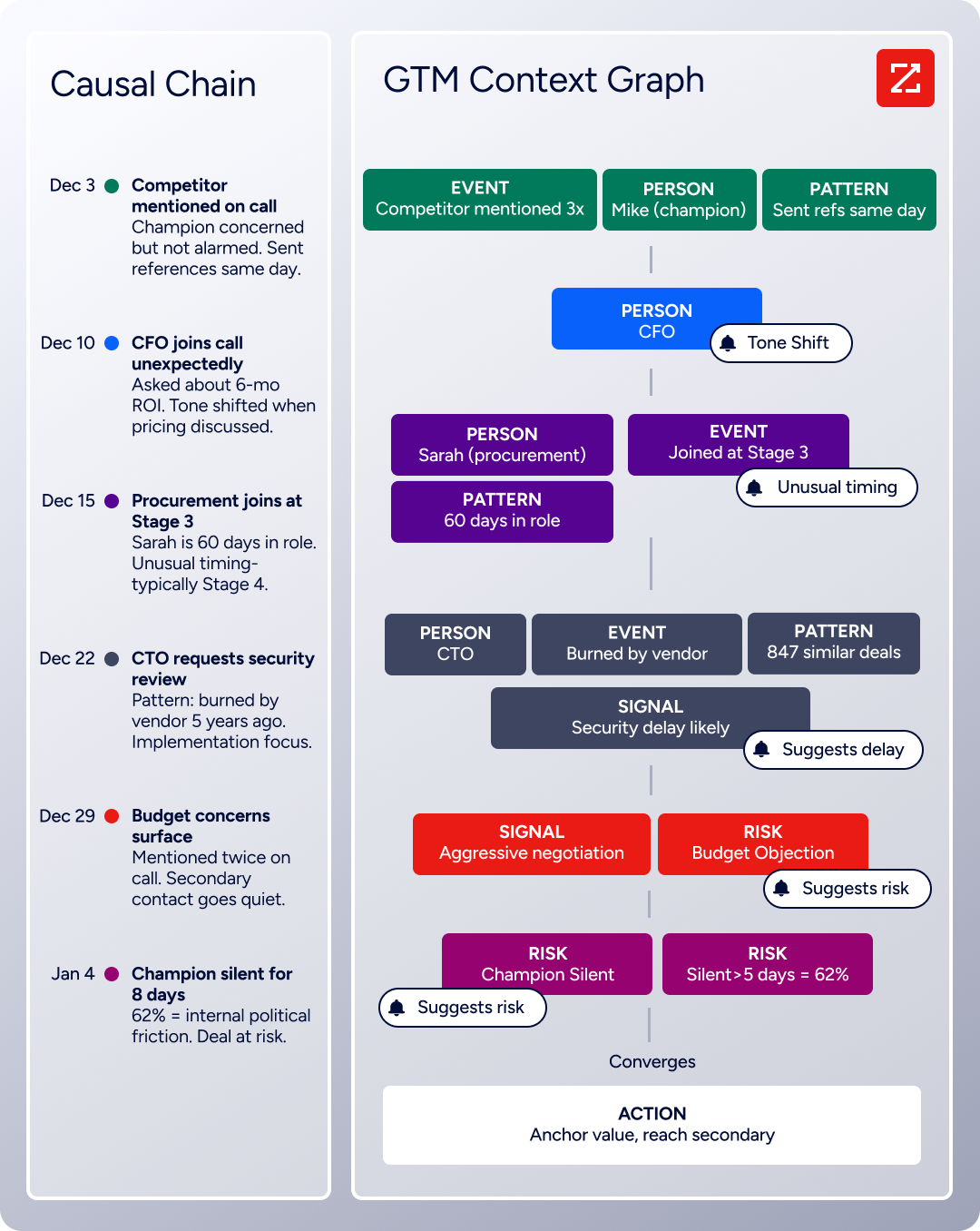
As ZoomInfo's Chief Product Officer Dominik Facher explains: "The CRM recorded the state change." It has no record of why it happened. Perhaps the CFO joined the last call and asked about six-month ROI, which accelerated the deal. Perhaps the VP went quiet for eight days due to an internal budget battle. CRMs (and by extension, the compensation systems that read from them) were never designed to capture these signals.
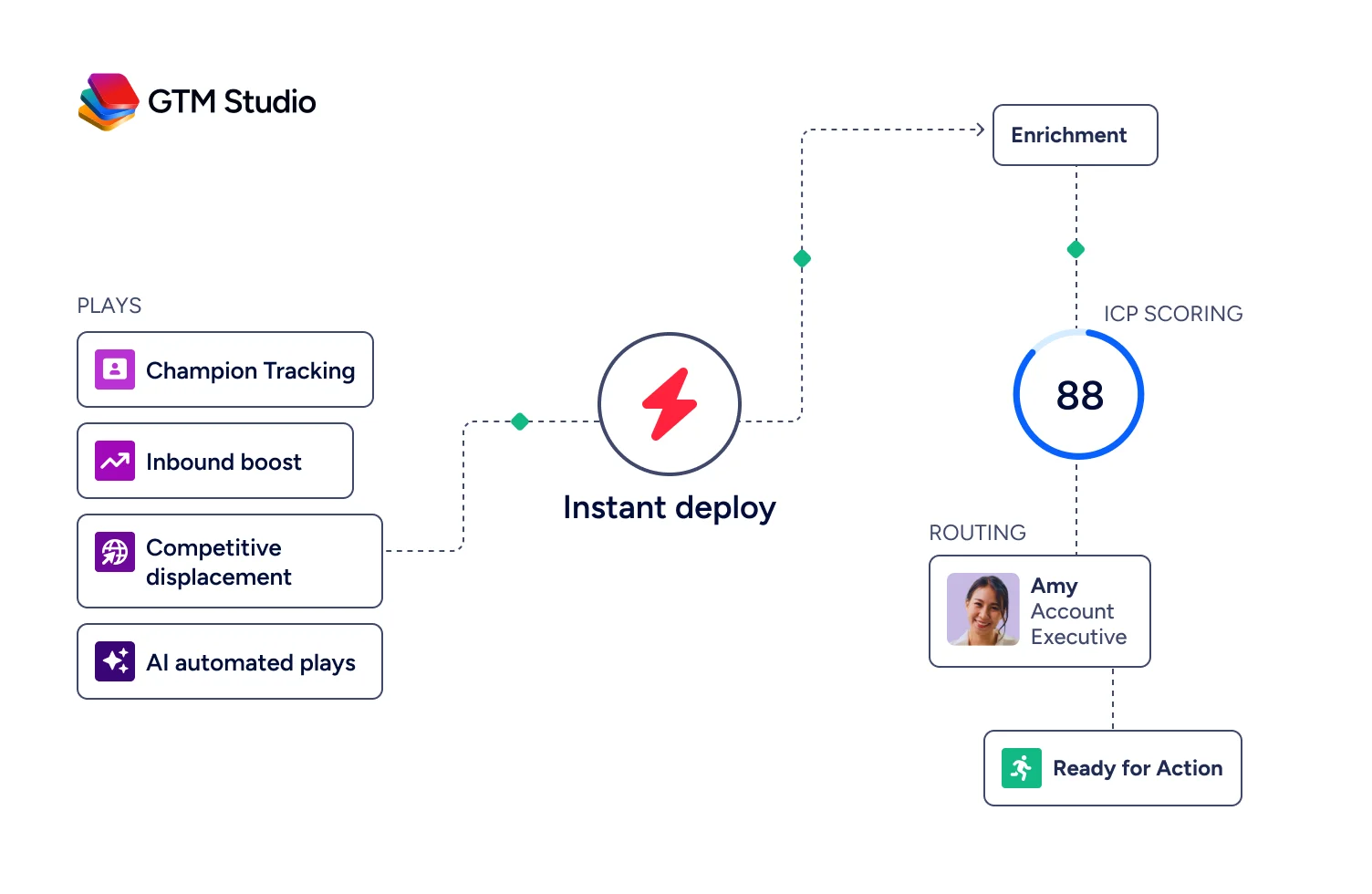
This intelligence layer flows into GTM Workspace for sellers (prioritized accounts, AI-drafted outreach, deal execution), GTM Studio for marketers and RevOps (audience definition, campaign orchestration, pipeline measurement in natural language), and APIs and MCP for any third-party tool or AI agent. All three channels draw from the same intelligence, so a buying signal one team detects is immediately actionable by every other team.
ZoomInfo in Action: Your GTM Workspace flags that a target account's CFO joined the last two calls and asked ROI-focused questions, a pattern the GTM Context Graph recognizes from your previous closed-won deals. Simultaneously, ZoomInfo Intent data shows the company is researching your competitor's pricing page. Your rep walks into the next call knowing why the deal is accelerating, who the champion is, and what competing narrative to address. That deal-level intelligence turns a well-designed comp plan into actual closed revenue.
"That combination of our internal CRM data, external signals, and AI that's given all that context has helped us craft very specific account- and persona-based messages. And people have responded to them right away." (Seismic)
Universal Access: Use the Intelligence in Any Tool
ZoomInfo's intelligence is not locked inside a single application. API access is included in all relevant plans, and the MCP server connects directly to AI assistants including Claude and ChatGPT with no custom coding required. The same data and contextual intelligence powering GTM Workspace and GTM Studio can flow into any CRM, any internal tool, or any partner platform.
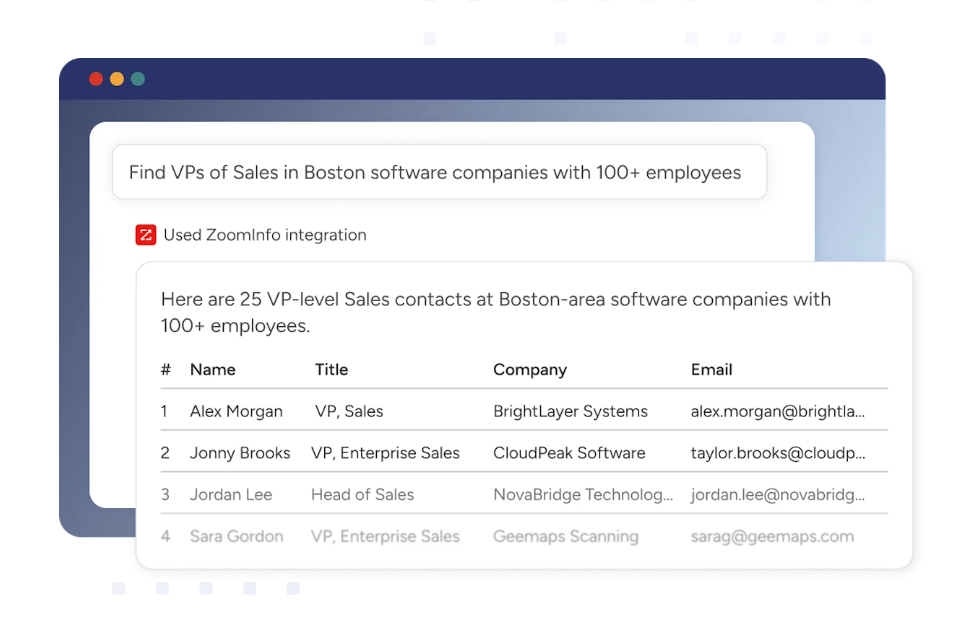
For revenue operations teams that also run Varicent or any other SPM tool, ZoomInfo's data can enrich the account and territory data feeding into compensation planning, keeping the inputs accurate and current rather than relying on whatever was last synced from CRM.
ZoomInfo in Action: Your RevOps team uses ZoomInfo's Enterprise API to automatically enrich Salesforce account records with current firmographics, technographics, and org chart data before those records feed into your compensation platform's territory model. Instead of planning territories on stale CRM data, every planning cycle starts with a verified, current view of your market, and your comp platform's calculations run on inputs you can trust.
"The plug-and-play aspect of the API means I can integrate it very easily into any process and get information at a moment's notice." (BDO Canada)
ZoomInfo Pricing
ZoomInfo uses a consumption-based pricing model with custom quotes. Pricing scales around enterprise license agreements, data access, API consumption, and AI activity. The mechanics are seat-and-credit-based (seats determine user access; credits determine export volume), and costs depend on usage patterns, number of users, monthly credit volume, features, company size, and contract length.
The pricing page is organized into Sales plans (Professional, Advanced, Enterprise) and Marketing plans (Marketing Demand, ABM Lite, ABM Enterprise), each with tiered features. Chorus (conversation intelligence) and Chat (website chat) are priced as standalone products.
ZoomInfo also offers ZoomInfo Lite, a permanent free tier with access to the B2B database, 10 monthly export credits, individual and company searches, the ReachOut Chrome Extension, and HubSpot integration. No credit card or time limit required.
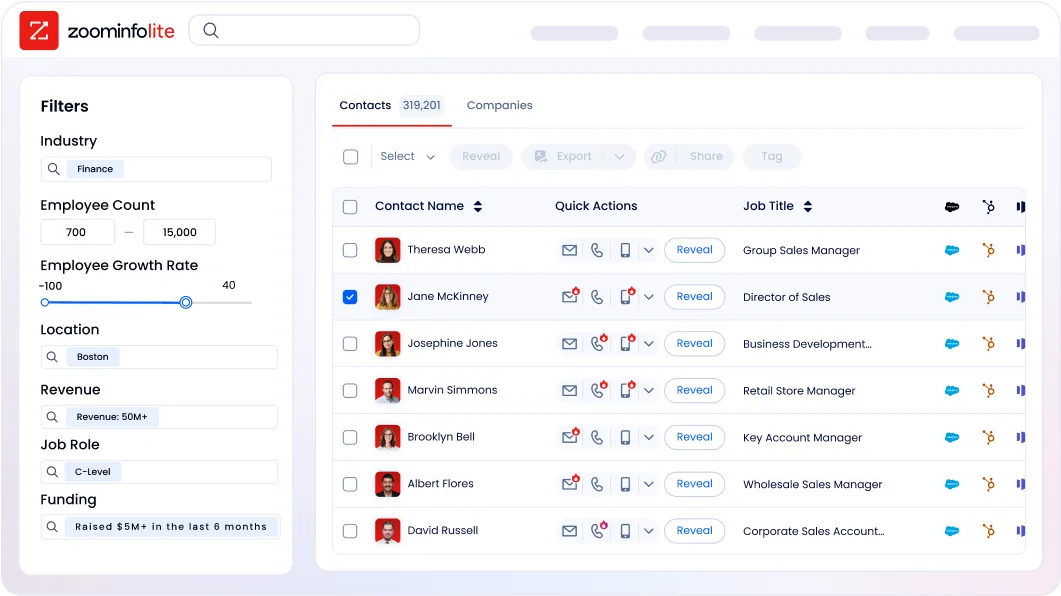
A separate 7-day free trial provides access to core platform features including intent signals and email outreach.
Who Should Use ZoomInfo?
Choose ZoomInfo if:
Your revenue team's performance challenge isn't how commissions are calculated but whether sellers are targeting the right accounts with the right intelligence. ZoomInfo's B2B data and GTM Context Graph ensure your sales plans are built on verified, current market reality rather than stale CRM data.
You need buyer intent signals, org chart intelligence, and conversation-level deal context that no compensation platform provides, but that directly determines whether your comp plans produce the revenue they're designed around.
Your GTM stack spans multiple tools and you need an intelligence layer that works everywhere: inside your CRM, inside your comp platform's territory model, inside your AI agents, and inside execution surfaces for sellers and marketers, all drawing from one dataset.
Want the buyer intelligence that turns territory plans into closed revenue? Start with ZoomInfo's free trial and see which accounts are actively in-market for your solution right now.
2. Xactly — Best Alternative for Enterprise ICM with Proprietary Benchmarking Data
Source: Xactly
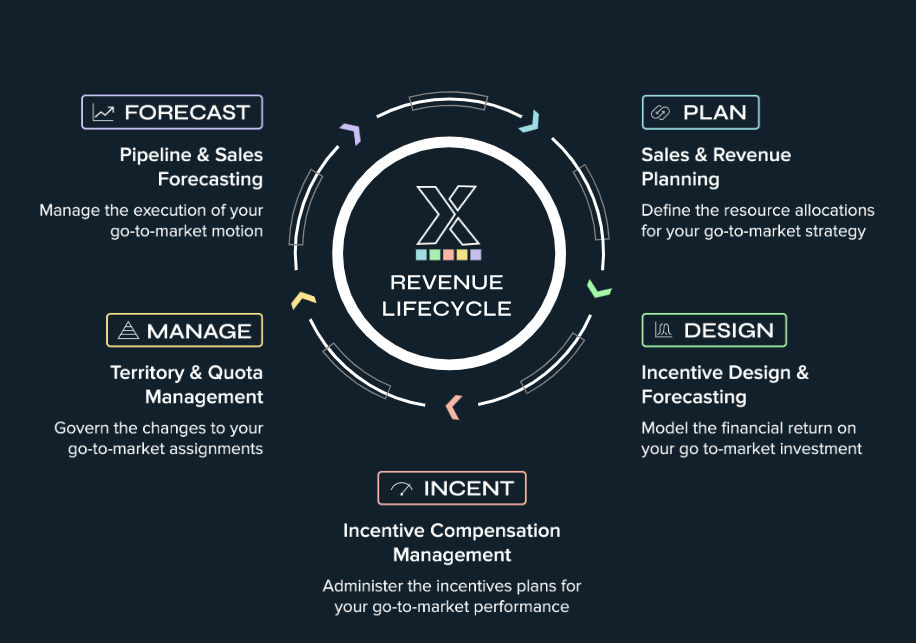
Xactly is a Sales Performance Management and Incentive Compensation Management platform built for mid-market to large enterprise organizations that need compensation automation with external benchmarking context. Founded in 2005, Xactly claims to have been "the first to take ICM to the cloud" for broad commercial use, and has expanded into a full SPM platform covering territory planning, quota management, incentive design simulation, and AI-powered forecasting. Its key capabilities include:
Xactly Intelligence benchmarking with 20+ years of proprietary pay and performance data from 700+ enterprise companies
Built-in ASC 606 and IFRS 15 compliance through the Commission Expense Accounting (CEA) module
High-performance calculation engine processing over $7 billion in calculated commissions and bonuses monthly
Full SPM product suite including Incent, Plan, Design, Manage, and Forecast on a shared data model
Enterprise integrations via native connectors to Salesforce, Microsoft Dynamics, NetSuite, Workday, HubSpot, and Snowflake
AI agents including a Dispute Management Agent co-built with ServiceNow
Xactly sits in the same enterprise ICM tier as Varicent. Its structural advantage rests on the proprietary benchmark data that no competitor can replicate.
Why Choose Xactly Over Varicent for Enterprise ICM?
Xactly stands out in the following areas:
Proprietary Benchmarking Data That Replaces External Consultants
Xactly's core differentiator is structural: 20+ years of pay and performance data accumulated from its customer base since 2005, representing compensation structures, attainment patterns, and quota-setting benchmarks across hundreds of enterprise companies. This dataset powers Xactly's AI models without requiring configuration from the buyer.
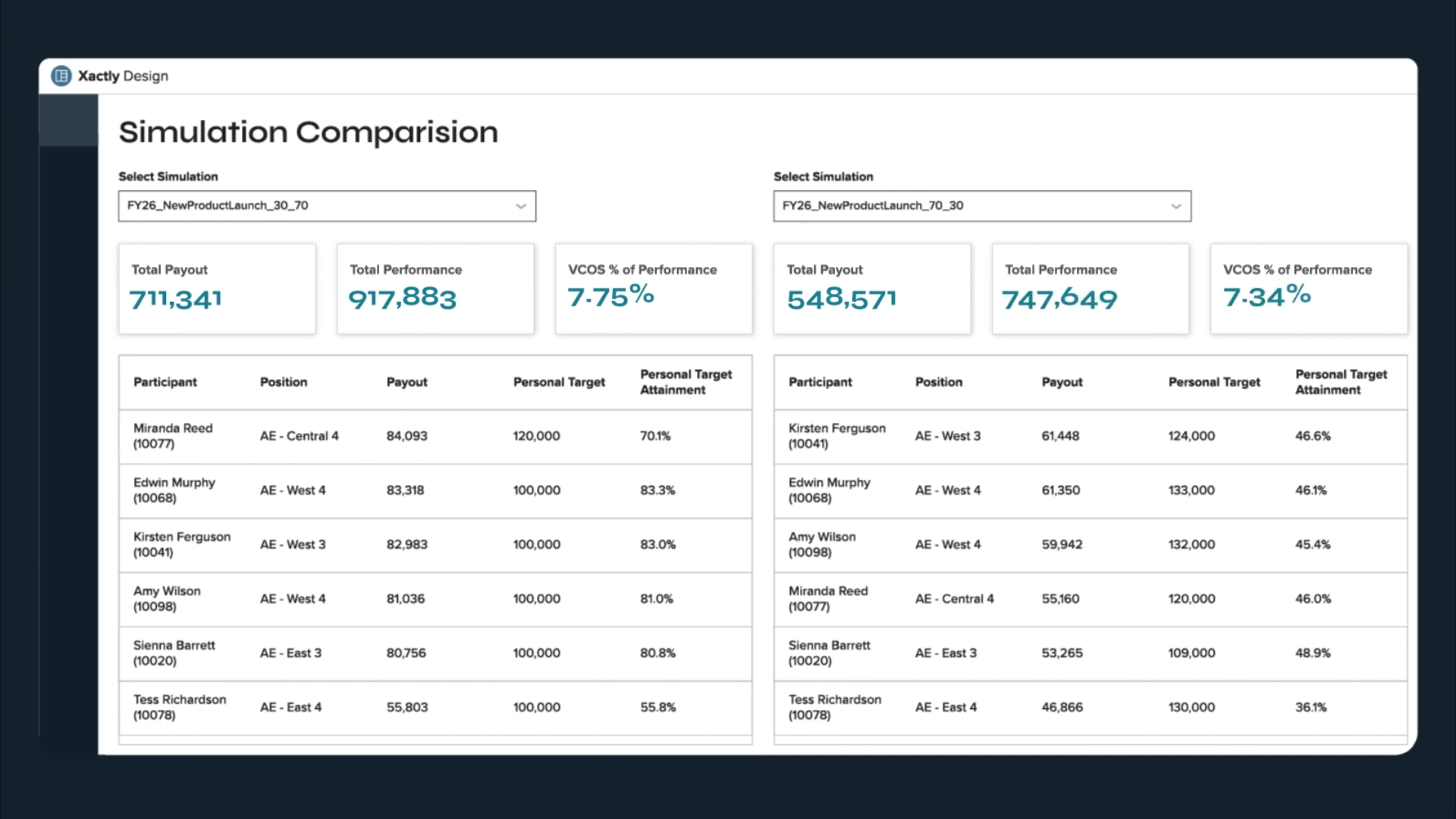
Comp plan designers can use Xactly Design to run unlimited what-if simulations against historical market data, compare pay mix and OTE levels against industry norms by role and company size, and forecast the financial impact of plan changes before rollout, potentially achieving up to a 90% cost reduction by eliminating recurring compensation consulting engagements.
Source: Xactly
Varicent offers scenario modeling and plan simulation, but the external benchmark context that Xactly's proprietary dataset provides is not replicable through any Varicent configuration.
Calculation Speed and ASC 606 Compliance at Enterprise Scale
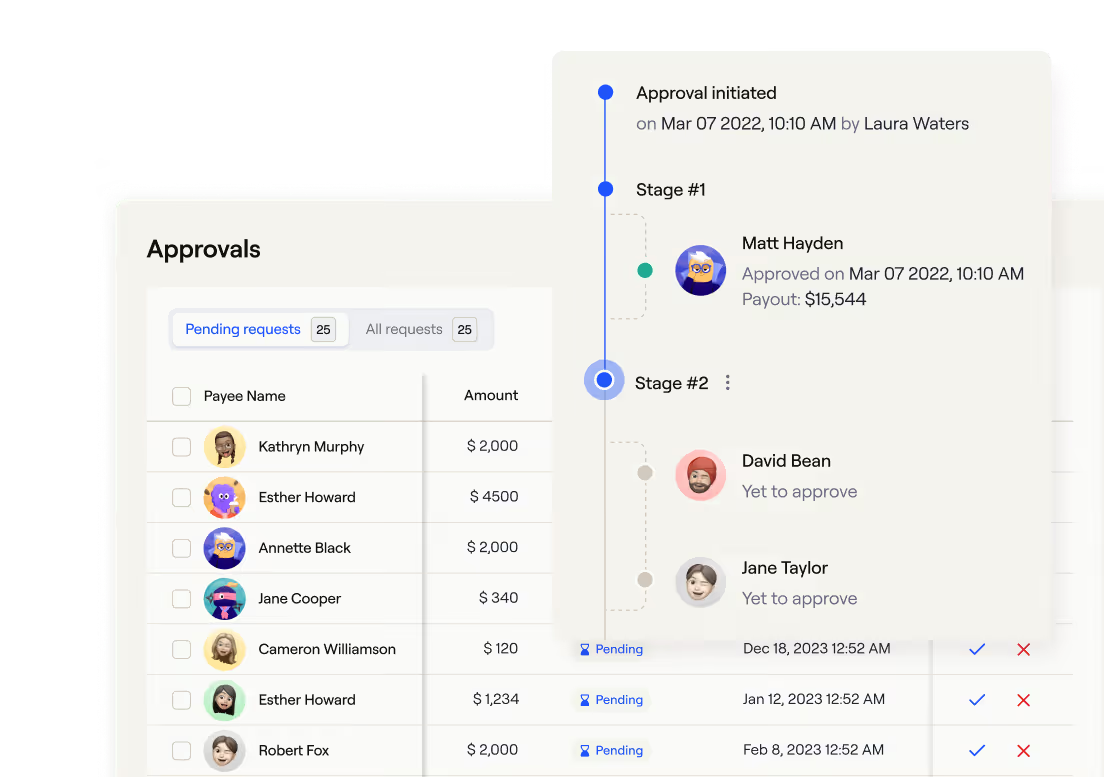
Varicent's G2 reviewers consistently surface calculation speed as a friction point, citing "lengthy load times and delays" and "slow calc times especially with complicated plans." Xactly's calculation engine claims 99.8% on-time commission payment accuracy and a 90% average reduction in overpayments (Forrester study). On the compliance side, Xactly's dedicated Commission Expense Accounting module automates ASC 606 and IFRS 15 compliance including dynamic true-ups for contract events, with pre-built auditor reporting that integrates with CRM, HRIS, CLM, CPQ, and downstream accounting ledgers.
More Transparent Contract Terms
Varicent's contract includes a 30% fee increase on lapsed subscriptions and non-refundable payment terms across all charges. Xactly's contract was independently reviewed by TermScout and rated in the top 13% of SaaS vendor contracts for customer favorability, noted for having no "gotcha" provisions. Both vendors use quote-based pricing, but the third-party validation gives Xactly a verifiable signal of contract transparency that Varicent cannot currently claim.
NOTE: We also evaluated beqom and Oracle Incentive Compensation for this slot. While beqom excels at total compensation management across HR and sales use cases in European enterprise environments, and Oracle Incentive Compensation carries the integration weight of the full Oracle cloud ERP suite, Xactly offers the most differentiated enterprise alternative to Varicent for organizations prioritizing proprietary compensation benchmarking, built-in ASC 606 compliance, and strong external analyst validation (ISG Overall Leader, TrustRadius Buyer's Choice 2026).
Xactly Pricing
Xactly operates on a named-seat subscription model with all pricing quote-based. The Incent product is structured across three tiers:
Incent Core (Scaling Automation): High-Performance Calculation Engine, Plan Configuration and Administration, Performance Dashboards, AI Assistants, Standard Data Integrations.
Incent Plus (Enterprise Compliance): Everything in Core, plus ASC 606 Compliance (CEA module), Prior Period Processing, Business Group Security, Full Sandbox Environment, Advanced Data Connectors.
Incent Ultimate (Strategic Intelligence): Everything in Plus, plus Industry Benchmarking (access to 20+ year proprietary dataset), AI Agents and Proactive Insights, MBO and Objective Management, Advanced Modeling Capabilities, Custom Process Extensions (Xactly Extend).
Strategic Planning modules (Xactly Plan, Design, Manage, and Forecast) are purchased separately.
Who Should Use Xactly?
Choose Xactly if:
Your organization runs complex multi-role compensation structures for thousands of payees across global territories, and you need a calculation engine with documented accuracy at enterprise transaction volumes rather than one where complex plan layers compound processing delays.
You are a public company or preparing for IPO and need financial compliance automation (ASC 606 / IFRS 15) built natively into the same platform running your compensation calculations.
Your comp plan design team currently relies on external consultants to benchmark plans against industry norms, and you want to internalize that benchmarking capability using a vendor whose 20+ year proprietary dataset is not replicable through any competitor's configuration.
3. CaptivateIQ — Best Alternative for No-Code Compensation Management at Scale
Source: CaptivateIQ
CaptivateIQ is an incentive compensation management and sales performance management platform built to eliminate the technical dependency that makes legacy ICM tools inaccessible to mid-market and fast-scaling organizations. Backed by Sequoia, Accel, and ICONIQ Growth at a $1.25 billion valuation, and trusted by 800+ companies including Gong, Expedia, and Boston Scientific, CaptivateIQ tackles Varicent's most consistently cited limitation: the need for coding knowledge to make routine plan changes. Its key capabilities include:
SmartGrid no-code calculation engine handling accelerators, clawbacks, SPIFs, splits, and multi-product structures through a spreadsheet-like interface
Faster implementation with the platform claiming "up and running in a matter of weeks instead of months"
CaptivateIQ Agents (AI) including Comp Builder, Comp Ops, and Rev Planning agents grounded in actual plan logic
Integrated planning modules sharing a single data model across Incentives, Planning, and Catalyst (predictive ML)
Modern rep experience with real-time earnings statements and natural-language payout explanations
SOC 1, SOC 2, and dedicated SOX compliance controls with ASC 606 reporting available as an add-on
Why Choose CaptivateIQ Over Varicent for No-Code Compensation Management?
CaptivateIQ stands out in the following areas:
No-Code Plan Administration That Eliminates Specialist Dependency
The most persistent Varicent complaint is that routine plan modifications require developer involvement or external consultants. CaptivateIQ's SmartGrid is a calculation engine that comp administrators interact with through a spreadsheet-like no-code interface. The same logic that handles multi-tier accelerators, clawback rules, split credits, and overlay structures is expressed through a visual canvas rather than configuration code.

Source: CaptivateIQ
Forrester's Q1 2025 Wave awarded CaptivateIQ its highest possible scores in plan creation and maintenance, plan modeling, and end-user modeling because non-technical admins can build plans of genuine complexity without engineering dependencies. The Guided Plan Builder supports up to 7,000 unique simultaneous plans, and SmartGrid processes worksheets with 10M+ source transactions in 12 seconds.
Faster Time-to-Value and Lower Total Cost of Ownership
Varicent's implementation is delivered alongside major SI partners including Deloitte, KPMG, and Accenture, signaling both the quality of available support and the typical scale of the engagement. CaptivateIQ positions around a different model: the enterprise page claims "Fastest implementation. 2X faster time to ROI. Lower TCO" versus legacy platforms. Forrester noted that "customers consistently call out value as the reason they selected the solution."
AI Agents Built Inside the Compensation System
CaptivateIQ Agents include the Comp Builder Agent (builds plans from plain-language descriptions), Comp Ops Agent (explains payouts in plain English, catches calculation anomalies), and Rev Planning Agent (configures territory assignments from natural-language goals). Each agent operates with full access to plan rules, performance data, and calculation logic, giving reps self-serve earnings transparency and reducing commission inquiry volume.
NOTE: We also evaluated Performio and Everstage for this slot. Performio is a capable ICM platform with enterprise references, but its plan-building experience is not as distinctly no-code as CaptivateIQ's SmartGrid. Everstage (covered separately in this article) is a strong no-code alternative positioned more toward SMB and lower-mid-market. CaptivateIQ offers the most credible combination of no-code admin self-sufficiency and enterprise-grade calculation depth.
CaptivateIQ Pricing
CaptivateIQ does not publish pricing publicly. All contracts are quote-based through a sales engagement. Pricing is per-payee plus a one-time setup fee, determined by three factors: number of payees, compensation plan complexity, and number of integrations required. CaptivateIQ Incentives, Planning, and Catalyst are distinct products, each with its own subscription cost. ASC 606 compliance reporting is available as a paid add-on. No free trial is available; the standard entry point is a product demo or self-guided tour.
Who Should Use CaptivateIQ?
Choose CaptivateIQ if:
Your compensation team currently files IT tickets or engages external consultants for routine plan changes, and you need to bring that ownership in-house without sacrificing plan complexity.
You're evaluating Varicent but cannot sustain a multi-month, consultant-heavy implementation, or lack a dedicated comp-tech resource to own a technically demanding platform post-go-live.
You need territory and quota management connected to incentive calculations in one platform, eliminating the reconciliation burden between separate planning and ICM tools.
Your sales reps maintain shadow spreadsheets to verify payouts, and you need real-time earnings visibility to eliminate that friction and its administrative overhead.
4. Everstage — Best Alternative for Accessible SPM Without Enterprise Complexity
Source: Everstage
Everstage is an AI-powered Sales Performance Management platform built for mid-market teams that need commission management without the technical overhead or consulting dependency of enterprise platforms. Its key capabilities include:
No-code compensation plan designer supporting multi-tiered structures, SPIFs, draws, clawbacks, and accelerators
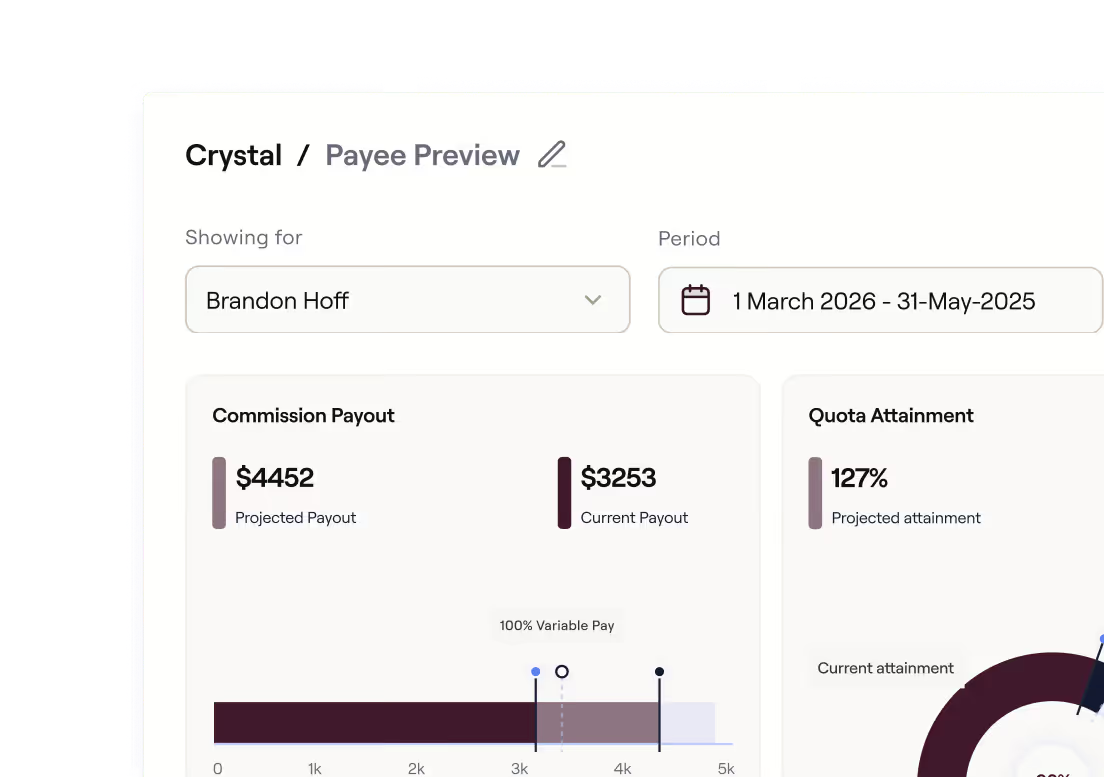
Crystal AI Agent delivering real-time rep earnings visibility and conversational payout forecasting
Pre-built native integrations with 100+ CRM, ERP, HR, and data warehouse systems
Time Machine for pre-deployment plan modeling against historical performance data
Agent Core intelligence layer with AI assistants for data prep, onboarding, and dispute resolution
4-6 week implementation timeline with a free proof-of-concept before any purchase commitment
Why Choose Everstage Over Varicent for Accessible SPM?
Everstage stands out in the following areas:
No-Code Plan Administration Built from the Ground Up
Everstage's no-code plan designer handles multi-tier accelerators, split credits, overlapping territories, draw-against-commission, clawbacks, and SPIFs through a visual builder that RevOps admins own without technical involvement. Agent Core extends this: the AI Databook Assistant handles data joins, filters, and transformations through natural language, and the AI Onboarding Assistant manages payee lifecycle without touching spreadsheets.
Real-Time Rep Earnings Transparency via Crystal AI
Crystal is a conversational payout forecasting interface where reps ask natural language questions, adjust deal variables in real time (deal size, contract duration, close date), and see how those changes affect projected commissions before a deal closes. Crystal delivers commission visibility inside Slack, Microsoft Teams, Gmail, and natively within Salesforce via the Connectivity Bundle. G2 reviewers consistently cite payee-side visibility as a primary driver of adoption success.
Source: Everstage
Commercial Terms Without the Penalty Structure
Varicent's contract includes a 30% fee increase on lapsed subscriptions. Everstage markets "No hidden costs" as a value proposition, and its publicly accessible terms do not include an equivalent lapse penalty. Everstage also offers a free proof of concept where prospects share their most complex comp plan and Everstage replicates it inside the platform before any purchase commitment.
NOTE: We also evaluated Visdum and Compass for this slot. While Visdum is built for SaaS revenue teams with usage-based compensation modeling, and Compass offers a gamification-forward rep experience, Everstage offers the strongest combination of no-code administration, real-time rep transparency, and implementation speed for mid-market teams looking to move off Varicent's complexity.
Everstage Pricing
Everstage prices on a per-payee basis with custom quotes required through the sales team. Implementation services are scoped separately. Standard implementation timeline is 4-6 weeks. No self-serve free trial is available, but a free proof of concept is offered pre-commitment. The company holds SOC 2 Type II, SOC 1 Type II, ISO 27001, ISO 42001:2023, GDPR, and CCPA certifications.
Who Should Use Everstage?
Choose Everstage if:
Your RevOps team needs to own and modify compensation plan logic without raising engineering tickets or engaging external consultants for every plan change.
Your sales reps are building shadow spreadsheets because commission data lags behind deal activity, and you need real-time, deal-level earnings transparency inside Salesforce, Slack, and Teams.
You want to validate the platform against your actual compensation plans before signing: Everstage's free proof-of-concept replicates your most complex plan in-platform before any commitment.
Your implementation timeline is constrained: Everstage's 4-6 week go-live directly addresses the multi-month legacy SPM implementation cycles that have pushed mid-market teams away from enterprise procurement.
If Everstage looks close but not quite right, compare the other Everstage alternatives worth considering.
5. Salesforce Spiff — Best Alternative for Salesforce-Native Commission Automation
Source: Salesforce Spiff
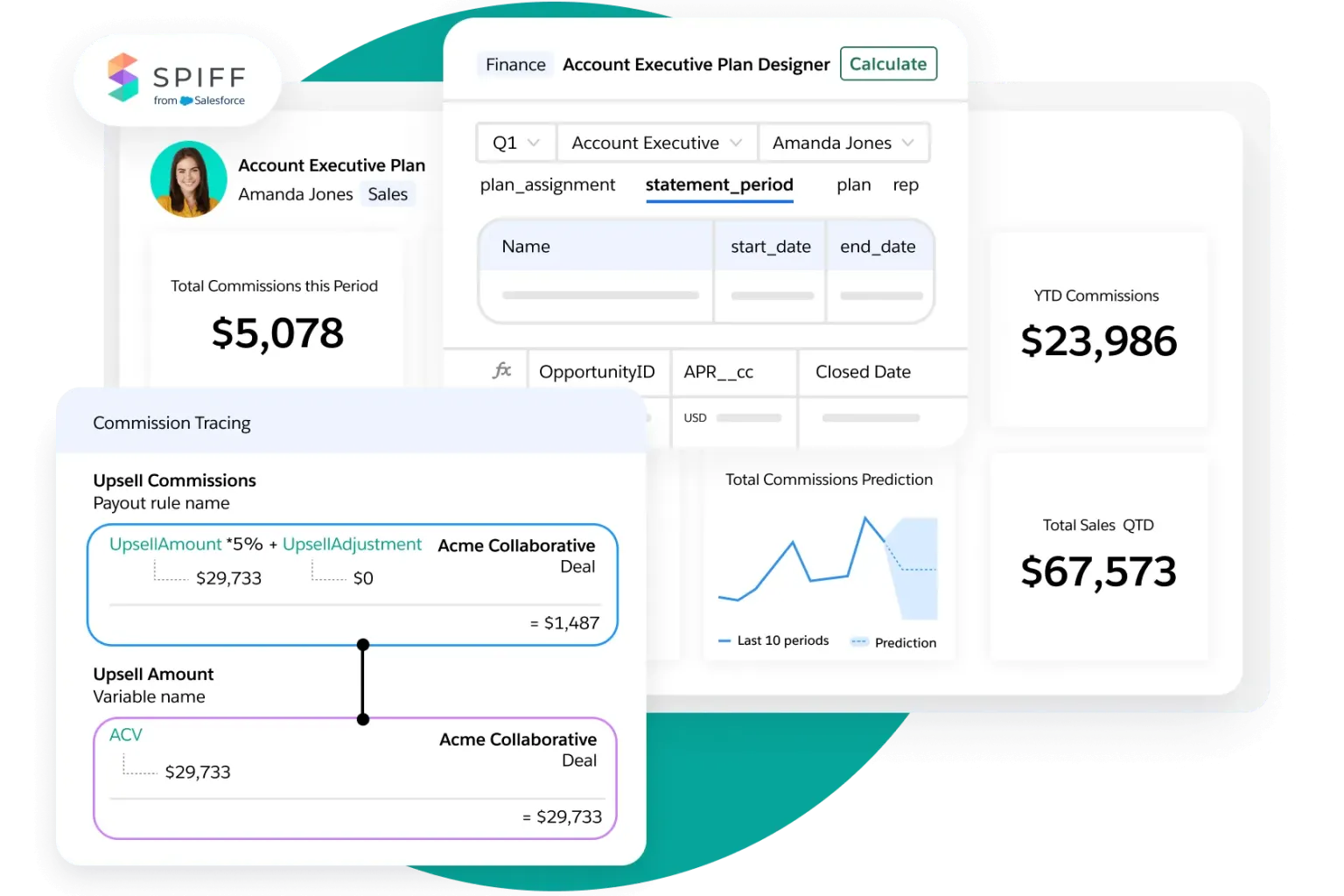
Salesforce Spiff is a native incentive compensation management platform built directly into Salesforce Sales Cloud. Rather than connecting to Salesforce via an external integration, Spiff reads deal data directly from Sales Cloud objects, so commission calculations update the instant an opportunity changes, with no sync job required. Originally an independent company founded in 2017, Spiff was acquired by Salesforce in February 2024 and now functions as the dedicated ICM module within Sales Cloud. Its key capabilities include:
Native Sales Cloud integration with real-time opportunity-to-commission data flow
Real-time commission calculation that updates as deals close, not on a batch schedule
Finance-grade audit trail covering every calculation with full traceability
ASC 606/IFRS 15 expense reporting automation via the Commission Expensing module
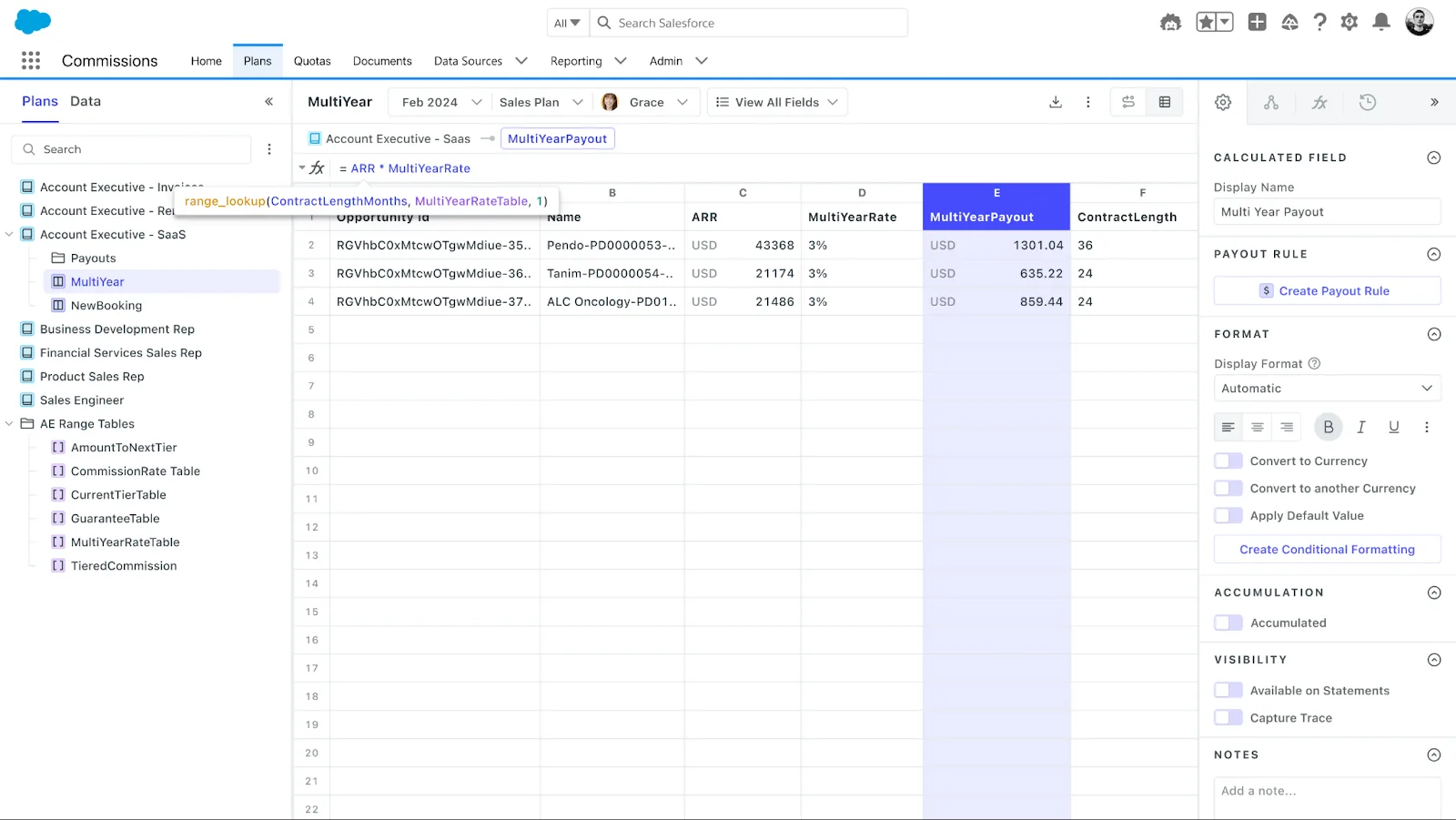
Commission Estimator embedded directly on Salesforce Opportunity and CPQ Quote pages
AI-powered plan recommendations via the Spiff Assistant
Why Choose Salesforce Spiff Over Varicent for Salesforce-Native Teams?
Salesforce Spiff stands out in the following areas:
Zero-Gap CRM Integration Versus Managed ETL Pipelines
Varicent supports Salesforce via connectors, but the integration model is still an external link with its own maintenance burden and failure points. Because Spiff is built directly on the Salesforce platform, commission calculations draw from the same underlying data model. When a rep updates a deal amount, close date, or product line in Salesforce, that change is immediately available to Spiff's compensation engine. There is no separate integration to configure, no data quality mismatch between CRM and compensation, and no troubleshooting sync failures during month-end close.
Real-Time Commission Calculation Versus Batch Processing
While Varicent's calculation engine handles complex plans, its G2 reviewers report slow calc times on complicated ones. Spiff's approach is architecturally different: reps see commissions update the instant a deal is marked Closed Won, and the Commission Estimator on the Opportunity page shows projected payout as reps modify deal terms before closing. On G2, 93% of users rate the commission estimator positively as the primary reason reps trust the numbers rather than maintaining shadow spreadsheets.
Built-In ASC 606/IFRS 15 Compliance Automation
The Commission Expensing module automatically applies incentive logic to generate compliant expense reports, with unlimited subgrouping down to the obligation line. Statement freezing can lock automatically at period end, and every change is tracked in the System Activity Log. Spiff holds ISO 27001/27017/27018/27701 certification and a dedicated SOC 2 report.
Source: Salesforce Spiff
NOTE: We also evaluated Commissionly and Core Commissions for this slot. While Commissionly handles simple commission structures at a lower price point for smaller teams, and Core Commissions offers strong plan-design flexibility in non-Salesforce environments, Salesforce Spiff offers the tightest commission automation for teams already on Sales Cloud who want to eliminate a standalone ICM vendor and the integration layer it requires.
Salesforce Spiff Pricing
Salesforce Spiff publishes a single per-seat tier:
Salesforce Spiff: $75 USD/user/month, billed annually. Includes Commission Plan Management, Effective Dating, Foreign Currency Conversion, Commission Expensing (ASC 606/IFRS 15), Real-time Rep Statements, Commission Estimator, Tracing and Audit Trails, Workflow Management, Automated Approvals, Dispute Resolution, Leader Dashboards, and Custom Reports.
Non-Salesforce connectors: $250/connector/month for each external system integration (ERP, payroll, HRIS, data warehouse). The native Salesforce connector is included.
Premium Support: Available at 30% of net contract price.
No free trial is currently available.
Who Should Use Salesforce Spiff?
Choose Salesforce Spiff if:
Your revenue operations team is already standardized on Salesforce Sales Cloud and you want commission calculation to live in the same platform and data model, rather than maintaining a separate ICM vendor with its own integration and contract.
Your reps are losing trust in commission accuracy because payouts calculate on a batch schedule, and you need a real-time commission estimator embedded directly on the Opportunity page.
You're a publicly traded company and need automated ASC 606/IFRS 15 commission expense reporting with an immutable audit trail without building that workflow outside your compensation platform.
Spiff is the wrong choice if your CRM is HubSpot, Microsoft Dynamics, or anything outside Salesforce. The $250/connector/month fee for each non-Salesforce integration changes the cost equation significantly, and the native data-model benefit that drives the core value proposition is lost.
6. QuotaPath — Best Alternative for Transparent, AI-Powered Commission Tracking
Source: QuotaPath
QuotaPath is an AI-native sales commission tracking and compensation management platform designed for revenue organizations that have outgrown spreadsheets but don't need the complexity, cost, or implementation timelines of enterprise ICM platforms. Its key capabilities include:
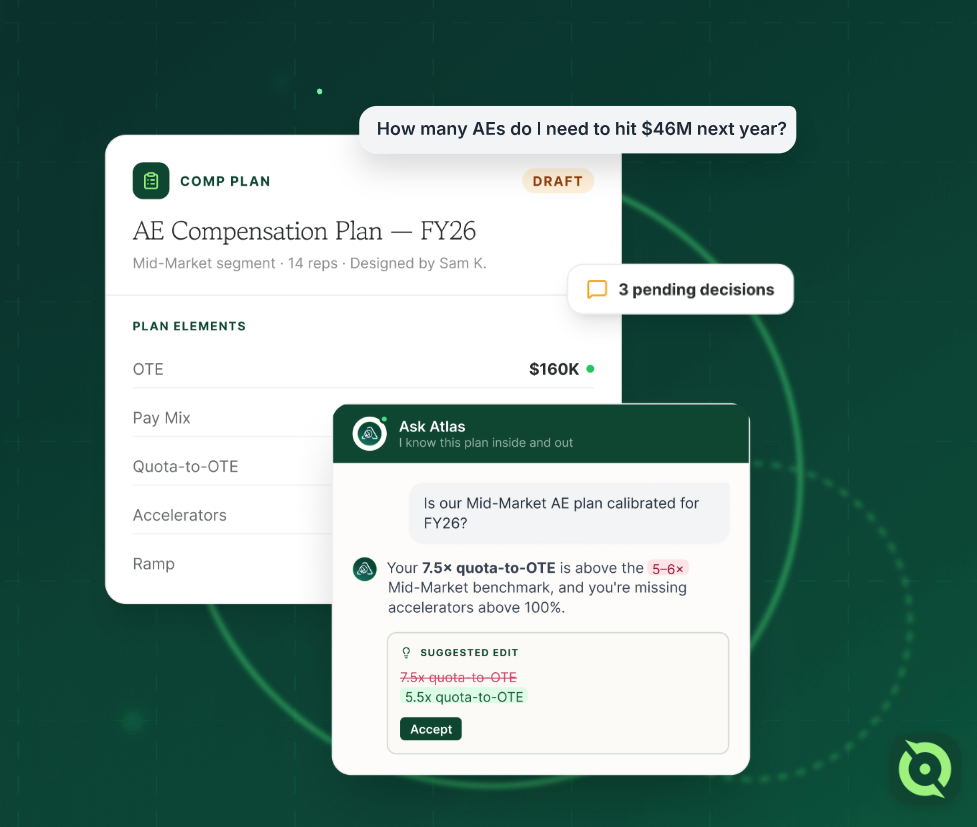
AI-Powered Plan Builder that generates structured comp plans from uploaded documents or plain-text descriptions
Real-time rep-facing earnings dashboards with deal-level commission breakdowns and forecasted payouts
Atlas AI Revenue Strategist for comp plan grading, scenario modeling, and benchmarking
ASC-606 compliant commission accounting with straight-line amortization and waterfall export (Growth tier and above)
Native integrations with Salesforce, HubSpot, Rippling, QuickBooks, NetSuite, Stripe, BigQuery, and Snowflake
A permanent free tier for Atlas Standalone with AI-assisted comp plan analysis
Why Choose QuotaPath Over Varicent for Transparent Commission Tracking?
QuotaPath stands out in the following areas:
Transparent Flat-Rate Pricing With No Contractual Penalties
Varicent requires custom quotes, offers no free trial, and imposes a 30% fee increase on lapsed subscriptions. QuotaPath publishes pricing directly on its website at $35/user/month (Growth) and $50/user/month (Premium), with flat monthly platform fees of $525 and $800 respectively. A 30-day free trial is available across all tiers. Teams can model their total cost before speaking to a sales rep and test the platform in their actual environment before committing.
AI Plan Builder That Simplifies Configuration
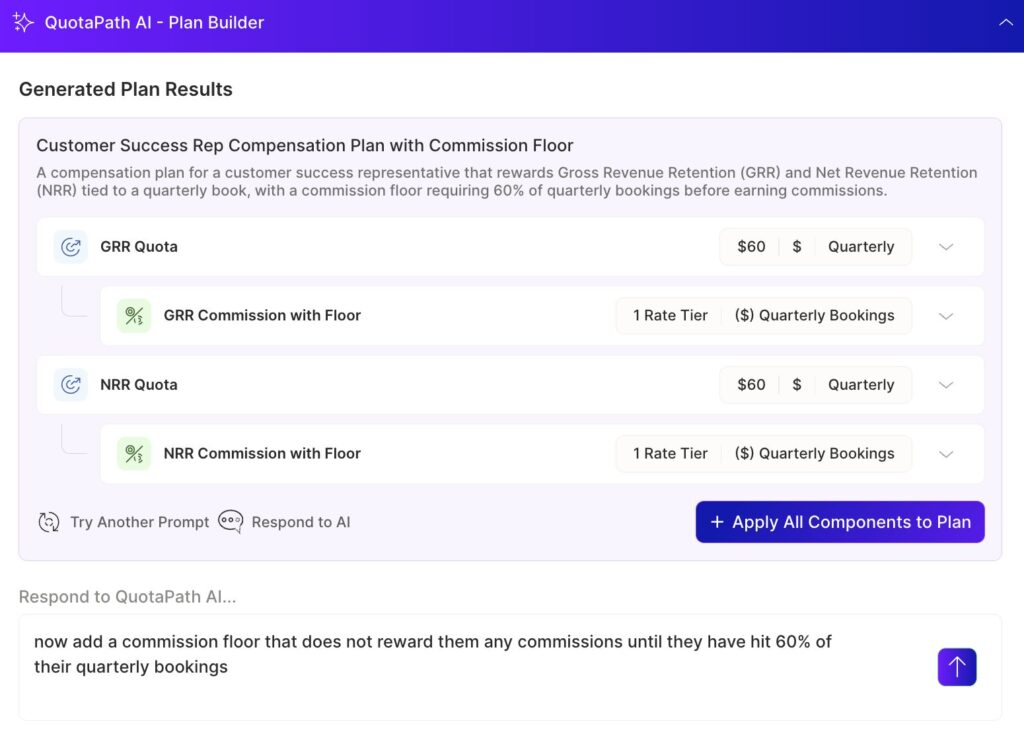
QuotaPath's AI-Powered Plan Builder lets admins upload an existing compensation plan document (a signed PDF or Word file) and the AI reads it and generates a structured plan with quotas, accelerators, commission rates, and bonus components automatically.
Source: QuotaPath
Admins can also describe the plan in plain language and iterate until the structure matches requirements. Plans include a modeling tab for simulating payout outcomes at any attainment level before publishing to reps. QuotaPath's self-service model directly answers the dependency on technical resources that drives teams away from legacy ICM platforms.
Rep-Facing Transparency at a Fraction of Enterprise Cost
Reps see commission breakdowns by deal and forecasted earnings in real time, with an Earnings Explanation side panel showing step-by-step plain-language math for how each commission was calculated. This is the same transparency goal Varicent's Research Assistant achieves, delivered at a published starting price of $6,300/year rather than a custom enterprise quote.
NOTE: We also evaluated CaptivateIQ and Spiff (now part of Salesforce). While CaptivateIQ offers deeper enterprise-grade configurability, and Spiff integrates natively within the Salesforce ecosystem, QuotaPath offers the most accessible entry point for teams moving off spreadsheets: a 30-day free trial, published pricing, an AI Plan Builder, and ASC-606 compliance in its mid-tier plan.
QuotaPath Pricing
Growth ($35/user/month + $525/month platform fee): Quota management, leaderboards, plan verification, ASC-606 Ledger, 9 CRM integrations including Salesforce and HubSpot, ~45-60 day average implementation. Effective minimum annual cost: $6,300/year.
Premium ($50/user/month + $800/month platform fee): All Growth features plus plan modeling, multi-level approvals, custom reporting, automated payroll sync, API access, Rippling HRIS integration, 7 accounting integrations, 5 analytics integrations. Effective minimum annual cost: $9,600/year.
Atlas Add-On (AI Revenue Strategist): Atlas Standalone is free (5 messages/day) with guided workflows and Comp Plan Grader. Atlas Pro is $20/user/month with enhanced limits and Monte Carlo scenario modeling. Atlas Connected starts at $5,000/year with live workspace data integration.
Who Should Use QuotaPath?
Choose QuotaPath if:
Your RevOps team is managing commissions across multiple spreadsheets and needs to migrate before the next payout cycle causes an error. QuotaPath's 45-60 day implementation and AI Plan Builder are built for this transition.
You need ASC-606 compliant commission accounting without paying for an enterprise ICM platform. The Growth tier includes the full Ledger at a published annual minimum of $6,300.
You want to evaluate a comp platform before committing. QuotaPath's 30-day free trial and published pricing let you model total cost and test the product before signing.
Your primary CRM is HubSpot. QuotaPath's native real-time HubSpot integration includes lead and invoice object support, and a QuotaPath app on the HubSpot Marketplace lets reps view earnings without leaving their CRM.
7. Forma.ai — Best Alternative for AI-Native Plan Configuration and Faster SPM Execution
Source: Forma.ai
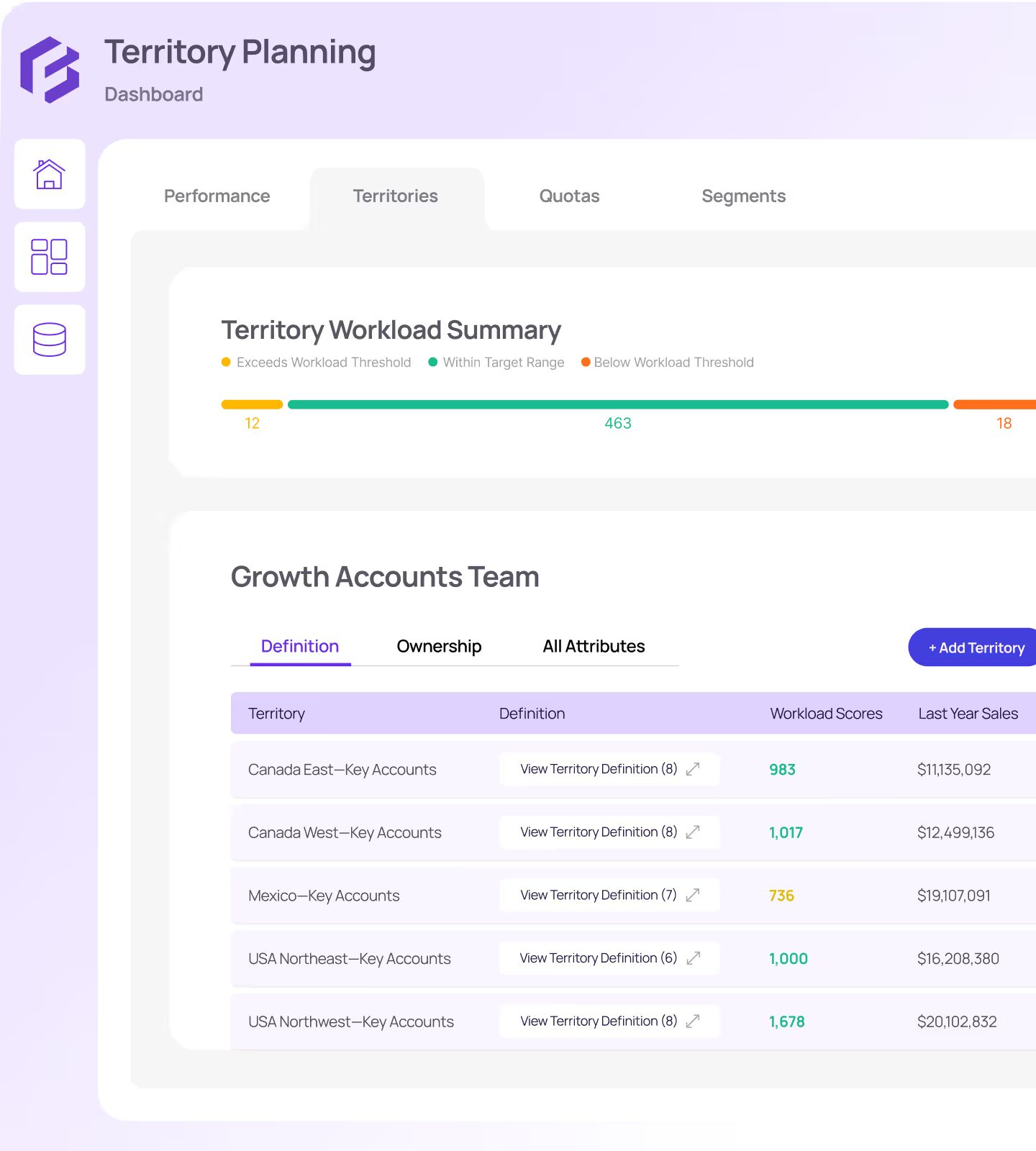
Forma.ai is an enterprise Sales Performance Management platform that combines incentive compensation management, territory planning, and quota setting on a single AI-native data architecture. It positions itself as a direct challenger to legacy ICM platforms on two fronts: the administrative burden of configuring complex compensation plans and the speed at which those plans go from design to live calculation. Its key capabilities include:
Natural language plan configuration that eliminates coding requirements for plan admins
AI-powered calculation engine with documented 91.7% faster run-times compared to legacy ICM platforms
Real-time what-if scenario modeling built natively into the platform
200+ pre-built connectors to CRM, ERP, HRIS, and financial systems
Unified SPM architecture with Forma Operator (ICM), Forma Architect (territory and quota), and Forma Prophet (advisory analytics) on a shared data model
Embedded advisory analytics combining proprietary ML models with on-platform expert consulting
Why Choose Forma.ai Over Varicent for AI-Native Plan Configuration?
Forma.ai stands out in the following areas:
Natural Language Plan Configuration vs. Varicent's Specialized Development Language Varicent's G2 and TrustRadius reviews consistently cite the requirement for coding knowledge or dedicated technical resources to handle routine plan changes. Forma.ai's plan configuration layer allows compensation admins to describe new incentive logic in plain language and have AI compile it into a validated, reusable plan component, with no coding required. Organizations using this approach report defining, configuring, and deploying new plan types in days rather than the months that legacy configuration cycles typically require.
Calculation Performance and Plan Rollout Speed
Forma.ai documents a 91.7% reduction in calculation run-time and an 87% reduction in incentive plan rollout timelines compared to legacy ICM platforms. For enterprise organizations running thousands of payees across complex multi-tiered plans, this means plan changes deploying in days rather than weeks and fiscal-year launches hitting their start dates instead of lagging behind.
Unified Architecture Built for the Full SPM Stack
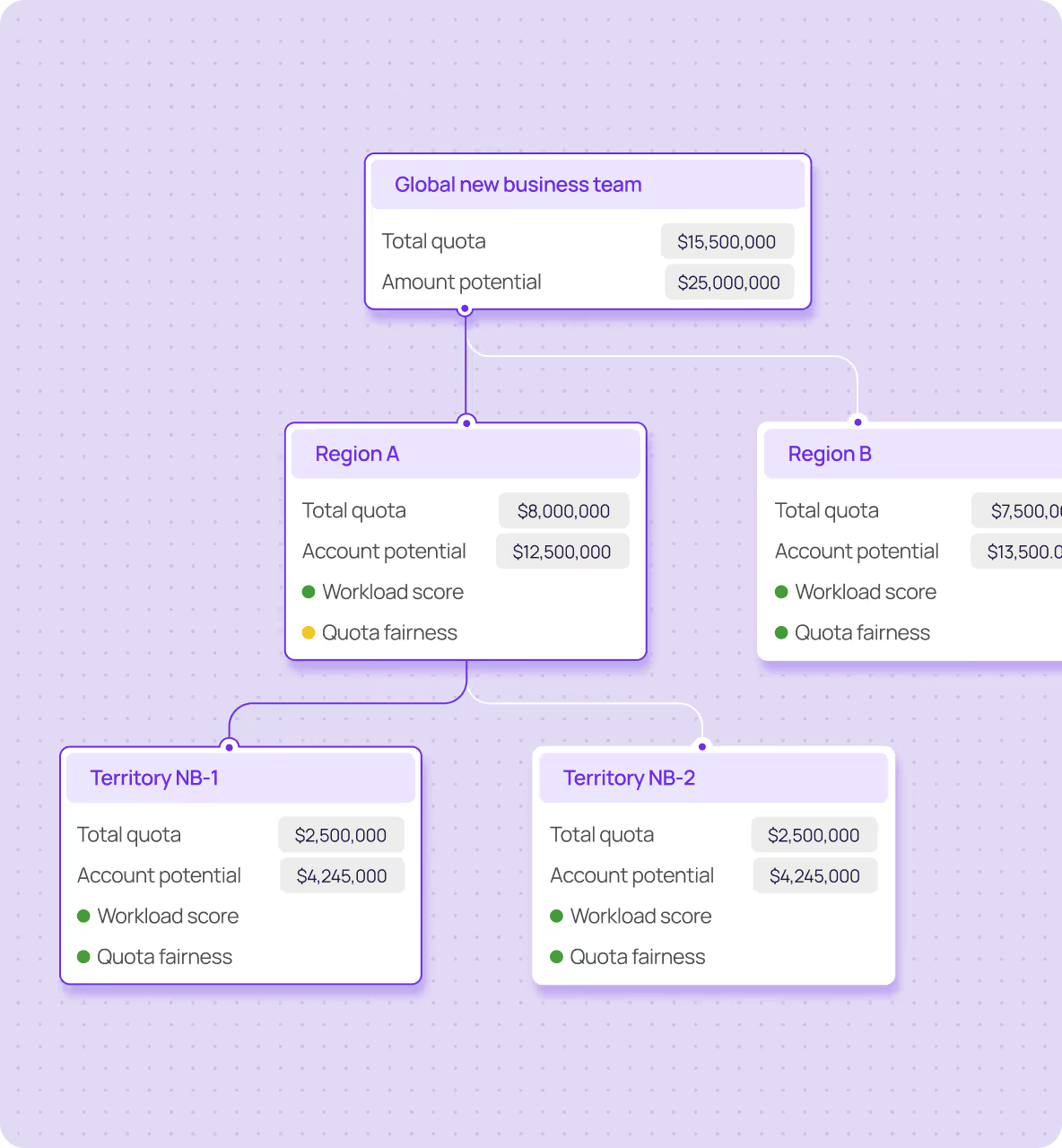
Forma.ai's suite (Operator, Architect, and Prophet) runs on a single data model designed from inception to connect all three functions. When a territory assignment changes in Architect, crediting rules, plan documents, and payouts update automatically in Operator without manual reconciliation. The shared data model also powers Forma.ai's seller dashboards, which reduce compensation-related support ticket volume by giving reps direct visibility into their earnings and plan logic.
Source: Forma.ai
NOTE: We also evaluated CaptivateIQ and Salesforce Spiff for this slot. While CaptivateIQ excels at faster onboarding and a more accessible UX for comp teams new to dedicated ICM tools, and Spiff suits Salesforce-native organizations wanting tight CRM-embedded commission tracking, Forma.ai offers the most complete full-stack SPM architecture for teams needing enterprise-grade calculation performance, natural language plan configuration, and territory-quota-incentive connectivity without stitching together separate vendor relationships.
Forma.ai Pricing
Forma.ai does not publish standard pricing tiers. The company uses a fully custom, quote-based enterprise model. The publicly disclosed pricing structure has three components:
Onboarding & Implementation: A one-time fee covering enterprise setup.
CompOps Platform: An ongoing subscription covering ICM, financial reporting, performance dashboards, and data management.
AI-Configurator: An additional component priced according to the level of configuration capability required.
Forma.ai's homepage carries an explicit commercial guarantee: "Lowest cost of ownership, Get the most cost-efficient enterprise solution, guaranteed." This positions the all-in price against the total cost of competitor platforms plus the external SI spend those platforms typically require.
Who Should Use Forma.ai?
Choose Forma.ai if:
Your compensation team is maintaining parallel spreadsheet workflows because your current ICM's configuration layer requires technical skills they don't have. Forma.ai's natural language plan configuration eliminates the coding requirement.
Your calculation run-times are a planning bottleneck. Organizations running complex multi-tiered plans with large payee populations report that Forma.ai's engine processes the same workload in a fraction of the time.
You need territory, quota, and incentive compensation to operate as a connected system rather than three separately-managed workflows. Forma.ai's Architect and Operator modules share a data model where territory changes cascade to incentive calculations automatically.
Your comp team's primary job has become managing the platform rather than advising the business. Forma.ai's natural language configuration and unified architecture are designed to shift compensation analysts from calculation processing back to performance coaching.
The Final Verdict
Varicent excels as an enterprise SPM platform, but revenue teams across different sizes and maturity levels have specific needs that may be better served by specialized alternatives. Based on our research, here are the best alternatives:
ZoomInfo for GTM intelligence, buyer data, and intent signals that connect compensation strategy to actual revenue outcomes
Xactly for enterprise ICM with 20+ years of proprietary benchmarking data and built-in ASC 606 compliance
CaptivateIQ for no-code compensation management that eliminates technical dependency without sacrificing calculation depth
Everstage for accessible SPM with a 4-6 week implementation, real-time rep transparency, and a free proof of concept
Salesforce Spiff for commission automation built natively into Sales Cloud with zero integration overhead
QuotaPath for transparent, published pricing with an AI Plan Builder and a 30-day free trial
Forma.ai for natural language plan configuration and documented faster calculation performance
Many revenue teams will find that the right answer isn't choosing one of these alternatives exclusively. Some organizations use a specialized ICM platform for commission calculations while layering ZoomInfo's GTM intelligence on top to ensure those compensation plans are built on accurate, current buyer data and intent signals. Consider your specific needs, team size, and technical capacity when deciding which combination works best.
Want the buyer intelligence that turns territory plans into closed revenue? ZoomInfo's GTM Context Graph unifies B2B data with your CRM, conversation intelligence, and behavioral signals, so your revenue team knows who to target, when to engage, and what to say. Start your free trial or request a demo and see how ZoomInfo powers the go-to-market motions that drive results.
Varicent Alternatives FAQ
Why do businesses look for Varicent alternatives?
Varicent's most common limitations include a steep learning curve that requires coding knowledge for routine plan changes, slow calculation times on complex plans, no public pricing or free trial, and contract terms that include a 30% fee increase on lapsed subscriptions. Mid-market teams without dedicated technical resources often find the platform's complexity exceeds what they can sustain without ongoing consulting support.
What is the best overall Varicent alternative?
There is no single best alternative because the right choice depends on your specific needs. Xactly is the strongest enterprise-grade direct competitor with proprietary benchmarking data. CaptivateIQ is the best no-code option for growing teams. QuotaPath is the most accessible with published pricing and a free trial. ZoomInfo is the best choice for organizations whose performance challenge is about targeting the right accounts with the right intelligence rather than just automating commission calculations.
Is there a free alternative to Varicent?
No platform in this category offers a fully free ICM solution at enterprise scale. However, QuotaPath offers a 30-day free trial across all paid tiers and a permanently free Atlas Standalone tier for AI-assisted comp plan analysis. ZoomInfo offers ZoomInfo Lite, a permanent free tier with B2B data access and 10 monthly export credits. Everstage provides a free proof of concept that replicates your actual compensation plans before any purchase commitment.
Which Varicent alternative is best for Salesforce users?
Salesforce Spiff is built for Salesforce-native teams. It sits directly on Sales Cloud and eliminates the integration layer, with commission calculations that update the instant a deal closes. It starts at $75/user/month. For organizations on Salesforce that also need buyer intelligence and intent signals, ZoomInfo integrates natively with Salesforce and delivers account enrichment, org chart data, and buying signals directly into CRM records.
How does Xactly compare to Varicent for enterprise use?
Both are enterprise-grade SPM platforms with full ICM capabilities, territory planning, and AI features. Xactly's differentiator is 20+ years of proprietary pay and performance benchmarking data that informs plan design, a dedicated ASC 606 compliance module, and contract terms rated in the top 13% for customer favorability by TermScout. Varicent's differentiator is its AI-native architecture recognized by Forrester as the most advanced in the category, its connected platform where territory, quota, and incentive changes propagate automatically, and deeper specialization in insurance and financial services verticals.
Which alternative is best for mid-market teams with limited technical resources?
CaptivateIQ and Everstage are both strong options. CaptivateIQ offers a no-code SmartGrid engine that handles enterprise-level plan complexity through a spreadsheet-like interface, while Everstage provides a 4-6 week implementation timeline, a free proof of concept, and Crystal AI for real-time rep earnings forecasting. QuotaPath is the most accessible entry point with published pricing starting at $35/user/month, a 30-day free trial, and an AI Plan Builder that generates plans from uploaded documents.
Can ZoomInfo work alongside Varicent?
Yes. ZoomInfo and Varicent solve different problems within the same revenue organization. Varicent manages territories, quotas, and incentive compensation. ZoomInfo provides the B2B data, intent signals, and account intelligence that inform those plans. ZoomInfo's Enterprise API can enrich the account and territory data feeding into Varicent's planning models, ensuring compensation calculations run on accurate, verified inputs rather than stale CRM records.
How difficult is it to migrate from Varicent to one of these alternatives?
Migration complexity depends on your plan complexity and data volume. CaptivateIQ and Everstage both position around faster implementation (weeks rather than months). Forma.ai's natural language plan configuration can replicate existing plan logic without coding. QuotaPath's AI Plan Builder can read existing plan documents and auto-generate the structure. For organizations staying at the enterprise tier, Xactly offers a full SPM stack on a shared data model. The most common approach is to run the new platform in parallel for one payout period before cutting over.
Looking beyond Varicent? Compare the strongest alternatives side by side:
