
What makes a cold email subject line work
Cold email subject lines are the first filter between your message and the trash folder. A good one earns an open in under two seconds. A bad one ends the conversation before it starts. Whether you're writing B2B cold email subject lines for a 300-account territory or a single high-priority deal, the mechanics are the same.
Three traits separate subject lines that work from ones that don't:
Specific: Names a pain point, company detail, or trigger event. Generic subject lines signal generic emails.
Low-friction: The reader can decide to open in under two seconds. If they have to decode it, they won't.
Honest: The subject line matches what's inside. Misleading subject lines get opens once and spam reports forever.
Understanding where subject lines fit in the broader cold email equation also helps. The 30/30/50 rule breaks it down: 30% of your email's success comes from the subject line (it determines whether the email gets opened), 30% from the opening line (it determines whether the reader keeps reading), and 50% from the offer or CTA (it determines whether the reader takes action).
The implication is practical. Most reps over-invest in subject line creativity and under-invest in the clarity of their ask. A mediocre subject line with a compelling offer will outperform a clever subject line attached to a vague CTA every time.
For a demand generation context, the same rule applies: the subject line is the door, not the room. Build the room first.
10 cold email subject line strategies that actually work
"The overall idea is stand out," says ZoomInfo Senior Sales Development Rep, Zachary Thompson. "People get so many emails. Sometimes, prospects will give me their personal email address, after a good phone call, because it will get lost if I email their business account!"
Here are the cold email subject line strategies that work, drawn from real ZoomInfo reps in the field.
1. Seasonality
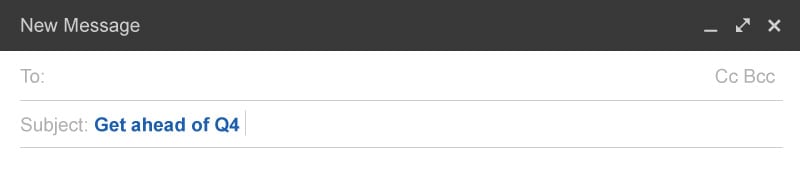
"Every industry has something that's top-of-mind," says Dominique Catabay, a demand generation Specialist at ZoomInfo. "For example, we sell to sales and marketing, so the fiscal calendar year drives decisions for our prospects. I like to use references to 'end of quarter' or 'end your month strong.'"
"Think about seasonal or time-based terms that your prospect will be attuned to," says Thompson. "For our prospects, an example might be 'summer slump.' The budgeting process is top of mind for our target market during October-November (and we want to get in during budget planning!)."
"End your Q3 strong, one idea"
"Budget season is coming. Ready?"
"Summer slump: how [Company] is avoiding it"
2. F.O.M.O is real
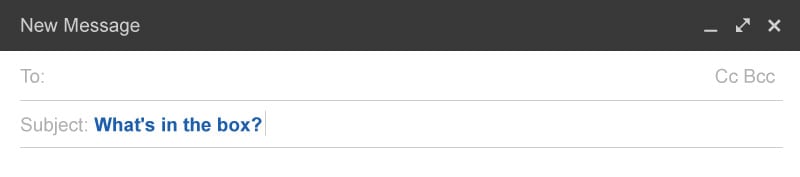
Traditionally, we think of B2C subject lines about deals expiring at midnight or BOGO specials ("Today only!"). The same principle applies to B2B email subject lines, with a professional twist.
FOMO-driven subject lines work because professionals need to stay current. Catabay's advice is to offer new information the prospect doesn't already have. "Things change, and professionals need to stay current. No matter how experienced you are, there are things you don't know," she says. "There will always be new technologies and best practices that you need to learn about. Offer new information."
"Before you write another blog post, read this"
"3 trends your competitors already know"
"What changed in outbound this quarter"
3. How-to content
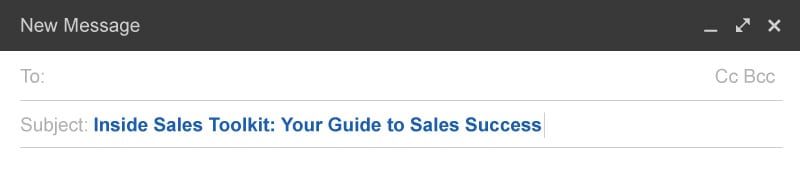
"Anything that offers how-to info gets good opens," Catabay says, "because we're helping and disarming." Not selling. "This works especially well with smaller companies, because they really are looking for assistance and trying to get better."
"How to set up an ABM strategy in 30 days"
"How to cut your SDR ramp time in half"
"How to survive your next overnight flight" (mystery + utility combo)
4. Use personal "power words"
"Find 2-3 'power words' for your prospect through research, and find a way to fit those into the subject line," Thompson says.
"Idea for [topic the prospect cares about]"
"Find out where they went to school. I like to refer to a college sporting event or mascot name, especially during March Madness. Anything on LinkedIn, a business website, or press release is fair game." (Personal information is not.)
"Idea for [Company]'s pipeline coverage"
"Saw your talk on outbound, quick thought"
5. Don't give away too much detail
"Share just enough information to get them interested," Catabay says. "I'm always surprised to find that often, general subject lines work better than something more detailed."
"Update?"
"Translations"
Thompson agrees. "I thought the more specific and in-depth I could go, the better... but that's not actually the case for subject lines. I've found that specific isn't better. Save the depth and detail for the content of the email."
One caveat: the message itself still needs to deliver. Being vague can be intriguing enough to click, but all the clicks in the world don't mean anything if the prospect was expecting one thing and got something else. As Act-On's Nathan Isaacs puts it, "You can't buy beer with open rates."
6. Keep it short and sweet
"Most people are opening email on their phones," Thompson says. "I want my prospect to be able to see the whole subject line (no breadcrumbs) on a mobile device."
"Saw Salesforce on your website."
"Call tomorrow."
Desktop email clients show approximately 60 characters in the subject line preview. Mobile preview windows show approximately 30 characters. A subject line that reads perfectly on desktop may be cut off on mobile, dropping the most important word entirely. The practical rule: keep subject lines under 50 characters for safe cross-device display.
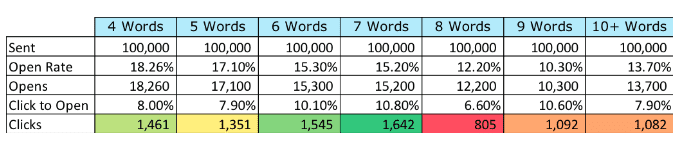
According to a Marketo study, seven words is the commonly cited ideal length, though it varies by industry and content quality. ZoomInfo's sales and marketing teams aim to stay under 50 characters.
7. Use numbers (but beware of the email spam trap)
Numeric numbers like dates and times work well, but certain patterns can send you straight to the spam folder, damaging your domain authority and email deliverability.
"10 mins, [date]?" Asking for an appointment is a great use of numbers.
"Cruisin' 4 Critters is August 2nd, Register Today!" This example from Constant Contact leverages numbers to include a deadline and a sense of urgency, without sounding spammy.
HubSpot's research on spam trigger words suggests avoiding patterns like:
#1
100% free
100% satisfied
4U
50% off
Billion
Billion dollars
Million
Join millions
One hundred percent guaranteed
Thousands
8. Use restraint when it comes to puns and jokes
Dad jokes and eye-rolls can be silly. "But it's a chance to be relatable!" says Catabay. "We wouldn't want it to seem like some automated email that everyone gets, it feels more personal, person to person. I like to use puns in marketing emails."
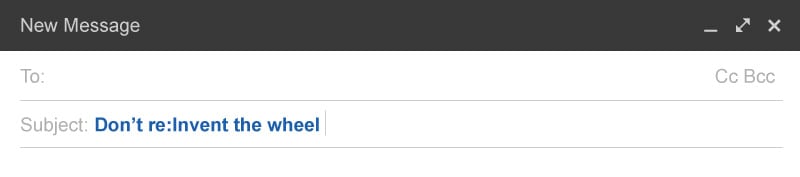
"Don't re:Invent the wheel" (sent ahead of the AWS re:Invent conference)
"Abra-cord-abra! Yeah, we said it." (shared by HubSpot, reportedly about charging cords)
Puns and humor are situational. There's no template or playbook here. Keep things tasteful. If your dad wouldn't say it, don't say it.
9. Keep it real
Gimmicks work... for about two seconds.
"Question about [goal]." This one works because it's real. You're offering a solution, so you actually want to know about your prospect's goals. Because the "goal" is different for everyone, no two subject lines will be the same.
"These things are dynamic," Thompson says, "and it's hard to predict how long something will be 'in' or how long it will work. Gimmicky subject lines can give you a short lift in open rates, but the volume of email that's sent in the B2B world is so overwhelming that novelty wears off, fast.
"Always be thinking about what you can do to stand out to the prospects, so you're not just one of the other 300 other drip emails they have to deal with every single day."
10. It's about them (not you)
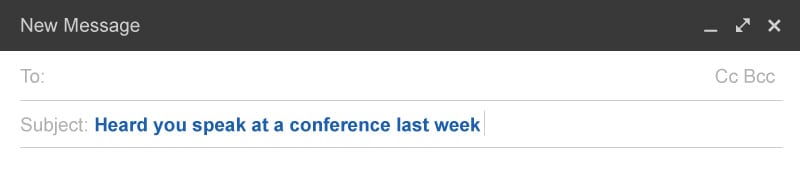
"This should go without saying," Thompson says, "but we still see it all the time. Subject lines should reference something the prospect cares about, not you or your product." Their company, their goals, their pain points, their interests.
The Cocktail Party phenomenon demonstrates selective attention: our brain is biologically designed to filter out what doesn't interest us or what doesn't benefit us. And you are not of interest. Not yet.
"Your annual goal."
"Ever had this problem? Tell me about it."
Deliverability basics that affect subject line performance
The best cold email subject line in the world fails if the email never reaches the inbox. Before optimizing subject lines, make sure your sending infrastructure isn't working against you. This is especially relevant for B2B cold email subject lines, where corporate filters and sender reputation play a bigger role than in consumer email.
Four areas to get right before you scale outreach:
Use a business domain. If you're sending from a gmail.com or yahoo.com address, fix that first. Free email domains tank your credibility with spam filters and with the people you're trying to reach, most prospects won't even open it.
Keep your list clean. Sending to stale or invalid addresses drives bounce rates up and domain reputation down. A high bounce rate tells inbox providers that your list wasn't verified, which reduces deliverability for every message you send, including the ones going to valid addresses. Reps who build full outreach sequences only to watch open rates collapse because a third of emails bounced know exactly how demoralizing this is.
Avoid spam-trigger words in subject lines. Words like FREE, GUARANTEED, excessive punctuation, and ALL CAPS trigger spam filters before a human ever sees your subject line. The email gets routed to junk, and your domain takes the hit.
Warm up new sending domains. Before scaling outreach volume on a new domain, send low volumes first and gradually increase. Jumping straight to high-volume sends signals spam behavior to inbox providers.
Stale contact data doesn't just waste calling time. It actively damages the email channel by inflating bounce rates and eroding sender reputation over time. Verified contact data keeps outreach reaching real inboxes rather than bouncing back and degrading the domain you send from.
Best cold email subject lines by use case
Not all cold email subject lines serve the same purpose. The best cold email subject lines for a first-touch B2B prospecting sequence look different from a re-engagement attempt or a networking ask. The best cold email subject lines b2b practitioners use are segmented by context, not pulled from a generic list.
Here's a segmented bank organized by use case.
For first-touch B2B prospecting
These subject lines need to earn attention from someone who has never heard of you. Specificity and brevity are the primary levers. Short subject lines under seven words perform well on mobile and signal respect for the prospect's time.
"Idea for [Company]'s outbound motion" (specificity + curiosity)
"Saw [Company] just hired a VP Sales" (trigger event)
"How [Competitor] customers are switching" (social proof + FOMO)
"Quick question about [Company]'s pipeline" (low friction)
"[Mutual connection] suggested I reach out" (social proof)
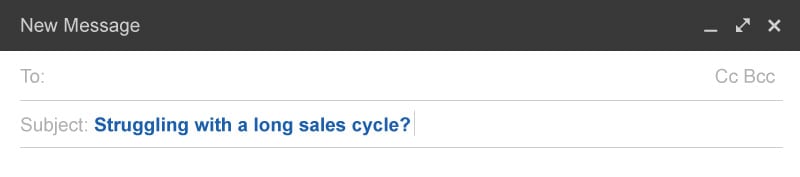
"Struggling with connect rates?" (pain-point question)
"3 ideas for [Company]" (numbers + specificity)
"Your Q3, one thought" (short, prospect-centric)
"Saw Salesforce on your website" (tech stack trigger)
"What [Similar Company] did differently" (peer-company social proof)
For follow-up after no reply
Follow-up subject lines should acknowledge the prior contact without passive aggression. Avoid "Per my last email" and "Did I misunderstand?" (see the "Cold email subject lines to avoid" section below). The goal is to add something new, not to guilt the prospect into responding.
"One more thought on [topic]"
"Anything change on your end?"
"New angle on [Company]'s challenge"
"Still relevant? Quick check-in"
"Forgot to mention this"
"Worth a 10-minute call?"
For re-engagement of cold accounts
Re-engagement works best when it's tied to a trigger event. A new funding round, leadership change, or product launch gives you a genuine reason to reach back out without it feeling like a cold restart.
"Congrats on the Series B, quick thought"
"Saw [Company] just launched [product]"
"New VP Sales at [Company], right time to reconnect?"
"Things look different at [Company], worth a chat?"
"One thing changed since we last spoke"
"[Company] is on our radar again, here's why"
For networking and career outreach
Career cold email subject lines follow the same core principles as B2B sales subject lines: be specific, be honest, and make it about the recipient. The tone shifts slightly, less urgency, more genuine curiosity. Avoid generic subject lines like "Exploring opportunities" or "Informational interview request." They signal low research effort and get deprioritized.
"Loved your talk on [topic] at [event]"
"[Name] suggested I reach out"
"Marketing background that could help [Company]'s growth"
"Quick question about your path to [role]"
"Saw your post on [topic], resonated"
Fix your subject line: weak to strong rewrites
The fastest way to improve your subject lines is to diagnose what's failing. The best cold email subject lines aren't always the cleverest ones, they're the ones that fixed a specific problem. Here are six common failure patterns and the rewrites that address them.
Weak | Strong |
|---|---|
"Following up" | "Quick question about [Company]'s Q3 pipeline" |
"Checking in" | "Saw [Company] just hired a new VP Sales" |
"I'd love to connect!" | "Idea for [Company]'s outbound motion" |
"FREE DEMO, Limited Time!!!" | "How [Competitor] customers are switching to [Category]" |
"RE: Our conversation" | "[Mutual connection] suggested I reach out" |
"Just wanted to touch base" | "Your annual goal, are you on track?" |
Failure modes, labeled:
"Following up": vague, no value signal
"Checking in": no trigger event, no reason to open
"I'd love to connect!": seller-centric, not prospect-centric
"FREE DEMO, Limited Time!!!": spam triggers plus false urgency
"RE: Our conversation": misleading if no prior conversation exists
"Just wanted to touch base": no specificity, no hook
Once you've fixed the weak patterns, the next question is how far you can push personalization without it becoming a manual research burden for every send.
How to personalize cold email subject lines at scale
First-name personalization is table stakes. Prospects have seen "[First Name], quick question" enough times to tune it out. Real personalization operates at three levels, each with a different research investment and a different response rate ceiling.
Tier 1: Name and company
The baseline. You're inserting the prospect's name and company into a template. It scales easily and performs better than no personalization, but it's the floor, not the ceiling.
Example: "Idea for Acme Corp's pipeline"
Research effort: none beyond what your CRM already has
Tier 2: Role-specific pain point
You're referencing a challenge that's specific to the prospect's function or seniority level. This requires knowing your buyer personas well enough to write templates by role, but those templates scale across your full territory.
Example: "VP Sales challenge: connecting with the right buyers"
Research effort: one-time persona research, then templatized
Tier 3: Trigger event
The highest effort and highest response rate. You're referencing something that just happened at the prospect's company: a new hire, a funding round, a product launch, a competitor switch. The subject line feels personal because it is.
Example: "Congrats on the Series B, one idea for your new sales motion"
Research effort: per-account signal monitoring
The challenge with Tier 3 is scale. Manually researching trigger events for 300 accounts isn't realistic for a single rep. ZoomInfo's intent data and buyer signals surface those trigger events automatically, so reps can write Tier 3 subject lines without spending 20 minutes on LinkedIn before every send.
Cold email subject lines to avoid
The personalization ladder gives you a ceiling to aim for. What follows is the floor to stay above.
Practitioners learn faster from failure patterns than from prescriptive advice. Some subject lines are so cringey they do actually get opened... and passed around the office for a chuckle, or worse, posted on LinkedIn. Not the kind of response you're looking for.
"Do not open this email." Thou dost protest too much. We see right through you, the desperate sender.
"Reminder": Your prospect is already suffering anxiety from the real, actual "reminder" emails from their boss. Are you trying to give them hives?
"Friendly reminder": Even worse. Are we friends now?
LOTS OF PUNCTUATION MARKS!!!!??? Especially when combined with ALL CAPS. Save the drama for your mama. Email panic attacks belong in the trash.
WeIRd CApiTaLiZAtioN: Delete. Rinse. Repeat.
"RE: Alligators" (or hippos, falling rocks, etc.): This worked for a hot minute in 2011.
"Thanks in advance." Are you daring us to NOT do whatever it is you want? And speaking of passive aggression...
"Did I misunderstand?" No you didn't, Mr. Snarky-pants.
"Per my last email." Good thing you're the only person who ever emails us, so we remember each of them.
"Any updates on this?" Um, do we owe you an update?
Of course, this list would not be complete without a nod to SalesFolk's delightfully cringey email Hall of Shame.
How ZoomInfo helps your subject lines actually reach the inbox
The best subject line you've ever written still fails if the email bounces or lands in the wrong inbox. ZoomInfo is an all-in-one AI GTM Platform built on three capabilities that address exactly that problem.
The foundation is data. ZoomInfo's 200M+ verified business emails and 120M+ direct-dial phone numbers mean your outreach lands in front of verified contacts, not the stale addresses that inflate bounce rates and erode the domain reputation you've spent months building. When your list is built on verified contacts, the subject line gets a fair shot.
The intelligence layer is the GTM Context Graph, which processes 1.5B+ data points daily to surface which accounts are showing buying signals right now. That changes how you write subject lines. Instead of crafting a generic opener for 300 accounts, you're writing Tier 3 subject lines for the accounts that are already in-market, referencing the trigger event that made them worth contacting today. The GTM Context Graph reasons across ZoomInfo's B2B data, your CRM records, and behavioral signals to surface that context without manual research.
The third capability is universal access. Sellers access all of it inside GTM Workspace without toggling between a data tool, a CRM, a sequencing platform, and LinkedIn. The context is already there when you sit down to write.
Request a demo to see how ZoomInfo puts verified data and buying signals behind every send.
Frequently asked questions
What's a good open rate for B2B cold emails?
Personalized B2B cold email subject lines achieve 20-25% open rates on average, while non-personalized campaigns drop to 1-5% (Mailchimp benchmark). Reply rate is a more meaningful metric than open rate. A 1-3% reply rate on a well-targeted list is a strong result. The subject line's job is to earn the open; the email body's job is to earn the reply.
How long should a B2B cold email subject line be?
Keep subject lines under 50 characters for safe cross-device display. Desktop email clients show approximately 60 characters; mobile preview windows show approximately 30 characters. A subject line that reads well on desktop may be truncated on mobile, cutting off the most important word. The practical rule: write the subject line, count the characters, and trim anything after the 40-50 character mark. Seven words is a commonly cited ideal length.
What words should I avoid in B2B cold email subject lines to stay out of spam?
Avoid words and patterns that trigger spam filters: FREE, GUARANTEED, 100% satisfied, excessive punctuation (!!!???), ALL CAPS, dollar signs in subject lines, and urgency phrases like "Act now" or "Limited time offer." These patterns are associated with mass commercial email and will route your message to the junk folder before a human ever sees your subject line. Also avoid misleading subject lines that don't match the email body. Over time, recipients mark those emails as spam, which damages sender reputation at the domain level.
What is the 30/30/50 rule for cold emails?
The 30/30/50 rule is a framework for allocating effort in cold email writing: 30% of your email's success comes from the subject line (determines whether it gets opened), 30% from the opening line (determines whether the reader keeps reading), and 50% from the offer or CTA (determines whether the reader takes action). The implication: most salespeople over-invest in subject line creativity and under-invest in the clarity of their ask. A mediocre subject line with a compelling offer outperforms a clever subject line with a vague CTA.
How do I write cold email subject lines for job outreach?
The same mechanics that make B2B sales subject lines work apply here, with one adjustment: the urgency dial turns down and the curiosity dial turns up. Reference something specific about the person's work or background rather than leading with what you want. A subject line like "Loved your talk on [topic] at [event]" or "Saw your post on [topic], resonated" opens the door without putting the recipient on the defensive. Mutual connections are gold: "[Name] suggested I reach out" consistently outperforms cold openers. Skip "Exploring opportunities" and "Informational interview request" entirely, they signal you didn't do your homework.
What are the best B2B cold email subject lines for SDRs in 2025?
The best cold email subject lines b2b SDRs are using in 2025 share three traits: specific to the prospect's situation, short enough to read in full on mobile (under 50 characters), and free of false urgency. Top-performing patterns include trigger-event references ("Saw [Company] just raised a Series B"), pain-point questions ("Struggling with [specific challenge]?"), and peer-company social proof ("How [Similar Company] solved [problem]"). Gimmicks and clickbait patterns that worked in 2018-2020 have been overused to the point of generating negative responses. Authenticity and specificity are the current differentiators. For the best cold email subject lines overall, the through-line is the same: make it about the prospect, not about you.