
Choosing between Bloomerang and Salesforce for your nonprofit often comes down to five questions:
Is your organization small enough that simplicity matters more than customization?
Do you have technical staff to administer a complex platform?
Is donor retention your primary challenge, or do you need a CRM that handles fundraising, service, marketing, and operations across departments?
Does your nonprofit pursue corporate partnerships and need to identify decision-makers at target companies?
How much can you budget for software, implementation, and ongoing administration, including consultant fees?
In short, here's what we recommend:
Bloomerang is built for small and mid-sized nonprofits that want to raise more money and keep more donors without hiring a database administrator. Its Giving Platform combines donor CRM, online fundraising, and volunteer management in one system, with an interface staff can learn in hours.
Bloomerang centers on donor retention: top customers achieve a 64% donor retention rate compared to the roughly 43% industry average. Its AI assistant Penny flags at-risk donors and drafts outreach so small teams can act before supporters lapse.
However, Bloomerang's email builder and donation form customization lag behind competitors, and organizations raising $10M+ with complex planned giving needs will hit a feature ceiling.
Salesforce is the enterprise platform that can do almost anything, if you're willing to invest in making it work. The #1 CRM by market share, Salesforce offers 17 industry-specific clouds (including nonprofit solutions), 9,000+ apps on AppExchange, and customization through its low-code platform.
For large nonprofits with complex programs, multi-entity structures, and IT staff, Salesforce provides flexibility Bloomerang cannot match. The trade-off: implementations typically take 3 to 12 months, most deployments require partner involvement, and total costs are hard to predict before you start.
Both platforms excel at managing the supporters you already have. But growing your donor base through corporate partnerships, foundation grants, and identifying business leaders as major gift prospects requires intelligence about the business world that neither CRM provides on its own.
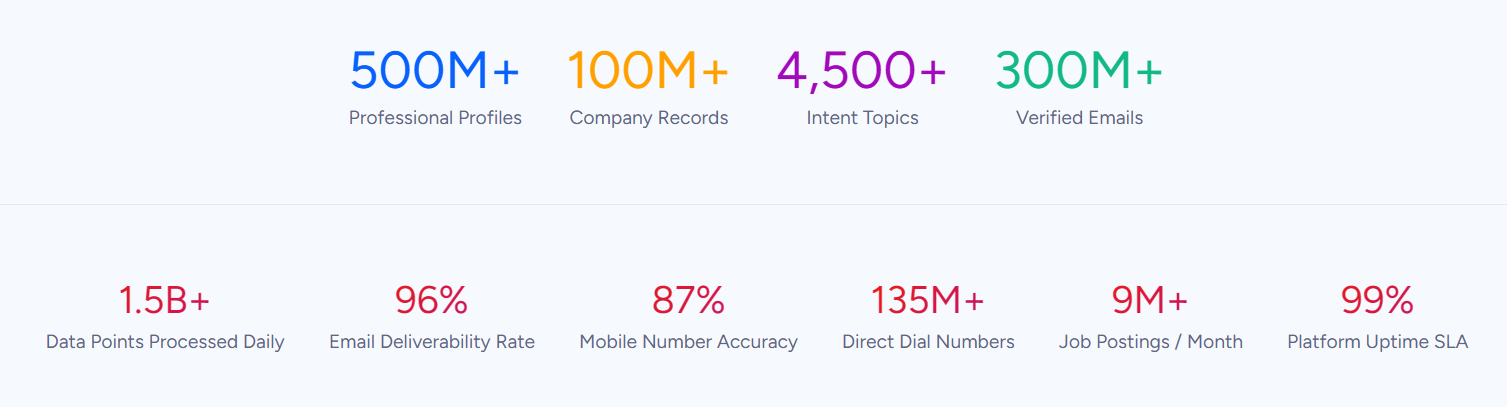
ZoomInfo is a B2B intelligence platform built on a large-scale dataset: 500M contacts, 100M companies, 135M+ verified phone numbers, and 200M+ verified business email addresses. Its GTM Context Graph, an intelligence layer processing 1.5B+ data points daily, combines this data with your first-party records to surface actionable context.
For nonprofits pursuing corporate sponsors, identifying potential major donors among business leaders, or researching foundations and their officers, ZoomInfo provides verified contact data and company intelligence that fundraising CRMs were never designed to offer.
With a native Salesforce integration and API access for connecting to any system, ZoomInfo serves as the data intelligence layer that makes either CRM more effective at expanding your supporter base beyond individual donors.
If your nonprofit needs to tap into corporate partnerships, see how ZoomInfo's data can power your outreach with a free trial.
Bloomerang vs. Salesforce at a glance
Bloomerang | Salesforce | ZoomInfo | |
|---|---|---|---|
Built for | Small to mid-sized nonprofits | Organizations of any size and industry | B2B intelligence for corporate outreach |
Core strength | Donor retention and unified giving | Enterprise customization and ecosystem | Verified B2B contact and company data |
Starting price | |||
Learning curve | Hours to days | Weeks to months | Moderate |
Implementation | Onboarding team included | Typically partner-led, 3-12 months | |
Users included | Per-user pricing | Per-seat with credits | |
AI capabilities | GTM Context Graph intelligence | ||
Nonprofit-specific | Yes, exclusively | Via industry cloud and AppExchange | B2B data applicable to corporate outreach |
Support | Help Center, University, Labs |
A platform built for nonprofits vs. a platform built for everyone
This is the fundamental difference between Bloomerang and Salesforce, and it shapes everything else.
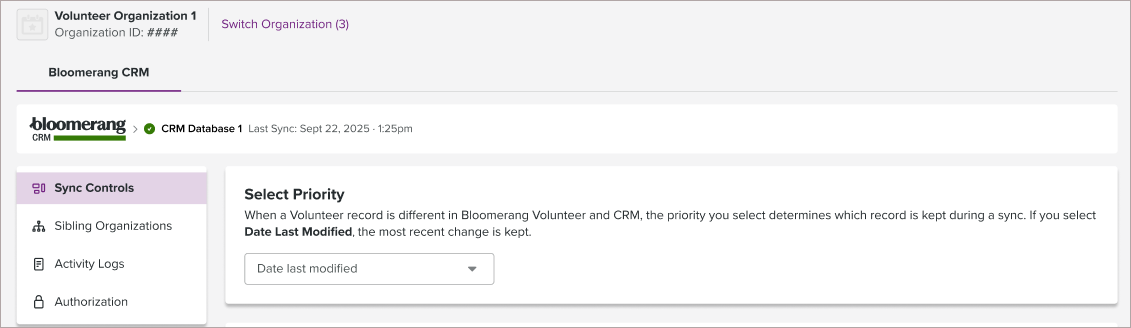
Bloomerang does one thing: help nonprofits raise money and retain donors.
Every feature, every design decision, every support conversation is framed around the nonprofit use case. The Giving Platform combines CRM, fundraising, and volunteer management because those are the three things most small nonprofits need.
Source: Bloomerang
Staff log in and see a donor retention dashboard, not a generic sales pipeline. Engagement scoring tells a development director which donors are cooling off, not which leads are sales-ready.
Salesforce takes the opposite approach.
It's a platform that can become almost anything, for any industry. Nonprofits access Salesforce through the Nonprofit Success Pack (NPSP) or Salesforce's newer nonprofit solutions, layered on top of the core platform.
This means Salesforce can handle multi-entity structures, complex grant accounting, planned giving, and sophisticated reporting that Bloomerang cannot. It also means that out of the box, Salesforce doesn't know what a "donor" is. Someone has to teach it.
That teaching happens during implementation. Salesforce implementations require partners for over 70% of deployments, with costs that can run 100-150% of annual license fees. For a small nonprofit without IT staff, this barrier is real. For a large nonprofit with complex needs and the resources to match, it's an investment that pays off in flexibility.
Ease of use separates the two platforms by design
Bloomerang's G2 scores tell the story: 9.2 for Ease of Use, 9.2 for Ease of Admin, 8.7 for Ease of Setup, and 9.5 for Quality of Support.
The platform earned G2's Highest User Adoption badge (Mid-Market, Winter 2025), meaning teams actually use the system rather than abandoning it after launch. Reviewers on Capterra (4.7/5 from 1,287 reviews) describe staff learning the basics in hours, often without formal training.
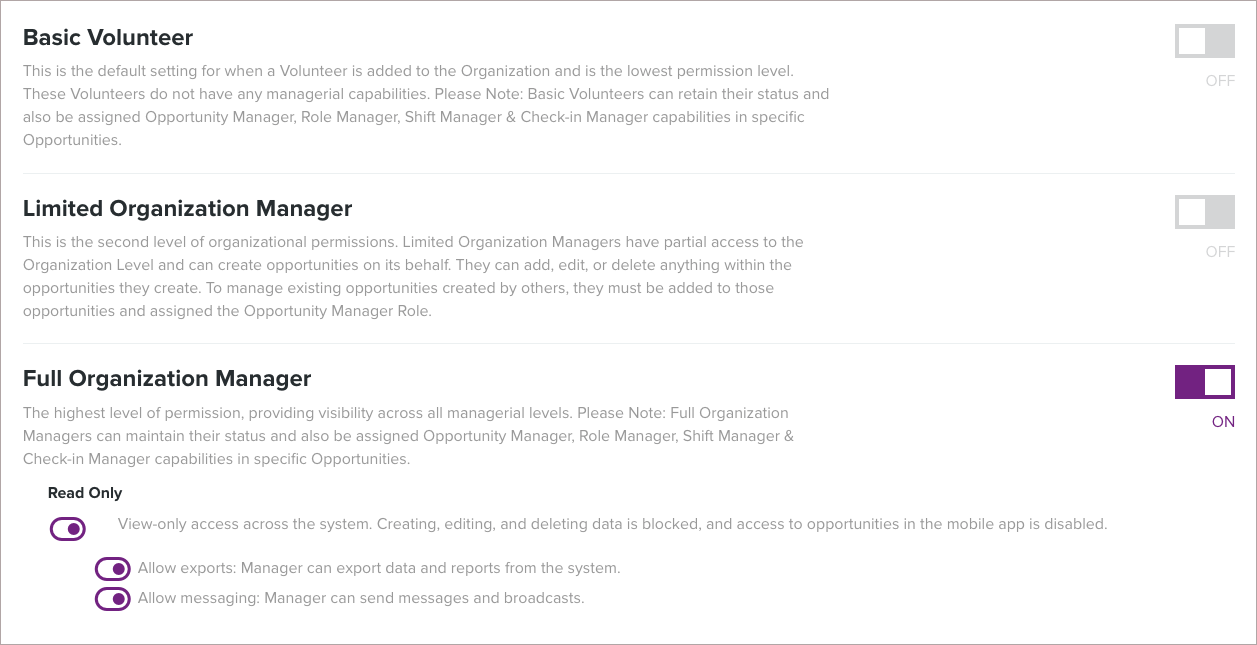
The three-product structure helps. Bloomerang Fundraising, CRM, and Volunteer each have a focused interface rather than one overwhelming dashboard. Tiered permissions (Basic User, Limited Organization Manager, Full Organization Manager) let nonprofits give staff only the access they need without risk of accidental changes.
Source: Bloomerang
Salesforce is a different experience. The platform is capable but dense.
The Lightning Experience interface improved on its predecessor, but meaningful configuration still requires trained administrators. Trailhead provides 1,500+ learning badges and serves 6+ million learners, which is simultaneously impressive and revealing: you need a free learning platform with 1,500 badges because the product requires that much learning.
For a nonprofit executive director wearing multiple hats, the difference is stark. Bloomerang is the tool she can use between donor meetings. Salesforce is the platform she hires someone to manage.
Donor retention and fundraising: Bloomerang's home turf
Bloomerang was founded in 2012 around a single idea: nonprofits lose too many donors, and their CRMs aren't helping.
Co-founder Jay Love had been CEO of eTapestry and SVP at Blackbaud, and he built the original product around a "Donor Retention Wheel" that surfaced retention rates on the login dashboard. No major CRM at the time treated retention as a primary metric.
That founding instinct now runs through every layer of the product:
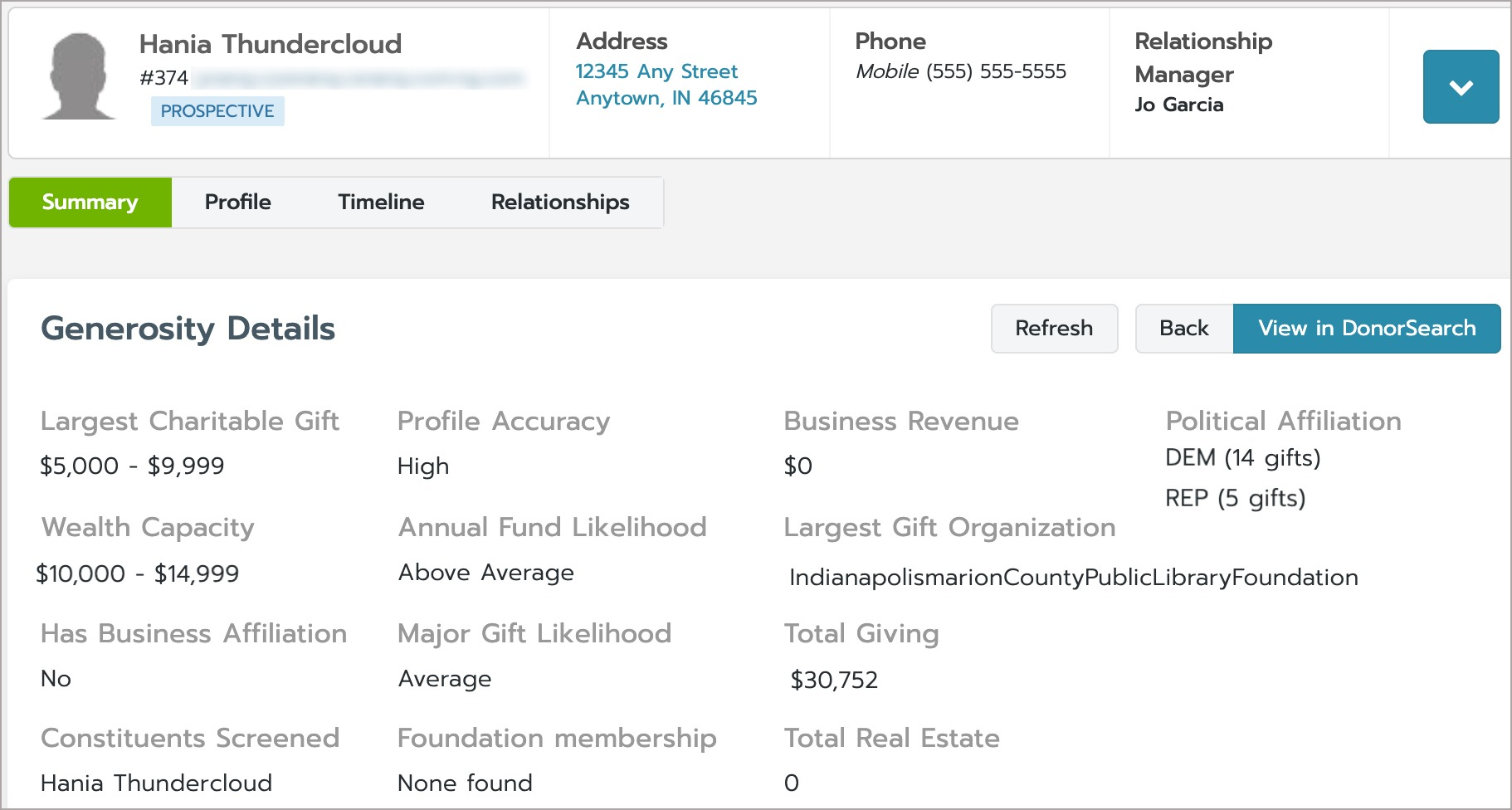
Engagement Level scoring assigns each constituent a color-coded status (On Fire, Hot, Warm, Cool, or Cold) based on interactions and transactions
Source: Bloomerang
Journey Automation triggers donor engagement workflows based on lifecycle events (first gift, recurring gift, birthday, donor anniversary, or lapse risk)
Penny AI flags at-risk donors, drafts outreach, and prepares meeting briefings for major gift conversations
Conversational reporting lets any staff member type a plain-language question and get a report instantly
On the fundraising side, Bloomerang's platform (built on its 2024 Qgiv acquisition) covers donation forms with AI-powered Smart Amounts, event management with drag-and-drop seating charts and QR-code check-in, text fundraising with reported 58% gift completion rates, peer-to-peer campaigns with team leaderboards and fundraising commitments, and auctions supporting virtual, live, and hybrid formats.
Salesforce can match or exceed many of these capabilities, but nothing comes pre-configured for nonprofits.
Peer-to-peer fundraising, event ticketing, and text-to-give require AppExchange solutions or custom development. Donor retention scoring requires building custom reports or installing third-party packages.
The flexibility is there (Salesforce can model almost any fundraising workflow), but the nonprofit fundraising intelligence Bloomerang bakes into the product must be created in Salesforce, often at additional cost.
Where Salesforce pulls ahead is at scale. Organizations running complex major gift programs, planned giving, multi-entity accounting, or grant portfolios with funder-specific reporting requirements will find Bloomerang's feature ceiling. Salesforce's customization means there is no theoretical limit to what you can build. The question is whether you have the resources to build it.
The corporate intelligence gap both platforms leave open
Both Bloomerang and Salesforce help you manage relationships with supporters who already know you. But what about the ones who don't?
For nonprofits that pursue corporate sponsorships, foundation grants, or major gifts from business leaders, the CRM holds only half the picture.
You can track your interactions with a corporate contact once they're in the system, but neither platform answers the harder questions: Which companies in your region have the giving capacity and the mission alignment to become sponsors? Who runs their corporate social responsibility program? What's the right way to reach them?
Bloomerang integrates with DonorSearch for wealth screening, which identifies philanthropic capacity based on public records of past giving, real estate, and stock holdings.
This works well for individual donor research. But it doesn't cover the business intelligence side: company financials, corporate hierarchies, department org charts, or verified business contact information for the people who make partnership and sponsorship decisions.
ZoomInfo fills this gap.
Its B2B dataset spans 500M contacts and 100M companies with 300+ searchable company attributes, reaching up to 95% accuracy on first-party data through a verification pipeline backed by 300+ human researchers.
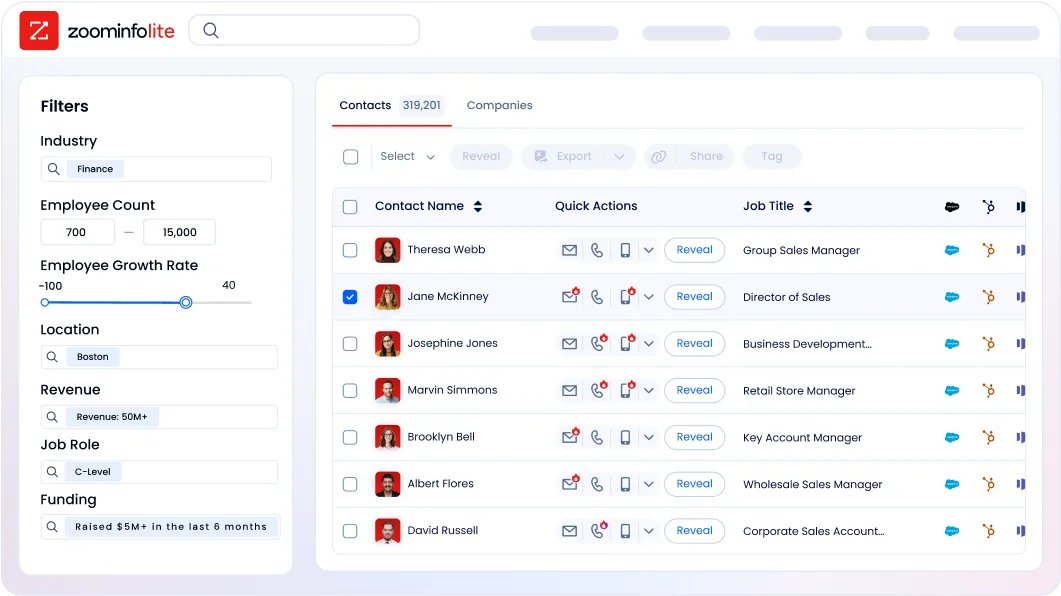
For a nonprofit development team, this translates directly: search by industry, company size, location, and job title to find corporate giving officers, CSR directors, and executives at companies aligned with your mission.
Access org charts to identify the right decision-maker instead of guessing. Get verified direct-dial phone numbers and business emails so your outreach reaches a person, not a general info@ inbox.
For nonprofits using Salesforce, ZoomInfo's native integration enriches contact and account records directly in the CRM, appending company intelligence, verified contact details, and organizational data without manual research.
For a closer look at how the two platforms compare, see our Salesforce vs. ZoomInfo comparison.
"ZoomInfo gives us the information we need to execute. We don't have to go through and spend our time digging. It's already there, so we can be three steps ahead." (Vensure)
Pricing tells you who each platform was designed for
Bloomerang uses constituent-based pricing, meaning costs scale with the number of supporters in your database rather than the number of staff using the system.
All plans include unlimited users. Published starting prices:
Bloomerang CRM: $125/month, billed annually
Bloomerang Fundraising: $40/month (must be purchased with CRM)
Bloomerang Volunteer: $119/month
The Giving Platform bundles (Standard and Pro) require contacting sales for pricing. The standard initial contract is two years, auto-renewing annually after that. There is no free trial or free plan; the entry point is a live demo and a self-guided product tour.
The unlimited-users model matters for nonprofits. A 15-person development team pays the same software cost as a 3-person team, making budget planning straightforward as you grow your staff.
Salesforce pricing is more complex.
The free CRM supports up to 2 users with basic functionality. Paid tiers for Sales Cloud range from $25/user/month (Starter Suite) to $550/user/month (Agentforce 1), all billed per user. Most nonprofits using Salesforce at a functional level need at least the Pro Suite ($100/user/month) or Enterprise ($175/user/month) edition.
But the per-user license is often just the beginning. Marketing Cloud starts at $1,500/org/month. Premier support costs 30% of net license fees. Implementation adds another layer. For a nonprofit with 10 users on Enterprise, the software alone runs $21,000/year before marketing tools, premium support, or implementation costs.
Salesforce does offer discounted nonprofit pricing through its Power of Us program, which provides free licenses for qualifying organizations and changes the equation. But implementation, customization, and ongoing administration costs remain regardless of the licensing discount.
ZoomInfo uses custom-quoted, consumption-based pricing with no published prices.
A permanent free tier, ZoomInfo Lite, provides access to the B2B database with 10 monthly export credits and basic search. A 7-day free trial is also available for the full platform. For nonprofits with occasional corporate outreach needs, Lite may be sufficient; organizations with active corporate partnership programs would benefit from a paid plan.
Integrations and data management
Bloomerang's integration approach is focused rather than sprawling.
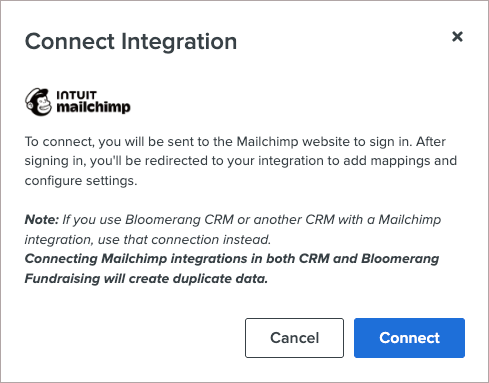
Key integrations include QuickBooks for financial reconciliation, Mailchimp and Constant Contact for email marketing, DonorSearch for prospect research, Zapier for connecting to other apps, and Dataro for predictive donor modeling (available July 2026). The platform provides a REST API licensed to all customers.
Source: Bloomerang
One notable strength is Bloomerang's built-in data hygiene. Nightly NCOA address updates, deceased-record flagging, automatic credit card updater, and duplicate detection are included at no extra cost. For small nonprofits without a data administrator, these automated cleanup processes prevent database decay without manual effort.
Salesforce operates at a different scale.
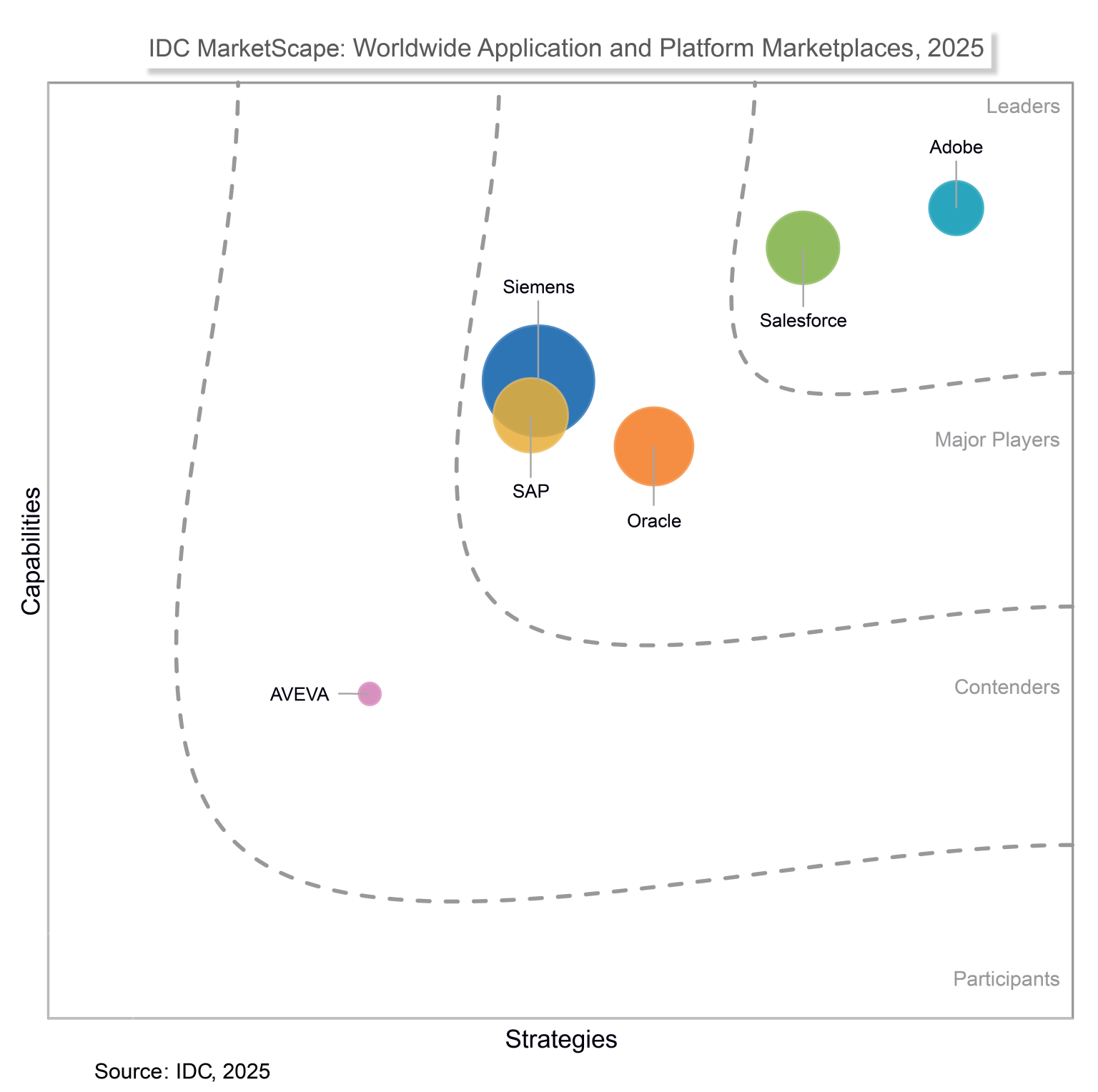
The AppExchange marketplace offers 9,000+ apps with 14+ million installs. For nonprofits, this means dedicated apps, fundraising tools, volunteer management solutions, and grant tracking packages from hundreds of vendors. MuleSoft provides integration with hundreds of pre-built connectors. The API ecosystem covers REST, SOAP, Bulk, Metadata, and Pub/Sub APIs.
Source: Salesforce
The trade-off is complexity. Each integration requires configuration and maintenance. Data management in Salesforce is capable but largely manual: there's no equivalent of Bloomerang's automatic nightly address updates or deceased-record flagging in the base platform.
ZoomInfo connects to both ecosystems differently.
For Salesforce users, ZoomInfo offers a native integration that enriches records directly in the CRM. For any platform, the Enterprise API and MCP server provide programmatic access to ZoomInfo's data, letting nonprofits pull corporate intelligence into whatever system they use. API access is included in all relevant plans.
Source: ZoomInfo
"The plug-and-play aspect of the API means I can integrate it very easily into any process and get information at a moment's notice." (BDO Canada)
Support determines how much value you extract
Bloomerang includes live chat, email, and phone support with every plan, staffed by Bloomerang employees rather than outsourced teams.
Training resources are substantial for a company Bloomerang's size: daily group training sessions, 100+ on-demand courses, guided learning paths, 500+ on-demand webinars, 50+ nonprofit templates, and the annual GiveCon conference. Onboarding includes dedicated specialists, conversion project managers, data migration specialists, and implementation engineers.
Salesforce support is tiered.
The Standard plan (free) provides documentation, the Trailblazer Community, and an AI Help Agent. Premier (30% of net license fees) adds structured onboarding, 1:1 coaching, and a 1-hour response time for business-impacting issues. Signature (custom pricing) provides a dedicated Customer Success Manager and 24/7 support with 15-minute response for critical issues.
The Trailblazer Community of 20 million members with 1,300+ local groups in 90 countries is a genuine asset. 80% of users report it helps extend capabilities and reduce costs. For nonprofits with Salesforce expertise on staff, this community is invaluable. For those without, it's another resource requiring time investment.
The gap is clear: Bloomerang includes human support as a core feature. Salesforce charges for premium support or expects you to invest time in self-service resources. For nonprofits where every hour counts, included support has real economic value.
Bloomerang vs. Salesforce vs. ZoomInfo: Which should you choose?
The right choice depends on your nonprofit's size, resources, and growth strategy.
Choose Bloomerang if:
You're a small to mid-sized nonprofit raising roughly $250K to $10M annually
Donor retention is your most pressing challenge
You need staff to use the system with minimal training
You want fundraising, CRM, and volunteer management in one platform
Your budget can't absorb months of implementation and consultant fees
Choose Salesforce if:
You're a large or complex nonprofit with multi-entity structures, planned giving, or intricate grant reporting
You have IT staff or an admin who can manage the platform
You need customization that a focused nonprofit platform can't provide
You want access to the largest ecosystem of third-party apps and integrations
You're willing to invest in implementation for long-term flexibility
Add ZoomInfo if:
Your nonprofit pursues corporate partnerships, sponsorships, or foundation grants
You need to identify business leaders as potential major gift prospects
You want verified contact data for corporate decision-makers (direct dials and emails that work)
You're using Salesforce and want to enrich your CRM with B2B intelligence
You need company data (org charts, corporate hierarchies, company attributes) for prospect research
Start finding corporate supporters with ZoomInfo's free trial.
For most small nonprofits, Bloomerang is the straightforward choice. It solves the core problem (managing and retaining donors) without requiring technical expertise or large budgets. For large, complex nonprofits, Salesforce provides the depth and flexibility to build exactly what you need, at a proportional investment.
And for nonprofits that want to grow beyond their existing donor base into corporate partnerships and major gifts from the business world, ZoomInfo provides the intelligence layer that neither CRM was designed to offer.
Bloomerang vs. Salesforce vs. ZoomInfo FAQ
Is Bloomerang only for nonprofits?
Yes. Bloomerang is built exclusively for nonprofit organizations. Every feature, from engagement scoring to donation forms to volunteer management, is designed for the nonprofit use case. If you're a for-profit business evaluating CRMs, Bloomerang is not an option; a general-purpose CRM like Salesforce would be the right fit.
Can Salesforce handle nonprofit fundraising out of the box?
Not without configuration. Salesforce is a general-purpose CRM that requires setup through the Nonprofit Success Pack, third-party AppExchange apps, or custom development to handle fundraising workflows, donor management, and nonprofit-specific reporting. Most nonprofits using Salesforce engage implementation partners to configure their fundraising capabilities, which adds cost and time.
How does Bloomerang's pricing compare to Salesforce for a small nonprofit?
Bloomerang's CRM starts at $125/month with unlimited users, meaning a 10-person team pays the same as a 2-person team.
Salesforce charges per user. Enterprise edition at $175/user/month for 10 users would cost $21,000/year in software alone, before implementation, support, or add-on costs. Salesforce does offer discounted nonprofit pricing through its Power of Us program, but implementation and administration costs remain significant regardless.
What does ZoomInfo offer that a nonprofit CRM doesn't?
ZoomInfo provides B2B intelligence: verified business email addresses, direct-dial phone numbers, company attributes, org charts, and corporate hierarchies for 100M+ companies. Neither Bloomerang nor Salesforce includes this kind of business data natively.
For nonprofits pursuing corporate partnerships, foundation grants, or major gifts from business leaders, ZoomInfo provides the contact and company intelligence needed to identify and reach the right people.
Does ZoomInfo integrate with Bloomerang or Salesforce?
ZoomInfo has a native integration with Salesforce that enriches contact and account records directly in the CRM. For Bloomerang, ZoomInfo data can be connected via Zapier or the ZoomInfo API, though there is no direct native integration between the two platforms. ZoomInfo also offers API and MCP access for connecting to virtually any system.
Which platform has better built-in data management?
Bloomerang includes nightly NCOA address updates, deceased-record flagging, automatic credit card updater for recurring gifts, and duplicate detection at no extra cost.
Salesforce offers data management tools but they often require configuration, third-party apps, or additional purchases.
ZoomInfo provides data verification and enrichment for B2B contacts, with up to 95% accuracy on first-party data verified by 300+ human researchers.
How long does implementation take for each platform?
Bloomerang implementation is handled by a dedicated onboarding team and typically takes weeks, with data migration support included.
Salesforce implementations range from weeks for simple setups to 3-12 months for enterprise deployments, with over 70% requiring implementation partners.
ZoomInfo deploys in weeks, and its free tier and free trial provide immediate access.
Can a nonprofit use all three platforms together?
Yes. A common setup uses Bloomerang or Salesforce as the primary CRM for managing donor relationships and fundraising operations, with ZoomInfo added for corporate prospect research and contact intelligence.
For Salesforce users, the native ZoomInfo integration makes this straightforward, as B2B data enriches CRM records automatically without manual data entry.
See how Salesforce compares against other CRMs and platforms:
