
Choosing between CaliberMind and HockeyStack for B2B revenue analytics often comes down to five questions:
Do you need enterprise attribution modeling, or faster results with prebuilt dashboards?
Is Marketing Mix Modeling a priority alongside multi-touch attribution?
Do you want AI that analyzes your data, or AI that analyzes and acts on it?
How complex is your CRM environment? Are you running Salesforce with Custom Objects and years of data debt?
Do you need the analytics layer only, or do you also need B2B data to power prospecting, outreach, and account intelligence?
In short, here's what we recommend:
CaliberMind is built for enterprise marketing teams with messy data. Its Google BigQuery-based architecture handles the CRM environments that break other tools (Salesforce Custom Objects, orphaned leads, inconsistent UTMs) and layers multi-touch attribution, Marketing Mix Modeling, and ABM analytics on top of cleaned, unified data.
CaliberMind is one of the few B2B platforms combining MTA and MMM in a single, continuously updating data warehouse. The trade-off: a steep learning curve, enterprise-only pricing (reportedly starting around $30,000/year), and no self-serve option.
HockeyStack is a faster alternative, built by Y Combinator-backed engineers who approached revenue analytics as a product problem. Its buyer journey stitching connects 20+ GTM tools into one timeline, with 9 attribution models available simultaneously and Blueprints that identify the engagement patterns behind closed-won deals.
HockeyStack's AI Agents go further, moving from analytics into autonomous action (resurrecting closed-lost deals, optimizing budgets, coaching reps). The trade-off: a smaller team (35 employees at Series A), no transparent pricing, and AI Agents still early with limited independent validation.
Both platforms solve attribution and revenue analytics well. But both assume you already have B2B data (contacts, company intelligence, intent signals) flowing into your GTM stack. For teams that need data, intelligence, and execution in one place, there's a third option.
ZoomInfo is an all-in-one AI GTM platform built on a large B2B dataset: 500M contacts, 100M companies, 135M+ verified phone numbers, and 200M+ verified business email addresses. That data feeds the GTM Context Graph, which processes 1.5B + data points daily, combining CRM records, conversation transcripts, and behavioral signals to capture not just what happened in your deals, but why.
Sellers access it through GTM Workspace, marketers and RevOps through GTM Studio, and custom tools or AI agents through APIs and MCP. Where CaliberMind and HockeyStack measure what your marketing produced, ZoomInfo provides the data, intelligence, and execution tools to produce more of it.
If you want a platform that starts with data and extends into intelligence and execution, see how ZoomInfo works.
CaliberMind vs. HockeyStack vs. ZoomInfo at a glance
CaliberMind | HockeyStack | ZoomInfo | |
|---|---|---|---|
Core focus | Marketing measurement & revenue attribution | Revenue data intelligence & AI agents | All-in-one AI GTM platform |
Attribution models | 8+ (including Markov chain, custom weighted) | 9 (single-touch and multi-touch) | Account-level attribution via GTM Studio |
Marketing Mix Modeling | Yes (native, launched April 2026) | No | No (different approach via GTM Context Graph) |
AI assistant | Agent Cal (deterministic, on Google Gemini) | Odin (multi-agent orchestration) | AI agents across GTM Workspace and GTM Studio |
AI execution agents | No (analytics + CRM writeback) | Yes (12 prebuilt + custom builder) | Yes (GTM Workspace + GTM Studio agents) |
B2B contact database | No | No | 500M contacts, 200M+ verified emails, 135M+ verified phones |
Data architecture | Google BigQuery (ELT, customer-owned) | Atlas (proprietary unified timeline) | GTM Context Graph (1.5B+ data points daily) |
CRM integration | Salesforce writeback (Custom Objects) | Salesforce & HubSpot | Salesforce, HubSpot, Microsoft Dynamics |
Pre-built connectors | 170+ (via Fivetran) | 30+ one-click integrations | 120+ marketplace integrations + API/MCP |
Pricing transparency | Custom quotes only (~$30K/year reported) | Custom quotes only | Custom quotes (free tier available) |
Implementation time | 2 weeks setup, longer to full value | ~1 week to dashboards | Weeks, not months |
Best for | Enterprise marketing teams with complex data | Mid-market to enterprise revenue teams | Full GTM teams needing data + intelligence + execution |
Attribution modeling: depth vs. flexibility
CaliberMind and HockeyStack both solve multi-touch attribution, but their approaches reflect different design priorities.
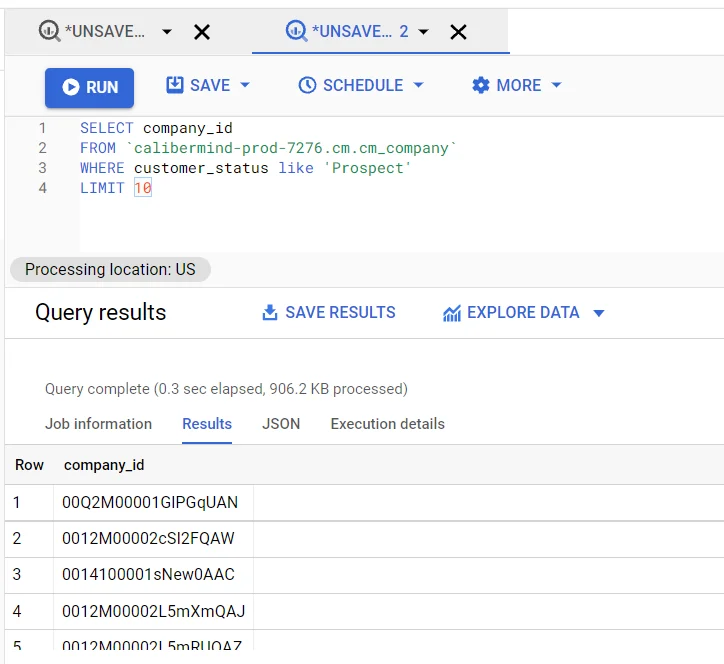
CaliberMind treats attribution as a data engineering problem first. Before any model runs, the platform ingests raw data through its ELT pipeline on Google BigQuery, resolves lead-to-account relationships, deduplicates records, and standardizes fields. Only then does it apply attribution logic.
Source: CaliberMind
Users can toggle between 8+ models (first-touch, last-touch, U-shaped, W-shaped, time-decay, linear, Markov chain, and custom weighted) and compare results without rebuilding reports. The platform tracks online and offline touchpoints, including in-person events, gifts, and sales rep touches, on equal footing with paid ads and email campaigns.
What makes CaliberMind distinct is adding Marketing Mix Modeling alongside MTA in a single platform. MTA captures individual touchpoints, but it's blind to brand-building, dark social, and offline influence. MMM fills that gap with statistical modeling that quantifies the revenue contribution of every channel, including those that leave no trackable click.
Because both run on the same data warehouse, teams avoid the common problem of managing two separate vendors with conflicting data sets.
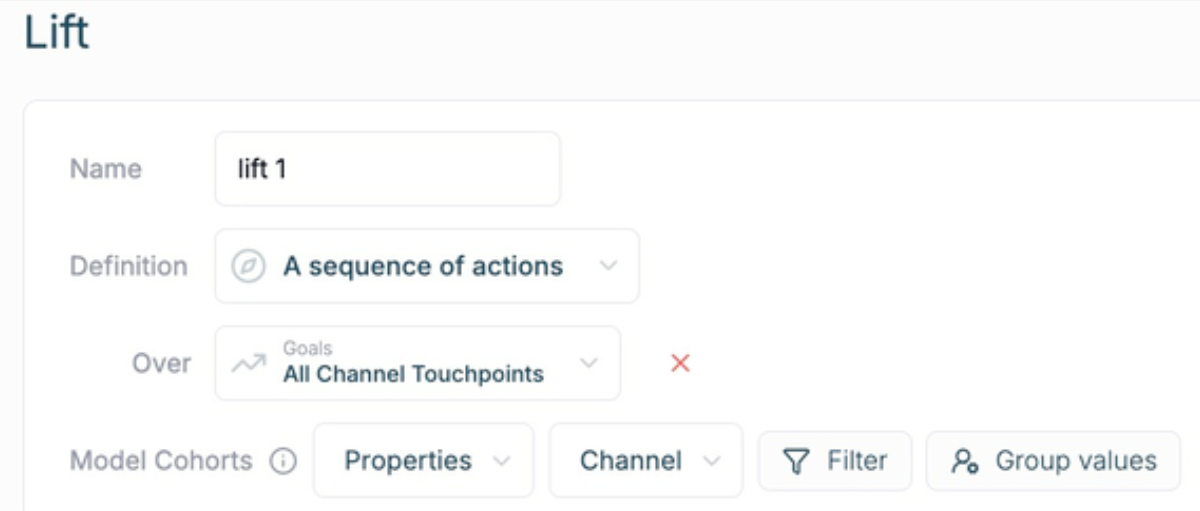
HockeyStack provides 9 attribution models accessible simultaneously from the same data. It goes further with two capabilities CaliberMind lacks. First, Lift Reporting estimates cause-and-effect relationships between marketing activities and outcomes, moving beyond correlation to measure incremental impact.
Source: HockeyStack
Second, Blueprints move past reporting entirely, identifying engagement patterns that consistently appear in closed-won deals, measuring how close each target account is to that pattern, and prescribing next steps to speed deals along.
HockeyStack also offers reverse-funnel analysis, tracing buyer journeys backwards from revenue. Rather than asking "what did this campaign produce?" it asks "what path did our best deals take?" This lens can surface insights that forward-funnel attribution misses.
For a deeper look at HockeyStack's analytics and attribution capabilities, see our HockeyStack review.
Neither platform generates the B2B data that feeds attribution models. Both depend on the quality of data flowing in from your CRM, ad platforms, and marketing automation tools.
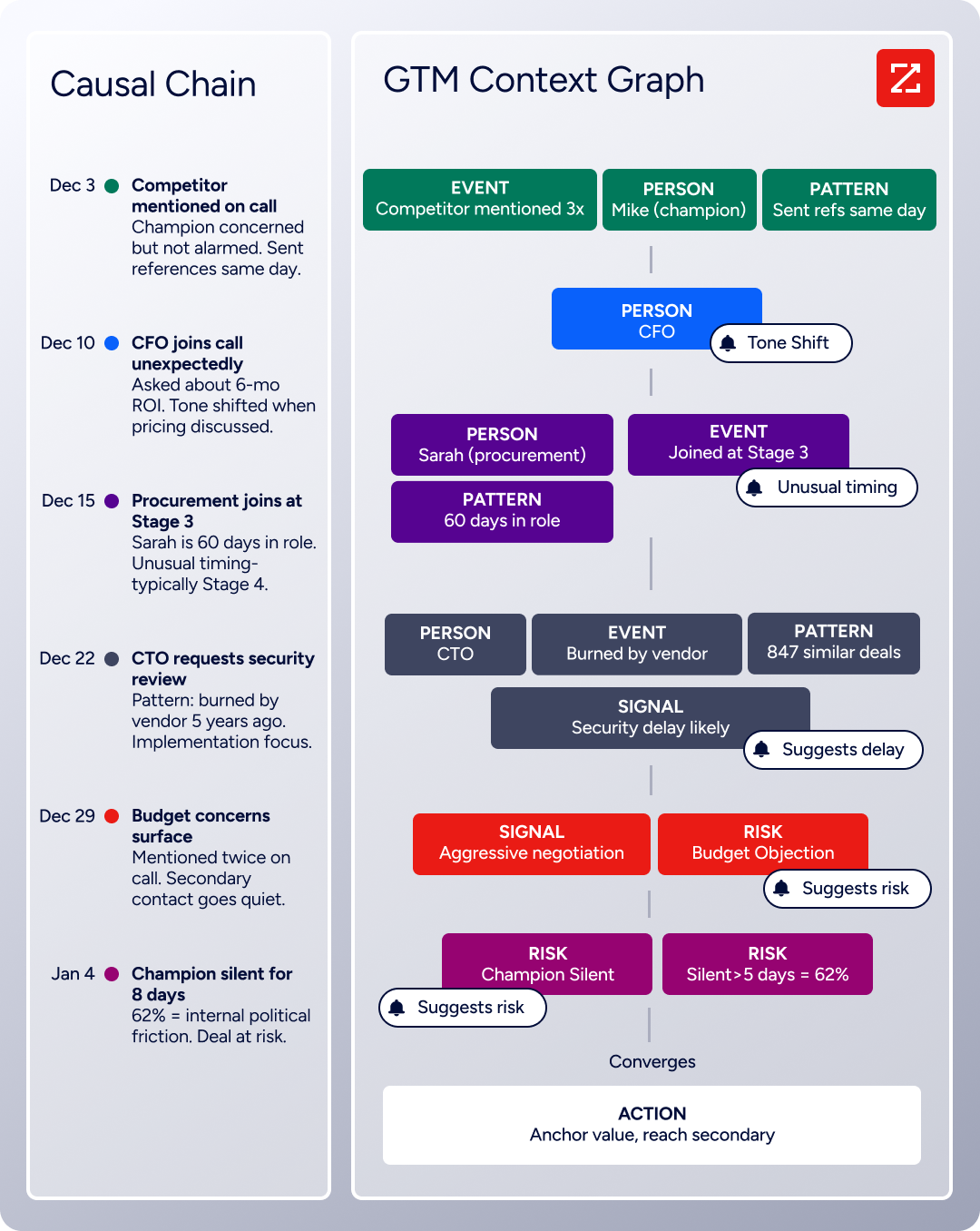
ZoomInfo approaches measurement differently. Rather than building a dedicated attribution engine, ZoomInfo's GTM Context Graph combines its B2B data with customer CRM records, conversation transcripts, and behavioral signals to capture why deals move or stall. GTM Studio includes AI-driven dashboards tracking engagement, funnel progression, and top-performing segments.
Source: ZoomInfo
The insight isn't just "which campaign generated pipeline." It's "the CFO joined the last call and asked about six-month ROI, matching the pattern behind closed-won deals in your segment, while the company is hiring three new VPs and researching your competitor."
Seismic attributed 39% of active pipeline to opportunities identified or influenced by ZoomInfo signals, boosted sales productivity by 54%, and saved 11.5 hours per week per seller. (Seismic Case Study)
Data architecture determines what's possible
The architectural decisions each platform made early on define their strengths and limitations today.
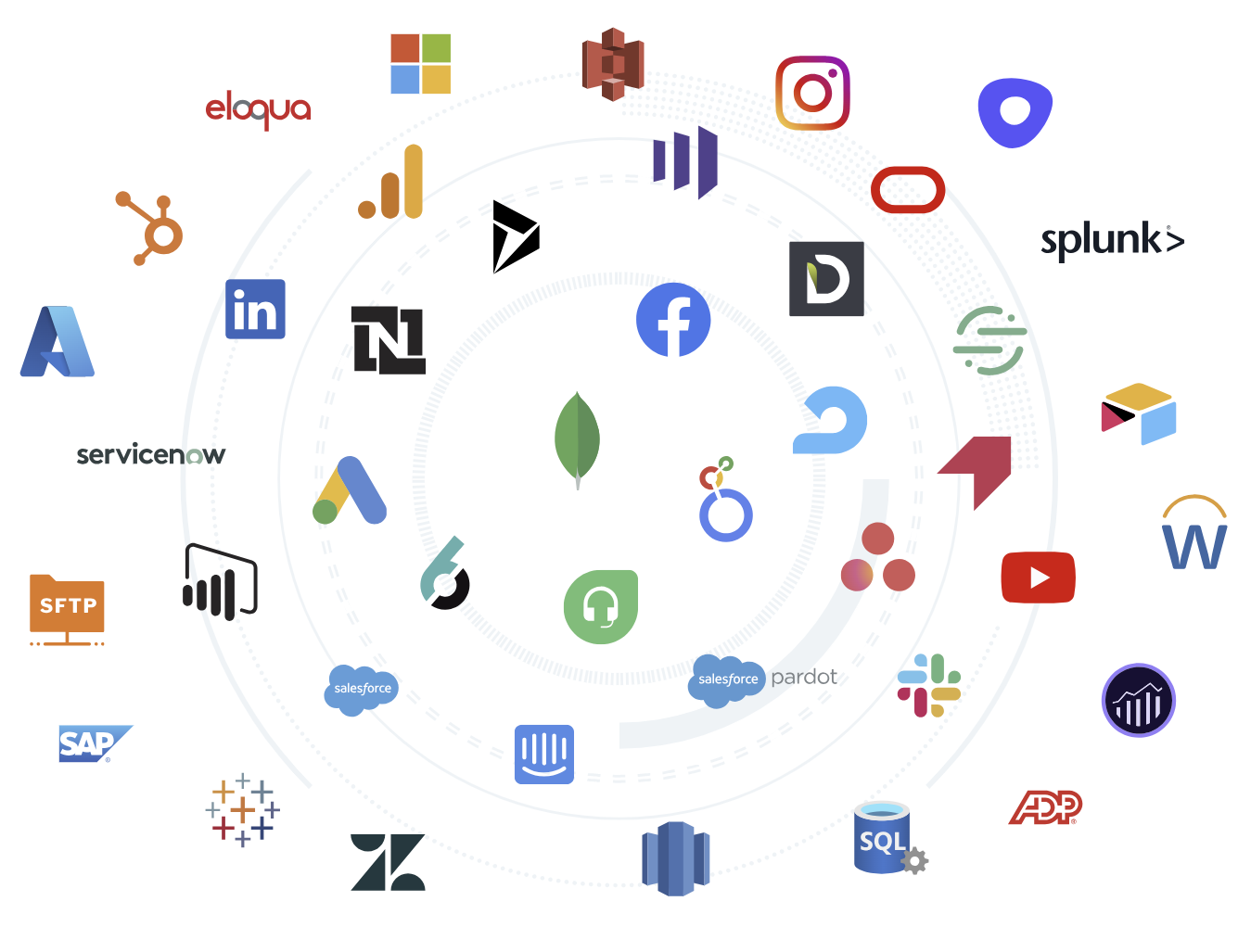
CaliberMind builds on Google BigQuery with a full ELT (Extract, Load, Transform) approach. Raw data loads first, then transforms downstream, so original datasets remain intact and auditable. Everything flows through six core data objects: People, Companies, Events, Channels, Opportunities, and Campaigns.
The platform's 170+ pre-built connectors (powered by a Fivetran partnership) pull data from across the martech stack.
Source: CaliberMind
For enterprises with complex Salesforce environments, CaliberMind's data layer is a real differentiator. It handles Custom Objects natively, performs lead-to-account resolution automatically, and supports SQL-level customization.
Customers retain direct access to their BigQuery environment and can connect BI tools like Tableau directly to the data warehouse.
The transparency is genuine. CaliberMind calls itself "not a black box," and every query, relationship, and metric can be traced to its source. This matters for enterprise buyers who must explain to leadership exactly how every number was produced.
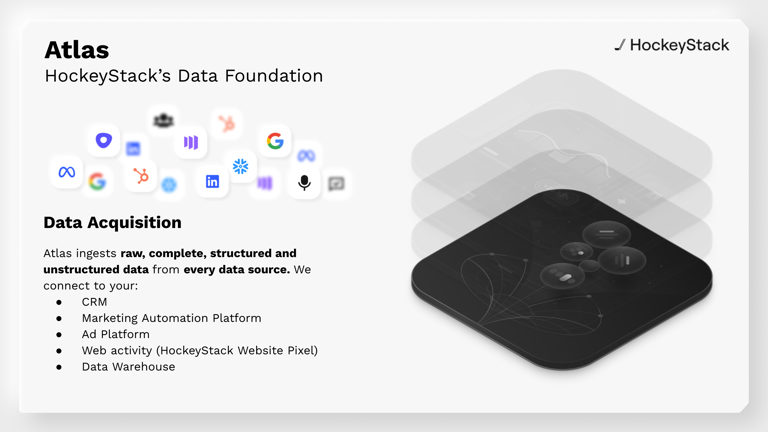
HockeyStack uses Atlas, a proprietary data foundation that handles deduplication and identity resolution across sources. The platform claims to process 400B+ rows per day with sub-second speed.
Source: HockeyStack
HockeyStack connects to CRMs, ad platforms, marketing automation, ABM tools, and data warehouses (BigQuery, Snowflake, Amazon S3, Redshift).
HockeyStack's cookieless tracking uses server-side SHA-256 fingerprinting (no IP addresses or PII stored) to identify visitors without cookies. This gives it a practical edge as privacy regulations tighten and cookie-based tracking degrades.
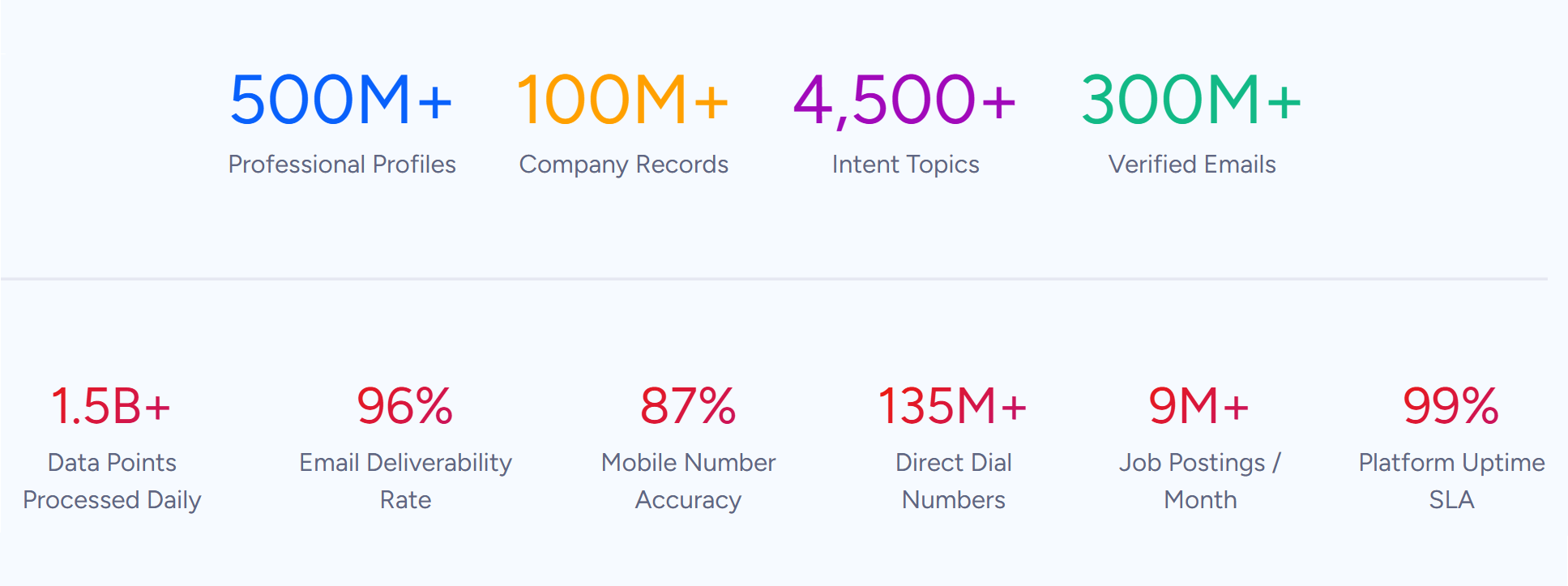
ZoomInfo's data architecture starts from a different position. Where CaliberMind and HockeyStack unify your existing data, ZoomInfo generates new data. The platform covers 500M contacts, 100M companies, 135M+ verified phone numbers, and 200M+ verified business email addresses, verified through a pipeline backed by 300+ human researchers with up to 95% accuracy on first-party data.
Source: ZoomInfo
The GTM Context Graph then unifies this third-party data with a customer's CRM records, conversation intelligence, and behavioral signals, processing 1.5B + data points daily.
This distinction matters practically. CaliberMind and HockeyStack make your existing data more useful. ZoomInfo expands what data you have. In a Fortune 500 competitive RFP analyzing 25 million contacts across vendors, the independent consultant concluded that "no other competitor came even close."
SpringDB used ZoomInfo's enriched data to achieve 2x–3x increases in campaign conversions, a 300% increase in database usability, and 30–50% uplift in average deal size. (SpringDB Case Study)
AI capabilities: analysis vs. execution
All three platforms have invested in AI, but the implementations serve different purposes.
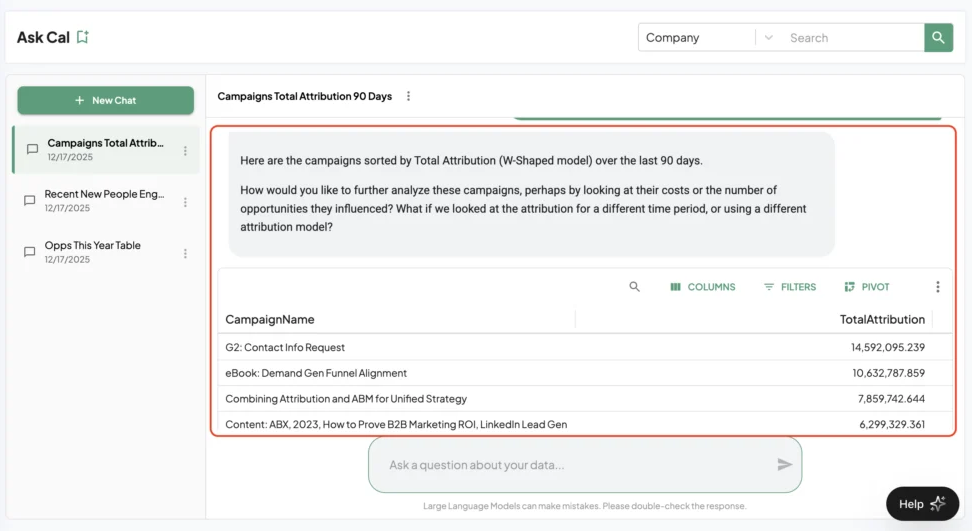
CaliberMind's Agent Cal is a conversational AI assistant built on Google Gemini that queries the unified BigQuery data warehouse in natural language. Its key characteristic is deterministic architecture: rather than predicting answers, Agent Cal translates questions into SQL queries against the cleaned data model. Every answer includes a "View Query" link showing the exact SQL used.
Source: CaliberMind
As CaliberMind's Head of Product puts it: "Most AI today is a 'black box.' You get a number, but you don't know how the machine got there. We built Agent Cal to be the first agentic analytics solution that shows its work."
Agent Cal can also build audience segments, generate dashboard widgets from conversations, and produce AI-powered data enrichment that classifies accounts by purchase driver or generates buyer journey narratives. CaliberMind does not use customer data to train AI models, and each customer operates within a private model instance.
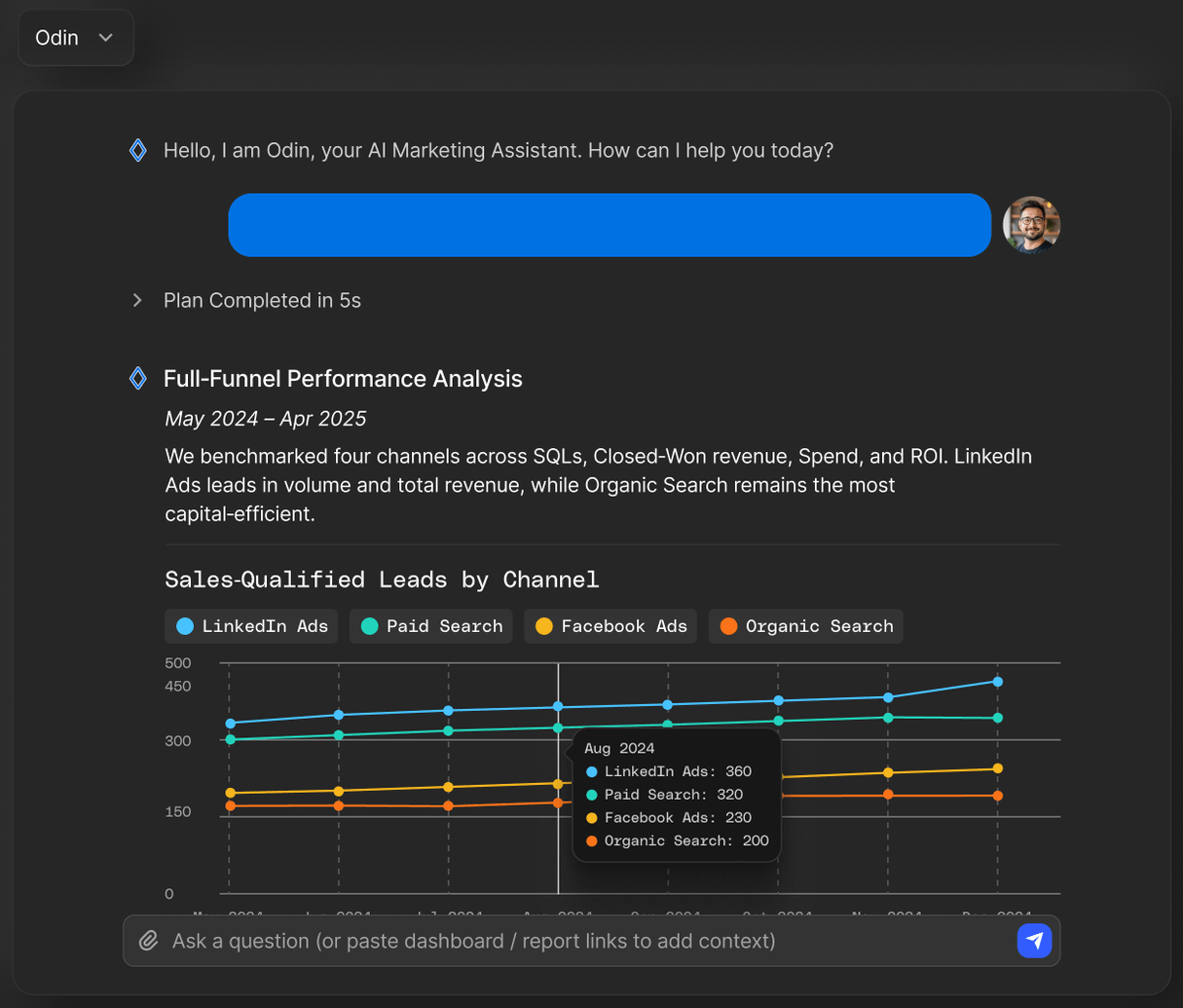
HockeyStack's Odin is also an AI analyst, but uses multi-agent orchestration instead of a single model. When a user asks a question, specialized agents handle different layers (data querying, report building, buyer journey aggregation) with an Evaluation Agent cross-checking every output against original datasets.
Source: HockeyStack
Like Agent Cal, Odin uses deterministic executable code rather than generative prediction for calculations. Odin is also accessible directly via Slack, which helps teams that live in messaging tools.
Where HockeyStack pulls ahead is the AI Agents layer. While CaliberMind's AI stops at analysis and CRM writeback, HockeyStack's 12 prebuilt agents take autonomous action. The Closed Lost Deal Resurrector scans old deals for renewed buying signals. The Marketing Budget Optimizer reallocates spend based on performance data.
The Account Pre-Call Brief generates talking points from CRM history and intent signals. A Custom Agent Builder lets teams create agents for any GTM use case in plain English. These agents run on Nex-LM, HockeyStack's proprietary LLM trained on GTM data.
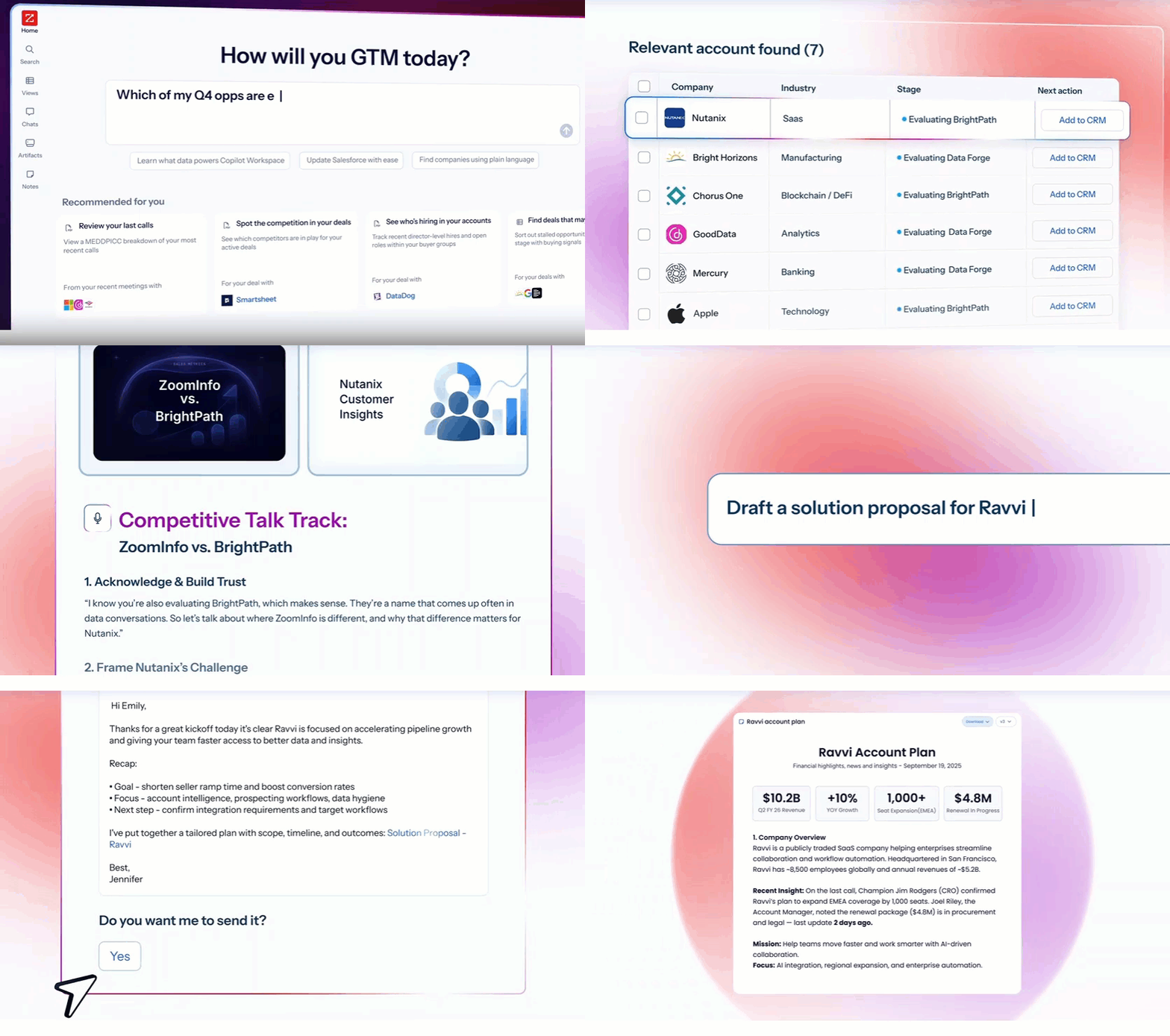
ZoomInfo's AI operates at a different level. The GTM Context Graph reasons across CRM data, conversation intelligence, intent signals, and behavioral data to understand deal context. In GTM Workspace, specialized AI agents handle account research, outreach drafting, CRM updates, and signal monitoring.
Source: ZoomInfo
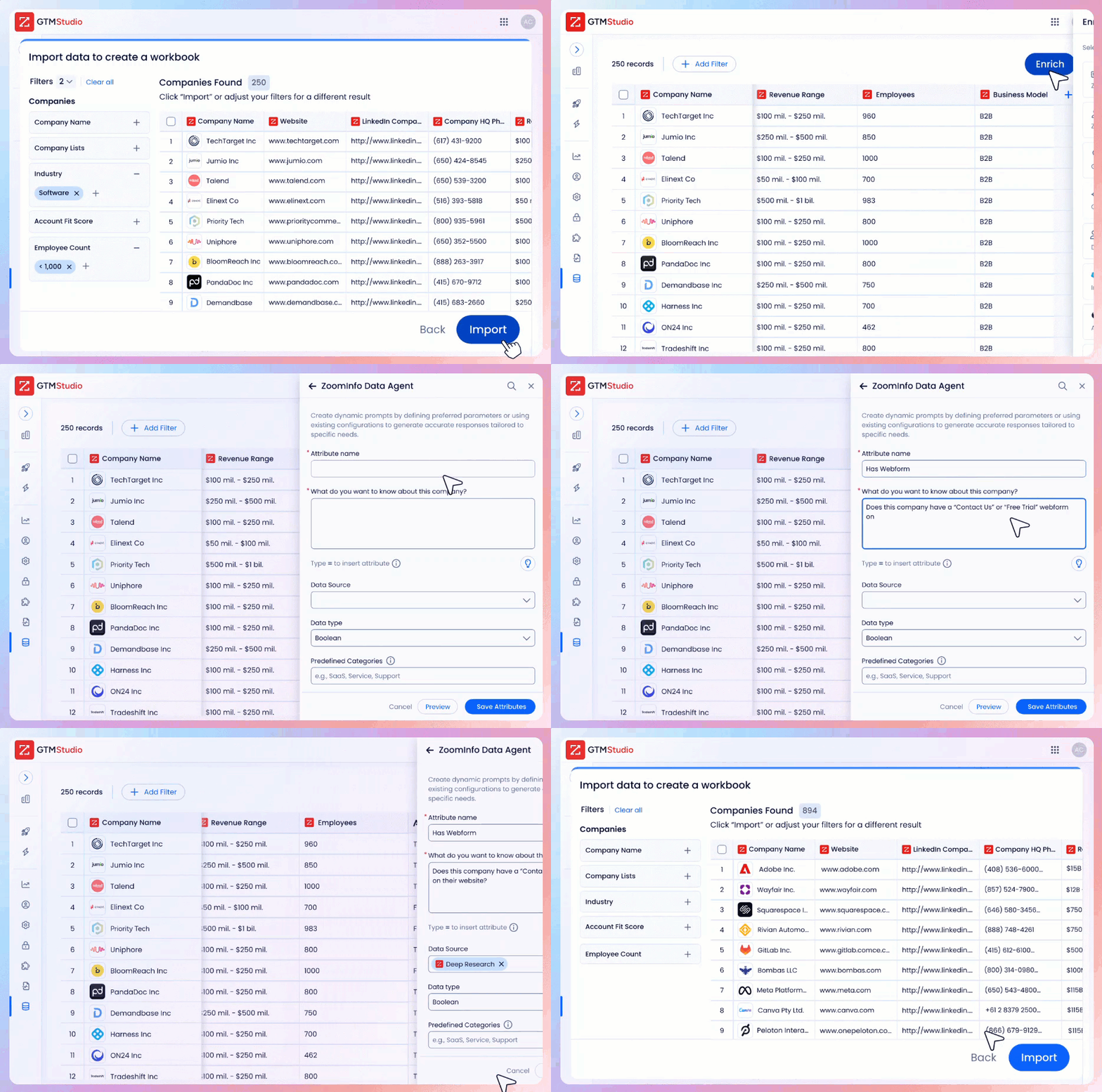
The AI Assistant generates account briefs, pulling CRM history, company news, and stakeholder context into a 10-second summary. In GTM Studio, marketers describe audiences in natural language and launch multi-channel plays targeting accounts that match historical win patterns. Through APIs and MCP, the same intelligence powers any third-party AI agent or custom tool.
Source: ZoomInfo
The difference is scope. CaliberMind's AI answers questions about marketing performance. HockeyStack's AI answers questions and takes action within revenue analytics. ZoomInfo's AI powers the full GTM motion, from identifying who to contact, to understanding why deals move, to drafting outreach that addresses what matters in each conversation.
Spekit found that opportunities at higher-scoring accounts were 43% more likely to turn into qualified pipeline and moved 58% faster through qualification using ZoomInfo's signals. (Spekit Case Study)
Implementation speed and learning curve
How quickly each platform delivers value reflects its design priorities.
HockeyStack is the fastest to implement. Dice had dashboards up within one week. The platform's self-serve onboarding walks through workspace configuration, CRM connection, and funnel setup, with prebuilt dashboard templates that deliver live insights from day one.
Resources like the Template Library, Workflow Library, and Odin Prompt Library shorten the learning curve. For teams tired of months-long analytics implementations, this speed matters.

Source: HockeyStack
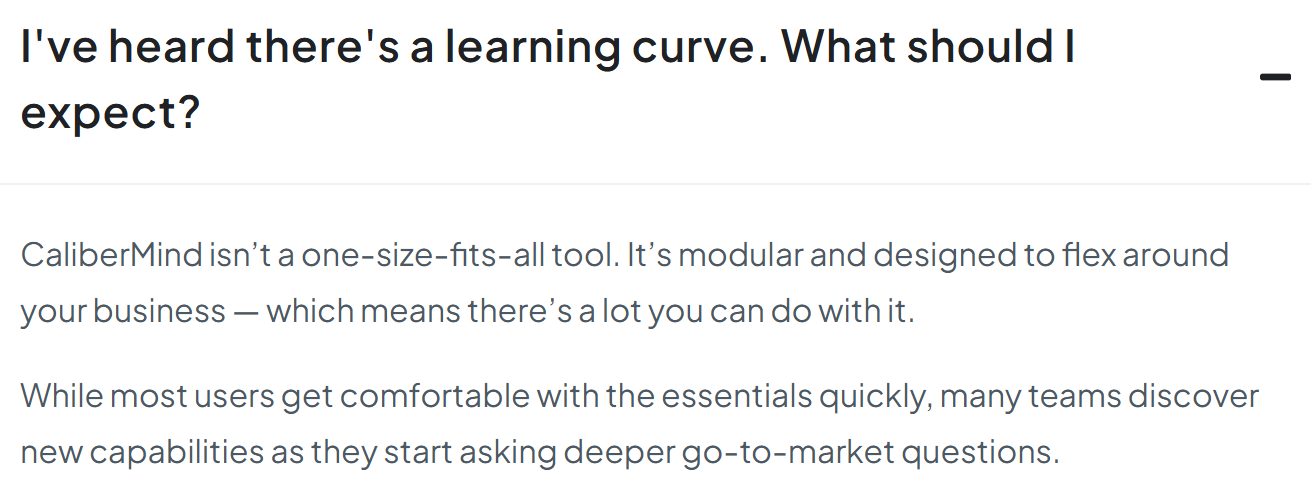
CaliberMind claims a two-week-or-less setup time, but the company acknowledges the learning curve on its own FAQ page: the platform is "modular and designed to flex around your business — which means there's a lot you can do with it." Customization still favors SQL-literate users, and G2 reviewers flag complexity as a common limitation.
Source: CaliberMind
The professional services model (with expert-led implementation, optional model customization, and managed services retainers) helps teams navigate this, but it means CaliberMind's full value often takes longer to realize.
That said, for enterprises with messy data environments, CaliberMind's data transformation process is the product, not a delay. Cleaning and unifying years of CRM debt takes time regardless of which tool you choose. CaliberMind's built-in rules engines for deduplication, standardization, and normalization handle that work within the platform rather than as a prerequisite.
ZoomInfo's implementation varies by product. GTM Workspace "deploys in weeks, not months." The full onboarding program runs 30 to 90 days with a structured approach across planning, technical implementation, education, and adoption.
The redesigned program produced a 25% improvement in customer satisfaction scores. ZoomInfo University provides role-specific learning paths and certifications for ongoing enablement.

Source: ZoomInfo
Pricing: all three require a conversation
None of these platforms publish prices, a common frustration for buyers doing independent research.
CaliberMind uses a custom pricing model based on data volume, not user count. Per their pricing page: "Does CaliberMind charge per user? No." All quotes require a sales conversation. Third-party sources report pricing starting around $30,000 per year.
All plans include multi-touch attribution, account-based engagement, buyer journey insights, Ask Cal AI, unlimited users, and guided implementation. Professional services (support packages, managed services retainers, project-based work) are separately priced annual add-ons.
HockeyStack structures pricing into two plans: GTM Intelligence (reporting, Odin, Blueprints, 2 AI Agents, scoring, and workflows) and GTM Execution (everything in Intelligence plus all agents, custom agent builder, and 250,000 Agent Credits). Both tiers include hands-on support and custom setup. Additional costs include Account Intelligence Credits at $0.08 per credit beyond the 10,000 included annually.
For a full breakdown of what HockeyStack actually costs, see our HockeyStack pricing guide.
ZoomInfo uses consumption-based pricing across three product lines (Sales, Marketing, and standalone products like Chorus and Chat), each with tiered feature access.
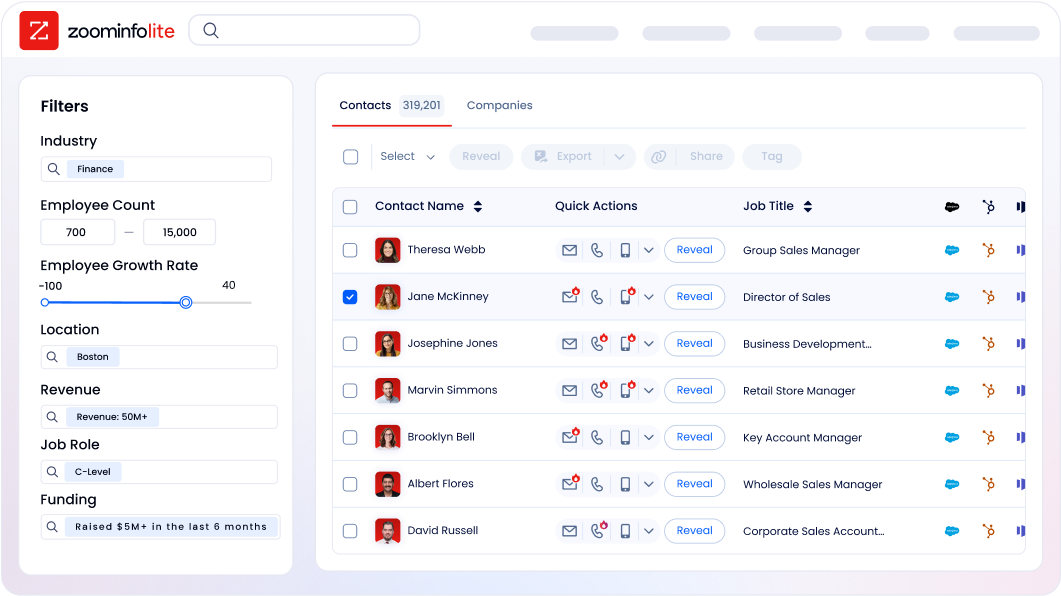
What sets ZoomInfo apart on pricing is its free entry points: ZoomInfo Lite is a permanent free tier with access to the B2B database, 10 monthly export credits, and WebSights Lite, while a 7-day free trial provides broader access. Neither CaliberMind nor HockeyStack offers a free tier or trial.
Source: ZoomInfo
The total cost comparison is more nuanced than sticker price suggests. CaliberMind and HockeyStack measure what your existing data produces, but they don't generate new data. If you're separately paying for B2B contact data, intent signals, conversation intelligence, and sales execution tools, the combined cost of those point solutions plus an analytics platform may exceed a consolidated ZoomInfo investment.
CaliberMind vs. HockeyStack vs. ZoomInfo: Which should you choose?
The right choice depends on which problem you're solving first.
Choose CaliberMind if:
Marketing measurement and attribution are your primary challenge
You have a complex Salesforce environment with Custom Objects, years of data debt, and inconsistent naming conventions
Marketing Mix Modeling alongside multi-touch attribution is a priority
Data transparency and SQL-level auditability matter for leadership reporting
You have the budget and patience for a thorough implementation
You need unlimited users without per-seat pricing
Choose HockeyStack if:
You want fast results with attribution dashboards in days, not months
Prescriptive insights (Blueprints showing what engagement patterns win deals) matter more than statistical modeling
You want AI that goes beyond analysis into autonomous action (deal resurrection, budget optimization, rep coaching)
Your team values a modern, product-first experience over full configurability
You're a mid-market to enterprise B2B company with a mature martech stack that needs unification
Choose ZoomInfo if:
You need B2B data (contacts, company intelligence, intent signals) alongside analytics
Your challenge isn't just measuring what happened, but knowing who to target, when to engage, and what to say
You want a single platform that powers sales prospecting, marketing orchestration, and revenue intelligence
You need the same intelligence available in your CRM, in AI agents, and through APIs
You're building for the full GTM team, not just marketing ops
See ZoomInfo's all-in-one AI GTM platform in action.
CaliberMind and HockeyStack both solve the revenue analytics problem that has frustrated B2B marketing teams for years. CaliberMind does it with depth, offering flexible attribution modeling and data governance for enterprises with complex environments. HockeyStack does it with speed, delivering analytics faster and extending into AI-driven execution.
But both depend on the quality of the data underneath. ZoomInfo starts at that foundation (a large, verified B2B dataset) and builds the intelligence and execution tools on top. For teams that have spent years stitching together point solutions for data, analytics, and outreach, that consolidation changes the math.
Redwood Logistics achieved a 99% reduction in CPC and 310% increase in CTR using ZoomInfo's audience insights. "It's about the right data at the right time to reach out with the right message across the full buyer journey," said Chelsea Kenyon, Senior Director of Digital Strategy. (Redwood Logistics Case Study)
CaliberMind vs. HockeyStack vs. ZoomInfo FAQ
What is the core difference between CaliberMind, HockeyStack, and ZoomInfo?
CaliberMind is an enterprise marketing measurement platform specializing in multi-touch attribution and Marketing Mix Modeling, built on Google BigQuery for data flexibility and transparency. HockeyStack is a revenue data intelligence platform that combines attribution, buyer journey analytics, and AI execution agents to move from insights to autonomous action.
ZoomInfo is an all-in-one AI GTM platform built on a large B2B dataset (500M contacts, 100M companies), with a GTM Context Graph that powers intelligence and execution across sales, marketing, and RevOps.
Which platform offers the most attribution models?
HockeyStack provides 9 attribution models accessible simultaneously, plus Lift Reporting for estimating causal impact. CaliberMind offers 8+ models including Markov chain and custom weighted models, and is unique in combining multi-touch attribution with Marketing Mix Modeling in a single platform.
ZoomInfo approaches measurement through its GTM Context Graph and GTM Studio analytics rather than a standalone attribution engine.
Which platform is best for companies with complex Salesforce environments?
CaliberMind is the strongest choice for organizations with messy CRM data, Salesforce Custom Objects, and complex account hierarchies. Its ELT architecture on Google BigQuery preserves raw data, and its built-in rules engines handle deduplication, lead-to-account matching, and standardization natively.
HockeyStack integrates with Salesforce and supports full sync but does not offer the same Custom Object support. ZoomInfo integrates with Salesforce and offers data enrichment and hygiene through its Operations product and GTM Studio.
Do any of these platforms include B2B contact and company data?
Only ZoomInfo includes a proprietary B2B database with 500M contacts, 100M companies, 135M+ verified phone numbers, and 200M+ verified business email addresses. CaliberMind and HockeyStack are analytics platforms that unify and analyze data from your existing tools but do not generate new contact or company data. CaliberMind does support ZoomInfo WebSights integration for IP enrichment.
How do the AI capabilities compare?
CaliberMind's Agent Cal is a deterministic AI analyst on Google Gemini that translates natural language into SQL queries with full auditability. HockeyStack's Odin uses multi-agent orchestration for analysis, and its 12 prebuilt AI Agents extend into autonomous action (resurrecting deals, optimizing budgets, coaching reps) powered by its proprietary Nex-LM model.
ZoomInfo's AI operates across the full GTM stack, with agents in GTM Workspace handling account research, outreach drafting, and signal monitoring, while GTM Studio enables natural language audience building and campaign orchestration.
Which platform is fastest to implement?
HockeyStack is fastest, with customers reporting dashboards live within one week. CaliberMind claims two-week setup but acknowledges a longer learning curve for full value, especially with complex data environments. ZoomInfo's GTM Workspace deploys in weeks, with a structured onboarding program spanning 30 to 90 days depending on scope.
Is there a free trial or free plan available?
ZoomInfo offers both a permanent free tier (ZoomInfo Lite, with 10 monthly export credits and limited features) and a 7-day free trial with broader access. Neither CaliberMind nor HockeyStack advertises a free trial or free plan. Both require booking a demo for access. HockeyStack does offer a free Account Research Tool and interactive demo for evaluation.
Can these platforms work together, or are they mutually exclusive?
They can complement each other. CaliberMind already integrates with ZoomInfo WebSights for IP enrichment data. HockeyStack connects to data warehouses like BigQuery and Snowflake that ZoomInfo also feeds into.
For organizations that want attribution modeling alongside B2B data, combining a measurement platform (CaliberMind or HockeyStack) with ZoomInfo's data and execution layer is a viable approach.
Other tools worth evaluating side by side:
