
If you're comparing CRMNEXT and Salesforce for your bank or credit union, the real question isn't which platform has more features. It's whether your institution needs a CRM designed for financial services, or a platform that can be configured to serve any industry.
The questions that matter:
Do you need core banking integration that works on day one, or can your IT team spend months building custom connections?
Are pre-built financial services workflows more important than configurability?
Does your team need a CRM that every department (tellers, loan officers, compliance, marketing) can adopt, or one built primarily for sales and service?
Do you have the budget and personnel for a multi-cloud enterprise platform, or do you need faster deployment with less internal complexity?
Beyond managing existing relationships, do you need intelligence to find and prioritize new business prospects?
In short, here's what we recommend:
CRMNEXT is built for banks and credit unions. Every data model, workflow, and integration speaks the language of financial services: Account Holders instead of leads, loan pipelines instead of sales funnels, core banking integrations instead of generic API connectors. Named a Forrester Wave Leader for CRM Software for Financial Services (Q1 2025) with the highest Current Offerings score among all seven evaluated vendors, CRMNEXT ships with over 80% of workflows pre-built. The trade-off: CRMNEXT only serves financial institutions, publishes no pricing, and its G2 support ratings trail its feature scores.
Salesforce is the world's #1 CRM by market share, with a dedicated Financial Services Cloud powering 3.2 billion financial accounts. It covers Sales Cloud, Service Cloud, Marketing Cloud, Agentforce AI agents, Tableau analytics, and an AppExchange ecosystem of 9,000+ apps. For large financial institutions that need a platform they can configure for nearly any use case across multiple business lines, Salesforce delivers. But that breadth comes with complexity, steep implementation costs, and a pricing model that requires careful management.
Both platforms solve the relationship management problem. Neither solves the intelligence problem: identifying which businesses to pursue, which accounts are in-market, and which contacts to reach first. That requires a different kind of tool.
ZoomInfo is a B2B intelligence and GTM platform that gives financial institutions the data they need for business development and commercial banking growth. With 500M contacts, 100M companies, 135M+ verified phone numbers, and 200M+ verified business email addresses, ZoomInfo helps commercial banking teams identify prospects, track buying signals, and prioritize outreach. Its GTM Context Graph combines this data with your CRM records and behavioral signals to show not just who your prospects are, but when they're ready to engage. ZoomInfo integrates with Salesforce and exposes its intelligence through APIs and MCP for any other CRM, including CRMNEXT.
If adding B2B intelligence to your financial institution's CRM sounds like the missing piece, see how ZoomInfo works with your existing tools.
CRMNEXT vs. Salesforce vs. ZoomInfo at a glance
CRMNEXT | Salesforce | ZoomInfo | |
|---|---|---|---|
Primary function | CRM for banks and credit unions | Enterprise CRM platform (all industries) | B2B intelligence and prospecting |
Financial services focus | Exclusive vertical focus | Dedicated Financial Services Cloud | B2B data applicable to commercial banking |
Core banking integration | Native (Jack Henry/Symitar, Finacle, TCS BaNCS) | Via partners and custom builds | N/A (feeds data into your CRM) |
Pre-built workflows | 80%+ out of the box | Requires configuration | Automated prospecting workflows |
AI capabilities | Insight Engine (next-best-action, churn scoring) | Agentforce (autonomous AI agents) | GTM Context Graph (intent signals, buying patterns) |
Pricing transparency | Quote-only, no published pricing | Published tiers ($25–$550/user/month) | Quote-only, consumption-based |
Implementation | Vendor-implemented, no third parties | Typically partner-led, 3–12 months | Deploys in weeks |
Ecosystem size | Financial services partners | 9,000+ AppExchange apps | 120+ integrations, API/MCP access |
Best for | Community banks and credit unions | Large financial institutions with complex needs | Business development and commercial banking teams |
Built for banking vs. built for everything
This is the core architectural difference, and it shapes every decision that follows.
CRMNEXT was designed from the ground up for banks and credit unions. The data model uses Account Holders, not contacts. Loan pipelines are native, not configured on top of a sales module. Core banking integration is structural, not an add-on.
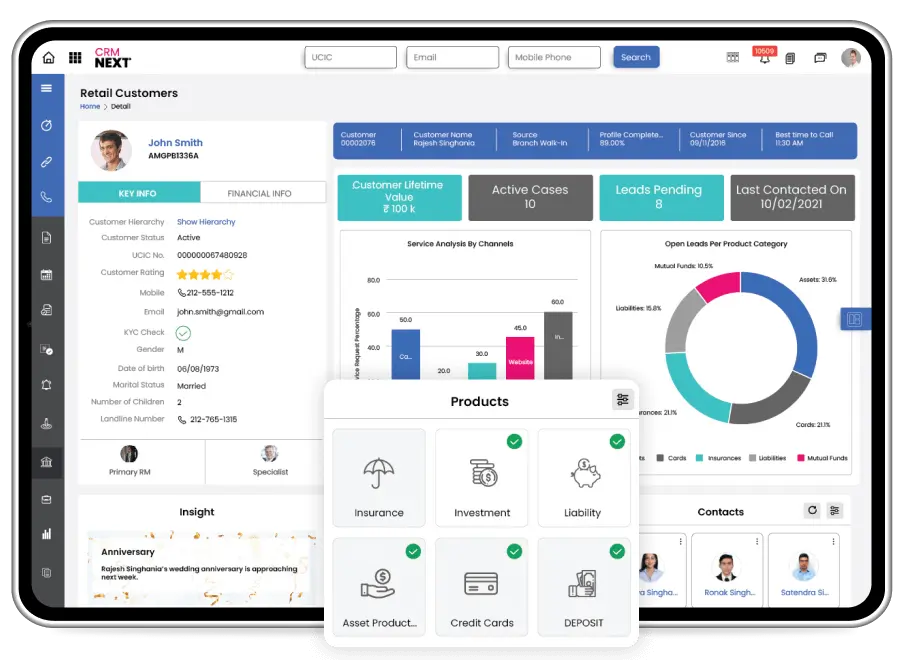
Source: CRMNEXT
Salesforce takes the opposite approach. It starts as a horizontal platform and narrows through configuration and industry clouds. Financial Services Cloud provides dedicated data models for banking, wealth management, and insurance, and it serves over 150,000 companies worldwide across 17 industry verticals.
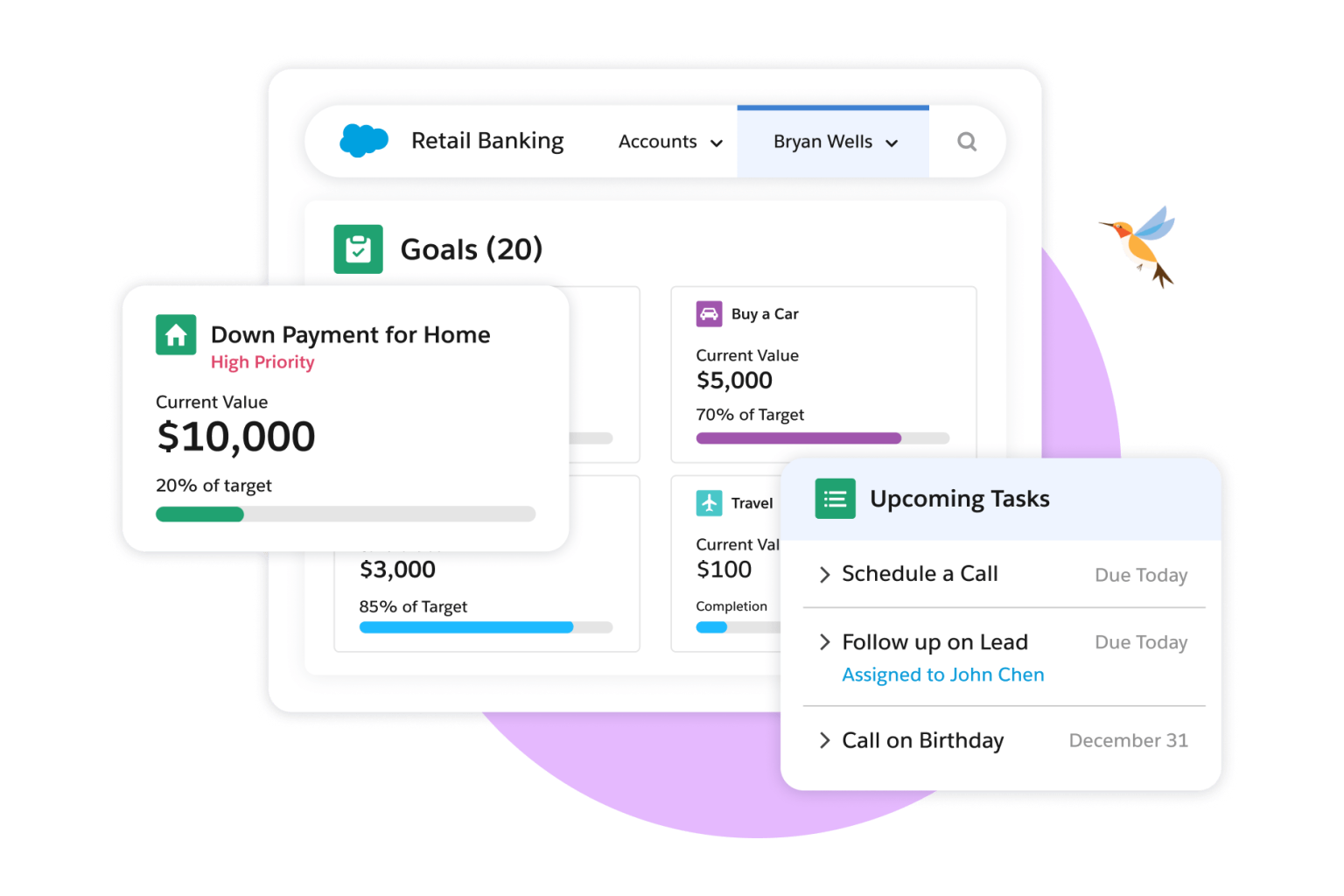
Source: Salesforce
But Financial Services Cloud is a layer on top of the core Salesforce platform, not a separate product built from scratch. You inherit Salesforce's full capability and its full complexity.
For a credit union with $500M in assets and 100,000 members, CRMNEXT's approach means faster deployment and higher frontline adoption. For a $50B bank running commercial lending, wealth management, and retail banking across multiple geographies, Salesforce's configurability may be the only option that covers the full scope.
How ZoomInfo complements either CRM for business development
Both CRMNEXT and Salesforce are only as useful as the data inside them. CRMNEXT pulls data from core banking systems. Salesforce aggregates data from whatever sources you connect. But neither platform generates new prospect intelligence or tracks buying signals across the open market.
For financial institutions with a commercial banking or business development function, this is a meaningful gap. Identifying which businesses in your service area are growing, hiring, adopting new technology, or researching financial products is work that CRMs were not designed to do.
ZoomInfo addresses this directly. Its technographics profile the tech stacks of 30+ million companies across 30,000+ technologies and 200+ categories. Its company attributes cover industry, headcount, revenue, and parent-child hierarchies for 100M companies.
WebSights resolves anonymous website traffic to companies, including buying team identification and direct contact information.
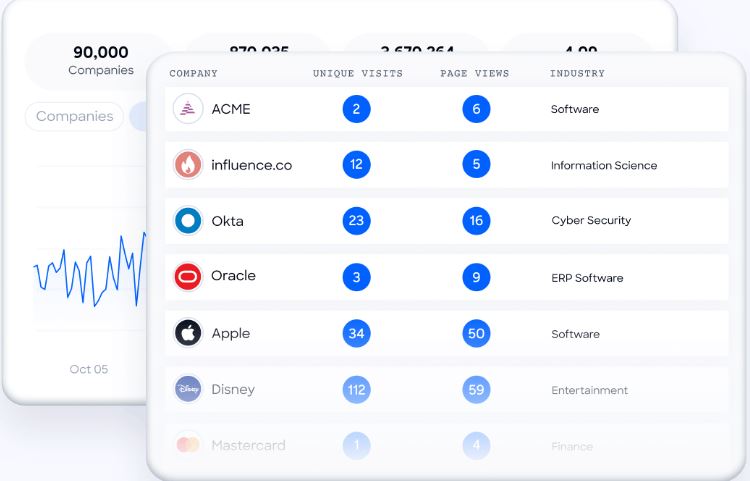
For sellers, this intelligence is accessible through GTM Workspace, where prioritized accounts, AI-drafted outreach, and deal context come together.
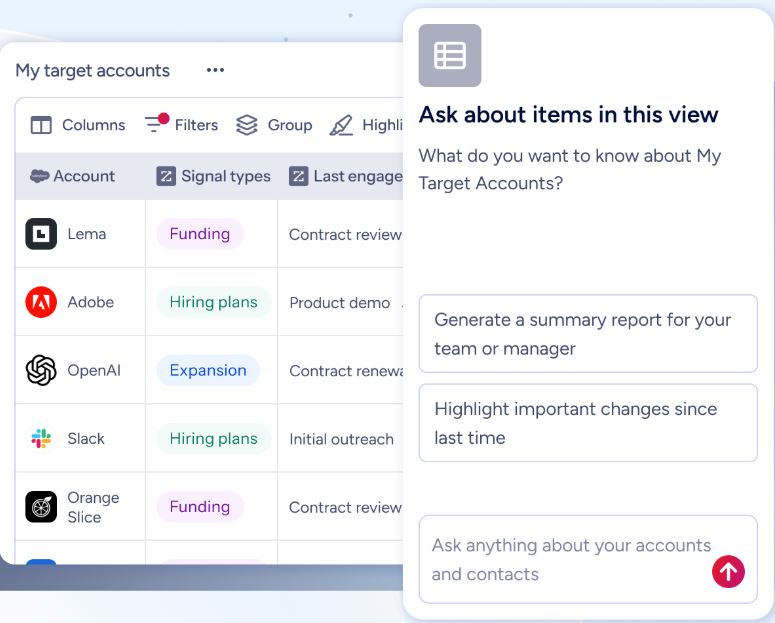
For marketers and RevOps teams, GTM Studio provides a canvas where audience definition and campaign activation happen in natural language.
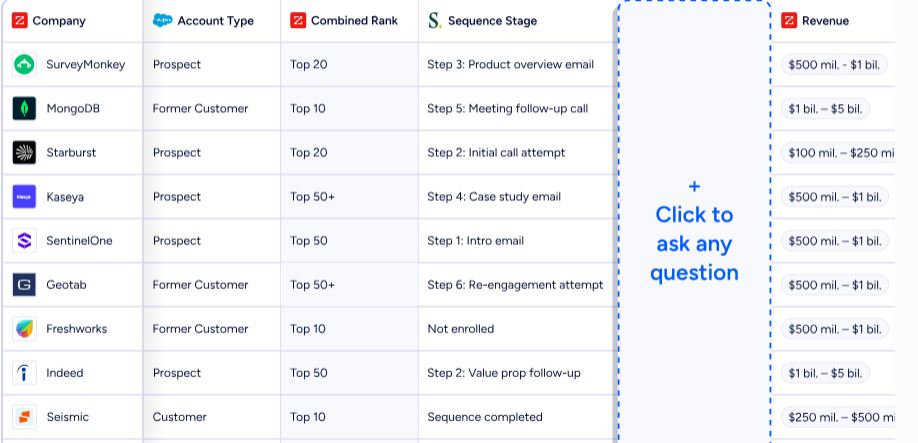
For teams that build their own tools, APIs and MCP expose the same intelligence to any application.
That intelligence, fed into either CRM, turns business development from guesswork into a data-informed process.
SpringDB used ZoomInfo's enriched data for precise client targeting, achieving 2x–3x increases in campaign conversions, a 300% increase in database usability, and 30–50% uplift in average deal size. "You'll get 10x the value if you think of ZoomInfo as a full platform and not just a tool for one team," said John Kotsuros, Founder and CEO. (SpringDB case study)
Workflow coverage reflects different implementation philosophies
CRMNEXT ships with over 80% of daily workflows pre-built for financial institutions. Magnifi Financial automated more than 50 workflows that staff had previously handled by email and text, producing a 30% increase in cases opened directly in branches. Staff can configure the remaining workflows using a no-code design studio without engineering support.
Salesforce offers workflow tools through Flow and its broader platform, but starts from a blank canvas. Financial Services Cloud adds industry-specific processes, yet the institution (or, more commonly, an implementation partner) must configure them. This is deliberate: Salesforce prioritizes flexibility over prescription. The trade-off is that over 70% of implementations are partner-led, adding time and cost.
BUSINESSNEXT takes the opposite stance, implementing its own software with no third parties. As they put it: "No third parties; BusinessNEXT implements its own software. Avoid any vendor confusion; have a clear line of sight into goals, milestones and project expectations."
Dupaco Credit Union's CIO described how CRMNEXT enabled their institution to "completely reimagine" their service request and delivery process, referral management, and complaint workflows.
AI capabilities serve different purposes
Both platforms invest in AI, but their AI does different things for different users.
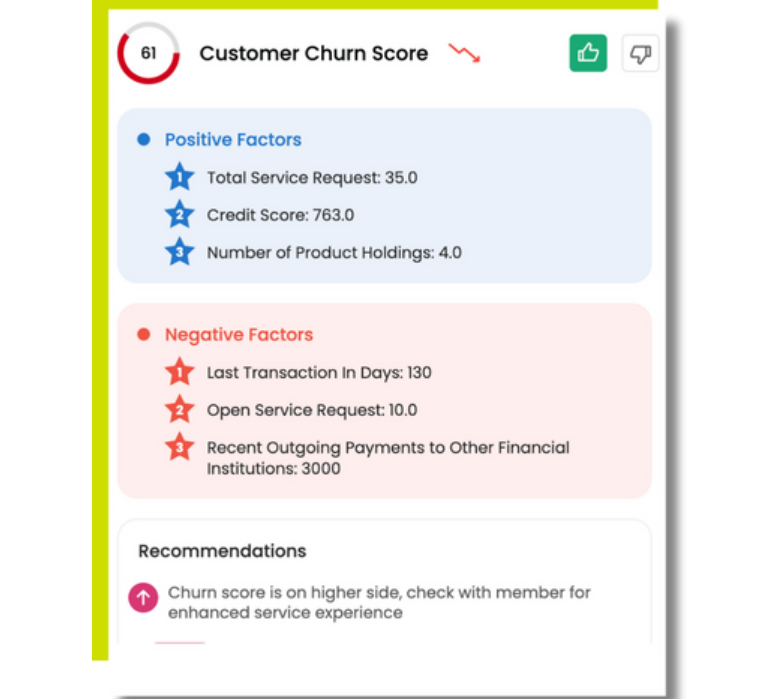
CRMNEXT's Insight Engine focuses on the member interaction moment. It surfaces next-best-action recommendations within the Account Holder's 360-degree profile, so a teller or loan officer sees suggestions during a live conversation.
The Churn Score flags retention risks before members disengage. In the 2025 Forrester Wave evaluation, BusinessNext received a 5/5 for AI capabilities across Predictive, Generative, and Agentic AI.
Source: CRMNEXT
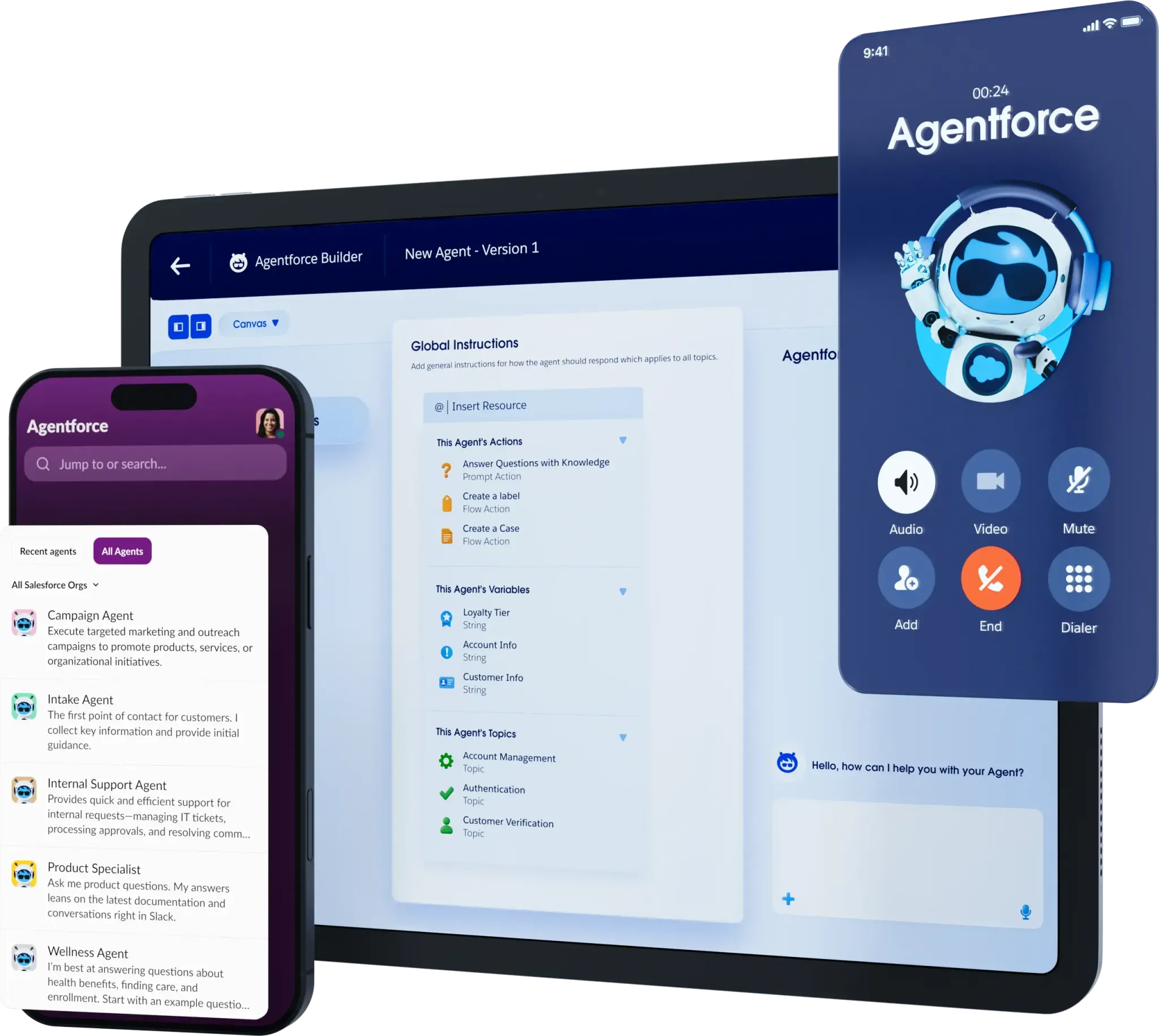
Salesforce's Agentforce is broader. It deploys autonomous AI agents that can handle entire workflows on their own, from resolving support cases to drafting follow-up emails to managing sales pipelines. Salesforce resolves 85% of support requests without human escalation using Agentforce.
Source: Salesforce
Agentforce runs on the Atlas Reasoning Engine, which uses a reason-act-observe-adapt loop rather than fixed prompts.
The practical distinction: CRMNEXT's AI is narrower but relevant to frontline banking staff during member interactions. Salesforce's AI is broader and more autonomous, but requires clean data and configuration to deploy. As Marc Benioff acknowledged at Dreamforce 2025: "You have got to get your data right."
The intelligence gap neither CRM fills
CRMs manage relationships with people you already know. But financial institutions also need to find new business customers, understand which companies are growing or in-market, and prioritize outreach to the right contacts at the right time.
Neither CRMNEXT nor Salesforce answers the question: "Which businesses in our market are looking for commercial banking services right now?"
ZoomInfo fills this gap. Its GTM Context Graph processes 1.5B+ data points daily, combining B2B company intelligence with intent signals and behavioral data to identify when accounts are in-market.
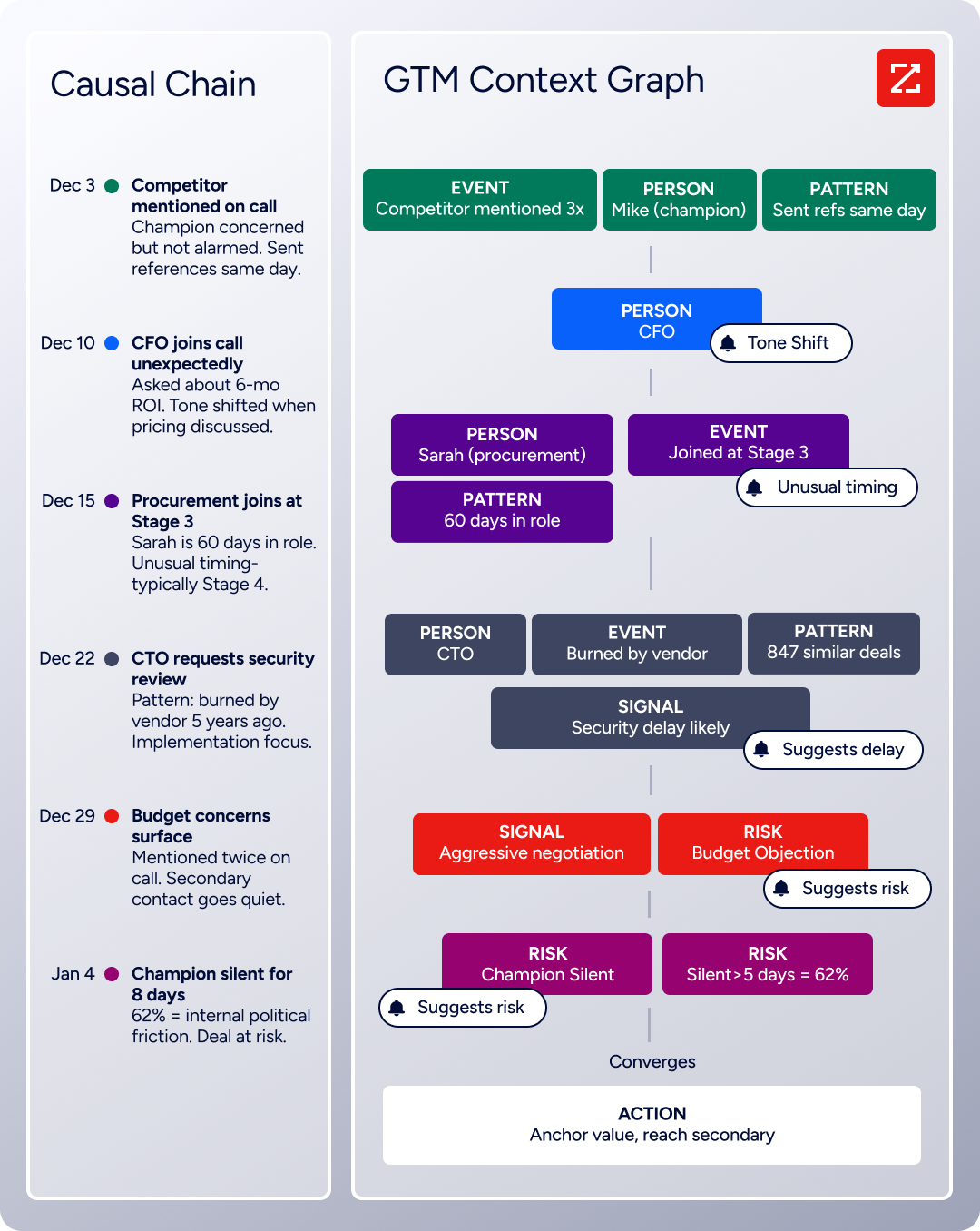
For a commercial banking team, this means knowing which local businesses just received funding, which are expanding headcount, and which are researching financial products before they walk into a branch or submit a web inquiry.
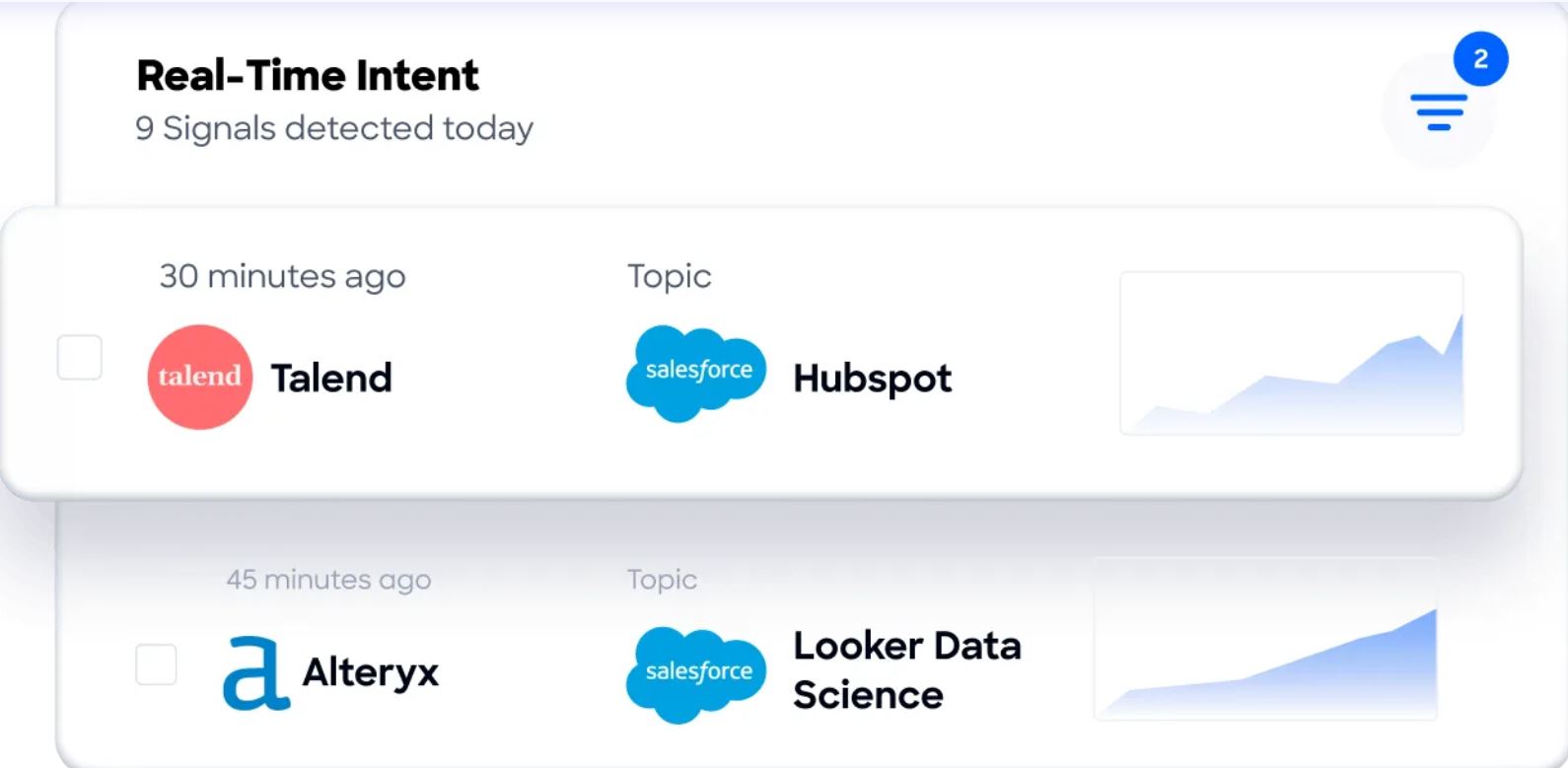
ZoomInfo's Buyer Intent data tracks signals from 210 million IP-to-Organization pairings, while Guided Intent (exclusive to ZoomInfo) identifies topics historically correlated with deal success rather than requiring manual topic selection.
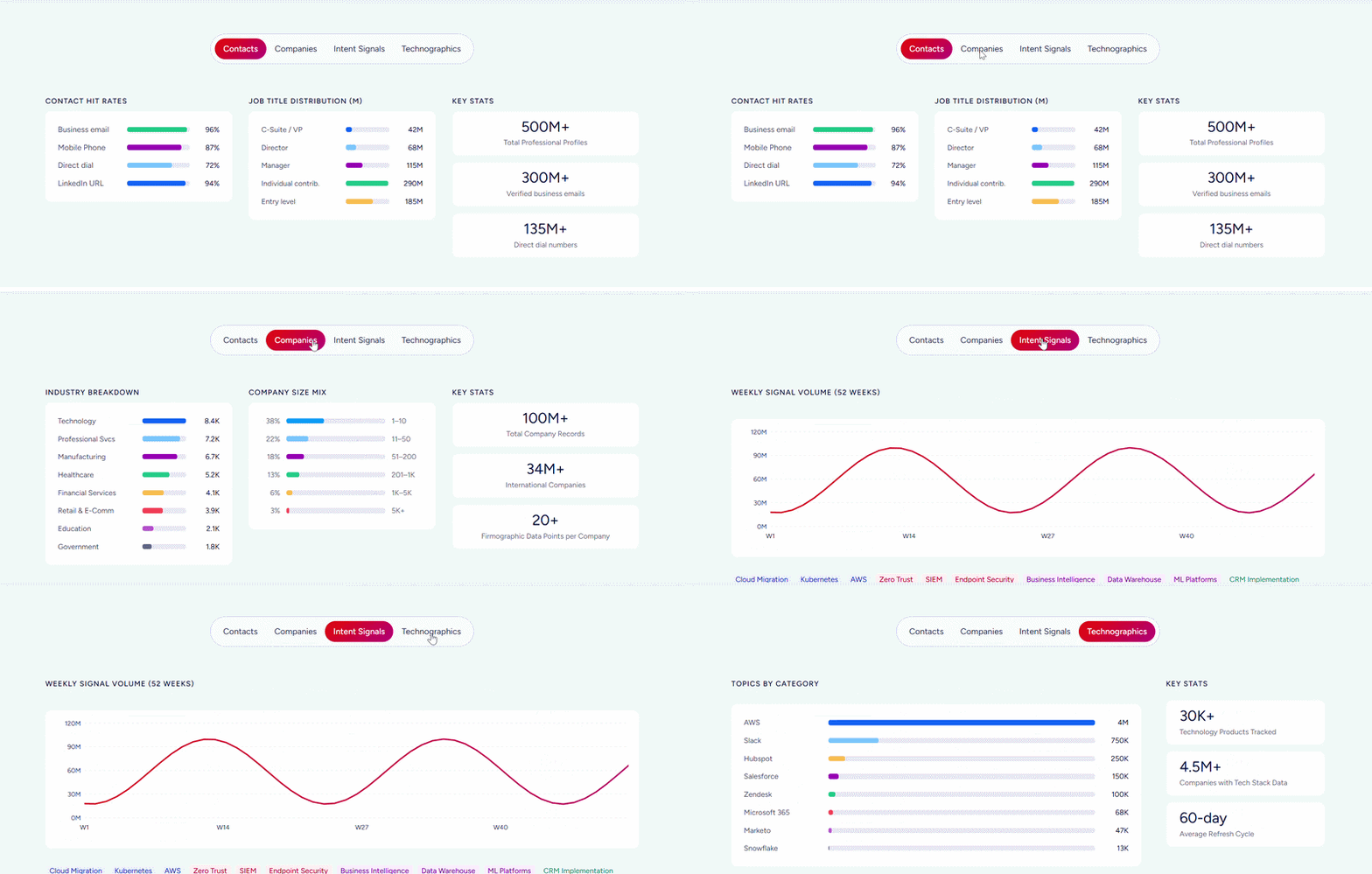
The contact data behind these signals (120M direct-dial phone numbers, 200M+ verified business email addresses) lets commercial banking teams act on insights immediately rather than spending days researching who to call.
ZoomInfo verifies its data through a multi-source pipeline: automated ML scanning of 28 million site domains daily, third-party data covering 95 million businesses, and an in-house team of 300+ human researchers. The result: up to 95% accuracy on first-party data, validated by a Fortune 500 competitive RFP analyzing 25 million contacts that concluded "no other competitor came even close."
Seismic's sales team attributed 39% of active pipeline to opportunities identified or influenced by ZoomInfo signals, with a 54% productivity gain and 11.5 hours saved per week per seller. (Seismic case study)
For a broader look at how Salesforce and ZoomInfo compare as platforms, see our Salesforce vs. ZoomInfo comparison.
Integration paths determine long-term flexibility
How each platform connects to your existing technology shapes what you can and can't do over time.
CRMNEXT integrates bi-directionally and in real time with core banking systems, loan origination systems, digital banking platforms, card systems, and call center tools. Named technology partners include Jack Henry, Symitar, Infosys Finacle, TCS BaNCS, and Temenos. Communication partners include Avaya, Twilio, and Cisco.
Cloud infrastructure supports AWS, Azure, Google Cloud, IBM Cloud, Oracle Cloud, and Red Hat OpenShift. The focus is depth with financial services infrastructure, not breadth across every category of business tool.
Salesforce has the broadest integration ecosystem of any CRM. 9,000+ AppExchange apps with 14+ million installs, and 91% of customers use at least one AppExchange app. MuleSoft handles enterprise integration with hundreds of pre-built connectors. APIs include REST, SOAP, Bulk, Metadata, Tooling, and Pub/Sub.
For financial institutions with technology stacks spanning multiple vendors, Salesforce's integration breadth is hard to match.
ZoomInfo connects to both ecosystems. It integrates with Salesforce as a featured partner, enriching CRM records with verified contact data, company intelligence, and intent signals.
For CRMNEXT or any other platform, ZoomInfo's Enterprise API and MCP server expose the same intelligence programmatically. API access is included in all relevant ZoomInfo plans, so the data flows regardless of which CRM sits at the center of your stack.
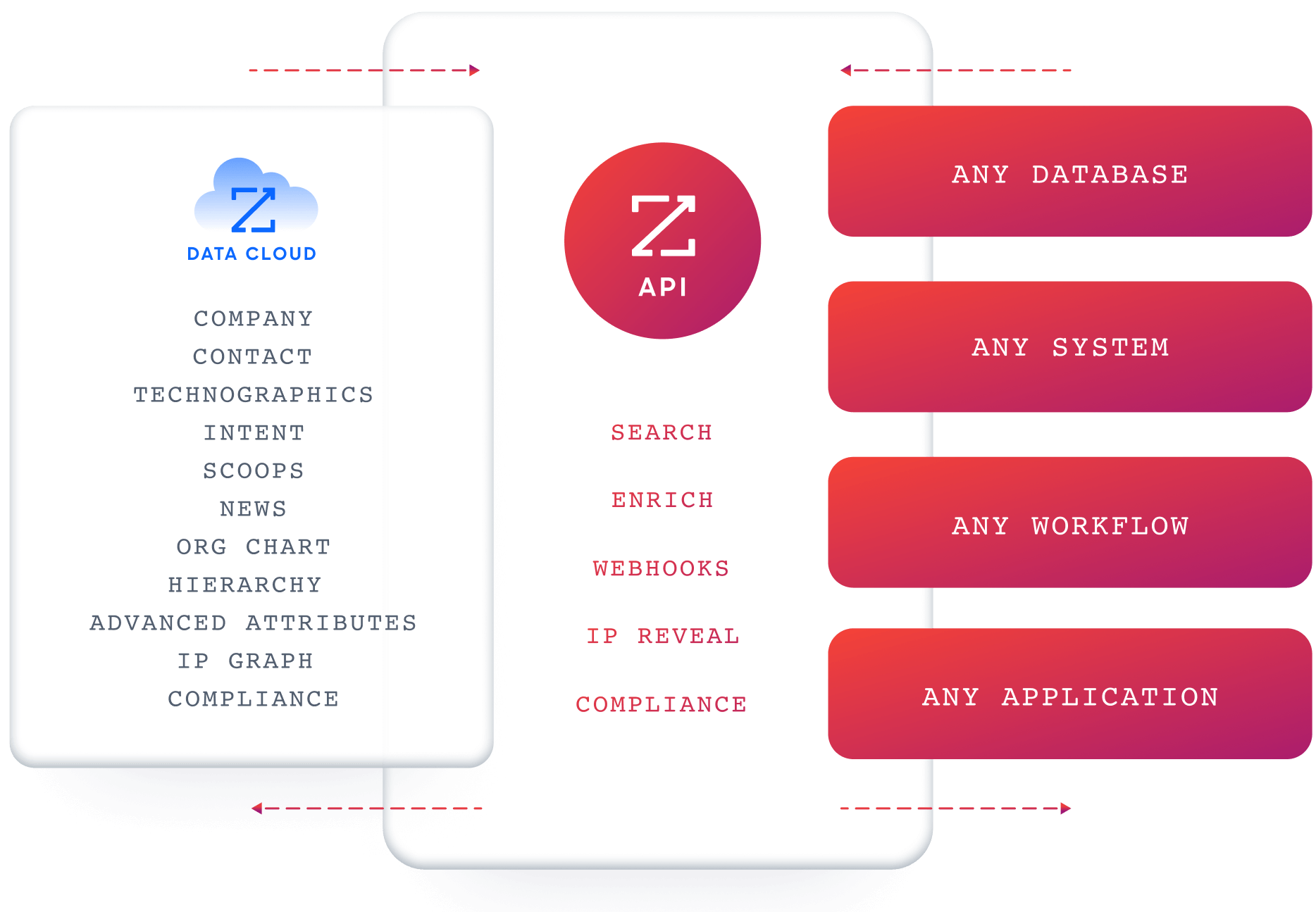
BDO Canada activated ZoomInfo data within internal systems using the API, cutting time spent on data dashboard updates by 87%. "The plug-and-play aspect of the API means I can integrate it very easily into any process and get information at a moment's notice," said Jerry Wilson, Senior Marketing Intelligence Analyst. (BDO Canada case study)
Pricing models reflect different market positions
CRMNEXT does not publish pricing. The only path to a quote is through a demo request form that asks for your company, title, and core banking system before sharing any numbers. Magnifi Financial described the cost as "a fraction of the cost of alternative solutions," but no independent pricing benchmarks are publicly available.
BUSINESSNEXT implements its own software, which may bundle or separately itemize implementation, training, strategy consulting, and an optional Innovation Subscription for custom development.
Salesforce publishes its tier structure. Sales Cloud and Service Cloud range from a free tier for up to 2 users to $550/user/month for Agentforce 1. Most financial institutions will need at least the Enterprise tier at $175/user/month.
Financial Services Cloud, Marketing Cloud, Data Cloud, and add-ons like the Contact Center ($150/user/month) and Agentforce for Service ($125/user/month) are priced separately. A 6% price increase took effect in August 2025 for Enterprise and Unlimited tiers.
The Premier Success Plan costs 30% of net license fees on top of licenses. Implementation typically requires partners, adding significant cost, and Salesforce itself has acknowledged its pricing "needed to be easier to understand, more predictable, and more flexible."
ZoomInfo uses custom-quoted, consumption-based pricing with no published dollar amounts for paid tiers. A permanent free tier (ZoomInfo Lite) provides access to the B2B database with 10 monthly export credits, and a 7-day free trial offers full feature access with no credit card required.
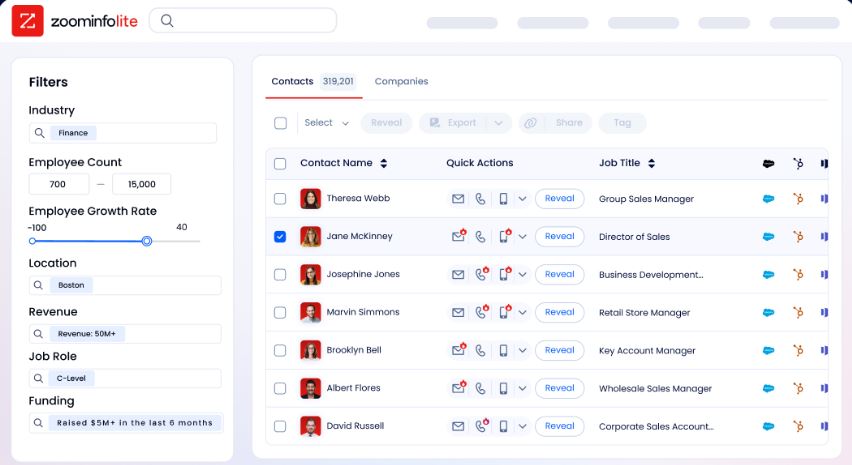
Total cost of ownership depends on your situation. CRMNEXT reportedly costs less for institutions that fit its profile (community banks and credit unions needing a department-wide CRM). Salesforce's costs compound across clouds, add-ons, implementation partners, and Success Plan fees, but may be necessary for institutions that need the platform's full breadth.
ZoomInfo is additive to either CRM budget, providing intelligence capabilities neither CRM includes natively.
CRMNEXT vs. Salesforce vs. ZoomInfo: Which should you choose?
The right answer depends on your institution's size, complexity, and growth strategy.
Choose CRMNEXT if:
You're a community bank or credit union in the $200M–$10B+ asset range
Native core banking integration (especially Jack Henry/Symitar) is a priority
You want pre-built financial services workflows that work on day one
Department-wide adoption across tellers, lenders, service, compliance, and marketing matters more than configurability
You prefer a vendor that implements its own software without third-party partners
Choose Salesforce if:
You're a large financial institution needing a platform that spans commercial banking, wealth management, insurance, and retail
You have the IT resources and budget for a partner-led implementation
AppExchange ecosystem access and broad third-party integration are critical
You want autonomous AI capabilities with Agentforce
Your growth plans may extend beyond financial services into adjacent business lines
Add ZoomInfo to either CRM if:
Your institution has a commercial banking or business development function that needs to identify and reach new business customers
You want to know which companies in your market are researching financial products
Your CRM data needs enrichment with verified B2B contact information, company attributes, and intent signals
You're building an outbound or account-based approach to business customer acquisition
You want intelligence that works inside your existing CRM, whether that's CRMNEXT, Salesforce, or another platform
See how ZoomInfo's B2B intelligence can support your commercial banking growth with a free trial.
The CRM you choose determines how you manage relationships. ZoomInfo determines how you find them. For financial institutions serious about growth, the most effective stack includes both: a CRM that fits your operational reality, and an intelligence layer that keeps your pipeline full of the right prospects.
CRMNEXT vs. Salesforce vs. ZoomInfo FAQ
What is the core difference between CRMNEXT and Salesforce for financial institutions?
CRMNEXT is built for banks and credit unions, with native core banking integrations, financial-services-specific data models, and over 80% of workflows pre-built. Salesforce is a horizontal CRM platform that serves all industries, with a dedicated Financial Services Cloud layered on top. CRMNEXT prioritizes faster deployment and department-wide adoption for financial institutions.
Salesforce prioritizes breadth, configurability, and ecosystem depth for institutions with more complex or multi-line requirements.
Which platform is better for a credit union with under $1 billion in assets?
CRMNEXT is likely the stronger fit. Its pre-built workflows, native Symitar integration, and vendor-led implementation reduce the IT burden and cost compared to a full Salesforce deployment. Salesforce's value compounds with organizational complexity, so smaller institutions may not need or fully use its broader capabilities.
Recent CRMNEXT customer wins include credit unions such as General Electric Credit Union, State Department Federal Credit Union, and Westmark Credit Union.
How does ZoomInfo fit into a financial institution's technology stack?
ZoomInfo is not a CRM. It's a B2B intelligence platform that provides verified contact data, company intelligence, and buying signals to help financial institutions identify and reach new business customers. It integrates with Salesforce and can connect to CRMNEXT or any other platform through its Enterprise API and MCP server.
The value is additive: ZoomInfo finds the prospects, your CRM manages the relationships.
Which platform has the strongest AI capabilities?
It depends on the use case. CRMNEXT's Insight Engine focuses on real-time recommendations for frontline staff during member interactions, including next-best-action suggestions and churn scoring.
Salesforce's Agentforce deploys autonomous AI agents that handle full workflows independently across sales, service, and marketing, with 85% of Salesforce's own support requests resolved without human escalation.
ZoomInfo's GTM Context Graph uses AI to identify buying patterns and predict which accounts are in-market. Each serves a different part of the go-to-market process.
How do pricing models compare across the three platforms?
CRMNEXT and ZoomInfo both use custom-quoted pricing with no published rates. Salesforce publishes tier structures ranging from free (2 users) to $550/user/month, with Financial Services Cloud, Marketing Cloud, and add-ons priced separately.
Most financial institutions on Salesforce need at least the Enterprise tier at $175/user/month, plus implementation partner costs and a Premier Success Plan at 30% of license fees. ZoomInfo offers a permanent free tier (ZoomInfo Lite) and a 7-day free trial for evaluation.
Can both CRMs integrate with core banking systems like Jack Henry and Symitar?
CRMNEXT has native, pre-built integrations with Jack Henry and Symitar that work out of the box, with bi-directional, real-time data sync. Salesforce can integrate with these systems, but typically requires custom development or third-party middleware through implementation partners.
The depth and speed of core banking integration is one of CRMNEXT's primary differentiators for community banks and credit unions.
Which platform has the largest ecosystem for third-party tools?
Salesforce, by a wide margin. Its AppExchange marketplace has 9,000+ apps with 14+ million installs, and MuleSoft provides enterprise integration with hundreds of pre-built connectors. CRMNEXT's ecosystem focuses on financial services partners, including core banking providers, telephony vendors, and cloud infrastructure.
ZoomInfo's App Marketplace lists 120+ partner integrations, with particular depth in CRM, marketing automation, and sales engagement tools.
Is ZoomInfo useful for credit unions that primarily serve individual consumers?
ZoomInfo's core strength is B2B intelligence, so it adds the most value for financial institutions with a commercial banking, business lending, or B2B service component. Credit unions focused on individual consumer relationships will find less direct application, though ZoomInfo's company data can still support employer group programs, Select Employee Group partnerships, and community business outreach initiatives.
See how Salesforce compares against other CRMs and platforms:
