
Choosing between Dubsado and HubSpot comes down to five questions:
Are you a solo creative professional managing a handful of clients, or a growing team running coordinated marketing, sales, and service operations?
Do you need branded proposals, contracts, and invoices in one place, or pipeline management, email automation, and AI-powered outreach?
Is your budget under $55 per month, or can you invest hundreds per month for a platform that scales with your team?
Do you need automation that handles client onboarding, or automation that nurtures leads across marketing channels?
Are you looking to manage the clients you already have, or to find and engage new prospects at scale?
Here's what we recommend:
Dubsado fits solopreneurs and small creative teams who need to manage client relationships from first inquiry through final invoice. It consolidates lead capture, proposals, legally binding contracts, invoicing, scheduling, and automated workflows into one workspace where every touchpoint carries your brand, not Dubsado's.
At $35–$55 per month with unlimited clients and projects, it works well for photographers, designers, coaches, and other service professionals who want to automate their client pipeline instead of chasing payments.
HubSpot is built for businesses that have outgrown single-person tools and need marketing, sales, and customer service working from shared data. Its Smart CRM connects Marketing Hub, Sales Hub, Service Hub, Content Hub, and Commerce Hub on a single data layer, giving every team one view of every contact.
With Breeze AI agents handling tasks from prospecting outreach to customer support resolution, HubSpot serves 288,000+ customers ranging from startups on the free tier to enterprises investing $3,600+ per month.
Dubsado and HubSpot both do their jobs well. But neither solves a problem that B2B service businesses face: finding the right prospects before they enter your pipeline. That's where a third platform earns its place.
ZoomInfo is a go-to-market platform that fills the prospecting gap both Dubsado and HubSpot leave open. Where Dubsado manages clients after they find you, and HubSpot nurtures leads once they've engaged, ZoomInfo identifies companies and contacts before either platform enters the picture.
Its database covers 500M contacts and 100M companies, verified through a pipeline backed by 300+ human researchers. The GTM Context Graph combines this data with your CRM records, conversation transcripts, and behavioral signals to show not just who to contact, but why now is the right time. ZoomInfo integrates natively with HubSpot and works as a prospecting layer for teams using Dubsado. Find your next customers before they enter your CRM with ZoomInfo Lite.
Dubsado vs. HubSpot at a glance
Dubsado | HubSpot | ZoomInfo | |
|---|---|---|---|
CRM type | Client management (project-based) | Full-suite CRM (contact, company, deal, ticket) | GTM intelligence (contact and company data + signals) |
Automation | Client onboarding workflows (Premier only) | Marketing, sales, and service workflows across all hubs | Signal-triggered prospecting and outreach workflows |
AI features | AI form generation, call notetaker (Labs) | Breeze AI agents for marketing, sales, service, and data | GTM Context Graph, AI-drafted outreach, account summaries |
Contracts & proposals | Built-in e-signatures, branded proposals | Quotes and e-signatures via Commerce Hub | Not applicable (prospecting and intelligence focus) |
Invoicing | Full invoicing with payment plans and autopay | Native invoicing via Commerce Hub | Not applicable |
Integrations | Zapier (Premier only), QuickBooks, Xero | 172+ marketplace partners, native CRM integrations, API, and MCP | |
Pricing | Free to $3,600+/mo per hub | Custom consumption-based pricing | |
Free option | ZoomInfo Lite (permanent free tier) | ||
Best for | Solo creative service professionals | Scaling businesses with marketing, sales, and service teams | B2B teams that need to find and engage prospects |
Built for different businesses entirely
Dubsado and HubSpot solve different problems for different buyers. The confusion happens because both call themselves a "CRM," but their definitions of that word barely overlap.
Dubsado is software for creative service businesses.
Its features follow a single workflow: a lead contacts you, you send a proposal, they sign a contract, you onboard them, you deliver the work, and you collect payment. The platform lets photographers, designers, coaches, event planners, and other service professionals run this entire sequence without switching tools.
Every client-facing touchpoint (forms, invoices, proposals, portals) can be branded with the user's own identity, including custom domain support. The company was founded in 2016 by husband-and-wife team Becca and Jake Berg, has remained self-funded, and has served 120,000+ creative business owners.
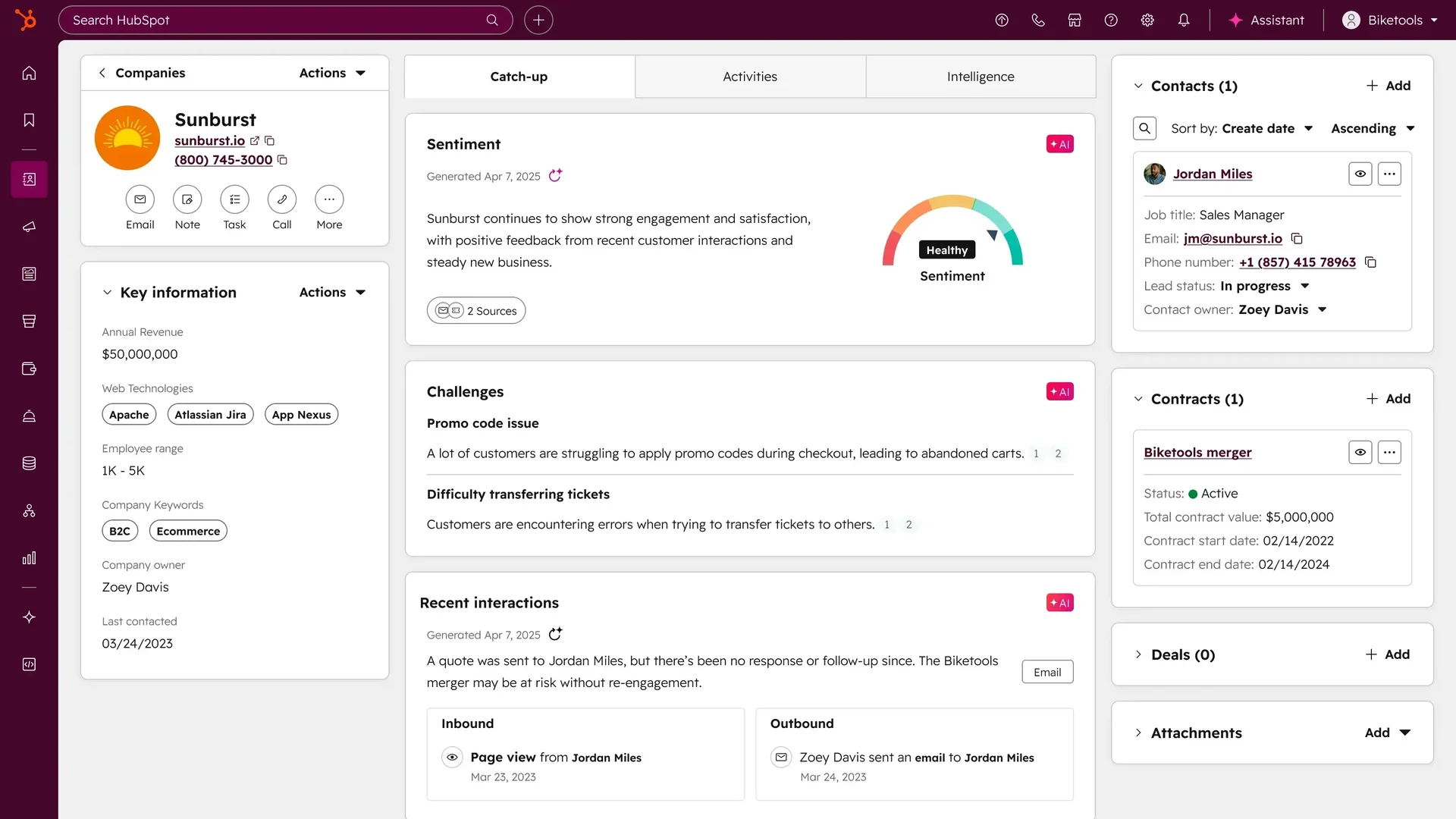
HubSpot calls itself "the agentic customer platform" for scaling companies.
It connects marketing automation, sales pipeline management, customer service ticketing, content creation, and commerce under one data layer. Its Smart CRM tracks contacts, companies, deals, and tickets across every touchpoint. Its AI layer, Breeze, runs agents that handle prospecting outreach, customer support, and data enrichment without human intervention.
Source: HubSpot
Founded in 2006 by Dharmesh Shah and Brian Halligan, HubSpot is a public company (NYSE: HUBS) with $3.13 billion in annual revenue and offices in ten countries.
The difference is scope.
Dubsado does one thing well: manage the client lifecycle for service businesses. HubSpot does many things: manage leads, marketing campaigns, sales pipelines, support tickets, website content, and payment collection across teams. A wedding photographer doesn't need deal pipeline forecasting. A 50-person SaaS company doesn't need branded proposal templates with package selection.
Dubsado owns the client-facing experience
If your business lives and dies by how polished you look to clients, Dubsado built its product around that problem.
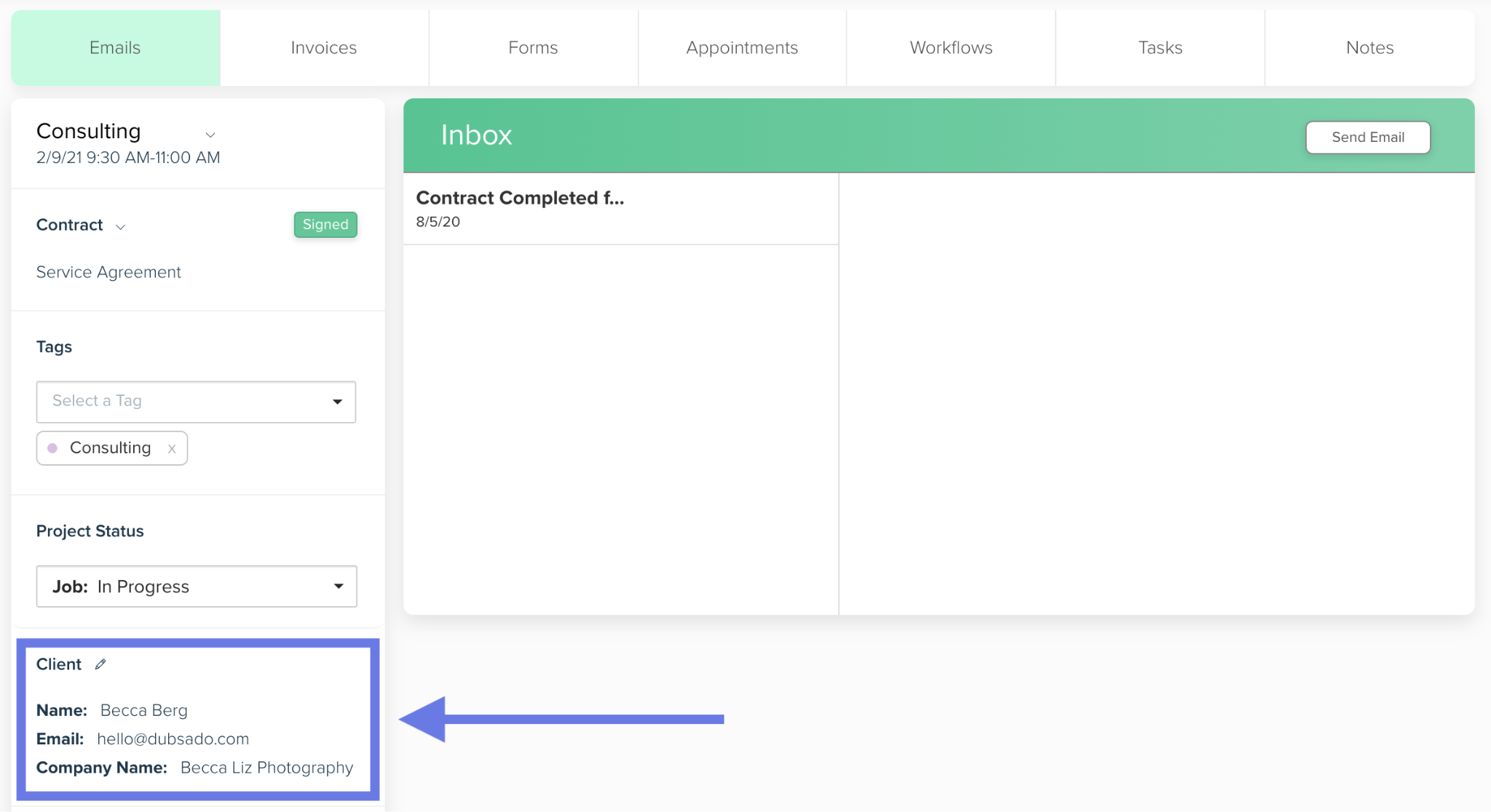
The proposals feature lets clients browse service packages, sign a contract, and pay a deposit in a single session from a single link. Contracts use legally binding e-signatures with time-stamped records and IP address tracking.
Smart fields auto-populate client details, project information, and invoice line items so you never fill in the same data twice.
Source: Dubsado
Invoicing goes beyond basic billing. Dubsado supports payment plans, autopay, recurring invoices, ACH transfers, credit cards, and buy-now-pay-later options through Affirm and Klarna, plus 30-minute instant payouts available around the clock.
Each client gets a password-protected portal where they can view contracts, invoices, forms, and project updates without digging through email. The scheduler handles appointment booking with Zoom, Google Meet, and Microsoft Teams integration and automatic timezone detection.
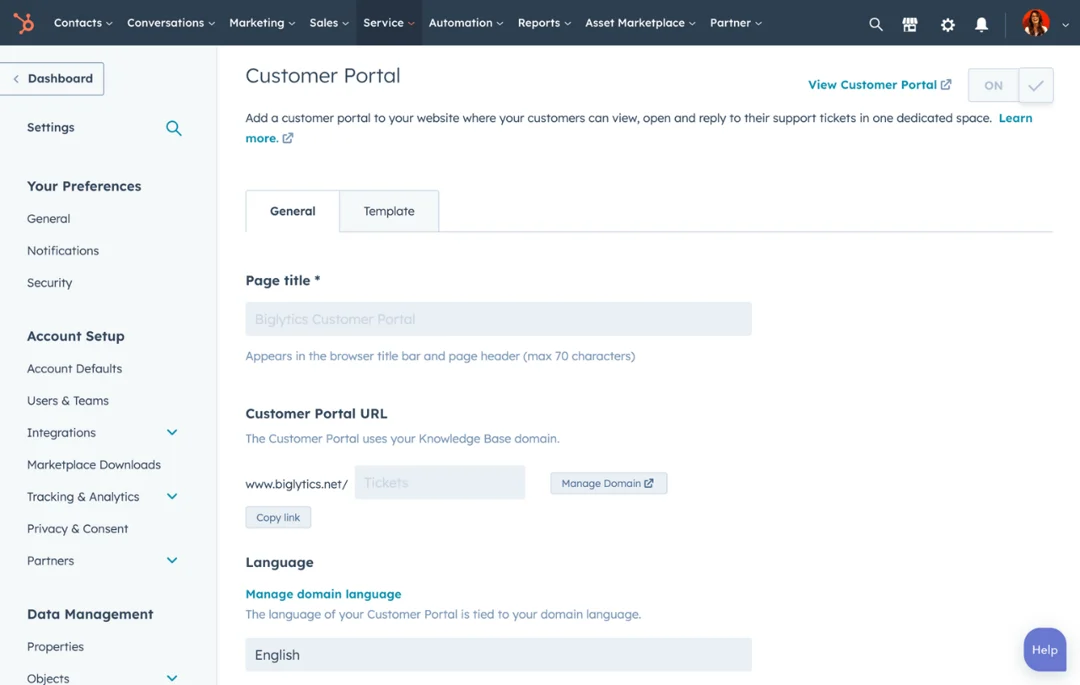
HubSpot has Commerce Hub for quoting and invoicing, and a customer portal for ticket tracking, but these features serve B2B sales teams, not client-facing service businesses.
Source: HubSpot
HubSpot's quotes generate from deal records using product libraries and approval workflows. Dubsado's proposals let a photographer present three wedding packages on a branded page where the client selects, signs, and pays in one sitting. They solve the same mechanical problem (getting paid for services) through different lenses.
HubSpot owns the growth engine
Where Dubsado helps you manage clients you already have, HubSpot helps you attract, convert, and retain more of them.
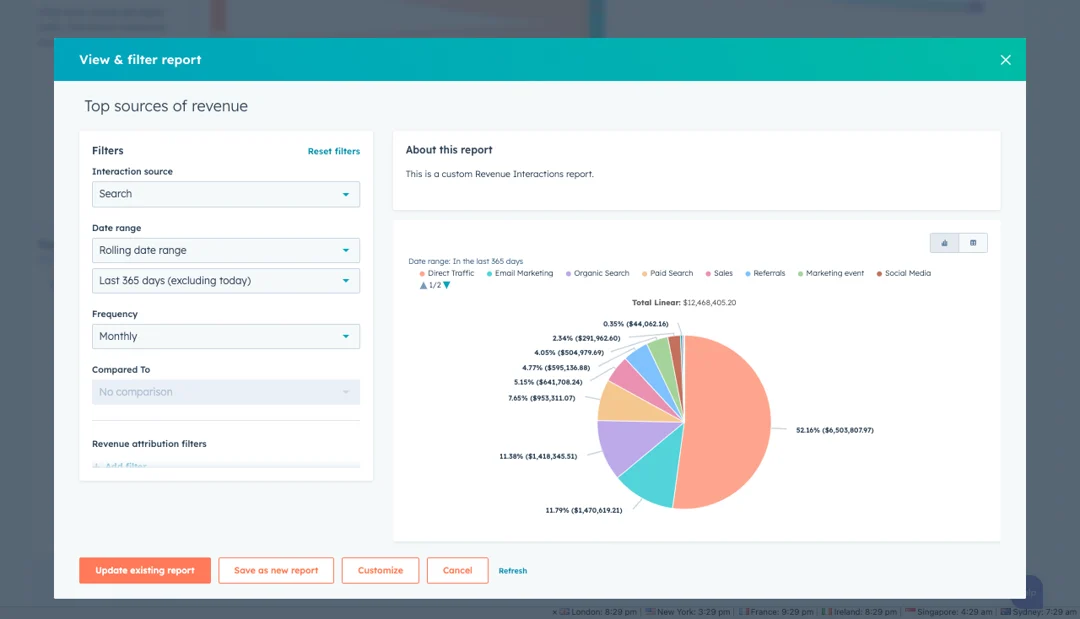
Marketing Hub handles the full acquisition cycle: landing pages, email marketing, social media management, audience segmentation, and multi-touch revenue attribution that shows which campaigns drive pipeline. The AI layer generates blog content, social posts, and personalized email sequences without requiring a dedicated content team.
Source: HubSpot
Sales Hub gives reps a workspace for managing deals, tracking email engagement, and running automated outreach sequences. The Breeze Prospecting Agent monitors buying signals, drafts personalized outreach, and operates either autonomously or with human review on each message. Conversation Intelligence records and transcribes calls, surfacing coaching insights for managers.
Service Hub consolidates support across email, live chat, WhatsApp, and Facebook Messenger into one help desk. The Breeze Customer Agent resolves customer inquiries across channels, with Nutribees reporting a 77% reduction in support tickets after deployment.
None of this exists in Dubsado, and it shouldn't.
Dubsado explicitly prohibits bulk email for newsletters or marketing campaigns. It has no deal pipeline, no marketing automation, no help desk, and no AI agents for prospecting. These aren't missing features; they're outside the product's scope. Dubsado manages client relationships. HubSpot manages the growth engine.
Automation serves different masters
Both platforms offer automation, but the triggers, actions, and use cases barely overlap.
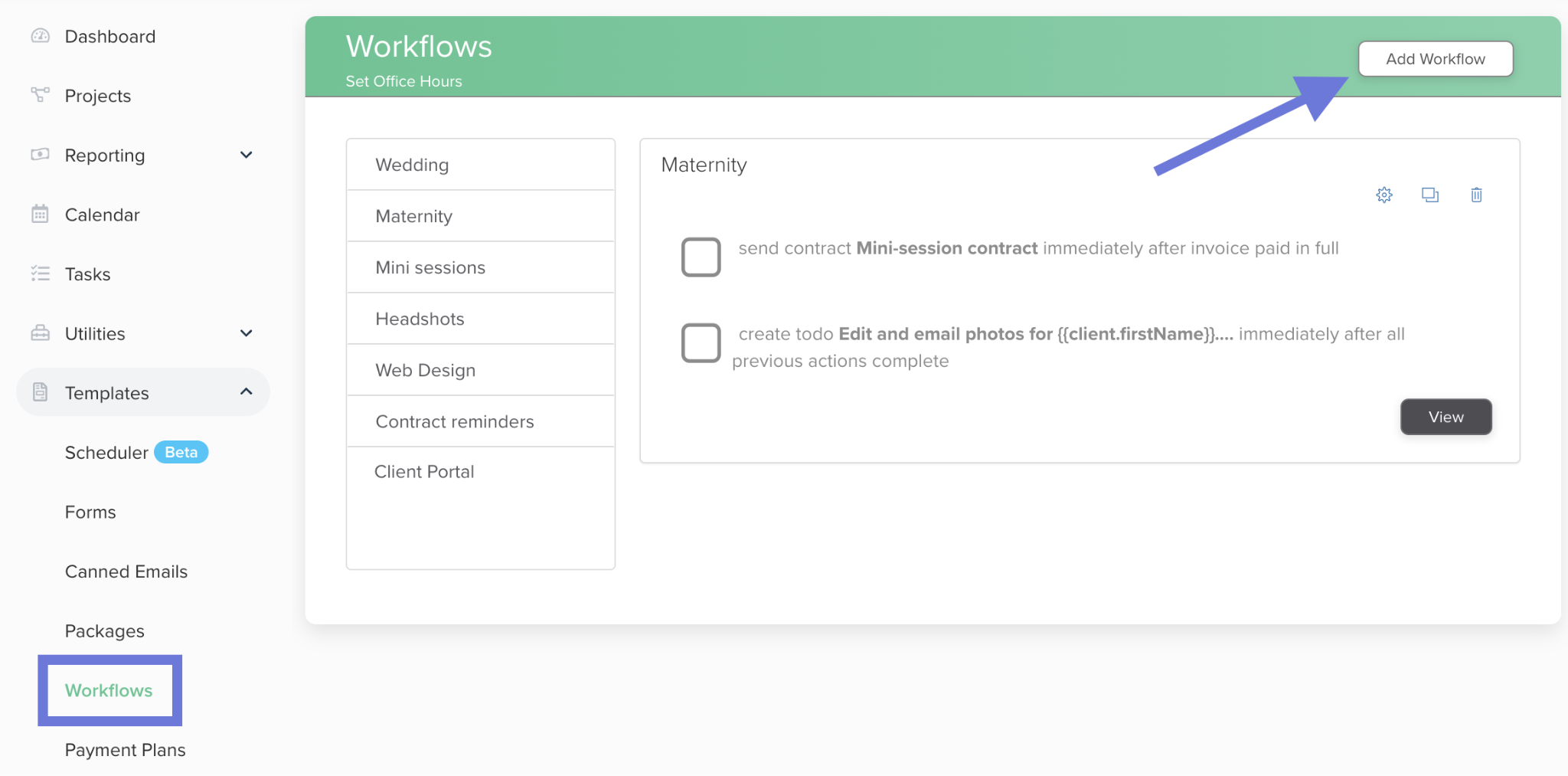
Dubsado's automation engine (called Flows in version 3.0) chains actions across the client lifecycle: send a welcome email when a lead submits a form, issue a contract when a proposal is accepted, generate an invoice when the contract is signed, deliver onboarding materials when payment clears.
Triggers are specific to service businesses: form completion, contract signature, installment payment, and appointment booking. An active hours setting prevents automated messages from firing at odd hours, and flows can chain into other flows for modular process design.
Source: Dubsado
The catch: Flows are a Premier-plan-only feature. Starter users get templates but no automation. And Capterra reviewers consistently describe the setup process as time-consuming, with a cottage industry of third-party setup specialists confirming that self-configuration demands patience.
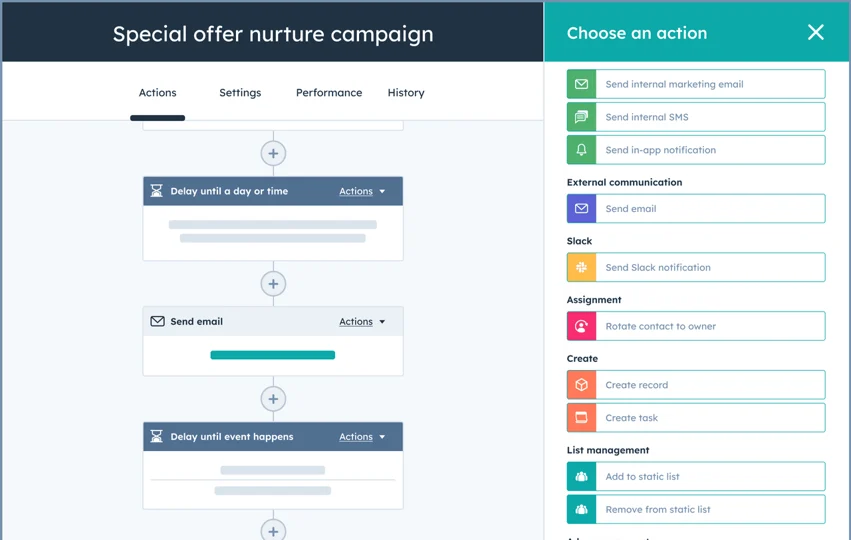
HubSpot's Workflows operate at a different scale.
Source: HubSpot
They trigger marketing emails based on website behavior, route leads to sales reps by territory, escalate support tickets by SLA timelines, and sync data between HubSpot and external systems.
Programmable Automation lets teams run custom JavaScript or Python inside workflows without external middleware. Breeze AI agents add autonomous action: the Prospecting Agent monitors enrolled prospects for buying signals and drafts outreach without waiting for a specific trigger.
The distinction is plain. Dubsado automates what happens between you and one client at a time. HubSpot automates what happens across your marketing funnel, sales pipeline, and service operation at once.
The prospecting gap both platforms leave open
Dubsado assumes clients will find you.
You embed a lead capture form on your website, and when someone fills it out, the platform creates a project and fires your onboarding workflow. But Dubsado doesn't help you identify who to reach out to.
HubSpot gets closer with its Breeze Prospecting Agent and free CRM.
But HubSpot's data quality depends on what's already in your CRM or what you import. The platform enriches records with AI, but the initial coverage depends on what you feed it.
For B2B service businesses that need to identify and engage prospects (not wait for inbound), this is where ZoomInfo enters the picture.
ZoomInfo's database covers 500M contacts and 100M companies with 135M+ verified phone numbers and 200M+ verified business email addresses, processed through a multi-source verification pipeline backed by 300+ human researchers and reaching up to 95% accuracy on first-party data.
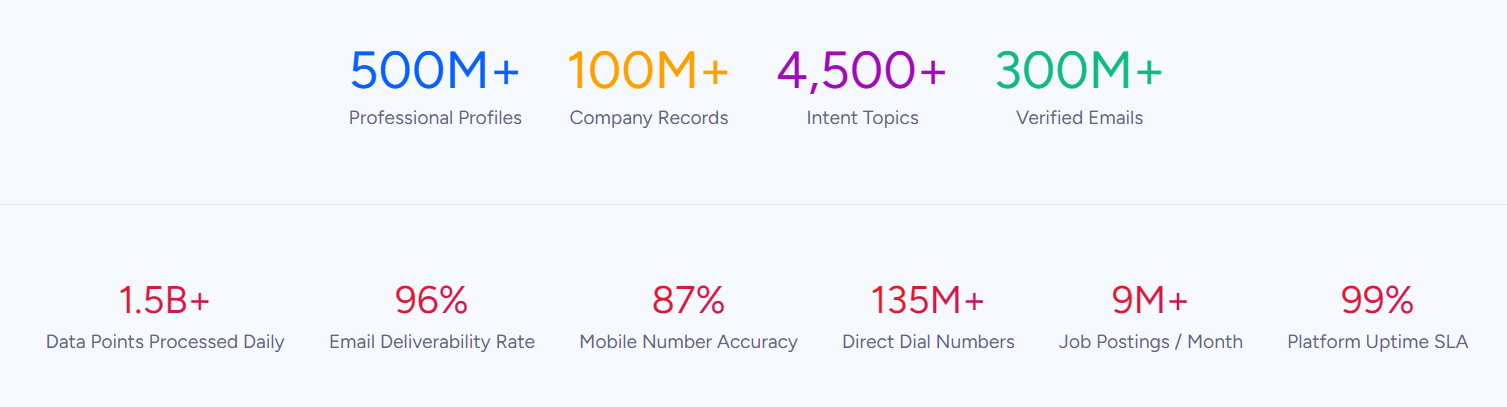
Where Dubsado manages the clients you've already won and HubSpot nurtures leads in your funnel, ZoomInfo identifies the accounts and contacts worth pursuing before any engagement begins.
The GTM Context Graph processes 1.5B+ data points daily, combining ZoomInfo's B2B data with a customer's CRM records, conversation transcripts, and behavioral signals. This layer reveals not just which companies match your ideal customer profile, but why a specific account is worth pursuing now (based on buyer intent signals, leadership changes, funding events, and technology adoption patterns).
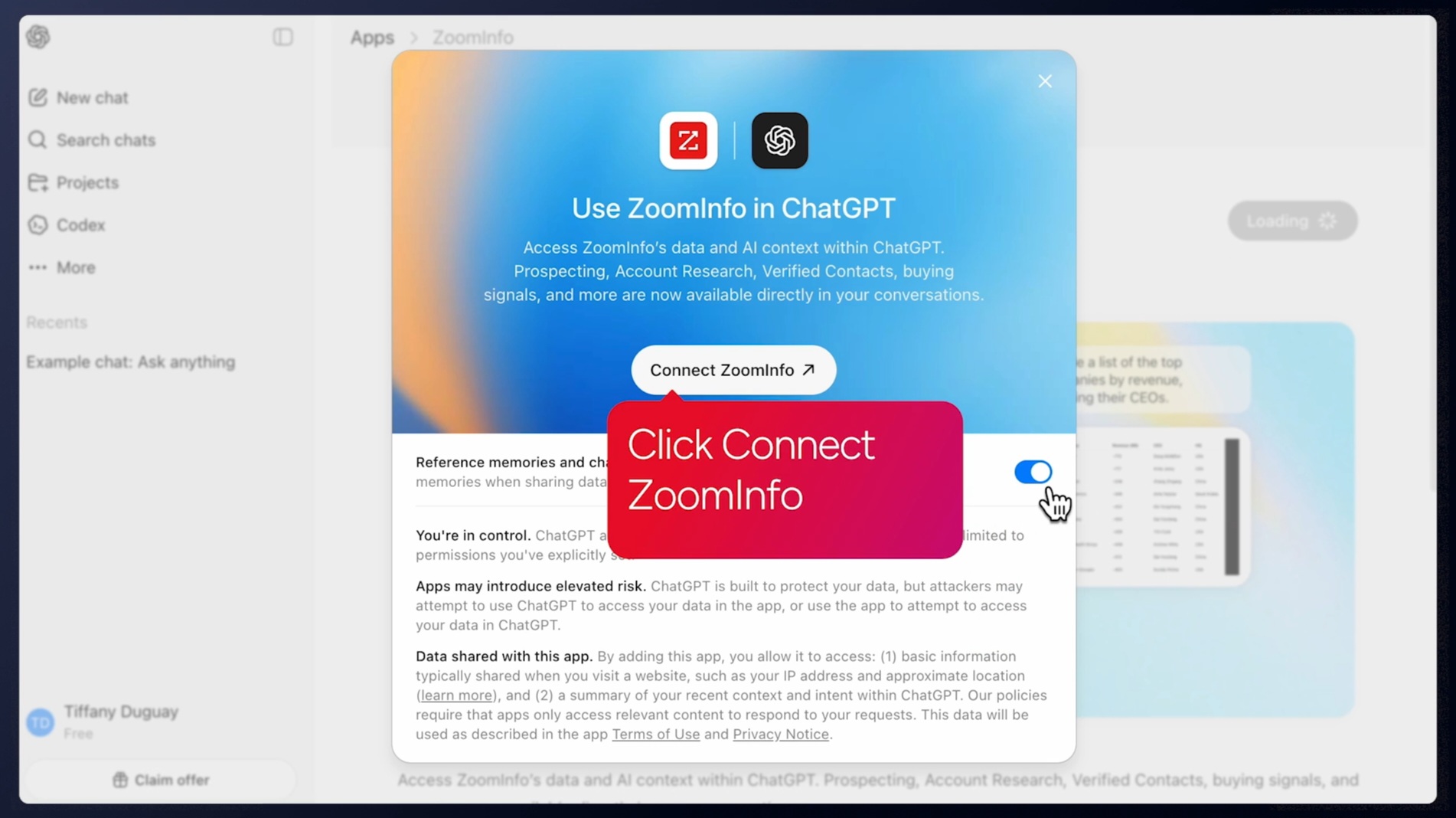
Teams access this intelligence three ways: GTM Workspace gives sellers a single view of prioritized accounts and AI-drafted outreach. GTM Studio gives marketers and RevOps a builder for audience definition and campaign orchestration in natural language. APIs and MCP expose the same intelligence to any custom agent, internal tool, or partner platform.
Source: ZoomInfo
For HubSpot users, ZoomInfo integrates natively to enrich CRM records with verified contact data, company intelligence, and intent signals inside the HubSpot interface. For Dubsado users, ZoomInfo serves as the prospecting layer that feeds qualified leads into the client management workflow.
Smartsheet's Senior Manager of Sales Technology Enablement: "ZoomInfo is our one source of truth for account data, and even more so for contact data. There's no other provider in the market that provides you with that level of detail." (Smartsheet)
Pricing tells you who each platform serves
The pricing of these three platforms reflects different buyer profiles.
Dubsado charges a flat fee: $35 per month for Starter or $55 per month for Premier.
Both plans include unlimited clients and projects. Annual billing saves roughly two months of fees. The 21-day free trial provides full Premier access with no credit card required. Additional users cost between $25 and $60 per month depending on team size.
The critical distinction: Starter users get templates but no workflows, no scheduling, no public proposals, no Zapier, and only one active lead capture form. Most of the automation that makes Dubsado worth using requires Premier.
HubSpot uses a per-seat, per-hub model that scales with team size and feature depth.
The free tier provides a permanent CRM with unlimited contacts (up to 1M records) and basic tools. Starter begins at $15 per seat per month on annual billing. Professional tiers start at $800 per month for Marketing Hub or $90 per seat per month for Sales and Service Hubs, with mandatory onboarding fees ranging from $1,500 to $7,000.
Enterprise Marketing Hub costs $3,600 per month. One detail worth noting: when subscribing to multiple Hubs at different tiers, all Core Seats are billed at the rate of the highest tier.
ZoomInfo uses custom consumption-based pricing with no published prices.
Costs scale based on seats, monthly credit volume, features, and contract length. ZoomInfo Lite offers a permanent free tier with access to the B2B database, 10 monthly export credits, and the ReachOut Chrome Extension. A 7-day free trial of the full platform is also available.
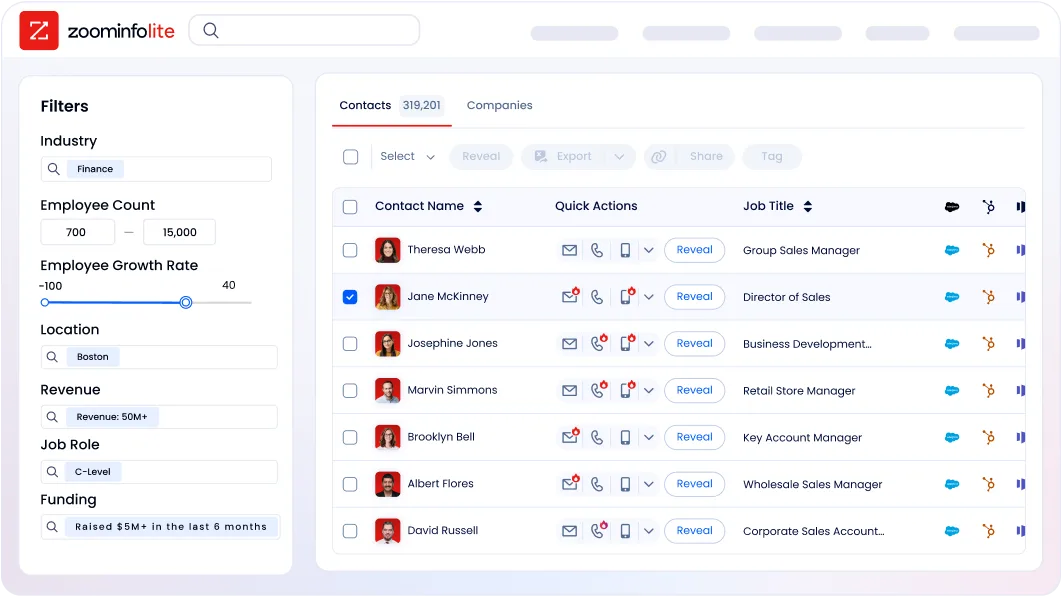
The pricing math tells the story. A solo wedding photographer pays $55 per month for Dubsado Premier and has everything they need. A 20-person SaaS company might invest $2,000+ per month across HubSpot's Marketing and Sales Hubs plus ZoomInfo for prospecting data. These aren't competing price points because these aren't competing products.
Dubsado vs. HubSpot vs. ZoomInfo: Which should you choose?
Choose Dubsado if:
You run a creative service business (photography, design, coaching, consulting, event planning)
You need branded proposals, contracts, invoicing, and scheduling in one tool
You're a solo operator or small team with fewer than 30 people
Client experience and brand presentation matter more than lead generation
Your budget is under $60 per month
Choose HubSpot if:
You have a growing team that needs marketing, sales, and service on shared data
You want AI agents handling prospecting, customer support, and content creation
You need marketing automation, deal pipeline management, and multi-channel reporting
You're ready to invest in a platform that scales from startup to enterprise
You want a free CRM to start and upgrade as your needs grow
Choose ZoomInfo if:
You need to identify and engage B2B prospects at scale
Data accuracy matters (verified phone numbers, direct dials, business emails)
You want buyer intent signals that reveal which accounts are researching your category
You're using HubSpot as your CRM and need an intelligence layer to enrich your data
You want one platform for contact data, company intelligence, and AI-powered outreach
Try ZoomInfo Lite for free or request a demo to see the full platform.
Seismic attributed 39% of active pipeline to opportunities identified or influenced by ZoomInfo signals, while their sales team reported 54% productivity gains and saved 11.5 hours per week per seller. Chief Business Officer Toby Carrington: "It's bringing data together faster than anyone could. It's both a time saving and a quality improvement." (Seismic)
FAQ
Is Dubsado a CRM?
Dubsado calls itself a business management CRM, but it works differently from traditional CRMs like HubSpot or Salesforce. It's built for managing client relationships in project-based service businesses, with a focus on proposals, contracts, invoicing, and workflows. It does not include deal pipelines, marketing automation, or multi-team collaboration features found in full-suite CRMs.
Can I use Dubsado and HubSpot together?
You can connect them through Zapier (requires Dubsado's Premier plan). Dubsado offers five Zapier triggers (New Lead, New Job, Payment Received, Contract Signed, Project Status Updated) and one action (Create Project).
This allows basic data flow between platforms, such as creating a Dubsado project when a HubSpot deal reaches a certain stage. There is no native integration between the two platforms.
Does HubSpot have a free plan?
Yes. HubSpot offers a permanent free CRM tier with unlimited contacts (up to 1M records), basic sales tools, 2,000 email sends per month, basic forms and landing pages, and live chat. The free plan is capped at two user seats and includes HubSpot branding on all customer-facing tools. It never expires and requires no credit card.
How does ZoomInfo work with HubSpot?
ZoomInfo has a native HubSpot integration available through the ZoomInfo Marketplace. It enriches HubSpot CRM records with verified contact data, company data, technographics, and buyer intent signals.
Sales teams can export ZoomInfo contacts directly into HubSpot, and the integration syncs data between both platforms. ZoomInfo also offers a free tier (ZoomInfo Lite) that includes HubSpot integration.
For a more detailed look at how the two platforms compare across data, features, and pricing, see our HubSpot vs. ZoomInfo comparison.
Is Dubsado worth it for non-creative businesses?
Dubsado targets creative service professionals, but its tools (proposals, contracts, invoicing, scheduling, workflows) work for any project-based service business. Coaches, consultants, accountants, lawyers, and virtual assistants use the platform successfully.
However, businesses that sell products, run e-commerce, or need project management features like time tracking, Gantt charts, and task dependencies will find it limiting.
What's the biggest difference between Dubsado and HubSpot pricing?
Dubsado uses flat-fee pricing ($35 or $55 per month) with unlimited clients and projects. HubSpot uses a per-seat, per-hub model where costs increase with team size and feature tier.
A solo user could spend $55 per month on Dubsado Premier or $15 per month on HubSpot Starter, but a team of 10 on HubSpot Professional could easily exceed $1,000 per month before onboarding fees. The two platforms serve different scales, so the pricing comparison only matters if your business fits both.
Does ZoomInfo compete with Dubsado or HubSpot?
ZoomInfo doesn't compete directly with either platform. Dubsado manages client relationships for service businesses. HubSpot manages marketing, sales, and service operations.
ZoomInfo provides B2B data and intelligence for finding and engaging prospects. It integrates natively with HubSpot and serves as a prospecting layer for businesses using either platform. ZoomInfo's value is strongest for B2B teams that need to identify accounts and contacts rather than wait for inbound leads.
What happens if I cancel Dubsado or HubSpot?
With Dubsado, you retain access through the end of your billing period. Annual plans offer a full refund within 14 days of the last charge. After cancellation, Dubsado retains account data for 90 days before deletion.
With HubSpot, paid subscriptions can only be canceled at the end of the commitment term (mid-contract cancellation is not permitted). After canceling, your account reverts to the free tier rather than being deleted.
More HubSpot comparisons:
