
In most B2B deals, only one or two people can approve a purchase. Everyone else on the buying committee can influence it, slow it down, or pass you along, but they can't sign. Time spent on the wrong contact is the most common reason a promising deal stalls.
This guide covers how to confirm whether your contact can approve the purchase, how to find the person who can when they can't, how to get past a gatekeeper, and how to reach the decision-maker while the budget and timing are still open.
Decision-Maker vs Influencer vs Gatekeeper
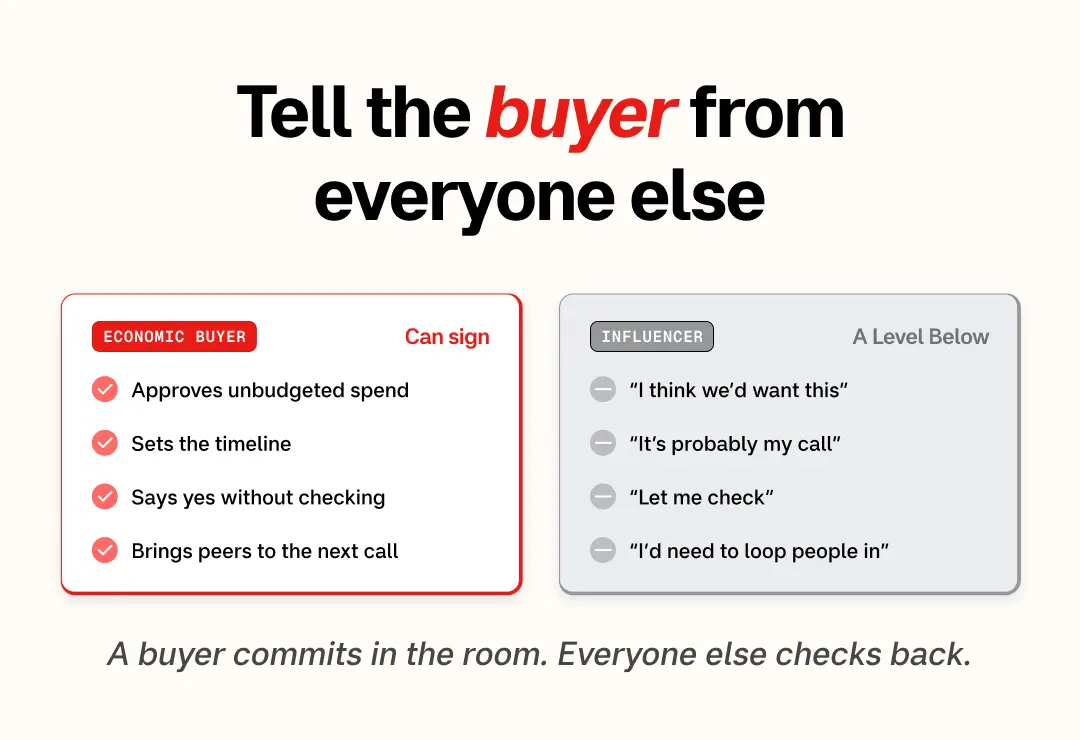
A decision-maker controls the budget and gives final sign-off. In most B2B deals the decision runs through a buying committee, and only one or two people in it can approve the purchase. The others are easy to mistake for the buyer:
Economic buyer. Owns the budget and the final yes. Your target.
Champion. Sells you internally, but rarely approves spend alone.
Influencer. Shapes the decision without controlling the budget.
Gatekeeper. Controls access, an assistant, a procurement contact, or a junior evaluator, and can stall you.
The economic buyer has one power the others lack: they can approve spend that was never budgeted, move money across the org, and say yes when everyone else can only say maybe. Working the whole committee is a separate discipline, covered in our guide to stakeholder mapping. This guide is about pinpointing and reaching the person who signs.
How to Confirm You Have the Real Decision-Maker
To confirm you have the real decision-maker, test for authority instead of trusting the title. Three checks do it.
Listen for hedging
People without final authority soften their claims: "I think we'd want this," "it's pretty much my call," "I'd need to loop a few people in." Commitment language points to authority; hedging points to someone a level below the budget.
Ask how the purchase gets approved
"Are you the decision-maker?" gets a yes from almost everyone. A better question is how the money moves:
"Walk me through how a purchase like this gets signed off, and who weighs in."
The sequence they describe gives you the real structure of the deal, and often a CFO or VP you were not yet working. Confirm it early on your discovery calls rather than at the finish line.
Watch what they can commit to
A buyer can pull a budget line, set a timeline, or bring peers to the next call.
Test it with a small ask that has a cost: a slot in the next budget review, or a follow-up with the CFO this week. Someone with real authority agrees in the room. A contact who has to check back on every step is a qualification flag worth catching early.
Where to Find the Decision-Maker
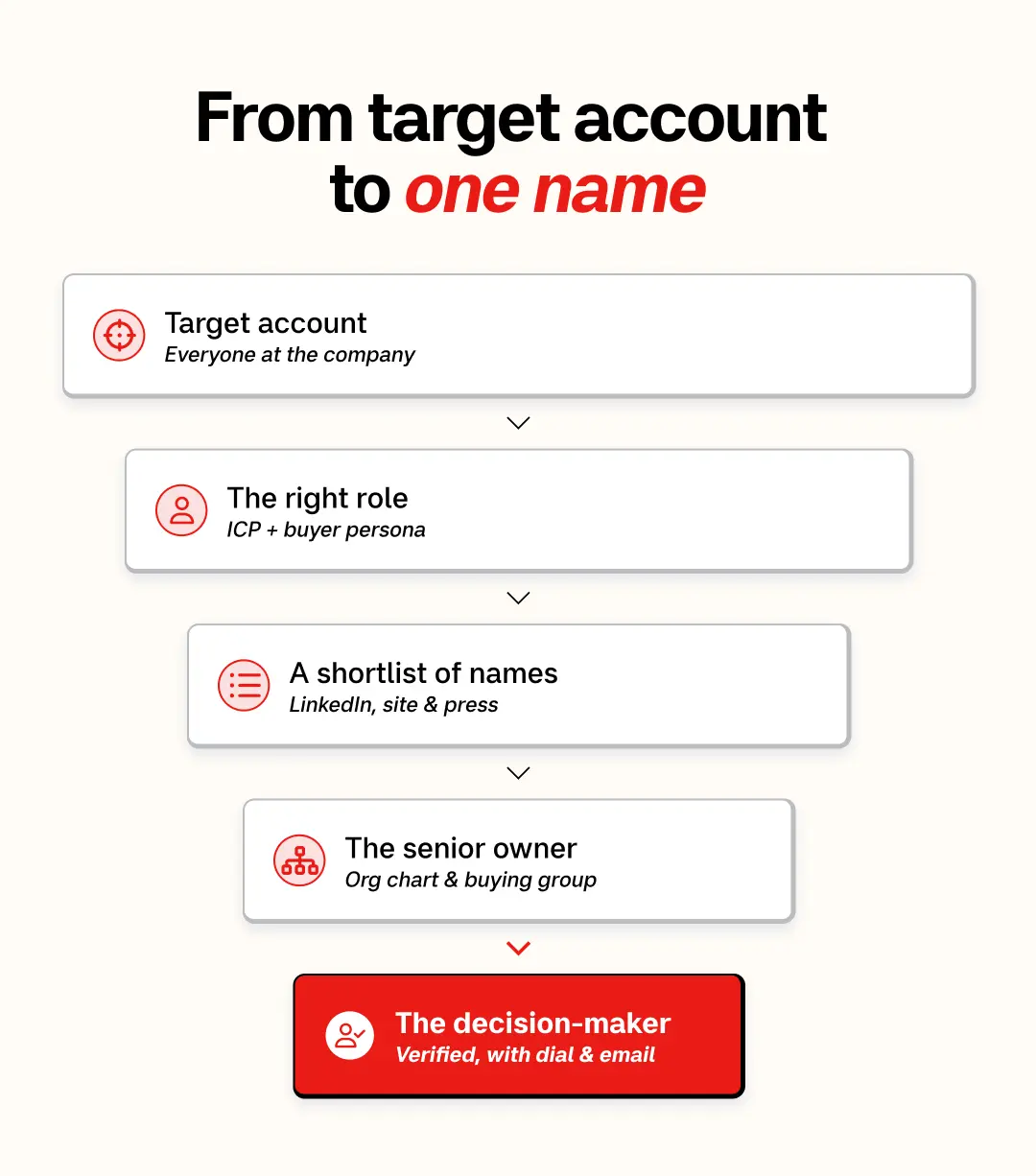
To find the decision-maker, work from the role down to a name.
Define the role
Your ideal customer profile and buyer persona tell you which function and seniority owns your category. Titles shift by company, so the play that works when selling to CIOs needs reframing when selling to CFOs or the wider C-suite.
Do the research
Filter LinkedIn by title and department, read the company's leadership and investor pages, and note who is quoted about your function in press and news, since a public quote often marks the owner. A former employee who recently left the team is worth a message too, as they will usually tell you who holds the budget now. These methods work, but they are slow and date quickly.
Use an org chart
An org chart and verified buying-group data show reporting lines, the senior owner above your contact, and the gatekeepers in between, in one view instead of ten browser tabs.
The research pays off in hard numbers. Florin Tatulea, ZoomInfo's GTM Engineer in Residence, writes in his Context Layer Digest newsletter that his best SDR booked around 15% of net-new accounts a quarter, against a 3-to-4% norm, by mapping who owned the decision before reaching out.
How to Get Past a Gatekeeper
To get past a gatekeeper, ask about the approval process. A direct "who is in charge of this?" prompts a gatekeeper to block you, while a logistics question like "where would a proposal like this go for sign-off?" reads as helpful and often gets you pointed to the buyer.
You can also avoid the gate. A verified direct dial and work email let you open a conversation with the decision-maker directly, which is why teams pair cold calling with a real contact database instead of the numbers listed on a company site.
Keep the Contact Data Current
Keep your contact data current, because the right name is useless if it points at who someone used to be. People change roles constantly, and a record that looks perfect can be pointing at someone who has already left. Tatulea describes the cost of acting on a stale record:
"I've had reps call me about my previous company, six months after I left. You've lost the buyer's trust before you've said a word."
Confirm the person is still in the seat, and keep your contact data refreshed so the buyer you found last quarter is still the buyer today.
How to Reach the Decision-Maker at the Right Time
To reach the decision-maker at the right time, act on change. The strongest buyer is one with budget and a reason to move now: funding puts money in play, a new executive rebuilds the stack in their first 90 days, and a spike in buyer intent means a decision is forming.
A signal points to an account, but it does not name the person. As Tatulea writes:
"A signal alone is noise. A signal in context is a reason to act."
Resolve the trigger to the real buyer, then move fast. Tatulea reports that acting on a web visit within about 20 minutes makes booking a meeting two to three times more likely, and he is blunt about the cost of waiting:
"Call the new CFO seven months after they joined and the budget conversation already happened without you."
Most shortlists are set in a two-to-four-week window, so pair the right name with the moment and follow up across the committee with a multi-threaded prospecting motion.
Common Decision-Maker Mistakes
Even strong reps lose deals to a few repeatable errors. Watch for these:
Trusting a champion's enthusiasm. Someone who loves your product but can't unlock budget will only carry the deal so far. Keep the champion close, but confirm who signs the purchase before you treat their excitement as a yes.
Mistaking gatekeeper access for progress. Time with an assistant or a junior evaluator feels like movement, yet the deal sits still until you reach someone who can approve. Use the gatekeeper to map the process, then get to the buyer.
Building on a stale record. People change roles constantly, so a name that looks right can point at someone who left months ago. Verify the contact is current before you invest in outreach, or the whole plan targets a ghost.
Reaching the buyer too late. Most shortlists are set in a two-to-four-week window, so even a strong message that arrives after the evaluation has started lands on a decision already forming without you. Act on the trigger while it is fresh.
Asking "are you the decision-maker." Almost everyone says yes. Ask instead how a purchase like this gets approved and who signs off, and the real decision-maker surfaces on their own.
How ZoomInfo Helps You Find the Right Decision-Maker
The three gaps that stall the hunt, seeing who owns the decision, trusting the record, and reaching the buyer in time, are what ZoomInfo, the all-in-one AI GTM Platform, is built to fix.
See who owns the decision. Open the org chart and buying-committee data for an account and the guesswork disappears: you see the senior owner above your first contact, the gatekeepers in between, and a shortlist of recommended contacts, so your time goes to the person who signs.
Reach the current buyer directly. Every contact carries a verified direct dial and work email, from a foundation of 500M+ contacts, 120M+ direct dials, and 200M+ business emails that is continuously reverified, so you open the conversation with the person in the seat today rather than working past an assistant or dialing a number that no longer connects. When a decision-maker leaves or a new one steps in, Scoops flag it, so your outreach never lands on someone who moved on.
Act while the window is open. The GTM Context Graph processes 1.5B+ data points a day to fuse intent, CRM, and behavioral signals, so you see which accounts are in-market and reach the buyer while the decision is forming, before the shortlist is set.
Find decision-makers with an AI agent. Connect ZoomInfo to the AI tool your team already uses through its MCP server, and account research runs on verified ZoomInfo data instead of a web summary. Ask an assistant like Claude to prospect for the decision-maker at a target account and it returns the right title, a verified dial and email, and a flag when someone new steps into the role, running the manual research from this guide for you.
ZoomInfo is free to start with consumption credits based on usage, so teams can prove the motion before they commit.
Turning the Right Contact Into Pipeline
Finding the right decision-maker comes down to three habits: test for real authority before you trust a title, verify the name is current before you commit, and reach the buyer while budget and timing are still live.
That is the gap ZoomInfo fills, org-chart and buying-group data to find the real buyer, verified dials and emails to reach them, and signals to act while the window is open.
See how ZoomInfo helps you find and reach the right decision-maker. Book a demo.
Frequently Asked Questions
How do you know if you're talking to the real decision-maker?
Test for authority rather than asking directly, since almost everyone claims to be the decision-maker. Listen for hedging language like "I think" or "it's probably my call," which points to someone below the budget line. Then ask them to walk you through the approval process: who signs off, in what order, and what happens between their yes and a signed contract. The sequence tells you whether you are with the economic buyer or a step away.
What is the difference between a decision-maker and an influencer?
The decision-maker, or economic buyer, controls the budget and gives final sign-off. An influencer shapes the decision with a respected opinion but can't approve the spend. Both matter, and you often win the buyer by first winning influencers and a champion, but an influencer's enthusiasm is not authority. The test: can this person approve unbudgeted spend and say yes when others can't? If not, they are an influencer.
How do you get past a gatekeeper to reach the decision-maker?
Ask about the approval process rather than the person. A direct "who is in charge of this?" prompts a gatekeeper to block you, while a logistics question like "where would a proposal like this go for sign-off?" reads as helpful and often gets you pointed to the buyer. You can also hold a verified direct dial and email for the decision-maker and start the conversation directly, without depending on the gate.
What if my main contact isn't the decision-maker?
Convert them into a champion. A contact without budget authority can still tell you how the decision gets made, who is involved, and what the buyer cares about, then introduce you. Give them what they need to make your case internally, and ask directly for a warm introduction to the economic buyer. A well-briefed champion is often the fastest route to the person who signs.
What job titles are usually the decision-maker?
It depends on deal size. Departmental purchases are often owned by a director or VP of that function, while larger or strategic deals pull in C-suite titles like the CFO, CIO, or CRO. Titles are inconsistent across companies, so treat them as a starting point and confirm budget ownership through an org chart and a direct conversation about how spending gets approved.
