
Sendinblue rebranded to Brevo in 2023 to mark its shift from an email tool to a broader customer platform. We use Brevo throughout this article.
Choosing between HubSpot and Brevo for your marketing and CRM comes down to five questions:
Do you need a customer platform that connects marketing, sales, and service, or a marketing execution tool at a lower price?
Is your team's biggest challenge automating complex workflows, or reaching customers across more channels for less money?
Does your budget support per-seat CRM pricing with mandatory onboarding fees, or do you need send-volume pricing with unlimited contacts?
Are you a B2B team whose results depend on finding the right accounts and decision-makers before campaigns launch?
How important is it that your marketing data, sales pipeline, and service tickets share the same database?
In short, here's what we recommend:
HubSpot is the customer platform for teams that want marketing, sales, service, content, and commerce connected through a single database. Its Smart CRM ties every hub together so a lead captured by marketing flows into a sales pipeline without manual handoffs, and a closed deal feeds into service without re-entering data.
With 288,706 customers across 135+ countries and over 2,000 app integrations, HubSpot is hard to outgrow. But costs escalate: per-seat pricing, per-hub licensing, mandatory onboarding fees at Professional and Enterprise tiers, and a rule that all Core Seats are billed at the highest subscription tier rate when you mix hub tiers across departments.
Brevo is the multichannel marketing platform for teams that need email, SMS, WhatsApp, push notifications, and basic CRM at lower cost. Brevo charges by emails sent, not contacts stored, and contacts are unlimited on every plan, including the permanent free tier.
For businesses with large lists and moderate sending volumes, this model can save thousands annually. Brevo also includes transactional email on all paid plans (order confirmations, password resets, shipping alerts), while HubSpot requires separate configuration for transactional sends. But Brevo's marketing automation and reporting lack depth compared to HubSpot, and its CRM is still catching up.
Both platforms give you tools to execute campaigns and manage customer relationships. But for B2B teams, campaign effectiveness depends on something neither provides on its own: knowing which companies are researching solutions like yours, who the decision-makers are, and how to reach them with verified contact data. That intelligence gap is where deals are won or lost before a single email goes out.
ZoomInfo is a B2B intelligence and GTM platform that provides the data foundation both HubSpot and Brevo lack. It tells your team which companies are researching your category, who the decision-makers are in each account, and how to reach them with verified contact information.
That intelligence sits on a database of 500M contacts and 100M companies, 135M+ verified phone numbers, and 200M+ verified business email addresses, along with buyer intent signals that identify in-market accounts before they fill out a form.
ZoomInfo's GTM Context Graph (an intelligence layer that fuses this data with your CRM records and conversation transcripts) reveals not just what happened in a deal, but why. ZoomInfo integrates with HubSpot and delivers its intelligence into any platform through APIs and MCP, so the data works wherever your team does.
If your B2B campaigns need better targeting data and real-time buying signals, see what ZoomInfo delivers.
HubSpot vs. Brevo vs. ZoomInfo at a glance
HubSpot | Brevo (Sendinblue) | ZoomInfo | |
|---|---|---|---|
Core function | CRM + marketing + sales + service platform | Multichannel marketing automation + basic CRM | B2B data intelligence + GTM execution |
Marketing automation | Advanced visual workflows with branching logic | Visual workflows; multichannel but simpler logic | AI-powered GTM plays via GTM Studio |
CRM depth | Full CRM with deal pipelines, forecasting, custom objects | Basic deal pipelines; maturing CRM | GTM Workspace for AI-driven sales execution |
B2B contact data | Stores contacts you capture | Stores contacts you capture | 500M contacts, 100M companies; verified direct dials and emails |
Buyer intent signals | Not native | Not native | 210M IP-to-Org pairings; Guided Intent |
Channels | Email, social, ads, chat, forms | Email, SMS, WhatsApp, push, wallet, chat, phone | Email, phone, ads, chat; multi-channel orchestration via GTM Studio |
Pricing model | Per seat + per hub + marketing contacts | Per email volume; unlimited contacts | Consumption-based; custom-quoted |
Starting price | $20/seat/month (Starter) | $9/month (Starter, 5K emails) | Custom-quoted; free trial available |
Free plan | Permanent; unlimited contacts, 2 users max | Permanent; 300 emails/day, unlimited contacts | ZoomInfo Lite (permanent); 10 monthly export credits |
HubSpot covers the full customer lifecycle; Brevo focuses on marketing execution
The most important difference between HubSpot and Brevo is scope.
HubSpot operates six interconnected hubs: Marketing, Sales, Service, Content, Data, and Commerce, all built on a shared Smart CRM. When a prospect fills out a form, that record is immediately available to the sales team.
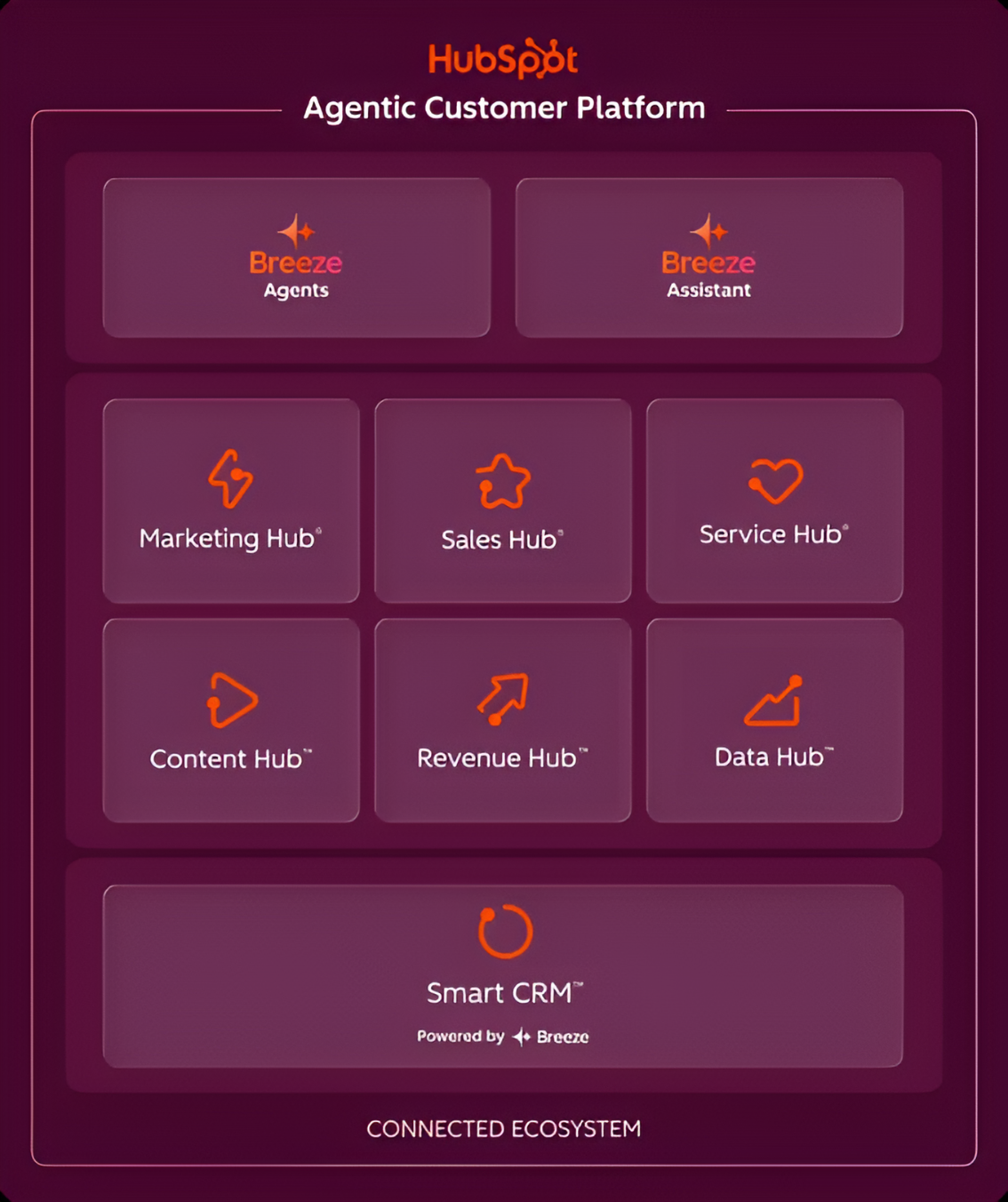
Source: HubSpot
When a customer submits a support ticket, the service team sees every marketing touchpoint and deal that preceded it. This shared context eliminates the manual data transfers that plague fragmented stacks.
Brevo covers email marketing, SMS, WhatsApp, web and mobile push notifications, live chat, VoIP phone, and a built-in CRM with deal pipelines. The channel breadth is notable for the price.

Source: Brevo
But Brevo lacks the depth HubSpot offers in service management, content creation, commerce, and data operations. If you need ticketing with SLA management, a built-in CMS, or CPQ for quotes and invoicing, HubSpot has native tools for all of them.
For B2B teams, both platforms share a bigger gap. They manage and engage contacts already in your database. Neither helps you find the right contacts in the first place. They record the state of your pipeline (which deals are in which stage) but cannot tell you which companies are researching your category, who the decision-makers are, or which buying signals should trigger outreach.
ZoomInfo fills that gap. While HubSpot and Brevo manage the contacts in your database, ZoomInfo tells you which contacts belong there. Its Contact & Company Search spans 300+ company attributes for market segmentation, with 120M direct-dial phone numbers and 200M+ verified business email addresses reaching up to 95% accuracy.
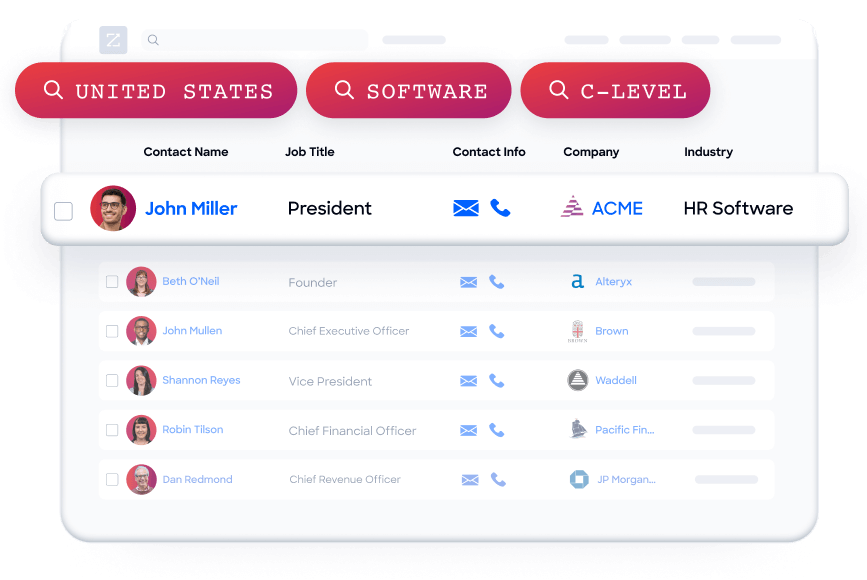
Source: ZoomInfo
Through GTM Studio, marketers and RevOps teams can define audiences in natural language, enrich them with first- and third-party data, and launch multi-channel plays without engineering support.
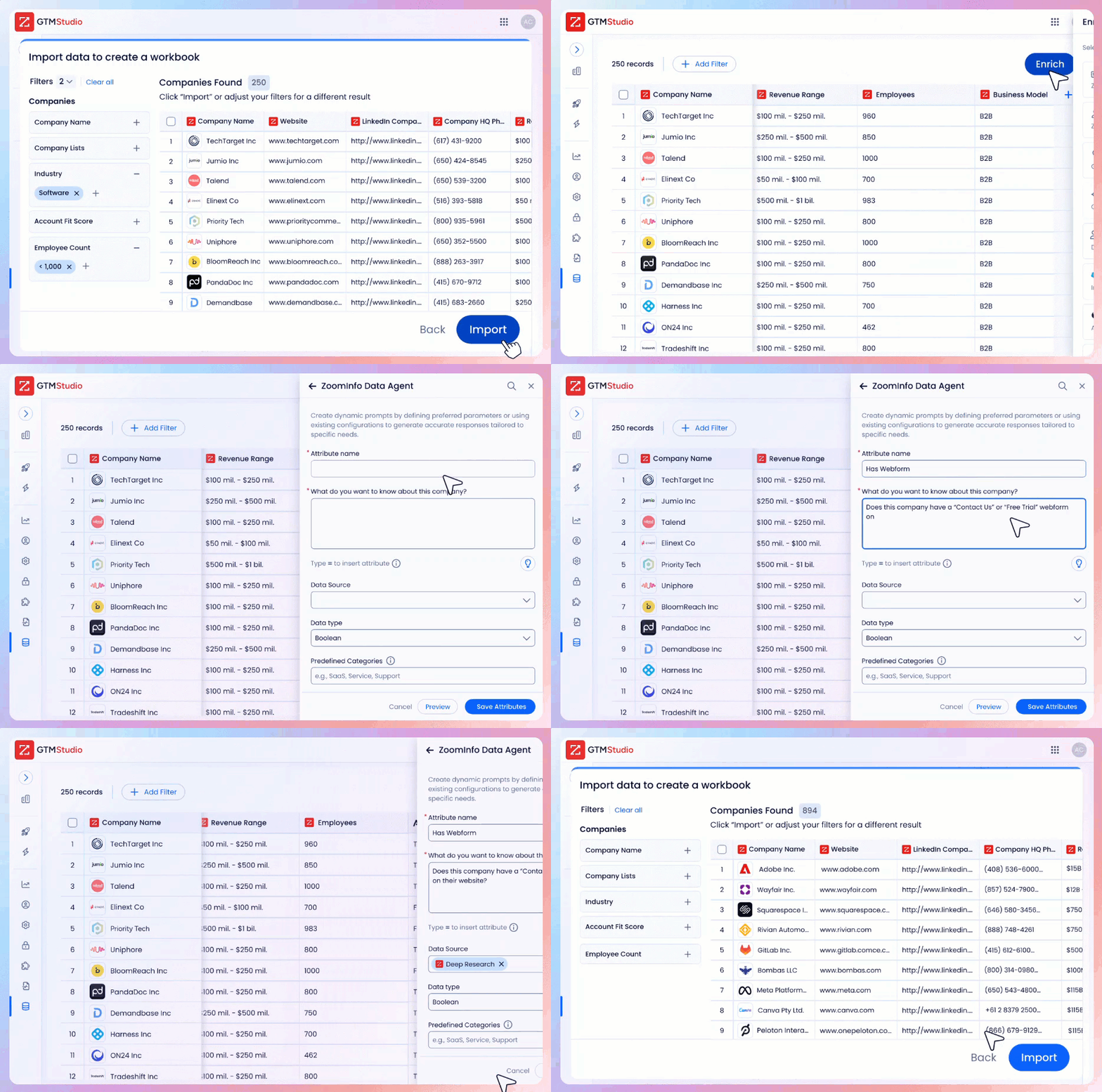
Source: ZoomInfo
SpringDB used ZoomInfo data for precise client targeting, achieving 2x–3x higher campaign conversions, a 300% increase in database usability, and 30–50% larger average deal size. (SpringDB)
Marketing automation: Brevo offers surprising channel breadth
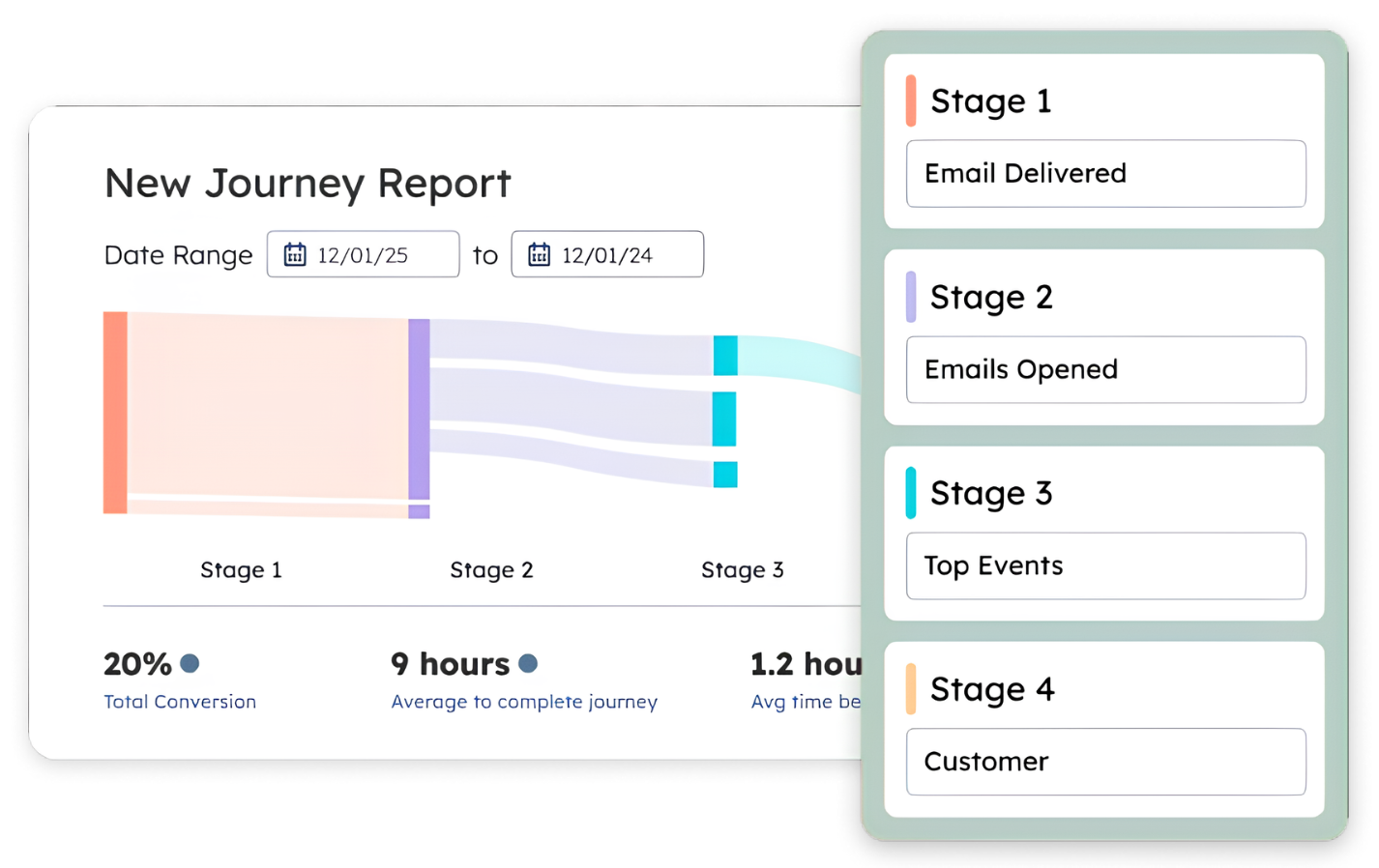
HubSpot's Marketing Hub provides a visual workflow builder with branching logic, behavioral triggers, and multi-step nurture sequences. Workflows fire based on contact behavior, lifecycle stage changes, form submissions, or deal movements.
Source: HubSpot
Because the automation draws on HubSpot's CRM, workflows use sales and service data, not just email engagement. HubSpot also supports programmable automation (custom JavaScript and Python code inside workflows) at Enterprise tier, opening up complex integrations without external middleware.
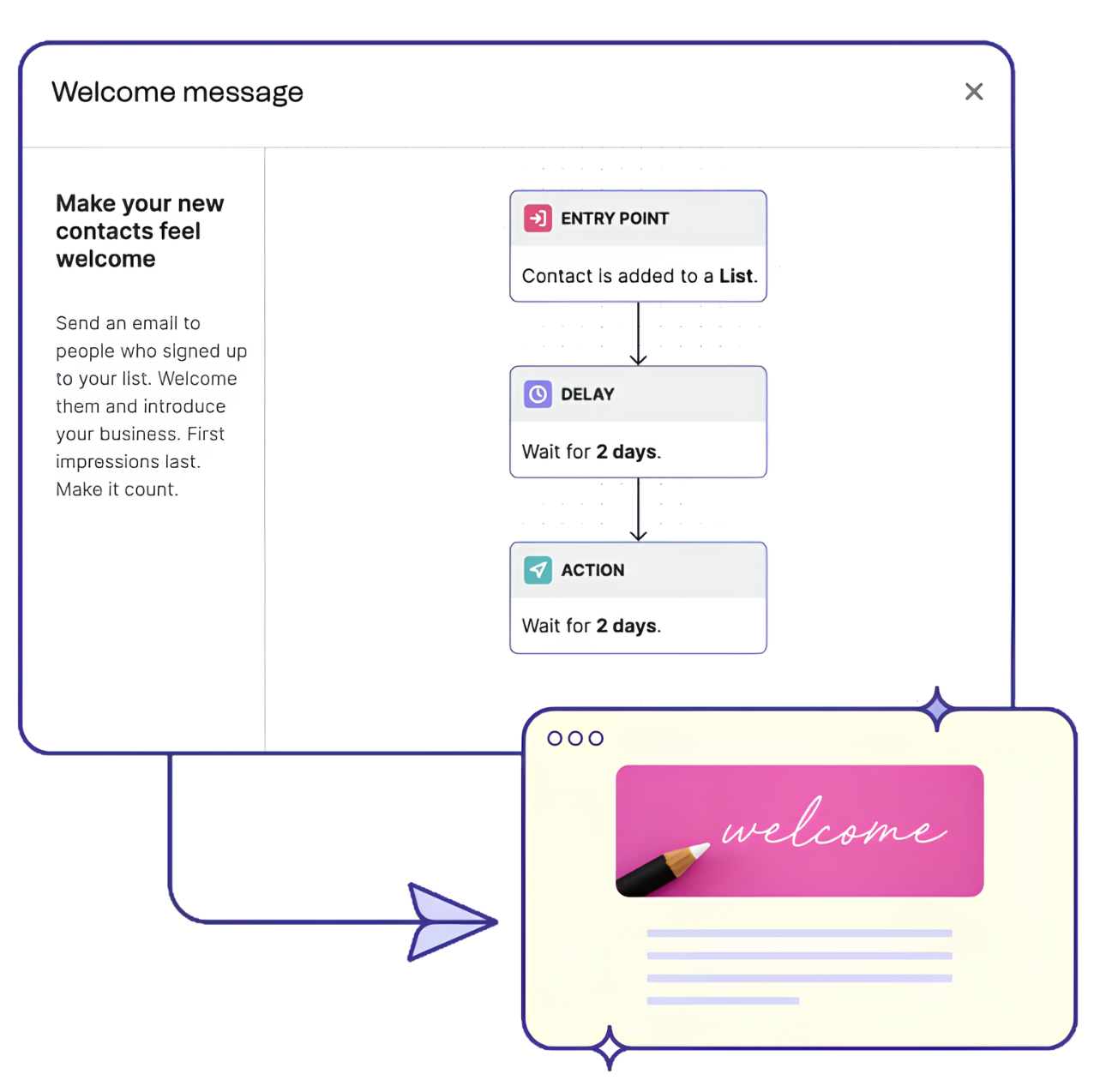
Brevo's automation platform is simpler in logic but broader in channel coverage. A single workflow can send an email, wait for a response, then send an SMS follow-up or a WhatsApp message, all from one editor. Brevo is a certified WhatsApp Business Solution Provider with direct API access, not a third-party relay.
Source: Brevo
For ecommerce teams running abandoned cart recovery, Brevo cites 10–15% revenue increases from these workflows. The free plan includes automation for up to 2,000 contacts with no credit card required.
Where Brevo falls short is sophistication. HubSpot supports complex conditional branching, predictive lead scoring, custom objects in workflows, and programmable automation. Brevo handles the basics well but hits limits with dynamic segmentation or multi-path conditional logic. Users on G2 and Capterra consistently flag automation complexity as a limitation.
For B2B teams, both platforms share the same constraint: they can only automate against contacts already in the database. If your marketing automation fires a nurture sequence to every "VP of Finance," it reaches only the VPs you already know.
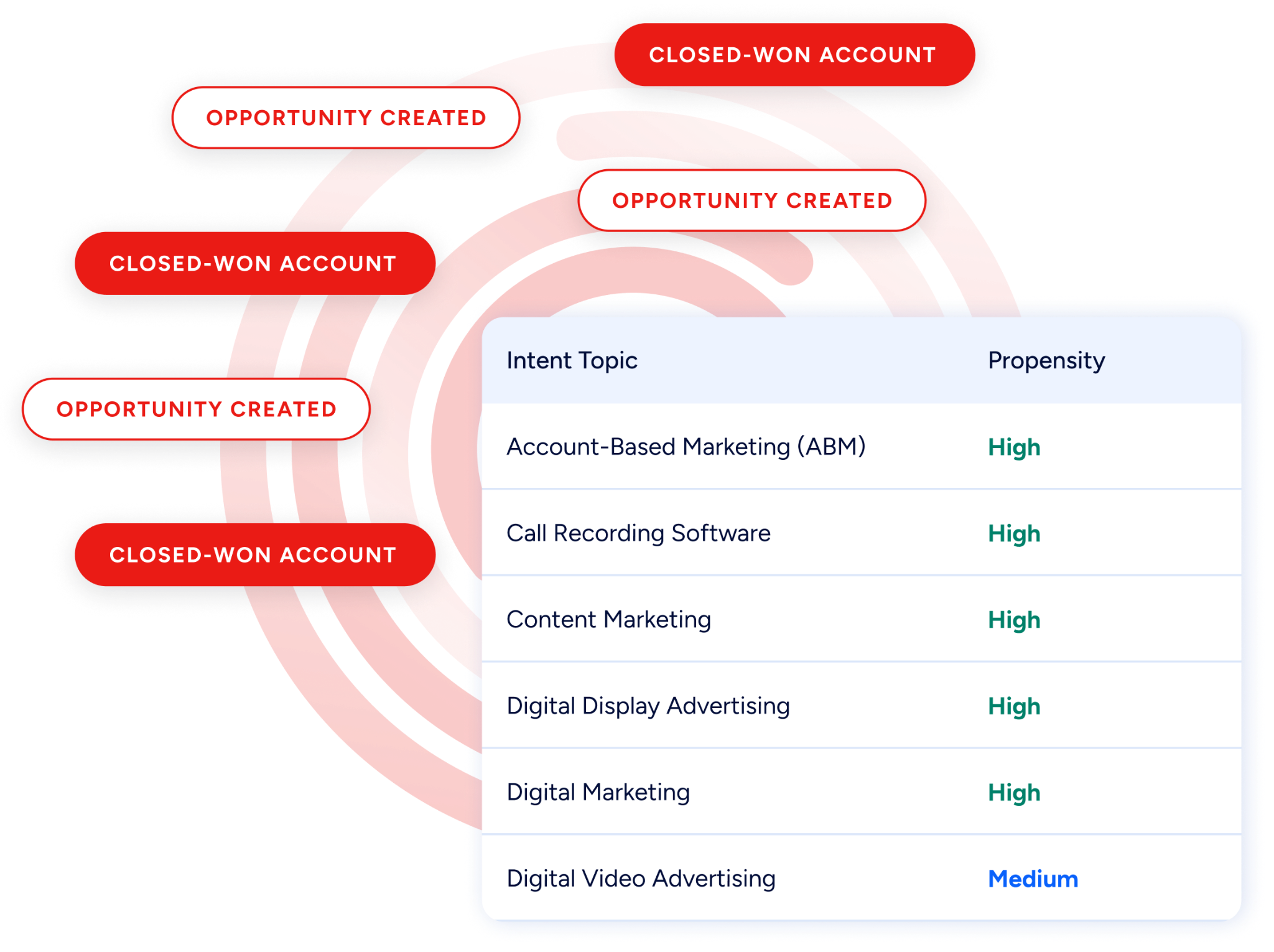
ZoomInfo's buyer intent data identifies companies researching relevant topics from 210 million IP-to-Organization pairings and 6 trillion+ new keyword-to-device pairings sourced monthly. That signal can trigger a GTM play in GTM Studio before HubSpot or Brevo even has the contact in its database.
Source: ZoomInfo
CRM and sales tools: HubSpot leads, Brevo is catching up
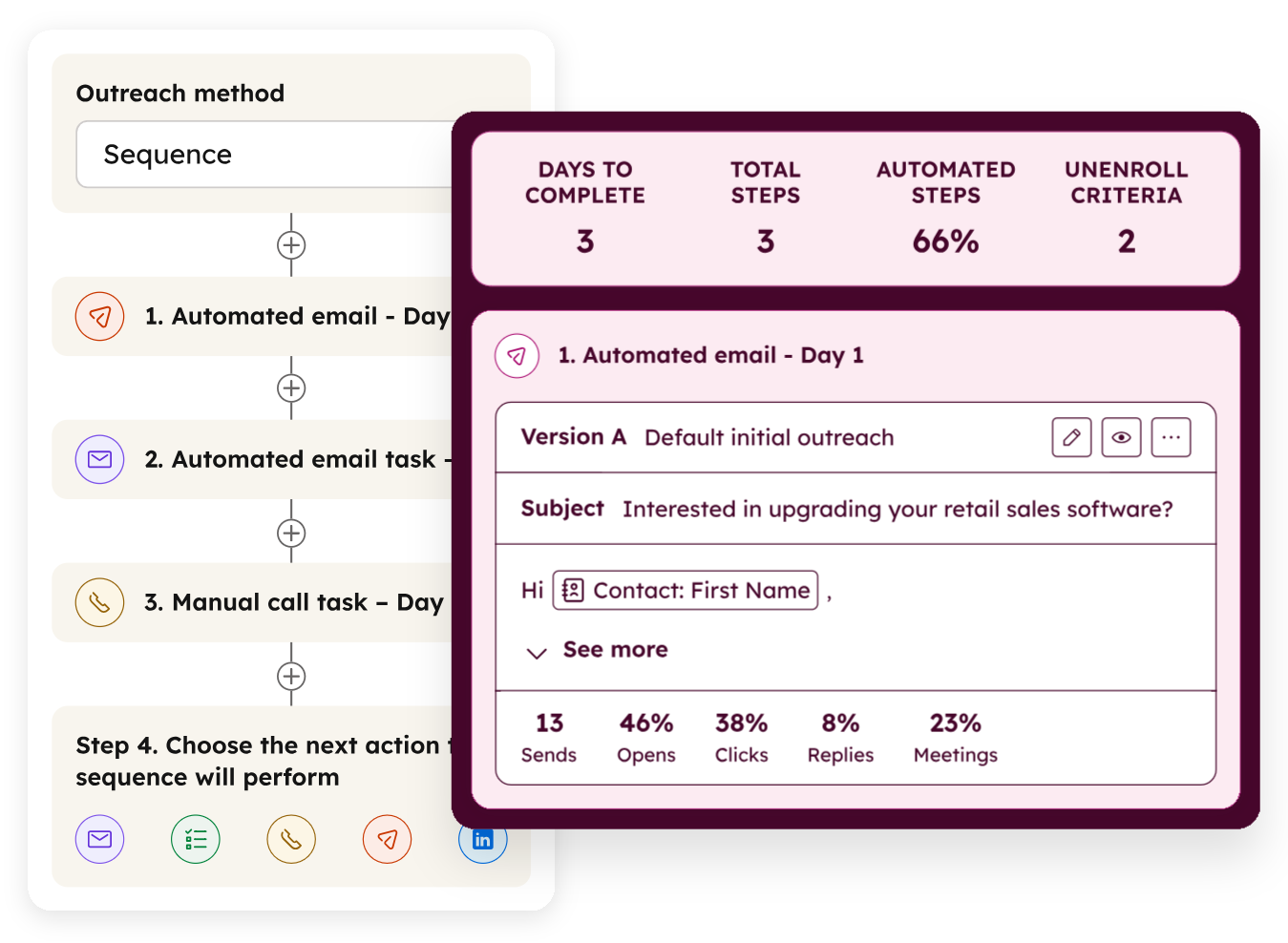
HubSpot's Sales Hub is a mature CRM with customizable deal pipelines, sequences for multi-step outreach, conversation intelligence, AI-powered forecasting, and CPQ for quote generation.
The Breeze Prospecting Agent drafts personalized outreach using the full CRM history, including won deals, support tickets, and marketing engagement. Sales is integrated with marketing and service, so a rep can see every blog post a prospect read, every support ticket they filed, and every email they opened.
Source: HubSpot
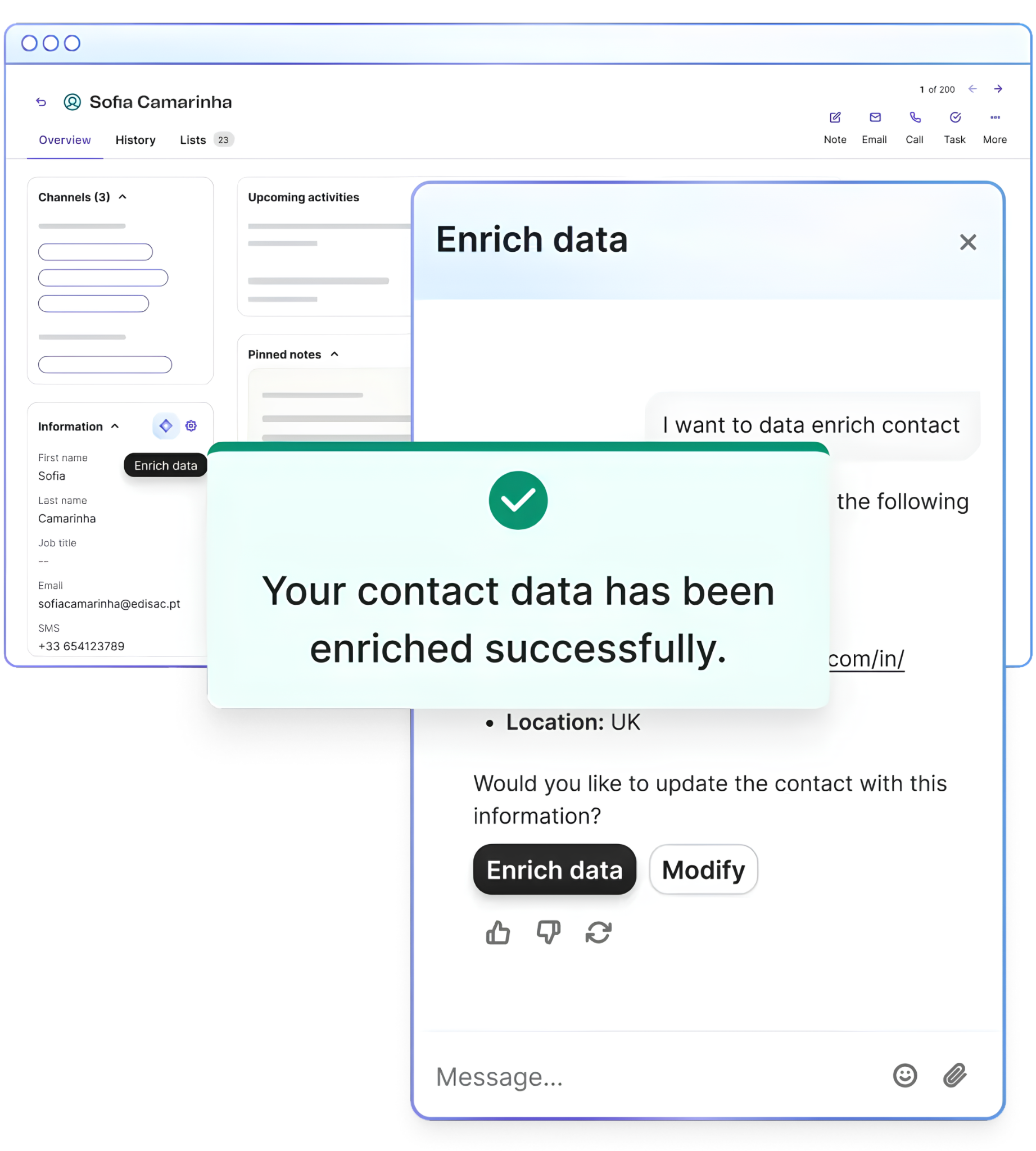
Brevo's Sales Platform provides basic deal pipelines, meeting scheduling, live chat, and a cloud-based phone with call transcripts and AI summaries. The Sales Free tier (included on base Brevo plans) supports 50 open deals and one pipeline at no extra cost.
Source: Brevo
For small teams with straightforward sales processes, that is real value at a fraction of HubSpot's price. But Brevo's CRM lacks custom objects, advanced forecasting, and the sales automation depth HubSpot provides at Professional and Enterprise tiers.
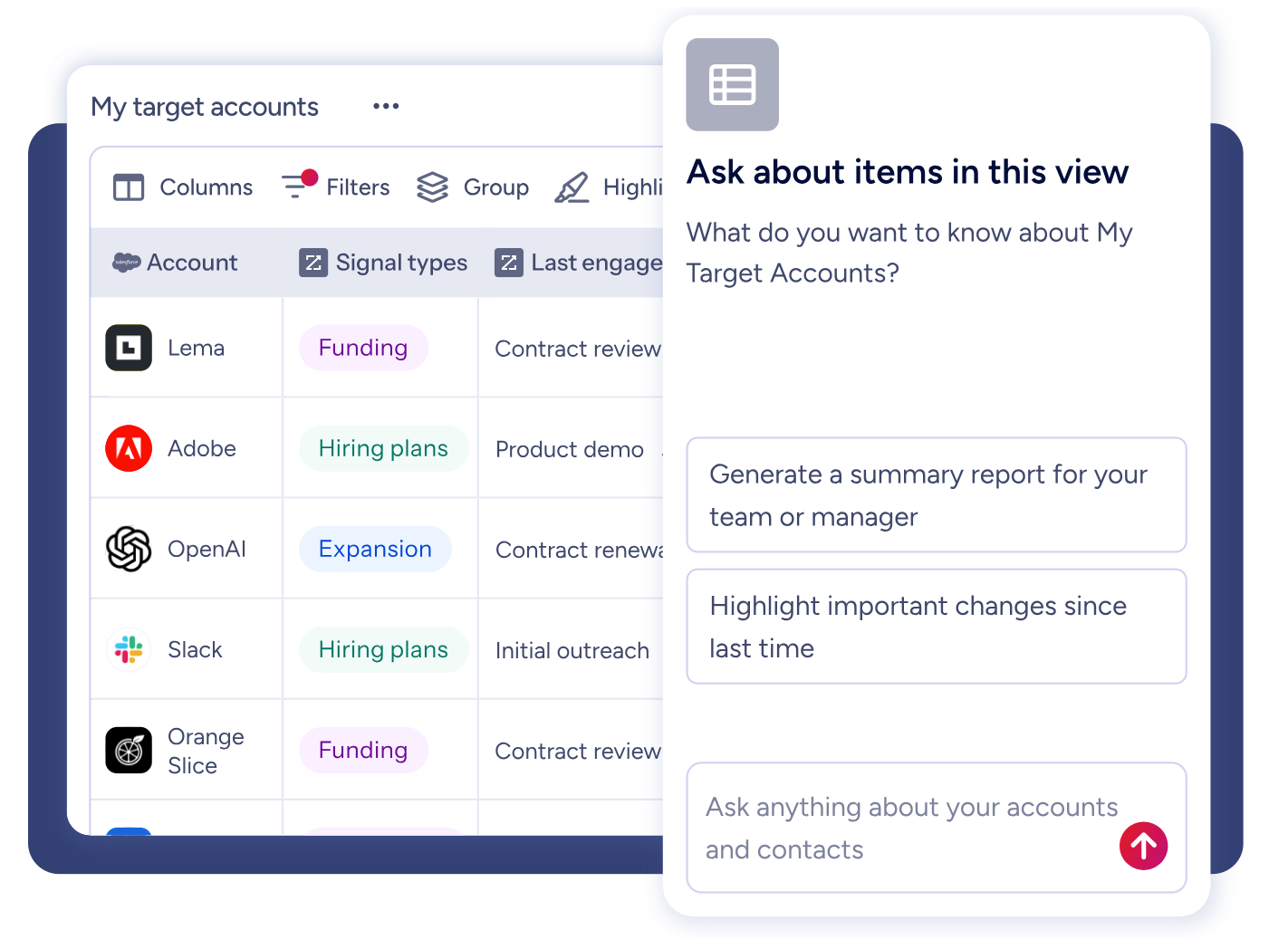
ZoomInfo approaches sales from the intelligence side. GTM Workspace gives sellers a single view of their book of business, combining CRM data, ZoomInfo contact intelligence, conversation history, and real-time market signals. AI agents handle account research, outreach drafting, CRM updates, and signal monitoring.
Source: ZoomInfo
The difference is what the system knows before a rep picks up the phone: which accounts show buying intent, who the hidden stakeholders are, and what patterns from thousands of similar deals suggest will happen next.
Seismic's sales team attributed 39% of active pipeline to opportunities identified or influenced by ZoomInfo signals, boosted productivity by 54%, and saved 11.5 hours per week. "That combination of our internal CRM data, external signals, and AI that's given all that context has helped us craft very specific account- and persona-based messages." (Seismic)
For a focused comparison of HubSpot and ZoomInfo on CRM and sales features, see our HubSpot vs. ZoomInfo breakdown.
The data quality gap both platforms share
HubSpot and Brevo both organize and activate the data you feed them well. But neither is designed to source, verify, or continuously refresh B2B contact data.
HubSpot's free CRM stores unlimited contacts (up to 1M records per standard object), but those contacts are only as good as what your forms capture and your team enters. Brevo stores unlimited contacts across all plans, with the same dependency on data your team brings in.
For B2B teams, this creates a compounding problem. Contact data decays as people change jobs, companies restructure, and email addresses go stale. Campaigns sent to bad data damage sender reputation. Sales teams waste hours chasing contacts who left months ago.
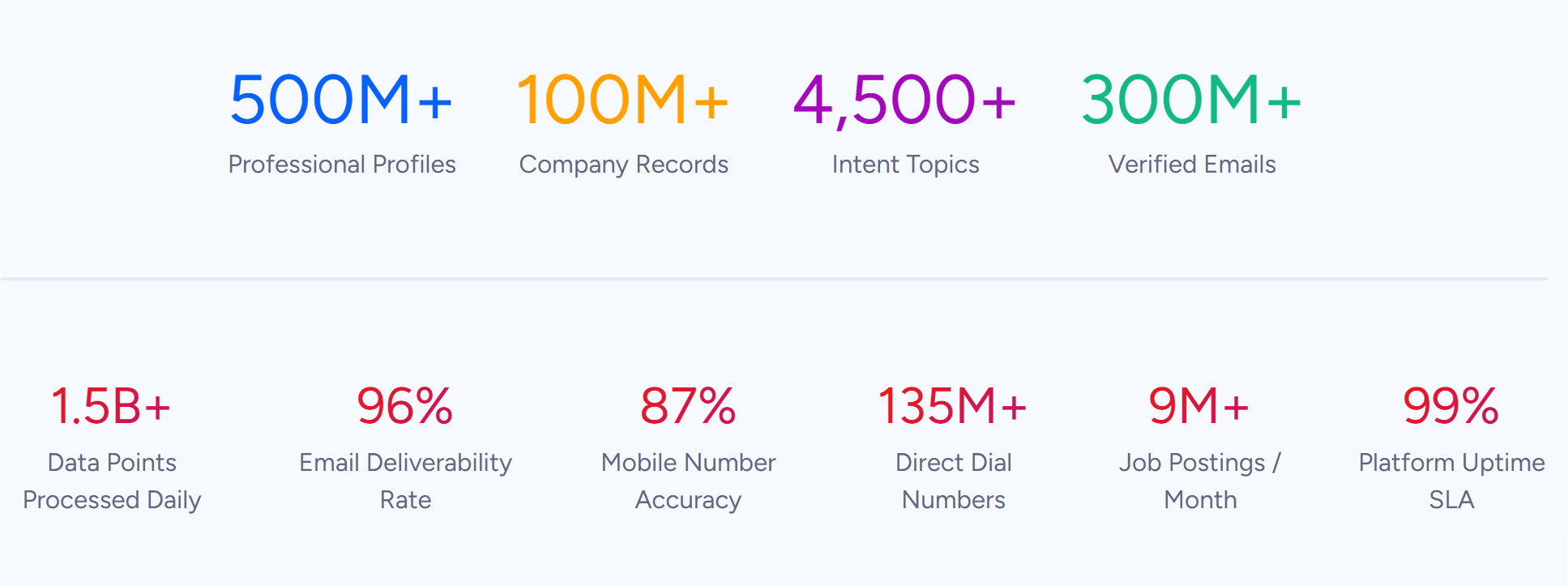
ZoomInfo was built to solve this. Its data pipeline aggregates from four sources: automated ML scanning of 28 million site domains daily, third-party partner data covering 95 million businesses, a community of 200,000+ ZoomInfo Lite users who share data back, and an in-house Data Training Lab of 300+ human researchers. The result is continuously verified data reaching up to 95% accuracy on first-party data.
Source: ZoomInfo
Independent validators back this up. In a Fortune 500 competitive RFP analyzing 25 million contacts across vendors, the independent consultant concluded that "no other competitor came even close."
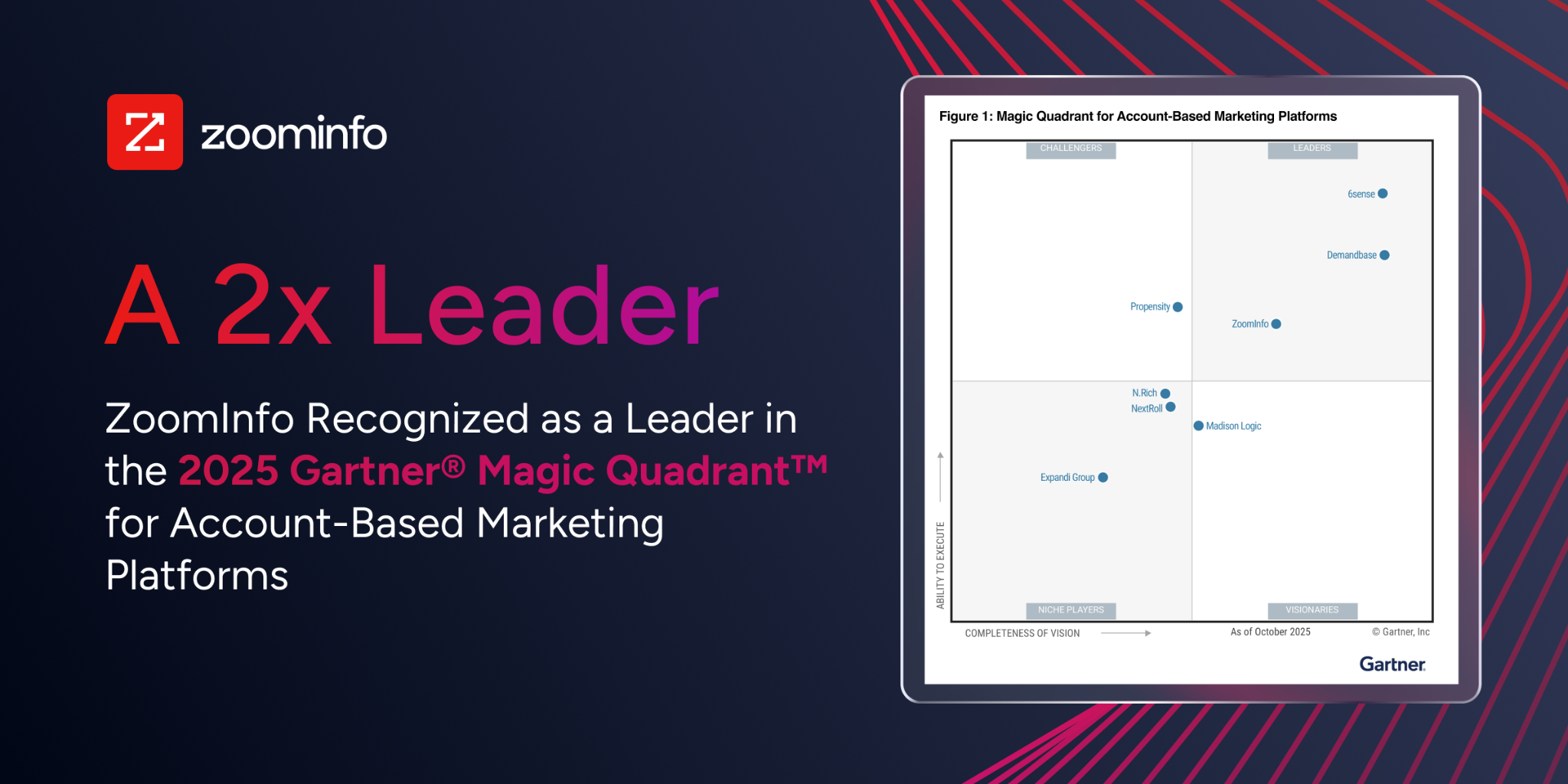
ZoomInfo has been named a Leader in the Gartner Magic Quadrant for ABM Platforms for two consecutive years and a Leader in the Forrester Wave for Intent Data Providers, receiving the highest possible scores across eight criteria.
Source: ZoomInfo
For HubSpot teams, ZoomInfo's native integration enriches CRM records automatically and keeps contact data fresh without manual research. For teams on other platforms, ZoomInfo's APIs and MCP deliver the same data programmatically.
AI features reflect each platform's DNA
All three platforms invest in AI, but their implementations reflect different priorities.
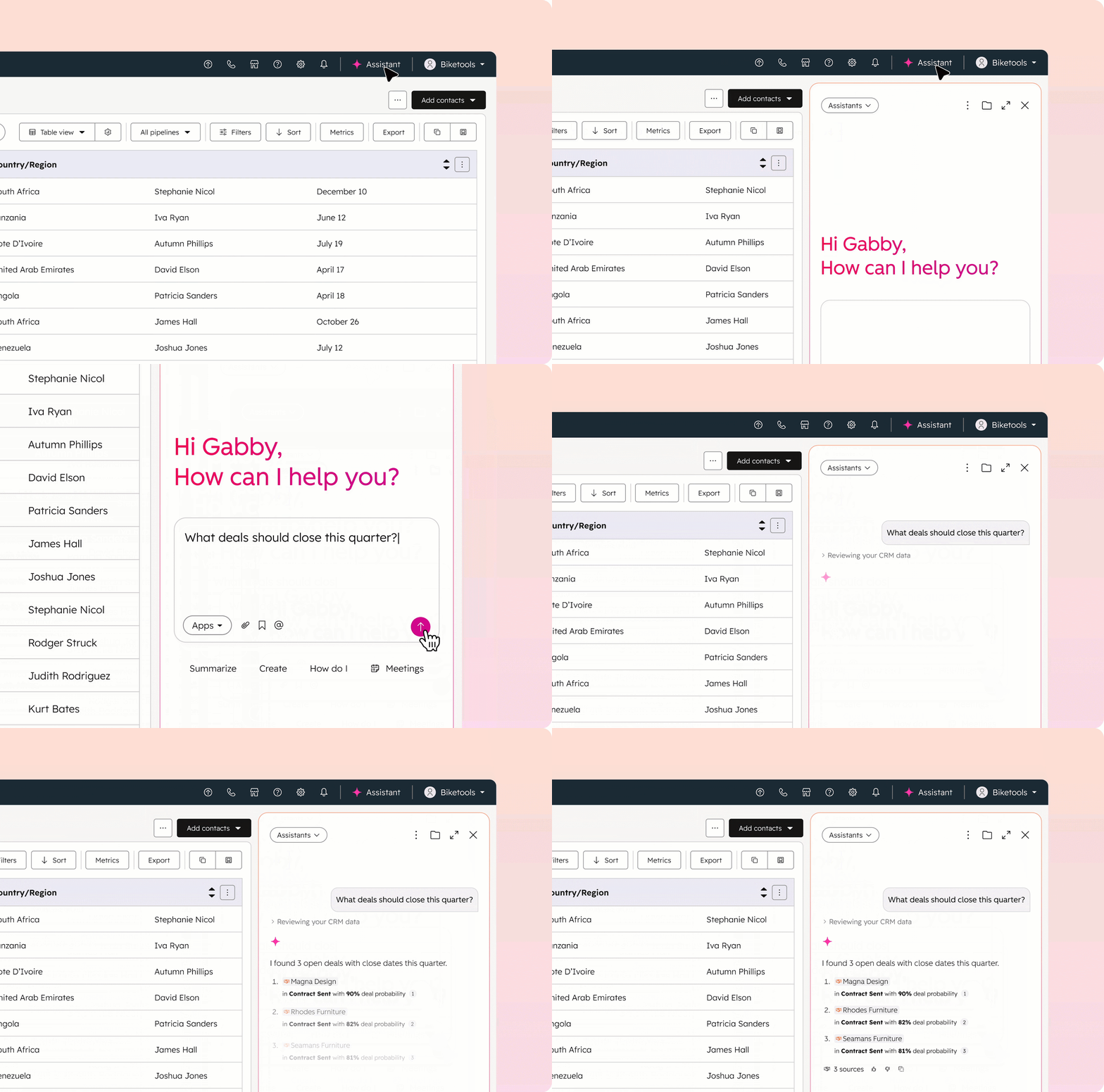
HubSpot's AI layer, Breeze, spans the full platform. It generates content, drafts emails, analyzes conversations, and powers autonomous agents across marketing, sales, and service. The Breeze Customer Agent resolves over 50% of customer conversations autonomously.
Source: HubSpot
The Breeze Prospecting Agent drafts personalized outreach using the full HubSpot customer history. But Breeze operates on whatever data your CRM already contains. Several Loop Marketing features (AI-Powered Segmentation, Personalization, Marketing Studio) are still in Beta, so HubSpot's most ambitious AI capabilities are not yet ready for broad enterprise use.
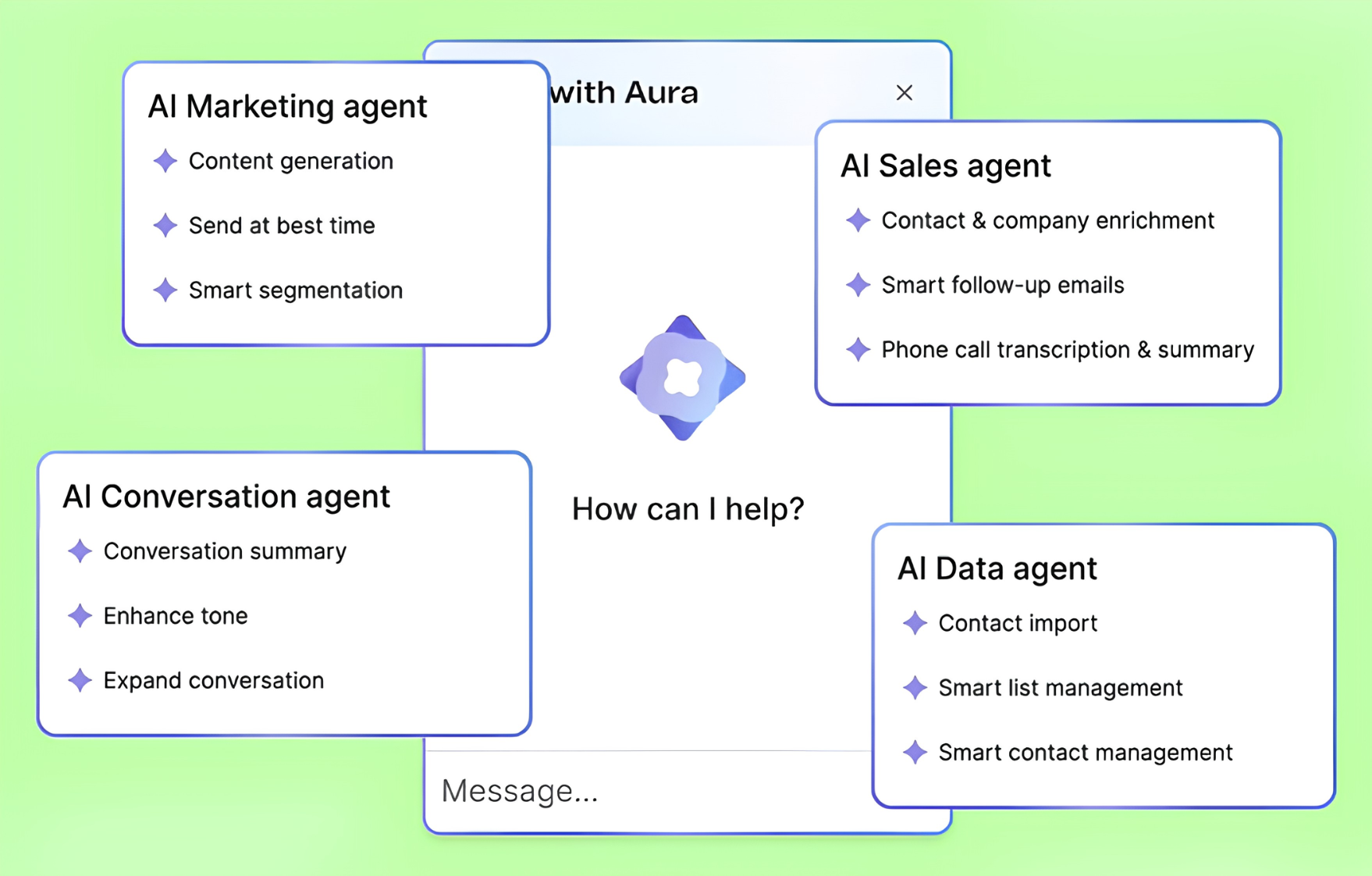
Brevo's AI layer, Aura, focuses on four agents: a Marketing Agent for content generation and send-time optimization, a Sales Assistant for contact enrichment and email drafting, a Data Analyst for natural-language queries, and a Conversations Agent for chat summarization.
Source: Brevo
Brevo has also launched an MCP server that connects its data to external AI assistants like Claude and ChatGPT. Brevo has committed €50M over five years to AI, signaling that its capabilities are early but funded.
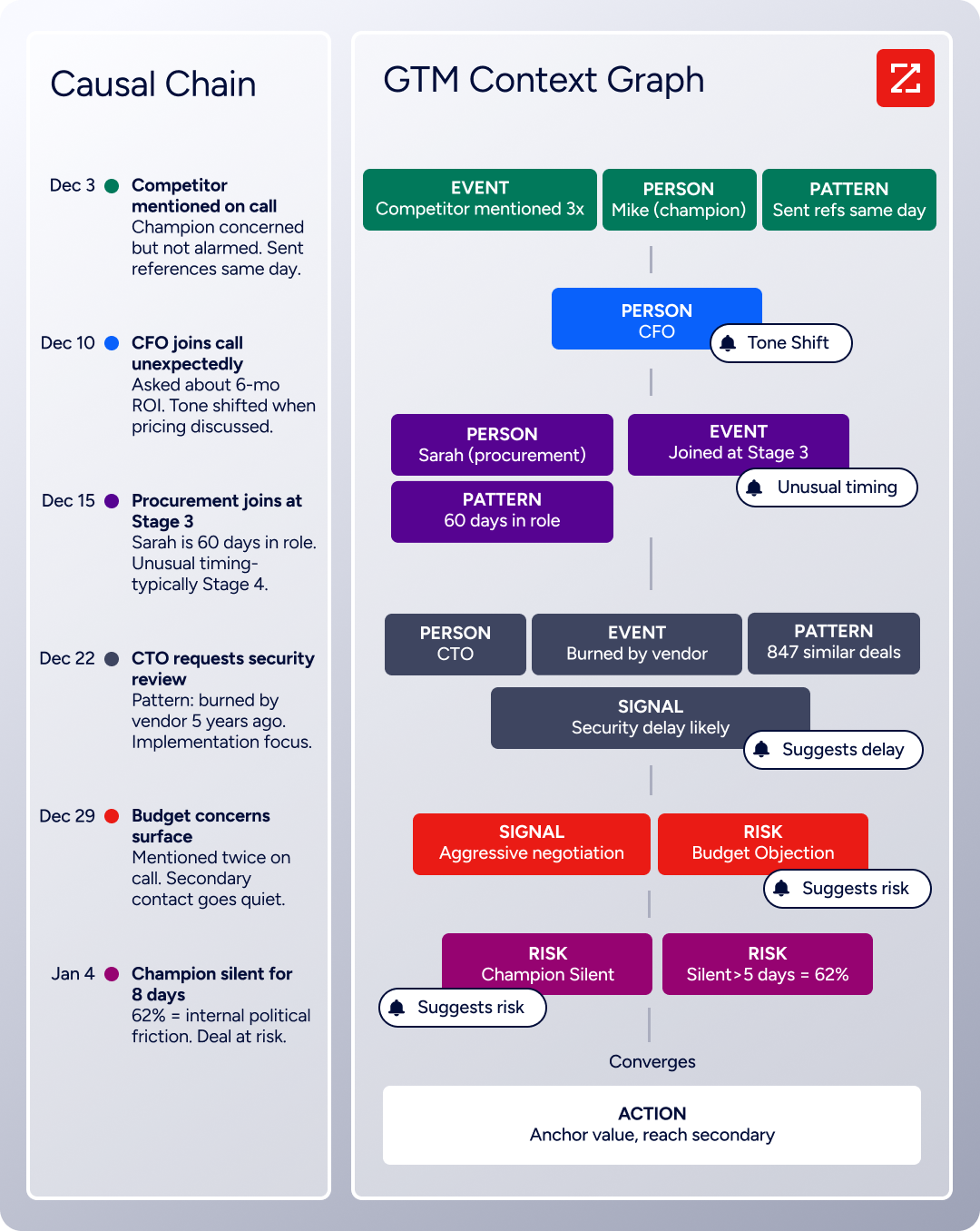
ZoomInfo's AI sits on a different foundation. The GTM Context Graph processes 1.5B + data points daily, fusing ZoomInfo's third-party B2B data with a customer's CRM records, conversation transcripts, and behavioral signals into a single intelligence layer.
Source: ZoomInfo
The distinction matters: HubSpot and Brevo's AI works with data already in your system. ZoomInfo's AI works with market-wide data, fused with your internal data, to identify patterns across thousands of deals. As ZoomInfo's CPO Dominik Facher explains: "The CRM recorded the state change. It has no record of why it happened." The GTM Context Graph captures that context.
In GTM Workspace, sellers get AI agents that research accounts, surface buying signals, draft outreach informed by the full deal context, and update CRM fields from one workspace. In GTM Studio, marketers describe audiences in natural language and launch multi-channel plays that get smarter as prospects respond. Expansion plays that used to take 3 weeks now launch in 30 minutes, without technical support.
Pricing models reveal different business philosophies
The three platforms price differently, and those differences shape who gets the most value.
HubSpot charges per seat and per hub, with tiers from Free through Enterprise. Marketing Hub Professional starts at $800/month (annual) with a $3,000 mandatory onboarding fee and includes 2,000 marketing contacts. Sales Hub Professional runs $90/seat/month (annual) with a $1,500 onboarding fee. Additional marketing contacts cost $250 per 5,000 contacts/month at Professional tier.
A hidden cost worth noting: when you subscribe to multiple hubs at different tiers, all Core Seats are billed at the highest tier's rate. A team mixing Marketing Hub Professional with Sales Hub Enterprise pays Enterprise-rate Core Seats across the board. On the other hand, HubSpot offers a Starter Customer Platform at $9/seat/month (annual) that bundles Starter editions of all hubs.
Brevo charges by email volume, not contacts. Standard starts at $18/month for 5,000 emails, with marketing automation, A/B testing, and Brevo branding removed. Professional starts at $499/month for 150,000 emails with 10 seats, WhatsApp campaigns, push notifications, phone support, and a dedicated Deliverability Specialist. Contacts are unlimited at every tier.
For businesses with large contact lists but moderate sending frequency, Brevo can cost a fraction of what HubSpot charges for the same list size. A pay-as-you-go credits option is also available: one email equals one credit, and credits never expire.
ZoomInfo uses consumption-based pricing with custom quoting. Pricing depends on usage, features, user count, and credit volume. ZoomInfo does not publish prices for paid tiers; all plans are negotiated.
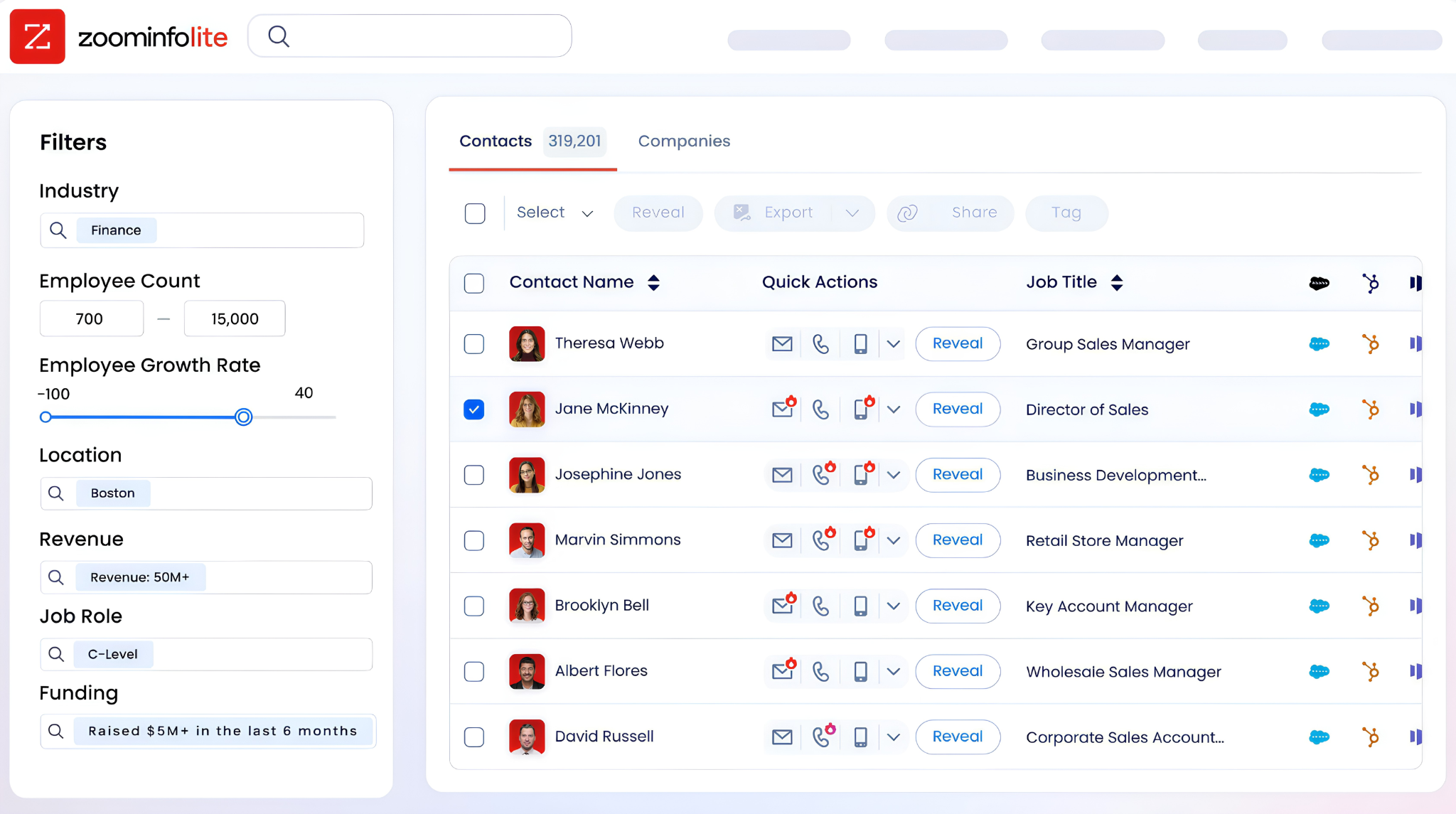
ZoomInfo Lite provides a permanent free tier with 10 monthly export credits, access to the B2B database, WebSights Lite (up to 10 website visitor reveals per day), and a HubSpot integration. A 7-day free trial is available for paid features.
Source: ZoomInfo
The right comparison is not price-to-price. HubSpot's cost covers a full customer lifecycle platform. Brevo's cost covers marketing execution at lower volume-based rates. ZoomInfo's cost covers the data intelligence that determines whether those campaigns reach the right people.
Integrations determine how well these platforms play together
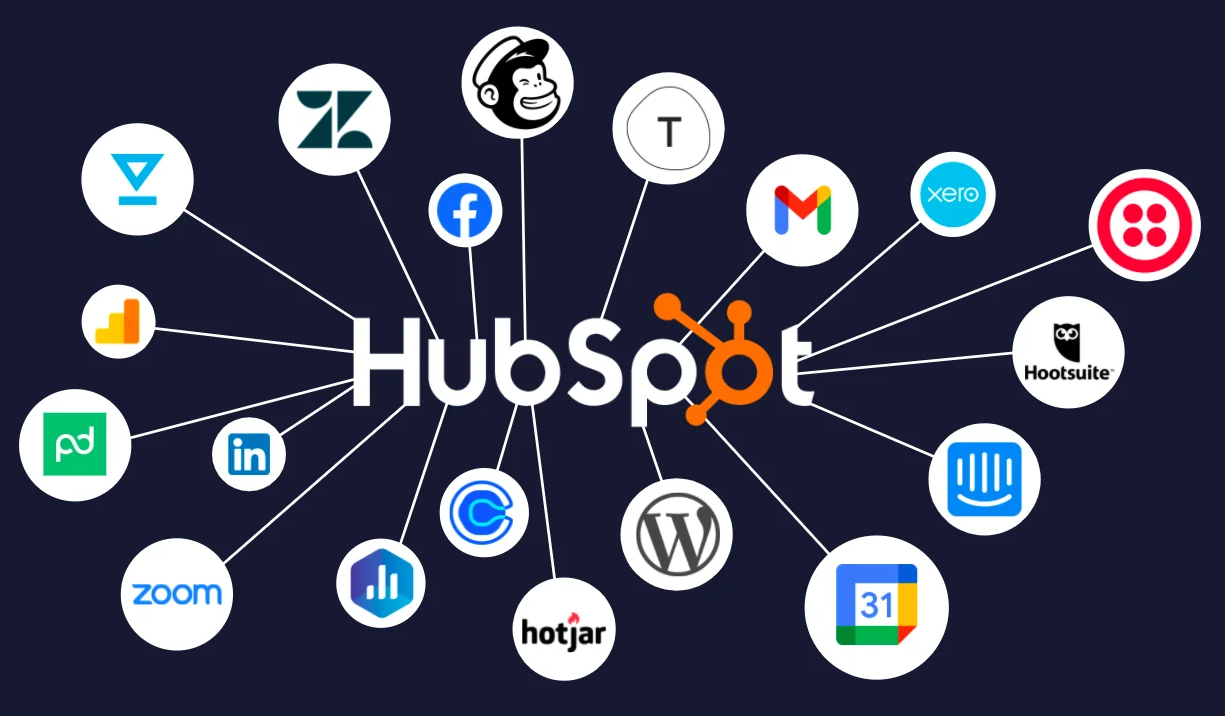
HubSpot has the largest ecosystem of the three, with 2,000+ apps and 2.5 million active installs. The App Marketplace covers CRM, sales engagement, analytics, advertising, ecommerce, and more.
Source: HubSpot
HubSpot also offers a REST API with date-based versioning, official SDKs in six languages, and a Remote MCP server for AI agent integrations. For teams building a broader tech stack, HubSpot's integration options rarely become a bottleneck.
Brevo connects to 150+ third-party tools, covering Shopify, WooCommerce, WordPress, Salesforce, Stripe, and automation platforms like Zapier and Make. The ecosystem is smaller but covers the core needs for marketing-focused teams.
Brevo's REST API and seven official SDKs (Node.js, PHP, Python, Java, C#, Go, Ruby) give developers solid programmatic access. Brevo's transactional email API supports 120,000 emails per minute with a 99.8% successful API request rate.
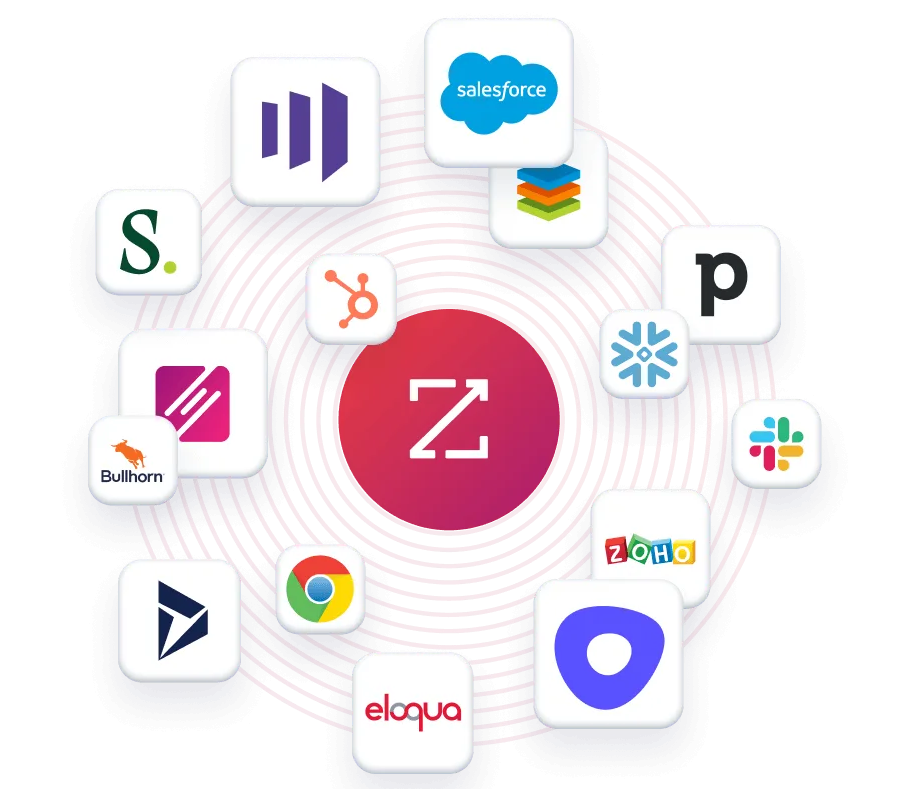
ZoomInfo focuses on making its intelligence available everywhere. The ZoomInfo App Marketplace lists 172+ integrations, with connectors for Salesforce, HubSpot, Microsoft Dynamics 365, and Snowflake. The Enterprise API covers search, enrichment, AI intelligence, and audience management endpoints.
Source: ZoomInfo
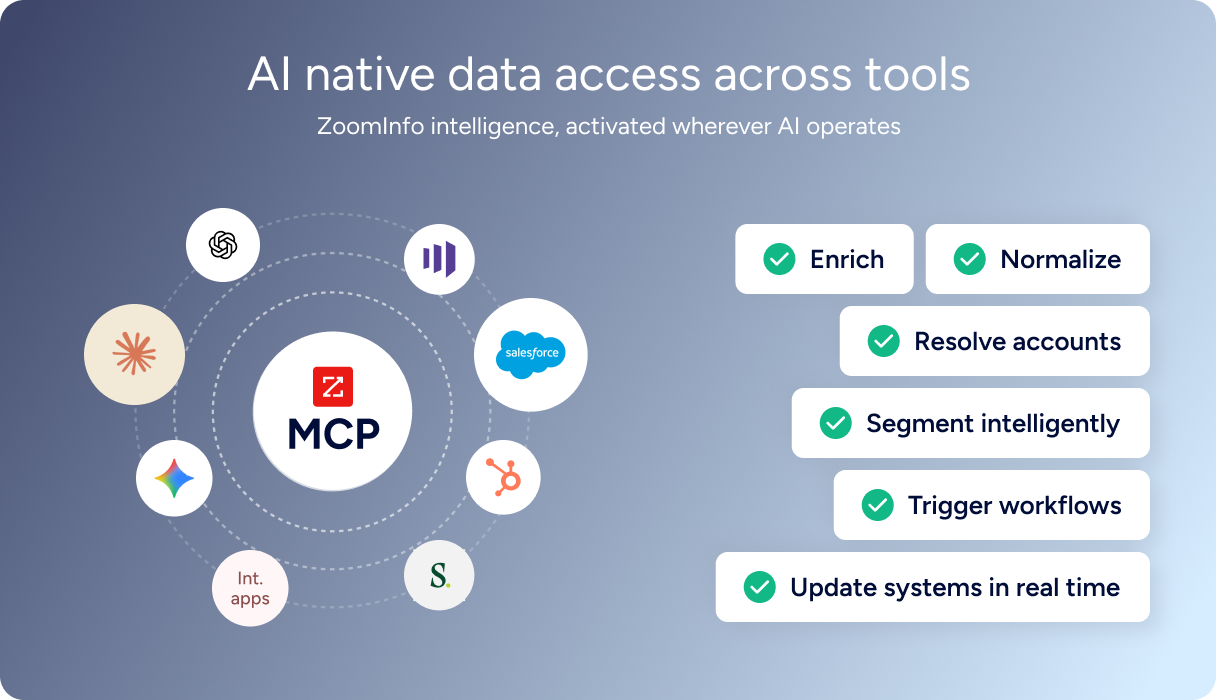
The MCP server connects ZoomInfo to AI assistants including Claude and ChatGPT, letting AI agents query contact data and account intelligence natively. Cloud Partners delivers ZoomInfo data into AWS, Google Cloud, Snowflake, and Databricks.
Source: ZoomInfo
ZoomInfo does not require you to choose between platforms. It enriches HubSpot CRM data through a native integration, feeds any platform through APIs, and powers custom AI agents through MCP.
BDO Canada activated ZoomInfo data within their internal systems, reducing time spent on data dashboard updates by 87%. "The plug-and-play aspect of the API means I can integrate it very easily into any process and get information at a moment's notice." (BDO Canada)
HubSpot vs. Brevo vs. ZoomInfo: Which should you choose?
The right platform depends on your team's primary need.
Choose HubSpot if:
You want marketing, sales, and service on one platform with a shared CRM
Your team needs marketing automation with complex branching logic
You need built-in service desk, content management, or commerce tools
You can invest in per-seat pricing and onboarding fees for the depth of functionality
You value the largest integration ecosystem and app marketplace
Choose Brevo if:
Email, SMS, and WhatsApp marketing are your primary channels
You need unlimited contacts without paying more as your list grows
Your sales team needs basic CRM without HubSpot's cost
Transactional email on the same platform as marketing campaigns matters to your workflow
GDPR compliance and EU data residency are deciding factors
Choose ZoomInfo if:
Your B2B team needs verified contact data and direct dials to reach decision-makers
You want to know which accounts are researching your category before competitors do
Your campaigns are limited by data quality in your CRM, not by the marketing platform itself
You need an intelligence layer that explains why deals move or stall
You want intelligence that works inside HubSpot, inside your own tools, or through ZoomInfo's native applications
Try ZoomInfo free and see how verified B2B intelligence changes your go-to-market results.
For many B2B teams, the most effective stack combines an execution platform (HubSpot or Brevo) with an intelligence platform (ZoomInfo). HubSpot or Brevo handles the how: sending campaigns, managing pipelines, tracking tickets. ZoomInfo handles the who and when: identifying the right buyers, surfacing intent signals, and delivering verified data into whatever tool your team uses.
The difference between a good marketing stack and an effective one is not the execution layer. It is the quality of intelligence feeding it.
HubSpot vs. Brevo vs. ZoomInfo FAQ
What is the fundamental difference between HubSpot, Brevo, and ZoomInfo?
HubSpot is a customer platform that connects marketing, sales, service, content, and commerce through a shared CRM database. Brevo (formerly Sendinblue) is a multichannel marketing platform focused on email, SMS, WhatsApp, and basic CRM at lower price points with unlimited contacts.
ZoomInfo is a B2B intelligence and GTM platform with verified data across 500 million contacts and 100 million companies, buyer intent signals, and AI-powered go-to-market execution. ZoomInfo works alongside CRM and marketing platforms or as a standalone GTM solution.
Which platform is cheapest for a small marketing team?
Brevo offers the lowest entry point. Its free plan includes 300 emails per day with unlimited contacts and no credit card. Starter begins at $9 per month. HubSpot's free CRM is generous but limits paid marketing features. Marketing Hub Professional starts at $800 per month with a $3,000 onboarding fee.
ZoomInfo is custom-quoted for paid plans, though ZoomInfo Lite provides a permanent free tier with 10 monthly export credits and access to the B2B database.
Why is ZoomInfo included in a HubSpot vs. Brevo comparison?
HubSpot and Brevo manage and activate contacts already in your database. ZoomInfo solves the upstream problem for B2B teams: finding the right companies and decision-makers, verifying their contact information, and identifying which accounts are in-market.
ZoomInfo integrates with HubSpot and delivers data into any platform via APIs and MCP, making it a foundational data layer rather than a replacement for either tool.
Does ZoomInfo integrate with HubSpot and Brevo?
ZoomInfo has a native integration with HubSpot, available through both the ZoomInfo Marketplace and the HubSpot App Marketplace. For Brevo and other platforms, ZoomInfo provides programmatic access through its Enterprise API and MCP server, making its B2B data and intelligence available in any tool or custom application.
Which platform has better marketing automation?
HubSpot offers the deepest marketing automation, with visual workflows supporting complex branching logic, behavioral triggers, custom objects, and programmable automation with JavaScript and Python. Brevo provides solid multichannel automation (email, SMS, and WhatsApp in a single workflow) but with simpler conditional logic.
ZoomInfo approaches automation through GTM Studio, which uses AI to build audiences, define triggers, and orchestrate multi-channel plays based on buyer signals rather than predefined workflows.
How do HubSpot and Brevo handle transactional email differently?
Brevo includes transactional email on all paid plans and the free tier, with a REST API and SMTP relay for order confirmations, password resets, and shipping alerts. HubSpot supports transactional email but treats it as a separate configuration rather than a core feature of Marketing Hub.
For SaaS or ecommerce teams that need both marketing and transactional messages from one vendor, Brevo's approach simplifies the stack.
Which platform is best for B2B sales prospecting?
ZoomInfo is built for B2B prospecting: 500 million contacts, 100 million companies, 135 million verified phone numbers, buyer intent data tracking 210 million IP-to-Organization pairings, and AI-powered account intelligence.
HubSpot's Sales Hub provides prospecting tools within its CRM, including a Breeze Prospecting Agent that drafts outreach from CRM history. Brevo's sales tools cover basic pipeline management and calling but lack the data depth and intent signals B2B prospecting demands at scale.
Can I use ZoomInfo with either HubSpot or Brevo?
Yes. ZoomInfo complements any CRM or marketing platform. It has a native HubSpot integration for automatic data enrichment, lead routing, and signal-based workflows. For Brevo or any other tool, ZoomInfo's API and MCP server deliver the same intelligence programmatically.
Many B2B teams run ZoomInfo alongside their marketing platform: ZoomInfo identifies the right targets and signals, while HubSpot or Brevo handles campaign execution and relationship management.
See how HubSpot stacks up elsewhere:
