
"Harness" began 2026 as an AI engineering term. By November, ten go-to-market vendors had put it in a product name or a tagline, by one analyst's count, and one of them had already taken it off its homepage.
I have read a lot of what was written about the harness this year. Here is my read of the debate: where the word came from, the five arguments I think are worth a revenue leader's time, and the question I see asked least, which is how a harness connects to the context it reads.
Where the word came from
Anthropic used "harness" in late 2025 for the scaffolding that keeps an agent productive across long tasks. Mitchell Hashimoto named the practice "harness engineering" in February, and an OpenAI post with that title made it famous.
The definition most people quote is LangChain's: "If you're not the model, you're the harness." On that reading an agent is a model plus a harness, and the harness is everything else: tools, memory, instructions, permissions, and checks. Philipp Schmid compares the model to a CPU and the harness to its operating system.
Some engineers think that is too wide. Birgitta Böckeler of Thoughtworks narrows the term to the guides and checks a team builds around an agent, and treats it as an ongoing practice.
Five arguments inside the harness debate
1. The harness matters more than the model
Dharmesh Shah, HubSpot's co-founder, made the case in a line: without a harness, a model is "an engine with no car." Engineers have backed it with evidence, showing agents that improved when only the harness changed and the model stayed the same.
I agree with this one. If an agent is going to email your customers, AI agent governance decides whether you can trust it: its approvals, its limits, and its memory of past corrections. It is one reason AI alone isn't enough.
2. Whether the harness will last
Latent Space framed this as Big Model against Big Harness. One side expects each new model to absorb what the last one needed scaffolding for. Harrison Chase of LangChain takes the other side. He argues that old scaffolding falls away and new scaffolding replaces it, because an agent always needs a system around the model.
I would plan for the harness to stay and for its contents to keep changing. That makes it risky to choose a vendor for this year's harness features alone.
3. Who owns what the agent learns
Chase's second point matters more to a buyer. A harness holds the agent's memory, so a closed harness hands that memory to a third party and becomes a form of lock-in. For a revenue team, memory means the corrections your reps made and the plays that worked. Ask where it lives and whether you can take it with you.
4. Whether to build your harness or buy one
LangChain has described the "company harness" it built for its own teams, including a go-to-market agent. It lives in Slack, knows who is asking, keeps memory, and runs mostly on a schedule without waiting to be asked.
Kyle Norton, a revenue leader, makes the operator's case. He argues against buying the layer that encodes how your company sells: buy the commodity infrastructure, and build or at least own the rest. That applies to vendors like us as much as to harness vendors, and I think he is right about what to own.
5. Whether the word means anything in go-to-market
In go-to-market the word arrived as a product name. Adam Schoenfeld, an independent analyst, has tracked who said what in Adam's GTM Report:
Company | When (2026) | What they called it |
|---|---|---|
Gong | June 24 | |
Unify | June 30 | "our revenue harness" |
Profound | July 2 | an agent harness for marketing |
Rox | July 27 | "giving agents a harness" |
Optimizely | August 5 | a marketing harness |
Salesforce | August 26 | "the new AIforce harness" |
September 9 | "a GTM Harness" | |
Hightouch | October 8 | the harness for marketing teams |
Phave | November 2 | a marketing harness |
HubSpot | November 12 | "the Customer Harness Company" |
HubSpot's was the most notable. Adam covered both the announcement and the U-turn, which came within a week of eachother.
For Adam's GTM Report, he also coded 143 replies to his posts on the subject. The two largest groups were the 38 who called "harness" a buzzword and the 30 who said the moat is data, context, or state.
What the harness reads
Every argument above is about the part of the agent that decides. Much less has been written about the part that knows.
The vendors themselves treat these as two things. Gong's launch post calls its harness the execution layer and gives a separate product, its Revenue Graph, the job of holding what is true about an account. Adam's short version is that context is an ingredient, and the harness decides what the agent sees and when.
Most of our customers have already tested what happens when the ingredient is poor. They take ChatGPT and connect it to their CRM.
ChatGPT is a fantastic orchestrator, probably one of the best there is. Connected to a CRM, it gives you garbage in and garbage out. The CRM holds twenty years of duplicates, gaps, and stale records. Most CRM data is not ready for AI, and a new model release does nothing to fix that.
The assistant does not know what you define as a customer or the history of that customer. It cannot tell you which plays have worked with companies like this one. The connection gave it access without giving it understanding.
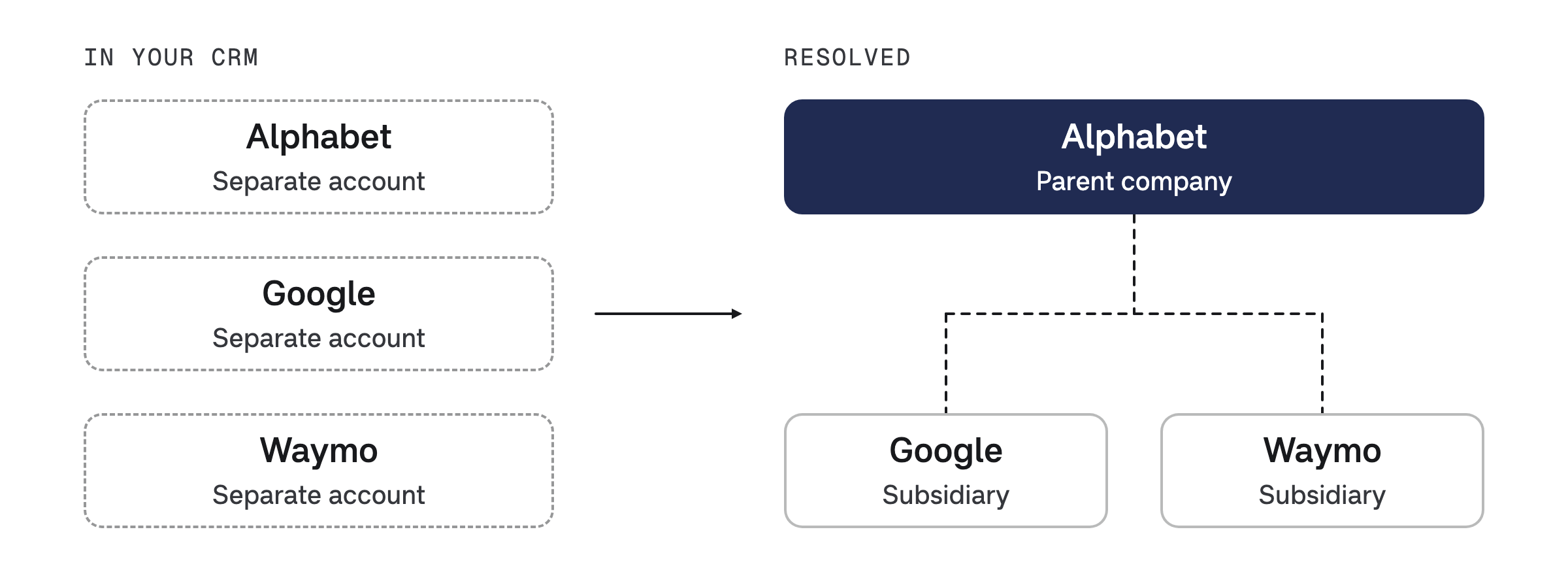
Try it on one account. Look up Alphabet in your CRM, and you will probably find Alphabet, Google, and Waymo as three separate accounts with nothing linking them. An agent with perfect access to those records still does not know they are one customer.
How context connects to the harness
Engineers already treat context as something the harness manages. Anthropic's guide to context engineering is about choosing what the model sees at each step, a term Simon Willison helped popularize in June 2025. Foundation Capital's essay on context graphs went further and argued for keeping a record of decisions: what was known, what was done, and what happened next. We have written about context engineering for B2B ourselves.
By LangChain's definition a context service is part of the harness, since it is not the model. I accept that. I still find it useful to separate the part that decides from the part that knows, because they connect in four places.
The harness holds the map, and context is what it calls
A harness knows where to look: which tool, which system, which record. What comes back is only as good as the source.
A harness can research at run time, up to a point
Give an agent web search, CRM access, and memory, and it can work out that those three accounts are one company. That works for one account. As a system it struggles, for three reasons:
Every agent repeats the work on every run, and you pay for it each time.
Two agents can reach two different answers about the same account.
Some facts cannot be worked out from your own records. Whether two names are one company, how subsidiaries roll up, and who left last month all need identity resolution against a maintained reference.
Context supplies the trigger
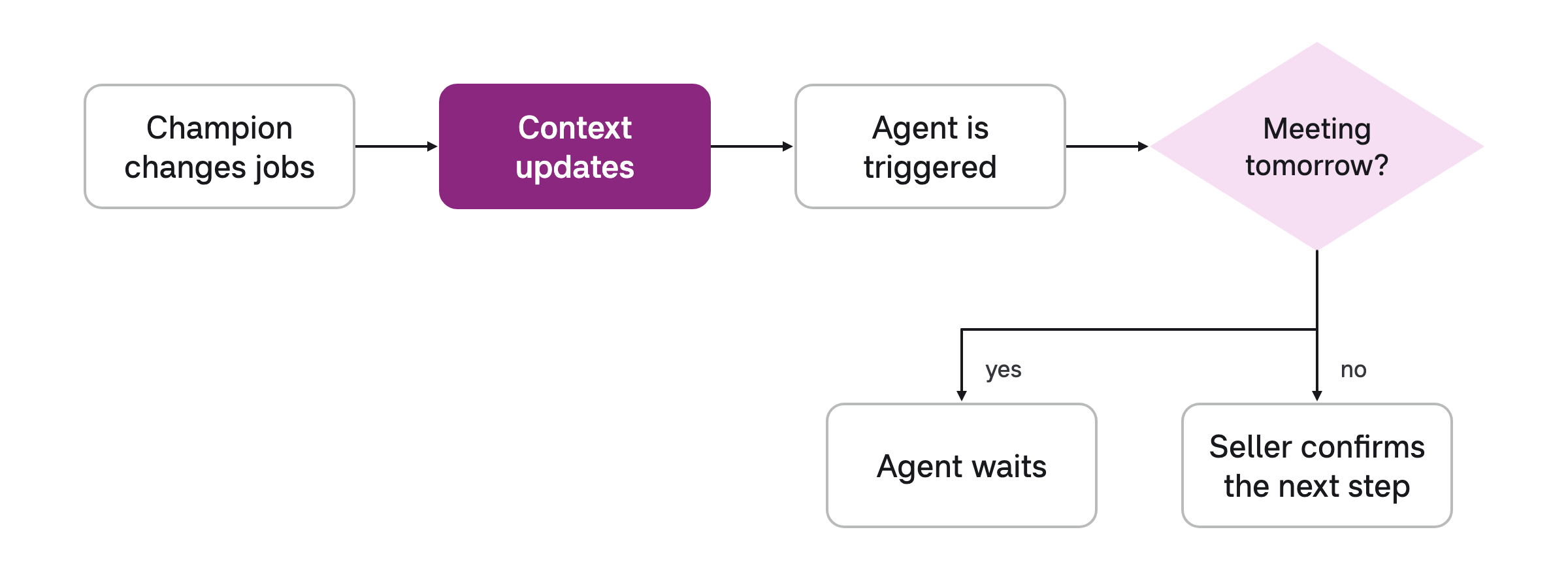
Say a champion at one of your accounts changes jobs. The context updates, and that should start an agent. Depending on how important the account is, the agent should bring in the right seller to confirm the next step. And if there is a meeting on the calendar tomorrow, the agent should not run at all. The rule came from the harness. Both the trigger and the reason to pause came from context.
Outcomes go back into context
When a rep edits or approves what an agent produced, that result should update the record, so the next run starts from a better picture. This is Chase's memory question again, seen from the data side.
What context has to cover
When I think about the data an agent needs, I see four kinds:
Structured first-party data: your CRM and product usage.
Unstructured first-party data: your calls, emails, and meeting notes.
Structured third-party data, or go-to-market data: who the companies and people are, how they are organized, and how to reach them.
Unstructured third-party data: the news, filings, and buying signals about what is changing.
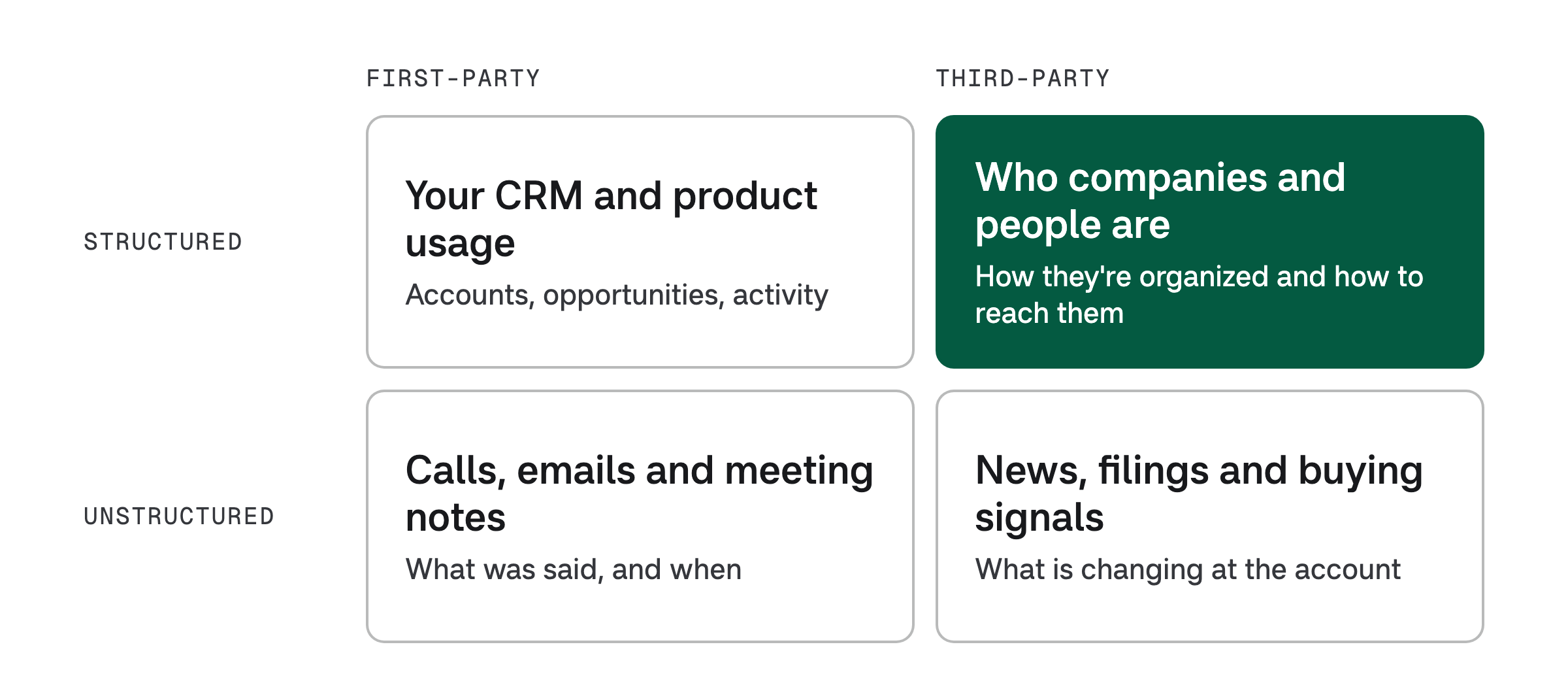
ZoomInfo started with the third, and it is still our home court. Building a real context data foundation meant covering the other three and resolving all of it to the same company and the same person. Whichever vendor supplies it, you can evaluate a context graph against the same ten criteria. It also has to stay current. B2B data decay never stops, and no account is the same from one day to the next.
Three questions for any harness
Harness design is moving quickly, and you will probably change yours or run more than one. Whichever you choose, I would ask:
What does the agent know about an account before it acts, and where does that come from?
When the facts change, how quickly does the agent find out?
Can every agent you run, built or bought, read the same context?
ZoomInfo builds on both sides of this line. The GTM Context Graph brings those four kinds of data into one view of every account and person, and GTM.ai opens the same graph our own applications use by API, command line, and MCP. Agents can reach it from inside Claude, through our sales plugin for ChatGPT, inside Snowflake, and many more options.
We also run agents of our own. Agent Teams in GTM Studio carry out plays inside Playbooks that set the goal, the limits, and the approvals, which makes them a harness by LangChain's definition. Our guide to AI agent orchestration explains how that works.
Frequently asked questions about harnesses and context in GTM
What is an agent harness?
An agent harness is everything around an AI model that lets it do work: tools, memory, instructions, permissions, and checks. An agent is a model plus a harness.
What is harness engineering?
Harness engineering is the practice of improving an agent by changing what surrounds the model, such as its tools, instructions, and checks, and leaving the model itself alone.
What is the difference between a harness and context?
A harness controls how an agent acts and where it looks. Context is what the agent finds there: who a company is, how it is structured, and what has happened with the account. Our guide to the B2B context graph explains what good context looks like, and our guide on how to evaluate a GTM context graph lists ten things to check with any vendor.
Is the context layer part of the harness?
By the widest definition, yes, because everything that is not the model counts as harness. In practice teams treat them separately, because most companies will run more than one harness and a context layer for AI agents has to serve all of them.
