
Every GTM team is bolting AI agents onto its stack right now, and the differentiator isn't the agents themselves but what they plug into.
Foundation models are converging and agent frameworks are commoditizing. The durable advantage sits one layer below, in the context layer that decides what reaches the model, in what shape, with what permissions, and from what source.
This article covers what a context layer is, why AI agents need one, and what its components are. Then it shows how GTM.AI runs as the headless GTM context layer in production today.
What is a context layer?
A context layer is the unified, governed, agent-accessible surface that exposes verified intelligence to any AI agent in your stack. It combines a database, a data warehouse, a CRM, a graph, and an API into one operational surface, with a single set of permissions and one identity-resolved view of the world.
For an AI agent doing GTM work, the context layer answers four questions in a single call.
Which entities are involved (the right account, the right contacts, the right deal record)
What relationships connect them (reporting lines, ownership, engagement history)
What signals are active right now (intent, hiring, funding, technographic shifts)
What history explains it (which actions were taken, what worked, what failed)
The output is a resolved, ranked, agent-ready context package the model can reason from directly.
Context layer vs. semantic layer
A semantic layer standardizes how business metrics get calculated, so "revenue" means the same thing in every dashboard. A context layer extends that foundation by adding governance, freshness, lineage, access controls, and the operational signals AI agents need to act, not just report.
Dimension | Semantic layer | Context layer |
Primary function | Standardize metric definitions for analytics | Deliver governed operational context to AI at inference time |
What it models | How to calculate | How to reason |
Primary consumers | Analysts, BI tools, dashboards | AI agents, automated workflows, revenue teams |
Freshness | Updated when metric logic changes | Continuously updated as operational context changes |
Governance scope | Metric definitions | Policies, access, provenance, temporal validity |
What breaks when it fails | Dashboards disagree on numbers | AI agents reason from stale or incomplete context |
The semantic layer ensures dashboards agree on the numbers. The context layer ensures an AI agent knows which numbers are current, approved, and safe to act on.
Why AI agents need a context layer
Three structural shifts make a context layer essential for GTM AI, not optional.
The primary consumer of GTM data has changed. A dashboard is built for a human to interpret, while an agent reads a context package and acts on it directly. Data formatted for humans doesn't transfer to agents that need machine-readable, identity-resolved context in a single call.
Agents compound errors at machine speed. A rep on bad data makes one bad call and corrects course on the next one. An agent on the same data runs fifty downstream actions before anyone notices. Without a context layer that resolves identity and verifies signals before delivery, the agent amplifies problems at the speed of automation.
Tolerance for messy data has collapsed. An agent that produces an account brief in 18 seconds can't pause for a rep to clean a duplicate record first. The data either resolves at query time, or the output isn't trustworthy.
Most enterprises feel this in their tooling stack. The average enterprise now runs 23 GTM technologies, and reps still default to spreadsheets because too many tools created too much context switching. Spreadsheets aren't the problem, they're the symptom of a missing context layer underneath.
Context layer vs. adjacent concepts
The terms get conflated, but a context layer is structurally distinct from CRM-native AI, a data API, a RAG implementation, or a CDP.
| Data scope | Identity resolution | Governance | Agent access |
CRM-native AI | First-party only | Within one system | CRM-bound | UI-bound |
Data API | First or third-party | Per source | Per endpoint | Read-only |
RAG implementation | Whatever you index | Semantic similarity | None native | Chunk retrieval |
CDP | Customer profiles | Within profiles | Marketing-focused | Audience export |
Context layer | First and third-party unified | Cross-source, resolved | Single plane | Native MCP/API |
The others each solve one piece. A context layer is the only architecture where an AI agent can ask one question and get back a resolved, governed, ranked answer drawn from every system at once.
How context layers work
A production-grade context layer isn't a single product. It's a set of architectural capabilities working together. Five components matter most for B2B revenue teams.
Entity resolution and identity
Entity resolution is the foundation. Without it, nothing else works.
A typical revenue stack holds the same company across CRM, intent platform, marketing automation, and call transcripts under different names, identifiers, and spellings. If the context layer can't resolve these into a single canonical entity, every downstream AI output inherits the confusion.
Entity resolution matches, normalizes, and merges records across systems into one verified truth. The same technique handles roles, collapsing "VP of Sales," "Sales Leader," and "Head of Sales" into one buying committee position.
This is computationally expensive and requires continuous maintenance, but it's the prerequisite for every other context layer function.
Relationship mapping
Databases store records. Context graphs store meaning.
A CRM shows a deal moved from "Discovery" to "Proposal" and then slipped three months. A context graph shows why. Which stakeholder went quiet, which similar deals stalled here before, what worked to recover them.
The graph connects entities through typed relationships, mapping who works where, who competes with whom, and which signals moved which deals. AI agents traverse those connections to assemble the full picture for any query instead of reasoning from flat, disconnected records.
Governance and access controls
A context layer without governance is a liability. Governance covers four controls.
Data lineage. Where the data came from and how it's been transformed.
Role-based access. Who's allowed to see it and under what conditions.
Temporal constraints. Whether the data is current or stale.
Policy rules. Whether it can be used in an automated workflow.
Together, these ensure the context an AI agent receives is relevant, trusted, current, and compliant.
Real-time signal integration
Static context decays. Roughly 70% of B2B contact data goes stale every year, and that's before you factor in deals shifting, companies getting acquired, and budget cycles changing underneath you. A context layer built on last quarter's data is a liability rather than a foundation.
Real-time signal integration attaches live operational data to resolved entities. Five signal types matter most.
Buyer intent surges
Job changes and leadership moves
Funding events and M&A activity
Technographic shifts
Engagement spikes
These signals keep the context layer current and give AI agents the temporal awareness to act on what's happening now, not what happened six months ago.
Token efficiency and precision delivery
The context window is finite, and every token competes with every other token for the model's attention.
A well-designed context engine doesn't dump everything into the prompt. It selects the most relevant context for the specific query, compresses it into the fewest tokens possible, and delivers a precision package that maximizes signal density. Fewer, better-selected tokens consistently outperform larger context dumps.
How GTM.AI works as the headless GTM context layer
ZoomInfo's GTM Context Graph is the implementation of the context layer concept, purpose-built for B2B revenue teams. It fuses verified B2B data, first-party CRM data, call and email history, intent signals, and account engagement signals into one resolved entity graph. AI agents access that graph through GTM.AI, the headless GTM context layer.
Forrester named ZoomInfo a Leader in the Q1 2026 Wave for B2B Marketing and Sales Data Providers with the highest Current Offering score in the category, calling out the GTM Context Graph for data discovery and agentic AI use cases.
The four foundational layers
ZoomInfo's GTM Laws of Physics guide lays out the four-layer architecture underneath GTM.AI.
Grounding Data. The verified B2B world model. 100M+ company profiles, 500M+ contacts, and billions of buying signals, verified to up to 95% accuracy on first-party data.
Unification. Entity resolution across systems, built on infrastructure developed over two decades to match and normalize records from CRM, intent, engagement, and third-party data into one canonical truth.
Context Graph. The connected intelligence layer where third-party data fuses with a customer's first-party data, including CRM records, conversation intelligence from Chorus, email interactions, product usage signals, and engagement history, into the relationships and causal chains agents need to reason from.
Surface Area. Skills, agents, and workflows running on the resolved graph. One MCP and API connection reaches Claude, ChatGPT, Microsoft Copilot, Salesforce Agentforce, HubSpot Breeze, and dozens more. GTM Workspace, GTM Studio, ZoomInfo Copilot, and ZoomInfo DaaS all draw from the same source.
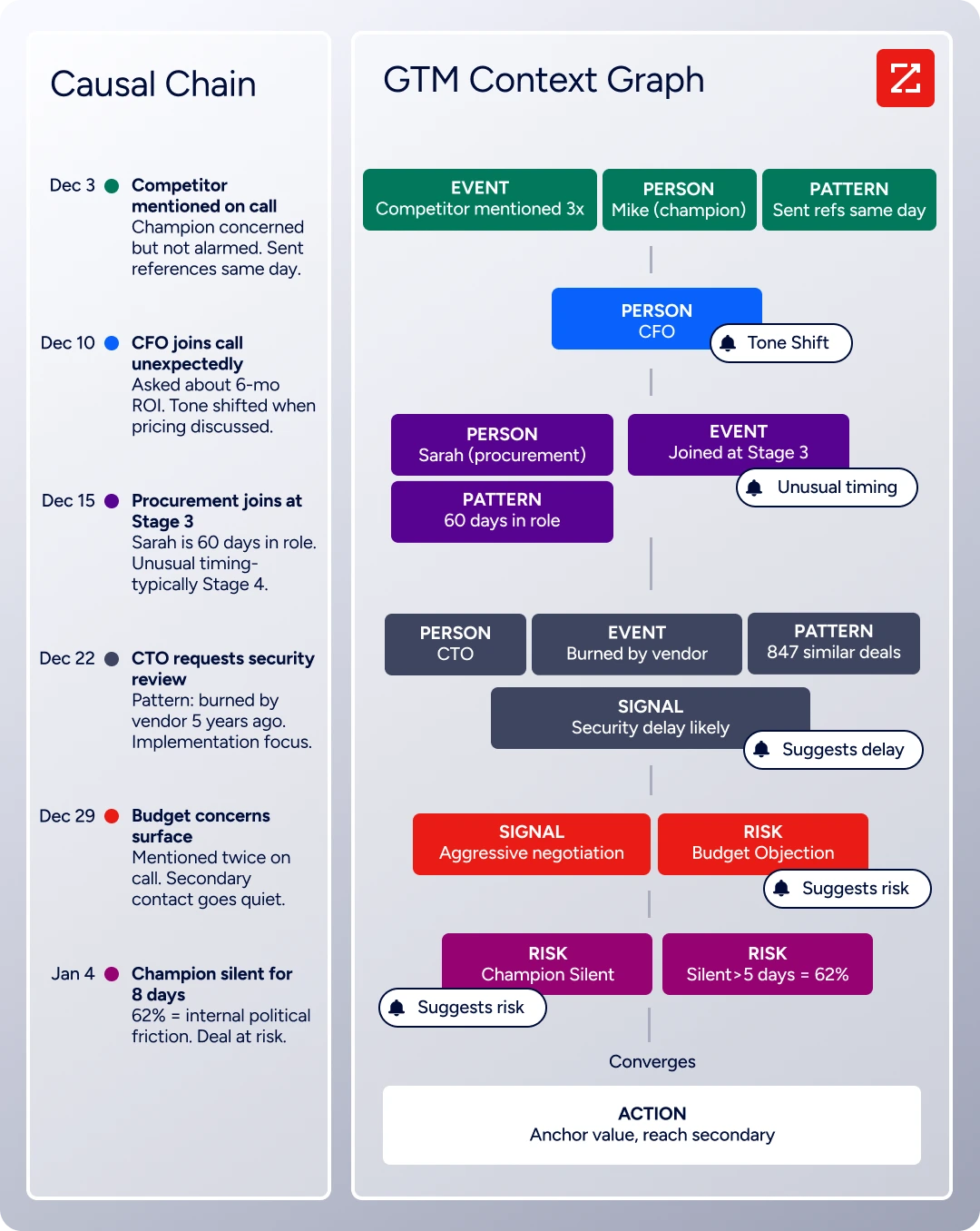
As ZoomInfo CEO Henry Schuck has put it, reasoning without verified data is fluent guesswork. Every model your team chooses sits at the surface area layer. Swap one model for another and the outputs shift. Remove the context layer and the outputs collapse.
Put a context layer underneath your AI stack
The model layer will keep getting cheaper and more capable. The data underneath it is what compounds. Every interaction, every resolved entity, every captured signal adds to a foundation that gets sharper while the models commoditize around it.
GTM.AI is how ZoomInfo delivers that foundation. Start building on it and see what your AI agents do with a context layer underneath them.
Frequently asked questions about context layers
What is a context layer?
A context layer is the architectural tier between enterprise data and AI agents, combining entity resolution, relationship mapping, governance, real-time signal integration, and precision delivery into one operational surface that any agent can call.
How is a context layer different from a semantic layer?
A semantic layer standardizes how business metrics get calculated across analytics tools, so dashboards agree on the numbers. A context layer extends that foundation with governance, freshness, lineage, and the operational signals AI agents need to act, ensuring the agent knows which data is current, approved, and safe to use.
How is a context layer different from a context graph?
A context graph is the data structure that captures relationships, decision traces, and temporal sequences. A context layer is the broader architectural unit that combines a graph with entity resolution underneath, governance across every component, real-time signals, and an agent-facing delivery surface on top.
Why do AI agents need a context layer?
AI agents act on whatever context they're handed, at machine speed, without the human pauses that catch errors. A context layer is what ensures the context they receive is resolved, ranked, and governed before it reaches the model, so agents produce outputs the business can trust at scale.
What is the Model Context Protocol (MCP)?
MCP is an open standard for connecting AI models to external data sources and tools, defining how an agent discovers and consumes context from platforms like ZoomInfo, databases, and internal systems without requiring a custom integration for every model.
How does GTM.AI work as a context layer?
GTM.AI exposes ZoomInfo's grounding data, unification infrastructure, and GTM Context Graph through API and MCP, with governance across every layer, and the same underlying intelligence powering GTM Workspace, GTM Studio, ZoomInfo DaaS, and dozens of external integrations.
