
"Account-based" used to mean marketing picked target companies and ran campaigns at them. Sales joined at the handoff, and customer success wasn't really in the conversation.
That model is under pressure. ABM still works, but intent data and AI tools can make cross-team coordination more workable, and disjointed experiences across the lifecycle are easy for buyers to notice.
ABX is the operating model emerging in response.
What is account-based marketing?
Account-based marketing is a B2B strategy that treats each target account as a "market of one." Instead of running broad demand generation campaigns and hoping the right leads show up, ABM flips the funnel.
You start with a defined list of high-value accounts and build personalized campaigns designed to engage the buying committees inside those organizations.
The core elements of an ABM program
Most ABM programs are built on the same foundation:
ICP definition. You define your ideal customer profile using firmographic data (industry, revenue, headcount) and technographic data (current tech stack, tools in use) to identify which accounts fit your best-customer profile.
Target account selection. From your ICP, you build a prioritized list of accounts your team will pursue. This list drives budget allocation, content creation, and sales focus.
Personalized content. Messaging is tailored to the specific pain points, industry context, and buying stage of each account or account segment.
Sales and marketing coordination. Marketing generates awareness and engagement. Sales follows up with direct outreach. Both teams work from the same account list.
Account-level measurement. Success is measured by account engagement, pipeline generated, and deals closed.
ABM programs typically operate in three tiers, a model defined by ITSMA (now Momentum ITSMA). 1:1 ABM delivers fully customized campaigns to a small number of high-value accounts. 1:few ABM groups similar accounts into clusters and personalizes at the segment level. 1:many ABM uses technology and automation to scale personalized touches across a broader account list.
Where ABM falls short
ABM moved B2B marketing forward, but over time a structural problem emerged. The "M" in ABM led many organizations to treat it as a marketing-only initiative, and when ABM stays in the marketing silo, three common gaps get worse:
Static account lists. Target lists get built once and rarely updated. Accounts that were a fit six months ago may no longer be in-market, and new high-intent accounts can be missed entirely.
Rigid campaign playbooks. ABM campaigns often follow predefined sequences that don't adapt to real-time changes in buyer behavior or intent signals.
Poor data quality. Without accurate, up-to-date firmographic, technographic, and intent data, teams end up targeting the wrong accounts at the wrong time, wasting budget and burning seller trust.
The handoff to sales gets messy, and post-sale teams often aren't involved at all. The "account-based" promise breaks down the moment the deal closes.
What is account-based experience?
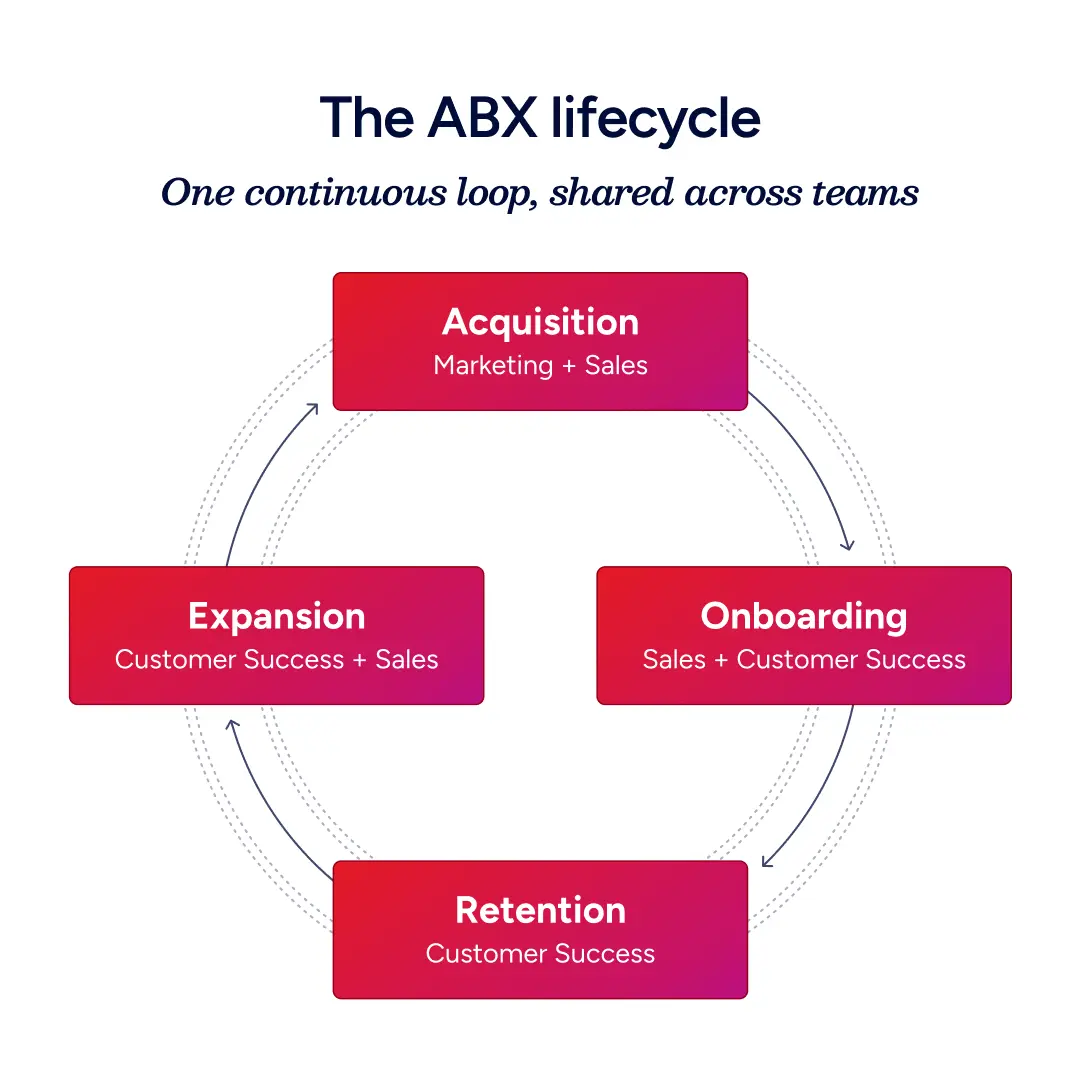
Account-based experience is often described as the evolution of ABM. ABX takes the core principle of account-based strategy, focusing resources on high-value accounts, and extends it across the full customer lifecycle. Marketing, sales, and customer success all operate from shared account intelligence.
Where ABM focuses on acquisition, ABX covers acquisition, onboarding, retention, and expansion. It's a cross-functional way of working that sales and customer success run alongside marketing.
How ABX extends the ABM model
ABX keeps everything that works about ABM: ICP-driven targeting, personalized engagement, account-level measurement. Then it adds what ABM lacks:
Full-lifecycle coverage. ABX doesn't end when a deal closes. Customer success teams use the same account data and coordinated plays to drive onboarding, adoption, retention, and expansion.
Shared account intelligence. All customer-facing teams work from the same data: firmographics, engagement history, intent signals, conversation insights. Every team sees the same account history before it acts.
Signal-driven execution. Instead of static campaign calendars, ABX uses real-time buyer intent data and behavioral signals to trigger coordinated actions across teams. When an account shows buying activity, the entire revenue organization responds.
Sales and marketing alignment in ABX
In ABM, marketing builds campaigns and hands off engaged accounts to sales. In ABX, that handoff disappears. Both teams operate in continuous coordination, which requires:
Shared plays. Sales and marketing build account plays together, in the same planning sessions.
Shared metrics. Both teams are measured on revenue outcomes as well as marketing engagement and sales activity.
Cross-functional orchestration. When an intent signal fires, marketing adjusts ad targeting, sales reaches out directly, and customer success reviews account health, all within the same coordinated motion.
ABX vs ABM: a side-by-side comparison
The differences between ABM and ABX become clearer when you put them next to each other:
Feature | ABM | ABX |
Primary goal | Target and acquire high-value accounts | Orchestrate relevant experiences across the full lifecycle |
Team ownership | Marketing-led with sales alignment | Cross-functional: marketing, sales, customer success |
Customer journey scope | Pre-sale pipeline generation | Full lifecycle: acquisition through retention and expansion |
Data usage | Firmographic, technographic, and intent data on lists updated infrequently | Firmographic, technographic, and contact data plus real-time intent signals, behavioral data, and engagement history |
Personalization | Campaign-level messaging by account or segment | Experience-level orchestration by account and stage |
Success metrics | Account engagement, pipeline generated, deals closed | Account coverage, pipeline velocity, revenue influenced, NRR |
Why ABX can produce better business outcomes
ABX changes how revenue teams allocate resources. Instead of working a fixed target list on a set campaign calendar, it uses real-time buying signals to identify accounts showing buying readiness right now. The result can be fewer but higher-quality opportunities, and faster movement through your sales pipeline once those opportunities materialize.
Coordinated outreach can reduce the friction that kills deals. Misaligned messaging, redundant touches, and the gap between marketing engagement and sales follow-up shrink when both teams operate from the same account data and the same playbook.
How ABX supports customer retention and expansion
Many ABM programs treat the closed deal as the finish line. ABX treats it as a new phase of the relationship.
Post-sale, ABX enables customer success teams to use the same account intelligence that powered the acquisition. They can monitor engagement signals, track product adoption, identify expansion opportunities, and intervene proactively when account health declines.
This matters because existing customers are a source of growth alongside new-logo acquisition. ABX gives post-sale teams the data and coordination to protect and grow existing revenue and reduce churn.
How to build an ABX strategy
A working ABX strategy comes down to three things: the right account list, signal-driven timing, and the right metrics to measure what's happening.
Step 1: Build and prioritize your target account list
Your target account list is the foundation. Build it using multiple data layers:
Firmographic data. Industry, company size, revenue, geography. These filters identify accounts that match your ICP.
Technographic data. Current tech stack and tools in use. These signals reveal competitive displacement opportunities and integration fit.
Intent signals. Which accounts are actively researching topics related to your solution? Intent data keeps the list current as accounts move in and out of market.
Once built, tier your accounts:
Tier 1. High-value accounts getting fully customized, 1:1 engagement.
Tier 2. Strong-fit accounts receiving segment-level personalization.
Tier 3. Broader ICP-fit accounts engaged through scalable, automated plays.
In ABX, resources follow account momentum as well as firmographic fit. A high-fit account with no intent signals or sales conversations yet can start in a lower tier and move up as those signals appear.
Involve sales from the start and build the list jointly. Sales brings deal intelligence and relationship context. Marketing brings data coverage and analytical rigor.
Step 2: Use intent data to time your outreach
Intent data is what turns ABX from a static account strategy into a signal-driven operating model. When an account shows active research behavior, like consuming content about your product category, comparing vendors on review sites, or searching for related keywords, that's your trigger. Coordinated outreach fires across teams:
Marketing. Adjusts ad targeting and content delivery.
Sales. Initiates direct outreach with relevant context.
Customer success. Reviews the relationship for existing accounts.
ZoomInfo's GTM Studio turns buyer signals into seller action, so plays fire automatically when buying signals appear.
Step 3: Measure ABX performance
ABX measures more of the lifecycle than traditional ABM. Move beyond MQLs and acquisition-only reporting. The metrics that matter:
Account coverage. What percentage of your target accounts have you engaged across multiple buying committee members?
Meeting rate. How effectively are you converting account engagement into live conversations?
Pipeline velocity. How fast are accounts moving through your pipeline stages?
Win rate. Are accounts engaged through coordinated ABX plays closing at higher rates?
Revenue influenced. How much closed revenue can you attribute to ABX motions?
Net revenue retention (NRR). Are ABX-engaged accounts retaining and expanding at higher rates?
These metrics connect ABX activity to pipeline and revenue, the language your executive team speaks.
The role of data and technology in ABX
ABX is only as good as the data underneath it. Coordinated plays across marketing, sales, and customer success fall apart the moment any team is working from stale or incomplete account intelligence. That's why the data layer and the platform that activates it matter more in ABX than they did in traditional ABM.
What good ABX data looks like
ABX runs on three data layers working together:
Firmographic and technographic data. Answers who fits your ICP and what technology they use.
Contact-level data. Answers who specifically inside the account makes decisions, influences them, or champions you internally.
Intent and behavioral data. Answers when an account is actively in-market and what topics they care about.
How to choose the right ABX platform
Fragmented data across disconnected tools can stall an ABX initiative. When your firmographic data lives in one system, your intent signals in another, and your engagement history in a third, coordination breaks down. Teams can't act on signals they can't see.
ZoomInfo addresses this with a unified data foundation. The platform combines contact data, firmographics, technographics, and intent signals in one place, with verified data on 500M+ contacts and 100M+ companies, and it processes 1.5B+ data points daily.
Underneath sits the GTM Context Graph, which reasons across ZoomInfo data, your CRM, conversations, and buying signals to show why accounts are moving. CRMs record state changes. The context graph is built to capture the signals, sequences, and reasoning the CRM can't store, which is what makes AI-powered execution useful. ZoomInfo was named a Leader in the 2025 Gartner Magic Quadrant for Account-Based Marketing Platforms, its second year in a row.
When evaluating ABX platforms, look for:
Unified data foundation. Contact data, firmographics, technographics, and intent signals in one platform rather than stitched together from several vendors.
Real-time signal delivery. Intent and engagement data that updates continuously rather than in weekly batches.
Cross-team activation. The ability to trigger coordinated plays across marketing, sales, and customer success from a single platform.
CRM integration. Native connections to Salesforce, HubSpot, and other core systems so account intelligence flows into existing workflows.
See how ZoomInfo compares with other ABM platforms in this video:
Get the data layer wrong and coordinated plays misfire. Get it right and ABX becomes how your revenue team actually works.
Start building your account-based experience strategy
In practice, those three steps need shared data and a platform underneath them: a target account list that updates as accounts move in and out of market, intent and engagement data your whole revenue team can act on, and a platform that turns those signals into coordinated motion across marketing, sales, and customer success.
ZoomInfo brings these together. From building your account list to triggering plays based on live buyer signals, the platform gives revenue teams the data enrichment and orchestration to make ABX operational.
Start a free trial and see how ZoomInfo supports account-based experience for revenue teams.
Frequently asked questions
What is the difference between ABX and ABM?
ABM is a marketing strategy focused on targeting and acquiring specific high-value accounts. ABX extends those principles across the entire customer lifecycle, coordinating sales, marketing, and customer success around shared account data and real-time signals.
What is ABX in marketing?
ABX, or account-based experience, is an account-based go-to-market approach that runs across marketing, sales, and customer success for the whole customer lifecycle. It keeps ABM's focus on high-value accounts and adds shared account data, signal-driven timing, and post-sale plays for onboarding, retention, and expansion.
Is ABX replacing ABM?
No. ABX builds on ABM. It keeps ABM's core principles (ICP targeting, personalized engagement, account-level measurement) and extends them to every customer-facing team and every stage of the buyer journey.
What is the difference between ABM and ABS?
ABM (account-based marketing) focuses on marketing activities directed at target accounts. ABS (account-based selling) is a B2B sales strategy that applies the same account focus to sales outreach. ABX unifies both under a single, cross-functional strategy that also includes customer success and post-sale teams.
How do you build an ABX strategy?
Start with a tiered target account list built from firmographic, technographic, and intent data. Time outreach to intent signals so marketing, sales, and customer success act together. Then measure account coverage, meeting rate, pipeline velocity, win rate, revenue influenced, and net revenue retention.
What data do you need to run ABX?
ABX requires three data layers: firmographic and technographic data for account identification, contact-level data for buying committee mapping, and intent and behavioral data for timing outreach to when accounts are actively in-market.
