

Key Takeaways
DaaS hands off the data operations layer. Providers own sourcing, accuracy, and integration, so your team works with the data instead of maintaining the infrastructure behind it.
The market splits three ways. B2B revenue teams pick between full-stack platforms (ZoomInfo, Cognism), marketplaces that aggregate third-party data (Snowflake), and specialists for financial, web-scraped, or consumer data.
Freshness separates a platform from a feed. Verification method and delivery flexibility matter as much as volume, and quarterly refreshes aren't the same as continuous verification.
The right provider depends on your use case. A platform built for B2B prospecting won't serve a hedge fund evaluating alternative data, and a marketplace isn't a substitute for a curated B2B database.
Every go-to-market decision starts with data. The problem is building accurate datasets in-house is slow, expensive, and almost impossible to keep current at scale. People change jobs. Companies restructure. Tools get swapped out. By the time your team has built a clean record, half of it is already out of date.
The best data as a service (DaaS) providers solve that by taking the data work off your plate so your team can focus on using records instead of maintaining them. This guide covers 9 of the top DaaS providers for B2B teams in 2026, what each one does well, what each one costs, and how to pick the right fit for your stack.
What Is Data as a Service?
Data as a service is a cloud delivery model where a provider collects, verifies, and distributes structured datasets through APIs, file transfers, or direct integrations into your cloud warehouse. You subscribe and access the data you need on demand instead of building proprietary collection pipelines.
In practice, DaaS replaces three things that used to live inside your own infrastructure:
Data collection. The provider handles sourcing from millions of public and proprietary signals, including web data, business filings, professional profiles, and partner integrations.
Verification and refresh. Records are continuously checked against multiple sources, so when a contact changes jobs or a company is acquired, your data reflects it without manual cleanup.
Delivery into your systems. Data flows directly into your CRM, marketing automation, cloud warehouse, or AI tools through APIs, webhooks, or native integrations.
For B2B revenue teams, this means fresher records, faster enrichment, and less time spent on data operations. Sales reps see verified direct dials and current job titles. Marketing teams build segments on accurate firmographics. RevOps stops chasing data quality fires every quarter.
See it in action: 5 Ways Go-to-Market Teams Use Data as a Service walks through five real B2B use cases showing how leading brands turn DaaS into pipeline and revenue.
Data as a Service Providers at a Glance
Provider | Best For | Delivery Model | Starting Price |
ZoomInfo | B2B sales, marketing, and RevOps teams | API, cloud (AWS, Snowflake, Databricks, Google Cloud, Azure) | Free Lite plan; consumption-based paid |
Bright Data | Alternative data and web intelligence | API, datasets, proxy infrastructure | From $0.75/1K records |
Dun & Bradstreet | Enterprise risk, compliance, and credit | API, batch, direct feed | Custom enterprise pricing |
Snowflake Marketplace | Multi-provider data access | Zero-copy cloud sharing | From $2/credit (varies by region) |
Cognism | European B2B prospecting | API, CRM integrations | Custom pricing |
Coresignal | Investment and alternative intelligence | API, bulk download | From $49/mo |
FactSet | Capital markets and financial analysis | API, feeds, terminal | Custom per-seat enterprise pricing |
Informatica | Enterprise data integration and MDM | Cloud platform, API | Consumption-based (IPUs) |
Data Axle | SMB marketing and consumer outreach | API, batch, direct mail | Variable by list size and channel |
Best Data as a Service Providers
The nine providers below span full-stack B2B platforms, web-data specialists, financial-data houses, and enterprise governance tools.
Each one leads in a different lane, so the right pick depends less on overall reputation than on which use case you're solving for.
1. ZoomInfo
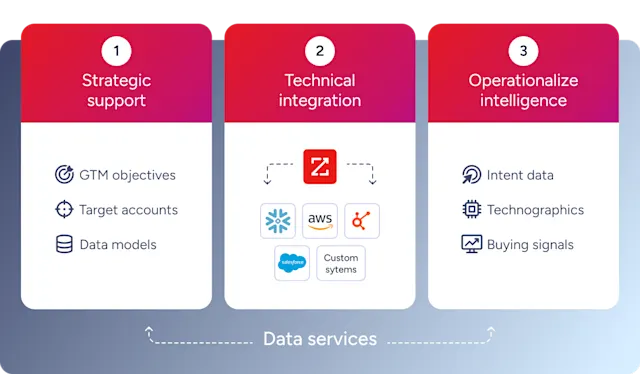
ZoomInfo Data-as-a-Service delivers verified B2B company and contact data directly into your CRM, data warehouse, or internal systems. It runs on one of the largest continuously verified B2B databases on the market. For revenue teams, the real advantage is delivery, with the same data foundation that powers ZoomInfo's apps piped as raw infrastructure into wherever your team already works.
Rather than another UI to log into, DaaS meets your stack where it is, through continuously refreshed Data Cubes in your cloud warehouse, real-time APIs and webhooks, or a Data Services team that designs custom datasets for you.
That same data foundation powers the rest of the platform, all on the same records and without engineering support. Teams can extend into the GTM Context Graph for account-level intelligence on the buying committee and real intent, or into GTM Studio to turn those signals into automated plays and waterfall enrichment across 25+ vendors.
Best for: B2B sales, marketing, and revenue operations teams that need verified contact and company data at scale, delivered into the systems they already use.
Key features:
500M+ contacts and 100M+ companies at 95%+ accuracy, plus 200M+ verified emails, 135M+ phone numbers, and 1B+ buying signals
Continuous verification that refreshes millions of records daily as people change jobs and companies restructure
Native delivery into AWS, Google Cloud, Snowflake, Databricks, and Azure, with marketplace listings for easy procurement
Enterprise APIs, webhooks, and a dedicated Compliance API for GDPR and CCPA opt-out management
A Data Services team to design custom datasets and operationalize intent and technographic signals
Pricing: Consumption-based. Cost is tied to what you use (exports, API calls, enrichment) rather than rigid per-seat licensing. ZoomInfo Lite is permanently free with 10 monthly export credits, and a 7-day trial of paid plans is also available.
What our customers say:
Snowflake: built its Account Propensity Scoring model on ZoomInfo Data Cube feeds, driving 25% higher engagement and 2x new-customer conversion.
MarketSpark: used ZoomInfo's Company Data Cube and AWS S3 integration to identify 30,000 high-fit prospects, growing both MQLs and SQLs by 5x.
2. Bright Data
Bright Data is a web data and alternative data provider. It's built for teams that need to pull structured data off the open web at a scale most platforms can't touch, from e-commerce pricing to public profiles and geospatial signals.
It's collection infrastructure rather than a curated database, which is exactly why technical teams choose it. You get raw reach and control over what you scrape.
The trade-off is that value depends on having engineering resources to integrate it. It also offers nothing on the B2B contact side, so it complements a prospecting database rather than replacing one.
Best for: Data teams, hedge funds, and e-commerce companies that need structured web data and have technical resources to integrate it.
Key features:
Ready-made datasets covering pricing, product listings, and public web profiles, delivered as bulk files or via API
Web scraping infrastructure built on residential and datacenter proxies for compliant, large-scale collection
Real-time and historical data with versioning for backfills and trend analysis
Pricing: Pay-as-you-go across product lines, scaling from one-off scrapes to enterprise collection:
Scraper APIs: from $0.75 per 1K records
Datasets: from $250 per 100K records
Proxies: residential from $2.50/GB, datacenter from $0.90/IP
Managed Data Acquisition: from $1,500/month
3. Dun & Bradstreet
Dun & Bradstreet is a cornerstone provider of business identity and risk data. The D-U-N-S Number is the business identifier that procurement, credit, and compliance systems treat as the global standard.
Few providers come close for verified business identity, corporate hierarchy, and financial risk data, which is why it's entrenched in regulated industries.
It's purpose-built for risk and finance rather than go-to-market, so teams looking for contact-level depth or buyer intent will find it points in a different direction. Pricing and onboarding are aimed squarely at the enterprise.
Full breakdown: what D&B is good at and where it falls short.
Best for: Enterprise risk, compliance, credit, and procurement teams that need verified business identity and financial data.
Key features:
D-U-N-S Number as a globally recognized unique business identifier, used in vendor onboarding, anti-money-laundering checks, and regulatory reporting
Firmographic and financial data across hundreds of millions of business records, including corporate hierarchies and ownership structures
Risk scoring and compliance screening built for regulated industries like banking, insurance, and government
Pricing: Custom enterprise pricing based on dataset and use case. Contact Dun & Bradstreet for a quote.
4. Snowflake Data Marketplace
Snowflake Data Marketplace is a distribution layer rather than a data source. It doesn't produce data. Instead, it lets you discover datasets from hundreds of providers and query them through zero-copy sharing inside the Snowflake instance you already run.
The appeal is operational. There's no ETL, no file transfers, and datasets stay live against their source. The prerequisite is that you're already a Snowflake shop. And because each dataset comes from a different provider, quality varies, so you still vet sources one by one.
Best for: Data engineering and analytics teams already operating on Snowflake who want to procure third-party data without standing up new pipelines.
Key features:
Hundreds of third-party data providers across firmographics, demographics, weather, financial, and consumer categories in one marketplace
Zero-copy data sharing that lets you query provider tables directly without copying, transferring, or transforming files
Live, auto-updated datasets that stay current with the provider's source, with governance and access controls applied through Snowflake
Pricing: Marketplace access is included with Snowflake. Snowflake itself runs on consumption-based pricing, starting at $2 per credit and rising by edition and region (Standard, Enterprise, Business Critical), plus $23/TB/month for on-demand storage. Many marketplace datasets are free; paid datasets are billed through your Snowflake account.
5. Cognism
Cognism is a B2B sales intelligence platform and the specialist choice for outbound into Europe. There, GDPR compliance and phone-verified mobile numbers are the cost of entry rather than a bonus.
Its differentiator is human-checked mobile data, which gives outbound callers a higher hit rate than algorithmically sourced numbers. Coverage and database depth are strongest across EMEA, so teams selling primarily into North America may find broader options elsewhere. Pricing also sits behind a custom quote rather than a transparent published tier.
Best for: B2B sales teams targeting European prospects who need GDPR-compliant data and reliable mobile numbers for outbound calling.
Key features:
Phone-verified mobile numbers for European contacts, manually checked through Cognism's Diamond Data verification process
GDPR and CCPA compliance built into collection and delivery, with consent tracking and opt-out handling at the record level
Intent signals through a partnership with Bombora, layered onto contact records to help prioritize accounts showing buying behavior
Pricing: Custom, with Platinum and Diamond tiers based on user count and data access. Contact Cognism for a quote.
6. Coresignal
Coresignal is an alternative data provider aimed at analysis rather than outreach. It turns public professional profiles, job boards, and business listings into structured datasets that feed models and due diligence.
Its strength is depth over time, surfacing the headcount trends, hiring signals, and employee movement that reveal how a company is actually growing. That makes it a strong fit for investors and talent intelligence teams. It's not a sales tool, though, since it surfaces patterns rather than the verified dials and emails a rep needs to start a conversation.
Best for: Investment firms, talent intelligence teams, and data scientists who need alternative signals for due diligence, workforce analysis, or modeling.
Key features:
Structured employee and company data from public professional profiles, including job titles, tenure, skills, and movement patterns
Job posting data aggregated from major boards and company career pages, useful for tracking hiring trends and growth signals
Firmographic records enriched with technographic and funding data, delivered through API or bulk download
Pricing: Coresignal offers tiered monthly plans:
Free trial: 200 Collect and 400 Search credits, valid for 7 days
Starter: from $49/month with 250 Collect credits
Pro: from $800/month with 10,000 Collect credits
Premium: from $1,500/month with 50,000 Collect credits, historical headcount access, and employee API webhooks
7. FactSet
FactSet is a financial data platform for capital markets professionals who need market-grade accuracy and breadth across global exchanges. Its edge is the combination of real-time feeds, deep historical coverage, and analytical context like ownership data and corporate actions in a single workflow.
It's a deliberately specialized tool. The data is priced and structured for finance teams, so it carries little relevance for B2B prospecting or marketing, and access comes through enterprise per-seat agreements.
Best for: Financial analysts, portfolio managers, investment banks, and capital markets research teams.
Key features:
Real-time and historical market data across global exchanges, with deep coverage of equities, fixed income, and derivatives
M&A deal intelligence, ownership data, and corporate action tracking used in due diligence and competitive research
ESG data and scoring for responsible investing and regulatory reporting
Pricing: Custom enterprise pricing built around your specific workflow, datasets, and seat count. Contact FactSet for a personalized proposal.
8. Informatica
Informatica isn't a data supplier but the governance layer that sits above one. It standardizes, cleans, and reconciles records from many sources, including the DaaS providers on this list, into a single trusted version.
For large organizations juggling CRM, ERP, and warehouse data, that master data management capability is the point, and it's where Informatica is strongest. It assumes you already have data flowing in and the IT resources to run a platform of this scale. Smaller teams looking for ready-to-use records will find it more infrastructure than they need.
Best for: Enterprise IT and data governance teams managing complex, multi-source environments where data quality and lineage matter.
Key features:
Cloud-native master data management for building a single source of truth across CRM, ERP, and warehouse systems
Data quality tools for profiling, cleansing, deduplicating, and standardizing records before they enter downstream systems
Pre-built connectors to hundreds of enterprise applications, including Salesforce, SAP, and Snowflake
Pricing: Consumption-based pricing using Informatica Processing Units (IPUs). Custom quotes based on workload volume.
9. Data Axle
Data Axle focuses on the campaign side of the market, supplying consumer and business lists for direct mail, email, and multi-channel outreach. Its sweet spot is North American SMB and consumer coverage, including the smaller-business records and multi-channel attributes that enterprise-focused platforms often leave thin.
That breadth across channels is the draw for marketers. The data leans toward campaign activation rather than the verified, intent-rich records a B2B sales team works from, and pricing depends heavily on list size and channel.
Best for: Marketing teams running direct mail, email, and multi-channel campaigns aimed at SMB or consumer audiences.
Key features:
Business and consumer databases with multi-channel attributes, including postal addresses, email, phone, and demographic data
SMB-focused business records with detailed firmographic profiles often missing from enterprise-focused platforms
Campaign targeting tools for direct mail, email, and digital advertising activation
Pricing: Variable, based on list size, segmentation, and delivery channel. Contact Data Axle for a quote.
How to Choose a Data as a Service Provider
Picking the wrong DaaS provider wastes budget and creates downstream data problems that are expensive to fix later. The five criteria below will help narrow your shortlist.
Define Your Data Needs
Start with the data types your team actually uses. B2B sales teams need verified contact records, firmographics, and intent signals. Financial analysts need real-time market feeds and corporate action data. Marketing teams may need consumer profiles or multi-channel attributes. Investment firms often want alternative data from job postings or web profiles.
Map your specific use cases first. A provider optimized for B2B prospecting won't help a hedge fund seeking alternative investment signals, and vice versa. Trying to solve multiple use cases with one provider often leads to compromised data quality across the board.
Evaluate Data Quality and Freshness
Volume without accuracy creates noise. Ask providers how they verify records, what percentage of their database has been validated within the last 90 days, and how often the data refreshes. A provider that updates quarterly isn't the same as one that verifies continuously.
Look for multi-source verification rather than single-source scraping. The strongest DaaS platforms combine automated collection with human review, which catches errors that algorithms miss, especially around job changes, company restructuring, and verification of direct dials and mobile numbers.
Check Integration and Delivery Options
Your DaaS provider should fit your existing tech stack without requiring custom middleware. Key questions to ask:
Does the platform offer native integrations with your CRM, like Salesforce, HubSpot, or Microsoft Dynamics?
Can data be delivered directly into your cloud warehouse, like Snowflake, AWS, Google Cloud, or Databricks?
Are API endpoints available for real-time enrichment on form submit or record creation?
Does the provider support webhook triggers for event-driven enrichment?
Are emerging access methods like MCP supported for AI-native workflows?
If your team lives in a CRM, API enrichment matters more than bulk file exports. If your data engineers work in Snowflake, native cloud sharing eliminates ETL overhead and keeps data live.
Assess Compliance and Data Governance
Confirm support for GDPR, CCPA, and any sector-specific requirements that apply to your business. Ask about data lineage, consent management, opt-out handling, and how the provider responds to data subject access requests.
Enterprise buyers should verify that the provider offers audit trails, role-based access controls, and contractual commitments around data usage rights. A provider with strong governance controls reduces legal risk and makes it easier to pass internal procurement and security reviews.
Run a Proof of Concept
Before signing an annual contract, request a sample dataset or trial period. Test the data against your existing records to measure match rates, accuracy, field completeness, and freshness.
A good trial reveals two things. The first is how well the provider's data maps to your ideal customer profile, and the second is whether the delivery method actually fits your team's daily workflows. A provider that looks great on paper but requires manual CSV uploads every week isn't the right fit for a team that needs real-time enrichment.
Build Your GTM System Around Verified Intelligence
The right DaaS provider gives your team the foundation to target accurately, engage confidently, and close faster. The wrong one creates years of cleanup work and erodes trust in every downstream system that depends on the data.
For B2B teams that need verified contacts, company intelligence, and buyer intent signals delivered directly into their existing cloud infrastructure, ZoomInfo DaaS provides the depth, accuracy, and flexibility to power every stage of the go-to-market motion. And for teams ready to act on that data inside one platform, GTM Studio turns signals into plays without engineering support.
Talk to our team to see how ZoomInfo DaaS fits your data strategy.
Frequently Asked Questions About Data as a Service
What Is an Example of a Data as a Service Provider?
ZoomInfo is one example, delivering verified B2B contact, firmographic, technographic, and intent data through APIs and native cloud integrations. Other examples include Dun & Bradstreet for risk and compliance data, FactSet for capital markets, and Bright Data for web-sourced alternative data.
What Is the Difference Between DaaS and SaaS?
SaaS delivers software applications you log into and use. DaaS delivers structured data through APIs or cloud sharing to power your own tools. Both run on subscription pricing, but the product is fundamentally different. One is software, the other is data.
How Is Data as a Service Different From Data as a Product?
DaaS provides ongoing, subscription-based access to continuously updated datasets. Data as a Product is a packaged dataset built for a specific analytical purpose, often a one-time delivery without ongoing refresh. DaaS fits operational workflows. Data as a Product fits one-off analysis.
What Industries Use Data as a Service?
DaaS is used across B2B sales and marketing, financial services, e-commerce, healthcare, insurance, and real estate. The common thread is needing external data at scale, whether for prospecting, trading, logistics, or campaigns.
How Much Does Data as a Service Cost?
Pricing varies widely by data type, volume, refresh frequency, and delivery method. Most B2B DaaS providers offer custom pricing based on the attributes your team needs. Marketplace platforms run on pay-as-you-go subscriptions tied to consumption.
